Blood and Lace (1971)

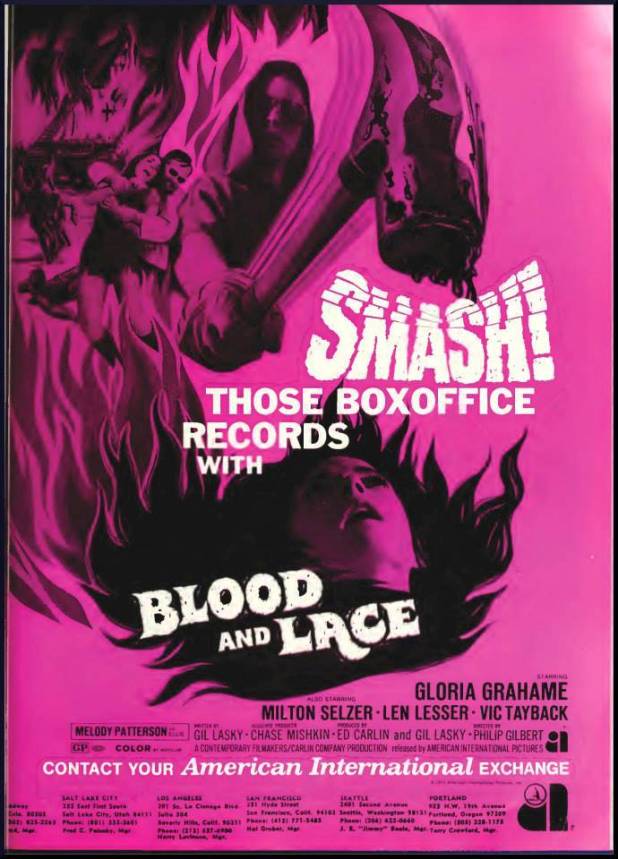
If you’re wondering, “How did a movie about a teenage girl whose prostitute mother was killed with a hammer and now lives in an orphanage where people getting their hands cut off get a PG rating,” you’re not alone. This is one of the roughest, scummiest movies I’ve watched, no matter the rating.

Ellie (Melody Patterson, F Troop) is that girl, now stuck in the orphanage of Mrs. Deere (Gloria Grahame), which she runs like a sweatshop with the help of the sweaty, swarthy Kredge (Len Lesser, Uncle Leo from Seinfeld).

Beyond that trauma, they’re also keeping dead kids in a giant freezer along with Mrs. Deere’s husband, who she refuses to believe is deceased. There’s also a dirty cop named Carruthers (Vic Tayback) who pursues Ellie in a way that it’s obvious that he has no good intentions in mind.

The only innocent seems to be Pete (Dennis Christopher), but once he falls for another girl named Bunch, Ellie has no one. Well, no one but that killer who keeps showing up staring at her while she sleeps as he clutches a hammer.

Stick around. Things get even sicker from there between those two, as if that were possible.

You can watch this on Amazon Prime.

Let’s Scare Jessica to Death (1971)

John Hancock had Jaws 2 taken from him, but did the same with Wolfen. What really amazes me is that the same director who did Prancer also made this movie.

Inspired by The Haunting, Hancock turned a basic monster movie script into a psychological exploration of whether or not the main character is really being stalked by a vampire. That original script was titled It Drinks Hippie Blood.

Jessica has just been placed in the care of her husband after some time in a psychiatric ward. He’s given up his job with the New York Philharmonic to care for her, moving upstate to an old farmhouse. When they arrive, a girl named Emily is already there. She offers to leave. Jessica invites her to stay. Suffice to say, things get worse from here.

let_s_scare_jessica_to_death_by_rob3rtarmstrong_dayma3d-fullview

This movie is less about the narrative story than it is about Jessica slowly losing her mind. That said, she might not be. The movie doesn’t really tip its hand in either direction, instead slowly growing darker and stranger like some proto-Lynch film with a wild synthesizer soundtrack.

I’m not certain today’s audience would like this film. I could really care less what they think, however.

You can get the blu ray from Shout! Factory.

The art for this article comes from robrtarmstrong on Deviant Art.

Here’s a drink for the movie.

It Drinks Hippie Blood

A day before

  • Watermelon
  • Vodka
  • Simple syrup
  1. Cut watermelon into cubes.
  2. Place in a bowl, then cover with a mix of 75% vodka and 25% simple syrup. Cover overnight in the freezer.

The drink

  • 2 oz. vodka
  • 2 oz. Watermelon Pucker
  • Watermelon cubes
  • 3 oz. WTRMLN WTR (or the juice from the watermelon you sliced)
  • .25 oz. lime juice
  • 1 oz. club soda
  1. Fill a glass halfway up with frozen watermelon cubes. Top with vodka, Watermelon Pucker, lime juice and WTRMLN WTR (or juice).
  2. Top with club soda and freak out.

Earth II (1971) and Plymouth (1991)

From the Editor’s Desk: Both of these “hard science” TV movies were produced, in part, by ABC-TV as weekly series pilots — which the network, passed. Regardless of the twenty-years difference between the films, fans have confused the two films — as result of mistaking Gary Lockwood starred “in a TV movie about miners on the moon.”

So, lets review Earth II . . . and examine the elusive, out-of-print and distribution Plymouth.


You wanna see a movie directed by Uncle Rico’s dad, you know from Napoleon Dynamite . . . well, since we just finished off “James Bond Month,” Lazlo Hollyfeld from Real Genius?

Then this is your movie.

Earth II is directed by Jon Gries’s pop, Tom, whose bat-shite crazy TV series resume lead him to directing Jim Brown and Burt Reynolds in 100 Rifles, Charlton Heston in Will Penny, Charles Bronson in Breakout and Breakheart Pass, along with with the ultimate Charles Manson document, 1976 Helter Skelter. Tom Gries died on January 3, 1977, shortly after — and amazingly, somehow, making Muhammad Ali not look completely incompetent — completing 1977’s The Greatest (but it’s still pretty bad, even with Ernest Borgnine of Marty in it).

But let’s get back to Earth II.

As we all know, 2001: A Space Odyssey was a game changer and everyone wanted back in the sci-fi game. So here we have Gary Lockwood — Frank Poole from Kubrick’s classic — as well as Mariette Hartley from Gene Roddenberry’s endless cycle of post-Star Trek endeavors, mainly Genesis II. Yep, that’ s Anthony Franciosa (Tenebre), Lew Ayres (Battle for the Planet of the Apes), and Hari Rhodes (Malcolm MacDonald from Conquest of the Planet of the Apes) along for the interstellar intrique.

As with most all U.S. TV movies, Earth II was an overseas theatrical feature, known as Killer Satellites, and it pushed its 2001, Apes, and Star Trek connections (Mariette Hartley was in one of that series’ popular episodes as Spock’s love interest) in its marketing materials. And it worked. But the foreign box office was better than the U.S. TV ratings; as result, Earth II wasn’t picked up for a weekly series as intended. But Gary Lockwood didn’t mind; he’s on record as saying he hated working on the production, eschewing it overly complex, sociopolitcal plotting.

Since this is very easily obtained as a still-in-print DVD and VOD stream, the reviews on this (rife with plot spoilers) are many. The basic gist of the story, if you haven’t guessed, is about a “second Earth,” that is, an orbital international space station. When things go amiss in Communist Red China and a nuclear missile comes to threaten the station’s 2000-strong pacifist inhabitants, they search for a way to solve the problem — without violence.

So, is Lockwood right?

Yeah. This is a bit slow to the point of boring. And it is complex, way too much for the young minds sci-fi-on-TV was geared for. And that complexity also resulted in the cancellation of the Planet of the Apes TV series and for Roddenberry’s Genesis II (and its reboots as Planet Earth and Strange New World) not going to series. Natch for Rodenberry’s The Questor Tapes.

But in terms of science accuracy, Earth II is stunning and the special effects are effective — just remember: in 1970 years. One can’t help but wonder if the creators behind TV’s Babylon 5 and the later SyFy Channel Battlestar Galactica reboot pinched from this classic TV movie (and we all know the debates regarding Babylon 5 vs. Star Trek: Deep Space 9). If you enjoy your sci-fi with intelligence, without the Lucasian Flash Gordon trimmings, then this “Before Star Wars” romp is for you.

This one is widely available on DVD and all the usual VOD platforms, but we found a free version — a really clean rip — over on You Tube.

Earth II was one of the many films we didn’t get around to reviewing during our month-long Star Wars ripoffs and galactic droppings month. You can catch up on those films with our Before and After Star Wars explorations. And since there’s a little bit o’ post-apoc in Earth II, be sure to check out our two-part post-apoc blowout with our Atomic Dustbins, Part 1 and Part 2. And since were on the subject of both Star Wars and 2001: A Space Odyssey, be sure to check out our “Exploring (Before “Star Wars”): The Russian Antecedents of 2001: A Space Odyssey” featurette.

Plymouth (1991)

“Remember that TV movie about miners on the moon?”

Did you hear the one about the 8 million dollar TV movie — the most expensive ever made, in part by ABC-TV — that no one watched? Well, they watched, but forgot all about it, soon after. Then they wracked their brains years later trying to remember the film, scouring the Internet to find it?

Well, it wasn’t a tween-teen fever dream. The film is real. And it was made a lot later than you remember, because you’re remembering Earth II (1971), itself another, well-made TV movie pilot (and overseas theatrical) produced by MGM-Warner Bros. for ABC-TV. So, yes, in 1990, you really did read an article about Plymouth’s production in Starlog Magazine — complete with that memory-haunting, (now, easily Googled) black and white production still of miners decked out in Alien (1979)-styled miner-space suits exiting a pressure hatch (also, the lead, here isn’t Gary Lockwood, but the always likable Dale Midkiff).

Plymouth — which debuted on Sunday, May 26, 1991 — was a co-production between ABC-TV, Walt Disney Studios (their Touchstone PIctures arm), and Italy’s Rai uno radiotelevisione. As result of Rai’s involvement, Plymouth played as a theatrical feature (?) in the Eurasian marketplace. It eventually turned up on European television (in the U.K. in July 2001), and as a Spanish-language Argentinian VHS. After its stateside debut on ABC-TV, Plymouth replayed once more as part of ABC-TV’s “The Wonderful World of Disney” that aired on Sunday nights (which ended production in 1997).

Then, Plymouth vanished from stateside television. It’s never been syndicated for UHF-TV nor for the retro-channels, such as the sci-fi-centric Comet. While DVDs are in the market, they’re grey market DVDr, since Plymouth has never officially been issued to VHS or DVD in the United States.

During a 1998 interview regarding the 30th anniversary of 2001: A Space Odyssey (1968), actor Gary Lockwood, who starred in Earth II, said he hated working on the ABC-TV project due to “its complexities.” And that’s the problem with Plymouth: too complex (expensive) for its own good. Lockwood, of course, was referring to Earth II’s plotting — and Plymouth has its plot complexities. So, yeah, this isn’t Gerry Anderson’s Space: 1999 or its predecessor, U.F.O: so no goofy aliens, here. But Plymouth is dangerously close to Battlestar Galactica territory via its plot and character departments.

Sure, Plymouth, like Earth II, is a “hard science fiction” piece that deals with the physical and psychological challenges facing the first moon base colony populated by the citizens of a Northwestern U.S. mining-timber town displaced by a corporation’s Chernobyl-Love Canal-styled disaster. UNIDAC, the company responsible, also operates a financially-failing helium-3 mining operation on the moon. A deal is stuck: the citizens of Plymouth, Oregon, will move to the moon and run the operation.

Plymouth completed production in 1990, remained shelved for year, and then was passed over as a series replacement. ABC-TV declined to purchase the series because, “It just didn’t meet our needs.” (And they probably knew another BSG flop when they saw one.)

While the production values are stellar (Lockheed served as tech advisors), and the writing (from director Lee David Zlotoff of TV’s MacGyver fame) and acting are on equal: this is all too “Battlestar Galactica on the moon,” with little action and too much human yakity-yak drama: e.g., a UNIDAC worker and Plymouth citizen (the town’s female doctor) engage in forbidden love that leads to an outlawed pregnancy, teen-bickering love, a souped-up moon buggy prototype (no, not Brad Pitt’s Ad Astra!), and the mischievous son of the town’s now pregnant doctor as the series’ resident “Boxey,” skirting (weekly, if this went to series) security protocols, as he finds himself (and a young Joseph Gordon-Levitt) trapped in a construction-mining tunnel. Oh, and a solar flair hits the moon, which increases cancer risks. You see where this is going: no space battles, no aliens. But, eventually: juvenile delinquent moon buggy racing.

If Plymouth did go to series — as did NBC-TV’s 1993 to 1996 Voyage to the Bottom of the Sea reimaging, seaQuest DSV (by producer Steven Speilberg and writer Rockne S. O’Bannon) — it would have, in order to survive in the ratings, ditch its “hard science” trappings for aliens, etc. (and SQV brought on a talking dolphin!), which caused Roy Scheider quitting that show. Yeah, Plymouth probably would have gone “Daggit,” too, for the kids, and brought on the eventual human androids kerfuffles.

You can learn more about the production of Plymouth at the “Say, Hello Spaceman” blog in a discussion about the impressive space suits’ creation, as well as the suits’ repurposing in Unearthed (1991), The Outer Limits: The Voyage Home (1995), and Star Command (1996). The “Beamjocky” blog on Live Journals also delves into the suits and the “hard science” of helium-3.


There are more TV movies to be had with our “Week of Made for TV Movies,” “Lost TV Week,” “Son of Made for TV Movie Week” and “Grandson of Made for TV Movie Week” tribute spotlights to those films that, in many cases, are even better than the movies that played in theatres.

About the Author: You can read the music and film reviews of R.D Francis on Medium and learn more about his work on Facebook. He also writes for B&S About Movies.

Sweet, Sweet Rachel (1971)

Originally airing on October 2, 1971 on ABC, this movie is a hidden pilot for the series The Sixth Sense. The role of Dr. Lucas Darrow would be replaced by the younger, handsomer Gary Collins and then, in syndication, that series would be spliced into Night Gallery, infuriating a young Sam who only wanted to see Rod Serling stories.

Here, Darrow is played by Alex Dreier, who is in The Boston Strangler and was well-known for his voice. He’s backed up by a blind man whose ESP voice connected him to the other world, as he’s left his surgical life behind to investigate the unknown.

Rachel Stanton (Stefanie Powers) comes home just in time to watch her husband crash through a window like Oliver Reed in Burnt Offerings. He soon recieves a phone call that has a woman’s voice that matches the ESP cards on the table in front of him. What an awesome open!

On a slight TV budget and with the morals of the time, this is as close as a made for TV movie is going to feel to a giallo. That’s a good thing. This has so many red herrings and people who could have killed Stanton’s husband. It could be Rachel. It could be cousin Nora (Brenda Scott, Simon King of the Witches), who claims that he loved her and wanted out of the marriage. Is it psychic Aunt Lillian (Louise Latham, Marnie). Or is it Uncle Arthur (Pay Hingle, who would one day be Commissioner Gordon)?

71 minutes worth of seventies occult psychobabble. You should be so lucky to watch this. Actually, you can do that on YouTube:

Los Campeones Justicieros (1971)

Blue Demon! Mil Mascaras! El Medico Asesino! La Sombra Vengadora! Tinieblas! Sure, Santo isn’t around, but the rest of these guys are! And they’re here to battle the evil Dr. Marius Zarkoff, who is better known as Mano Negra, the Black Hand! He’s played by David Silva, who also shows up in El Topo and Alucarda, somehow uniting every part of the Ven Diagram that makes up this site.

Also: the evil doctor has an army of little people and he isn’t afraid to use them.

This movie is like a Stefon sketch. It has it all: miniature assassins in a station wagon, double agent girlfriends, masked wrestlers fighting evil SCUBA divers, kidnapped girls stuffed into wooden crates, pills that make you invisible, little people bursting into flames, beauty contest winners and goddaughters being taken by the evil Black Hand and finally, a machine that makes tiny folks into super strong.

Even without Santo, this movie loses nothing. It is everything that every other movie should aspire to be. If only Julia Roberts would throw on a mask and battle cute lil’ ninjas from a speedboat!

NOTE: I love that I already reviewed this under its U.S. title. So nice I reviewed it twice!

Diamonds Are Forever (1971)

After one movie, George Lazenby was out. He was offered seven movies and left after On Her Majesty’s Secret Service on the advice of his agent. John Gavin, Adam Westm Burt Reynolds, Michael Gambon were all up for the role until United Artists made a demand: get Sean Connery back. Money be damned.

Connery came back for 1.25 million pounds, which is about $22 million dollars in today’s money and two back-to-back movies of his choice. To his credit, Connery used the money to establish the Scottish International Education Trust, where Scottish artists could apply for funding without having to leave their homeland. Connery’s made The Offence, directed by Sidney Lumet and was to make an all-Scottish version of Macbeth, which was abandoned because Roman Polanski’s version of the story was in production.

John Gavin came off the best, as he had a pay or play deal to be Bond, so he got his full salary.

The film starts with Bond chasing the man who killed his wife, SPECTRE boss Blofeld, catching him in a facility packed with clones of the villain. Bond kills a clone and then, supposedly, the real Blofeld (this time played by Charles Gray instead of Telly Savalas).

Bond is up against SPECTRE agents Mr. Wint and Mr. Kidd (Bruce Glover and Putter Smith) who are killing diamond smugglers. Glover and Smith had Connery convinced that the two were actually openly homosexual, but years later, while flying first class and flirting with a female flight attendant, Glover heard a Scottish voice say, “You son of a bitch.” Sitting behind him was Connery.

Our hero is accompanied by Tiffany Case, a diamond smuggler who is played by the first American Bond girl, Jill St. John. Felix Leiter is also on hand, this time played by Norman Burton (Simon King of the Witches, Mausoleum).

Ironically — as Jill St. John later married Robert Wagner — another Bond girl, Plenty O’Toole, is played by Wagner’s other wife Natalie Wood’s sister Lana. Wait — it gets nuttier.

The two have been involved in a decades-long feud that started during the filming of this movie as both were dating Sean Connery at the same time. And yes, Wagner started dating St. John three months after the mysterious drowning of Lana’s sister. At a photoshoot of former Bond girls for Vanity Fair magazine, an altercation occurred between them got so bad that Wood started crying. To top that off, Wood crashed an event honoring St. John in 2016 and with cameras in tow, began angrily demanding to know if Wagner killed her sister.

They have one thing in common: bad relationships. St. John was divorced three times by the age of 28 and Wood had two annulments and four divorces by 34.

Sausage pitchman Jimmy Dean is also in this as the Howard Hughes-like Willard Whyte. Dean was hesitant to play this part, as he had been an employee of the inventor at the Desert Inn.

Marc Lawrence, who directed Pigs, is in this as an attendant at the Morton Slumber Funeral Home, ably assisted by Sid Haig.

At the end, it looks like Bond is triumphant and Blofeld is dead again. Thanks to the McClory lawsuit, this is also the last movie with SPECTRE in it.

There’s one part of this that was always interesting to me. The moon landing set was a reference to the fake moon landing just two years after it happened, predating the mainstream belief in this conspiracy theory.

Gamera vs. Zigra (1971)

Shortly after Gamera vs. Zigra was completed, the film’s production studio, Daiei Film, went bankrupt. As a result, the film was distributed by another company called Dainichi Eihai. It only cost around $97,000, which is pretty amazing (Around $621,000 in today’s money).

This time, Earth is under attack by aliens. Well, we’re under attack by aliens again.

The Zigrans have enslaved a female astronaut to do their bidding and have a monster named Zigra which can stop the cellular activity of Gamera, who sinks to the bottom of the ocean. Luckily, the children, some dolphins and a bathysphere come to the rescue.

This movie has one of my all-time favorite Gamera moments, as the giant turtle uses a giant rock to play his theme song on the fins of Zigra before setting the beast on fire, because as we have all learned, Gamera does not play.

This would be the last Gamera movie for nine years, which is a shame. I knew none of  this as a child, as I began watching these movies probably in 1977 and had no idea of their history. I wouldn’t have seen this one anyway, as it’s the only original Gamera film to not be released in the U.S. It wouldn’t come over here until the VHS era.

Night of Dark Shadows (1971)

After the success of 1970’s  House of Dark Shadows, MGM wanted a sequel. The show was off the air and Curtis thought that this would be the perfect time to bring back Barnabas Collins, but Johnathan Frid was fearful of being typecast.

To his credit, Curtis didn’t recast the role and worked on an all-new story, originally called Curse of Dark Shadows. They even hired spiritualist Hans Holzer — yes, the guy who wrote one of the Amityville books — to be on set and loosely followed the parallel world sequence of the show, focusing on the popular Quentin Collins.

With just 24 hours notice, MGM forced Curtis to cut over 35 minutes from the movie, which makes it pretty incoherent. The film that was to be was much darker and more intense.

While this movie did fine, it didn’t have the magic or box office of the last one. Which is a real shame, because I love it.

Quentin Collins (David Selby, also of the Dark Shadows TV show) has arrived at Collinwood with his wife Tracy (Kate Jackson) and is mesmerized by the portrait of Angelique (Lara Parker, also reprising her role from the show).

John Karlen and Nancy Barrett show up as Alex and Claire Jenkins, two horror novelists who have moved into one of the guest houses. They’re about to learn just how crazy Collinwood can get, what with the housekeeper Carlotta (Grayson Hall, who played several Dark Shadows characters, but foremost amongst them Dr. Julia Hoffman) revealing that nearly everyone here is reincarnated from the past of the house, with herself as Sarah Castle and Quentin as Charles Collins, who once was the love of, yes, Angelique, who was hung as a witch. Seeing as how Charles was having an affair with her — the wife of his brother, no less — he was buried alive next to her corpse.

Hijinks, as they say, ensue. Hijinks like murder, possession, women hung in the trees and a girl holding a doll.

You also get Dark Shadows regulars Jim Storm as Gerard Stiles, Diana Millay (whose role as the phoenix-like Laura Collins was the first supernatural character on the show), Christopher Pennock as Gabriel Collins, Thayer David (who again, played many characters on the show) and Clarice Blackburn, who missed the last Dark Shadows film.

I spent years hunting this down on DVD and it was worth the effort. Perhaps the best viewing I’ve enjoyed of this film was in a rainy and foggy drive-in, late into the night. Does life get any better than that?

Play Misty for Me (1971)

During B&S About Movies’ “Radio Week,” you’ll notice we’ve reviewed a few Lifetime broadcast “radio psycho” films and mention this modest directorial debut by Clint Eastwood in passing. This tale about a womanizing DJ hooking up with the wrong fan is where the “genre” began. Oh, yes: Jessica Walters goes-for-broke in her portrayal of the troubled Evelyn Draper.

The script was conceived by Jo Heims, whose career dates back to working behind the scenes as a production secretary on 1958’s Missile to the Moon*; her earliest screenwriting credits included 1960’s The Girl in Lover’s Lane, 1961’s The Devil’s Hand and Elvis Presley’s Double Trouble. Coming to know Eastwood through their mutual employer, Universal Studios, Heims co-wrote Eastwood’s influential breakout role: 1971’s Dirty Harry. She also wrote Clint’s follow up to Play Misty for Me, the little-seen romantic drama, Breezy (1973) (he also directed High Plains Drifter that same year). Heims other works you’ve seen are the great John Llewellyn Moxey’s Nightmare in Badham County and the utterly bonkers Death Game (1977; received a Grindhouse Releasing Blu-ray bow in 2022).

The convincing “production values” on the radio station are courtesy of Play Misty for Me not being shot on a set, but as result of being shot inside an actual radio station: Carmel, California’s KRML 1410 AM. Also adding to the realism of the station’s jazz format was the shooting of additional scenes at the September 1970 Monterey Jazz Festival featuring appearances by Cannonbally Adderley and Johnny Otis.

A “live” DJ, carts, turntables, reel-to-reel decks, and rotary pot audio boards? That’s audio heaven.

While the studio initially wanted to go with the title “The Slasher” and market Eastwood’s directorial debut as a horror film, he got the title changed when he obtained the rights to Erroll Garner’s 1954 song “Misty” after he saw the jazz icon perform at the 1970 Concord Music Festival. He then acquired the rights for Roberta Flack’s “The First Time Ever I Saw Your Face” for $2,000; a popular British folk standard originally released in 1957 (You Tube), the song was written by British political singer/songwriter Ewan MacColl and sung by his American folkie wife Peggy Seger. Another song purchased for use in the film was Duke Ellington’s “Just Squeeze Me (But Please Don’t Tease Me).”

Yeah, Dirty Harry Callahan knows his jazz. Punk.


Now for the backstory and the runaway success on Flack’s other hit, “Killing Me Softly with His Song,” originally recorded by Lori Lieberman. (No: it’s not in the movie. We know.)

An early seventies confessional folk-pop singer in the mode of hit makers Joni Mitchell, Judy Collins, and Janis Ian, Lori Lieberman signed a production, recording and publishing deal with the songwriting partnership of Charles Fox and Norman Gimbel who, in turn, signed their own production deal with Capitol Records.

As with most of the forgotten musical acts of late sixties and early seventies during the burgeoning American FM radio era, the Internet exhumed Lieberman’s career frustrations in the wake of her 1971 debut single, “Killing Me Softly with His Song,” when it became a 1997 Grammy Award-winning single for the American Hip-Hop group, the Fugees—remade under the truncated title of “Killing Me Softly,” from the Fugees’ 1996 album, The Score.

From the time the song became one of the biggest-selling number one singles of 1973, as remade by R&B artist Roberta Flack, credits and royalties for the song became a point of contention for Lieberman, as she long claimed she contributed to the song’s lyrics. While the writing team of Fox and Gimbel scored another 1973 Top Ten hit with Jim Croce’s “I Got a Name,” and composed the television theme songs for the ABC-TV Network’s Happy Days and Laverne & Shirley, Lieberman floundered with three more albums for Capitol in the United States. Those albums, however, found a receptive audience in Europe (a country rife with voracious music connoisseurs), which resulted in a top-selling, Euro-only release of a 1976 greatest hits package, The Best of Lori Lieberman.

Lieberman recently released her 17th and 18th albums, Ready for the Storm and The Girl and The Cat, produced by Bob Clearmountain, known for his work with Bruce Springsteen, the Rolling Stones, and Bon Jovi.


Back to Play Misty for Me.

The most awesome aspect of this film is that Universal didn’t have much faith in turning over a film to Eastwood. So he waved his usual acting fee and was paid only as a director. To say Eastwood “showed them” is an understatement. He wrapped the film five days ahead of schedule and made it $50,000 short of its $950,000 budget. Play Misty for Me went on to gross $11 million in its initial release and, when it became a VHS rental in the ‘80s, earned another $6 million.

The influences of Clint Eastwood’s directing debut can’t be denied, as a female DJ-cum-radio psychologist taunted by a killer became familiar damsel-in-distress fodder for the Lifetime cable network, which aired the similarly-plotted The Night Caller (1998), Requiem for Murder (1999; Molly Ringwald), A Lover’s Revenge (2005; Alexandra Paul), and Radio Silence (2021). To a lesser extent, one can place the radio murder-mysteries Night Rhythms (1992), Night Owl (1993), director Fred Walton’s superb noir-slanted Dead Air (2009), and the direct-to-video renter, Shattered Illusions (1998), on the “radio psychos” list.

You can stream Play Misty for Me on Amazon Prime and Vudu.

* You can catch up with more pre-Star Wars sci-fi films, such as Missile to the Moon, with our Exploring: Before Star Wars feature.


Update November 2020 : Kino Lorber has just re-released Play Misty for Me as a Special edition Blu-ray in a new 2K transfer. The disc includes commentary by film historian Tim Lucas and a video essay with film historian Howard S. Berger. While Donna Mills appears in an all-new interview, Siegel and Eastwood appear in an “about” featurette. Writer-director Adam Rifkin (The Dark Backward, Detroit Rock City) offers his insights via his “Trailers from Hell” segment (You Tube). And . . . if you’re a Clint Eastwood completist: Kino Lorber has also re-issued Clint’s films The Beguiled and The Eiger Sanction to Blu. You can learn more about Kino Lorber’s complete roster of films at their official website and Facebook, and watch the related film trailers on You Tube.

As result of the Kino Lorber reissue, Sam takes another, new look at the film, here.

Now, the question is: When will Kino Lorber re-release the fellow radio flick A Matter of Degrees to DVD and Blu?

A whole week of radio flicks!

About the Author: You can read the music and film reviews of R.D Francis on Medium and learn more about his work on Facebook.

Legacy of Blood (1971)

Will to DieBlood LegacyLegacy of Blood?

Whatever you call it, this 1971 film has a plot as old as movies themselves — a patriarch gathers his family to hear his will. Carl Monson, who wrote The Acid Eaters and also directed Please Don’t Eat My Mother was behind this.

This is the last movie for Rodolfo Acosta, who either played Mexicans or Native Americans in Westerns usually. John Carradine is also in this — of course, this movie was made for him — and Richard Davalos (Blind Dick from Cool Hand Luke and the cover image for The Smiths albums “Strangeways, Here We Come” and two of their greatest hits collections), Faith Domergue (Perversion Story), former pro wrestler Buck Kartalian, Jeff Morrow (The Creature Walks Among Us) and John Russell, who replaced James Doogan on the second season of Jason of Star Command.

Yes, the outside of the house is also the same mansion that was used for Wayne Manor. You haven’t gone completely bats yet.

You can watch this on Tubi with riffs from either Elvira or Cinematic Titanic.