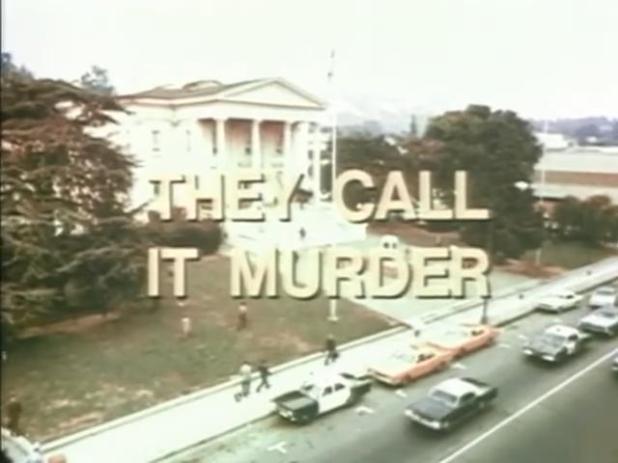
MILL CREEK THE SWINGIN’ SEVENTIES: They Call It Murder (1971)

Based on characters created by Erle Stanley Gardner, this was directed by Walter Grauman and written by Sam Roffe, who created Have Gun, Will Travel. The producers — Paisano Productions — had tried to launch a Doug Selby series for six years, while its series Perry Mason was popular. This is the only effort that came of all that hard work.

In the small town of Madison City, Doug Shelby (Jim Hutton) and Sheriff Brandon (Robert J. Wilke) have recently won the election pledging to keep the filth of neighboring Los Angeles out of their city. There’s also Chief Larkin (Ed Asner), who loves L.A. and a murder. That’s right — a body has been found in the pool at Jane Antrim’s (Jessica Walter) home. She that place with her disabled father-in-law Frank (Leslie Neilsen), a man who was put in a wheelchair by an accident. that also killed Jane’s husband Brian, who was also Frank’s son. For some reason, the insurance won’t pay up. And now that body isn’t drowned but has been shot twice, with two different bullets, in one entrance wound.

This is very Perry Mason, which makes sense, as Erle Stanley Gardner also created that character. Where his TV show was memorable, this movie, unfortunately, isn’t.

Don’t have the box set? You can watch this on YouTube.

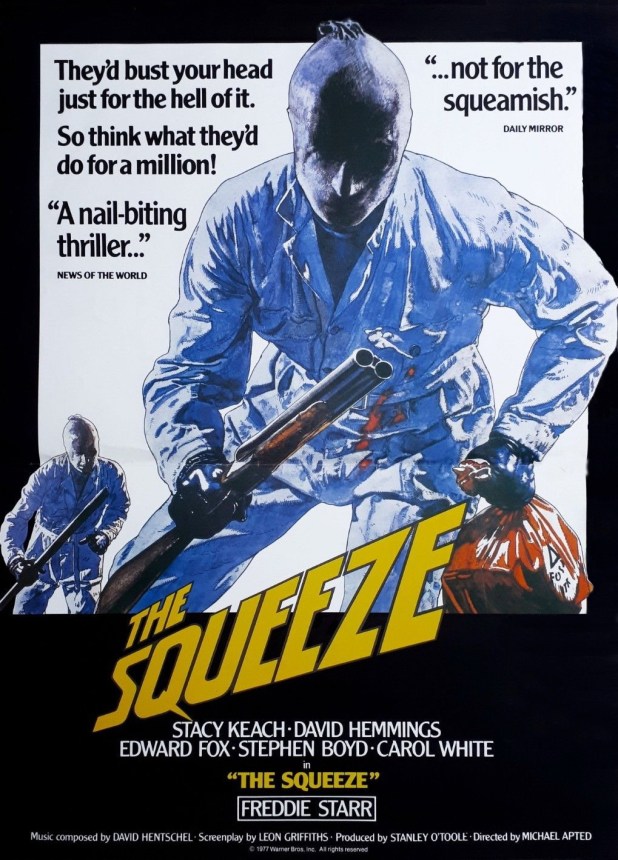
MILL CREEK THE SWINGIN’ SEVENTIES: The Squeeze (1977)

Michael Apted directed Coal Miner’s DaughterGorillas In the Mist and The World Is Not Enough but before all that, he made this movie that he called an “informed look at the British underworld.” That may be because he enlisted ex-gangster Bob Ramsey to act as a contact between the film unit and the local underworld. This kept harassment down and let them shoot in high crime areas.

Jim Naboth (Stacy Keach) has lost his job and his wife Jill (Carol White) and children thanks to his drinking problem. Now a private detective, he’s still drinking and she’s moved on to a new husband, Foreman (Edward Fox) and taking care of his daughter Christine (Alison Portes).

A gang of kidnappers —  Keith (David Hemmings), Vic (Stephen Boyd), Barry (Roy Marsden), Des (Barry Stewart Harwood) and Taff (Alan Ford) — take Jill and Christine to force Foreman to help them with a crime. He’s an important businessman, so he hires Jim to get his wife and child back.

The story itself is simple but the real issues are whether Foreman was part of the crime, the past relationship between Jim and Christine, and how Jim and Keith knew each other when Jim was a cop. There’s a lot of humiliation of Jim — and Christine — which also seems like Foreman’s doing. This may be too British for American audiences — Warner Bros. said it was “too indigenous” — but I found it interesting.

Don’t have the box set? You can watch this on YouTube.

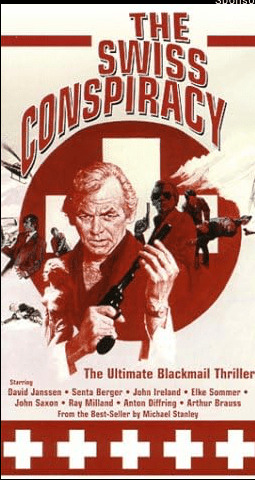
MILL CREEK THE SWINGIN’ SEVENTIES: The Swiss Conspiracy (1976)

You probably know Jack Arnold better from directing movies like It Came from Outer SpaceCreature from the Black Lagoon, Tarantula and The Incredible Shrinking Man than spy thrillers. In this movie, a Swiss bank has its infamous secret bank accounts get compromised. They get David Christopher (David Janssen), a former U.S. Treasury official who now resides in Geneva to help.

He meets with the four people being blackmailed — one has already been killed — who include Denise Abbott (Senta Berger), Dwight McGowan (John Ireland), Robert Hayes (John Saxon) and Andre Kosta (Arthur Brauss). Who could be blackmailing them? Well, it could be any of the following people: bank vice-president, Franz Benninger (Anton Diffring), his mistress Rita Jensen (Elke Sommer) or two criminals, Korsak (Curt Lowens) and Sando (David Hess). Whoever the blackmailer is, they demand uncut diamonds as their payoff. Christopher has to head into the Andes, all alone, prepared to face off with whoever the blackmailer or blackmailers may be.

Hey it’s 89 minutes long and moves quick. It’s not the worst movie you’ve seen.

Don’t have the box set? You can watch this on YouTube.

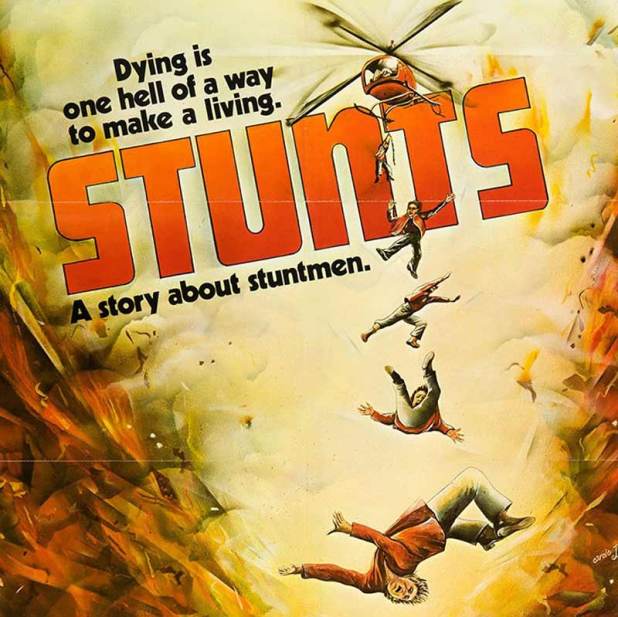
MILL CREEK THE SWINGIN’ SEVENTIES: Stunts (1977)

This was Bob Shaye’s — and New Line Cinema’s — first full-length production after a decade as a pure distribution company. Director Mark Lester would tell The Pink Smoke, “They were distributing Truck Stop Women to college campuses and they already had a script, so I was hired to direct it. We hired Robert Forster because he had done Medium Cool. Don Stroud was supposed to star in it but he got into a motorcycle accident the night before shooting.”

The film starts with the death of one of Greg Wilson, one of its stuntmen, who was set up. His brother Glen (Forster) arrives on the set, along with B.J. Parswell (Fiona Lewis!), a reporter who wants to write about the danger of the stunt game. The minute Glen gets there he gets hit on by the producer’s wife (Candice Rialson, in one of her last roles; she’s also great in pretty much everything she ever did, like ChatterboxHollywood Boulevard and Moonshine County Express).

Glen joins the stunt team of the film, who all promise one another that if anyone gets hurt, they’ll always pull the plug for one another, predating Dr. Kevorkian by several years. Screw the law. We’re stuntmen!

One of the people who have to get the plug pulled on them is Chuck, played by Bruce Glover, always a welcome sight. He’s married to Joanna Cassidy, who is — again, you’re going to get this a lot with this cast — astounding in everything I’ve ever seen her in. In this one, more than aardvarking with Crispin’s dad in a waterbed in the back of a custom van, she’s punching the faces of an entire bar of rednecks.

The death keeps coming, as Paul (Ray Sharkey? This is like a B&S About Movies dream cast and it gets even better) gets trapped in a burning building. That means that our hero has to finish the film, figure out who the killer is and get some revenge.

Former pro wrestler Hard Boiled Haggerty shows up, as does Richard Lynch. And you know how I feel about Mr. Lynch and the fact that he can make any movie better just by walking on set. Suffice to say he does way more than saunter on here.

This is why we’re doing an entire week of Mark Lester’s films. He knows how to get a story told, gather the right people to help tell it and get out of the way. He’s never let me down yet.

Don’t have the box set? You can watch this on Tubi.

Spagvemberfest 2023: Four Bullets for Joe (1964)

Directed by Agustín Navarro and written by Fernando Galiana, Mario Guerra, Julio Porter and Vittorio Vighi, this Italian/Spanish Western comes from just before the genre took off in those countries.

Frank Dalton (Paul Piaget) is out to get vengeance for his dead sister, a woman wrongfully accused of killing her husband. It’s a relatively American Western by way of a murder mystery and is very unlike the Eurowesterns that would come after. There’s also a sheriff (Fernando Casanova) trying to solve who the murderer is and trying to keep Frank out of harm’s way.

Notable cast members include Barbara Nelli (Lady Morgan’s VengeanceBloody Pit of Horror) and Rafael Bardem, the grandfather of Javier. I wish this were a better movie, but there are certainly others to check out. Then again, the appearance of a black-gloved killer in the middle of a Western is always something I am going to watch. There should be more giallo Westerns! I looked up a list on the Spaghetti Western Database and see the following listed that I need to watch:

Killer Caliber .32

Killer, Adios

Ringo, It’s Massacre Time

The Last Traitor

The Masked Thief

The Price of Death

Kill the Poker Player

Revenge of the Resurrected

The Crimson Night of the Hawk

You can watch this on Tubi.

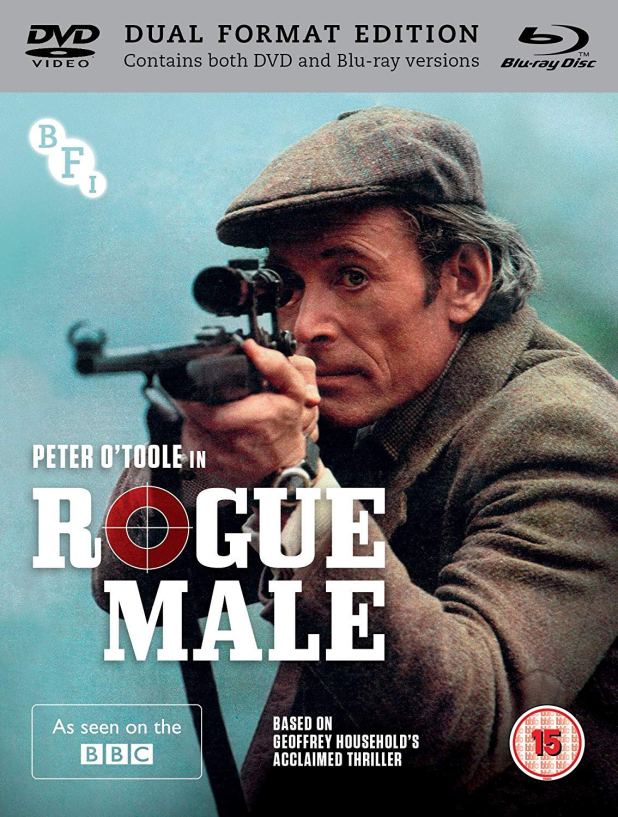
MILL CREEK THE SWINGIN’ SEVENTIES: Rogue Male (1976)

Based on Geoffrey Household’s 1939 novel Rogue Male, this BBC TV movie was directed by Clive Donner, adapted by Frederic Raphael and in addition to Peter O’Toole, it also stars Alastair Sim in his last film role.

In early 1939, before the start of World War II, Sir Robert Hunter (O’Toole) takes aim at Adolf Hitler with a hunting rifle. He hesitates to shoot, which ends with him being attacked by an SS guard. He’s tortured and claims that this was just an intellectual exercise to see if he could kill the leader. He’s a well-known British citizen, so to cover up the torture, they throw him off a cliff.

He survives and escapes to England, where a Nazi sympathizer named Major Quive-Smith (John Standing) recaptures him and demands that he writes a false confession that the British government demanded that he was given orders to kill the German leader. But he’s not giving up without a fight.

In 2007, Peter O’Toole named the film as his favorite among those that he had made. One of the reasons he was in it was because his wife Sian Phillips loved the novel.

Don’t have the box set? You can watch this on YouTube.

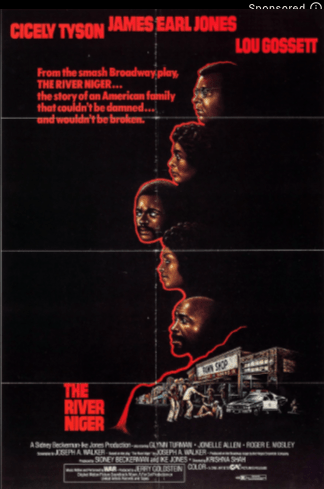
MILL CREEK THE SWINGIN’ SEVENTIES: The River Niger (1976)

Directed by Krishna Shah and written by Joseph A. Walker, this has an incredible soundtrack by the band War. It’s based on Walker’s 1972 play.

Johnny Williams (James Earl Jones) is a house painter and poet who has raised his family in Watts. His son Jeff (Glynn Turman) is home after failing out of the U.S. Air Force flight school and his wife wife Mattie (Cicely Tyson) is dying, but Johnny tries to remain positive. Yet when Jeff kills a rival gang member and a police officer gets killed, there’s a standoff with the cops that doesn’t end well for anyone.

The cast also includes Roger E. Mosley as Big Moe Hayes and Louis Gossett Jr. as Dr. Dudley Stanton.

This is shot in an all over the place style, somethimes in striking POV shots, other times in your face African masks dominating the entire shot. There seems to be so much crammed into this movie — Vietnam, alcoholism, racism, dealing with loss, Afrocentrism, the militarism of the Black Panthers — that it doesn’t have a solid focus, but these are the kinds of movies that had to be made and stories that had to be told.

Don’t have the box set? You can watch this on Tubi.

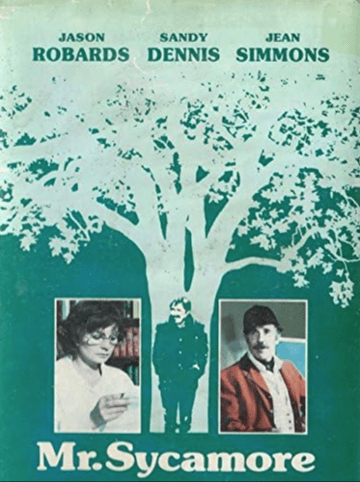
MILL CREEK THE SWINGIN’ SEVENTIES: Mr. Sycamore (1975)

From a story by Robert Ayre and a play by Ketti Frings, this is the tale of John Gwilt (Jason Robards), a postman who decides that he wants to become a tree. He plants himself in his back yard and waits for it to happen while his wife Jane (Sandy Dennis) tries everything she knows to get him to be normal. At the same time, John finds a sympathetic figure in librarian Estelle Benbow (Jean Simmons).

Directed and written by Pancho Kohner, who produced the Bronson movies AssassinationDeath Wish 4Messenger of Death10 to MidnightThe Evil That Men DoSt. Ives, The White Buffalo and  Kinjite, this is definitely a movie of its time.

Don’t have the box set? You can watch this on YouTube.

EXCLUSIVE INTERVIEW WITH JUSTIN BURNING, AUTHOR OF HAND-HELD HELL: THE OUTBREAK OF HOMEMADE HORROR

Justin Burning’s debut book, Hand-Held Hell, is a 376-page, full-color look at 44 outrageous works of underground cinematic horror created during and inspired by the technological, cultural and historical circumstances of the home-spun horror era, including in-depth interviews with 22 audacious filmmakers like Mark Polonia, Nathan Schiff, Tim Ritter, Donald Farmer, Fred Vogel, Brian Paulin and Scott Schirmer.

I had the chance to speak with Justin on the book, which you can get from Graveface Publishing and  Terror Vision.

B&S About Movies: How did you get into the world of SOV?

Justin Burning: I was aware of a lot of them (both SOV and 8mm stuff), like Splatter Farm, Video Violence, Sledgehammer and The Abomination, because some of them were on the shelves of indie video stores when I was growing up. I was fortunate to live through the entire video store boom at a pretty cognizant age (from grade school through early high school), and equally fortunate to have parents and grandparents that let me rent whatever, as often as I liked. We had a great indie video store within biking distance of my house, too, and in the age of Gen X latchkey childhoods, my parents let me go there by myself as long as I was back by dinner. Back then, I mostly just noticed the VHS covers of these flicks, rather than actually renting them, because I was a huge fan of Empire/Full Moon as a kid, so tended to rent a lot of those titles over and over instead. But in high school, I started seeking out the extreme fringes of my interests, as high schoolers often do. So, I got really into tape trading for the more transgressive films of the genre, like Nekromantik, Cannibal Holocaust, The Beyond, Faces of Death, Men Behind the Sun, Salo, etc. And through that, I stumbled across stuff like The Burning Moon, Darkness, Zombie Bloodbath, the Guinea Pig series, etc. And then I had a resurgence of interest in SOV a few years back, and really dove into that shallow pool head first.

B&S: Did the way you feel about these films change the more you explored them and met the people involved?

Justin: Yeah, somewhat. When you see these things for the first time, after being introduced to film through Hollywood and more polished productions, it’s a shock to the senses seeing what’s made when there are extremely limited creative and financial resources. Once you adjust beyond the initial, “What the fuck is this??” you start to wonder “Who the fuck made this??” and you assume it’s maybe some kind of mad genius. Occasionally it is. But usually it’s a person who really wanted to make a horror movie but didn’t know how to, or didn’t have the stuff they needed to make what was in their head. So, they improvised and they compromised. Alas, that’s not as romantic a story as someone concocting a piece of truly outsider, transgressive art that ended up exactly as weird and unique as they intended. But, one thing I’ve learned (and it’s actually a lesson I learned much earlier in life, being in an extreme metal band): Very few of them are as extreme as their movies. So many of these filmmakers are very kind and just very appreciative for the opportunity to talk about their films, and they were so helpful in providing materials for the book and participating in interviews.

B&S: Who surprised you the most when you got to speak to them?

Justin: Fred Vogel was one of them. For as harsh as the August Underground movies are, you don’t expect him to be such a warm, friendly dude. But my conversation with him was very pleasant. Also, Dean Alioto has had a pretty successful career, and he’s one of the more “Hollywood” guys in the book, but he was very accommodating and we talked for nearly three hours over Zoom. He had a lot of great stories about the making of The McPherson Tape. Meeting Nathan Schiff has been amazing. He was the filmmaker that most inspired me to write the book. I saw The Long Island Cannibal Massacre and knew it was something really special that more people really needed to know about. He’s not the most in-the-media horror filmmaker ever, and he’s not very present on social media, so I had a notion in my head he’d be hard to get in touch with and wouldn’t be interested in an interview. But he responded to my cold email, and has been very generous with his time since then. I’m hoping to write a book focused on his life and films, and we’ve been collaborating on making that a reality.

B&S: Rough question: what are the top movies you cover in the book?

I like them all for various reasons. However, I’m very partial to Nathan Schiff’s unique body of work and, as I mentioned, The Long Island Cannibal Massacre sort of inspired the whole endeavor, so that’s definitely a standout. I love Things, as well. It’s one of the most unique movies I’ve ever seen. Flesh of the Void, Video Diary of a Lost Girl and Elliot are three I had never seen prior to researching for the book, and they really made an impression on me. Headless is one of my favorite recent horror flicks. A fantastic example of how horror can be both extremely repulsive and extremely artful.

B&S: What didn’t make the cut?

Justin: It was really hard to decide on the final lineup. I knew from the start that I wasn’t going to attempt anything super comprehensive, so I roughly was going to do 50 movies, split evenly between the 80s/90s stuff and the modern day stuff. It’s hard to omit more obvious entries from a filmmaker’s oeuvre, like J.R. Bookwalter’s The Dead Next Door, Todd Sheets’ Zombie Bloodbath movies, the Polonias’ Splatter Farm, Donald Farmer’s Cannibal Hookers or Guinea Pig: Flower of Flesh and Blood. But I wanted to balance discussing historically significant films with more underground cuts that have been less talked about. Dave Skowronski’s 1989 flick Halloween Party was one I really wanted to include, but I couldn’t get in touch with Dave, and part of why I wanted to include it was to uncover the bizarre story behind its production, with the stolen music and everything, so without an interview to talk about those sorts of things, it wasn’t quite as enticing. There are some flicks I really, really love and wanted to hype up — like The Soultangler — but I had decided early on that including 16mm stuff was going to open a can of worms and really start blurring the line between amateur and professional productions. Some movies got cut so I could maintain the balance between the two eras.

B&S: Outside of SOV, what movies do you love?

Justin: Well, I’m an avid horror fan in general. My horror Mount Rushmore probably includes John Carpenter, Stuart Gordon, Lucio Fulci and David Cronenberg. I love Italian horror, and have particular soft spots for Bruno Mattei, Claudio Fragasso and Michele Soavi. I watch some sci-fi and fantasy stuff, as well. And then to balance out the dark shit, feel-good stuff like rom-coms and Christmas movies are always welcome, too.

Thanks to Justin for the interview. You can learn more about him on his site Confluence of Cult.

All purchases include a free code to download a companion EP featuring six tracks composed by the author. Grab your copy via graveface.com or terror-vision.com
MILL CREEK THE SWINGIN’ SEVENTIES: A Real American Hero (1978)

Also known as The Letter of the Law and Big Stick, this is a movie about Buford Pusser, except instead of Joe Don Baker, Bo Sevenson, The Rock or Kevin Sorbo, it has Brian Dennehy in the lead. Keep in mind this came out five years after the first movie and a year after Walking Tall: Final Chapter.

Buford Hayse Pusser was the sheriff of McNairy County, Tennessee, from 1964 to 1970, and constable of Adamsville from 1970 to 1972. During his time on the force, he survived seven stabbings and eight shootings as the result of his war on moonshining, prostitution and gambling on the Mississippi and Tennessee state line.

Already a local hero, Pusser’s war on the State Line Mob went national when his wife Pauline was killed on August 12, 1967. There was an ambush intended for him, brought on by common-law husband of a woman who tried to kill Pusser and who he shot and killed in self defense,

Pusser died on August 21, 1974, of injuries sustained in a one-car automobile accident four miles west of Adamsville on the same day that he met with Bing Crosby Productions in Memphis to talk about playing himself in the sequel to Walking Tall. It was claimed he was drunk driving but no autopsy was ever conducted.

As his legend grew — even when he was alive — singer Eddie Bond wrote and recorded several songs honoring Pusser, beginning with “Buford Pusser” in 1968 and then released Eddie Bond Sings The Legend Of Buford Pusser five years later. Pusser even recorded on Stax subsidiary Respect and even today, bands like The Mountain Goats and The Drive-By Truckers sing about him. And in 1973, when the first movie was made, he became a hero to many.

There’s a good cast here, with Forrest Tucker as Carl Pusser (he also played the same role in Final Chapter: Walking Tall), Brian Kerwin as Til Johnson, Ken Howard as Danny Boy Mitchell and Sheree North as Carrie Todd. It was directed by Lou Antonio and written by Samuel A. Peeples. If you don’t know the story from the other movies, here it is again. I like Dennehy, but I’m partial to Joe Don Baker. Then again, this led to the seven episode TV series. I can remember seeing all the commercials for these movies and I thought it was kind of sad that people kept glorifying someone who was dead, but I was a kid and what did I know.

Don’t have the box set? You can watch this on Tubi.