Sex & Drugs & Rock & Roll (2010)

As stated in our previous review of Cha Cha starring Herman Brood, Nina Hagen, and Lene Lovich, your enjoyment of this (admittedly) pretentious “art house” flick hinges on your appreciation of the music of Ian Dury (which, I’ll admit, is an acquired taste for U.S ears raised on the commercial, new wave refrains of America’s the Knack and the Cars and the U.K.’s the Police and Gary Numan), the world’s first disabled “rock star.”

If you were lucky enough to have a college radio station in your area or frequented the then trendy, big city new wave clubs of the times, then you’re probably familiar with Ian Dury’s most memorable album hits of “Sweet Gene Vincent” and “Billericay Dickie,” but you’ve surely heard his hit singles “Hit Me with Your Rhythm Stick” and “Reasons to Be Cheerful, Part 3” with the Blockheads in a TV series, film, or video game in recent years. The title of this bioflick is, of course, derived from Dury’s biggest selling and most memorable single, 1977’s “Sex & Drugs & Rock & Roll.” And while MTV ignored Dury’s catalog, the burgeoning video channel embraced the music of ex-Blockheads Chaz Jankel and turned his single “Questionnaire” into a minor U.S radio hit (watch the MTV video link, you’ll remember it).

So, in regards to the “art house” aspects of the film: Don’t go into this expecting a fluid, commercialized Tinsteltown chronicle on Dury’s life, ala Ray (Ray Charles), Walk the Line (Johnny Cash), or What’s Love Got to Do With It (Tina Turner). In lieu of a traditional, chronological narrative (that’s punctuated with animated segments and kinetic editing typical of an arty, indie film), Dury (a fantastic Andy Serkis — who you know as Gollum in the Lord of the Rings trilogy and as Ceasar in the Planet of the Apes reboot series) appears as a colorful, brash carnival barker, telling his own life story from the concert stage via a series of flashback (e.g., his wife gives birth to his child upstairs, while he’s telling his story on a club stage; of how, as a child, he contracted polio from a swimming pool and was bullied for his leg brace; of how he met Jankel backstage at Kilburn and the High Roads (Dury’s band prior to forming the Blockheads with Jankel) gig, etc.).

Dury would go on to become an actor in his own right, with roles with in several British films and television series. Here, in the U.S., you’ve most likely seen Dury in Bob Dylan’s 1987 box office bust Hearts of Fire (hopefully, we’ll get to that one for “Rock ‘n’ Roll Week”), The Cook, the Theif, His Wife & Her Lover (I dragged my date to see that one at an art house theatre because of Dury; she hated it, but of course), but you definitely saw Dury in the sci-fi flicks Split Second with Rutger Hauer (1992), Judge Dredd (1995), and The Crow: City of Angels (1996).

You can watch Sex & Drugs & Rock & Roll as a free-with-ads-stream on TubiTv; if you’d prefer an ad-free experience, it’s available on You Tube Movies. You can also get all of the music of Ian Dury you could possibly need — featuring album tracks, videos, and live performances — over on his official You Tube page. You can also catch Dury at the top of his game with his 1978 appearance on the live German television rock program Rockpalast (aka “Rock Palace,” a Euro-version of U.S TV’s The Midnight Special), also on You Tube.

About the Author: You can learn more about the writings of R.D Francis on Facebook. He also writes for B&S Movies.

Cotton Candy (1978)

“That’s part of the problem with being a kid actor. When your show’s over, nobody informs you that your career’s over, too.”
— Luke Halpin, aka Sandy Ricks on TV’s Flipper (1964 – 1968)

To become a child actor; a kid star, to paraphrase British modernist poet David Jones: it is both a blessing and a curse.

And for every Leonardo DiCaprio, who got his start as a kid actor on TV’s Growing Pains, receiving the industry’s blessing to transition into adult roles, there’s a Dustin Diamond, from TV’s Saved by the Bell, who’s destined to experience a fateful, Longfellowian rain fall.
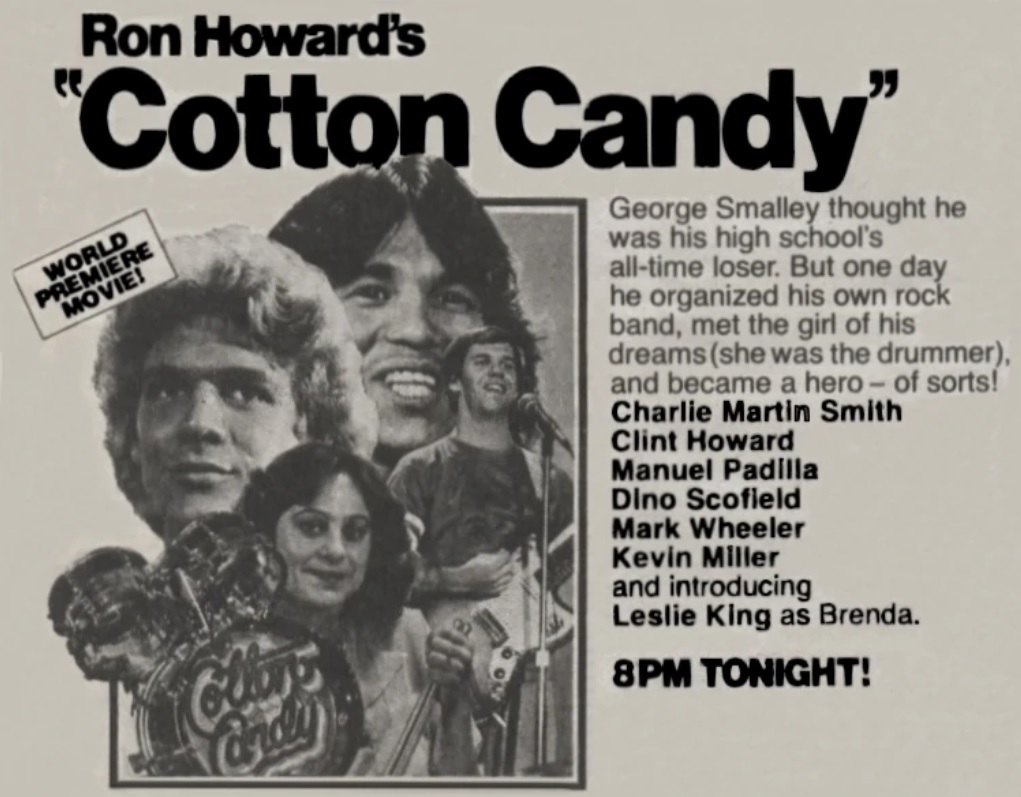
Courtesy of Made for TV Movie Fandom Wiki/You Tube trailer.

And in the case of Luke Halpin (Shock Waves), his successful ‘60s doppelganger would be Ron Howard who, as a kid actor, got his start as Opie Taylor on The Andy Griffith Show (1960 -1968). If only Luke Halpin had been noticed by George Lucas and cast in one of the most profitable films in history, American Graffiti (1973; we’re reviewed the sequel, More American Graffiti), or booked a part on ABC-TV’s Happy Days . . . damn the cackling Clotho, Lachesis, Atropos, that trio of witches weaving the looms of fate.

And the witches saw fit to weave Roger Corman into Ron Howard’s tapestry. And the B-Movie King and the strawberry-mop topped sitcom star made a deal: If Howard would star in New World’s hicksploitation romp Eat My Dust (1975), he would give Howard the opportunity pursue his dream of directing a feature film, which became Grand Theft Auto (1977; its theatrical one-sheet appears in Cotton Candy as George and Brenda go on a date to a movie theater). Both films duplicated the insane box office of American Graffiti: Eat My Dust grossed $5 million against $300,000 and Howard’s directing debut grossed $15 million against $600,000.

So with three box office bonanzas and a hit TV series on his resume, NBC-TV wanted a piece of the Howard action. So they gave Ron an opportunity to direct his second film—his first TV movie (the others were 1980’s Skyward, 1981’s Through the Magic Pyramid, and 1983’s Little Shots)—for his newly formed Major H Productions with his father Rance and brother Clint (Ice Cream Man!!!). The idea that Ron and Clint came up with was Cotton Candy: a TV movie-length pilot for a weekly series concerning the rock ‘n’ romance adventures between the rival high school bands (starring 30-year-old teenagers, as is the case with all teen comedies of the ’70s) Cotton Candy (the underdogs) and Rapid Fire (the chick magnets) making the race for stardom in Dallas, Texas. (The high school in the film was called-out-by-name Lake Highlands High School.)

Tad Painter, Morgan Ferguson, actor Mark Wheeler, Mark Ridlen (also a Dallas radio jock), and John Painter, collectively known as Rapid Fire, aka Dallas local band Quad Pi, formerly known as Lithum X-Mas/image courtesy of Clint Howard via Robert Wilonsky and The Dallas Morning News.

For his leading man, Howard cast his old buddy Charles Martin Smith (Toad from American Graffiti; he later directed the “No False Metal” classic, Trick or Treat!!!). Smith is George Smalley: a geeky high school senior who’s dogged by his mother about dating and girls and a dad (Alvy “Hank Kimble” Moore from Green Acres . . . Ack! Stop right there. This is B&S About Movies, buddy! We remember Alvy from Smokey and the Hotwire Gang, The Witchmaker . . . and The Brotherhood of Satan!!) who wants him to stop wasting his time with the guitar (oh, do I relate). So to get chicks and get dad off his back, he joins the school’s football team, but is quickly cut from the squad.

No matter. George hated football and was only doing it to please dad. What he really wants to do is music. So when one of the guitarists of the school’s hottest band (they do all of the school’s dances, mall concerts, hot parties, and get paid gigs!), Rapid Fire, leaves the group as result of a family move, George decides to ask for an audition after a show. And Torbin Bequette (an excellently dickish Mark Wheeler; portrayed Neil Armstrong for Ron in Apollo 13), the band’s popular singer and big man on campus, humiliates George in front of everyone.

So, together with his best friend (ugh, not another clueless, talentless dork with no musical or legal skills “managing” a band, riding his talented friend’s coattails: this is Ricky from American Satan all over again), Corky MacPherson (Clint Howard), they resolve to form a rock band to perform George’s original tunes and take down Rapid Fire at the big “Battle of the Bands” (Oh, the “Battles” at the local skating rink and the city park’s outdoor stage of the ’70s and ’80s!) competition at the real life, Town East Mall (Oh, those teen years of living at the mall! Orange Julius and Spencer Gifts!!) in East Dallas. Together, George and Corky recruit a set of brothers who play keyboards and guitar, a former gang member on bass guitar (Manuel Padilla, Jr., aka Jai from ‘60s TV Tarzan), and a very cute female drummer (Leslie King, she of the 1979 Drive-In T&A classics Gas Pump Girls and The Great American Girl Robbery; as a screenwriter she penned 1988’s To Die For for Deran Sarafin, yes, he of Jean-Claude Van Damme’s Death Warrant!).
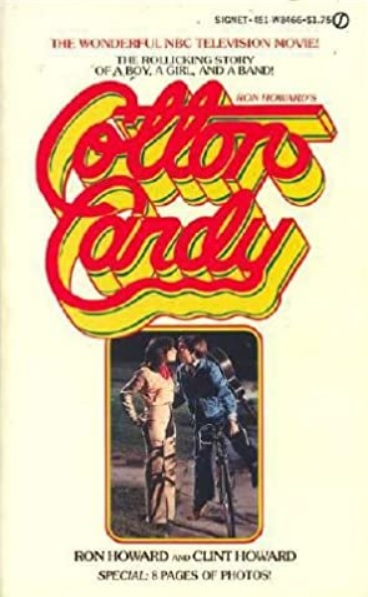
The out-of-print paperback tie-in/courtesy of Amazon (this was the best available image).

So, what about the music, you ask?

It is pure ’70s pop bubblegum. But Cotton Candy ain’t the Knack or Sweet. So instead of “Frustrated” or “Good Girls Don’t,” or “Fox on the Run” and “Love Is Like Oxygen,” we get a rocky-upbeat version of the safe n’ sweet sounds of the Carpenters (girl drummer, hatch), with the George Smalley originals “She Rolls,” “Born Rich,” and “Starship” (damn it: not uploaded to You Tube).

As for Rapid Fire’s catalog: And you thought the Sebastians (of Rocktober Blood fame) securing the right to Rod Stewart’s “Maggie May” and Ted Nugent’s “Sweet Sally” for their pirate radio romp On the Air Live with Captain Midnight (1979) was a rock ‘n’ boondoggle? How in the hell did Ron Howard get the rights to Bob Marley’s “I Shot the Sheriff” via Eric Clapton? How did he get the rights to Billy Preston’s (Hammond organist on the Beatles’ albums) “You are So Beautiful” via Joe Cocker?

Clearly, Cotton Candy, while a bunch of clueless dorks who decide playing strip poker with their female drummer is the mature thing to do, is the more talented band. Sure, Rapid Fire has the slick, silk windbreakers, smoldering good looks and feathered hair . . . and can afford snazzy, three-piece suits and fedoras, you know, to carry through that “gangster” theme to go along with that awesome “Tommy Gun” band logo.

“Rapid Fire’s got to reload . . . we’ll be back in five.”

But Torbin and the boys can’t write music; they can only can butcher jukebox-from-hell covers that ’70s sound-alike budget album distributor Pickwick International would reject for release.

Yeah, it’s all very “Pickwick International” with Rapid Fire. If you went on a Sunday “Swap Swap” excursion with the family at the local Drive-In, you know the label. I got burned by Pickwick’s version of Tommy (You Tube) thinking I was buying the Who’s rock opera. Well, that’s Torbin Bequette and Rapid Fire: all the girls, none of the talent, and it ain’t Clapton or Cocker.

Yeah, this is taking me back to those bag-o-dicks from Mad Sire in their silk band jackets and platform shoes and flared jeans churnin’ out their covers of Rick Derringer’s “Rock ‘n’ Roll Hoochie Coo” and Styx “Renegade” at the school dances . . . and taunting Hot Rats, the underdog Ramones-inspired stalwarts as “Hot Rats . . . more like cold crap,” as we ripped out the originals “Rock ‘n’ Roll Stereo Kids” and “Scene Queen” (which later became “Bitch Queen” as we, pathetically, went “metal”) to a garage audience of five fellow lost souls that were a lot like Sam, my boss at B&S About Movies.

Ack! Tagents and non-sequiturs! Back to the movie. . . .

Because Howard’s TV movie debut tanked in the ratings, and both Ron and Clint expressed embarrassment over the years regarding the project, Ron has publically stated the film will never, ever see (a hard or digital) release. And once Ron’s career took off with the likes of the theatrical features Night Shift, Splash, and Cocoon, he didn’t want anyone to remember Cotton Candy; when the ‘80s video boom hit and stores were hungry for product, the film was never released to VHS.

So how bad is it?

Well, in our review of It’s a Complex World, we spoke of how revered it is among the movers and shakers of Providence, Rhode Island, where it was filmed—ditto for Richmond, Virginia’s denizens who remember the making of the failed Rock N’ Roll Hotel. And the rock denizens of Dallas, rightfully, feel the same way about Cotton Candy. It’s all about nostalgia on this one. If you were in middle or high school in 1978 when Cotton Candy aired, you’ll love it. If you never seen it before and, compare it against Howard’s later works, such as Apollo 13 . . . let’s put it this way: it’s not as bad as Sgt. Pepper’s Lonely Hearts Club Band (is any rock movie?), but the proceedings will not be as cool as Eddie and the Cruisers, and not as awesome as Rock Star with Mark Wahlberg (” . . . stand up and shooout!”). Those who love it (moi): we are loading up our TV-to-VHS-ripped copies of Cotton Candy alongside Ladies and Gentleman: The Fabulous Stains and the Dennis Hopper Elvis-Johnny Rotton punk-tale oddity that is Out of the Blue (we’ve got to review that one!).

Cotton Candy recently had an 40th anniversary screening at the Lake Highland Alamo Drafthouse outside of Dallas, put together by Mark Ridlen of the faux Rapid Fire. But do not let that fool you into thinking a DVD restoration is forthcoming. . . .

The bootlegged VHS-ripped-from-TV (regardless of the flashy slip cases) on this one are impossible to find. Cotton Candy has never been officially released on DVD (by Howard or NBC-TV’s corporate parent, Universal) and hasn’t re-aired on TV since the mid ’80s—so watch out for those grey market TV-to-VHS-to-DVD rips in the marketplace. Yes, there are 1985-dated foreign VHS tapes in the marketplace (an image of the Swedish version recently, post-this-review, posted on the IMDb), but it’s doubtful those are from the original negative. Well, perhaps a PPV or VOD stream, Ron? How about a with-ads stream on TubiTV? That’s unlikely. After Howard’s Imagine Entertainment was acquired by Disney, the negative to Cotton Candy has been buried in their vaults ever since. . . .

So the best we’ve got to enjoy Cotton Candy are ’70s UHF-TV rips uploaded to You Tube. And it seems Ron Howard doesn’t mind, since they’ve been there a while. You have three uploads to choose from HERE, HERE, and HERE. Sadly, the ending of the film sticks on all of them before we can see the songwriting credits behind Cotton Candy’s tunes. Ah, but there’s nothing like a B&S About Movies review obscurity (see Arctic Warriors) to inspire those IMDb page updates. Courtesy of those updates, we now know that Joe Renzetti wrote those nifty Cotton Candy tunes with Charles Martin Smith. The Philadelphia-born Renzetti got his start as a film composer and soundtrack consultant alongside Smith in The Buddy Holly Story, teaching Smith and the rest of the cast to sing and play their instruments—live on camera—the first for a theatrical film. Another of Renzetti’s film gigs was instructing Kurt Russell as “The King of Rock ‘n’ Roll” on John Carpenter’s 1979 TV movie, Elvis.

So, you want more fake bands of the Cotton Candy variety? Then be sure to check out our “Ten Bands Make Up for Movies (and a whole lot more)” featurette.

* Our thanks to Advocate Mag and The Dallas News for preserving this beloved rock flick obscurity with interesting trivia bits in the preparation of this review.

About the Author: You can learn more about the writings of R.D Francis on Facebook. He also writes for B&S About Movies.

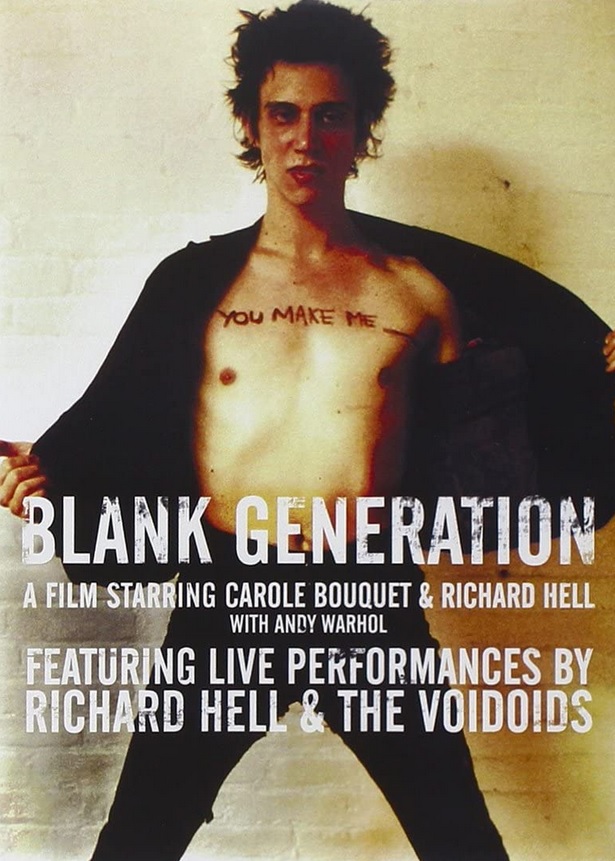
Blank Generation (1980)

Editor’s Update: In October 2021, Dark Force Entertainment announced their Blu-ray reissue of this punk classic. Learn more with their Facebook announcement.

Your willingness to slog through this punk-inspired drama — that is admittedly artsy and boring, rife with a lack of narrative clarity, bad acting, and an overall production incoherency courtesy of its failed Fellini-esque noodling (Warhol’s a great artist, but considered terrible at filmmaking in most quarters) — hinges on your fandom of Richard Hell, the music of the Voidoids, and nostalgia for the ’70s New York East Village punk scene spearheaded by the Bowery-based club CBGB’s.

Or perhaps that willingness hinges on your tolerance for the serial killer-obsessed oeuvre of direct-to-video German horror schlockmeister Ulli Lommel (Tenderness of the Wolves, The Boogey Man, BrainWaves, The Devonsville Terror) and, for the film buffs, Lommel’s connections to the works of Russ Meyer and Rainer Werner Fassbinder.

But as a piece of cultural history for music buffs (especially of punk music), while amateurish in places, this Ulli Lommel and Andy Warhol co-production (they previous worked together on 1979’s Cocaine Cowboys; a tale about a rock band subsidizing their lifestyle via drug running) won’t disappoint. (Here’s Andy’s scene, on You Tube).

Now, before we get started . . .

Let’s clear up the fact that there are two films carrying the title of the influential Richard Hell and the Voidoids’ tune (that inspired the Sex Pistols to write “Pretty Vacant”). The First, prefixed with the definite article: we picked up as a VHS bootleg tape set inside a black hard-clamshell case with a Xerox’d cover on the shelf of our local indie punk record store (tucked between a Hallmark gift n’ card store and a falafel joint). The Second: most of us watched it for the first time during an early ’80s late night viewing on the USA Network’s Friday night “Night Flight”* music video programming block (alongside Hell’s other starring role in Susan Seidelman’s 1982 punk chronicle, Smithereens).

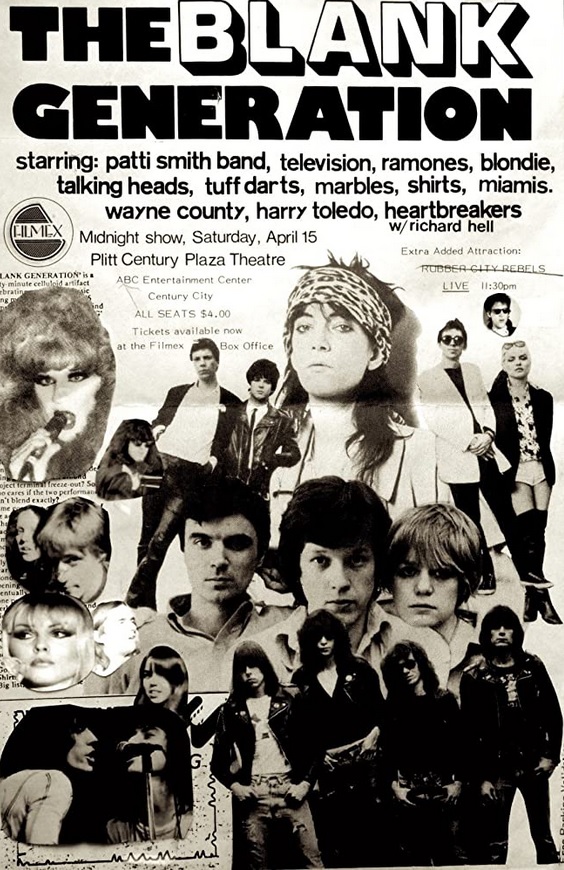
That first film, 1976’s The Blank Generation (again, carrying the grammatical article prefix), is a 16-mm black & white DIY documentary co-directed by Lydia Lunch and Patti Smith Group guitarist Ivan Kral and “No Wave” director Amos Poe (who went mainstream with 1984’s Alphabet City; starred Vincent Spano of Over the Edge, Matt Dillon’s first film). That film features grainy, live performances by Patti Smith, Blondie, Television, the Ramones, Talking Heads, the Heartbreakers, the Shirts (fronted by Annie Golden, later of Susan Seidelman’s 1985 Madonna-starring, Desperately Seeking Susan), Wayne County, and the Tuff Darts (featuring soon-gone original lead singer Robert Gordon) on the stage of CBGBs.

Original theatrical one-sheet **

The long since deleted ’80s VHS — copies are out there, if you want them, but run at $150.00

As for the narrative, dramatic version of the second film: Hell stars as Billy, an ascending musician and poet on New York’s local art scene that’s experiencing his first taste of fame across the pond; so Nada (Carole Bouquet, who starred as a “Bond Girl” in 1981’s For Your Eyes Only), a French filmmaker and journalist, comes to the States to interview him. Their journalist-subject relationship quickly progresses into a romantic triangle when Nada’s other lover, Hoffritz (Lommel), comes to New York to interview Andy Warhol (who cameos) — and Billy must choose between his career and love for Nada.

Uh, yeah. It’s a punk-tinged love story that’s more A Star is Born (1976; we reviewed the 2018 one) than a punk-rise-and-fall tale of the Breaking Glass variety. But what other film gives you the Voidoids (Robert Quine, Ivan Julian and Mark “Marky Ramone” Bell; later of Rock ‘n’ Roll High School) at the top of their game searing through “Liars Beware” and their punk anthems “Love Comes in Spurts” (featured in Christian Slater’s Pump Up the Volume) and “Blank Generation” from the stage of CBGBs?

None.

You can stream Blank Generation (1980) for the low, low price of $.99 on Amazon Prime Video, but guess what? We found a free stream over on You Tube, Midnight Pulp, and YuYu TV. As for The Blank Generation (1976): there’s no online streams or DVD reissues (official or grey market) in the online marketplace, but we found a free streaming copy on You Tube to enjoy. Uh, okay, that’s gone: try this one.

* Check out our “Drive-In Friday: USA’s Night Flight Night!” feature on those days of cable yore.

** B&S About Movies’ friend, Mike Delbusso, the proprietor of Michigan’s premiere rock art gallery, The Splatt Gallery, also talks about the film’s backstory and offers an alternate theatrical lobby card with this Facebook post. If you’re a fan of Detroit’s rocking past — or those ’60s and ’70s rocking days yore — spend some time with Mike amid the many wonderful posts at The Splatt Gallery, located in Walled Lake, Michigan.

About the Author: You can learn more about the writings of R.D Francis on Facebook. He also writes for B&S Movies.

Terminal City Ricochet (1990)

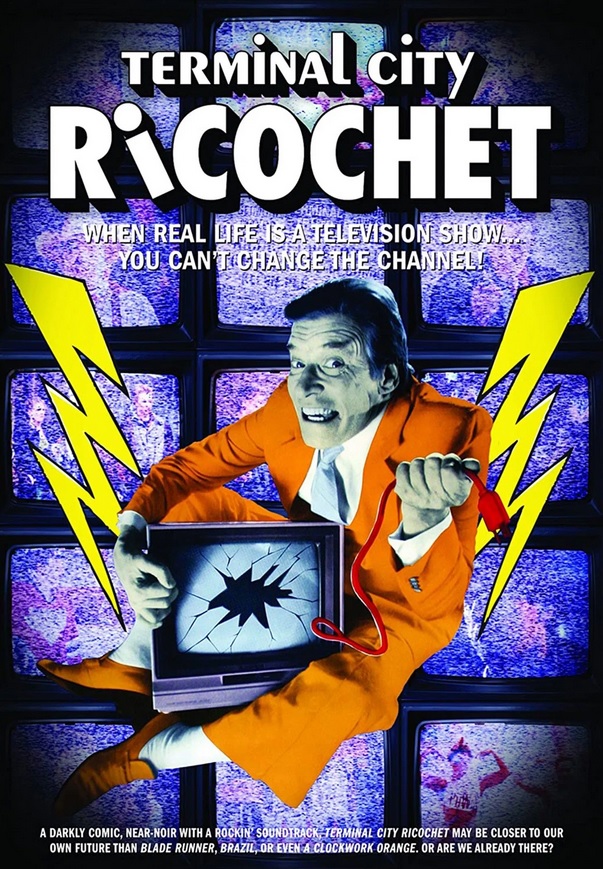
Jello Biafra of the Dead Kennedy’s goes Repo Man in this post-apoc sci-fi romp that reminds of Death Race 2000‘s political-parody intrigue — and it’s backed by the music of DOA, Keith LeBlanc, and Nomeansno, along with Biafra himself fronting DOA and Nomeansno for a pair of tunes.

Oi! I’m sold! Hey, ho! Let’s go!

Watch the official Alternative Tentacles trailer.

Canadian acting mainstay Peter Breck (appeared in a wide array of U.S cop and western dramas in the ’60s and ’70, as well as starring as Nick Barclay in ABC-TV’s The Big Valley; you’ve also seen Breck in 1958’s Thunder Road, 1960’s The Beatniks, and 1963’s Shock Corridor by Samuel Fuller) stars as Ross Glimore, a media entrepreneur who serves as the corrupt, evil mayor of Terminal City, a decaying dystopia that manipulates the masses through television — and bans things such as rock & roll and meat — that renders the citizens addicted to consumerism that financially benefits the government.

When Alex Stevens, a punk-youth newspaper delivery boy, witnesses Glimore commit a hit-and-run accident, Glimore dispatches Bruce Coddle (Biafra, in a pisser of a role), a maniacal agent of Terminal City’s Social Peace Enforcement Unit, and his lackeys (DOA’s Joe Keithley and pro-wrestling legend Gene Kiniski) to silence Stevens until after Glimore steals yet another election.

Terminal City Ricochet was never officially available on VHS and rarely shown outside of its native Canadian TV broadcasts, along with an occasional U.S film festival or art house showing hosted by Biafra himself. Alas, there’s no freebie uploads or PPV streams online — you can, however, listen to the soundtrack on You Tube. (I rented a bootleg rip in the early ’90s from a local comic book store that carried VHS obscurities, such as the previously reviewed Hangin’ Out starring Nena; I also picked up the 1993 documentary Hated: GG Allin and the Murder Junkies and Toshiharu Ikeda’s Evil Dead Trap around the same time.)

Alternative Tentacles first issued the film to DVD in 2010, but as of April 2020, they now offer the film and soundtrack as a DVD/CD combo at the reasonable price of $12.00 via their website. If you loved Allan Arkush’s Get Crazy, Alex Cox’s Repo Man, Penelope Spheeris’s Suburbia, Michael Nesmith’s Tapeheads, and Allan Moyle’s Times Square, then you’ll dig the low-budget indie shenanigans of Terminal City Ricochet.

Get this . . . the scribe behind this, Phil Savath, also wrote the David Cronenberg drag-racing epic Fast Company and . . . the sci-fi horror musical Big Meat Eater. Yeah, really. All this, and the Dead Kennedys, too.

And be sure to join us for our “Phil Savath Night” as part of our weekly Drive-In Friday featurette.

About the Author: You can learn more about the writings of R.D Francis on Facebook. He also writes for B&S About Movies.
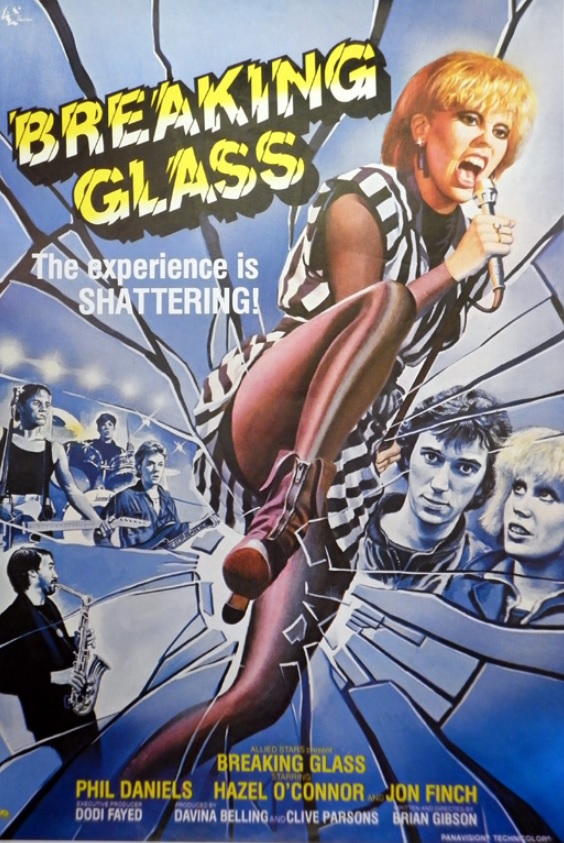
Breaking Glass (1980)

If you grew up in middle school or high school during the advent of a new cable TV channel called HBO in the early ’80s, chances are you caught at least one of the incessant airings (we watched it multiple times, of course!) of this British rock film — alongside the likes of the juvenile delinquency classic Over the Edge (starring Matt Dillon in his film debut) and Ladies and Gentleman: The Fabulous Stains. (Meanwhile, over on the USA Network’s “Night Flight” programming block, we watched Social Distortion in the punkumentary Another State of Mind and the Ramones in Rock ‘n’ Roll High School. Ah, those were the days. . . .)

Watch the trailer, listen to the soundtrack.

O’Connor got her start as an actress, with support roles in the British films Girls Come First (1975) and Double Exposure (1977). To launch her music career (with financial assistance by Princess Diana’s then lover, Dodi Fayed), O’Connor was teamed with Marc Bolan’s (T.Rex) and David Bowie’s longtime producer Tony Vinconti (he also worked with Iggy Pop and Thin Lizzy) to craft the songs for the film; Brian Gibson (later of several Styx videos, as well as the Tina Turner bioflick What’s Love Got to Do With It and the 1998 Brit rock flick Still Crazy) was hired to craft a film around the songs.

Fans of ’70s British new wave music and of Toyah, know that the unknown O’Connor beat out Toyah Willcox for the role. At the time, Willcox was high on the British charts with her debut album, 1979’s Sheep Farming in Barnet, which featured the hit singles “Neon Womb” and “Victims of the Riddle,” and “Leya” from 1980’s The Blue Meaning. (If you’re a fan of the image and music of Lene Lovich and Nena Hagan — from our previously reviewed Cha Cha — or Poly Styrene of X-Ray Spex and Siouxsie Sioux of Siouxsie and the Banshees, then you’ll enjoy the music of Toyah.)

As with the plot of most rock flicks, Gibson devised a story about the ubiquitous, meteoric rise and even quicker fall of Kate, a young and angry rock star lost in a world of drugs that’s compounded by managerial, record company, and media manipulation that leads to her eventual nervous breakdown. It’s a tale not far removed from the career trajectory of the faux bands chronicled in Slades In Flame, the 1982 Australian new wave comedy-drama Starstruck, 1980’s Times Square, and the aforementioned Ladies and Gentleman: The Fabluous Stains.

Astute British music fans will notice Phil Daniels from his starring role in Quadrophenia (brilliant as O’Connor’s talentless, bottom feeding street hustler-cum-manager), along with bassist Gary Tibbs from Adam and the Ants and Roxy Music as a band member (with equally decent acting chops). And keep your eyes open for ex-Animals keyboardist Zoot Money (You Tube) and Gary Holton of the Heavy Metal Kids (You Tube) in support roles. And yes, that is Jonathan Price as Ken, the band’s deaf and heroin-addicted saxophone player — on his way to his breakout roles in Something Wicked This Way Comes and Terry Gilliam’s Brazil.

Image courtesy of Good Reads. You can find used copies of the novelization on Amazon U.S.

Caveat Emptor #1: Sure, you can stream Breaking Glass on You Tube Movies and Amazon Prime U.S. But those are the American edits of the film that run at one hour thirty four minutes (94 minutes) with the film’s ending and other scenes (about 10 minutes) excised — you want to watch the original British version distributed in Europe that runs at 100 minutes. Alas, due to the usual legalese, that British version is not available on Amazon Prime in the U.K. — but the intrepid staff of B&S About Movies found the lone online copy of the British cut of the film on Vimeo (it’s been there for three years, but watch it while you can).

Caveat Emptor #2: The film was out-of-print for years and the recently released, mass marketed Blus and DVDs — which come from the choppy American print — have received poor reviews. The U.S online streams come from those un-restored Blus and DVD impresses. The way the reviews read, it seems we’d be better off with a grainy, taped-off-cable or VHS online rip of the film. The Blus and DVDs offer no menus or extras, booklets or the usual commentary tracks you’d expect from the re-release of such a classic, coveted film.

And just how influencial is this film?

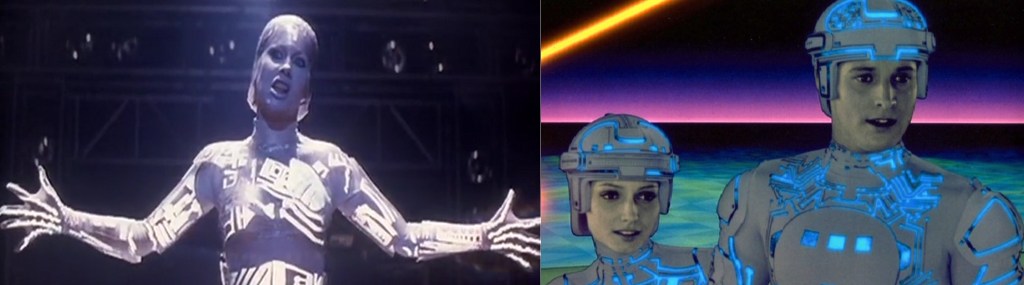
Well, we all know about the debated relationship between Jack Wood’s Equinox and Sam Raimi’s The Evil Dead, right? Well, check out this shot of Hazel O’Connor’s “robot” from the “Eighth Day” segment of Breaking Glass against an image of 1982’s TRON.

Then, there’s the striking similarities between the hair and makeup of O’Connor and Daryl Hannah’s Pris from Bladerunner.

You can listen to the full soundtrack — which hit # 5 on the British charts and earned a gold album status — on You Tube. You can also watch two scenes/songs/rock videos cut from the film of the soundtrack’s two Top Ten British singles, “Will You?” and “Eighth Day,” also on You Tube. “Give Me an Inch” became somewhat of new wave “hit” on U.S college radio stations at the time.

You are a programme! Programme! Programme!

About the Author: You can learn more about the writings of R.D Francis on Facebook. He also writes for B&S About Movies.

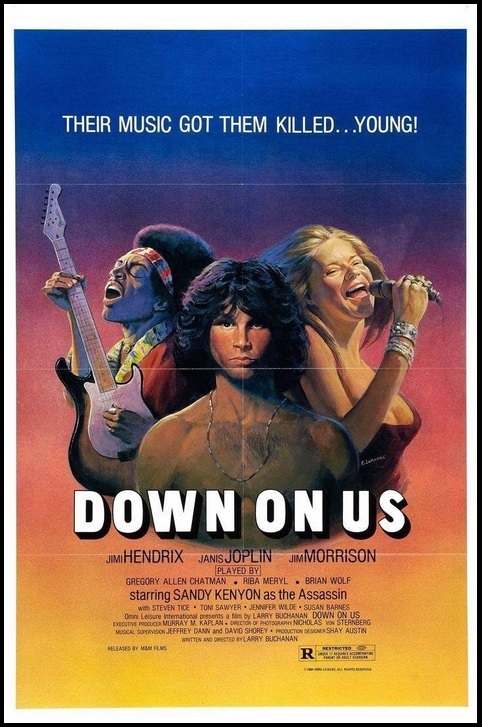
Down on Us (1984) aka Beyond the Doors (1989)

I have great memories of hearing the commercials on my local rock radio station for Down on Us when it played at the—then—behemoth six-plex in the big city as a midnight movie. Our hopes were high. We loved the Doors. We all dog-eared our copies Jerry Hopkins’s No One Here Gets Out Alive. We loved those midnight showings of AC/DC: Let There Be Rock, Led Zeppelin’s The Song Remains the Same, and Sam Raimi’s The Evil Dead. This was going to be an epic night where the classic rock spewed from the speakers, mixing with the waft of nacho cheese congealing over tortilla chips and the sweet flow of Mr. Pibb. . . .

To say we were disappointed at what unfurled across the silver screen would be an understatement. This wasn’t Rock ‘n’ Roll High School. This was Plan 9 from Outer Space: The Rock Musical. Yes, if Ed Wood made a rock ‘n’ roll flick, it would be this Larry Buchanan hot mess of a movie. Where’s Roger Corman and Allan Arkush when you need them?

While we’re on the subject of the Ramones: The modern-day doppelganger for Down on Us is Randall Miller’s muddled bioflick boondoggle, CBGB (2013). Randall Miller, the first film director in history to be convicted in the U.S. for the death of a cast or crew member (during the production of Midnight Rider, his Gregg Allman bioflick), was unable to secure permissions from the estates of Joey and Johnny Ramone, so faux “Ramones” tune were created—and Ramones tunes were absent from the accompanying soundtrack. (A movie about CBGB’s without the Ramones? Why bother making the movie at all?)

Original 1984 theatrical one-sheet courtesy of IMDb.

As for American exploitation filmmaker Larry Buchanan: He proudly wore his self-professed “schlockmeister” honor on his chest, an award he earned for his beloved (blue-jelled) day-for-night shoots trash-classics of Curse of the Swamp Creature, The Eye Creatures, In the Year 2889, Mars Needs Women, and Zontar: The Thing from Venus (need we say more: he made the Planet of the Apes rip-off Mistress of the Apes). Buchanan’s faux-biographical drama format—mixed with his ubiquitous speculations and conspiracy appendixes—that he utilized in Down on Us dates back to his “exposés” on the Kennedy assassination with The Trail of Lee Harvey Oswald (1964), the gangster chronicles The Other Side of Bonnie and Clyde (1968) and the life Charles “Pretty Boy” Floyd in A Bullet for Pretty Boy (1970), and the “romance” between billionaire Howard Hughes and actress Jean Harlow in Hughes and Harlow: Angels in Hell (1977). Buchanan also twice explored the life of Marilyn Monroe with his same theories-vigor in Goodbye, Norma Jean (1976) and Goodnight, Sweet Marilyn (1989). Not even folklore dinosaurs are immune from the depths of Buchanan’s conspiracies: he made the speculative-drama The Loch Ness Horror (1982).

Courtesy of its chintzy-muddy production values, Down on Us looks like a porn movie—only backed by a cover band sloggin’ through some “originals” they wrote that ersatz-as-tunes for Jimi Hendrix, Janis Joplin, and The Doors. Yikes! This wasn’t Oliver Stone’s The Doors—not by a longshot. This was Ferd and Beverly Sebastian’s Rocktober Blood—only with Jim Morrison instead of Billy Eye Harper (and Nigel Benjamin) fronting Sorcery. And if not for Oliver Stone going into production with his 1991 biography on the Lizard King, even with the home video market’s voracious appetite for analog delights to line their shelves, this Buchanan conspiracy faux-fest would most likely have never made it to video on the cusp of the grunge decade.

Although many critically attacked Buchanan’s film that explores Jim’s paranoia of the government—not so much a theory, but more a cinematic license playing with a “what-if” story line—as rubbish, it seems those critics are not familiar with the legend of Jim Morrison. For Morrison, it was a real, believed threat: American Government agents were after him; that he was marked as “Number 3”—after Hendrix and Joplin. Therefore, Morrison left America for Paris to find shelter and reject the legal controversies of his life. Except, in Buchanan’s bizarro-Jim world, Morrison didn’t die in a Paris bathtub: Jim fled to Spain and took up residence in a monastery.

And speaking of legal controversies: It’s one thing to craft a bogus dramatical document about the psychedlic rock triumvirate of Hendrix, Joplin, and Morrison. It’s another to licensing their music. So Buchanan contracted musicians to forge replicates of those artists for the film. Oscar nominated and award-winning director Gus Van Sant exceptionally and effectively executed this same approach with 2005’s Last Days, his faux-Kurt Cobain docudrama concerning actor Michael Pitt’s eerily portrayed pseudo-grunge rocker, Blake, fronting the film’s scripted Nirvana substitute, Pagoda (featuring stunning Nirvana simulations composed by Pitt; it all goes back to poet William Blake, one of Jim Morrison’s lyrical inspirations. The circle completes). The man Buchanan hired to mimic Jim Morrison was a musician also speculated as one of the possible musicians behind the Phantom mystery of March of 1974; an enigmatic Morrison-ersatz that released the album Phantom’s Divine Comedy: Part 1 on Capitol Records: Richard Bowen.

Richard Bowen’s other musical offering, starring Fabian!

Courtesy of Bowen, it was Buchanan’s film—not Oliver Stone’s The Doors—which offered the first on-screen interpretation of Jim Morrison, as done by actor Brad Wolf, who lip-synced to the music written and performed by Bowen. Bowen construct haunting Doors mimics with “Knock So Hard,” “Sorcery,” “Old Pictures,” “Holding On,” and “Phantom in the Rain”—each sounding like doppelganger leftovers from Phantom’s Divine Comedy: Part 1, or as outtakes from the recording career of Jim Morrison’s alleged son, Cliff Morrison. (Cliff Morrison—in a career-analogous path to Jimi Hendrix’s “son,” Billy Yeager (and to a lesser extent, Frank Marino of Mahogany Rush and his Hendrix-medium myths)—evoked his “dad’s” memory with two, late-nineties albums: Know Peaking and Color of People, fronting his Lizard Son Band.) Not only were the vocal similarities between Morrison, the Phantom, and Bowen contributing to the theory that Bowen could be the Phantom: the songs titles composed by Bowen for Down on Us also fueled the theory. Again, Bowen wrote two songs: “Sorcery” (which is what a “wizard” performs—and ties into the lead track on Phantom DC’s “Tales from a Wizard”), and the second song that appears in the film, “Phantom in the Rain.”

Image of 1989 reissue by Unicorn Video courtesy of Paul Zamarelli/VHS Collector.com and user 112-Video.

The first theory about Morrison’s demise was murder: In the backwash of Oliver Stone’s 1991 document, another film sloshed the brackish tributaries first navigated by Buchanan, a film that played it very fast and very loose with the Morrison-was-murdered theory: the 1992 direct-to-video rock flick Sorority House Party (You Tube). In this case, three hotties thwart a managerial plot to kill Attila, and unpredictable, high maintenance, costly ‘80s rock star, to boost album sales. This murder theory regarding Jim was the direct result of Hendrix and Joplin doing great sales numbers after their deaths. Moreover, with Jim flaking out on the band and a split of the Doors proving costly to both the band and the label, knocking off the Lizard King doesn’t seem like an implausible idea. (Also known as Rock and Roll Fantasy, Sorority House Party served as the directing debut of David Michael Latt, who came to incorporate the successful mockbuster purveyor, Asylum Studios.)

Other movies in the 1980s also tailored the mysterious threads of Jim’s death as cinematic narrative inspiration.

The second theory regarding Jim’s “demise” was a death hoax: Jim, tired of the dealing with the band and his Miami indecency trial ending in a possible jail sentence (like counterculture comedian Lenny Bruce), paid a French doctor to create a phony coroner report and death certificate. The cable movie-rock flick favorite Eddie and the Cruisers played with this myth—no doubt inspired, in part, by the last chapter of No One Here Gets Out Alive, the 1980 best-selling, first biography on Jim, which theorized Jim Morrison may have faked his own death. In Eddie and the Cruisers, a Rimbaud-inspired rocker of the Sixties, distraught over band infighting and record company hassles, bailed out with an elaborate death ruse. In the eventual Eddie sequel, the rocking protagonist, Eddie Wilson, ended up as a construction worker in Canada; not exactly ranking with the romanticized rumors of Jim running away to Africa—then returning to music in 1974 as a mysterious rocker, the Phantom; or as the Circuit Rider (that’s a whole other Jim-tangent that we won’t get into here).

And that brings us to best of the Jim-inspired conspiracy rock films: Down on Us (1984), eventually reissued to video as Beyond the Doors (1989). And we say “the best” because it’s all about the schlock n’ trash at B&S About Movies. (Honorable mention going Michael A. Nickle’s portrayal of the Lizard King in Wayne’s World 2, of course, living out his life as a sage beyond the immaculate perimeters in the desert.)

Larry Buchanan’s film speculated Jim was not murdered, nor did he fake his death: he went underground to avoid assassination. The plot line: President Richard M. Nixon, despondent over the antiwar sentiments agitated by the hippie icons of Hendrix, Joplin, and Morrison, sanctioned the F.B.I to kill the trio. Morrison apparently caught wind of the plot and “got out alive.” And, to complete the final cover up of the plot: the agent (Sandy Kenyon) who carried out the sanction is murdered. When his son discovers his dad’s files, the plot unfolds via flashback, then the son tracks down Morrison in Spain . . . .

While Buchanan’s film doesn’t get into it: The alleged “F.B.I murdered Jim” scheme has been in circulation since Jim’s death in 1971, cobbled in a basket with theories alleging the American government assassinated Dr. Martin Luther King, Malcolm X, and Marilyn Monroe (Hi, Larry!), along with Robert Kennedy and his brother, President John F. Kennedy (Hey, Mr. Buchanan!).

One of the earliest critics of the Warren Commission report regarding President Kennedy’s assassination, Mae Brussell, the late counterculture public radio personality of the Carmel and Monterey, California, radio stations KLRB and KAZU, most likely influenced Buchanan’s screenplay. The former host of the nationally syndicated Dialog: Conspiracy program compiled her government conspiracy theories in an unpublished November 1976 report: From Monterey Pop to Altamont, Operation Chaos: The C.I.A’s War Against the Sixties Counterculture (it was online to read in full; now it’s gone again). This report, along with current Doorsphile conspiracy theorists on social media platforms, contend there was a coordinated effort initiated in 1968 by the F.B.I’s Counter Intelligence Program and the C.I.A’s “Operation Chaos” to undermine the counterculture movement. These theories point out that Jim Morrison knew Charles Manson, through his mutual acquaintanceship of the Beach Boys’ Dennis Wilson and music producer Terry Melcher, and Morrison composed “Riders on the Storm” about Manson’s “murderous” followers.

Additionally, theorists opine the membership list of the 27 Club (with its own outlandish conspiracies; e.g., Courtney Love hired El Duce of the Mentors to murder Kurt Cobain) ties into the military service of the rockers’ parents. In addition to the high-ranking, classified naval service of Jim Morrison’s Admiral father, Lt. Col. Paul James Tate, the father of Manson Family murder victim, actress Sharon Tate, also served in the military. Theorists also point to Lewis Jones, the father of the Rolling Stones’ Brian Jones, a PhD mechanical engineer, who served as a military aeronautical engineer for Bristol Aircraft . . . et cetera, one may read the extended theories online, but the point: the deaths of their famous children were “assassinations.” The “theory” concludes: Charles Manson and his family were either hired as “actors” for the “plot,” or Manson himself was a patsy—like Kennedy assassin Lee Harvey Oswald (Oy! Larry!)—set up to take the fall for the Tate “assassination.”

It all began, according to Brussell, with the 1966 death of anti-establishment comedian Lenny Bruce (1967 memoirs: How to Talk Dirty and Influence People)—the first victim of the “operation.” The critical and financial success of the Monterey Pop celebration in the summer of 1967 simply solidified the government’s resolve to snuff out the counterculture’s icons. Brussell goes onto state that, between 1968 and 1976, many of the most famous names of the counterculture movement, were dead: Mama Cass Elliot of the Mamas and the Papas, Otis Redding, Jimi Hendrix, Brian Jones, and Janis Joplin all participated in or attended the Monterey Pop Festival. The report’s assassination roster also “stars” Duane Allman and Berry Oakley of the Allman Brothers (Hey, Randall?), folkie Tim Buckley, Jimi Hendrix’s manager Michael Jeffrey and the Beatles’ manager Brian Epstein, along with Graham Parsons of the Byrds, Ron “Pigpen” McKernan of the Grateful Dead, blues musician Jimmy Reed, and, of course, Jim Morrison, along with his wife, Pam Courson. All became victims of coordinated mind control tactics via Lysergic Acid Diethylamide (LSD)—a poisoning that altered the icons’ personalities and behaviors, encouraging their accidental “deaths-by-misadventure. . . .”

I know . . . I know . . . tangents and non-sequiturs. Let’s get back to the movie! But wait! There’s one last tangent: what’s this all have to do with Rocktober Blood?

Riba Meryl, who co-wrote the faux-rock epic “Rainbow Eyes” with Sorcery’s Richard Taylor, became an actress and portrayed Janis Joplin in Down on Us. Surprising, Riba, an accomplished singer in her own right, lip-syncs the faux-Joplin tunes “Easy Now” and “No Way” written-performed by Janet Stover (her lone film credit). Riba also repeated her Joplin character in a 1987 episode of the syndicated rock ’n’ roll U.S television series Throb (You Tube). After her lone, non-Janis character acting role in 1987’s Banzai Runner, Meryl concentrated on television and film session work and contributed the song “Brand New Start” to a 1987 cop-murder drama, The Jigsaw Murders (You Tube). Sadly, Riba passed away in 2007 at the age of 52 from breast cancer. (And why didn’t Riba Meryl provide the vocals for the song she wrote for Rocktober Blood? We may never know.)

The studio band who helped create the faux-soundtrack for Down on Us was comprised of the members of the American-New Jersey hardcore punk band Adrenalin O.D (they also as appeared as musicians-background actors). If you’re familiar with the Slickee Boys (their punky-take on Status Quo’s “Pictures of Matchstick Men”) or the Dead Milkmen (remember “Punk Rock Girl”?); AOD are goofy like that. How else can you describe a band who releases an album Crusin’ with Elvis in Bigfoot’s U.F.O that features “Bulimic Food Fight” as a lead single? Formed in 1981, AOD broke up after the failure of their “big rock move” on Restless Records, their fourth album, Ishtar (1990) (they do Queen a hell of a lot better than Metallica; it’s like the Monkees on crack. And they played CBGB’s several times).

And we never heard again from the acting-musician duo behind faux Hendrix: Gregory Allen Chatman mimed to the music written and performed by David Shorey (he also served as the film’s music supervisor): “Today or Tomorrow,” “Looks Like You,” “Crystal Wings,” “Three Day Rain,” “Poet’s Reprise,” “Just My Size,” and “Seriously Shot Down.”

We did, however, hear from two of the film’s lead actors, again: Sandy Kenyon, as government agent Alex Stanley, and Toni Sawyer as his wife; neither let there involvement with Buchanan dissuade their careers. Kenyon continued to work up until his 2010 death, amassing over 130 credits on a wide array of TV series since the 1950s (. . . I’ll never find a copy of the 1974 TV movie Death in Space starring Kenyon and Cameron Mitchell, will I? Nope: The only known surviving English language print is stored at Library of Congress, alongside Kim Milford’s lost TV rock flicks Song of the Succubus and Rock-a-Die Baby). Toni Sawyer’s latest (her 74th project), the family-adventure, When the Moon was Twice as Big (Facebook), is currently in post-production.

Both versions/titles of the movie are exactly the same: so don’t fret over which VHS issues you decide to buy. Although, in all my years, I’ve never seen a post-1984 VHS on the shelves as Down on Us, only the 1989 Beyond the Doors version. And I only found the ’89 VHS, out of six video memberships —once—at a 10,001 Monster Video. The VHS pops up in the online marketplace from time to time, Amazon and eBay in particular. However, beware of those DVDs: they’re all grey market rips-from-the-VHS.

As for online streaming: There’s only two choices to watch this online—via You Tube, natch. There’s a multi-part upload (of 13, 10-minute segments) HERE that was the only choice for many years. However, someone recently uploaded the complete film in one upload HERE.

“Our assignment: neutralize the three pied pipers of rock music.”
— F.B.I Agent Alex Stanley

Indeed. And you “neutralized” the after effects of my cheesy nachos and Mr. Pibb, Agent Stanley. (I miss you, John, my brother. Good times.)

About the Author: You can learn more about the writings of R.D Francis regarding Jim Morrison’s doppelganger, the Phantom of Detroit, on Facebook and Medium. He also writes film reviews for B&S About Movies.


Post Script: Down on Us is a movie that never ceases to keep on giving. Check out Bill Burke’s new, February 2022 take on the film at Horror News.net.

The Decline of Western Civilization (1981)

Penelope Spheeris may be best known for Wayne’s World, but her life and films are more than just one movie.

Until the age of seven, Spheeris grew up in a traveling carnival until her father was stabbed after intervening in a racial dispute. After his death, she grew up in California trailer parks with a succession of stepfathers, yet still graduated high school voted “most likely to succeed.”

Working at Denny’s and IHOP in Los Angeles — one wonders if she even encountered David Lynch — she put herself through UCLA and started her career producing short films with Albert Brooks, several of which aired during the first few seasons of Saturday Night Live.

Between DudesSuburbia and two of the Decline films, Spheeris has shown her understanding of punk even as she lays bare some of the sillier moments of the kids caught up in its wake. The decline of Western civilization could mean many things here. It could be a reference to Lester Bangs’ review of The Stooges’ Fun House, where a friend remarked that this album had to be the signal of the end of it all. Or it could be a reference to Germs singer Darby Crash Darby reading Oswald Spengler’s Der Untergang des Abendlandes (The Decline of the West).

The bands within this movie — as well as the punk rock fans — gave Spheeris some amazing access to their lives, warts and all. While some bands like Alice Bag Band and Catholic Discipline may not be well known, X, the aforementioned Germs, Fear, the Circle Jerks and Black Flag should be recognized by anyone, not just punk fans.

After the film was screened in Los Angeles, punk music fans got into so many fights and caused so much chaos that L.A. Police Chief Daryl Gates wrote the filmmakers a letter asking them not to screen the film again.

This series of movies was only available in bootleg form for years. This was because of licensing issues for all the songs and Spheeris not wanting to go back and relive them. She didn’t need the money, but then she decide dthat she’d rather be remembered for these films than her more commerical work.

You can watch this on Amazon Prime and Tubi. There’s also the official site which has press clippings and more info on the films.

Gib Gas – Ich will Spass, aka Hangin’ Out (1983)

While this German rock flick is best remembered for featuring MTV video favorite Nena in her acting debut, the film takes its title from a hit song by her co-star Markus Mörl, which translates as “Step on the Gas – I Want Fun.”

The film was crafted as a multimedia showcase to launch the music careers of both singers in their native Germany. But after Nena’s “99 Luft Balloons” (which isn’t featured in the film) became a freak international hit (in both of its German and English versions) courtesy of its video, the film was quickly dubbed into English and retitled as Hangin’ Out — a title which also carried over into its Spanish and Japanese dubs.

Japanese one-sheet courtesy of Worthpoint.

The film, which featured six tunes from Nena’s eponymous band, became the 13th most successful film in Germany that year. However, to hear Nena — who has long since derided the film — tell it, the film had an opposite effect on her career: instead of the film launching her career, it was the MTV success of her career that made the film successful.

And while Nena, along with fellow Germans Falco (“Der Kommissar“) and Trio (“Da Da Da” and “Boom Boom“) where able to find international success beyond the Euroasia continent, Marcus failed to expand his career beyond Germany’s borders. He did, however, score a Top Five hit with “Kleine Taschenlampe brenn,” (“Small Flashlight Burning”), which is featured in the film and consider a German pop music classic. The film also features another one of his chart hits, “Feuerwehrmann,” which you can listen to in this clip from the film.

So, what’s the film about? It’s a simple love story.

Tina (Nena) is tired of school and life in her Barvarian village and won’t give fellow student Robby (Markus Mörl) the time of day. Instead she falls for Tino (Enny Gerber, in his only film role), a red silk jacket wearing, motor scooter riding ne’er do well who works at the local carnival. When Tino leaves town and breaks Tina’s heart, she convinces Robby to hit the road and track down Tino — which leads Tina and Robby to eventually fall in love.

While there’s several clips from the film available on You Tube (some blocked from U.S. playback), we found this English language vignette on You Tube — as you can see, the film awkwardly transitions from English language dialog to German language vocals (and here’s several trailers and clips to sample). There’s no online rips or VHS copies available online of the English language dub released under the Hangin’ Out title, but we located a copy of the German language version of the film on Russia’s version of You Tube, OK.ru.

Nena’s only acted in front of the camera two more times: the German films Tagediebe (Day Thieves; 1985) and Der Usichtbare (The Invisible; 1987). Curiosity seekers of all things Nena can watch Der Usichtbare and this promotional video of the song “Memorija” from Tagediebe, courtesy of You Tube.

About the Author: You can learn more about the writings of R.D Francis on Facebook. He also writes for B&S About Movies.
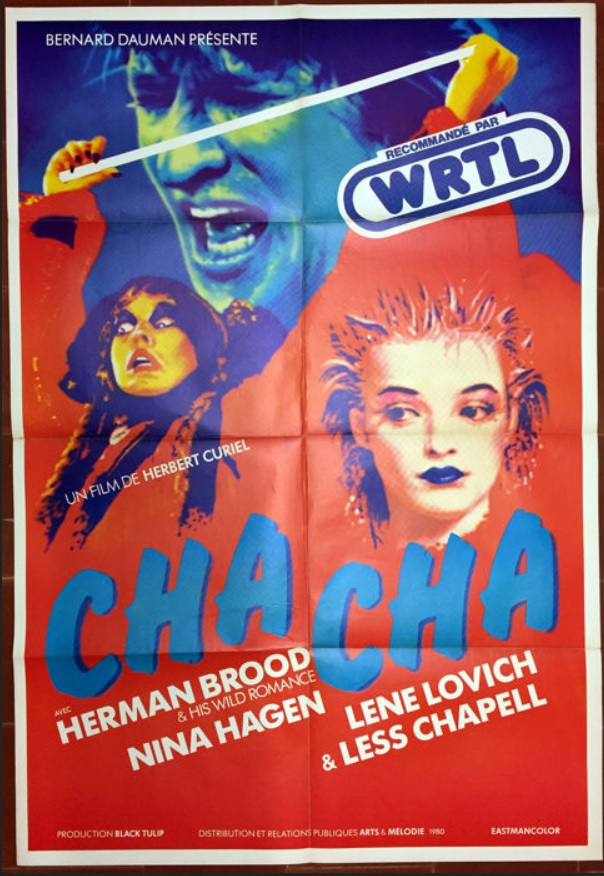
Cha Cha (1979)

Cha Cha served as a multi-media film and soundtrack collaboration by the then romantically-linked couple of Dutch rocker Herman Brood (1979 U.K./U.S. Top 40 new wave hit with “Saturday Night” by his band Wild Romance) and East German musician-actress Nina Hagen (1982 new wave hit with “Smack Jack”), along with Detroit, Michigan-born and London-transplanted Lene Lovich (1979 U.K./U.S. new wave hits “Lucky Number” and “New Toy”).

Since each were at the top of their Euro-chart popularity, it lent to their ability to get their — what isn’t so much a fluid, narrative work, but an art film comprised of a series of vignettes strung together by a series of musical performances — passion project made. Think of 1975’s The Rocky Horror Picture Show crossed with the Richard Hell-starring Blank Generation from 1980 by Ulli Lommell (BrainWaves with Keir Dullea, The Boogey Man with Suzanna Love), and you have an idea of what you’re getting into.

Courtesy of catawiki.es (Spain)

Yes. The words “art film” should give you pause; this one is purely for the uber fans of the musician-stars of the film. You’ll also need additional patience as the film’s dialog bounces between English to Dutch to German; and its amateur student film vibe doesn’t help matters. The “plot,” such as it is, set against Amsterdam’s punk/new wave scene, is part documentary (voiceovers and interviews, natch) and part narrative film — with the cast starring as themselves; Brood is “the star” of the film: a bank robber who wants to “go straight” and believes the path to righteousness lies in his becoming a rock ‘n’ roll star.

Also featured in the film are the notable Dutch new wave bands Phoney & the Hardcore (“Suicide“), the Meteors (“Teenage Heart“), and White Honey (“Nothing Going On In the City“). (While not commercial radio hits on par with Brood’s, Hagen’s, and Lovich’s works, they were popular spinners on U.S. college radio stations and new wave clubs at the time.)

In the end, if you want to revisit the ’80s new wave era — or visit it for the very first time — Cha Cha serves as a fun time capsule of the lost MTV video era.

You can enjoy a pretty clean rip of the full movie on You Tube (it’s been there for 8 years, so it safe to say it’s not going away anytime soon). You can also listen to the full soundtrack on You Tube as well; you can access a detailed track listing at Discogs. You can learn more about Herman Brood in the 1994 Dutch rock documentary Rock ‘n’ Roll Junkie (you can watch the 15 minute television promotional video and 90-minute feature length theatrical on You Tube) and Nina Hagen in the 1994 English document (very arty and avant-garde, natch) Nina Hagen = Punk + Glory on You Tube.

About the Author: You can learn more about the writings of R.D Francis on Facebook. He also writes for B&S About Movies.

Rollercoaster (1977)

“Hey, just wait a minute there, you smug and pretentious, know-it-all pseudo-film critic . . . what’s this disaster-suspense drama doing in the middle of a “Rock ‘n’ Roll Week” of reviews? This is just a knockoff of Dirty Harry crossed with Earthquake, and instead of Clint Eastwood’s police inspector, we get an amusement park safety inspector. And while George Segal is pretty cool in the role, he’s no Dirty Harry Callahan.”

The original theatrical trailer.

“Well, don’t forget that George is teamed with Richard Widmark as FBI Agent Hoyt.”

“Uh, no. Sorry. Still not Dirty Harry Callahan.”

“Well, do the factoids that Rollercoaster not only has a rock ‘n’ roll connection, but a connection to Pittsburgh and Star Trek as well, Mr. Critic of critics?”

“No, not really. But you’re going to ramble about it anyway. I’m going to go take a piss. Later, dude.”

Critics of critics. God, how we love ’em at B&S About Movies. . . .

So, the connection to Star Trek comes courtesy of director James Gladstone, who directed the classic September 1966 episode, “Where No Man Has Gone Before,” you know, third episode of the first season that served as the second series pilot when the first pilot, “The Cage” (starring Jeffrey Hunter as Kirk), failed . . . you know Gladstone’s episode: Gary Lockwood (2001: A Space Odyssey, Earth II) and Sally Kellerman (the original “Hot Lips Hoolihan” in the theatrical version of M.A.S.H) obtained psychic powers after the Enterprise crossed The Great Barrier. And, as we learned, courtesy of B&S’s Chief Cook and Bottle Washer, Sam, in his review of 1974’s Cry Panic, James Gladstone directed that John Forsythe-starring TV movie written by Jack B. Sowards who, in turn, came up with one of the greatest tales of Federation folklore: the Kobayashi Maru, a no-win scenario for new Starfleet captains that was first brought up in Star Trek II: The Wrath of Khan.

Gladstone also directed the ’70s duplex favorite, When Time Ran Out (1980), an Irwin Allen-produced disaster-suspense boondoggle about an island volcano. That film reteamed Paul Newman and William Holden from the disaster bonanza The Towering Inferno and Ernest Borgnine and Red Buttons from the water epic The Poseidon Adventure. And Gladstone, along with producer Jennings Lang (Airport ’75, Airport ’77, The Concorde : Airport ’79, as well as Play Misty for Me, Slaugtherhouse Five and The Nude Bomb!!), previously worked together on Swashbuckler (1976), Universal’s forgotten “pirate comedy” flop starring Robert Shaw from Jaws. (Yep, Lang also did the one that started it all: Earthquake.)

The plot of Rollercoaster was described by Gladstone as more of a Hitchcockian cat and mouse story than as the disaster movie it was marketed; Segal concurred: he saw it as a well-structured, Hitchcock-styled action-adventure, combined with Universal’s (“Sensurrond”) technology. And Rollercoaster was, in fact, the fourth film in the studio’s “Sensurrond” oeuvre: the aforementioned Earthquake, the WWII epic Midway (1976), and the theatrical version of Battlestar Galactica (1978).

The film stars Timothy Bottoms (Up From the Depths! Thank you, Charles B. Griffith for that duplex classic!) as a mad bomber blowing up the nation’s rollercoasters to extort a million dollars from a Chicago-based amusement amalgamate. Now, if you’re keeping track, that is pretty much the plot of Dirty Harry — only with the mad bomber replaced with an assassin, and Georgy-boy not slingin’ a .357 and quipin’ one-liners. And if it all sounds like Speed, with Dennis Hooper’s “mad bomber” blowing up a bus-for-bucks (which is just Die Hard on a bus), then it probably is.

“Hey, man. I’m back from my piss. And one hell of a loaf-pinch. You’re still rambling? Did you get to the rock ‘n’ roll part, yet? Time’s a-wastin’. I need to go do my yard work.”

Ugh. Critics of critics, again I say. . . .

Anyway, as for the Pittsburgh connection: Mine and Sam’s beloved Kennywood Park out in West Mifflin in Allegheny County was originally set as the location for the film’s opening “crash” segment. When the park got cold feet at the last minute, producer Jennings Lang reset the scene for “Wonder World” at Kings Dominion outside of Richmond, Virginia. (This extended interview, seen below, with King’s Park Manager, Dennis Speigel, who also starred in the film, tells it all.)

The Rock ‘n’ Roll Part!

So, do you remember during your MTV youth, the quirky “Cool Places” that featured the annoying and least-attractive member (well, opinions vary) of the then hot the Go-Go’s, Jan Wiedlin? Well, you might recall that wasn’t a Jan Wiedlin solo tune: it was the lone U.S. Top 50 radio hit by Sparks, which was featured on their twelfth studio album, In Outer Space (1983), issued by Atlantic Records.

Anyway, Spark’s previous label, Columbia (the band burnt through six deals over the years), decided a great way to promote their new signee was by casting them in movie and feature the planned singles of “Fill ‘Er Up” and “Big Boy“(the official single upload) from their mutual debut, Big Beat (1976; produced by Rupert Holmes . . . yes, the “Escape (The Piña Colada Song)” dude). Sadly, the genius of the Columbia promotions department didn’t work: after one more flop album, 1977’s Introducing Sparks, the label dropped the band. And here’s the big scene doing “Big Boy” from the film.

If you look closely at their “big scene,” you’ll notice that album’s ex-Tuff Dart Jeff Salen on guitar (“(Your Love Is Like) Nuclear Waste” and “All For The Love of Rock and Roll“), along with ex-Milk and Cookies (You Tube) bassist and drummer Sal Maida and Hilly Micheals. And since we’re talking MTV: You’ll recall Hilly Michaels had his own MTV video hit, “Calling All Girls,” from his solo debut, Calling All Girls (1980). As with Columbia pushing Sparks via film, Warners also failed to break Micheals to a mass audience by placing tunes from the album in the uber-obscure (flop) Robby Benson (The Death of Richie) rock flick, Die Laughing (“Shake It and Dance“), and Chevy Chase’s Caddyshack (“Something’s On Your Mind“).

Coco for Sparks!

Okay, so this is where Sam just says, “F it,” and lets me free range across The Point, gushing in gaiety over the quirky, they’ll-never-be-The Cars-no-matter-how-much-the-label-wishes-it-so Sparks. But I say “bollocks” to the industry: I love Sparks!

It all began for the Los Angeles Mael brothers with their ahead-of-its-time new wave precursor, Halfnelson (“half nelson,” get it?). The band featured the likes of Earle Mankey (later of the Pop and 20/20), his brother, Jim (later of the alt-rock chart-topping Concrete Blonde), along with Leslie Bohem and David Kendrick of L.A.’s Bates Motel. With fellow Bates Motel/Sparks’ members Jim Goodwin and Bob Haag, the quartet became the Gleaming Spires. Their new wave hit, championed by Rodney Bingenheimer (The Mayor of Sunset Strip), “Are You Ready for the Sex, Girls,” appeared on the soundtracks to The Last American Virgin and Revenge of the Nerds.

Halfnelson signed with Bearsville (home to Foghat, Todd Rundgren’s Utopia, R.E.M clones the dB’s, and NRBQ), with Rundgren producing. After one belly flop of an album, the label wanted a name change (their moniker was “dumb and confusing” per the label) and reissued the album. Three ignored albums later, Sparks were signed by “fan” Muff Winwood (Steve Winwood of Traffic and Blind Faith’s brother) to Island. So off to England Sparks went, to ride that country’s then hot “glam” wave, where they fit right in with the likes of David Bowie (his long time producer, Tony Visconti, produced them), T.Rex, Mud (Never Too Young to Rock), and Slade (Slade In Flame).

Then, when glam became passe in the U.K. under the rise of punk rock and the Maels didn’t fit in with that Sex Pistols-inspired scene, they returned to the U.S., where hard rock was on the rise in a post-Van Halen world. And Columbia’s brain trust had Sparks make a “big rock move” for two more albums. And that “move” led to Sparks’ appearance in Rollercoaster — a role that the Brothers Mael described in a September 2006 Mojo interview as “the biggest regret” in the career of Sparks.

Regret? I went screaming from the duplex to find used Sparks albums at the local used record store. Hey, at least Columbia converted one person into a “Sparkhead” via the film.

And how is this not on TubiTV, considering it’s been re-released on Blu by Shout Factory (Thank You!!!), who has their own Tubi channel? No online stream, either? Not even on Amazon Prime? What the hell! Well, we found this — as a commenter dubbed it — “Glaucomavision” copy (you’ll get the joke when you open the link) on You Tube, for those of you that have never experienced the wonder of the members of Sparks fleeing the shrapnel of a rollercoaster.

Yeah. I love this movie.

About the Author: You can learn more about the writings of R.D Francis on Facebook. He also writes for B&S About Movies.