EDITOR’S NOTE: Children of the Night was on the CBS Late Movie on July 8, 1988.
“Don’t hide what you feel inside
Don’t let anybody stand in your way
Just let the music take you higher
Now are you ready to rock
Children of the night?”
Yes, that may be a Whitesnake song, but this TV movie prefers “Hell Is for Children.”
Kathleen Quinlan plays Dr. Lois Lee, the founder of Children of the Night, a non-profit organization that works to support youth who were involved in prostitution. She started as a college student who started to take sex workers into her home for protection and in the film, she runs into pimp Roy Spanish (Mario Van Peebles) and they battle over one of his girls, Valerie (Lar Park-Lincoln in her first movie).
Director Robert Markowitz made plenty of TV movies that played the CBS Late Movie, including the Maximilian Schell-starring The Phantom of the Opera. It was written by William Wood, whose career stretched back to the early 60s, Vickie Park and producer Robert Guenette, who directed some of my favorite BS movies, such as The Mysterious Monsters, The Man Who Saw Tomorrow and The Amazing World of Psychic Phenomena.
EDITOR’S NOTE: Smokey and the Bandit Part 3 was on the CBS Late Movie on April 29, 1988.
I’m fascinated by the fact that at one point, this movie may have been called Smokey IS the Bandit. Articles at. the time said that the plan was to feature Jackie Gleason as both Smokey and the Bandit with the original version filmed from October 1982 to January 1983. Test audiences reacted poorly, finding Gleason playing both parts confusing, so reshoots were filmed in April 1983, with the Bandit scenes re-shot with Jerry Reed playing the role. That’s one story. Another is that Gleason was only Sheriff Buford T. Justice, but would become the Bandit when he took on the challenge of the Enos brothers. An early trailer for Smokey IS the Bandit had Gleason appear in character as Justice to explaining to audiences that to defeat the Bandit he would become his own worst enemy.
Why no Burt? He and Hal Needham were making Stroker Ace and after two of these movies, he seemingly had no interest.
According to Snopes, the jury is out on this story, but I want to believe. They cite Hick Flicks: The Rise and Fall of Redneck Cinema by Scott von Doviak, which states that no such movie exists or was even planned: “An urban legend persists (propagated by Leonard Maltin, among others) that Smokey and the Bandit 3 was originally filmed as Smokey IS the Bandit, with Gleason playing both title roles. After a disastrous test screening, Jerry Reed took over the role of the Bandit in reshoots, or so the story goes. In reality, it’s hard to believe this idea ever got past the pitch meeting, and not so much as a production still (let alone a full-blown bootleg copy) of the supposed original version of the movie has ever surfaced.”
However, the Ocala Star-Banner did report as the movie was being filmed, “As in the first two films, Texas Sheriff Buford T. Justice, played by Jackie Gleason, is hot on the tail of Bandit. This movie originally was titled Smokey Is the Bandit, with Gleason playing both roles, but that idea was scrapped and Jerry Reed, who played trucker Cletus Snow in the first two films, will play the Bandit and drive the black and gold 1983 Trans Am.” Similar articles appeared in trade papers in 1982.
There is also evidence of the trailer, mentioned above:
And there’s a photo of Gleason as the Bandit.
Finally, my last proof is that in May of 2016, a 114-page script for Smokey Is the Bandit was posted online. Written by Stuart Birnbaum and David Dashey, this was listed as the final draft and very similar to what was shot for the film, with no scenes of Jerry Reed, Gleason showing up as Bandit (who has no dialogue other than his giggle), Dusty Trails being a member of the Enos family and a very similar ending.
The Lost Media Wiki even has an image of a heavy-set stuntman playing Bandit and he looks just like Gleason, not Reynolds.
As for the movie that was really filmed, it was directed by Dick Lowry (Project: ALF, Archie: To Riverdale and Back Again, The Jayne Mansfield Story) and had eleven scripts from writers Stuart Birnbaum (Summer School, The Zoo Gang), David Dashev (The Fish Who Saved Pittsburgh) and Gleason, who had final script approval. He said of the story, “Why do we even need writers?” Keep in mind that Gleason was 67 at this point and had already seen a dead alien thanks to Nixon, if the rumors are to be believed. After all, he had a UFO-shaped house that he called The Mothership.
But I digress.
It all begins with Sheriff Buford T. Justice retiring. The Enos brothers (Paul Williams and Pat McCormick) make a bet with him, just as they did with the Bandit, but he turns them down, looking to relax. Yet even a few hours of retirement is too much for him, so he takes them up on their wager: $250,000 against his badge if he can transport a large statue shark from Miami, Florida to Austin, Texas.
Justice and his son Junior (Mike Henry) avoids all of their traps, so the Enos family hires Cledus Snow (Jerry Reed) to dress as Bandit, drive a similar car (Grandson of Trigger) and steal the shark back. He also picks up a girl named Dusty Trails (Colleen Camp) at a used car lot, just like the first movie, to help him.
The hijinks include a battle with bikers at the Gator Kicks Longneck Saloon, a chase through the Mississippi Fairgrounds, an orgy at the Come On Inn that ends with Buford being pursued by a muscular woman named Tina (Faith Minton) and Buford actually winning the bet. Then, he goes to arrest the Bandit and has his mind destroyed when he realizes it’s Cledus.
Let’s get deep. Buford and the Bandit come to the understanding that their lives have no meaning without one another. A Smokey. is nothing without his Bandit, so to speak. The Bandit — now Reynolds after a short, contracturally obligated cameo — drives off with Tina as Buford leaves his son behind.
To make this even stranger, in 1983, Gleason was also in The Sting II, a movie that didn’t have Robert Redford and Paul Newman. 1983 was the year of this, as Curse of the Pink Panther also came out berefit of Peter Sellers.
A good portion of this film is very Boogeyman II, as it repeats almost everything we’ve loved in the first two movies. This makes us judge everything we see after and what we find is lacking, despite how much we love the characters. Just like the speech at the end, we need Reynolds with Gleason. Otherwise, what’s the point?
July 14-20 Vanity Project Week: “…it might be said that the specific remedy for vanity is laughter, and that the one failing that is essentially laughter is vanity.” Are these products of passionate and industrious independent filmmakers OR outrageous glimpses into the inner workings of self-obsessed maniacs??
This whole thing started with “The Karate Rap” in 2012. Or 1986, when the video was made. 2012 seems to be the year it went online, according to Punching Day.
“Relax, and breath / Keep training, you′ll get it / Ich ni san shi, come on everybody / Train Karate / Ich ni san shi, come on everybody / Train Karate / (Karate train your body all the time)”
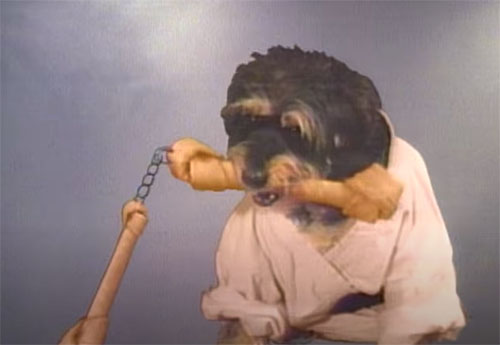
This video has a Karate Dog.
The man behind this is David Seeger, who followed that rap video with episodes of The All New Mickey Mouse Club and mixtapes of daytime soaps, like All My Children: Daytime’s Greatest Weddings, All About Erica, Luke and Laura Vol. 1: Love on the Run and Luke and Laura Vol. 2: Greatest Love of All.
It always comes back to Anthony Geary.
The son of Hal Seeger (a TV producer and the director of a cartoon, Batfink) and the brother of Susan (who wrote episodes of Blossom and Hangin’ With Mr. Cooper), Charbie Dahl (a creative consultant on Family Matters), Efrem (who produced and wrote Queer as Folk) and Mindy (34 episodes of The West Wing and Bloodfist VII: Manhunt), David directed, wrote and stars in this as Sensei Dave.
An evil martial artist named Tiger (Robert Scaglione) challenges every martial artist in the world to Kumite. Only Sensei Dave shows up, looking like the whitest of all great white hopes, a man who keeps his black belt in the freezer. Why? Look, that’s going to be the least of your questions after watching this.
Will this movie reuse footage from “Karate Rap?” Will footage from Batfink slow the plot to an absolute crawl? Will the entire Seeger family, including Dad, appear as one of the bad guys? Of course. But are you ready for the idea that Sensei Dave can heal any wound and can also send his spirit out of his body? Or that Tiger has a much cooler training facility complete with bikers and women in lingerie that looks like the VCA ripoff porn of Mortal Kombat? Let’s call that movie Mortal Kumbat. Oral Kombat? Oral Cumbat? Mortal Kumblast: Finish Her? Fourplay With Goro?
Anyways.
Tiger has been trying to kill Sensei Dave since he was a baby. He once kicked his baby carriage down the steps — someone alert Erica Shultz — and Dave also stopped him from beating up unhoused people, who revealed that he would be Karate Jesus someday.
That day is now.
Hal Gaudy (Dave’s dad, Hal) is funding Tiger, who has drug dealers in his karate school. Locker rooms — for reasons. He makes a fair amount of money betting on Tiger’s fights. They draw as well as indie pro wrestling, which is to say, not well. They also own a cable TV channel and keep Tiger on staff as a hitman, complete with a miniature scythe. A kama. A sickle. You get it. They have killed so many people along with Tiger that they need a map for their yard to remember where people are buried, which is totally not something the police would use against them in court.
Also: Thanks to Punching Day, I know Tiger’s rap that he says before he kills someone: “Do you know the truth about the tiger’s tooth? Does it cut, does it puncture, does it rip? Let me give you a tip!”
So many questions: Why does Tiger live above a porn store in a small apartment with giant pictures of the Teenage Mutant Ninja Turtles and Bart Simpson? Are we to infer that America is a fascist bully because the evil man’s girl wears a U.S. flag for lingerie? Or are we just to know that because it’s true?
Tiger and Sensei Dave battle on a boat, and by the end, Sensei Dave is left dead in the water. Literally. Drowning dead. Dave’s ghost leaves his body and visits his pregnant wife and his sister, Sister Sensei — now the movie makes sense and also you will scream yourself hoarse if you scream the secret word scream every time they say the title — to avenge his death. Or find his body. Or something.
Sister Sensei is a big Hollywood star — well, Mindy was trying — and doesn’t have time to avenge her brother’s death. So he starts haunting her, and sometimes, it feels like all of the images and sounds and effects overload to the point that you may think you licked one of those blue stars the teachers warned you weren’t stickers but instead LSD.
To get his sister — who has never done karate — to fight, his ghost pervs on her in the shower and does an impression of Max Headroom mixed with Garth Algar, complete with early 90s video effects. But whatever. It’s time for a montage, and Mindy becomes Sister Sensei and is given Dave’s belt, and no one is all that sad that Dave is dead.
Remember Exposed! Pro Wrestling’s Greatest Secrets? That same audience shows up for the fight between Tiger and Sensei Dave, who shows up, only for Sister Sensei to take the fight. Keep in mind that this is a comedy, and then watch these scenes and the aftermath, where Sister Sensei’s face looks like a hamburger. Funny!
Sam’s favorite trope: Sister Sensei’s tale of the tape photo is her publicity picture.
Instead of following all the signs in the crowd — where did these people get these signs and how did they know to bring “equal rights” signs when Sensei Dave was supposed to be there and there was no hint of Sister Sensei taking the booking — that empower women, Sensei Dave enters his sister’s body to fight, all while his very pregnant wife pulls a Mary in a manger and breaks water right there, giving birth backstage. Look, I have been backstage at MMA and pro wrestling shows. This is no place to be born. It’s also not the place to have a baby, but you wouldn’t be surprised how often that happens.
Sensei Dave leaves her body and causes it to wash up on shore after being dead and bloated in the river for five days, and he just gets up and lives, like two days better than Jesus’ record, and the unhoused people from his past proclaim him to be the karate messiah.
As for his sister, Tiger beats her so severely that she dies.
You read that right. His sister straight up gets killed, and her spirit also leaves her body. She goes “Into the Void” — “Rocket engines burning fuel so fast / Up into the night sky, they blast / Through the universe, the engines whine / Could it be the end of man and time?” — and is now in Karate Heaven.
You know who else is there?
Tiger.
Yes, the Karate Void is part of the Martial World, and anyone who fights can be in it at any time. Imagine how Sister Sensei feels, dying and being trapped there — I wish this had a Street Fighter II countdown screen with her bloody as it counted down from ten to one — and then the guy who karate killed you can just show up at any time to make fun of you for dying at his hands. Anyways, she knows Karate Magic and comes back to life, knocking him out.
Sensei Dave’s wife has the baby on the filthy concrete.
But wait…two years later, and Dave’s wife Holly spins to the camera and says, “Tiger?”
Yes, we’re getting a sequel. Sons of the Sensei.
But we never got it.
Yet.
Hellhammer taught us, “Only death is real.” But in this movie, even the final beyond is not infinite. These people die more than the X-Men when Chris Claremont wrote it.
This took 19 years to be released. It aged, like wine. Or stinky cheese.
EDITOR’S NOTE: The World According to Garp was on the CBS Late Movie on September 11 and November 27, 1987.
For some reason, my parents let me watch this when I was ten and between someone losing their penis in the mouth of a lover when their car is hit from behind and the tragic ending, I was changed. In fact, the end upset me so much, as it made me realize that I too would die, that I didn’t sleep for days.
Directed by George Roy Hill (Thoroughly Modern Millie, Butch Cassidy and the Sundance Kid, The Sting, The Great Waldo Pepper, Slap Shot, Slaughterhouse-Five, Funny Farm) and written by Steve Tesich (Breaking Away), this was based on the book by Clifford Irving.
T.S. Garp (Robin Williams) was born after his mother, Jenny Fields (Glenn Close), took advantage of a brain-dead tailgunner, injured in combat during World War II. She mounted him, he got her pregnant, he died, Garp was born. Jenny writes Sexual Suspect, the story of her life, and becomes a feminist icon, while Garp marries Helen (Mary Beth Hurt), has two boys named Duncan and Walt, and becomes a fiction writer.
A girl named Ellen James (Amanda Plummer) has been assaulted and her tongue cut out. The women who gather around Garp’s mother all begin to cut out their own tongues, despite Ellen telling them not to. Helen cheats on Garp; he rams into the car where she is going down on one of her students, causing the death of their son, Walt and Duncan to lose an eye. His mother is killed by an assassin, and he can’t even go to her funeral until transgender football player Roberta Muldoon (John Lithgow) sneaks him in.
Speaking of Roberta, she’s why Irving wouldn’t write the script: “It was the early 1980s when George Roy Hill asked me if I would write the screenplay for Garp, but I knew we didn’t see eye to eye about Roberta. George was a World War II guy; he couldn’t see past the comedic part of a transgender woman who’d been an NFL player. A pity, because John Lithgow, who was cast as Roberta in the film, could have played her as I wrote her. Roberta is a force of normality in an otherwise extreme world; she is the only character who loves Garp and his mother equally, the only character who isn’t in a rage about someone or something. I declined to write the Garp script because George wouldn’t do Roberta my way.”
At the end, Garp is shot and is airlifted to the hospital and maybe Heaven as he remembers his mom throwing him in the air as “When I’m 64” plays. I had loved that song as a kid, so hearing it in this way horrified me.
At one point in this movie, the female inmates begin to fight, and Crazy Daisy (Tiffany Million, once a GL, OW girl and later an adult star) says, “I’ve seen this in Chained Heat!”
Yes, you sure did.
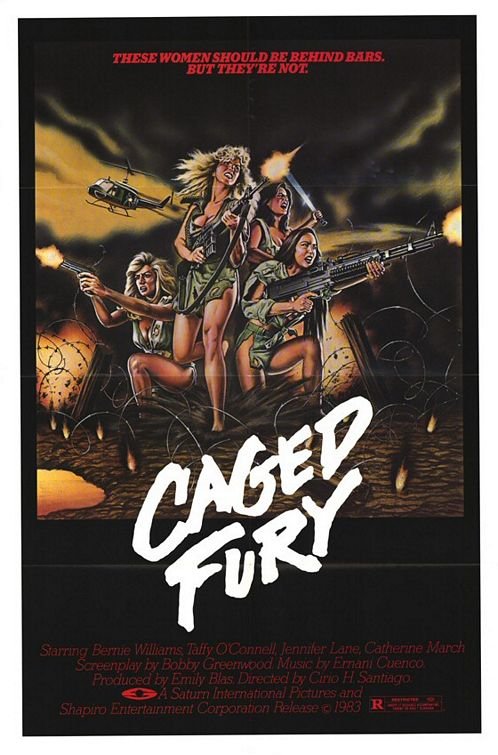
While Cirio H. Santiago also made a movie called Caged Fury just six years earlier, this one — directed and written by Bill Milling (who also wrote Silent Madness and Savage Dawn; he also directed adult films under the name Philip Drexler Jr. (A Scent of Heather), G.W. Hunter (Heart Throbs), Craig Ashwood (All American Girls), William J. Haddington Jr. (When A Woman Calls), Chiang (The Vixens of Kung Fu (A Tale of Yin Yang), Jim Hunter (Up Up and Away), Luis F. Antonero (Temptations) and Bill or Dexter Eagle (Virgin Snow).
Wikipedia claims that Fernando Fonseca (The Unholy) and one of my obsessions, Philip Yordan, wrote this, but I see no other evidence anywhere. Fonseca only wrote one other film, South Beach Dreams, and Yordan and Cannon never worked together, which is a fact that still makes me sad.
Kat Collins (Roxanna Michaels) is living out the first stanza of Poison’s “Fallen Angel:”
“She stepped off the bus out into the city streets
Just a small town and a girl with her whole life
Packed in a suitcase by her feet
But somehow the lights didn’t shine as bright as they did
On her mama’s TV screen
And the work seemed harder
And the days seemed longer
Than she ever thought they’d be”
After kissing her father (Michael Parks) goodbye and leaving Utah for Hollywood, she meets Rhonda Wallace (April Dawn Dollarhide), who gets her work with a photographer named Buck (Blake Lewis). After posing, the girls head off for the Sunset Strip and get into it with some bikers, which, seeing as how this is a 1990 direct-to-video movie, gets rapey and then they get saved by good, guy bike enthusiast Victor (Erik Estrada) and American Combat Karate school leader Dirk (Richard Barathy).
Buck then introduces the ladies to a porn director, but that ends up setting them up as prostitutes and sending them off to Honeywell Prison, which is where the movie really gets going. You know exactly all of the women in prison moments, precisely, and the guards are as bad as you’d think they’d be. They’re led by Spyder (Gregory Scott Cummins, former San Diego Chargers punter) and include Pizzaface (Ron Jeremy), Paul Smith remembering everything he once did years ago in a similar role in Midnight Express and Mindi Miller (Sugar from Penitentiary III) as Warden Sybil Thorn, an S&M catsuit wearing evildoer named for two WIP legends: Sybil Danning from Caged Heatand Dyanne Thorne, who forever will be Ilsa.
So while Roxanne is getting indoctrinated into white slavery, her sister Tracy (Elena Sahagun) figures that the best plan is to do the exact same things her sister did and get put in the same prison. She’s also helped by giallo-level policework from Detective Randall Stoner (James Hong). Of course, Estrada and Barathy have to rescue her, but Estrada catches a bullet, so the white kung fu expert has to fight his way out of this lingerie hell, which magically releases them right in front of Mann’s Chinese Theater.
This movie is also replete with adult stars as prisoners, including Kascha using her more mainstream name Alison LePriol, Janine Lindemulder — who knows a little something about the big house after serving a six-month federal prison sentence for tax evasion — as Lulu (you may recognize her, if you didn’t watch adult movies, as being on the cover of Blink 182’s Enema of the State album cover or for her relationship with Jesse James) and Julia Parton (yes, a relative of Dolly and once the publisher of High Society).
As for the bad guys putting this all together, there’s Jack Carter as the big bad Mr. Castaglia, as well as Beano, who you may remember from Deathrow Gameshow, as Tony “Two A Day” Tarentino. This movie feels like it knows way too much about the dark side of Los Angeles, what with Jeremy in the cast and Big G being played by Bill Gazzarri.
So Gazzari’s…
The three hundred feet or so on Sunset Boulevard that started at Gazzarri’s and ended at the Rainbow and the Roxy Theatre was where rock and roll lived in the 90s (although the place was hot from the 60s on, with The Doors being a house band and the Miss Gazzarri’s Dancers counting Catherine Bach and Barbi Benton as alumni). When Gazzarri died in 1991 and the club closed down in 1993, it was damaged in an earthquake and went through many name changes before becoming the nightclub 1 Oak. If you want to see the club, I recommend The Decline of Western Civilization Part II: The Metal Years. Nearly every major metal band played Gazzarri’s, including longtime house band Van Halen, Ratt, Cinderella, Quiet Riot, Mötley Crüe, Poison, Guns N’ Roses, Warrant and Faster Pussycat, as well as bands you may not know if you didn’t read Hit Parader and Rip! like Shark Island, Hurricane and, if you saw Decline, Odin.
What you’ve seen is pure sleaze. I mean, it’s a woman in prison movie. Would you want it any other way? Why are you watching it if you’re just going to judge me? You’ve read this far. You’re complicit.
William Asher was credited by many as inventing the TV sitcom. He brought Our Miss Brooks from radio to TV, directed 100 out of 179 episodes of I Love Lucy, produced and directed Bewitched (which starred his second wife Elizabeth Montgomery) and also had episodes of Make Room for Daddy, The Twilight Zone, The Patty Duke Show, Gidget, The Dukes of Hazzard and Alice on his resume. He even planned JFK’s inauguration ceremony along with Frank Sinatra.
He was also one of the leading beach party directors, with Beach Party, Muscle Beach, How to Stuff a Wild Bikini,Beach Blanket Bingo and Bikini Beach to his credit. Of this time in his life, he would say, “The scripts of the Beach Party films were sheer nonsense, but they were fun and positive. When kids see the films now, they can get some idea of what the ’60s were like. The whole thing was a dream, of course. But it was a nice dream.”
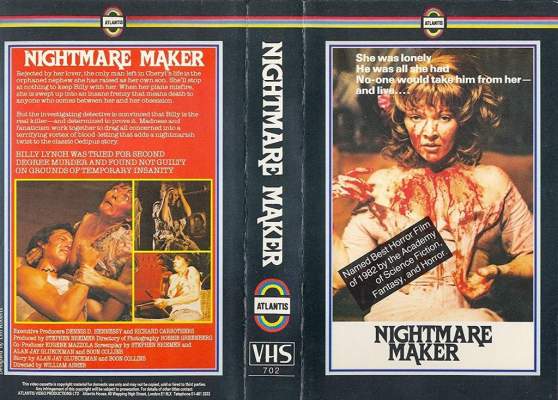
I tell you all this to set you up for one of the strangest films I’ve ever seen — imagine what that entails — and one that has stuck with me for years: Butcher, Baker, Nightmare Maker.
Originally, Michael Miller (Jackson County Jail) was set to direct this film. Still, he was replaced by Asher (he had also recently lost the job on The Eyes of Laura Mars to Irvin Kershner). He did direct the opening, however.
And what an opening it is!
Years ago, Billy (Jimmy McNichol, brother of Kristy, who is shirtless pretty much for the entire film) was sent to stay with his aunt Cheryl (Susan Tyrell, owning this movie like no one has ever owned a movie before). However, not only did their brakes give out, but a giant log beheads Billy’s dad, and the car goes off a cliff, where we see a photo of young Billy floating out into the water as the car explodes, floating, all of that, in the very first scene of the movie!
Now, Billy is a high school senior living with his aunt. He has a dream of playing basketball on a scholarship at the University of Denver, but Cheryl is having none of it. His school life isn’t much better, as his teammate Eddie (Bill Paxton!) is jealous of his closeness to their coach Tom Landers (Steve Eastin, Field of Dreams). But there’s a bright silver lining: the school’s newspaper photographer, Julia (Julia Duffy from TV’s Newhart), is into him.
On Billy’s seventeenth birthday, his aunt changes her mind about the scholarship just in time for her to put the moves on TV repairman Phil Brody (William Caskey Swaim, Friday the 13th: A New Beginning), who rebuffs her, only to then pull down his pants and tell her to “work it.” She flips out and attacks him, so he shoves her down. She retaliates with a kitchen knife as Billy watches from outside the window, as blood sprays all over his birthday balloons.
Cheryl hysterically tells the police that Phil tried to rape her. But his blood is all over Billy and so are the kid’s prints on the knife. That brings in Joe Carlson (a brutal Bo Svenson), whose homophobic mindset deduces that Billy’s coach Tom was his love and that Billy killed Phil — who was Tom’s lover — as part of a love triangle gone wrong. He thinks Cheryl is just covering up for her nephew when the truth is anything but that.
What follows is Cheryl going bonkers, doing all manner of things like drugging Billy’s milk so that his basketball tryout goes wrong and shearing her hair into an unmanageable chunk of a hairstyle. Oh yeah — she also treats her nephew way too lovingly, to the point that it’s uncomfortable. And then she goes completely insane when she catches Billy in bed with his new girlfriend.
Of course, by the end of the film, she’s nearly murdered that girlfriend twice, stabbed a noisy neighbor, killed a cop, and we discover that she’s really Billy’s mom and his birth father’s body is mummified in the basement while his head floats in a jar of formaldehyde.
Even after their final confrontation, Billy must deal with Joe the cop and his bigoted ways. To say that this movie builds to a fever pitch is an understatement. And I really don’t want to give all that much more away. Yes — even with those spoilers above, there’s so much more to explore here.
Nearly all of the major creative forces of this film came from places of personal pain. Asher lived through the Depression, losing his father before he was even a teenager. His mother (stage actress Lillian Bonner) became an alcoholic, so he escaped by way of the Army Signal Corps at the age of 15.
Screenwriter Alan Jay Glueckman (his script Russkies was made into a film directed by Halloween IIand Halloween: Resurrectiondirector Rick Rosenthal, plus he wrote two home invasion made for TV movies, The Fear Inside and Facemade-for-TVlus, his short film Pickup was the first film appearance of Glenn Close) continually wondered about who his birth parents were and had a tumultuous relationship with his adoptive ones due to their refusal to accept his homosexuality.
And Susan Tyrell, the heart of this film, was born into show business. Her father was a top agent at the William Morris Agency, representing Loretta Young and Carole Lombard. Yet she always described her proper upbringing as miserable, due to her demanding British mother, a socialite and member of the diplomatic corps in China and the Philippines during the 1930s and 1940s.
By her teenage years, Tyrell had cut off contact with her mother, of whom she would say, “The last thing my mother said to me was, “SuSu, your life is a celebration of everything that is cheap and tawdry.” I’ve always liked and I’ve always tried to live up to it.”
She stayed in contact with her father, who was able to use his connections to get her a bit part in a touring play with Art Carney, as well as have Look magazine follow the show. He’d die a few months later from a bee sting.
Even her Playbill obituary says that she specialized in roles like “whores, lushes and sexpots.” Perhaps her most famous role was in John Huston’s Fat City, which earned her an Academy Award nomination. She was also part of the Warhol Factory scene and appeared in numerous films. She appeared in various roles, including the Queen of the Sixth Dimension in Forbidden Zone, Solly in Angel and Avenging Angel, the miniature Midge Montana, wife to Kris Kristofferson’s ringmaster in Big Top Pee-Wee, and Ramona Ricketts, the grandmother to Johnny Depp in Cry-Baby.
What I’m saying is, this is a movie made by people who actually lived.
This movie has it all — malignant motherhood, a modern-day retelling of Oedipus, an inversion of a modern-day girl trope where Billy becomes the victim and Julia the helpful savior, and — strangely enough for a film made in 1981 — the homosexual characters are the positive characters in the story and not the monsters. In fact, Billy may be homosexual himself, if you chose to read the movie that way.
Of course, the movie was pretty much dead on arrival, thanks to a disastrous test screening and a new title, Night Warning, that says nothing about what the audience is about to see. It’s also a movie so strange that it seems to occupy its own universe, unlike any other film before or since. I can see why the general public wouldn’t enjoy it. In England, it made the infamous Category 2 video nasty list.
Basically, what I’m saying is rush out, find this and watch it. Now.
I’ve often said that I prefer Zombi 2to Dawn of the Dead — at least if I am looking for a more fun movie — because it skips the political allegory and gets right to the zombie splatter that I really want to see.
Burial Ground (also known as Le Notti del terrore, Nights of Terror, Zombi Horror, The Zombie Dead and most confusingly, Zombi 3) raises you that lack of Romero’s restraint and storytelling, doubles down by ripping off Fulci’s work which is in itself a ripoff (but a masterful one) and piles on the sleaze. No, really. This is a film that is ready to outright offend everyone.
The film starts with a professor accidentally unleashing an evil curse that reanimates the dead. He’s instantly killed. Meanwhile, three “jet-set couples” (I’ve heard them referred to this way several times and it always makes me laugh) and a creepy man child named Michael (who was played by Pietro Barzocchini, who was 25-years-old at the time…more on that soon) arrive at a nearby mansion, invited by the professor. We catch Evelyn (Mariangela Giordano, The Sect) stealing lingerie that she found in the mansion, to which her boyfriend James replies, “You look just like a little whore, but I like that in a girl.” At that point, that creepy manchild of hers, Michael, comes in and freaks out while his mom absentmindedly just stands there, nude.
It doesn’t take long before the dead attack. A maid is decapitated with a scythe because these living dead can use tools. Why are they more evolved than Romero or Fulci zombies? We never learn.
The zombies break into the mansion and attack everyone. This leads to that young creep, Michael, becoming totally shell-shocked. Evelyn, his mother, attempts to confront him, so he becomes to fondle her breasts. As he kisses her, he tries to get his hand between her legs. She slaps him as he runs away, shouting, “What’s wrong? I’m your son!” He runs right into one of the party guests, Leslie, who is now a zombie. Like a Fulci librarian, he stares at her as she makes her way toward him.
At this point, everyone reasons that they should just let the zombies into the house, because they are slow and it will allow them to escape. Sure. That always works. Evelyn goes to find her son, who has been killed by Leslie. She flips out and smashes Leslie’s head against a tub, screaming as loudly as possible, all the while.
Everyone runs toward a monastery, where the film decides to become a Blind Dead film. The zombie monks chase everyone to a workshop where they kill Mark with power tools. Creepy Michael has now become an even creepier zombie. Evelyn has lost her mind and thinks it’s a miracle, so she bares her breasts for her son to suck on. He replies by eating her breast off in graphic detail.
Finally, Janet is menaced by multiple zombie hands as the film ends with the Profecy of the Black Spider. Yes, that’s how they spell prophecy. “The earth shall tremble, graves shall open, they shall come among the living as messengers of death, and there shall be the nigths of terror.” And yes, they also spelled nights incorrectly.
Director Andrea Bianchi isn’t one for subtlety, which is evident in films like Strip Nude for Your Killer and Confessions of a Frustrated Housewife on his IMDB credits. Suppose you’re looking for unrepentant gore (Fulci’s through-the-door eye gouge is repeated here with a window). In that case, consider the bad special effects (the latex zombie heads are near Troll 2in their quality), the playing with guts and gore ala Blood Feast, and the total lack of storyline or sense. Then I’d advise you to watch this one.
This movie is ridiculous, but man, I love it. It’s the kind of film you can say, “But yeah, did you see Burial Ground? That one is totally insane.” And I love Berto Pisano’s atonal, goofy soundtrack that blares any time the zombies show up. But if you’re looking for a movie with any class, well, don’t say I didn’t warn you.
Here’s a drink to enjoy during this movie.
This Cocktail Smells of Death
1/2 oz. vodka
1/2 oz. rum
1/2 oz. apple schnapps
1/2 oz. blue curacao
1/2 oz. Chambord
1/2 oz. blueberry vodka
1/2 oz. orange juice
2 oz. cranberry juice
Frozen blueberries
Fill a glass a quarter of the way with frozen blueberries.
Combine all ingredients in a shaker and mix with ice, then pour over blueberries.
William Allen Castleman directed Johnny Firecloud and The Erotic Adventures of Zorro, as well as composed the music for The Swinging Cheerleaders, The Adult Version of Jekyll & Hide, the 1974 The Wrestler, The Big Bird Cage, Trader Hornee, The Ecstasies of Women, Thar She Blows!, Space Thing, Nude Django, The Lustful Turk, The Acid Eaters, Ski on the Wild Side, She Freak, The Defilers, The Devil’s Mistress, Starlet!, Trader Hornee, ‘Gator Bait and At the End of the Rainbow. He also produced 7 Into Snowy and Chorus Call, so he was busy.
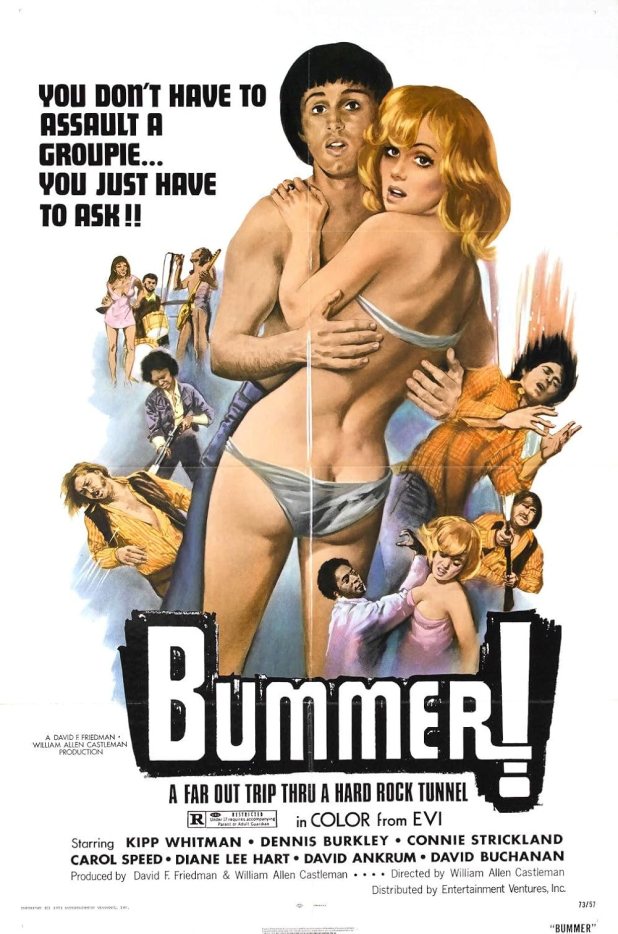
Written by Alvin L. Fast, who also wrote Moonshine Girls, Tom, Eaten Alive, Black Shampoo, Satan’s Cheerleaders and Angels’ Brigade, Bummer is about a rock band called The Group who are, well, out getting groupies. Their bass player, Butts (Dennis Burkley), goes nutzoid and starts killing people. First, he throws two of the girls in a shower and slaps them while calling them pigs. But you know, he owns the touring van. The limit comes when he kills people, starting with a groupie and the lead singer Duke (Kipp Whitman) before the other band aids get their revenge.
One of those girls is Carol Speed from Abby! Other ladies include Connie Strickland (The Centerfold Girls), who plays Barbara, the girlfriend of drummer Gary (David Buchanan); Dolly, who is Diane Lee Hart from The Pom-Pom Girls and Morely, The Group’s manager, who is Leslie McRay (Cleopatra in Death Race 2000).
Shot by Gary Graver, which makes this way better than it should be. It also has one of the most misogynistic taglines ever: ““You don’t have to rape a groupie… You just have to ask!”
David F. Friedman, the other producer, and Bob Cresse show up as cops at the end. As Herman Traeger, Friedman produced Ilsa and he was behind much of the soft core — and some hardcore — exploitation that made up the best of the form. Cresse wrote and produced most of those and shows up in them, often as a love camp commandant or as Granny Good in House On Bare Mountain. Cresse had a reputation for being tough, often carrying guns and with two bodyguards on his payroll. His career ended when he was walking his dog and saw two men beating a woman on Hollywood Boulevard. He pulled out a gun and ordered the men to stop. One of them said he was a cop and shot Cresse before killing his dog. The hospital stay that followed — he had no health insurance — ruined him.
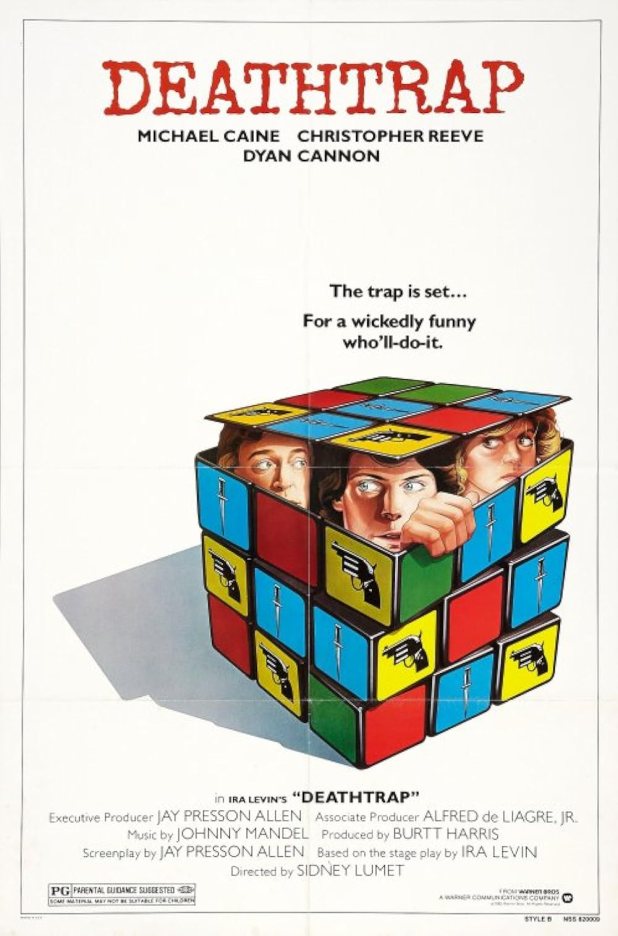
EDITOR’S NOTE: Deathtrap was on the CBS Late Movie on May 29, 1987.
I definitely watched this on HBO and ten-year-old me was scandalized by the plot twist.
Playwright Sidney Bruhl (Michael Caine) has another failed play and tells his wife, Myra (Dyan Cannon), that he plans on inviting over a student, Clifford Anderson (Christopher Reeve), who has a good script. Then, he plans on killing the man and making the story all his own. A few moments after Sidney gets Clifford into Houdini’s Handcuffs, the young man is dead and Sidney is trying to get Myra to help him hide the body. But is it all as it seems? And why is psychic Helga Ten Dorp (Irene Worth) warning about the man in boots?
I’m going spoiler-free for this movie, directed by Sidney Lumet and written by Jay Presson Allen. It was based on Ira Levin’s play, and there’s a twist not in the original: the reveal of a kiss between two of the characters. Some say that scene may have cost the movie money in the homophobic 70s. In fact, the TV version doesn’t have the kiss, and instead, one man rubs another’s face.
Also, Michael Caine already did Sleuth, and here he is, doing it again.
Originally a South Korean movie called Amelika bangmungaeg (also called Visitor of America), this was released in the U.S. by Aquarius Releasing with new dubbing, an incredibly insane poster of Bruce Lee emerging from a grave to defend a half nude woman and battle a flying bat baby as well as a new beginning filmed in the U.S. where lighting strikes the grave of Bruce Lee, who soon emerges, ready to fight. In an amazing display of absolute lunacy, that’s it. No more Bruce Lee.
No, instead, we follow Wong Han (Jun Chong, a judo master who used the name Bruce K. L. Lea; he’s the founder of the World United Martial Arts Organization (WUMAO); has trained Lorenzo Lamas, Sam J. Jones, Phillip and Simon Rhee, and Heather Graham; he also shows up in L.A. Street Fighters, Silent Assassins and Street Soldiers) as he makes his way to America to try and learn who killed his brother Han Ji-Hyeok.
Also, it appears that Wong’s brother died by jumping off his apartment building and is being incinerated in the furnace of the same building, which ends with Wong scooping up all the burned bones and placing them around his neck, along with a photo of the deceased and wandering the streets looking for answers. He’s then attacked by a man in black, whom he defeats and kills, which leads to his arrest.
Wong is bailed out by a wealthy man named Scott Lee and asked to find a woman named Susan (Deborah Dutch, Deep Jaws, 976-EVIL II), who ends up being a waitress. Lee’s decision to hire him is a mystery, given that he’s shown no ability to find the killers of his brother, so there’s no precedent for his detective skills. Anyways, he decides to help Susan and teaches her martial arts so quickly that she can fight nearly as well as he in mere days. She soon informs our hero that she learned from her job in Lee’s Turkish bathhouse that five men were involved in the death of his brother: the black man Wong has already battled, as well as a white man, a Japanese fighter, a Mexican and a cowboy. Given that there are about 4 million people in Los Angeles, finding them will be challenging. Then again, he didn’t see the killers yet and did find Susan, so he’s batting .500, which would get you in the hall of fame.
Then, our hero goes to a Christmas parade. Why? So the people there can look directly at the camera, and the filmmakers could shoot this without permits. Our hero is a peculiar individual who refuses to sleep in Susan’s house due to moral reasons. Consequently, she purchases an RV for him to sleep in outside her house.
Anyway, the cowboy is the last one standing, having killed the other killers before Wong, which means our hero and he will have to battle one-on-one. He fights like a pro wrestler, which I can appreciate, and then we learn that maybe Wong’s brother is still alive, as nearly everyone else dies. Yes, our hero can’t even protect the woman who helps him, choosing to do a fancy flying kick instead of just disarming the bad guy.
Directed by Lee Doo-yong and written by Hong Ji-Un, this movie is really something else. It’s not goo,d and yet I loved every moment. I kept thinking about the trailer and the poster and how they had to have led people to say, “Bruce Lee versus the black angel of death? How can I not watch this?”









 B&S About Movies
You must be logged in to post a comment.