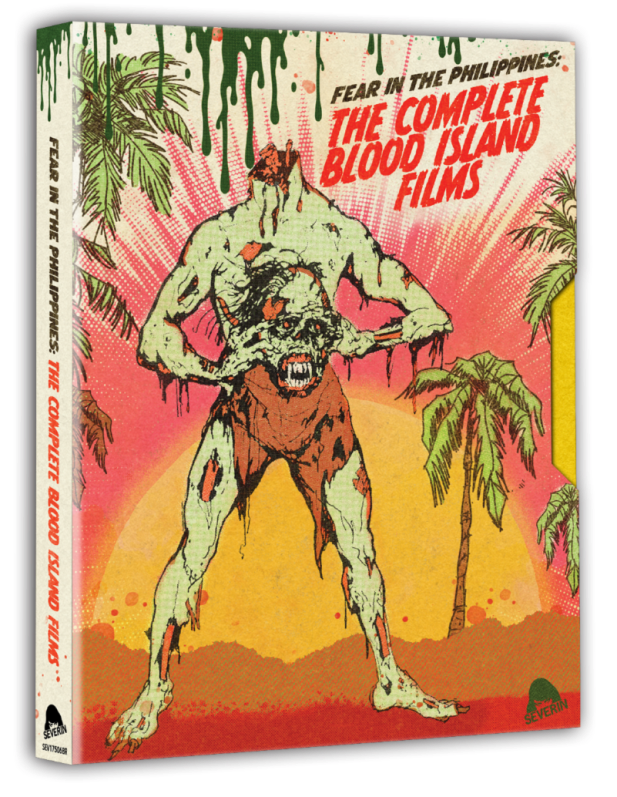
SEVERIN BOX SET RELEASE: Fear In the Philippines: The Complete Blood Island Films

From 1959 to 1971, Filipino filmmakers Eddie Romero and Gerry de León —along with Hemisphere Pictures marketing consultant Samuel M. Sherman—booked flights for drive-in audiences to Blood Island. This dark den of zombies, medical experiments, wanton women and terror would last four movies that fans of exploitation films have obsessed over ever since.

I’ve loved these movies ever since I first discovered them when Severin’s first re-releases came out a few years ago. I was so lucky to see many of them at the drive-in.

Now, Severin is re-releasing all of them – scanned uncut in 4K with improved color and audio plus over 8 combined hours of special features – in a new box set that you can get directly from the Severin Films Webstore.
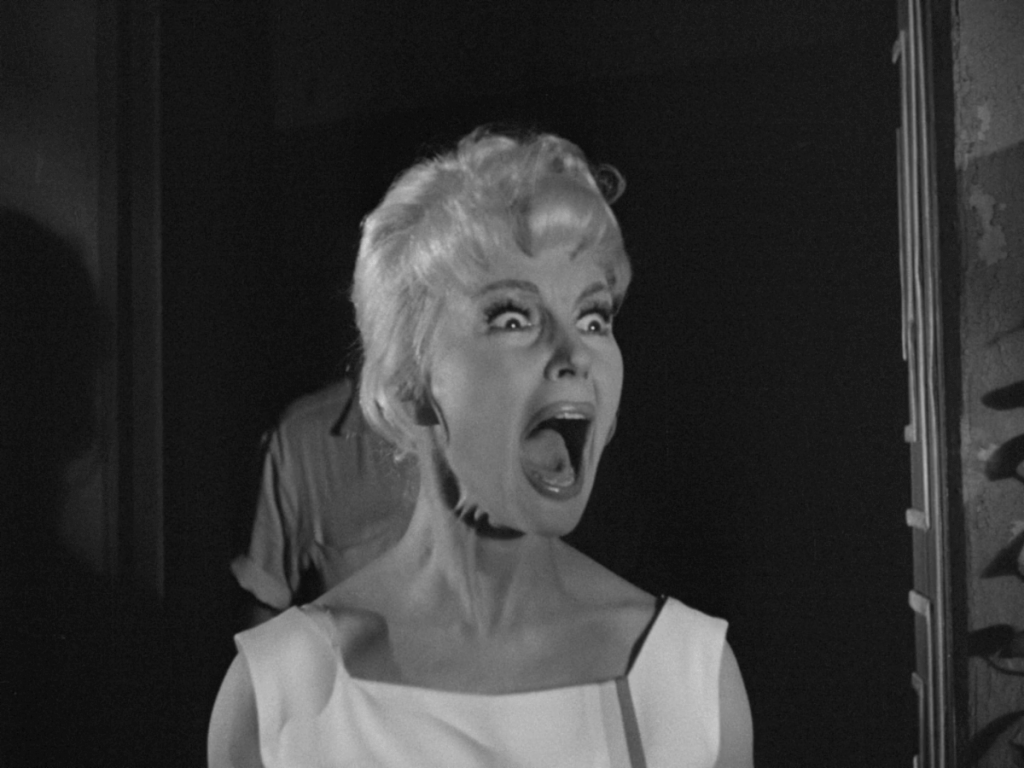
Terror Is a Man (1959): Call it Blood Creature, Creature from Blood Island, The Gory Creatures, Island of TerrorGore Creature, or its most well-known title, Terror Is a Man, but what you should really call it is the first of the Blood Island films. These movies, produced by Eddie Romero and Kane W. Lynn, include Brides of Blood, The Mad Doctor of Blood Island and Beast of Blood.  You can also consider The Blood Drinkers a Blood Island movie.

This movie was in theaters for nearly ten years—until 1969, when distributor Sam Sherman re-released it as Blood Creature with a warning bell that alerted the audience to impending gore.

William Fitzgerald (Richard Derr, who was almost The Shadow in a TV pilot that was turned into a movie called The Invisible Avenger) is the lone survivor of a ship that has crashed on Blood Island. Also, there are Dr. Girard (Francis Lederer, whose Simi Hills home is considered a landmark residence), his frustrated wife Frances (Greta Thyssen, who was in three of the Three Stooges shorts and Cottonpickin’ Chickenpickers) and his assistant Walter Perrera.

Much like The Island of Dr. Moreau, Girard is making half-man, half-animals like the panther he’s been experimenting on that tends to attack villagers. Of course, the doctor’s wife falls in love with the protagonist, and the beast gets loose and kills all sorts of people, including his creator. But hey — that mummy-like cat-eyed fiend seems to survive at the end, as a small island boy sends him away on a rowboat.

Gorgeous natives. Strong men. Crazy doctors. Werecats in bandages. Blood Island. Indeed, this one has it all.

The Severin release includes extras such as interviews with Samuel M. Sherman, co-director Eddie Romero, Pete Tombs (co-author of Of Immoral Tales), and critic Mark Holcomb, a trailer, and a poster and still gallery.

Brides of Blood (1968): This movie, which was originally known as Island of Living Horror, was rereleased with Count Dracula’s Great Love. The former was retitled Cemetery Girls and the latter was renamed Grave Desires.

Much like all of these Filipino horror films, it’s completely bonkers.

The tropics are the place for three Americans to find, well, complete insanity.

Dr. Paul Henderson, a nuclear scientist investigating nuclear bomb tests, is played by Kent Taylor. He was once a major star, playing the title role in fifty-eight Boston Blackie movies. His name is also half the inspiration for Superman’s alter ego (the other star is Clark Gable).

He’s married to the gorgeous but always ready-to-cuckold Carla, Beverly Powers. Beverly was once the highest-paid exotic dancer in the world before becoming an actress and starring with Elvis in SpeedwayKissin’ Cousins and Viva Las Vegas. She also pretty much played herself in Breakfast at Tiffany’s. After all that acting, she became a minister with The Living Ministry in Maui, Hawaii.

Then there’s Jim Farrell, a young Peace Corps member played by John Ashley. Ashley was an AIP star who appeared in Dragstrip Girl and sang his song “Let Yourself Go Go Go” in Zero Hour! He was also a regular in their beach movies, appearing at Beach PartyMuscle Beach PartyBikini BeachBeach Blanket Bingo, and How to Stuff a Wild Bikini.

After living in Oklahoma for a while, Ashley produced these movies with Hemisphere Pictures, living in the Philippines for part of the year and helping to create these little bits of madness.

Our protagonists soon learn that Blood Island is cursed. It’s now a place that has been irradiated by nuclear fallout from those bomb tests, with vines that attack people and butterflies that bite. There’s also a beast in the jungle that tears women apart to get off because, hey, why not?

Carla learns that the beast is one of the villagers, Esteban, but it comes at the price of her own life. She’s an early “sex and people who want sex must be destroyed” casualty decades before this type of destruction de rigeur.

Between carnivorous trees eating Carla’s remains and the movie ending in a vast orgy, this is probably unlike any other film you’ve seen before. You can say that about every single film from this studio.

The press book for the movie suggested that all female theatergoers would get the chance to become Brides of Blood and receive a free engagement ring. There was even the idea of giving away fake marriage certificates, but legal concerns prevented that.

Extras on the Severin release include commentary from  Samuel M. Sherman; interviews with co-director Eddie Romero, Sherman and Beverly Powers; the alternate Brides of Blood Island title sequence and a Jungle Fury title card; a teaser; a trailer and a poster and still gallery.
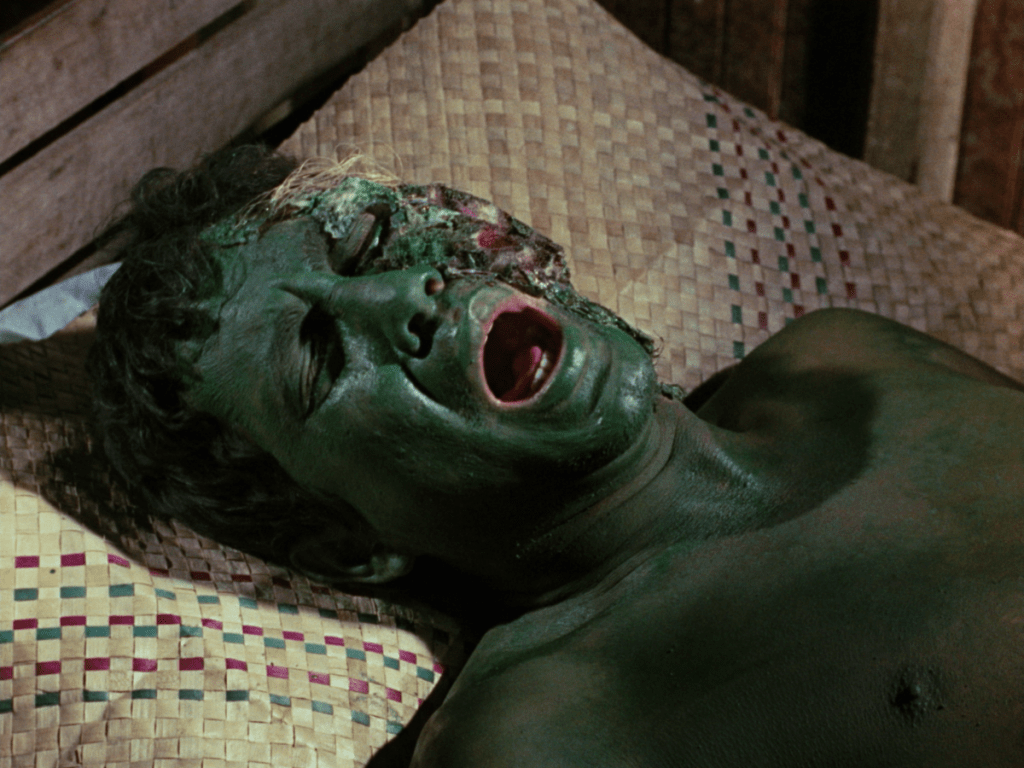
Mad Doctor of Blood Island (1969): We’re back ten years after we first got to Blood Island. Eddie Romero and Gerardo de Leon have returned in the directing chair, and this time, they’ve brought even more blood, beasts and boobs than they did in their last effort, Brides of Blood.

This film was syndicated to TV as Tomb of the Living Dead and is also known as The Mad Doctor of Crimson Island because, in some states, like Rhode Island, the word “blood” wasn’t allowed in movie advertising.

After Brides of Blood, John Ashley discovered that the film was so well-received that distributors asked him to make more. He moved to the Philippines and got to work.

The film starts with an initiation, as at some theaters, you are given a packet of green liquid and asked to recite the oath of green blood so that you can watch the unnatural green-blooded ones without fear of contamination. Years later, Sam Sherman said that he came up with this idea, and he got incredibly sick when he drank one of the packets. The film’s other gimmick is rapidly zoomed in and out, like Fulci on speed, whenever a monster appears. That was to cover the harmful special effects, but it made plenty of theatergoers sick. Man — destructive green liquid and frequent pans and zooms. It’s as if they wanted kids to puke!

A woman runs naked through a jungle before a green-skinned monster kills her. Yes, that’s how you start a movie!

Then we meet our heroes, like pathologist Dr. Bill Foster (Ashley), Sheila Willard (Angelique Pettyjohn, who was famously in the Star Trek episode “The Gamesters of Triskelion” and early 80s hardcore films like Titillation, Stalag 69 and Body Talk) and Carlos Lopez (Ronaldo Valdez, who would become the first Filipino Kentucky Fried Chicken Colonel).

The ship’s captain, who got them there, tells them how the island is cursed and how its people bleed green blood. Everything falls apart — Sheila’s dad, who she hoped to take home, is now a drunk. And Carlos’ mother refuses to leave, even after the mysterious death of her husband.

It turns out that Dr. Lorca has been experimenting on the natives, who just want to be healthy. Instead, they’re becoming green beasts that murder everything they can. Look out, everyone! I hope you’ve drunk your green blood before this all began!

Angelique Pettyjohn claimed that the love scene with John Ashley was not simulated. Seeing how Severin finally found the uncut film, and I haven’t seen any penetration, I think she’s full of it. But who am I to doubt her?

To make this even better, the American trailer of this is narrated by Brother Theodore!

Extras on the Severin release include commentary by Nathaniel Thompson and Howard S. Berger and a second commentary with Samuel M. Sherman; interviews with Pete Tombs, Mark Holcomb and Eddie Romero; a trailer and a poster and still gallery.
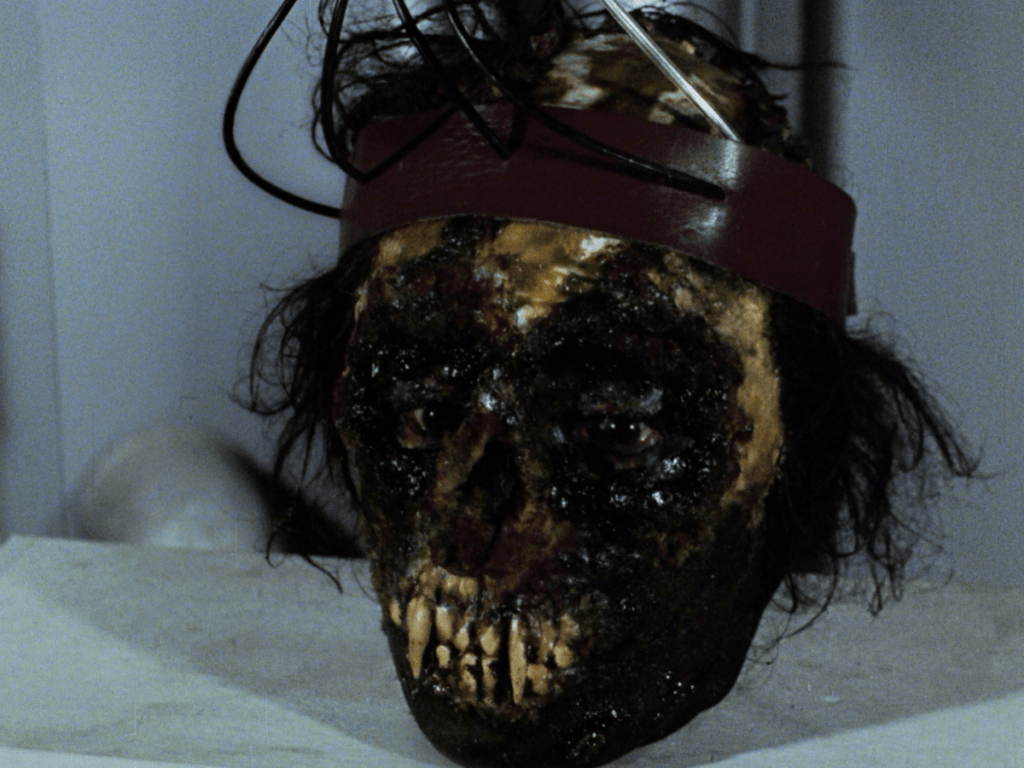
Beast of Blood (1970): All good things must end. This is the final of the Blood Island films and the last movie that Eddie Romero would make for Hemisphere Pictures.

As Dr. Bill Foster (John Ashley), Sheila Willard, her father and Carlos Lopez escape from Blood Island, this movie’s Beast gets on board and goes buck wild, killing everyone he can and blowing up the ship. He survives and heads back to the jungle while Dr. Foster spends months recovering. Everyone he knew or loved is now dead.

Of course, he’s going back to Blood Island.

Dr. Lorca (Eddie Garcia), who apparently died at the end of the last movie, is still alive but horribly scarred. He controls the beast, which can live without its head and even talk and control its own body from afar.

This is less of a narrative movie for me and more a collection of magical images, as bodies squirt blood and beasts have swampy faces and make strange noises while their heads rot inside beakers and lab equipment.

To promote this one, which played a double bill with Curse of the Vampires, the producers printed counterfeit 10 bills that folded in half, with the other side revealing a poster for the film. Those fake sawbucks were scattered all around the neighborhoods where this movie played.

Extras on the Severin release include commentary by Samuel M. Sherman, interviews with Celeste Yarnall and Eddie Garcia; a Super 8 digest version; a trailer; a radio spot and a poster and a still gallery.

Body Chemistry II: The Voice of a Stranger (1992)

Yes, I did watch Body Chemistry 3 and then Body Chemistry 2, while never seeing the first movie, in which Dr. Claire Archer (Lisa Pescia) teaches a man named Tom (Marc Singer) what it’s like to go from The Beastmaster to The Beastbottom. Sure, she’s cosplaying as Alex Forrest, but this is a cheap Concorde cash-in, and you may already know how much I love those.

Pescia returned as the good doctor for the second film and became a radio show host in a small southwestern town. She’s here to replace shock psychologist jock Dr. Edwards (John Landis), who fights with every caller. Her boss? Big Chuck (Morton Downey Jr.). And her real goal? I want to get with former LAPD officer Dan Pearson (Gregory Harrison, former Dr. Gonzo Gates on Trapper John M.D.) despite him reconnecting with high school love Brenda (Robin Riker, Alligator). He’s keeping a secret that he’s been kicked off the most violent police force in the world because he was too brutal, as well as the fact that he was sexually assaulted as a child — or maybe he just saw his dad treating a woman like he was Rocco Siffredi — which makes him crave rough sex as an adult. Are you coming to an erotic thriller for an authentic examination of how people are imprinted with their sexual desires? Or are you here to see bare breasts? Good news. American Emmanuelle Monique Gabrielle shows up and shows out.

For the ladies? Clint Howard as a criminal and Jeremy Piven as a small-town police officer.

Director Adam Simon almost made the first film but chose Brain Dead instead. He also directed Carnosaur and created the TV show Salem. The script was written by Jack Canson (who used the same stage name, Jackson Barr, to write the first movie, Subspecies, Trancers II, Bad Channels and Mandroid) and Christopher Wooden (Kiss Me a Killer, Dinosaur Island).

Why should you spend time watching this? Former “Zip it!” talk show host Downey Jr. is handcuffed, forced to wear a wig and forcibly taken against the glass of a radio studio until he has a heart attack. I didn’t see that one coming.

You can watch this on Tubi.

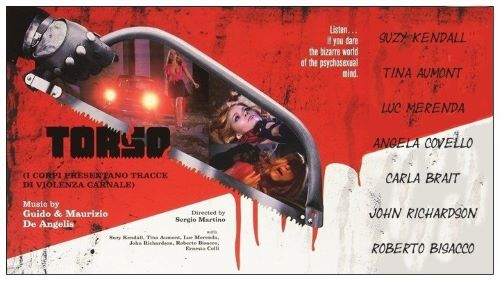
Cinematic Void January Giallo 2025: Torso (1973)

EDITOR’S NOTE: Cinematic Void will be playing this tonight at 7 p.m. at the Sie Film Center in Denver, CO. (tickets here). It will be hosted by Theresa Mercado with very special co-host James Branscome of Cinematic Void. For more information, visit Cinematic Void.

Torso is such a simple title. I’d rather call this film by its Italian name: I Corpi Presentano Tracce di Violenza Carnale, or The Bodies Bear Traces of Carnal Violence. Either way, it was directed by Sergio Martino and features none of the cast that he had come to use in his past films like George Hilton, Ivan Rassimov or Edwige Fenech.

It does, however, star Brtish actress Suzy Kendall, who played the lead role of Julia in Dario Argento’s seminal The Bird with the Crystal Plumage. She’s so associated with giallo that she appeared as the main character’s mother in 2012’s ode to the genre, Berberian Sound Studio.

This is a film that wastes no time being strange. Or salacious. A photographer is shooting a soft focus lovemaking session between three women amongst creepy, eyeless baby dolls. By the time we register what is happening, we’re now in a classroom, where swooping pans and zooms refer us to the main cast of the film as we overhear a lecture and later a discussion about Pietro Perugino’s painting of Saint Sebastian. Did he believe in God? Or was he just trying to sell sentimentality? Could an atheist find himself able to translate religion to those with faith?

We cut to a couple making out in a car as a figure stalks them through the eye of the camera, making us complicit in the act of the killer. Quick cuts reveal the white-masked face of this maniac. The man runs after him while the girl doesn’t even care that they had a voyeur watching. As she waits for him to return to the car, but grows impatient. The headlights of the car cast her shadow large across the columns of a bridge. And their light is quickly extinguished by black-gloved hands. The camerawork here is really striking, keeping us watching for the killer, as we’re no longer behind his eyes. His attack is swift and ruthless, juxtaposed against the images of fingers penetrating the eyes of a doll.

The art professor (John Richardson, Black Sunday, The Church) and Jane (Kendall) meet by chance at a church where she challenges him to change his views on Perugino. As she returns from their somewhat romantic afternoon, Jane spies her friend Carol arguing in the car with a man who she believes is married.

Meanwhile, ladies of the evening walk the street, ending up with Stefano, a student who has been stalking Julie. He has trouble performing and the prostitute he’s with tells him that all the men with hang-ups always come her way. That said — even if he’s queer, he better pay the money. He flips out and attacks her, but she makes her escape.

We’re then taken to a hippy party that looks like it’s taking place inside Edward Lionheart’s Theater of Blood. There’s weed, there are acoustic guitars, there are bongos, there are dudes with neckerchiefs, there are motorcycles. Truly, there’s something for everyone. But after leading on two men, Carol just walks out into the mud. They try and chase her, but she makes her escape into the foggy night. We hear her footsteps through the swamp as she walks, exhausted and covered in mud. What better time for our white-masked killer to return? We see glimpses of him through the fog and then he is gone. Whereas in past films Martino ignored the murder scenes instead of story, here the violence is extended, placing the killer and his actions in full view. After killing the girl, he rubs mud all over her body before stabbing her eyes — again intercut with the baby doll imagery. Her blood leaks into the mud as the score dies down.

This scene really feels like what the first two Friday the 13th movies were trying to achieve, but of course several years before they were made.

A police detective is in front of the art class, showing images not of art, but of the crime scene. A piece of cloth has been found under the fingernails of one of the murdered students, Flo. And that same scarf was found on Carol’s body. It’s their duty to report seeing anyone who wore this scarf to the police, who want to cooperate with the students who normally riot and throw rocks at them.

Two of the men in the class — Peter and George — were the last two people to be seen with Carol, the ones who she turned down at the party. Meanwhile, Stefano continues to stalk Jane. The music in this film is so forward-leaning — tones play when the killer shows or during moments of tension.

A man calls Daniela and tells her that if she ever tells where she saw the red and black scarf, she’s dead. Fearing for her life, she tells her uncle, who lends his country home to her and her friends so that they can get away from the city while the killer is at large.

Oh yeah — I forgot the pervy scarf salesman, who the police are leaning on. Right after talking to the police inspector, he calls someone and asks for money to buy his silence. Whoever it is, they bought the scarf from him and wouldn’t want anyone else to know. They’ll also get out of town and head to the country. Coincidence? I think not!

Stefano is all over Dani, telling her that he needs her. She wants nothing to do with him. When she stares at him, she remembers seeing him wear the red scarf. She escapes — slamming the door in his face. She tells Jane that she remembers seeing him wear the scarf — and never again — the day Flo died. The whole time, the creepy uncle is watching the two girls. Jane offers to speak to Stefano, then meet the girls at the vacation home.

The street vendor is flush with cash, creeping along in the dark. A car starts to follow him. We see the black-gloved hands again as the car hits its victim again and again, bright red gore pouring all over the screen.

Jane goes to speak to Stefano, finding only strange baby dolls and letters to Dani asking her to love him and remember the promise that she made as a little girl. Jane is surprised by Stefano’s grandmother, who tells her that he left town.

The other girls are asleep on the train as someone watches them. A strange man enters their train car and sits down.

The camerawork in this movie feels as predatory as the perverts and killers that exist within it. Speaking of pervs, when the girls arrive in the countryside, the local men pretty much lose their minds, particularly over Ursula (Carla Brait, the man wrestling dancer from The Case of the Bloody Iris). She and Katia make out as a peeping tom watches, only for the killer to show up and off the leering man. There’s an amazing scene of the killer dumping the pervert into a well, shot underwater and staring upward as the body falls toward the lens.

Man, every man in this movie is scum. They’re either frightened boys or perverts wanting one chance to knock up a woman or scarred from past sexual encounters. None of them are positive, as even the uncle who gives Dani the villa seems way too interested in her. Every man is a predator at worst and a leering pervert at best.

Jane hurts her ankle when she gets overly excited about breakfast. A doctor arrives — the mysterious man from the train — and he gives her a pill, which knocks her out.

The girls go sunbathing while Jane recovers. Dani thinks she sees Stefano — complete with the red scarf — watching them. They return home and drink champagne, which Jane uses to wash down her sleeping pills.

A few minutes later, the door rings. It’s Stefano — the girls all scream — but he’s dead — the girls scream again — and the killer is behind him, holding the red scarf — now scream even louder! Instead of showing us the murders, Martino switches form, cutting to a ringing bell and Stefano being buried.

Jane wakes up, asking where her breakfast is. She’s obviously slept late as a result of the pills. She walks around the apartment, looking for Dani, Ursula and Katia, only to find a mess. Tossed chairs, bottles of beer and every single one of her friends murdered. Suzy Kendall is amazing in this scene, caught between fear and nausea. Unlike so many wooden giallo performances, she’s actually believable.

She hides as the killer comes back, forced to stay quiet and watch as he saws her friends into pieces. Even the ordinary world routine of the milkman arriving cannot stop the butchering of her friends, with her trapped just feet away.

This final act is completely unexpected, as up until now, the film had played by the rules of the giallo, the large number of victims versus a large number of red herrings.

In fact, this film is so packed with red herrings, even the cast had no idea who the killer was. Martino wouldn’t tell them who it was, so each of the actresses had her own theory as to who the killer was. And in the original script, the killer survived.

Now, instead of that traditional giallo structure as I mentioned above, it is the last survivor — a near prototype for the final girl — against a killer. Throw in that Julie can’t move well due to her leg and Martino has set up quite the suspenseful coda.

Trapped in the house, Julie tries to signal with a mirror, using Morse code. But it totally misses the heroic doctor’s sight. He places a call, but it doesn’t seem like it’s to Julie. She looks out the window and sees the killer coming back.

It turns out that the killer was the professor, who saw a childhood friend die trying to reach for a doll. He compares the other kills to dolls, with only Julie as a flesh and blood person. Everyone else was a bitch or played games with him or blackmailed him. He hacked Ursula and Katia to pieces like dolls as a result. Dani saw him. Carol may have seen him. And he killed Stefano when he saw him in the village. Death, he says, is the best keeper of secrets and then he sees Julie as a doll and tries to hang her. She’s saved at the last second by the doctor.

They battle into a farmhouse, across the yard and to a similar rock where we saw the younger professor watch his friend die. We hear a screen and have no idea who has been killed — but luckily for Jane, the doctor survives.  He discusses whether fate or providence had kept him in town, where he could save her. Perhaps it was written in the stars. Julie replies that Franz, the professor, would have been a realist and called it a necessity. Franz is dead and the dreamers live on.

The more times that I’ve watched this film, the more that I appreciate it and how it flips the genre conventions on their head and moves toward more of a slasher, with many of the giallo elements feeling tacked on somewhat to stay within the expected pieces of the form. A real clue that it’s really a slasher? The killings are more important than who the killer is.

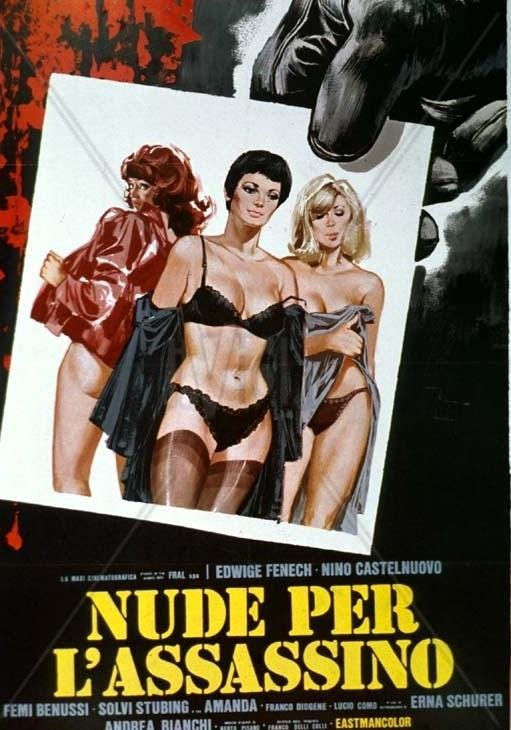
Cinematic Void January Giallo 2025: Strip Nude for Your Killer (1975)

EDITOR’S NOTE: Cinematic Void will play this Saturday, Jan. 4 at 7:00 p.m. at Central Cinema, Knoxville, TN with The Psychic (tickets here). It’s also playing on Friday, Jan. 24 at midnight at The Belcourt Theatre in  Nashville, TN (tickets here). For more information, visit Cinematic Void

When a movie starts with a fashion model dying during a back alley abortion and it being covered up as a drowning, all before the opening credits, you know that you’re in for something demented. When you realize that the film was written and directed by Andrea Bianchi, who brought us Burial Ground, you will either run screaming or sit down and pay attention.

The doctor who performed the operation is killed by a maniac in a motorcycle suit, but nobody at the Albatross Modeling Agency cares. All Carlo, the head photographer, cares about is using his modeling connections to pick up women. That’s how he meets Lucia (Femi Benussi, Hatchet for the Honeymoon), whom he takes from the steam room to the modeling agency.

Magda (Edwige Fenech looks better than I’ve ever seen her look in any movie) is jealous, so she surprises Carlo with some black lace, and they begin an affair. We then see a photo of the main agency members, like Mario, Magda, Carlo, Stefano, Dorris, Maurizio and his wife, and the owner of the studio, Gisella. There’s one other person in the photo—Evelyn, who we saw die in the beginning.

Mario heads home, and the killer shows up. When their helmet is removed, Mario knows the killer. But it’s too late. He’s dead now. The killer takes the photo so that they have a checklist of who to kill.

So then there’s Maurizio, who is cheating on his wife with a prostitute. He takes her on a crazy ride through the streets and then takes her back to his place, where he begs and threatens her life before she suddenly wants to have sex with him — because, you know, that’s how things worked in the 1970s — before he lasts all of a minute and starts embracing his blow up doll. Honestly, what the fuck? Of course, he’s killed right afterward. Good riddance.

Carlo later witnesses Gisella being murdered and even photographs the attack, but he’s hurt in a hit-and-run accident. While he’s recovering, Magda develops the film, but the killer ruins the negatives.

After killing Doris and Stefano, the murderer tries to kill Carlo and Magda, but the killer is knocked down the stairs. So who is it? New model Patrizia — Evelyn’s sister — blames him for her sister’s death. However, she dies before she can tell the police of his involvement.

The movie ends with Carlo playing around by mock choking Magda before initiating anal sex with her, as she tells him not to, in a scene meant as a comedy but lost in translation and the fact that forty-plus-year-old Giallo could never anticipate the #metoo movement.

The title of this film says it all. It’s the most nudity I’ve ever seen in a movie. And it’s one of the most lurid I’ve seen, too. I do not know if Bianchi intended this as a comedy, but it feels like one.

It’s almost incredible that a movie with this much nudity and mayhem moves at a glacial pace. It felt like the film’s first hour was the entire running time and contained wall-to-wall misogyny. I know, I know, that’s the majority of Giallo, but it feels so overwhelming and alien when seen with today’s eyes. I mean, should I be shocked that a movie called Strip Nude for Your Killer is so sexist? And why do I love it so much? Maybe it’s because Edwige Fenech makes me watch anything that she is in.

Cinematic Void January Giallo 2025: The Psychic (1977)

EDITOR’S NOTE: Cinematic Void will be playing this on Saturday, Jan. 4 at 7:00 p.m. at Central Cinema, Knoxville, TN with Strip Nude for Your Killer (tickets here). For more information, visit Cinematic Void

Before Fulci became known as the godfather of gore, he made movies in nearly every genre. This is the next to last film he’d make — Silver Saddle follows it in 1978 — before 1979’s Zombie announced to the world that he was here to tear eyeballs, unleash bats and provide dazzling if incomprehensible odes to mayhem.

Fulci is no stranger to the Giallo, with some of his most important films being A Lizard in a Woman’s Skin and Don’t Torture a Duckling and the unappreciated Perversion Story. The title refers to the film’s exploration of the duality of human nature, a theme that Fulci often revisits in his work. Here, he’d team up again with writer Roberto Gianviti and begin his long partnership with writer Dardano Sacchetti, who sought to lend a touch of Argento to the original script’s traditional mystery.

What emerged was a film shrouded in mystery and darkness—a rumination where death is inescapable and always close, a world where doom hangs over every moment, captivating the audience with its enigmatic atmosphere.

The film is set in Dover, England, in 1959, a time of social change and upheaval. A woman commits suicide by literally diving from the Cliffs of Dover. Forgive the harmful effects — Fulci tends to use wooden bodies in his films for some reason, much like the end of Duckling. The main point is that her daughter Virginia may be living in Italy, but she can clearly see her mother’s day.

Today, Virginia (Jennifer O’Neill, Scanners) lives in Rome and is married to a wealthy businessman named Francesco (Gianni Garko, Sartana himself!). As she drives him to the airport for his next business trip, she begins to see visions. An older woman is being killed. A wall is torn down. And a letter is under a statue. How strange is it that the house she is beginning to renovate looks precisely like the one in her visions?

When she tears down the wall that looks like the one in her dreams, she finds the skeleton of her husband’s ex-lover and the police want to charge him with the murder. Virginia becomes the detective of the story, obsessed with saving her husband with the help of psychic researcher Luca Fattori. Soon, they believe that the real killer is Emilio Rospini (Gabriele Ferzetti, On Her Majesty’s Secret Service).

So who is the woman? Why was her body in that room, which was once her husband’s bedroom? Why is the woman’s face on the cover of the magazine that Virginia buys? That’s because Virginia’s visions aren’t the past but premonitions of the future.

Meanwhile, she’s given a wristwatch that plays a haunting theme every hour in the house. This eerie soundtrack, composed by Fabio Frizzi, adds a layer of suspense and tension to the film and was reused to incredible effect in Kill Bill. The growing knowledge that the victim isn’t dead yet—and that Virginia may be that victim—darkens every frame of Fulci’s epic.

Quentin Tarantino was so in love with this film that he intended to remake it with Bridget Fonda sometime in the 2000s, but this never happened.

Perhaps just as interesting as the film is the life of its star, Jennifer O’Neill. Possibly best known for her long career as a Cover Girl model, she has been married nine times to eight husbands (she married, divorced, and remarried her sixth husband, Richard Alan Brown). By the age of 17, she’d already attempted suicide so as not to be separated from her dog, had a horse break her neck in three places and married her first husband. She’s also had a horrible history with guns, having accidentally shot herself in 1982 and being on the set of the TV show Cover Up in 1984 when co-star Jon-Erik Hexum accidentally killed himself. While waiting for a delay, he had been playing Russian roulette with a prop gun and was unaware that the discharge could still cause damage. Placing the gun to his temple, he fired and caused so much damage to his brain that he died six days later.

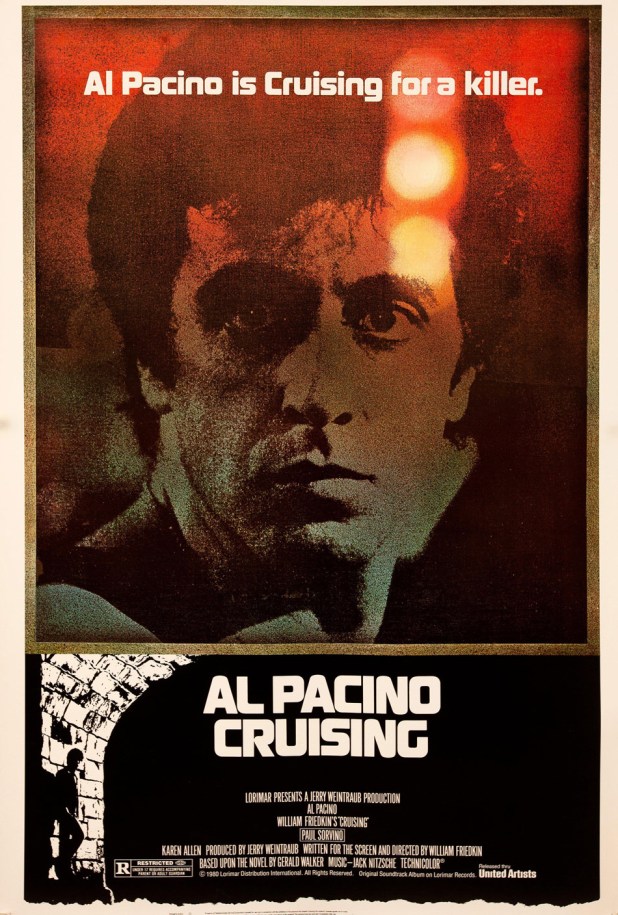
Cinematic Void January Giallo 2025: Cruising (1980)

EDITOR’S NOTE: Cinematic Void will be playing on Saturday, January 4, at midnight at the Little Theater in Rochester, NY (tickets here) and Friday, January 17, at 7:30 PM at the Little Theater in Rochester, NY (tickets here). For more information, visit Cinematic Void

Despite being approached several times with New York Times reporter Gerald Walker’s 1970 novel Cruising, William Friedkin (The Exorcist, Sorcerer and perhaps not as successfully, Jade) wasn’t interested. He changed his mind after an unsolved series of murders in New York’s leather bars.

Articles by Village Voice journalist Arthur Bell and NYPD officer Randy Jurgensen helped inform this film. The latter went into the same deep cover as this film’s protagonist, Steve Burns. Then, Friedkin learned that Paul Bateson, a doctor’s assistant who appeared in The Exorcist, had been implicated in the crimes while serving a sentence for another murder.

Friedkin did some of his research for the film by attending gay bars dressed in only a jockstrap, but by the time the movie began filming, he had been barred from two of the most oversized bars, the Mine Shaft and Eagle’s Nest, due to the controversy surrounding the movie.

Much like The New York Ripper and God Told Me To, this movie feels like one set at the end of the world — New York City near the close of the 20th century. Someone is picking up gay men, murdering them and leaving their body parts in the Hudson.

Officer Steve Burns (Al Pacino)—exactly the type of man the killer has been after—is on the case. Captain Edelson (Paul Sorvino) has assigned him to infiltrate the foreign world of S&M and leather bars. But as the case progresses, he begins to lose himself and his relationship with Nancy (Karen Allen).

Soon, he learns of just how brutal the NYPD is to gay men — even if they’re just suspects. And he finds himself growing closer to his neighbor Ted (Don Scardino, Squirm).

By the end, nothing is truly clear. While the killer may be Stuart Richards, a schizophrenic who attacks Burns with a knife in Morningside Park, it could also be Ted’s angry boyfriend Gregory (James Remar). After all, Ted’s mutilated body is discovered while Stuart is in custody. Or the real killer is still out there — perhaps he’s even a patrol cop (Joe Spinell). The truth is never told.

Spinell is incredible in this, which is no surprise. He used his real life for inspiration, as there’s a line about his wife, Jean Jennings, leaving him and moving to Florida with his daughter. His wife had just done exactly that before this movie was shot.

The actual version of this movie may never be released. Friedkin claims it took fifty rounds to get the MPAA to award the film an R rating. Over 40 minutes of footage was cut, which consisted of time spent in gay bars. The director claims that these scenes showed “the most graphic homosexuality with Pacino watching and with the intimation that he may have been participating.”

This footage also creates another suspect — Burns himself may have become a killer.

When Friedkin sought to restore the missing footage for the film’s DVD release, he discovered that United Artists no longer had it and may have even destroyed all the cut footage.

In 2013, James Franco and Travis Mathews released Interior. Leather Bar is a metafictionalized account of the two filmmakers’ attempts to recreate the lost 40 minutes of Cruising.

There’s a disclaimer at the start that says, “This film is not intended as an indictment of the homosexual world. It is set in one small segment of that world, which is not meant to be representative of the whole.” Years later, Friedkin would claim that MPAA and United Artists required this, hoping that it would absolve them of the controversy that had been all over this production.

That’s because protests had started at the urging of gay journalist Arthur Bell, the aforementioned Village Voice writer whose series of articles on the Doodler’s killing of gay men inspired this movie. There were numerous disruptions to the filming, as protesters blasted music and loud noises at all filming locations, leading to hours of ADR to fix the ruined dialogue.

Body of Evidence (1993)

Directed by Uli Edel and written by Brad Mirman (who scripted and produced another American Giallo, Knight Moves), Body of Evidence was yet one more attempt for Madonna to find the screen success that she had in Desperately Seeking Susan as a lead and not a supporting character. But just like Shanghai Surprise, Who’s That Girl — ¿Quién es esa niña? — and Bloodhounds of Broadway, this was critically decimated, and audiences tuned out after the first week in theaters. Strangely, it was released in Japan along with another Madonna movie, the Abel Ferrara-directed Dangerous Game, as Body and Body II. And it’s totally a Giallo by way of the erotic thriller. I mean, if Madonna had someone with black gloves and a knife stalking her, I might lose my mind. There’s still time to make this happen.The Material Girl is Rebecca Carlson, a woman who has led two older men to the brink of the Pearly Gates thanks to her abilities in bed. And maybe some cocaine. But totally because her vagina is Kali, goddess of destruction in labia majora and minora form.

As she proclaims her innocence, Frank Dulaney (Willem Dafoe) becomes her lawyer. There’s no way that she killed Andrew Marsh (Michael Forest), just as there’s no way she could have shtupped Jeffrey Roston (Frank Langella) to the point that he feared for his life. As for Frank, despite being married to Sharon (Julianne Moore, who regrets this movie and the nude scenes she did), reacts to everything Rebecca does as if he’s a wolf in a Tex Avery cartoon. It’s shocking — if this movie is shocking at all, mind you — that no one says, “Frank, put away your dick.”

But he doesn’t, and she restrains him and pours candle wax all over him, which was shocking in 1993, as would be public sex and handjobs on elevators surrounded by people.

Everyone wants Rebecca, which would have been the title for this in the 1940s — and it wouldn’t have that handjob scene — because, well, everyone does. Like Dr. Alan Paley (Jürgen Prochnow), who was trying to get her into bed and instead testifies that she tried to kill his patient when she turned him down. All this court testimony makes Frank think that maybe Rebecca isn’t the pure girl who scalded his balls just a few weeks ago with a Yankee Candle.

Even though Frank can get two big wins — secretary Joanne Braslow (Anne Archer) probably gave the old man, the coke and surprise witness Jeffrey Roston is really gay, which broke Rebecca’s heart — before she gets off. I mean, she gets off the charges, not gets off as she does throughout the movie, like when Frank finally tackles her and handcuffs her like he’s Michael Douglas instead of the Green Goblin.

At the end of the case, she whispers in his ear that she did it. Defense lawyer Robert Garrett (Joe Mantegna) looks super sad, as does Frank, who follows her home — his marriage is over — and learns that she’d be sleeping with Paley as well; he deals with this news by shooting Rebecca twice and knocks her out a window, just in case we need to totally have proof that this evil woman, this seductress, this jezebel, has med her Hayes Code death. Should a car drive her over, and then someone asks if she’s really dead, followed by graphic footage of her body evacuating itself of feces? She’s dead. Real dead.

Frank goes to fix his marriage and tells Garrett he should have won. Instead of being calm, he replies, “I did.” Dude, Madonna is dead. You don’t have to rub it on a man who played Max Schreck and Jesus Christ’s face. You wouldn’t do that to the other guy who pulled that off, Klaus Kinski. Don’t do it to Willem.

Richard Riehle plays a cop in this, and every time I see him, I smile and think of his many roles.

Madonna, Dafoe and Edel spent two weeks rehearsing the sex scenes, which had no body doubles — although Madonna is doubled on the posters by Tori Sinclair, who appeared in fetish videos and Joe D’Amato’s The Hyena under the name Linda Comshav — and Dafoe really tied up, just waiting to get that candle wax all over his putz. Despite perfect camera placement and lighting, she also improvised the scene where she jilled off, or so they’d like you to believe. Despite all this sex, producer Dino De Laurentiis was angry that she released Sex two weeks before the film came out, just like the Dereks having Bo’s nudes in Playboy before Bolero escaped into multiplexes. This is better than that movie, but saying that is perhaps the slightest praise I can muster.

Just like a porn star who doesn’t want to step in any man gravy puddles, Madonna keeps her high heels on in every sex scene. She must have liked the movie because she used samples of it in two of her songs, “Erotica” and “Justify My Love,” which led Wayne Campbell to exclaim, “Take a look at the unit on that guy.”

There were two endings, and they chose the one in which the bad girl gets her comeuppance — no pun intended.

You can watch this on Tubi.

For so long, I had this movie and Call Me together on my Tubi My List because they looked like they went together. This was a total coincidence.

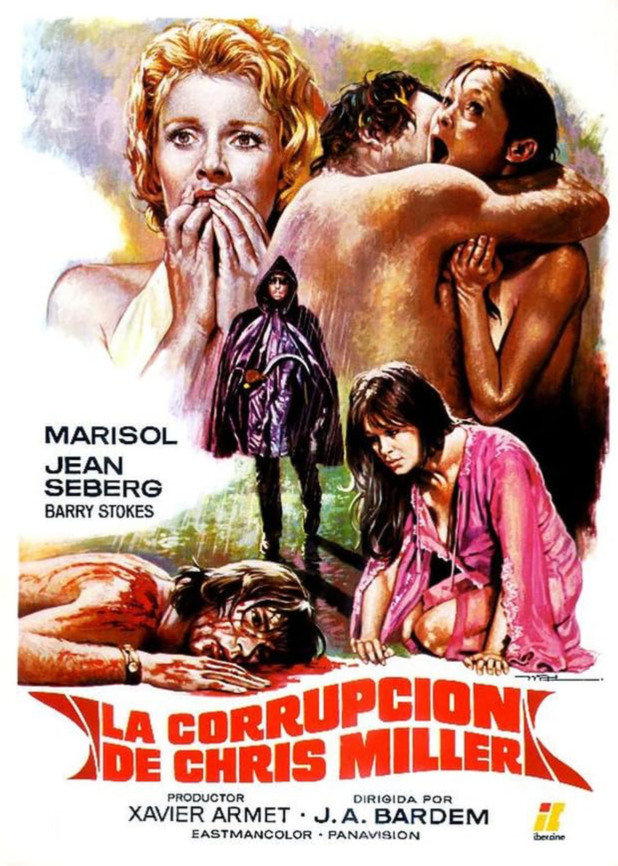
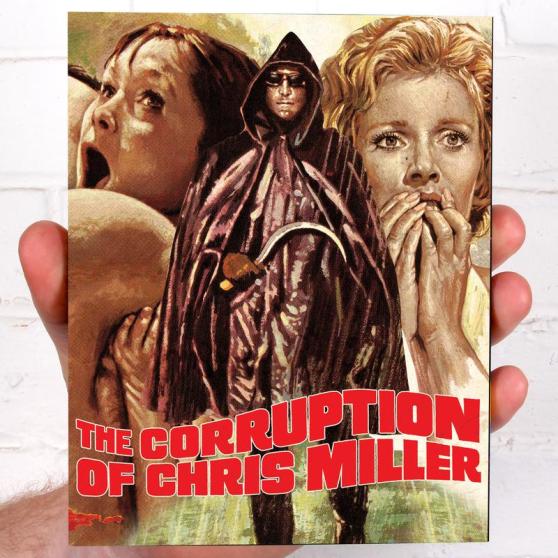
Cinematic Void January Giallo 2025: The Corruption of Chris Miller (1973)

EDITOR’S NOTE: Cinematic Void will be playing this on Thursday, Jan. 9 at 7:30 PM at the Little Theater in Rochester, NY (tickets here). For more information, visit Cinematic Void

Chris Miller (former Spanish child star Marisol; when she married dancer Antonio Gades, Fidel Castro acted as their godfather) lives with her stepmother Ruth (Jean Seberg, the haunted and doomed beauty who was also in Breathless and Saint Joan). The loss of Chris’ father has damaged both of them, so when a drifter named Barney (Barry Stokes, Prey) shows up, it changes their lives. Maybe not for the better, what with a killer slicing his way through the village…

This Spanish giallo was directed by Juan Antonio Bardem (yes, the uncle of Javier) who also made Death of a Cyclist and wrote A Bell From Hell. It was written by Santiago Moncada, who was also the pen behind Hatchet for the HoneymoonRicco and The Fourth Victim.

Ruth blames Chris for her husband leaving, so she uses Barney to seduce her stepdaughter, who is recovering from the dual loss of her father and being assaulted at school. Her plan? When daddy comes home, he won’t love his daughter much any longer because she’s no longer a virgin. Meanwhile, the killer keeps on killing, including a scene where he dresses like Charlie Chaplin.

Also released as Behind the Shutters Sisters of Corruption and , this movie is also a proto-slasher, rife with bloody murders, including a moment when the rain slicker-covered villain kills an entire family in slow motion.

This is a film that deals as much with trauma as murder, that has the sound of running water causing horrifying flashbacks and has no easy ending for anyone in the film, as the guilt of the killings won’t disappear with the death of any suspect.

Vinegar Syndrome recently released this on blu ray, complete with a newly scanned 4K capture from the original 35mm negative. That version will be playing at The Little.

Jade (1995)

Jade brings together the Dracula and Frankenstein of sleaze, as Robert Evans produces and Joe Eszterhas writes with William Friedkin there to direct — and change the script so many times that Eszterhas needed a $4 million payoff from Paramount to keep his name on the movie. Friedkin later claimed he let everyone down on this movie, including his wife, producer Sherry Lansing. As for what the actors thought, Michael Biehn noted, “I didn’t realize until the read-through that I was the bad guy in it.”

It’s also one of the last roles that Linda Fiorentino would take on, finally ending her on-screen career in 2009, a star with such promise after The Last Seduction. Was it that she was hard to work with? Did Kevin Smith sabotage her career after Dogma was challenging to make? And did people think she was Bridget, her The Last Seduction character?

When asked by Roger Ebert why she always played terrible girls, she replied, “I have this terminal condition called bitchiness, right?” She continued, “Maybe others see what I don’t necessarily see in myself. And a lot of it in Hollywood concerns what you look like. I’m dark, my eyes are dark, and my voice is deep, and how the hell could I play a Meg Ryan role, the way I look.” But then again, she also dated Hollywood fixer and private investigator Anthony Pellicano and FBI agent Mark Rossini, which was rumored to be her using favors to aid in the defense of her actual boyfriend, Pellicano. Was life imitating art imitating life? Rossini used government computers to get case info for Pellicano’s lawyers, which meant he eventually pleaded guilty to illegally accessing FBI computers and was quit/fired from the Bureau. But hey, Linda Fiorentino.

Back to that Ebert interview. It’s intriguing how she pushed for more from this movie: When we were doing Jade, the way Joe Eszterhas wrote the sex scenes was so dated and boring, and I just thought, I can’t do this. And there was a lot of nudity, and I thought, we’ve gotta come up with something a little more interesting to keep me going here. So I did a little random research, you know, and I asked a couple of women I had known who had affairs with men who were very powerful – and invariably those men in powerful positions wanted to be dominated by the woman at the end of the day. They wanted to be the submissive party in the sex act, and it correlated with the level of power. Maybe men with no power want to dominate their women. I just thought, well, this is interesting. And it’s the same for women: Women want to be the dominant party because that’s their fantasy, and the male fantasy is to be the submissive party. And so we got into that in Jade.”

As for her male counterpart in this movie, David Caruso left NYPD Blue after the show’s second season because he wanted a film career. Critics and the media were ready to attack him for that hubris, especially after his first post-TV film, Kiss of Death, also bombed.

And when it comes to Eszterhas, after making $3 million for Basic Instinct, he was due for a fall, which was either going to be this movie, SliverShowgirls or all three. He got $1.5 million for this (and $4 million for his next film One Night Stand).

Friedkin was also struggling, as his last two movies were the three demoness movies The Guardian and Blue Chips. In his book The Friedkin Connection, he said that this movie had “a terrific cast—a wonderful script. Great locations. How could it miss?”

Caruso is Assistant District Attorney David Corelli, who visits the murder scene of Kyle Medford, a wealthy businessman who set up several rich and powerful men like Governor Lew Edwards (Richard Crenna) with gorgeous women, including Patrice Jacinto (Angie Everhart). Corelli is told by Edwards and his henchman Bill Barret (Holt McCallany, who most people know from being on Mindhunter, but come on, he got laid and paid as Sam Whitemoon in Creepshow 2) never to let this info out, seeing as how his brakes are soon cut, that’s to be considered a warning.

The seductress who gets the most requests goes by the name of Jade. Seeing as how Anna Katrina Maxwell-Gavin’s (Fiorentino) prints show up on the ancient hatchet — yes, that kind of murder weapon points to this being a Giallo — that killed Medford, it seems like perhaps she could be Jade. She once dated Corelli before marrying his fellow DA, Matt Gavin (Chazz Palminteri). Medford’s safe is filled with sex toys, drugs, videotapes and, oh yeah, bags filled with pubes. But back to those videotapes. Anna Katrina is one of them.

It also seems like she may have killed Patrice, but her husband cuts the interrogation short. Why would she be on those tapes? Well, didn’t he have his affairs? Of course, the governor sends his men, which also includes bad cops Bob Hargrove (Michael Biehn) and Pat Callendar (David Hunt), to kill Allison, who gets saved by Corelli — who was nearly seduced by her — and Gavin — who wanted to kill Corelli for perhaps sleeping with his wife. But all along, it had been Gavin who killed Medford to keep the secrets he and his wife keep, telling her to introduce him to Jade the next time they make love.

Biehn would say of the film. “It was like a jumbled mess. And the movie came out a mess, too. It had great people on it, though. So a great cast, great director… everything but a script.”

Then again, how many giallo makes no sense at all?

But this has an incredible car chase, murder set pieces straight out of Italy, lush production values, a gorgeous heroine/antagonist/who knows in Fiorentino, and they threw a lot of money at this movie to make something that Sergio Martino did for about a tenth of the cost. Plus, there is a moment where Angie Everhardt gets run over by a car not once but twice. Plus, a scene of a naked Palminteri crawling around and begging for Jade to re-enact the movie poster on their bed. 

In his book Hollywood Animal, Eszterhas said, “In the week after he was found not guilty and got out of jail, O.J. Simpson went to see two movies. Showgirls and Jade.”

That says something, right?

Several other cuts of this movie exist, including a European cut with more explicit sex scenes—yes, it’s possible—and a director’s cut with a different ending, 12 minutes more story and, yes, lots more carnal moments.

I will never forget this movie for another, as Cal tells Andy when he talks to women to be like David Caruso in Jade. Always keep asking questions. Be calm and kind of be a dick.

Sources

Fiorentino Finds Good Ways to Be Bad | Interviews | Roger Ebert. https://www.rogerebert.com/interviews/fiorentino-finds-good-ways-to-be-bad

Michael Biehn on The Victim, William Friedkin, and his favorite antagonist role. https://www.avclub.com/michael-biehn-on-the-victim-william-friedkin-and-his-1798233922

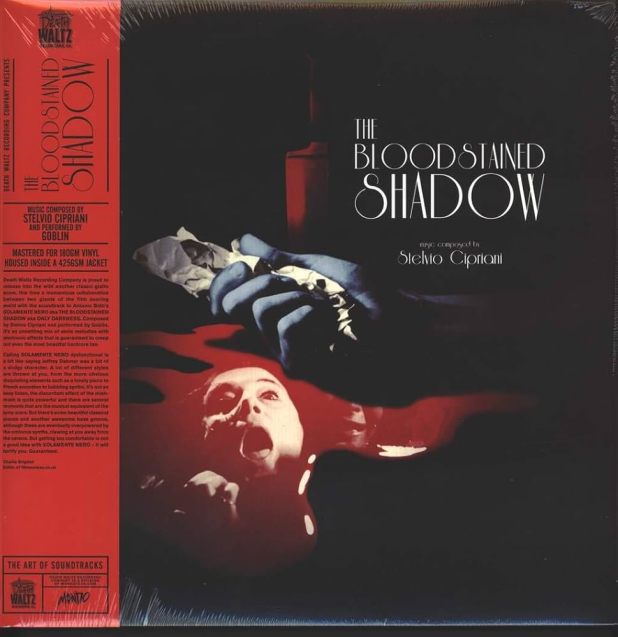
Cinematic Void January Giallo 2025: The Bloodstained Shadow (1978)

EDITOR’S NOTE: Cinematic Void will be playing this film on January 6 at 7:00 PM PT at Los Feliz 3 in Los Angeles, CA. For more information, visit Cinematic Void. For tickets, visit this site. Can’t make it to the movie? Watch it on Tubi.

One of my favorite things about giallo are the alternate titles. As if The Bloodstained Shadow isn’t a great name, this movie also goes by Solamente Nero (Only Blackness), which is a way better title. The other thing I love about this genre is that just when I think I’ve seen every good one, I find another to enjoy.

This is the kind of movie that tells you exactly where it stands in the first minutes, as a killer strangles a girl in a field before the credits even start. That murder has never been solved. Years later, a college professor named Stefano has a nervous breakdown. To recover, he comes home to visit his brother Don Paolo, who has become a priest that hates all of the immorality in their small town.

Oh what immorality — there’s a gambler, a psychic, a combination atheist/pedophile and an illegal abortionist with a mentally challenged son who lives in a shack top the list, along with your typical sex and drinking that happens in any town.

Meanwhile, murders have been piling up and whoever is behind it, they’re leaving notes to the priest, warning him that if he reveals who the killer is, he’ll be next. That’s because on Stefano’s first night back home, Don Paolo saw the killer murder the town psychic in the courtyard.

Stefania Casini (Suspiria) also appears as the love interest, Sandra, who helps Stefano come back to normalcy. Well, as normal as a town filled with murder can be. I’m kind of amazed that she wears a belly chain all day. When you get to the love scene, you’ll know what I mean.

There’s also some amazing religious imagery in this one, like a skinned and bloody animal that has been placed in the sacristy to warn the priest that he’s getting too close, or the communion scene that reveals who the real killer is.

Finally, Goblin plays some great music in here, created by composer Stelvio Cipriani. It’s really a great package, thanks to director Antonio Bido, who directed one other giallo, Watch Me When I Kill. I love how the past childhood trauma that the brothers endured continues to permeate their lives as they try to grow up. This is a very adult giallo and by that, I mean that it doesn’t need nudity and gore to tell its tale.