The Crash of Flight 401 (1978) and The Ghost of Flight 401 (1978)

We’re reviewing both of these TV movies side-by-side as result of their basis in the December 1972 crash in the Florida Everglades near the Miami International Airport of Eastern Flight 401 scheduled from New York JFK to Miami. The flight ended with 101 fatalities: the pilots and flight engineer, two of the 10 flight attendants, and 96 of 163 passengers; 75 passengers and crew survived. The crash was documented in the national best-selling paperback Crash (1977) by Rob and Sarah Elder. The supernatural aftermath of the crash was documented in the equally popular The Ghost of Flight 401 (1976) by John G. Fuller.

Paramount and Universal Studios quickly adapted the properties into TV movies: Paramount Television produced Crash (1978), aka The Crash of Flight 401 in its video shelf life, for ABC-TV. Universal Studios optioned the supernatural tales and retained Fuller’s book title for their NBC-TV movie.

Barry Shear (Madam Sin) directs The Crash of Flight 401 with William Shatner starring as National Transportation Safety Board Investigator Carl Tobias (purely narrative; not a factual character), under pressure to exonerate Lockheed, the manufacturer of the wide-body L-1011. Eddie Albert (TV’s Green Acres, the POTUS in Dreamscape) and Lane Smith (District Attorney Jim Trotter in My Cousin Vinnie) star as the surviving Eastern Airlines’ captain and flight engineer under investigation for causing the crash. The passengers and FAA personnel read as a who’s who of ’70s television: Adrienne Barbeau (who returned to the passenger cabin in the 2020 horror-parody Exorcism at 60,000 Feet), Lorraine Gary (Jaws), Christopher Connelly (Raiders of Atlantis), Ron Glass (TV’s Barney Miller), Ed Nelson (Roger Corman’s Rock All Night and Night of the Blood Beast), and Joe Silver (Rabid).

The late Steven Hilliard Stern (This Park is Mine) directs The Ghost of Flight 401, a tale concerned with the ethereal sightings of pilots Robert Loft and Don Repo on other planes that had salvage parts from the wreckage. Ernest Borgnine stars as flight engineer Dom Cimoli alongside Russell Johnson (TV’s Gilligan’s Island) as Captain Loft; Gary Lockwood (of the TV Movie Earth II) is the FAA investigator on the case. The rest of the cast features a young Kim Basinger with a when-you-see-’em-you-know-’em TV and feature-film character actor feast of Robert F. Lyons, Allan Miller, Alan Oppehheimer (a quickly gone-and-replaced Six Million Dollar Man TV movie cast member), Eugene Roche, and Hal Holbrook’s then wife, Carol Eve Rosen.

As is the case with all TV movies of the ’70s, while they’re up against the budget, the production values are high and — according to the comments of IMBb users involved in and experienced both incidents as airline industry workers — are technically accurate. The acting, of course, is excellent across all quarters.

Barry Shears’s 80-plus credits, which began in the early ’50s, were mostly in episodic TV, Tarzan and Police Woman in particular. His dozen-plus TV Movies include Power (1980; Joe Don Baker as Jimmy Hoffa), Undercover with the KKK (1979; a true story about an FBI infiltrator), and Strike Force (1975; with an early Richard Gere in a cop vs. drug dealer drama).

Other works in Stern’s superior TV movie oeuvre (on U.S. TV and cable; in Canada, they ran as theatrical features) are the James Brolin-starring The Ambush Murders (1982), the pre-stardom Tom Hanks-starring Mazes and Monsters (1982), and the Ned Beatty-starring (Ed and His Dead Mother) Hostage Flight (1982).

You can watch The Crash of Flight 401 and The Ghost of Flight 401 courtesy of You Tube. In addition to ABC and NBC airing both of these fact-based airline movies, ABC also broadcast the adventure-drama SST Death Flight, while NBC took the subject matter into a sci-fi turn with The Disappearance of Flight 412; CBS-TV broadcast the horror-fantasy The Horror at 37.000 Feet, which also starred William Shatner. We’ve also reviewed all of the theatrical forefathers that inspired the “Big Three” TV Networks’ airline telefilms with our “Airport: Watch the Series” featurette.

And don’t forget: We’re TV movie crazy around here, so be sure to catch up with a wide-array of TV movies from the ’70s and ’80s with our tributes “Lost TV Week,” “Week of Made for TV Movies,” and “Sons of Made for TV Movies Week,” and “Grandson of Made for TV Movie Week.” And here we are, with another “TV Week” because, well, TV Movies rock. And there will be another one: that’s bank.

We reviewed a gaggle of airline disaster TV movies this week, so be sure to check out our “Airline Disasters TV Movie Round Up” feature with links to all of the reviews.

About the Author: You can learn more about the writings of R.D Francis on Facebook. He also writes for B&S About Movies.

The Disappearance of Flight 412 (1974)

Before there was The Asylum Studios. Before there were mockbusters. Before there were an endless stream of direct-to-DVD and direct-to-streaming variants of popular movies, there were the “Big Three” networks’ (ABC, CBS, and NBC) endless stream of TV movies that knocked-off popular theatrical films. In the case of this Jud Taylor-directed (TV’s Star Trek and Man from U.N.C.L.E.) airline thriller, it was made by NBC in the midst of the Airport disaster flick series of films made between 1970 and 1979 (read out “Airport: Watch the Series” featurette), which also included ABC’s SST Death Flight and CBS’s The Horror at 37.000 Feet. While ABC’s offering was an adventure-drama and CBS’s a horror-fantasy, NBC’s offering took a sci-fi turn.

Ugh. Cheap-jack DVD cover available at your local retail “impluse buy” end caps and electronic retail dust-bin barrels.

Glenn Ford (Jonathan Kent in Superman ’78, but since this is B&S About Movies, we remember him best for The Visitor and Happy Birthday to Me) is an Air Force Colonel in investigating an Air Force base’s rash of electrical disturbances aboard its aircraft. To pinpoint the in-flight problem, he dispatches the four-man crew of Flight 412 piloted by Captain Bishop (David Soul of Salem’s Lot). Shortly into the flight, the flight makes radar contact with three unidentified craft and reports them as U.F.Os; two fighter jets are dispatched and force Flight 412 to land at a remote, abandoned military airfield in the American Southwest desert. Sequestered in a barracks and their craft hidden away in a dilapidated hangar, government officials begin to interrogate and convince the crew they did not see flying saucers. Meanwhile, Ford’s Colonel — and Bradford Dillman — refuse to accept Flight 412 simply vanished — and that it has anything to do with alien contact.

At the time of this NBC-TV production, Peter Hyams had not yet scripted the conspiracy-similar Capricorn One; he came up with the idea back in 1969 while working on the Apollo broadcasts for CBS-TV. Completing the script in 1972, no production company wanted to make it; that is until ITC Entertainment (Space: 1999, Saturn 3) put Capricorn One into pre-production in late 1975 and commenced filming in late 1976. In a coincidence: Capricorn One was — based on its casting of the then popular James Brolin and O.J Simpson — pre-sold to NBC to secure its TV rights, which assisted in augmenting the production’s budget.

While a ratings success during its initial October 1974 broadcast on NBC, contemporary critics decry Flight 412 for its overuse of stock footage (which leads to the boondoggling jets switching from U.S. Marine McDonnell Douglas F-4B Phantom II fighters to Grumman F9F Panthers; the latter didn’t fly in the ’70s as they were retired after the ’50s, this according to aeronautical critics), recycling newsreels of individuals speaking of their “close encounters,” and voice-over narration to advance the plot. But those critics seem to miss the point: that the “plot” was based on “fact” and made to resemble a documentary about a “real event” involving a military U.F.O encounter. Flight 412 became a frequently-ran film on NBC’s late night programming blocks and UHF-TV syndication until the mid-’80s, at which time it was given a VHS release.

Courtesy of its casting of Glenn Ford, David Soul, and Bradford Dillman, the film is easily available as a still-in-print DVD and streams on Amazon Prime. But we found You Tube freebies HERE and HERE and on Daily Motion. You can also enjoy it as part of Mill Creek’s Nightmare Worlds 50-film pack, which afford us to do another take on this film.

Image courtesy of JohnGrit/Unisquare.

Other network TV movies parked at the Hollywood hangers are Paramount Studios-ABC’s The Crash of Flight 401 and Universal Studios-NBC’s The Ghost of Flight 401; both are concerned with a real-life, 1972 Eastern Airlines crash and its supernatural aftermath. Don’t forget that we wrapped up our week of airline flicks with our “Airline Disasters Round Up” feature.

About the Author: You can learn more about the writings of R.D Francis on Facebook. He also writes for B&S About Movies.

Vanishing Point (1997): John Doe Week

Editor’s Desk: This review originally ran on August 7, 2020, as part of our “Fast and Furious Week I” week of reviews and we’ve brought it back for “John Doe Week.


Did you know their was a remake of Vanishing Point? It’s okay. No one does.

The FOX-TV Network—back when they were in the business of creating original content, in lieu of reality programming and weirdo-dorky Seinfeld (sorry, Sam) wanna-be shitcoms—retooled this 1971 classic made by their sister film studio. Ack! No one should be poking around Richard C. Sarafian’s classic. And how did Sarafian go from this, to Farrah Fawcett’s Sunburn (1979), to become “Alan Smithee” on Solar Crisis (1990)? And so it goes in the B&S About Movies universe. (See? Too many movies, so little time. So many reviews to write!)

Of course, since this is a TV film, the vague existentialism and “thinking road flick” gibberish of the original is excised, thus transforming Barry Newman’s Kowalski into an action hero. Luckily: it features the same model 1970 Dodge Challenger R/T as the original film. Sadly: the messages regarding religious cults, racism, drug abuse, homophobia, and police entrapment are lost . . . and we’re stuck with a Challenger-driven Bonnie and Clyde redux.

And if you thought Sarafian’s transition from Vanishing Point ’71 to Farrah was odd: The director, Charles Robert Carner, wrote Gymkata (1985)* for Robert Clouse. Yes. The film starring American Olympic gymnast Kurt Thomas—as if no one learned their lessons from trying to turn Olympian Mitch Gaylord into a film star with American Anthem* and American Tiger.

Watch the trailer.

In the Challenger cockpit is the always welcomed Viggo Mortensen (who starred in the rock-religious flick Salvation with his then wife, Exene Cervenka of X (we are reviewing it this week; look for it) ; and yes, he’s Aragorn from Lord of the Rings) as Kowalski; he’s still employed by a car delivery service, but now he’s a Desert Storm veteran pining for his glory days as a stock car racer. This Kowalski’s “need for speed” isn’t the result of drugs, bets or personal demons: he’s a clean, faithful husband desperate to get home to his pregnant wife who’s suddenly hospitalized. While the ‘70s Kowalski didn’t need a reason to say “Fuck the Man!” to earn his folk hero status, the ‘90s Kowalski becomes an Americana hero as result of being mislabeled as a “terrorist” by an overzealous government abusing new anti-terror laws. 

Helping out on the radio front is a politically outspoken DJ simply known as “The Voice,” (Jason “Beverly Hills 90210” Priestly, a FOX-TV series, natch) on KBHX 106.5, “The Voice of the Rocky Mountains.” At least Priestly’s DJ is hip enough to spin tunes such as “Volunteers” by the John Doe Thing. Not helping matters is a hard-edged, ex-stock racer turned Utah State Trooper (the always welcomed Steve Railsback of Lifeforce) in hot pursuit with a Hemi of his own and a catch-Kowalski-at-all-costs attitude (if this sounds a lot like the Marjoe Gortner-Railsback persuit in The Survivalist, it probably is.) And in with the desert-dwelling assist is rocker John Doe (A Matter of Degrees) as an anti-government tax evader with a knack for repairing Hemis. (And rock trivia buffs take note: This is only time you’ll see the ex-husbands of X vocalist Exene Cervenka—Viggo and John Doe—together in the same film.)

It’s interesting to note that while a TV movie, Vanishing Point ’97 has a 90-minute, theatrical-running time. Movies shot-for-TV run 80 minutes, then 40 minutes of commercials are added to fill a two-hour programming block. Thus, 10 minutes of advertising are lost to fit the film into that 120-minute programming block. That’s bad business. So, considering Viggo’s status at the time, was this intended as a theatrical feature, and 20th Century Fox realized their production faux-pas and dumped it on TV?

What do you think, Eric?

“Jesus. Even the poster for this sucks. What the f**k was Viggo thinking.”
— Eric, purveyor of film quality and Seinfeld hater

Indeed, Eric. Indeed.

You can watch Vanishing Point ’97 on You Tube.

* Sam? Bossman? How many times must I lay down the American Anthem/Gymkata gauntlet? At the very least, all I want for Christmas is a Sam Panico review of Gymkata. Amen.

About the Author: You can learn more about the writings of R.D Francis on Facebook. He also writes for B&S About Movies.

L.A. Macabre (Amazon Prime Series, started in 2013)

Fifteen episodes of the series L.A. Macabre are now available on Amazon Prime (season one, season two) and we were lucky enough to get a sneak peek.

Originally starting as a found footage web series on YouTube. the second season of the show turned it into a single camera drama with more locations throughout Los Angeles, as well as expanded characters, stunts and scares. Now, the Amazon Prime version has been cut into fifteen 30-minute episodes.

The series starts with three filmmakers — show host Ryan (Ryan Hellquist), director Colin (Aidan Bristow) and Ryan’s younger sister Jamie (Ryan Bartley) — getting the opportunity to interview Callie (Corsica Wilson), a former member of a cult called The New Family. After the first episode of L.A. Macabre with her in it airs, Callie begins to get stalked by someone or something who just could be from her old life. Or is she everything that she seems?

If you’re a true crime fan or someone missing Supernatural, this show has something to offer you. It starts off smart and quick before somehow picking up steam from there. I really like that the show moves away from found footage and becomes more of an action-adventure by the second season, while concentrating on the romance between Ryan and Callie, as well as the worry that she may be brainwashing him with the techniques that were once used against her.

You can learn more about this series by visiting its offical Facebook and Twitter pages. You can also watch the show on YouTube.

The California Kid (1974)

A Universal and NBC-TV co-production starring Nick Nolte, Martin Sheen and Vic Morrow?

And there’s a car . . . with chases that rival 1968’s Bullit?

I’m all in. Gentlemen (and Ladies) start your VCRs!

Watch the car chases!

The Sheriff Roy Childress (a bastardly-cool Vic Morrow) makes bank on how much the local judge can fine the unsuspecting visitors who go over the posted speed limit — even by 5 miles per hour. And those speedsters stupid enough that try to outrun ol’ Roy, well he just runs them off the road — over an errant cliff — if they attempt to make the state border. And it’s just not greed, but revenge: his wife and daughter were killed by a speeder. And all speeders must pay — or die if they don’t.

One of those victims is Michael McCord’s (Martin Sheen) brother who rides into town like a “man with no name” behind the wheel of a 1934 Ford Coupe hot rod. Another victim was the brother of Buzz Stafford (Nick Nolte), the local town mechanic. Along with the local waitress-cum-love interest (Michelle Phillips), they’re going to take down Childress and reform the corrupt town.

Director Richard T. Heflon worked his way up from directing episodes of Banacek (with George Peppard of Battle Beyond the Stars fame) and The Rockford Files, along with the forgotten (but cool) ’70s TV movies Locusts and Death Scream, to theatrical features with Future World and Outlaw Blues with Peter Fonda (Easy Rider).

You can watch this on You Tube. Do it. It’s the best 70-minutes you’ll ever spend in your life. Awesome!

About the Author: You can learn more about the writings of R.D Francis on Facebook. He also writes for B&S About Movies.

Hot Rod (1979)

Burt Reynolds created a cottage industry with Smokey and the Bandit . . . and with the “Big Three” television networks still in the movie business, they wanted a slice (or is that a wad of tobacco spit?) of that good ol’ boy pie.

So we get the always-welcomed Greg Henry (The Patriot), Robert Culp (of the Fast and Furious precursor — and also awesome TV movie — The Gladitor), Grant Goodeve (who replaced Mark Hamill in TV’s Eight is Enough when Hamill got Star Wars), Robin Mattson (TV movie Return to Macon County and the long-running daytime drama General Hospital), and Pernell Roberts (TV’s Bonanza and Trapper John, M.D.).

Watch the trailer.

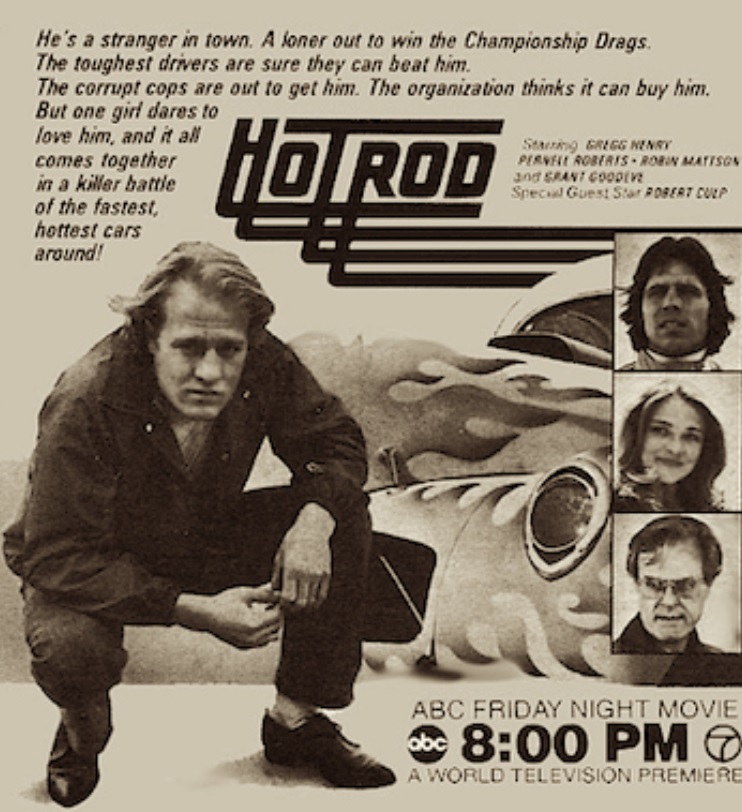
For once, the theatrical one-sheet, well, the “splashy” TV Guide ad says it all. For he came to town on a horse (hot rod) with no name — and you ain’t gonna win against “The Bandit,” there Sheriff Buford T.

And it’s all brought to you by the Roger Corman-raised George Armitage (ah, no wonder this is so goooood), who gave us Gas-s-s-s, Private Duty Nurses, Night Call Nurses, and Darktown Strutters . . . and the we-still-haven’t reviewed Kris Kristofferson and Jan-Michael Vincent epic, Vigilante Force. Oh, and as part of our upcoming “John Doe Week” (no, not flicks about unidentified dead bodies, wise ass — it’s a tribute to the acting career of the leader of the Los Angeles punk band, X), we review Pure County, a film which he co-wrote.

Oh, man . . . forget Farrah. It was Robin Mattson torn out of a magazine and scotch-taped to my teen bedroom wall, alongside those Roger De Coster and Don “The Snake” Prudhomme mag spreads. And don’t forget the Runaways ripped out of a CREEM mag. Good times. Sigh, Robin . . . competing with Sandy West for my heart.

You can watch Hot Rod on You Tube HERE and HERE.

About the Author: You can learn more about the writings of R.D Francis on Facebook. He also writes for B&S About Movies.
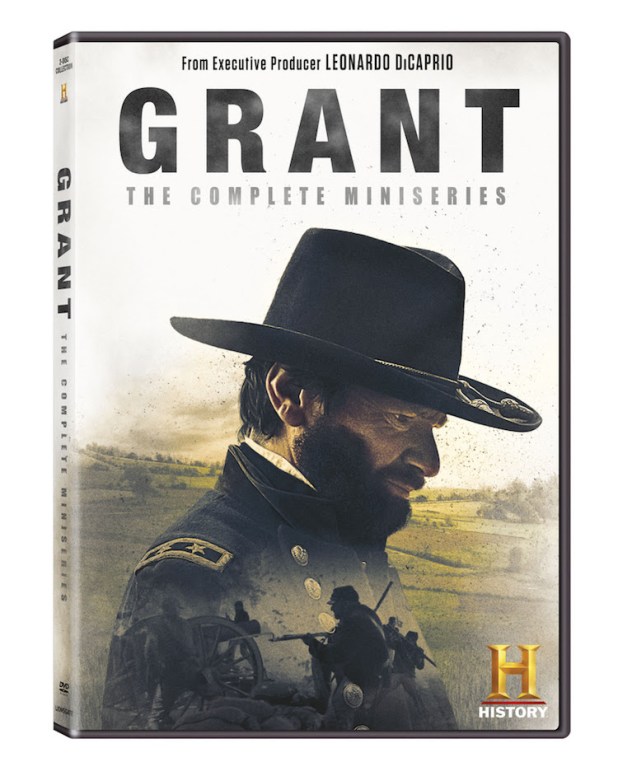
Grant (2020)

Executive produced by Academy Award winner Leonardo DiCaprio, this film went perfectly with the election process this year, as it taught me about the 18th President of the United States, a man who overcame a troubled past and alcoholism to save our nation.

I love how this blends a shot movie, commentary by several experts and real images of the past to form the full picture of someone who I had only glanced at during history class.

Justin Salinger plays Grant and it’s through him we see the human side of the historical icon. I’d often heard him painted as an alcoholic whose time as President was marred by corruption, which is only part of the real story, which this six-hour mini-series (originally airing on History) sets right.

Having this all on one DVD set is such a great addition to my library. History continually finds ways to make what was once dry into exciting shows that actually teach me new things. If you’d like to learn more about what true leaders were once like, I recommend you pick up this new release from Lionsgate.

Drive-In Friday: Phil Savath Night

From Terminal City Ricochet with Jello Biafra to Beverly Hills, 90210 with Luke Perry? From the science fiction/horror musical Big Meat Eater featuring the soft-shoe of “Baghdad Boogie” to the historical drama Samuel Lount? Drag racing through the eyes of David Cronenberg? Children’s programming?

Welcome to the eclectic career of Phil Savath.

Phil Savath, born December 28, 1946, was an American-born Canadian film and television writer and producer. He was most noted as a two-time Genie Award nominee for Best Screenplay, with nominations for Original Screenplay at the 4th Genie Awards in 1983 for Big Meat Eater and Adapted Screenplay at the 10th Genie Awards in 1989 for The Outside Chance of Maximilian Glick. (The Genies are the Academy of Canadian Cinema and Television’s equivalent of the Oscars.)

Savath started his career in television in the late ‘70s as the co-creator and star of the CBC Television children’s comedy series Homemade TV and Range Ryder and the Calgary Kid, and then made his theatrical debut with David Cronenberg’s Fast Company.

Fans of FOX-TV’s Beverly Hills, 90210 know him for the dozen episodes he wrote for that post-Brat Back series, as well as the oft-aired HBO favorite, The Outside Chance of Maximilian Glick, which was turned into a short-lived TV series, Max Glick. He also wrote the Canadian hockey drama Net Worth (1995) and developed the Canadian TV series African Skies (1992) about a bi-racial teen friendship in post-Apartheid South Africa. As a producer, before his death in 2004, he produced the late ‘90s series These Arms of Mine, along with the TV Movies White Lies, Little Criminals, and Liar, Liar: Between Father and Daughter.

Movie 1: Fast Company (1979)

The influence of this Phil Savath-penned script on the career of David Cronenberg can’t be denied.

The first of Cronenberg’s feature films for which Cronenberg did not originate the screenplay, he was hired by the producers to direct. It was on Fast Company that Cronenberg developed long-time working relationships with cinematographer Mark Irwin, art director Carol Spier, sound editor Bryan Day, and film editor Ronald Sanders — each worked on Cronenberg’s later films. Actor Nicholas Campbell, who plays William Smith’s young protégé, also went on to appear in Cronenberg’s The Brood, The Dead Zone, and Naked Lunch. Sadly, Fast Company also serves as final release for Claudia Jennings (‘Gator Bait), who died in a car wreck several months after this drag racing drama’s release.

Movie 2: Big Meat Eater (1982)

Take one part Ed Wood’s Plan Nine from Outer Space, one part Paul Bartel’s Eating Raoul, and one part Richard O’Brien’s The Rocky Horror Picture Show and vigorously shake in your “intentionally bad cult films” tumbler, and serve: We’ve got a mad butcher, a murdered mayor, and aliens who reanimate the mayor to assist in the harvesting of a rare, radioactive fuel deposit beneath the butcher shop. Oh, and there’s song and dance numbers (which you can enjoy during our intermission).

And those Great White Northeners “got it,” since Phil Savath and his co-writers Laurence Keane and Chris Windsor received Canada’s Oscar equivalent — a Genie Awards’ nod — for Best Original Screenplay in 1983. While Windsor never made another film, Keane and Savath continued onward and upward . . . and what could Phil possibly write as a follow-up feature? It’s not what you’d think.

Intermission!
Courtesy of the Phil Savath-penned “Baghdad Boogie.”

Back to the show!

Movie 3: Samuel Lount (1985)

The man who gave us Big Meat Eater . . . wrote this? He did.

A historical drama set during the Upper Canada Rebellion of 1837, the film stars very familiar Canadian TV and film character actor R. H. Thomson (I remember him from the cable-played Escape from Iran: The Canadian Caper and The Terry Fox Story, as well as lots of American TV series) as Samuel Lount, an organizer of the rebellion who was ultimately convicted of treason and executed in 1838.

Receiving a limited theatrical run before debuting on Canadian television, it made its U.S debut on HBO and Showtime. While not winning any awards, it received five 7th Genie Awards’ nods for Best Actor, Best Cinematography, Best Costuming, Best Editing, and Best Sound Editing.

Yes, this powerful, fact-based drama is — in fact — from the pen of the man who gave us a film backed by a soundtrack performed by Alternative Tentancles bands. Yes, that’s right. Phil Savath worked with Jello Biafra. But Phil wrote “Baghdad Boogie” and incorporated “Heat Seeking Missile,” a song that would give Spinal Tap pause, into a movie — so what’s really shocking you at this point?

Movie 4: Terminal City Ricochet (1990)

So, Phil did a pretty good job with the sci-fi horror parody Big Meat Eater, so he took a crack at parodying the post-apoc sci-fi craze of the ’80s with this dystopian-political intrique romp. It’s the story of a media entrepreneur who weasels his way into the mayorship of Terminal City and manipulates the populace through television, with their ensuing addictions to consumerism lining his pockets.

Oh, and the good mayor’s Chief Social Peace Enforcement Officer? Jello Biafra of the Dead Kennedys.

Yeah, it’s a must watch.

About the Author: You can learn more about the writings of R.D Francis on Facebook. He also writes for B&S About Movies.

Mill Creek Sci-Fi Invasion: 984: Prisoner of the Future (1982)

Before his best known, first studio-backed film, The Gate, and its sequel, The Gate 2: The Trespassers . . . long before he passed up the chance to direct A Nightmare on Elm Street 4: The Dream Master . . . before I, Madman . . . long before he started churning out the mockbuster hoards of Ice Spiders, Mega Snake, and Destruction: Los Angeles for the SyFy Channel . . . before he got into the Hallmark Christmas movie business alongside our equally beloved Fred Ray Olen and David DeCoteau, Hungarian-born Tibor Takács shot this failed Canadian TV series pilot programmer in 1978. Courtesy of the Star Wars-infused sci-fi market, it was shook loose from the analog dustbins onto home video shelves in 1982. Criminally allowed to fall into the public domain, this well-written and produced production (on a budget, natch) turned up as a track selection (aka The Tomorrow Man) on numerous bargain-basement DVD compilations.

Primarily known as a talent manager, studio producer and engineer, this CBC telefilm-pilot was Takács’s first professional feature film project, after his self-produced feature film debut, Metal Messiah (1978), a long-form rock opera/video which starred two bands from his stable: Kickback and the Cardboard Brains. (We’ve wanted to review Metal Messiah since forever, but have been unable to locate a copy. And yes, we’ve had I, Madman (1989; with Jenny Wright!) on our shortlist of must-reviews since our 2017 review of The Gate. We’ll get to it, one day . . . what the hell . . . courtesy of our annual October 2020 “Slasher Month,” Sam reviewed it, finally!

As you read this review, please take into consideration my crazed fandom for Patrick McGoohan’s surreal psychological drama The Prisoner, concerned with the imprisonment of an intelligence agent, of which this Orwellian-influenced tale reminds — only with the resourceful, low-budget production designs of PBS-TV’s 1980 production of Ursula K. Le Guin’s 1971 novel A Lathe of Heaven. (Again, take into consideration of my fandom of that PBS adaptation igniting my sense of nostalgia for Takács’s dystopian tale.) And speaking of PBS-TV, one will also have a sense of Tom Baker-era Dr. Who déjà vu in the production designs (especially in the prison’s Cylon/Cybermen-styled sentries) and its cast of Shakespearian-skilled thespians.

Since Takács knows we are, at the very least, familiar with the dystopian tales of Aldous Huxley with Brave New World and more importantly, George Orwell’s 1984, 984: Prisoner of the Future dispenses with long-winded set ups in establishing how The Movement came into power and gets right into it: how affluent businessman Tom Weston became “984” by way of his entries in a ratty diary from the walls of his prison cell, which triggers a series of flashbacks to the mind games played by Warden Dr. Fontaine (the steely-excellent Don Francks (his work dates back to ’60s TV’s The Man From Uncle), his interrogator.

Don’t let the fact that this Canadian TV tale fell into, it seems, public domain territory due to a lack of legal due diligence on the part of the CBC, deter you from watching. This is a quality work by Tibor Takács that rises above the usual public domain or still legal, yet forgotten, odds ‘n’ sods from the VHS-era finding a new, digital home on these DVD box sets that brings the ol’ ’80s video store shelves to the abode.

You can watch 984: Prisoner of the Future on You Tube or own it as part of the “Mill Creek Sci-Fi Invasion Box Set.” You Tube also offers the trailer. Be sure to join us as we examine Tibor’s career and films with our “Drive-In Friday” featurette.

Our thanks to the digital librarians of Wikipedia for referencing this review as part of the “List of Dystopian Films” page.

About the Author: You can learn more about the writings of R.D Francis on Facebook. He also writes for B&S About Movies.
Triple Fisher: The Lethal Lolitas of Long Island (2012)

Back in 1992, the news cycle was dominated by Amy Fisher, a sixteen-year-old girl who had an affair with auto mechanic Joey Buttafuoco, the auto mechanic who had continually fixed her car. As their affair reached its close, she ended up heading to his wife’s house and shot her in the head twice.

Somehow, Mary Jo Buttafuoco survived and Fisher was named as the suspect, serving seven years in prison. In the pre-Twitter era, this was all people talked about in person, in the papers and on the relatively new idea of 24/7 news.

Back then — 28 years ago feels like a lifetime — three TV movies were made telling the story. This is what happened back then — news didn’t burn out in hours and we got to watch made-for-TV versions of stories ripped from the headlines. The three films were Amy Fisher: My Story with Noelle Parker in the lead (NBC, December 28, 1992); Casualties of Love: The “Long Island Lolita” Story had Alyssa Milano as Fisher and Lawrence Tierney as Joey’s father (CBS, January 3, 1993) and The Amy Fisher Story with Drew Barrymore (airing the same night on ABC). Of the three, the Barrymore version was considered the best — all things considered — and earned the highest ratings.

Now, writer and director Dan Kapelovitz (The Three Geniuses: The Re-Death of Psychedelia, the short Amazing Angelyne and the upcoming 48 Hrs. Literally) has taken all three films and remixed them into one overlapping narrative. Much like trying to combine the story of Fisher from The National EnquirerThe ExaminerThe New York PostInside EditionHard Copy and Star Magazine and creating your own version of what really happened inside your head, the Rashomon-esque overlayering of these films.

What is the real story of Amy, Joey and Mary Jo? Is it the one that played out in the media, including brutal back and forth moments on The Howard Stern Show? Was it in the tabloids that I devoured? Or did these movies tell the right story? Is there a right story? Can multiple people play multiple roles in multiple movies and all combine to tell one story that has numerous touchpoints that are told through multiple lenses and points of view?

I don’t have the answers, I just like watching movies.

As someone who has never been a sixteen-year-old girl in love with a Zubaz wearing older man — confession time! — I can’t really understand why Amy did what she did. But I do know that love makes you do things that money, obligation and duty can never match. I’ve also never had a woman eat a pizza in a sexual way while looking at me. And I have no idea if that’s actually possible.

This movie makes me happy for repetitive drug tracks, for protagonists doing blow while cops trail them then a race through a cemetery pausing only to kneel on your mothers grave, for beepers, for fake Long Island accents, for Le Barons, for dudes swept up in killing the wives of boyfriends because they’re also having sex with the girl, for made-up movies that aren’t nearly this convoluted and for the fact that this exists at all, while hair metal ballads blaring while three different Amys shoot three different Mary Jos and three different Joeys have no idea what to do. That doorbell keeps on ringing over and over and over and as all three wives approach all three doors to confront all three mistresses, I find myself asking myself, “What is truth?”

The answer? As Joey tells Amy when she asks what their future is going to be, “It’s whatever you want it to be.”

I got to see this via AGFA and Fantastic Fest, which presented it in a limited edition stream through the Alamo Drafthouse. It was worth every minute. To learn where it may play some day again, you can learn more at the official site or read more about the film at AGFA’s site.