SHUDDER EXCLUSIVE: Virus :32 (2022)

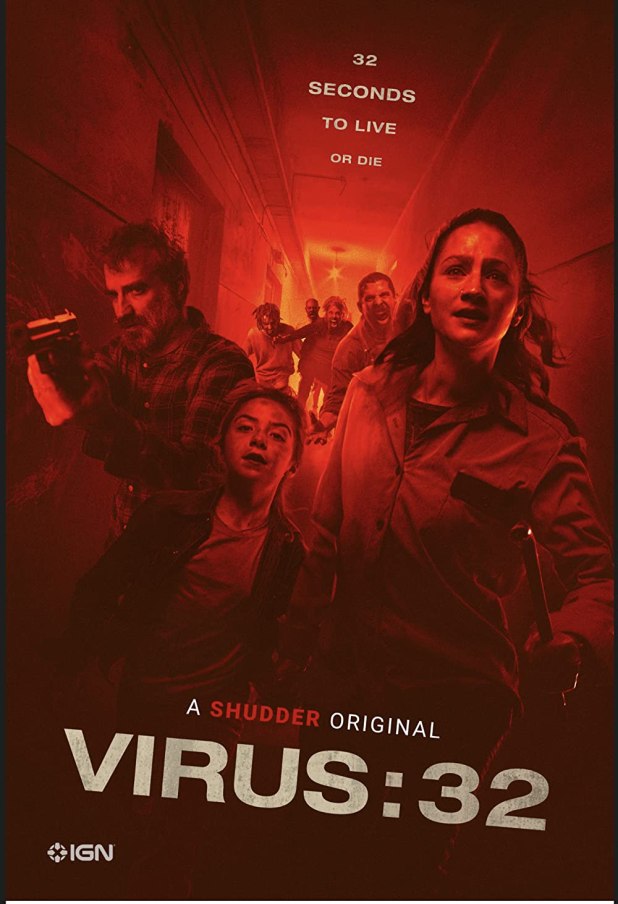
Man, everybody is making virus movies now. After enduring — and I say that in the best way — The Sadness, can another virus film even measure up? Gustavo Hernández’s Virus :32 is ready to try. It has an interesting hook, in which a rapidly spreading virus transforms people into intelligent, ultra-violent, extra-fast zombies.

So what is the 32? Well, after they attack, they’re left incapacitated for 32 seconds.

The streets of Montevideo are on fire and the zombies keep hunting and killing anyone who has not been infected. Yet within the sports club where Iris (Paula Silva) works as a security guard, she and her daughter Tata (Pilar Garcia) are unaware that the world is ending.

There have been so many zombie movies that I am frankly a zombie when it comes to them. Yet I did like that this movie attempts to tell the story of the bond between mother and daughter even in the face of horror. Or in the case of Louis (Daniel Hendler), he will do anything he can to save his already infected wife.

This movie also has a great location, as the giant cavernous gym creates so many opportunities for frightening moments. And that drone shot at the beginning sets up such a world to be destroyed and then to be chased within.

If you still have some love in your heart for the shambling masses of the living dead or the infected or whatever you want to call them, Virus :32 isn’t a bad use of your living minutes.

SHUDDER EXCLUSIVE: They Live In the Grey (2022)

Directed and written by brothers Avel and Burlee Vang (Bedeviled), this film is about Claire Yang (Michelle Krusiec) a social worker checking in on the case of Sophie Lang (Madelyn Grace) and her parents Audrey (Ellen Wroe) and Giles (J.R. Cacia). Yet Claire’s life may be even tenser than those of her clients, as she lost her son Lucas in a hit and run accident and the aftermath broke up her marriage to Peter (Ken Kirby). Oh yeah — she also sleeps in her closet because she keeps seeing visions after that traumatic event.

Those visions increase when she visits the Yang family, so she steps away from their case. Yet Sophie keeps getting bruises that her family claims are supernatural. She’s taken away from her parents, so Claire steps in to help. She attempts to contact the spirit — a woman in white — from the Lang home, but has an out of body experience and passes out. This costs her her job and she turns to her husband after finding some closure over the death of Lucas. Yet when she comes back home, the woman in white is there and informs her that she was trying to protect Sophie from Audrey. That’s when she rushes back to the Lang home in the hopes of saving everyone.

They Live In the Grey is decent yet really feels like it could have been trimmed down somewhat. At almost two hours long, it feels like it can’t decide whether it wants to scare you or have an extended conversation. With some tighter editing, I feel that this would have been a better film, but I’d love to know the intentions of the filmmakers.

L’Ultima Meta (1991)

EDITOR’S NOTE: This originally appeared in Drive-In Asylum #22 which you can buy here.

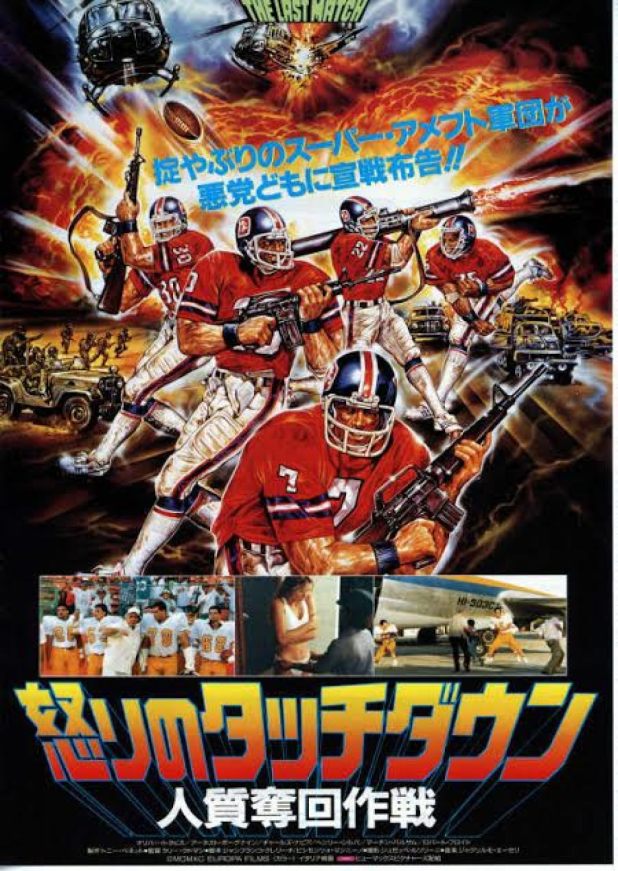
Often, I refer to movies as having an all-star cast, which is really a misnomer. After all, what I consider A-list talent certainly does not fit the rest of the world. The Last Match, however, has the very definition of what I consider an all-star cast. Let’s take a look at the lineup:

Ernest Borgnine: Amongst the 211 credits Mr. Borgnine amassed on his IMDB list, none other have him leading a football team against an unnamed Caribbean island to save his assistant coach’s little girl. He was, however, in four Dirty Dozen movies and The Wild Bunch, not to mention playing Coach Vince Lombardi in a TV movie. One assumes that he took this role to get away from his wife Tova and her incessant cosmetics shilling. 

Charles Napier: As the American consul in this movie, Napier cuts a familiar path, which he set after appearing in the monster hit Rambo: First Blood Part II. For him, it was either playing bureaucrats or cops, thankless roles that he always brought a little something extra to. The exception is Baxter Wolfe, the man who rocks Susan Lakes’ loins in the beyond essential Beyond the Valley of the Dolls

Henry Silva: If you need a dependable jerk and you have the budget of, well, an Italian movie about a football team that also does military operations, call Mr. Silva. He admirably performed the role of the heel — or antihero at other times in movies like Megaforce, Battle of the Godfathers, Cry of a Prostitute (in which he plays the Yojimbo role but in a mafia film; he also pushes Barbara Bouchet’s face inside a dead pig’s carcass while making love to her and he’s the good guy), Escape from the Bronx and so many more movies.

Martin Balsam: Perhaps best known for Psycho, Balsam shows up in all manner of movies that keep me up at 4 AM on nights when I know work will come sooner than I fear. He’s so interested in acting up a storm in this movie that he is visibly reading off cue cards.

They’ve all joined up for a movie that finds the coach’s daughter get Midnight Express-ed as drugs are thrown in her bag at the airport on the way home from a vacation with her hapless jerk of a boyfriend. At least he’s smart enough to call assistant coach Cliff Gaylor (Oliver Tobias), the father of the daughter whose life he has just ruined. And luckily for this film, Tobias was in a movie called Operation Nam nearly a decade before, which meant that they could recycle footage of him in combat. He also was The Stud and serviced Joan Collins, so he has my eternal jealousy going for him, too.

Who could dream up a movie like this? Oh, only Larry Ludman, but we see through that fake name and know that it’s Fabrizio De Angelis steering this ship, the maker of beloved trash such as Killer Crocodile, five Karate Warrior movies and three Thunder movies that star the beloved Mark Gregory as a stiff legged Native American warrior who pretty much cosplays as Rambo. And don’t forget — this is the man who produced Zombi, The House by the Cemetery, The Beyond and New York Ripper!

In this outing, he’s relying on Cannibal Holocaust scribe Gianfranco Clerici and House on the Edge of the Park writer Vincenzo Mannino to get the job done. For some reason, despite this being an Italian exploitation movie, we never see the coach’s daughter in jail. Instead, we’re treated to what seems like Borgnine in a totally different movie than everyone else, barking orders into his headphones as if he was commanding the team in a playoff game. 

To make matters even more psychotic, the football players show up in full uniform instead of, you know, commando gear. One wonders, by showing up in such conspicuous costumes, how could they avoid an international incident? This is my lesson to you, if you’re a nascent Italian scumtastic cinema viewer: shut off your brain, because these movies don’t have plot holes. They’d have to have actual plots for that to be possible. 

I say this with the fondest of feelings, because you haven’t lived until you witness a football player dropkick a grenade into a helicopter. Supposedly this was written by Gary Kent for Bo Svenson, who sold the script to De Angelis unbeknownst to the stuntman until years later. It was originally about a soccer team!

Former Buffalo Bills QB Jim Kelly* is in this, which amuses me to no end, as does the ending, where — spoiler warning — Borgnine coaches the team from beyond the grave!

You know how conservative folks have quit watching the NFL as of late? This is the movie to bring ‘em back, a film where the offensive line has fully automatic machine guns and refuses to kneel for anything. No matter what your politics, I think we can all agree on one thing: no matter how dumb an idea seems, Italian cinema always tries to pull it off. 

*Other pros include Florida State and arena football player Bart Schuchts and USFL player Mark Rush, as well as Dolphins Jim Jensen, Mike Kozlowsky, Elmer Bailey and Jim Kiick. It’s kind of astounding that at one point, these players could just end up in a movie without the NFL knowing. This would never happen today.

CANNON MONTH 2: Joey (1977)

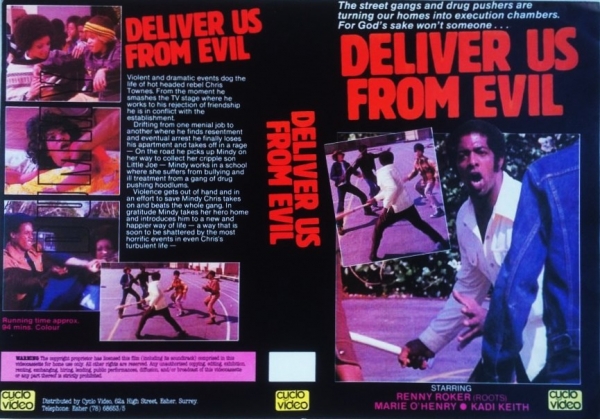
EDITOR’S NOTE: This isn’t a Cannon movie but a 21st Century release. It was originally distributed in 1975 as Deliver Us From Evil

The trailer for this movie claims that it’s “a movie that tells it like it is about blacks. The beautiful blacks. The evil blacks.”

It’s also a movie that’s preaching to its audience about ending the drugs and violence in black communities to the point that it moves from blacksploitation to Godsploitation. It starts with Chris Townes (Renny Roker and yes, he is related to Al) going shithouse in a room full of glass vases and getting sent to a psychiatric ward where he screams at people. When he gets out, he has to deal with the worst white people ever at work and back home with his landlord. Maybe he can get with Mindy (Marie O’Henry), a social worker who he has a crush on. Well, when he drives her home, his maniac skills behind the wheels show her that yes, Chris is a dangerous human being to be avoided.

Chris needs to get with Mindy, so he decides to start being nice to the wheelchair-bound Little Joe (Danny Martin) to prove how nice of a guy he is. But then it is revealed that Mindy is married and Chris uses Little Joe to meet her friend Kim (Kandi Keath) because this movie flies through characters and at the same time, black on black crime is out of control to the point that it appears in this movie and is moralized over more than a day of Fox News.

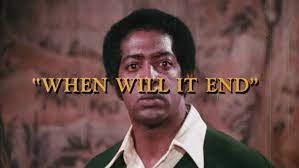
But you know, I kind of love this as it ends with Chris looking directly at us, the audience, and demanding that a million black men march on Washington 18 years before that happened. And then this title comes up:

The tagline for this movie was “

Director and writer Horace Jackson had some talent. Sure, this movie is all over the place, but there’s a scene where criminals beat up Mindy that is really artistic. And sadly, it could still be made today and be completely relevant. You could watch this and laugh at how silly and earnest it is or you could look at it as a filmmaker using all of the tools that he had to get out a message that he believed in.

You can watch this on Tubi.

CANNON MONTH 2: The Working Girls (1974)

Stephanie Rothman studied film at USC, was the first woman to be awarded the Directors Guild of America fellowship and wanted to make “highly thoughtful, European-like small films” that were inspired by Bergman’s The Seventh Seal. After her first movie for Roger Corman, who hired her as his assistant, she got to make her first movie, It’s a Bikini World.

It wasn’t really what she wanted to make.

“I had very ambivalent feelings about continuing to be a director if that was all I was going to be able to do. So I literally went into a kind of retirement for several years until more than anything in the world, I wanted to make films,” Rothman said to Film Comment.

She return to making movies on Corman’s Gas-s-s-s and then directed The Student Nurses for Corman’s New World Picture. That’s when she kind of figured it out, telling Interview about how she came to some level of peace — or at least understanding — with making an exploitation movie: “”I had never heard that term before. Roger never used it. So that’s how I learned that I had made an exploitation film. Then I went and did some research to find out exactly what exploitation films were, their history and so forth, and then I knew that’s what I was doing, because I was making low-budget films that were transgressive in that they showed more extreme things than what would be shown in a studio film, and whose success depended on their advertising, because they had no stars in them. It was dismaying to me, but at the same time I decided to make the best exploitation films I could. If that was going to be my lot, then that’s what I was going to try and do with it.”

The Working Girls was one of three movies — along with Terminal Island and Group Marriage — that Rothman would make for Dimension Pictures. While she never got to make the movie she wanted in her career, she did infuse her films with female desire which broke from what was on most drive-in and grindhouse screens at the time.

It’s about Honey (Sarah Kennedy, who was also in The Telephone Book), Denise (Laurie Rose) and Jill (Lynne Guthrie), three young women who have to escape the traps that men put them into — and women, what with a rich woman trying to pay off Honey to kill her husband — and emerging smarter and better off through their own intelligence. The men are almost universally users and get their comeuppance, which is so different than anything else on the screen at the time.

I could tell you all that or I could also let you know that Cassandra “Elvira” Peterson is nude in this movie, which may destroy all of the good will this has built. That said, perhaps sometimes guys needed a spoonful of sugar to take all this medicine.

CANNON MONTH 2: I Go Pogo (1980)

EDITOR’S NOTE: Thanks for being part of the second Cannon Month. There are so many movies to get to, from the rest of the films Menahem Golan directed to 21st Century’s 70s films that they distributed to the thousands of titles that Cannon owned. Trust me — there will be a third Cannon Month. This is one of the 21st Century-distributed movies and I’m kind of fascinated as to why they would have the rights.

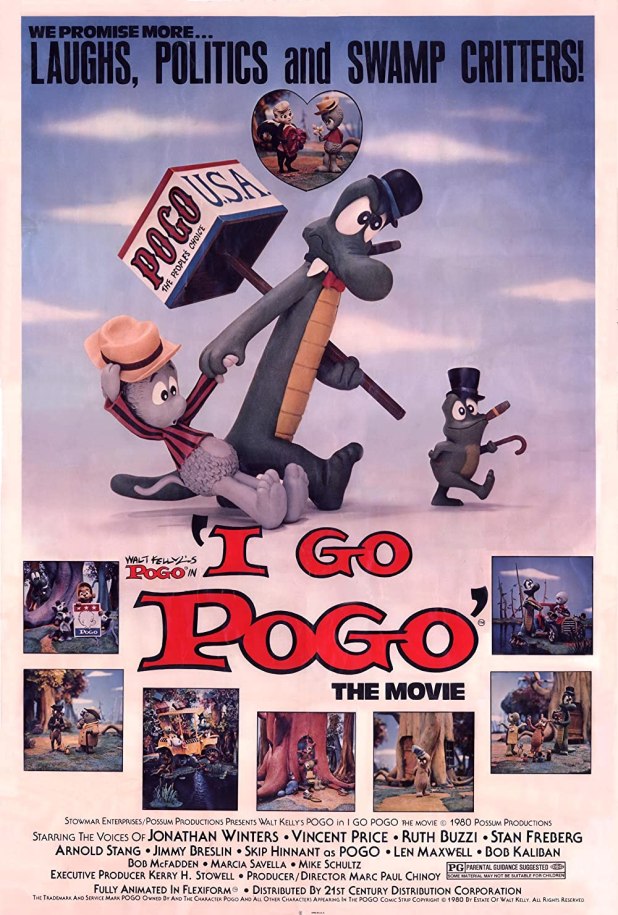
Pogo is the cartoon character who said, “We have met the enemy and he is us.” Sure, it was created for kids, but it had political satire that appealed to adults. Cartoonist Walt Kelly created it and the strip was syndicated to American newspapers from 1948 until 1975, then there was a revival from 1989 to 1993 with writer Larry Doyle and artist Neal Sternecky, who eventually did the whole cartoon himself. Actually, some newspapers carried reprints from 1975 to 1982 because that’s how popular Pogo was.

Chuck Jones had made The Pogo Special Birthday Special for the strip’s 20th anniversary but fans and Kelly disliked it. Walt and his wife Selby wrote and hand-animated We Have Met the Enemy and He Is Us, which was unfinished due to Walt’s poor health but the storyboards were used for the book of the same name. Finally, in 1980, this stop-motion film was made.

While this was released on VHS and played cable quite often — and Selby Kelly sold DVD on her site before her death — it has never officially been released on DVD. There was a ViewMaster set which makes sense, as the stop motion characters lend themselves well to that format.

Actually, the release of this movie is so weird. There were movie posters and ads in Variety claiming that it was to be released by 20th Century Fox. That never happened. It played once in August 1980 in New York City and its Kennedy Center debut never happened.

The stop-motion animators worked hard to ensure that the movie could be released four months prior to the 1980 election along with a promised a $1 million promotional budget and national Pogo for President write-in campaign.

Instead, 21st Century released it as a video rental through Fotomat huts — yes, this was a thing before digital cameras where you’d drive up and get your film developed but I never knew they had movies — in a plain generic Fotomat box.

On November 2, 1982 — the day of the mid-term elections — HBO premiered a new cut of the film that had narration added by Len Maxwell. This movie is really talky, so now it became even more filled with words. That’s the version that aired on cable through 1992 and that Disney Home Video released in 1984 and United American Video in 1989.

Directed by Marc Paul Chinoy, this film’s claymation characters seem a bit too dimensional when I think of Walt Kelly’s art, yet it’s still an interesting look. The strange thing is that this is based on the strip where Pogo ran for President and that was in 1952 and 1960 so the stories were nearly thirty years old by the time this movie came out, so some of the timely references are no longer so on the mark.

That said, the cast is strong, with Ruth Buzzi as Miz Beaver and Miss Mam’selle Hepzibah; Kelly’s friend journalist Jimmy Bresin as P.T. Bridgeport; Stan Freberg as Albert the Alligator; Jonathan Winters as Porky Pine, Molester Mole and Wiley Catt; Skip Hinnant (the voice of Fritz the Cat) as Pogo and Vincent Price as Deacon Muskrat.

It also has a good soundtrack featuring Dr. Hook and the Medicine Show. Yet it just feels like something I’m unsure kids would be interested in, as the subtext of political commentary has become the entire story. But hey, Will Vinton has always said that The Adventures of Mark Twain was the first full-length claymation movie and this was at least five years before that.

21st Century created a one-sheet poster, trade ads and trailers but decided not to release this as the rights were so murky that even they worried about being sued.

You can watch this on YouTube.

The Lost City (2022)

You know, I watch a lot of horror movies but I can admit to liking stuff like Romancing the Stone. So when The Lost City came out, I was pretty excited about it. And it definitely lived up to what I thought it would be.

Directed by Aaron and Adam Nee from a script by Oren Uziel and Dana Fox, from a story conceived by Seth Gordon, it stars Loretta Sage (Sandra Bullock), a romance author who is sick of being typecast — writecast? — by her series of books about the life of Dr. Angela Lovemore and Dash McMahon. She’s also tired of her cover model, Alan Caprison (Channing Tatum), who gets more attention than her at appearances.

Meanwhile, Abigail Fairfax (Daniel Radcliffe) is a billionaire criminal who kidnaps her as he feels that the lost city in her new book is actually real and she knows how to get there. It’s Alan — and Jack Trainer (Brad Pitt), who is a real-life version of one of her book’s characters — to the rescue. But when Jack gets taken out of the picture, can Loretta and Alan live up to what she has written?

I wasn’t expecting a movie that would change my life but instead a fun summer blockbuster that would make me forget just how strange and dark the world is becoming.

You can watch The Lost City on Paramount Plus or buy it on DVD, blu ray or 4K Ultra HD.

Out There Halloween Mega Tape (2022)

If you haven’t seen the WNUF Halloween Special, you should just stop reading this and do exactly that.

This spiritual sequel, directed and written by Chris LaMartina (Call Girl of CthulhuWhat Happens Next Will Scare You, WNUF Halloween Special) moves from the UHF past to the VHS, well, also past to inform of us of what happened next. But it’s also so much more.

If you ordered from Video Search of Miami or were lucky enough to be part of a tape trading crew, this movie will delight your heart beyond belief. This mixtape of footage comes from Trader Tony’s Tape Dungeon, a bootleg video operation that had been busted by the government and this release is to pay for Tony’s release.

It starts with an episode of a talk show hosted by Ivy Sparks (Melissa LaMartina) that would completely fit into the world of Ricki Lake yet also retains its local channel feel. Where WNUF felt part of the time when UHF reigned supreme, this episode is when your local affiliate was just starting to lose its hold on media and give way to large networks, as Fox became the fourth network and all of the shows that you loved like local pro wrestling and horror hosts were replaced by infomercials. We may not have known it at the time, but we were in the saddest of timelines.

Now, WNUF is an ACE channel and Ivy Sparks now hosts the show Out There, which feels like the kind of wild 90s prime time specials Fox used to air when they were the outlaw-feeling network that put alien autopsies live on the air.

I really loved the darkness at the edge of the public service announcements, the callbacks to the fate of characters from the first chapter of this story and the dread that builds as a UFO cult gets closer to being called home. This may have been inspired by the world of thirty years ago, but it’s literally the happiest I’ve been watching a movie this year.

You can buy this from the official site or check it out in person as it goes on tour. You can also get a VHS edition that comes with a printed catalog of every movie Trader Tony has for sale.

ARROW BLU RAY RELEASE: A Fugitive From the Past (1965)

Director by Tomu Uchida (Bloody Spear at Mount Fuji, The Mad Fox), A Fugitive From the Past came in sixth place in Kinema Junpo magazine’s 1995 poll of the Top Japanese Films of the 20th Century, third in 1999 and sixteenth in their 2009 poll.

As a storm sends a passenger ferry to a watery grave claiming the lives of hundreds of people, three suspects race from a burning pawnshop. Detective Yumisaka (Junzaburo Ban) finds only a burned boat and two bodies which he knows came from the crime and not the sinking of the ferry. Meanwhile, Takichi Inukai (Rentaro Mikuni) and sex worker Yae (Sachiko Hidari) have a brief encounter that will remain in their minds for years.

The case grows cold until Yumisaka is called back by his successor Detective Ajimura (Ken Takakura).

Two new bodies have been found.

Based on Tsutomu Minakami’s Kiga KaikyoA Fugitive From the Past, the story shows how everyone’s lives have been changed by the robbery. Inukai has become a normal businessman named Tarumi. When Yae sees him on the street she thanks him; the money he gave her allowed her to escape her life. He fears she will tell someone even though she kept his secret despite intense police interrogation years before.

Yumisaka resigned from the force as the case obsessed him. It still does. So when Ajimura finds a new clue, his life may have some closure, if only they can solve the mystery.

This is a story of two people — a woman saved by a killer and a police detective destroyed by his crime — that are still looking for him for different reasons. It may be three hours long, but it’s a really intense crime procedural that can now finally be seen in its full beauty here in America.

The Arrow blu ray of this film — the first home video release outside of Japan — has the restored 183-minute-long cut of the film, along with an introduction by writer and curator Jasper Sharp, scene-specific commentaries from leading Japanese film scholars Aaron Gerow, Irene González-López, Erik Homenick, Earl Jackson, Daisuke Miyao and Alexander Zahlten, the original theatrical trailer, an image gallery, a Tomu Uchida filmography, a reversible sleeve featuring original and newly commissioned artwork by Tony Stella and a first pressing limited edition collector’s booklet that has writing on the film by David Baldwin and Inuhiko Yomota. You can buy it from MVD.

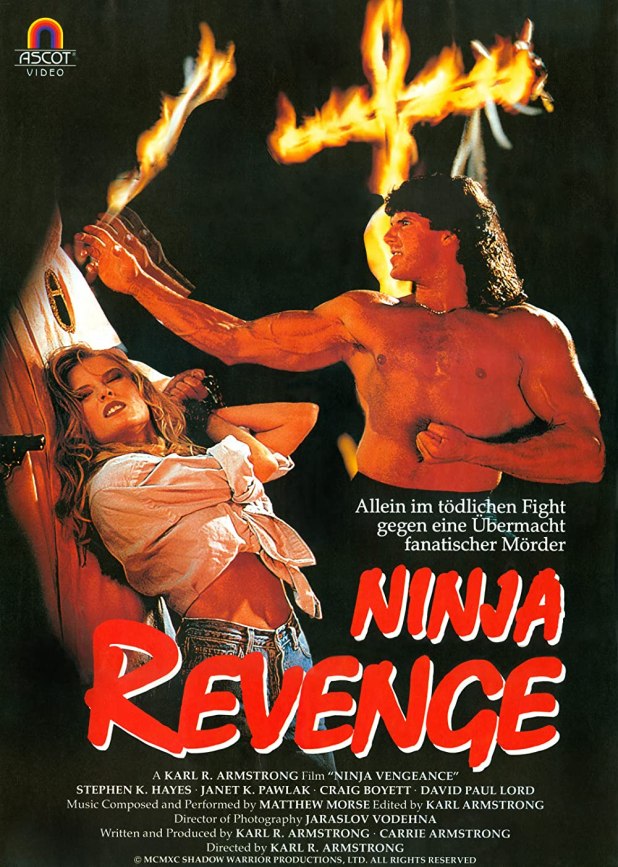
CANNON MONTH 2: Ninja Vengeance (1993)

Jesse (David Lord) says he’s a ninja, but he has all these books on being a ninja in his gear and I don’t think that real ninjas learn from a book. They’re raised as ninjas, right? Or they come in as adopted ninjas like Snake Eyes or Nero in Enter the Ninja. I also don’t want to tell ninjas what to do — I mean, Menahem Golan, whose 21st Century Film Corporation made this should know better than me — but I also don’t think they battle the Klan, even if that’s a noble enough cause.

Karl Armstong only directed this movie and Perfect Mate, mainly working as an editor, often on animated films like How to Train Your Dragon and Over the Hedge. Perhaps he found his calling because making ninja movies was not it.

Despite flashbacks from his ninja master (real-life ninja master and let’s not be racist, but non-Asian man Stephen K. Hayes who was in kung fu magazines a lot, so your mileage on him being an actual ninja master may vary), I wonder exactly how much Jesse learned. Mostly he rolls around in the mud. He does ride a Ninja motorcycle, which is the kind of thing that I also don’t think ninjas do.

Someday, someone will make a ninja against the Klan movie and it will be amazing. This, however, is not it. Ninja Vengeance was made in 1988 and not released until 1993. I imagine it had some type of bad movie radioactive half-life and therefore had to be kept from the rest of the world. Avoid at all costs.