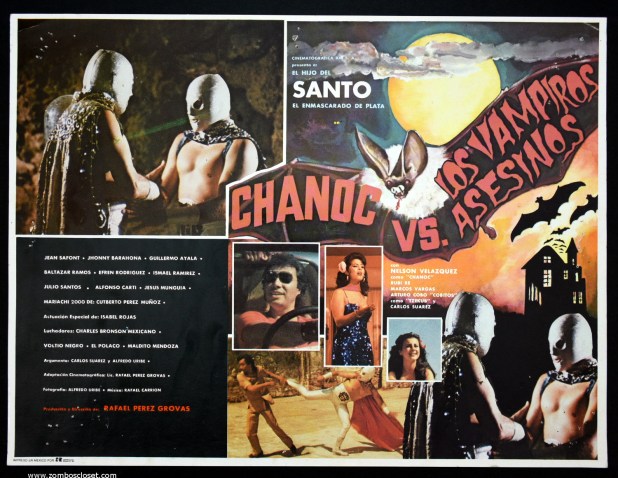
Chanoc y el hijo del Santo contra los Vampiros Asesinos (1983)

Just over a year after his retirement in late January 1984, Santo removed his mask just enough to expose his face on national television. This was the only time that he had shown his face in public and is considered him saying goodbye to the public, as he died only one week later. He was buried in his mask and ten thousand people gathered to say goodbye.

This film was made a year before and features El Santo sitting inside a cave where we can see the famous silver mask in a glass case. He asks a young man in sunglasses if he is ready to accept the family’s tradition of fighting for the common man and serving justice*. Santo tosses a smoke capsule at the young man, who emerges as El Hijo del Santo and embraces his father, who walks away from the rest of the film.

Chanoc** (Nelson Velazquez) and his sidekick Tzekub (Arturo Cobo) have been tossed into the ocean by smugglers and are rescued by El Hijo del Santo (who only appears in his mask three times and instead wears those shades to hide his identity) and his sidekick Carlitos (Carlos Suarez). As for the vampires in the title, the gang members are merely dressing as them to scare people away.

I wanted to enjoy this movie but I realize the further from reality lucha films stray, the more I tend to love them. This is not one that transcends our day to day drudgery.

You can watch this on YouTube.

*Thanks to Cult Faction, I can share that speech: ““My son, you have been preparing to take my place. I’ve taught you to love the poor and the weak, and now you are ready to help them and defend them, to fight for justice and the law. And above all, to be the friend of the people. I am going to present you with this mask, which has been my pride and my emblem. When you put it on, you will have to honour it always, even when your own existence is endangered. If you feel capable of consecrating your life, swear to it as I did. But first, you have to know one thing: once you put it on, you can never go back. Now tell me, are you willing?”

**Chanoc is an adventurer and fisherman who comes from the comics and has appeared in Chanoc,  Chano en las garras de las fierasChanoc contra el tigre y el vampiroChanoc en las tarántulasChanoc en el foso de las serpientesChanoc en la isla de los muertos and Chanoc en el circo union.

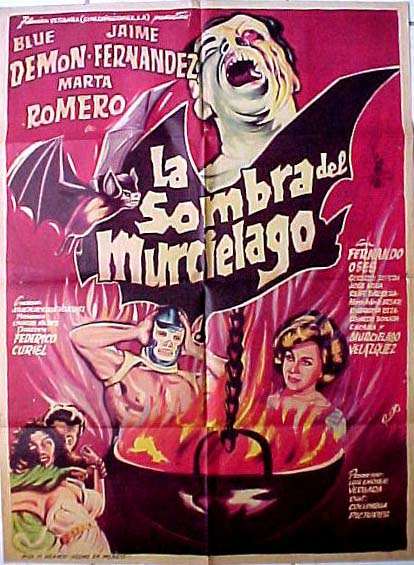
La Sombra del Murciélago (1968)

Federico Curiel was a maniac and I mean that in the very best of ways. He wrote tons of great movies like El Baron del Terror, as well as directing stuff like the Nostradamus vampire movies, lucha films with Neutrón, Blue Demon and Santo, Westerns such as Super Colt 38 and so much more. He’s also the man who brought together so many luchadors for The Champions of Justice series.

Here, he delights us yet again with the tale of El Murcielago, a former wrestler who has become disfigured and obsessed with singer Marta Romano as he sits in his cave, wearing a jeweled robe, playing an organ and being generally awesome. He takes this beautiful girl and hides her away from the rest of the world to watch him fight and kill a series of other wrestlers until Blue Demon decides that he’s going to save the wrestling business.

The joy of lucha libre movies is that astounding things can just happen. Men can be disfigured and take over caves filled with henchman who listen as they regale them with dibble dabble keyboard musings and the rantings of a madman. Beautiful singers can be kidnapped and scream at every rat they ever see. And Blue Demon can show up and solve everything with wonderful violence.

There are also four musical numbers, which feels just about the right amount.

You can watch this on the amazing White Slaves of Chinatown channel on YouTube.

Girl Gang/Pin-Down Girl (1954)

EDITOR’S NOTE: We covered Pin-Down Girl under its other title, Racket Girls, earlier this year. Thanks to this Kino Lorber re-release of Something Weird’s The Golden Age of the Exploitation Picture imprint, we’re watching it again.

Girl Gang is really about Joe (Timothy Farrell), who leads the titular group of young ladies. He hooks them on drugs, then gets willing participants in the crimes of robbery and prostitution. Farrell would play pretty much the same role, under the same name, in 1957’s Gun Girls. His main girl June is played by Joanne Arnold, who was the Playboy Playmate of the Month for May 1954.

This is the kind of movie I find myself loving when I’m not watching Italian splatter or Mexican lucha movies: too old to be teenagers getting in trouble and dragging down everyone else with them.

Pin-Down Girl also has Farrell, this time as Umberto Scalli, a women’s wrestling manager who uses the world of pro wrestling to hide all of the racketeering, bookmaking and prostitution he has his dirty little fingers wrapped up in. Oh yeah — he also owes the mob enough money for them to want him dead.

Peaches Page, Clara Mortensen and Rita Martinez were all real wrestlers in a movie that threatened to show the real side of the business.

Farrell had already played Scalli in The Devil’s Sleep and despite getting killed by organized crime at the close of this film, he would come back for Dance Hall Racket, which has Lenny Bruce and his wife Honey Harlow. Now that I think of it, Scalli dies in every movie he shows up in. Is he an eternal man forced to be killed again and again for the sins of vice and wrestling women?

The man playing these roles was no saint either. At the same time that he was making these movies, the actor worked as a bailiff for the Los Angeles Marshal’s Department. He was embarrassed at work when he — and the entire cast — of Paris After Midnight was arrested by the Los Angeles Vice Squad as they made the movie. Things went pretty well after that with Farrell being appointed the County Marshal in 1971. But in 1975, he was fired after his conviction on felony charges for illegal use of deputy marshals in political activities. He would have gone to jail for six months, but just got probation because he was in bad health. He spent the rest of his life managing properties and a lumber mill when he wasn’t saving animals with his wife, so perhaps he learned his lesson.

Both of these movies came to be because of producer George Weiss, who is perhaps best known for getting Glen or Glenda? out there, as well as padding the film with nonsensical sequences of BDSM and dancing women. He’s also the man responsible for producing Olga’s House of Shame, White Slaves of Chinatown, Olga’s Girls, Mme. Olga’s Massage Parlor and Olga’s Dance Hall Girls, a series of roughie films that scandalized the screens of their era, as well as providing insidious influence for the Findlays and John Waters.

I truly appreciate that these films are being released on blu ray and preserved for generations of weirdos like me who may come in the future.

The Kino Lorber blu ray re-release of these films has Girl Gang and Pin-Down girl remastered in 2K from the original and re-release 35mm negative. The former has commentary by Alexandra Heller-Nicholas while the latter has a commentary track by Eric Schaefer, author of Bold! Daring! Shocking! True!: A History of Exploitation Films 1919-1959.

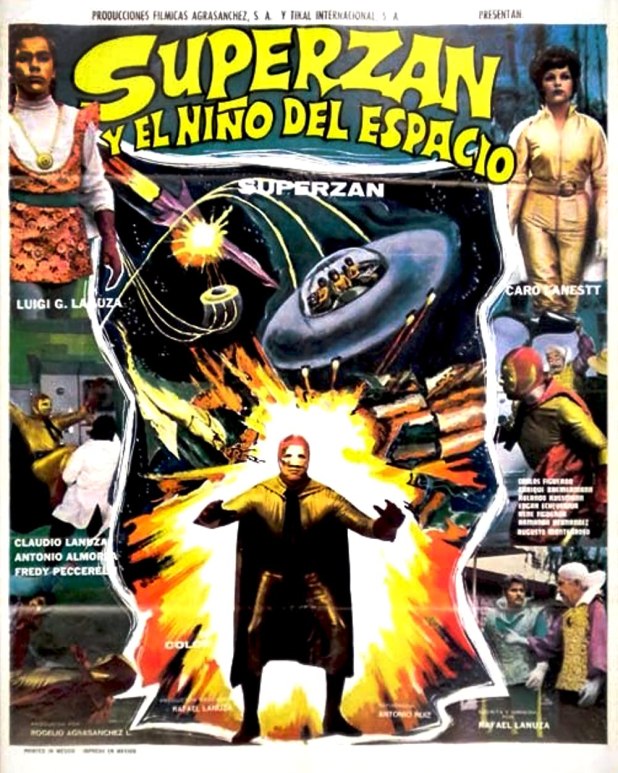
Superzan y el Niño del Espacio (1973)

Superzan has always been closer to a superhero than a luchador and sadly, this film doesn’t make me like the character any more than I already had — which was not much.

The Space Child of the title is Silio, a gold-skinned boy from the planet Aramina in the Andromeda galaxy. His goal is to solve our energy crisis because if we keep using fossil fuels, we’re going to knock our planet and then our galaxy out of place and then ruin everything. To make it happen, he works with a scientist to create a supercomputer before that dastardly nerd kidnaps him and decides to take over the world.

The golden boy sends a plea to his home planet for Superzan to rescue him, but the evil scientist has a luchador that does his dirty work named Evil Genius, which adds up to lots and lots of wrestling between the two of them.

Of course, the alien child came here in peace and we weren’t ready for it, so he goes back home. Way to go, humanity. Obviously, we have learned nothing since 1973, even if we attempted to listen to an orange-faced manchild for some obscene length of time.

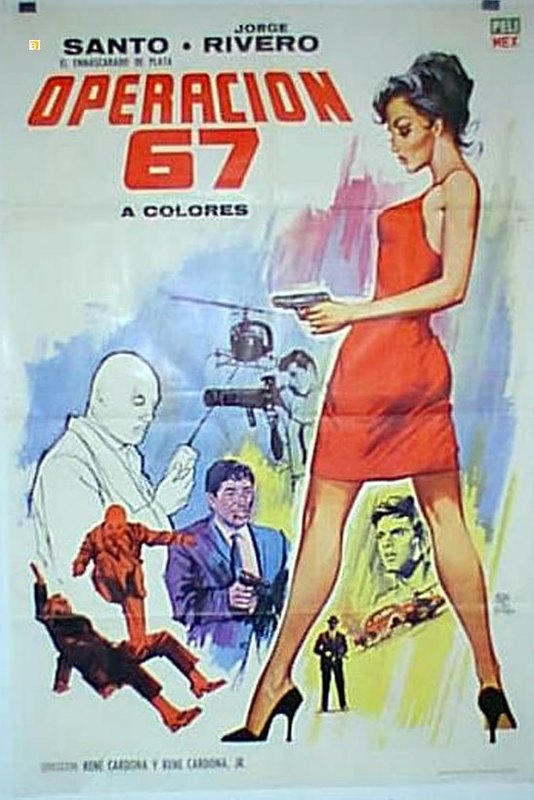
Operation 67 (1967)

If I had to pick two Mexican stars to be secret agents, it would be Santo and Jorge Rivera, who we all know as Mace from Fulci’s insane ode to fog Conquest. Yes, the Eurospy craze stuck around a little but longer in Mexico and if Santo gets to be a spy, so be it.

The whole scheme in this movie is to counterfeit money and — I’m guessing — destroy the world’s economy. Everyone evil has a watch welded to their wrist that allows the bosses to listen in and destroy them, if they must.

Somehow, even more than a Bond film, this become a proto-Andy Sidaris affair which I could not applaud for more fervently. Yes, Jorge ends up in bed with a Japanese exotic dancer and then gets attacked by a small plane that he blows up with a bazooka. As far as I’m concerned, that sounds like this movie could have been filmed on Savage Beach.

The main evil leader is really Ruth Taylor, but come on. She’s Golden Rubi herself, Elizabeth Campbell, who played the wrestling heroine in Doctor of Doom, Las Mujeres PanterasWrestling Women vs. the Aztec Mummy and She-Wolves of the Ring. She also shows up in the Eurospy ala Mexico movies Las Sicodélicas and Peligro…! Mujeres en Acción, as well as the baffling yet awesome film The Chinese Room.

For some reason — feel free to make up the story in your head as you watch — Ruth is absolutely in love with her enemy Jorge, saying things like “Whatever happens, I really love you.” and telling him that she never lied before expiring from the multitude of bullets that she’s been perforated by.

I am all for more spy movies with Santo and luckily, René Cardona and son would immediately make El Tesoro de Moctezuma, which would bring our secret agent amigos together again.

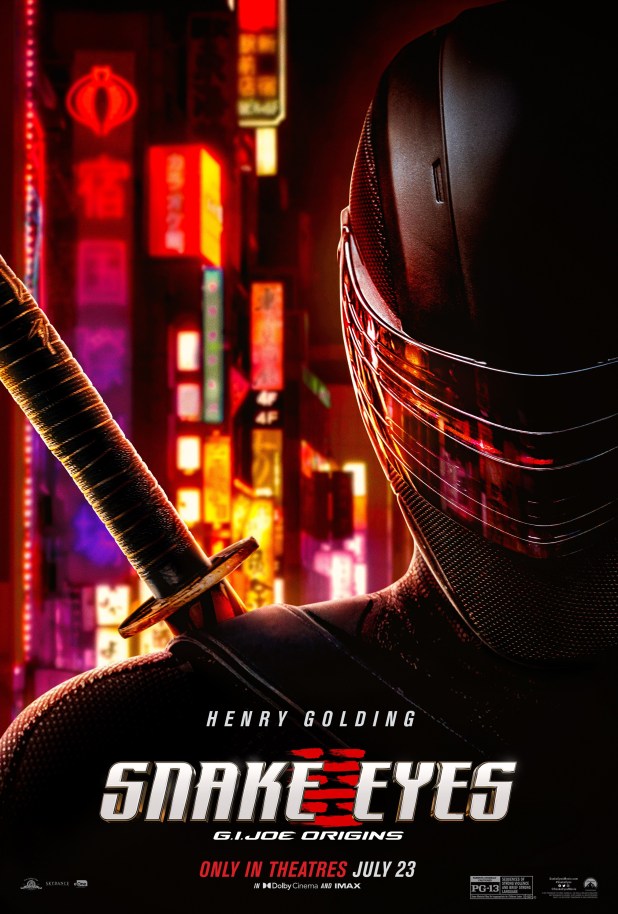
Snake Eyes (2021)

Have I ever told you how much I love G.I. Joe?

If you know me in person, the answer is probably yes. In addition to an entire room of our home being devoted to movies, there’s an entire room for my collection. Did you know that they made an aircraft carrier that’s bigger than your coffee table? I do. It’s in my house.

When I first started dating my wife, the entire upstairs of my house was devoted to this toyline. And not just a figure here or there. I’m one of those maniacs that troop builds, which if you don’t know, be happy that you’re a normal human being and not devoted to buying and outfitting hundreds of the same army figures and building gigantic platoons of them. Hey, to be fair, Peter Cushing did this as well, so I cling to the knowledge that at least one respected person also played with toys, but I doubt Peter Wilton Cushing, OBE ever had a woman say to him, “Why do you have thirty of the same tank?*”

I’m telling you all of this to tell you that there’s no way that I can be objective about this movie.

Snake Eyes has the same problem that comic book movies had before the Marvel Cinematic Universe did something incredibly simple: they just followed the source material. Sure, the problem is that there’s all sorts of source material. G.I. Joe has multiple comic books, toy lines and cartoons, but perhaps the best version of the story are the Marvel Comics that came out written by Larry Hama in which Snake Eyes was the central character**.

Snake Eyes looks at that source material, especially the central story of two sword brothers who fate has torn apart — actually, it’s super close to Enter the Ninja — and says, “Well, we can do some of that. But what if, and go with us on this, there was a meteorite that people can use like a laser?”

The issue is that there’s an audience that knows G.I. Joe from the silly cartoon stories***, an aging out audience that angrily only loves the comic and toys, and then there’s the audience you want: the general ticket-buying public, the ones that actually make a movie successful.

Look — if you plan on watching this movie and don’t want perhaps its dumbest plot point spoiled — sneak out now.

I’ll get to it. Trust me.
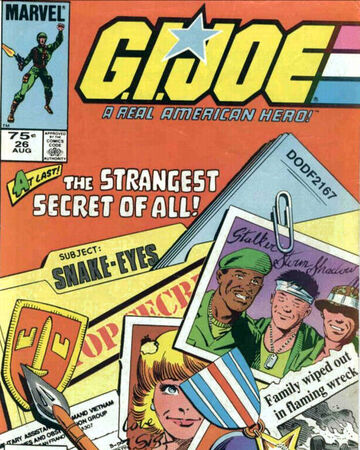
Why look! It’s like someone wrote and storyboarded the perfect Snake Eyes story already!

Snake Eyes is not a soldier in this movie. I understand that the Vietnam War was decades ago and the story needs to be updated. I’m also not even remotely upset that Snake Eyes is now Asian-American and played by Henry Golding, who is a fine actor and really went all out to do the physicality that this movie needs. And I get it — the idea that Snake Eyes lost his father and it put him on a path of revenge is also not a bad idea. There are tons of movies based on the very same idea and it works.

In fact, a lot of the movie works up until the middle of the film, when a moment just tanks the concept (and it gets worse from there).

A Yakuza boss named Kenta (Takehiro Hira) discovers Snake Eyes fighting in an underground MMA circuit — how that gets him close to the man that killed his father is debatable — and hires him to put machine guns into fish. One day, Kenta asks Snake Eyes to shoot a traitor — it ends up being Tommy AKA Storm Shadow and Kenta’s cousin and yet he doesn’t recognize him — but our hero ends up saving the man’s life. But to double back on why he didn’t recognize his own cousin it turns out that it’s all a ruse and Snake Eyes is really the bad guy, sent to infiltrate the Arishkage Dojo, a family of ninjas that has protected Japan for centuries.

Trust me — other than Akiko (Haruka Abe) most of the Arishkage are complete morons who just allow a stranger into their midst and show him every single one of their secrets.

Which brings up one of my biggest issues before we dare go any further. There are moments of great drama in this movie, like when Snake Eyes and Storm Shadow slice their hands open and become blood brothers. We know that this should happen, but we’re never given a dramatic reason why they should be so close when it’s all based on a series of lies, which makes Snake Eyes seem to be a manipulative jerk instead of the hero we should get behind. And don’t give me the redemptive journey excuse — this is the first time I’ve met the hero, I guess, and I want to like him.

The film cannot decide if we should know the source material, because if we do, we’re going to dislike lots of this. And if we don’t, we’re not going to understand the dramatic reasons why so many things are happening****.

The dramatic event that causes Storm Shadow to turn away from his family — in the comics — is when Zartan has infiltrated their dojo and uses technology to murder the Hard Master (he had intended to kill Snake Eyes for Cobra Commander, as Snake Eyes’ family and the evil leader’s brother were in a car accident that ruined both of their lives). This makes it seem as if Storm Shadow killed his uncle out of jealousy, so the ninja clan dissolves and Snake Eyes leaves for America. The two are destined to battle again and to become brothers once more after all of the intricacies of fate are untangled.

Contrast that with Snake Eyes being hired by the Yakuza and Cobra — kinda shoehorned in with the Baroness (Úrsula Corberó) appearing to battle (and team with, awkwardly) Joe representative Scarlett (Samara Weaving, who deserves to be the lead in movies like Ready or Not and not a second banana) — to steal the Ariskage source of power, which leads to Storm Shadow using said McGuffin and being kicked out of his ninja clan while Snake Eyes just asks to be forgiven and everyone says, “Well, you got our entire base burned down and lots of our people killed, but at least you said you were sorry” while Storm Shadow quite understandably flips out.

But back to the point that ruined this for me.

Snake Eyes must get through three trials. The first one is a great lesson in selflessness, as he must take a bowl from the Hard Master without losing his bowl. The second seems like straight-up Luke in the cave The Empire Strikes Back moment. And finally, he must descend into a pit and be judged, as the third trial kills most of the people involved.

That’s because — seriously, this is the spoiler — deep in that cave there are a whole bunch of sacred anacondas that can sniff out whether someone is pure of heart so that they can be ninjas, which are killing machines when you come to think of it, which reminds me of how Wanted went from an order to supervillains in the comic to sacred assassins all listening to a loom that wove fabric that told them who to kill for the good of humanity in the baffling goofiness of the film.

The moment I saw a gigantic snake start judging this film’s hero, I just sat into space, staring and said, “Well, I’m out.”

If I can say anything nice, there’s a decent neon-lit Oldboy influenced battle at one point. Scarlett’s costume looks a lot like the new Classified figure. And it remains a thrill to see the Cobra logo on the big screen. Yet the majority of the fights grow too dark, too oddly cut and too small for what should be a big and bold action film.

I really think the potential to make a G.I. Joe move exists. Actually, it’s called The Expendables but that’s a moot point. It’s just hard to watch filmmakers make a simple concept more difficult than it needs to be. The story beats have been lined up for you. And if you follow them, they can help make a movie that makes sense. And yes, giant snakes are silly, but if they work for the story, they can be forgiven, because I watched an entire film where Cobra Commander devolved into human snake while clinging to Roadblock and bemoaning how he was once a man and then Burgess Meredith leads a Lovecraftian world of bugs against the Joes. As dumb as G.I. Joe: The Movie is — and the first five minutes remain the best distillation of what a movie with these characters could be — it’s somehow nowhere near as daft as this.

I really wanted to love this. Hasbro stopped making G.I. Joe toys for years and shuttled the fan club just to reset the brand for this. But hey — as bad as the movie is, at least I have new action figures. If that’s all I get, as most Joe fans, I’ve learned to be happy***** with it.

*That same woman, nearly a decade later, said to me at the end of this movie, “All this time, I thought Snake Eyes was the bad guy.” I have failed.

**Which is interesting because Snake Eyes is the whole reason I was allowed to have these toys. My parents were hippies who were very anti-guns and military. The inclusion of a ninja allowed them to see that this was not all just army figures. To be deeper, the comic series was an integral part of my brother’s development, as it was how he learned how to read — he’s somewhat dyslexic — as my mom and he would read it together. He had the opportunity to tell this to series creator Larry Hama, which is a treasured memory.

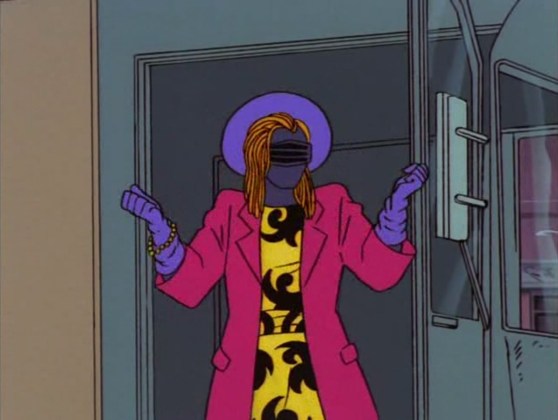
***Snake Eyes once dressed as a disco woman with a dancing dog on the show. Yes, really.
****Why does Akiko change her mind and see anything in Snake Eyes when all he does is act like a jerk to her and repeatedly sneak punch her in the face? Why does Tommy give Snake Eyes his sword when they’ve known each other for all of a few days and not years like the comic? Why does the word of the man who killed Snake Eyes’ father mean more to him than nearly everyone else in this entire story? Why does the film wait until the end to give you what you want — Snake Eyes and Storm Shadow taking their names and costumes? Am I the only one that remembers that it took 90 minutes of sheer dross for Jem to give audiences what they wanted when Kesha showed up as Pizzazz right when you realized that there was no way a sequel was happening?

*****It’s still better than the first movie, which is the lowest bar ever even if that movie has a Brendan Fraser cameo as Sgt. Stone, and about the same as the second, if only for that film’s astounding ninja mountain battle scene and because it has the Rza as the Blind Master.
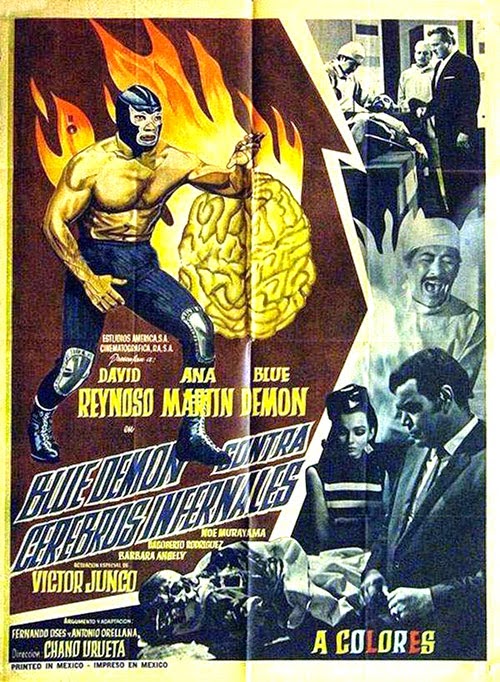
Blue Demon contra Cerebros Infernales (1968)

If you have an issue with seeing brains outside of skulls, perhaps this is a movie to avoid, as it seems like the main story thrust of this is to show brains as often as possible, but there’s also plenty of neon-hued labs, swinging go-go dance numbers, Blue Demon wrestling matches, future science that never really came true and Noé Murayama, the son of a Japanese dentist, as a mad scientist with female zombies in his employ.

Director Chano Urueta also made one of the most deranged movies I’ve ever delighted to see more than twenty times, El Baron del Terror. He worked on several of Blue Demon’s movies and the Los Leones del Ring series, which had Jorge Rivero as twin luchadors. He started making movies as far back as 1928 and his career lasted the whole way up until 1974. Ureta also acted in several movies and shows up in Peckinpah’s The Wild Bunch and Bring Me the Head of Alfredo Garcia.

The best thing about a 1968 lucha movie is that it combines so many things that you love into one big combo. To wit: Eurospy movies, evil — and good — women in miniskirts and high boots (and occasionally berets), Adam West Batman-inspired sets, a caveman wrestling and so much more.

For some reason, it was decided that Blue Demon should have some superpowers in this film, so he learns how to teleport. He also can run through walls which is a great power to have.

I love the solo Blue Demon movies because I’d rather see him as a hero with agency instead of the foil or second banana to Santo. He just seems to try harder than the competition.

Angel (2018)

Fae is a sex worker. Thierry is a world-famous cyclist. During his vacation in Senegal, he quickly falls for her until he begins to act strangely as if he were on drugs. After going their separate ways, she learns the next morning that he has died and that she is arrested as a suspect.

This is a movie based in reality with a dash of movie license, as it tells a similar story of the last days of  Belgian cyclist Frank Vandenbroucke, who overdosed in a prostitute’s apartment in Senegal. It’s also taken from the book Monologue of Someone Who Got Used to Talking to Herself by Dimitri Verhuls.

There’s one astounding line in this that makes the entire movie, as one girl asks another: “Do you realize we fuck guys older than we’ll ever be?” Just think on that.

Can two people fall in love in one night particularly if they are both damaged souls coming together in a way that no one would expect to be anything but passion? Angel tells that story, even if the results may not end up as a Hollywood ending.

Angel is available on demand from Oration Films.

Mil Mascaras contra Las Vampires (1968)

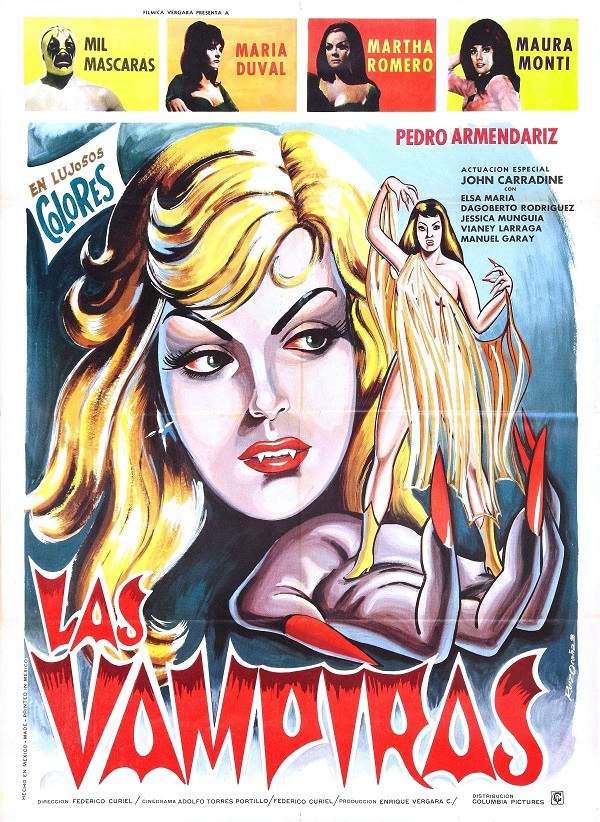
Back in Drive-In Asylum #8, I wrote about “John Carradine vs. Mil Mascaras” and this movie is the film where it happens.

Carradine had sold everything he owned to start a traveling Shakespeare actor’s company and when it folded, he was penniless, which led to the kind of roles that we love him in. In fact, the actor would get to go wild in these parts unlike any straight films he’d made. He’d make several movies in Mexico such as Diabolical Pact, Enigma de MuerteAutopsy of a Ghost and La Señora Muerte, but this time, he’s a vampire!

A Transylvania Airlines plane has crashed in Mexico. bringing Aura to the country — all of the male vampires are dead — and into competition for leadership of the vampire women with Dracula’s widow Countess Véria. They’re also biting luchadors and using them as henchmen, which puts Mil on their trail.

Meanwhile, the women have Count Branos (Carradine). Once he was such a powerful vampire that he was the man who taught Dracula. Yet now, after a vampire hunter put a stake through his brain instead of his heart, he’s become a moronic and sad man, crying in a cage and dreaming of the days when he ruled the world of the undead.

Yet its a ruse, as Véria sacrifices her own life to make him powerful again and man, Carradine goes absolutely wild in the role as an unbound master vampire. Sure, it’s all the way at the end of the movie, but man, it’s great.

Also: a car runs Mil off the road and it’s driven by bats. By bats!

Even better, this movie starts off as all Carradine movies should, with him speaking directly to the camera. All movies should start this way.

You can watch this on YouTube.

Mil Máscaras (1969)

Mil Máscaras means Thousand Masks and the man behind those multiple faces became one of the most recognizable wrestlers in the entire world as well as the star of twenty movies.

The character of Mil Mascaras was announced before he even wrestled in the ring, with the character created by “El Rey Midas de la Lucha Libre” Valente Perez. Perez was the publisher of Lucha Libre magazine and also came up with Tinieblas.

Mil is one of the first lucha stars to wrestle in the U.S. — he was the first masked wrestler to appear in Madison Square Garden after the ban on masked wrestlers was lifted — and Japan, where he became a major star in All Japan Pro Wrestling, often teaming with his brother Dos Caras.

Yet Mil Máscaras was created specifically to be a movie star. This suited producer Luis Enrique Vergara well, as Santo had argued for more money and Blue Demon was injured. The lucha movies were making money, so Vergara got a new star out of Mil.

Taking a page — many pages to be fair — out of Doc Savage, Mil gets an origin story that finds him as an infant found clutched in his dead mother’s arms at the end of World War II. Scientists adopt him and put him through a brutal series of physical trials and mental lessons to create a superhuman that can make the world a better place.

While this movie was shot in black and white and may seem pretty plain when compared to the wilder lucha stories to come, everything has to start somewhere. Mil has some really fun matches in this and there’s lots of great rock and roll for the kids to twist away the night to.

While there are many that decry Mil for being selfish in the ring, he remains a major star years after being named Pro Wrestling Illustrated’s most popular wrestler in 1975. No less of an expert than the original Tiger Mask, Satoru Sayama, said ” If it weren’t for Mil Máscaras, there would be no Jushin Liger, no Último Dragón or the Great Sasuke today.”

Note: Information for this article came from Luchawiki.