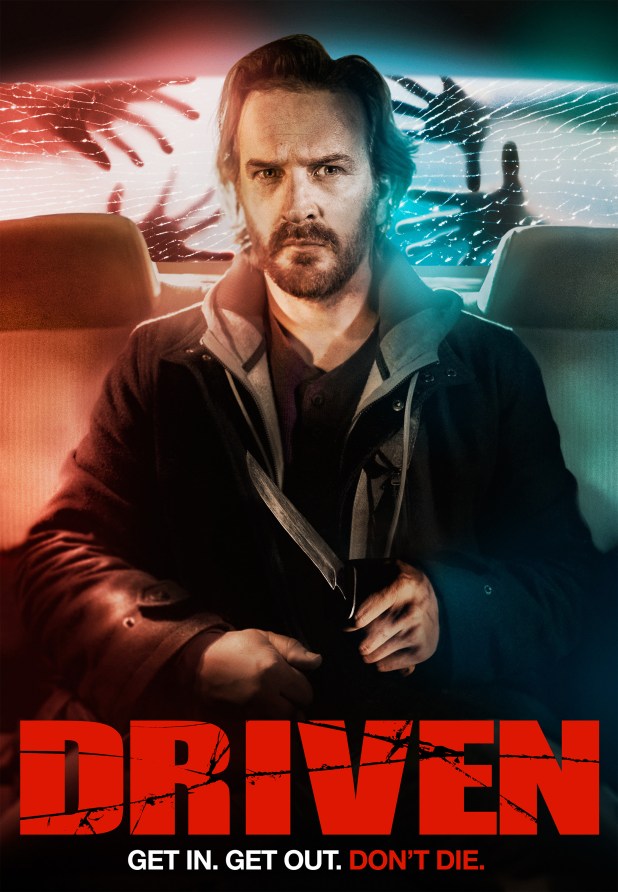
Emerson Graham (Casey Dillard, who also wrote the film) has lost her lover, her friends and even her motivation to be a stand-up comedienne. Now, she spends her nights as a cab driver, but on this fateful night, a mysterious passenger named Roger (a welcomed Richard Speight Jr., Gabriel from TV’s Supernatural) gets her involved with his battle against the demonic curse against his family.
Basically, this is a movie between two actors for a good chunk of the film, shot within Emerson’s rideshare car during a four hour period. I really liked how the demonic parts of this movie just sneak up on you. I’d done no reading about the film before starting to watch it and it really surprised me. I was hooked the whole way through.
I really enjoyed how the romantic parts of the partnership between the leads was played down. This is more about the battle to save the world — and their parts in it, too — than anything else. It was pretty realistic, for a movie where demons are possessing people, that is.
Driven arrives on-demand (Amazon) and on DVD on June 16 from Uncork’d Entertainment. You can learn more about the works of Glenn Payne at his official site. You can also ad-stream the film for free on Tubi.
Driven is the sixth feature film by Glenn Payne, a founding member of the improvisational comedy troupe West of Shake Rag based out of Tupelo, Mississippi. He’s currently in post-production on his seventh film, the horror-thriller, Killer Concept, due in 2021. He’s also written and directed the impressive against-the-budget science fiction set piece, Earth Rise (2014; also on Tubi), about the effects of space travelers on the way to Mars.
DISCLAIMER: We were sent this movie by its PR team.
Fruit Chan’s Dumplings is a masterpiece. It is also a film not for the faint of heart.
If you cringed when you watched Pier Paolo Pasolini’s final film, 1975’s Salo, the 120 Days of Sodom . . . if you experienced a case of vomit reflux at Tom Six’s The Human Centipede . . . this statement on how far one will steep into the Seven Deadly Sin for their own personal gain . . . well, there’s no cup of rice tea that will sooth your soul or stomach.
Written by multi-award winning and Oscar-nominated writer Lillian Lee (aka Pik Wah Lee) of 1993’s Fairwell My Concubine fame, Dumplings is a film that’s incorrectly lumped in with the J-Horror cycle. And it’s a film that will forever remain untouched by the American obsession to remake all things J-Horror to a lesser and lesser effect. There’s never going to be an Aunt Mei cycle of films competing with tales of Toshio (Ju-On, aka The Grudge) and Sadako (Ringu, aka The Ring). There’s no way to boil this this graphic-filled dough ball into a good ol’ red, white & blue banality snack, homogenized for the post-Saw “Hard-R” marketplace.
I’ve lost many a film geek debates analogizing the Hong Kong-boiled Dumplings as a neo-giallo film. But this is my film review and I hereby christen this film as Asian Giallo. For if Dario Argento was in his “Animal” and “Three Mothers” trilogy prime—today—and not creating films in the puritanical ’70s, Argento—and not Lillian Lee—would have created Aunt Mei’s ersatz Erzsébet Báthory, the 17th century Countess of Transylvania who created a personal youth elixir from the blood of virgins. (Then Maestro Dario would have screwed it up with some over-the-top volumed Iron Maiden tunes, then blamed the bloody hijinks on a monkey with a straight razor.)
Mrs. Li (multi-award winning actress and musician Miriam Yeung) is a former actress pushed to the limits of vanity by her vain, wealthy husband in an affair with his maseuse. To save her marriage, she seeks the services of Aunt Mei (Bai Ling, Southland Tales), an underground chef famous for her rejuvenating dumplings—and the secret ingredient is more than just blood.
And we’ll just leave it at that.
You can watch the short version of “Dumplings” as part of the Three . . . Extremes anthology on Shudder, but there’s a free-with-ads stream on FShareTV. You can stream the feature film version of Dumplings on Shudder. But if you’re not a Shudder member, you can watch 11 clips from the film that will give your the full story arc, courtesy of Movie Clips on You Tube.
This a must watch and must have for any horror movie hound’s collection. And it’s a giallo . . . damn it!
Update, November 2020: Bai Ling and Fruit Chan are back together — in a familiarly-themed film — in the 2019 Cantonese-Mardarin language drama The Abortionist. Nominated in the “Leading Actress” and “Best Director” categories for this year’s Golden Horse Awards held in Taiwan (in November), Ling stars as a Tai chi teacher with a secret life as a black-market abortionist. You’ll remember Ling won dual “Best Supporting Actress” awards at the Hong Kong Film Awards and Golden Horse Awards for Dumplings, Chan’s segment of the Three Extremes omnibus, in 2004.
Hopefully, Ling and Chan will win in their respective categories, which will encourage an American distributor to release The Abortionist in the Western-domestic marketplace. At the very lest, we’ll hopefully be able to see The Abortionist on the free-with-ads stream Tubi TV platform, which afforded us the opportunity to discover and enjoy the recent Asian-imports Daughter and 0.0 MHz. We’ve also recently reviewed Ling’s work in the fun retro, genre mash-up Exorcism at 60,000 Feet.
About the Author: You can read the music and film reviews of R.D Francis on Medium and learn more about his work on Facebook. He also writes for B&S About Movies.
Here’s another film that, like Antonio Margheriti 1971’s Web of the Spider, is open for the giallo vs. British horror debate. It’s a U.K. production, with some assistance from Belgium and Spain, shot at Britain’s famed Pinewood Studios—with nary a Spaniard or Italian in the British cast headed by Donald Pleasence’s (Phenomena) daughter, Angela.
And the “it’s not a giallo” argument also applies to Larraz’s directorial debut, 1970’s Whirlpool and his 1971 follow up, Deviation, which are considered as Hitchcockian erotic thrillers (rife with lesbianism, natch) that lean towards the bloodless psychological.
As for myself: Yes, Symptoms is a bit more restrained and subtle, but it’s stocked with all the gialli character-prototypes, it keeps you guessing, has exquisite cinematography, and packs a punch at times; so I approach Larraz’s sixth film as a Spanish giallo variant of Roman Polanksi’s Repulsion—much more so than an Amicus-styled horror (which are more implied “shock scares” than violent).
Pleasance’s Helen Ramsey returns to the U.K after an extended time abroad in Switzerland and reconnects with her old writer-friend Anne Weston (Scottish actress Lorna Heilbron of The Creeping Flesh with Peter Cushing and Christopher Lee) and invites her to spend the weekend at her family’s remote, dilapidated forest estate—complete with a swampy lake where someone once drowned. Of course, there’s “something” wrong at the estate—and “something” with Helen (e.g., she has a solitary “erotic moment” of pleasure as she stands at a creepy attic door; a swampy boat ride arouses her), and Anne begins to experience the same voices and moving shadows as Helen. When the estate’s creepy handyman (isn’t there always one in these films) discovers Cora’s corpse—the manor’s “previous house guest” that caused Helen’s extended “vacation” abroad—she goes off the deep end (or does she?) and more people die.
The DVDs and Blus for Symptoms are easy to find—but know your regions. Mondo Macabro released it for the first time in both formats in 2016, while the British Film Institute put out their own versions that same year. But we found you a free rip for you to enjoy on You Tube.
We’ve since done a week-long tribute to José Ramón Larraz’s works in July 2022 — including a second take on this film. Yeah, we love him!
About the Author: You can read the music and film reviews of R.D Francis on Medium and learn more about his work on Facebook. He also writes for B&S About Movies.
Dick Butler (Ray Lovelock, The Living Dead at Manchester Morgue) and Ingrid Sjorman (Ornella Muti, Flash Gordon) are trying to enjoy their own summer of love, travelling through Italy and paying for it with porn magazines and nudes of Ingrid. Then they get busted by the cops. Then they get robbed by a biker gang. Then they get mistaken for crooks. They’re on the run, out of gas and running out of options.
Also known as Oasis of Fear, Deadly Trap, Dirty Pictures and Love Stress in Japan, this Umberto Lenzi giallo is all about what happens next.
Soon, our hapless couple has found their way to the home of bored middle-class housewife Barbara Slater (Irene Papas, Don’t Torture a Duckling). She’s up for some sexual shenigans, potentially with both of them, but she’s also way smarter than either of our teenagers realize.
In the book Blood and Black Lace: The Definitive Guide to Italian Sex and Horror Movies, Lenzi claimed that he had trouble getting Papas to participate in the threesome scene. What he had no trouble with was getting Lovelock’s help in capturing the free spirit of 1971, as he sings the theme “How Can You Live Your Life?” and rocks out some amazing clothes, including the Union Jack jacket that appears on the poster for the Oasis of Fear release of this movie.
Beyond a brand new 2k restoration in English and Italian, the new Mondo Macabro release of this film features roy Howarth and Nathaniel Thompson commentary, an archival interview with Umberto Lenzi, deleted x-rated scenes (they’re basically photos inside the magazines that Dick and Ingrid sell) and the original Italian trailer.
This movie was shot in the same home as Fulci’s Perversion Story and Argento’s The Cat O’Nine Tails. I have no idea where they got the matching white bellbottom outfits or the yellow old school car that they covered in flower stickers.
While not a top tier giallo, this is still a quick watch packed with plenty of twists. Don’t get it confused with A Quiet Place to Kill. We’ll be getting to that one soon enough.
You can get this from Mondo Macabro, who were kind enough to send us a copy.
Honestly, I don’t think I can get more excited about two movies. This Saturday at 8 PM on the Groovy Doom Facebook page, we’re going to be watching The Darkand The Visitor!
Bring all your alcohol and drugs. They won’t be enough to make sense out of either of these films!
So this isn’t really a giallo. But then again, Near Dark really isn’t a gothic horror movie, but it does a damn good job of updating that genre too. That’s due to Kathryn Bigelow, the only woman to ever win a Best Director Academy Award.
From Point Break to Strange Days and the film that won her that honor, The Hurt Locker, she’s able to take the conventions of film, remix them and come up with her own unique take. She also doesn’t shy from the ballet of violence, either.
Back when Vestron Pictures tried to go legit, this movie was almost released under their auspices. Metro-Goldwyn-Mayer got the rights and the film died in theaters.
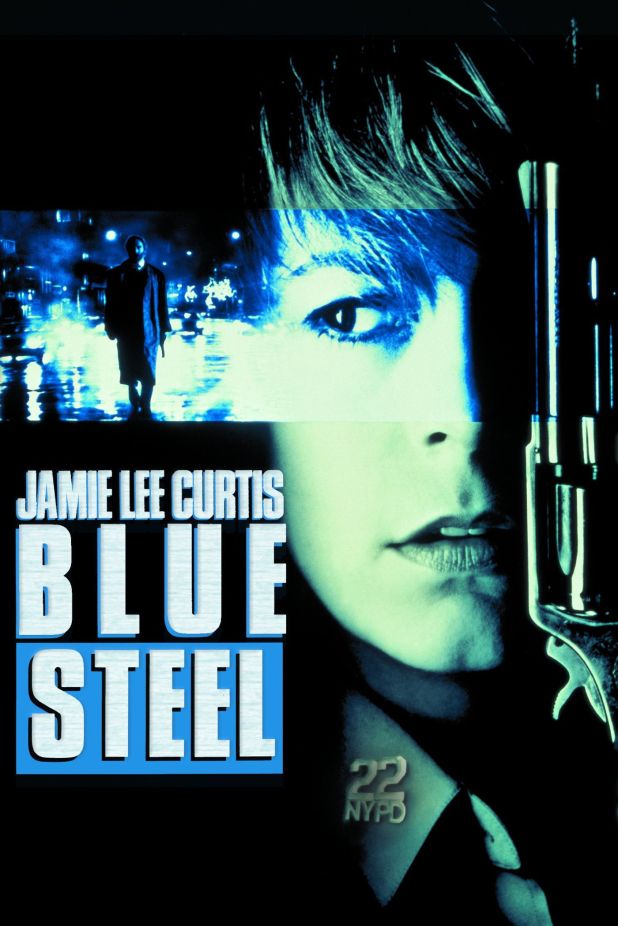
Interestingly enough, Roger Ebert saw this movie as a sequel of sorts to Halloween, while remaking that it was more interesting than just another replaying of the Michael Myers formula because “the filmmakers have fleshed out the formula with intriguing characters and a few angry ideas.”
Ron Silver, one of cinema’s greatest assholes, plays Eugene Hunt, a mystery man who falls for rookie cop Megan Turner (Curtis) the moment she blows gigantic bloody holes into a young Tom Sizemore. He takes the criminal’s gun away, which in effect makes Turner a criminal instead of a cop, shooting an unarmed man with such deadly force over and over again.
Turner finds herself torn between Hunt and the man investigating her, Detective Nick Mann (Clancy Brown, the Kurgan in Highlander). It’s an intriguing idea, as nearly every male relationship in her life is abusive, from her father to even the way that Mann speaks to her upon their first meeting. She’s trying to achieve in a male-dominated field as well and the only positive relationship — with her friend Tracy (Elizabeth Pena) — is also brutally torn away.
I’d be remiss if I didn’t mention that Louise Fletcher plays her mother. And also doubly guilty if I didn’t remark that she is also in Exorcist II: The Heretic. But I digress.
The end of this film plays nearly as a parody of action movie cliches. There are no people in Times Square, usually the most crowded of spaces and each character has too many bullets in their guns. That said, we’ve come too far, Turner has given up too much and Hunt must pay in blood. So much blood.
Director Stelvio Massi was the cinematographer or director of photography for plenty of great movies like The Case of the Bloody Iris, Sartana’s Here…Trade Your Pistol for a Coffin and Giovannona Long-Thigh. He knows how to make things look gorgeous, particularly in the way he shoots women, which comes in more than handy here.
Arabella is a woman obsessed with the carnal act. Sadly, her husband has been rendered impotent and confined to a wheelchair ever since he wrecked his car while she was dirty facetiming him (he was driving, because the opposite is impossible) on their wedding day. She’s filled his role with trips to brothels, including one that gets raided while she’s assaulted by a cop. She gets back at that officer by inviting him back to her place and while he’s yodeling in the valley, she bops him upside the head with a hammer. Her cucked husband, who has been watching all of this hammer smashed face action go down finally feels the blood flow down below, which means that he has to keep setting up his wife to kill off more and more people. He also finally gets back the urge to write and they start to fall in love again, but of course, he has to keep watching her make love to other people.
The problem for our heroine is that everyone she makes loves to dies, including a cowboy who gets his member sliced clean off. The next day, as the cops are gathering evidence, one of them is so upset that he can’t stop eating his sandwich. The world of this movie is insane, because there’s a photo of that mutilated wang on the cover of the next day’s newspaper.
There’s also a scene in the Freak Boy Zone, a place where Arabelle cruises all the gay men and picks one to take home. This entire moment is absolutely insane, as the homosexual side of town feels like it came out of an Enzo G. Castellari post-apocalyptic movie.
This movie looks grubby, makes little to no sense and will offend pretty much everyone that watches it. That means that you’re definitely going to want to watch it.
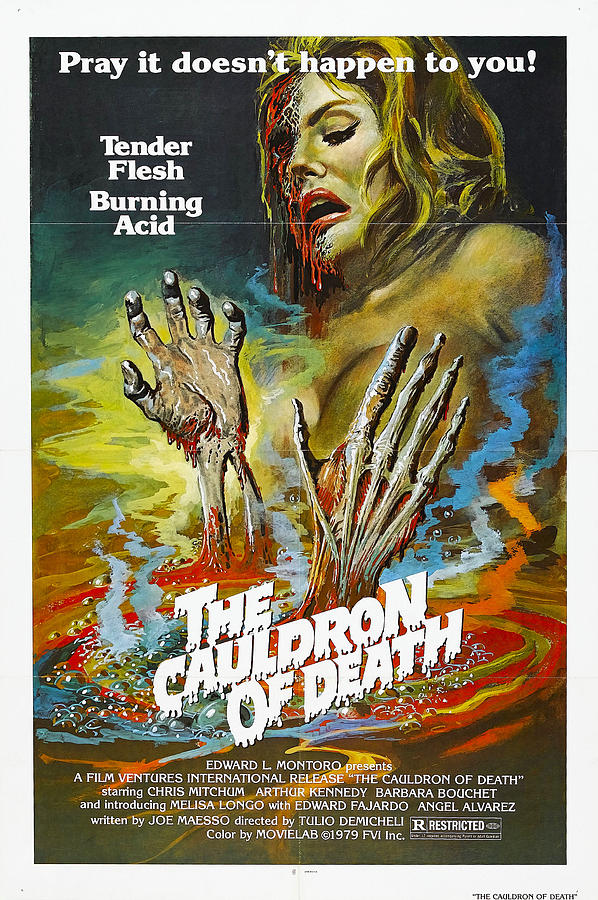
I get it. This movie isn’t a giallo. But what is it, really? It was sold under so many titles, from the more horror-centric Cauldron of Death (complete with completely insane poster) to the more crime-oriented Gangland, the great Italian title Un Tipo Con una Faccia Strana ti Cerca per Ucciderti (A Guy With a Strange Face Is Looking for You to Kill You), The Dirty Mob, Mean Machine and even O Exolothreftis (The Terminator) in Greece.
Make no mistake — this is a movie awash with exploitation, gore, aberrant behavior and no real heroes. In short, it’s exactly the kind of movie you come to this site to read about.
Rico Aversi (Chris Mitchum) has just got out of jail, two years after Don Vito (Arthur Kennedy, the inspector from The Living Dead at Manchester Morgue) killed his father. Everyone wants Rico — notice that his named is spelled completely unlike the title of the movie — to kill the boss off, but Rico just wants to enjoy life outside of prison.
Malisa Longo (Cat in the Brain) plays his girlfriend — and who used to love Rico’s woman — and she enjoys sleeping with the hired help, which gets one unlucky member of the workstaff castrated in shocking detail. Then, his John Thomas gets shoved in his mouth and he’s dipped into acid and turned into soap. This movie is not interested in being unoffensive. Plus, you get Paola Senatore (Eaten Alive!) as Rico’s sister, whose death sets him finally on the path to revenge.
Robert Mitchum is one of my favorite actors ever, so it kind of pains me to admit this his son kind of slumbers through this leading role. But then again, everyone else in this movie is going to seem boring next to Barbara Bouchet, who pretty much sets the screen on fire, dances on the flames and sets it ablaze all over again in this movie. Anyone could show some leg to get the attention of some criminals. Bouchet goes all in, dancing nude on the roof of a car, covered in fog, giving her all no matter how grimy this scumfest gets. Without her, this movie would be passable. With her, it’s transcendent.
So yeah. It’s not a giallo. But man, if you’re coming in looking for bad behavior, gorgeous women and great clothes, it has all of that covered.
Francois Gaillard and Christophe Robin must be big Danzig fans, as their arty French neo-giallo films often reference his albums, whether it be the solo instrumental album this one is named for, the Samhain song that inspired All Murder, All Guts, All Fun, The Misfits song Last Caress or Die Die My Darling, which in turn was named for the 1965 Hammer movie.
Angela fantasizes about the gorgeous fortune teller who lives next to her. She dreams of what it would be like to touch her, but soon finds her decimated body. She accidentally breaks a crystal ball, which gives her the ability to see the future. But will it protect her from being the next victim?
This movie may have been made in the style of the giallo, but it doesn’t have the story to back it up. Let’s back up — yes, most giallo movies actually do have plots and are not formless exercises in style. This looks gorgeous, but it is inevitably empty inside.
Also, much like all giallo, my wife walked in at the exact moment that two nude women were making love. How am I still married?
This sixth directing effort and second English language film intended for the American market by Spain’s Bigas Luna is mistakenly dismissed as a Spanish giallo ripoff of Demons (1985).
In reality, Luna wasn’t inspired by that Lamberto Bava and Dario Argento co-production: he was inspired “The Sandman,” an 1816 German short story by E.T.A Hoffman, which appeared in his book Die Nachtstucke, aka The Night Pieces. The story moves from a subjective-objective-subjective narrative across three stories-within-stories by way of three letters regarding a protagonist trapped in a world of hallucinations and reality, as he deals with his childhood-based post-traumatic stress regarding the horrific tales of “The Sandman”—who was said to steal the eyes of children.
“All the eyes of the city will be ours.” —Mother Alice Pressman
And “The Sandman” in Luna’s interpretation, Mother Pressman, was almost portrayed by Betty Davis (Burnt Offerings). Could you imagine a ten-time nominated and two-time Oscar winning actress chanting this other classic line from the film?
“For years you were like a snail, hiding, happy. Hiding, happy.”
It almost happened.
Sadly, due to a scheduling conflict with The Whales of August (a very good romantic drama with Vincent Price and Lillian Gish), Davis turned down the role. And while she would have been amazing, we got Tangina Barrons from Poltergeist, aka Zelda Rubenstein, in the bargain—and she brought us one of the most diabolical mothers to the big screen since Mama Bates in Psycho. And for his tortured “Nathanael” from Hoffman’s story, Luna brought on Oscar nominated character actor Michael Lerner, who modern audiences of the Marvel Universe know as Senator Brickman in X-Men: Days of Future Past and Mayor Ebert in Roland Emmerich’s Godzilla ’98.
As the film opens, we meet Lerner’s timid mamma’s boy, John Pressman, a diabetic ophthalmologist’s assistant who’s going blind. And his psychic mother’s prone to hypnotizing him and sending him out with his surgical tools to collect eyes for her.
By the wrap of the first act, it’s revealed we’re inside a Los Angeles movie theatre, The Rex, which is showing a horror film, The Mommy—that stars Rubenstein and Lerner. As the film plays on, the theatre patrons begin to experience symptoms of mass hypnosis from the film, suffering anxiety attacks, disorientation, nausea, and eye strain. The psychosis eventually inspires a man in The Rex to start killing patrons and employees—in sync with the killings committed in the film The Mommy.
And this is the point of the review where my passion for this masterpiece from Bigas Luna goes off the rails and I expose the entire film in a manic run-on sentence. So, we’ll stop here. For this is a movie that you must watch—and not read about.
Released before Richard Martin’s Matinee (1989) and Alan Ormsby’s Popcorn (1991) more mainstream film-within-film romps, Anguish is Bigas Luna’s masterpiece. It is the film that should have broken him to mainstream American audiences and been a runaway success on par with Halloween.
Sadly, a John Carpenter, Sean S. Cunningham, or Wes Craven-like success was not in the cards for Luna. As with Reborn, Luna’s 1981 religious thriller starring Dennis Hopper and Michael Moriatry, Anguish (aka Angustia), bombed, making less than $300,000 in U.S box office. But at a meager budget of $2 million, in conjunction with video rentals, it became one of Luna’s biggest hits in the worldwide marketplace.
This one has everything you want in a giallo—be it an Italian original or Spanish variant: Victorian furnishings, metallic wallpapers, telepathy via conch shells, crazed pigeons, snails, and eye surgery. Seriously, snails are cozying up to pigeons. Birds fall behind china hutches and get stuck between walls. Snails are crushed. Eyes are poked. It’s an M.C Escher “Magic Mirror” of insanity that’ll send Freud screaming from the theatre ranting that it’s all about a fear of castration. That’s Freud for you: right to the penis. The fact that the constant reference of spirals and the spiral formation inside the conch (snail shell) is symbolic of infinity, was lost on Freud, it seems. Why is it always about the schlong, Siggy?
Me? I’m just in awe of Michael Lerner from Harlem Nights and Maniac Cop 2 going meta-giallo and moving from film-to film-to film scooping out eyes for his momma like a god boy should. And my only “anguish” with this film is that I didn’t experience it in a movie theatre as intended—and on a VHS tape as everyone eventually did.
There’s no free online rips or PPV-VOD streams? Well, at least the DVDs and Blus are all over the online marketplace and easily obtainable. And don’t listen to Leonard Maltin and abide by his stuffy Movie Guides—which awarded Anguish 2.5 out of 4 stars. Listen to Sam. Listen to me. Listen to Matthew Diebler and Jacob Gillman who reference this Luna masterpiece in their neo-giallo The Invisble Mother: watch his movie.
About the Author: You can read the music and film reviews of R.D Francis on Medium and learn more about his work on Facebook.He also writes forB&S About Movies.





 B&S About Movies
You must be logged in to post a comment.