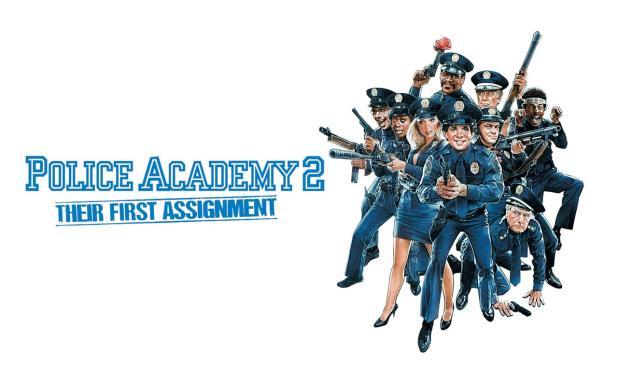
The Police Academy cadets have graduated and have now been assigned to the worst precinct in town, where they have to help Captain Pete Lassard (Howard Hesseman) fight Zed (Bobcat Goldthwait) and the Scullions gang.
Let me tell you — a 13-yer-old Sam definitely watched this at the Spotlight 88 drive-in outside Beaver Falls, PA and laughed like a lunatic. Nothing has changed for 47-year-old Sam, except he watched this on Netflix, even though he owns two different Police Academy box sets.
Chief Henry Hurst (George R. Robertson) gives Lassard thirty days to turn around the 16th precinct or the job will go to Lieutenant Mauser (Art Metrano) and Sgt. Proctor (Lance Kinsey). This leads to Lassard calling up his older brother Eric (George Gaynes) and getting six new officers: Carey Mahoney (Steve Guttenberg), Larvell Jones (Michael Winslow), Eugene Tackleberry (David Graf), Douglas Fackler (Bruce Mahler), Moses Hightower (Bubba Smith) and Laverne Hooks (Marion Ramsey).
This is when Tackleberrt falls for Sgt. Kathleen Kirkland (Colleen Camp, Clue, Wicked Stepmother). And we’re introduced to the adversarial and soon friendly relationship between Zed and Carl Sweetchuck (Tim Kazurinsky).
Bill Paxton was offered the role of Zed, but turned it down as he didn’t want to sign to be in any sequels. How strange would that have been?
You can make fun of these movies all you want, but they made peoples’ careers. For example, Bubba Smith went on record saying that he made more money from this movie than playing NFL football for a decade. That’s because he asked for 2% of the film’s profits instead of a higher salary. Smart guy.
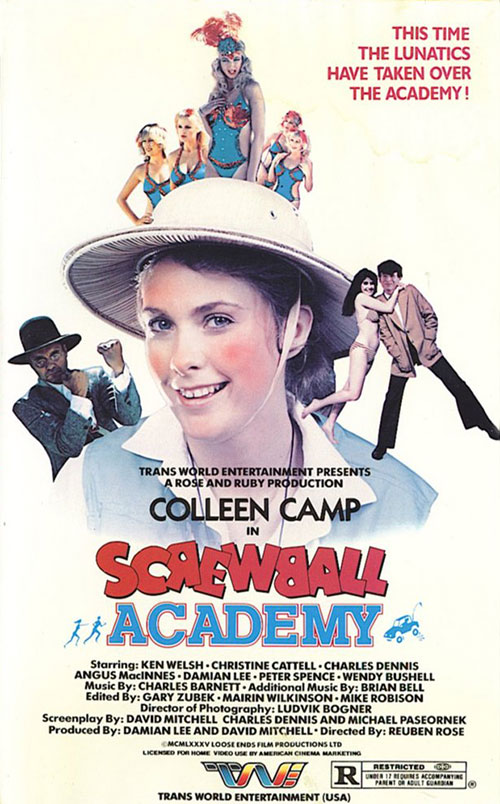
Also known as Loose Ends, this is an attempt to use the name of the Screwballs franchise — such as it is — while using Coleen Camp from Police Academy and Police Academy 4 to somehow try and make a new series, because this movie has nothing to do with Screwballs other than the knowledge that both movies are Canadian exploitation tax shelter films.
Camp plays Liberty Jean, who has moved to Wagatno Beach — really Canadian sex movie location Wasaga Beach — to make a movie called Say Cheese all about the way women are treated in the world. Of course, it’s also the kind of movie I’d watch, so the local religious group the Church of the Divine Light and their leader Bishop Wally (Damian Lee, the director of Abraxas, Guardian of the Universe) decides to start a holy war.
Directing this whole mess is John Blanchard, who was the director of many episodes of SCTV and The Kids In the Hall, so he should know funny.
That said, it is on YouTube, so if you want to endure it like I did.
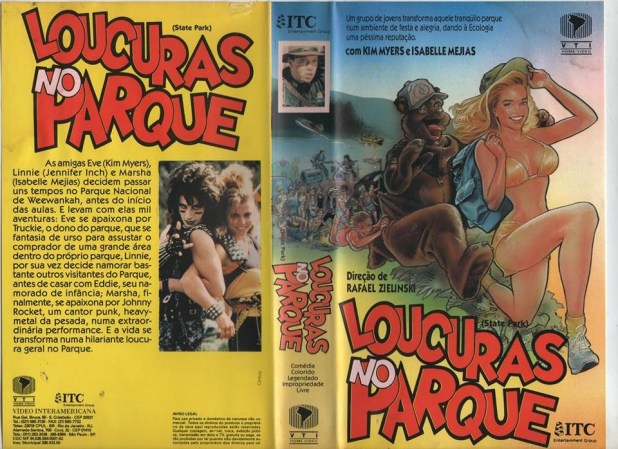
Also known as Heavy Metal Summer, this movie seems to be about Johnny Rocket and drummer Louis, who are on their way to Los Angeles to be part of the Sunset Strip hair metal scene in the three years they have left before “Nevermind” comes out.
It’s also about Eve (Kim Myers, A Nightmare On Elm Street Part 2) trying to win the Weewankah Wilderness Challenge so she can go to college. She’s helped by Linnie (Jennifer Inch, Screwballs) and Marsha (Isabelle Mejias, Julie Darling in the flesh!), but more. importantly, those two just want to hook up with guys.
This movie from Screwballs director Rafal Zielinski, who also made Last Resort, the one with the Coreys, not the one with Charles Grodin, and Recruits. Somehow, he was able to get Ted Nugent to show up for this movie, which shows how close Detroit and Canada really are. Actually, the movie is set in Michigan, despite being filmed up north. And by up north, I don’t mean Northern Michigan.
Man, that’s a joke you’d only get if you were from Michigan, which may be another reason why this movie isn’t so well known.
Dark Sister is the (very welcomed) U.S. reboot of Sororal, an Australian neo-giallo that weaves the psychosexual tale of the ratty loft shut-in Cassie (well played by Amanda Woodhams in her leading lady debut; ironically looking like Dakota Johnson’s sister). An artist traumatized by the murder of her mother, Cassie comes to realize the nightmares and daytime hallucinations of brutal slayings she commits to canvas (The Paints of Laura Mars, if you will) are the chronicles of a real life serial killer crisscrossing the continent down under. The “dark sister” of the title (the better title of “soraral” means “of or like a sister or sisters”) is a hooded, rainslicker-esque lookalike who totes around a creepy, deteriorating doll that’s connected to a Satanic cult who needs Cassie to give birth to the Anti-Christ.
The reviews on this mixture of giallo and the supernatural haven’t been kind, with critical insight that state this third film—from what I feel is an impressive, developing resume—by writer-director Sam Bennett is merely “style over substance” and his work is “amateurish” and “unrealistic.”
Huh?
Since when did an Italian Giallo—or any of its Spanish knockoffs—of the ‘70s ever put “realism” or “substance” over what were always the main priorities of the giallo genre: art and surrealism rooted in Impressionism and Renaissance art.
The giallo resume of Dario Argento, the leader of the genre, is the cinematic equivalent of Salvador Dali’s melting clocks and M.C Esher’s impossible objects and staircases to nowhere. Giallo is all about the utilization of oozing color palates and oddball light sources, nonsensical supernatural red-herrings to nowhere, psychic links to killers hidden in POV, whispered poetic passages, hyper-sexual oddball red-herring characters, rape and murdered moms, junk science (about sunspots, Y chromosomes, eye-memories, love-chemicals), pedophile fathers, doctors and detectives riddled with kinks and ulterior motives, and a general, overall incoherence set to a soundtrack of jazz-rock noodling and chanting choirs.
And if that makes me a giallo snob, then dip me in yellow paint, feather me in crystal plumage, and dump me in the town square and let me enjoy my Stendhal syndrome episode so I can shed my tears for my mother.
The more giallo, overseas theatrical one-sheet.
Yes, I’ve watched Paolo Cavara’s Black Belly of the Tarantula and Sergio Martino’s The Case of the Scorpion’s Tale—and every bloody tale concerned with insects and animals—more times than any one person should. I accept Dario Argento’s what-the-fuck plot twists of an intelligent chimp wielding a straight razor and cute girls with psychic links to insects with glee. And regardless of how much I enjoy the films of Riccardo Freda, Umberto Lenzi, and Ruggero Deodato: I’m burnt out on them. But I love the era and adore the genre and I want more . . . but my yellow has turned to brown. And while I know they’re box office hits, I pine for the giallo era over the endless cycle of The Conjuring sequels and the Blumhouse universe’s jump scares.
And that’s how films like The Editor and Dark Sister become part of my beloved giallo library. Bravo, Mr. Bennett. It feels like home to me. (I suggest you pair the Italian-made Evil River with Dark Sister for your double feature this evening.)
Theatrically released in its homeland in 2014, Wild Eye Releasing acquired Sororal—giving it a new title and artwork—for a U.S. streaming and DVD release in 2018. They’re now offering it in 2020 as a free-with-ads stream on TubiTV along with several other films from their catalog.
And here we are, in 2022, with this review still receivinga lot of hits, as horror fans continue to discover this great flick by way of it currently appearing on various Smart TV streaming platforms. Seriously, we love this movie!
Disclaimer: This movie was sent to us by its PR department. As always: you know that has nothing to do with our feelings on the movie.
About the Author: You can read the music and film reviews of R.D Francis on Medium and learn more about his work on Facebook.He also writes for B&S About Movies.
Are you ready for the movie that won USA Networks’ B-Movie Awards for Best Picture and has the honor of being their highest-rated late-night film when it first aired on cable television?
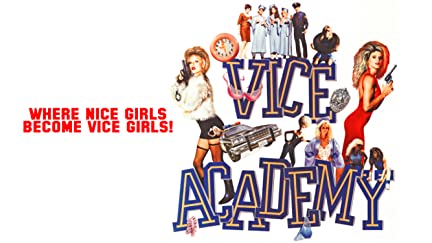
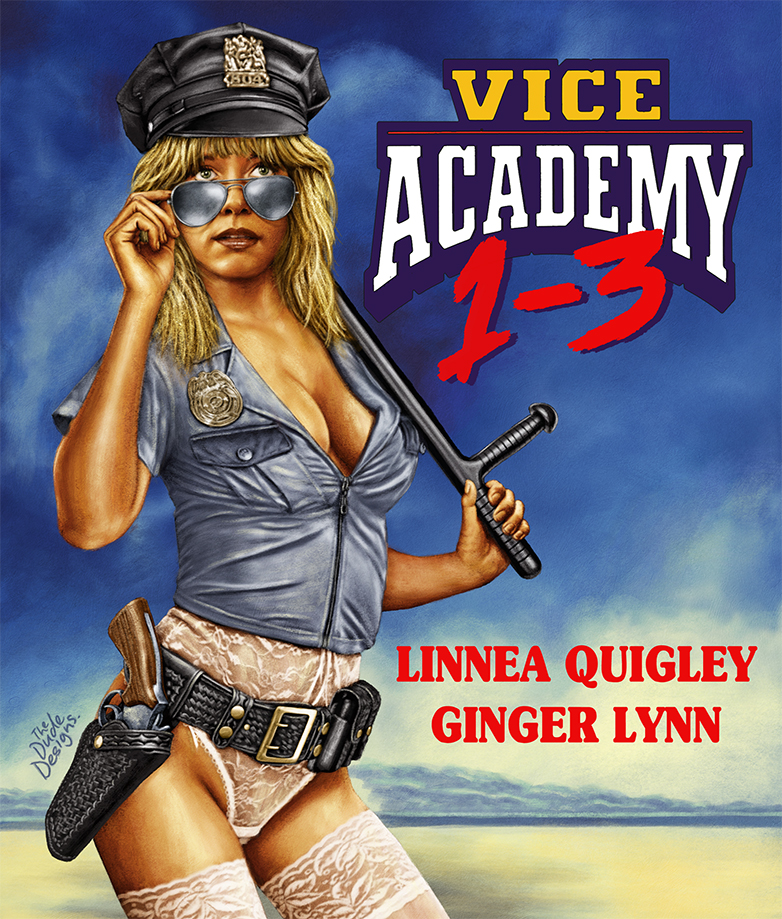
How about a Police Academy ripoff with Ginger Lynn and Linnea Quigley? Are you prepared for that?
What if I told you that RIck Sloane, the maker of Hobgoblins, was the creator?
Yeah, you’d watch that.
Holly Wells (Ginger Lynn, the one-time queen of VHS adult films) goes legit, teaming with scream queen Linnea Quigley, who plays Didi, to enter a vice school where cops learn how to bust adult movies and prostitution.
Tamara Clatterbuck, who is also in Hobgoblins and was a dominatrix in UHF, is Tinsel while Jean Carol is the evil Queen Bee. Karen Russell also shows up and you remember her from films like Hellbent, Phoenix the Warrior, Dr. Alien and Shock ‘Em Dead.
Jayne Hamil also makes the first of her five appearances as vice academy teacher Miss Thelma Louise Devonshire. And hey! The actress using the name Christian Barr who plays Cherry Pop is actually Allison Barron, who we all know as Helen from Night of the Demons.
Ginger Lynn isn’t the only adult star in this. The late Viper, a former ballet dancer who eventually left the adult industry and became a phlebotomy technician is here too.
This is a movie so cheap that the girls all wore their own outfits and Ginger drives her own car in the opening. Are clothes and cars why you’re watching this? I dare say no.
You can watch this on Tubi or grab the blu ray set of the first three films from Vinegar Syndrome. It features interviews with Lynn and Quigley, as well as commentary Rick Sloane.
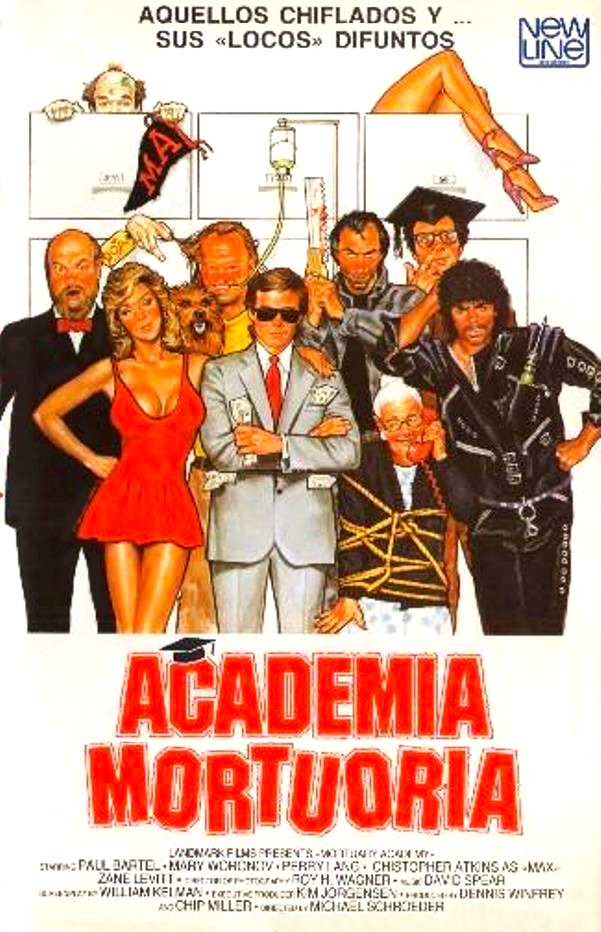
Sam (Christopher Atkins, The Blue Lagoon) and Max (Perry Lang, The Hearse) inherit the Grimm Mortuary and Academy, but as these things go, they must graduate from it to actually own it. Trying to keep them from achieving that goal is the current owner, Dr. Paul Truscott (Paul Bartel) and his assistant Mary (Mary Woronov), who want to keep the school and mortuary because they both suffer from necrophilia.
I often discuss the perfect check the boxes of movies. Between Bartel, Woronov and a hijinks comedy, I was sold.
Directed by Michael Schroeder, who also worked with Bartel for the movie Out of the Dark, this movie sets up a slapstick crew of students, like one that yearns to bring dogs back from the dead and an effeminate singer played by Stoney Jackson, Phones from Roller Boogie.
Making this movie nearer to my heart is an appearance by Dona Speir, who made so many of the Andy Sidaris movies so much better.
James Daughton (Greg Marmalard from Animal House), Nedra Volz (Moving Violations), Tracy Walter (Bob the Goon!), Wolfman Jack and Cesar Romero all appear. This movie isn’t for everyone and I wouldn’t have it any other way.
The band that plays in this movie, Radio Werewolf, was Radio Werewolf, who advocated vampirism, socialism and black-humored lyrics about Nazism. Their co-directors were Nicholas Schreck and Zeena Lavey Schreck, the daughter of Anton Lavey.
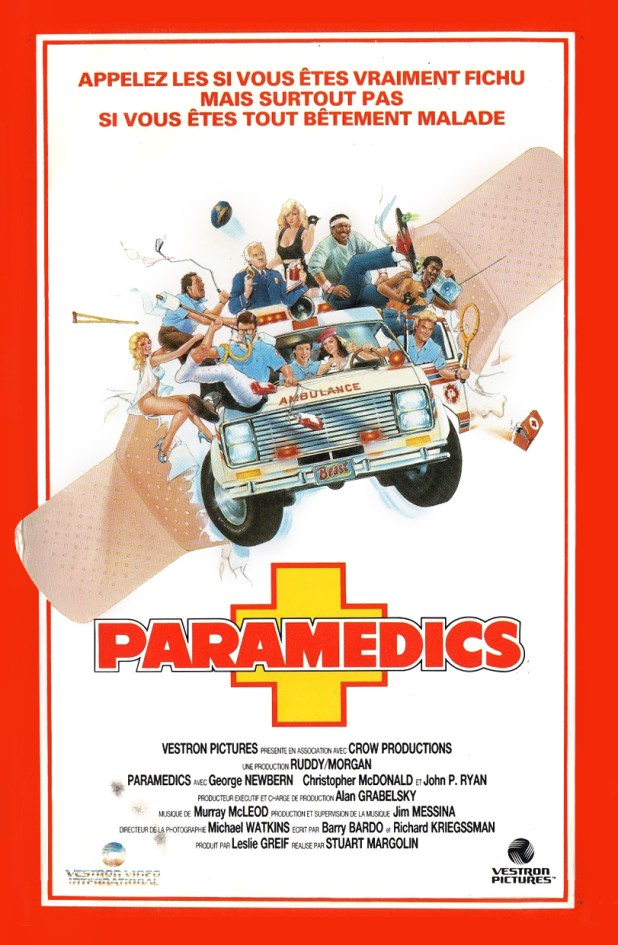
Stuart Margolin did more than play Evelyn “Angel” Martin on The Rockford Files. He directed plenty of TV shows and this 1988 Police Academy takeoff.
George Newbern (Poochinski!) is Uptown and Christopher McDonald (Shooter McGavin in a rare babyface role!) is Mad Mike, two, well, paramedics who get moved from uptown to the streets and come across a corpses for cash scam.
Karen Witter, Playboy’s March 1982 Playmate of the Month plays Danger Girl, a woman so sexually adept that she girls nearly every man that she sleeps with, like Ray Walston of all people, who starts the film up being dominated by her. If you ever wanted to see Mr. Hand get mahandled, this would be the movie for you. I won’t judge your kink.
That is Leigh Hamilton from Hocus Pocus playing the dispatcher, but not her voice. Listen hard — it’s really Sally Kellerman. Lydie Denier — a Zalman King vet — always shows up.
You may not know the name Hugh Wilson, but you probably know his work. He created WKRP in Cincinnati, Frank’s Place and The Famous Teddy Z, plus he directed The First Wives Club, Burglar, Blast from the Past and Guarding Tess.
He was the director of the first Police Academy, a film that every movie this week is really all about.
Producer Paul Maslansky got the idea for the film while making The Right Stuff, as he watched a gang of mismatched police cadets getting screamed at by a sergeant. He claims that the group was “an unbelievable bunch-including a lady who must have weighed over 200 pounds and a flabby man of well over 50. I asked the sergeant about them, and he explained that the mayor had ordered the department to accept a broad spectrum for the academy. “We have to take them in and the only thing we can do is wash them out.””
Boom. Police Academy.
The mayor wants to improve the police force, so he asks that the academy accept willing recruits, regardless of gender, body weight, skin color or age.
One of those unwilling recruits is Carey Mahoney (Steve Guttenberg), the everyman who we follow throughout the first of these movies and their sequels. He keeps getting in trouble for standing up to authority and his father’s friend Chief Hurst — out of respect for a fellow cop — demands that Mahoney either go to police academy or prison. Mahoney agrees if he can bring along a noisemaking man he just met, Larvell Jones (Michael Winslow).
Guttenberg was made for this, as just like his character, his father was a cop.
Lieutenant Thaddeus Harris (G.W. Bailey, an enemy cop in nearly every one of these films) wants to wash the candidates out. Mahoney wants to quit. And when he’s not daydreaming, Commandant Eric Lassard (George Gaynes) wants his cadets to do well.
As I always say, hijinks ensue. Mahoney sends the two mean cadets to a gay bar called The Blue Oyster that I promise you, most Japanese people still use as a cultural touchstone for what gay bars look like. Hightower (Bubba Jones) is protective of the quiet Hooks (Marion Ramsey). Tackleberry (David Graf) loves guns. Leslie Barbara is chubby. George Martin is a ladies man. Douglas Fackler (Bruche Mahler) is accident-prone.
Pretty much every character gets a one-note that they will use for the rest of the film if not the rest of the series. But hey — it’s honestly really funny. Maybe it’s because I was twelve when I first saw it. Or it could be that I’m still twelve inside.
For the first film, Leslie Easterbrook’s Sgt. Debbie Callahan isn’t on the side of the good guys, but she will be soon. And Georgina Spelvin from The Devil In Ms. Jones has a memorable cameo.
The Police Academy movies often feature people before they become famous and then are sore spots on their resumes. For this movie, that person would be Kim Cattrall, who plays Mahoney’s love interest. She will not be the last big star to wander into these films, often in one of their first starring roles.
I also love that the “shoe polish on the megaphone” came from a prank played on British director Michael Winner (Death Wish, The Sentinel) on the set of one of his movies.
President Bill Clinton told Guttenberg that this was one of his favorite movies, and that watching the films helped him through a difficult time. We can only assume that this was during the Monica Lewinsky scandal. I wonder how hard he laughed at the oral sex joke.
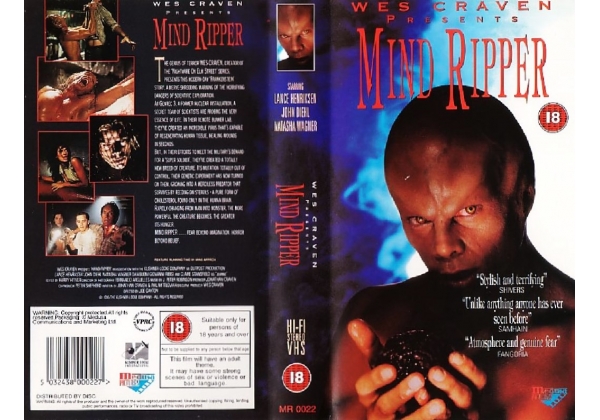
Although it is marketed in some regions as a sequel to The Hills Have Eyes and The Hills Have Eyes Part II under the titles The Hills Have Eyes III and The Hills Still Have Eyes, there are no actors, characters or even storylines from either of those movies. It does, however, have producer Wes Craven, whose son Jonathan wrote this movie.
It’s directed by Joe Gayton, who went on to write the movies Bulletproof and Faster.
Set in a remote desert location — hence the title The Outpost , as well as the tenuous connection to The Hills Have Eyes — where government scientists are trying to bring back suicides as superhumans, this movie is all about the dark side of experimenting on the dead. There is no good side of this, by the way.
Stockton (Lance Henriksen, who deserves better) is a scientist called in to help oversee the project. He’s joined by his son Scott (Giovanni Ribisi, who despite this being his first role, deserves better), daughter Wendy (Natasha Gregson Wagner, Urban Legend, who also deserves better) and her boyfriend Mark (Adam Solomon, who never made a movie after this, so maybe he didn’t deserve better). After all, an uncontrollable test subject named Thor is loose and must be contained.
This was one of the first movies shot in Bulgaria after the fall of Communism. I’m sorry, Bulgaria.
You can watch this on Amazon Prime and Tubi. It’s also available with Rifftrax commentary on Tubi.
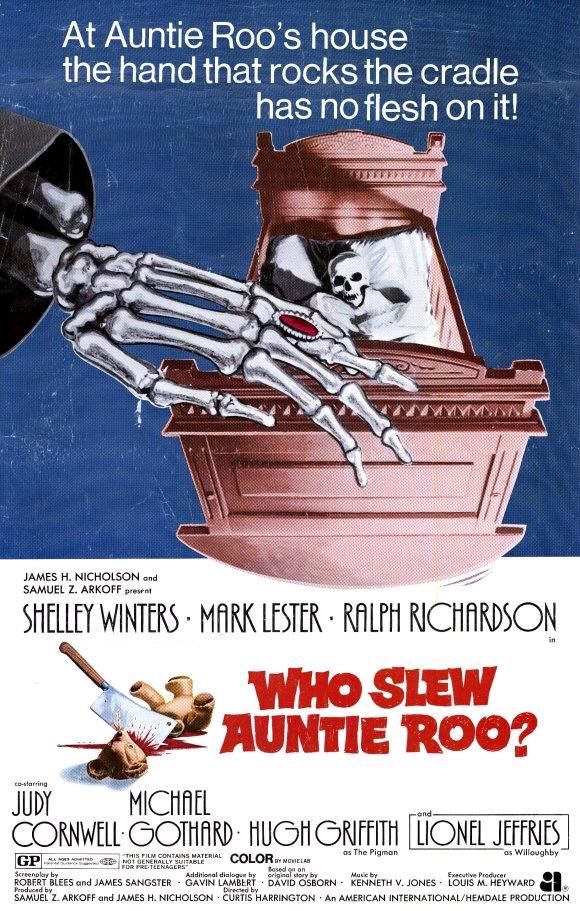
Following the success of What’s the Matter with Helen?, Curtis Harrington directed this intriguing psycho-biddy film. In it, Mrs. Rosie Forrest (Shelley Winters), the Aunty Roo of the title, is known by the children of a local orphanage as a kindly old lady who throws a huge Christmas party every single year for them. However, the truth is far more sinister. She’s obsessed with her dead daughter Katharine, whose mummified body lies in state in her attic so Aunty Roo can sing lullabies to her every night.
Mark Lester and Chloe Franks from The House That Dripped Blood play Christopher and Katy Coombs, two orphans who find themselves in Roo’s clutches. She believes that Katy might be her daughter, and the story takes a turn that’s reminiscent of the classic Hansel and Gretel tale, adding an intriguing layer to the narrative.
Ralph Richardson plays Mr. Benton, a fake psychic who tries to help Aunty Roo connect to the spirit of her long-departed daughter.
The early 70s are filled with what I call enjoyable junk. This would be one of those films with Winters practically devouring the scenery. It makes an outstanding double bill with the aforementioned What’s the Matter with Helen?, which is the superior of the two films. While Whoever Slew Auntie Roo? shares some thematic and stylistic similarities, it stands out for its more compelling narrative and character development.





 B&S About Movies
You must be logged in to post a comment.