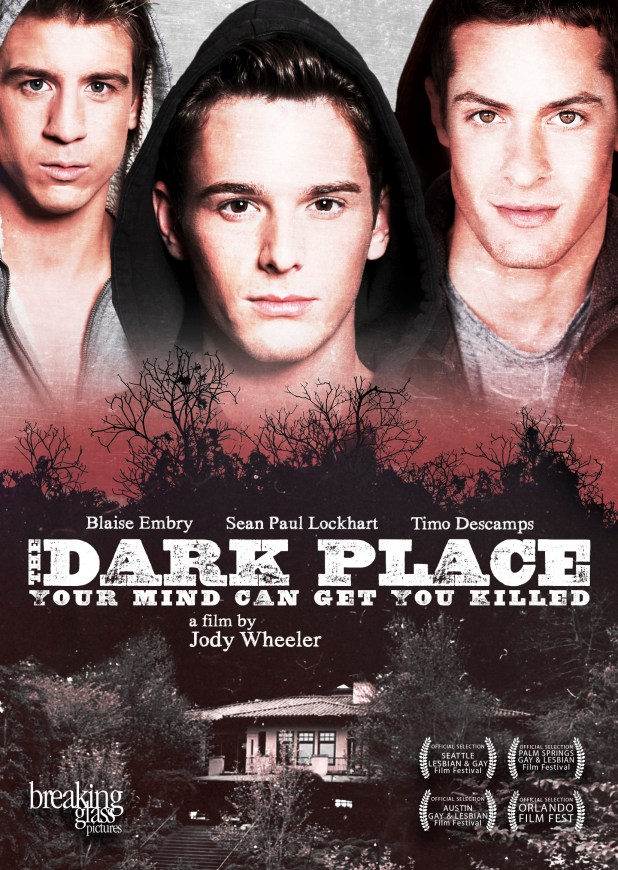
Long estranged from his widowed mother, Keegan Dark is blessed with the uncanny ability to remember his life in videographic detail. However, this strange ability keeps him at odds with his family and loved ones.
Returning home with his boyfriend in the hopes of making amends, he’s shocked to discover that his mother has remarried and that his new siblings aren’t very trustworthy. His investigation into their past is derailed when his mother drops into a coma, his boyfriend seemingly leaves him and the town’s sheriff targets him as the most likely culprit. With allies scarce and time running out, Keegan must fight — and use his remarkable mind — to unravel the secrets that threaten to destroy him.
Shot in Hillsboro and Portland, Oregon, USA, this film has played several festivals and was back in theaters earlier this year before being released on streaming services.
Sean Paul Lockhart, who plays Jake Bishop in the film, has had a pretty interesting life. Under the names Brent Corrigan and Fox Ryder, he acted in adult films for several years before working in mainstream movies like Chillerama and directed the movie Triple Cross.
His first boyfriend introduced a 17-year-old Lockhart into the gay adult industry by acting in a scene with him while Bryan Kocis, the owner of Cobra Video watched. His first contract called for Lockhart to appear in six sex scenes and one non-sex scene in exchange for a used Volkswagen Jetta, a set of tires and rims, transportation costs, vehicle insurance, and money for gasoline.
Kocis and Lockhart dated for a short time and there was litigation over his stage name. On January 24, 2007, Kocis was killed by two Virginia Beach male escorts, Harlow Cuadra and Joseph Kerekes. He was stabbed 28 times before his throat was cut, nearly decapitating him. Then, his home was set ablaze and dental records had to be used to identify the body. His computer survived and was used to identify the men who killed him.
The murder and trials were turned into a book called Cobra Killer: Gay Porn Murder, a play named Cruel Men: In The Lion’s Den and a movie entitled King Cobra.
Anyways — The Dark Place is a decent enough mystery with an interesting hook for its protagonist.
Holy Stendal déjà vu, Batman! Does Chip Mayer star in this? I’m going to faint.
No, but Richard Moll’s Kragg from 1987’s Survivoris back again . . . no, wait . . . he’s Kyla this time . . . in this Puerto Rican-produced jungle-apoc romp for France’s Interlight Pictures (action flicks with Marc Dacascos, Christopher Lambert, Mickey Rourke, and Steven Seagal) that reminds of a (lower budget) Oblivion and After Earth (both from 2013 and not even made yet!) colliding with Escape from New York. The experienced apoc connoisseur will also spidey-sense Ray Liotta’s 1994 future-jungle prison romp, No Escape, and 1971’s uber-obscure TV Movie space station tale, Earth II, along with the Euro-produced — and U.S theatrically-released Escape apoc rips — Doomsday (2008) and Lockout (2012).
Snake? Is that you? You got a tan, grew your hair — and your eye!
After a World War and ecological collapse, mankind has relocated into massive space station colonies — and converted Earth into a “prison planet” (a sort of Liberty Island plus). When a ship transporting the “President of Space” (familiar character actor Richard Herd; “Wilhelm” from U.S TV’s Seinfeld) crashlands on Earth on the way to a political conference to stop an inter-solar system war, he’s captured by The Duke of New York . . . I mean, Kragg . . . oops, I mean, Kyla, with the intent of leading a “break out.”
Those plans are complicated by the recently exiled (they launch your pinball-ass in a canister down a gravity tunnel back to earth!) Snake Pliss . . . I mean, Tarkin (no, not the Grand Moff one), who finds the President’s little grandson among the wreckage of a second escape pod — and he springs into action to save the President. Well, it’s not all about the kid: it helps that the President’s hot assistant, Devin (well played by the late Lisa Robin Kelly, aka Laurie Forman from U.S TV’s That ’70s Show), gives Tarkin some extra ass-kicking incentive. But Kelly kicks some pretty mean ass herself, all with the makings of a potential action star brimming with that Sharon Stone-era King Solomon’s Mines sass (making her 2013 death even more disheartening).
And that clock must tick . . . so the President’s ill and needs his medicine or in 24 hours, he’s dead. And he’s been separated from his tracker. And if he doesn’t make it to the conference . . . well, it won’t matter, because when the war breaks out, we’ll all be dead. (I’m feeling woozy!)
Hey, don’t knock it. The Survivor is actually a fun watch for us apoc rats. Watch the trailer and see for yourself. . . .
As you can see, there’s a lot going on with this French-financed apoc-romp and it’s wrong to shrug it off as some low-budget direct-to-video fodder. Granted, it may be derivative in places — but so were the 20 and 30 million-budgeted Doomsday (2008) and Lockout (2012) — but The Survivor has sharp production values, as well as great makeups and costumes for the various Earth-ravaged tribe-societies. Those production values are courtesy of a noted art director and visual effects artist whose work you’ve enjoyed many, many times on some of mainstream Hollywood’s biggest science fiction, fantasy, and comic book films, such as Batman Forever, Batman & Robin, and The Dark Knight, along with the Harry Potter series, Clash/Wrath of the Titans, and Tom Cruise’s Edge of Tomorrow: Nick Davis (in his only directing effort, thus far).
The script — with a story that moves with a solid pace and knows its Greek and Roman Empire war histories — is smartly penned by the writing team of Cary Solomon and Chuck Konzelman.
Now every writer in Tinseltown has to start somewhere and write for “one for them” (see David Mickey Evans with Open House as an example) before said writer can move onto their passion projects. In the case of Solomon and Konzelman, that meant before they could achieved their greatest success in the Christian marketplace with the spiritual films What If…, God’s Not Dead, and Do You Believe?, they had to make their bones with the action flicks T.N.T (1997; with Oliver Gruner) and Point Blank (1998; with Mickey Rourke). Were Solomon and Konzelman going for an ’80s Italian apoc-tribute here? It sure feels like it to me: The Survivalist is everything that Michael Sopkiw’s After the Fall of New York could have been if it had the budget that backed Nick Davis. It could have been Parisfal’s continuing adventures. I’ve returned to Sergio Martino’s vision of New York many times* — and Nick Davis will see me again. It feels like (a post-nuked) home.
As for The Survivor falling under the U.S direct-to-video marketplace radar is that it was shot with the French-Euro marketplace in mind — as a vehicle for that country’s Martial Arts star, Xavier Declie, who’s a cross between Italian ‘80s B-action star Mark Gregory (we did a whole week about him at B&S!) and Xavier’s fellow Martial Arts-acting countryman, Jean-Claude Van Damme (yep, we did a week long tribute to JCVD as well!). Today, Xavier is a highly-sought after, Los Angeles-based personal trainer.
Oh, we’re not done yet. There’s another déjà vu production twist.
Richard Moll — while playing pretty much the same (excellent!) post-apoc sociopath in Survivor (1987) and The Survivor (1998) — also plays a post-apoc sociopath in the Nick Davis-penned Galaxis(1995), an entertaining The Terminator meets The Empire Strikes Back panache starring Brigitte Nielsen . . . where Moll plays . . . “Kyla”? (Huh, what’s going on here, my VHS Stendal is kicking in . . . there’s too many apoc flicks lining the walls.)
Damn, Snake. Awesome sex change. Va-va-voom!
Now, to give Galaxis a new VHS shelf life, it carried the alternate title: Terminal Force. Then, after its own theatrical run and when it hit the video shelves, The Survivor became . . . Terminal Force 2 (?). So, while it’s technically not a sequel, but because of Moll playing roughly the same character (but different) in both films, with the same name, The Survivor and Galaxis were both issued on the “Terminal Force” two-pack DVD. But . . . Galaxis was also alternately retitled as Starforce and Star Crystal — and there’s another Alien rip out there called, Star Crystal. (My head is really spinning. I think I am going to throw up.)
The same, but different. Damn, Brigitte. Just damn.
You can watch the full version of The Survivor for free on You Tube. You won’t be disappointed.
If you missed our month-long September rally of post-apoc film reviews, you can catch up with a complete listing featured in our “Atomic Dustbin” recaps, Part 1 and Part 2.
*As the apoc-year of 2019 A.D came to a close, I took a second look — in counterpoint to Sam’s previous review — at 2019: After the Fall of New York.
About the Author: You can read the music and film criticisms of R.D Francis on Medium and learn more about his work on Facebook. He also writes for B&S Movies.
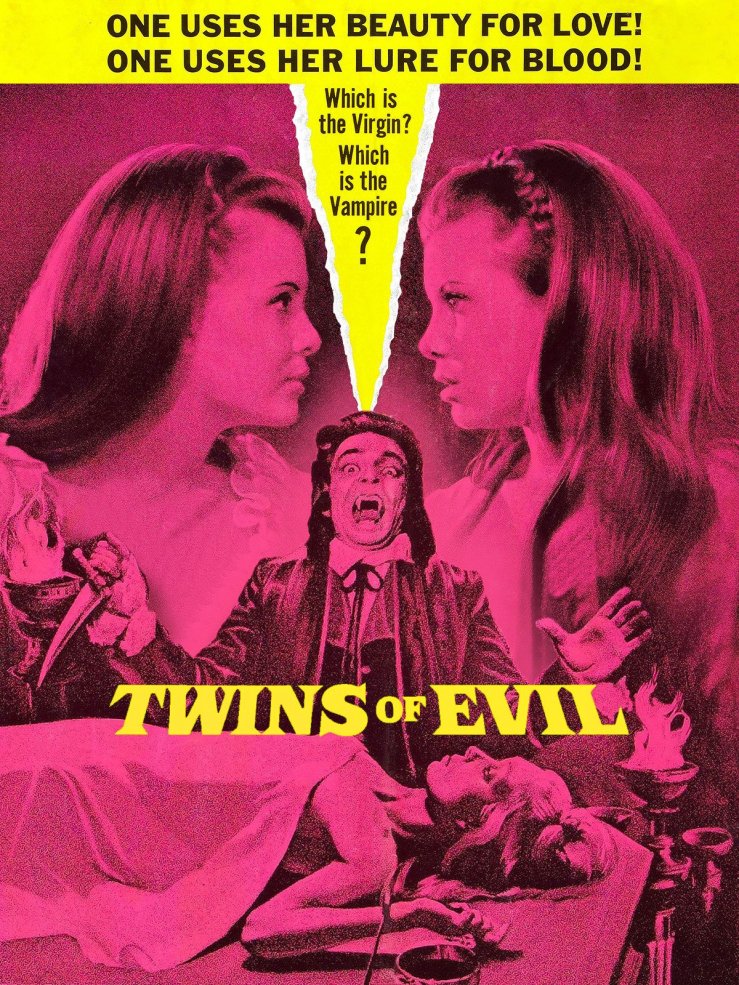
When I was first writing this site in earnest, this was one of the films I watched and never took the time to write about. It’s not because I don’t love it. Au contraire, it’s probably my favorite late-model Hammer film next to Captain Kronos – Vampire Hunter, another film I’ve failed to discuss on this site. It’s everything a movie should be. It has horror, amazing performances, plenty of sex and lots of Satan. All hail the Karnstein family!
The third and final film of the Karnstein Trilogy — The Vampire Lovers and Lust for a Vampire are the other two, although the aforementioned Kronos is also tied in — this movie is all about twin sisters, Frieda and Maria Gellhorn. One is good. One is evil. Both are played by Playboy‘s October 1970 Playmates of the month, legitimate identical twins Mary and Madeleine Collinson. Born in Malta, the twins appeared in five other films: Some Like It Sexy, Permissive, Groupie Girl, She’ll Follow You Anywhere and The Love Machine, which was based on the book by Jacqueline Susann, who also wrote Valley of the Dolls.
After their careers in entertainment, Madeleine married a British Royal Air Force officer and raised three children before dying in 2014. Mary has two daughters and now lives in Milan with an “Italian gentleman,” whom she has been with for more than two decades.
Think gorgeous twins are a one in a million miracle? Not in the Gellhorn family, as their former model mother gave birth to another set of twins years after the girls were born.
The girls have been recently orphaned and come to live with their puritanical witch-hunting uncle Gustav Weil (Peter Cushing, destroying everything in his path). Maria (played by Mary) is content to be a normal teenager. Her sister Frieda (played by Madeleine) becomes fascinated by wicked Satanist Count Karnstein (Damian Thomas, Sinbad and the Eye of the Tiger), who probably makes her refer to him as daddy and says things like, “Good girl.”
Oh yeah — he also calls Countess Mircalla Karnstein (Katya Wyeth, Hands of the Ripper) back from the grave and she rewards him by making him a vampire. Ingrid Pitt was supposed to play this role but didn’t do the cameo.
Maria falls for the handsome and virtuous teacher Anton (David Warbeck, The Beyond), who knows all about killing vampires. At the same time, Frieda is feasting on naked virgin women chained to walls, because every 1970’s vampire movie has lesbian moments.
Frieda is captured by the Brotherhood, the group of witchfinders that Gustav leads, but the vampires switch out Maria and she nearly gets killed. This leads to a battle throughout the castle complete with vampire heads being hacked clean off. It’s wonderful.
Australian-born actor Alex Scott — he’s also in Next of Kin, The Asphyx and The Abominable Dr. Phibes — shows up, as does Dennis Price (who was in plenty of Jess Franco movies), Judy Matheson (Lust for a Vampire), Kirsten Lindholm (The Vampire Lovers) and singer-actress Luan Peters/Karol Keyes, who hit the 70’s vampire trifecta by being in Lust for a Vampire, Vampira and this film.
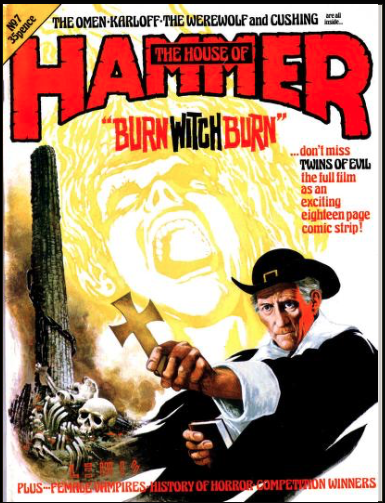
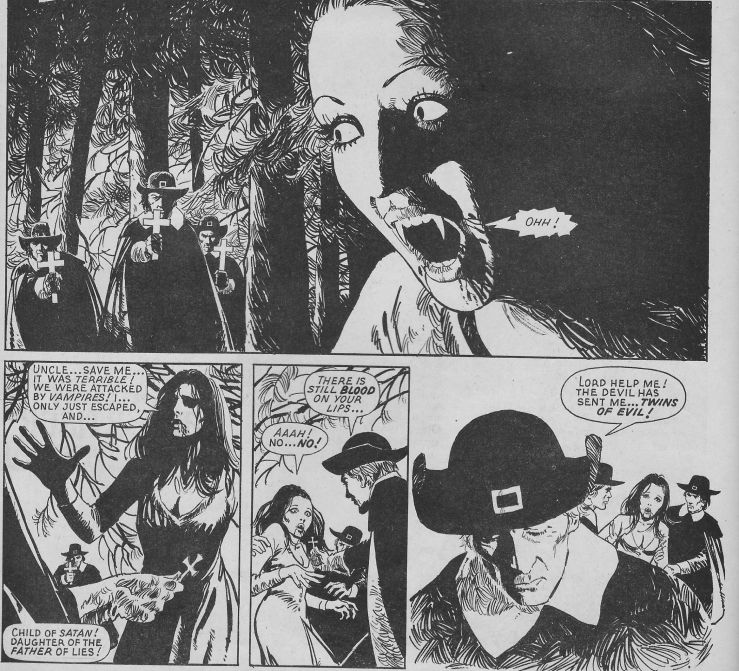
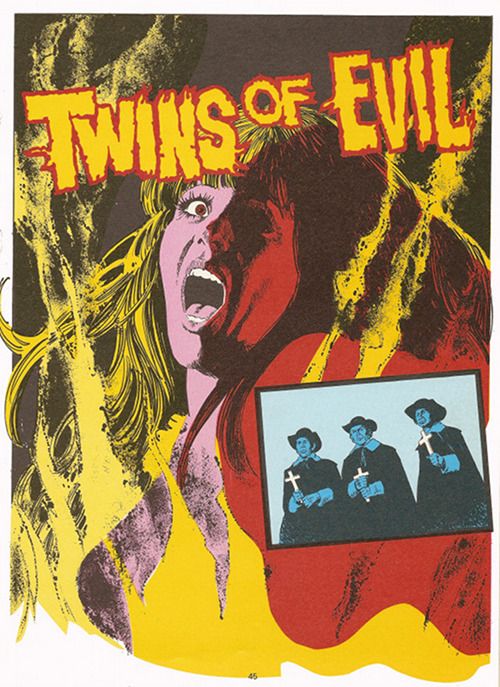
Twins of Evil was adapted into an 18-page comic strip for the January–February 1977 issue of the magazine House of Hammer. You can check it out on the Internet Archive for free.
Director John Hough would go on to direct The Legend of Hell House, Escape to Witch Mountain, Return from Witch Mountain, The Watcher in the Woods, The Incubus, Lady and the Highwayman, Biggles: Adventures in Time, American Gothicand more.
Shot on the same sets as Vampire Circus, Twins of Evil is everything I love about movies. And if you’re into metal, the band Hooded Menace used a sample from this film in their song “In the Dead We Dwell.”
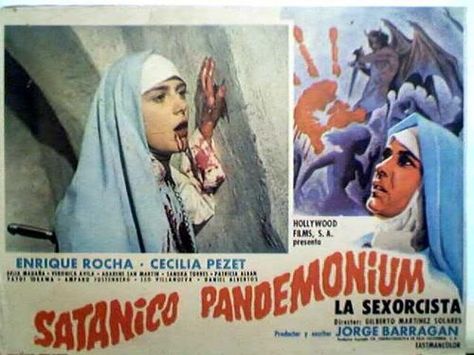
Sister Maria should be living the quiet and chaste convent life, but she has a fantasy world in which she runs free and wild, the servant of Satan. In our world, her acts of violent blasphemy are on the increase as she begins to realize that her job is to lead her sisters in Christ down the left hand path to Hell. The Devil has his hooves into Sister Maria and he isn’t going to let go.
Gilberto Martinez Solares also directed Santo and Blue Demon Against the Monsters, but there’s no way that will prepare you for this movie. I’d compare it — obviously — to Alucarda, a movie that it has similar themes to but less eye popping visuals. That’s not to say that this movie plays it safe, but man, it had a high bar to reach.
Sure, Maria is good with medicine and animals, but once she sees Lucifer — who tells her “Call me Lucifer. If you want me, just think of me, I’m everywhere.” — and eats the apple he offers, all Hell breaks loose. Where she once self-flagellated herself, now our heroine — I guess? — is making love to the other nuns when she’s not watching them hang themselves.
There’s also an interesting subplot about a black nun who is treated badly by everyone, including her Mother Superior, which seems a deep subject to tackle in a Mexican nunsploitation film. Also — lots of stabbing. And obviously, this is where Salma Hayek’s character in From Dusk Till Dawn got her name.
This is on Tubi, but you can preorder the blu ray now from Mondo Macabro.
Okay, so this is more demons than Satan. Well, it’s actually evil Native American spirits, but it’s a rare obscurity and that’s what B&S About Movies is all about. So, let’s work this one into our “Satan Week” (well, three weeks, actually) anyway, shall we?
Shot outside of St. Louis, Missouri, for under $3 million and theatrically known as (I think, the better titled) Cry Blue Sky, it was poorly edited, chopped down from its original 108-minute running time to 86-minutes and retitled for its home video and pay cable version (it ran on HBO).
To sum up the plot: If Eyes of Fire were made today, it would be known as Cowboys vs. Demons and programmed alongside the Aslyum-styled mockbuster “Cowboy vs.” knockoffs Cowboys Vs. Vampires (2010; aka Dead West) and Cowboys vs. Zombies (2014).
Oh, but this film is so much better than those films.
I was actually inspired to give Eyes of Fire, the directing debut by Avery Crounse, another watch after picking up (from the public library on a whim) a copy of the supernatural period horror film, The VVitch (2015), the commendable directorial debut of Robert Eggers.
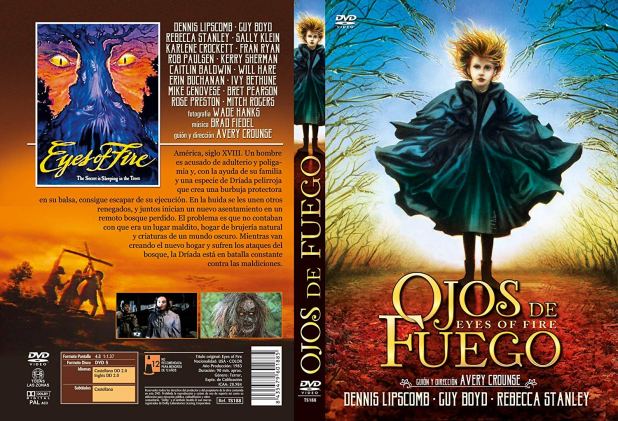
Eyes of Fire tells the story of a wicked, polygamist preacher (is there any other kind) who runs the old west (circa 1750) town of Dalton’s Ferry. When the Reverend Will Smythe (Dennis Lipscomb) is called out for his adultery among his parishioners, he and his flock are subsequently banished. Of course, God tells the Reverend to make a new life in a valley foretold in Indian legends as the “Forest of Darkness,” a wooded area with souls trapped inside trees and running amok with “mud people.”
Before you know it, all hell breaks loose in the Promised Land, Blair Witch-style, as the settlers can’t seem to find their way out of the forest and they’re picked off one by one. It’s up to a rugged frontiersman, Marion Dalton (Guy Boyd), and a crazy, woods-dwelling witch who proclaims herself the “Queen of the Forest” (Karlene Crockett) to battle the marauding Indian spirits.
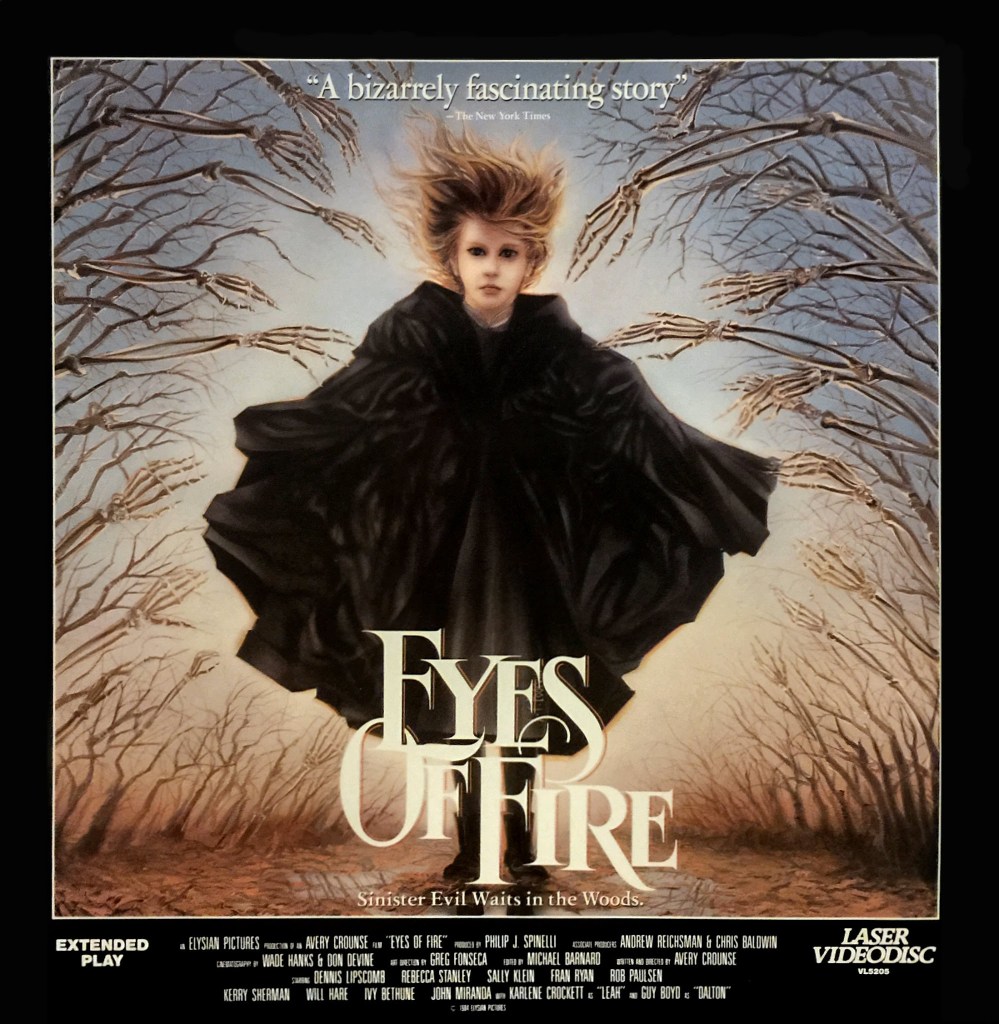
Yes. In a laser videodisc format!
While Eyes of Fire is low-budget and under the radar, there’s no denying that it’s well made and features great cinematography, costuming and special effects (the tree-trapped spirits are excellent), along with solid acting from the cast of unknowns. Granted, some quarters may say it’s slow: if you watch the home video cut instead of the theatrical cut, it is a bit choppy and doesn’t make a whole lot of sense in places (it loses 22 minutes between its different cuts), but that only lends to its Phantasm-like foreboding. It’s certainly more entertaining that other films of its ilk*, such as Aramand Mastronianni’s (He Knows You’re Alone, Cameron’s Closet) The Supernaturals, which I remember as being very boring—and I ejected it from the VCR less than half way through, never to watch again.
It’s unfortunate that Crounse disappeared from the industry (maybe he went into commercial work?) after two more films: The Invisible Kid (1988) and Sister Island (1993), as he showed a lot of promise. I vaguely remember the former as a theatrical with Jay Underwood, who was “hot” at the time. I never heard of the latter—one of the many low-budget romps from the extensive resume of Karen Black (Burnt Offerings).
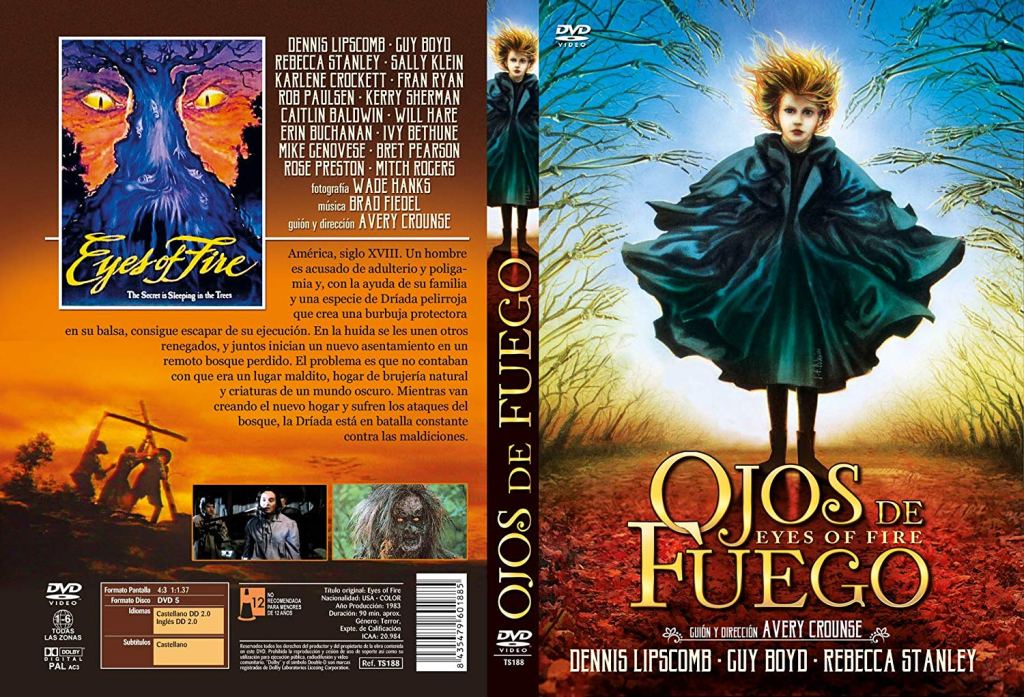
Foreign DVD reissue.
There’s lots of familiar TV faces afoot: Guy Boyd (pick a late ‘70s/early ‘80s TV series) was a semi-regular on Remington Steele, a co-star on 2000’s Black Scorpion, and was in Brian DePalma’s Body Double—and he’s still active today. You can play “pick a TV show” with the late Dennis Lipscomb as well, with his starring roles in Cop Rock and Wiseguy, while Karlene Crockett was a regular on Quincy M.E and Dallas. Eyes of Fire was the only feature film appearance by Rob Paulsen, as he reverted into voice work and became Pinky from Pinky and the Brain (1995) and Yakko from Animanicas (1993). Keen eyes will pick up on Kerry Sherman, who made her debut in Greydon Clark’s Satan’s Cheerleaders (1977), and Fran Ryan, who’s been in everything from TV’s Gunsmoke to Bill Murray’s Stripes (1983).
There are two pretty clean VHS rips on You Tube here and here to enjoy. Oh, and Sam the Bossman did his January 2020 take (Doh! Our reviews wires crossed, again!), as well as taking a new look at in September 2021 due to its inclusion for Fantastic Fest.
* Night of Horror (1981) with more Confederate Civil War ghosts (one of those “the cover is better than the movie” flicks and a VHS-eject), Ghostriders (1987) with western ghosts deep in the heart of Texas (well made, but boring; a VHS eject), and Stones of Death (1988) with aborigine ghosts (Aussie Indians) going “Poltergeist” (better made, but ho-hum familiar). Honorable mention: William Grefe’s (Mako: Jaws of Death) awful but fun drive-In nostalgia romp Death Curse of Tartu(1966) with its burial ground Indians.
About the Author: You can read the music and film reviews of R.D Francis on Medium and learn more about his work on Facebook. He also writes for B&S Movies.
The byline for this movie states: “Most horror stories take place in suburban areas, but these three teenagers are about to realize that those are not the only places where these things happen.”
Nicholas Michael Jacobs also directed Night, a movie that features long shots of people getting ready. This one starts with nearly ten minutes of a guy going through drawers while being barely audible.
There are three stories here. In Sundown, a young man waits for a partner to help in break in to a house. That man no shows, so he heads home — leading to that overly long looking through stuff moment we discussed — and gets chased by a killer. Inanimate is about an evil doll made of human skin — as well as a lengthy laundry sequence — and the final story is all about the chain email that cursed the babysitting in the opening story. Finally, the bad guys from each segment all fight one another at the end.
Supposedly, Jacobs is in his early twenties and I already see an improvement from Night. Here’s to his next film — and the one after that — as he continues to grow. Hopefully, he gets more than $1,000 for his next budget.
I’m a big fan of Taika Waititi. His film What We Do In the Shadows is one that I’ve introduced to so many people and given to just as many as a gift. His take on Thor pretty much changed the Marvel cinematic universe for the better and is the proof of goodness I point to when people naysay superhero films. And he’s also been behind some intriguing fare like Eagle vs. Shark, Boy and Hunt for the Wilderpeople, all while playing memorable roles like Korg in the Marvel films, Viago in What We Do In the Shadows and IG-11 in The Mandalorian.
His take on Christine Leunens’s book Caging Skies intrigued me from the first previews. While he was slated to work on a live action adaption of Akira — Hollywood won’t give up on trying — this was a different movie that needed a deft hand. Luckily, Waititi was that hand.
Johannes “Jojo” Betzler (Roman Griffin Davis in his first role) is a ten-year-old boy who is a member of Hitlerjugend, the Nazi youth movement. His father is supposedly fighting on the Italian Front, his sister has recently died and all he has left is his mother Rosie (Scarlett Johansson). Oh yeah — and his best and imaginary friend, Adolph Hitler (Waititi).
Jojo and his best friend Yorki attend a training camp, run by Captain Klenzendorf (Sam Rockwell, as always wonderful), who keeps failing at nearly everything. When ordered to kill a rabbit, Jojo finds that he cannot, earning the nickname Jojo Rabbit. To get back in the graces of the other young Nazis, Hitler convinces Jojo to throw a grenade without permission, which gives him facial scars and a limp.
A demoted Klenzendorf is asked by Jojo’s mother to include her son, so he is given the job of spreading propaganda and collecting scrap metal.
Meanwhile, Rosie is hiding Jewish girl Elsa Korr (Thomasin McKenzie, Leave No Trace) in her home. The revelation that Jewish people aren’t monsters, as well as the end of the war and his mother’s role in being against the Nazis will change Jojo’s view of the world.
Notably, every Nazi in the film is comedically ineffective, from Rebel Wilson as Fraulein Rahm to Stephen Merchant as the Gestapo agent Deertz and Alfie Allen as the second-in-command Finkel. The town’s stand against the Allies and Russians is well-nigh laughable, but also strangely heartbreaking. There’s been some criticism that the Nazis are shown in a good light at times in this film and as comedic foils at others. To me, they’re shown as objects of derision, paper villains that easily crumble when the real world intrudes. Klenzendorf sees himself as one of the heroic Aryan ideal that winds up in military finery in well-lit paintings with a Wagnerian soundtrack, but the best that he can do is spit in Jojo’s face to save his life.
Released by Vestron Video in 1987, this forgotten folk horror—also known as Cry Blue Sky—is very similar to The Witch, minus any arthouse aspirations. Instead of a man whose pride casts his family out of their village, this movie is about a reverend accused of adultery and polygamy.
Reverend Will Smythe (Dennis Lipscomb, Under Siege) and his followers leave their town behind to live in a valley haunted by an ancient evil. A rugged woodsman, Marion Dalton (Guy Boyd, Body Double), is along for the ride because he has his eye on Smythe’s lusty wife, Eloise. Hijinks, as they say, ensue. And by hijinks, I mean whatever is in the woods begins to haunt and kill everyone.
Rob Paulsen, who plays Jewell Buchanan, would become a voice actor. Perhaps you’ve heard him as Raphael and Donatello, two of the Teenage Mutant Ninja Turtles, or Pinky from Pinky and the Brain. He’s also in the movies Stewardess School, Warlock and Body Double. He’s also the voice that says, “Cheers was filmed in front of a live audience.” In all, he’s been in 1,000+ commercials and been the voice of 250+ cartoon characters.
Director Avery Crounse started his career as a photographer and only made two other films: The Invisible Kid and Sister Island, which starred Karen Black.
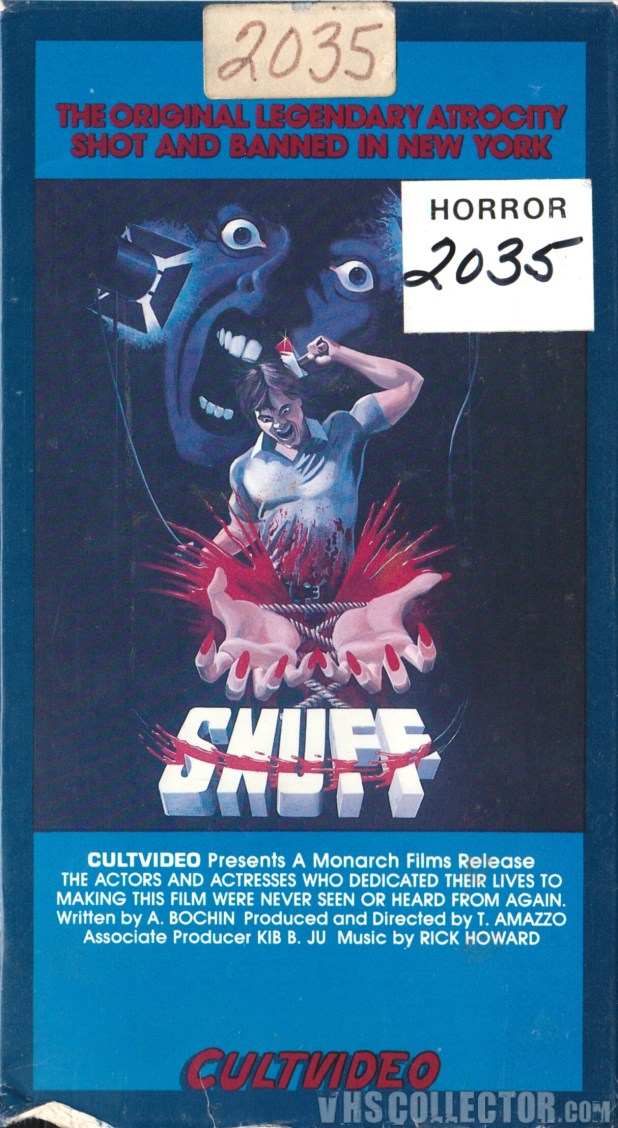
No matter what Charlie Sheen and Black Emanuelle tell you, snuff movies are urban legends. This movie is probably the reason why so many people think they’re real.
Starting out as a low-budget exploitation film called Slaughter — made by the husband-and-wife team of Michael and Roberta Findlay — it was filmed in Argentina for the low, low price of $30,000. Shot with no sound and concerning a Manson-like cult, it made the film’s moneyman Jack Bravman some money before it was released, as AIP paid to use the title for its Jim Brown blacksploitation vehicle of the same name.
Allan Shackleton, who produced Misty and Blue Summer, had shelved the film for four years when he released with a new ending, shot to look like actual footage, based on an article he had read about South American snuff films. This led to the film’s tagline: The film that could only be made in South America… where life is cheap!
The new ending shows the crew of Slaughter killing one of the actresses for real, with the abrupt ending and lack of credits all planned to make the movie appear legitimate. Then, Shackleton hired fake protesters to picket movie theaters showing the film. That blew up, as even though the fact that the film was exposed as a hoax in a 1976 issue of Variety, it kept getting more popular. At one point, protests reached such fervor that New York District Attorney Robert M. Morgenthau investigated the movie.
The plot of this movie is paper-thin. Actress Terry London (Mirta Massa, Miss International 1967) and her producer Max Marsh visit South America. She gets pregnant by another man and a female-filled biker cult led by a man named Satan stalks and murders her.
As for the infamous murder sequence, shot in the New York production studio of adult film director Carter Stevens (who made movies for the Avon Theater chain as well as the adult film Punk Rock), it’s very tacked on. But if you’re coming to see someone get murdered, do you even care about art?
Oh man, you Turkish maniacs. You aren’t content to just make your own slightly different version of The Exorcist like, well, any of the movies on our list of Ten Possession Movies That Aren’t The Exorcist. No, you’re going to pretty much remake the movie scene for scene and have “Tubular Bells” in just about every single scene. Bravo!
12-year-old girl Gul is living a high society life with her mother in Istanbul, yet becomes possessed after messing around with an Ouija board. Did she learn nothing from The Chill Factor, Spookies, all of the Ouija movies and, well, The Exorcist?
“This is literally the same movie,” said my wife, Becca.
“Shot for shot,” was my answer. “Just with fewer people and no budget.”
99% of Turkey’s population is Muslim and it has a history of being Islamic. One wonders how the Catholicism of the original would have played there. Perhaps that’s why we have this grainy little remake. I kind of love its slavish devotion to the source material, like a Sweded movie before anyone knew what that was.







 B&S About Movies
You must be logged in to post a comment.