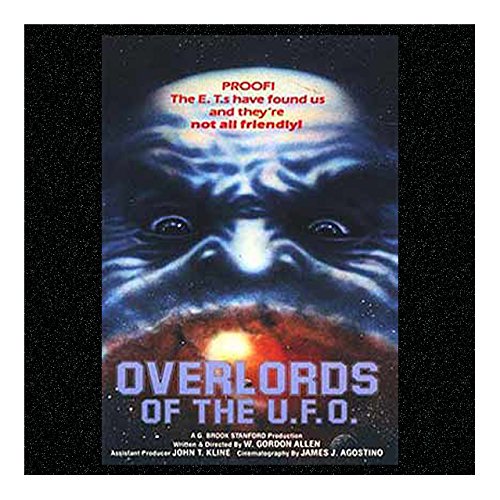
In the days before cable TV and streaming, which are filled with as much paranormal content as you can handle, movies like this about U.F.O.s were few and far between. And the commercials that advertised them were terrifying when I saw them on TV.
The one and only film directed by G. Brook Stanford and written and produced by W. Gordon Allen, who also shows up as an expert in the film. According to the Kook Science Research Hatch, Allen “was an American radio station owner and manager, film producer, author and devoted saucerian.” He wrote the book Space-Craft from Beyond Three Dimensions in 1959 in the early days of UFO journalism and followed that with 1966’s Enigma Fantastique and 1974’s Overlords and Olympians: Introduction to Para-Psycho-Physics.
I kind of love that when Arnold didn’t have photos or the budget to show a re-enactment of a contact, there’s a crude illustration that repeatedly gets panned across the screen. This movie is similar to the magical Schick Sunn Classic formula of an authoritative voice intoning dramatically as we learn about Betty and Barney Hill, Kenneth Arnold or Travis Walton. There’s also some ridiculous electronic music playing throughout this movie that brings me the comfort and joy that others may get from warm milk or a blanket.
There are even stories of contact between Spanish researchers and representatives of an alien race called the Ummo, the telepathic visions of dolphins, underwater UFOs and the Ethereans, who were sending androids to our timeline to stop mankind from inventing something.
Sure, the Ummo story was a hoax, but you really get the feeling that unlike so many modern docs and shows that just make a buck that this was Allen’s true mission in life. He wanted people to know about occupants of interplanetary craft and if he had to make his own exploitation movie to get the word out, he was going to do the best job he could.
The good: the constant use of the phrase “Who are the overlords of the U.F.O.?”; blaming cattle mutilations on invisible monsters; the disjointed feel of this, as if Allen had a stack of things he wanted to get through and had a day or two to make a movie and get it in front of your eyes, when the truth was that he probably had years.
The bad: Uri Geller bending spoons, an obvious magic trick from a discredited man who still shows up in numerous paranormal documentaries.
The wonderful folks at White Slaves of Chinatown are responsible for so many of the movies that we watched during this week of weird docs and educational films. This one may be the strangest they’ve shared, which is saying so much.
It’s all about the 19th-century automaton collection of Jack Donovan set to strange synth music — created by Yardbirds member Paul Samwell-Smith — for about forty-five minutes. Forty-five hellish minutes of images of murderous dolls, acrobats, music playing figures and smoking monkeys dressing like Napoleon.
You know how every movie that has a cursed videotape always looks like The Ring? No. Not at all. That possessed footage should look exactly like this film. After all, Anton LaVey didn’t just decide that “development and production of artificial human companions” would be part of the “Pentagonal Revisionism: A Five-Point Program” for the Church of Satan by accident.
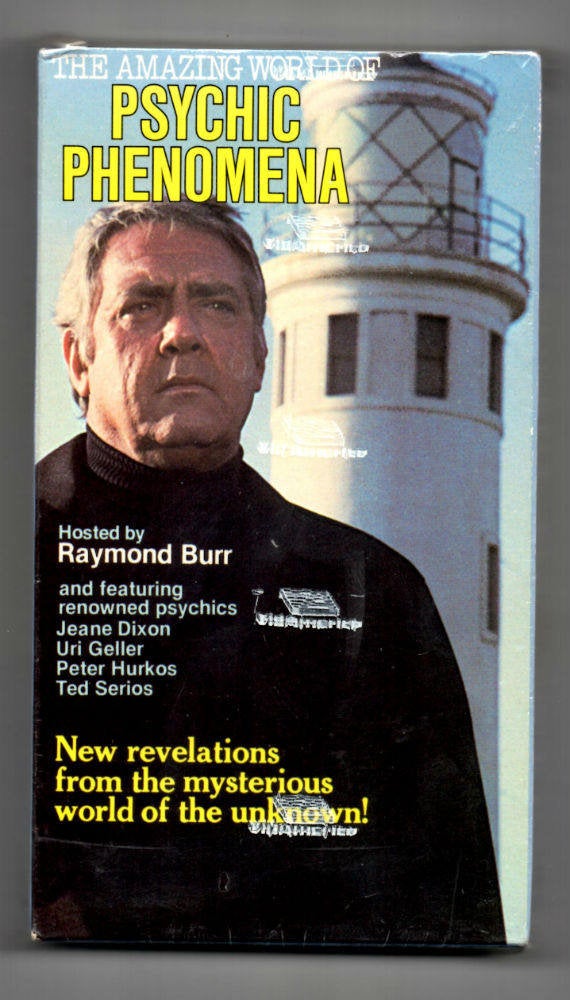
Man, those guys at Sunn made so many of these and I feel sad, because I’m starting to run out of their films to enjoy. Well, this time, they told Brad Crandall to stay home and brought in the big guns. And by big guns, I mean Raymond Burr. This movie astounded me as a kid because I only knew him from Ironsides, so when he started walking, I was as amazed as the crew of SCTV when Guy Caballero first stood from his wheelchair.
Written and directed by Robert Guenette — who is pretty much the master of these kinds of movies, because he’s also the man who made The Mysterious Monsters and The Man Who Saw Tomorrow — this movie is like reading the National Enquirer in the 70’s when it was borderline insane and unafraid to scream it on every page. Look, there’s Jeanne Dixon! What about Nostradamus? And hey, did you know Sharon Tate’s voice showed up after her death? What about ghosts showing up in photos? Or Apollo 14 astronaut Edgar Mtchell having ESP and contacting people from the moon? Did a psychic detective find the Boston Strangler? What’s astral projection all about? Peter Hurkos, who was in all sorts of these movies, is around. And oh hey, it’s Uri Gellar*!
There’s one definitely unsettling story about a voice in the basement that feels like it could have been a movie all its own and probably was, as it has no evidence — that would not stop Sunn Classics — and feels more like a horror movie than the rest of this.
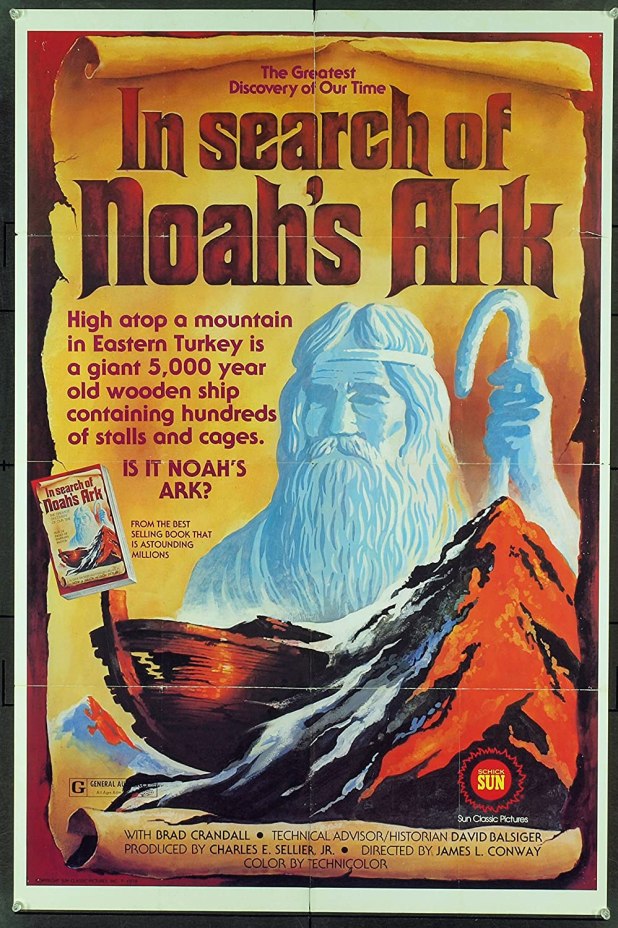
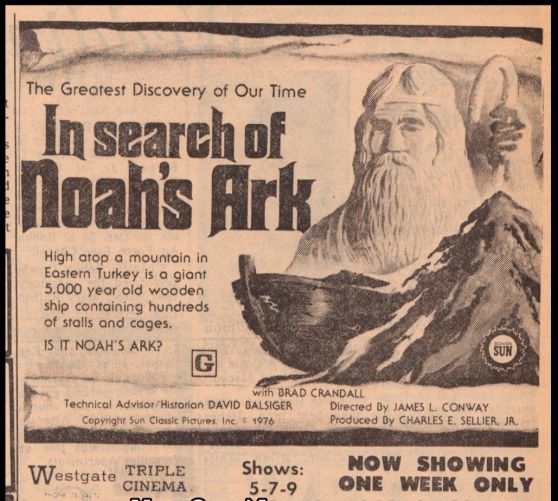
In case you haven’t realized this week, I’m kind of enamored of Sunn Classics documentaries. Yes, those wacky folks from Utah used their computers to learn exactly what kind of movies that American families wanted to see and the answer was this movie.
Based on the book by David Balsiger, Sunn made this one cheap and quick in Park City Utah. The main point of all of this is that Noah’s Ark has been found on Turkey’s Mount Ararat, yet physical and political challenges have kept mankind from studying the ark any further.
Sunn’s magic worked. This movie was the number nine movie for all of 1976, which is pretty amazing when you consider that the studio often four-walled theaters and didn’t play multiple screens like the other movies on the list like Rocky, The Omen, King Kong and Silver Streak. Sunn made this movie for next to nothing and it grossed $55 million in the U.S.
Just hearing the voice of Brad Crandall, who also was the smooth talker behind Sunn’s Beyond and Back, The Lincoln Conspiracy and The Bermuda Triangle, makes me feel so calm and happy in a world that is quite frankly going to pieces. These movies are my safest of spaces, so I don’t even call them out Henry Silva style when they make crazy claims that can’t even hope to be backed up with things like evidence and actual truth.
Vern Adix, who plays Noah in this, was also Plato in Beyond and Back, which is a pretty good one-two IMDB role combo, right?
Somehow, the makeup man for this movie was Don Shanks, the man who would one day be Michael Myers. Man, that Utah film world keeps on rewarding me with trivia, huh?
As for director James L. Conway, who is still working today, he also directed several of Sunn’s efforts, including The Boogens, Hangar 18and the one Sunn film that eludes my grasp, 1981’s The President Must Die.
Seventeen years later, Sunn — now Sun International Pictures — made an updated version of this called The Incredible Discovery of Noah’s Ark for CBS. Hosted by Darren McGavin, the special featured interviews with experts and plenty of speculation on the findings of George Jammal, who had what he called “sacred wood from the ark.” Jammal’s story of the dramatic mountain expedition which took the life of his Polish friend Vladimir was, as Felix said above, BS.
The truth is that Jammal and scholar Gerald Larue took some railroad tracks and cooked them up in an oven with some blueberry and almond wine, sweet and sour barbecue sauce, iodine and teriyaki sauce, then claimed that the wood came straight from the boat that survived the Great Flood.
Larue was a scholar of religion and professor emeritus of gerontology at University of Southern California. A former ordained minister who became an agnostic, he was also an archaeologist who took part in biblical digs in Egypt and Israel, as well as a debunker of biblical stories and accounts of miracles.
After the show aired, Larue exposed the hoax and his role in it to Time magazine. Sun International Pictures argued that it was a secular humanist plot to discredit Jammal, saying that it was “sad and unfortunate that Dr. Larue, a distinguished USC professor, would victimize Mr. Jammal and his family to execute a third-party hoax in which he was the primary benefactor.”
Again, the truth was that Jammal had hoaxed Sun International Pictures and the Institute for Creation Research for around seven years. They missed the clues that he left behind, which are frankly obvious. His dead friend Vladmir’s last name was Sobitchsky and he was joined on his expedition by Mr. Asholian and a man named Allis Buls Hitian.
They could have also carbon dated the wood — I mean, they discuss the process at length as they talk about the Shroud of Turn during In Search of Historic Jesus — but they went with their gut.
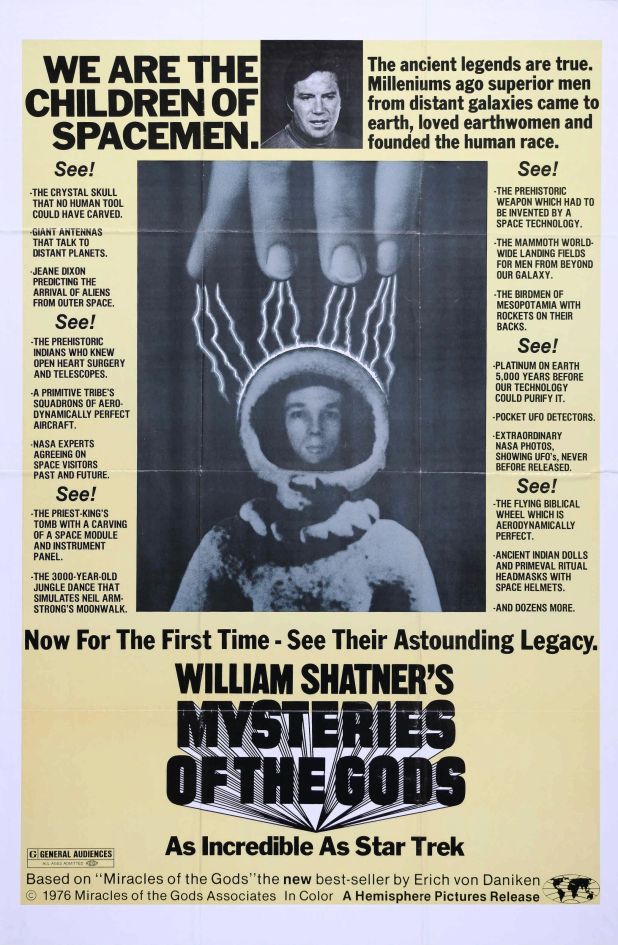
In 1976, William Shatner was seven years away from the end of Star Trek and three years from the theatrical movie, so he was taking whatever work he could get, which meant The Tenth Level, A Whale of a Tale and the TV series Barbary Coast.
And oh yeah — Mysteries of the Gods.
Let me tell you, the seventies were a weird time to be alive. People had biofeedback machines in their plants so they could talk to them, everyone was recovering from Vietnam and Watergate, and aliens were everywhere.
Harald Reinl (who also directed The Return of Dr. Mabuse, The Torture Chamber of Dr. Sadism and Chariots of the Gods) directed the German version of this movie, with the American parts directed by Charles Romine (Behind Locked Doors). This is based on the work of Erich von Däniken, whose ancient astronaut theories now form the basis of so much of basic cable alien shows while he himself has been seen as a charlatan for some time.
Shatner wears some astounding clothes that have huge collars and often bare his chest, like some lusty Doc Savage flying all over the world to interview old women about crystal skulls and debate with scientists. Man, for that reason alone, this movie is worth a watch, plus there’s plenty of synth music and a short running time. This is a good start if you’ve just getting into 20th century carny paranormal documentaries.
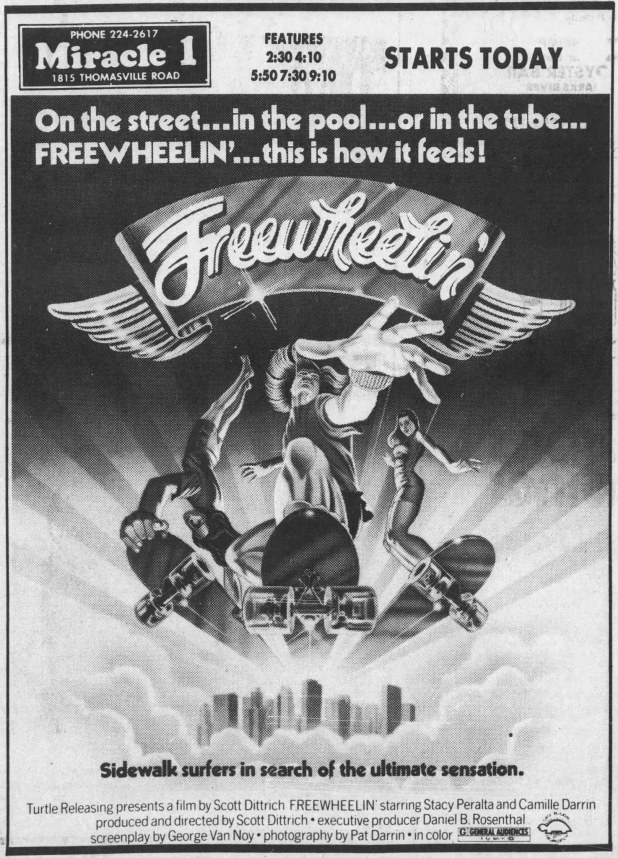
Scott Dittrich directed several surf and skate videos, including Asian Paradise and Rolling Thunder. This is one of the earliest ones in the form, showing the original Zephyr team, including Stacy Peralta and his team.
The story isn’t really necessary — I hated when even my era’s skate videos had a narrative when all I wanted to see was street tricks — but that’s fine. Peralta would go on to be part of Powell/Peralta and sponsor the Bones Brigade, who for my money made the best boards and skate videos ever.
It’s pretty cool that the world of skateboarding at this stage accepted surfing, BMX, roller skating and more. There’s really something for everyone here and for all the hate thrown at the music in this film, well, it was 1976.
Editor’s Note: Fool us once, Plural “S,” shame on you; fool us twice, shame on B&S About Movies. We reviewed Satan’s Slaves — the 1982 Phantasm-inspired plural one from Indonesian — on November 12, 2019, as part of our Mill Creek Pure Terror 50-Film Set of reviews. One slight problem: that film wasn’t on the set: it was the 1976 British, singular one starring Michael Gough. And we caught the title faux pas before we went to press, but just said the hell with it because, well, the Indonesian one has rocked our world for many years. This time, we’re reviewing the proper film, as result of its inclusion on Mill Creek’s Gorehouse Greats 12-Film Set (Amazon), which we’re unpacking with reviews all this week.
Today’s review is brought to you today by the letter “S” and the number 666.
How is it that we could go on all day about British actor and Hammer stalwart Michael Gough, starting with his first role as Sir Arthur Holmwood in Hammer’s Horror of Dracula (1958), watch his work in Horrors of the Black Museum (1959) multiple times, and watch him in The Phantom of the Opera (1962), The Skull (1965), and Horror Hospital (1973), but never encountered his work on Crown International Pictures’ Satan’s Slave? Even with all of our combined video store memberships and watching Friday and Saturday late night horror blocks on our local UHF-TV stations, we’ve never heard of it or seen it (at least it slipped by me). How is that possible? We fell in love with Euro-obscurities like A Bell From Hell and Symptoms from multiple UHF showings — and even seen them on home video shelves.
Well, let’s unpack this flick brought to you by the letter “S,” Oscar.
Turns out, director Norman J. Warren has two flicks on this Gorehouse set: this and Terror(1978), which is also on the B-Movie Blast 50-Film pack that we’ve already reviewed this month. Truth be told, while he’s legendary — at least in B-Movie and video nasty circles — Warren is an under-the-radar obscurity to most horror fans (well, except for FUBAR’d dudes like Bill Van Ryn who’s made his fandom of Warren’s Prey well known), with only 16 credits. The Warren films you (may or not) know are the insipid, Star Wars-inspired sex comedy Spaced Out (1979), aka Outer Touch (that we passed on during our “Star Wars Month” tribute; the similar, better known Galaxinawon that review pole position), and the Alien rip off (that we did cover with our “Alien Week” tribute) Inseminoid(1981). Then there’s that off-the-nut sci-fi zombie romp Prey(1977) that Bill Van Ryn digs, and Warren’s final tour de force: Bloody New Year (1987), that Sam digs. All of those films were, of course, better distributed projects that turned up in theaters, cable, and VHS (for me, that would be as Inseminoid; Spaced Out was an oft-aired HBO programmer).
Then there’s Satan’s Slave — sans that pesky “S” plural.
Perhaps it’s because it was only Warren’s third feature film — after two Italian sex shenanigans flicks issued in 1968: Loving Feeling and Private Hell, which makes Satan’s Slave his first horror film. In between his Alien romp, Inseminoid, and his Slasher romp, Bloody Birthday, Warren changed it up with, well, looking at the cover, a Stallone Rambo-cum-Arnie Commando rip called Gunpowder (1986) — has anyone seen it?
Now, the writer on this, well that’s a different story: While he wrote Warren’s Satan’s Slave and Terror, he gave us the video rental favorites of ’70s British horror: White Cargo (1973), House of Whipcord (1974), Frightmare (1974), the sleaze-o-rama that is The Confessional (1976), and Schizo(1976): Lord Smutmeister David McGillivray (and we mean that as a complement).
This time we have a supernatural horror tale with Catherine (British horror “Scream Queen” Candace Glendenning; The Flesh and Blood Show) who comes to live with her uncle and cousin (Michael Gough and Martin Potter; his work goes back to Fellini Satyricon) after she survives a car crash that killed both of her parents. Of course, Uncle Alex and Cousin Stephen are behind the crash: they’re necromancers who need her as a sacrifice to resurrect a powerful, spiritual ancestor.
To say more will spoil the film, as this Rosemary’s Baby-inspired tale (but not at all like a cheap Italian ripoff of that film or The Exorcist) is an excellent watch; one that’s far above the fray of the exploitative-norm discovered on Mill Creek sets. The scripting, set design, and acting — from all quarters — is top notch. I loved it. Consider it one of my new classics in the British ’70s cycle of gothic horror tales, right alongside Captain Kronos: Vampire Hunter and Hammer’s Karnstein Trilogy.
The production story: There’s additional material shot that was even more violent, and alternative versions of existing scenes that are in the film are available in other prints in the overseas markets. So, what we get is an amped up, Gothic psychological-sexploitation tale that programs nicely with the better distributed (as with the aforementioned A Bell from Hell and Symptoms via VHS and UHF-TV) Virgin Witch (1971) and the always incredible to watch The Wicker Man (1973). Of course, keen eyes immediately notice that the house and grounds of the Yorke estate appeared in Virgin Witch; and when you watch Terror off this same Mill Creek set, you’ll notice the Gothic estate, reappears.
While you can get this on the two Mill Creek sets we’ve unpacked this month, the more serious Warren fan can get Satan’s Slave, along with Terror, Prey, and Inseminoid on Anchor Bay’s Norman Warren Collection DVD box set. Vinegar Syndrome and Severin also offer restored single-disc reissues. However you watch it: watch it. There’s a copy of Satan’s Slave on You Tube.
About the Author: You can learn more about the writings of R.D Francis on Facebook.He also writes for B&S About Movies.
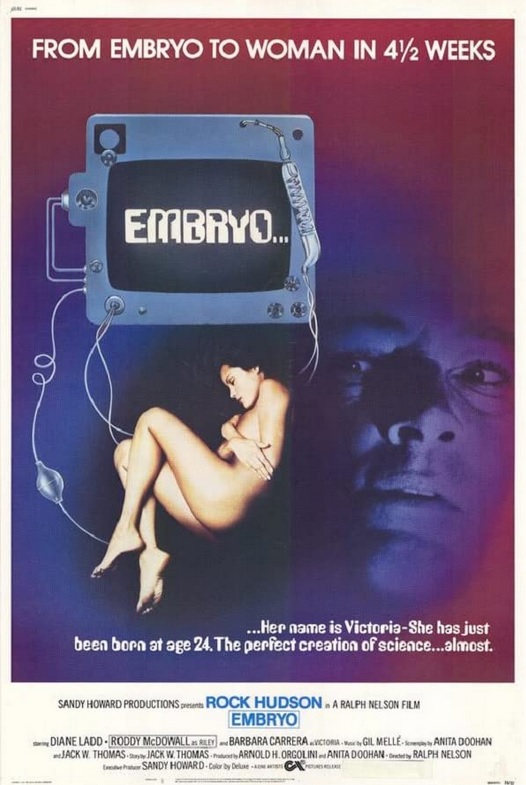
Hey, I’m talking to you, Bill Van Ryn! You want a Groovy Doom Saturday Night Watch Party double feature, then you have to pair Tony Curtis’s and Rock Hudson’s forays into the horror/sci-fi genres with TheManitou (1978)and Embryo. What were they thinking. What were their agents thinking. I know what their fans were thinking: what in the hell is this crap? Then, Rock had to two-fer the bombs with Avalanche (1978). Rock Hudson in a Roger Corman disaster flick? Yep, he did it. Then he upped the ante with a Star Wars dropping: The Martian Chronicles (1980). Doh!
Rock, Rock, Rock. What in God’s great creation! You were a heartthrob from the Golden Age of Hollywood and you did a six-season ratings-winning stint with NBC-TV’s McMillan & Wife, and you gave us the TV movie greats of World War III (1982) The Vegas Strip War (1984). I guess it’s true what they say: aging actors and washing out actors really do retreat to horror films for work (see Wanda Hendrix in One Minute Before Death and Jeanne Crain in The Night God Screamed as examples).
A PC hooked to a fetus? Hey, it’s the sci-fi ’70s!
Apparently, there was a deeper, philosophical meaning in behind Anita Doohan and Jack Thomas’s script (it served as Anita’s debut and Jack’s last) about a doctor dealing with the mental, emotional, and physical consequences of growing a human fetus in an artificial uterus. . . .
Hey, you know what Mr. Van Ryn? You could also pair Embryo with Fritz Weaver in Demon Seed, since both films deal with a fetus spawned in an artificial uterus — only Fritz picked a classic (in my world, anyway). But this Rock sci-fi romp . . . Oy! This isn’t Demon Seed: this is Bruce Dern splitting-heads in The Incredible 2-Headed Transplant — only that’s a trash classic and Bruce Dern was still AIP-drug-and-biker-flick Bruce Dern, so he gets a pass. And, in a twist: Dern’s ex-wife, Diane Ladd, stars here as Rock Hudson’s Dr. Paul Holliston’s sister-in-law/lab assistant.
Holliston is a geneticist who, after the death of his wife in a car crash, and the pangs of wanting her back, he begins tinkering with an experimental growth hormone made from human placental lactogen that not only shortens the gestation period . . . it speeds up an embryo’s growth. After successfully birthing a Doberman Pinscher from a pup he saved from a dog he ran over with his car, he decides to try the hormone on a human; he applies the technique to an unborn fetus from a suicide victim. The fetus quickly grows into a 22-year-old woman he names Victoria (Barbara Carrera) — who also becomes his lover. While she develops superior intelligence — as with Atom Age Vampire, Invasion of the Bee Girls and The Wasp Woman — Victoria begins to rapidly age and craves pituitary gland extract from human fetuses. Now a modernized vampire — in the vein (sorry) of Marilyn Chambers in Rabid — she murders a prostitute to steal her unborn child to suck out the needed nutrition. Unsuccessful in his murdering her in a car crash, the now elderly Victoria — to Holliston’s horror — gives birth to his child: a mad, screaming baby.
More reissue artwork overselling a movie.
Embryo is an updated Frankenstein(yes, that’s the ’73 one; the ’31 one is the influence) — with a smidgen of The Bride of Frankenstein. It’s a vampire tale — lacking a smidgen of fangs. And Rock certainly tries; he’s earnest in his attempt to make it all work. The class and style that William Friedkin brought to The Exorcist — which is this film’s inspiration and a quality Rock certainly thought he was getting — is absent. And that’s baffling when you consider Rock’s director was Ralph Nelson, who won multiple Oscars for Lillies of the Field (1963), Father Goose (1964), and Charly (1968). As with Stanley Donen, the co-director of Singing in the Rain (1952), being woefully out of his element with the Star Wars knockoff Saturn 3, a comedy and dramatic Oscar-winning director does not an Exorcist bid, make.
As with Rock’s fellow Golden Age of Hollywood compatriot, Kirk Douglas, himself an Academy Award and Golden Globe nominated and winning actor, expecting more from Stanley Donen, Rock ended up in another “Trog”: Joan Crawford’s attempt to expand her audience with a horror film. What Rock ended up in was a more expensive, complacently-crafted AIP film. But an AIP-mad-scientist film is still an AIP-mad-scientist film: cash flow and A-List stars, be damned. What Embryo desperately needed to push it over the top is one of the favorite lines of dialog of fellow B&S About Movies’ contributing writer, Jennifer Upton: “Herschell, what about the children?” from the crazed turkey-man movie Blood Freak (1972).
But there’s no crazy dialog and just a rabid dog. Nor a blood-craving turkey man. It’s all just turkey with no mayo and Rock committing proxy-incest with his petri-dished pseudo-daughter. And it’s brought to you, in part, by Sandy Howard Productions — yep, the studio behind The Neptune Factor (1973), The Devil’s Rain (1975), and Terror Train (1980). Cine Artists Pictures, the studio behind this, went out of business, which is why this “major studio picture” is in the public domain, endlessly recycled on Mill Creek boxers.
So, in addition to airing on the national, retro-UHF channel COMET from time to time, you can have your own copy courtesy of Mill Creek’s B-Movie Blast 50-Film Pack and Nightmare Worlds 50-Film Pack. You can also stream it free-with-ads on Tubi TV as well as watch it on You Tube. We found trailers to sample HERE and HERE because: fool us once, trailer embed elves! You need another take on this to convince you to watch? Here it is! Two box sets means two reviews, baby!
* Nightmare World image courtesy of JohnGrit/Unisquare.
About the Author: You can learn more about the writings of R.D Francis on Facebook.He also writes for B&S About Moviesand publishes on Medium.
Editor’s Note: Hey, it’s a Ron Marchini movie! So program it as many times as you want, Mill Creek! We reviewed this flick on August 5, 2020, a part of our reviews for Mill Creek’s Savage Cinema 12-Movie collection. Then guest writer Herman P. Caine gave us another take on November 28, 2020, as part of our unpacking Mill Creek’s Sci-Fi Invasion 50-Film set. And we’re reposting our review from the Savage Cinema set to celebrate Death Machines’ inclusion on Mill Creek’s B-Movie Blast 50-Film pack. All Hail Ron Marchini! Celebrate karate sci-fi and B-Movies!
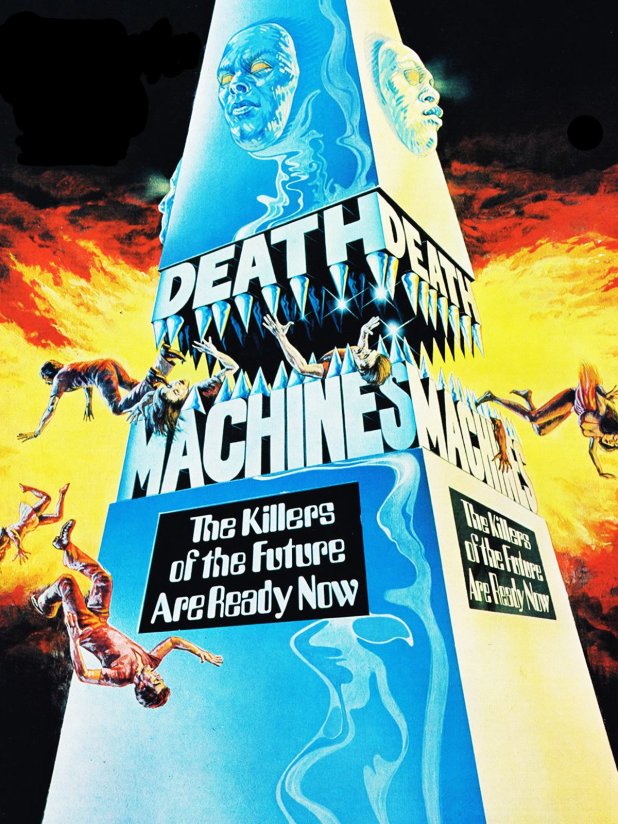
The Savage Cinema set has motorcycles. It has stock cars. It has dynamite coffins. And now, it has death machines. The poster for this movie has always fascinated me and now the time has finally come to see if it lives up to the insane promise of the painting that hawked its wares.
Madame Lee has gathered three martial arts masters, now and forever known as White Death Machine (Ron Marchini, who is also in Omega Cop and Karate Cop), Asian Death Match (Michael Chong, Kinjite: Forbidden Subjects) and Black Death Machine (Joshua Johnson, The Weapons of Death) after she injects them with a mysterious formula that makes them her commandable karate fighting soldiers.
There’s a green-faced cop named Captain Green. A good guy who loses his hand, gets his ass kicked in a bar fight and still gets the girl. Bikers who bother zombie killers when they just want to eat burgers and talk to old men about God. A mysterious mastermind in the shadows. Dudes getting thrown off buildings. And a distributor — yes, our friends at Crown International Pictures — that wanted a science fiction angle for a movie about evil martial artists shot in Stockton, CA.
I have no idea what was in that zombie juice, but it makes street fighters impervious to bullets. This was all a passion project of Paul Kyriazi, who also made Ninja Busters. There’s also a cop named Lt. Clay Forrester, who is no relation to Gene Barry or Trace Beaulieu.
This movie doesn’t make any sense and you’re either going to be bored into oblivion by it or love it like the lover who broke your sixteen-year-old heart and you never quite got over her. There is no in-between.
If you want to see it for yourself, you can do no better than the blu ray release that Vinegar Syndrome has put out. Freshly restored in 4k from its original Techniscope camera negative and featuring brand new interviews with its director and stars? I never thought I’d see the day. You can also check this out on Amazon Prime.
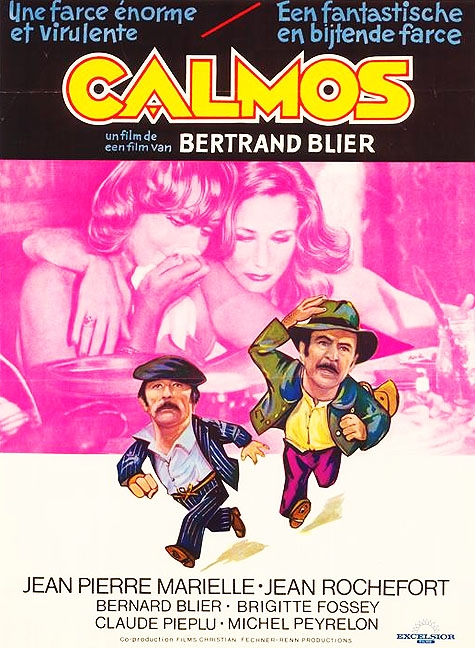
Also known as Femmes Fatales, this Bertrand Blier-directed film presents a satire of both the rise of feminism in France and the traditional attitudes of Frenchmen.
Paul (Jean-Pierre Marielle, The DaVinci Code) is a married gynecologist who has grown sick of looking at women’s bodies. As he runs from his office into the street, he meets Albert (Jean Rochefort, who narrated the French versions of Disney’s Pooh movies). Realizing that they both want the same things in life, they leave town for a small village where they eat and drink away from their wives.
The village priest, who they bring into their world of food and wine, soon takes the side of their wives (Brigitte Fossey from Quintet is one of them) and forces them back to Paris and anything but marital bliss.
Here’s where things get weird.
After weeks of freedom, our heroes — such as they are — run away from the demands of their wives and hide at a farm. They’re soon joined by hundreds of men who want to get away from the demands of their feminist wives.
That’s when an army of women attacks, with a captain who demands that Paul and Albert pleasure all of them before she lets them go. They make a run for it before they are taken back to Paris, operated on and forced to have sex with woman after woman.
Somehow, after all that, they are shrunk down to miniature size and taken to an island, where they fly hang gliders directly into the anatomy of a woman. The end.
I really struggled to figure out what Blier wanted me to feel here. Is it just a joke, all a laugh about the fact that women finally had control of their bodies and may want to initiate sex more often than men, which is a major reversal in the ways of the world in 1976? Then why is every woman in this an amazon obsessed with having sex with men in their late 40’s (as someone who is 48, this is not a complaint as much as an observation)? Is the inversion of the way men treat women any better than the alternative?
I know that I should probably just be laughing or titillated, but I’m just confused.



 B&S About Movies
You must be logged in to post a comment.