Sensi (1986)

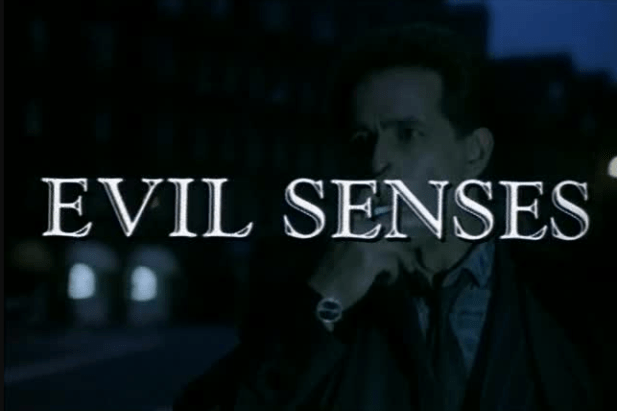
Evil Senses is all about Manuel (Gabriele Lavia, who directed and co-wrote this with Gianfranco Clerici, Vincenzo Mannino and Dardano Sacchetti) is a hitman who has found a list of names that means nothing to him, but that marks him for death by his bosses. He hides out in a brothel that’s run by an old girlfriend named Micol (Mimsy Farmer) and falls in love with one of her employees, Vittoria (Monica Guerritore). He doesn’t realize that they share the same employer and that her husband wants her to get the list and kill him. He tells her that he’s thrown the list away but has memorized it.

Lavia’s co-star is his wife, who he had already directed in Scandalosa Gilda. If this all feels like a vanity project, it’s close. But if I was making my own movie, I’d work with Saccheti and have Fabio Frizzi do the music, so who can fault him? And wow, this was all filmed in English.

By the end, Vittoria falls for Manuel and saves his life, helping him kill the organized crime leaders that they both serve. Then he shoots her, because he’s a loner.

This was also released as Stripped to Die in Italy. I’m frankly shocked at how little Mimsy is in this and I assume that she was looking for another movie after making Body Count while she was in Italy.
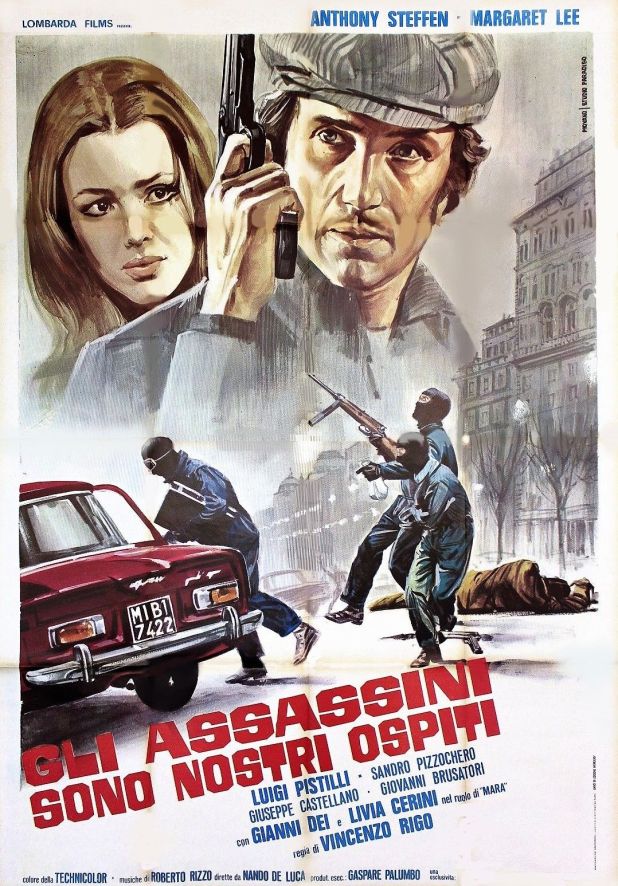
Gli assassini sono nostri ospiti (1974)

Franco (Gianni Dei), Eliana (Margaret Lee) and Mario (Giuseppe Castellano) rob a jewelry store, shooting numerous people and barely escaping with their lives. Their driver isn’t so lucky and Franco has also been shot. Commissario Di Stefano (Luigi Pistilli) has shut the streets down and put roadblocks everywhere, so they decide to hide in the home of Dr. Guido Malerva (Anthony Steffen), holding him hostage and forcing him to heal Franco. Then the doctor’s wife, Mara (Livia Cerini) comes home and the robbers realize that they’re in the midst of a fight that has been going on for a long time, but they have to be patient and wait for their boss Eddy (Sandro Pizzocchero).

Director Vincenzo Rigo only made two other movies — Passi furtivi in una notte boia and Lettomania — but this is an interesting movie shot almost all within one room. He wrote the script along with Renato Romano (Dorian Gray) and Bruno Fontana (the director of The Dirty Seven AKA Emanuelle: Queen of the Desert and the writer of Joe D’Amato’s Ossessione fatale and Escape from Women’s Prison).

Not a typical giallo, this is close to a film noir. Also: Pistilli has some amazing sideburns.

You can watch this on YouTube.

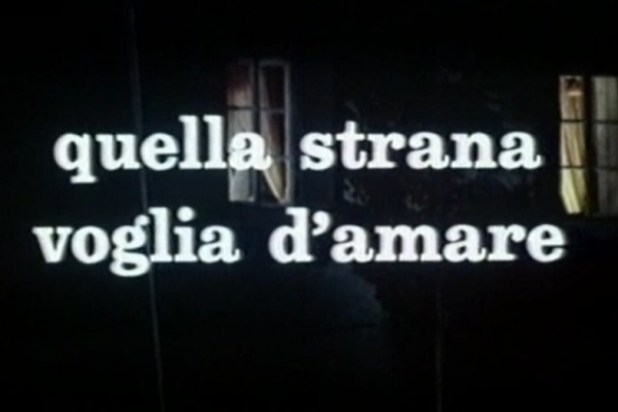
Quella strana voglia d’amare (1977)

Angela (Marina Giordana, Beast with a Gun) and Marco (Christian Borromeo, Murder Rock) live in a huge house in the country — I will resist making Blur references — and because this movie’s title in English is That Strange Desire to Love, you can guess that they are a couple despite being related. Oh Italian exploitation movies…

Don’t blame me. Blame Mario Imperoli (Mia moglie, un corpo per l’amoreLike Rabid Dogs) and the man he wrote this with, the infamous Luigi Montefiori, better known as George Eastman.

The problems arise when a teacher named Claudia (Beba Loncar), a teacher is sent to instruct them under the orders of Father Don Giuseppe (Philippe Leroy). There’s also Rocco (Eastman), a handyman who has been made mute by a car accident who is also in love with Angela. The giallo element comes in when Angela uses Rocco to get revenge on Claudia for daring to make love to Marco. Upset by his guilt — and the sound of a car accident that Marco keeps replaying — Rocco kills himself and that means that Angela and Marco can embrace once again.

Also: George Eastman is so strong in this movie that he can lift a car.

Somehow, this is probably as tender and well-thought out of an Italian exploitation incest movie as you’re going to get. I realize that sentence makes no sense.

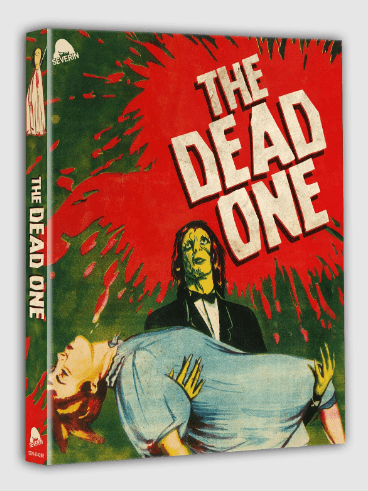
SEVERIN BLU RAY RELEASE: The Dead One (1961)

Thanks to Severin Films for including a quote from this site in the sales copy: 

“A SIGNIFICANT MOVIE… One of the first zombie films made in color, it mostly played Southern drive-ins and Mexican cinemas before disappearing for over 40 years.” B&S About Movies

Extras on this release include an audio interview with distributor Samuel M. Sherman, an interview with author/filmmaker C. Courtney Joyner on Barry Mahon and a trailer.

You can get the blu ray from Severin.

The Dead One is a significant movie because it’s one of the first two zombie films made in color — the other is Dr. Blood’s Coffin — and it was made outside of the Hollywood system in New Orleans. It mostly played in Southern drive-ins, in Mexico and the UK before it disappeared for 41 years.

Shot in Eastmancolor and Ultrascope, a form of Cinemascope from Germany, The Dead One has a cool looking zombie and otherwise would be an unremarkable film other than the fact that it’s a Barry Mahon film and stands out from the rest of his output, which is either falls into the disparate genres of nudist films, roughies, propaganda movies or childen’s films.

Actually, the poster for this would like you to know just how remarkable this movie is, saying that The Dead One is “The Greatest VOODOO Film Ever Made – Filmed on Location in New Orleans Where VOODOO was introduced to the New World.”

A zombie is haunting the plantation of Kenilwort and commanded by Monica Carlton (Monica Davis, who is also in Mahon’s 1,000 Shapes of a FemaleRocket Attack U.S.A. and She Should Have Stayed In Bed), the mistress of the decaying plantation.

This is probably the most restrained Mahon film I’ve seen. It played double bills for a long time, a filler for drive-ins that would run late into the night while what happened in the steamed up cars looked a lot like the other movies Barry was known for making.

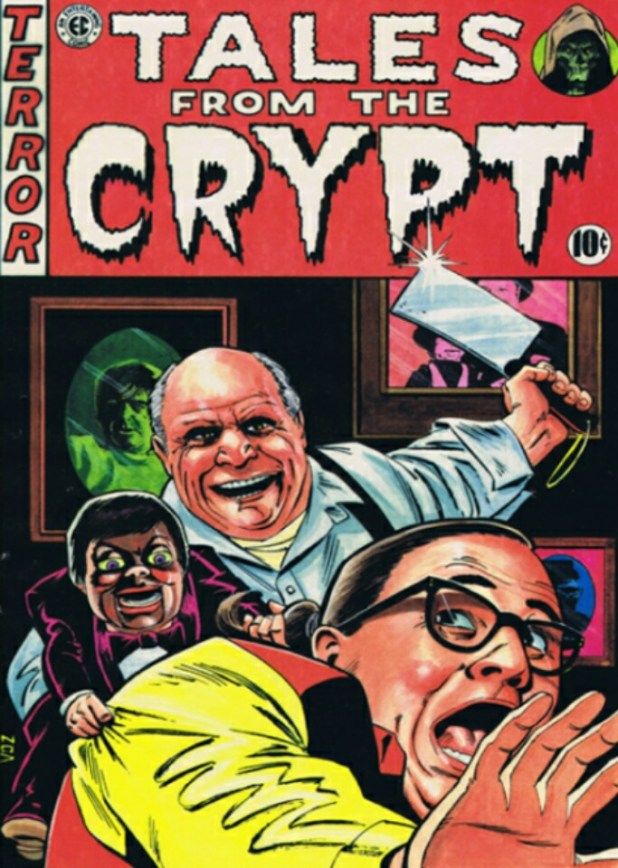
Tales from the Crypt S2 E10: The Ventriloquist’s Dummy (1990)

“Good evening, fear fans. You’re just in time. Contents: one ventriloquist’s dummy Hacme Novelty Company, Battle Shriek, Michigan. Oh, goody! Watch this, kiddies. You won’t see my lips move. You know why? I don’t have any! Well hello, Dickie. Would you like me to tell a tale from the crypt? No thanks, death-breath. Then how about sitting a little closer to the fire?!”

Directed by Richard Donner and written by Frank Darabont and Steven Dodd — wow, this episode is bringing the wattage, right? — “The Ventriloquist’s Dummy” stars Bobcat Goldthwait as Billy Goldman, a horrible amateur ventriloquist who saw the final performance of his idol, Mr. Ingles (Don Rickles) and Marty, which ended in a fire, Ingles losing his hand, his girlfriend being killed and the end of his career.

Billy invites Mr. Ingles to see him perform and he bombs. The elder artist lashes out at him, telling him that he’s horrible with no technique or ability to work an audience. Moments later, a woman who was seen with Ingles is found dead and Billy was covering the body with his coat. When Billy finds the man he has looked up to so much, Ingles is shooting morphine into his stump. Calling him a junkie and murderer, Ingles says that Morty is the one who hates women. The truth is that Morty is no doll. He’s a conjoined twin at the wrist and the morphine is all that keeps him from killing. Now that he’s taken so long to give him his medicine, Morty attacks him and then Billy, who makes a deal with him to be a star.

However, Morty is always a step ahead of the person calling him a dummy.

This episode comes from the story of the same name from Tales from the Crypt #28. It was writtem by Al Feldstein and William Gaines and drawn by Graham Ingels, who the Mr. Ingles character is named for.

This is a really great episode that is, as I said above, filled with talented people.

B&S About Movies podcast episode 13: The Concorde … Airport ’79 and Concorde Affaire ’79

The Concorde…Airport ’70 and Concorde Affaire ’79 are the kind of movies I wish they still made. Big dumb movies. Planes still crash. Where are the movies? You can watch Airport ’79 on these services and Concorde Affair ’79 on YouTube.

You can listen to the show on Spotify.

The show is also available on Apple Podcasts, I Heart Radio, Amazon Podcasts and Google Podcasts.


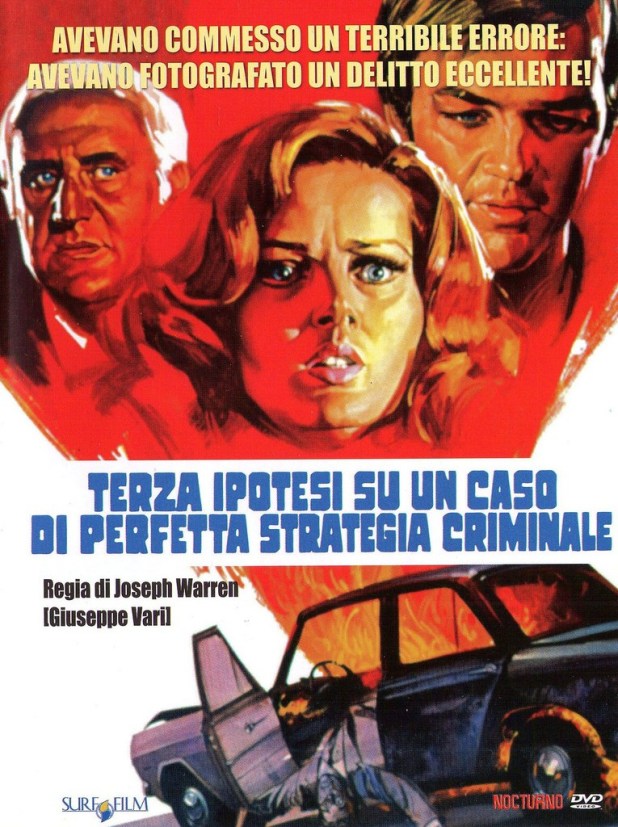
Terza ipotesi su un caso di perfetta strategia criminale (1972)

Third Hypothesis on a Case of Perfect Criminal Strategy is better known by the name Who Killed the Prosecutor and Why? It was directed by Giuseppe Vari (Rome Against Rome) and written by Thomas Lang. Carlo (Lou Castel) and girlfriend Olga (Beba Lončar) started with a fashion shoot on a remote beach but have already dropped the camera — and most of their clothes — when two cars show up. Men throw the body of a dead man — who turns out to be a prosecutor — into the other car, cover it with gasoline and light it up. state prosecutor. Instead of going to the police, Carlo decides to find out who did this and blackmail them with the photos he’s taken.

After talking to his pornographer Uncle Fifi (Massimo Serato), Carlo speaks to Don Salvatore (Fortunato Arena) about buying the photos. When he refuses, the photographer goes to the media, but his buyer Roversi (Carlo Landa) is soon killed, which means that both Carlo and the newspaper’s editor Mauri (Antonio La Raina) decide to figure out who is killing people who want these photos. Maybe they should have just gone to the police and Inspector Vezzi (Adolfo Celi). If they did, we wouldn’t have a movie, so that’s how it goes, I guess.

So how is this a giallo? Whoever wants the photos has gained some of the negatives and is killing anyone else who has seen them, as mentioned before, but they have black gloves, we never see them and their murders are in the style of the genre.

If that isn’t enough for you, some cuts of this movie have hardcore inserts, which is the definition of gratuitous.

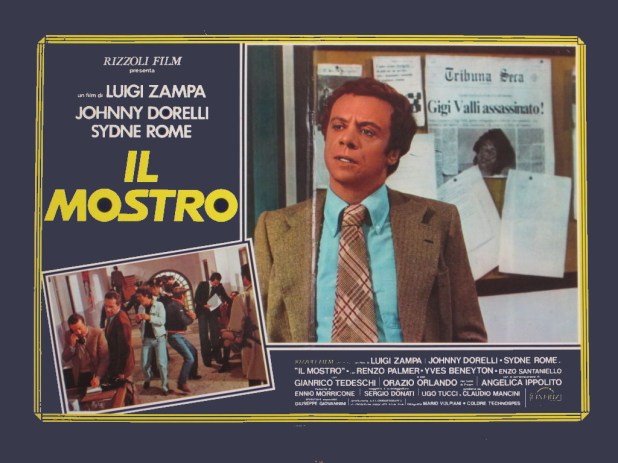
Il mostro (1977)

Valerio Barigozzi (Johnny Dorelli) is a giallo writer who also writes the Countess Esmerelda column in the newspaper. One day, he accidentally gets a letter from a serial killer that reveals the next victim. He starts to get even more letters and each killing moves him up into the editorial office, but it also makes him more of a suspect.

Unlike most gialli, the killings aren’t important or even shown as murder set pieces. We only see the end result. The real villains are those using these murders to advance their careers, like our protagonist. Like many a gialli, there is a score by Ennio Morricone.

Directed by Luigi Zampa and written by Sergio Donati, this even winks at the giallo genre by showing the posters for Spasmo and Death Walks On High Heels outside of a theater (as well as CarrieDestruction Force and The Beast In Heat).

Don’t come to this expecting the black gloves and razor of the giallo. Instead, see how far someone will go to be somebody. It feels very much like Zodiac years before Robert Graysmith wrote his book and reminded the public that a very real killer was mailing confessions and clues to the San Francisco Chronicle.

You can watch this on YouTube.

Eglima sto Kavouri (1974)

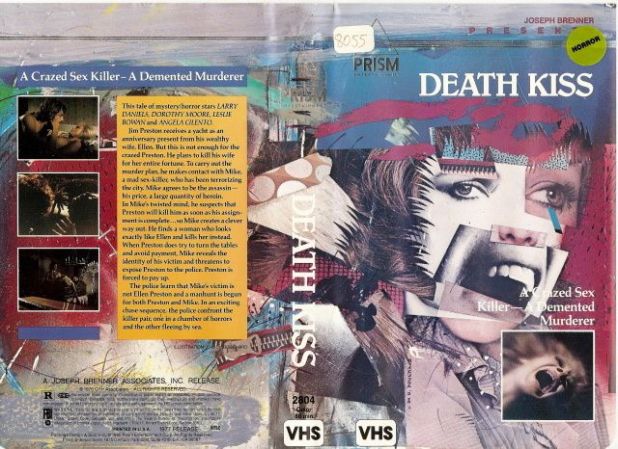
Eglima sto Kavouri (Crime In Kavouri) was released as He Murdered His WifeThe Rape KillerDeath Kiss (the name it played as on Commander USA’s Groovie Movies), Vai killer! (Go Killer!) and The Wife Killer, this Greek movie was directed by Kostas Karagiannis (Dangerous Cargo, Land of the Minotaur) and written by Thanos Leivaditis.

Jim (Larry Daniels, the American name for Lakis Komninos) has a good looking wife named Helen (Dorothy Moore) who gives him a yacht but since he already has a new love named Laura (Jane Paterson), he decides to kill her. To do that and not be arrested for it, he works with Mike (Vagelis Seilinos), a pantyhose-masked serial killer who has been stabbing couples on lover’s lanes. The plan? Mike roughs up Jim and kills Helen, then both men split up the money she’s worth. And some heroin, too.

Mike believes that Jim will kill him when the job is complete, so he finds someone that looks just like Helen and kills her, which is a plan, I guess. He keeps the real Helen in his basement but you know that she’s going to get out and ruin all of his planning. But let’s salute Vagelis Seilinos for going all out as he acts as a chloroform carrying choke-out killing machine.

Daniels and Moore were also in the Karagiannis film Tango of Perversion, which is pretty strange. This is a 70s furniture having giallo but in Greece instead of Italy and for that, it’s worth your time.

You can watch this on YouTube.

Io so che tu sai che io so (1982)

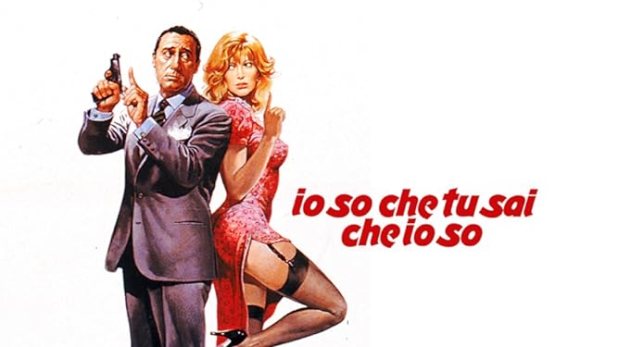
I Know That You Know That I Know stars its director, Alberto Sordi, as Fabio Bonetti, a banker who has been married to his wife Livia (Monica Vitti) for more than twenty years. All he cares about these days are football and watching TV. And then they meet a private detective (Giuseppe Mannajuolo) who has been filming them for two weeks, as he has been hired by the rich Vitali to watch his wife Elena (Micaela Pignatelli), but accidentally filmed them.

That’s when he shares what he has learned: their teenage daughter Veronica (Isabella De Bernardi) is on drugs, Livia is cheating on Fabio and, well, Fabio has days to live thanks to a mystery disease. That’s when Fabio decides to change his life. He’s never shown love to his daughter, who dresses in his clothes to shock him. He chose football matches over his wife and pushed her into another man’s bed. So he decides that before he dies, he’s going to fix his family.

Written by Sordi with Augusto Caminito (The Designated Victim) and Rodolfo Sonego (Vacanze di Natale ’91), this raises the same question I always have for American sitcoms. How could Monica Vitti — she was Modesty Blaise! — end up with Alberto Sordi? Some guys have all the luck.

You can watch this on YouTube.