Directed by Harald Reinl, Der Würger von Schloß Blackmoor is a Bryan Edgar Wallace adaptation. Not Edgar Wallace, but his son. He wrote books of his own, adapted his father’s stories for movies and even had some of his stories turned into films like this and The Phantom of Soho and The Dead Are Alive. There’s also a rumor that he was an uncredited contributor to the script of The Cat o’ Nine Tails.
The killer in this is strangling people on a British estate. However, not only does he do that, he then brands an M into the foreheads of those he murders and then decapitates them. Well, maybe he likes to make sure that they’re dead.
The masked killer shows up after a party during which Lucius Clark (Rudolf Fernau) announces that he will be knighted. The hooded strangler accuses him of stealing diamonds and killing Charles Manning, then claims that he will kill until he gets what he wants. He may also only have nine fingers, and the police, Lucius, and his niece Claridge (Karin Dor, who would play Helga Brandt in You Only Live Twice and is also in The Torture Chamber of Dr. Sadism and Los Monstruos del Terror) must solve the case before more are killed.
This is part of the Terror In the Fog box set and has extras including a new introduction by genre film expert and Video Watchdog founder Tim Lucas and audio commentary by Kevin Lyons and Jonathan Rigby. You can get it from MVD.
Aug 4-10 Stoner Comedy Week: I don’t gas reefer anymore, but I love it when people in movies do!
Lawrence Kasanoff executive produced movies like Party Camp, Blood Diner, The Underachievers, Dream a Little Dream, Blue Steel, Class of 1999, A Gnome Named Gnorm and Ghoulies III: Ghoulies Go to College before finding success with the Mortal Kombatmovies. He also founded the Vestron Pictures genre subsidiary Lightning Pictures in 1986, Lightstorm Entertainment with James Cameron in 1990 and Threshold Entertainment in 1993, which is where this movie came from. Threshold claims to have done the first morphing in a film for Terminator 2, as well as tons of 3D and 4D work on theme park attractions.
Kasanoff and Threshold Entertainment employee Joshua Wexler created the concept that would become Foodfight! in 1997. They entered into a $25 million joint investment with Korean investment company Natural Image, thinking that foreign pre-sales and loans against the sales would cover the budget. Kasanoff also decided to produce and direct the film, despite having no prior experience in animation.
If this was a success, the movies Arcade and Mascots would be next. As those movies never came out, you can assume that Foodfight! was anything but successful.
In fact, it was a mess.
After raising tens of millions of dollars in funding, the film was initially scheduled for a Christmas 2003 theatrical release. It was also said to come out in 2005 and 2007. Then, when a loan was defaulted on, creditors auctioned off the film’s assets and all associated rights to Fireman’s Fund Insurance Company.
In an article in Animation Magazine, “The Long, Strange Odyssey of Foodfight!,” Kasanoff was beyond gung ho on the project, saying, In terms of coming to have an independent digital animation studio making a digitally animated movie right now, I think we’re pretty much it. We’ve got the movie, we’ve got the property, the place, the equipment, the talent, we’re there. Do we believe our next film, Foodfight!, is going to be a huge hit? Of course we do! We think it’s great. We’ve gotten a fantastic response to it. I’ve told people all over the world, and we’re getting a uniform reaction to it. We’re betting a ton that it’s going to be a great movie. We’re risking more on this movie than any other venture I’ve ever been involved in in my life. Every studio but one offered us a deal on the movie, but for us as producers, not for us as the animation studio. We’re never going to be the next Pixar, being for-hire producers with some other shop.”
Before the rights were sold, the hard drives holding this movie disappeared. Industrial espionage was claimed. In 2012, it was released on DVD and on demand in Europe.
So those are the facts. Here’s another one: this movie is weird.
Weird because none of the corporate mascots paid to be in this. They allowed the film to use them, but no one made money. And yet this feels like a sell-out film. And they’re barely in the movie, despite being all over the poster. Somehow, some execs got worried and pulled their characters, like Cheetos’ Chester Cheetah, the Coca-Cola Polar Bears, Count Chocula, the M&Ms (the animators had “mistakenly rendered the Green M&M, a female mascot, as male within the footage shown to company representative”) and cereal mascots like Sugar Bear, Lucky the Leprechaun, the Trix Rabbit, Cap’n Cruch, Sonny from Cocoa Puffs and the Honey Nut Cheerios Bee.
It all takes place in Marketopolis, a grocery store that when the lights go down turns into a neo-noir film where Dex Dogtective (Charlie Sheen) and his partner Daredevil Dan (Wayne Brady) protect other foods from criminals — and run a nightclub called the Copabanana, don’t fall in love — when Dex isn’t pining for his lost love Sunshine Goodness (Hilary Duff). There’s also the new Brand X, led by General X (Jerry Stiller) and Lady X (Eva Longoria), taking over the store, which is populated by the Energizer Bunny, Kid Cuisine and K.C. Penguin, Punchy from Hawaiian Punch, Mr. Clean, Twinkie the Kid, Mrs. Butterworth (Edie McClurg), the Vlasic Stork, Charlie the Tuna (Jeff Bergman), The California Raisins, Tootsie the Owl and Mr. Bubble. These characters are Ikes, or icons, and when they die, their brands die. Someone is killing Ikes — this is a kid’s movie, but has a cartoon cat played by Harvey Fierstein be Harvey Fierstein and a joke from Midnight Cowboy, not to mention the “La Marseillaise” sequence from Jean Renoir’s La Grande Illusion being parodied (thanks as always to my guiding light when it comes to writing things like this, Nathan Rubin) — and there’s a secret plot that’s not all so secret.
This is a movie with Larry Miller playing Vlad Chocool, a chocolate cereal vampire bat who has a forbidden love for Daredevil Dan (this is them getting back at General Mills for not allowed Count Chocula out to play); Chris Kattan as Polar Penguin; Ed Asner as the old guy who runs the grocery store; Cloris Leachman as the Brand X Lunch Lady and Christopher Lloyd as the voice of Brand X.
According to comments made by animators, Kasanoff didn’t seem to realize the difference between live-action and animation, often demanding retakes and notes like “make this more awesome.” He also insisted on bringing his dogs to the studio, one of which was said to be a nightmare. He also reportedly asked for a personal nude 3D render of Lady X, which he would keep and admire.
Either the animation was unfinished in this or that’s how bad it is, a movie that wants to be a tough gumshoe film yet is a movie for kids but filled with outright unpaid product placement and sold off to Europe, who didn’t have most of these characters — or may outright hate them, like Chef Boyaredee — where no one wanted to watch it.
How did this get made?
Why did this get made?
It’s still better than Sausage Party.
You can watch this on YouTube.
To learn even more, watch ROTTEN: Behind the Foodfight!
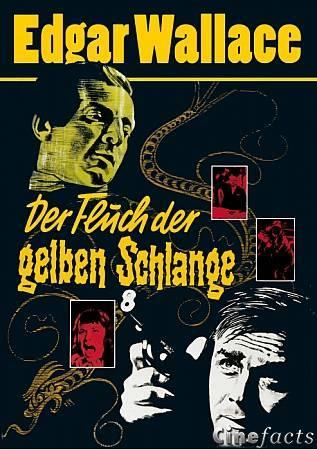
Directed by Franz Josef Gottlieb. who co-wrote it with Janne Furch, this krimi is based on The Yellow Snake by Edgar Wallace. It’s plot — prep for movies being made in 1963 not being as politcally aware as today — is about a Chinese cult taking over the world with an idol called The Golden Reptile. Fing-Su (Pinkas Braun) leads this cult and is at odds with his Western adopted brother, Clifford Lynn (Joachim Fuchsberger), who comes tosolve the case and is to be married off to one of two arranged marriages, either to Joan (Brigitte Grothum) or Mabel (Doris Kirchner).
Snake cults, human sacrifice, yellow peril — this is less krimi than straight up Sax Rohmer. That said, it looks good and has some fun moments to spare.
This is part of the Terror In the Fog box set and has extras including a new introduction by genre film expert and Video Watchdog founder Tim Lucas and audio commentary by Kim Newman and Barry Forshaw. You can get it from MVD.
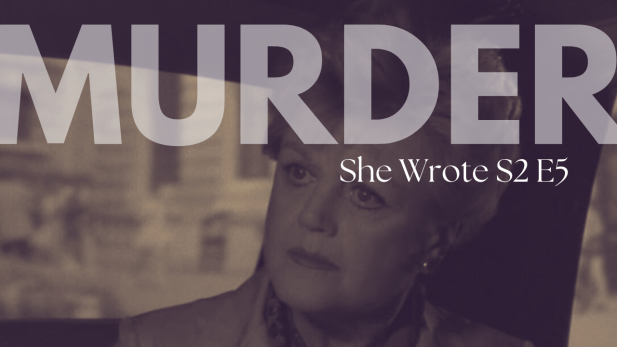
Jessica is left in shock by the news of her cousin Emma’s untimely passing. However, her world is turned upside down when she discovers that Emma’s death was a ruse, a clever ploy to escape the clutches of a dangerous threat.
Season 2, Episode 5: Sing a Song of Murder (October 27, 1985)
Tonight on Murder, She Wrote…
Jessica receives a call about the death of her cousin Emma. When she gets to London, she learns that she has inherited the Mayhew Theater and that her cousin is alive.
Who’s in it, outside of Angela Lansbury, and were they in any exploitation movies?
Violet Weems is Sarah Douglas, who kicked off my fascination with bad girls when she was Ursa in the Superman movies.
Barrie Ingham from Dr. Who and the Daleks is Inspector Roger Crimmins.
Bridget O’Hara is played by Glynis Johns, Mrs. Banks from Mary Poppins.
Patrick Macnee is Oliver Trumbull. Yes, from The Avengers and tons of horror movies.
Danny Briggs is played by Gregory Paul Martin.
Don Siegel’s son, Kristoffer Tabori, is Ernest Fielding.
More minor roles include Kenneth Danziger as Acrhie Weems; Gillian Eaton as a landlady; Terrence Scammell as a director; Richard Davies and Neal Hunt as toughs, John Straightley; David Grant Hayward and Ron Southart as police officers; Larry Carr, Farrell Mayer, Tony Regan, Walter Spear, William Ward and Kathryn Janssen as theater audience members, Freeman Love as a bartender and Paul LeClair as a theatre executive.
What happens?
Emma, who faked her own death, is revealed to be none other than Angela Lansbury herself. This unexpected twist adds a whole new layer of intrigue to the episode, especially when she takes on a new persona and performs a musical number. And you know how much I love when Lansbury gets to do an accent, sing or dress like a moron.
Jessica finds Bridget going through Emma’s house to steal something. She gets her fur coat and wears it, only to be hit by a car that is out to kill Emma. She’s just in the way, or more to the point, they don’t know who they killed. It all seems like Oliver has to be the person who is trying to kill Emma and who killed Bridget.
Who did it?
Oliver’s lover, Kitty, felt that Emma was holding him back from being the star that he deserved to be.
Who made it?
It was directed by TV movie master John Llewellyn Moxey and written by series creator Peter S. Fischer.
Does Jessica get some?
This is one of only three episodes where Jessica gets an on-the-lips kiss with one of her male guest stars. This time, it’s Oliver Trumbull, the boyfriend of her cousin Emma, and it’s a case of mistaken identity. This rare occurrence adds a layer of complexity to the plot and Jessica’s character. She also gets kissed in S1, E0, “The Murder of Sherlock Holmes“, and S3, E6, “Dead Man’s Gold.”
Does Jessica dress up and act stupid?
It starts with Emma — close enough, it’s still Angela — singing “Good-bye, Little Yellow Bird,” the same song she sang in The Portrait of Dorian Gray.
Was it any good?
Good cast, not a bad episode.
Any trivia?
Angela Lansbury and Olivia Hussey were mother and daughter in Death on the Nile.
The last name MacGill is used several times for Jessica Fletcher’s ancestors or relatives. It’s taken from her real-life mother’s stage name, Moyna MacGill.
Give me a reasonable quote:
Bridget O’Hara: Danny Briggs! As poor an excuse of a human being as God ever made! This quote captures the intense emotions and drama of the episode, highlighting the tension between the characters.
What’s next?
When a phone call from Francesca’s supposedly dead first husband precedes a fatal incident, Jessica must unravel the truth from hysteria to find a killer. Wings Hauser is in it!
July 28 – Aug 3 Screwball Comedy: Just imagine, the Great Depression is raging and you’re getting less than a fin a week at the rubber boiling factory, but it only costs two bits to go to the movies all day, so let’s watch some quick-talking dames match wits with some dopey joes!
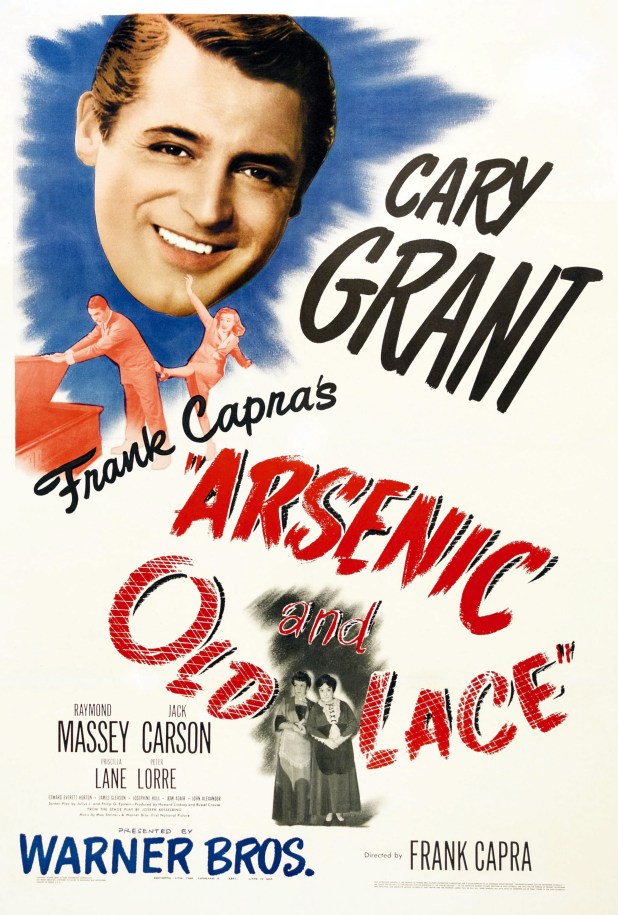
Based on Joseph Kesselring’s play, this movie was completed in 1941 but delayed until 1944, as the producers agreed to not show it in theaters until the Broadway run ended.
On Halloween, Mortimer Brewster (Cary Grant), a theater critic and author who is anti-marriage and a minister’s daughter, Elaine Harper (Priscilla Lane), get married. On the way to their honeymoon, she goes to tell her father, and he visits the aunts who raised him, Abby (Josephine Hull) and Martha (Jean Adair), who still live with his insane brother Teddy (John Alexander). While there, he finds a dead man; he learns that his aunts have been killing old single men — twelve so far — with elderberry wine that has arsenic, strychnine and cyanide. What a mixed drink.
Then, his evil older brother Jonathan (Raymond Massey) arrives, also a killer of twelve people, with his plastic surgeon, Dr. Herman Einstein (Peter Lorre). Jonathan is said to look like Boris Karloff, who originated the role on Broadway and stayed so that the entire cast didn’t leave to make the movie. Or, as some suggest, the producers forced him to stay, and he was not allowed to participate. He did get to play the part in the 1962 TV movie.
Indeed, in Dear Boris, Cynthia Lindsay wrote that “Josephine Hull and Jean Adair went to their graves believing that Boris Karloff had been so saintly as to agree to let them go to Hollywood to make this film while he stayed on Broadway doing the play. Nothing could have been further from the truth: Karloff was furious and disappointed that he was the only cast member not allowed out of his contract to do the film.”
Warner Bros. even offered Humphrey Bogart to the play’s producers; they kept Karloff.
In The Capra Touch: A Study of the Director’s Hollywood Classics and War Documentaries, 1934–1945, Matthew C. Gunter argues that the theme of both the play and film — directed by Capra — “is the United States’ difficulty in coming to grips with both the positive and negative consequences of the liberty it professes to uphold, and which the Brewsters demand. Although their house is the nicest in the street, there are 12 bodies in the basement. That inconsistency is a metaphor for the country’s struggle to reconcile the violence of much of its past with the pervasive myths about its role as a beacon of freedom.”
Elliot Kintner (Paul Rudd) and his teenage daughter, Ridley (Jenna Ortega), are driving through Canada toward his boss, Odell Leopold’s (Richard E. Grant) house when they hit a unicorn.
That’s the start of this film, which also finds Ridley having cosmic visions through the fairy tale creature’s horn before her dad bludgeons it to death. The blood removes her acne and improves her father’s allergies. The Leopolds — mother Belinda (Téa Leoni) and son Shepherd (Will Pouter) — experiment with the body they find in Elliot’s car and cure Odell’s cancer.
Meanwhile, the unicorn’s parents come for it, killing everyone in their path.
I liked how the unicorns are basically velociraptors. This wears its influences proudly and isn’t afraid to be a dumb monster movie, and I say that with peace and love. This has a lot of Aliens in it, too, which is unexpected. I mean, the family has alien eggs in the kitchen! This is weird in the best of places, and I applaud that.
The special edition Blu-Ray release of Death of a Unicorn has a commentary track with director and writer Alex Scharfman, deleted scenes, a “How to Kill a Unicorn” featurette and six collectible postcards. You can order it from Deep Discount.
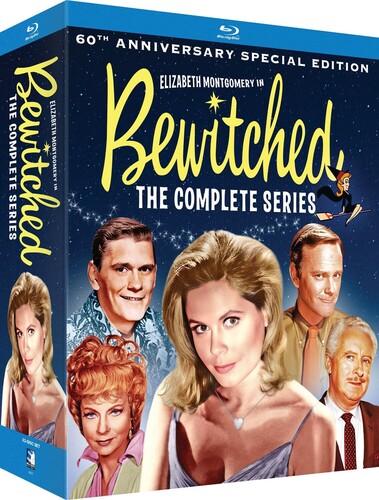
Bewitched aired throughout the most tumultuous time in modern history — hyperbole, that could also be today, but true, as rehearsals for this show’s first episode were on the day Kennedy was shot and the episode “I Confess” was interuppted by Martin Luther King Jr.’s death — from September 17, 1964, to March 25, 1972. The #2 show in the country for its first season and remaining in the top ten until its fifth season, it presents a sanitized and fictional world that at the time may have seemed contrary and fake to the simmering 60s, but today feels like the balm I need and an escape.
Within the home on 1164 Morning Glory Circle, Samantha (Elizabeth Montgomery) and Darrin Stephens (Dick York, later Dick Sargent) have just had a whirlwind romance and ended up as husband and wife. At some point, she had to tell him that she was a witch, a fact that he disapproved of, and that she should be a normal housewife instead of using her powers. Yet she often must solve their problems — usually caused by her family, such as her mother Endora (Agnes Moorehead) — with a twitch of her nose.
Creator Sol Saks was inspired by I Married a Witch and Bell, Book and Candle, which luckily were owned by Columbia, the same studio that owned Screen Gems, which produced this show. You could use either of those movies as a prologue for this, which starts in media res — I like that I can use such a highbrow term to talk of sitcoms — with our loving couple already settling into the suburbs.
Author Walter Metz claims in his book Bewitched that the first episode, narrated by José Ferrer, is about “the occult destabilization of the conformist life of an upwardly mobile advertising man.” As someone who has spent most of his life in marketing, maybe I should look deeply into the TV I watched as a child. Bewitched was there all the time in my life, wallpaper that I perhaps never considered.
Head writer Danny Arnold, who led the show for its first season, considered the show about a mixed marriage. Gradually, as director and producer William Asher (also Montgomery’s husband at the time) took more control of the show, the magical elements became more prevalent. What I also find intriguing is that with the length of this show’s run, it had to deal with the deaths of its actors and York’s increasing back issues, which finally forced him to leave the show and another Dick, Dick Sargent, stepping in as Darren, a fact that we were to just accept.
That long run, the end of Montgomery and Asher’s marriage and slipping ratings led to the end of the show, despite ABC saying they would do two more seasons. Instead, Asher produced The Paul Lynde Show, using the sets and much of the supporting cast of this show. He also produced Temperatures Rising, which was the last show on his ABC contract, which ended in 1974.
Feminist Betty Friedan’s two-part essay “Television and the Feminine Mystique” for TV Guide asked why so many sitcoms presented insecure women as the heads of households. None of this has changed much, as the majority of sitcoms typically feature attractive women and funny but large husbands, a theme created by The Honeymooners, and the battles between spouses. I always think of I Dream of Jeannie, a show where a powerful magical being is subservient to, well, a jerk. At least on Bewitched, Samantha is a powerful, in-control woman with a mother who critiques the housewife paradigm.
Plus, unlike so many other couples on TV at the time, they slept in the same bed.
Bewitched‘s influence stretched beyond the movie remake. The show has had local versions in Japan, Russia, India, Argentina and the UK, while daughter Tabitha had a spin-off. There was even a Flintstones crossover episode!
Plus, WandaVision takes its central conceit — a witch hiding in the suburbs — from this show. And Dr. Bombay was on Passions!
This is the kind of show that has always been — and will always be — in our lives. Despite my dislike of Darren’s wedding vows of no magic, there’s still, well, some magic in this show. Just look at how late in its run it went on location to Salem for a multi-episode arc, something unthought of in other sitcoms.
You can watch this just for the show itself, to see the differences between the two Darrens and when Dick York had to film episodes in special chairs because of his back pain, when the show did tricks like have Montgomery (using the name Pandora Spocks) playing Samantha’s cousin Serena to do episodes without York or just imagine that the world was changing outside. Yet, magic and laughter were always there on the show, throughout the lives, divorces and deaths of its principals and supporting cast.
The Mill Creek box set is an excellent, high-quality way to just sit back, twitch your nose and get away from it all. This 22-disc set has everything you’d want on Bewitched, including extras like Bewitched: Behind the Magic, an all-new documentary about the making of Bewitched, featuring special guest appearances by actor David Mandel (Adam Stephens), Steve Olim (who worked in the make-up department at Columbia), Bewitched historian Herbie J Pilato, film and television historian Robert S. Ray, Bewitched guest star Eric Scott (later of The Waltons) and Chris York, son of D. York (the first Darrin). There are also sixteen new episodic audio commentaries, moderated by Herbie J Pilato that include behind-the-scenes conversations with Peter Ackerman (son of Bewitched executive producer Harry Ackerman), David Mandel, Bewitched guest star Janee Michelle (from “Sisters at Heart”), Steve Olim, Robert S. Ray, former child TV actors and Bewitched guest stars Ricky Powell (The Smith Family), Eric Scott (The Waltons), and Johnny Whitaker (Family Affair and Sigmund and the Sea Monsters) and Chris York (son of D. York). There’s also an exclusive 36-page booklet featuring pieces by Bewitched historian Herbie J. Pilato, as well as an episode guide. You can order it from Deep Discount.
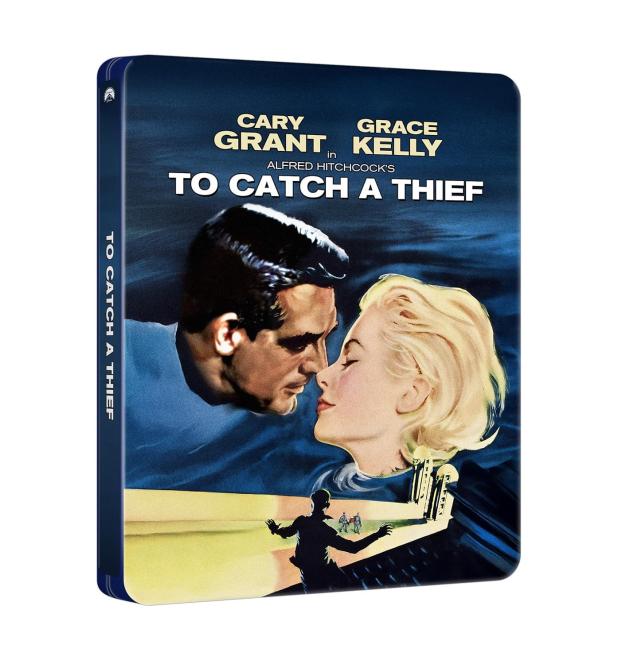
John “The Cat” Robie (Cary Grant) is a retired jewel thief who is suspected of crimes all over the French Riviera. His old gang has gone straight, and maybe he has, too. The only way to prove himself is to catch whoever is pulling off these thefts, working with insurance agent H. H. Hughson (John Williams).
His way of proving his innocence is like casing the joint, starting with Frances Stevens (Grace Kelly) and her mother Jessie (Jessie Royce Landis), who have just come into money. Whenever he’s in trouble, it seems that his old partner’s daughter, Danielle Foussard (Brigitte Auber), is there to save him. But is there just one burglar? Or several? And will Robie be able to pull off stealing Frances away from her mother?
Hitchcock’s first film in VistaVision and last with Grace Kelly, it wasn’t well-received by critics when it came out, as they expected Hitchcock’s suspense. Instead, they got an adventure movie with romance, including a gorgeous scene as Grant and Kelly watch fireworks.
Hitchcock got Grant out of retirement for this movie. With the rise of Method actors like Marlon Brando, he thought no one wanted to see him, and he was upset with how the McCarthy era had treated Charlie Chaplin. After this, he acted for more than a decade.
The Paramount Steelbox of this movie — it’s the only movie Hitchcock made for Paramount that he didn’t get the rights to — has the film on 4K UHD, Blu-ray and a digital code. Extras include commentary by Dr. Drew Casper, a Leonard Maltin feature on To Catch a Thief, featurettes on the Hitchcocks, the writing and casting of the film, censorship, the making of the film and Grant and Grace. Plus, it looks gorgeous and I’m so happy to have it on my shelf.
July 28 – Aug 3 Screwball Comedy: Just imagine, the Great Depression is raging and you’re getting less than a fin a week at the rubber boiling factory, but it only costs two bits to go to the movies all day, so let’s watch some quick-talking dames match wits with some dopey joes!
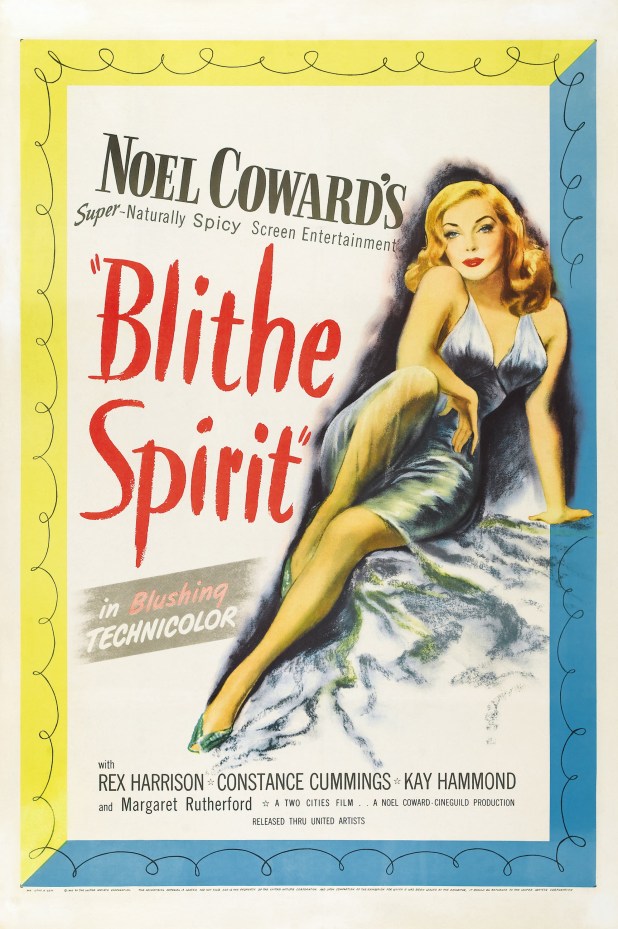
Based on the Noel Coward play, this movie has socialite and novelist Charles Condomine (Rex Harrison) looking for material for his next book. He decides to have Madame Arcati (Margaret Rutherford) come to his home and conduct a séance. As an unbeliever, he’s shocked when it brings the spirit of his first wife, Elvira (Kay Hammond), into his life, as she tries to ruin his marriage to Ruth (Constance Cummings), who can’t see or hear the ghostly form of his first bride.
Coward wanted this cast and screenwriter Anthony Havelock-Allen saw this as one of the reasons why this movie failed, saying “The point of the play is a middle-aged man well into his second marriage, having long ago put away the follies of his youth with his sexy first wife, and suddenly being woken up by her reappearance as a ghost. Rex Harrison was not middle-aged, and Kay Hammond, though a brilliant stage actress, didn’t photograph well and also had a very slow delivery, which was difficult in films. When we started shooting scenes with Kay and Rex, it became obvious that Constance Cummings (the second wife) looked more attractive to the average man in the street than Kay. This upset the whole play.”
In his book, A Serious Business, Harrison didn’t seem to enjoy it either: “Blithe Spirit was not a play I liked, and I certainly didn’t think much of the film we made of it. David Lean directed it, but the shooting was unimaginative and flat, a filmed stage play. He didn’t direct me too well, either – he hasn’t a great sense of humour … By that time, it had been over three years since I’d done any acting. I can remember feeling a bit shaky about it, and almost, but not quite, as strange as when I’d first started, but Lean did something to me on that film which I shall never forget, and which was unforgivable in any circumstances. I was trying to make one of those difficult Noel Coward scenes work … when David said, “I don’t think that’s very funny.” And he turned round to the cameraman, Ronnie Neame, and said: “Did you think that was funny, Ronnie?” Ronnie said, “Oh, no, I didn’t think it was funny.” So what do you do next, if it isn’t funny?”
Coward hated the ending that was added, as it has Charles dying — perhaps due to his wives’ spirits — and joining them as ghosts. He claimed that it ruined the best play he ever wrote.
A classic today, it was a box office disappointment for director David Lean in 1945. It did win Tom Howard the Academy Award for Best Visual Effects.
A Joe Dante movie always has a conflict — a battle between blockbuster and personal statement, led by a filmmaker with a keen commercial instinct, yet the heart of a nonconformist. Through it all, one walks away with the feeling that while the film itself may have some rough edges, there’s a genuine love for moviemaking (heck, movies themselves) at the core. That makes perfect sense — before Dante was in the industry, he wrote opinionated mini-reviews for the Castle of Frankenstein magazine. After apprenticing as an editor for Roger Corman, he directed Piranha and The Howling, the latter a film that is a veritable love letter to the history of werewolves on film, wrapped within a postmodernist take on the subject. Again, always that juxtaposition.
Perhaps Dante’s biggest monetary — if not critical — success was 1984’s Gremlins, as is its 1990 sequel, Gremlins 2: The New Batch. The former is a cute and cuddly big-budget affair on one hand; an incredibly dark, depressing, and borderline horror film on the other. There aren’t many family-pleasing films that detail father figures dying in chimneys and left unfound for months, after all. And the latter is sequel that does everything but scream at the viewer that sequels are inferior cash grabs devoid of art while simultaneously throwing everything that Dante and a fleet of the most talented FX guys and animators can invent at the screen, including Chuck Jones coming out of retirement and an insane Hulk Hogan cameo (look, any movie where Paul Bartel asks for the Hulkster’s help dealing with unruly Gremlins in a movie theater demands numerous rewatches).
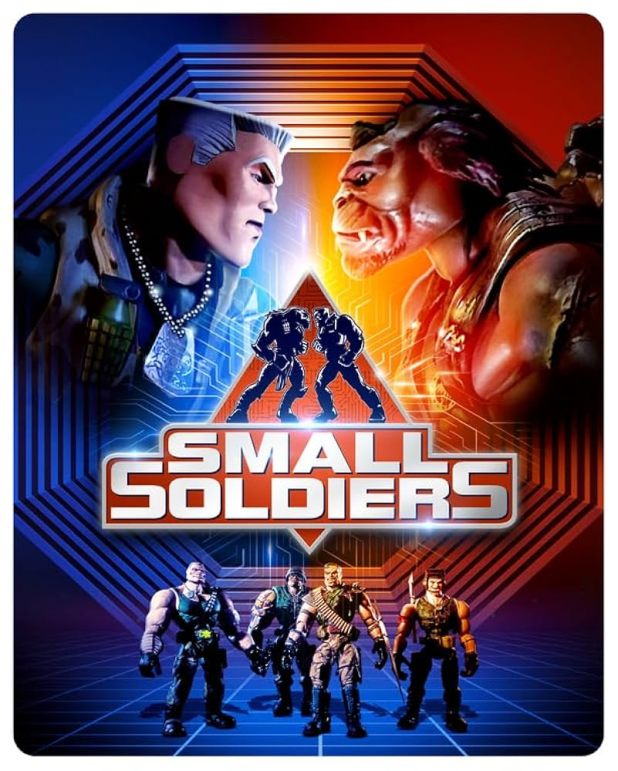
1998’s Small Soldiers is, on the surface, all about war. And again — it’s a picture at war with itself. GloboTech Industries — no relation to GloboChem, despite David Cross’s appearance in the film — has acquired the Heartland Toy Company. CEO Gil Mars (Dennis Leary) demands toys that play back, so he selects two toy lines — Irwin Wayfair’s (the aforementioned David Cross) Gorgonites and Larry Benson’s (Jay Mohr) Commando Elite — and combines them into one storyline of forces at war with one another. Thanks to a tight deadline, safety testing is ignored, and Benson uses GloboTech’s overly powerful X1000 microprocessor to integrate it into the toys, which makes them self-aware. Trivia note — the stolen password that Benson uses is Gizmo, a reference, of course, to Gremlins.
There’s another war between perception and reality. The toys cast as the bad guys, the Gorgonites, are caring individuals who want to protect the planet, while the militaristic GI Joe-esque Commandos become the heels. So what happens when they arrive at toy stores? That’s answered when Alan Abernathy (Gregory Smith, whose character is potentially named for Clayton Abernathy, GI Joe’s Duke) purchases the entire line from delivery driver Joe (Dick Miller, who appears in every one of Dante’s films). Alan discovers that the toys are living, breathing, sentient beings when Archer sneaks away in his backpack. Upon returning to his dad’s store the next day, the Commando Elite had awakened and decimated the Gorgonites and the rest of the store, leaving traditional, non-mass-produced toys a smoking wreck.
Alan attempts to warn the company of the malfunctioning Commando Elite, who do not understand they are just toys (the Gorgonites have accepted their fate and just want to go to Yosemite National Park, which they feel is their homeland), going on the attack and kidnapping Alan’s love interest, Christy. To defeat their militaristic foes, the Gorgonites must battle their very nature, embracing the violence they abhor.
Small Soldiers is a strange film, a near-spiritual sequel to Gremlins, in that small terrors come to life to battle in the full-sized real world. But it’s unclear whether of its audience and what it wants to be, a fact that Dante himself admitted: “Originally I was told to make an edgy picture for teenagers, but when the sponsor tie-ins came in, the new mandate was to soften it up as a kiddie movie.” Kenner produced the tie-in action figures, albeit for a movie that criticizes the toy industry for prioritizing militaristic conflict over peaceful learning. The Burger King Kids Meals were also controversial, as the film was initially intended to receive a PG rating, rather than the PG-13 it ultimately received.
It’s also a blockbuster that, instead of being relentlessly driven to make money by playing to the lowest common denominator, delves deeply into its references to past films and themes. Additionally, the casting is based on who works best for the film, rather than who sells tickets —a trademark of Dante’s. Tommy Lee Jones may voice the leader of the Commando Elite, Chip Hazard, but Arnold Schwarzenegger was Dante’s original choice (and the rest of the team would have been filled out by the entire cast of Predator). Instead, the surviving cast members of The Dirty Dozen — George Kennedy, Clint Walker, Ernest Borgnine, and Jim Brown — were cast. Richard Jaeckel sadly passed away before filming began, and Charles Bronson refused to lend his voice to a cartoon. The Gorgonites are voiced by Frank Langella (who knows toy tie-ins well, thanks to his role as Skeletor in Masters of the Universe) and the entire Spinal Tap crew of Michael McKean, Harry Shearer and Christopher Guest. Even better, there are numerous references to past Dante works, including Robert Picardo’s character, Ralph Quist, who shares the same last name as his character in The Howling, Eddie Quist.
Small Soldiers may have NASCAR, fast food and toy tie-ins, but it feels like a deeply personal film that savors biting the hand that fed the beast that financed it. It may be many things, all at once, but above all, it does not commit the most grievous of all movie sins. It is never ever dull.
This Paramount release also has bloopers and deleted scenes. You can get it from Amazon and Diabolik DVD.





 B&S About Movies
You must be logged in to post a comment.