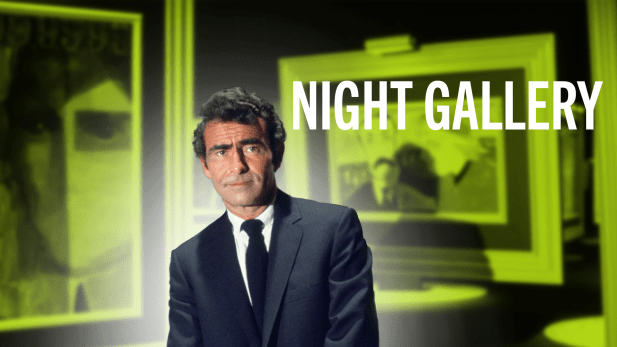
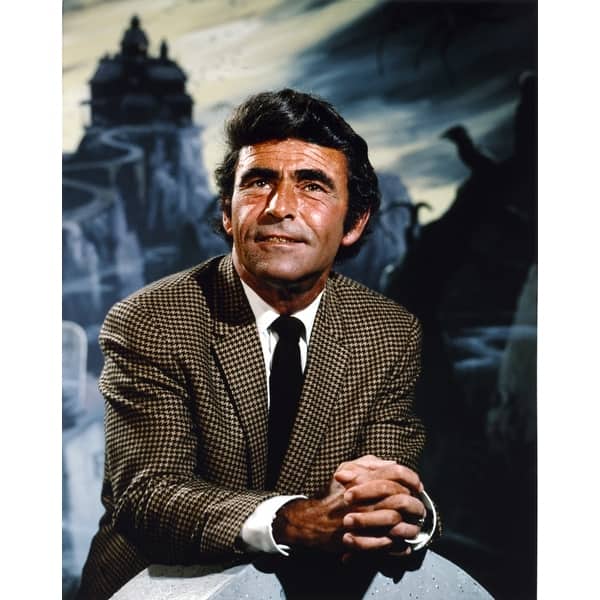
We’ve arrived at the end of the second season of Night Gallery. Don’t be sad — there are a few more episodes to go for season 3.
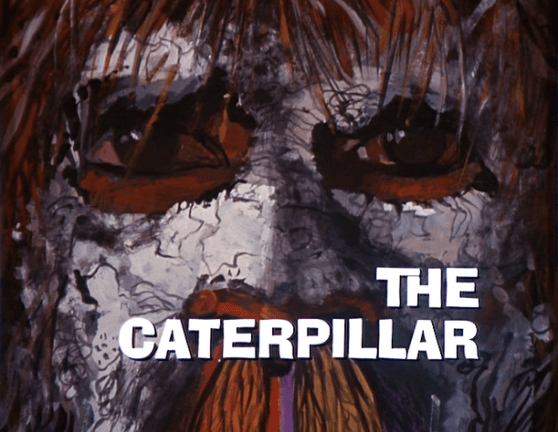
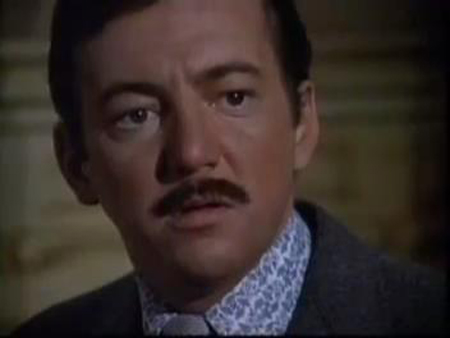
“The Caterpillar” is a classic story for this show, one that gets repeated often and even has entered into being an urban legend. Directed by Jeannot Szwarc and written by Rod Serling from the story by Oscar Cook — who actually served in its setting, Borneo — this is the story of British civil servant — and new man in Borneo — Stephen Macy (Laurence Harvey). He’s moved into the home of Mr. Warwick (Tom Helmore) and his much younger wife Rhona (Joanna Pettet,The Evil) and as you can imagine, quickly makes a move on Mrs. Warwick. He hires Tommy Robinson (Don Knight) to place an earwig — a small bug that burrows into the brain and death is always the end of its work — on the pillow of Warwick.
Except that Macy’s pillow is used. Somehow, the evil man survives and even confesses that he did what he did for love. Sadly, the worse is yet to come, as the earwig that went through his brain — giving “agonizing, driving, itching pain” — was female.
And she laid eggs.
Just a perfect Night Gallery story, directed and told by the two of the best talents on the show. No gore, just a spot of blood and plenty of acting gives this the kind of darkness that some turn away from.
“Little Girl Lost” was directed by Timothy Galfas (Black Fist) and written by Stanford Whitmore (The Dark) from a E.C. Tubb story. Professor Putman (William Windom) was once a brilliant military physicist but the death of his daughter Ginny after a hit and run accident has destroyed him. A psychologist, Dr. Charles Cottrell (Ivor Francis), wants an injured test pilot, Tom Burke (Ed Nelson), to bond with the man, help him think his daughter is still alive and keep him working on the weapon the government needs.
It works at least until they go out in public and someone sits where Putman’s daughter is supposedly sitting. He then realizes what they want. “Bigger and better bombs at a fraction of the cost.”
So he gives it to them. He really does.
This is one of the best Night Gallery episodes as it dispenses with the silliness and gives us dread and darkness. There are no black out gags here, just the end of the world for one man and, well, for everyone, all told in the moral play style that Serling pioneered for television.
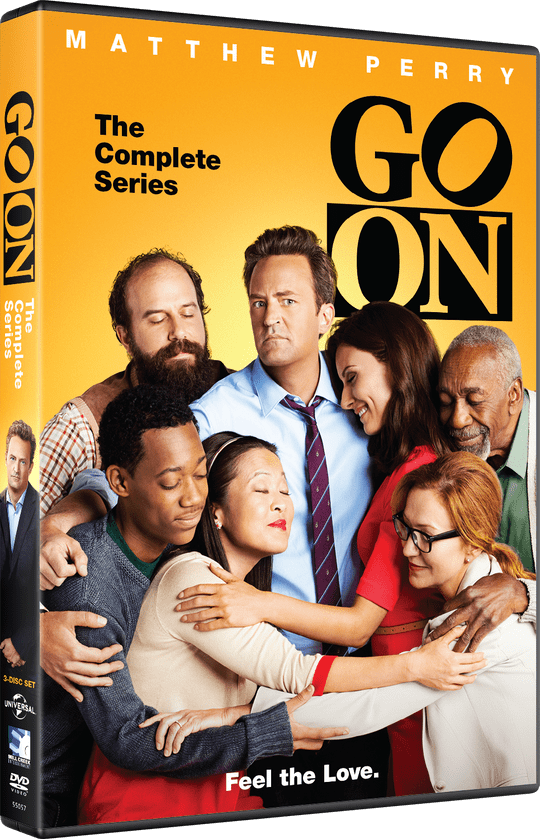
Radio talk show host Ryan King (Matthew Perry) has barely taken any time to get over the death of his wife. He just wants to get back to work, but his boss Steven (John Cho) won’t allow him back on the air until he goes to grief counseling.
Ryan joins a support group but he could really care less. However, the way he approaches the sessions actually helps the others in his group. Led by the barely trained Lauren Bennett (Laura Benanti), the members are Anne (Julie White), a lesbian proscutor unable to get past the loss of her partner; Yolanda Mitsawa (Suzie Nakamura), whose fiancee ran off; Owen Lewis (Tyler James Williams), whose brother is in a coma; Mr. K (Brett Gelman), who has a mysterious job with NASA and who also refuses to reveal why he’s there; Sonia (Sarah Baker), who misses her cat; Fausta (Tonita Castro), whose father and brother just died; Danny (Seth Morris), whose wife had a child with another man while he served in the army; George (Bill Cobbs), who is dealing with the loss of his sight and a former member of the group who shows up from time to time, Simone (Piper Perabo), who Lauren dislikes, perhaps because she starts dating Ryan.
Scott Silveri, who was a writer and executive producer on Friends, also created Joey, which was another sitcom with an alumni of the show. While that Matt leBlanc sitcom lasted for two seasons, this show only lasted one. Maybe all the sadness on the show was a bit much for viewers. Or perhaps they didn’t like how it felt so much like Community.
I love sitcoms and had never seen this show before, so I enjoyed sitting down with it and getting to know its characters. Ever since the first Newhart series and Dear John, group therapy has been a perfect t story engine for comedy shows. It works here, as you really enjoy the interplay between the characters. Gelman is probably the most entertaining of all of them and his governement ties are funny when you consider that a decade later, he’d be known as the conspiracy obsessed Murray Bauman on Stranger Things.
This was streaming for some time on the Roku channel, but seeing as how you can never tell when things are going to be removed, it’s a really cool thing to own this DVD set of the only season of the show. I wish we could have seen where a second season would have gone.
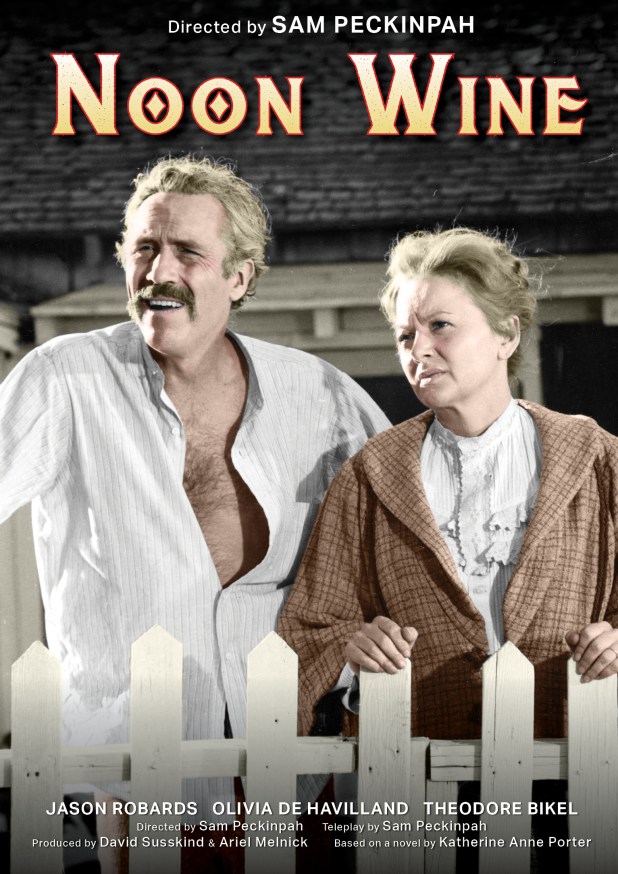
Originally airing on November 23, 1966 on ABC Stage 67 and now made available on DVD thanks to Liberation Hall and the UCLA Library Film & Television Archive, Noon Wine was directed and written by Sam Peckinpah.
At the time, the legendary cantankerous director was a Hollywood outcast — I wonder when the time happened when he made anyone like him or was popular with studios — following the troubled Major Dundee and being fired from The Cincinnati Kid.
Producer Daniel Melnick was a big fan of Peckinpah’s television series The Westerner and his movie Ride the High Country. Producer Martin Ransohoff had fired him from that movie for “vulgarizing the picture” and shooting it in black and white. He replaced him with Norman Jewison and Strother Martin was fired at the same time as Peckinpah.
Melnick thought that it was pretty unfair, so he went against a lot of big names and gave Peckinpah complete freedom. The writer of the book it was based on — part of three stories, including “Old Mortality” and “Pale Horse, Pale Rider,” that were in her 1939 Pale Rider, Pale Rider book — Katherine Anne Porter loved what he did with the script.
This was a big hit and saved Peckinpah, leading to his comeback. He was nominated by the Writers Guild for Best Television Adaptation and the Directors Guild of America for Best Television Direction. He did one more TV job — “The Lady Is My Wife” for Bob Hope’s Chrysler Theater— and then wrote Villa Rides and taught a class at UCLA. In 1969, he got to make The Wild Bunch.
Star Jason Robards would keep a personal copy of the film in his private collection, but for half a century, you could only see it at the Library of Congress and the Museum of Broadcasting, I’m so excited that I own this DVD now.
Royal Earle Thompson (Robards) is a dairty farmer in southern Texas, sometime before the 20th century. He talks a great game, but he’s too lazy for farming life. He’s married to Ellie (Olivia de Havilland), who is sick more often than she’s well, and has two young sons named Arthur (Steve Sanders) and Herbert (Peter Robbins). Basically, it could all fall to bits any second until a quiet stranger named Olaf Helton (Per Oscarsson) comes for a job and a place to live.
Nine years later and the farm is thriving, thanks completely to Helton. Everything is perfect now. Perfect until a bounty hunter named Homer T. Hatch (Theodore Bikel) shows up and claims that Olaf is a mental patient. Thompson has a vision of his farming hand being killed, so he grabs an axe and kills Hatch. Helton runs away as Sheriff Barbee (Ben Johnson) and his deputy (L.Q. Jones) arrive.
Thompson is found not guilty but he may as well have been convicted. Even his own wife fears him and his sons want nothing to do with him. He writes a letter at the close, saying that it was all his fault, not Helton, saying he only wanted to defend his friend.
Peckinpah didn’t think that De Havilland was convincing in the closing moments of the film. He had a plan, however. He asked the cameraman to keep shooting the next scene. After he said cut, he told her that she was a nasty actress. Her reaction is what’s in the film.
In the book, Thompson kills himself with aa shotgun. How amazing is it that we don’t see that in Peckinpah’s film after the excesses that he’d unleash on audiences in a few years?
I loved the Liberation Hall release of this, as it has two versions, one with the original commercials that aired back in 1966. It gave me a time machine feeling and man, this movie is something else, a nuanced take on a story that draws you in and holds you for the entire length of this movie.
I know no bigger fan of Dawson’s Creek than my friend Jim Sloss, who was kind enough to teach me that Pacey’s boat is named True Romance and to write this:
Over the years Sam has asked me many times if I’d like to write something for B&S and I’d always hem & haw and then never get around to it. Then came the box set of all box sets, the show that is like a time capsule to the 1990s and one of my all-time favorites, Dawson’s Creek.
In 1998 when this show came out I can remember vividly watching it on my VCR the following morning (because I had to work the night before) and from the first moment of the pilot to the last I was hooked, the dialogue was nothing that I’d heard before in a teen soap. They took a chance at treating the audience like adults rather than kids and it paid off. So, from that night on I followed the “kids” from Capeside each week for six seasons.
Created by Kevin Williamson, the co-creator of the horror franchise Scream, this series is a fictionalized account of a young film buff from a small town just trying to find his way. Pretty much what Kevin Williamson did was pitch what he knew and so he told a fictionalized version of his growing up in North Carolina. The show was launched on the WB network in January 1998 and was an instant hit with the show being parodied on MTV and Saturday Night Live. Their use of current pop culture and hit music for the time was what kept it relevant each week and talked about on school campuses.
During the late 90s, Dawson’s Creek was considered cutting edge for teen angst, touching on issues that were not talked about on TV and even less so in public. The first season dealt with drug abuse, addiction and infidelity along with every teenage boys dream… the inappropriate relationship with a hot teacher. In 1998 that was a huge story arc for a main character with the teacher just leaving to avoid scandal. These types of stories were becoming more and more common during this time and now leads to the teacher spending long stretches in prison rather than just moving on to another school.
Yet along the way these colorful kids learned from their mistakes and grew into functioning adults just trying to make their way. With the main character Dawson Leery, played by James Van Der Beek, not getting his High School crush Joey Potter, played by Katie Holmes, but instead getting to fulfill his dream of working in movies and TV where he turned his life into a teen drama TV show just like Kevin Williamson.
I would be remiss if I didn’t leave you with the greatest quote and moment of this fantastic tv show. In the finale we find our core characters several years in their future living their lives with little interaction when everyone is reunited for a wedding they immediately learn that one of the main characters, Jen Lindley, is dying of cancer. While Dawson is spending time with his close friend at a hospice facility she has this Hollywood filmmaker record a video for her infant daughter to watch when she’s older. In that video one line she says that gets me every time is “Be sure to make mistakes. Make a lot of them, because there’s no better way to learn and to grow.” While she’s saying that you can see the anguish on Michelle Williams’ face, showing the audience how fragile she is at the end of her short life and how she just wants the best for her child.
This show never shied away from tough storylines and in the end wrapped up everyone’s arc phenomenally.
I would give this series a 10 out 10!!
P.S. The popular Jenna Ortega can be seen watching Dawson’s Creek in Scream 5 out in 2022 and currently on Paramount+.
Thanks again Jim.
The Mill Creek release of the entire series has all 127 episodes across six seasons, along with seven hours of bonus extras, which include Entertainment Weekly‘s 20th Anniversary Reunion, audio commentaries on select episodes, a retrospective featurette and alternate scenes and an alternate ending to the pilot episode.
I watched several of the episodes on this set as, surprise, I never watched this show, despite Jim telling me near consistently — we lived in a house with six people while this show was popular, so I have no idea how I didn’t watch it with him — that I need to watch “The Dawnson,” as he put it.
Surprisingly — as I have often remarked about Williamson’s other work — I really liked what I watched. It felt honest and truthful, nearly lived in. I’ve been watching a few episodes a week now and really enjoying the opportunity to be part of the lives of these characters.
These Mill Creek TV sets are great because they really give you the opportunity to do the same, exploring or binging or however you choose to watch. And unlike streaming, they’re always there for you, not being edited or taken down when you’re in the middle of watching a season.
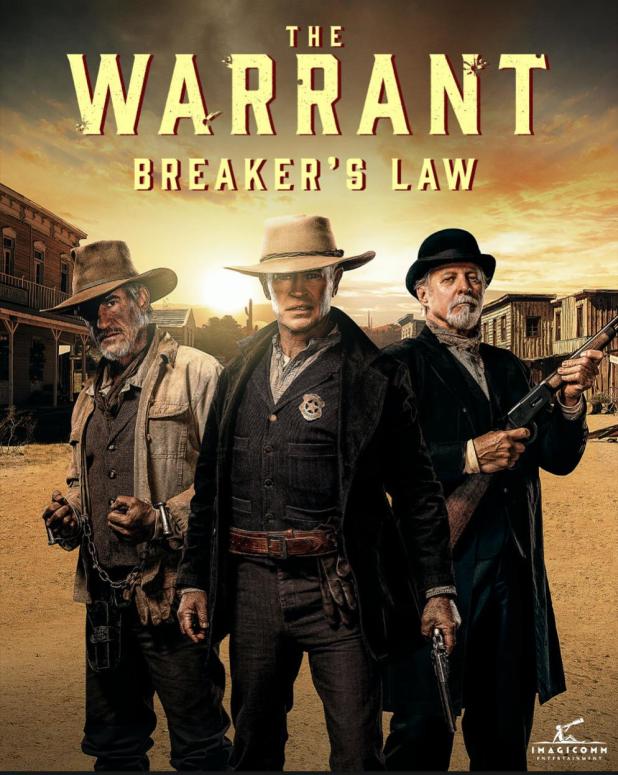
The sequel to 2020’s The Breaker, this film brings back Neal McDonough as Civil War hero and sheriff John Breaker. Director Brent Christy is also back in the saddle for this movie, which finds Breaker working again with his friend Deputy Marshall Bugle Bearclaw (Gregory Cruz).
On their latest mission, they must deliver a warrant for Henry “Dead-Eye” Bronson (Dermot Mulroney). It’s not so simple, as Henry is the twin brother of Yule Bronson (also Dermot Mulroney), the powerful leader of a gang of bandits who threaten the town of Absolum’s Hill, which includes Judge Thaddeus (Bruce Boxleitner) and his daughter Charlotte (Amy Hargreaves).
I kind of love that TV movies on basic cable are continuing the American Western, creating stories that are fun and engaging, then move to physical media. Something just feels right about it, like Breaker and Bugle hunting down varmints and evil gunslingers. And hey — I always love to see Boxleitner show up, even if I feel old now, as I remember when he was the young hero and not the elder powerful man in peril.
You can get this Mill Creek release from Deep Discount.
There aren’t many episodes left in season 2 of Night Gallery. With each new installment, I feel a pang of sadness, as only one season remains.
“I’ll Never Leave You — Ever” was directed by Daniel Haller and written by Jack Laird from a story by Rene Morris. It starts in the middle of lovemaking between Moragh (Lois Nettleton) and Ianto (John Saxon) and we quickly learn that she’s married to a dying man, Owen (Royal Dano), and the two wish that he would just take that turn for the worse so they could finally be together.
As she returns home, we can feel both her guilt and her disgust at the man she once loved slowly succumbing to illness. I don’t know if you can blame her for going to an old woman (Peggy Webber) and receives a doll that she can use to destroy her husband once and for all.
As you can imagine, nothing goes according to plan.
I loved that Laird actually concentrated on making an actually eerie story instead of a joke. Wow — it feels like more than one episode now that I’ve said something nice about him.
“There Aren’t Any More MacBanes” was directed by John Newland and written by Alvin Sapinsley from the story “By One, by Two and by Three” by Stephen Hall.
Bard College is celebrating graduation, which includes Elie Green (Darrell Larson), Mickey Standish (Barry Higgins) and — if he can pass his classes and earn his Master’s in Philosophy — Andrew MacBane (Joel Grey). Yet it may never happen, as the man paying his way, his Uncle Arthur (Howard Duff) is frustrated by his progress. He finally delivers a new rule: Andrew must find a job within six months or be completely cut off, not just for his stipend but for his inheritance.
Yet Andrew doesn’t care. He’s more concerned with discovering the ten pages that are missing from the spellbook of his ancestor Jedediah MacBane, who died after using a spell to murder his worst enemy, his best friend and his best friend’s wife — yes, three people, all at the same time — centuries ago. The friends laugh about this and plan to meet in six months.
As you can figure, Andrew doesn’t have a job in six months. Instead, his uncle soon is torn to pieces by something that seems like a wild animal. Mickey dies next as he works in Africa. And now, the creature is coming for Elie and, as you may have surmised, Andrew.
The messenger who delivers the letter for Elie? Mark Hamill.
This one has some real tension but the final reveal is laughable when it should terrify.
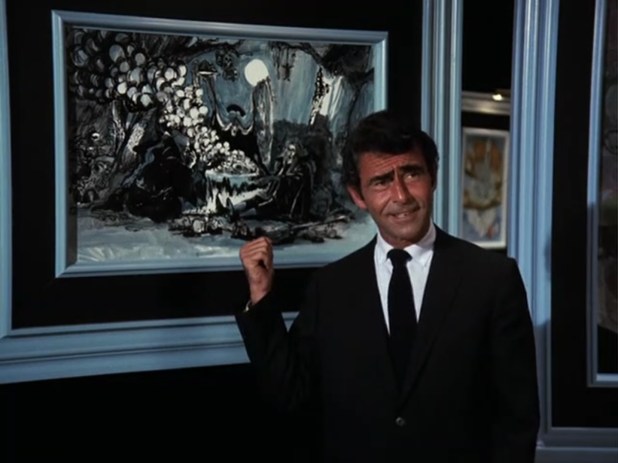
This is one of the few episodes I’ve seen where Rod Serling hostd and didn’t write anything. The stories are fine, but this show should be better than just simply good. It aspires to be great at times and when it just coasts, it feels like a waste.
VIDEO ARCHIVES NOTES: This movie was discussed on the May 9, 2023 episode of the Video Archives podcast and can be found on their site here.
Making a Planet of the Apes TV series was a plan by its producer Arthur P. Jacobs as early as 1971, but because the movies were still doing well at the box office, development was put on hold until Battle for the Planet of the Apes was complete in 1973.
Sadly, Jacobs died within days of that film being released and his production company sold the rights to 20th Century Fox, who sold the first three Apes movies to CBS. When they aired in September of that year, they did big ratings and that’s when the network got excited about the potential of a series. They even turned down other series in development, like Gene Roddenberry’s Genesis II, instead making that as a series of TV movies while Apes was greenlit for 14 episodes.
Made for $250,000 an episode (around $1.5 million today), the show aired from September 13 to December 27, 1974 before ratings didn’t live up to expectations. The show had a whole new cast of humans to worry about. Colonel Alan Virdon (Ron Harper) and Major Peter J. Burke (James Naughton) are astronauts who — just like Taylor — have crashed landed on the future world of the apes. They become friends with Galen (Roddy McDowall, who had already played Cornelius and Caesar), a chimpanzee who has been tasked with their care. The rest of the apes see him as their master; they certainly don’t feel that way. Their main nemesis would be the brutal Security Chief Urko (Mark Lenard, Spock’s father), who defies Dr. Zaius (Booth Colman, taking over for Maurice Evans, but even wearing the same costume) by wanting to kill the humans instead of bringing them back to be studied.
Yes, this is in the same universe as the films — well, until the planet gets blown up, so maybe a side universe — as Zaius mentions that human astronauts landed a decade before. Or maybe not, as in Planet of the Apes as American Myth: Race and Politics in the Films and Television Series, Eric Greene theorized that the show takes place in the year 3085, which is 900 years before Taylor’s crash in the original film and 400 years after the Lawgiver’s sermon in Battle. As the show has a society where apes are in control of humans, the Lawgiver’s message of equality between man and ape has failed. Maybe the end of Battle had it right all along.
The good news is that the show looks amazing. They had a great set — it was mostly shot in what is now Malibu Creek State Parks — and after five movies, creating the ape makeup had become an art form.
Where the show suffers is, well, no one cares about the humans. By the last of the movies, the story had moved from Taylor and Brent to Cornelius, Zaius and their son Caesar as the true heroes. Going back to the original idea of humans on the run felt like a step backward, even if the show is really well done. Yet that look cost a ton, so the show had to do way better than it did. It was developed for television by Anthony Wilson, a story consultant on Lancer, the creator of Future Cop and Banacek and the man who wrote Look What’s Happened to Rosemary’s Baby). Even wilder, the story consultants were Joe Ruby and Ken Spears, who went on to make so many show that I also grew up with, including creating Scooby-Doo, as well as Bigfoot and Wildboy, and producing cartoons like Chuck Norris: Karate Kommandos, Rambo, Turbo Teen, Rubik the Amazing Cube and perhaps most importantly, the post-apocalyptic Jack Kirby-driven series Thundarr the Barbarian.
A year after this show ended, NBC aired thirteen episodes of Return to the Planet of the Apes, an animated series in which three more astronauts — Bill Hudson (Tom Williams), Jeff Allen (Austin Stoker, who was MacDonald in Battle) and Judy Franklin (Claudette Nevins) — who try to navigate a world divided between the apes, regressed humans and the advanced mutants. Creative director Doug Wildey, who also was the creative force behind Johnny Quest, had only seen the first two films, so that’s what you get in this show. But hey — General Urko, Zira, Cornelius, Dr. Zaius and Nova are all in it.
After that show only lasted a season, it seemed like no one wanted to watch the apes any longer. Then, something funny happened.
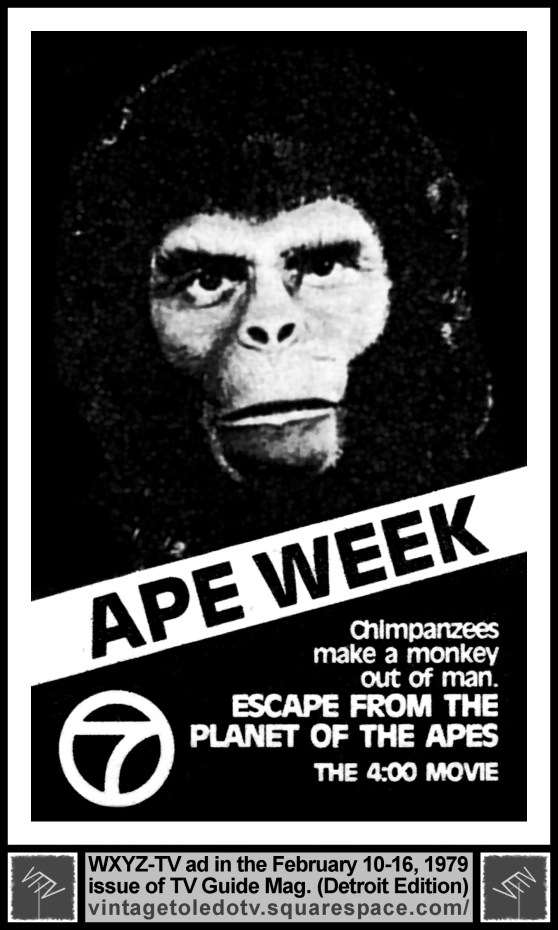
UHF stations started getting the rights to show the films and would air them in Ape Weeks that did big local ratings. But after a few years, there weren’t any more ape movies to show, right?
Wrong.
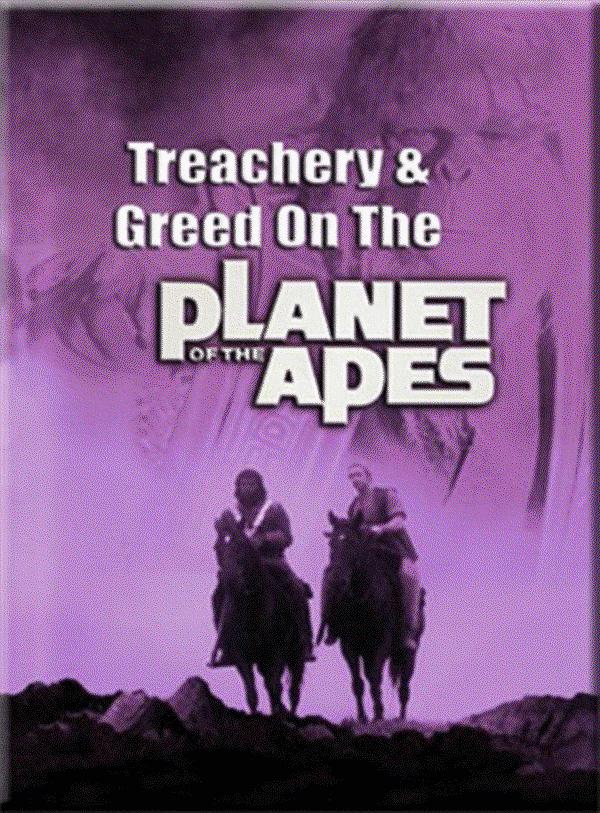
In the early 80s, Fox reedited ten of the episodes into five television films. Each film combined two episodes and they even shot new prologues and epilogues with McDowall as an aged Galen. The films were titled with some of the wildest names in the series: Back to the Planet of the Apes,Forgotten City of the Planet of the Apes, Life, Liberty and Pursuit on the Planet of the Apes, Farewell to the Planet of the Apes and — the film we’re here to really discuss — Treachery and Greed on the Planet of the Apes.
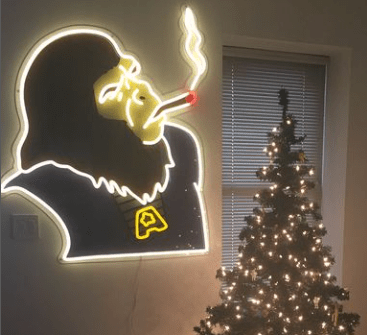
Made up of two episodes, “Horse Race” and “The Tyrant,” this film combines what are really episodes nine and eleven of the show, so they don’t go together at all. Trust me, if you were a big Apes fan like my brother and I were — actually was, his house is filled with Ape memorabilia including a neon smoking ape sign — you were beyond excited for more.
In “The Horse Race” segment, a human blacksmith named Damon (Russ Martin) and his son Gregor (Meegan King) get involved in the adventures of Virdon, Burke and Galen. When a scorpion stings Galen, Gregor saves his life by riding a horse to get the antidote. Despite saving an ape’s life, Gregor finds himself up for execution because, after all, ape law says that humans are not allowed to ride horses. To win back the blacksmith’s son’s life, Virdon agrees to put his life up against chimpanzee ruler Barlow’s (John Hoyt) best rider. And that ends up being, of course, Urko.
Directed by Jack Starrett (Run, Angel, Run!; Cleopatra Jones; Race With theDevil), this episode is filled with action. It was written by David P. Lewis (Death Ship) and Booker Bradshaw (who in addition to being a writer was also an actor; he’s in Coffy, Skullduggery and is one of the voices in the American dub of Galaxy Express 999). Lenard said that Starrett was “a funny sort of Western director; he brought humor into it, lots of fun and a kind of carnival atmosphere with horse racing.”
In a funny story — as told to future X-Men writer Chris Claremont in a UK issue of the Marvel Planet of the Apes comic book — Lenard said that Starrett had no idea who he was out of makeup. “I’d done several days of shooting and had a late call, so I went out to the Fox Ranch early and said hello to him. He got a funny look on his face, and I said, “You don’t remember me, do you?” And he said, “Well, I’ve seen you somewhere; I’ve seen your face somewhere.” And I told him I was Urko. He turned crimson, blushed, and got embarrassed.”
The action is probably why this was Harper’s favorite episode. In an interview in the book I Talked with a Zombie: Interviews With 23 Veterans of Horror and Sci-Fi by Tom Weaver, he said “I knew how to ride pretty well because, years earlier, I’d worked on a ranch out in South Dakota for one summer. The other ape was played by a stuntman — Wesley Fuller — a guy who had been a regular, and he really could ride. I said, “Jesus, where’d you learn to ride like that?” and he said, “That’s my bag, baby!” I don’t know if he was a jockey or not, but he was an excellent horsemen. There’s one scene where you can see that I’m riding full-out and he’s riding next to me, and he starts hitting me with his whip, and then I grab the whip — it’s an old, standard thing in Westerns, where you take the whip out of the other rider’s hand and smack him back with it. He worked with me on that, and we were even able to keep the horses going at a pretty good clip as we carried this off. And the stuntmen hated horses. They said, “They’re dumb animals, and they’re heavy, and you can’t predict them and you can’t really control them!” So they hated horses! I had three stuntmen working on that episode, doubling me. Two of them broke a leg, and one wrenched his ankle or his knee so badly he was incapacitated for the rest of the shoot. All three injuries involved the horses.”
This episode was also turned into a book, Journey Into Terror.
The second part of the film is “The Tyrant” episode, which was directed by Ralph Senensky (a TV career that goes from The Twilight Zone and The Fugitive all the way up to Star Trek, Night Gallery, The Wild Wild West, the TV movie Death Cruise, Hart to Hart, the Casablanca TV series and so much more) and written by Walter Black (tons of TV, including The Flintstones, Bonanza, The High Chaparral and S.W.A.T.).
Our heroes must stop the plans of a corrupt gorilla official named Aboro (Percy Rodrigues), who is using the huge taxes he throws at humans to fund the bribery he’s using to stay in power. Galen disguises himself as Octavio, Zaius’ assistant, and turns Aboro against Urko. In fact, he goes so far that he tries to have the ape general murdered. Burke is conflicted but ends up — for not the first time in the series — working with his enemy.
Senensky has an amazing site where he breaks down everything he directed, including this episode. He got the basics of the show and what made it work right away: ” recognized back then that the series was a reenactment of early America’s history with slavery, with the humans being the enslaved. What I didn’t recognize, but do now, is how much the format of Planet of the Apes bore a very strong resemblance to that of The Fugitive. The two astronauts and Galen, like Kimble, under constant pursuit by the law, would become emotionally involved each week with some person or persons, and the following story would proceed from there.”
He also had the same experience that Starrett had with Lenard: “I never saw the real Roddy McDowall; I never met Roddy out of make-up.”
Senesky has a really well-considered appraisal of the show, saying that fourteen episodes weren’t enough for it to find its footing or its audience. His work on Star Trek showed him that science fiction series needed time to find their way.
He also spoke of the TV movies: “Since fourteen segments was not enough to send the show into syndication, ten of the shows were selected and paired off in twos to create five television movies. “The Tyrant” was combined with “The Horse Race”, retitled Treachery and Greed On the Planet of the Apes and today still plays occasionally on the Fox Movie Channel. Thirty-eight years later I still receive residuals for the endeavor. They’re not large, but they are cashable. The most amusing check I received was for an amount less than the forty-four cents the Director’s Guild had to pay to send it to me. The net amount on the check? Thirty-seven cents.”
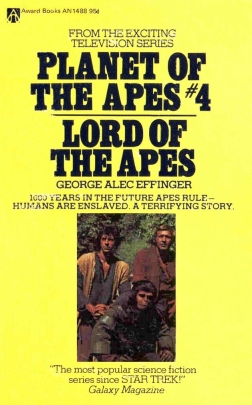
This episode is one of the stories in the fourth Apes TV tie-in book, Lord of the Apes.
If you want to hear what it was like to be part of the Planet of the Apes TV series, director of photography Gerald Perry Finnerman (Brother John, Sssssss, Nightmares, Moonlighting, Devil Dog and the sole survivor of a plane crash while scouting locations, which led to him wearing a metal full body brace for six years while still working) sums it up by saying, “It was a tough show. When it was canceled, I wasn’t sorry.”
After two nearly Jack Laird-less episodes, I knew my luck would not hold out. Yet I don’t plan to go into the Night Gallery close-minded. Perhaps this will be a good episode.
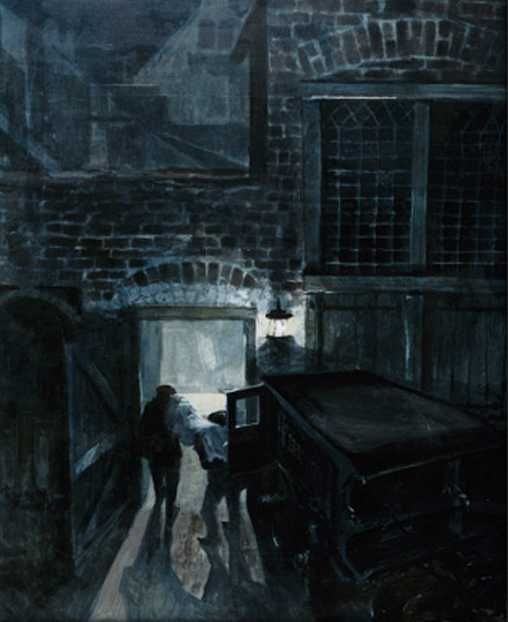
Directed by Jeff Corey and written by Rod Serling, “Delivers In the Rear” starts with a body being delivered for Dr. John Fletcher (Cornel Wilde) of the Macmillan School of Medicine. The image of a dead person is so shocking that one of his students, Tuttle (Gerald McRaney in his first TV appearance), faints. The bodies that he gets seem to have been dead only a few hours. Sure, the men delivering them could be murderers. But science…
That night, while eating dinner with his fiancee Barbara Bennett (Rosemary Forsyth) and her family, her father Bennett (Kent Smith) brings this fact up, wondering about grave robbing. What fun dinner talk…
Fletcher believes that “no individual life is of any consequence if it means the saving of many lives.” So when the cops close in — a woman believes that he has the body of her murdered husband — he asks his grave robbers to get rid of the body and supply him with a woman so that the police no longer suspect him. Of course, the woman they kill and bring to him is…his fiancee.
As always, Serling brings his darkest tales to the party.
Frances Turchin (Geraldine Page) believes that her husband is trying to kill her, a plot that she describes in grand detail to Sergeant Stanley Bevelow (James Gregory). Of course, she goes on so much that she reminds the officer of his wife and he wonders how he can get away with it as well. “Stop Killing Me” was directed by Jeannot Szwarc and written by Jack Laird from a story by Hal Dresner. It is, as you can figure, another blackout sketch but stretched way longer than it has any right to be enlongated.
“Dead Weight” concerns Landau (Bobby Darin), a criminal involved in a bank heist gone wrong who needs to escape the attention of the police. That’s where Mr. Bullivant (Jack Albertson) comes in, as he has a history of helping get thugs out of jams just like this.
The truth? The fixer kills off the criminals, grinds them up and sends them away as dog food.
This was directed by Timothy Galfas, who also made Black Fist and also served as the cinematographer for the live action scenes that were rotoscoped over for the 70s animated Lord of the Rings. If you guessed that this was another Jack Laird script, based on the story “Out of the Country” by Jeffry Scott, you would be correct.
After two weeks of solid episodes, Night Gallery reminds us that it was a constant push and pull between the elegant and bleak world of Serling and the hackneyed and prosaic work of Laird. I wanted more this time and was left, well, wishing.
I’m really enjoying the last two episodes of this show, which take two stories and have one director — in this case, Jeannot Szwarc — tell both of them.
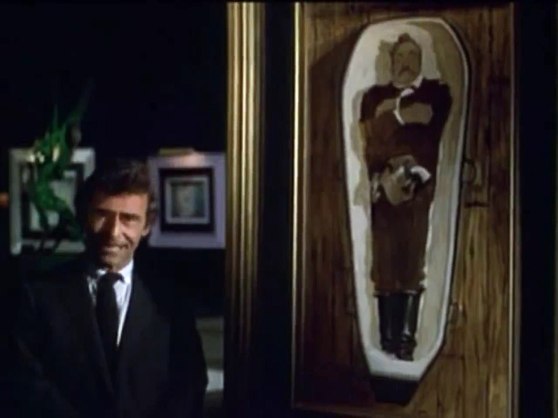
“The Waiting Room” is written by Rod Serling and starts with Sam Dichter (Steve Forrest) riding into the type of Western town that has a man swinging from a tree. As he enters a bar, he’s recognized by one of four card players, Doc Soames (Buddy Ebsen). Dichter soon reveals he’s the kind of man that’s sad that he missed getting to see that hanging. That’s when Charlie McKinley (Lex Barker) stands up from the card game, says it’s time to go and goes outside to be shot in the head, a fact that surprises only Dichter.
The same exact thing happens once an hour, as Joe Bresto (Albert Salmi) and Abe Bennett (Jim Davis) explain their deaths, then leave the bar to relive — redie? — them. Surely Doc Soames couldn’t have been a killer like them. But he reveals that all the gunfighters he healed that went out and killed others weighed on his conscience until he shot himself.
Only Dichter remains, but as he’s told that it’s his turn, the story comes full circle. A magical 27-minute work of art by Serling and Szwarc that tells one of the best stories of every episode of Night Gallery.
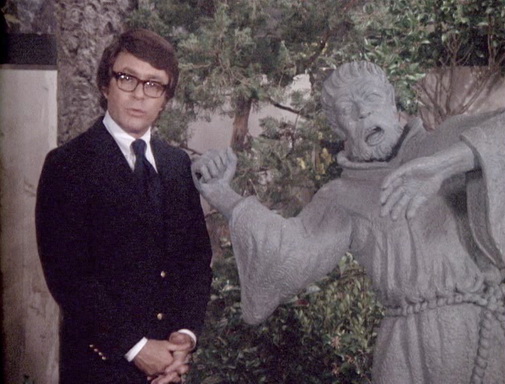
Written by Alvin Sapinsley and based on “Out of the Eons” by Hazel Heald, “Last Rites for a Dead Druid” starts with Jenny Tarraday (Carol Lynley) and Mildred McVane (Donna Douglas) buying a strange sculpture because the screaming man reminds Jenny of her husband Bruce (Bill Bixby). He hates it and banishes it to the backyard.
Yet every night, he dreams of the horrible thing out back and soon learns it’s a statue of Bruce the Black, a magician who sacrificed animals and humans to gain power. And when he’s near the statue, he’s not himself, like how he forces himself on his wife’s best friend, not that she minds. But when he nearly kills a cat on the grill and tries to murder his wife to be with Mildred, Bruce hits the limit.
The end is kind of ridiculous but in a way that I love. Bruce attempts to smash the statue and the unexpected occurs, all while it’s kind of hinted that Mildred — Elle Mae turned evil — is behind all of this possession and madness.
It was so nice to enjoy another episode and not deal with black out sketches or silliness. Ah, Night Gallery. As always when you are good, you are beyond good.
AmnesiA (2001): Directed and written by Martin Koolhoven, AmnesiA is the story of two A’s: Alex and Aram (both played by Fedja van Huêt) and their attempts at reconnecting as they attempt to care for their elderly, dying, constantly drunk and frequently hilarious mother (Sacha Bulthuis). That sounds like anything but something I’d usually want to watch, except that there’s also the suicide of their father which has been a point of secrecy and contention for years, as well as the constant power games that Alex unleashes on Aram, including turning his girlfriend Sandra (Carice van Houten) against him. Oh yeah. She’s also a pyromaniac who just appeared in his car one day.
At the same time, Aram has come back to the family home with Wouter (Theo Maassen), a friend who had a crime go wrong and is dying from a bullet to the stomach. This will not help Alex, who can no longer take photographs, as every time he focuses on a subject, he sees the face of a woman who utterly upsets him. One brother is at war with everyone; the other just wants to hide inside himself. There’s no way they can agree, get along or make it through life without great tragedy.
Also: This movie has a lot of female urination to the point that you wonder if it’s some kind of symbolic thing or it’s a Tarantino feet moment.
That said, this is a dark and surreal journey into long-kept family secrets, including a murder in addition to that suicide, and a movie that was meant to be a black comedy, which was lost on audiences, according to the director. Not everything is explained and yet filling in those holes makes this an even more intriguing watch.
Also: Aram’s car has the license plate 28IF, just like Paul’s on the cover of Abbey Road. He’s also barefoot for most of the film, so if I follow the logic that I learned through record album conspiracy theories, he’s already dead.
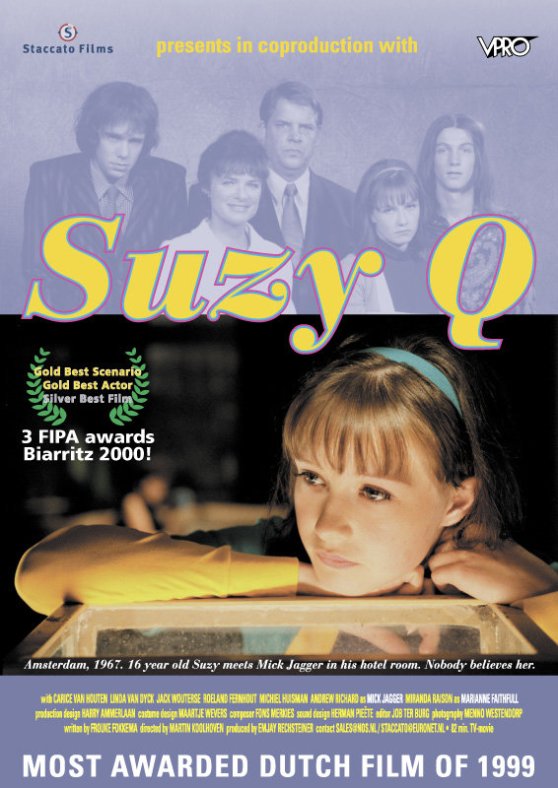
Suzy Q (1999): Based on the childhood memories of Frouke Fokkema, who wrote the script together with director Martin Koolhoven, Suzy Q is about Suzy (Carice van Houten), a young girl coming of age in the 1960s. The title refers to The Rolling Stones’ cover of the Dale Hawkins song “Susie Q” and the Stones — most importantly Mick Jagger and his lover Marianne Faithfull — figure into the plot, as Suzy finds her way into their hotel room and is kissed by Mick, a fact that no one wants to hear or believe.
Her mother is lost, her father is abusive yet powerless and her brothers are trying to escape with either guitar or young lust. Suzy yearns for a time when she will escape these origins, but it won’t happen just yet. But she will get away.
This is a strong early film for Fokkema and Carice van Houten is incredible. Demetri Jagger was set to play his uncle Mick, but he backed out with some worry that the rock star would not approve. Instead, that’s Andrew Richard — Andy Bird, a one-time lover of Madonna — playing the singer.
All of the music rights kept this from coming out on DVD for some time. Koolhoven encouraged people to post the movie online and did it himself on YouTube.
Dark Light (1997): A burglar (Marc van Uchelen) gets caught breaking into the farm of an old woman (Viviane de Muynck). She’s obsessed with religion. Her body is covered with sores. Things get weird.
She believes that the thief is there by divine intervention and she must enact his penance, which means forcing him to slaughter a pig and lick her body, which is a horrifying moment in direct contrast to the barren and beautiful location that this is set at.
He remains handcuffed throughout as they both throw Biblical passages at one another and battle for some kind of power over one another. She sees herself as Job, afflicted with sores of some plague. We never see her face.
For an early film, Dark Light proves the talent of its creator, director and writer Martin Koolhoven.
The Cult Epics blu ray of AmnesiA has a 4K HD transfer (from the original camera negative) and restoration of the movie, plus an introduction by Martin Koolhoven, commentary by Koolhoven and Fedja van Huet that is moderated by Peter Verstraten, a conversation with Koolhoven and Carice van Houten, a making of, behind-the-scenes footage and a trailer. Plus, there’s a second disk with two TV films by Koolhoven: Suzy Q and Dark Light. There’s also new slipcase art by Peter Strain and a double-sided sleeve with original film posters. You can order this movie from MVD.










 B&S About Movies
You must be logged in to post a comment.