CHILLING CLASSICS MONTH: Bad Taste (1987)

Today’s Chilling Classics entry comes from Blake Lynch, who not only knows plenty about movies, but knows plenty of people connected with creating them. I’m really happy that he chose to talk the early career of Peter Jackson. We share a love of Meet the Feebles.

Bad Taste (1987) by Blake Lynch

Preface

Out of all the winners of the Best Picture at the Academy Awards, Peter Jackson may very well be able to claim the strangest directorial debut. The man who would go on to direct greatly nuanced films like Heavenly Creatures in 1994, The Lovely Bones in 2009, and the Lord of the Rings trilogy, began his career by directing the x-rated puppet film Meet the Feebles in 1989 and Bad Taste in 1987.

What’s Bad Taste about? Well, it’s a low budget film set in New Zealand about aliens who want to kill humans for their fast food franchise. It’s the sort of film that isn’t that terribly compelling based on the tagline alone. The film, though, is a wonderfully experimental, bizarre, at times grotesque independent picture that reveals Peter Jackson’s love of trying out new things with the special effects budget.

Production History

Bad Taste began as a 20-minute short film. Eventually, the film turned into a feature and was shot on weekends over a period of four years in Jackson’s home of Pukerua Bay, New Zealand.

The production lasted so long that one of the film’s characters died and another actor’s voice had to be dubbed in during post-production. Another character got married during the production of the film and had to be written out of Bad Taste because of his religious wife’s objections.

There are only four actors visible in the entire film with many other actors hiding behind alien costumes, which were made in Peter Jackson’s mother’s oven. Peter Jackson plays one of the roles and three others roles are played by Jackson’s friends.

Jackson funded the film by himself until the very end when the New Zealand Film Commission awarded Jackson money. The budget was so tight that the production couldn’t afford guns for the characters, camera mounts, a steady-cam device, and many other film essentials.

Drive-In Totals

  • 68 total deaths or .74 kills a minute

  • 1 death by mallet

  • 2 alien kills while a gun is lodged in another person

  • 1 disemboweled seagull

  • 1 alien who has his brain eaten out of his head

  • 1 alien who has his head pulled off and used like a soccer ball

  • 1 death from a balcony fall

  • 1 alien cut in half due to a car collision

  • 5 aliens, 1 house, and 1 sheep destroyed by rocket launcher

  • 2 aliens split in half by a chainsaw

  • 1 house that turns into a spaceship

Plot

There are some ways in which it isn’t very helpful to approach Bad Taste. For one, viewers shouldn’t read much into the dialogue in Bad Taste. There are great stretches of the film that don’t have many words spoken, while other scenes spend way too much time on exposition and unimportant details.

Likewise, it’s not helpful to look for a meaningful story in the film. There isn’t one. The only momentum between the film are changes in location: the cliffs, the house, the car, the spaceship.

I’m not saying Bad Taste is a bad film because it lacks these details. The film is definitely worth watching, if nothing for the glimpse of the genius that would become Peter Jackson. Instead, I’m trying to say that Bad Taste has all of the trappings of a no-budget independent film.

The film begins with the Astro Investigation and Defence Services sending Derek, Frank, Ozzy, and Barry to determine why a whole New Zealand town is now empty. While the streetwise Barry (Peter O’Herne) fends off alien attacks, Derek (Peter Jackson) attempts to look for signs of life in the town.

Immediately after contacting Frank (Minke Minett) and Ozzy (Terry Potter), we encounter by far the strangest scene in the film. Derek tortures an alien named Robert. That’s a neat scene, you might think. It might even remind you a bit about a similar sequence in George Romero’s Day of the Dead. But, what’s completely baffling about this bit of the film is that Peter Jackson plays both the alien who is being tortured as well as the person who is doing the tortured. You wouldn’t be wrong in saying the scene depicts Peter Jackson torturing himself.

Ever the masochist, Peter Jackson then films another character injury scene when Derek falls down a cliff while being chased by aliens. When he wakes up in a seagull’s nest, Derek discovers that his brain is leaking from his head. To keep his brain from leaking out of the back of his head, Derek throughout the film relies on hats and belts. I am fairly certain that this is not appropriate medical treatment to be followed in the case of such an event. I watched Bad Taste over a decade ago and this is visual of strapping your brains into your head with a belt is the only thing that I remembered about Bad Taste.

Around this time in the film, we encounter Giles (Craig Smith), a charity collector who ends up trying to run from aliens but ends up stuck in a pot for alien stew. Giles turns out to not be the only one that the aliens have attempted to turn into food. Instead, the aliens turn out to have turned all of the residents from the now empty town into alien fast food. In what is probably the second most viscerally disturbing thing in the film, Robert vomits into a bowl that is eaten by the aliens. Legend has it the vomit was actually just a combination of yogurt and muesli, but one glimpse at the greenish blue concoction is enough to make most people sick to their stomach.

At this point, the film turns into an effort by Frank, Ozzy, and Derek to rescue Giles from Lord Crumb (acted by Doug Wren, voiced by Peter Vere-Jones) and the aliens. It’s at this point, we enter into an action-filled sequence that leads to the conclusion of the film. I won’t discuss what happens here for several reasons. For one, there’s not really any type of plot development. Instead, this sequence is all about a series of action sequence after sequence. Two, I’ve already hinted at what you’ll see in my drive-in totals. And three, there’s actually a bit of a surprise with how Bad Taste ends that I won’t reveal.

Do I like this film? I struggle alot with independent films like this. I know the legacy. I know it has a huge cult following. I know that Peter Jackson went on to win Academy Awards, work with Spielberg, and do all sorts of wonderful creative projects. There’s glimpses of a creative mind in this film that are worth watching. If it comes to early Peter Jackson, though, I’m a Feebles man through and through.

Legacy

Bad Taste was approved by the New Zealand Film Commission, but was later banned by the Queensland Film Board in Australia. Because the Australian Film Commission viewed the Queensland Board’s decision to break up the film as unprofessional, the Queensland Film Board was broken up as a result of Bad Taste.

After a screening of the film in 1988 at the Cannes Film Festival, Jackson managed to sell the picture. Jackson’s subsequent film, Meet the Feebles, was filmed with financial support from Japanese investors as well as assistance from the New Zealand Film Commission.  The film did not, however, receive much recognition at the 1989 New Zealand Film and Television awards.

The film has a devout cult following. While the band Flesh Grinder named an album after the film, the band Kaihoro took its name from the town in the movie and the band Skinny Puppy used clips from Bad Taste in one of the band’s music videos.

In 1993, Peter Jackson approached the New Zealand Film Commission with plans to make a Bad Taste 2 and 3 for $7 million in which Derek would be rescued from the alien planet and the aliens seek revenge. As of November 2018, these films have still not entered production.

CHILLING CLASSICS MONTH: Deep Red (1975)

Deep Red is one of the few Argento movies that I’ve seen in a theater. I’m not sure what the audience expected, as it was on what was presented as a grindhouse night. I think they wanted something like the modern interpretation of the term, all fast moving action and laughs. I don’t think that many of them were happy with what they got from this film — a movie that started with a 500-page script that even Dario Argento’s family felt was too cryptic and continues with not just one, but two references to American painter Edward Hopper. This isn’t just a movie about murder. This is a movie that transforms murder into art.

The movie begins at Christmas, as two shadowy figures battle until one of them stabs the other. Screams ring out as a knife drops at the feer of a child.

Fast forward to Rome, as a medium named Helga Ulmann is conducting a lecture about her psychic powers. Within moments, she senses that one of the people in the theater is a killer. Later that night, that killer kicks in her front door and murders her with a meat cleaver (which is probably why this movie got the boring American title of The Hatchet Murders).

British musician Marcus Daly (David Hemmings, BarbarellaBlowup, Harlequin), who fits the giallo mold of the stranger in a strange land thrust into the middle of a series of murders that he must solve, is returning home from drinking with his gay best friend Carlo (Gabriele Lavia, Beyond the DoorInferno) when he sees the murder that we’ve just witnessed from the street. He runs to save Helga, but she’s thrust through the window and her neck is pierced by the broken glass of her window in a kill that has become Argento’s trademark.

As he tells the police what has happened, he notices that a painting on Helga’s wall is gone. That’s when Gianna Brezzzi (Argento’s wife at the time, Dario Nicolodi, who met him during the filming of this movie) takes his photo, which ends up on the cover of the newspaper the very next day.

Unlike most giallo women, Gianna is presented as more competent and even stronger than our hero — she sits high above him in her Fiat 500 and continually bests Marcus every time they arm wrestle.

Marcus isn’t your typical hero, though. When the killer attacks him, he doesn’t stop them by daring or skill. He locks himself in his study to escape them. He does remember the song the killer played — we also have heard it when Helga is murdered — that psychiatrist (and Helga’s boyfriend) Professor Giordani believes is related to some trauma that motivates the killer.

Feeling guilty that she’s caused the killer to come after Marcus, Gianna relates an urban legend of a haunted house where the sounds of a singing child and screams of murder can be heard. The truth lies in House of the Screaming Child, a book written by Amanda Righetti, which tells the truth of the long-forgotten murder. Marcus and Gianna would learn even more, but the killer beats them to her house and drowns her in a bathtub of scalding hot water (directly influencing the murder of Karen Bailey in Halloween 2). As she dies, the writer leaves a message behind on the wall, which our heroes find. They’ve already assumed the investigation — again, in the giallo tradition — and think the police will assume that Marcus is the murderer, so they don’t report the crime.

Marcus follows the trail of the killer from a picture in the book to the real house, which has been abandoned since 1963. As he searches the home, he uncovers a child’s drawing of a murdered man and a Christmas tree, echoing the flashback that starts the film. Yet when he leaves the room, we see more plaster fall away, revealing a third figure.

Marcus tells his friend Carlos all that he’s learned, but his friend reacts in anger, telling him to stop questioning things and to just leave town with his new girlfriend. At this point, you can start to question Marcus’ ability as a hero — he misses vital clues, he hides instead of fighting and he can’t even tell that someone is in love with him.

Professor Giordani steams up the Righetti murder scene and sees part of the message that she left on the wall. That night, a mechanical doll is set loose in his office as the killer breaks in, smashing his teeth on the mantle and stabbing him in the neck.

Meanwhile, Marcus and Gianna realize that the house has a secret room, with Marcus using a pickaxe to knock down the walls, only to discover a skeleton and Christmas tree. An unseen person knocks our hero out and sets the house on fire, but Gianna is able to save him. As they wait for the police, Marcus sees that the caretaker’s daughter has drawn the little boy with the bloody knife. The little girl explains that she had seen this before at her school.

Marcus finds the painting at the young girl’s school and learns that Carlo painted it. Within moments, his friend turns up, stabs Gianna and holds him at gunpoint. The police arrive and Carlo flees, only to be dragged down the street and his head messily run over by a car.

With Gianna in the hospital and his best friend obviously the murder, Marcus then has the Argento-esque moment of remembering critical evidence: there’s no way Carlo could have killed the psychic, as they were together when they heard her screams. The portrait that he thought was missing from the apartment was a mirror and the image was the killer — who now appears in front of him.

The real killer is Martha (Clara Calamai, who came out of retirement for this role, an actress famous for her telefoni bianchi comedy roles), who killed Carlo’s father in the flashback we’ve seen numerous times after he tried to commit her. She chases Marcus with a meat cleaver, striking him in the shoulder, but he kicks her and her long necklace becomes caught in an elevator which beheads her. The film ends with the reflection of Marcus in the pool of the killer’s blood.

While this film feels long, it has moments of great shock and surprise, such as the two graphic murders that end the film and the clockwork doll. The original cut was even longer, as most US versions remove 22 minutes of footage, including the most graphic violence, any attempts at humor, any romantic scenes between David Hemmings and Daria Nicolodi, and some of the screaming child investigation.

This is also the first film where Argento would work with Goblin. After having scored Argento’s The Five Days — a rare comedy —  Giorgio Gaslini was to provide music for the film. Argento didn’t like what he did and attempted to convince Pink Floyd to be part of the soundtrack. After failing to get them to be part of Deep Red, Goblin leader Claudio Simonetti impressed the director by producing two songs in one night. They’d go on to not only write the music for this film, but also for plenty of future Argento projects.

A trivia note: Argento’s horror film museum and gift shop, Profondo Rosso, is named after the Italian title to this movie.

Deep Red is the bridge between Argento’s animal-themed giallo and supernatural based films. While its pace may seem glacial to modern audiences, it still packs plenty of moments of mayhem that approaches high art.

Want to see it for yourself? Sure, it’s on the Chilling Classics set, but for the best possible home experience, get the Arrow Video blu ray. You can also stream Deep Red on Shudder and Amazon Prime for free with your membership.

CHILLING CLASSICS MONTH: The Witches Mountain (1972)

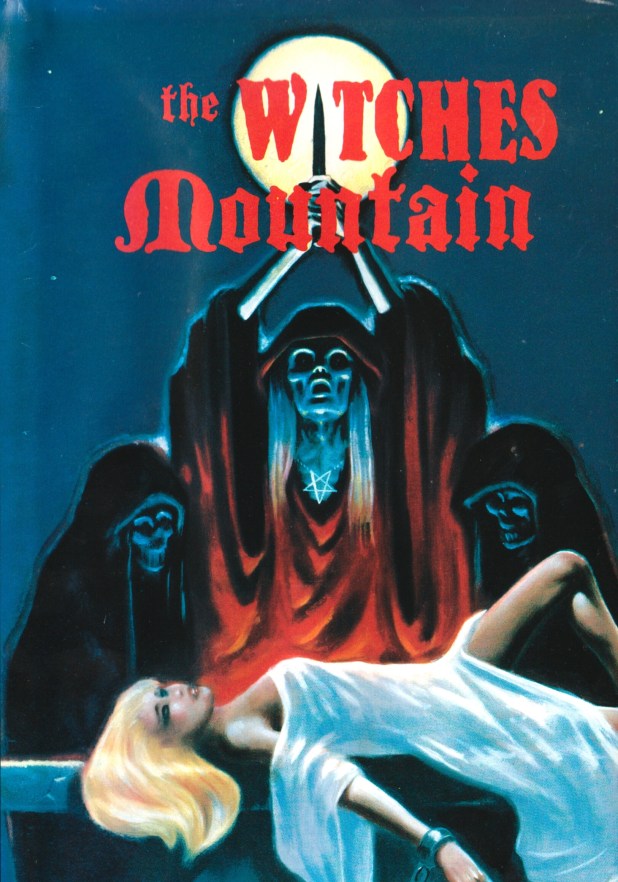
Known in Spain as El Monte de las Brujas, this 1972 effort comes to us from director Raúl Artigot, who was the cinematographer on The Ghost Galleon (released in the U.S. as Horror of the Zombies) and The Erotic Rites of Frankenstein.

The opening of this movie is Cathy’s Curse level insanity: Carla walks around her house and finds a knife stuck in a wig, a voodoo doll and finally, a bloody cat in her bed. That’s when a little girl appears and tells her that she took care of the stupid cat before running away to look for another animal. Carla follows her to the garage, throws gasoline all over the place and sets everything — including the little girl — on fire.

That’s just the start of this movie. The next scene has nothing to do with any of that, as photojournalist Mario (Cihangir Gaffari, Jess Franco’s The Demons) breaks up with Carla and decides to not go on vacation with her, instead calling his office and begging for an assignment. Soon, he’s on his way to the Pyrenees Mountains in northern Spain. Soon, he meets freelance writer Delia (Patty Shepard, who not only appeared in numerous Paul Naschy movies like La Noche de Walpurgis (The Werewolf vs. The Vampire Woman) and Los Monstruos del Terror (Assignment: Terror) as well as Hannah, Queen of the Vampires and Slugs), who joins him on his trip.

They decide to stop at an ancient hotel that’s staffed by a man who sounds like every bad Igor impression. And then they learn of a mountain that’s haunted by a coven of witches, so they decide to go check it out.

Keep in mind that the beginning of this movie has nothing to do with things until the end, that Mario is a horrible hero and that you will hear chanting ala The Exorcist and The Omen for the entire running time of this movie. Do you want a shock ending, too? Of course, we can get that for you!

Avco Embassy included this movie as part of their Nightmare Theater package that was syndicated for television in 1975. The others are Marta, Death Smiles on a Murderer, A Bell from HellManiac MansionNight of the SorcerersFury of the Wolfman, Hatchet for the HoneymooonHorror Rises from the TombDear Dead DelilahDoomwatchMummy’s Revenge and The Witch.

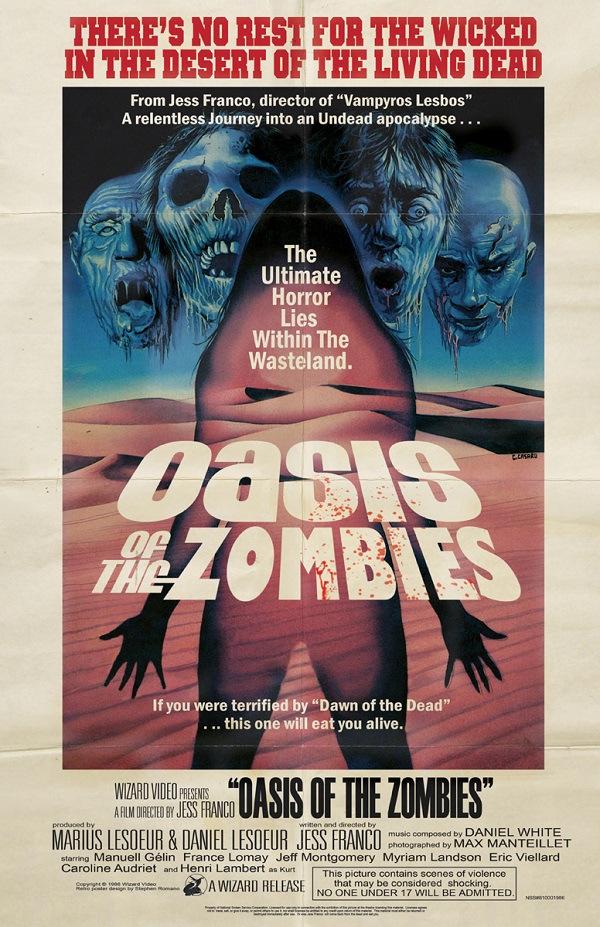
CHILLING CLASSICS MONTH: Oasis of the Zombies (1981)

Today’s movie comes to us from Roger Braden, whose Facebook group Valley Nightmares is all about the history of the films that played at the drive-ins and theaters in his home state of Kentucky. He also writes from Drive-In Asylum and likes The Car as much as I do! Thanks for helping out, Roger!

During World War II a Nazi squadron transporting gold across the North African desert are ambushed by the Allied Army and everyone is killed except one man, Captain Robert. Years later Capt. Robert tells his story to German fortune hunter Kurt who reveals that he trained that German squad and murders Capt. Robert so that he can find the gold. Nazi Bastard! After hearing of his father’s death, Capt. Robert’s son discovers his Dad’s diary’s about the battle and the gold and decides to try and find the gold himself. Both men ignoring the legend of ghosts that haunt the oasis where the battle happened.

Looks and sounds like a decent movie to watch, right? You couldn’t be more fucking wrong. Other than the pre-credit opening of two young women stumbling across the seemingly “unfindable” oasis being attacked, there are no more “zombies” until almost halfway through the film. Instead we get story, and we get story flashbacks with scenes from other movies spliced into it. And we get narration of story during some really bad “battle” scenes while some jazzy cymbals play in the background. But Captain Robert is a true badass in these scenes, only using a pistol during the battle despite the Nazi’s having machine guns, grenades and having 5 times the manpower as the Allies.

When the zombies finally make their appearance they are some of the worst looking creatures you’ll ever see. Honestly, the two “main zombies” are fucking hilarious. One is apparently just a concrete head with an eye stuck to it. The other at least walks around, with 2 giant wet bug eyes. How he kept those giant eyes wet despite being buried in the sand is beyond me.

And they are S-L-O-W zombies too. More than a few people, despite seeing the zombies moving towards them like a glacier, wait to the last second to move, and then run right into the pack and get eaten. The gore in this is poorly done, and there’s not as much as one would expect. There is also one incredibly lame “sex” scene. “Day for night” scenes where sometimes its broad daylight when it’s supposed to be dark. The same footage being repeated throughout the film, this is one of the worst movies I’ve ever seen. Trust me, I watched this turd 3 times (!) in October alone. First to refresh my memory from seeing it (for the 2nd time) probably 15 years ago with my sons. The other two times were trying to figure out how to write about it. I can still only name about 3 characters in this entire movie, that’s how forgettable it is. Legendary low budget filmmaker Jess Franco can take full credit for this, despite his many aliases in the credits, as he was the co-editor, co-writer and co-musical score, wrote the screenplay and Directed it. Hell, he even played one of the fucking zombies.

Yeah, we love this so much, we reviewed it again, as we blew through a bunch of Jess Franco stuff in 2020.

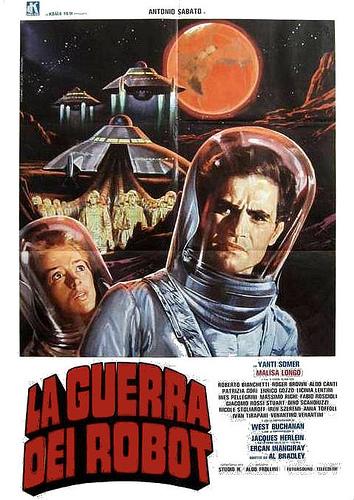
CHILLING CLASSICS MONTH: War of the Robots (1978)

Paul Andolina, whose writes the site Wrestling with Film, is in charge today. Beyond loving wrestling, he also knows a ton about Russian and lucha films (and he even speaks pretty good Spanish, so we hear!).

War of the Robots — originally titled La Guerra dei Robot — is an Italian science fiction film released in 1978 most likely to cash in on the franchises of both Star Trek and Star Wars. I’d like to imagine this film came about when Alfonso Brecia and Aldo Crudo were as high as cucuzzi (Italian squash) are long which just so happens to be extremely.

I could not ask for a more crazy colored sci-fi romp than what this film offers. Female scientist Lois and male professor Carr are on the cusp of something extraordinary; they soon will be able to create any creature they want and make the first immortal man! However, their plans are cut short when a mysterious group of gold-clad humanoids attack and abduct them. It’s up to Lois’ lover Captain Boyd and crew to rescue them from their captors.

War of the Robots has a lot of twists and turns during its hour and thirty-nine minute runtime. There also is a cut of the film that is four minutes longer but the cut included on the Chilling Classics set is the shorter one.

When the crew finally gets to Lois and Dr. Carr it turns out nothing is what it seems at all. Louis is now an empress and Carr is mad with power over the gold-clad humanoids who turn out to be androids. The inhabitants of the planet Louis and Carr are taken to also happen to be wrinkly old monster folks. The latter half of the movie turns into a whole scale war. Battle is waged in caves, palaces, command decks and even in starship space battles.

This movie has a bit of everything; it’s got phasers, it’s got laser swords, it’s got mutants who live on irradiated asteroids but most importantly it has West Buchanan! West Buchanan is an American actor who starred in his fair share of Italian genre films. It just so happens that West Buchanan looks like he could be Harley Race’s twin brother. Harley Race is a wrestler who has worked for NWA, WWE, and WCW. I was really surprised how similar they look. Now the reason I bring that up is that I’m a collector and avid watcher of films that star professional wrestlers. That’s not the sole reason I enjoy this film so much it’s not the greatest film by any means but those who like campy science fiction films should find plenty to enjoy. I think most folks will especially like the scenes where androids are sliced in half by laser swords.

I must also point out the amazing score is by Marcello Giombini who also scored some of the Emmanuelle films, Sabata and even Antropophagus. If you have the chance to watch this I do recommend it. Apparently it is part of a series of science fiction films by director Alfonso Brecia, The films that precede it are War of the Planets, Battle of the Stars and it is followed by Star Odyssey. I hope I stumble across the other films as I truly did enjoy this film.

You can watch this one of the many uploads of War of the Robots on You Tube.


Don’t forget: We also reviewed Brescia’s Star Odyssey as part of our month-long tribute to the release of Star Wars: Episode IX – The Rise of Skywalker. You can catch up with all of those reviews with our “Exploring: After Star Wars” featurette. And we way over thought Brescia’s “Star Wars” movies with one of our weekly “Drive-In Friday” featurettes: “Pasta Wars with Alfonso Brescia.”

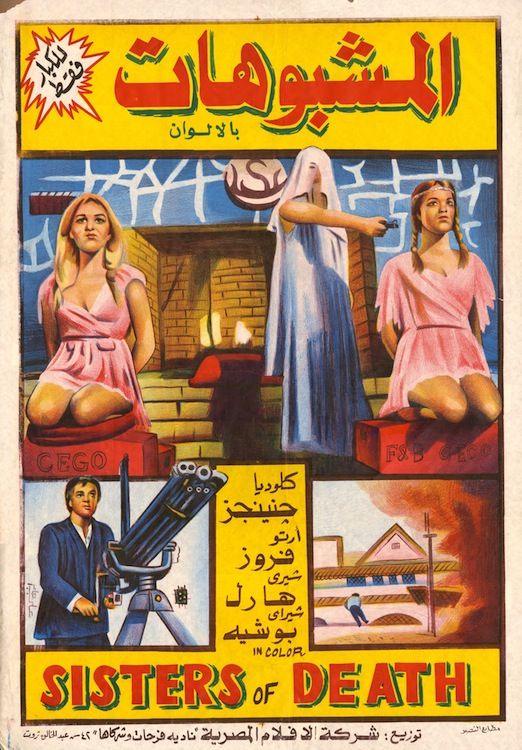
CHILLING CLASSICS MONTH: Sisters of Death (1976)

This movie starts in the most awesome way. During an all-girl secret society college initiation, The Sisters kneel as they hide behind shrouds and place a loaded pistol to each pledge’s head. The first girl, that goes well, as all we hear is a click and she survives. The next one, well, it doesn’t go so well. This time, we hear a loud gunshot and see the results, with blood everywhere.

Years later, there’s a reunion of the Sisters, set up by envelopes all containing $500. The first to get one is Judy (the gorgeous, yet doomed exploitation queen Claudia Jennings, Unholy Rollers) and all of the Sisters suspect one another of sending these invites, which threaten to spill the secret murder they’ve all kept to themselves.

Soon, the five surviving Sisters are gathered at a lavish estate that just so happens to be owned by the father of the Sister who died. That’s when this movie becomes a kind of, sort of slasher, ending with a 70’s twist downer ending. It’s pretty PG, with the deaths occurring off camera and Jennings staying clothed, so if you’re looking to be shocked and titillated, I can suggest several other films for you.

This was shot in 1972 and sat unreleased for a few years. It feels like a made for TV remake of Ten Little Indians, but it isn’t. It has a few familiar faces in it, like Joe E. Tata, who played Peach Pit owner Nat Bussichio on Beverly Hills, 90210 and former Mouseketeer Sherry Alberoni (NIghtmare Circus).

Sisters of Death doesn’t get much better than its first ten minutes. That’s the beauty of the Chilling Classics set. There are so many films here, you can always find something else.

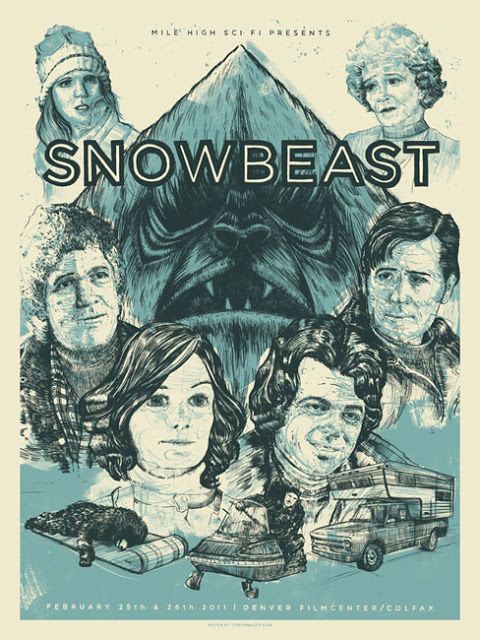
CHILLING CLASSICS MONTH: Snowbeast (1977)

This entry was written by Bill Van Ryn, the man behind the always stupendous Groovy Doom and Drive-In Asylum. Bill knows more about movies than almost anyone I’ve ever met and is always there with an answer to my questions, no matter how trivial or dumb they may be.

A popular vacation spot, desperate for tourist dollars, is suddenly beset by a beast that kills people. This coincides with the big breadwinning season of the vacation spot, leading the people in charge to hush up the deaths and avoid spooking the tourists into bolting. In the post-Jaws 1970s, there was no limit to the number of movies that came along with this exact same plot. One of the most successful imitators was William Girdler’s 1976 flick Grizzly, which placed the action in a park and substituted a bear for a shark. 1977 TV movies Snowbeast distills this formula even further, making the park a Colorado ski resort and changing the grizzly to a bigfoot monster.  

Robert Logan and Sylvia Sidney play a grandson and grandmother who find their winter carnival interrupted by a monster that starts attacking and eating isolated people on the slopes — at one point, Logan says he can identify a victim’s body by looking at her face, and another character says “She doesn’t have it anymore.”  Sidney, of course, doesn’t want to admit that there is a problem at all, and advises Logan to keep it a secret. Bo Svenson is a former Olympic ski champion who has fallen on hard times and picks the wrong time to come to his old friend Logan for a job; I’m pretty sure entering into combat with a murderous bigfoot was not what he signed on for. Svenson’s wife, played by Yvette Mimieux, happens to be a former flame of Logan’s adding a love triangle to the story. Anyone who read the novel Jaws knows there was a love triangle in that story too, although it was not retained for the film version, so maybe nobody realized at the time just how deeply the screenwriter Joseph Stefano plunder the depths of Peter Benchley’s story. 

Although the violence is subdued enough for a TV movie, there are some moments of dread to be found here, like when one character is trapped in a wrecked RV and can’t escape the oncoming monster, which just comes right for him and slaughters him immediately. There’s also a very silly moment when the creature shows up to interrupt a rehearsal for a pageant. It smashes a window, causes a little hysterical panic (including a hilarious reaction shot from Sylvia Sidney), and then proceeds back to where it came, stopping along the way to kill a helpless parent who was just waiting to pick up her daughter from the rehearsal. 

Ultimately, camp is king in Snowbeast, and there is enough of that on hand to entertain this jaded viewer. Also, I enjoyed the outdoor photography, including some impressive tracking shots of characters skiing. 

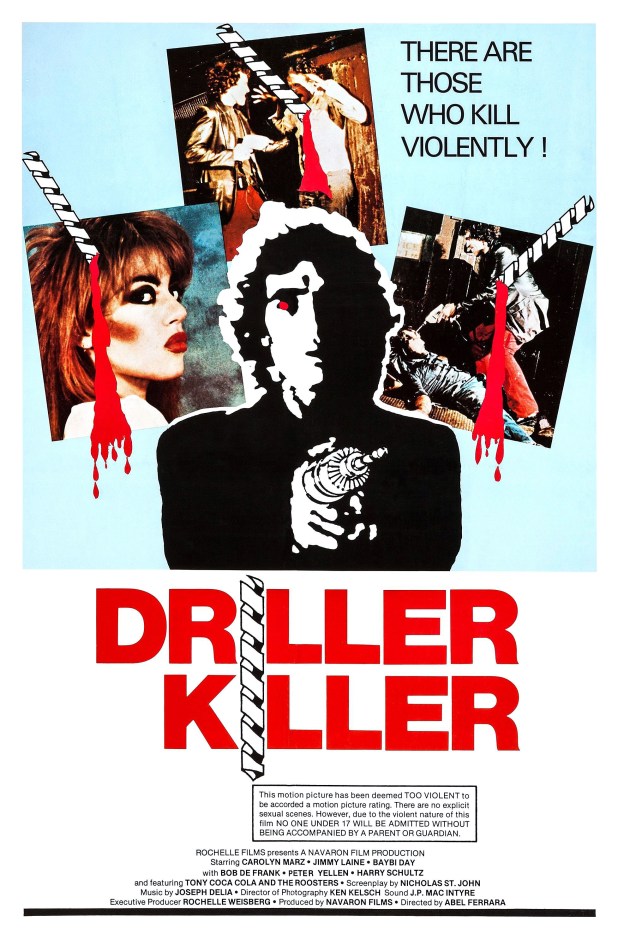
CHILLING CLASSICS MONTH – another take on Driller Killer (1979)

John S Berry says that he’s a pretty low key guy. He has a few articles on the Rupert Pupkin Speaks site. I asked him to tell me a little more about himself and he replied that he loves bargain bin horror movies, his cat Walter, Terry Gordy and most people.

One of my favorite themes in any version of storytelling is the duality of man. Nothing is absolute, Tony Soprano was a charming guy but he was also the same guy that killed a guy on his daughter’s college scouting trip. I love that feeling when you can spend years, seasons or most of a movie hating a character then you feel sympathy and compassion for this at times awful person. I felt absolute heartbreak in the UK office when David Brent says, “please don’t make me redundant.” After so many episodes of cringing and total jack ass behavior I suddenly felt for this jerk. Similar feelings came into play for me with Reno in The Driller Killer.

Ironically, after writing this opening paragraph I just blew up myself. I am usually calm (I think but wait did Reno think the same?) but after a nine-hour day and four hours of commuting I just snapped at everyone in the house. Of course, I usually cool off after a walk and it is not a walk where anyone is murdered by a drill (and I said my apologies just not in painting form).

Reno is a struggling, stressed out artist played by Abel Ferrera living with Carol and her girlfriend who seems to be strung out. Carol seems to be slumming or pretending to be outrageous when actually she is an ex-airline stewardess who has a milquetoast of an ex-husband that she knows will take her back unconditionally. Bills are due and the pressure seems to be on Reno who is trying to create his masterpiece which involves a bloody buffalo.

Watching Ferrera as Reno Miller I wish he would have acted in more films as he has a very interesting presence and jawline. I waffle between thinking he is funny to kind of scary (the dream lighting of him shaking the blood out of his hair is amazing)to a narcissistic asshole back to funny.

On the surface this film seems to be a straightforward plot; boy has girls, tries to make a masterpiece, loses mind and kills bums with a drill. But a little bit of research (not too much ruins the magic) the story has more depth to it and it kind of richens the experience of the movie.

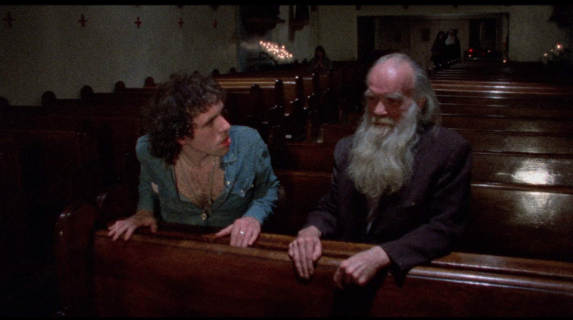
The old man at the church in the beginning is supposed to be Reno’s derelict dad that is why he had Reno’s name and number on a slip of paper. Reno bails on the family reunion but is shaken by it and perhaps this encounter started the journey into his madness. Further odd research I found the actor who played the old man in the church was James O’Hara who was in Gunsmoke and The Quiet Man. I am not sure if he is a super method actor or he had really fallen on hard times but he certainly looked the part of wino deluxe.

Watching this film, you are treated to two types of ghosts; those images of the surely dead by now winos and what Union Square once looked like. This movie is a great example of we don’t need no stinking permits and mixes in shots of actual bums and crew members stunting as bums. They do a remarkable job, especially the bum at the bus stop (Ferrera friend/actor) and it is often hard to tell who is legit.

Reno at times shows an odd sense of compassion to the bums in his neighborhood early in the film. He has an almost pep talk about his dad with one passed out wino. The scene that Ferrara really kind of made me shift back into he is not that bad of a guy mode was when talking with a bum on the street asking him about his old lady and my favorite line: “How come you are on the street and not with the people that love you man?” He further shows some heart as he hides with the wino as another bum runs by being chased by hoodlums. Sadly, for Skid Row Reno’s attitude and approach would change soon.

The pressure of it all starts to get to Reno and his new neighbors The Roosters do not help his mental stage. The character of Tony Coca Cola again is another case of no way is that guy an actor. He really seems like a Dead Boy/ Stiv kind of guy. But fooled again he is an actor (and writer, director etc.) One great realistic moment is when Reno is struggling with his vision painting and he says not in an angry way “Come on guys it’s 2 in the morning.”

Reno continues to work on his masterpiece and tries getting an advance from an art dealer who is a total pompous creep. Tony blows up several times and lashes out at Carol only to later apologize in crude painting form. He keeps promising once this painting is done we are set, well…

Reno starts to go on his rampage when he finally reaches his breaking point at a Roosters show where they are playing songs he has already heard in every stage already numerous times. There is not a ton of context as to why he was so drawn to the power drill belt commercial but hey it is a cool title and look. But I suppose the rapid killing spree helps with inspiration and soon he is finishing his buffalo AND a Tony Coca Cola portrait (it’s rumored that the buffalo is in a museum in New Mexico, wonder where Tony’s ended up?)

The painting is finally done and Reno is ready to get paid. The dirtbag art dealer comes to see this masterpiece and poor Reno sitting there with a blank look and a tie take a verbal beating and you can just feel the sadness in the air. We just watched this guy brutally murder people and now I feel bad for this guy who has really worked and given his all to his vision only to have someone disrespect it.

Then Carol has decided she has had enough of this artist lifestyle and splits on Reno. In a sad scene Reno chases after her and pleads with her to stay. Reno has anger but then goes sad sack as he is sitting there with her suitcase calling after her (“Come back man. You need your stuff”).

This pushes the switch in Reno over there is no looking back. Sure, he probably is not going to end up like his old man in the streets drinking rotgut but that would have been a better path. There is a lot to process in the last act and I appreciate the fact that not everything is tied up with an absolute outcome (just watch and make up your own story I say).

The good folks at Arrow just recently put out a suped up version of the film, but I really think the first time to view should be with all the scratches, grainy picture and red boxes. It just feels right that it is on the Chilling Classics compilation (and about a million other bargain bin compilations that I love). The Driller Killer is tribute and homage to the old scary, gross New York City and the sleazy good old days.

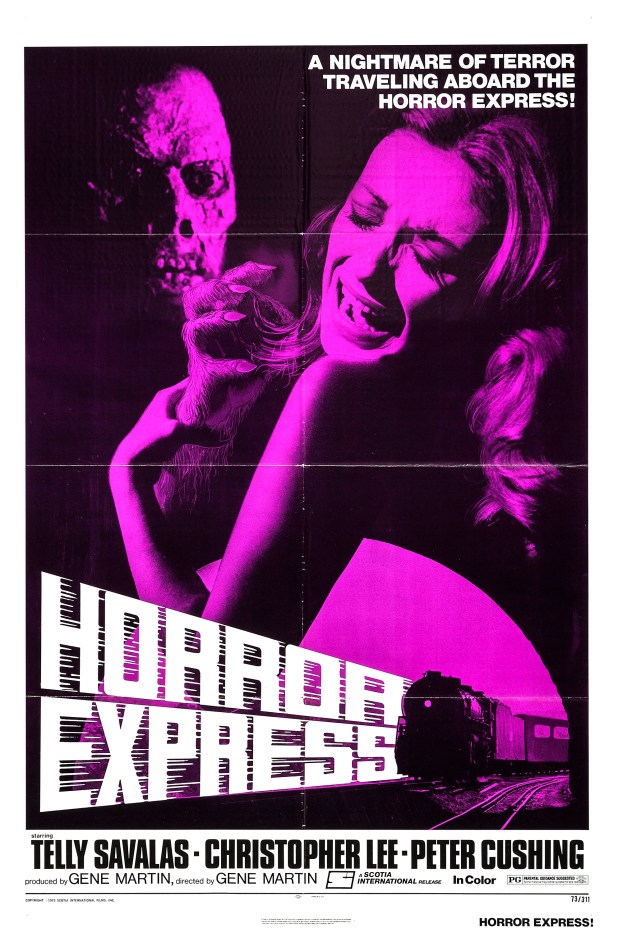
CHILLING CLASSICS MONTH: Horror Express (1972)

This entry was written by Bill Van Ryn, who creates both Groovy Doom and Drive-In Asylum. You should order every issue, because Bill puts together a zine that makes you fall in love with movies more and more with every page.

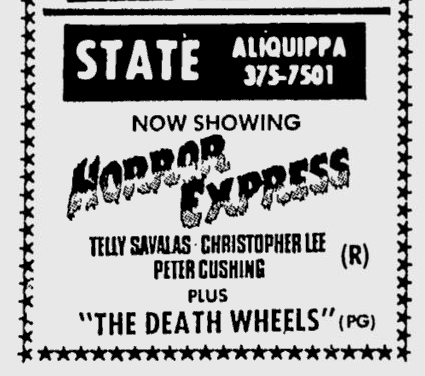
There was something great about growing up in the 70s as a monster kid. With VHS still a distant promise waiting over the horizon, TV was the only way you could access movies once they passed through your local theaters–and if you were a kid, seeing them theatrically usually meant pleading your case with an adult who was totally disinterested. TV was the last stand. Fortunately, local stations desperate for programming often filled their lineup with syndicated packages of older films. Horror movies often turned up as time-fillers on local TV, usually in late night slots meant for insomniacs and people who worked graveyard shift.  What this meant for us monster kids was, we scoured the TV Guide looking for movies noted “THRILLER”, and then you had to make a decision about whether or not it was worth staying up until 3am to watch.

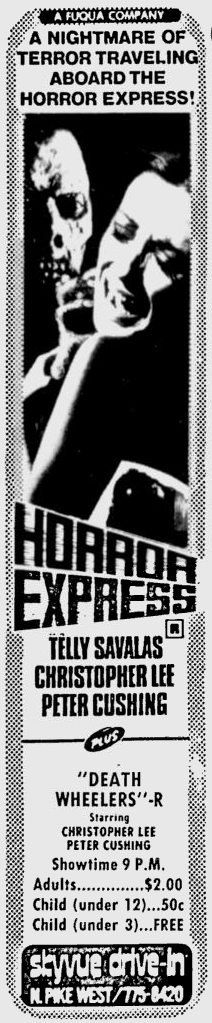
1972’s Horror Express was one of those flicks that I *never* missed, no matter what. Not only does it star Christopher Lee and Peter Cushing, Telly Savalas shows up about halfway through the film as a Russian cossack (!), and it’s got a series of simple but gruesome attack scenes that were some of the goriest things I’d seen up until that point. The story is set in the early 1900s, and Lee plays an anthropologist who discovers a hairy ape-like fossil in the Himalayas. Believing it to be the missing link, he crates it and hurriedly books passage on the Trans-Siberian Express in order to return to England with it as quickly as possible. Cushing is a colleague of his who is also on board, and immediately senses that Lee is up to something noteworthy. Unbeknownst to anyone, the creature is actually the last vessel of an extraterrestrial intelligence that has the ability to lock eyes with its victims and drain their brains of all information contained therein. It gets out of the crate and starts absorbing people. Its victims die gruesomely in the process, bleeding profusely from the eyes, which turn white like a boiled fish. This alien presence can also transfer itself to another host in this way, allowing it to jump from body to body if necessary.

Horror Express is a British/Spanish coproduction directed by Eugenio Martin, who had just made the movie Pancho Villa starring Telly Savalas. Martin used the same train set from that previous film, and each different “car” of the train was actually the same set redressed for each new part of the train. That meant that the entire film had to be shot out of order, with every scene taking place in the corresponding car being completed before the set was taken down and redressed. The movie was shot silent, with the entire soundtrack dubbed in later, although Lee, Cushing, and Savalas all did their own dubbing, so their familiar voices are all present.

Most importantly, the story is engaging and clever, with the mystery of the creature being slowly unraveled by the protagonists using clues left behind. One of the more outlandish moments has Cushing obtaining the eyeball of the now dead fossil and extracting fluid from it — fluid that somehow contains actual images that the host observed, now visible under a microscope! This is how they determine that it was from outer space and had been on Earth since prehistoric times. Hey, it’s as good an explanation as anything, right?

Although not a Hammer production, this movie definitely feels like one, especially since we have Lee and Cushing together in the same film. It was perfect for late night television, and it was hard for me to forget those bleeding white eyeballs after I saw this movie. You’ve probably already noticed the similarities to the story Who Goes There? by John W. Campbell, the basis for “The Thing”, and I always loved the way this movie sets up the hairy fossil as if it’s the villain. Eventually you realize that whatever the fossil was, it was just a shell, another victim of the real monster. Although we’re talking about the Chilling Classics public domain version of Horror Express, there exists a fabulous blu ray transfer from Severin Films, definitely worthy of your hard earned dollars.


CHILLING CLASSICS MONTH: The Driller Killer (1979)

Before Ms. 45, The King of New York and Bad Lieutenant (a film that rivaled The Car for my grandfather’s affections), Abel Ferrara directed and starred in this film, which was classified as a video nasty. It’s also fallen into the public domain, which is why it’s on the Chilling Classics set.

Reno Miller (Ferrara, using the name Jimmy Laine) and his girlfriend Carol start the film inside a Catholic church, as an elderly homeless man kneels at the pulpit. The man approaches Reno, who suddenly flees, unaware that the man is his father.

Despite his bohemian artist existence, Reno has pressing real world issues, like paying for the huge electricity bill for the Union Square apartment he shares with Carol and her drugged out lover Pamela. But the masterpiece he is painting is going to change all that — if he ever finishes it.

After fighting against the noise of a band called Tony Coca-Cola and the Roosters playing all night one door away and seeing a vision of himself covered in blood, Reno hits the streets, avoiding gangs and telling himself that he can’t end up like the homeless walking dead.

Reno tries to tell his landlord about the band playing all night, but the authority figure — such as it is — has been bribed and only wants his rent money. He gives Reno a dead rabbit, which he decimates as he hears voices and has a vision of Carol with no eyelids.

That night, Reno kills his first derelict and then tries to see a show with the band from next door. Their music makes him even more upset, so he leaves as his roommates make out. His next murder spree sees his kill the homeless all over New York City.

Tony Coca-Cola barges further into Reno’s life, kissing Pamela and blasting his guitar while our hero — well, the protagonist — paints him for the rent money.

The final stage of Reno’s madness occurs when an art gallery owner declares his masterpiece unacceptable and Carol leaves him when he has no emotion. She moves back in with her ex-husband as Reno goes wild, killing the art gallery guy with his drill. Pamela finds the dead body and runs as Reno grabs her. We’re left unsure as to what happens next.

Carol and her ex-husband have already fallen back into their routine as lovers when Reno intrudes, killing the man while she showers. She doesn’t notice his dead body and gets into bed, thinking her ex-husband is under the covers when it’s really Reno. And just like Black Christmas, another 1970’s slasher that doesn’t have a definitive ending, we cut to black.

From its buzzing soundtrack to religious iconography, punk rock aesthetic and scenes of brilliant red blood drenched murders, Driller Killer is a grimy, scuzzy and noisy blast of strangeness hidden within this box set. It’s unlike anything else on it, a slasher where nude women are safe and the most marginalized of all citizens, the homeless, are destroyed left and right by a man who wants to wipe out his father and himself. Hell, it’s unlike almost any other movie you’ll watch ever.

There was talk in 2007 that David Hess (Last House on the Left and House at the End of the Park) would star in a remake of this film, created by Robert director Andrew Jones called Driller Killer Redux. The rights were never cleaned up, Hess died and the project never became a movie.

You can find this streaming on Shudder and for free on the Internet Archive and on Amazon Prime. If you want to own a physical copy, you can either get the Chilling Classics box set or buy the Arrow Video release, complete with new commentary from Ferrara, at Diabolik DVD.