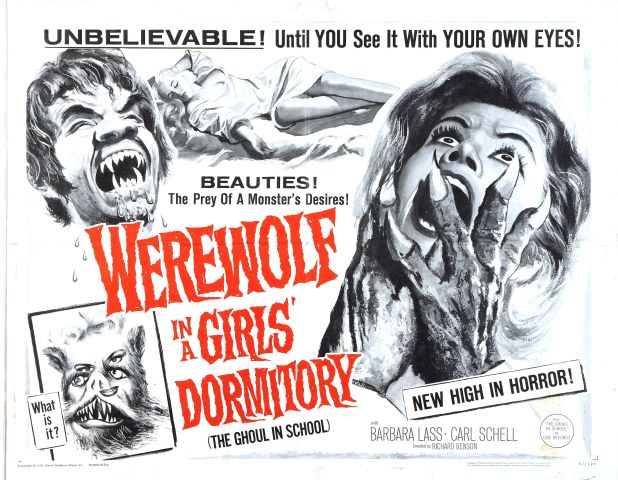
CHILLING CLASSICS MONTH: Werewolf in a Girl’s Dormitory (1961)

This entry was written by Bill Van Ryn, who is behind the amazing Groovy Doom and Drive-In Asylum. Bill knows more about movies than probably anyone I’ve ever met before and teaches me something new every time we talk.

Did you ever wonder what it takes to be a member of law enforcement in a horror movie? If you ever saw the movie Pieces, then you may have questioned why a school that’s being plagued by chainsaw murders would be allowed to carry on business as usual. Seeing as the killer has not been apprehended and the police have no idea who’s doing it, why would the school officials and the police department allow the school to stay open? More importantly, why would students stay there?  The same goes for today’s film, Werewolf In A Girl’s Dormitory, an Italian movie from 1961 originally titled Lycanthropus. It was released with the new title in the US in 1963, on a double bill with Corridors of Blood, and a groovy bubblegum rock and roll jam called “The Ghoul In School” glued onto the titles in hopes of selling it to the young crowd. Check out the track on YouTube if you dare, it’s funny how the lyrics also include the phrase “corridors of blood” to help sell the double feature.

But what of the movie itself? While it’s no classic, it’s not bad for what it is, if you’re willing to ignore the ridiculous aspects of the story. For instance, it’s set in a school for “wayward girls” who all happen to be stunningly beautiful. In addition to the school staying open despite murders occurring there, the students are prone to wandering around outdoors at night, even though there’s a werewolf outside that has already reduced the student body by a few heads. Lead actress Barbara Lass is especially pretty and vulnerable in that European horror heroine kind of way, and the hero actually leaves her alone OUTSIDE the school one night after walking her home. None of these people are behaving as if the threat is legitimate, even though we see enough of the attacks to know that it really is a werewolf.  The identity of this werewolf is a mystery, or at least the filmmakers hope so, with multiple red herrings much in the style of a giallo. The problem is, the herrings are way too red, and once you scratch them all off the list, there is the werewolf. Although there’s not much surprise, there’s a lot of atmosphere.

There’s also an overabundance of characters, making the plot a convoluted tangle. New professor Julian Olcott (handsome Austrian actor Carl Schell) is immediately suspected when his arrival at the isolated school coincides with several mauling deaths of young students. There is a blackmail plot (again similar to a giallo) involving a creepy instructor (Maurice Marsac) who is having liasons with the female students, with a packet of incriminating love letters being the hot item it seems the werewolf will kill to protect (think of the revealing diary from Blood and Black Lace).

It’s sometimes difficult to take a film dubbed into English seriously — not that we should take a film like this too seriously, anyway. But actors who performed an English dub track were sometimes not the best performers, and it’s hard for any of the performances to seem convincing. We’re left with the film’s ability to create atmosphere on a visual level, and this one actually pulls it off. The sets are suitably creepy, including the bleak looking “school”, the outdoor wooded areas, and the black and white cinematography seems to be a lot better than any current transfer of the film reveals. Hopefully one day we’ll get a decent home media rendering of the original film.
CHILLING CLASSICS MONTH: Haunts (1976)

This entry was written by Bill Van Ryn, who is behind the amazing Groovy Doom and Drive-In Asylum. Bill has always been a major inspiration and help when it comes to my love of film, as well as always being awake when I text him at 3 AM to discuss Paul Naschy.

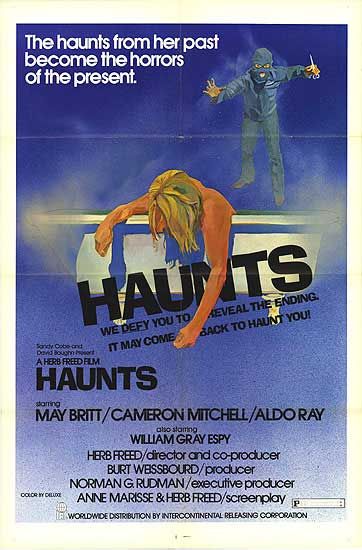
Haunts is one of those low budget films with multiple layers of implications. On the surface, it’s a horror movie about a masked killer stalking a small town for victims, with a female lead who acts as the film’s damsel in distress.

Another dimension unfolds, though, when we realize that the movie is really about the breakdown of the woman’s psyche, seemingly inspired by Roman Polanski’s Repulsion. It gets even deeper when you consider the harrowing performance delivered by lead actress May Britt, who left a promising career in films to raise the children that she had with then-husband Sammy Davis, Jr.

Haunts was made in 1975 (with no theatrical release until 1976) after she’d divorced Davis, and this modest production was part of her attempt to regain the momentum of her acting career. 

Britt plays Ingrid, a woman who has a lonely existence as the solitary proprietor of a small farm in a rural community. Murders start happening in the town, and Ingrid’s paranoia is ramped up to warp factor, especially after she is attacked by the killer. Although she manages to escape, the trauma of the experience triggers memories in her regarding the death of her mother, who committed suicide in a bathtub when Ingrid was very young. The murders also coincide with the presence of Ingrid’s uncle Carl (Cameron Mitchell), who is visiting with her at the farm. Two other possible suspects include a skeezy supermarket bag boy named Frankie (William Grey Espy) and a polite newcomer named Bill (Robert Hippard).  

For better or worse, Haunts is a complicated film where everything is not spelled out for the viewer. The hallucinatory editing style gives us symbolic inserts that cut in on the action. For instance, Ingrid is plagued by memories of sexual abuse, and there are brief moments where we see an adult male touching her suggestively as she sits on his lap, and these are intercut with a scene where she milks a goat. Yeah, it’s that kind of movie. Also, like Repulsion, it’s filled with moments that we come to realize were not reality at all, but rather things that Ingrid imagined as she began to break down mentally. The low budget regional aspect of the production, however, reminds me more of S.F. Brownrigg’s Keep My Grave Open, which is very close to Haunts in terms of its tone, as well as certain aspects of its plot (an isolated woman’s sanity unravels, an entire character may or may not have been completely imagined by the heroine, a murderer who stabs people, complex family relationships involving incest).

Director Herb Freed (Graduation Day, Beyond Evil) keeps the film engaging, although it does suffer from some strange pacing problems. The most notable is the abrupt climax that arrives about 15 minutes before the movie ends, and the remainder of the film is devoted to explanations that somehow fail to answer all of our questions. May Britt was an unusual choice to play the lead in this film, although it’s not a negative in the least. It’s a little jarring to hear her foreign accent among actors who are playing characters in a small American town, but it adds an unusual quality to Haunts; imagine your favorite European horror film relocated to a small rural American community, add some ultra 70s décor and attitudes, and you begin to get the picture. The bizarre qualities of the story are quite unexpected, especially the matter-of-fact references to unsavory subjects like rape, incest and the sexual abuse of minors. I also have to mention that somehow there was enough money in the budget here to commission a score by none other than Pino Donaggio, although this was very early in his career, so maybe his fee wasn’t quite so high.

CHILLING CLASSICS MONTH: Naked Massacre (1976)

Thanks to Jennifer Upton for contributing this review. An American living in London, she is a freelance writer for international publishers Story Terrace and others. In addition, she has a blog where she frequently writes about horror and sci-fi called Womanycom.

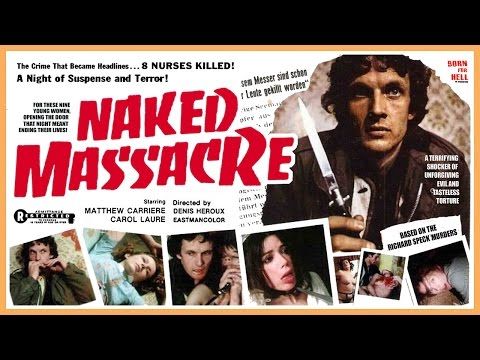
Originally (and more appropriately) titled Born For Hell, Naked Massacre is an overlooked diamond in the rough. Released the same year as Taxi Driver (1976) it explores similar themes in its exploration of the life a traumatized Vietnam Vet driven to violence. The plot revolves around an American named Cain played by German actor Matthieu Carrière who has just left one war and – likely suffering from PTSD – lands smack in the middle of another on his way home. An international co-production between Ireland, Canada, Italy and Germany; production took place in Belfast, Northern Ireland during the Troubles, an ethno-nationalist conflict happening at that time.

French-Canadian Director Denis Heroux makes the most of the war-torn location. Shot like a documentary, the roving camera explores the cold, dreary backdrop of boarded up shops and empty streets. The film features real soldiers and actual bomb sites. Given the amount of actual violence happening at that time in history, it is amazing that a film crew was granted permission to shoot there at all let alone stage a fake explosion in a church.

It is heavily implied through close-ups of anti-violence posters, street tags painted in blood red praising the IRA and reports blaring away on the Television of reports of terrorism in the Middle East that Cain’s constant exposure to humanity’s cruelties are the impetus for his crimes. No matter where he travels next it will be the same story. He is a lost man both literally and figuratively. He is stranded, unable to find transport home. He has little money, is not allowed to work and is therefore forced to stay in a homeless shelter. He is traumatized by his experiences in Vietnam and no longer able to perform sexually as evidenced by an awkward encounter with a prostitute. With no recourse to help for his deteriorating mental condition, he eventually gives in to his impulses culminating in the murder of eight student nurses living together in a shared house. It is here where the film draws much inspiration from the 1966 Richard Speck case. Similarly, none of the women make the slightest attempt to fight back against their aggressor, despite their advantage in number. As was also true in the real case, each nurse is systematically isolated from the group, tortured and killed and only one girl survives by hiding under a bed who alert the police to Cain’s identifying “Born To Hell” tattoo on his left arm.

In the conclusion, Cain is caught while receiving medical treatment for attempting suicide in a dirty public toilet. The film ends with a slide show of the faces of the murdered girls in stark black and white.

Although the last act is similar in tone to the similar Last House On the Left (1972) and its imitators Night Train Murders (1975) and House On The Edge Of The Park (1980), Naked Massacre is not as gory or explicit in its sexual violence. The most blood we see is when Cain tries to open up his own vein rather than that of a victim. Comparatively, Massacre’s subtext is deeper than those titles made so partially by its international cast. Each victim is from a different country. They are all played by actresses from a different place and dubbed with the correct corresponding accent. Their abuser Cain is an American abroad, who terrorizes and slaughters them one by one.

Whether the director was attempting to deliberately portray America as the worst of all invading criminals in a world of violent offenders remains almost irrelevant in the face of the feeling left with the viewer. Each murder is incredibly intimate and yet impersonal all at once. It is perhaps not as powerful as the other films mentioned in this review but it is nonetheless worthy of a look, particularly for fans of this sub-genre.

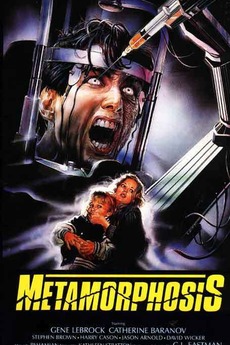
CHILLING CLASSICS MONTH: Metamorphosis (1990)

You know what I miss? Italian ripoffs of successful movies. They just don’t seem to happen anymore. Like this — obviously, it’s The Fly, but takes plenty of twists and turns. And oh yes — it’s directed by B&S About Movies favorite George Eastman!

Gene LeBrock (Father Peter from La Casa 5/Beyond Darknessplays Dr. Peter Houseman, a young scientist who just doesn’t get along with the older scientists at his university. His ideas are just a bit too crazy. One of those ideas is injecting himself with his own formula for reversing the effects of aging. That action causes him to undergo a Dr. Jeckyl and Mr. Hyde syndrome, along with his body falling apart.

He also has all sorts of women problems, from dating a fellow scientist with a young kid to a student who won’t stop teasing him in class and even a mystery girl that he only sees in flashbacks. And oh hey – is that Laura Gemser as a prostitute? It is!

Then, as things happen, he starts to turn into a lizard and kills people. Say no more, you know?

As this was made at the end of the Italian horror movie era, the effects are as minimal as the budget. There are some good ideas, some interesting moments and enough violence to keep things from getting too boring. And hey, it has a needle to the eye, so I’m certain that Fulci was pleased.

Trivia note: In Spain, this movie was called Re-Animator 2.

You can grab this on the Mill Creek Chilling Classics set (which is a bargain packed with bad transfers and plenty of great films that we’ve been covering all month), watch it for free on Amazon Prime or buy a much better quality copy from Shout! Factory.

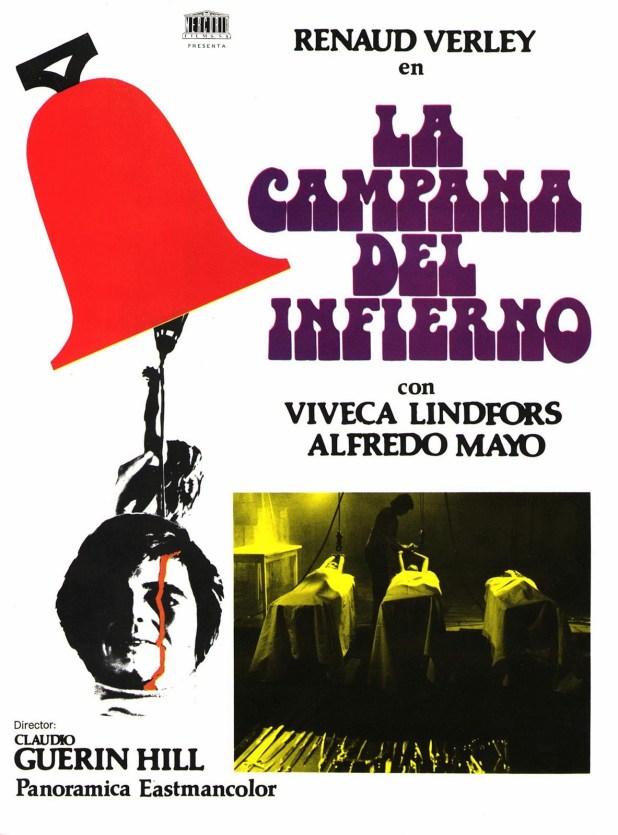
CHILLING CLASSICS MONTH: A Bell from Hell (1973)

What happens when a young man is released from an insane asylum and returns home? Well, he goes for revenge on his aunt and her three daughters, the ones who stole his insurance when they claimed he had gone crazy.

This is another part of the Avco Embassy’s Nightmare Theater package syndicated for television in 1975. The others are MartaDeath Smiles on a Murderer, Maniac MansionNight of the SorcerersFury of the Wolfman, Hatchet for the HoneymoonHorror Rises from the TombDear Dead DelilahDoomwatchWitches Mountain, Mummy’s Revenge and The Witch).

Bell from Hell isn’t an easy watch. It’s dreamy at times, brutally realistic at others, particularly the slaughterhouse scene. Juan wants revenge against Marta (Viveca Lindfors, Creepshow) and her three daughters (as well as anyone connected with them), but there are times when he could easily kill them and he lets them escape. A good chunk of this movie feels thrown together. But there’s a reason.

Director Claudio Guerín fell — or jumped — from the tower housing the title bell on the last day of shooting and was killed. The film was completed by Juan Antonio Bardem. One assumes that Bardem did the best job he could to combine all the many parts that Guerín into some whole. Throw in the fact that this movie is translated from Spanish to English and you get a swirling dervish of confusion.

Unknown

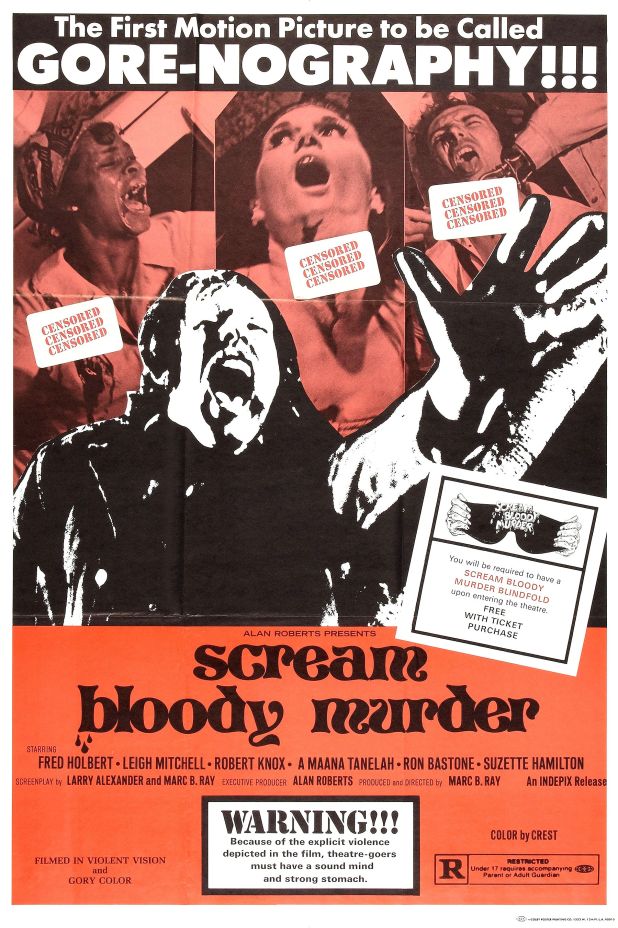
CHILLING CLASSICS MONTH: Scream Bloody Murder (1973)

As Matthew watches his father work on a tractor, he decides to turn it on and kill him with it, all at the cost of his own left hand. Yes, we’re not even at the credits yet and Scream Bloody Murder — the first motion picture to be called gore-nography! — is already insane.

Matthew grows up in a psychiatric hospital with a hook for a hand, returning home at the age of eighteen to live with his mother and her new husband, Mack Parsons. In addition to killing his father, Matthew might hate sex but wants to fuck his mother. He does the logical thing here and kills Parsons with an axe and shoves his mother to the ground and kills her when her head hits a rock. We’re about ten minutes into this movie, mind you.

Our hero takes a ride with a young couple, but soon, he’s seeing them as his mother and Parsons, screaming, “Don’t touch her!” and beating the man to death with a rock and drowning the woman. This movie feels less like a movie and more I am watching maniacs actually film their insane activities. And then the voices of his mom and new dad chase him everywhere!

Finally, Matthew makes it to town where he meets Vera, a painter and prostitute. He falls in love with her to the kind of degree that I would when it came to mean girls who smoked gloves and had asymmetrical haircuts in the early 1990’s. Except instead of making them mixtapes and doing their homework, Matthew is slicing the throat of one of her johns and violently taking over a mansion. Yes, he uses a pillow to kill the owner, a cleaver to kill the maid and even cuts off a dog’s head! Matthew!

Matthew then brings Vera to his new home, but she refuses to live there, so he takes her prisoner. Even when he gives her the life of her dreams and the chance to be an artist, she doesn’t want to stay.

Soon, a doctor comes to visit (Angus Scrimm!) but Matthew kills him. Vera is stuck inside with a killer, but she realizes that he’s disgusted by sex. She convinces him to let her take a bath and then tries to make him have sex with her. He starts to freak out and turns his head. She stabs him, but he survives and soon chases her down before cutting her throat with his hook.

With his love now dead, Matthew goes completely off — everything before was just a test, obviously — and runs through town, followed by the voices and phantom states of his victims as they lure him to his fate. He’s also followed by some swinging horns, baby! Everything descends into psychedelics, aided and abetted by the kind of horrible transfer that you know and love from your friends at Mill Creek. I don’t care! I don’t need a perfect blu-ray or 4K transfer to love the end of this movie! Dig that dolly roll back from the altar! Now that’s a shot!

Writer/director Marc B. Ray also wrote Stepfather 3, as well as an episode of Kids Incorporated, featuring Martika, Fergie and Jeff “Chunk from The Goonies” Cohen and Mario Lopez, and the 1970’s New Mickey Mouse Club, with Lisa Whelchel of TV’s Facts of Life. And co-writer Larry Alexander worked on plenty of 70’s TV, like Lucan and The Super Mario Super Show. None of this kid fare will prepare you for this movie.

This is one bizarre, dark and downright strange movie. It’s nearly an art film, filled with meanness toward the world and nearly everyone in it is murdered — horribly — for no reason at all. Actually, it’s too poorly shot to be an art film, but I wonder how audiences reacted to this upon watching it at the drive-in. There’s no real escape valve or comedy relief. It’s just unrepentant nihilism. In fact, it gets so dark that one wonders if it goes so far that it becomes comedic.

Also known as Claw of Terror, Captive Female and Matthew, this is yet another part of the Chilling Classics box set, which is equally packed with bad quality and great surprises.

You can watch the whole thing here:

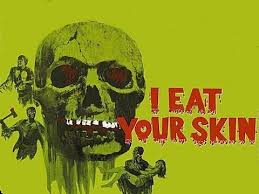
CHILLING CLASSICS MONTH: I Eat Your Skin (1971, but really 1964)

The only reason anyone knows this movie is because of Jerry Gross. He bought it, paired it on a double feature with I Drink Your Blood and renamed it from Zombies to I Eat Your Skin and made this amazing trailer and double poster.

These two movies have nothing in common. I Drink Your Skin is a certified classic of the drive-in while this is a messy black and white film where a writer heads to a Carribean island looking to research voodoo for his next book. Then he meets a mad scientist who is trying to stop aging and hijinks ensue.

This sat on the shelf for six years and you can see why when watching it. Director Del Tenney is also responsible for The Horror of Party Beach, so that should explain so much about this one.

I can only wonder what order these two films played in. Would this be a good comedown from the acid lunacy of its tag partner? Or would the boredom of this one serve as absolutely no preparation for the bloodlust that was to soon follow? One wonders.

This is yet another in the unending stack of evidence that I continually present to Becca as reasons that I will never take a cruise or an island vacation. No one is taking me to the Green Inferno!

While patently ridiculous, the end of this film does pick up some steam, with a lengthy twerking exhibition/voodoo ritual. There’s also a great moment where a zombie carries a box labelled explosives into the prop of the escape plane, grounding our remaining heroes. And I kind of love that the writer hero of this one starts and ends the movie reading love scenes passages from the purple prose he writes to an enraptured audience of bikini clad women. And this is the guy I’m supposed to be rooting for?

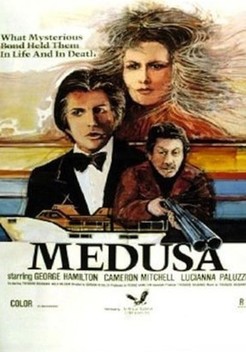
CHILLING CLASSICS MONTH: Medusa (1973)

In Greece, a stewardess is murdered by a masked maniac, with the authorities feeling like it can only be one of two people: a drunken American playboy (George Hamilton) and a murderous gangster (Cameron Mitchell). Yes, the Mill Creek Chilling Classics set really knows how to give you quite the mix of films!

According to screenwriter Christopher Wicking, this film was only made because George Hamilton was willing to do it. He was about to marry Alana Stewart (she’s in the film in a small role) and he figured it was the chance to have a great honeymoon with all expenses paid, as well as an acting salary.

As for the film that emerged, well…it tries to be a giallo yet has none of the trademark verve and energy of that genre. It does have Luciana Paluzzi from The Green Slime as Harrison’s incestuous sister. So it has that going for it.

Man, I usually love Gordon Hessler’s films, like Scream, Pretty Peggy and Sho Kosugi’s Pray for Death. But this film plods like no other film has plodded before. It’s hour and thirty-nine minute running time may as well be three years and nine months.

I guess I can honestly say that this is both the best and worst George Hamilton vanity project that I’ve ever seen.

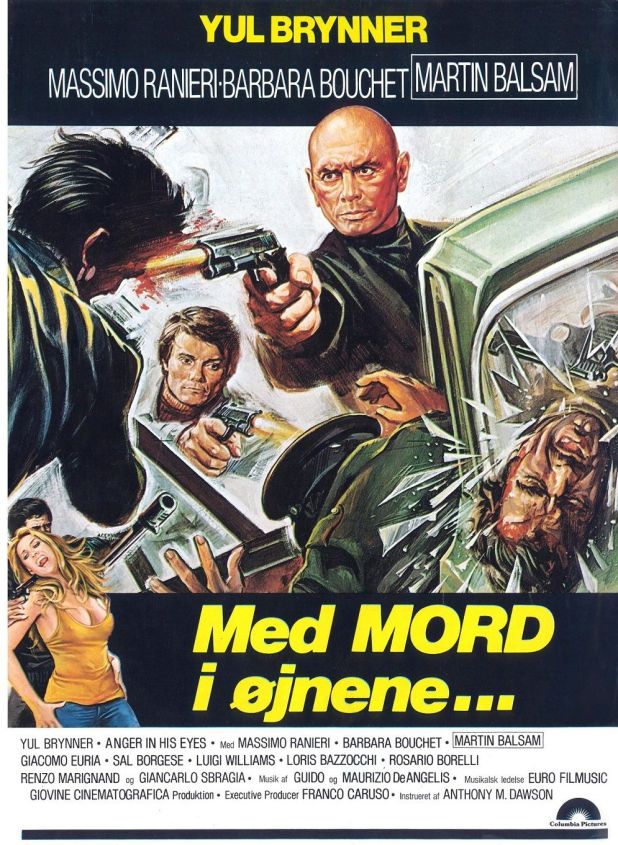
CHILLING CLASSICS MONTH: Death Rage (1976)

Before he totally devoted himself solely to the stage, Yul Brynner made one final film. This was it. It’s also known as Anger In His Eyes and feels completely out of place on the Chilling Classics box set.

Shenanigans at a horse track lead to an American mafia plater being killed in Naples. They bring Peter Marciani (Brynner) out of retirement to get revenge, which he’s all too happy to do once he finds out that the killers were behind his brother’s murder. Of course, there are plenty of doublecrosses along the way.

Need a better reason to watch this? Barbara Bouchet (The Red Queen Kills Seven TimesAmuck!Don’t Torture a Duckling) plays love interest and exotic dancer Anny. And Martin Balsam — for the ladies!!!

I’ll do you one better — it’s directed by Antonio Margheriti, who directed Yor, Hunter from the Future. There are some interesting touches like how Marciani literally sees red when he thinks of his brother.

Interestingly enough — maybe more so than this movie, a Eurocrime mob revenge film — Bouchet was horrified at Brynner’s treatment of the crew, so she sent him a bouquet of carnations, a flower he was extremely phobic about being exposed to. Did he get that phobia from acting in the TV movie Flowers from a Stranger, where that was the entire plot of the film? I can’t find anything else about it, but that seems like such a weird thing to be upset about. I do know that Bouchet told this story in person when Death Rage played the Beverly Cinema during Quentin Tarantino’s first all-grindhouse-classic month in 2007.

Want a copy for yourself? Cult Action is the place to go.

CHILLING CLASSICS MONTH: Maniac Mansion (1972)

I love Mill Creek multipacks. Sure, the quality is abysmal at times. Often, you get the same films on multiple sets. And you get bad dubs. But let’s face it — often you can find these sets used for $5 or less and you get up to 50 amazing films. That inspired me to spend the month of November gathering some of my favorite writers and fans of the site to tackle the Chilling Classics box set.

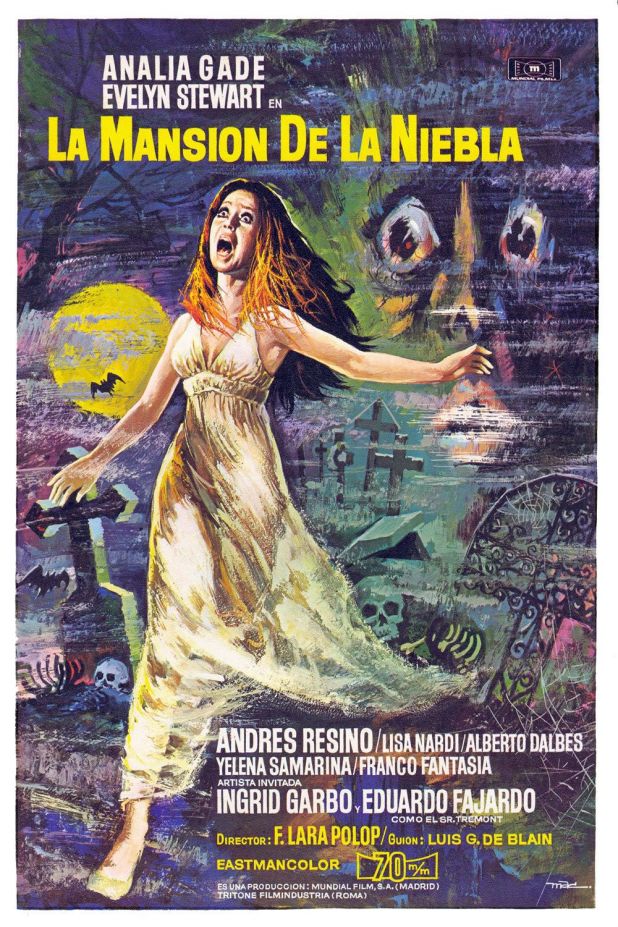
Originally released as La Mansion de la Niebla (The Mansion in the Fog) and also known as Murder Mansion, this Spanish/Italian film fuses old school haunted house horror with the then new school form of the giallo.

The plot concerns a variety of people drawn to a house in the fog, so the original title was pretty much correct. There are plenty of European stars to enjoy, like Ida Galli, who also uses the name Evelyn Stewart and appeared in Fulci’s The Psychic as well as The Sweet Body of Deborah. And hey, there’s Analía Gadé from The Fox with the Velvet Tail. Hello, George Rigaud, from All the Colors of the Dark and The Case of the Bloody Iris! They’re all here in a movie that seems to make little or no sense and then gets even more bonkers as time goes on.

This was one of the 13 titles included in Avco Embassy’s Nightmare Theater package syndicated in 1975 (the others were MartaDeath Smiles on a MurdererNight of the SorcerersFury of the Wolfman, Hatchet for the HoneymoonHorror Rises from the TombDear Dead Delilah, DoomwatchBell from HellWitches MountainMummy’s Revenge and The Witch). How did these movies play on regular TV?

There’s a history of vampires in the house, the previous owner was a witch and hey — this is starting to feel like an adult version of Scooby Doo with better-looking ladies. That’s not a bad thing. But if you’ve never watched a badly dubbed giallo-esque film before, don’t expect any of this to make a lick of sense.

Don’t want to buy the whole box set? This is playing for free on Amazon Prime.