Slaughter Hotel (1968)

How can you pass up an Italian Giallo written and directed by the man whose pen ignited the spaghetti western genre with his screenplays for Clint Eastwood’s A Fistful of Dollars and For a Few Dollars More?

How about if that film starred Klaus Kinski?

Yeah, I knew that get your attention. But we’re all horny here, so you also get Margaret Lee from Double Face, Dick Smart 2.007 and Special Agent Super Dragon, and Lady Frankenstein herself, Rosabla Neri. (Huba-huba! Schwing!)

Fernando Di Leo’s original goal was to transition out of westerns into his preferred genre of film noir. But as the black-and-white film noir of old already gave way to the yellow blood of new, Di Leo ended up writing and directing this giallo about a cowl and caped murder stalking the wealthy female inmates of a sanitarium.

Of course, all of the women are diagnosed as nymphomaniacs (and in need of a triangle-of-death shave . . . if you know what I mean), so they’re seducing the staff—everyone from the isolated villa’s gardener to the doctors. And since we’re in a remote medieval villa converted into a hospital, the joint is well-stocked with weapons of mass giallo on the walls and along the hallways. And the heads fly by scythe, bodies are impaled by iron maiden, and nurses are hacked to pieces by axe, by mace, by bow-and-arrow, and bye-bye in quick succession.

In between the blood baths, there’s plenty o’ soft core red herrings of the lesbian interracial variety flipping and flopping; the women—as with all giallos—would turn a gay man straight and leave a straight man shriveled. Are they all attired in designer sun dresses, pant suits and chunky heels—running around in the grass? Of course they are! (Hey, Paul Naschy!) And did you know any variety of phobias can be cured with a nude massage of one’s butt cheeks? That a nurse bubble-bathing a female patient is just what the doctor ordered?

This was known in its homeland as The Beast Kills in Cold Blood, aka Cold Blooded Beast. But once the U.S distributors Hallmark Releasing and American International Pictures took their puritanical scissors to it, it was retitled as Asylum Erotica and Slaughter Hotel to play as the undercard on numerous Drive-In triple bills until the late-70s. The most explicit and obscure cut—The Dissatisfied Erotic Dolls of Dr. Hitchcock—was a bogus attempt to market it as a sequel to Riccardo Freda’s 1962 burgeoning giallo The Horrible Doctor Hitchcock—and features even more sexually explicit scenes added after the fact (as if it need more?).

If Di Leo stuck to the genre, today he’d be revered as Argento and Bava: the cinematography is lush, the shots are imaginative, and the soundtrack is acid trip, nausea-inducing top notch. And Di Leo certainly knows how to put the “sleaze” in Eurosleaze with those multiple, long and lingering triangle of death shots. And the “artsy” Richard Speck-style slaughter at the end has to be seen to be believed. Yikies.

If you want this on DVD for your collection, your best bet is to go with the uncut, Italian subtitled (or dubbed; it’s well done) version that runs at 97 minutes—and avoid the 74-minute U.S. versions at all costs. The even dirtier “Dr. Hitchcock” version is all but lost. You can watch a really clean print of the 97-minute version for free as an age-restricted stream (you’ll have to sign in) on You Tube. To say it’s X-Rated is an understatement. But the Italians made this—so it’s “art.”

About the Author: You can read the music and film reviews of R.D Francis on Medium and learn more about his work on Facebook. He also writes for B&S About Movies.

Double Face (1968)

Klaus Kinski starring in a Riccardo Freda movie: I’m all in. I picked this one up in a ravenous impulse-buying frenzy from the now defunct, and sorely missed, grey market auteur VSOM (Video Search of Miami), as it was the only way to get most of these Euro-Giallo gems.

German Krimi films, a crime thriller sub-genre of film popular in the 1960s, gets an Italian giallo makeover with Riccardo Freda (1962’s The Horrible Doctor Hitchcock and 1963’s The Ghost) directing a script by Lucio Fulci (1971’s A Lizard in a Woman’s Skin, 1972’s Don’t Torture a Duckling), which he adapted from one of several of Britain’s Edgar Wallace novels (Massimo Dallamono’s What Have You Done to Solange? and Umberto Lenzi’s Seven Blood Stained Orchids are Wallace novel adaptations). Being Euro co-production, this carried two titles: in Germany as Das Gesicht im Dunkeln, aka The Face in the Dark, and A doppia faccia, aka Double Face in Italy and the rest of Europe, with the Italian title adopted for its U.S Drive-In undercard release.

This is one of those films where everyone is sleeping with everybody else. In this case, Klaus Kinski’s rich industrialist is carrying on an affair with his secretary; meanwhile, his wife Helen (British actress Margaret Lee; they both starred in 1971’s Slaughter Hotel) openly flaunts her lesbian affair with Liz (the heart stopping Annabella Incontrera (the Matt Helm entry The Ambushers, Black Belly of the Tarantula, The Case of the Bloody Iris).

Then the ubiquitous POV black gloves tinkers with Helen’s car—and she dies in a fiery accident. And as in the Freda’s The Horrible Doctor Hitchcock: Kinksi comes to discover his wife may not be dead.

But how?

Well, his new fling, a pretty, mod-swingin’ chick (Christiane Krüger; 1969’s De Sade with Keir Dullea) takes him to porn theatre showing a film starring herself and Kinski’s dead wife—and the film was made after her death. Together they search for the answers surrounding his wife’s death—and the evidence points to Kinski’s industrialist. Did he do it?

Arrow did this film right with a Blu-ray released in June last year, which is easily available in the online marketplace.

You can watch this for free on You Tube.

About the Author: You can read the music and film reviews of R.D Francis on Medium and learn more about his work on Facebook. He also writes for B&S About Movies.

A Black Veil For Lisa (1968)

And it’s back to the spaghetti western lands once again, as we visit Massimo Dallamona, the cinematographer from for Clint Eastwood’s A Fistful of Dollars and For a Few Dollars More—which were scripted by Fernando Di Leo, who wrote and directed his own giallo flick, Slaughter Hotel (1971).

However, unlike Di Leo, Dallamona stuck with the genre, also bringing us Venus in Furs (1969), What Have You Done to Done to Solange? (1972), What Have They Done to Your Daughters? (1974; a poliziottesco-giallo hybrid), and The Cursed Medallion (1975; which rips The Exorcist, as well). At that point, Clint Eastwood and Charles Bronson ignited the Italy’s burgeoning poliziottesco genre, and Dallamona brought us Super Bitch (1973) and Colt 38 Special Squad (1976). His final film was the Italian-German-Spanish giallo co-production, Rings of Fear (1978), posthumously released after his 1976 death.

As with Rings of Fear, A Black Veil for Lisa was also a West German co-production (German cinema was attempting, like Spain, to get in on the giallo craze as the krimi genre was fading away; so they imported Italian directors to Hamburg). Esteemed British actor John Mills—who was far beyond his prime in the ‘30s and ‘40s and, like most older and forgotten actors, moved into giallo—was imported as well.

He’s Franz Bulon, a jealous, controlling German narcotics detective who married one of his previous collars (Va-va-voom! It’s flame-maned Luciana Paluzzi, aka SPECTRE assassin Fiona Volpe from Thunderball). When he collars Max Lindt (Robert Hoffman from 1974’s Spasmo and the 1978 “sci-fi” giallo, Eyes Behind the Stars), an assassin hired by a drug-lord behind the serial murders of rival drug dealers, instead of arresting Max, the old bastard blackmails him to kill his philandering, young wife.

Yeah, this plan’s going to work just find, Inspector Gadget.

This one has it all. It puts the “trash” in Eurotrash. It’s morbid. It’s erotic. But it’s not as graphic or sexual as we might prefer in our gialli. Thus, this is a bit more to the side of film-noir, as the giallo genre was not yet fully realized with Mario Bava’s Bay of Blood. And everyone is screwin’ everybody—figurative and literally, which we like in our gialli and film noir. And, since Dallamona came out the cinematograph realm, this film looks sharper than shard of glass, with lots of stylized, colorful angles. The acting across all fronts is excellent.

Known by Euro-audiences as La morte non ha sesso, aka Death Has No Sex, this is out in the U.S. marketplace as a legit Blu-ray/DVD via Olive Films, whose catalog deals mostly in rare and deep Euro-obscurities. Olive’s valiant efforts to retain obscure gems like this for posterity—giving us something beyond worn out VHS tapes and hazy-streaming rips made from VHS-taped UHF-TV (and severely edited, natch) showings—is greatly appreciated.

You can find the DVD and Blus at Best Buy and Walmart and a wide variety of online market outlets. But we found two, okay free VHS rips on You Tube HERE and HERE.

About the Author: You can read the music and film reviews of R.D Francis on Medium and learn more about his work on Facebook. He also writes for B&S About Movies.

Seven Deaths in the Cat’s Eye (1973)

The divine Mr. Anthony M. Dawson, aka Antonio Margheriti, is back with his third giallo flick (this one’s an Italian-French-West German co-production), the others being (the previously reviewed) Nude, She Dies, and 1971’s Web of the Spider (but discriminating gialli connoisseurs will argue that’s more of a straight horror film because it’s color remake of Tony’s own film, 1964’s Castle of Blood. But that’s another review-debate for another time).

Jane Birken (be still my beating heart) (of Michelangelo Antonioni’s Blow Up, Jack Smight’s (Damnation Alley) Kaleidoscope, and the 1973 Christopher Lee-starring British horror Dark Places) stars as Corringa MacGrieff . . . in a film you’d swore was made by Dario Argento, as we’ve got a POV murderer with a straight razor, we’ve got a secluded castle in the Scottish highlands, we’ve got a dungeon, we’ve got a cat, and . . . an orangutan (it’s all about the seclusion, and the animals and insects in gialli).

(And are we plot-spoiling by telling you that seven people die . . . and the ginger cat creeping around the dank castle sees it all? Yeah, and the orangutan gets around—but Seven Death’s in the Orangutan’s Eye sounds stupid.)

So Birken is the ubiquitous bad girl expelled from another Catholic school. And she returns to Dragonstone Castle where she used to spend her summers. At the castle she reunites with her mother Alicia (Dana Ghia of Massimo Dallamona’s The Night Child) who’s doting over her sister, Corringa’s Aunt Mary, the penniless owner of Dragonstone. And like any Agatha Christie novel, we have a full house, with headshrinker Dr. Franz (Anton Diffring of The Beast Must Die and Circus of Horrors) and Father Robinson, the live-in priest (Venantino Venantini of City of the Living Dead), Suzanne, the French teacher (bisexual, natch) (Doris Kunstmann of 1997’s Austrian-made Funny Games), and Corringa’s nutty cousin Lord James MacGrieff (Hiram Keller of Fellini Satyricon) and the Lord’s pet orangutan.

Hey, shouldn’t there be a creepy gardener/groundkeeper? Yep, there is: Angus (Luciano Pigozzi of Blood and Black Lace).

Of course, the Doc is there to take care of crazy James, but also to boink Aunt Mary, and Suzanne—who, in turn, has eyes for Corringa. So while the sisters argue over the family’s money and estate, Alicia is murdered. Then there’s another murder. And the local townsfolk fear a vampire is on the loose: for when a MacGrieff kills another MacGrieff, that victim turns into a vampire—so says the “legend.”

If you’ve watched a lot of Italian horror films—and you know the frugalness of the Italian film industry, where nothing goes wasted—you’ll notice the castle exteriors are the same exteriors from Mario Bava’s Black Sunday and the lush castle interiors from The Whip and the Body. And if it all sounds plot recycling from Margheriti’s own Castle of Blood and The Virgin on Nuremberg, it probably is.

One may argue Seven Deaths in the Cat’s Eye is more British gothic than Italian giallo because it lacks spectacular kills, but the lush cinematography and stylized shots we love in our gialli, is there in spades.

You can (if you’re a member) watch a pristine, ad free and uncut stream on Shudder. The DVDs and Blus (on the Blue Underground and 88 Films labels) are all over the brick-and-mortar and online marketplace, easily picked up at your local Best Buy and Walmart. But, hey, times are tight in these virus days, so we found a two, free rips to enjoy for free on You Tube HERE and HERE. You can purchase the uncut, uncensored and fully restored film from original European vault materials at Blue Underground.

About the Author: You can read the music and film reviews of R.D Francis on Medium and learn more about his work on Facebook. He also writes for B&S About Movies.

Dumplings/Gau ji (2004)

Fruit Chan’s Dumplings is a masterpiece. It is also a film not for the faint of heart.

If you cringed when you watched Pier Paolo Pasolini’s final film, 1975’s Salo, the 120 Days of Sodom . . . if you experienced a case of vomit reflux at Tom Six’s The Human Centipede . . . this statement on how far one will steep into the Seven Deadly Sin for their own personal gain . . . well, there’s no cup of rice tea that will sooth your soul or stomach.

Written by multi-award winning and Oscar-nominated writer Lillian Lee (aka Pik Wah Lee) of 1993’s Fairwell My Concubine fame, Dumplings is a film that’s incorrectly lumped in with the J-Horror cycle. And it’s a film that will forever remain untouched by the American obsession to remake all things J-Horror to a lesser and lesser effect. There’s never going to be an Aunt Mei cycle of films competing with tales of Toshio (Ju-On, aka The Grudge) and Sadako (Ringu, aka The Ring). There’s no way to boil this this graphic-filled dough ball into a good ol’ red, white & blue banality snack, homogenized for the post-Saw “Hard-R” marketplace.

I’ve lost many a film geek debates analogizing the Hong Kong-boiled Dumplings as a neo-giallo film. But this is my film review and I hereby christen this film as Asian Giallo. For if Dario Argento was in his “Animal” and “Three Mothers” trilogy prime—today—and not creating films in the puritanical ’70s, Argento—and not Lillian Lee—would have created Aunt Mei’s ersatz Erzsébet Báthory, the 17th century Countess of Transylvania who created a personal youth elixir from the blood of virgins. (Then Maestro Dario would have screwed it up with some over-the-top volumed Iron Maiden tunes, then blamed the bloody hijinks on a monkey with a straight razor.)

Mrs. Li (multi-award winning actress and musician Miriam Yeung) is a former actress pushed to the limits of vanity by her vain, wealthy husband in an affair with his maseuse. To save her marriage, she seeks the services of Aunt Mei (Bai Ling, Southland Tales), an underground chef famous for her rejuvenating dumplings—and the secret ingredient is more than just blood.

And we’ll just leave it at that.

You can watch the short version of “Dumplings” as part of the Three . . . Extremes anthology on Shudder, but there’s a free-with-ads stream on FShareTV. You can stream the feature film version of Dumplings on Shudder. But if you’re not a Shudder member, you can watch 11 clips from the film that will give your the full story arc, courtesy of Movie Clips on You Tube.

This a must watch and must have for any horror movie hound’s collection. And it’s a giallo . . . damn it!

Update, November 2020: Bai Ling and Fruit Chan are back together — in a familiarly-themed film — in the 2019 Cantonese-Mardarin language drama The Abortionist. Nominated in the “Leading Actress” and “Best Director” categories for this year’s Golden Horse Awards held in Taiwan (in November), Ling stars as a Tai chi teacher with a secret life as a black-market abortionist. You’ll remember Ling won dual “Best Supporting Actress” awards at the Hong Kong Film Awards and Golden Horse Awards for Dumplings, Chan’s segment of the Three Extremes omnibus, in 2004.

Hopefully, Ling and Chan will win in their respective categories, which will encourage an American distributor to release The Abortionist in the Western-domestic marketplace. At the very lest, we’ll hopefully be able to see The Abortionist on the free-with-ads stream Tubi TV platform, which afforded us the opportunity to discover and enjoy the recent Asian-imports Daughter and 0.0 MHz. We’ve also recently reviewed Ling’s work in the fun retro, genre mash-up Exorcism at 60,000 Feet.

About the Author: You can read the music and film reviews of R.D Francis on Medium and learn more about his work on Facebook. He also writes for B&S About Movies.

Symptoms (1974)

Here’s another film that, like Antonio Margheriti 1971’s Web of the Spider, is open for the giallo vs. British horror debate. It’s a U.K. production, with some assistance from Belgium and Spain, shot at Britain’s famed Pinewood Studios—with nary a Spaniard or Italian in the British cast headed by Donald Pleasence’s (Phenomena) daughter, Angela.

Watch the trailer.

But our illustrious director here is Spain’s José Ramón Larraz, who’s best known for the 1974 lesbian vampire romp Vampyres, and who we’ve droned on about in our reviews of his Estigma, and in our Spanish horror reviews of León Klimovsky of The Vampires Night Orgy and Paul Naschy’s Horror Rises from the Tomb, Panic Beats, and The People Who Own the Dark.

And the “it’s not a giallo” argument also applies to Larraz’s directorial debut, 1970’s Whirlpool and his 1971 follow up, Deviation, which are considered as Hitchcockian erotic thrillers (rife with lesbianism, natch) that lean towards the bloodless psychological.

As for myself: Yes, Symptoms is a bit more restrained and subtle, but it’s stocked with all the gialli character-prototypes, it keeps you guessing, has exquisite cinematography, and packs a punch at times; so I approach Larraz’s sixth film as a Spanish giallo variant of Roman Polanksi’s Repulsion—much more so than an Amicus-styled horror (which are more implied “shock scares” than violent).

Pleasance’s Helen Ramsey returns to the U.K after an extended time abroad in Switzerland and reconnects with her old writer-friend Anne Weston (Scottish actress Lorna Heilbron of The Creeping Flesh with Peter Cushing and Christopher Lee) and invites her to spend the weekend at her family’s remote, dilapidated forest estate—complete with a swampy lake where someone once drowned. Of course, there’s “something” wrong at the estate—and “something” with Helen (e.g., she has a solitary “erotic moment” of pleasure as she stands at a creepy attic door; a swampy boat ride arouses her), and Anne begins to experience the same voices and moving shadows as Helen. When the estate’s creepy handyman (isn’t there always one in these films) discovers Cora’s corpse—the manor’s “previous house guest” that caused Helen’s extended “vacation” abroad—she goes off the deep end (or does she?) and more people die.


The DVDs and Blus for Symptoms are easy to find—but know your regions. Mondo Macabro released it for the first time in both formats in 2016, while the British Film Institute put out their own versions that same year. But we found you a free rip for you to enjoy on You Tube.

We’ve since done a week-long tribute to José Ramón Larraz’s works in July 2022 — including a second take on this film. Yeah, we love him!

About the Author: You can read the music and film reviews of R.D Francis on Medium and learn more about his work on Facebook. He also writes for B&S About Movies.

Anguish (1987)

This sixth directing effort and second English language film intended for the American market by Spain’s Bigas Luna is mistakenly dismissed as a Spanish giallo ripoff of Demons (1985).

In reality, Luna wasn’t inspired by that Lamberto Bava and Dario Argento co-production: he was inspired “The Sandman,” an 1816 German short story by E.T.A Hoffman, which appeared in his book Die Nachtstucke, aka The Night Pieces. The story moves from a subjective-objective-subjective narrative across three stories-within-stories by way of three letters regarding a protagonist trapped in a world of hallucinations and reality, as he deals with his childhood-based post-traumatic stress regarding the horrific tales of “The Sandman”—who was said to steal the eyes of children.

All the eyes of the city will be ours.”
—Mother Alice Pressman

And “The Sandman” in Luna’s interpretation, Mother Pressman, was almost portrayed by Betty Davis (Burnt Offerings). Could you imagine a ten-time nominated and two-time Oscar winning actress chanting this other classic line from the film?

“For years you were like a snail, hiding, happy. Hiding, happy.”

It almost happened.

Sadly, due to a scheduling conflict with The Whales of August (a very good romantic drama with Vincent Price and Lillian Gish), Davis turned down the role. And while she would have been amazing, we got Tangina Barrons from Poltergeist, aka Zelda Rubenstein, in the bargain—and she brought us one of the most diabolical mothers to the big screen since Mama Bates in Psycho. And for his tortured “Nathanael” from Hoffman’s story, Luna brought on Oscar nominated character actor Michael Lerner, who modern audiences of the Marvel Universe know as Senator Brickman in X-Men: Days of Future Past and Mayor Ebert in Roland Emmerich’s Godzilla ’98.

As the film opens, we meet Lerner’s timid mamma’s boy, John Pressman, a diabetic ophthalmologist’s assistant who’s going blind. And his psychic mother’s prone to hypnotizing him and sending him out with his surgical tools to collect eyes for her.

By the wrap of the first act, it’s revealed we’re inside a Los Angeles movie theatre, The Rex, which is showing a horror film, The Mommy—that stars Rubenstein and Lerner. As the film plays on, the theatre patrons begin to experience symptoms of mass hypnosis from the film, suffering anxiety attacks, disorientation, nausea, and eye strain. The psychosis eventually inspires a man in The Rex to start killing patrons and employees—in sync with the killings committed in the film The Mommy.

And this is the point of the review where my passion for this masterpiece from Bigas Luna goes off the rails and I expose the entire film in a manic run-on sentence. So, we’ll stop here. For this is a movie that you must watch—and not read about.

Released before Richard Martin’s Matinee (1989) and Alan Ormsby’s Popcorn (1991) more mainstream film-within-film romps, Anguish is Bigas Luna’s masterpiece. It is the film that should have broken him to mainstream American audiences and been a runaway success on par with Halloween.

Sadly, a John Carpenter, Sean S. Cunningham, or Wes Craven-like success was not in the cards for Luna. As with Reborn, Luna’s 1981 religious thriller starring Dennis Hopper and Michael Moriatry, Anguish (aka Angustia), bombed, making less than $300,000 in U.S box office. But at a meager budget of $2 million, in conjunction with video rentals, it became one of Luna’s biggest hits in the worldwide marketplace.

This one has everything you want in a giallo—be it an Italian original or Spanish variant: Victorian furnishings, metallic wallpapers, telepathy via conch shells, crazed pigeons, snails, and eye surgery. Seriously, snails are cozying up to pigeons. Birds fall behind china hutches and get stuck between walls. Snails are crushed. Eyes are poked. It’s an M.C Escher “Magic Mirror” of insanity that’ll send Freud screaming from the theatre ranting that it’s all about a fear of castration. That’s Freud for you: right to the penis. The fact that the constant reference of spirals and the spiral formation inside the conch (snail shell) is symbolic of infinity, was lost on Freud, it seems. Why is it always about the schlong, Siggy?

Me? I’m just in awe of Michael Lerner from Harlem Nights and Maniac Cop 2 going meta-giallo and moving from film-to film-to film scooping out eyes for his momma like a god boy should. And my only “anguish” with this film is that I didn’t experience it in a movie theatre as intended—and on a VHS tape as everyone eventually did.

There’s no free online rips or PPV-VOD streams? Well, at least the DVDs and Blus are all over the online marketplace and easily obtainable. And don’t listen to Leonard Maltin and abide by his stuffy Movie Guides—which awarded Anguish 2.5 out of 4 stars. Listen to Sam. Listen to me. Listen to Matthew Diebler and Jacob Gillman who reference this Luna masterpiece in their neo-giallo The Invisble Mother: watch his movie.

About the Author: You can read the music and film reviews of R.D Francis on Medium and learn more about his work on Facebook. He also writes for B&S About Movies.
Nude, She Dies (1968)

How many titles can one film have?

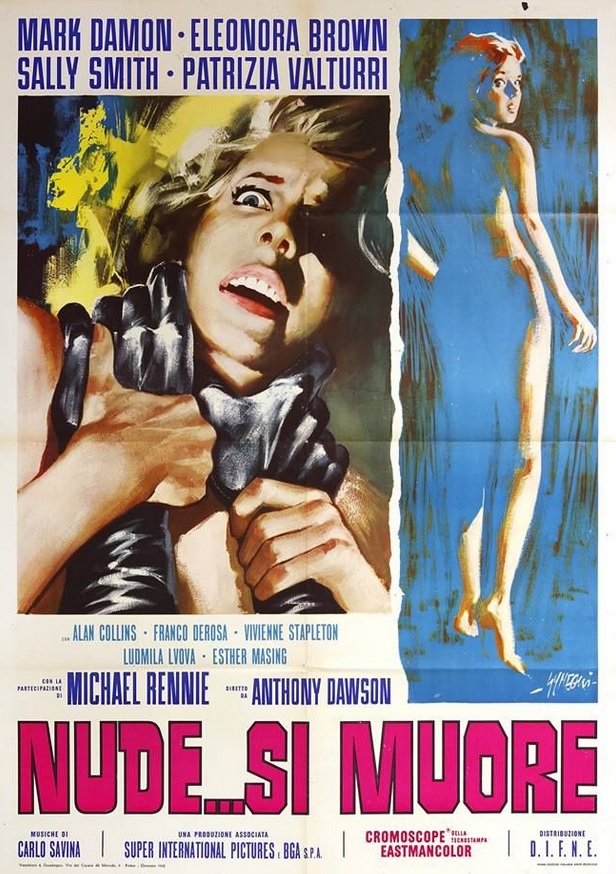
This Antonio Margheriti-directed and Mario Bava-penned giallo started out as Cry Nightmare . . . then became Nude . . . si muore, aka Naked . . . You Die. Then there’s The Young, the Evil, and the Savage (which stinks; sounds like a Rock Hudson jungle-romance flick). Then, when it hit the U.S. market and got some chops to the celluloid, it became Nude, She Dies, and the really sleazy and offensive, Schoolgirl Killer (but it’s not as sleazy as the title implies).

Watch the trailer.

Antonio Margheriti did it all: Biblical Sand & Sandal flicks, horror flicks (Castle of Blood and The Long Hair of Death), Clint Eastwood western rips, James Bond rips (Lightning Bolt), Charles Bronson bad-ass cop rips (Death Rage), Indiana Jones rips (The Ark of the Sun God), and space opera rips (Yor, the Hunter from the Future). He even ripped off George Romero with Cannibal Apocalypse. And he did giallo flicks: this, Web of the Spider, and Seven Deaths in the Cat’s Eye.

This whatever-title-you-want-to-use “who done it” wastes no time in breaking out the black-gloved killer with a POV strangulation of a woman in a bubble bath—and those hands stuff her body in a large trunk for disposal. But, through a series of circumstances, the trunk ends up at St. Hilda’s College (thus, the Schoolgirl Killer moniker), an exclusive and remote (these schools, clinics, chateaus, etc. must be remote) finishing school. Closed down for the holidays, seven girls (the favored number of giallo films) remain; one stumbles into the killer in the school’s basement when he attempts to retrieve the trunk.

When Michael Rennie’s (The Day the Earth Stood Still) Inspector Durand shows up to investigate this “disappearance,” the suspicions and accusations fly among the students, staff and teachers—e.g., the ubiquitous creepy gardener, the horny swim instructor, Mrs. Clay, the new French summer school teacher, a nutty professor who collects birds (all giallo flicks must even the slightest animal angle), and the always-ready-to-hop-in-the-sack hot teacher played by Mark Damon of Hannah, Queen of the Vampires.

You can watch the Nude, She Dies version of the trailer on You Tube.

If you want this on DVD, it’s readily available, but caveat those run times: you want the Italian version which runs at 98 minutes.

You can watch the full movie for free on You Tube.

There’s another perspective on this film with a May 20, 2022, review as part of our latest week of Mario Bava and Antonio Margheriti film tributes.

About the Author: You can read the music and film reviews of R.D Francis on Medium and learn more about his work on Facebook. He also writes for B&S About Movies.

Seven Notes of Terror (1984)

Hey, wait a minute? They stole the artwork from Rocktober Blood! Bogus!

Nope, this isn’t the case of Top Line, Hands of Steel, and Cy Warrior — three different movies — all using the same artwork, because . . .

This is still the Rocktober Blood you know and love . . . just with a slap of the ol’ Dutch Boy “Giallo Yellow” for its Italian theatrical and home video distribution.

Forget the fact that there’s no mention of “seven notes” in the film, or “seven” of anything. No seven keys or locks to solve a bloody noir mystery. And that Head Mistress only had six members and a lot more than seven people died. And there were no insects, or animals, or velvet, or scorpions, or cats, rats, or bats. But there were “eyes,” per se.

But why was Billy Harper nicknamed “eye” in film? Did he remove or collect eyes? Nope. Why not redub the film as Seven Eyes of Terror/Sette occhi di terror. Or Seven Bloody Irises/sette sanguinose iridi?

Yes, I am well aware there’s seven notes in a scale. But there’s also twelve notes in an octave. Why not redub the film Ottava di terror. Or Terrore in 12 note. And it wasn’t Billy, it was John who did the killings, so why not title it Gemello della morte?

Dude, this is Spine all over again. Your overthinking films is annoying.

Yeah, I know. And yeah, I know we know we go and on about this metalsploitation classic — three times, in fact, as Sam (review) and myself (review) both chronicled the exploits of Billy Eye Harper. We even reviewed the never-made sequel, Rocktober Blood 2: Billy’s Revenge. Then we waxed over it again, as part of our “Drive-In Friday: Heavy Metal Horror Night” featurette. Then we named dropped it again in our review of AC/DC: Let There Be Rock.

Huh? What does this all have to do with AC/DC?

Oh, you didn’t know that Billy Eye Harper, aka actor Trey Loren, aka Tracy Sebastian, is responsible for helping break the Aussie rockers in America? True story. So, while Billy Eye duped us all with bogus, grey market-level DVD and Blu reissues and a bogus Rocktober Blood sequel, he did his part in unleashing AC/DC in America and, for that, we thank him. And forgive him.

Best part of the movie and only reason to watch #1 . . .

Anyway, as you can tell, the foreign distributor attempted to align our beloved metalsploitation classic with the ‘70s Giallo titled-classics of 4 mosche di velluto grigio (Four Files on Grey Velvet), Il gatto a nove code (The Cat o’ Nine Tails), Sette note in nero (Murder to the Tune of Seven Black Notes), La dama rossa uccide sette volte (The Red Queen Kills Seven Times), Sette orchidee macchiate di rosso (Seven Blood Stained Notes, aka “Orchids”), and La morte negli occhi del gatto (Seven Death’s in the Cat’s Eye).

Of course, the direct-to-video “boobs and blades” shenanigans cooked up Ferd and Beverly Sebastian in California — while beloved by us, the once wee denizens of the ‘80s video fringe — is no “homage” to the likes of the masterworks of Dario Argento, Lucio Fulci, Emilio Paolo Miraglia, Umberto Lenzi, and Antonio Margheriti by any stretch of all the colors of the dark. And let’s face it: Billy Eye ain’t no Jason Vorhees or Freddie Kruger, either.

Ah, but the “New Wave of British Heavy Metal” (NWOBHM), featuring the violent, religious mania and bloody lyrics composed by the likes of Venom and Iron Maiden, complete with the requisite Satanic imagery on the album covers, was in full swing. And the dumbed-down American Slasher-cum-giallo-ripoff flicks colliding with heavy metal was the next logical match made in hell, as the music coming out of England was, in fact, Giallo musicals . . . but we ended up calling it “metalsploitation” here in the critically puritanical states.

Best part of the movie and only reason to watch #2 . . .

And let’s not forget where that musical sub-genre’s roots began: Dario Argento was the first to mix the hard rock peanut butter into the chocolate giallo with 1971’s Four Flies on Grey Velvet, which follows a musician (Michael Brandon of FM) that gets tangled in a murderous web. And how can we forget the late-in-the-giallo cycle Paganini Horror, with Luigi Cozzi’s Bon Jovi wannabes unleashing a curse from an ancient composition? And that Argento cranks up the Goblin to make our ear drums pulse in fear?

But before those films, there was Brian DePalma’s tribute to the likes of Alice Cooper and Kiss in the frames of his 1975 rock opera, Phantom of the Paradise. And there’s no denying that the exploits of Winslow “The Phantom” Leech and Gerrit “Beef” Graham influenced the frames of Black Roses, Shock ’em Dead, Terror on Tour, Rock ’n’ Roll Nightmare, and Rock ’n’ Roll Zombies, and Trick or Treat, along with the non-classic Turbulence 3: Heavy Metal, in which a reviled Marilyn Manson-like gothstar becomes an international hero after saving a jet liner from a terrorist takeover (a film that needed a whole lotta Ray Liotta and maybe a little Danzig). Then there’s Don Kirshner’s rip on DePalma with his ABC-TV “Movie of the Week” two-fer with Song of the Succubus and its sequel, Rock-a-Die, Baby.

Hey, wait minute! Danzig just released his debut metalsploitation flick, Verotika (and now, in 2021: Death Rider in the House of Vampires).

Ah, yes. Satan’s music is still bloodying up our films. And we hail our Dark Lord . . . to the tune of seven red notes. Let the Acid Witch bless your soul!

We dig into the failed attempt at getting a sequel off the ground. True story, for reals!

Ferd Sebastian
July 25, 1933 — March 27, 2022
Obituary

About the Author: You can read the music and film reviews of R.D Francis on Medium and learn more about his work on Facebook. He also writes for B&S About Movies.

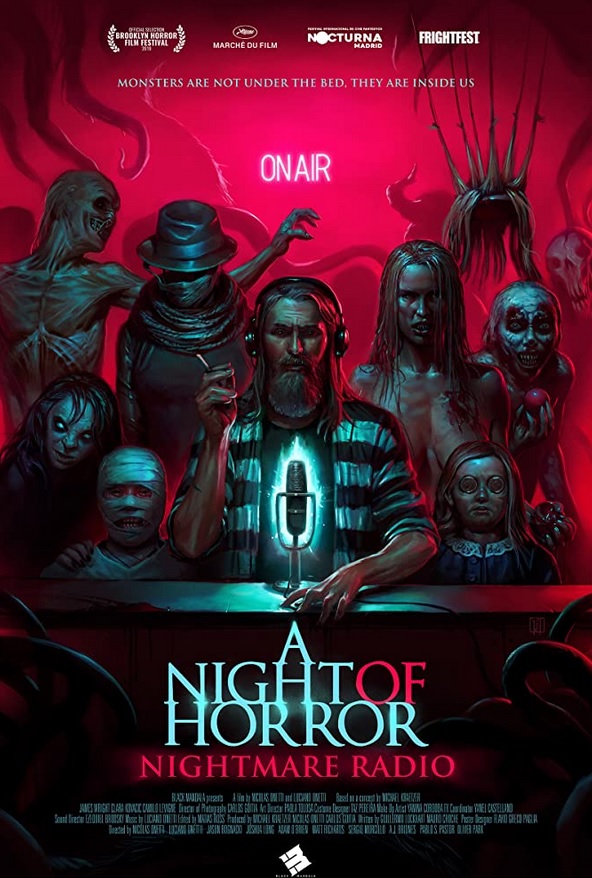
A Night of Horror: Nightmare Radio (2019)

The Argentinean duo-brothers Nicolas and Luciano Onetti are back with another of their retro-Italian Giallos, which began with Deep Sleep (2013) and continued with Francesca (2015), What the Waters Left Behind (2017), and Abrakadabra (2018). This time they step back from their usual writer and director chairs and serve as producers on this horror anthology throwback to the Amicus pictures of old that unfolds as a “greatest hits” package of superior horror shorts from around the world.

Now if this sound a lot like the William Shatner-starring A Christmas Horror Story with our favorite starship captain as the macabre DJ spinning the portmanteau follies, you’ve guess right. But what sets this omnibus package apart: it’s an earnest attempt by the Onetti Brothers to provide an opportunity for unknown, first time filmmakers to present their work to a larger audience.

To package the films, the Onetti’s developed their own wraparound sequence that features—instead of say, a crypt keeper of the Sir Ralph Richardson variety from Freddie Francis and Milton Subotsky’s anthology gold standard, 1972’s Tales from the Crypt—a cryptic radio disc jockey. Unlike most anthologies that strive for long segments across three—but typically five stories—the Onetti’s opt for eight quicker and shorter tales—along with a ninth wraparound—with tales of the macabre.

The anthology flicks of the ‘70s that the Ornetti’s successfully emulate with A Night of Horror: Nightmare Radio are rooted in the classic words of Gothic horror authors Sheridan Le Fanu, Gaston LeRoux, and Guy de Mausspaunt—Sheridan Le Fanu’s influential short-story collection In a Glass, Darkly (featuring the vampire classic “Carmella”), in particular.

The wrap around, if you haven’t already guessed, is the subtitle of the film:

Nightmare Radio: Rod Wilson (James Wright in his film debut; looking a lot like Rob Zombie) is the resident prick of a radio host (is there any other kind in suspense or horror films set inside radio stations?) of an overnight radio program, which he hosts in a converted ranch house, and is dedicated to all things metal and horror, as he spins his own tales and allows listeners to tell their own. Then, one evening, he receives enigmatic phone calls from a troubled child desperate for help. At first, Rod thinks it’s all a joke . . . until he discovers the calls are the clues to uncovering a dark secret of his own life that unravels across the stories:

In the Dark, Dark Woods: An invisible witch haunts a patch of woods and becomes a catalyst for another woman’s life . . .

Post-Mortem Mary: When a young girl dies in a rural Australian village, a neighbor and her young daughter help the girl’s parents prepare her body for burial. Through some post-mortem photography, they discover a sinister force in the woods has possessed her body . . .

A Little Off the Top: And for a little touch of Sweeney Todd, we have a psychologically-bent hairstylist with an unhealthy obsession about the “art” of his profession . . . and over one of his female clients. And that leads him to go Saw on her, strapping her head in a medieval torture device. Then he breaks out the Sharpie and starts to mark dashes on her forehead . . .

The Disappearance of Willie Bingham: A newly hired supervisor at a prison institutes a program (that reminds of Eli Roth’s Hostel) where criminals can atone for their crimes though elective surgery amputations based on the sex crimes they committed . . .

Drops: A professional theatre dancer’s struggles with relationship and professional issues takes a deadly turn when a demon begins to intrude in her life . . .

The Smiling Man: A little girl and a trail of creepy balloons. But it’s not a clown of the Stephen King variety responsible: it’s a gangly demon offering her a tasty treat made of something . . .

Ack! WTF! Watch out for the balloons. It’s The Smiling Man!

Into the Mud: The 10th Victim goes horror as a woman wakes up in the woods and finds herself pursued by a mysterious hunter; her salvation may come in the form of an equally mysterious creature . . .

Vicious: After a late-night out, a woman returns home and discover her sister in terror at the hands of deformed demons who’ve invaded the house.

The best three of the lot are In the Dark, Dark Woods, Post-Mortem Mary, and The Disappearance of Willie Bingham. But The Smiling Man . . . yikes. It’s a serious creep fest that I hope the Onetti’s expanded into a feature film.

Now, when you’re juggling multiple films from multiple writers, and even more directors, and trying to patch them together into a single, cohesive film, that spells trouble. It usually means you’ll end up with a disjointed film lacking in consistency across all the disciplines. Such is not the case with this latest Onetti Brothers’ entry. This looks a lot like Rob Zombie movie: well-shot, well-verse in its Giallo roots and filled with rich colors. Granted, it may have a few clumsy creative moments, and few strained performances in the acting department, but overall the Onetti’s Frankenstein’d a film worthy of a horror fan’s watch from horror’s newest crop of filmmakers.

A Night of Horror: Nightmare Radio recently premiered to a receptive audience at the Brooklyn Festival of Horror this past October and is currently in the market for U.S distribution. You can keep abreast on when it hits all of the usual online streaming and PPV platforms (definitely on Shutter and Netflix) via their Facebook page. You can check out more trailers from the catalog of the Onetti Brothers’ Black Mandala Productions on You Tube.

Update: This will be available on DVD all VOD platforms on September 1.

Disclaimer: We were provided a screener by the film’s P.R firm. That has no bearing on our review.


What’s that? You want more anthology flicks? Then check out our “Ten Horror Anthologies” exploration.

Some other portmanteaus we’ve recently reviewed are:

All the Creatures Were Stirring (2018)
The Dark Tapes (2019)
Dead of Night
(1977)
The Dungeonmaster (1984)
From a Whisper to a Scream (1987)
Hi-Death (2018)
Holiday Hell (2019)
Kwaidan
(1964)
Morbid Stories (2019)
Shevenge (2019)
Tales from the Darkside: The Movie (1990)
Terror Tales (2016)
Trilogy of Terror II (1996)
The Twilight Zone (1983)
Ugestu
(1953)
The Uncanny (1977)
Vault of Horror (1973)

About the Author: You can read the music and film reviews of R.D Francis on Medium and learn more about his work on Facebook.