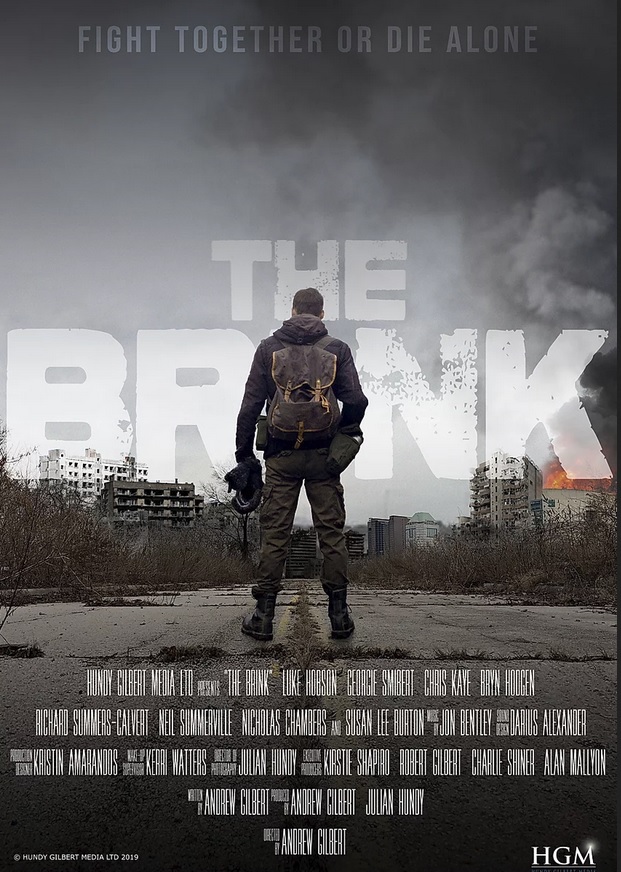
During a You Tube movie excursion, as I spiraled down a digital rabbit hole, I discovered this British-produced apocalypse entry currently in post-production.
Fifteen years after the Third World War, man struggles on the verge of extinction after the passing of a ruthless nuclear winter. What’s left of civilization has no choice but to kill and pillage for survival.
Away from the urban devastation, in the desolate countryside of southern Britain, a lone, young boy survives in isolation away from humans. His self-imposed peace soon unravels at the hands of a group of survivors that must battle against a new, savage enemy that emerges from the aftermath.
As you can see, the trailer doesn’t tell us much about the film in terms of plot or characters, but the images speak volumes: the cinematography is stellar and the film’s inventive, tightly-budgeted staging effectively utilizes its remote British countryside locations; you can feel the foreboding nature of the film. And the acting from the unknown, mostly new-to-the-biz cast of actors (Chris Kaye, Luke Hobson, and Georgie Smibert) looks like it’s of the “A Game” variety.
My celluoid memory cores kept accessing the apoc-classics of Cornel Wilde’s No Blade of Grass from 1970 and 1979’s Ravagersstarring Richard Harris — in terms of The Brink foregoing set builds and effectively utilizing pre-existing structures with a dilapidated “apoc” feel to them. As result: The Brink doesn’t look like your standard, low-budget direct-to-DVD release that’ll see an early birth on the Syfy Channel. This is a movie to keep your eye on. This isn’t some Dolph Lundgren zombie hunt with AfterEffects exploding heads and gun flashfire.
You can learn more about The Brink, along with the in-production horror films Flytrap and The Dead Inside, on the web at HGM Productions.
You can catch up with more apocalypse films courtesy of our recent month-long rally of apoc film reviews with our two-part “Atomic Dustbin” round up. You can also visit the latest installment of our weekly “Drive-In Friday” feature where we had an “A-List Apoc Night” with the films Z.P.G, The Ultimate Warrior, Zardoz, and Quintet.
Update: After the writing of this review (and a few post reschedulings), The Brink has since been retitled for international distribution as Edge of Extinction — with a digital release on May 18th and a DVD release following sometime in July. You can stream it on Amazon Prime, courtesy of Indie Rights Movies, which now — as of November 2020 — offers it as free-with-ads-stream on Tubi Tv.
“My daughter found another doctor. She said you can’t even treat your own daughter.”
Dr. Sharon Cheung (Asian Film Awards, Golden Horse, and Hong Kong Film Awards multi-winner Kara Wai) is a career-obsessed Hong Kong psychiatrist and single mom who’s fed up with and neglects Jenny (Yanny Chan of the Cantopop girl group Super Girls, in her acting debut), her rebellious teen daughter—with the hopes of marrying her off to one of her rich client’s sons. As Jenny’s rebellious streak becomes increasingly more bizarre, Dr. Cheung begins to wonder if her daughter’s rebellion is the manifestation of mental illness. Or is Jenny gaslighting her mother, who begins to suffer the onset of her own psychological break exacerbated her descent into drug and alcohol abuse? Or is there a supernatural presence pushing them both to the brink? Or is Jenny possessed?
Notable Hong Kong producer Pang-Chun Chan’s writing and directing debut isn’t a film about A24 or Blumhouse-styled shock scares and CGI poltergeists; it’s a film about practical in-camera effects; it’s about actors—through emotions and body language—selling the light, the color and shadows to give audiences the creeps. Chun Chan’s eye is all about slow-building tension and keep-you-guessing mystery. In the framework of the supernatural and psychological terror, he also presents compelling questions regarding the paranormal vs. hard science and western Christianity vs. Eastern Taoism in Dr. Cheung’s atheism and her rejection of her country’s traditional beliefs in sprits and the afterlife.
Distributed in the international marketplace since its 2015 theatrical debut, Daughter is now currently available for the first time in a (well-done) English dub as a free-with-ads stream on TubiTV. It’s an affable mix of Roman Polanksi’s Repulsion and William Friedkin’s The Exorcist, with a touch of film noir, haunted house and J-Horror conventions that, hopefully, if successful in the west in this dubbed form, Daughter (aka Shuang shen) will be presented in a U.S. region-appropriate DVD in its native Cantonese and Mandarin languages with subtitles (which is my preferred format to watch overseas films).
About the Author: You can read the music and film reviews of R.D Francis on Medium and learn more about his work on Facebook.He also writes for B&S About Movies.
Disclaimer: We discovered this movie on our own and were not presented with a promotional screener or review request.
This creepily effective K-horror romp offers a touch of Michael Keaton’s White Noise (ghosts using audio/TV static to contact the living), Tobe Hooper’s Poltergeist (remember Beatrice Straight’s Dr. Lesh’s team and their electro-gizmos?), and Sam Raimi’s The Evil Dead (a haunted remote cabin) and is based on the popular Asian web-comic by Jak Jang. K-pop fans will recognize its leads in Jung Eun-ji (the lead singer of the band Apink; You Tube) and Lee Sung-yeol from the boy-band Infinite; You Tube).
Eun-ji stars as So-hee, the daughter of a shaman — and she also possesses the gift of supernatual insight. She’s the newest member of a college-based ghost hunters club “0.0 MHz” run by Sang-Yeob (Lee Sung-yeol). The club takes its name from the radio frequency at which the human brain can make contact with the spirit realm.
Along with three other members (they were 12, but the seniors graduated) they head off for a “fun weekend” to search for a remote rural home rumored as haunted by the spirit of a suicide victim. Of course, with So-hee’s Danny Torrence-like abilities, she already receiving warnings from her late grandmother and a stringy-haired schoolgirl who appears at a general store that they stop at along the way. And they don’t heed the shopkeeper’s warnings about those woods.
And you know the rest of the yūrei story. Yeah, the Shiryō hits the fan. And that ain’t no onryō, nae chingu. Once that meoli yulyeong (hair ghost) tangles into you. . . .
If you’re a fan of the A24 and Blumhouse horror oeuvres and are into flicks like The Conjuring, Annabelle, and the Americanized The Grunge sequels, prequels, sidequels, etc., then there’s something here for the horror hounds. Me, personally: I’ll take a “J” or “K” supernatural original from the East before a knockoff from the West any day of the week.
Is the film as “graphic” as the comic? No (the film’s rated PG-15 in Korea). Because of the film’s connection to the teen-driven K-pop scene, the horror is toned down for that teen audience, so the geistin’ never goes full-blown “Raimi,” but the production design is solid, the cinematography is crisp, and the atmosphere is uber creepy. American reviewers haven’t been kind on this latest Asian horror offering, but it seems they’ve overlooked the K-pop connection and that, while this is now available for the first time in the U.S., 0.0 MHz was never intended for U.S audiences weened in a post-Eli Roth and James Wan world. This is a film about suspense and the psychological over gore. Must everything be guts and gore and “shock scares” to satisfy our horror needs? Can’t we all just enjoy atmosphere and suspense, for once? Then again, the friends I’ve exposed to Ugestuand Kwaidanscoffed at those films. . . .
You can watch 0.0 MHz exclusively through Shudder or through their imprint with Amazon Prime. You can view the English translation of the comic at Manga Eden.
Disclaimer: We weren’t sent a screener for this film. We discovered it all on our own and genuinely enjoyed the movie.
About the Author: You can read the music and film reviews of R.D Francis on Medium and learn more about his work on Facebook.He also writes forB&S About Movies.
March 2022 Announcement: Severin Films has released a Blu-ray of Nosferatu in Venice — scanned in 2k from the original negative — which serves as the unofficial sequel to Werner Herzog’s Nosferatu. In addition to cast and crew interviews, the Blu also features the 80-minute documentary, Creation is Violent – Anecdotes From Kinski’s Final Years.
Severin has since released the documentary as an independent stream on the free-with-ads Tubi service.
Still fighting the property tax man . . . and that land developer keeps coming back with higher counteroffers.Do we really need a shopping mall way out here?
I could go on for days and days about these prides of German filmmaking. I’ve seen most of their works, but not all of them: but still more than probably any other human being on the planet. And I more than likely hold the world’s record for the most viewings of these five collaborations between the two of them—a tumultuous, symbiotic existence chronicled by Herzog himself in the 1999 documentary, My Best Fiend (which you can watch on TubiTV).
Considering Kinksi appeared in 137 films and, since the age of 19, Herzog has directed 73 and written 59 films—both across all genres, including documentaries—B&S About Movies could easily do two, month-long tributes to my two best celluloid heroes. And I could write most of those reviews by heart—without a third to fifth viewing of those works. And I’d sell my soul for a diminutive “under five” acting role in a Werner Herzog film. Just name the swamp or jungle: I’ll be there, Mr. Herzog. I’ll drag a boat for you. But I won’t chainsaw off a foot for you. I have my limits.
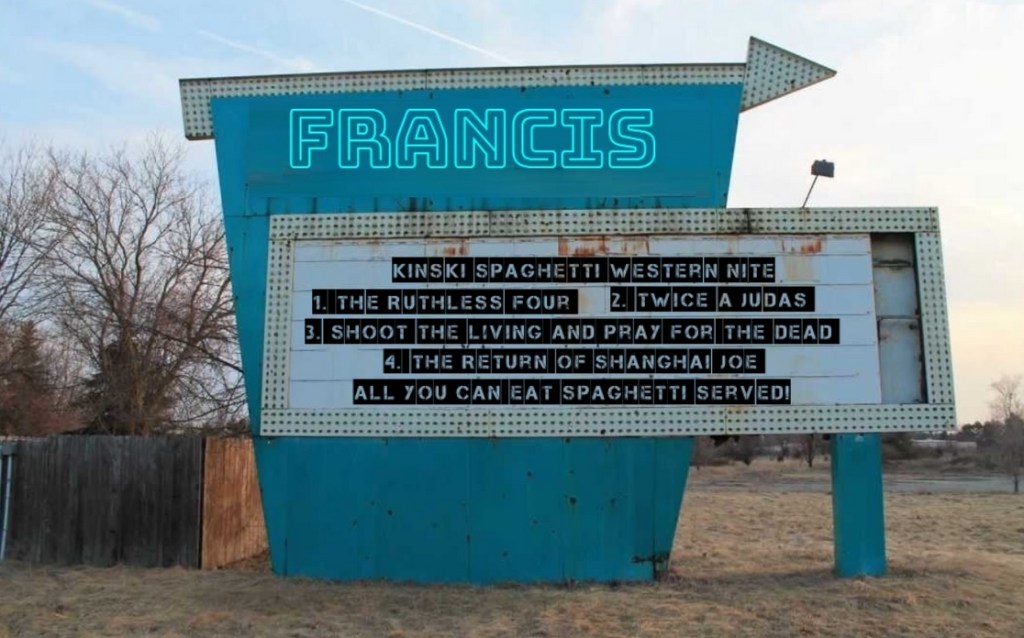
So, settle in with your rotisserie hotdogs, heat-lamped burgers, and ice-cold A&W Root Beers as we sit back in the station wagon bench seat to enjoy the Herzog-Kinski five-film oeuvre of Aguirre, the Wrath of God, Nosferatu the Vampire, Woyzeck, Fitzcarraldo, and Cobra Verde. And as the films roll: Keep in mind that each was made before the advent of digital technologies: everything was shot in-camera using practical effects with no process shots. And that makes these films ever more amazing.
Yeah, they don’t make ‘em like this anymore. And probably couldn’t if they tried—without the crutches of a filmless camera and digital after-effects.
Roll ’em, Dano!
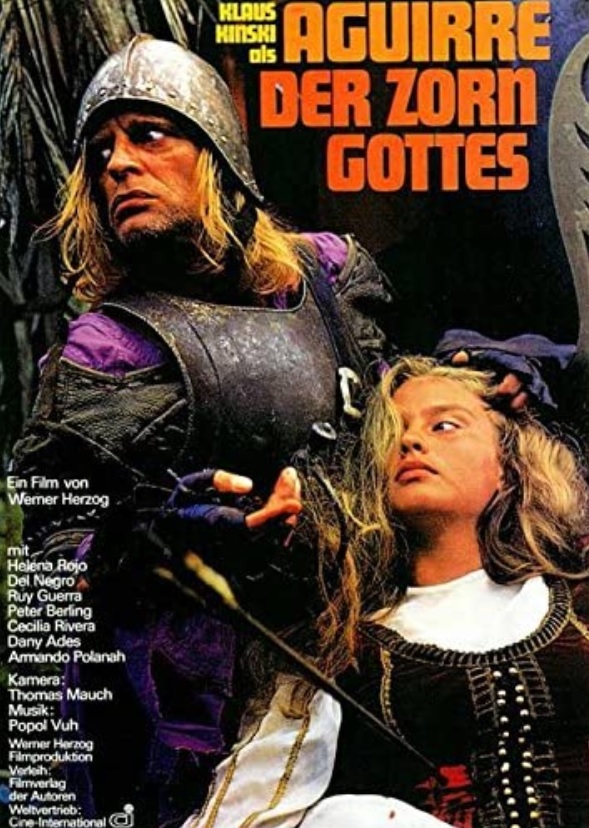
Movie 1:Aguirre, the Wrath of God (1972)
If you want to know where William Friedkin and Francis Ford Coppola picked up their narrative and cinematography ideas for their respective, crazed jungle romps, Sorcerer (1977) and ApocalypseNow (1979), then look no further than Aguirre.
Herzog is, first and foremost, a historian. If you review his resume, you’ll noticed he excells at the documentary format and is, in fact, one of the world’s greatest documentarian filmmakers. No stuffy talking heads need apply. And even in his narrative works, Herzog leans towards chronicling the lives of historical figures and events.
Here, he decided to examine the life of 1500s Spanish conquistador Lope de Aguirre, who broke away from the command of Gonzalo Pizarro to lead a group of men on a crazed journey down the South American Amazon River in search of the lost, legendary city of gold, El Dorado.
What makes this film epic is that it’s not shot on a soundstage. There’s no green screens or plate processings: it was shot along the Amazon in the middle of the Peruvian rainforests for a five-week shoot.
Wrap you head around that for a moment: Herzog convinced European actors and crew members to live in the jungle and travel along the most dangerous river in the world. And Herzog and Kinski clashed all along the way, with an unhinged Kinski terrorizing the crew and the local natives who assisted the production as crew and extras. Try to remake (oh, god, please don’t) this in today’s major studio system: You wouldn’t. You’d be in a green room emoting to green tennis ball stand-ins, amid the to-be-digitally-painted-later trees.
While Herzog repeated this crazed jungle exploration, somewhat, in his fourth film with Kinski, 1982’s Fitzcarraldo, he also parodied his debut film with Kinski in the frames of his 2004 mockumentary Incident at Loch Ness. That film concerns the “troubled” filming of Enigma of Loch Ness and includes “scenes” from the documentary Herzog in Wonderland. If you’re into meta-fiction, then that film’s film-within-a-film-within-a-film is just what the big red streaming button ordered. It’s the end-all-be-all of meta films, before meta became digital de rigueur, matched only by Spike Jonze’s Adaptation.
You can watch this debut Herzog-Kinski collaboration as a free-with-ads stream on TubiTv. You can also stream Incident at Loch Ness on TubiTv.
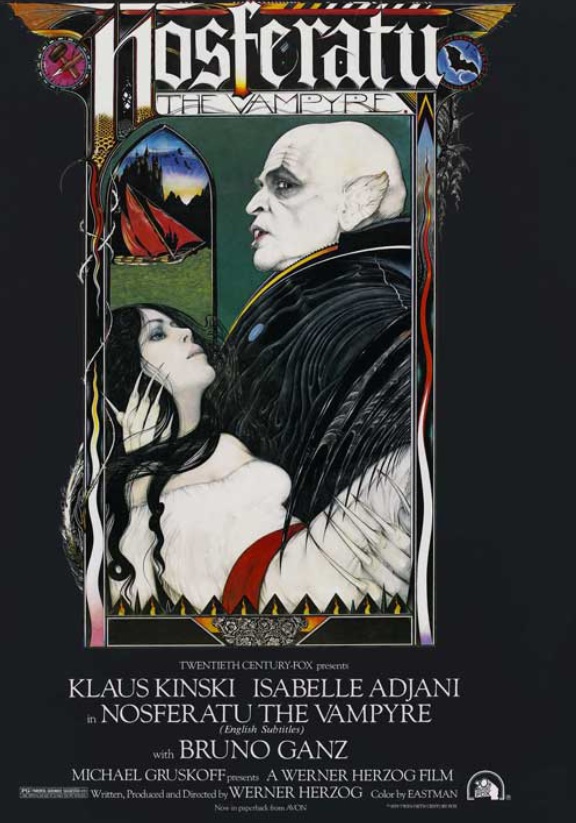
This second of five Herzog-Kinski romps is an impressionist-stylized remake of F.W Murnau’s unauthorized, 1922 black-and-white silent adaptation of Bram Stoker’s Dracula. But how did Herzog manage to make this film without the same copyright issues that plagued Murnau’s version? Simple. The day the copyright expired on Stoker’s novel and entered the public domain, Herzog began his adaptation.
As with all of Herzog’s films, this is scored by the West German progressive rock group Popol Vuh who, when it comes to soundtracks, are that country’s greatest musical export, next to the commercially better known Tangerine Dream*. And as with Tangerine Dream, Popol Vuh released both independent studio albums and soundtracks. Seriously. The soundtrack is incredible. (I played the album until it split apart like a cinnamon roll.)
And we’ll leave it at that, as Sammy P, the bossman at B&S About Movies, did a commendable job at reviewing this masterpiece of horror. No disrespect to Max Schreck who scared the sand out of me, but Kinski giving a “voice” to the character really ups the game. A highly recommended horror watch if there ever was one.
You can watch this as a free-with-ads stream on TubiTv. And Kinski made a pseudo-sequel with Christopher Plummer and Donald Pleasence in Italy—1988’s Nosferatu in Venice, which you can also stream for free on TubiTV.
Movie 3: Woyzeck (1979)
Less than a week after wrapping principal photography on Nosferatu the Vampyre, Herzog, Kinski, and the crew from that film banged out this psychological drama in less than three weeks—the quick shoot courtesy of many of the scenes done with only one take. That’s Kinski. He doesn’t mess around, boy. He delivers on the first take.
The film is based on an unfinished play by one of Germany’s most revered poets and dramatists, Karl Georg Buchner. First premiering in 1913 in Munich, the play, under a variety of interpretations after his death, is one of the most influential and performed plays in Germany. The play itself is loosely based on the tragic, real life story of Johann Christian Woyzeck, a soldier who killed his girlfriend and was executed for the crime.
In this study of the tragedy of human jealousy, Woyzeck fathers a child out of wedlock. To earn extra money to take care of his growing family, he agrees to a series of medical experiments that tears at his mental state, leads to a series of apocalyptic visions—and tragic consequences.
Definitely one of the more obscure Kinski films for western audiences and intended solely for German audiences, it none the less became a commercial and critical hit throughout Europe and achieved an arthouse acceptance in the U.S.
You can watch Woyzeck as a free-with-ads stream on TubiTV.
The snack bar will be open in five minutes . . .
INTERMISSION
. . . And now, back to the show . . .
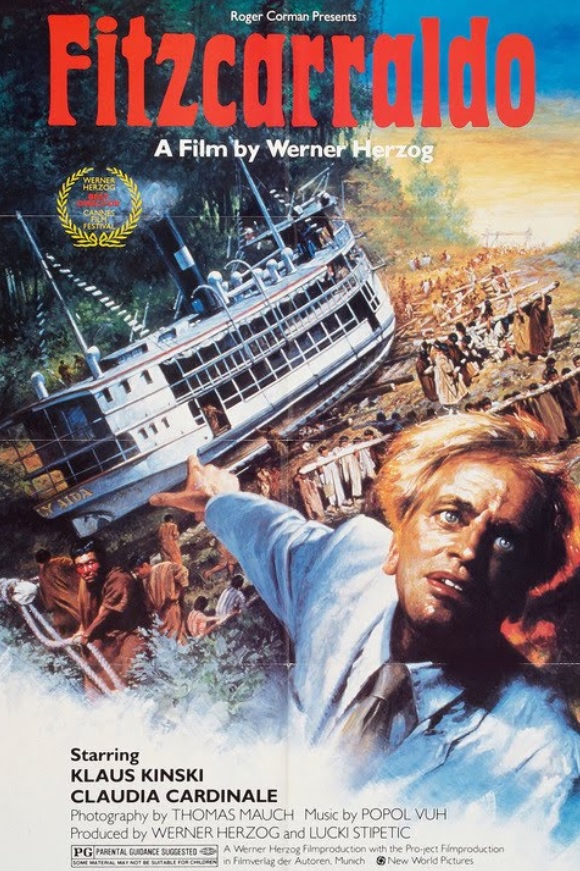
Movie 4: Fitzcarraldo (1982)
This brings back wonderful memories of my “saving the isle seat” for Gene Siskel of the Chicago Tribune and Roger Ebert of the Chicago Sun-Times for the weekly PBS-TV broadcast of Sneak Previews. And they raved about this movie. And I had to travel to a single-screen arthouse in the big city to see it. And it was worth every drop of gasoline to get there.
As with most Herzog films: This was based on historical documents regarding a Peruvian rubber baron and his real-life accomplishment of transporting a boat across the Peruvian jungles to rubber-rich lands. And as with most, well all, Herzog films with Kinski in the mix, this was rout with problems. But not all were Kinski’s fault. For example: Kinski didn’t cut off anyone’s foot: the Peruvian extra, who was bit by a venomous snake, cut off his own foot with a chainsaw to stop the venom spread and save his own life.
Jason Robards (Something Wicked This Way Comes) was originally cast and forty percent of the film was completed—then he came down with dysentery. All of the footage with Robards and Mick Jagger has to be scrapped and reshot. But Jagger had to leave to go on tour with the Rolling Stones. So Jagger’s character as Fitzcarraldo’s assistant was excised from the script. Could you imagine: a film starring Klaus Kinski and Mick Jagger? Wow. (They would have ended up killing each other. Neither would have been left standing. I wonder who the Stones would have gotten as a new lead singer?)
As with the impossible dreamer Lope de Aguirre, Irishman Brian Sweeney Fitzgerald sees “gold” in the Peruvian rubber industry and is determined to transport a steamship over a treacherous jungle mountain to reach a rich rubber tree deposit in the Amazon Basin. And yes: the cast and crew is manually hauling a 300-ton steamboat across the jungle. That’s how you rolled in the pre-CGI days, baby.
You can watch this as a free-with-ads stream on TubiTv. The troubled shoot was chronicled in the critically acclaimed 1982 documentary Burden of Dreams, which you can stream-with-ads for free (region-dependent) on Vimeo and as a PPV on iTunes and Amazon Prime.
Movie 5: Cobra Verde (1987)
For this fifth and final film in the Herzog-Kinski oeuvre, as is usually the case, Herzog drew from another historical document: British author Bruce Chatwin’s 1980 novel The Viceroy of Ouidah, which is an examination of the 1880’s slave trade through the eyes of the fictional Brazilian, Francisco Manoel da Silva (Kinski).
After his ranch is destroyed by drought and he murders a gold mining operator who exploits his workers, da Silva goes on the lam to become Cobra Verde, aka Green Snake, the most feared bandit of the Brazilian outback. After capturing an escaping slave and finding work with a local sugar baron, da Silva becomes a successful African slave trader—and comes to lead a native army to overthrow the local warlord king who supplies slaves to the Portuguese.
Critically well received throughout Europe, U.S. audiences came to discover this gem (IMO) on the home video market.
You can watch this as a free-with-ads stream on TubiTv. As with the troubled Fitzcarraldo production, this was also chronicled, with the 1987 European-Swiss TV movie Location Africa. You can watch it as a two-part free stream on You Tube.
Okay, people. Use the trash receptacles. Those drink cups and hotdog and burger foil wrappers wreck havoc on the bush-hog.
I was elated when it was announced that Werner Herzog and Nicolas Cage were making a film together: 2009’s Bad Lieutenant: Port of Call New Orleans. I thought for sure that Herzog found his new “best fiend” in Cage—a new muse more than capable of taking over Kinski’s crazy crown.
However, Herzog has embraced the documentary format as of late and has only made three narrative films since his Cage collaboration: My Son, My Son, What Ye Have Done (2009), Queen of the Desert (2015), and Salt and Fire (2016)—two with Michael Shannon, along with Willem Dafoe and James Franco. All four films are excellent and come highly recommended.
And I don’t see Cage, or Dafoe, Franco, or Shannon for that matter, going “Kinski” on Herzog. Well, maybe Cage. Just kidding, Nic. I am still your bitch**. And Kinski’s. And Herzog’s.
About the Author: You can read the music and film reviews of R.D Francis on Medium and learn more about his work on Facebook. He also writes for B&S About Movies.
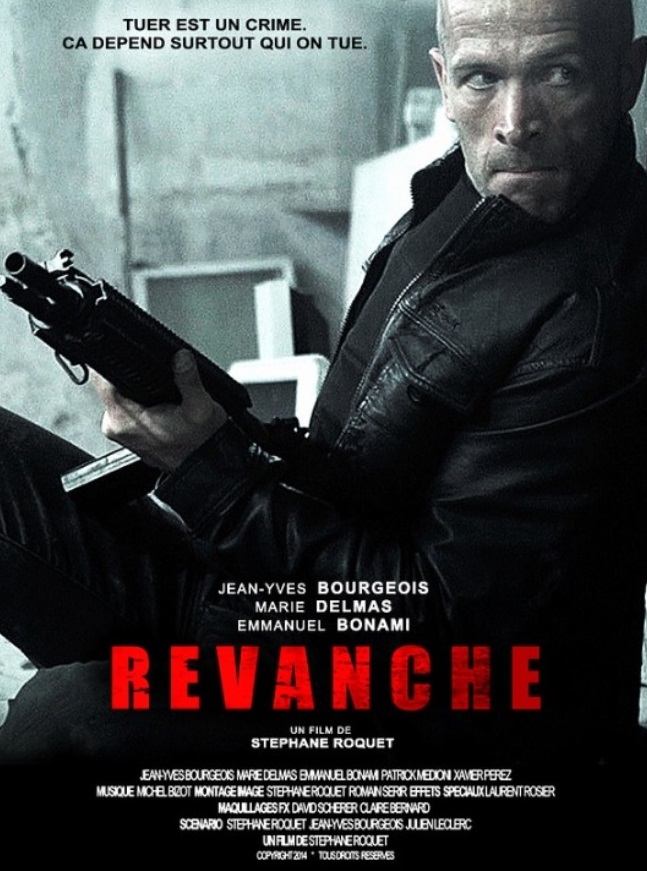
Fans of Liam Neeson’s series of “aged action star” flicks will enjoy Revenge, a gritty, graphic world where Death Wish collides with The Equalizer that serves as the tour de force industry calling card for working man French actor Stéphane Roquet in his debut as a screenwriter, director, producer, and cinematographer.
Jean-Yves Bourgeois mesmerizes in his acting debut (reminding us of that first time we saw Jason Statham in his leading man debut in The Transporter) as Detective Franck Beriat. Released after serving a six-year prison term for arresting—then killing—a pimp, he becomes an unlicensed private detective, talking only the cases he feels where he believes justice wasn’t served.
When a femme fatale hires Franck to track down her missing sister—a case that reminds him of the murder of his prostitute-cum-C.I girlfriend that landed him in prison—the assignment turns into a one-man war against a crime syndicate run by an arrogant lawyer.
Bottom line: you’ll be seeing more from Stéphane Roquet behind the lens and Jean-Yves Bourgeois in front of it. They’re the next Luc Besson and Jason Statham. In case you haven’t guessed: I love this movie; it’s a French version of a Takashi Miike yakuza-revenge flick.
In the international marketplace since 2016, Revenge is now available in the U.S. for the first time as a free-with-ads stream on TubiTv. If you prefer an ad-free experience, you can stream the film through Vudu or You Tube Movies. To learn more about the film and the Industry Works Studios roster, you can visit their website and You Tube page.
Disclaimer: We weren’t sent a screener or review request for this film. We discovered it on our own via social media and truly enjoyed the film.
About the Author: You can read the music and film reviews of R.D Francis on Medium and learn more about his work on Facebook. He also writes for B&S About Movies.
Michael Polish (of the Polish brothers twins), know for the critically acclaimed Twin Falls Idaho (1999), Jackpot (2001), Northfork (2003), and The Astronaut Farmer (2006) returns with his wife, Kate Bosworth (Lois Lane in Superman Returns), in this human trafficking drama.
Nona is a poor Honduran girl who, after losing her father in a shooting and her brother in a home invasion stabbing, makes the decision to head to America to find her only family: her mother who was too poor to pay for her daughter to accompany to the U.S. as she looked for work.
When Nona meets the Vespa-riding Hecho, himself on the way to America, he promises Nona a new life — and a free ride to America: then her world goes dark. When they reach the border, she learns Hecho works with a human smuggling ring. She’s blind-folded and passed off to a Coyote. And she’s led into a life of prostitution in the U.S.
As is the case with any film that carries the Polish seal of approval, Nona is expertly shot and captures the beauty of the wilds of Central America and Mexico. Polish also wisely chose to shoot the film in Spanish with English subtitles which, I realize, is off-putting to some (Kate as a detective who rescues Nona is the sole English speaker). But make no mistake: this tale is rough ride. It’s uber dark, but an eye-opening, recommended watch about a world we don’t want to admit exists but need to know it does.
On an international rollout since 2017, Nona is now available in the U.S. through TriCoast Worldwide and Rock Salt Releasing across all digital and On Demand platforms (Amazon Prime, Hulu, IMBb TV, SlingTV, Starz Online, and Vudu).
Michael Polish is currently in post-production on two films scheduled for release in 2020 and 2021: Forces of Nature (a heist-during-a-hurricane flick starring Mel Gibson) and Axis Sally (a WW II drama starring Al Pacino). His two films in the pre-production stages are The Last Girl in the World (a pandemic drama) and Helios (drama aboard the International Space Station). Each sounds exciting — especially Helios — and we look forward to watching them — as we do with all films from the Polish brothers.
An old man, fated to collect souls for eternity, seeks atonement after trading his daughter’s soul in this feature film debut by South African writer-director by Harold Hölscher.
The bankrupt William Zeil returns with his new wife, Sarah, and adopted daughter, Mary, to the family farm he inherited from his estranged father, with the hopes of starting a new life. Lazarus (the incredible Tshamano Sebe), the farmhand who took care of William’s father in his lonely, final hours, assists them in settling into their new, rural surroundings.
Despite Sarah’s misgivings, Young Mary and the elderly, but spry Lazarus quickly develop a bond as kindred spirits, and William finds a “connection” to his later father through the mysterious, but charming old man. But Lazarus carries a burdensome, dark secret with him, literally, everywhere he goes: a demon child with its insatiable appetite for human souls. And the family soon discovers they should have heeded the local’s weariness of Lazarus’s return from wandering afar.
This moody, supernatural exploration of South African folklore — originally known as 8 in its homeland — with a Blumhouse-level of production quality on par with the likes of Get Out and Ma— is rife with gialloesque insect metaphors regarding eternal life and man’s relationship to nature with it’s talk about moths and worms — and carries a J-Horror vibe of the tales of Toshio (Ju-On, aka The Grudge) and Sadako (Ringu, aka The Ring). The film comes with the occasional subtitles when the local, indigenous peoples speak their native tongue, which may turn off the few; but the production values, cinematography, and acting in this non-Hollywood jump-scares cookie cutter on a budget are expertly crafted and more than compensates for the subtitling.
The Soul Collector is via TriCoast Worldwide and Rock Salt Releasing is coming soon to select theaters, digital and On Demand platforms courtesy of Scream Factory. You can learn more about the film at 8themovie.com.
This ambitious, affable children’s film from Denmark—which features 100 backgrounds and 30-plus characters drawn in Photoshop, with each cell painted-by-hand and each character layered 600-times to enable movement—imagines famed English mystery purveyor Agatha Christie as a young child—in this case through the imagination of a lonely ten-year-old Agatha-Christine. Through books—and adorned Christie’s famed “Miss Marple” outfit of a large Fedora and red blazer with skirt—“AC” imagines herself solving crimes in a black-and-white, film noir world.
Moving with her mother and two siblings (her teen-sister Sara and her into-everything baby brother Kevin) to a new apartment, the building’s basement—complete with a friendly, talking gecko as her new “sidekick”—proves to be the perfect space to start her own detective agency. When a local shop becomes the scene of a crime, young Agatha sets her sights on Vincent, a ten-year-old skateboard-loving next door neighbor as her main suspect. It’s that “weird feeling” she gets in her stomach every time she sees him—”something’s up” with that boy.
If your little ones enjoy the reruns/restreams of the early 2000’s American-imported BBC children’s animated series Charlie and Lola, then they’ll enjoy the adventures of Agatha and Vincent. The action here is easy to follow and low-key, which is great for the kids but not so much for the adults, so a parent has no worries allowing their kids to stream this without supervision on their smart devices. They’ll learn valuable lessons regarding faith and trust in others, how to deal with feeling like an “outsider,” and that you should always be yourself and believe in the best “you” you can be—a great message for children to learn.
TriCoast Entertainment imported Agatha Christine: Spy Next Door for the first time to the U.S. on various VOD and PPV digital platforms (Amazon, AT&T, Fandango, FlixFling, InDemand, iTunes, and Vudu) for release on June 16.
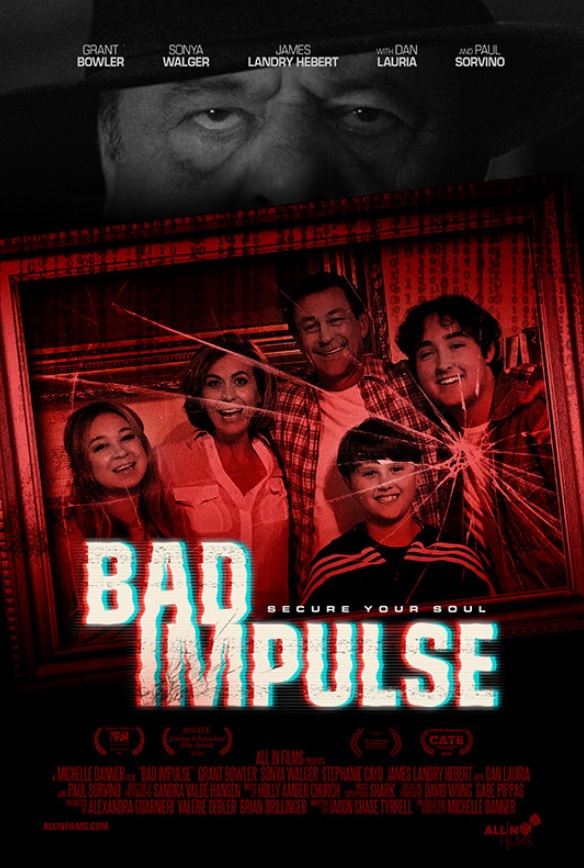
Bad Impulse is a psychological thriller about family secrets exposed as result of modern technology.
In the aftermath of his attack by loan sharks, Henry Sharpe (Grant Bowler), a suburban husband, father, and successful stockbroker, becomes a paranoid recluse. He comes to install a cutting-edge home security system from the mysterious Lou Branch (Paul Sorvino). The “cutting edge” to system is that each occupant of the household is fitted with an anklet that draws a blood sample and codes their DNA into the system. Henry Sharpe soon realizes his paranoia has placed his family at the mercy of an A.I. that is slowly destroying that which he most wants to protect.
In addition to the marquee names of the great Paul Sorvino and Dan Lauria that we came to see (do we really need to rattle off their resumes?), the film also stars Grant Bowler (Guns Akimbo) and Sonya Walger (Showtime’s Power, ABC-TV’s Parenthood and Lost, and SyFy’s TheTerminator: The Sarah Conner Chronicles).
Bad Impulse is the fourth feature film by Michelle Danner, a renowned acting coach who’s worked with the likes of Gerald Butler (Greenland, released on December 18, 2020), James Franco, Michael Pena, and Michelle Rodriquez. She’s currently in pre-production on a fifth feature, The Runner, starring Elisabeth Rohm (TV’s Law and Order). The screenwriter of Bad Impulse and The Runner, Jason Chase Tyrrell, made his debut with 2017’s Ghost House starring Scout Taylor-Compton (Abducted) and Mark Boone Junior (Trees Lounge, American Satan).
Currently on the film festival circuit where it won “Best Narrative Feature” at the 2019 International Independent Film Awards and the “Best Director Award” at the 2019 Culver City Film Festival, Bad Impulse will appear as a DVD, VOD, and PPV in the coming months. You can learn more at the website for All In Films and the film’s official Facebook page.
Disclaimer: We were not provided a screener copy nor received a review request for this film. We discovered this movie all on our own, were intrigued by the trailer and its cast, and wanted to give the film some advance press.
About the Author: You can read the music and film reviews of R.D Francis on Medium and learn more about his work on Facebook.He also writes for B&S About Movies.
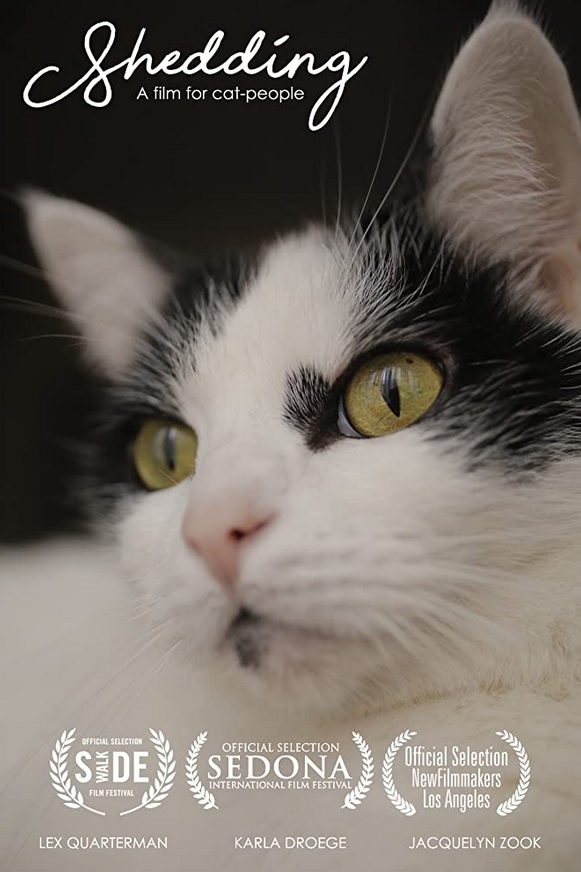
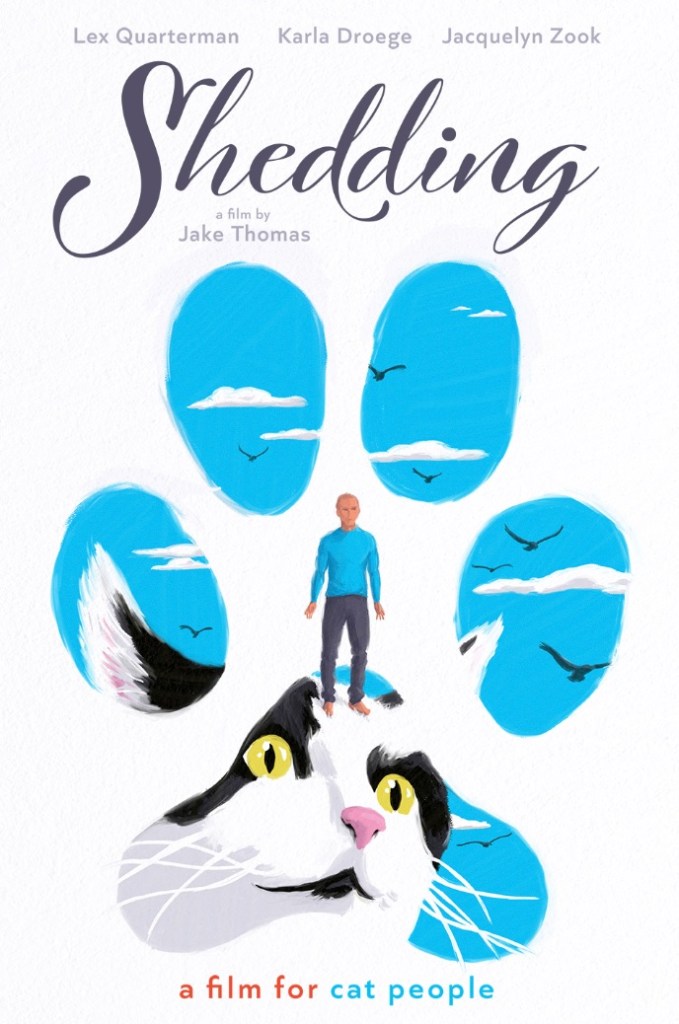
Shedding is a retro-magical fantasy with a narrative structure created through an inventive use of music, camera work, editing, and actor-body language that harkens the French New Wave movement of the late ’50s. Shedding is the story of a Panda, a bored house cat who longs to escape his life and go outside—and with the slight tinkling of a wind chime in the breeze, Panda gets his wish: he transforms into a human. And during his daylong journey in the outside world, he helps a grieving mother and daughter at odds over the loss of their son and brother, find peace.
The original festival one-sheetscourtesy of Jake Thomas.
If you haven’t guessed: Shedding isn’t an A-List Hollywood cute-cat movie starring Will Ferrell with an over-the-top interpretation of a human-cat romancing a career-driven Kristen Wiig and redeeming mom Lin Shayne’s broken soul. This is a film about, just what the title says: shedding. About shedding one’s pains, wants, and needs. About finding a “new coat” through coping and bonding with others—and finding an acceptance and “rebirth” in our lives.
As is the case with the works of Claude Chabrol (La Femme infidel), Jean-Luc Godard (Breathless), and Francois Truffaut (400 Blows) this feature film debut by Jake Thomas (award-winning shorts Blessed are the Peacemakers, One on One) is a film of subjectivity and ambiguity; an existential commentary on the human condition through the mind of a cat, the relationships animals have with humans, and how animals help humans deal with the emotions of loss and longing. It’s a film that, as the credits roll, you’re left wondering: Was it real or was it a dream. And if it was a dream, were the human’s part of the cat’s dream, or vice versa. Did the cat help the humans gain a better understanding of their lives, or the humans of the cat?
As we discussed in our recent reviews of the indie-minimalist masterworks The In-Between by Mindy Bledsoe, Wicca Book by Vahagn Karapetyan, Space by Monte Light, Same Boat by Chris Roberti, Double Riddle by Fernando Castro Sanguino, and Ghostby Anthony Z. James these modestly-budgeted tales from the John Cassavetes narrative school of filmmaking that focus on characters and story that are shot with handheld cameras, available lighting, and spontaneous actor improvisation isn’t easily digested by a mass audience—an audience that most likely dismisses the iPhone-based films of first-time filmmakers Jody Barton and James Cullen Bressack (For Jennifer) and have no interest in the recent low-budgeted, iPhone-shot works of multi-award winning director Stephen Soderbergh (Unsane).
Inspired by the likes of his fellow filmmakers who started their careers with low budget DIY feature films, such as Christopher Nolan (Following), Robert Rodriquez (El Mariachi), and Kevin Smith (Clerks), Thomas, who’s worked as a script reader and other various film disciplines for Lakeshore Entertainment, Paramount Pictures, and Warner Bros., began crafting a “storytelling experiment” capturing footage of his cats on an iPhone with the intent of placing the audience in the mind of an animal protagonist. After pouring through the hours and hours of archival footage of his cats to weave a narrative, he then spent the next twelve days iPhone-shooting the second act of his live action fairytale that worked with a combination of script and actor improvisation.
The new December 2020 theatrical one-sheet courtesy of Freestyle Digital Media.
I know. I know. I keep coming back to Will Eubank analogies.
But it’s true: If Will Eubank was able to make the transition with his under-the-radar, low-budget science fiction dramas Love (2011) and The Signal (2014) to directing Underwater, a major motion picture for 20th Century Fox, the same good fortune will come to Jake Thomas.
It’s not the technology. It’s not the “cost” of the filmmaking tool. It’s the person behind the technology that creates great film. And Shedding isn’t just a great film—it’s an incredible film.
A quick meet-and-greet with director Jake Thomas.
On November 12, 2020, Freestyle Digital Media, the digital film distribution division of Byron Allen’s Entertainment Studios, acquired the North American distribution rights. Shedding will be available to rent and own on DVD, digital HD internet, cable, and satellite platforms on December 8, 2020. You can follow the career of Jake Thomas and the film’s progress on Facebook, Instagram, and Twitter.
About the Author: You can read the music and film reviews and short stories of R.D Francis on Medium and learn more about his work on Facebook.He also writes film reviews and analysis forB&S About Movies.
Disclaimer: We were intrigued by this film’s advance press and trailer and contacted the filmmaker for a review screener. As you can tell, the film didn’t disappoint.












 B&S About Movies
You must be logged in to post a comment.