Interface (1984)

Interface takes me back to the days of those “Big Box” in-a-plastic-tray oddball obscurities of yore that one happened upon a couple-of-years-after-the-fact of its release courtesy of one’s obsession (moi) of exploring the breathing-their-last-breath mom n’ pop video stores in the nooks ‘n crannies of strip malls. Just one look at that Pinhead-esque (Hellraiser didn’t come out until 1986!) villain peppered with wires . . . well, an early ’90s rescuing of this Vestron Video-imprint from the $1.00 cut-out rack was a non-brainer.

The cover I remember — and had — only it had a Vestron logo/courtesy of IMDb.

Speaking of brains: Creatively — in terms of the concepts running through its Pons connector — Interface is an SOV-styled cyberpunker with Cerebrum and Cerebellum to spare. In terms of everything else: it’s a decent could-have-been-a-concept-to-an-award-winning short that, with the proper execution of the film disciplines, could be a revered, cyberpunk-version of Equinox, THX-1138, and Dark Star — three analogous student short films so impressive, additional funding was provided to the projects for expansion into feature films.

Instead, with Interface, we ended up with a very special, but not-very-good, but still cool to watch-for-the-ideas “ancient future” (before the Wachowski’s The Matrix in 1999!) obviously influenced by David Cronenberg’s “body horror” classic Videodrome and John Badham’s cyber-forefather WarGames. If writer-director Andy Anderson (in his debut effort) had been a-few-more-years Tinseltown advanced in his career with A-List representation — and not a University of Texas at Arlington film student at the mercy of volunteer acting and film students — and made a “David Cronenberg’s Videodrome meets John Badham’s WarGames” meeting pitch — in conjunction with his villainous concept art and the tagline: “It’s not just another fantasy game. These players are serious . . . dead serious,” we’d be discussing a film that Variety proclaimed “. . . is an all-new, groundbreaking feature film from Andy Anderson, a new voice in sci-fi.”

Sure, Interface is notable for providing Lou Diamond Phillips his first film role (as Punk #1 in the film’s opening scenes) among an inexperienced University of Texas-student cast, and while seeing Lou in his debut may pique your interest, there’s a lot more, very special moments — in spite of the strained acting and ill-timed comedic moments — that makes this early cyberpunker worthy of a watch.
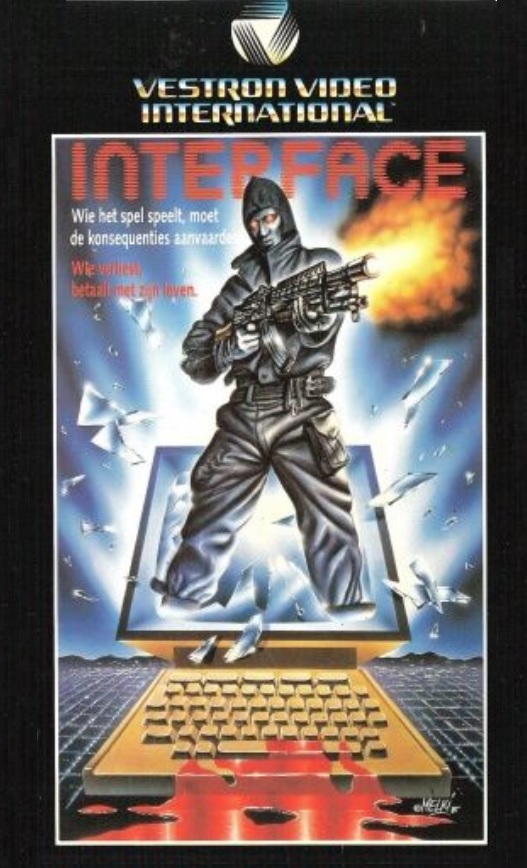
Art department for the win! Now that’s a rental-inspiring VHS sleeve!/courtesy of Rosalio Noriega Pinterest via movieposterdb.com.

As you can see from the two, embedded clips below, Anderson was way ahead of the cyber-curve — with women making-out with TV sets before Cronenberg thought of the idea. And we love, based on the voice-synthesizer preferred form of commutation by the members of the Circle, that Anderson’s a fan of the pinnacle of ’70s Frankenstein-as-a-computer flicks: Colossus: The Forbin Project — okay, maybe it’s more of an ’80s MTV-video voice-synth-thing, but we still dig it! Domo arigato, Mr. Roboto!

And yes, these clips are washed-out and muddy — the same goes for the full-length upload we’ve found. But that’s not ineptitude: the image is the result of multiple VHS rental-replays. The film is, to be honest, well-framed with solid camerawork. And kudos to Chief Production Designer Betty Burkhart (who also stars as the cyberbandit Futrista) for the obviously-up-against-the-budget art design.

These clips — HERE and HERE — give you a tease of the story: Upon the murder of his prized student and teaching aid — who’s running an on-the-sly computer scam — computer professor Dr. Rex Hobson and his students discover (Before there was a “dark web”!) the Circle of Logic (an actual circle of TRS-80s and Commodore 64s — complete with wireframe vector graphics), a vigilante computer cult comprised of masked members who go by the names Xardon, Manborn, Olympius, Eveton, Futrista, Orion, and Modem — and worship the “Master Process” (think TRON’s MCP “Master Control Program”).

Polybius is coming for you, again. So, you do feel lucky, cyberpunk? Do ya?

However, the cult is no longer content in righting the world’s wrongs via hacking and altered passwords (think of Micheal Douglas’s “Circle of Judges” in 1983’s The Star Chamber, sans computers; in fact that film is foretold in the more-violent frames of 1979’s Delirium): they’ve resorted to serial murder-by-computer. Another cult target is The Prankster, a clear-masked and cloaked vigilante that commits theft-by-computer while setting-up stings on drug dealers (one of which in Lou Diamond Phillips in his debut). Another student on the Circle’s CRTs is Bobby, who, like cinema’s most-likeable computer nerd, David Lightman, hacks the report card database to change grades — only for profit. (In part of the films comedy (?), the before-his-murder, geeky Bobby is bullied by one those thirty-year-old teenager trope-types: a college football star with one of the worst receding hairlines ever suffered by a college student). In addition to the prostitute murder-by-remote-television, our college baldy-boy has his police record tweaked with a “rape charge” and, after destroying his life, the Circle dispatches him — in a world where an “Enter” key can accomplish miracles — by electrocution-via-telephone.

Yep, the Internet back in those “ancient future” days past, is pretty scary, even if one learned their murder-by-computer tactics from a chalk board.

An overhead projector with acetates or dry-erase board wasn’t in the budget: computer science by chalk board. How ’80s!

One of those University of Texas student-cast members, Lauren Lane, who stars here as our heroine Amy Witherspoon, worked her way up the Tinseltown chain to main cast roles in NBC-TV’s Hunter (1989-1991) and L.A. Law (1992), as well as a six-year run as C.C. Babcock on CBS-TV’s The Nanny. Our male lead, John S. Davies, who stars as computer science professor Dr. Rex Hobson, Ph.D. (and worked on Anderson’s 1986 feature, Positive I.D, and his third and final film, 1998 Detention) ended up in Robocop (as Chessman, for the fans who go a-lookin’), appeared in multiple episodes of Walker, Texas Ranger during its seven-season run, and worked alongside The Rock in the 2004 remake of Walking Tall. (You can learn more about Davies’s career at his official website. What a career! And it all began with Interface.)

G.D Marcum, a member of the camera crew on Interface and Positive I.D. — as well as the Fred Williamson movies South Beach, Steele’s LawThee Days to a Kill and Night Vision — became a director in his own right, with his lone-feature film, Through the Fire. That film, while also known as City of the Living Dead: Part II in some quarters (and dedicated to the zom-maestro), has nothing to do with Lucio Fulci’s City of the Living Dead.

In December 2019, Interface was double-packed with another 1984 Vestron Video release, Soul Survivor, for sale on Amazon Prime. Uh, oh. Emptor the Caveat alert!!! Thanks to user J.L Host, we know to not let the fact that both films are Vestron releases on a single disc, fool us into thinking it’s an official release: it’s a single-layered, grey-market DVD-R — with all the ubiquitous quality-control issues for the R-format — with two films compressed onto a single-disc; as a disc only has enough space for one film. This is one time we’d appreciate a public domain, VHS-to-DVD box-set rip by the fine folks at Mill Creek (a “Cyber-Mania” set). Amazon sells VHS-ripped DVDs, as well, but the quality of those rips are unknown: beware.

But wait! In a case of the ultimate, celluloid irony: we found a very clean, 2019 You Tube rip of Interface, courtesy of Jackson Yoemans, which he discovered at the shop of our buds out at Seattle’s Scarecrow Video. Thanks for the efforts in persevering a lost film, Jackson!

So, yeah . . . Tinseltown. You can keep your major studio cyber-drivel with The Net and Disclosure. We’ll take Andy Anderson’s George Orwellian-cum-Commodore 64 debut — as well as Steven Lovy’s Circuitry Man — any day of week, and twice on Sundays. Domo arigato, Andy, for a fun film!

Interface with 40 more “Ancient Future” films with our “Exploring” round up!

Update: March 24, 2022: Clinton Rawls contacted us regarding his friendship with writer-director Andy Anderson. You can learn more about Clinton’s wares at Comics Royale.com. A fan-based site, Clinton takes foreign-language Bond comics, many which were unofficially produced, and translates them into English for the first time for the enjoyment of the Bond community and fans of the ’60s and ’70s spy craze. It’s a very cool labor of love you should visit.

By the way, B&S has reviewed all manner of Bond and the Eurospy films, so click around and discover!


Clinton: “The way Andy explained it to me: He got his students at the University of Texas at Arlington to look at the budgets for their various short films, and to also consider all of the work they put into the films: pre-production, storyboarding, etc. He convinced them that if they were able to put their budgets together, that they could make a feature film. That’s exactly what they set out to do. I believe a student wrote the script, the crew was made of students, and a student director. They set out to film during the winter break between semesters.

“They filmed one single day before (I’m not exactly sure why) it became clear that the student director wasn’t going to work out and couldn’t complete the project. With all of that money in place, actors cast, equipment and locations secured, sets built, etc., Andy stepped-in on day two of the production and took over directing the film so that the students wouldn’t see their hard work go to waste.

“I got the impression that Andy wasn’t terribly proud of the finished product, and he rarely claimed it as one of his films. In fact, someone joked that they had tracked a copy of the film down and were organizing a screening. Andy was not amused. He told them, ‘If you’re going to do a screening, have a bunch of beer and make it a fun time, but don’t look at it as one of my serious films.’

“That said, Andy was incredibly proud of all the students who went on to have careers in the business — getting their start on the film. In addition, the film played at a film festival in Germany before its purchase by Vestron for release. As result, Interface earned a profit on home video and Andy was pleased, as it allowed him to make his next feature film: Positive ID: a film he was proud of for the rest of his life.

“Sadly Andy died in 2017, and the loss was felt by many. He had a great body of work, some of it in the permanent collection of the Museum of Modern Art in New York, and his short films were especially wonderful. He was a great teacher and friend.”

About the Author: You can learn more about the writings of R.D Francis on Facebook. He also writes for B&S About Movies and publish music reviews and short stories on Medium.
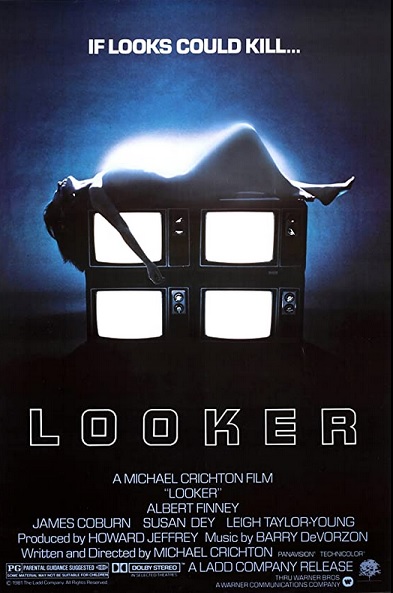
Looker (1981)

British actor Albert Finney was, first and foremost, an acclaimed British stage actor, which is why he vanished from our theater screens after his tour de forces as Hercule Poirot in Murder on the Orient Express (1974), and in Ridley “Alien” Scott’s The Duellists (1977).

Then, in 1981, Finney returned to our theater screens — and our HBO cable programming, where most of us seen the films — with a vengeance, in the heist-caper Loophole (never seen it), the horror film Wolfen, and this Michael Crichton-penned and directed science fiction-suspense flick. It’s another patented, intelligent statement on the state of man by Crichton that takes the worlds of television and its related advertising to task, as well as the medium’s obsession with beauty. To than end: Susan Dey goes topless in a couple of scenes (for three minutes and tastefully done).

But seeing Laurie Partridge from our TV past isn’t why we’re here, this week. For this week isn’t about boobs: it’s about goofy and outdated computer technologies and whacked techno-predictions of films from the ’80s and ’90s.

Welcome to our “Ancient Future Week.”

Sure, Looker is noted as the first commercial, mainstream movie to commit a full, computer-generated, three-dimensional solid representation of the human body to film. But that’s not what makes this one of our favorite, goofy “ancient future” favorites around the B&S About Movies cubicle farm. It’s those nifty Light Ocular Oriented Kinetic Emotive Responses guns, aka the L.O.O.K.E.R gun.

But alas, the movie, sans the gun scenes, is a hot mess of chopped up celluloid and not even a LOOKER gun can wipe the box office bad from our memory.

Don’t believe us? Then let co-star James Coburn tell it — from the pages of Psychotronic Video No. 9/1991:

My part was pretty much on the cutting room floor. They really pissed that film away. They had Albert Finney running around in a security guard’s uniform throughout the film. It didn’t make any sense. It could have been a good picture. It was about how television controls. It was about how commercials manipulate people to buy products, politicians, whatever. But, they cut the film up for a television print. I don’t know why they did that. They spent some bread on the picture too. It was a $12 million production. That’s not much today, but back then it was a pretty big budget.”

And it shows, Mr. Coburn. We believe you.

Sure, those LOOKER guns and goggles and light wand-bar thingies are pretty cool — zapping away people’s memories and all, but what in the hell is going on? And we could say, “What in the hell made Albert Finney hold out three years — only to pick Looker as a project he wanted to do?” As we learned from James Coburn as to what happens often with a box office failure: The film in the script and on the storyboards never ends up on film. And the story that ends up on film, doesn’t come out of the editing suite quite the same way.

If you recall that Crichton also wrote and directed Westworld (1973) and Coma (1979) — both awesome films that we enjoyed that became critical and box office hits — and remembering he dipped his toes into the “ancient future” with the less successful Tom Selleck bomb that was Runaway (1984) — you’ll see those film’s concepts are laced throughout the plot. Looker is a tale about how technology can be used to manipulate consumers’ impulses and responses to advertising. This same concept, even less effectively, plays out in the 1980 Lee Majors-starring Canadian thriller, Agency — only with a stronger political slant and without the sci-fi angle. And to that end: Digital Matrix/Restin Industries (run by Coburn’s John Restin) is “backing” the next President of the United States.

Albert Finney is Dr. Larry Roberts, a Beverly Hills plastic surgeon who comes under suspicion for the murder of four of his model-patients. He comes to discover each were employed, and sent to his practice by, an advertising research firm that’s developed a process of digitally scanning bodies into 3-D models — and never having to use the real models in advertising campaigns, ever again. Why do they have to be murdered after? Exactly. And the reasons are never explained.

Well, guess what?

Thanks to the advent of film restoration reissues on DVD and Blu-ray, the “scene” that explains the “why” can finally be watched, albeit a couple decades too late. Why was this cut from the U.S. and theatrical and home video versions — and left in the European prints that run 15 minutes longer than the domestic 93 minute (one hour and thirty-three minutes) cut — is only for a Warner Bros. executive to tell. Since then, there are commercial TV prints that have this missing scene restored. And we wish someone would rip the TV version, as this missing scene is absolutely crucial to the story — so we can see James Coburn’s point about his dissatisfaction (you’ll notice the local station ID logo that appears within the clip, below). The “document shredding” analogy as to why the girls were murdered is an excellent testament of the sharp mind and pen of Michael Crichton.

In addition — we think — to using their “Light Ocular Oriented Kinetic Emotive Responses” technology to hypnotize consumers into purchasing a product — and vote — they also developed a weapon-version of the technology for military applications: when fired, the LOOKER gun creates the illusion of visibility of the user, as the victim “shot” looses all sense of time.

So, this one has it all: consumerism manipulation, political manipulation, and the distortion of technologies to, instead of helping people, lull them into submission. And you get a great soundtrack by Barry De Vorzon, who also gave us the soundtracks to Bobbie Jo and the Outlaw, Rolling Thunder, and The Warriors.

Unfortunately, what Looker does not have is the editing that gave it a lick of sense when we went to see it at the local twin cinema all those years ago. I have watched the longer, overseas version since then, and Looker is better than I remembered.

And it’s probably more likely to happen now, than then — thanks to social media. And the way everyone has been carrying on this past year and change in cities across America, probably is. Is Mark Zuckerberg, Jack Dorsey, and Sundar Pichai today’s John Restin?

They’re looking at you.

No freebie, kids. Ah, but we found a deleted-scene clip and the trailer. You can rent-to-stream on Vudu and You Tube. Because of its oft-runs on HBO in the early ’80s, it’s a fan favorite and has a wealth of ripped clips to sample via You Tube and Google’s video-search feature. You can purchase Looker via the Warner Archive at WBShop.com. You can also purchase copies of the hard media and streaming version at Amazon.

About the Author: You can learn more about the writings of R.D Francis on Facebook. He also writes for B&S About Movies.

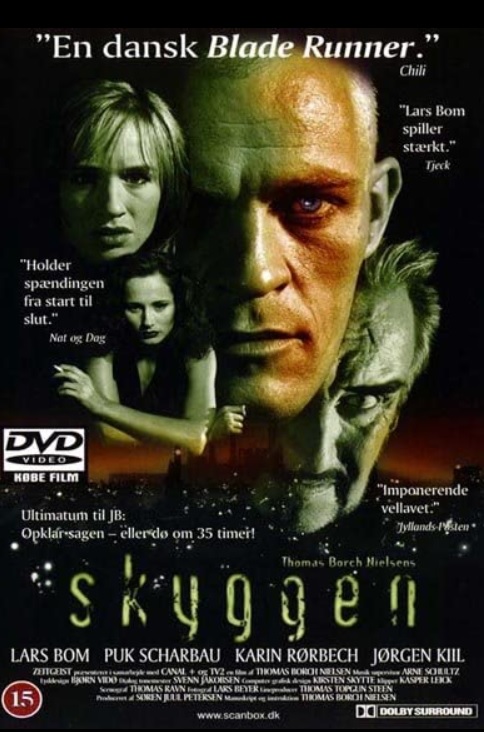
Skyggen, aka Webmaster (1998)

“We will soon fix the programming error in the super semantic subset of your linguistic structure.
— JB

Remember how, when Neil Marshall’s Doomsday came out 2008 and Luc Beeson’s Lockdown came out in 2012, we all groaned at the absurd Escape from New York/L.A. ripoffness of it all? Well, this Danish sci-thriller copies that absurdity-of-it-all rip with Bladerunner. Only this shot-on-a-low-budget-with-Digital Betacams thriller gives us — not a Ridley Scott rip — but an ersatz-sequel to the (dopey-to-crappy) Lawnmower Man franchise (when you see the graphics, you’ll see the analogy): a “Part III” that’s cyber-adrift between 1995’s William Gibson-based Johnny Mnemonic and the Wachowskis’ 1998 cyber-standard, The Matrix.

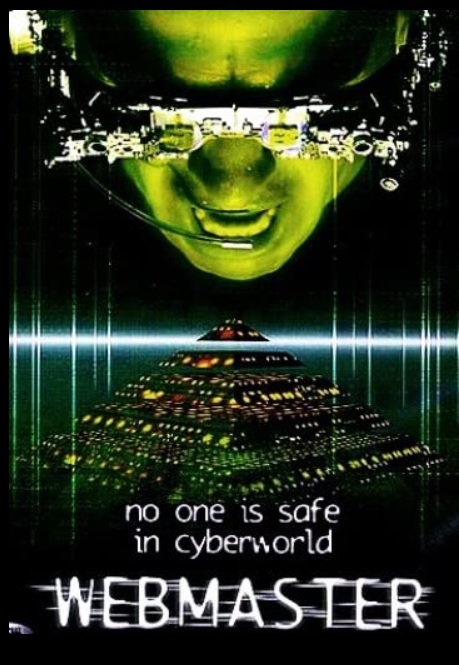
The 2000 U.S-English-market reissue.

And you know what?

Regardless of its student film ambition-over-budget production design, character-arcs and plotting that’s even more tech-ludicrous than the cyber non-realities of Disclosure, Hackers, and The Net (all reviewed this week, look for them) writer and director Thomas Borch Nielsens produced a debut feature film with a heartfelt, Tommy Wiseau-commitment to the film (and I dig Nielsens’s convincing tech jargon). Courtesy of rescuing a copy of the dubbed-and-retitled U.S.-version of Skyggen (Danish for “Shadow”) from a Blockbuster cut-out barrel for $2.00 bucks — and having the ability to revisit it a few times over the years — Webmaster grew on me in an enjoyable, Circuitry Man kind-of-way. It’s a film where your individual “love to plug” into it may vary; however, it’s a hell of a lot better than the assembly-line glut of Asylum when-hybrid-animals-and-environments-attack romps backing up the direct-to-streaming rivers. The film’s only negative: its arthouse-vibe would have been better served in an English-subtitled form, as the dubbing is a poorly-done distraction.

As with Bladerunner, the world of Skyggen is a dark, atmospheric world where computers are available at every corner and everyone is a VR-addict clad in black leather and vinyl because, well, in the “ancient future,” all clothing stores only sell S&M gear (and you have your comparisons to The Matrix), everyone is mainlining something into their veins, ’90-era tech music perpetually throbs, and you have two hair-color choices: blonde or one of the rainbow’s seven spectrums.

The 1998 Danish-Euro version. No, that’s not Juliette Lewis in the upper left corner.

JB is a reformed hacker — who wears VR goggles and hangs upside down as he hacks and codes — hired as the webmaster of a cyber-domain (foreshadowing Bitcoin) that specializes in the illegal transfers of digital currency (and the only way for users to log on is with a VR-headset, natch). When a cyber-intruder hacks the domain and steals the site’s funds, Stoiss, the site’s web-mogul founder, pulls a “Bob Hauk”: but instead of injecting JB with a set of carotid-artery severing micro-explosives, he installs a heart-explosive that runs out in 35 hours (and you have your comparisons to Escape from New York, but due to budget, more 2019: After the Fall of New York; a film which we love, so all is well). At that point, JB is off the net and thrust into the underbelly of a tech-noir detective thriller — with a hacker instead of a detective — navigating the usual double crosses and murders rife with bounty hunters, femme fatales, and cyberpunk gangs.

There’s no deying Jean-Luc Godard’s neo-noir Alphaville, Elio Petri’s pop-art romp The 10th Victim (1965), and Francois Truffaut’s Fahrenheit 451 (1967) are the prefect combinations of film noir and dystopian fiction. The same holds true for the later tech-noirs spun in the frames of Wolf Gremm’s Kamikaze ’89 and Claude Chabrol’s Docteur M. While Webmaster may not be up to the cinematic level of those regarded films, Thomas Borch Nielsens has, none the less, dreamed up a very creative and enjoyable, low-budget gem that’s worthy of you seeking out a copy of the VHS or DVD in the online marketplace.

Sadly, there’s no online streams to share. The best we have to expose you to the film is a trailer and the film’s opening title sequence that sets up the cyber-verse. Yes. This film has fans . . . and deserves the love!

About the Author: You can learn more about the writings of R.D Francis on Facebook. He also writes for B&S About Movies.

Circuitry Man (1990) Circuitry Man II (1994)

Wow! Finally! Yeeeees! When Blender Master Sam stirred up an “Ancient Future” theme week, I jumped with glee! Finally, a reason to review one of my favorite home video rentals that oft-played on HBO. It was the first movie that my analog cortex correlated to “ancient futures,” aka “future history,” if you will, when Sam published this month’s schedule. Eh, yeah, it has a some post-apoc stank on it from our last week’s “Post-Apoc Week,” but since this has a lot of pre-Matrix tech tomfoolery, we’re reviewing it this week.

As with the Sam Raimi The Evil Dead precursor Equinox (1970), and, in a sci-fi vein, John Carpenter’s Dark Star (1974), Circuitry Man got its start as a UCLA student film by Steven Loy and his brother, Robert. IRS Media, the home video arm of IRS Records, backed the expansion of the project into a feature-length film. The burgeoning cyberpunk effort was successful enough on the retail rental circuit that it inspired one of the earliest direct-to-video sequels (eh, still cool, but not as good), Circuitry Man II, aka Plughead Rewired: Circuitry Man II (1994), in which Vernon Wells, Jim Metzler, and Dennis Christopher return from the first film. Both films are highly recommended as a great, first time doorway into ’80s VHS-era sci-fi (but always one over two, for me). (Remember how Escape from New York always rules over Escape from L.A., and it’s always Phantasm the original over II? Yeah, it’s like that. Sometimes, we don’t want the ball to come back.)

Of course, the major studios put out the likes of the similar cyberpunk-cum-tech noirs Hardware (the very cool debut feature by South African writer-director Richard Stanley) and Total Recall (eh, Dick’s book We Can Remember It for You Wholesale is better) that same year, but neither are quite as distinctive and fun. To that end, and considering Total Recall, there’s a definite Phillip K. Dick-vibe with the Loy brothers against-the-budget post-apoc world forced, by pollution, to live in underground in parking garage-like bunker-environs. Lori (Dana Wheeler-Nicholson), a female body guard, is pressed into service by a drug smuggler for a major microchip deal; when the exchange goes bad, Lori’s on the lam, aided by Danner (a really great Jim Metzler), a pleasure android (read: male prostitute). Together, they’re now “drug smugglers” of virtual reality computer chips, chased from Los Angeles to New York City and aided by a fellow fringe-denizen, Leech (an also great Dennis Christopher). Not only are they pursued by the police, but by gangsters, led by the villainous, VR narcotic-addicted Plughead (an incredible Vernon Wells . . . yes, Wez from post-apoc influencer, The Road Warrior*).

I love to plug!

Released five years before Kathryn Bigelow and James Cameron’s not-so-memorable tale of black market VR smuggling with Strange Days (1995), Circuitry Man, as far as direct-to-video movies go at the height of the VHS tape market, is right up there alongside Charles Band’s Trancers in the imagination-against-the-budget sweepstakes. And the Loy brothers were smart to forgo the cheezy, low-budget computer graphics and just sticking to the noirish caper. (Ugh, remember how great Christopher Walken was, but how awful the big screen, dream-VR romp Brainstorm (1980) was for that very reason?) Another plus: the genre switching of the roles, with a woman as the noir-spiraling P.I (if you will) and making her sidekick the male “prostitute” who helps the jammed-up detective. And, as I rewatch Circuitry Man all these years later (on VHS, natch), the Windows 3.1 software is a lot of fun . . . dated, but fun to watch. At least our reluctant protagonists aren’t running around with “mission critical,” ’80s-era Kmart Kraco (or Radio Shack’s Realistic) audio cassette tapes in 1997, à la Snake Plissken. (Truth: As cool as Escape from New York always will be; the cassette tape bit still sucks; so, a major ball drop there, John. Couldn’t you make-up a some faux-techo doo-dad?)

Circuity Man is definitely — in terms of low-budget indie sci-fi’ers that began their life as student film, such as Dark Star and George Lucas’s space opera precursor, THX-1138 — required viewing and worthy of an entry in any sci-fi fan’s home video library. How, and why, Carpenter and Lucas (and Raimi) hit such career highs from such similar beginnings, but the Loy brothers dissipated into the analog snows after Circuitry Man II, is crime against cinema. I, for one, would have loved to have seen what they would have come up with courtesy of a major studio’s backing.

If you search “Circuitry Man” on You Tube, you’ll find many-a-fan favorite clips uploaded. While there’s no streams — freebie or official — online for Circuitry Man II, you can stream the original Circuitry Man at Amazon Prime and Vudu. We found the You Tube trailers (get ’em while they’re still there, if they are . . .) for Part 1 and Part 2.

Be sure to look for our review of the “ancient future” of Brainstorm, this week. And check our interview with Vernon Wells!

About the Author: You can read the music and film reviews of R.D Francis on Medium and learn more about his work on Facebook. He also writes for B&S Movies.

Evolver (1995)

The renegade robot tomfoolery of Micheal Crichton’s Runaway (1984) — he also gave us Looker (1981) — (look for both reviews this week) and Jim Wynorski’s Chopping Mall, aka Killbots (1986), bring us to this “ancient future” ditty oft-run to ad nauseam levels during the earliest days of the Sci-Fi Channel before the double-Ys.

In the director’s chair is Mark Rosman, who made his debut with the Film Ventures International’s slasher The House on Sorority Row (1982). He was replaced on his second directing effort, Mutant (1984), by John “Bud” Cardos. As result of his clashing with FVI’s Edward L. Montoro, who produced, and subsequent firing from that Alien rip, it’s the film we remember Rosman for the most amid his 25 directing credits. (Eh, maybe Mutant is more of a zombie rip, or even hicksploitation-esque; who cares, it stinks in spite of its confusing marketing.)

Yeah, if we bought into the antiquated projections of all of the “ancient future” films we’ve reviewed this week — especially Evolver — all of our homes would be equipped with sentient robot scamps. Well, we are . . . but a table-top Alexa (for those too lazy to type or swipe) or a Roomba (for those too busy to vacuum floor schmutz) just isn’t the same as having a Robert Doornick International Robotics, Inc. SICO robot beep n’ boop us a “Happy Birthday” greeting.

Much like today’s smart phones, texting, and live video streaming fully integrating into modern screenplays, these MS-DOS-intergrated, teen-based movies came at us a fast and furious pace with the likes of the video game and computer nerdom of C.H.O.M.P.S (1979), Weird Science (1986), Short Circuit (1986), and to a lesser extent, Wired to Kill (1986). Not even Sly Stallone was immune, if you remember your Rocky films (IV, if you forgot).

If you revisited the films Prime Risk, Terminal Entry, and Defense Play with our reviews during this “ancient future” week, then you’re up to speed on the tech shenanigans of Evolver: we’re dealing with another bright and unmotivated teenager of the (lower-rent) David Lightman variety. While a whiz at computers, Kyle Baxter (Ethan Randall, aka Embry, “The Bass Player” from That Thing You Do!; Mark from Empire Records), much like Michael Brower from Brainscan (1994; reviewed this week, look for it), he’s evolved from hacking school computers-for-grades or bank ATMs to subsidize his allowance: he’s mastered the realms of online video games and virtual reality.

It’s in that VR-world that Kyle wins — after hacking the game — a national VR-Lazer Tag tournament held by Cybertronix, run by Q, aka John de Lancie. His prize: Evolver, a robotic opponent armed with a compressed air gun, which shoots soft-foam balls, to compete in real-life laser tag games.

True to his name, our little not-Johnny 5 doesn’t so much “short circuit”: he “evolves” across each successive game Kyle and his friends play. Now developed with an obsessive, human-driven competitiveness, Evolver’s changing out his soft-foam ammo for ball bearings and begins shooting out the eyes of and killing the school bully. As with JOSHUA before him, it isn’t just a “game” for Evolver, as his programming is based on S.W.O.R.D — Strategic War-Oriented Robotic Device. Oops. Calling Johnny 5 to set: Evolver is an A.I war machine — only he’s pissed off and not even Ally Sheedy can calm him down. And drivers beware: watch out for the flame thrower upgrade that can toast your vehicle.

As with the ten-years’ similar-earlier Chopping Mall with its souped-up, crazed Atari-meet-NES mini-bots, we could go back and forth on whether Evolver is a sci-fi action flick or tech’d up slasher film. And you may like Evolver. Or you may be on the fence. Or you may outright hate it. Me? I paid to see Evolver in theaters on a “date night” and it’s one of the few times my date (we met in a web-design class, natch) and I mutually agreed on a film critique and made it to the “Applebees phase” of the evening. The “chicks and films” thing worked — at least that time.

The proceedings , while outdated and behind the times in 2021 in the Year of Our Gates, Evolver is certainly better that the pixelated CRT monitors brain farts of Brain Twisters (1991) and Albert Pyun-directed Charles Band’s evil video game bum bomber that’s-not-Tron, known as Arcade (1993; yep, reviewed this week, so look for it). All in all, Mark Rosman gave us a pretty decent theatrical flick to kill a Saturday afternoon, or night, as per your own dating rules and regulations.

Rosman is still behind the keys and the lens with an interesting Beatles “What If” flick, In My Life (2021), starring Janeane Garofalo (in the just reviewed Lava) and Kevin Pollak (Outside Ozona). If you’re into the fairy tale romance of Prince William and Kate Middleton — and aren’t we all — Rosman made William & Kate (2011) for the Hallmark Channel and Sun, Sand & Romance with BSG-reboot star Tricia Helfer (2017) for Lifetime.

You can stream Evolver as a VOD on several platforms, but we found a free online stream on Roku for your personal devices. We also express our gratitude to the individual who, in updating this film’s Wikipedia entry, cited this review as as an reference.

About the Author: You can learn more about the writings of R.D Francis on Facebook. He also writes for B&S About Movies.

Brainstorm (1983)

2001: A Space Odyssey and Silent Running will — always and forever — be two of my favorite science fiction movies. Douglas Trumbull did the mind-blowing special effects on the first and did the same on the second, but also directed it. And he gave us the effects in Close Encounters of the Third Kind. He turned down Star Wars and Star Trek: The Motion Picture. But he made my beloved syndicated Canadian TV series, The Starlost, so all is well.

In between his special effects gigs, Trumbull developed other films in the wake of Silent Running: all ended up in “development hell.” The only one to make it out of the La Brea Celluloid Pits was Brainstorm: a film known more for the controversy of Natalie Wood dying during the course of the film’s production.

Watch the trailer.

At the time of its release, Brainstorm was ballyhooed as a “cinematic event” as result of its planned release as the first film shot in Trumbull’s newly developed Showscan process (the development of the cinematography process is why he backed out of Star Wars and Star Trek) that shot 60 frames-per-second on 70mm film. Sadly, MGM back out on the plan at the last minute; Trumbull shot in the usual 24 frames-per-second on Super Panavision 70 used on other films.

Two years after Wood’s much-publicized death, the film finally opened on September 30, 1983. Even with the publicity as “Natalie Wood’s last movie,” no one went. My family went to the film as our weekly Sunday event; my parents both hated it. Roger Ebert of the Chicago Sun Times thumbed it down and gave it a reluctant 2 out of 4 stars.

Produced for $18 million, the film cleared just over $10 million in U.S. box office. Trumbull vowed to never make another Hollywood feature film again, ever. And he hasn’t. In addition to less than a dozen, self-produced shorts, he’s only, just recently, executive produced the 2018 feature-length indie The Man Who Killed Hilter and Then the Bigfoot.

Again, I am a fan of Trumbull. And I love Ken Russell’s somewhat-similar psychological thriller Altered States (1980) dealing with scientists plying themselves with psychoactive drugs and floating in sensory deprivation tanks.

But not this movie.

However, as we dig into this movie’s backstory (online) and the fact that Trumbull “quit” Hollywood as result, we know it’s not his fault. And besides: Trumbull’s influence gave us the likes of Steven and Robert Lovy’s Circuitry Man and Andy Anderson’s Interface — films which I really like, even more so (reviewed as part of this week’s “Ancient Future” theme week). We’d also have to thank Trumbull for the Brat Packer sci-fi’er of cheating-death scientists in Flatliners (meh; Brainstorm is looking better to me now).

Micheal Brace (Christopher Walken) heads a team of computer researchers and engineers that also includes his wife, Karen (Natalie Wood), Louise Fletcher (forever remembered as Nurse Ratchet in 1975’s One Flew Over the Cuckoo’s Nest), and headed by Cliff Roberston (Peter Parker’s Uncle Ben in Tobey Maguire’s Spider-Man). They’ve invented a “brain-computer interface” that enables the recording of a person’s brain sensations, commit them to tape, then play the tapes back for others to experience. When a team member decides to get cute with the invention — i.e, have sexual intercourse while plugged in — the playback “sensory overloads” another colleague’s brain.

At that point, the financial backers of the project (in steps our character actor favs: Alan Fudge of Are You In the House Alone?, and Donald Hotton of One Dark Night fame) sees the “military applications” to profit.

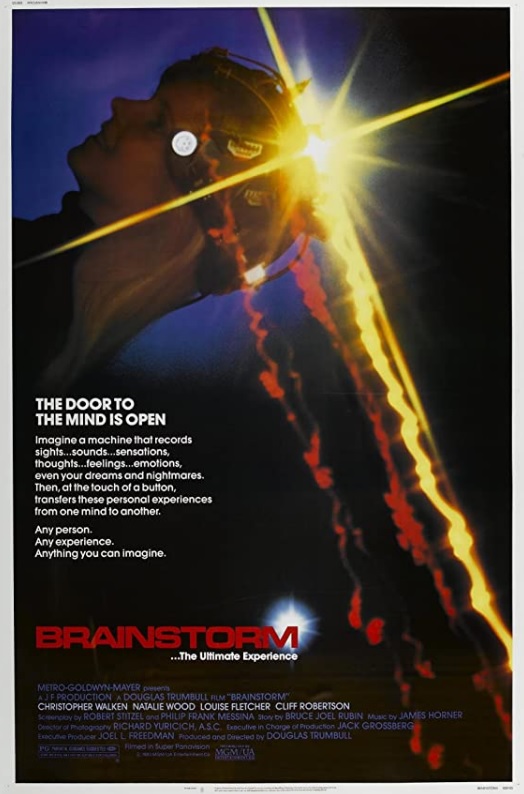
As you can see by the theatrical one-sheet: Trumbull — with the taglines of “The Door to the Mind is Open” and “. . . The Ultimate Experience” — was promising us an extrasensory ride into the human brain with a 2001: A Space Odyssey twist.

Nope.

What we ended up with was the recording of “memory bubbles” by Louise Fletcher’s Lillian Reynolds’s fatal heart attack (scene clip). You would think a recording of death itself — promising a “journey through hell and the afterlife and into the universe beyond” — would be, well a mind blowing, extrasensory ride. It wasn’t. At only 106 minutes (one hour and 45 minutes), Brainstorm played a lot longer, since it was boring, not the least bit mind blowing, and just a bunch of fizzy bubbles popped by romantic dramas between Walken and Wood’s estranged scientists. “Jupiter and Beyond the Infinite,” denied.

Look, it’s an expertly put together, well-produced effort and the acting is on the green (expect for Louise Fletcher’s overacted death scene; it’s still cringy all these years later; the chain smoking — around all of the electronic equipment — is annoying, for there had to be a better way to set up her heart attack), but the film around all of that is sub-par and it just doesn’t make it to the cup — or skull cap, if you will. (Especially the whole pseudo-comedy set up with the two security guards up against the malfunctioning robotic production line; it looks like it’s dropped in from another movie. What were you thinking, Mr. Trumbull?) So, slag me for not like Brainstorm: I can deal. Just like I can deal with those who “can’t believe” I recommended them 2001: A Space Odyssey and Silent Running.

But, to quote our favorite, existential PhD bouncer, Dr. James Dalton: opinions vary . . . down by the roadhouse or movie theater. You may like it. And, like that other, not so existential wrestler I respect, Shirley Doe: films are funny that way.

About the Author: You can read the music and film reviews of R.D Francis on Medium and learn more about his work on Facebook.

Defense Play (1988)

It’s time for more high school kids with computer-tech skills!

But thanks to the presence of ubiquitous TV character actor Monte Markham (who lost out on the Steve Austin role in The Six Million Dollar Man; but we’ve enjoyed him in such TV movie and drive-in fare as The Astronaut, Hotline, and Ginger in the Morning) as the lead adult and (experienced) director, this obscure, up-against-the-budget clone is much better than the better known ’80s teen hacker clones Prime Risk and Terminal Entry, both which benefited from incessant pay cable replays not bestowed to Defense Play.

What’s the Airwolf doing here? Blue Thunder? Nope, it’s just a drone.

Now, if the film’s “Ancient Future” backwash to teen-tech romps WarGames and The Manhattan Project, and the presence of Monte Markham (as the military dad who heads the top secret shenanigans), doesn’t stir the cockles of your mainframe, this is the movie that answers the question: “Whatever happened to Boof from Teen Wolf?”

This time, instead of the U.S. Air Force firing up the WOPR, they’re firing up a (stock footage) Saturn V (in 1988, no less, although the shuttle program was in full swing) from Vandenberg AFV topped with a top secret (and aren’t they all) satellite. To foil the launch, KGB agents (natch) are out to steal — in a plot that foresees today’s drones — DART, a miniaturized, remote-piloted stealth helicopter under development at a local university. (And there’s LOTS of stock footage and stock sound EFX at “play,” here. You’ll notice what’s what.)

Not Saturn V’s, but Deltas — based on Space Shuttle technology — were used to launch satellites in the ’80s . . . but when you’re on a budget, you take what stock footage you can get.

The “David Lightman” for this go-around-the-mainframe is Scott Denton (David Oliver from Night of the Creeps; passed away at 30 in 1992), just another one of those 30-year-old high school students with a knack for computers. He’s the project’s team leader alongside Karen Vandemeer (Susan “Boof” Ursitti, who, before and after this, has smaller support roles in Funland and The Runnin’ Kind) and other older-than-high school age whiz kids on the DART program. When Karen’s dad, the school’s computer professor, is murdered-by-laser from one of the prototype DART copters, Scott and Karen — as is the case with the other ’80s teen-tech hero romps Iron Eagle and Red Dawn, My Science Project and (ugh, another mention of the abysmal) The Manhattan Project — spring into action to find the murderer and thwart those Ruskies from thwarting the satellite launch.

If you’re into the nostalgia of Apple IIs, dot-matrix printers, and dial-up modems running those drone forefathers, then enjoy the show. While this received a limited theatrical release and ended up on VHS, it’s never been — and more than likely never will be — released on DVD. Amazingly, there’s a VHS rip to watch on You Tube. And with Susan Ursitti (sigh goes the heart) starring, how can you not watch? Boof is a PTA soccer mom these days. Wild, right? We should all be so lucky to have a wife like the Boofster.

Caveat Mainframe: Ulli Lommel (Blank Generation, The Boogeyman), never one to not cheap-jack the films of others, has his own WarGames brat with a high-tech mini-copter that came out in 1987 as I.F.O. – Identified Flying Object — that was reissued to video as Defense Play.

Be sure to look for my reviews of Prime Risk and Terminal Entry, this week, as we continue with our week-long tribute to computer flicks of the ’80s that we will wrap up with our “Exploring: The ‘Ancient Future’ of A.I.” feature.

About the Author: You can learn more about the writings of R.D Francis on Facebook. He also writes for B&S About Movies.

Y2K (1999) and Y2K (1999)

No. That’s not a B&S About Movies site bug: there’s two movies with the same title released in the same year jumping on the “Year 2000/Millennium Bug” bugwagon that was going to, well, descend the Earth into global chaos.

The first one, also known as Y2K: The Movie, aka Countdown to Chaos in the overseas theatrical markets, was crafted by the great Dick Lowry, the producer and/or director behind Angel Dusted, In the Line of Duty: The F.B.I Murders, and Miracle Landing (one of the TV movie airline disaster flicks we didn’t get to in our week-long tribute).

The second one is an even dopier — Canadian-made, natch — direct-to-video time waster, which is also known as Terminal Countdown in the overseas theatrical markets. Direct-to-video sausage king Richard Pepin, through his PM Entertainment Group, who ground out the likes of the sci-fi actioner and disaster romps such as Cyber Tracker, T-Force, and Epicenter across his 120-plus credits, made the other one (Steel Frontier and Skyscraper; no, the Anna Nicole one, are two others).

And neither production thought of using the no-brainer title of The Millennium Bug for their oh-so-got-it-wrong “ancient future” hysteria boondoggles.

So “controversial” was the first Y2K, it almost didn’t air on the NBC-TV network on November 21, 1999, as some of the major utility, banking, and trading institutions feared it would cause a “War of the Worlds” type panic, inadvertently caused by Orson Welles’s radio drama broadcast on Oct. 30, 1938.

Well, it did air . . . NBC executives just chuckled at the silliness of it all. People losing their nut because of a TV movie?

Imagine if the A-List disaster flicks Armageddon and Deep Impact had to run with a disclaimer to appease the chicken little and falling skies buffoonery of the energy and banking worlds. Well, this flick, did:

This program does not suggest or imply that any of these events could actually occur.”

And guess what? The critics hated it and nobody it watched anyway.

The always likable Ken Olin is an MIT-trained systems analyst employed at a nuclear power plant in Seattle. While in Washington D.C. bickering over the Y2K issue, he learns that a Swedish plant — as the clocks turned over to 2000 — suffered a catastrophic meltdown. And like all disaster flicks before and after it, our hero faces an adversity rush to home before his family goes “nuclear” — and not even the presence of the always on-the-spot Joe Morton (Terminator 2) and Ronny Cox (of the aforementioned In the Line of Duty: The F.B.I Murders), can save them . . . or this movie. For there’s no thrills. There’s no action. There’s no nothing. Yeah, we ballyhoo the “Big Three” network TV movies around the B&S About Movies cubicle farm all the time, but not this one. Ugh. When it comes to “ancient future” flicks, this one gets it wrong and is the worst of them all — both in the ancient future and TV movie categories.

As for the second one? The critics hated it and nobody rented it. See for yourself — with this trailer.

The always spot-on Louis Gossett, Jr. (Jaws 3D) is pulling a paycheck, as well as the always welcomed Malcolm McDowell (Moon 44). This time, instead of a nuclear power plant, we have a top-secret (in the deep jungles), long-range missile site — connected to Richard M. Nixon’s administration (!) — that will launch its nuclear stockpile when the clocks clicks over to January 2000. And like all disaster flicks before and after it, our hero (Gossett) needs to stop the launch. Which leaves Mal as the evil general.

Sorry, no there’s no trailer for it, but you can stream Y2K: The Movie from NBC-TV for free on You Tube. You can also stream Y2K: Terminal Countdown on the Russian version of You Tube, OK.ru — which makes it all the more of a sweeter watch, courtesy of the Russian explanation-dubbing over it.

About the Author: You can read the music and film reviews of R.D Francis on Medium and learn more about his work on Facebook.

Terminal Entry (1987)

The computer . . . some people think it’s a high tech toy. But this is no toy!
— copywriting department gobbledygook

You’re David Mickey Evans: A budding screenwriter that wants to break into the business with two, deeply personal screenplays—Radio Flyer (1990) and The Sandlot (1993)—that enrapture the innocence of your childhood and lifelong love of baseball.

Access denied, kid!

You’re trying to “make your break” during the slasher ‘80s. And this is the movie business—the operative word being business—and La-La Land stands at the foot of Mount Lee to make money, kid. And they’re not here to give people the warm fuzzies about their lost childhood.

So you come to the realization you’ll have to write “for the marketplace,” so you come up with a slasher script for your screenwriting debut, Multiple Listings, that’s bastardized into 1987’s Open House. Then you’re employed as a writer-for-hire on a WarGames (1983) knock-off. . . .

“Give me Risky Business with a computer, kid.”
— Fat cat studio executive

Just take those old computer from the shelf / I am hacking them here all by myself / I just want some old time hacking codes

“Kids and computers, kid. Kids and computers. Smart-ass teen hackers and kiddie tech nerds sell tickets,” stogie-belches the studio fat cat as he perches his wing-tipped spats on his ostentatious oak desk. “But give me a My Science Project (1985) or The Manhattan Project (1986), kid; not a shit-storm Prime Risk (1985). And we want it quick, there’s some movie Defense Play (1988) in production and we need to beat ’em to the theaters. And none of that personal childhood crap. You want to relive your baseball dreams, go play a pick-up game in Griffith Park and gander at The Hollywood Sign from afar. And I want action with those smart-ass remarks and no introspective statements about man losing his humanity to technology, either. Now get out of here, kid. I have a ‘nooner’ coming in, I mean, I’m casting a part.”

And the executive cheeses that script with a “design” for the poster of what becomes Terminal Entry (1987): Black-clad terrorist dudes superimposed-running across and attacking an IBM PC, complete with a Tom Cruise Risky Business-inspired smart ass wearing a chef’s hat in the background.

But Terminal Entry worked out reasonably well on cable and home video, so you’re hired to complete uncredited re-writes on a sci-fi clunker, Class of 1999 (1990; sequel to the superior Class of 1984). Again, the end product wasn’t so great, but it did reasonably from a financial, if not critical, standpoint. So now the wing-tipped fat cats are willing to take a look at those two “personal” screenplays—Radio Flyer (1990) and The Sandlot (1993). And you’ve become the toast of Hollywood as one of the highest paid screenwriters of the ‘90s, with sales of over $1 million for each script.

But let’s back to the “Ancient Future” frolic that couldn’t get Tom Cruise as their lead, since he was already off into the wild, blue younger with Top Gun and, luckily, he avoided all the computer crap. And the producers couldn’t come up with a script, so they simply lifted the plot of WarGames hook, line, and CRT monitor.

You remember the plot of WarGames? David Lightman wanted to be the first to play Protovision’s new line of video games, so he attempted to hack into their mainframe . . . and instead hacked into NORAD’s defense computer.

Then you’re up to speed on the (non) story in Terminal Entry.

The gool ol’ U.S.A is under a cyber attack by overseas (Middle Eastern, natch) terrorists trying to access a military satellite. Meanwhile, a group of high school computer nerds want to play a new video game. And they inadvertently hack the terrorist’s stolen password and—instead of the WOPR—they gain access to the defense network satellite. And the kids think they’re “playing the game,” but actually issuing mission directives to the the terrorists to assassinate officials and blow up buildings across the U.S.

What can we tell ya, R2. Times were for tough for Yaphet Kotto (Alien) and Edward Albert (Galaxy of Terror) who must had some laughs at the honeywagon over that career common denominator. Oh, and this makes two Tracy Brooks Swope movies we’ve reviewed at this site: she’s part of our upcoming “Lee Majors Week” with her work in Keaton’s Cop. And speaking of Tracy and our need to see actors in multiple movies: Patrick Labyorteaux from Heathers is in here. Oh, and if you ever wondered what happened to Rob Stone, the eldest son Kevin from the ’80s TV sitcom Mr. Belvedere, he’s here as one of the computer nerds.

And one Patrick and one Rob does not a Tom Cruise make. For this is Terminal Crap, indeed.

You can watch the full movie on You Tube—a full VHS rip complete with opening trailers! Check out the trailer, here.

Be sure to look for my “80s Computer Week” review tributes to Prime Risk and Defense Play, this week. And, we did a whole week of reviews in honor of Lee Majors and his films, so we’re rolling Keaton’s Cop, as well, in the coming weeks.

About the Author: You can read the music and film reviews of R.D Francis on Medium and learn more about his work on Facebook. He also writes for B&S Movies.

Prime Risk (1985)

We, the lost analog-cum-celluloid denizens of the (digital) pages of B&S About Movies are here to partake of another one of our “theme weeks,” in this case, all of those “ancient future” computer movies of the ’80s and ’90s that made the Internet more amazing and more frightening than it actually is. For those were the golden days of Hollywood — before thumb drives and clouds — when Tinseltown could dupe us with mere oscilloscopes and strips of magnetic tape — especially when a cute girl is running said scopes and cutting said tape. Hello, hook. Nice to meet you, line and CRT monitor.

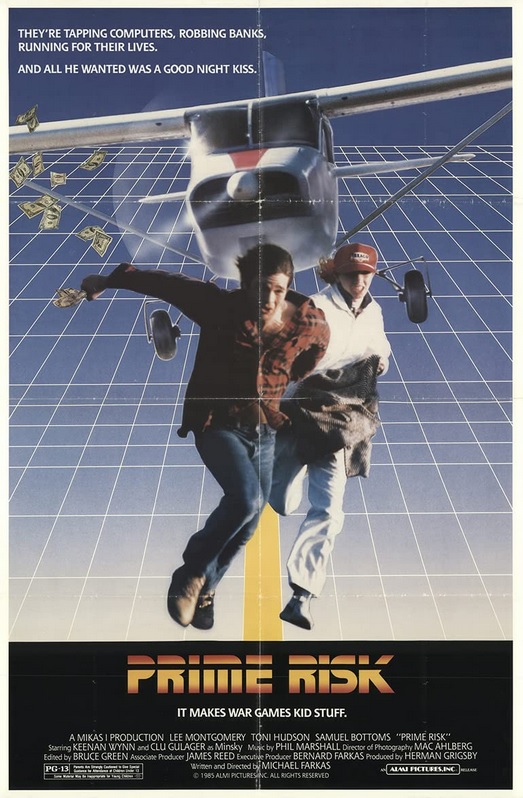
Art Department fail. Would you lay down $3.25 to see this in a theater?

Only 22 at the time of making the film, writer/director Michael Farkas came into his technical knowledge courtesy of his father who worked in IT security; as result, Farkas, compared to us Asteroid and TRON addicts, was a “David Lightman” and knew a hell of a lot more than we did about what made our Apple IIs and Commodore 64s tick. So, while the techno-gobbledygook, knob-twirling, scope-bouncing waveforms, and ticking red-LEDs are dated now, he was cyberhuskin’ then, since the tech was relevant and accurate to the times — hook, line, and cybersnakeoil.

Films like Prime Risk are a byproduct of those pre-AOL days when most of the world lacked computer knowledge beyond their Atari gaming system and quarter-swallowing arcade games. Moi? At the arcade: Defender and Xevious was my jam; I was rockin’ out with Space Defender on my Apple II packing a whopping 64kb of RAM. Who cared how it worked? All we knew is that we could punch in the number “7 7 3 4” into the red-LED displays of our Hewlett-Packard HP-35s and Texas Instrument TI 1200s and, when you turned it upside down, it spelled “H E L L” (calculators of the day used the “open” four, which resembled an upside-down “h”). Hey, my Commodore 64 had a “brain,” it would play 3D Tanx and recite whatever I typed: profanity, of course. So, thanks to our technological gullible intrigue, Hollywood could sell us on the bleeps n’ bloops anyway they saw fit: who knew that, with an (cathode-ray) oscilloscope and some strips of cassette tape, you could rule the world?

How? We weren’t even dialing-up by AOL, yet. We still had to insert a 5.25″ initialization disk to boot the system, Dr. Charles Forbin, be damned.

So, you heard of the tales of Joshua, the “son” of Professor Falken, aka “WOPR,” in WarGames, right? Well, take that movie . . . and recast Matthew Broderick and Ally Sheedy with dream-hunky Lee Montgomery (the all-grown up kid from Ben, the sequel to the original rat movie, Willard) and heart-weeping Toni Hudson (of the well-remembered ’80s comedy Just One of the Guys; the not so well-remembered School Spirit). Then replace Dabney Coleman (who I can always do without) with lovably-cranky Keenan Wynn (Laserblast) as the villain, and toss in a helping of Sam Bottoms (Up from the Depths) and a soupçon of the always-awesome Clu Gulager (Return of the Living Dead, Hunter’s Blood) as doubting-Thomas, good guy FBI agents. And — most importantly — reverse the roles: make the girl the hacker and the guy the ne’er do well “romantic” sidekick. And — even more importantly: instead of stopping nuclear Armageddon, we’re stopping financial Armageddon. Oh, and ditch WOPR for an oscilloscope. . . .

So, are these kiddie-tech proceedings worse than WarGames . . . yet better than the smartass-kid-makes-a-nuclear-bomb box office bomb that is The Manhattan Project?

Yes!

Welcome to the pre-AOL cyberworld of Prime Risk. Pfft. War Games are kid stuff. Hacking computers is Risky Business!

Julie Collins (Toni Hudson) is a still-in-high-school computer engineering genius who applies for a part-time job at a local bank. Of course, this being the ’80s, the head IT job at a bank is a “man’s job.” Julie vows revenge. So, packing 128ks of RAM and an oscilloscope, she deciphers the magnetic pulses from the bank’s ATM machine, converts the electromagnetic cycles into tones, and translates the beeps ‘n boops into PIN numbers. Then, with hunks of plastic and analog tape, she burns off her own ATM cards. And as Julie, along with her cash-strapped-I-hate-my-dad school chum, Mike (Lee Montgomery), they stumble into a Russian plot to crash the Federal Reserve and collapse the U.S. economic system.

So, did you get that? The U.S. economy can be wiped out by mastering the art of magnetic information storage and retrieval — and knowing how to operate an oscilloscope. Is that conveniently-labeled “Remote Jammer Transmitter” on loan from the Batcave?


No freebies on this one, kiddies. MGM owns the rights and Park Circus handles the distribution. So while it’s not available on DVD, you can stream it on Amazon Prime. As such: here’s the unofficial trailer upload; we hope it is still there. . . .

Thanks to incessant HBO replays (Over the Edge!) this forgotten, post-WarGames “ancient future” frolic turned into a well-deserved cult classic. And we have to give Farkas credit: he was the first filmmaker to the marketplace with a teen-tech hero clone, beating out the bigger studio/director WarGames-hopefuls Terminal Entry and Defense Play to the theaters. Courtesy of an extensive, May 2020 interview with writer-director Micheal Farkas at the Australian site Cult Film Alley, you can learn more about the film’s production history. (Anthony Edwards (Top Gun) instead of Lee Montgomery? Darren McGavin (The Night Stalker) instead of Keenan Wynn? Wow. Fascinating film facts, Cult Film dudes!)

Be sure to look for my reviews of Terminal Entry and Defense Play as we continue to roll out our week-long tribute to computer flicks of the ’80s.

About the Author: You can learn more about the writings of R.D Francis on Facebook. He also writes for B&S About Movies.