“From the moment that I read the script it was perfect. It didn’t need any changes. The subject matter was incredible. The writing was perfect for that subject matter. It had such a wide variety of emotional range that each character was going to bring to the table that it just jumped off the page.” — Actor Paul Logan, with Alika Gasimova of ISAFF Interviews
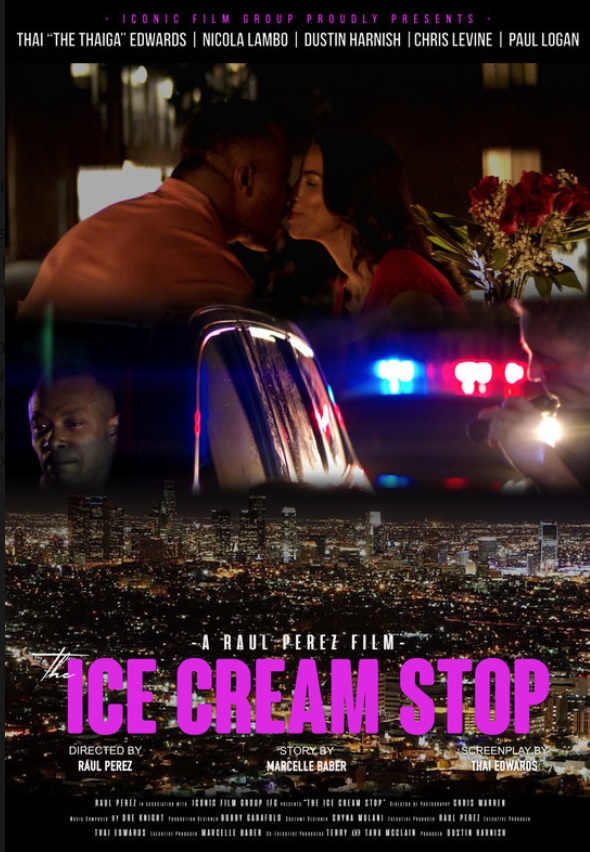
To say that I, as a film critic, am privileged to have watched an advanced digital stream of this masterpiece, granted the opportunity to expose it to others, well, that’s what makes my job the best job there is. I’ve acted in my share of shorts, watched many at film festivals, and reviewed a few along the way for B&S About Movies, but never a short film like The Ice Cream Stop. Raul Perez and Thai Edwards are two unknown filmmakers with a major studio, A-List education as to the importance of the emotional impact and social influences of film; an art form that can, when expertly executed, can open eyes and instill a new perspective in the viewer.
Raul Perez, as with any film school graduate, ultimately wants to write and direct his own films. An up-and-coming actor, such as Thai Edwards, wants to be noticed and book larger roles beyond the usual shorts, web series, and network/cable under-five “day player” roles that serve as the beginning of an actor’s career. To quote Rodney Dangerfield: It’s tough out there, in Tinseltown. So amid his directorial work with shorts and music videos, Perez has worked in various capacities on the crews for the hit TV series Black-ish, Criminal Minds: Beyond Borders, Ellen’s Game of Games, and Major Crimes. Thai Edwards, along with his writing-producing partner, Marty Baber, decided to take Tinseltown by its thorny star to become a wingtips-on-the-desk and cigar-chompin’ QWERTY warrior.
Here, in his eighth directing effort, Raul Perez makes his co-screenwriting debut in a fitting tale exploring our recent concerns regarding racial inequality and social injustice . . . and how one’s life can change in a moment at the mercy of another’s misplaced anger and bad decision making, turning another human being into an exorcising-personal-demons punching bag.
Surgeon Dr. Michael Harris (a solid Thai Edwards) returns home at 3 am from a double shift at the hospital to Tameka, his loving, pregnant wife (a ditto Nicola Lambo). Before going to bed, he asks her if she needs anything: she’s craving ice cream. Although exhausted, he decides to make a quickie-mart run.
It is on his return home that Micheal’s life changes: Officers Reynolds (Paul Logan) and Davis (Dustin Harnish), “aroused” by Micheal’s driving, initiate a traffic stop. Although Micheal checks out, the stop escalates upon the arrival of Officers Morales (Chris Levine, Shadows) and Officer Smith (Jed Dennis), as their out-ranked level heads can not stop what’s been set in motion. At that moment, each of their lives change — and are connected beyond their mutual, traffic stop tragedy.
Not many films instill the sickness of a burning anger mixed with fear in the pit of your stomach . . . and cause you to shed tears. The Ice Cream Stop is a gut punch and not for the faint of heart. It is a film you must see.
The most recognizable face in the unfamiliar but effective cast of The Ice Cream Stop is actor Paul Logan. U.S. daytime TV fans know Paul for his four-year run as Glen Reiber on The Days of Our Lives. You’ve also seen him on the highly-rated SyFy Channel and mockbuster streamers Atlantic Rim: Resurrection, MegaFault, and Mega Piranha. Fans of TV’s Criminal Minds, Lethal Weapon, and NCIS will notice Nicola Lambo, while fans of TV’s S.W.A.T. will recognize Thai Edwards, who also appeared in the dramatic indie Anabolic Life with Chris Levine. B&S About Movies readers know the work of Chris Levine by way of the indie streamers No Way Out and his leading role in the upcoming, retro-’80s actioner, The Handler.
Courtesy of the pedigree of the network TV resumes in front of and behind the cameras, all of the disciplines are firing on all cylinders (oh, are they ever) — as the expertly-cut trailer above, proves. No trailer is complete without great cinematography: to that end, Chris Warren’s night photography is of a stellar, Oscar-level quality (reminding of J. Micheal Muro’s work in Paul Haggis’s Crash and Robert Richardson’s in Martin Scorsese’s Bringing Out the Dead), making him a name to expect more great works.
The cast, via their superior acting skills, are instantly relatable: Thai Edwards and Nicola Lambo are pure, major studio chemistry as the expecting couple. Paul Logan and Dustin Harnish make us hate them, while Chris Levine and Jed Dennis — with little dialog and more body language and facial expressions (the signs of a truly great actor) — illicit sympathy; you feel their regrets that this “stop” is wrong. No actor can pull that off without a great script: the connection to the characters comes courtesy of an expertly crafted screenplay by Edwards and Perez that’s replete with perfect character arcs; everything the viewer needs — in a script that forces a dark, vile ugliness that exists in our society into our faces and causes us to look within ourselves — is there. Not many short films on the festival circuit leave you wanting more, saying, “Give these guys a budget to make this into a feature” (or do another film), which is the end game of some short films. The Ice Cream Stop is one of those very few film shorts to accomplish that goal.
“I had to equate this literally to playing like a child molester or Hitler, someone who is loathsome and who you detest. You had to just go there. If you didn’t commit 100% percent to something like this, especially if this is not the way you think, the audience would see right through it.“ — Actor Paul Logan, with Alika Gasimova of ISAFF Interviews
It’s no shock to this reviewer that The Ice Cream Stop recently completed successful, award-winning screenings at the Los Angeles Film Awards in March and the Colorado International Activism Film Festival in September. Currently continuing its festival run — and surely to win many more awards — you can follow the film at its official Facebook and Instagram portals to keep abreast of its commercial streaming release date. And do keep track, for The Ice Cream Stop is a film you must see.
If you enjoy film to the point of wanting to know what goes into making a film, you can learn more about the process through the insights of Raul Perez and Thai Edwards — as well as the rest of the cast — courtesy of their mutual interview with Isaff Interviews WordPress; the portal also offers a video version of the interview on You Tube. There’s more insights to enjoy at the personal website of Thai Edwards, as well as The Iconic Film Group.
Just wow. I love this amazing film and await more from all concerned.
The cast and crew of The Ice Cream Stop: Front row, from left: Dustin Harnish, actor/screenwriter Thai Edwards, and Paul Logan. Second row, from left: Chris Levine, director Raul Perez, Nicola Lambo, project co-creator/producer Marcelle Baber, and Jed Dennis/image courtesy of Isaff Inteviews WordPress.
“My partner Marcelle Baber, the creator of The Ice Cream Stop, is the one responsible for [the film] and gets the real credit. We all played our part individually and collectively in this project; Raul had a great vision on how to illustrate it and the cast just gave it a heartbeat, but without the idea that helped create the words in order to tell a story, [our film] would never be.
“Marty [Marcelle Baber] had a dream and this was just a conversation that he brought to his cousin-by-marriage, Raul, and Raul, after ten-plus years of trying to get something going after a few failed attempts, brought [the project] to me and I took it on like any actor/executive producer who believed in the vision and all the people involved, would.
“We all helped to develop and work on the storyline for about seven months; some of this actually came from personal experiences that happened to me and Marty . . . what happened to George Floyd just made us want to do something about it — but in a different way and take a different approach. This helped Raul a lot to come up with the shots needed for the film; it all took about six months after Marcelle brought it to us. This was a film given to us by God at a time when it was much needed. Above all, I’m just happy that we got the assignment given to us, right! It’s a hard watch: you’re either going to love it or hate it; but I see it to be a timeless piece, especially since things haven’t changed and the conversation about this, still, is a non-issue with some people.” — Thai Edwards, to B&S About Movies
Disclaimer: We didn’t receive a review request or screener copy of The Ice Cream Stop from a PA firm or from a distribution company. We discovered the film on our own via social media and were provided a screener for the film upon our request. That has no bearing on our review.
About the Author: You can learn more about the writings of R.D Francis on Facebook.In addition to writing film reviews for B&S About Movies, hepublishes on Medium.
Oy, this movie . . . this friggin’ movie! Just like a Wim Vink joint, such as Half Past Midnight, a Jim Larsen joint takes its punches for being repetitive and plotless, with its “awfulness” compounded by its scant-to-no dialog and added-in-post victim screams that come replete with bad acting and well, bad everything that a film should not be.
Frackin’ balderdash: Nigel the Psychopath is a thing that should be.
For as our cherished (well, my) Doug Ulrich and Al Darago Karo Consortium for Better Film product line foretold in Snuff Kill: a Larsen bowel movement is a burst of pure offal ridiculousness squeezed out by an-off-the-Ritalin energy. Yeah, that’s right: move it on over, Mr. Dennis Divine, for there’s a new, pulpy monster mag back pages SOV-auteur in the john, er, town.
Yeah, just plop it right over ‘ere, Jimbo: our VCRs have been trained on a steady diet of the fibrous intestinal cleaners of Jean Rollin, Jess Franco, and Bruno Mattei for a very long time. We can handle the raison d’etre Sean S. Cunningham stank for the one hour serving you’re dishing . . . or is that squatting? Hey, if we can clench our cheeks on Joel Reed’s Gamma 693, we can pass this tape worm without the vasoline assist, no problemo.
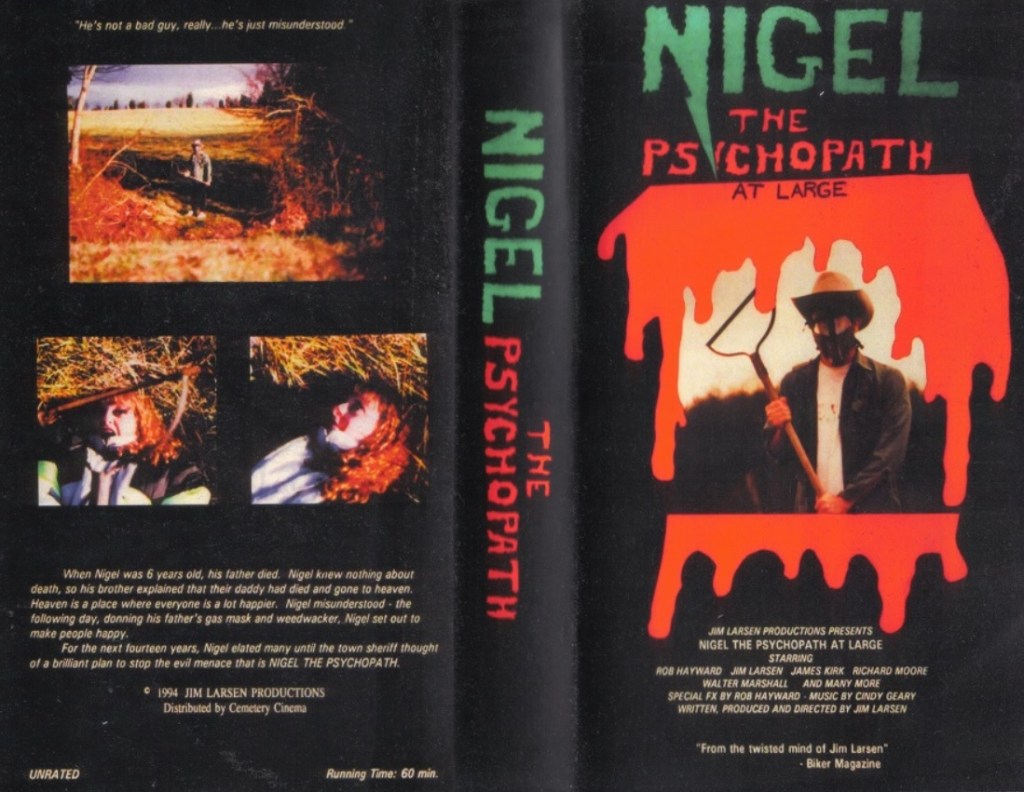
Okay, so . . . the pesky plot, or lack there of: Our misunderstood ‘lil devil on this 9th day in the month of our Scarecrow is Nigel: a gas mask-adorned psycho who frolics among the SOV backyards of America as he lives by the edict: heaven is a place where everyone is a lot happier. But not just anyone, mind you: get the adults the frack out of here, for Nigel stalks the local playground and kills children death-porn style — with a weedwacker (well, a sickle/rake thingy) — along with the occasion broomstick impaling and staple gun dispatching. Heads are split open, neck are garroted-by-tree, faces are stomped, and arms and legs are loped off in quick succession in between fight scenes that make ol’ Dolemite himself, Rudy Ray Moore, look like Bruce Lee.
Oh, hell yes, and jumpin’ Jehoshaphats, Nigel the Psychopath is a film that breaks all the rules, not just the crafts of filmmaking and thespin’, but of good taste and common sense that jangles the five sense. Ye must embrace the inept editing and the muddy-to-blaring music that goes from acoustic guitars to reggae to rock. Accept and suspend all logic as Larsen’s gang of shemps* out-Raimi a Sam Raimi production with a commitment to the shot-on-video cause. Pair ‘er up with Cards of Death and Lazarus the Legend and analog yourself into a snowy-screened stupor.
In the end, for me: Nigel the Psychopath isn’t so much a fluid narrative, but a documentary — a documentary chronicling Jim Larsen and his friends having the best ’80s summers, ever, as they lived the dream of making their own slasher movie. So, yeah, uh, okay . . . Nigel the Psychopath may not be the best movie (for me, it is), but it’s full of the heart that lacks in wannabe, SOV-masquerading junk like the Canadian slop that is Blue Murder. And the Larsen love comes in spurts!
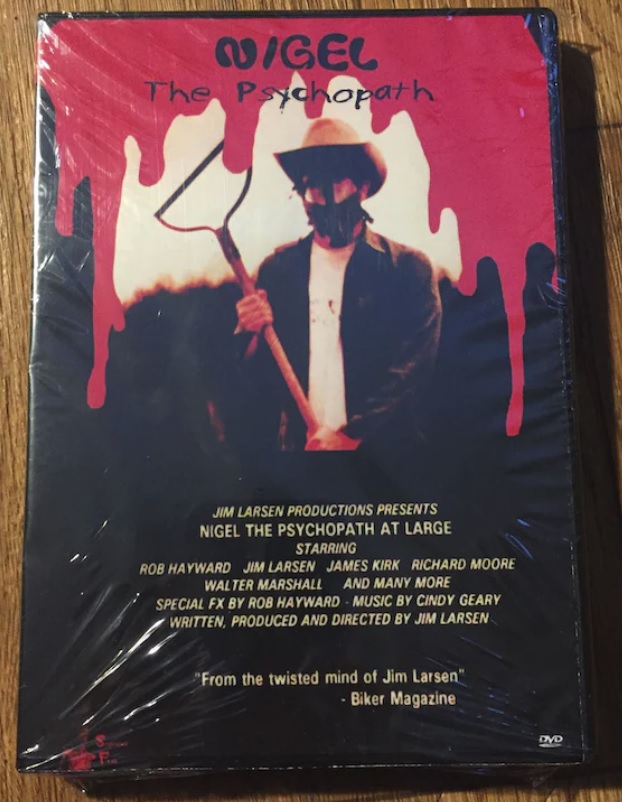
Thanks to writer and director Jim Larsen interacting with his fans via the wonders of the web, we’ve come to know that, while we toss his slasher opus on our SOV woodpiles, it was actually shot on Super 8 mm film and VHS video between the years of 1986 to 1989. There are also three versions on YouTube to chose from: the original super 8 film short, the VHS-version, Nigel the Psychopath At Large, and Nigel the Psychopath: 33rd Anniversary Director’s Cut (that runs a wee-longer, at 70-minutes). Pick one or pick ’em all and watch the insanity for yourself, courtesy of Jim’s very active You Tube portal.
What’s that? You want to know more about the man, the myth, the “real” warped mind of Jim Larsen? Well, he’s on the web at themindofjimlarsen.com via WordPress. He tells his version of events concerning Nigel the Psychopath with his own page dedicated to the film. Read it!
* Dude, if we have to explain “shempin'” to you, we know ye not. Turn in your B&S About Movies membership card.
About the Author: You can learn more about the writings of R.D Francis on Facebook.He also writes for B&S About Movies.
“Have you ever felt the need for vengeance?” opened the film review posted at our fellow WordPress site, On the Subject of Horror. They, like B&S About Movies, take a Charlie Kaufman-approach to reviews and write ourselves — along with our past fears and pains — into our reviews. Why? Because that’s how deeply we associate with films. It’s therapeutic. So, I kept reading . . . and discovered a film that slipped by me, as result of Mr. Covell’s engaging writing. So, you see, personalizing film reviews, in conjunction, with a little self-deprecation, works. For we leave the haughty Variety, to well, Variety. Yeah, they’re a fine publication, as is The Hollywood Reporter, but well, you gotta go gonzo and be a little different on the digital plains along the muddy banks of the ol’ Allegheny.
And “different” best describes The Head Hunter: a film that just isn’t a piece of once-swallowed-and-gone-head candy and click, “next-movie” consumption: this movie sticks to your brain and burrows into your marrows — where those pesky little Tardigrades swim amid your biology.
Sure, we enjoy the big, CGI “shock scares” of the A24 and Blumhouse variety, and James Wan (Malignant) never steers us wrong, but it’s the little guys that get us. What really intrigues us at B&S About Movies aren’t those filmmakers with ten or one hundred million dollars in their pocket: it’s what the filmmakers with $10,000 or $100,000 in their pocket can do. You know those films: the production cost of one shot/scene in Martin Scorsese’s The Irishman could cover the entire production cost of an indie streamer.
Such a film — discovered courtesy of One the Subject of Horror (Read. That. Blog.) — is The Head Hunter.
Geezus. He looks like a bad acid-tripped Batman.
Using Jean-Jacques Annaud’s 1981 film Quest for Fire as inspiration and shooting in Portugal and Norway, this brilliant feature film by Jordan Downey and Kevin Stewart, the team behind the ThanksKilling franchise (?), was shot for a mere $40,000.
Let me say that again: this film was short for four Salmon P. Chase greenbacks. By the ThanksKilling guys.
In some faraway Norwegian wood, we meet our medieval bounty hunter who tracks down monsters and other beasts of burden for his kingdom. When his daughter is slaughtered by one of those beasts, he transforms into an unstoppable “slasher” for the cause. Only, instead of flailing and wailing “final girls”: he’s collecting the heads of monsters.
Our father (an excellent Christopher Rygh) comes to learn that the dish of cold vengeance from which he dines, as with Max von Sydow’s Töre in Ingmar Bergman’s The Virgin Spring, will never fill, never quench his internal furnaces of burning hate. “Father” isn’t a bully, but as in any bully: Sure, the initially draw of first blood floods the cortex with sweet brain candy. Then the emptiness, returns. For vengeance never quenches. Revenge never satisfies. Well, maybe for the narcissist and the sociopath who walks down a school hallway or sits in a manager’s office. . . .
As our buds over at On the Subject of Horror pointed out: the team that gave us the ThanksKilling movies, movies about a rabid, profanity spewing turkey puppet, made this. Which makes this $40,000 streaming wonder all the more amazing.
Are there a production faux-pas? Sure there is, as is par for the digital greenways, uh, maybe (my eye saw none). But there is no question this is a beautifully shot film and a non-sugary feast for the brain.
As another fan opined on another You Tube upload of the trailer: “Someone give these guys a budget, this movie was great!”
Indeed.
Initially distributed by Vertical Entertainment on digital media, The Head Hunter found its way to DVD through Lionsgate. You can watch it online at Amazon Prime and Roku. To learn more, the film also has a very well-written and informative Wikipage that will take care of the “DVD supplement” needs in a streamer’s live.
Do yourself a favor: watch this movie. For if ye do not, thy shall feel the wrath of . . . oh, who are we kidding? We’re bully-scarred milquetoast movie calves . . . and you can kick our little white-veal asses to kingdom come with the slightest branch of Norwegian wood. Like the warriors from GWAR: you wouldn’t even break a sweat dispatching us. But you could take a moment to hit that “like” button or leave a comment for us hard-writing lads.
About the Author: You can learn more about the writings of R.D Francis on Facebook.He also writes film reviews for B&S About Moviesand publishes on Medium.
“Rivers dry up not only because of lack of rainfall but also because of suffocation of smaller streams, chaotic urbanization, deforestation, and unplanned public policy. A civilization too can suffer from choking and droughts, in forms of dogmas, ignorance, and superstition.” — Writer and Director Aditya Patwardhan
I can’t recall — if ever — the last time I watched a theatrical feature that meshed the fictional and non-fictional documentary into one cohesive film. So, with that combining of narratives, you wonder if it will work. And it does, masterfully, in this, Aditya Patwardhan third feature film.
In a felicitous work with man desiring a greener planet, we see the hardships of India’s water and climate change crisis — along with the related unemployment, poverty and hygiene issues — through the eyes of four people: Adriana, a refugee from civil war-torn Venezuela; Kankana, an Indian actress working in Hollywood; Suraj, a street cleaner from the Rajasthan slums of India, and Ravi, a television news reporter from Jaipur.
Adriana came to the Far East land with Rally for River, a pan-India campaign that strives for a better planet. Kankana, who returned to her homeland to research her upcoming film role, instead becomes a catalyst for her reconnecting with her family and homeland. For publicity, she travels with the privileged Ravi, who, instead of chronicling Kankana’s life and career, comes to see the deterioration of his county through her eyes. Suraj, the street cleaner and least privileged of the quartet, sees the world differently: man can, not only ruin the world: he believes they have the power to save it.
Everything works in A Nomad River: The acting (including U.S. TV-familiar Nicole Cannon of the CSI franchise and Lifetime movie shingle), the writing and scripting in a brilliant narrative juxtaposition shot for, get this: $200,000. It’s an amazing movie that has to win multiple awards. It must.
His work internationally recognized, Los Angeles-based filmmaker Aditya Patwardhan has created a wide array of music videos, shorts, pilots and documentaries shot not only in the United States, but in India and Columbia, as well as Eastern Europe and the Baltic States. His feature film debut, And the Dream that Mattered, a drama about an Asian actor’s journey from Korea to Hollywood, debuted in 2018. His sophomore effort, Transference, a drama regarding the struggles of sexual child abuse, appeared in 2020.
Patwardhan’s third feature, A Nomad River, becomes available on Amazon, iTunes, Google Play, YouTube Movies, Cable and Satellite On Demand on October 19, 2021, through Freestyle Digital Media. You can visit with the film on Facebook, Twitter, and its official website.
Four other indies we’ve reviewed with exotic locals are A Band of Rogues, Gozo, Nona, and Still the Water. Another film that analogies man with nature is the very fine Chasing the Rain. Do seek each of them out for a night of viewing. They come highly recommended for anyone who supports indie films.
Disclaimer: We were provided a screener copy of this film from the production’s PR firm. That has no bearing on our review.
About the Author: You can read the music and film reviews of R.D Francis on Medium and learn more about his work on Facebook.He also writes forB&S About Movies.
“Today is tomorrow. Tomorrow is yesterday.” — the woman at the bridge
We were first exposed to the work of Michigan-based actor Mason Heidger courtesy of his leading role as a lovable “mad scientist” in the sci-fi oriented rom-com, Making Time. In that film, Heidger impressed with his thespian abilities in rattling off — and convincingly upselling — that film’s scientific expositional dialogue concerned with theoretical physics and quantum mechanics as it related to time travel. So, when I discovered his newest project — and that the project also served as his writing and directing debut in film — I knew I wanted to review it for B&S About Movies.
“It’s just a little side project I did because I was bored. It’s nothing spectacular,” Heidger modestly explained.
“Get ‘bored’ more often,” was my eventual reply.
As Tomorrow Is Yesterday streamed, it became obvious that, across his wide array of shorts and indie features — as well as a dayplayer role as Officer Rucka in the Detroit-shot scenes of Batman v Superman: Dawn of Justice, along with roles in writer-director Harley Wallen’s Michigan-produced Agramon’s Gate and Eternal Code — Heidger wasn’t puffing his ego with any “I am an actor!” foolishness, as most actors oft do, on sets: instead, he was paying attention.
Also starring Christy Edwards (of Wallen’s A Bennett Song Holiday and Eternal Code) and David Budziszewski (a skilled sound recordist doubling in his first acting role), Mason Heidger has crafted an award-winning short on a zero-budget that works wonders across all of its disciplines. The seasonal, wooded cinematography by Cory James Taylor (crewed on Transformers: The Last Knight, as well as Eminem music videos) is clean and crisp. While I lacked a film synopsis or press kit, the soundscapes expertly created by Budziszewksi and musician Aaron J. Morton (Doctor Who: The Soldier Stories fan series; You Tube channel) placed my streaming-watch in the immediate mind set that, while the film opens with a man (Heidger) walking his dog through a peaceful wood, he’s walking into an otherworldly, Twilight Zone moment, one that that will forever change his life — in an Ambrose Bierce, “An Occurrence at Owl Creek Bridge” stream of consciousness kind-of-way.
My only qualm with the film: Why didn’t you give the dog a screen credit, Mason?
In July of this year, Michigan’s Royal Starr Film Festival selected Mason’s film writing and directing debut for screening. He’s since made Tomorrow Is Yesterday available — for free — on You Tube. You can learn more about the non-profit efforts in film by the Royal Starr Arts Institute on Facebook. You can also learn more about Mason Heidger’s filmmaking journeys on Facebook.
Heidger’s currently in post-production on the feature film debut of fellow Michigan filmmaker Michael B. Chait’s Wolf Hound: a film concerned with the Nazi’s KG 200 program. In addition, Mason recently completed work on Detroiter Harley Wallen’s eleventh feature film, Ash and Bone, currently on the festival circuit with a streaming release, this year. That film delves into the world of Mitten State-bred urban legends . . . the one I know, and freaks me out, is Hell’s Bridge . . . so I wonder if Mason Heidger was, himself, inspired by that creepy bridge legend in crafting his tale.
Fans of Harley Wallen’s films can catch up, with our reviews of Abstruse (starring the always welcomed Tom Sizemore) and Tale of Tails (with Kaiti Wallen of Enteral Code).
Be sure to follow our “Short Films” link, below, to populate our reviews of that genre. Show your support for short filmmakers: for today’s short filmmaker is tomorrow’s feature film Oscar winner.
Disclaimer: We were provided a screener copy of this film from the writer-director upon our request — after discovering it on social media. That has no bearing on our review.
About the Author: You can learn more about the writings of R.D Francis on Facebook.He also writes film reviews for B&S About Moviesand publishes on Medium.
This is one of funniest and enjoyable, cult-driven 78-minutes you’ll enjoy unspooling across the SOV tundras. And it was done to the tune of $1000. Lazarus the Legend is a shot-on-video epic that would have also fit nicely into our “Regional Horror Week,” which ran from Sunday, March 14 to Saturday, March 20 (use our “Search Box” feature to your left to find those films), but since that end of the B&S schedule filled up quickly, this lone feature writing and directing debut by Erie, Pennsylvania’s Matthew Frazzini — since it is a shot-on-video feature, after all — overflowed into our current, September “SOV Week” tribute.
When Lazarus (Dale Crawford) receives a do-or-die challenge from Nick Safara (writer-director Matthew Frazzini), an ancient foe, Lazarus begins his quest in a world where the lines of good and evil blur as he saves the world by acquiring the ultimate power. Lazarus’s sidekick in his fight against Safara’s “Clobbers” is Eva (Frazzini’s sister, Christine Lorraine), a local fortune teller, and his girlfriend, Nina (Patty Colman).
Pour John Carpenter’s Kung-fu/sci-fi action tribute, Big Trouble in Little China (which has its share of fans and detractors; I’m a fan — and no, not because of the Kim Cattrall bondage scene, but because of Kurt Russell’s perfect slices of ham; I’ll watch anything with Kurt, yes, even Escape from L.A. which sucks donkey), dump in Lloyd Kaufman’s 1990 Troma superhero comedy romp Sgt. Kabukiman N.Y.P.D., then smidgens of your favorite Turkish or India ripoffs of American film/TV franchises, then soupçons of Kiss makeup, Star Trek music, and Bruce Lee sound effects. Shake your ’90s Blockbuster Video-logo’d tumbler. Movie served! Gulp the greatest action-comedy ever committed to camcorder. Does this exceed the “heart” of Tommy “The Room” Wiseau that we oft mentioned often around the B&S About Movies cubicle farm — and then some? Oh, yes. And it’s even better than Wiseau’s debut — because, with Frazzini’s debut, the comedy here, is intentional.
King Diamond just # 2’d his leathers/courtesy IMDb.
Courtesy of his sister and co-star, Christine, in her efforts to satiate fans’ questions about the film, she maintains the film’s IMDb page. So we know that her brother created Lazarus the Legend as a spoof of his fandom of martial arts movies. (Shameful Plug: We love the genre, too. Check out our “Drive-In Friday: Karate Blaxploitation Night” featurette.) She also tells us the cast featured Matthew’s co-workers/friends from the steel mill company where he was a plant superintendent. He produced, wrote, taped, and edited the film in his spare time, which was shot in and around Eric, Pennslyvania — the Bayfront Parkway area in particular, which has vastly changed since the film was shot. And Frazzini’s passions paid off: Lazarus the Legend won the “Best Screenplay” award at the 1993 Hometown Video Festival — against 2,200 films from five countries — in Atlanta, Georgia.
Unlike most SOVs, Lazarus the Legend was never released on VHS or DVD. Outside of the festival circuit, it aired on Erie public access television — only once. The folks at Adjust Your Tracking later came to release in the film in a limited-edition VHS — which includes a newly-produced “Making of” documentary and other Frazzini-produced horror-short films.
However, no worries! You can enjoy this ingenuity-rife, Kung-fu sci-fi-action wrestling comedy courtesy of Vacuum Tube Rescue You Tube — in its original, unedited and full-length state. The commercial-free upload has been online since 2014, so it’s not going anywhere. Enjoy!
Hey, wait! Don’t leave! Come back!
In keeping with the regional wrestling comedy vibes of Lazarus the Legend — and the fact that it also shot in Pennsylvania (well, Eastern, this time) — you may want to check out Masked Mutilator. That film had a 25-year production history that began in 1994 to be completed and release in 2019. Another wrestling-centric — and SOV flick — we reviewed this week is Heavy Metal Massacre (1989). Yeah, we love wrestling-oriented films around the ol’ B&S cubicle farm along the muddy waters of the Allegheny . . . you can catch up with all of our wrestling flick reviews, here.
Sadly, we lot Matthew Frazzini in 2009 as a victim in a car crash. And he left us with this film. And the SOV canons are better for it. Just wow . . . if that doesn’t look like Sam the Bossman in ersatz King Diamond face paint. . . .
About the Author: You can learn more about the writings of R.D Francis on Facebook.He also writes for B&S About Movies.
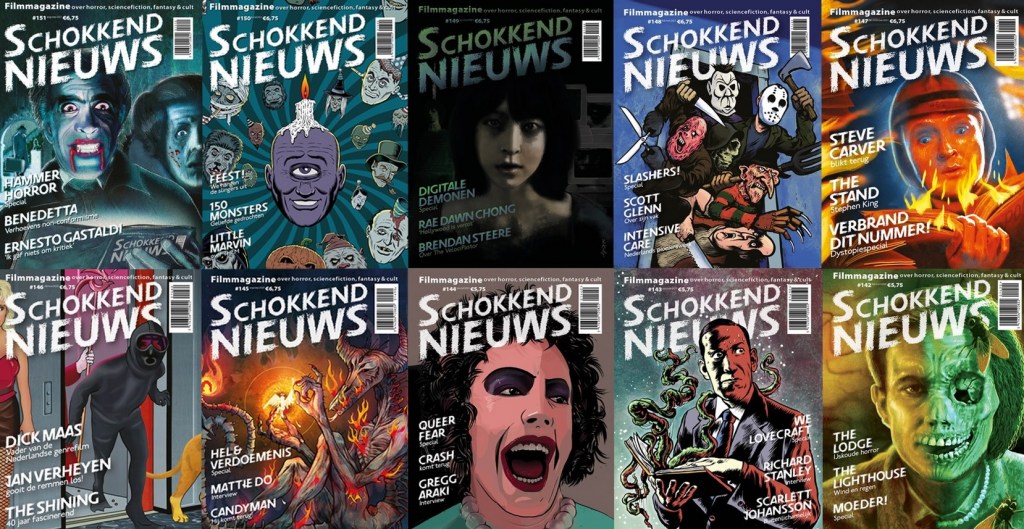
Editor’s Note: This interview with Dutch filmmaker Wim Vink by Hans Minkes originally appeared in the pages of the Netherlands-published Schokkend Nieuws (Shocking News) Film Magazine, dedicated to horror, science fiction, fantasy and cult cinema. It was first published on July 9, 2013, and digitally-republished in its homeland on September 9, 2013, and updated on July 22, 2018.
Hans Minkes, the writer of this interview for Schokkend Nieuws, also publishes his film insights for the Dutch-language cinema blog Bloedlink FilmBlog— a blog dedicated “about the real necessities in life . . . Genre, Horror, and Cult Movies!”
As you read this interview, you’ll discover Wim Vink has a rabid, international fan base and is revered in the United States by horror aficionados. While the press is bountiful in the Netherlands, there’s no English-language press on Vink’s works—let alone an interview—with the writer-director.
Our thanks to Schokkend Nieuws and Hans Minkes for allowing this English-translated version of this article to appear on B&S About Movies.We also extend our special thanks to You Tube user altohippiegabber for their efforts in preserving the career of Wim Vink and making us aware of this rare interview, which we’ve translated for U.S. and other English-speaking fans. As Alto opined: Wim Vink is undoubtedly the godfather of the Dutch horror film, “the uncrowned horror king of Tiel.”
Amen to that.
Wim Vink: Groundbreaker from Tiel
09-09-2013 | Last updated: 22-07-2018 | 07-09-2013 By Hans Minkes
In ZOMBIE 1, Richard Raaphorst’s short film from 1995, Wim Vink rises from the grave after a drunk has pissed on his tombstone. This time, reaching retirement age is enough to bring about his return. Wim Vink, after a long career as a professional photographer, hangs up his camera. But his film camera hangs on another twig. . . .
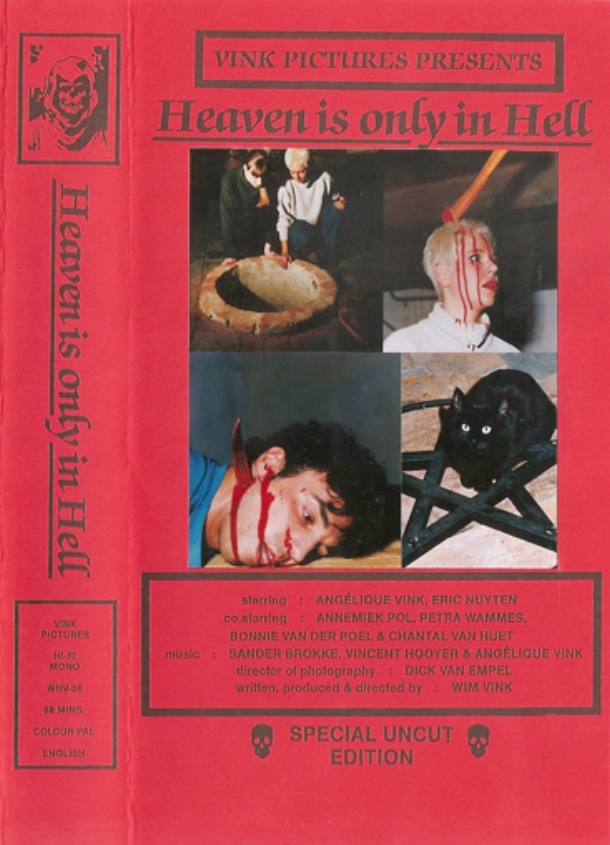
The founder of Dutch low-budget horror—he has directed the short films ZOMBIE HORROR (1981), DANCE MACABRE (1986) and the feature film HEAVEN IS ONLY IN HELL (1994)—is reviled by many. He is accused of a lack of talent or is called a sell-out for the ostentatious use of surreptitious advertising in his films. Yet there is no escaping it: Wim Vink was the first to shoot horror films on pro-super-8 and 16mm with friends and acquaintances. And that from the wet river clay of Tiel.
What I admire in this man is that he has managed to make horror films with his own hands for years and that he enthusiastically tried to sell them to everyone. Pouring blood bag after blood bag on your actresses, while no one around you is waiting for this and investing so much money in your dream with a reasonable chance of never seeing it again, that’s guts! To me he is the Godfather of Dutch Horror.
ZOMBIEHORROR was your first short horror film in 1981. Why did you choose horror?
“I was crazy about horror. I had already filmed everything; documentaries, nature films, corporate films, but no feature film yet and you should have tried everything. The equipment was there and within two days I had gathered friends around me who wanted to go on the adventure with me. I was a big fan of Fulci, Argento and Romero’s work, so a horror film was a natural choice.”
Image courtesy Letterboxd. Both are available as a two-fer PAL-VHS in overseas markets.
How did you manage to finance the films?
“I paid for everything out of my own pocket for ZOMBIEHORROR. I had a budget of 10,000 guilders (!) [dollars]. Later I started using surreptitious advertising. I often had to hear criticism about that, but it was effective and shooting a film costs a lot of money.”
It sometimes comes across as if you were fighting the windmills of Tiel like a Don Quixote in clogs. Did you encounter a lot of resistance? To what extent are you responsible for the end result?
“The problem is I’m stubborn. I want to keep everything in my own hands and that takes a lot of time. I wrote the scripts, filmed everything myself and also did the editing. It was always really a Wim Vink Production. You really shouldn’t arrive in the Netherlands with Dario Argento at the time, then you would have been ripped off. I’ve argued hundreds of times with people who don’t understand horror, but I don’t anymore. Everything is allowed in movies. It is and remains film. End of discussion.
“The headmaster of a school in Zoelen, a village next to Tiel, has been unimaginable at me with letters sent to the local newspapers. I was put down. Fortunately, there were also supporters, such as the then mayor of Tiel. The misunderstanding has even once almost led to a real lynching. I had planned a funeral scene next to the cemetery in a small village outside Tiel on a Sunday morning. We were busy when suddenly a procession with villagers and accompanying coffin entered the cemetery. To say the least, people were not pleased with the film crew present. We were almost molested there. Fortunately, one of the actors was a police officer. He called for reinforcements quickly, otherwise things could have gone wrong.”
In the pre-internet era, advertising a movie was a bit more challenging than it is today. No YouTube or crowdfunding, but with a film look and your soul under your arm, you can visit potentially interested parties. How did you handle that?
“In the Netherlands I distributed large numbers of video tapes with my own hands, but it was mainly abroad where I had the most success.”
In a videotape I bought from you, I found a personal message from the American distributor Mondo Video. They asked if you could provide NTSC versions of your movies. What have you managed to achieve internationally?
“I immediately saw the great potential of the foreign market and therefore decided to make my films in English. I have spent many guilders [dollars] advertising in fanzines worldwide. For example, I had advertisements in Fangoria, which I paid five hundred dollars for at the time, and then you only had a postage stamp size in advertising space. The advertising campaign certainly paid off. I distributed my films single-handedly in the United States, Russia you name it! I also had a long-term contract with the French television channel Antenne 2, which often showed my films in the late evening programme. I have won 187 awards worldwide, so in addition to scorn and ridicule, I have certainly received respect and appreciation. [There was never a deal with Mondo Video due to financial disputes].”
The VHS reissues/courtesy of onorato73/picuki.
Despite the relative success overseas, you were systematically rejected at film festivals in the Netherlands. Seems quite frustrating to me.
“I submitted my films several times for festivals, but I never made it through the pre-selection. ‘We don’t allow those kinds of films,’ was often the reaction I got. I thought, look at it, I am organizing a festival myself; the Benelux Horror & Science-Fiction Narrow Film Festival in Tiel. It had four editions in the eighties and was very infamous! I had about 1,200 visitors in one day, so there were definitely people waiting for genre films.”
Strangely enough, you can’t be found in the compilation video THE NETHER HORROR COLLECTION from 1995. Your name does appear in ZOMBIE 1 by Richard Raaphorst. The grave of Wim Vink that is pissed on by a drunkard, on which ‘Wim Vink-the Zombie’ comes to life; do you consider it an ode or a snarl?
“Oh, delicious! I think it’s a good joke. Any form of publicity is advertising and it was entertaining too. Richard Raaphorst contacted me to ask if I would mind. The film was already finished by then, but I said: ‘Go ahead!’ I’m actually flattered.”
I recently came across a DVD of your movie HALF PAST MIDNIGHT on a site. Doesn’t seem like pure coffee to me?
“I’ve come across that DVD too, but it’s as illegal as it can be! I have not given permission for that. I’ve been working on the release of a DVD box set containing all six horror movies I’ve made for some time now. With making offs, trailers, soundtracks, stills, mini posters, and two short horror/science fiction animation films. And then there is also a bonus. What that will be. . . . There were some contractual obligations that made it take so long.”
The original VHSs/courtesy of mattressparty/picuki.
Now that you’re retired, you naturally have plenty of time. Can we expect some more news from you?
“It’s always itchy! I have stories on the shelf for ten films. But making those films takes a lot of time and energy and I’m not twenty-five anymore.”
END
* Be sure to read the retrospective review by R.D Francis at B&S About Movies of Wim Vink’s Half Past Midnight and Heaven is Only in Hell, along with Pandora and Dance Macabre.
Our many thanks to Julius Koetsier, the Editor-in-Chief at Schokkend Nieuws, for working with B&S About Movies to honor the work of Wim Vink in the U.S.
Banner image courtesy of Schokkend Nieuws Filmmagazine Facebook.
About the Author: You can learn more about the writings of R.D Francis on Facebook.He also writes film reviews for B&S About Moviesand publishes music journalism pieces and short stories based on his screenplays, on Medium.
Editor’s Note: We’re also discussing the writer and director’s earlier works Pandora (1984) and Dance Macabre (1986) within this review.
The original VHSs/courtesy of mattressparty/picuki.
Thanks to the digital realms, with horror fans willing to rip VHS tapes into DVD-rs for their retro-retail portals and video-sharing sites, the once-lost, extremely-hard-to-find resume of Wim Vink — which has all of the earmarks of the ’80s SOVs we adore at B&S About Movies (thus our joint “SOV” and upcoming “Video Nasties” tribute-review weeks) — is easier to discover.
Well, unless you live in the Netherlands, where these films were shot-on-film stocks and distributed exclusively on VHS tapes, independently, by Wim Vink.
Vink’s was an oeuvre you didn’t hear about during the height of the video ’80s in the U.S. You may have picked up on the films in some of the more, offbeat, pulpy underground mags n’ ragzines of the day; possibly you back-page ordered (Spine and Blood Cult) or back-page tape-traded a grey copy. However, we, the many, had their first exposures via the Internet, as horror aficionados began praising the work on blogs, genre message boards, and websites. Maybe, as I did with Pandora — my first exposure to and the only film of Vink’s I’ve seen pre-Internet — many years ago, you picked up a grey copy (along with the U.S. made but Japan-distributed Cards of Death) at your local comic book store.
Vink’s works are intelligent films rife in scene details, but with very little dialog. They’re films that wear a Romero and Argento influence on their bloody sleeves, only with more of an art house film vibe. Some say the films are “boring and repetitive” — and more so with the only full-length film in the Vink catalog, Heaven is Only in Hell. However, that is the whole point of a Vink joint: the devil, if you will, is in the details: the mundane details. For the mundane is, in fact, our reality. Sure, a “good” or “professional” filmmaker knows how to edit out those moments for “narrative flow,” etc. and so on. Well, you know what: when I want that in my film, I’ll load up an A24 or Blumhouse “shock-scare” set piece.
Me, I’m the guy who watched Don Coscarelli’s Phantasm at the local duplex in 1979 and was jaw-dropped. Sam Raimi’s The Evil Dead dislocated my mandibles as a “Midnight Movie.” (And, along the muddy water banks of the Waal, bordering the south-central city of Tiel, it seems Vink lost his own, lower jawbone.) And I’ve rewatched the ‘Cos’s and ‘Ram’s debuts more than I’ve watched Star Wars — and I’ve watched them every Halloween, since. Look, I’m a Dennis Devine SOV-type of guy; the one who has watched Fatal Images and Dead Girls more than the average VHS purist. I can go on and on . . . and on — and I have during this “SOV Week” — about the films of Doug Ulrich and Al Darago (Snuff Kill). I adore the heart and inventiveness of each and every one of these filmmakers.
My only beef: Wim Vink is, unlike Coscarelli, Raimi, and Devine, an utter mystery — at least here, in the U.S. (Well, not so much, anymore, as we’ll discuss, later.) Even the Ulrich-Darago collective under the shadow of Vink, is easier to uncover in our Google world. Vink’s career is a series of fan-blogged and message board bits n’ pieces — and we’re doing our best to pull it all together, for a one-stop, Wim Vink shopping experience, right here, at B&S About Movies, in little ‘ol Pittsburgh, U.S.A. (along the muddy river waters of the Allegheny).
In fact, while many believe Vink’s resume of pro-super-8 and 16mm films consists of only four films — it’s actually a resume of eight films. The others — it seems, are forever elusive in the U.S. — are ZombieHorror (1981), Surrealism (1982), Porror (1988), and the Star Wars homage Luke Skywalker Meets the Horror of Darth Vader (1989).
Yes, Wim Vink’s career demands a box set — complete with a color booklet, commentary tracks, and other various vignettes. Make it happen, Severin. Yeah, we know about the music cues “borrowed,” and it’s a music copyright licensing nightmare. However, Wim Vink’s films must be digitally preserved: he is a Dutch filmmaker of historical importance and deserves to have his oeuvre contained in a luxurious box set. So make it happen, ahem, Arrow Films.
Alas . . . until then, and every now and then, we’ll just have to keep plugging “Wim Vink” into search engines and video hosting sites — with the hope that the remainder of Wim Vink’s resume surfaces, somewhere. . . . I want to set up a theater in Pittsburgh, fly in Vink, and have an all-day retrospective — complete with a question and answer event, then have fans line up to buy DVDs and posters for a signing session. Hell, we’ll invite Quentin Tarantino and Nicolas Winding Refn.
Calm down, R.D. Settle. . . .
The reality is: Wim Vink’s films are, in fact — regardless of the “depth of field” issues that appear from time to time (but that’s more of a VHS tape wear n’ tear issue) — “good” and “professional,” properly-edited films. Vink’s films are not just some U.S., 16mm-blown-to-35mm “backyarder” from the Drive-In ’70s (say, like the pretty fine works of Maryland master Don Dohler), nor an ’80s SOV’er start-n-stop-start shot over months of weekends on the non-thespian “friends and family plan,” on-the-sly, sans permits. Vink’s works consistently hit all of the engaging, cinematography touchstones of well-framed singles and doubles, wides, reverses, cutaways, and even “POV” and “God Shots” in the frames.
The films are also — especially Heaven is Only in Hell — packed with background actors, aka extras: and they’re real, trained actors (some say they’re friends and acquaintances; if so, they so a stellar job). And we know this because of the natural approach of the acting exhibited. No one in Vink’s films are deer-in-the-headlights-I’m-in-a-movie! acting for the cameras. And while Vink’s films are practically void of dialog, the leads are effective — in conjunction with Vink “professionally” setting a scene — in “selling the drama” at hand through staging and body language.
There’s a great scene — sans dialog (as with all of the films; the only audio present is soundtrack music) — in Half Past Midnight where one of the bullies leans over the nurse’s desk-station to speak with her mother: a character whom we’ve already met, earlier, in the film. So, we know they’re “conspiring” to hide the daughter’s behavior that put our tortured protagonist in the hospital, in the first place. In the next scene: mom’s injecting poison — with the purpose of murder.
Vink’s work with that hospital scene takes me back to Francis Ford Coppola’s work in The Godfather, which I rewatched in the same week as Vink’s slight resume. (Settle, hear me out.)
Al Pacino’s Michael Corleone goes to the hospital to visit his father, Don Corleone, to discover the police officers assigned to protect his father — as well as hospital workers — are missing. Then, footsteps. The assassin is coming . . . revealed to be a bouquet-bearing Enzo, the neighborhood baker, only wanting to pay his respects. Michael — without dialog, his mind working — sees Enzo in his fedora and overcoat: he looks like one of pop’s men. So Michael asks Enzo for a favor: stand outside, in front of the hospital. The “presence” will stave off the assassin until the “family members” arrive to protect the Don. No dialog: just staging and actor body-language.
Then there’s the Corleone wedding scene: Today, that extensive scene would be studio-cut to shreds. But it’s a scene with all these, wonderful, engaging little details and events — moments that add nothing to the narrative at hand (the grandfather sings a dirty song in Italian, for example) — but it’s details that need to be there.
Vink’s work is filled with those same, non-dialog and, what seems, superfluous details. Yes, even though Vink is working in the SOV-horror realms, those works, while admittedly rough in spots, are competently produced works (unlike, say, 1985’s abysmal Blue Murder) and probably the best-produced works in the annals of ’80s SOV-to-retail and ’70s 16-to-35mm-to-Drive-In distribution (something like 1967’s abysmal Night Fright comes to mind as the worst-produced 16-to-35mm romp).
While there may be music-cheats (but really “homage”) afoot in a Vink joint, in terms of staging, there’s no “cheat” in a Vink film: we get a staging, prop, and set design competence not prevalent in most other, SOV or 8 and 16mm horrors.
During Vink’s lone feature-length production, Heaven is Only in Hell, that’s a real fire truck and real ambulance in the scene — a scene packed with voyeur extras (voyeurism is one of the film’s subtexts) — and real first responder personnel amid a well-stocked, engaging crowd. We’re inside a real hospital, not some errant room with a bogus, unconvincing dressing. And a real school campus, both interior and exterior. A character is a car mechanic: we’re inside a real garage, and a real hair salon, a real record store, and so on. So, yeah, a Vink production is not your typical SOV or single-digit-mm joint: somehow, all of the locations — regardless of the budget — are booked, and up the overall production values.
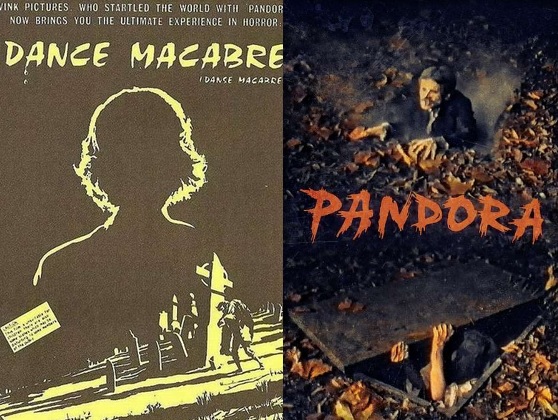
Vink’s earliest was Pandora (1984), a shot-on-8mm tale-to-video of Romero-styled zombies, shot-in-Dutch (the only one), concerned with an Evil Dead-styled box with the power to raise the dead. Eh, who needs the English language when you can listen to zombies (loudly) munching. Then there’s Dance Macabre (1986), with more Romero-undead mayhem by a cult that raises a female’s skeletal remains who then attacks people and starts a zombie plague (more munching) in an apartment complex. Both are short in content, but, oh, so long — as all of Vink’s films are — on style: a Lucio Fulci fever dream, if you will.
Pandora and Dance Macabre are extremely hard to find on VHS (again, at least in the U.S.). Today, we’ll review the two easiest-to-find films: the main subjects of this two-fer review, and then we’ll ease into those first two films.
Half Past Midnight(1988)
Courtesy of the IMDb.
Dutch writer-director-make up artist Wim Vink’s next SOV’er concerns a shy, sweet girl bullied at school by her fellow classmates: your typical, ’80s big-haired and mascara-type bitches, and boyfriends. Debbie loves computers and electronics and solders circuit boards (which comes in handy for the later mayhem). She loves photography. She has great relationship with her mom. She rides a bike, everywhere.
Why do her classmates hate her so?
They’re bullies. There is no reason.
Since Vink is a director of details, one of surrealistic-slanted cinematography, there’s little to no dialog to tell us why: for Vink is about the actors selling the story — which they do, both lead and background. Sure, the “story” all seems mundane, at first watch (you can’t watch it just once), but that’s only to heighten the shock of when Debbie gets her revenge by killing her tormentors one by one, in extremely gruesome, bloody ways — and OTE gory and bloody, in the best of ways.
Half Past Midnight is a great example of ultra-low-budget horror. It’s absurd. It’s raw. It’s awesome. And it was shot in Tiel, Gelderland, Vink’s hometown. So it is truly homegrown, which makes us love it, even more.
Half Past Midnight is also, only half an hour long (and in English) — the prefect length, due to its brutality — with its tale of Debbie (Angelique Viesee), an attractive-awkward student, relentlessly bullied by her dickish classmates. One is a voyeur always taking pictures of Debbie’s misfortunes. Her teacher (Ad Kleingeld) takes pity, but with an ulterior motive: he rapes her.
While it’s not established if we are in a high school or college, everyone looks to be beyond their teen years. And that office building looks more “college campus” than “high school” to these eyes. So, that takes the creep-factor off the fact Debbie’s, obviously older, teacher asks her on a date. Now, mind you, without dialog, Vink’s made a statement on how easy it is for a sexual predator to chose and manipulate an insecure victim; the simplest act of kindness to a put upon person can open the door to a graphic event. Again, it’s about the “reality” in a Vink production.
As we mentioned: voyeurism is part of the — non-verbal — subtext. Everyone stands by and watches Debbie being assaulted, brutally, and does nothing. And when one does, such as her lecherous teacher (helps her pick up dumped books and papers; has her collect the student’s papers after class), it’s only as a backdoor for his own assault. Then, the bully who photographs Debbie’s assaults — in an eerie foreshadow of today’s smartphone-viral media sickness — develops the film in a dark room, with a glean in her eye.
So . . . the bullies are back: with a teacher now in their corner. The students ambush-spray an aerosol can in Debbie’s face and blind her. She stumbles into traffic and is hit by a car. She survives, barely. But a nurse at the hospital — the mother of one of the bullies — injects poison into Debbie’s eye.
Debbie dies. (We think.)
Debbie returns from the dead — whatever was injected in her eye, reanimates her (we think) — so she lays waste to the lot of them, going “Ash” on their asses, if you will. Using her electronics skills, Debbie solders herself a belted-power pack, complete with knife sheath, to run an electric chainsaw. And said chainsaw POVs into chests, as butcher knifes go through-and-through necks, as well as sawed off arms, and torso dismemberment, and intestinal flow, ensues, in one of the bloodiest, seven minutes ever committed to film. The only thing missing is a penis detachment by hedge clippers.
So, you thought Deadbeat at Dawn was the ultra-low-budget throwdown. Eh, piffle. Jim Van Bebber is a pussy compared to Wim Vink. Debbie ain’t no Carrie (a definite influence, here, alongside The Evil Dead) that’s for damn sure, for no ESP is required. Just a chainsaw, please. Oh, and lots of loud, screamin’ guitars by Rob Orlemans!
Half Past Midnight is simply fucking amazing. Period. Exclamation point.
The joy of a Wim Vink film is, not only recognizing the musical-homage cues, but the plot and visual cues. In the case of Vink’s only feature-length film, fans cite Michele Soavi’s classic The Church (1989). And if you’re familiar with that film — of course you are — the film unbalances you with its “what the hell is going on” plotting. Soavi’s works (the early ’90s pieces of StageFright, The Sect, and Cemetery Man) are less about fixed, narrative flow and more about image collages; loosely connected nightmares. And as with Vink’s other works: the characters are connected, somehow, then they’re not. The Vink modus operandi: ambiguity.
Here, we meet Mike and Sharon; he works as a garage mechanic, while Sharon works as a bookkeeper at stereo store. (Were they once related; now reincarnated in a future, apart, now searching for one another?) A local house for sale — where someone previously died (when, who knows/or is Mike seeing his future) — begins to haunt his mind, to the point his work suffers. Sharon, likewise, is disturbed by the same visions: the result of her psychic abilities.
Of course, as with the characters in each of Wim Wink’s films: the characters don’t live fast, they slowly exist in boring, mundane lives: going to work, then home, work, home. And it’s the drudgery that make them susceptible to the supernatural, in this case: the ghostly chants urging them to open a well’s portal.
Their dreams/visions concern a centuries old pagan coven, led by a witch and her young daughter (?), and a cursed, ancient well that, as result of progress, is now in the basement of the empty home Mike purchases. Meanwhile, Sharon’s visions overwhelm her to the point that she breaks into the house to find the “Hell Well” in its cellar — set in the middle of a finished, wooden floor, covered by an iron pentagram. And Sharon brings a “sacrifice” from her aerobics class; with fresh blood, she can now descent into the well. Mike? He hesitates and rejects his mistress: he’s strung up “Evil Dead” style by ghostly ropes from the home’s attic’s rafters — and slaughtered.
This time, the soundtrack’s all-original, composed by Angelique Vink (who also plays Sharon), as well as synth-numbers by Sander Brokke and Vincent Hooyer. And, again: sparse dialog, with only the repetitive looping of the film’s opening chant-narration for an unsettling, moody work of horror impressionism (think F.W. Murnau’s Nosferatu from 1922, better yet: Carl Theodor Dreyer’s stellar, Vampyr, from 1932). Again, detractors may say the film is overly repetitive and padded; that maybe so. However, I see it as a purposeful, artistic-narrative choice: Mike and Sharon’s lives are so, utterly empty, their aural and mental visions consume their lives to the point of an obsessive-compulsive disorder.
So, with that, as mysteriously (well, at least outside of the Netherlands) as Wim Vink drifted into the VCR-driven snows of the SOV ’80s . . . he dissipated into the developing, nickle-collated, laser-spinning ethers. For Wim Vink’s visions were not meant for a digital world, only the analog tapes of the past. . . .
Image courtesy Letterboxd. Both are available as a two-fer PAL-VHS in overseas markets.
Pandora (1984)
Oh, Hail Satan and the hell with this being in Dutch with no subtitles. All I know is I’m nostalgia waxing an Amando de Ossorio-meets-Paul Naschy Spanish zombie joint, à la Tombs of the Blind Dead and The People Who Own the Dark. (Hey, did you see the 2020 homage-sequel, Curse of the Blind Dead, yet? Do it!)
Now, when you see the word “Pandora,” you think “box,” but what we have here is a book . . . well, there’s a box, too . . . as well as music cues lifted from Suspiria, The Exorcist, and even some Tangerine Dream*. Of course, the music is gone . . . so we can hear the zombie munching n’ licking n’ slurpin’.
What’s great about Vink’s work is that it’s a body of work that understands film is an art form based in “showing” and not “telling”; for film is 90% visual and 10% dialog (and the stage is the reverse). A film’s images tell the story though props, an actor’s body language and, most importantly: that your actors are not skilled in the craft of acting—but “being.” This was a fatal mistake made by James Glickenhaus (The Exterminator, producer of Maniac Cop) with his debut film, The Astrologer (1975, aka Suicide Cult): he didn’t have a complete grasp of — as does Wim Vink — of cinematography; so his otherwise intriguing film, bogs down with 60 minutes of ponderous dialog against its 79-minute running time. This is a “mistake” not experienced in a Vink film.
So, regardless of language, we have a young woman who requests information on a book; the librarian directs her. Why would a book that can open a doorway for the dead to rise be in the library? Why was the woman looking for the book?
I don’t care.
All I know is, she — we think — has been “possessed” by the book, and having visions of a white-robed witch. And a leaf-covered sarcophagus slides open and four, Bob Clark/Alan Ormsby,’60s era Children Shouldn’t Play with Dead Things zoms are now the white-cloaked witch’s army of the dead. And they need to retrieve a box — from a businessman who possessed the box.
Fog starts pouring out of the box. One witch stabbing later: lunchtime for zombies — and it’s better than anything dished in Bruno Mattei’s Hell of the Living Dead.
Then, the woman who checked out the book, buys that errant “Pandora” box from an antiques shop . . . and the witch and her zombie quartet are back, for the box. And we get a little bit of time displacement, a sudden transport into a cavernous crypt, and an even larger zombie army. . . .
Dutch language, be damned, this film rocks my rocks offs.
Dance Macabre (1986)
In 1978, Sam Raimi, Bruce Campbell, Rob Talpert and Scott Spiegel released their their proof-of-concept short Into the Woods: a tale about a group of friends who desecrate an Indian burial ground while staying at a cabin. Around that same time, Don Coscarelli began filming Phantasm: his tale about two brothers running afoul of a cryptic mortician. Romero released Dawn of the Dead that same year. Dance Macabre is a homage to those films, right down to a music-pinch from Phantasm’s funeral scene, as well as synth-cues from Romero’s, as well as Argento’s and Fulci’s zom-romps (you’ll know ’em when you hear them). And I love the hat tip to Coscarelli, courtesy of a reenactment of Jody first meeting The Tallman, right down to the bone chilling, “Sir.”
Oh, my beautiful Vink surrealism. My only complaint is that the film isn’t longer than 22 minutes. My greatest love: there’s never one moment of silence. Outside of a character’s ritual chant, no one speaks, but the ripped music cues never stop, throbbing, trapping us in a black-metal disco on the cusp of a Dante circle. Well, except for the flesh munching. . . .
We first meet a trio of necromancers digging up a coffin of skeletal remains.
Why? Who cares.
Then we’re traveling down a modern-day road in a 19th Century-styled, horse drawn carriage. In the back: a kidnapped girl, then carried up to the attic of an apartment building. One throat slit and blood flow later: we have a white-eyed, big-haired blonde demon reanimated and on-the-loose (with a knife-licking fetish), impaling knifes into foreheads and ripping across throats of the building’s tenants.
Of course, the dead rise as a plague breaks out in the building. A SWAT team is called in for a little Pittsburgh-inspired cops vs. zombies battle. . . .
Who were the necromancers? Were they in the past? Who’s the blonde? Sure, she’s a witch, but from when and whom?
I don’t care. . . .
I just watched a film with more fun packed into 22 minutes than any 90 minute VHS slopfest I’ve watched in my analog lifetime. Dance Macabre is everything I want in an SOV horror — even though this was shot on 16mm. And it only gets better with Half Past Midnight, and even better-better with the full-length opus, Heaven is Only inHell.
Why didn’t Argento, Fulci, or Romero see the magic in Wim Vink and bankroll a 35mm feature proper? What a fucking tragic, missed opportunity.
The VHS reissues/courtesy of onorato73/picuki.
Were to Watch
You can watch Heaven is Only In Hell on You Tube courtesy of BurialGround5 — what would we do on Saturday nights without BG5?
Someone by the name of Jurgen Telkamp saved Half Past Midnight for the digital realms — god bless you, brother — on You Tube. Devilman666 comes with the back-up assist on another You Tube copy, as well.
You can watch Dance Macabre on You Tube, thanks to Hipster Pobre.
You can watch Pandora on You Tube courtesy of altohippiegabber. Just wow. The memories. Thank you!
Vim Wink’s Complete Resume (Thanks, Alto!)
1981 — ZombieHorror (30 mins) 1982 — Surrealism (25 mins) 1984 — Pandora (30 mins) 1986 — Dance Macabre (22 mins) 1988 — Porror (6 mins) 1988 — Half Past Midnight (32 mins) 1989 — Luke Skywalker Meets the Horror of Darth Vader (5 mins) 1994 — Heaven is Only in Hell (86 mins)
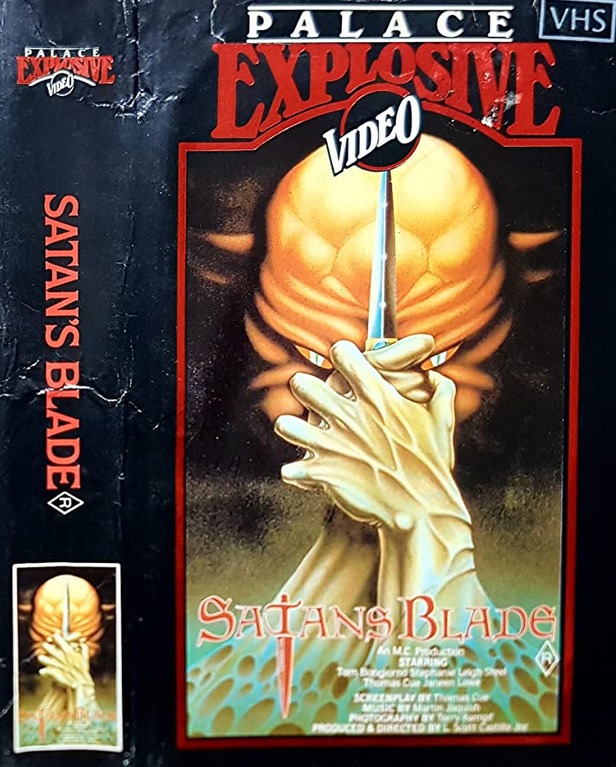
Yeah, I know Satan’s Blade was shot on 35mm, but this “SOV Week” is all about the brick and mortar nostalgia of the video store ’80s. So, if it walks like an SOV and quacks like an SOV and has a cheesy, Combat-cum-Scrapnel Records-styled cover — film stocks, be damned — it’s an SOV in my analog-pumpin’ heart.
Yeah, Satan’s Blade is rife with that ol’ brick and mortar, mom n’ pop stores nostalgia that I constantly lament about at B&S About Movies . . . so I don’t care if Satan’s Blade is an ultra-low-budget rip on the first two Friday the 13th films, as say some critics. Me? I see The Evil Dead crossed with a crime caper gone bad, in the frames.
You too, huh? We’re both thinking of, even though it wasn’t made yet, Scarecrows (1988). As I said in that review, as I re-watched Scarecrows all those years later, I couldn’t help but think Quintin Tarantino and Robert Rodriquez watched it back in the day — and it bled into their formulating From Dusk Till Dawn, which flips-its-script from an action caper to a vampire flick. Well, I think Q n’ R are fans of Satan’s Blade, too, with its script-flip from a crime caper to a faux-Jason armed with a haunted blade, gone wild.
Look, all I know is that my youth was filled with King Diamond, Slayer, and Saxon albums — and pretty much anything came down the Combat/Shrapnel pipeline. Those were the days that the soundtrack — with some much-needed, added adjustments — of River’s Edge spun in my car. And I had just bought copies of the new albums by Hallows Eve and Heathen. And I rented the crap out of any and all SOV horrors that I could get my hands on and I just rented a copy of L. Scott Castillo Jr.’s lone film.
Yeah, Satan’s Blade is that nasty tapeworm lodged in the cockles of my analog heart, pumpin’ through my celluloid veins like a vinyl selection from the Metal Blade Records catalog: forever.
Load the friggin’ tape!
Ah, the VHS I remember. It feels like — a clamshell box — home.
A pair of female bank robbers make off with $50,000 after they kill two bank tellers in cold blood (a female Seth and Richie Gecko, natch). They lay low at a snowy mountain cabin, waiting for their third partner to split the spoils. But, as is the case in any noir: greed ensues. And double crosses. And everyone ends up dead. Two by their own hands. The third . . . by an unseen force.
Something is in that cabin . . . of the “Jason, Jason, Jason, kill, kill, kill,” variety.
That “something” is a local legend about a murderous mountain man who comes from the bottom of the lake by the cabin.
Doh!
Cue the dopey vacationers who rented the cabin at the wrong time: two married couples celebrating the law school graduation of one of them — and a group of nubile college girls with a friend mourning the death of her father. Of course, sex — which always stirs these heavy mental, shiny-implement lovers — ensues, with the proceedings getting down to the ol’ “final girl,” Stephanie — who comes to discover the town Sheriff is behind the murders, as he wanted the money from the robbery hidden in the cabin.
Is the Sheriff really possessed by the Satan’s Blade — a knife that is also a talisman?
Look, I love this movie. I don’t care of how “derivative” the plot is critically analyzed by the other.
Satan’s Blade is an up-against-an-ultra-low-budget slasher, which — for moi — only enhances its eerie vibes, and I dig that the music is synth-Carpenter cheesy. Sure, the story is slight, so there’s a bit much in the expositional prattling-padding department, with lots of driving and walking (but not as much driving as in Rock ‘n’ Roll Nightmare, thank god). Sure, this Castillo jam isn’t as gory as a Vim Wink shot-on-video joint or off its GBH nut, but then, what SOVs are?
At least the acting is better than in most SOVs, not that everyone is on-point; there’s some woefully strained thespin’ afoot. I also dig the amped-up film noir of it all, filled with whodunits, double-crossings, and red-herring flip-floppin’ twists. In addition, L. Scott Castillo Jr. — apparently made this for one-million dollars — who was probably hoping to strike Raimi Midnight Movie gold, ain’t exactly Raimi-inventive, but he still knows his way around a 35mm camera. So while — in my eyes — Satan’s Blade has that ol’ SOV stank on it, technically, it’s not an SOV; but it’s surely closer to, but better than, a 16mm Don Dohler (Fiend) joint (which I lump into my SOV-dom with Satan’s Blade).
Yeah, I love this movie.
Double featuring Satan’s Blade with a Doug Ulrich and Al Dargo’s joint (Snuff Kill will get you started) just feels right. Toss down a John Howard and Justin Simonds (Spine) chaser, for a triple. . . .
Ugh. Satan’s Blade also makes me feel old; now I am missing my ol’ video stores with their 5-5-5 membership cards. So I hate you, Castillo. But I love yahs, just the same.
And so it goes. . . .
Courtesy of the ongoing efforts of VHS Legacy — doing the Lord’s work (yuk, yuk) — you can watch Satan’s Blade on You Tube. You can also learn more about the Arrow Video reissue — an incredible transfer, by the way (working in 35mm paid off, L. Scott) — with an “Arrow Story” video uploaded to You Tube. The reissue caveats on Satan’s Blade, run at the different times of 79, 82, and 83 minutes, so shop accordingly. Olive Films released their hard presses in the United States in 2015 on Blu-ray, while Arrow Films released their DVD/Blue combo in the United Kingdom in 2016.
About the Author: You can read the music and film reviews of R.D Francis on Medium and learn more about his work on Facebook.
There’s no breaking of the Ninth Commandment, allowed. Not this time.
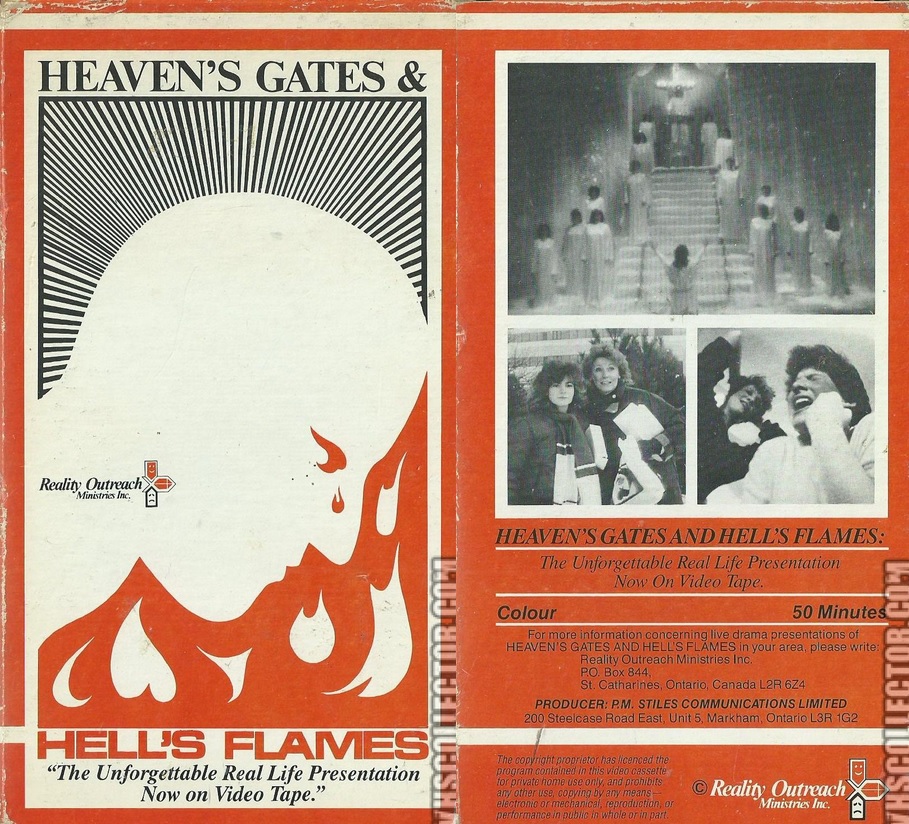
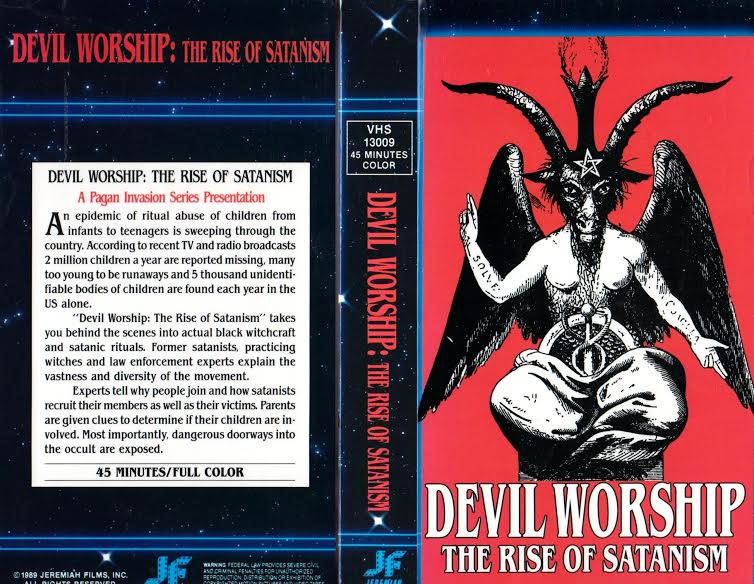
We know you’ve never seen or heard of this beautiful collision of a Christploitation flick and an ’80s SOV’er for the most epic, greatest SOV in the horror realms committed to video tape. And yes, video store owners, who had no friggin’ idea of what was distributed to them (see the great Spine shelving snafu), gandered at the words of “Heaven’s Gates” and “Hell’s Flames” and, instead of placing the tape in the “Family/Children’s” section (and this is not child appropriate in the least) where it belonged, they tossed it on the horror section shelves.
And there it was for me to score: in the horror section of the video store, a store sandwiched between a Falafel joint and an accident-attorney office. Yes, those hour-long “Christian Scare” documentaries you would see during the sleepless overnights and lazy weekends as you channel surfed past TBN – The Trinity Broadcasting Network* in the ’80s ended up on VHS for distribution on your home video shelves.
Yes, I was a truly blessed, metal-head and VHS lovin’ youth that day of yore . . . courtesy of Paul and Jan Crouch.
So . . . this 50-minute Canuck Christploiter made in St. Catharine’s, Ontario by Reality Outreach Ministries portrays people of various ages and walks of life who die in a variety of unexpected ways (e.g., drug abuse, the bottle, car accidents, muggings-gone-bad, steel girders falling). The way they lived on Earth determines where they will spend eternity: Heaven or Hell.
Oh, and a warning: this is a stage play produced by the ministry and committed to tape.
BUT IT IS STILL EPIC! ROLL THE TAPE!
Thanks, Paul Z, at VHS Collector for the clear image.
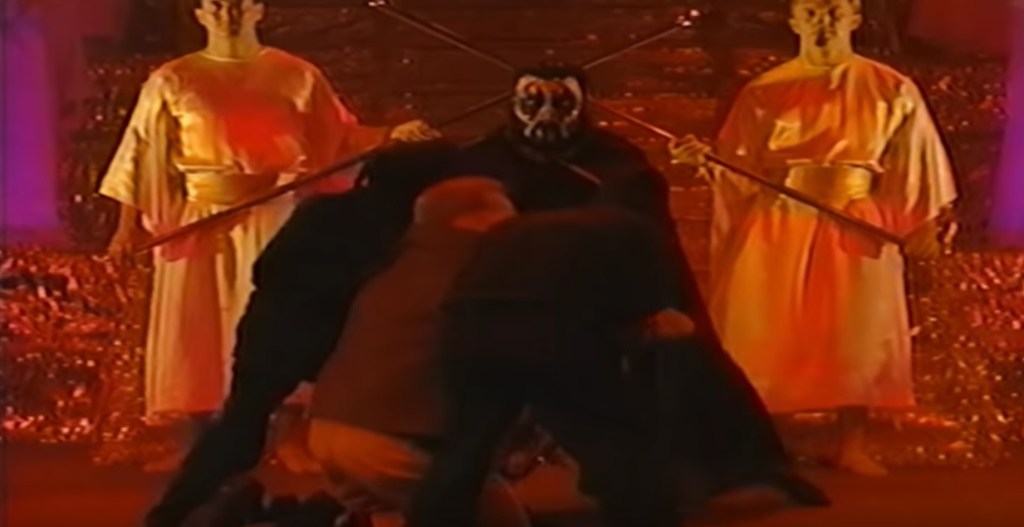
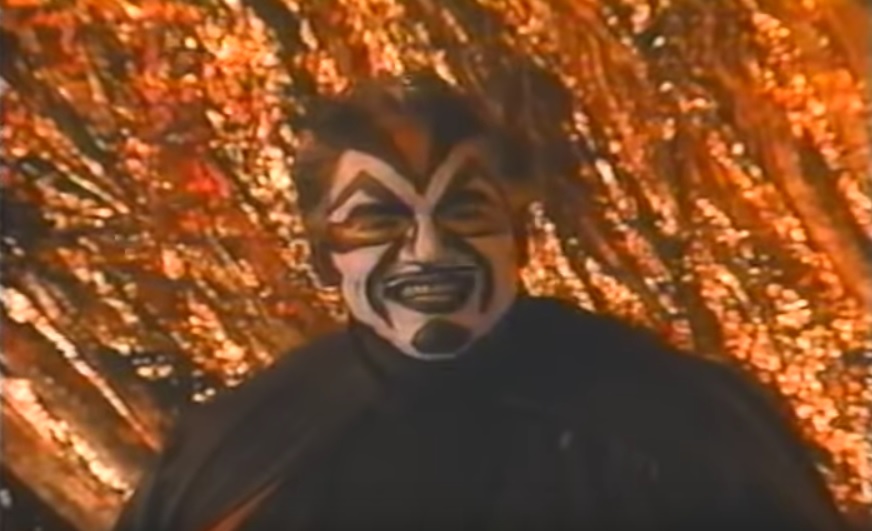
Dude . . . when this play’s depiction of Heaven kicks in, it is right out the Estus Pirkle playbook — but HGHF has nothing on The Believer’s Heaven and beats it by a few clouds. Then, when Hell kicks in — complete with a bastardized Gene Simmons-meets-King Diamond-cackling Satan — it holds no candle to Jose Majica Marins’s Coffin Joe depictions of Hell in This Night I’ll Possess Your Corpse. Oh, ye reader, forget about Estus Pirkle’s multi-colored Rubic’s Cube face-painted Satan in Ron Ormond’s The Burning Hell, for Reality Outreach Ministries has just blessed you with the Satan you always wanted in your nightmares.
Oh, yeah. The rest of the plot.
Well, it’s a bunch of vignettes, as “actors” do “scenes” that warn, you, on the various horrors awaiting those who do not accept Jesus Christ. For example: We have a young couple on a nice, romantic evening in the park (two folding chairs on stage, natch). She speaks about “her psychic said romance is in the air” as her Christian boyfriend warns her on the dangers of “deceptive physics.” Then, a mugger shows up, steals her purse, and shoots both. Dead.
For reals. I am not making this up.
Now, we’re at the “Pearly Gates” and the boyfriend gets in. The girlfriend says, “Wait, why am I here? I’m supposed to be reincarnated!”
Cue King Diamond.
The King and two of his minions grab Blondie and drag her into the red-cellophane fires. Meanwhile, the best part, is the boyfriend pulls the ol’ I-told-you-so gag — with a glean in his eye. Why? Because Christians get off on the ol’ I-told-you-so-and-seeing-you-go-to-Hell gag.
Next vignette.
Two construction worker-buds are on top of a high building (again, folding chairs on the stage). The saved worker witnesses to his troubled work-bro and turns him to Christ. Suddenly . . . a girder (actors, awfully, selling the drama) falls. Both die. Both go to Heaven. But, since the one guy just got saved . . . there’s a paperwork snafu, since there wasn’t time to write his name down in the Book of Life. But don’t worry. Jesus shows up to set the Angel in charge of the book, straight.
For reals. I am not making this up.
Okay, just one more. . . .
A little girl begs her busy, career-driven and charity-committed mom to go to church. “Next, week, Sweetie,” mom brushes her off. Suddenly . . . a car (again, actors — awfully — selling the drama), hits them. Mom and daughter are dead.
Then, mom gets the shock of her life: being a good parent, a loyal wife, and doing good deeds, alone, won’t get her into Heaven. But since the daughter went to church, she goes to Heaven. So, to Hell mom goes. Why? Because working with the homeless and the handicap wasn’t good enough for God — and you turned your back on His son. Yes, King Diamond shows up and takes away mom — to the girl’s screams and cries, begging Jesus to save her mom. Seconds later, Jesus shows up and touches the girl. All is well. The girl skips up the silver and gold staircase.
For reals. I am not making this up. It’s not a fever dream. It’s real.
And you thought Estus Pirkle’s sharpened bamboo into the ear canals of children was sick. We told you this tops a Pirkle joint six days a week and twice on Sundays. It’s pure insanity — stage production, be damned — so how can you not want to watch this? Okay, so it’s not as bonkers as Pastor Kenneth Okonkwo’s two-part, papier-mâché production, 666: Beware, the End is at Hand, but what zero-budget soul-saving epic, is?
“I want the boy! Throw him to the pits of Hell!“
“Forget about your mommy, little girl. She’s mine, now!Ooh, it’s cold gin time again!”
“To Hell with him!Bring the black box to the altar!”
“Like father, like son!For my real name is Kim Bendix Petersen!”
Anyway, it goes on and on and on like this for a glorious 50-minutes, well, near 75-minutes, since the festivities are front and backended with a Pastor’s service. But name your sin: Abortion. Drugs. Sex. Not going to church. Reincarnation. Fortune tellers. The dangers of every and any sins, are depicted, here. Lovers and families are torn apart. People hug Jesus and go to Heaven without a tear or care of their loved one being dragged to Hell.
Yes. Jesus greets you, personally, each and everyone, with a hug . . . as you walk through a literal door, aka gate, under the Angel that’s perched on top of a golden pedestal, on top of the silver and gold staircase — you know, the Angel who makes sure you’re in the Book of Life, sans any paperwork snafus where you died two-second later, after just “being saved” by a buddy.
Now, hear me out for a second: Wouldn’t it be the “Christian thing” to do, that, when your loved one is about to be dragged to Hell by faux-Gene Simmons, that your “Christian Heart” would make the ultimate sacrifice and take your loved one’s place, so they can enter Heaven?
Oops. Sorry for allowing logic into the plot. Never pick at the plot holes. Especially not in Christian Cinema.
Look, it’s a fun and frolicking “SOV Week” at B&S About Movies, so we can poke (sorry) a little fun, here. However, honestly, for a stage play, the production values are pretty decent. The stage is one, single dressing. A simple lighting change is all it takes to transform the silver and gold of Heaven into the red and orange fires of Hell. Sure, it’s not an Oscars-level production, but still, for a church auditorium-cum-chapel gig, it leaves you impressed. Yeah, credit where credit is do: the stage manager, or audio visuals manager for Reality Outreach Ministries, really makes this all work, brilliantly. I wonder if he ever did a film, proper? I’d rent that movie.
However, what is not impressing, are the “actors,” who we assume are volunteering for the cause. The way they jump around, screaming and “rejoicing” on stage with their “I’m in Heaven. Woooo! This is awesome. Angel, is my name in the Book of Life? Yes, I’m in. I’m going to Heaven!” would be a flailing, arms-akimbo thespian tragedy if it wasn’t so gosh darned funny.
Oh, hell yeah, pardon the vernacular, it’s on You Tube and You Tube.
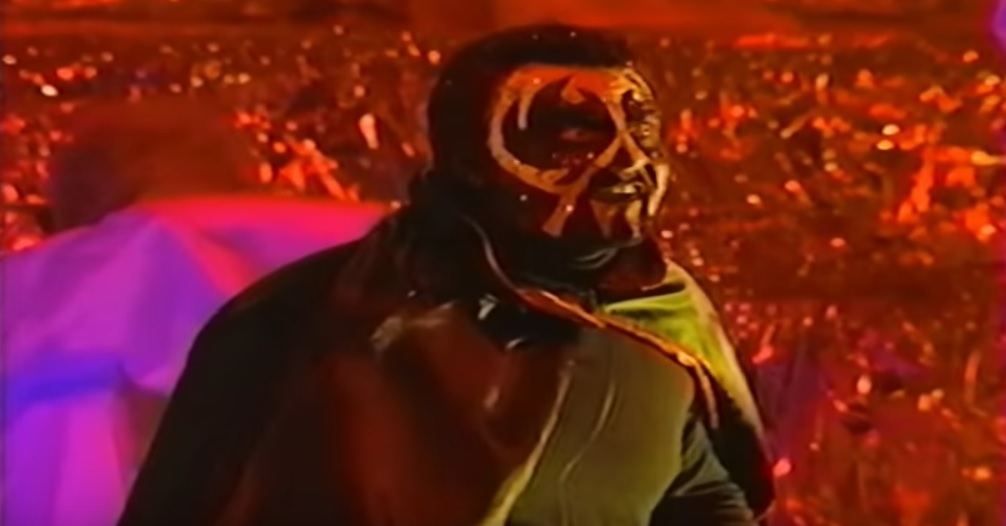
The caveat: The uploads are of two, different productions of the same play. In my opinion, the first version (with faux-King Diamond) — the one I watched on tape all those years ago, is the stronger production of the two. The second version (with Gene Simmons; the second still, above) — which I didn’t know existed until this review — runs a bit longer at 90 minutes, due to it having more Pastor preaching than the first.
Both are still epic. Watch ’em both! Hell, yeah! Also watch this. . . .
* We also discuss the “Christian Scare” era within our review of the Paul and Jan Crouch-produced Six: The Mark Unleashed and its metal music-is-evil component with the fictional film, Raging Angels.
About the Author: You can learn more about the writings of R.D Francis on Facebook.He also writes forB&S About Movies.










 B&S About Movies
You must be logged in to post a comment.