Bucheon International Fantastic Film Festival: Nightsiren (2022)

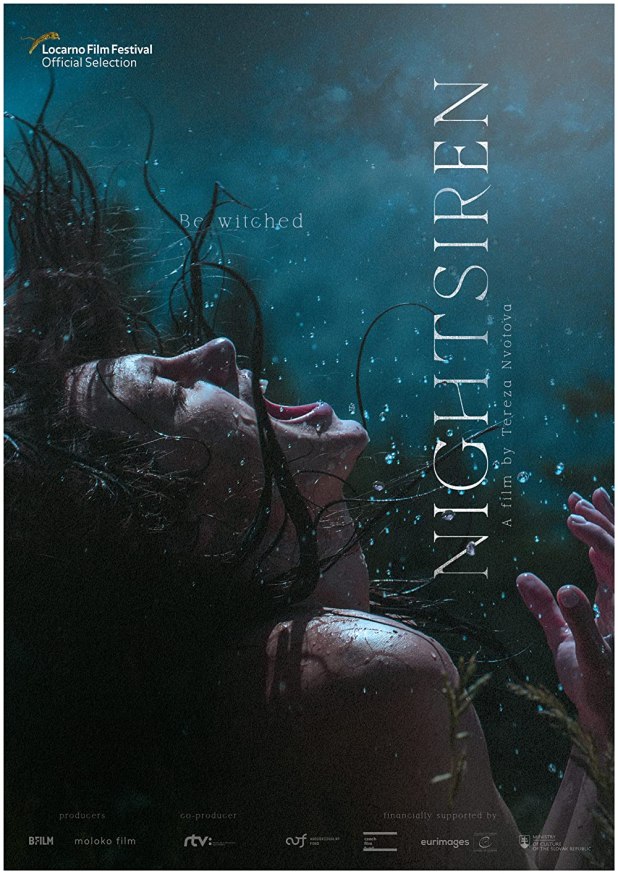
Two decades after a tragedy with her sister, Šarlota — pronounced Charlotta — comes back to her remote mountain hometown in Slovakia to claim an inheritance left by her dead mother. Yet when she gets there, her mother’s house has burned to the ground. Staying in her former neighbor’s abandoned cabin — rumored to have been a witch’s house — Šarlota remembers the misogyny, patriarchy and superstition that she had left. As she approaches a herbalist named Mira, the locals believe Šarlota must also be a witch.

A deserved winner of the Best Picture in the Cineasti del Presente Competition at the Locarno Film Festival, director Tereza Nvotová has made a movie that looks absolutely gorgeous and from another world. The witch sabbath scene in this is incredibly evocative and blew me away.

We live in a world that fears what it does not understand and seeks to hold back things of beauty and passion. These issues exist from big cities to small towns and everywhere in between; things are sliding back into a world where women no longer even have autonomy over their own bodies. Nightsiren presents a place where the power within women is challenged by old beliefs and an even older guard.

I watched this film as part of The Bucheon International Fantastic Film Festival (BIFAN). You can learn more at their official site.

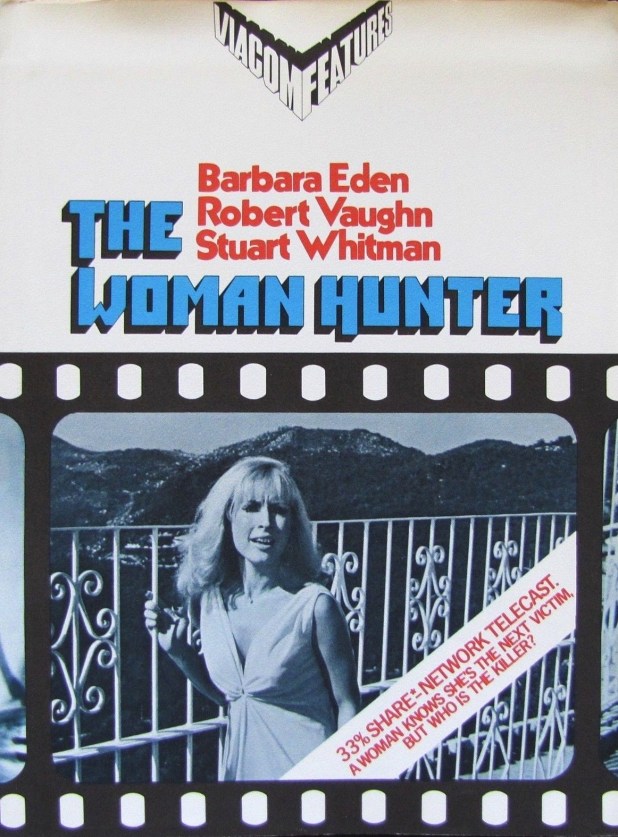
CBS LATE MOVIE MONTH: The Woman Hunter (1972)

EDITOR’S NOTE: The Woman Hunter debuted as a CBS Movie of the Week on September 19, 1972. It played the CBS Late Movie on October 7, 1974.

The Woman Hunter has an all-star cast, with Barbara Eden in the lead, alongside Stuart Whitman, Larry Storch and Robert Vaughn. Like I said — it’s what I say is an all-star cast.

Most Giallo heroines are characterized by their wealth and potential mental issues. However, in The Woman Hunter, when Dina Hunter (Eden) survives a car accident and plans a trip to Mexico with her husband (Vaughn), who would have thought that the artist she hired to paint her portrait (Whitman) could be a jewel thief and a murderer?

Enrique Lucero, who plays the Commissioner, would go on to try and hunt down Mary, Mary, and Bloody Mary and also appears in The Wild Bunch, Guyana, Cult of the Damned and The Evil That Men Do.

This was written by Brian Clemens (Captain KronosAnd Soon the Darkness) and Tony Williamson (Adam Adamant Lives!The Avengers). It is Clemens’ first U.S. work and Williamson’s only script made over here. It’s directed by Bernard L. Kowalski, who stepped in for John Peyser (The Centerfold Girls). I assume that everyone enjoyed shooting this on location in Acapulco. Larry Storch even brought his wife Norma along.

You can watch this on YouTube.

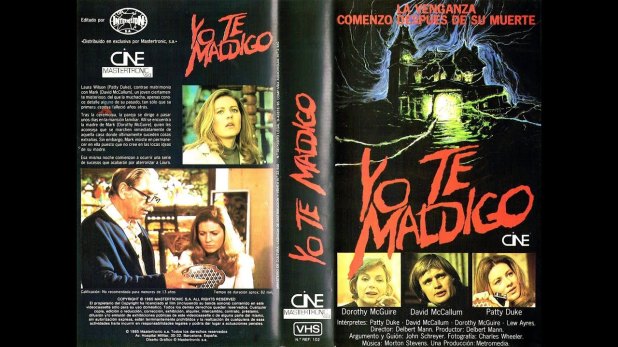
CBS LATE MOVIE MONTH: She Waits (1972)

EDITOR’S NOTE: She Waits debuted as a CBS TV movie on January 28, 1972. It played the CBS Late Movie on September 12, 1972 and January 14, 1974.

Laura Wilson (Patty Duke, Valley of the DollsThe Swarm) and Mark (David McCallum, Illya Kuryakin on The Man from U.N.C.L.E. and better known to today’s TV audience as Dr. Donald Mallard on N.C.I.S.) haven’t been married long. On their first trip to meet his mother (Dorothy McGuire, The Greatest Story Ever Told), she learns that maybe this marriage wasn’t the best of ideas. Mom has been ready to go nutzoid ever since Mark’s first wife, Elaine, died, and she’s convinced that her ghost is inside her home.

Everywhere Laura goes, she starts hearing Elaine’s favorite song and even her voice. Is she trying to possess her? Or is she just being ridiculous, as the family doctor suggests? The movie never fully embraces the supernatural. It’s more about Mark shutting himself off and not dealing with the past.

The family maid thinks that Mark’s mother is getting worse and worse, with Laura in danger of the very same insanity. And what’s the deal with Mark’s friend David (James T. Callahan, the dad from Charles in Charge)? And can you talk a ghost out of possessing someone just by talking to them?

Director Delbert Mann (Marty) weaves a competent story, penned by Art Wallace, the main writer for TV’s Dark Shadows. It’s a tale that fits snugly into the 1970s, a time when possession, Satan, and the ghosts of murdered wives lurked around every corner. The film’s slow pace is a deliberate nod to the conventions of TV movie horror, inviting you to revel in the nostalgia of a bygone era.

Bucheon International Fantastic Film Festival begins next week!

I’m honored to have been asked to review films for The Bucheon International Fantastic Film Festival (BIFAN).

Launched in 1997, BIFAN is the representative cultural festival of Bucheon, Korean, a UNESCO creative city of literature. Works by master filmmakers such as Peter Jackson, Christopher Nolan, Darren Aronofsky, Guillermo del Toro Jang Joonhwan and Na Hongin have been discovered and introduced at BIFAN.

The festival called into question the topic of censorship through provocative special programs, such as the blue movie special program, and it built a fan community through a program dedicated to martial arts movies by the Shaw Brothers Studio and the Bollywood special program. BIFAN has experienced its share of ups and downs following changes in authority, but it has received endless love and support over the past 26 years from audiences and guests, for presenting new sensibilities, rich imagination, and unique programs. With “Stay Strange” as its motto, BIFAN strives to be a film festival that cheers for the nonmainstream, while discovering and giving courage to talents that are pushed to the margins.

The genre films and talents discovered and introduced by BIFAN become more amplified and can meet the world through the festival’s industry program, B.I.G. built upon the foundation of the Network of Asian Fantastic Films (NAFF), which launched in 2008 to help with the production and development of genre films, B.I.G has developed into a platform that represents the genre film industry. Asian genre filmmakers have been discovered and nurtured through the world’s first genre film project market, It Project, and our film education program, Fantastic Film School. Through Made in Asia, we have accumulated data on popular movies in Asia and created a network of industry leaders.

BIFAN runs from June 29 to July 9 and will have 262 films from 51 countries.

To learn more, visit the official site.

I’m truly excited as there are some major surprises coming to the site this week from BIFAN!

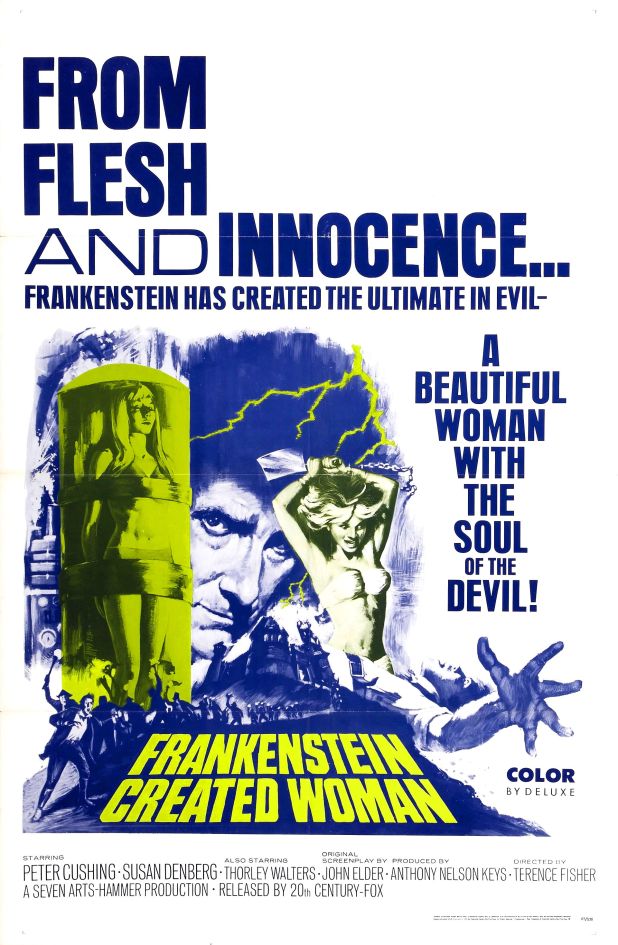
CBS LATE MOVIE MONTH: Frankenstein Created Woman (1967)

EDITOR’S NOTE: Frankenstein Created Woman played the CBS Late Movie on February 9 and June 18, 1973.

From flesh and innocence, Frankenstein has created the ultimate in evil. A beautiful woman with the soul of the devil!

With a tagline like that, how can you not watch this movie?

The fourth film in Hammer’s Frankenstein series is a thought-provoking exploration of the soul and morality. It’s the one in which we stop thinking about death as a physical matter and start delving into these profound questions.

The movie starts with Hans Werner watching his father executed by the guillotine. Then, we see him as a young man, working as an assistant to Dr. Hertz and Baron Victor Frankenstein (Peter Cushing, as it always must be). The doctors have learned how to trap the soul before it leaves the body — they must have been watching The Asphyx* — and think that they can transfer it into another body.

They get their chance when Hans is put to death defending the honor of his girlfriend Christina (Susan Denberg, Playboy Playmate of the Month for August 1966) after several rich men abuse her for her deformities and kill her father. After he follows in his father’s footsteps, the doctors can extract his soul.

Unable to live without Hans, Christina tragically drowns herself in a river. The doctors, however, decide to transfer Hans’ essence into the body of his lover. For months, the two doctors work to heal her physical maladies and make her the perfect woman. The big problem is that she’s haunted by Hans, who she sees as a ghostly apparition, and begins to hunt down the men who killed him and her father.

As the film closes, Christina realizes that she should have never come back to life, so she drowns herself again as Frankenstein somehow learns a lesson and walks away.

Directed by Terrence Fisher, this is the kind of Hammer film that I love. It boldly moves away from simply being modern versions of classic horror and creates its own unique commentary on the world through the lens of the fantastic.

*I realize that the movie was made five years after this, but the joke was too simple not to use.

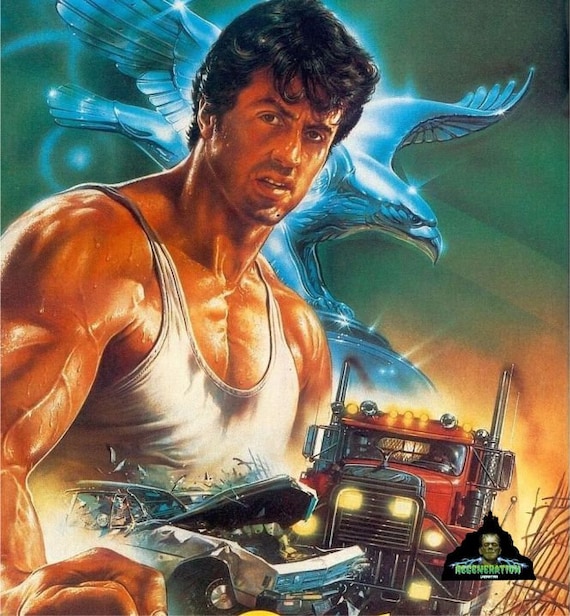
CBS LATE MOVIE MONTH: Over the Top (1987)

EDITOR’S NOTE: Over the Top was on the CBS Late Movie on the next to last month of its run, airing on October 19, 1990.

Stirling Silliphant wrote the Oscar-winning screenplay for 1967’s In the Heat of the Night, as well as The Towering InfernoThe Poseidon AdventureVillage of the Damned,  TelefonThe EnforcerShaft In Africa and more than 700 hours of prime-time television drama to his credit. He was also a close friend and student of Bruce Lee, who he featured in the movie Marlowe and four episodes of the series Longstreet. They also worked together on a script called The Silent Flute, which was eventually filmed as Circle of Iron.

Those are some fantastic credits. Somehow, someway, he eventually found himself working with Sylvester Stallone to write the screenplay for the movie that would take arm wrestling from the bar to the mainstream. And who was ready to direct?

None other than Cannon Group co-owner Menahem Golan, the director of Delta ForceEnter the Ninja and The Apple. Yes, that Menahem Golan.

https://www.youtube.com/watch?v=jJ8d_czhqeA

Lincoln Hawk (Stallone) is a man trying to rebuild his life. While he does that, he’s driving a truck and arm wrestling. His ex-wife Christina (Susan Blakely, My Mom’s a WerewolfThe Concorde … Airport ’79) wants him to bond with their son Michael (David Mendenhall, Space RaidersStreets and the 12-year-old drug dealer in the Diff’rent Strokes episode where Nancy Reagan shows up) because she knows that she’s dying.

Michael has been in military school and calls everyone “sir.” His grandfather, Jason Cutler (this movie is yet another in my quest to see every film with Robert Loggia in it), hates Hawk and never wants him in their family.

On the journey from Colorado to California, Michael develops a deep bond with his father, who teaches him the art of arm wrestling and the essence of manhood. However, their reunion at the hospital is marred by the news of Christina’s demise. Blaming his father for not being there in her final moments, Michael returns to his grandfather’s home. Hawk, in a desperate attempt to free his son, ends up getting arrested. The mansion where Cutler resides may look familiar, as it was also featured in The Beverly Hillbillies.

Michael visits Hawk in jail, informing him of his decision to stay with his grandfather. Determined to win back his son’s trust, Hawk sets off to compete in the World Armwrestling Championship in Las Vegas, with a grand prize of $100,000 and a new, larger semi-truck. In a bold move, he sells his truck and places a $7,000 bet on himself at twenty-to-one odds. The discovery of the letters Hawk had written to him over the years, trying to establish a connection, further fuels Michael’s belief in his father.

Hawk advances to the final eight but suffers his first loss in the double-elimination tournament and hurts his arm. Cutler summons our hero and tells him that he’s always been a loser, but if he leaves forever, he’ll give him $500,000 and a better truck than the prize.

Hawk refuses and makes it to the finals, taking on his rival, the undefeated Bull Hurley. His son finds him and gives him the emotional energy he needs to survive, just as Hawk doesn’t only beat Bull but gains his respect. Somehow, Cutler gets over ten years of being a complete asshole and is happy about Michael and Hawk being reunited because that’s how eighties movies work. The guys get so sweaty in the final battle that they have to get the strap, and people go wild for it. It’s pretty impressive, and you’ll yell, “Get the strap!” too.

The film’s climactic finals were shot during a tournament organized by Cannon, the production company. This year-long competition, starting in Beverly Hills, featured events across North America, Europe, Israel, and Japan. The actual crowd and the B-roll footage of matches at the Las Vegas Hilton are what you see in the movie. The scene where Michael Bociu breaks his elbow? That’s as real as it gets.

If you’re into pro wrestling, Terry Funk, Reggie Bennett and Scott Norton show up here (Ox Baker, who was in Escape from New York, and Manny Fernandez and The Barbarian almost made it into the movie). Plenty of professional arm wrestlers like professional arm wrestling personalities such as Allen Fisher, John Vreeland, Andrew “Cobra” Rhodes, John Brzenk (who inspired the story) and Cleve Dean are also on hand.

The music in this movie is astounding. Kenny Loggins sings “Meet Me Halfway” numerous times, and there is also some Giorgio Moroder, some Asia, some Robin Zander, some Eddie Money and Sammy Hagar singing “Winner Takes It All,” which was also made into a music video to promote the film.

The film received three nominations at the 8th Golden Raspberry Awards in 1988. David Mendenhall won two for both Worst Supporting Actor and Worst New Star, which seems kind of crappy for them to abuse a kid. Sylvester Stallone was nominated for Worst Actor, an award he’s won four times, but he lost to Bill Cosby in Leonard Part 6 this time.

Stallone has claimed that if he had directed this, he would’ve changed the setting to an urban environment, used scored music instead of rock songs, and made the Las Vegas finale more ominous. These changes would have significantly altered the film’s tone and atmosphere. So why was he in it? He answered, “Menahem Golan kept offering me more and more money until I finally thought, “What the hell – no one will see it!””

Speaking of Stirling Silliphant, he only did the screenplay. Actor/writer Gary Conway (American Ninja 2: The Confrontation) and director/writer David Engelbach (America 3000Death Wish II) created the original story. Engelbach cried when he saw the finished movie, remarking that his original draft “wasn’t nearly as dumb as the final film and was more about truck driving and arm-wrestling than it should’ve been.”

When this movie came out, my brother and I were in our early teens and couldn’t wait for it. There was an entire line of toys that had knobs in their backs that allowed them to arm wrestle and, even better, an actual competition table. We begged our parents for it nearly every day for six months, but our mother continually told us to use an actual table. She had no vision. At this point, I could have a father-in-law who hates me, a bedridden ex-wife and a son who doesn’t know me, but I could flash anyone and put their arm down in no time. Get the strap!

Even more magical, fifty miles from the filming of this movie, Sergio Martino had assembled an Italian/American crew to create Hands of Steel, the only Road Warrior by way of The Terminator truck driving movie that also has arm wrestling in it. Coincidence? Do you know anything about Italian cinema?

CBS LATE MOVIE MONTH: Trog (1970)

EDITOR’S NOTE: Welcome to an entire month of movies that played on the CBS Late Movie. Up first, Trog! This film played four times in the middle of the night on the Tiffany Network: February 24, 1972; May 30, 1972; September 14, 1973 and December 6, 1974.

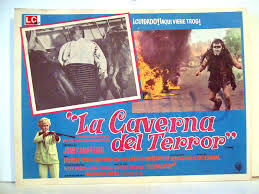
Trog makes me sad. Beyond the fact that it feels a lot like King Kong or Son of Konga doomed monster from our past that just can’t survive in today’s horrible modern world—it’s also depressing at times to watch Joan Crawford act her heart out in a film where no one else can come close to her power.

That’s not to say this is a bad film. It’s delightful and well-directed by genre vet Freddie Francis (Tales from the Crypt and plenty of other wonderful Amicus portmanteau films). It’s also quick-moving and enjoyable.

But it’s still sad.

A troglodyte (TROG!) is found alive in the caves of England. Dr. Brockton (Crawford) has had some success communicating with him and sees him as the missing link. However, her neighbors do not like her having a monster in her house, mainly after it kills a dog when it steals his ball.

Local businessman Sam Murdock (Michael Gough, who appeared in many Hammer films and as Alfred in the 1980s and 1990s Batman films) worries that the creature will negatively impact local businesses. But he really has an issue with a woman being in charge.

Meanwhile, Trog undergoes multiple surgeries, which enable him to learn to communicate. In a trippy sequence, we see into his mind, which is filled with memories of the Ice Age and dinosaurs.

The court upholds Dr. Brockton’s goal of teaching Trog, so Murdock sneaks in and lets him loose. He kills several people, including the businessman, before taking a little girl and retreating to his cave. Dr. Brockton can communicate with Trog, and the girl goes free. Meanwhile, soldiers open fire on our titular caveperson, and he falls to his death, impaled on a stalagmite.

As Dr. Brockton leaves in tears, a reporter tries to interview her. She has no comment as she wanders away.

See? Depressing.

Due to the film’s low budget, Crawford used her own clothes. And it shows. She’s a beacon of fashion in a grimy town. She stands out like no one else. And speaking of suits, the one for Trog was left over from 2001: A Space Odyssey!

This was Crawford’s final film, but I don’t believe the TV show Feud: Bette and Joan. She’d continue to act afterward, appearing in an episode of TV’s The Sixth Sense called Dear Joan: We’re Going to Scare You to Death. If you’ve ever listened to My Life with the Thrill Kill Kult, that’s where the sample on the song “A Daisy Chain for Satan Comes From.”

PS: I would know none of this were it not for Bill from Groovy Doom.

I’m glad I watched Trog. But the sad ending — and thinking of Joan changing in her car during the breaks in filming — make me a little misty-eyed. That said, it’s one of John Waters’ favorite films, so there’s that.

CBS LATE MOVIE MONTH starts now!

The CBS Late Movie — also known as CBS Late Night and Crimetime After Primetime — started on February 14, 1972. Late nights were still new for the Tiffany Network, as many of their stations were playing old movies after the news, but affiliates started to discover that there were less and less new movies available.

Those stations wanted something new.  A 1966 poll revealed that approximately 80% wanted a late evening entertainment show Mondays through Friday, just like NBC’s The Tonight Show. Starting in 1969, they gave Merv Griffin a late night show but his syndicated ratings didn’t come over to late night and he couldn’t compete with Johnny Carson.

With the CBS Late Movie, the network committed to providing classic feature films as well as the debut of more recent theatrical fare. By the second month of this strategy, they were drawing better ratings than Carson, at least for a short time.

In a reality without VCRs, much less streaming movies, the CBS Late Movie — which ran from 11:30 P.M. to 2:30 A.M. — provided an eclectic mix of newer films, made for TV movies, pilots that weren’t bought, collected episodes of canceled shows, episodes of popular shows and some strange films that otherwise may have never aired on TV.

The first run of movies came from a new package of MGM films that had not been previously televised, as well as packages of 1950s Warner Bros. and MGM films that had been run only on local and independent stations but never on a network. In the first two weeks, eight of the ten movies were world television premieres.

Starting in 1976, back-to-back reruns of different one-hour television series started. This was my first chance to see Kolchak, The Night Stalker on TV, as well as British shows like The New Avengers and Return of the Saint and Canadian shows like Night HeatHot ShotsAdderely and Diamonds. When ABC canceled T.J. Hooker, the show appeared in late night with new episodes and even a TV movie.  There were also original shows like Beyond the Screen and an American version of Top of the Pops.

The Pat Sajak Show took over the timeslot in 1989 and by that point, most stations would show syndicated programming. Eventually, David Letterman would come to CBS and take over the late night programming. There was the 1991 Crimetime After Primetime block, CBS Summer Showcase in 2015 and even a period where there was original late night programming including The Kids in the Hall along with re-airings of The Prisoner.

Much of what I love of pop culture comes from summer nights watching the CBS Late Movie with my dad. I can vividly recall so many films and episodes of Kolchak. I’d plan for what was coming with my TV Guide and can remember one time that we watched the first segment of an episode of Kolchak and were able to get hot dogs and be back home by the end of the never-ending commercial breaks. The first one would often end by almost 12:30 A.M. for a show that started at 11:30 P.M.

All this month, I’ll be spotlighting movies that aired on CBS when everyone else was asleep. You can see the entire list on Letterboxd and if you’d like to contribute, I’d be honored.

Sources

Wikipedia: The CBS Late Movie

Retro Junk: The CBS Late Movie

Chattanooga Film Festival Red Eye #8: Silver Slime (1981), Killing Spree (1984) and Possibly In Michigan (1983)

Silver Slime (1981):

Christopher Gans has made some great movies and gets little credit. His better-than-the-game Silent HillCrying Freeman, his segments in Necronomicon and the incredible Brotherhood of the Wolf are among his many accomplishments.

As a student, he made this film, which pays tribute to Bava, complete with a dedication at the end. And you know, in just around 15 minutes, Gans gets it. He understands how giallo works, and instead of making the kind of modern Giallo that everyone tries these days, he crafts a film that looks bad with love and then goes forward, taking what works and creating a near-lunatic energy that feels like where you’d hoped Argento would have kept going after Tenebre and Opera.

Only two actors are credited: Aissa Djabri as Le témoin (the witness) and Isabelle Wendling as La victim (the victim). Like all Giallo directors of ill repute, one must assume that Gans is the killer or at least their hands.

Phillipe Gans and Jean-François Torrès created the music for this, and much like the visuals, it takes the sound of the form and makes it more hard-driving and powerful, while Jérôme Robert has gone on to plenty of work in the French film industry.

This just knocked me out.

You can watch this on YouTube.

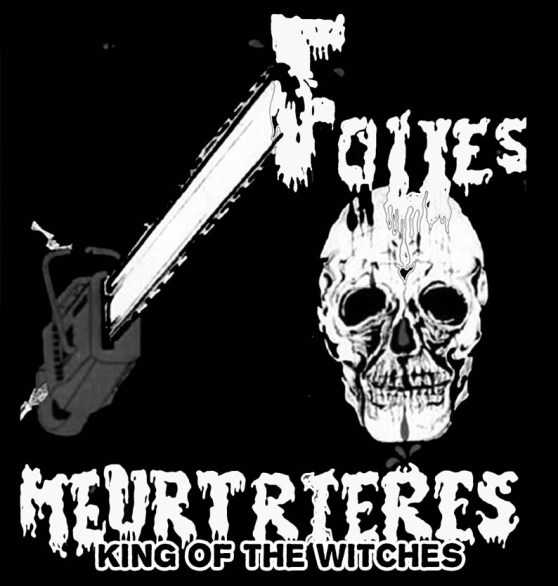
Folies Meurtrières (Killing Spree) (1984): Shot on Super 8 at some time in the early 80s in France, this film is 52 minutes of a killer aimlessly killing, killing and killing some more while a fuzzed-out synth soundtrack plays, the kind of music that those that say their films are “inspired by John Carpenter” but just have a neon color palette and a few keyboard songs on the soundtrack dream and wish and hope and pray that they could achieve.

Then everything changes.

And by changes, I mean the end of Maniac gets ripped off.

Look, I get it, this is a cheap knockoff of a slasher that may be bright enough to make fun of the things we accept in these films. But man, I love these lo-fi movies that want nothing more than to make their own effects and do their best to entertain you. They’re not significant movies — they were never intended to be — but they were a lot of fun to make.

I’ve heard that this movie is in the genre Murderdrone, in which “90% of the movie is people wandering around and getting murdered set to shitty lo-fi bedroom synths, and it’s increasingly hard to pay attention, but you can’t look away, and you’re stuck in a murdertrance.” This Letterboxd list has some more of those…

As for the man who made this, Antoine Pellissier, he’s a doctor now.

Possibly In Michigan (1983): Made with funding from the National Endowment for the Arts and the Ohio Arts Council, video artist Cecelia Condit’s nightmarish short has had many lives: as an art project to help her heal from her past, as a scare tactic shown on the 700 Club and as a viral video that got shared without context and was rumored to be a cursed film.

Starting with her film Beneath the Skin, Condit uses her video work to attempt to deal with the cycles of violence that she felt were all around her and so close to her. That’s because, for a year, she dated Ira Einhorn, the Unicorn Killer, who was also one reason we had Earth Day. The entire time that they dated, the rotting body of his ex-girlfriend, Holly Maddux, was in a trunk. A trunk that Condit constantly walked past, one assumes.

It made it onto religious television because, in addition to examiningt the self-destructive behaviors of men toward women, it alsoexaminest female friendships and love.The lead characters, Sharon and Janice, may be a couple, or they may just be supportive women. Or both. Who are we to put any bounds on their relationship?

It’s become a viral sensation several times, as teens try to copy its strange musical numbers and send it to one another as a curse straight out of The Ring.

Our ladies are just trying to shop for perfume — this was shot at Beachwood Place in Beachwood, Ohio, where Condit sat outside the building manager’s office until she was allowed to shoot there; she was given twenty-minute blocks of time, which was a challenge — when Arthur begins to stalk them, a man whose face changes with a series of latex masks.

Arthur is the kind of Prince Charming who shows his love to women by hacking them to pieces; his always-changing face is a way of showing the roles that abusive men have taken in their relationships. We also discover that Sharon is attracted to violent men but also likes making them think that violence is their idea. Regardless, love should never cost an arm and a leg.

The songs, written and performed by Karen Skladany (who also plays Janice), are insidious in the way that they worm their way into your brain. This is the kind of weirdness that is completely authentic in a way that today’s manufactured social media creepypasta weirdness cannot even hope to be a faint echo of.

As frightening as this can be, it’s also a film about absorbing — eating a cannibal is one way, right? — and getting past the worst moments of life without being destroyed by them. This also lives up to so much of what I love about SOV in that while we’ve been taught that the 80s looked neon and sounded like a Carpenter movie, the truth is that the entire decade was beige and sounded like the demo on a Casio keyboard. This doesn’t nail an aesthetic as much as document the actual 1983 that I lived within, minus the shape-changing cannibal and singsong happy tale of a dog in the microwave.

Consider this absolutely essential and one of the most critical SOV movies ever.

The Chattanooga Film Festival is happening now through June 29. To get your in-person or virtual badge to see any of these movies, click here. For more information, visit chattfilmfest.org and follow us on Facebook, Twitter and Instagram.

Chattanooga Film Festival Red Eye #6: Club Life (1987)

Norman Thaddeus Vane lived a life.

After an early conversion from Judaism to Roman Catholicism, a year in the Merchant Marine and two years in the Air Force, he attended Columbia University on the G.I. Bill.

After graduation, his first play, The Penguin, opened Off-Broadway with Martin Landau in the cast and received rave reviews—reviews that eluded his Broadway debut, Harbor Lights. He then spent the next two decades in London, where he wrote and directed Conscience Bay and The Fledglings when he wasn’t running nightclubs—one of which he sold to the Krays—and contributing to Penthouse.

He also married 16-year-old Sarah Caldwell when he was nearly forty, which formed the basis of his script for Lola (AKA Twinky AKA London Affair), a movie in which Susan George stands in for his wife — his wife did act in his film Mrs. Brown, You’ve Got a Lovely Daughter — and Charles Bronson basically played him.

As the seventies began, he wrote the Italian film 1931: Once Upon a Time in New York, AKA Pete, Pearl & the Pole, which had Tony Anthony as Pete, Adolfo Celi as the Pole and Lucretia Love as the Pearl. He also wrote the Native Americansploitation film — is there a genre? — Shadow of the Hawk stars Jan-Michael Vincent, Marilyn Hassett and Chief Dan George.

Somewhere in the middle of the 70s, he shot the second unit on the adult horror comedy Dracula Sucks, which would serve him well when he made the mainstream Frightmare, a movie that has references to the Universal Dracula.

Perhaps his most interesting film is 1984’s The Black Room, which Vane revealed to Nightmare USA based on his real life, as he cheated on his wife in his black room with Penthouse centerfolds that he met while working at that publication. It’s also the only movie I’ve ever seen where a man rents a sex room from a brother and sister-couple who may or may not be vampires.

The last few movies of Vane’s career are hit and miss: Midnight, in which he was unhappy with the final cut, which was taken from him; Taxi Dancers, a sex film shot in the same nightclub used for Club Life and You’re So Dead, made when Vane was 79 years old and never shown, as far as I know.

Vane wrote an op-ed for the Los Angeles Times in 1991 in which he confessed to how hard agism had hit him, saying, “After being dropped by William Morris some years ago, I managed to sell several scripts to studios. But in recent years, the wall has been impenetrable. Instead of disappearing, I decided to write, produce and direct low-budget, independent features.”

If you want to know more, the incredible Hidden Films was lucky enough to interview Vane before he died in 2015.

But hey — we’re here to talk about Club Life.

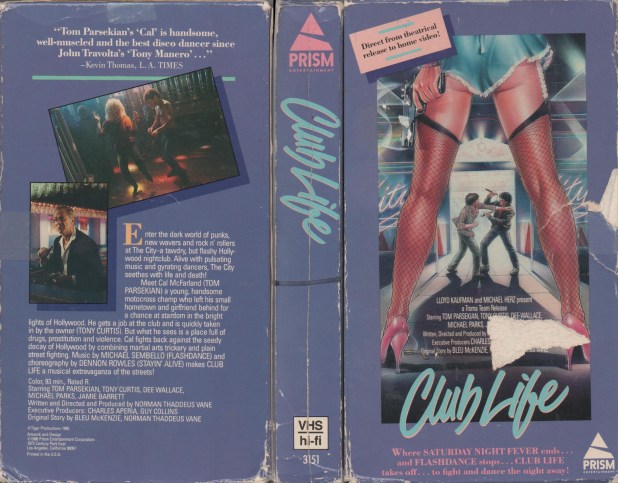
Cal (Tom Parsekian) is a kid from a small town with dreams of Hollywood stardom. His journey takes him to The City, a nightclub owned by the coked-out Hector (Tony Curtis), who is in debt to organized crime but also loves to watch his wife Tilly (Dee Wallace) sing. Cal’s Hollywood dream leads him to become a bouncer, learning from the seasoned Tank (Michael Parks). The film features a unique scene where Tank effortlessly dodges every move Cal makes, leading to a moment of shared laughter and pain.

The girl Cal left behind, Sissy (Jamie Barrett), has come to Los Angeles looking for him, but she falls into a bad crowd at the same time as Cal leaving behind The City, as he comes to work at a lesbian bar called Different Drummer. Sissy also sings, and her number “First Class Man” gets her both booed off the stage at the ladies-only club and also catcalled.

This movie is awash in neon and fog. It also has one of the most fantastic sex scenes ever, as Cal and Sissy work it out on a clear waterbed lit from the inside and filled with fish. This is the movie that proves to you that you haven’t seen everything.

It’s not done yet.

After Tank gets killed, during which one of the tough guys says, “The cat can’t sleep if he wants to breathe.” Cal returns to The City and tries to keep Hector safe from all his debts. Did I mention that Cal can also dance? Or that he uses — and here’s the part that might be better than the waterbed filled with sea life — neon nunchucks that get a slow-motion dance fight scene that blew my brains out my nose.

This is a movie filled with strange BDSM fog-enhanced dancing set to music by Frank Musker (who is credited on the Stardust song “Music Sounds Better with You” thanks to a sample it contains from the song “Fate” that he did with Chaka Khan), Michael Sembello (the Flashdance force is strong within this) and Terry Shaddick (who co-wrote Olivia Newton-John’s “Physical”).

Smiley-faced balloons intrude on breakups, graffiti clowns watch over overdoses, and a funeral happens inside a nightclub. It’s also shot by Joel King, whose resume includes camera work on Just Before DawnThe BeastmasterCarrieOut of the Blue and Embrace of the Vampire. That should give you an idea that this movie looks everywhere. As for the wild dance numbers were choreographed by Dennon Rawles, who also worked on Voyage of the Rock Aliens and Staying Alive.

Also, Kristine DeBell shows up, and again, her career has some wild choices, from Meatballs and the erotic Alice in Wonderland to playing Jackie Chan’s love interest in The Big Brawl to being in A Talking Cat!?!

This film ends as only it can. Cal smashes the hall of mirrors where his friend Tank died and basically decimates the entire club with his neon nunchucks. He then splits the disco ball and throws his brightly colored martial arts weapon over the Hollywood hills.

You best believe I was crying.

PS: Norman Thaddeus Vane was not paid for the movie, and when it was nearly finished, he stole the film itself. He told Hidden Films, ” The movie was being edited at Consolidated Film Industries, and I went over and stole these really heavy cans of negatives and put them in the cellar of a friend’s house. And then I told our representative, “Listen, tell Guy Collins that I’m not giving the negatives back until I get some serious money.”  They called the police and I said to them, “I’ve been working for this company for three months and I haven’t been paid dollar one. I’m holding the negative as a lien against the money they owe me by contract.” The police took my side. Guy’s brother came over and paid me $40,000  and said he’d owe me another $40-50,000, but I never got it.”

You can watch this on YouTube or download it from the Internet Archive.

You can listen to the podcast I did on this movie on YouTube.