CBS LATE MOVIE MONTH: Dracula Has Risen From His Grave (1968)

EDITOR’S NOTE: Dracula Has Risen From His Grave was on the CBS Late Movie on May 19 and October 12, 1972 and August 9, 1974.

This was the fourth Hammer Dracula movie and the third to star Christopher Lee (he doesn’t appear in The Brides of Dracula). It was directed by Freddie Francis, who stepped in to replace Terence Fisher, who injured his leg in a car accident. It has an extraordinary and wonderful effect when Dracula appears in the film, as the edges of the frame take on the colors of crimson, amber and yellow.

There’s a fantastic beginning where a young altar boy (Norman Bacon) finds a dead woman hidden inside a church bell, just one more of Dracula’s victims. But a year after — and the events of Dracula: Prince of Darkness — finds the greatest of all the undead quite dead.

Monsignor Ernst Mueller (Rupert Davies) visits the village from the opening and learns that the altar boy can no longer speak and the town’s holy man (Ewan Hooper) has lost his faith. Because Dracula’s castle has a shadow that extends over their church, they refuse to even come near it. The Monsignor decides to exorcise the castle, which leads to the kind of strange occurrences that always bring Dracula back: lightning strikes, the older priest slips, he hits his head on a rock, and the drips of his blood through the cracks in the ground make their way to the deceased vampire.

As Mueller returns home, Dracula quite literally rises from his grave and takes on the frightened priest as his familiar. Now unable to enter his castle, he flips out and demands revenge, heading off to Keinenberg, where he plans on making Mueller’s niece Maria (Veronica Carlson, Frankenstein Must Be DestroyedThe Horror of Frankenstein) into one of his lovers.

Luckily, her boyfriend Paul (Barry Andrews) is ready to protect her, even if he has to defeat the advances of a barmaid Zena (Barbara Ewing, who has since become a well-reviewed author) who has been hypnotized by Dracula. There’s a wild moment when Dracula orders the priest to kill Zena, so he burns her body in a bakery oven while Dracula leaps across the rooftops to find and bite Maria.

This has some fascinating ideas as Paul has to go it alone after the Monsignor dies. As an atheist, he and the lost faith priest are unable to properly stake and destroy Dracula. As always, Dracula is stopped, and faith is restored. This is the most challenging time for achieving that end goal.

As a kid, the Hammer movies were quite literally the end-all, be-all of my existence. I thought about them all day and would discuss them with anyone who wanted to hear about them—often, many who didn’t.

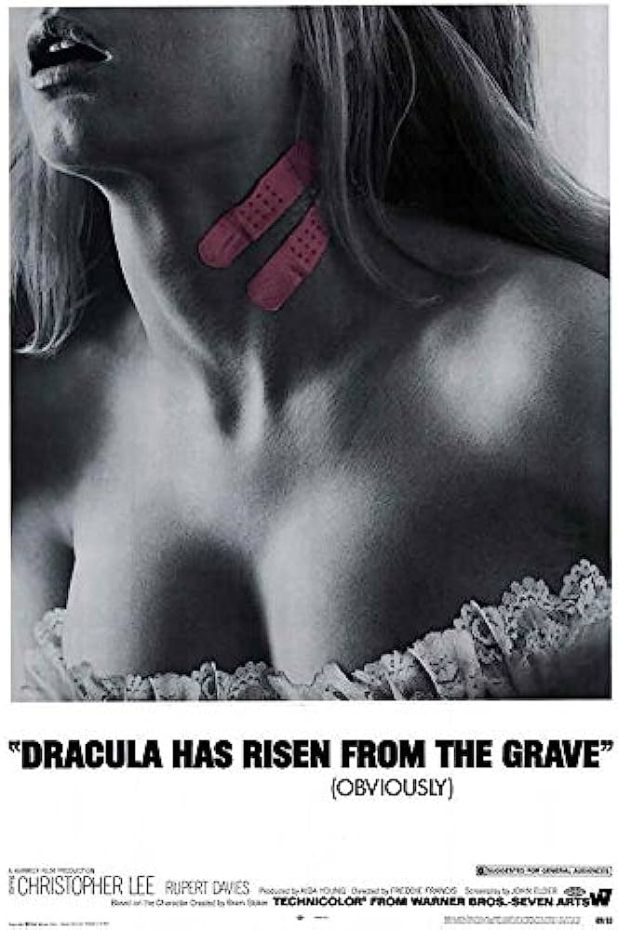
As an old man, I’m struck by how often the film in the movie is sped up, which doesn’t work, while the color effects and rooftop scenes have lost none of their infernal power. Plus, this has one of the best posters I’ve seen, just the throat of a bosom woman with band-aids where Dracula’s teeth have penetrated her.

CBS LATE MOVIE MONTH: Kingdom of the Spiders (1977)

EDITOR’S NOTE: Kingdom of the Spiders was on the CBS Late Movie on April 28, 1982 and January 12, 1983.

Directed by John “Bud” Cardos and written by Richard Robinson and Alan Caillou, whose real name was Alan Samuel Lyle-Smythe MBE, M.C. and who was an author, actor, screenwriter, soldier, policeman and professional hunter.

Despite the initial fright they may cause, it’s worth noting that tarantulas’ venom is about as dangerous as a bee sting. They mostly cause itching from the shedding of their bristles, which are used to make itching powder. This fact, coupled with the humorous association of itching powder with comedy movie scenes of mischief, adds a delightful touch of humor to the film.

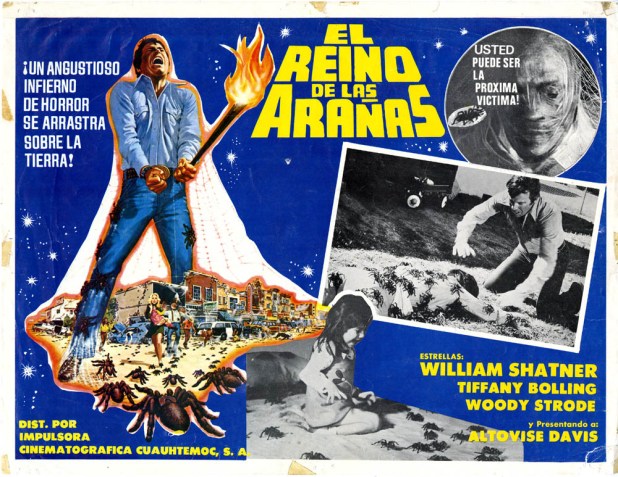
This film features 5,000 tarantulas in its cast, a staggering number that took up 10% of the film’s budget. It’s safe to assume that star William Shatner was compensated more than his eight-legged co-stars. Interestingly, these spiders, being cannibals, had their own set of demands. All 5,000 of them had to be kept in separate containers, adding a unique challenge to the production process.

They’re also very shy, so to make it appear that the spiders were attacking people, fans and air tubes were used.

Let’s take a trip to Camp Verde, Arizona.

That’s where Dr. Robert “Rack” Hansen (Shatner) practices. He’s heading out for a house call to see Walter Colby (Woody Strode), whose prize calf dies for reasons that puzzle Hansen. Diane Ashley (Tiffany Bolling) comes down from the big city of Flagstaff to blow his mind: spider venom killed the cow.

It gets worse. Walter’s wife, Birch (Altovise Davis, Sammy Davis Jr.’s third wife), soon discovers that their dog is dead and that a giant spider nest is in the backyard. Thanks to all the pesticides, the spiders have lost their natural food source, and instead of turning on one another, they’ve decided to eat larger meals.

Their big scientific plan is to burn the spider hill, which doesn’t go well because the arachnids escape into tunnels and show an advanced intelligence that conducts a revenge hit on Walter, his wife and Hansen’s sister-in-law Terry (Marcy Lafferty).

The mayor (Roy Engel) gets Sheriff Gene Smith (David McLean) to spray the town with pesticides, which is how things got this bad in the first place. Ashley says rats would have been a better idea, but obviously, the mayor met Larry Vaughn at a convention of mayors in Las Vegas and saw his seminar on never canceling the county fair, no matter what common sense tells you. More pesticide is planned, but the spiders deal with that by crashing a crop duster.

The survivors plan on escaping in an RV, but by the time they try, the entire town has been webbed up as the outside world forgets them and plays country music on the radio.

In 1998, Shatner told Fangoria that he was working with Cannon Films in the late 1980s to produce a sequel, but he probably meant Menahem’s 21st Century, which did run trade ads for Kingdom of the Spiders 2. Shatner would direct, write and star in the film, in which a man would be tortured with spiders. As you can imagine from Menahem’s playbook, this ad was just a photo of Shatner and the title of the movie.

Producers Igo Kantor and Howard James Reekie, using the name Port Hollywood, planned a sequel in the 2000s that promised Native American myth and spiders driven mad by secret government experiments involving extremely low-frequency tones.

I love this movie because you can tell that the spiders want nothing to do with anybody, much less feel the need to attack them. The entire cast of Bela Lugosi fights an octopus, and the emotion of fear is present, but no one is ever in danger.

CBS LATE MOVIE MONTH: Gargoyles (1972)

EDITOR’S NOTE: Gargoyles was first on the CBS Late Movie on May 1, 1973; May 16, 1975 and September 3, 1975.

EDITOR’S NOTE: Gargoyles was first on the CBS Late Movie on May 1, 1973; May 16, 1975 and September 3, 1975.

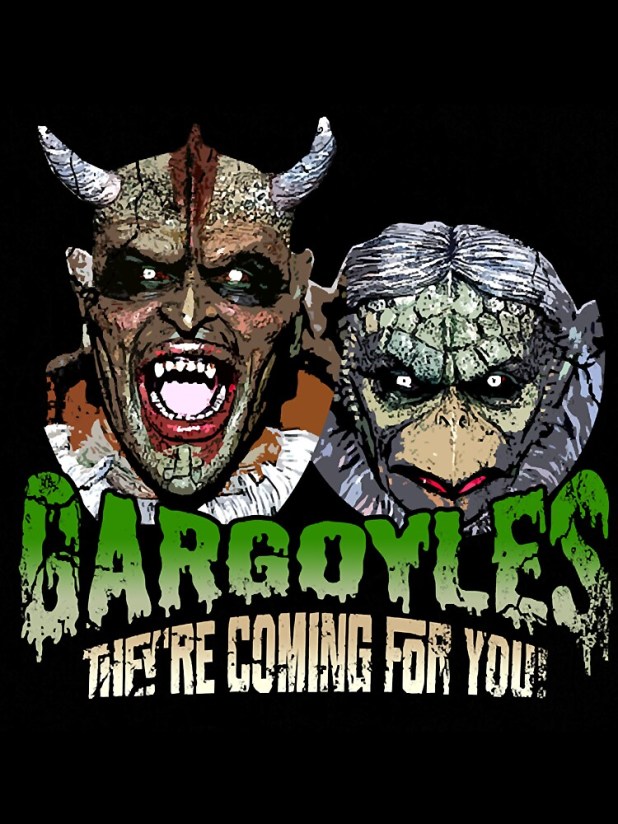
When I was a kid, I remember asking my dad what movies he thought were scary. He answered Night of the Living Dead and Gargoyles, so I was always nervous to watch this movie. It just looked strange, and in the late 1970s, it wasn’t like I could find it on demand. But the unique storytelling of Gargoyles always intrigued me.

Originally airing on CBS on November 21st, 1972, it was directed by Bill L. Norton (Baby: Secret of the Lost Legend, More American Graffiti) and written by Steven and Elinor Karpf (Devil Dog: The Hound from Hell, The Jayne Mansfield Story), Gargoyles may be uneven, but has moments of pure joy.

It’s one of the first films Stan Winston (Terminator, Aliens) worked on, providing a variety of gargoyle makeup. The look of the creatures is not just terrific, it’s downright amazing, as they don’t all look the same. The leader (Bernie Casey (Felix Leiter in Never Say Never Again, UN Washington in Revenge of the Nerds) has a perfect look that balances a regal bearing with an otherworldly aura. You can see why this won an Emmy. It’s big budget-worthy work on a shoestring budget.

Speaking of budget, the film was shot with just one camera over 18 days, which chased away the original director. Temperatures at the Carlsbad, NM location, baked the cast and crew, reaching 100 degrees or more the entire shoot. So it’s incredible that what emerged is so interesting.

The opening dialogue informs us that Satan lost the war in Heaven, with his children being the gargoyles who rise against man every six hundred years (there’s even an image from Haxan to symbolize the devil). This dialogue is by Vic Perrin (Tharg from the “Mirror, Mirror” episode of Star Trek, and the voice of Metron and Nomad), who also provides the crazy VO for the head, Gargoyle.

We join Dr. Mercer Boley (Cornell Wilde, No Blade of Grass), author of the occult, and his daughter, Diana (Jennifer Salt of Sisters and Son of Sam TV movie Out of the Darkness) as they head off to the desert — and Uncle Willie’s Museum — where they find a skeleton of a creature that Willie (Woody Chambliss of Zero Hour! and The Devil’s Rain!) claims he saw in the hills. The doctor doesn’t believe a word, but his daughter listens to his tales, only to be cut off by the sound of wings and something trying to get into the museum. Whatever it is, it sets off a fire that kills Uncle Willie.

They head to a local motel run by Mrs. Parks (Grayson Hall, who played Dr. Julia Hoffman in Dark Shadows and Carlotta Drake in Night of Dark Shadows), who is never without a drink in her hand (an acting choice by Hall that we can endorse). Two of the gargoyles try to take back the skeleton they’ve rescued from the inferno, but one is hit by a truck. It seems like the doctor sees money in the bodies of these gargoyles, alerting the group’s leader to his plan. He kidnaps Diana, showing her the eggs his people care for and explaining that they just want to live in peace with humans.

Throw in a bunch of motorcycle riders (including Scott Glenn of The Right Stuff and Silence of the Lambs), cops who can’t understand what is going on, the finest hound dogs in the area, an all-out war between humans and Gargoyles with way too much talking and you have this movie. But I can’t dislike it — it’s filled with great moments like the leader making Diana read to him about the historical account of an incubus seducing a woman and the speech he gives to the humans at the end. The closing image of a Gargoyle flying away, clutching a wounded female of his species? Amazing.

It’s worth seeking out, if only to see how horror used to be all over 1970s TV. If you grew up in that era, you have less of a chance of dismissing this movie as dumb.

Bucheon International Fantastic Film Festival: King On Screen (2022)

Starting with Carrie, Stephen King was adapted by more than fifty directors and eighty or more films and series were filmed. The beauty of King On Screen is that it brings together nearly every living director who worked on these films, including Tom Holland (The Langoliers, Thinner), Mick Garris (The StandSleepwalkers), Frank Darabont (The Green MileThe Shawshank Redemption, The Mist), Taylor Hackford (Dolores Claiborne), Mike Flanagan (Dr. Sleep, Gerald’s Game), Mark Lester (Firestarter), Mikael Håfström (1408), Josh Boone (The Stand), Tom McLoughlin (Sometimes They Come Back), Lewis Teague (CujoCat’s Eye), Fraser C. Heston (Needful Things), Craig R. Baxley (Storm of the CenturyRose RedKingdom Hospital), Mikael Salomon (Nightmares and Dreamscapes: From the Stories of Stephen King), Scott Hicks (Hearts In Atlantis), David Carson (Carrie 2002), John Harrison (CreepshowCreepshow 2), Zak Hilditch (1922), Greg Nicotero (Shudder’s Creepshow), Vincenzo Natali (In the Tall Grass), Tod Williams (Cell) and so many more.

Director Daphné Baiwir starts this with a sequence that takes you directly into nearly every one of King’s stories. If you love the author, you’ll have so much fun going back in and out of this scene to see how many references you can catch. My wife is a fan, so she was excited to see Jeffrey DeMunn show up, as he was in The Shawshank RedemptionStorm of the CenturyThe Green Mile and The Mist.

Don’t expect anyone to knock on any of these movies. Well, the movie likes The Shining TV movie more than Kubrick’s, but these are all friends of King. However, if you’re watching this, there’s a significant chance that you don’t have too many bad things to say about any Stephen King movies.

The part of this that I loved the most was the part about Tom Hanks, as Frank Darabont discussed how giving he is to everyone on set.

You can learn more about this film at the official website and Twitter and Instagram pages.

I watched this film as part of The Bucheon International Fantastic Film Festival (BIFAN). You can learn more at their official site.

Bucheon International Fantastic Film Festival: With Love and a Major Organ (2023)

ABOUT THE AUTHOR: Joseph Perry writes for the film websites Gruesome Magazine, The Scariest Things, Horror Fuel and Diabolique Magazine; for the film magazines Phantom of the Movies’ VideoScope and Drive-In Asylum; and for the pop culture websites When It Was Cool and Uphill Both Ways. He is also one of the hosts of When It Was Cool’s exclusive Uphill Both Ways podcast and can occasionally be heard as a cohost on Gruesome Magazine’s Decades of Horror: The Classic Era podcast.

Many of us human beings have felt at times like ripping out our own hearts, but in the fantastical world of director Kim Albright’s Canadian genre-blender With Love and a Major Organ (Canada, 2023), it is not only literally possible, but others can make off with them, too. 

Anabel (Anna Maguire) is a sensitive, artistic sort who seems to feel things much more than most of those around her. Friends and other acquaintances are obsessed by such things as online apps that require fewer feelings and less thinking. 

After having her romantic feelings toward George (Hamza Haq), a man she recently randomly met in a park, rebuffed, and becoming disenchanted with her friends and others, Anabel tears out her own heart and becomes a less feeling person. Meanwhile, George replaces his own heart with hers, and the world opens up to him in ways that he never felt before. 

Blending surreality, science fiction, and other genre-film elements with drama and occasional bittersweet humor, With Love and a Major Organ —written by Julia Lederer and based on her own play — aims for the heartstrings and plucks them quite splendidly. Though based on a play, Albright opens the story to a big, wide, colorful world, making it a true movie-watching experience rather than simply a filmed play. Anabel and George are wonderfully complicated characters, and they are brought to vivid cinematic life by Maguire and Haq, who lead a talented cast of supporting actors. 

Joe watched this film as part of The Bucheon International Fantastic Film Festival (BIFAN). You can learn more at their official site.

Bucheon International Fantastic Film Festival: Valerie and Her Week of Wonders (1970)

The film Jaromil Jires, directed before this one, 1969’s The Joke, has been described as “possibly the most shattering indictment of totalitarianism to come out of a Communist country.” As a result, it was banned for nearly twenty years.

Valerie and Her Week of Wonders is based on the 1935 Vítezslav Nezval novel. Much like that work, this movie is a work of surrealism and one of the films that I can best point to being part of a genre I’ve been referring to as ‘dark childhood’ films. This genre, which I’ve come to represent as movies that use the supernatural to explain the pains of oncoming adulthood, often features dreamlike sequences, allegorical storytelling, and a focus on the psychological aspects of growing up.

Valerie is asleep when a thief steals her earrings. She’s frightened by the masked Constable, who grows angry when the thief returns what he has stolen to her. That’s when she learns that the earrings were a last gift from her mother before she entered a convent, but they once belonged to the Constable.

The Thief and the Constable remain at odds over the earrings and Valerie. That night, she meets the masked man in the street, where he leads her to a chamber where her grandmother ritualistically whips herself all in the name of a past lover. Oh yeah — there’s also a woman named Elsa who was once the Constable’s lover and grows young again when she tastes blood.

The earrings pass through multiple owners, and Valerie’s blood is the key to nearly everyone’s survival. People transform into monsters and cats, and if you didn’t guess already, the movie has descended into a dream that only Valerie can wake up from.

Honestly, it’s hard to rationally write about this film. The film is a visual masterpiece, with magic infused in every frame. You’re either going to be captivated by its artistic brilliance, or you’re going to find it too arty or strange. Obviously, I belong to the former camp.

Members of the bands Espers, Fern Knight, Fursaxa and other musicians formed the Valerie Project in 2006, performing original songs while the film plays.

If you’ve ever read Angela Carter’s works or seen the film The Company of Wolves, which she wrote for director Neil Jordan, you’ve seen work directly influenced by Valerie.

Grab the Criterion blu of this and do yourself a favor. It’s a perfect film.

I watched this film as part of The Bucheon International Fantastic Film Festival (BIFAN), as part of the Folk Horror: Lands of Cruelty, Beliefs of Terror program which also includes Eyes of FireKill List, the 2019 French version of La LloronaWoodlands Dark and Days BewitchedBldg. NIn My Mother’s Skin and To Fire You Come at Last. You can learn more at their official site.

CBS LATE MOVIE MONTH: Whoever Slew Auntie Roo? (1972)

EDITOR’S NOTE: Whoever Slew Auntie Roo? aired on the CBS Late Movie on October 31, 1973 and March 8 and June 1, 1976.

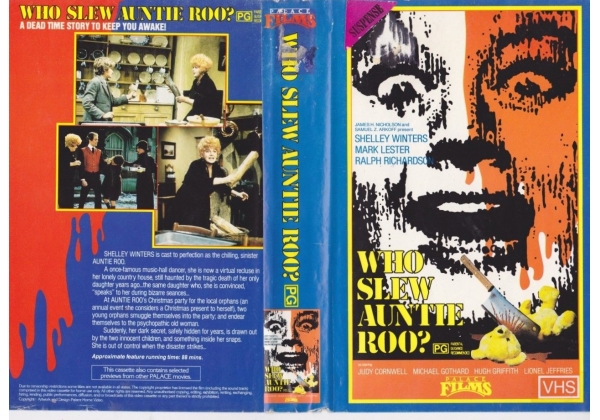
Following the success of What’s the Matter with Helen?, Curtis Harrington directed this intriguing psycho-biddy film. In it, Mrs. Rosie Forrest (Shelley Winters), the Aunty Roo of the title, is known by the children of a local orphanage as a kindly old lady who throws a huge Christmas party every single year for them. However, the truth is far more sinister. She’s obsessed with her dead daughter Katharine, whose mummified body lies in state in her attic so Aunty Roo can sing lullabies to her every night.


Mark Lester and Chloe Franks from The House That Dripped Blood play Christopher and Katy Coombs, two orphans who find themselves in Roo’s clutches. She believes that Katy might be her daughter, and the story takes a turn that’s reminiscent of the classic Hansel and Gretel tale, adding an intriguing layer to the narrative.

Ralph Richardson plays Mr. Benton, a fake psychic who tries to help Aunty Roo connect to the spirit of her long-departed daughter.

The early 70s are filled with what I call enjoyable junk. This would be one of those films with Winters practically devouring the scenery. It makes an outstanding double bill with the aforementioned What’s the Matter with Helen?, which is the superior of the two films. While Whoever Slew Auntie Roo? shares some thematic and stylistic similarities, it stands out for its more compelling narrative and character development.

CBS LATE MOVIE MONTH: The House That Screamed (1969)

EDITOR’S NOTE: The House That Screamed aired on the CBS Late Movie on January 30, 1973 and June 14, 1974.

Spain’s first major horror film production, The House that Screamed—AKA La Residencia and The Boarding School—was based on a story by Juan Tébar. Because the cast included both English and Spanish actors, the film was shot in both languages and then dubbed into English in post-production.

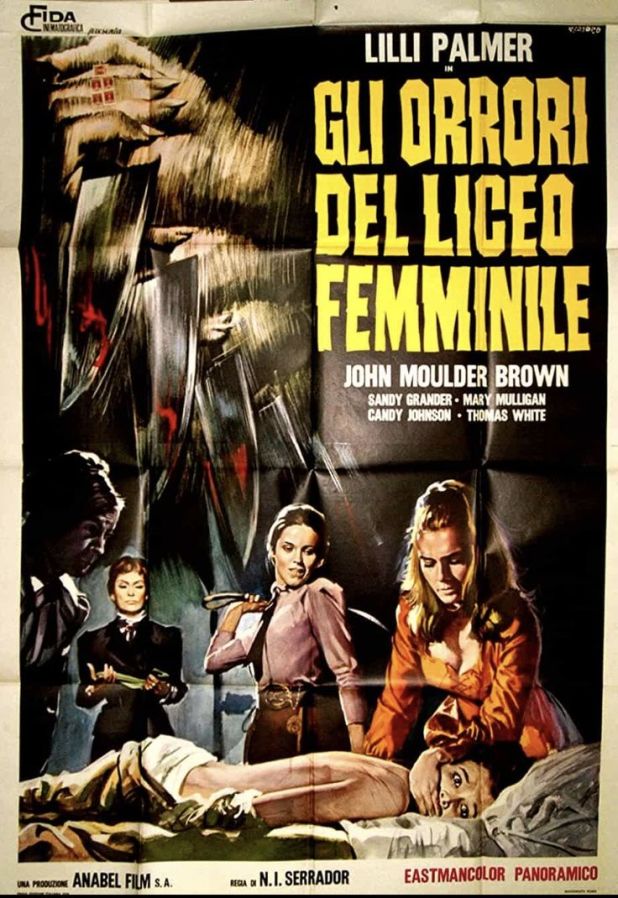
Directed and written by Narciso Ibáñez Serrador (Who Can Kill a Child?), it takes place at a school for girls—reforming them and making them acceptable wives for their future husbands—in 19th-century France run by Headmistress Señora Fourneau (Lilli Palmer). Teresa Garan (Cristina Galbó, The Living Dead at Manchester Morgue) is a newcomer to the school and instantly notices just how strange of a place it is. For example, she always feels like she’s being watched.

Fourneau rules the school by the whip—quite literally, she has no problem beating her students into submission—and has Irene Tupan (Mary Maude), an older student, as her near WIP second-in-command.

Yet things are not alright. Students keep going missing, Teresa is bullied when the girls discover that her mother is a prostitute, and Luis (John Moulder-Brown), Fourneau’s son, is in love with Teresa despite the rules of her mother, who believes that none of these girls are good enough for him. He was once interested in Isabelle (Maribel Martín, The Blood Spattered Bride) until his mother roughly helped his face and intoned, “These girls are not good enough for you. What you need is a woman like me!”

That’s when the film literally goes Psycho, wipes out a main character, and the narrative transforms an antagonist into the protagonist. The horror, however, is nowhere near over for anyone. That idea of Luis finding a woman just like his mother haunts the headmistress.

This gorgeous movie predates Argento’s Bird With the Crystal Plumage by a few months and Suspiria by eight years. It’s as much a slasher as a gothic horror movie and works as both, and it has elements of Giallo and Women in Prison films. Yet, above all, it remains classy and has lush colors, incredible cinematography and luscious interiors, making this quite the furniture movie. Even better, you can see the film that was taken from it. Pieces might be a tribute movie, even if it’s not a movie discussed all that often in the U.S.

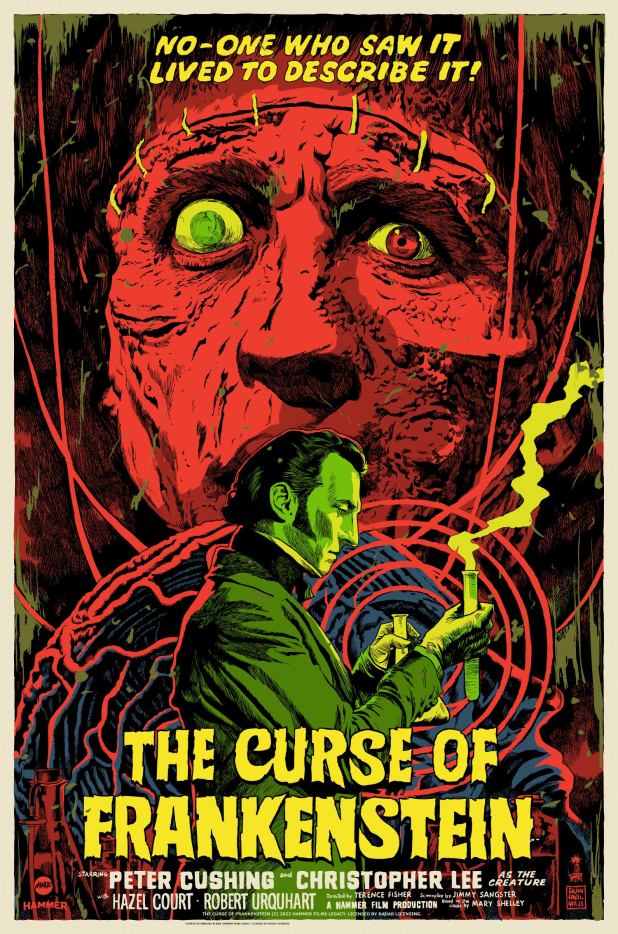
CBS LATE MOVIE MONTH: The Curse of Frankenstein (1957)

EDITOR’S NOTE: Curse of Frankenstein aired on the CBS Late Movie on May 24 and September 21, 1972 and June 28, 1974.

Hammer was initially founded in 1934 by William Hinds, whose stage name was Will Hammer, as he grew up in the Hammersmith section of London. They produced the now-lost The Public Life of Henry the Ninth and The Bank Messenger MysteryThe Mystery of the Mary CelesteSong of Freedom and Sporting Love before going out of business. That said, Hinds also co-owned a distribution company, Exclusive Films, with Enrique Carreras, which stayed in business.

In 1947, Hammer was revived after the war and began shooting low-budget radio show adaptations. They learned that they could save money by shooting in country homes rather than film sets—and stayed with that for much of their output—and would remodel Down Place on the Thames into Bray Studios, their best-known base of operations.

Hammer’s first horror movie was their 1955 adaptation of Nigel Kneale’s BBC Television science fiction serial The Quatermass ExperimentThe Quatermass Xperiment and Quatermass 2 were big hits; while the TV show was an unknown entity in the U.S., it was exported here as The Creeping Unknown to play a double feature with The Black Sleep. The results were so successful that United Artists offered to pay for part of the sequel.

Also — in the November 6, 1956 issue of Variety, it was claimed that a nine-year-old boy died of a ruptured artery while watching that movie in Oak Park, Illinois. According to The Guinness Book of Records, this would be the only known case of an audience member dying of fright. William Castle immediately took notice, one imagines.

As production began on Quatermass 2, Hammer needed someone in the U.S. willing to invest in and promote their movies. This led them to Associated Artists Productions. At the same time, Max J. Rosenberg and Milton Subotsky had sent Associated Artists an adaption of Mary Shelley’s novel Frankenstein, or The Modern Prometheus. They’d only made one movie and were hard to bet on, but Associated Artists’ boss Eliot Hyman did send the script to Hammer.

Until the day he died — and beyond — Rosenberg claimed that he produced The Curse of Frankenstein. However, Subotsky’s script was perhaps very close to Universal’s Son of Frankenstein and was only 55 minutes long. Screenwriter Jimmy Sangster said he had never seen Subotsky’s script or was unaware of Rosenberg’s involvement. In fact, he had never seen the Universal Frankenstein films and had just written what he thought the movie should be.

If the names Rosenberg and Subotsky are familiar, well — they became Amicus.

Another issue Hammer had to deal with was that studios had to submit their scripts to censors before making them in England. The censors said, “We are concerned about the flavour of this script, which, in its preoccupation with horror and gruesome detail, goes far beyond what we are accustomed to allow even for the ‘X’ category. We can give no assurance that we will be able to pass a film based on the present script, and a revised script should be sent to us for our comments, in which the overall unpleasantness should be mitigated.

You can only imagine how much more upsetting it would all be in vivid color instead of black and white. Hammer’s new take on horror didn’t avoid blood or gore; compared to the horror of the past, it zoomed in on it and let it take up the screen. It may seem tame today, but in the days before splatter and even Blood Feast, it was incendiary.

Directed by Terence Fisher, The Curse of Frankenstein has an intriguing opening that puts you right in the middle of the story: As Baron Victor Frankenstein (Peter Cushing in his first significant film role) awaits execution for the murder of his maid Justine (Valerie Gaunt), he reveals his story to a priest (Alex Gallier).

With the death of his mother, Victor owns the Frankenstein estate and pays for his remaining family, Aunt Sophia (Noel Hood) and her daughter Elizabeth (Hazel Court). He also pays for Paul Krempe (Robert Urquhart) to teach him science, which leads to them bringing a dead dog back to life. Indeed, they can do the same with human beings, but as Victor descends into scientific butchery, Paul leaves just as Victor’s fiancee — his cousin Elizabeth — comes to live with him.

His plan is sound, if not maniacal, as the dead body parts are sewn together to make the ideal human being, which will be guided by the brain of a professor. Sadly, that brain is damaged as Paul returns to try and stop Frankenstein. At this point, the scientist is so deluded that he thinks that it’s fine that he’s pushed the old teacher to his death. The creature (Christopher Lee) he brings to life is a madman, and Paul helps him stop it; later that night, Frankenstein still brings it back to life and uses it to murder Justine, with whom he has been having an affair. She seals her fate by claiming that she will reveal that he has impregnated her and is conducting experiments against nature.

Paul is invited back to the house the evening before the Frankenstein wedding, but the creature goes wild and grabs Elizabeth. Victor stops it and sends it into a vat of acid, where it disappears; he is arrested, and Paul refuses to tell the truth. Standing outside with Elizabeth, they remark about the insanity that took Victor as he is led to the gallows.

Released on May 20, 1957, with Woman of Rome in the UK and on July 20 in the U.S. with Hammer’s Quatermass-inspired X the UnknownThe Curse of Frankenstein made back seventy times what it cost. It led to five sequels and one comedic remake, the only time Cushing didn’t play Victor. The look of this film led to a Gothic craze in horror that everyone from Corman to Bava eventually took to greater heights. It sensationalized British critics who hated how bloody and exploitative it was, but as for fans of horror films, well…Hammer was the new name on their lips.
CBS LATE MOVIE MONTH: The Green Slime (1968)

EDITOR’S NOTE: The Green Slime was on the CBS Late Movie four times: March 23 and November 20, 1972; January 25, 1974 and March 10, 1976.

Known in Japan as Ganmā Daisan Gō: Uchū Daisakusen or Gamma 3: The Great Space War, this was directed by Kinji Fukasaku (Battles Without Honor or HumanityBattle RoyaleMessage from Space) and written by American screenwriters Tom Rowe, Charles Sinclair and Bill Finger, the uncredited for decades co-creator of Batman. It was shot with a Japanese crew and had non-Japanese actors, Robert Horton, Richard Jaeckel, and Luciana Paluzzi, in the lead roles. A  co-production between Metro-Goldwyn-Mayer, Ram Films, and Toei had MGM paying and providing the script, along with Toei hiring the film crew and getting a location to shoot this.

Commander Jack Rankin (Horton) takes command of space station Gamma 3 to destroy Flora, an asteroid about to end all life on Earth. Along with Commander Vince Elliot (Jaeckel) and science officer Dr. Hans Halversen (Ted Gunther), they set bombs off on the surface of the asteroid, but they end up bringing back some of that green slime. That slime starts eating any energy and turns into a one-eyed creature that loves to kill humans.

As we’re getting into the United Nations nature of this movie, it all started in Italy, as years before, MGM had contracted Antonio Margheriti to direct four films about the adventures of space station Gamma One: Wild, Wild Planet, War of the Planets, War Between the Planets and Snow Devils. MGM was so happy with these movies that they released them theatrically. This was intended by producers Walter Manley and Ivan Reiner as the fifth film in the series.

Charles Fox, who wrote the theme song for this film, would go on to co-write “Killing Me Softly With His Song,” the Wonder Woman theme and music for Barbarella. The song features Randy Nauert on sitar, Richard Delvy on drums, who also produced and arranged it, Rick Lancelot singing, Rob Edwards on guitar, and Paul Tanner playing the theremin.