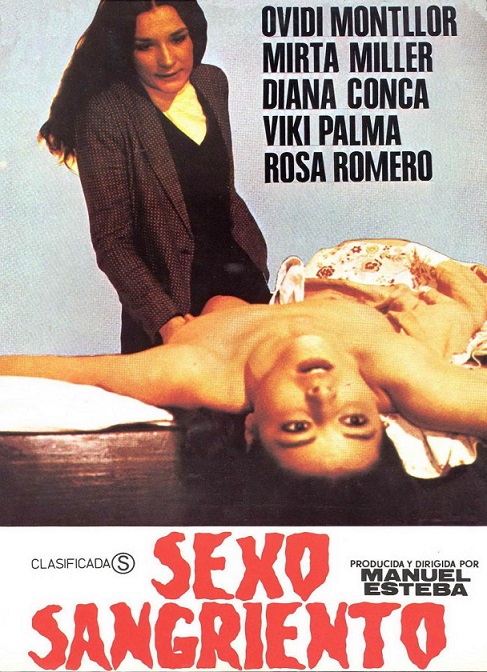
Directed by Manuel Esteba (El E.T.E. y el Oto), who wrote the story with Xavier Flores, Sexo Sangriento is about the home of María Domènech (Mirta Miller), a place where she lives with her strange son (Ovidi Montllor). Psychology student Norma (Rosa Romero) convinces her friends Laura (Diana Conca) and Andrea (Viki Palma) to go to that house, thinking that it has been empty since the end of the Second World War. They have the plan to do a seance there before breaking down — bad omen — and having María, a painter, offer to host them in her ancient manor — even worse omen — for the evening.
Shot mostly handheld, this feels a bit Italian gothic as well as giallo what with the ghost in the basement. Then again, it also has someone wandering around before death with a knife stuck in their stomach, strange bloody paintings and a tomb beneath it all. This has the reputation for being sleazy but it’s actually a decent movie. Maybe because it has a lead lesbian couple? Then again, one of the murders does get rather rough.
A lot of the music in Bloody Sex comes from the CAM Music Library, selecting some of the same songs that are in Piecesand Ring of Darkness. And you’ll recognize Goblin’s “L’alba dei morti vivirti” from Dawn of the Dead/Zombi, which Mattei reused for Virus – l’inferno dei morti viventi.
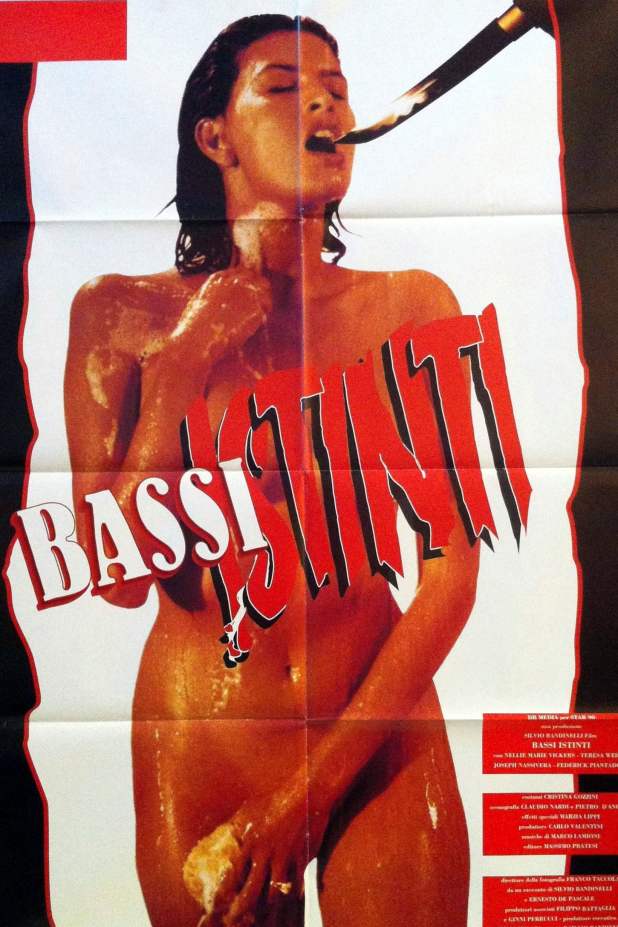
The Black Gloves is a 1992 giallo that goes past the tease and goes directly to hardcore. It’s directed by Frank Simon, who is really Silvio Bandinelli, who spent his career in adult. He also wrote the script with Ernesto de Pascale.
Also released as Private Detective and Masquerade, this is available in softcore and hardcore form. Linda Forrester (Raven, billed as Nellie Marie Vickers; she is also in the mainstream film Angel Eyes, directed by Gary Graver as well as adult classics like Taboo and Curse of the Cat Woman) and Guido Moranto (Joey Silvera, also an adult star) are working undercover to investigate art theft from collector Anesto, whose half-brother has already been murdered by a killer with black gloves.
Italian adult star Eva Orlowsky, who appears the Illona “Cicciolina” Staller’s directed and written movie Diva Futura – L’avventura dell’amore which is about a group of forward thinking women trying to get a cure for AIDS finished before the Vatican stops it, plays the art dealer’s wife Anna, who has her own affair happening with Roberto (Rocco Siffredi, maybe the most famous European male adult actor ever; he takes his name from Roch Siffredi, the character played by Alain Delon in Borsalino).
It also has Teri Weigel in the cast, who was one of the first Playboy Playmates to do Penthouse and adult, as well as someone who crossed over into the mainstream, appearing in Predator 2 and Marked for Death.
It’s pretty amazing that this is a shot on film adult giallo, even if the murders are pretty mild and it all looks like it was shot for TV.
EDITOR’S NOTE: Cinematic Void will be playing this film on January 29 at 7:00 PM PT at Los Feliz 3 in Los Angeles, CA. For more information, visit Cinematic Void.
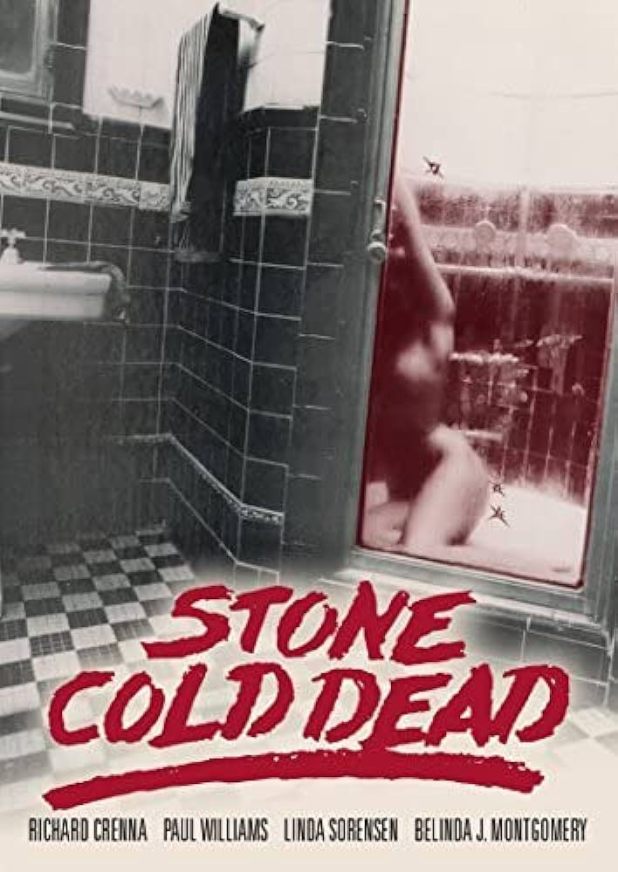
Directed and written by George Mendeluk (Doin’ Time, The Kidnapping of the President, Meatballs III: Summer Job), and based on The Sin Sniper by Hugh Garner, this has a killer with an interesting weapon: a camera with a long-range lens takes a photo of each victim seconds before the killer shoots them. The killer is sending these photos to the police to taunt them as he kills as many women as possible.
Sergeant Boyd (Richard Crenna) is Toronto’s meanest cop and he wants this killer dead or in jail. He’s trying to protect the sex workers of Yonge Street, who include both real girls of the night and actresses, like Linnea Quigley, who plays the first victim. Plus, Paul Williams plays the man who owns all these women, Julius Kurtz. There’s also the typical call girl with a good heart, Monica Page (Linda Sorensen) and a tough undercover female cop, Sandy McCauley (Belinda J. Montgomery). This is a Canadian movie, which is definitely proved to be true when Lesleh Donaldson has a small role. She was in almost every northern horror movie that mattered, including Funeral Home, Happy Birthday to Me, Curtainsand Deadly Eyes.
There are a lot of reviews online that don’t enjoy this movie. How can they feel that way with such a powerful ending and the chance to see the actual darkness of Toronto before it was all cleaned up? I mean, the former Psychedelic Avenue might not be the same any more, but Zanzibar survives. I wish I could have seen it back in the 60s when it had what owner David Cooper said was a “Twenty-first Century total environment with “stroboscopic” lights, mannequins and closed-circuit cameras that would take photos of the dance floor and project them on the wall.”
EDITOR’S NOTE: Cinematic Void will be playing this film on January 26 — with Cemetery Man — at 8 PM PT at The Frida Cinema in Santa Ana, CA (tickets here) and January 27 at 11:59 PM ET at the Coolidge Corner Theatre in Brookline, MA (tickets here). For more information, visit Cinematic Void.
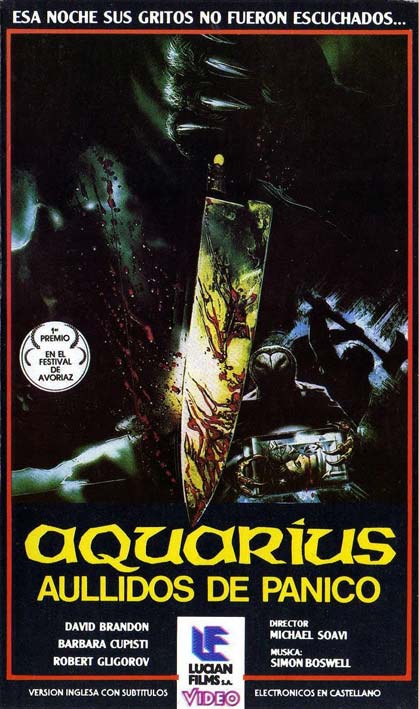
There was a moment two minutes into this movie, when a slasher-like scene turned into a Cats-like play, that my mind was blown. And there was a moment halfway through when a body was torn in two that I jumped off my couch, screaming, “Soavi, I love you!”
There’s no other way to say it — this movie is completely crazy. Is it because of Michael Soavi’s (The Sect, Cemetary Man) direction? Or the script from George Eastman (better known Nikos Karamanlis from Antropophagus and, well, kinda sorta Nikos in Absurd, a movie so brutal that it inspired a murderous black metal band)? Why ask questions? Why not just sit back and enjoy the mayhem?
The entire movie takes place in a theater, where actors and a crew are creating a musical about the Night Owl, a mass murderer. Alicia (Barbara Cupisti, The Church, Cemetary Man) sprains her ankle, so she and Betty sneak out to a mental hospital to get some help. While there, they see Irving Wallace, a former actor who went on a murder spree, which has continued in the insane asylum. He uses a syringe to kill an attendant and hides in Betty’s car.
Because Alicia left, the director fires her while Betty is killed with a pickaxe outside. Alicia finds the body and calls the police (one of them is Soavi, who spends an extended scene asking if he looks like James Dean), who lock them inside the theater and guard the premises. Because, you know, that’s the way the police handle these things.
The director is inspired — the play will now be about Irving Wallace and everyone must stay the night to rehearse, even the rehired Alicia. While rehearsing the first scene, Wallace dons the killer’s owl costume and strangles, then stabs one of the other actors in front of everyone.
Then, Wallace cuts the phone and starts killing one person at a time. It’s at this point that this movie goes off the rails and does some rails. A power drill going through someone? Yep. Hacking someone up with an axe? Yep. A woman cut in half that sprays blood all over an entire room full of people? It’s got that, too. A dude getting chainsawed until the saw runs out of gas and then getting decapitated? Oh yes.
Wallace takes all of the bodies and blares the theme from Sergei M. Eisenstein’s Battleship Potemkin while feathers fall. Alicia finds the key to escape and a gun while Wallace pets a black cat, his face covered by the owl mask.
Alicia has no idea how a gun works and can’t take the safety off. Wallace chases her, even stabbing him in the eye ala Halloween. The higher in the theater Alicia climbs, Wallace keeps following, in a POV shot that makes it feel like he’s climbing toward us. She cuts the cord he is climbing and he falls to his death. But this is a slasher — albeit one through the eyes of Soavi — and the killer comes back until he is set on fire.
The next day, Alicia goes back to the theater to find her watch. Willy, the janitor, tells her that they took eight bodies out, which makes her realize that Wallace is still alive. He shows up, unmasked, and tries to kill her all over again. After hearing Willy tell her how she didn’t even have to think to kill him and that the gun would do it all once the safety is off, she unloads a bullet “right in-between the eyes.”
Alicia wanders out of frame, toward a bright white doorway that we first saw just before Wallace attacked her. And in this scene, we can really see why Soavi stands ahead of the pack when it comes to horror. That doorway offers escape, not just from Wallace, but from the film itself, as her fictional character, her final girl, is removed from our minds. The killer lives long after the victims and survivors, so the camera pans down to reveal Wallace, blood pouring from behind his eyes, and he begins to laugh. Soavi said that he intended this to be a wink to the conventions of the slasher, where the killer never really dies.
This film was produced by Joe D’Amato, who had a scene from this movie play within his 9 1/2 Weeks rip-off Eleven Days, Eleven Nights. Also known as Aquarius and Deliria, it features an amazing soundtrack by Simon Boswell. And Soavi — in his first time as a director — shines with intricate camera work (it’s very Argento), complete with a wordless final twenty minutes of Alicia fighting against Wallace.
The end of this film approaches near surrealism within the horror narrative. This gets the highest review I can give. It’s a slasher that transcends the genre to become real art.
EDITOR’S NOTE: Cinematic Void will be playing this film on January 20 at 7:00 PM MT at Sie FilmCenter in Denver, CO. You can get tickets here. For more information, visit Cinematic Void.
Between the giallo elements of this movie and the Jess Franco-indebted The Duke of Burgundy, Peter Strickland seems like someone who has watched the same movies as me. I just sit around and watch a hundred gialli in a month while he actually makes movies like this, Flux Gourmet and In Fabric.
British sound engineer Gilderoy (Toby Jones) has come to work at Italy’s Berberian film studio to work on a movie about horses. He didn’t realize that it was a giallo, The Equestrian Vortex — ah, the waves of Argento-style animal-themed movie titles — and how deep he would get into it, making disgusting noises on a Foley stage for the film’s murder set pieces. Director Santini (Antonio Mancino) has made a film about an aroused goblin — Goblin? — beneath a girl’s riding school that sounds more Suspiria than Deep Red. Yet the real terror comes from the sounds created by Gilderoy and the two actresses he’s working with, Silvia (Fatma Mohamed) and Claudia (Eugenia Caruso).
Strickland was inspired by the fact that Bruno Maderna could work with John Cage and score Death Laid an Egg, which he saw as a juxtaposition between high art and violent trash.
The sound artist loses all touch with reality, as Santini won’t admit that he made a horror movie while he also assaults Silvia, who destroys the audio they’ve made, meaning that Elisa (Tonia Sotiropoulou) is hired and is more abused by sound as the story continues. Like Blow Out, he needs the perfect scream but how far will he go to get it? And is he losing touch with his mother and real life at home?
Speaking of Gilderoy’s mother, that’s Suzy Kendall, who to many Americans was the first giallo queen with her appearance in The Bird With the Crystal Plumage. This was her first movie in 35 years.
I loved this movie while others may find it obtuse. It’s similar to The Editor but instead of tributes to the greatest moments of the giallo, this looks for the horror within making art.
EDITOR’S NOTE: Cinematic Void will be playing this film on January 22 at the Los Feliz 3 in Los Angeles. For more information, visit Cinematic Void.
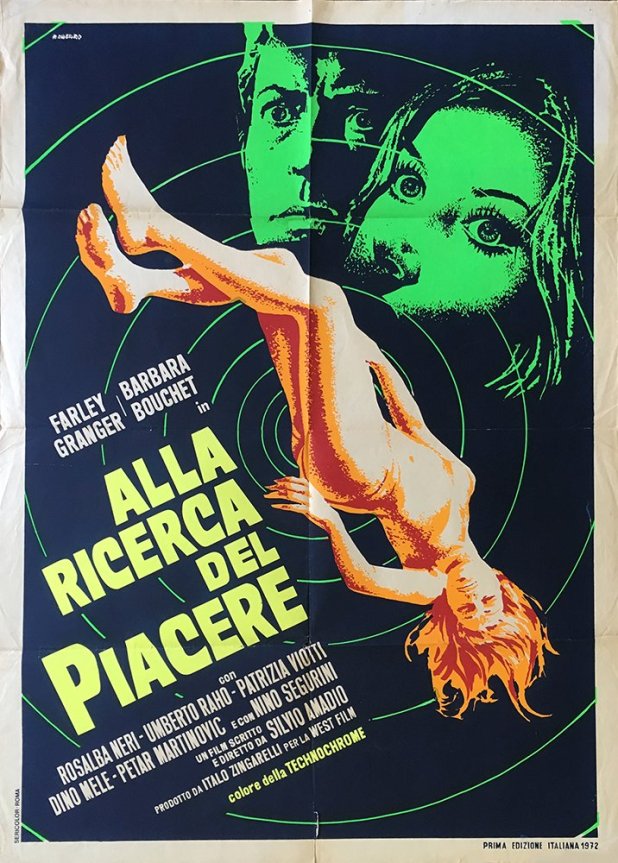
Amuck! is a great title, but this is a movie that has a ton of great other titles –Alla ricerca del piacere (In Pursuit of Pleasure), Maniac Mansion, Leather and Whips and Hot Bed of Sex were also used and the working titles were Replica de un delitto (Repetition of a Crime) and Il passo dell’assassino (Footsteps of the Killer). No matter what name you give it, this is one dark little film.
Along with his wife Eleanora (Rosalba Neri, Lady Frankenstein), the writer lives in comfort on his own island. Their past secretary, Sally, disappeared without a trace. However, Richard and Eleanora don’t know Greta’s reason for joining them — the missing girl was her lover, a fact we find out via a flashback lovemaking scene that is artful, if stilted, awkward and the way that men would assume women would couple (staring at one another and attempting to kiss, then going to sleep). Indeed, it feels like the fever addled wet dream of a maniac, which pretty much sums up what giallo can be at times.
The more Greta gets close, the more sex, drugs and violence is unearthed. The Stuarts often hold sex parties in their palatial home. Oh yeah — Eleanora has ESP, seeing Greta’s death, screaming about it while in a fit of prophecy.
Indeed, death begins to follow our heroine. The next day, a hunting trip turns into a brush with quicksand, that most evil of all movie doom.
Richard reveals that Eleanora fascinates him because of her duplicitous nature and he is falling in love with Greta because of how honest she is. He then reveals the accident that claimed Sally’s life in a flashback: Eleanora watches Rocco through her hunting scope before inviting him to a rendezvous with her and Sally. They both dance for him in a series of druggy jump cuts — perhaps the film’s most assured scene. After making love to Eleanora, the fisherman kisses Sally tenderly before losing control, which is shown by how the film speeds up, like the Keystone Kops. He ends up choking Sally to death while Eleanora watches, powerless to stop him.
Richard and Greta end up making love later that night during a storm. Eleanora watches through the doorway before looking directly at the camera, as if she is sad yet not surprised.
The very next evening, after Richard leaves town, Eleanora sets up the same threeway with Rocco (who she calls the perfect male, yet he seems like a leering idiot). Greta tries to leave, only to find the dead body of the butler in the hallway. Richard shows up, telling her that this has all been a game. They’ve found Sally’s body and now, they need to get rid of her. He tells her that it’s all over now and she must die, describing how Rocco will murder her in calm tones.
However, Rocco remembers an act of kindness that Greta had performed for him. Eleanora attacks him, slapping the shit out of him before he tosses her into a wall, killing her, and stabbing Richard.
Greta leaves, learning that Rocco is getting the help he needs. Yet the film ends on a weird note, as a policeman tells Greta that the woman in the lagoon wasn’t even Sally. FIN.
Director Silvio Amadio crafts a film that takes some time to get going and has flashes of mood, but may not rank amongst the best in giallo. That said, he has an attractive cast to work with, an interesting story and there’s a well shot sequence of a boatman taking a dead body down a river that aspires to art.
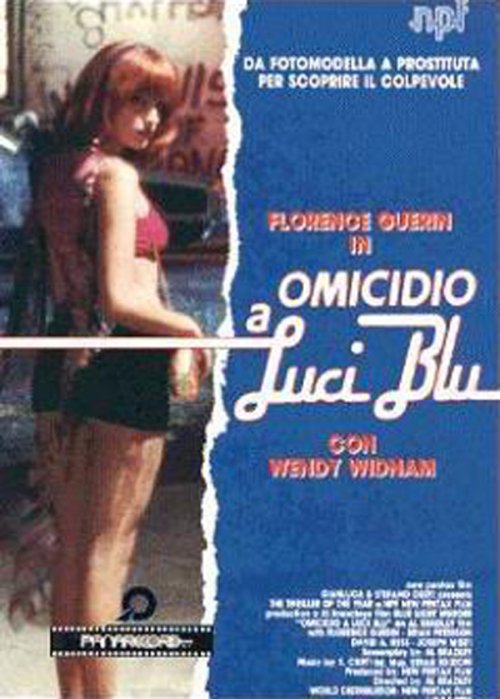
Starlet DuBois (Florence Guérin, who was about a decade late to be a giallo queen but made plenty of fun late in the game entries like Bizarre, Cattive Ragazze, Faceless, Too Beautiful To Die, Knife Under the Throat) transforms at night, kind of like Angel, to become Sherry, a prostitute in Times Square, all to hunt for her brother’s murderer. See, or some reason, her brother was playing Russian roulette with a hand grenade that went off and killed three men, injured six others and castrated one of them. Whoever that is, well, they’re slicing the members of men all over the Deuce. This worries a cop named Flanigan (David Hess as a good guy?) who wants her out of his turf.
If this all starts to feel like it’s referencing Body Double, well, that movie was a giallo, so Brescia is just getting back some interest for the Italians. DePalma’s film was called Omicidio a Luci Rosse in Italy, which means Red Light Killer. This is Blue Light Killer.
Brescia was also into music videos at this time in his career — just watch Iron Warrior — and this definitely has that, as well as primitive computer graphics and David Hess in a dress trying to pretend he’s Florence Guérin, who is one of the most gorgeous women in the history of, well, existence. And he’s David Hess.
EDITOR’S NOTE: Cinematic Void will be playing this film — my favorite giallo — on January 20 at the Egyptian Theatre in Los Angeles. It will play with Torso and Sergio Martino will be in person. For more information, visit Cinematic Void.
Sergio Martino’s directorial efforts have run the gamut — from straight exploitation (Mondo Sex and Mountain of the Cannibal God, which features Stacy Keach and Ursula Andress, as well as real animal mutilation which we’d never endorse) to horror (Island of the Fishmen, which in addition to starring Barbara Bach and Joseph Cotten, was re-edited by Jim Wynorski and re-entitled Screamers), post-apocalyptic action (2019: After the Fall of New York and Hands of Steel, which is more Terminator rip off than Road Warrior), spaghetti westerns, crime dramas, war films, comedies and even Italian TV, where he’s worked for the last several decades. But this week we’re here to discuss his contributions to the world of giallo.
This is his first effort and the start of the ensemble case in which he’d use in his films. George Hilton would appear in four of his films, Ivan Rassimov in three and one of the queens of the giallo, Edwige Fenech, would star in three (in fact, she was married to Sergio’s brother, the late producer Luciano Martino, at one time).
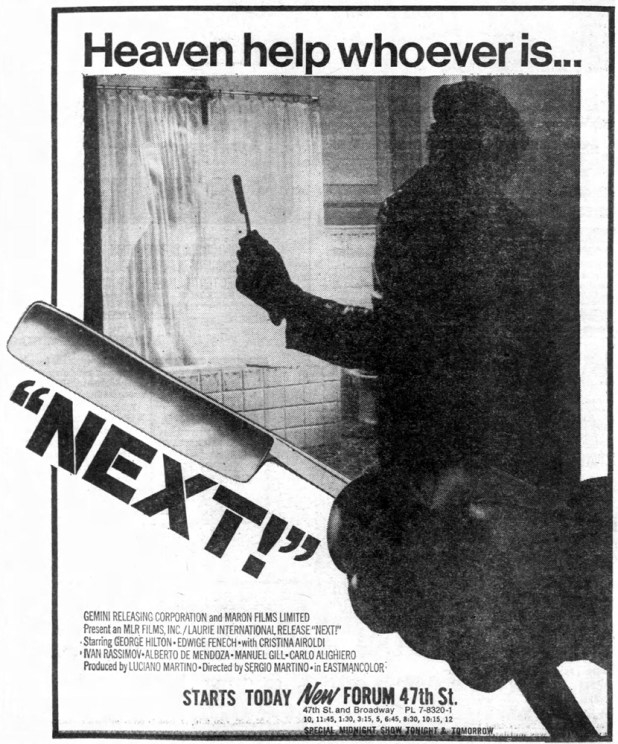
Wondering why this film isn’t just titled The Strange Vice of Mrs. Ward? Turns out a woman named Mrs. Ward sued before the release, claiming that the film would ruin her good reputation, so they changed the title. Yes, Italy, the country where you can make a movie called Zombi 2and have nothing to do with the original film still has legal settlements such as this. You can also find this movie under the titles Blade of the Ripper, Next! and The Next Victim.
Julie Wardh (Fenech) is the wealthy heir to a retailing company. But she’s also a fragile flower, back in Vienna, a city packed with memories and former lovers. She’s married to Neil (Alberto de Mendoza from Horror Express and A Lizard in a Woman’s Skin), a man so wealthy and powerful that he leaves for business the moment they land.
As Julie rides alone in the rain, her car is stopped by the police who are on the hunt for a killer. The sound of the wiper blades reminds her of the last time she was here, recalling a vicious fight between her and a lover who repeatedly slapped her around before they made love in the rain. There’s a gorgeous shot here at the end, where the lovers are to the left of the camera while rain descends on them, almost illuminating them and a sports card pushes into the right foreground. Compared to other giallo which seem content to merely ape Argento or seem like boring police procedurals, Martino aspires to art within his direction (which honestly is why this site is planning on a week of his films).
A green light and honking horns snap Julie from her reverie and she returns to her apartment, where she takes strange notice of a car. Her apartment has been left exactly as it was the last time she was here — it’s a white pop art explosion of metallic, green and blue lines contrasted with oval windows — and just as she’s getting ready to take a bath, the buzzer rings. A dozen roses with a note attached: The worst part of you is the best thing you have and will always be mine – Jean.
We cut to a party, where Caroll (Conchita Airoldi, who would go on to produce Cemetery Man) is trying to hook Julie up with her cousin George (George Hilton, All the Colors of the Dark, The Case of the Bloody Iris) as a catfight between two girls in paper dresses goes down. Tell you what — if I am to learn anything from giallo, it’s that every party in 1970’s Italy was packed with drugs, crazy music and the chance that anything from a fistfight to an orgy could happen at any minute. People had to be exhausted all the time. Jean (Ivan Rassimov from Planet of the Vampires, Your Vice is a Locked Door and Only I Have the Key, Eaten Alive!), the guy who sent the roses and was the man she remembered in the earlier flashback, is there extending a salute. This enrages Julie, who leaves the party, but he follows her into the street. He reminds her that she belongs to him, but she counters that she married Neil to escape him, which is cemented when Neil shows up and punches the dude. Jean just laughs, looking at both of them, knowing that he owns Julie body and soul.
This leads to a flashback where Jean pours champagne all over her, soaking her dress, then smashes the bottle of champagne, showering her in glass shards. He uses what’s left of the bottle to slice up her dress and skin before he takes her. Their coupling is a mix of pleasure and pain, covered in blood, that she had to escape. But did she want to?
So what then is Mrs. Wardh’s strange vice? Is it for men that are bad for her? Is it for pain and dominance? Or some combination of both? As we learn, she’s caught between three men — her husband, whose cool indifference and emotional (and physical) unavailability is just as cruel as her former lover Jean, who owns her to the point that she is nearly his again before Neil showed up to hit him. And the third side of this love rectangle (is there such a thing?) is George, who is the porridge to her Goldilocks — the just right combination of both. Yet there is a fifth side to this — making it a love pentagon (!?!) — with Julie wanting to be a good woman, true to her vows and not to her need to be beaten, bloodied and forced. She is torn between her desire and her need to fit into the moral code of the world. So much of giallo is based on this — created in a country where the Holy Seat of a religious empire sits smack dab in the middle of Rome. Religion and morality nearly shook hands with the sexual revolution and excesses of the pre-AIDS 1970s.
Ah, but let’s not forget that a proper giallo needs a murder, which this film delivers with a quick slash in the shower. That said — what strikes me about Martino is that unlike Argento, he cares more about the story and the characters than creating murder art set pieces. The conversation between Carol and Julie isn’t just words on a page, they’re vital clues into her mental state. Whereas Carol’s casual amorality is revealed, saying that the killer — who we just saw attack the showering girl — is taking out her competition, Julie worries about her values. She married Neil for security and protection, but not the monetary or physical kind. She wanted protection from herself, as she feels that her loss of control and willingness to submit to the violent impulses of men makes her a sinner.
George shows up to meet Julie and get to know her better. He even tells her that he loves to court women when their husbands are around, cuckolding them. Julie claims that that leaves her cold, while Carol claims that she’d bed him, family or not. They decide to go to lunch together, which seems to be more about George staring at Julie than sustenance. Julie demands that George take her to the bus station, but instead he takes her all over the countryside on his motorcycle (What is it with Fenech’s character and dudes that ride bikes? Is it the freedom that it represents?) while he wears white leather fringe, a look that is very 1971. He calls her the moment that she enters the house and she tells him that she likes him way too much, so she can never see him again. Of course, he’s already there and enters the front door before kissing her. She tries to get away, but he keeps telling her that he is in love with her. She begs him to not complicate her life, that she is not the girl he thinks she is. Their kiss is artfully compressed into a second kiss that occurs much later that same day — an intriguing way to show the passage of time and the growth of their relationship.
As they kiss in the dark, a car nearly hits them, which Julie is sure is Jean. She tells him to take her anywhere, which ends up being his apartment. The car returns and its driver watches from the window as Julie and George make love (or, more to the point, she knees him in the crotch while laying upon him, but whatever works for them, I guess).
Later, Julie gets more flowers from an anonymous admirer. Her husband asks who they are from and she wishes aloud that they came from him. There’s another note attached — “Your vice is a locked door and only I have the key.” She tells him that she realizes that diplomats only love other diplomats. He replies that she feels that he has always failed and wronged her. He asks if she is content. “I’m more than content,” comes her reply.
The black gloved killer is watching her and calls her to blackmail her, saying that he will tell her husband. She goes to talk to Carol and claims that it’s Jean. Carol responds that the killer’s last victim was “that whore at the party” and Jean couldn’t be the killer, as he doesn’t go after women like that. Carol embraces free love and says that if Julie is into George, then why should she have to hide it? Also: Carol just walks around her apartment naked (and also has a crazy cover up that is all black with red feathers) and Julie is just fine with it. Carol offers to go to where the blackmailer/killer wants her to drop off the money.
Julie nervously chainsmokes while watching a motorcycle race, a scene intercut with Carol going to meet the killer. To show the escalation of worry, Martino piles on the jump cuts and quick switches between the two women. Whereas Julie is trapped within her worry and the walls of her apartment, the carefree Carol is all alone within a huge park. Alone until the killer reveals himself, slashing her with a straight razor. Again — the killings are rather matter of fact in contrast to the set-ups in this film.
The police get involved, finally investigating Jean. They go to his apartment, which is covered with photos of naked women and exotic animals. Then, they interrogate him with her in attendance. It’s just an excuse for him to keep trying to seduce her and inform the police that Julie has a blood fetish, so she could be the killer, too. George has also been brought in for questioning, to which Jean says, “Now I know why my flowers have no effect on you.”
Neil arrives to take Julie home, but later George says that he wants to speak to her husband and take her away from the city. She says that she has to see this out, she has to discover who killed her best friend when it should have been her.
As Julie returns home, she finds herself in a dark parking garage. The headlines of a car cut into the inky blackness before she is nearly run over. She runs for the elevator, watching for the killer and the numbers of her floor to get closer. Yet the doors open to reveal the killer! Julie runs from him, even attempting to hit him with her car. She barely makes it inside the apartment, screaming at the door. Her husband lets her in but she’s in hysterics. There’s a lot of this scene that feels like it influenced Halloween 2‘s elevator scene. I’m not alone in feeling like that sequel is a giallo. Check out this awesome article from Bill at Groovy Doom to see what I mean.
Neil has had enough and decides to go to Jean’s house and confront him. He tells Julie that he will go alone, but she is afraid and rushes to be with him. They explore his dark house, finally finding Jean’s body in the tub. Julie is overcome and passes out in her husband’s arms. When they get outside, Jean’s car is gone and flowers have been left in the backseat with another poem. Neil throws the flowers down in disgust.
We cut to a dream sequence of George, a laughing Carol and Jean covered in blood, slapping her around. Her husband wakes her up and shows her the photo of the killer. She asks her husband to protect her, but he leaves. She calls and begs George to come get her. He promises to take her to Spain, a place that will make her forget the rest of the world (people continually promise this to Julie, such as Carol’s offer that a place will make her forget she’s on a diet or that an affair will make her forget her sadness).
Neil comes back home to learn that Julie has left. Meanwhile, the killer tries to attack another woman, who unmasks, disarms and stabs him. He makes one last attempt to kill her, but passes out from blood loss.
Meanwhile (!), George and Julie are spearfishing. The camera work here slows down, turning around our lovers (You can’t tell me that DePalma didn’t watch at least a few giallo, even though he claims to have only seen The Bird with the Crystal Plumage and has been dismissive of Argento’s work. Sure, all of his films and giallo betray the and of Hitchcock, but some of these films seem way too close). They discover that the killer has died, but George disappears and someone starts following Julie. She arrives back at their apartment to hear the sound of dripping water. We follow the sound to the bloody curtains of the tub as water and blood spill out. The camera begins to spin back and forth before she sees Jean’s dead body, screams and passes out. George arrives and tries to wake her up, but she’s catatonic. George finds the cause of Julie’s worry — rust had been dripping onto the floor, looking like blood.
Julie awakens and her mood gives way to madness. She’s sure someone is there and yet there is no one. As she realizes this, she attacks a wall and is chloroformed from behind by…Jean! George is rushing a doctor to see her, explaining her vice for blood that excites and repels her at the same time. But Jean is too busy dragging her to the kitchen, where he duct tapes the window shut. He opens a gas line and locks the door (using an ice cube?), leaving her to die. We hear her heart beating out as it’s cut with shots of the doctor and George rushing to her. She makes an attempt to stand but cannot. And it’s too late — Julie is dead.
Neil comes to see the police and blames George for what the police are classifying as a suicide. Jean waits in a secluded area for George, who greets him with a smile. He asks him for the money — turns out that they were in this together. Even after explaining that they both have an alibi, Jean asks again for the money. George shoots him and leaves a gun in his hand, making it look like a suicide.
Turns out that Neil and George were in on this too — Neil has paid off his debts and with Carol gone, George is the only heir to a fortune — much like Hitchcock’s Strangers on a Train. As they drive away laughing, Neil sees Julie on the side of the road and demands that Neil turn around. To their surprise, it is her — followed by the police. A chase leads them off the side of the road to their death. The doctor has saved her life and it seems like he’s fallen for her.
Wow. The Strange Vice of Mrs. Wardh was but the first of Martino’s giallo films, but it’s great. It kept me guessing until the end with none of the b roll travelogue footage and red herrings that plague so many other films in the genre. What a movie to spend the middle of the night into the morning with!
Here’s a drink recipe.
The Strange Cola of Mrs. Wardh (tweaked from this recipe)
1 1/2 oz. J&B Scotch
5 oz. cola
4 dashes Angostura Orange Bitters
An orange wedge
Put on your black leather gloves and use a switchblade to slice an orange wedge.
Fill a tall glass with ice and pour in the J&B and cola.
Add the bitters, then squeeze in the orange juice and use the rest of the wedge for a garnish.
EDITOR’S NOTE: Cinematic Void will be playing this on January 19 at 11:59 CT at The Belcourt Theatre in Nashville, TN (tickets here), January 20 at 7 PM PT at the Egyptian Theatre in Los Angeles with The Strange Vice of Mrs. Wardh and Sergio Martino in person and January 22 at 7 PM CT the Music Box Theatre in Chicago with Sergio Martino in person (tickets here). For more information, visit Cinematic Void.
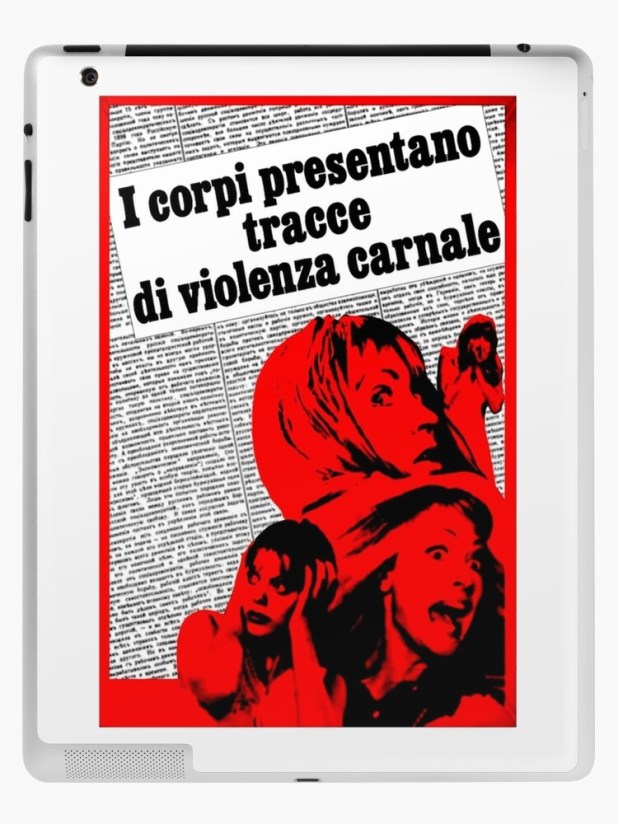
Torso is such a simple title. I’d rather call this film by its Italian name: I Corpi Presentano Tracce di Violenza Carnale, or The Bodies Bear Traces of Carnal Violence. Either way, it was directed by Sergio Martino and features none of the cast that he had come to use in his past films like George Hilton, Ivan Rassimov or Edwige Fenech.
It does, however, star Brtish actress Suzy Kendall, who played the lead role of Julia in Dario Argento’s seminal The Bird with the Crystal Plumage. She’s so associated with giallo that she appeared as the main character’s mother in 2012’s ode to the genre, Berberian Sound Studio.
This is a film that wastes no time being strange. Or salacious. A photographer is shooting a soft focus lovemaking session between three women amongst creepy, eyeless baby dolls. By the time we register what is happening, we’re now in a classroom, where swooping pans and zooms refer us to the main cast of the film as we overhear a lecture and later a discussion about Pietro Perugino’s painting of Saint Sebastian. Did he believe in God? Or was he just trying to sell sentimentality? Could an atheist find himself able to translate religion to those with faith?
We cut to a couple making out in a car as a figure stalks them through the eye of the camera, making us complicit in the act of the killer. Quick cuts reveal the white-masked face of this maniac. The man runs after him while the girl doesn’t even care that they had a voyeur watching. As she waits for him to return to the car, but grows impatient. The headlights of the car cast her shadow large across the columns of a bridge. And their light is quickly extinguished by black-gloved hands. The camerawork here is really striking, keeping us watching for the killer, as we’re no longer behind his eyes. His attack is swift and ruthless, juxtaposed against the images of fingers penetrating the eyes of a doll.
The art professor (John Richardson, Black Sunday, The Church) and Jane (Kendall) meet by chance at a church where she challenges him to change his views on Perugino. As she returns from their somewhat romantic afternoon, Jane spies her friend Carol arguing in the car with a man who she believes is married.
Meanwhile, ladies of the evening walk the street, ending up with Stefano, a student who has been stalking Julie. He has trouble performing and the prostitute he’s with tells him that all the men with hang-ups always come her way. That said — even if he’s queer, he better pay the money. He flips out and attacks her, but she makes her escape.
We’re then taken to a hippy party that looks like it’s taking place inside Edward Lionheart’s Theater of Blood. There’s weed, there are acoustic guitars, there are bongos, there are dudes with neckerchiefs, there are motorcycles. Truly, there’s something for everyone. But after leading on two men, Carol just walks out into the mud. They try and chase her, but she makes her escape into the foggy night. We hear her footsteps through the swamp as she walks, exhausted and covered in mud. What better time for our white-masked killer to return? We see glimpses of him through the fog and then he is gone. Whereas in past films Martino ignored the murder scenes instead of story, here the violence is extended, placing the killer and his actions in full view. After killing the girl, he rubs mud all over her body before stabbing her eyes — again intercut with the baby doll imagery. Her blood leaks into the mud as the score dies down.
This scene really feels like what the first two Friday the 13th movies were trying to achieve, but of course several years before they were made.
A police detective is in front of the art class, showing images not of art, but of the crime scene. A piece of cloth has been found under the fingernails of one of the murdered students, Flo. And that same scarf was found on Carol’s body. It’s their duty to report seeing anyone who wore this scarf to the police, who want to cooperate with the students who normally riot and throw rocks at them.
Two of the men in the class — Peter and George — were the last two people to be seen with Carol, the ones who she turned down at the party. Meanwhile, Stefano continues to stalk Jane. The music in this film is so forward-leaning — tones play when the killer shows or during moments of tension.
A man calls Daniela and tells her that if she ever tells where she saw the red and black scarf, she’s dead. Fearing for her life, she tells her uncle, who lends his country home to her and her friends so that they can get away from the city while the killer is at large.
Oh yeah — I forgot the pervy scarf salesman, who the police are leaning on. Right after talking to the police inspector, he calls someone and asks for money to buy his silence. Whoever it is, they bought the scarf from him and wouldn’t want anyone else to know. They’ll also get out of town and head to the country. Coincidence? I think not!
Stefano is all over Dani, telling her that he needs her. She wants nothing to do with him. When she stares at him, she remembers seeing him wear the red scarf. She escapes — slamming the door in his face. She tells Jane that she remembers seeing him wear the scarf — and never again — the day Flo died. The whole time, the creepy uncle is watching the two girls. Jane offers to speak to Stefano, then meet the girls at the vacation home.
The street vendor is flush with cash, creeping along in the dark. A car starts to follow him. We see the black-gloved hands again as the car hits its victim again and again, bright red gore pouring all over the screen.
Jane goes to speak to Stefano, finding only strange baby dolls and letters to Dani asking her to love him and remember the promise that she made as a little girl. Jane is surprised by Stefano’s grandmother, who tells her that he left town.
The other girls are asleep on the train as someone watches them. A strange man enters their train car and sits down.
The camerawork in this movie feels as predatory as the perverts and killers that exist within it. Speaking of pervs, when the girls arrive in the countryside, the local men pretty much lose their minds, particularly over Ursula (Carla Brait, the man wrestling dancer from The Case of the Bloody Iris). She and Katia make out as a peeping tom watches, only for the killer to show up and off the leering man. There’s an amazing scene of the killer dumping the pervert into a well, shot underwater and staring upward as the body falls toward the lens.
Man, every man in this movie is scum. They’re either frightened boys or perverts wanting one chance to knock up a woman or scarred from past sexual encounters. None of them are positive, as even the uncle who gives Dani the villa seems way too interested in her. Every man is a predator at worst and a leering pervert at best.
Jane hurts her ankle when she gets overly excited about breakfast. A doctor arrives — the mysterious man from the train — and he gives her a pill, which knocks her out.
The girls go sunbathing while Jane recovers. Dani thinks she sees Stefano — complete with the red scarf — watching them. They return home and drink champagne, which Jane uses to wash down her sleeping pills.
A few minutes later, the door rings. It’s Stefano — the girls all scream — but he’s dead — the girls scream again — and the killer is behind him, holding the red scarf — now scream even louder! Instead of showing us the murders, Martino switches form, cutting to a ringing bell and Stefano being buried.
Jane wakes up, asking where her breakfast is. She’s obviously slept late as a result of the pills. She walks around the apartment, looking for Dani, Ursula and Katia, only to find a mess. Tossed chairs, bottles of beer and every single one of her friends murdered. Suzy Kendall is amazing in this scene, caught between fear and nausea. Unlike so many wooden giallo performances, she’s actually believable.
She hides as the killer comes back, forced to stay quiet and watch as he saws her friends into pieces. Even the ordinary world routine of the milkman arriving cannot stop the butchering of her friends, with her trapped just feet away.
This final act is completely unexpected, as up until now, the film had played by the rules of the giallo, the large number of victims versus a large number of red herrings.
In fact, this film is so packed with red herrings, even the cast had no idea who the killer was. Martino wouldn’t tell them who it was, so each of the actresses had her own theory as to who the killer was. And in the original script, the killer survived.
Now, instead of that traditional giallo structure as I mentioned above, it is the last survivor — a near prototype for the final girl — against a killer. Throw in that Julie can’t move well due to her leg and Martino has set up quite the suspenseful coda.
Trapped in the house, Julie tries to signal with a mirror, using Morse code. But it totally misses the heroic doctor’s sight. He places a call, but it doesn’t seem like it’s to Julie. She looks out the window and sees the killer coming back.
It turns out that the killer was the professor, who saw a childhood friend die trying to reach for a doll. He compares the other kills to dolls, with only Julie as a flesh and blood person. Everyone else was a bitch or played games with him or blackmailed him. He hacked Ursula and Katia to pieces like dolls as a result. Dani saw him. Carol may have seen him. And he killed Stefano when he saw him in the village. Death, he says, is the best keeper of secrets and then he sees Julie as a doll and tries to hang her. She’s saved at the last second by the doctor.
They battle into a farmhouse, across the yard and to a similar rock where we saw the younger professor watch his friend die. We hear a screen and have no idea who has been killed — but luckily for Jane, the doctor survives. He discusses whether fate or providence had kept him in town, where he could save her. Perhaps it was written in the stars. Julie replies that Franz, the professor, would have been a realist and called it a necessity. Franz is dead and the dreamers live on.
The more times that I’ve watched this film, the more that I appreciate it and how it flips the genre conventions on their head and moves toward more of a slasher, with many of the giallo elements feeling tacked on somewhat to stay within the expected pieces of the form. A real clue that it’s really a slasher? The killings are more important than who the killer is.
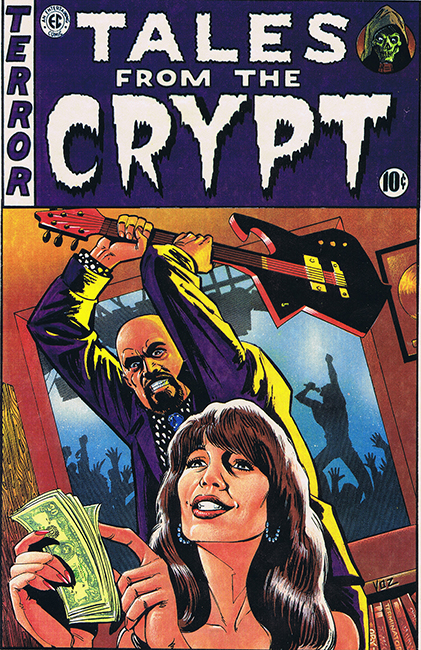
“I always wanted to play guitar but I could never quite master the fingering. So I won’t be a rock star. I’ll just have to settle for being a shock star.My groupies. Tonight’s little riff is rife with sex, death and rock and roll. Now, that’s entertainment! You’ll meet a putrefied promoter of pop with an ear for a hit. I don’t want to kill it for you. Let’s just say we come into the story just when his career is getting real hot!”
Directed by Jeffrey Price (the writer of Who Framed Roger Rabbit?; this was his only directorial job), who wrote this episode along with Peter S. Seaman (who wrote Wild Wild West, Shrek The Third and How the Grinch Stole Christmas with Price) and Steven Dodd, this is the tale of Marty Slash (Lee Arenberg), a promoter who runs off with all the money from a charity concert only to be blackmailed by a banker by the name of Ms. Kilbasser (Katey Segal) while fighting the voice in his head (Sam Kinison).
It also has Iggy Pop in it, which is fun. I wonder if Katey Segal wondered if she would be in any more projects with Sam after doing Married With Children with him just five months before filming this.
This is based on the story of the same name from Shock SuspenStories #15. It was written by Al Feldstein and William Gaines and drawn by Reed Crandall. That story has no rock promoter but everything else is similar.



 B&S About Movies
You must be logged in to post a comment.