The Stendhal Syndrome aka La sindrome di Stendhal (1996)

ABOUT THE AUTHOR: Sean Mitus grew up watching Chiller Theater & Pittsburgh UHF channels and has been a drive-in enthusiast for the last seven years. Sean enjoys all genres but has recently become interested in Italian Giallo and Poliziotteschi genres. 

“A young policewoman slowly goes insane while tracking down an elusive serial rapist/killer through Italy when she herself becomes a victim of the brutal man’s obsession.” – IMDB

After licking his wounds from back-to-back underperforming releases filmed in the US (Two Evil Eyes and Trauma), Dario Argento returned to Italy (and some say to peak form) with The Stendhal Syndrome, hereafter referred as Stendhal Syndrome. The film stars his daughter, Asia Argento, as Detective Anna Manni and then Euro-star Thomas Krestchmann as Alfredo Grossi.  Argento’s Stendhal Syndrome is a fascinating inversion of the usual giallo tropes.  

The film opens with a cold open of Anna Mani and we have no idea who she is.  We see here have a transcendent experience while touring the Uffizi Art Gallery in Florence, Italy.  The experience is a purported psychosomatic phenomenon known as the Stendhal Syndrome and is visually realized in early CGI with visual flair by Sergio Stivaletti.  Anna is helped by a stranger, Alfredo.  Anna develops amnesia and begins to recover small details.  As she investigates the latest rape and murder crime scene, Anna is attacked and raped by Alfredo who turns out to be a wanted serial rapist and killer. What follows is another visual set piece of the rape and murder of another victim.

Anna escapes and attempts to put her life back together.  As she does, Anna has sudden shifts in her personality, appearance, and behavior.  She has another Stendhal experience before being reinstated to limited duties as a Detective with mandated counseling sessions.  Anna becomes obsessed in finding Alfredo and his visage begins to dominate her every thought.  She returns a colleague’s romantic advances with a simulation of her sexual assault by Alfredo.

Anna returns to her hometown and family for a more supportive environment.  However, her distant relationship with her father doesn’t help any.   Anna tries painting as therapy without rrelief  It actually seems to drive her deeper into mental instability.  While this goes on, we see Alfredo target, rape and murder another victim in a harsh set piece.  As Anna contacts early victims who attest to Alfredo’s brutality and devastating impact, Alfredo calls Anna from within her apartment and kidnaps her once again.  

Alfredo brings Anna to his lair and in the harshest set piece brutally assaults and rapes Anna.  He keeps her captive, and Anna has another Stendhal fugue of sexual torment.  Alfredo returns for another assault, when Anna manages to turn the tables on him.  She fights viscously and recovers her gun. In Alfredo’s attempt to exert psychological dominance, Anna manages to shoot Alfredo and disables him in a cathartic beating.  She taunts Alfredo before dumping him helpless into a waterfall and raging waters below.   

The final third of the film finds Anna unable to shake Alfredo’s psychological scars, even as she flips back to a feminine persona and appearance.  The investigation into Alfredo’s background reveals a distorted obsession with Anna.  She claims to be recovered from her visions and their effects.  She meets a French art student and the budding romance seems to put her on the path to recovery.  Suddenly, Anna is getting phone calls from Alfredo, and Anna’s new lover is mysteriously murdered.  Anna is notified that Alfredo’s body has been recovered and she seeks clarity from her psychologist who instead challenges her distorted point-of-view on Alfredo’s influence over her.

In the film’s climax, Anna’s colleague Marco rushes to see Anna as we see Anna fully transform to her feminine, protective self.  We see the body of her psychologist who was brutally murdered by Anna. We along with Marco see Anna finally revealed as the murderer of her psychologist and lover. Anna has finally succumbed to Alfredo’s madness in full. She lures Marco to her car and kills him. Anna attempts to flee, but we know she never will be free of Alfredo as the film ends.

As I mentioned, the Stendhal Syndrome is dominated by the theme of inversions: 

  • The story upends the usual giallo tropes with the killer being known early in the film.
  • The killer, Alfredo, is dispatched at the midpoint of the film.
  • Anna becomes predator a la rape revenge movies (Call Her One Eye; Repulsion; I Spit on Your Grave).
  • Anna becomes more aggressive both sexually and personality, dresses more masculine, and later seeks out and repeats her degradation on Alfredo
  • Anna later flips back to her feminine side to but continues to lose control of her sanity and ultimately descends into madness a la Repulsion

The Stendhal Syndrome is a strong entry in the giallo pantheon.  Argento’s aggressively misogynistic treatment of how women are assaulted and murdered, rivaling Fulci’s The New York Ripper) and Asia Argento’s relatively young age in the role (just 21 during release) may put off some.  I argue that by this time Argento had included more slasher-style set pieces as with Tenebrae, Trauma and Opera so this shouldn’t come as a surprise and that  Asia Argento’s performance does not limit her character development.  

Further strengthening the viewer’s experience is Thomas Krestchmann’s sublime performance as the sociopath Alfredo, the moody cinematography by Giuseppe Rotunno, and Ennio Morricone’s usual nuanced score.  I recommend The Stendhal Syndrome for giallo and Argento fans who have seen his earlier works. Seek out Blue Underground’s 3-Disc Limited Edition for a full treatment of this deserved gem!

References

  • The Art of Madness: Inside ‘The Stendhal Syndrome” – Michael Gingold; Blue Underground 3-Disc Limited Edition © 2017
  • Film Commentary – Troy Howarth; ; Blue Underground 3-Disc Limited Edition © 2017
  • So Deadly, So Perverse, Vol. 2 – Troy Howarth; Midnight Marquee Press, Inc; © 2015
  • https://www.imdb.com/title/tt0117658/reference
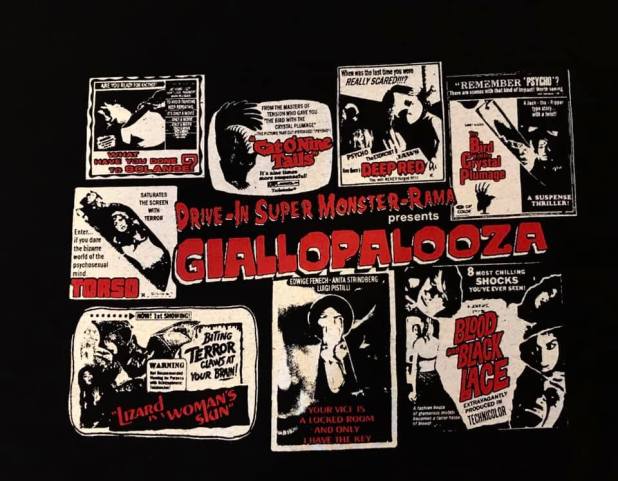
GIALLOPALOOZA PRIMER!

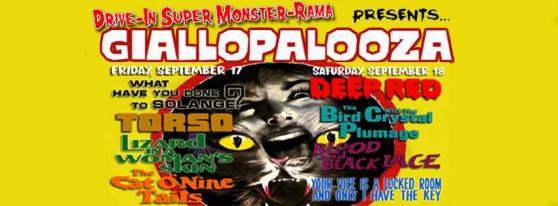
Get ready! Starting tomorrow, the Drive-In Super Monster-Rama is presenting “Giallopalooza”, two big nights of classic, fully restored giallo thrillers from such maestros as Dario Argento, Mario Bava, Lucio Fulci and Sergio Martino!

On Friday, September 17, the line-up will be What Have You Done to Solange?, Torso, A Lizard In a Woman’s Skin and The Cat O’Nine Tails. Saturday, September 18 they will present Deep Red, The Bird with the Crystal Plumage, Blood and Black Lace and Your Vice Is a Locked Room and Only I Have the Key.

Admission is $10 per person each night (children 12 and under FREE with adult guardian). Camping on the premises is available each night for an additional $10 a person, and that includes breakfast.

Advance tickets are available online at the Riverside Drive In’s webpage.

Here are the eight movies. To read a deeper review, just click on the link.

What Have You Done to Solange?: When a philandering teacher romances a student on a boat, they are witness to a murder on shore, the first of many that may be caused by the actions of the teacher.

Massimo Dallamano started his Schoolgirls in Perili trilogy, which includes What Have They Done to Your Daughters? and Rings of Fear, with this mixture of the German krimi film and the Italian giallo. He’s aided an abetted by an Ennio Morricone score and cinematography by Aristide Massaccesi, which is the real name of the man with so many of them, Joe D’Amato.

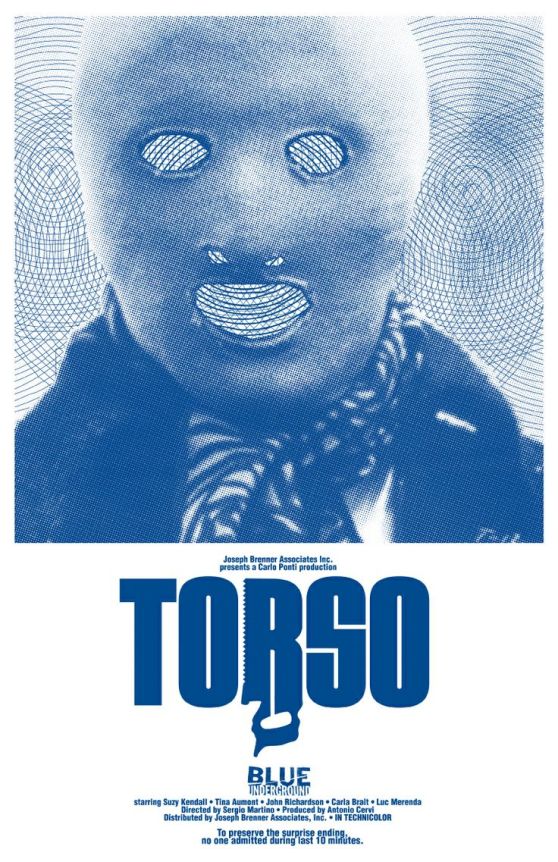
Torso: A serial killer is using a red and black scarf to murder several gorgeous college women. Is even an escape to a resort far away far enough?

Sergio Martino is one of the absolute master directors of giallo and while this film flirts with the slasher by the end, it still has many of the trademarks of the genre. It also has an astounding sequence where the masked killer appears in the morning mist that gets me every time.

A Lizard In a Woman’s Skin: The daughter of a British politician witnesses a death in one of her dreams and when she wakes up, she’s the suspect in this journey through madness.

If you only think of Lucio Fulci as a gore director — well, there’s goes in the too — this is one movie you need to discover.

The Cat O’Nine Tails: A newspaper reporter and a puzzle-obsessed blind journalist — and his niece — attempt to solve murders connected to a pharmaceutical company’s experimental, top-secret research project.

Dario Argento’s second film in the Animal Trilogy was written by Argento with Dardano Sacchetti and Luigi Cozzi. It’s also notable because it has two leads familiar to American audiences, James Franciscus and Karl Malden.

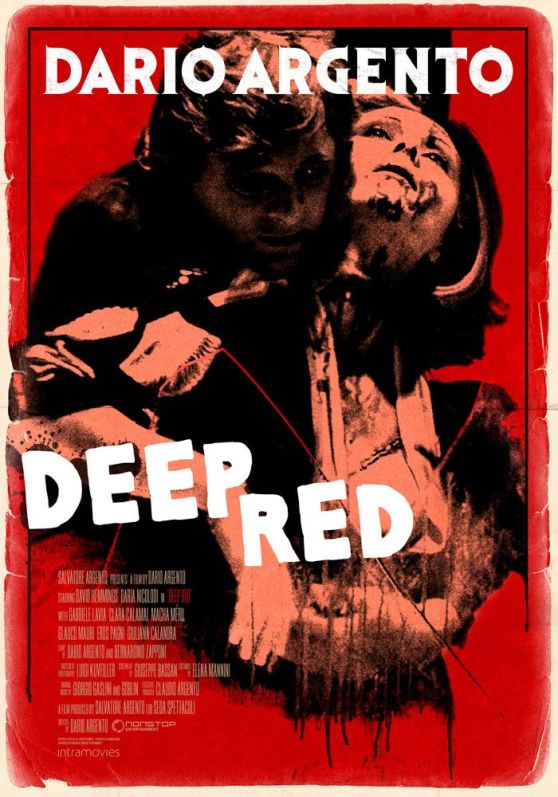
Deep Red: The murder of a psychic leads a pianist and a journalist on their own investigation into just who could be committing a series of horrific crimes.

Argento’s first team-up with both Daria Nicolodi and Goblin. Plus, this movie has perhaps the most frightening appearance of a doll ever.

The Bird with the Crystal Plumage: An American in Paris witnesses an attempted murder and tries to solve the mystery. But does he remember everything?

Dario Argento’s 1970 film was a hit worldwide, signalling a rush for nearly any Italian exploitation director to make films with animal titles, black gloves, POV killers, jazzy soundtracks and no small number of murders.

Blood and Black Lace: A fashion house of ill-repute is where models engage in sin and pay the price in a movie that is quite literally a pornography of violence (and style).

This is my favorite giallo of all time and you have no idea just how excited I am to see it play out on the big drive-in screen, the places where movies are most meant to be viewed.

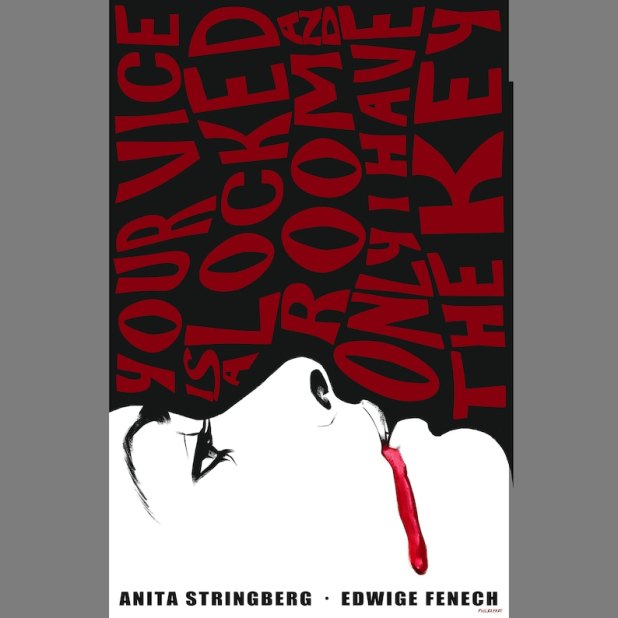
Your Vice Is a Locked Room and Only I Have the Key: I remember in the time before I watched this movie where I’d just stare at the poster and the title and wonder, how is this even a real thing? And it is, a glorious Sergio Martino-directed opus.

Also released as Gently Before She Dies, Eye of the Black Cat and Excite Me!, Martino’s fourth giallo is a direct reference to the note the killer leaves for Edwige Fenech in his first take on the form, The Strange Vice of Mrs. Wardh.

Remember — the event is this Friday and Saturday with admission just $10 per person each night (children 12 and under FREE with adult guardian). Camping on the premises is available each night for an additional $10 a person, and that includes breakfast. Advance tickets are available online at the Riverside Drive In’s webpage. I hope to see you there — stop by and ask for a drink of J&B or one of the many cocktails I’ll be making up for the evening.

Night one cocktails:

Che cosa hai fatto al gatto nero? AKA Drinks of The Black Cat (adapted from this recipe)

  • 1 oz. blue curacao
  • 1 oz. vodka
  • 3 oz. lemon-lime soda
  • 1 oz. cranberry juice
  • .5 oz. lime juice
  1. Fill a shaker halfway with ice, then add curacao, vodka and lime juice. Shake.
  2. Add soda and stir.
  3. Pour cranberry juice into a tall glass. Over the back of a spoon, strain the mixed ingredients over the cranberry juice and see how gorgeous it looks, like Barbara Bouchet showing up in motorcycle gear in Perversion Story.

Una mela che porta le tracce della violenza AKA The Apple Murders (from the J&B site)

  • 1 5 oz. J&B
  • 4 oz. sparkling apple juice
  • Apple, cored and sliced
  1. Put on black gloves and play with a switchblade, noticing how it catches the light.
  2. Core and slice apple, then place in glass with ice.
  3. Pour apple juice and J&B over top. Enjoy!

Night two cocktails:

6 drink per l’assassino AKA Blood and Penny Black Lace (adapted from this recipe)

  • 1.5 oz. J&B
  • .5 oz. pink grapefruit juice
  • .5 oz. honey syrup
  • Dash of lemon juice
  • Dash of bitters
  • A cherry
  1. Shake all ingredients with ice in a shaker until cold.
  2. Told with a cherry, then watch out for spiked gloves to the face.

L’uccello dal piumaggio giallo AKA The Bird Who Dreamed of Another Cage (adapted and changed from this recipe)

  • 1.5 oz. rum
  • .75 oz. Campari
  • .5 oz. lime juice
  • .5 oz. maple syrup
  • 1.5 oz. pineapple juice
  1. Watch a murder happen with no context, then get dragged into the investigation.
  2. When that’s done, pour everything into a shaker with ice, shake it up and pour into a glass. Enjoy!

The artwork for this article comes from Bill Van Ryn and it’s awesome.

GIALLOPALOOZA PRIMER: Your Vice Is a Locked Room and Only I Have the Key (1972)

EDITOR’S NOTE: There’s never been a better titled movie ever. Sergio Martino again proves why he was the absolute master of the genre with this film. We originally shared this movie on November 7, 2017 and can’t wait to see this at the Drive-In Super Monster-Rama Giallopalooza on September 17 and 18. The artwork for this article comes from PhilRayArt. Buy something from them!

Has a movie ever had a better title? Nope. Sergio Martino’s fourth entry into the giallo genre, following The Strange Vice of Mrs. Wardh, The Case of the Scorpion’s Tail and the previously reviewed All the Colors of the Dark, it refers to the note that the killer leaves to Edwige Fenech’s character in Mrs. Wardh. And the title is way better than the alternate ones this film has — Gently Before She Dies, Eye of the Black Cat and Excite Me!

Martino wastes no time at all getting into the crazy in this one — Oliviero Rouvigny (Luigi Pistilli from A Bay of Blood, Iguana with the Tongue of Fire, Death Rides a Horse) is a dark, sinister man, a failed writer and alcoholic who lives in a mansion that’s falling apart (If this all feels like a modernized version of a Poe story like The Fall of the House of Usher, it’s no accident. There’s even an acknowledgment that the film is inspired by The Black Cat in the opening credits.). His wife, Irina (Anita Strindberg from A Lizard in a Woman’s Skin and Who Saw Her Die?), suffers his abuses, but never more so than when he gathers hippies together for confrontational parties. He makes everyone pour all of their wine into a bowl and forces her to drink it, then humiliates their black servant Brenda until one of the partygoers starts singing and everyone joins in, then gets naked. This scene is beyond strange and must be experienced. Luckily, I found the link for you, but trust me — it’s NSFW.

The only person that Oliviero seems to love is Satan, the cat that belonged to his dead mother. A black cat that talks throughout every scene he’s in, his constant meows led to my cats communicating with the TV. God only knows what a 1970’s giallo cat said, but it seems like his words spoke directly to their hearts.

One of Oliviero’s mistresses is found dead near the house, but he hides her body. The police suspect him, as does his wife. Adding to the tension is the fact that Irina hates Satan, who only seems to care about messing with her beloved birds.

Remember that servant? Well, she’s dead now, but not before she walks around half-naked in Oliviero’s mother’s dress while he watches from the other room. She barely makes it to Irina’s room before she collapses, covered in blood. Blood that Satan the cat has no problem walking through! He refuses to call the police, as he doesn’t want any more suspicion. He asks his wife to help him get rid of the body.

Oliviero’s niece Floriana (Edwige Fenech, pretty much the queen of the giallo) is in town for a visit, learning how Oliviero hasn’t been able to write one sentence over and over again for three years, stuck in writer’s block (and predating The Shining by 5 years in book form and 8 years away from Kubrick’s film). Unlike everyone else who tolerates Oliviero’s behavior or ignores it, Floriana sees right through the bullshit. The writer is used to seducing every woman he meets and she initially rebuffs him, even asking if it’s true that Oliviero used to sleep with his mother. He angrily asks if it’s true that she’s a two-bit whore. “Those would be two bits worth spending,” is her caustic reply.

Irina confides all of her pain to Floriana as the two become lovers. And another girl gets murdered — perhaps by Oliviero. Then, a dirt bike racer comes to drop off milk and hit on Floriana. Whew — I was wondering when this film would get hard to follow and start piling on the red herrings!

After being questioned by the police, Oliviero comes home to choke his wife. He stops at the last second…then we’re off to the races! The motorbike races! The milkman loses when his bike breaks down, but he’s the real winner — taking Floriana back to the abandoned house that he lives in. And oh look — there’s creepy Oliviero watching the action.

Meanwhile, Satan has gotten into the coop and chowed down on several of the birds. Irina catches him and they have quite the battle. He scratches her numerous times before she stabs him in the eye with a pair of scissors. An old woman watches and is chased away by Irina’s yelling.

She’s afraid that her husband will kill her once he learns that she killed Satan. And Oliviero keeps wondering where the cat is, especially after he buys the cat his favorite meal from the store — sheep eyes. That said — Satan might not be so dead, as we can hear his screaming and see him with a missing eye.

Floriana puts on Oliviero’s mother’s dress, asking if this is what the maid looked like before she died. Whether it’s the dress or the forbidden family love or just her beauty, he rips off her dress — at her urging, mind you — and begins making love to his niece. We cut to Idrina, caressing her pet birds, when Oliviero confronts her with scissors and questions about Satan. He almost stabs her before he ends up raping her inside the coop, while Floriana looks on. She playing them off the other, even telling Idrina that she’s slept with her husband. She also tells her that Oliviero wants to kill her, so she should kill him first.

Idrina wakes up to the sound of Satan, but can’t find him anywhere. What she does find is her husband in bed with Floriana, who is belittling him. With every sinister meow, there’s a zoom of the cat’s damaged eye. Finally, Oliviero attacks her for spying on him, slapping her around before he leaves to write. She walks the grounds of the mansion, seeing the motorcycle rider make a date with Floriana and catching sight of Satan, who runs from her. In the basement, she finds scissors and the hidden bodies of her husband’s lover and the murdered maid. In a moment of clarity — or madness — she stabs her husband while he sleeps. The sequence is breathtaking — a giallo POV shot of the murder weapon intercut with the same sentence being typed over and over interspersed with all of the abuses that Oliviero had wrought upon her. She stabs again and again before Floriana interrupts, asking her if it was easy. The sentence that the author had written again and again was him claiming that he would kill her and there was a space in the wall for her, so obviously, she had to kill him.

As for Floriana, all she wanted was the family jewels, which were hidden in the house. They seal Oliviero’s corpse within the wall while Walter watches from afar. He’s played by Ivan Rassimov, who does creeping staring dudes better than anyone else — witness his work in All the Colors of the Dark. And it turns out that he’s the real killer! He’s been typing “vendetta” over and over again. Floriana asks if Idrina was planning to kill her before she runs off into the night, then Walter appears to kiss Idrina. Turns out they were working together all along — she tells him where to find Floriana the next morning. Holy shit — Idrina reveals her whole plot, revealing how she drove her husband crazy, making him believe that he could have been a murderer! She wishes that there was an afterlife so Oliviero’s mother — who she killed! — could tell him how great her revenge was. She ends by wishing that her husband was still alive so that he could suffer for eternity.

Walter sets up an accident that takes out Floriana and her boyfriend, as their motorcycle crashes, sending blood across the white heart of a billboard and out of her lips. He tosses a match on the gasoline-soaked highway, burning both of their corpses. He collects the jewelry and gives it to Idrina, who responds by shoving him off a cliff!

When she returns to the mansion, the police are there, as there were alerted to her stabbing Satan by the old woman. They come inside the house to write a statement, but hear the sound of Satan’s meows. Following the sound, they find him inside a wall — with the corpse of her husband!

Your Vice is a Locked Room and Only I Have the Key is superb. An intriguing story — only a few derailing giallo moments (like the killing of the girl in the room with the dolls and the B roll motocross scenes) — with great acting, eye-catching camerawork and some genuine surprises, it’s well worth seeking out and savoring.

Drive-In Super Monster-Rama is presenting “Giallopalooza”, two big nights of classic, fully restored giallo thrillers from such maestros as Dario Argento, Mario Bava, Lucio Fulci and Sergio Martino!

On Friday, September 17, the line-up will be What Have You Done to Solange?, Torso, A Lizard In a Woman’s Skin and The Cat O’Nine Tails. Saturday, September 18 they will present Deep Red, The Bird with the Crystal Plumage, Blood and Black Lace and Your Vice Is a Locked Room and Only I Have the Key.

Admission is $10 per person each night (children 12 and under FREE with adult guardian). Camping on the premises is available each night for an additional $10 a person, and that includes breakfast.

Advance tickets are available online at the Riverside Drive In’s webpage.

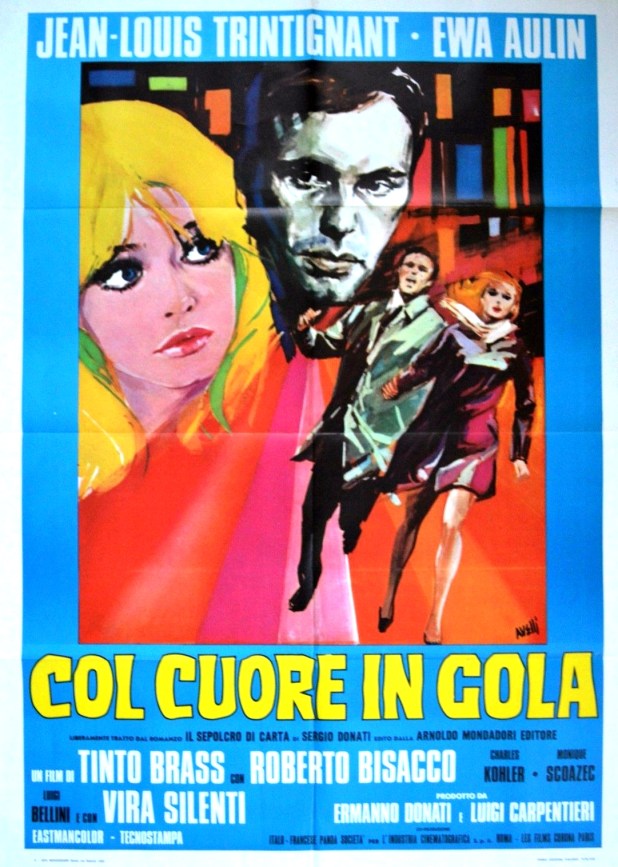
Col cuore in gola (1967)

The original title of this movie translates as With Heart in Mouth, but it was also released under several alternative titles, including I Am What I AmDeadly SweetEn cinquième vitesse (In Fifth Gear), Dead stop – Le coeur aux lèvres (Dead Stop – The Heart to the Lips), Con el corazón en la garganta (With My Heart in My Throat), Heart Beat and Ich bin wie ich bin – Das Mädchen aus der Carnaby Street (I Am What I Am – The Girl from Carnaby Street.

Bernard (Jean-Louis Trintignant) discovers Janes (Ewa Aulin, Candy) standing over a dead body in a London nightclub and instantly believes that she has to be innocent. Her father has recently been killed in a car accident, but Jane thinks that he was killed because of a blackmail scam gone wrong. And that body? The blackmailer.

He protects her from a series of shadowy men — including a dwarf — and the police that are following them both as they go deeper and deeper into the darkness that is her life. So does the control that he thinks he has over her life, but Jane is the kind of hurricane that has seemingly destroyed many a man before.

Man, this movie is something else. Tinto Brass directed it and it looks part comic book, part documentary, shot with hidden camera and wild zooms. It’s as 1967 as it gets and I mean that in the best of ways, with loud fuzzed-out music, pop art sensibility, switches from black and white to color and moments where Aulin’s beauty threatens to shatter whatever reality exists on film. Guido Crepax, whose comic Valentina was the basis of Baba Yaga, drew the storyboards and his art appears throughout the movie.

Brass’ only giallo, this feels more Antonioni than Bava. And yeah, it may go on a bit too long, but when it’s on, it’s on.

Now, to be up front, Aulin was all of sixteen when she made this and she has some semi-nude scenes. If that offends you, you can choose not to watch this.

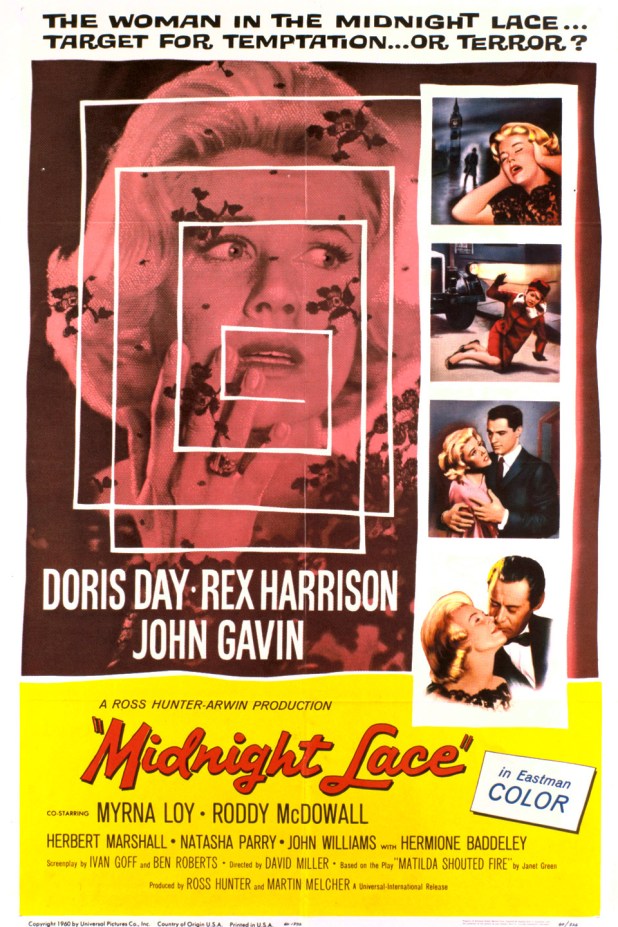
Midnight Lace (1960)

HOLLYWOOD GIALLO (+ ITS OTHERS), the awesome IMDB list by Schwenkstar, described this nascent giallo as “Stalker disguises his voice in a creepy manner to hide his identity, a multitude of red herrings keep you guessing, and a shock reveal.”

What it did not tell me was that Midnight Lace starts Doris Day — of all people — as American heiress Kit Preston, a young girl who is one day threatened by an unseen voice inside the fog that threatens to kill her, keeps gaslighting her and makes her think that she’s going insane.

Day vowed to never make another thriller after this movie, as she said it so emotionally drained her. She stayed true to her word. Perhaps the reason why she was so mentally destroyed by this picture was that in order to be properly inspired to be afraid, she called upon a memory of her first husband dragging her out of bed and throwing her into a wall.

Midnight Lace is pretty much like a cover version of a Hitchcock thriller. Beyond having so many of his stars — Day was in The Man Who Knew Too Much, John Williams was a cop in Dial M for Murder* and To Catch a Thief, as well as John Gavin being in Psycho, this feels like, well, Dial M as a telephone is how the killer goes after our heroine who has a husband named Tony.

That said, the ending, which finds Day trying to escape through the scaffolding of her house after the reveal of who the villain really is — well, that’s the whole reason to watch this.

*Anthony Dawson and Herbert Marshall were also Dial M and this movie.

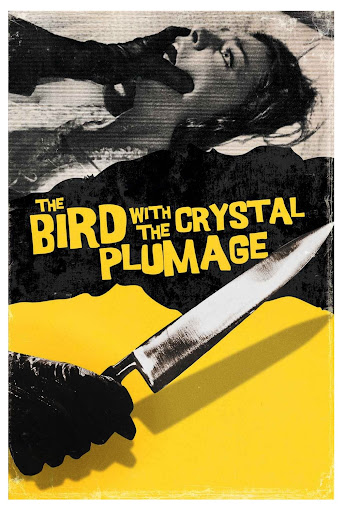
GIALLOPALOOZA PRIMER: The Bird with the Crystal Plumage (1970)

EDITOR’S NOTE: We originally covered this giallo cornerstone back on March 26, 2019 and then expanded on it when Arrow Video has released a UHD edition of this film. This is playing on the second night of the Drive-In Super Monster-Rama Giallopalooza on September 17 and 18. You really can’t get into giallo without seeing this film, so I’m excited to share these thoughts with any first-timers who will be checking out L’uccello dalle piume di cristallo at the Riverside!

Other than the films of Mario Bava (Blood and Black LaceThe Girl Who Knew Too Much), there’s no other film that has no influenced the giallo. In fact, the most well-known version of the form starts right here with Dario Argento’s 1970 directorial debut. Until this movie, he’d been a journalist and had helped write Leone’s Once Upon a Time in the West.

Sam Dalmas (Tony Musante) is an American writer suffering from an inability to write. He’s gone to Rome to recover, along with his British model girlfriend (yes, everyone in giallo can score a gorgeous girl like Suzy Kendall). Just as he decides to return home, he witnesses a black-gloved man attacking a girl inside an art gallery. Desperate to save her, he can only watch, helpless and trapped between two mechanical doors as she wordlessly begs for help.

The woman is Monica Ranier and she’s gallery owner’s wife. She survives the attack, but the police think Sam may have had something to do with the crime, so they keep his passport so he can’t leave the country. What they’re not letting on is that a serial killer has been wiping out young women for weeks and that Sam is the only witness. That said — he’s haunted by what he’s survived and his memory isn’t working well, meaning that he’s missing a vital clue that could solve the crime.

As you can see, the foreign stranger who must become a detective, the missing pieces of memory, the black-clad killer — it’s everything that every post-1970 giallo would pay tribute to (perhaps rip off is the better term).

Another Argento trope shows up here for the first time. It’s the idea that art itself can cause violence. In this film, it’s a painting that shows a raincoat-clad man murdering a woman.

Soon, Sam is getting menacing calls from the killer and Julia is attacked by the black-clad maniac. The police isolate a sound in the background of the killer’s conversations, the call of a rare Siberian “bird with the crystal plumage.” There’s only one in Rome, which gets the police closer to the identity of who is wearing those black gloves (in truth, it’s Argento’s hands). It’s worth noting that the species of bird the film refers to as “Hornitus Nevalis” doesn’t really exist. The bird in the film is actually a Grey Crowned Crane.

Alberto, Monica’s art gallery husband, tries to kill her, finally revealing that he has been behind the attacks. Ah — but this is a giallo. Mistaken identity is the main trick of its trade. And even though this film was made nearly fifty years ago, I’d rather you get the opportunity to learn for yourself who the killer really is.

I may have mentioned before that my parents saw this movie before I was born and hated it to a degree that any time a movie didn’t make any sense, they would always bring up “that weird movie with the bird that makes the noises.” Who knew I would grow up to love Argento so much? It’s one of those cruel ironies that would show up in his movies. I really wonder if my obsession with giallo and movies that are difficult to understand is really me just rebelling.

An uncredited adaptation of Fredric Brown’s novel The Screaming Mimi, this film was thought of as career suicide by actress Eva Renzi. And the producer of the film wanted to remove Argento as the director. However, when Argento’s father Salvatore Argento went to speak to the man, he noticed that the executive’s secretary was all shaken up. He asked her what was wrong and she mentioned that she was still terrified from watching the film. Salvatore asked her to tell her boss why she was so upset and that’s what convinced the man to keep Dario on board.

The results of all this toil and worry? A movie that played for three and a half years in one Milan theater and led to copycats (and lizards and spiders and flies and ducklings and butterflies and so on) for decades. Argento would go on to film the rest of his so-called Animal Trilogy with The Cat O’Nine Tails and Four Flies on Grey Velvet, then Deep Red before moving into more supernatural films like Suspiria and Inferno.

Drive-In Super Monster-Rama is presenting “Giallopalooza”, two big nights of classic, fully restored giallo thrillers from such maestros as Dario Argento, Mario Bava, Lucio Fulci and Sergio Martino!

On Friday, September 17, the line-up will be What Have You Done to Solange?, Torso, A Lizard In a Woman’s Skin and The Cat O’Nine Tails. Saturday, September 18 they will present Deep Red, The Bird with the Crystal Plumage, Blood and Black Lace and Your Vice Is a Locked Room and Only I Have the Key.

Admission is $10 per person each night (children 12 and under FREE with adult guardian). Camping on the premises is available each night for an additional $10 a person, and that includes breakfast.

Advance tickets are available online at the Riverside Drive In’s webpage.

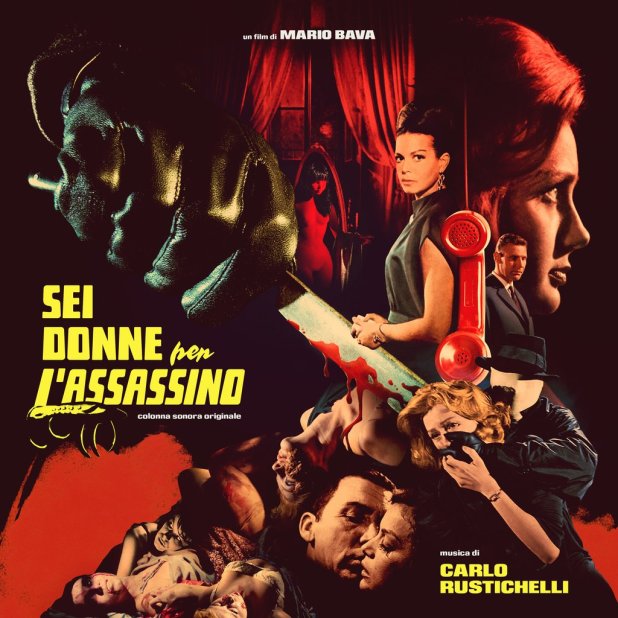
GIALLOPALOOZA PRIMER: Blood and Black Lace (1964)

EDITOR’S NOTE: Probably my favorite giallo is the one that’s considered amongst the first in the form. Mario Bava’s 6 donne per l’assassino AKA Blood and Black Lace was originally written about on our site on March 24, 2019. I’m super excited to see it at the Drive-In Super Monster-Rama Giallopalooza on September 17 and 18. Let’s raise a glass of J&B and get into it.

There’s no way to calculate the influence of Blood and Black Lace. It takes the giallo from where Bava started with The Girl Who Knew Too Much and adds what was missing: high fashion, shocking gore and plenty of sex. The results are dizzying; it’s as if Bava’s move from black and white to color has pushed his camera lens to the brink of insanity.

Isabella is an untouchably gorgeous model, pure perfection on human legs. But that doesn’t save her as she walks through the grounds of the fashion house and is brutally murdered by a killer in a white mask.

Police Inspector Sylvester takes the case and interviews Max Morlan (Cameron Mitchell!), who co-manages the salon with his recently widowed lover, the Countess Christina Como. Soon, our police hero discovers that the fashion house is a den of sin, what with all the corruption, sex, blackmail, drugs and abortions going on under its roof. Isabella was murdered because she had kept a diary of all the infractions against God that happened inside these four walls.

Nicole finds the diary and tells the police she will deliver it, but it’s stolen by Peggy. As she arrives at the antique store her boyfriend Frank owns, the killer appears and kills her with a spiked glove to the face. The killing is shocking. Brutal. And definitely the forerunner to the slasher genre.

Even after the cops arrest everyone in the fashion house, the murders keep on piling up. Peggy claims that she burned the diary, so the killer burns her face until she dies. Greta is smothered to death. And Tilde is killed in the bathtub, then her wrists are slit open, spraying red into the water and marking her as a suicide.

So who is it? Come on. You’re going to have to watch it for yourself.

The success of Black Sunday and Black Sabbath had given Bava the opportunity to do anything he wanted. His producers thought that this movie would be a krimi film along the lines of an Edgar Wallace adaption. Instead, Bava gave more importance to the killings than the detective work, emphasizing sex, violence and horror more than any film in this form had quite before.

Blood and Black Lace was a failure in Italy and only a minor success in West Germany, the home of Edgar Wallace. And in America, AIP passed on the film due to its combination of sex and brutality. Instead, it was released by the Woolner Brothers with a new animated opening.

Today, Blood and Black Lace is seen as a forerunner of body count murder movies and the excesses of later giallo films. To me, it’s a classic film, filled with Bava’s camera wizardry and love of color. It is everything perfect about movies.

Drive-In Super Monster-Rama is presenting “Giallopalooza”, two big nights of classic, fully restored giallo thrillers from such maestros as Dario Argento, Mario Bava, Lucio Fulci and Sergio Martino!

On Friday, September 17, the line-up will be What Have You Done to Solange?, Torso, A Lizard In a Woman’s Skin and The Cat O’Nine Tails. Saturday, September 18 they will present Deep Red, The Bird with the Crystal Plumage, Blood and Black Lace and Your Vice Is a Locked Room and Only I Have the Key.

Admission is $10 per person each night (children 12 and under FREE with adult guardian). Camping on the premises is available each night for an additional $10 a person, and that includes breakfast.

Advance tickets are available online at the Riverside Drive In’s webpage.

When a Stranger Calls Back (1993)

Fourteen years after When a Stranger Calls, this TV movie brings back Cheryl Wilson, Carol Kane and Charles Durning as Mrs. Schifrin, Jill Johnson and John Clifford, as well as director Fred Walton.

The opening of this movie is great. Julia Jenz (Jill Schoelen, an unsung scream queen) is babysitting when she hears a knock on the door. Smart enough to not let anyone in, she tells the man on the other side of the door that she can call a tow truck for him but won’t let him in. When she does try to call, the lines are cut and as she begins lying to the mysterious voice, she realizes that someone is coming in and out of the house. It’s too late — the children she was watching have been abducted.

Five years later and Julia is still traumatized, with whoever stole the children continuing to break into her apartment. She’s helped by counselor Jill Johnson, but the constant abuse causes her to try and kill herself with a self-inflicted head wound. Julia and John Clifford decide to figure out who the stalker is, a man who can throw his voice and has special makeup and clothing that allows him to blend into the walls of Julia’s apartment.

You can watch this on Tubi.

Phobia (1980)

Psychiatrist Dr. Peter Ross (Paul Michael Glaser ) is using radical techniques — maybe even abusive — techniques on his patients to cure them of their fears. But then, they start getting killed off one after the other.

The script for this film comes from a story by Dead and Buried team Ronald Shusett* and Gary Sherman that was scripted by Peter Bellwood, Lew Lehman and Hammer veteran Jimmy Sangster.

It also has John Huston, a director of some pedigree, making it. But this feels less like the John Huston who directed The Maltese Falcon, The Treasure of the Sierra Madre, The Asphalt Jungle, The African Queen, The Misfits and Prizzi’s Honor and more like the John Huston who acted in Myra BreckinridgeThe Bermuda Triangle and The Visitor.

But hey — Susan Hogan from The Brood and Lisa Langlois (Class of 1999Happy Birthday to MeDeady Eyes) are in this.

If this sounds like Schizo without Kinski, well…you’re not wrong.

The best thing about this movie is that Marian Waldman, Mrs. Mac from Black Christmas, plays Glaser’s housekeeper.

Seriously, John Huston directed this. And it’s dull. So dull. Nobody seems to care and the premise of making criminals atone for their crimes by taking part in an experimental video therapy and being killed is a good one. This movie does not succeed in telling that story.

*According to Dan O’Bannon, Ronald Shusett was the first to option the script from the original screenwriter. Shusett was in talks to sell the rights further, provided he could fix it, which meant that he restructured it with O’Bannon.

Rings of Fear (1978)

This is the third entry in a loosely linked series of films that are known by the pretty much pervy title of the Schoolgirls in Peril trilogy. All of these movies have young girls shockingly be interested in sex and being murdered for it.

The series starts with Massimo Dallamano’s What Have You Done to Solange?, one of the best films in the giallo form, which he followed with What Have They Done to Your Daughters? Sadly, Dallamano would die before this movie was made, but he is credited for writing the screenplay.

When the body of a teenage girl is discovered wrapped in plastic twelve years before Laura Palmer, Inspector Gianni DiSalvo (Fabio Testi) finds himself investigating a clique of young women called The Inseparables who attend a prestigious all-girls’ school and were friends with the victim.

One of their number is Fausta Avelli, who was also in Don’t Torture A DucklingThe Psychic and Phenomena. And Helga Line, who was in everything from So Sweet…Perverse and Nightmare Castle to The Vampires Night OrgyHorror Rises from the Tomb and Black Candles, is in this.

Most of this movie recycles the past two films, but man, the ending where the first killer casually kills himself and then there’s the reveal of the real person behind everything? That makes watching this all worthwhile.