ABOUT THE AUTHOR: Eric Wrazen is a Technical Director and Sound Designer for live theatre, specializing in the genre of horror, and is the Technical Director the Festival de la Bête Noire – a horror theatre festival held every February in Montreal, Canada. You can see Eric as an occasional host and performer on Bête Noire’s Screaming Sunday Variety Hour on Facebook live. An avid movie and music fanatic since an early age, this is Eric’s first foray into movie reviewing.
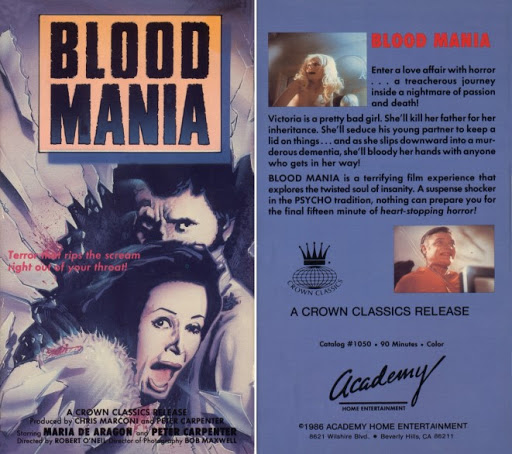
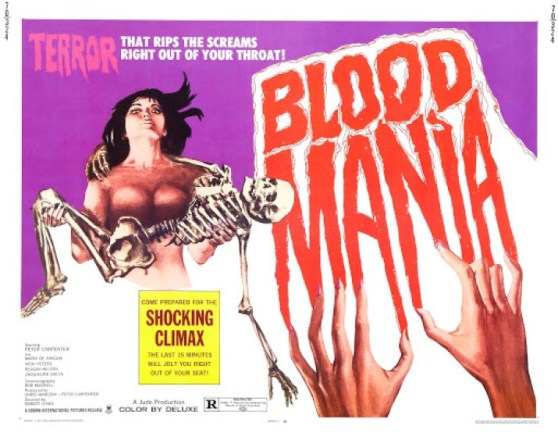
(From Wikipedia) Blood Mania is a 1970 American horror film written by Peter Carpenter and Tony Crechales and directed by Robert Vincent O’Neil, and starring Carpenter, Maria De Aragon, Vicki Peters, Reagan Wilson, Jacqueline Dalya, and Alex Rocco. The film stars Carpenter as a doctor whose mistress, an heiress, murders her terminally ill father to help him pay off a debt.
If there is one thing that can be said about Blood Mania, it’s that it’s a movie.
You really have to hand to Mill Creek Entertainment. “Gore House Greats” is an amazing title for a movie collection. Likewise, Blood Mania is an amazing title for a movie. Unfortunately, in the case of Blood Mania, it is neither gory, nor that bloody. There’s a little bit of mania, so I guess they get points for that.
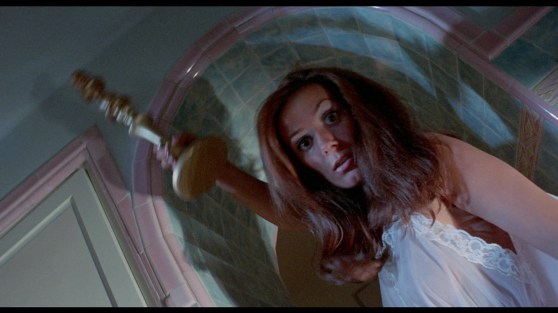
The opening sequence for Blood Mania is a freaky dream sequence depicting the stalking of a hippie babe in a peekaboo nightie over the sounds of a budget version of the Velvet Underground detuning and abusing their instruments. OK. So far so great!
Sadly, the rest of the movie doesn’t come anywhere near this level of freakiness and fun.
A more apt title for Blood Mania would have been “Worlds Dumbest Doctor” or possibly, “Victoria, The Crazy Bitch”. Either of these is a better indicator of the easy, sleazy melodrama you are about to witness.
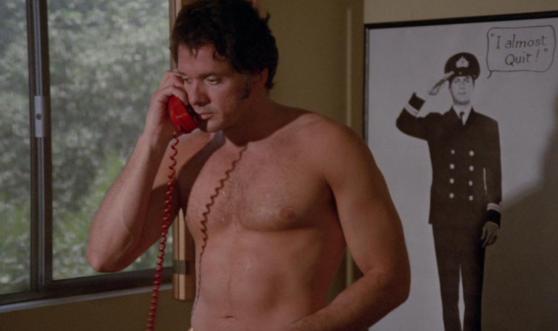
Briefly (and without spoilers) Bloody Mania follows the sordid tale of Dr. Craig Cooper, one hunky hunk of burning physician as he beds babes of varying levels of wealth in order to bang his way out of a bad debt. Even this synopsis makes Bloody Mania sound more interesting than it actually is. In reality, this movie is closer to a soap opera with a little nudity thrown in to keep things sleazy.
I feel that this movie would have been better pitched as a Russ Meyer or Doris Wishman style sexploitation flick. There’s plenty of sex and it includes a plethora of sexploitation’s favorite tropes like nymphomania, blackmail, abortion, lesbians, and drugs. It also uses a bunch of classic sexploitation tricks used to fill out the running time when there isn’t enough plot to fill 90 minutes. A fair portion of Blood Mania consists of people driving around, frolicking on the beach, or visiting an amusement park. This is the kind of movie that “fast forward” was invented for.
Blood Mania isn’t a good movie, nor is it a “so bad it’s good” movie. But it is a movie. And I guess for Mill Creek Entertainment – that counts for something.
Hey, we love this film so much that Bill Van Ryn of the Groovy Doom/Drive-In Asylum collective gave us his take Blood Mania, again, for Mill Creek’s Gorehouse Greats box set.
Update: July 21, 2021: We’ve also previously reviewed Peter’s work in his forth and final film — which he, as with Blood Mania, wrote and produced — Point of Terror. And, thanks to frequent reader and uber Peter Carpenter fan, librarian Mike Perkins (thus his awesome research), we learned of this new blog entry from B&S About Movies’ friend Mike Justice, on his The Eerie Midnight Night Detective Agency blog regarding Peter Carpenter’s life and all-too-short career. Strap it on, it’s a great read.
And, surf over to this really cool Flickr posting from Mike Perkins, featuring early photos of Peter. And, there’s no stopping Mr. Perkins’s fandom, as he also honored Peter by not only having Peter’s IMDb page updated with correct information, he created an all-new Find A Grave entry for Peter. Did you know that Peter’s real name was Nathaniel Joseph? Or that he was in the Air Force? We do now, thanks to Mike Perkins’s hard work.
Yeah, we love our readers! Thanks for contributing to B&S About Movies, Mr. Perkins! (Yeah, we love you too, Justice.) And we love it when our readers reinforce and uplift our passions in honoring the actors and filmmakers of our youth. You gotta fight for the ’cause!
I’m echoing what nearly every article about this movie says, if only because it’s true. The first two minutes of this movie are better than anything that will follow.
We start in a ghost town, where a laughing hooded figure buries a young boy alive. When the kid asks, “Who are you?” the reply is chilling: “You know me, Joey!” and then laughter, as the boy’s shocked face is shown and we see gigantic eyes fill the screen.
Seriously, if that’s all Terrified! was, people would still be talking about it and not just manaics like me.
The titles are so classy — just check out the whole opening at Art of the Title — that even the Crown International Pictures title card comes up as part of the animation and not just thrown out at the start of the movie.
Lew Landers’ last movie — he made The Raven at Universal before a long career that went from film to television — Terrified! is all about a college psychology student studying just how much terror a man can take. Once a killer starts hunting him, he gets first-hand knowledge.
Denver Pyle — years before he was Uncle Jessie — is in this as a lawman. Speaking of lawmen, Ben Frank, who was Inspector Lt. Mankiewicz in Death Wish 2, is in this. So is Barbara Luddy, who was one of the Disney players from 1955 to 1973, with her voice showing up as Lady in Lady and the Tramp, Merryweather in Sleeping Beauty and Rover in One Hundred and One Dalmatians. And oh wow — Robert Towers is here too, someday to be in Masters of the Universe as the strange-looking Skeletor minion Karg!
It’s not horrible, but man, that opening makes you hope for so much more.
Welcome to Mill Creek Month! As you know, we love those Mill Creek sets, so we’re doing an entire month of these films. The first set we got into was B-Movie Blast, which has — as is par for the course with these bricks of films — a crazy gaggle of films. We originally reviewed this movie on November 23, 2020, as part of our William Gréfe week, then again on February 1, 2020, for the B-Movie Blast set.
Well, it’s back again — with a new, second take — as it’s also part of Mill Creek’s Gorehouse Greats 12-Pack.
Does it deserve two takes? Nope. But we are celluloid masochists. And this movie supports animal abuse to get a movie made. You’ve been warned.
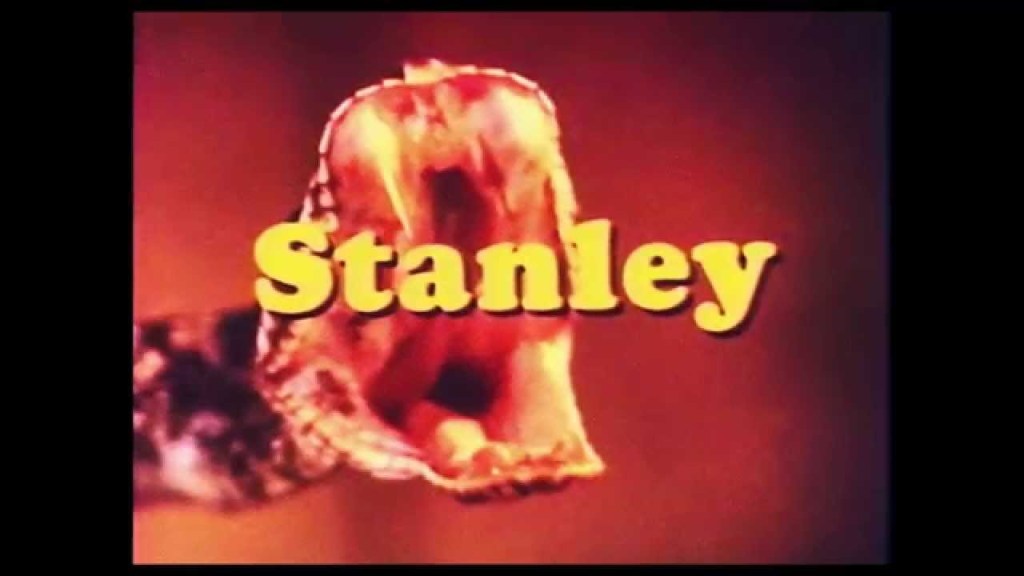
If you wanted to know what writer, director, and star Christopher Robinson did before his vanity run for box office gold with The Intruder (1975), welcome to the pre-Jawswhen-animals-attack mayhem that is Stanley. Did you see Rattlers in 1976? Okay, so this is the first snake movie. (No, not the Scorpio killer from Dirty Harry (1971), that’s Andrew Robinson; not related.)
Robinson is Tim Ochopee, an f-up Seminole war vet back from Vietnam who wants to just be left alone with his best friend, the snake Stanley, in Everglades seclusion. Not if Richard Thomkins (Alex Rocco; who excels at character actor dickdom), an expert tanner (a maker of leather goods) who is “mobbed up” and kills Tim’s pop.
Remember Willard (1971). Yeah, it’s like that. Only with a pet snake instead of a rat.
Yep. William Grefe seen the box office gold of Willard and decided the world needed a guy with an ESP link to his pet snakes — led by Stanley the snake instead of Ben and Socrates. But it’s a Grefe flick: Sandra Locke didn’t bite the head off a rat and let the blood run down her fleshy breasts. But a stripper dancing on stage does that with a snake, here. And Bruce Davison didn’t kidnap his lady love: Tim kidnaps Rocco’s daughter Susie to to that end.
While this movie piles on the violence, the horrors the snakes endured was worse. So much for a Florida regional horror shot-on-the-fly in the Everglades outside of the eyes of Hollywood execs and PETA. Grefe had snakes defanged. He had the mouths sewn shot on others. When you hear this — even though it is snakes, still — you end up hating Grefe and never watch another one of his films. Ever. Again. Which is why I am not a rabid a Grefe fan as others are. It gets worse: Grefe had Stanley, the lead snake, killed. Then made it into a wallet.
Fuck you, Grefe. You deserved to have a bottom-of-the-barrel career of shit movies than never rose out of Z-moviedom. I can’t believe you got a box set retrospective. Animal killer.
There was talk of a sequel, Stanley in Miami. It never happened, thank god, as the lives of snakes were saved. Sorry, you just don’t mistreat and kill animals for the sake of a friggin’ movie. And a sucky-ass one at that. I can’t recommend this. Find your own freebie streaming links or online store DVDs and Blus.
About the Author: You can learn more about the writings of R.D Francis on Facebook.He also writes for B&S About Movies.
Editor’s Note: Fool us once, Plural “S,” shame on you; fool us twice, shame on B&S About Movies. We reviewed Satan’s Slaves — the 1982 Phantasm-inspired plural one from Indonesian — on November 12, 2019, as part of our Mill Creek Pure Terror 50-Film Set of reviews. One slight problem: that film wasn’t on the set: it was the 1976 British, singular one starring Michael Gough. And we caught the title faux pas before we went to press, but just said the hell with it because, well, the Indonesian one has rocked our world for many years. This time, we’re reviewing the proper film, as result of its inclusion on Mill Creek’s Gorehouse Greats 12-Film Set (Amazon), which we’re unpacking with reviews all this week.
Today’s review is brought to you today by the letter “S” and the number 666.
How is it that we could go on all day about British actor and Hammer stalwart Michael Gough, starting with his first role as Sir Arthur Holmwood in Hammer’s Horror of Dracula (1958), watch his work in Horrors of the Black Museum (1959) multiple times, and watch him in The Phantom of the Opera (1962), The Skull (1965), and Horror Hospital (1973), but never encountered his work on Crown International Pictures’ Satan’s Slave? Even with all of our combined video store memberships and watching Friday and Saturday late night horror blocks on our local UHF-TV stations, we’ve never heard of it or seen it (at least it slipped by me). How is that possible? We fell in love with Euro-obscurities like A Bell From Hell and Symptoms from multiple UHF showings — and even seen them on home video shelves.
Well, let’s unpack this flick brought to you by the letter “S,” Oscar.
Turns out, director Norman J. Warren has two flicks on this Gorehouse set: this and Terror(1978), which is also on the B-Movie Blast 50-Film pack that we’ve already reviewed this month. Truth be told, while he’s legendary — at least in B-Movie and video nasty circles — Warren is an under-the-radar obscurity to most horror fans (well, except for FUBAR’d dudes like Bill Van Ryn who’s made his fandom of Warren’s Prey well known), with only 16 credits. The Warren films you (may or not) know are the insipid, Star Wars-inspired sex comedy Spaced Out (1979), aka Outer Touch (that we passed on during our “Star Wars Month” tribute; the similar, better known Galaxinawon that review pole position), and the Alien rip off (that we did cover with our “Alien Week” tribute) Inseminoid(1981). Then there’s that off-the-nut sci-fi zombie romp Prey(1977) that Bill Van Ryn digs, and Warren’s final tour de force: Bloody New Year (1987), that Sam digs. All of those films were, of course, better distributed projects that turned up in theaters, cable, and VHS (for me, that would be as Inseminoid; Spaced Out was an oft-aired HBO programmer).
Then there’s Satan’s Slave — sans that pesky “S” plural.
Perhaps it’s because it was only Warren’s third feature film — after two Italian sex shenanigans flicks issued in 1968: Loving Feeling and Private Hell, which makes Satan’s Slave his first horror film. In between his Alien romp, Inseminoid, and his Slasher romp, Bloody Birthday, Warren changed it up with, well, looking at the cover, a Stallone Rambo-cum-Arnie Commando rip called Gunpowder (1986) — has anyone seen it?
Now, the writer on this, well that’s a different story: While he wrote Warren’s Satan’s Slave and Terror, he gave us the video rental favorites of ’70s British horror: White Cargo (1973), House of Whipcord (1974), Frightmare (1974), the sleaze-o-rama that is The Confessional (1976), and Schizo(1976): Lord Smutmeister David McGillivray (and we mean that as a complement).
This time we have a supernatural horror tale with Catherine (British horror “Scream Queen” Candace Glendenning; The Flesh and Blood Show) who comes to live with her uncle and cousin (Michael Gough and Martin Potter; his work goes back to Fellini Satyricon) after she survives a car crash that killed both of her parents. Of course, Uncle Alex and Cousin Stephen are behind the crash: they’re necromancers who need her as a sacrifice to resurrect a powerful, spiritual ancestor.
To say more will spoil the film, as this Rosemary’s Baby-inspired tale (but not at all like a cheap Italian ripoff of that film or The Exorcist) is an excellent watch; one that’s far above the fray of the exploitative-norm discovered on Mill Creek sets. The scripting, set design, and acting — from all quarters — is top notch. I loved it. Consider it one of my new classics in the British ’70s cycle of gothic horror tales, right alongside Captain Kronos: Vampire Hunter and Hammer’s Karnstein Trilogy.
The production story: There’s additional material shot that was even more violent, and alternative versions of existing scenes that are in the film are available in other prints in the overseas markets. So, what we get is an amped up, Gothic psychological-sexploitation tale that programs nicely with the better distributed (as with the aforementioned A Bell from Hell and Symptoms via VHS and UHF-TV) Virgin Witch (1971) and the always incredible to watch The Wicker Man (1973). Of course, keen eyes immediately notice that the house and grounds of the Yorke estate appeared in Virgin Witch; and when you watch Terror off this same Mill Creek set, you’ll notice the Gothic estate, reappears.
While you can get this on the two Mill Creek sets we’ve unpacked this month, the more serious Warren fan can get Satan’s Slave, along with Terror, Prey, and Inseminoid on Anchor Bay’s Norman Warren Collection DVD box set. Vinegar Syndrome and Severin also offer restored single-disc reissues. However you watch it: watch it. There’s a copy of Satan’s Slave on You Tube.
About the Author: You can learn more about the writings of R.D Francis on Facebook.He also writes for B&S About Movies.
Mill Creek is a green company: they love to recycle, even if the film is celluloid compost. For Prime Evil is a film that we love and the “B” in B&S, Becca, calls it like she see it: shit. We reviewed this on February 1, 2020, for the first time on the first day of our Mill Creek month-long blowout as part of its inclusion on their B-Movie Blast 50-film pack. And here it is again, with a deserving slot on the more appropriate Gorehouse Greats 12-film set, which we are also unpacking this month. Viva (junk) Italian horror cinema!, we say, much to boss Becca’s dismay. Yeah, yeah, we know it’s not “Italian” and it’s shot in New York by Robert Finlay of Blood Sisters fame — but wow, it confuses like an Italian horror romp should.
Two reviews. One Movie. Thank you, Mill Creek. Shame on B&S About Movies.
Becca calls it as she see it, and accurately: For this really is a nonsensical piece o’ shit.
And we love ludicrous Italian horror movies (even when it’s not a ludicrous Italian horror movie, so there!). Even when the Italians shoot in the U.S. and try to be “American” and fail at it. It’s like all of those Philippine Namsploitation flicks that take place in Cambodia, but shoot in the Philippines, and place pictures of Ronald Reagan all over the set to make it look “American.” And it’s all ripping off The Exorcist and The Amityville Horror. So, yeah, when the Italians go Satanic with heaping helpings of the occult, regardless of the confusion, we say, “GO TEAM NEAPOLITAN!”
But Roberta Findlay, she of the many o’ softcore sex flicks, such as Honeysuckle Rose — no, not the 1980 one with Willie Nelson; the 1979 one with John Holmes — made this. Yes, the same one who made the “adult comedy” Liquid A$$ets with Samantha Fox and Veronica Hart. And Roberts hits all of Italian junk cinema plot points we know and love, here:
You want a black mass in a church? Check.
You want a priest — a centuries old one at that — who not only lords over a group of chanting robed monks, he also sidelines as a drug dealer? Check.
You want a crazy, pseudo-implied pedophile who lords over his granddaughter to keep her as a virgin for a Satanic sacrifice? Check.
A boyfriend who is useless in the damsel-in-distress department. Check.
A nun who pretends to hate God so she can infiltrate the cult. Check.
Remember in Rocktober Blood, all of the out-of-place aerobics? Check.
Remember the Satan puppets in the “No False Metal” classic that is Rock ‘n’ Roll Nightmare? Check.
And to Crown International Pictures for distributing this mess in the U.S., we thank you. You can watch this on YouTube, but learn what you’re getting into with this clip from the film. You can get the restore-disc from Vinegar Syndrome.
About the Author: You can learn more about the writings of R.D Francis on Facebook.He also writes for B&S About Movies.
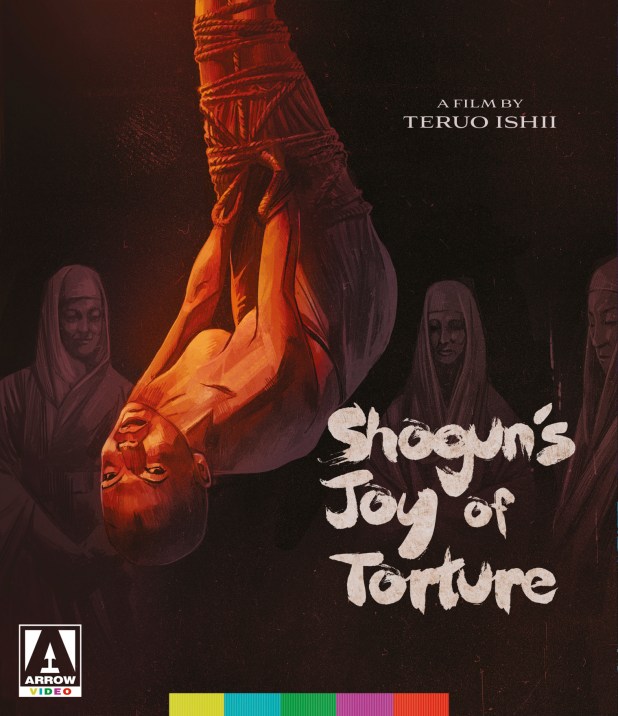
Teruo Ishii (Inferno of Torture, Invaders from Space, Horrors of Malformed Men) is mostly known for his ero-guro (erotic-grotesque) films, but his oeuvre jumps all over the place, from science fiction to sequel series, martial arts, noir and horror. Truly, anything that he could make — 83 feature films in all — he made.
From all accounts, he was a quiet, unassuming man. Well, let me tell you — if this movie is any guide, he was an absolute maniac. An anthology of three true crimes of the Tokugawa shogunate era, this is a movie that will absolutely shock you on every level.
The first story concerns a woman who will do anything to help her brother — even the unthinkable — which causes both to pay a horrifying price. The second is about a lusty monk who causes the nuns of a Buddhist temple to suffer torture for the libidinous actions that they feel compelled to enact. And finally, in the most depraved — and well made, I mean, this looks like art the way it’s filmed and presented — a sadistic torturer and a master tattoo artist discuss the way torture should be depicted within art. It’s also about Christian missionaries trying to turn the Japanese to a Western god and being duly decimated. And also artistic depictions of depravity.
The Arrow Video release of this offers a pristine looking print, as well as features of Ishii and a discussion of the history of torture in Japanese exploitation cinema.
Honestly, this movie is a hard watch. Yet there are seven sequels from Ishii and a 1976 follow-up, Shogun’s Sadism. It definitely has something to say about the nature of crime and punishment, as the final segment, though the roughest, has the most moral message. This is where I mention that this is one of many movies that speak against violence and bad morals while indulging in both. But isn’t that what exploitation films are all about?
15 years ago, director Mark Blumberg flunked high school English class when he failed to read Moby Dick. Only now does he realize how much he loves the book so he’s decided to reach back to the teacher that failed him and present a book report for it in the form of a documentary.
Finish this film — which he sees as “nothing less than a comprehensive portrait of the reading mind,” Blumberg meets scholars, scientists, teachers and even visits an annual reading marathon of the book. He even gets the opportunity to film two of Melville’s living descendants and learn what the book means to them.
Like any creation of art, this deeply personal project begins to take a toll on the filmmaker, who starts to realize that this is less about finishing a book that he ignored when he was a teen and more about fixing himself right now.
The Art of Reading is the kind of documentary that I love, one that starts in once place and leaves behind changed lives when its complete.
ABOUT THE AUTHOR: Robert Freese contributes to many different magazines, zines and websites such as Videoscope, Rue Morgue, Drive-in Asylum, Grindhouse Purgatory, Horror and Sons and Lunchmeat VHS. (His most recent piece, about the 80’s video distributor Super Video, can be found here). He also co-hosts the Two Librarians Walk into a Shelf podcast so he has an excuse to expose library patrons to ninja and slasher films.
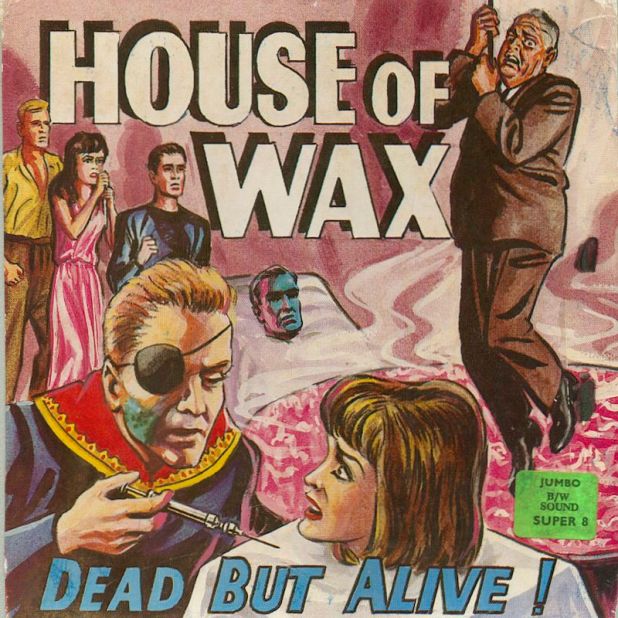
Our story begins at a posh Hollywood soiree where head of Paragon International Pictures Max Black announces the start of a new movie starring hot young talents, Tony Deen and Marie Morgan, as well as their engagement.
After the party, on his way home, a shadowy figure assaults Deen and injects him with a concoction that puts him in a state of suspended animation. We are then whisked to the Movieland Wax Museum, where tour guide Nick walks patrons from one famous display to another.
Detectives Haskell and Carver arrive to ask curator Vincent Renard about the recent disappearances of other Paragon stars. Renard doesn’t have any information that can help their investigation, but he agrees it is weird that each one of them disappeared shortly before the unveiling of his newest display dedicated to those same Paragon stars.
We learn in a flashback that at another Paragon party, Marie Morgan told Max Black she was quitting the business to marry Renard, who, at the time, was Paragon’s top make-up artist. Enraged, Black throws a drink into Renard’s face just as he lights a cigarette. Renard’s head bursts into flames. He staggers blindly outside and jumps into the pool. Authorities write it off as an accident. The “accident” leaves Renard disfigured and missing an eye.
Renard reconnects with Marie, regardless that Max does not want her associating with him any longer, and eventually convinces her to “pose” for him.
You don’t have to be the savviest horror film fan to connect all the dots here, but Nightmare in Wax is still a total delight. If you were a kid when you first saw it, it no doubt scared the snot out of you. The premise of a madman injecting his victims with an agent that renders them motionless, then keeps them docile with hypnotism, is potent nightmare fuel. But just like quicksand, another terrifying concern that blossomed in many of us in our adolescence, the premise of such an outlandish plan disintegrates into itself when adult logic is applied. (I mean, certainly some sounds would be coming from their bodies, escaping gases, stuff like that, right? Possibly, tears running out of their never blinking eyes and maybe some kind of skin discoloration as they go longer without actual food and water, but I’m being a killjoy now.)
In and of itself, Nightmare in Wax succeeds because it was produced only to creep out drive-ins patrons looking for some cheap thrills, and then later the same viewers surfing for late night TV chills. It’s a fine example of exploitation that runs with its absurd premise and delivers the required thrills fans of such an entertainment desire. It is not really gratuitous in any way as its most gruesome moments are suggested, keeping the proceedings in PG rated territory but not dulling their impact to shock and disgust. It exists and delivers on the same level as the Creepy and Eerie horror comic magazines that were popular at the time. Never really scary, but blackly fun and offering simple morality tales for a young audience. It offers just the right amount of gruesome entertainment for a fun night at the drive-in with friends.
Cameron Mitchell stars as Renard and he is absolutely wonderful. This is the Cameron Mitchell fans most love: the crazy, cackling, carrying around a dead body and talking insanely to it during a high-speed police chase to the pier in Santa Monica Cameron Mitchell. (For myself, I love this Mitchell performance more than his similar psycho role in The Toolbox Murders.)
Anne Helm is great as Marie, but she fails to make Marie completely sympathetic, especially since she only agrees to pose for Renard if he gives her a bust of Tony Deen, who she is still madly in love with. (When he finally has her trapped, there is a bit of joy on the part of the audience when Renard cackles, “If I can’t have you the right way, I will have you another way.”) Berry Kroeger had been making pictures since the early forties and is perfect as the slimy little toad Max Black. (You do feel joy when Renard is torturing the creep.)
There is a slew of familiar faces in the cast, among them Al Adamson regulars Scott Brady as Detective Haskell and John “Bud” Cardos, looking an awful lot like Sam Rockwell, as Detective Carver. Hollis Morrison is a hoot as Nick, especially when he thinks he is hallucinating. Morrison worked throughout the sixties but tapped-out soon after this film with a final appearance on the TV show McCloud. This was one of character actor Virgil Frye’s earlier films and Ken Osborne appears briefly as a bartender, following up with appearances in Blood of Dracula’s Castle, Five Bloody Graves, and Hell’s Bloody Devils before directing the outstanding western Cain’s Cutthroats in 1970.
Written by a true master of exploitation, Rex Carlton delivered a gruesomely good ride that exploits the premise for all it is worth. Carlton also wrote the film that was released on a double bill with Nightmare in Wax, Blood of Dracula’s Castle, a film as equally fun. The two films ran together as an amazingly successful double feature for years. Carlton, unfortunately, did not live to enjoy the success of the films he wrote. He took his own life soon after Sam Sherman and Al Adamson lost the rights to Blood of Dracula’s Castle, some speculating that he owed the wrong people money for a loan to get the films made. (Posthumously, the two films raked in an amazing pile of dough for distributor Crown International Pictures, and they played multiple double bills, triple features and dusk to dawn shows well into the seventies. Another Sherman/Adamson film he scripted, The Fakers, went on to theatrical success as Hell’s Bloody Devils. Earlier in his career, Carlton wrote the absolutely bonkers exploitation classic The Brain that Wouldn’t Die.)
Director Bud Townsend began his career in TV and then moved into features. He continued making films released by Crown International Pictures well into the eighties. From a historical perspective, the film offers a glimpse of the long lamented Movieland Wax Museum as it existed just prior to being sold to Six Flags. It depicts a moment in time that will forever exist in this film. Quaint as wax museums may seem to some, when they are gone there is definitely a sense of loss by those of us who enjoy such activities as posing for pictures with wax effigies of stars and characters from the past. More than living up to its title, Nightmare in Wax is a darn fine spook-show. It’s cheap and clunky, but it just might creep you out a bit. If anything, Cameron Mitchell’s over the top performance makes it more than worth a watch. The Gorehouse Greats Collection presents the film in a widescreen format and is by far the best copy I’ve seen available, between other budget releases and streaming.
Editor’s Note: Thanks to Dustin Fallon from Horror and Sons for this entry. He’s always been a big promoter of our site and has been instrumental when it comes to getting writers for our Mill Creek box set review projects. Dustin wrote this back on November 3, 2019, as part of our Mill Creek Pure Terror Month tribute of reviews. Well, in addition to that 50-film box set, this crazy film is also part of Mill Creek’s Gorehouse Greats 12-pack. This is a great review of seriously goofy film. No way we can re-review it any better than Dustin’s take.
They Saved Hitler’s Brain is a 1968 film directed by David Bradley, who also directed 2 well-known films starring Burt Lancaster, “Peer Gynt” and “Julius Caesar”.
You know what? Strike that last sentence.
The Madmen of Mandoras is a 1963 film from director David Bradley, who also directed 2 well-known films starring Burt Lancaster, “Peer Gynt” and “Julius Caesar”. They Saved Hitler’s Brain is really just the same damned movie, re-titled for television distribution in 1968 and featuring new footage shot specifically for its broadcast re-release.
The new footage, which is essentially an entirely new opening for the film, is a bunch of muddled nonsense that attempts to expand upon the original film’s plot, but in truth adds nothing of value or importance to the film, and actually slows down the film’s pacing. The film opens with a scientist who has been working on a secret government project to create a serum for the deadly chemical weapon known as “G-gas” (which the government fears may be used as a weapon by hostile countries) being blown to bits when he triggers a bomb connected to his car. A government agent, who looks suspiciously like Hall of Fame closer Dennis Eckersley, is assigned to the case.
The opening moments of The Madmen of Mandoras are edited into this new footage through the use of some rather abrupt and jarring transitions, with the difference in film quality immediately apparent. These scenes highlight a military briefing on the lethal “G-Gas”, where it is stated that the antidote must remain well guarded, as its falling into the wrong hands could have dire consequences for the entire world. Of course, this just means that a scientist working on the antidote is soon captured by agents of the surviving Third Reich!
They Saved Hitler’s Brain attempts to add some additional action to its runtime by meshing footage from the original film with the newly created scenes so that it appears that Eckersley and his new female partner are trying to thwart the abduction. However, both agents fail to do so and are killed for their efforts, saving viewers the nightmare of dealing with them any longer. This, in essence, wraps up the “Hilter’s Brain” portion of this review, as well as the newly created portions of the film. Now, forget they ever happened because they are total shit!
As for the real film, The Madmen of Mandoras….
Near the end of WWII, Nazi scientists discover a means of preserving the life of Adolph Hitler into perpetuity, allowing the man to continue his plans for world domination for years to come. Well, at least his severed head is preserved, severed from his body and placed into a small glass tank filled with various “life-sustaining” fluids. A decoy of the Fuhrer is left behind to deceive the Allied forces into believing that the madman had been killed and his plans for domination thwarted. The surviving officers of the Reich, with Hitler’s head in tow, flee to the fictional South American island nation of Mandoras, where they secretly plan their next steps.
Years pass and with the creation of the G-gas weapon, the Nazis have found the key to their resurgence. The only thing standing in their way is the antidote, which counters the gas’s effects, should it ever be released. As such, Nazi agents are sent to America with orders to abduct a certain Professor John Coleman, one of the scientists working on the serum. However, the government of Mandoras is not without knowledge of the Nazi’s schemes and have sent their own agent to prevent the plan from succeeding.
The Mandorian (Is that the correct terminology for the natives of this tiny fictional country?) agent fails and Coleman is taken despite his interference. Also captured are Coleman’s youngest daughter, Suzanne, and her boyfriend, David. The next intended target is Coleman’s son-in-law, Phil Day, who works for US intelligence. Granted, they weren’t intelligent enough to predict an incident such as this, or Coleman would have had some sort of security detail. The Mandorian agent prevents Phil and his wife’s abduction, but is shot and killed in the process. However, as this is a movie, the man is able to disclose the entire elaborate conspiracy to Phil before he expires.
Phil and his wife, Kathy, soon board a flight to Mandoras. Upon landing, the couple are “greeted” by the island nation’s police force, which in this case is just Creature From the Black Lagoon co-star Nestor Paiva and his seemingly slow-witted assistant. The couple are treated as “special guests” of the nation, even though no one should have known that they were visiting, and are shown to the island’s finest hotel. Okay, so it’s the only hotel.
Not long after settling into the hotel room, the Days’ are shocked to find a man sneaking into their room, despite their still being in it at the time. After a brief scuffle, the man is introduced as “Camino”, the twin brother of the Mandorian agent killed in America. Camino discloses that he, like his late brother, are working to stop the Nazi resurgence. He warns the couple that many nefarious eyes are now watching them and that danger can wait around any corner.
Essentially ignoring this warning, Phil and Kathy head out to a small local bar. There, they find Suzanne dancing away to the brass band that is playing. Suzanne informs her sister that the men that kidnapped her were quite friendly, which really doesn’t seem like the actions and behavior of a group known for their acts of genocide. Suzanne is also not aware of David’s whereabouts, but she also doesn’t seem overly concerned either. The good nature of the Nazis is proven untrue when a failed attempt on Phil’s life leaves another man dead and a dancer with a bullet in her side. After the dust has settled, Phil notices that Kathy and Suzanne are no longer in the bar. Making matters worse, Phil is arrested before he can even begin to search for the women.
Phil is escorted to the Mandoras’ presidential palace, which the Nazis have overtaken to use as their new base of operations. Phil is placed into a jail cell, where not only Kathy and Suzanne await, but Professor Coleman as well. David resurfaces, revealing himself to be a Nazi officer who has been involved in the plot for quite some time, brutally bitch-slapping Suzanne when she confronts him. However, the incarceration proves to be brief when Paiva and the nation’s president appear to release the captives, disclosing that they’ve secretly been fighting against the Nazi insurgence.
Hitler’s severed head finally makes its grand entrance, leading his forces as they prepare their bombers for a worldwide G-gas attack. This plan doesn’t get very far though, as Phil, Camino, and the rest of the men launch an all-out assault on the small, single-engine plane that is actually shown. I did mention that this was a low-budget film, right? You won’t be seeing much more than stock footage of bombers. Here, you’ll just get a Cessna.
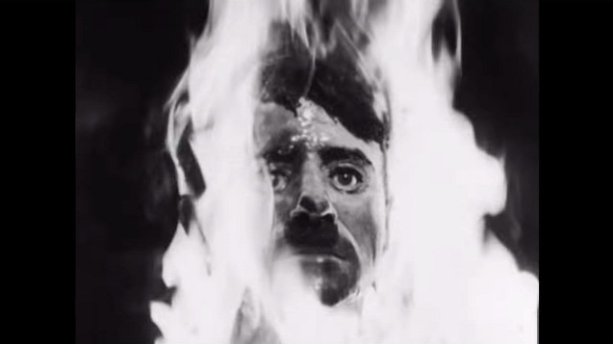
As one might expect, the heroes win, preventing the world from falling into the hands of the Third Reich. What you might not expect, especially from a film of this age, is the grisly closing image of Hitler’s disembodied head, here portrayed by a wax mold, gruesomely melted away by flames. While it is quite evident that the head is indeed wax, it’s still fairly gnarly watching the wax melt away like layers of skin and flesh from the skull-shaped creation. In fact, the scene was deemed disturbing enough to viewers that it had to be (marginally) edited down for the television re-issue.
The Madmen of Mandoras, or They Saved Hitler’s Brain, or whatever you choose to call it is a fun slice of pro-American/anti-Nazi propaganda* layered in a healthy dose of 1940’s/50’s era comics “pulp”, and sprinkled with a pinch of early 60’s pop culture sensibility. It doesn’t require a lot of thought and generally moves at a steady pace, although the footage added to the television re-release does make the first half of the film drag noticeably. The film feels more than a little dated by today’s standards, but still provides some solid entertainment for a rainy weekend afternoon or one of those nights when you’re just not sure why you are even still awake.
Editor’s Note: We reviewed this way back on November 22, 2018, during one of our first Mill Creek blowouts with the Chilling Classic film pack of 50 movies. Now Mill Creek’s brought it back as part of their Gorehouse Greats 12-pack. Two box sets, twice the movie fun!
Also known as Witchcraft, The Naked Goddess, Devil’s Doll and Live to Love, this black and white film is all about some people in Los Angeles who want to be ahead of the Black House’s curve in San Francisco and start worshipping Satan…err, Gamba, the Great Devil God.
Probably the most interesting thing that I can tell you about this movie is that Chess Records released Baker Harris and the Knightmares’ “Theme from ‘The Devil’s Hand.” No word on how many people bought it.
Rick Turner (Robert Alda, Father Michael from the bastardized version of Bava’s Lisa and the Devilthat was retitled The House of Exorcism, which strangely enough also has a similar plot to this movie, so Satan has to be behind this coincidence) keeps seeing a succubus, a nearly nude vision of a woman dancing in the clouds. Soon, he has come to a doll shop that has one in the exact image of his dreams, which is a likeness of Bianca Milan (Linda Christian, the first Bond girl).
Understandably, his girlfriend Donna (Ariadna Welter, El Vampiro) is freaked out when she finds a doll that looks just like herself. Rick is too after the shop owner Frank Lamont (Neil Hamilton, Commissioner Gordon from TV’s Batman) knows him by name. He also refuses to sell Donna her doll, instead stabbing it and causing her no end of pain.
Of course, while his lady is in the hospital, Rick becomes Bianca’s lover. She’s been sending thoughts into his mind and wants him to join her cult and takes him to a meeting, where Gamba decides if a woman lives or dies when his wheel of knives descends on a woman. She lives, but a cult member takes photos of the event.
Donna is cured by midnight and released from the hospital. There are bigger problems, as the cultist who took the photo is a reporter who Frank curses and kills like Dr. Lavey cutting out photos of Jayne Mansfield.
Soon, the cult is having another meeting to test Rick, asking him to choose if Donna lives or dies. Who knew being in a devil cult had so many meetings? It seems like an awful lot of commitment to make. He chooses her and all of the cult dies in a fire.
The film ends quite ambiguously for when it was made, as the couple thinks everything is copacetic and we soon see in the skies, waiting for him. This is one weird movie, one that feels like a waking dream.







 B&S About Movies
You must be logged in to post a comment.