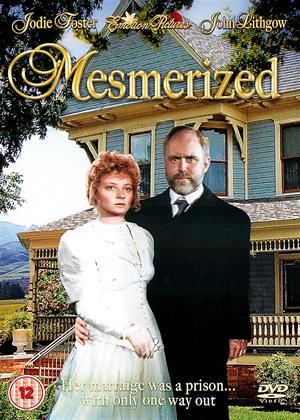
Somehow, this Mill Creek set has a Jodie Foster movie on it. Not a TV movie or something from her past, but a 1986 Jodie Foster movie where she plays Victoria, an orphaned girl who is married to the much older Oliver Thompson (John Lithgow!) and sent away to school. When she comes back, years later, she realizes that her husband and most of his family are all deranged.
A co-production between Australia, New Zealand, United Kingdom and United States with RKO Pictures, this was released in the U.S. as My Letter to George and Shocked in other areas, which is a great title but if I saw it with that name, I would have been furious that such a great name was used to describe a period film.
Perhaps most astoundingly, this was written and directed by Michael Laughlin, who wrote and directed two of my favorite movies, Strange Behavior and Strange Invaders.
Loosely based on that of Adelaide Bartlett, who was put to trial in 1886 for the chloroform poisoning of her husband, this feels like the kind of film where the story of how Foster got on board, much less decided to be a producer, feels like it would be more interesting than the movie that I just watched.
The ecosystems of islands, by nature, are self-sufficient biological communities that, sans the intrusion of man’s foolish nature, can survive and thrive for an eternity. Man, on the other hand, is not an island; man is a social animal that withers and dies in their Don Quixote quest for independence. Autonomy doesn’t grant self-worth, but self-loathing.
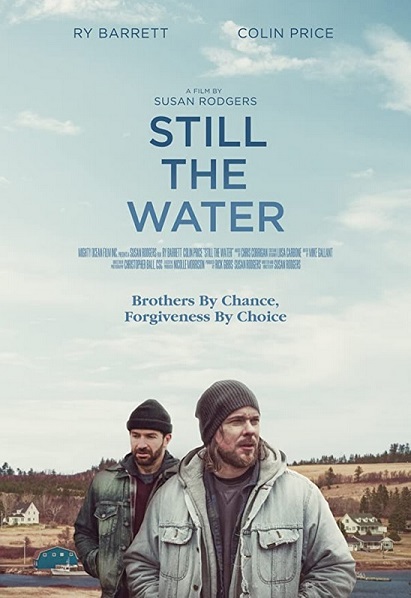
And the Brothers McAuley of Prince Edward Island — the eldest Nicky, the troubled middle child Jordie, and the cooler-passionate youngest Noah — are about to learn a geographical lesson in futility.
The not-so-Musketeers are led by the bullish Nicky, a man-child who hasn’t learned the craft of thinking before he lets his tempers flare. Jordie is a semi-pro hockey star who runs from life’s responsibilities for the ice and comes to discover the “lone wolf” approach to life simply doesn’t work. Noah, for the most part, escaped his father Doug’s alcoholism to mature into a somewhat well-adjusted, approachable free spirit. When Jordie’s propensity in taking out his frustrations on the ice result in his being kicked off his team for fighting, he has no place to go other than home. And while forgiveness lingers in the mists, family resentments towards the hell the now-recovered father Doug’s drinking brewed, lies within the fogs of the past.
This powerful, dramatic feature-film debut regarding the trials and tribulations of family from from writer-director Susan Rogers encapsulates her passions for her Malpeque Bay, Prince Edward Island home; an adoration encapsulated by Cinematographer Christopher Ball (Black Swan; second unit on Aquaman, multiple episodes of SyFy’s Haven). Courtesy of Ball’s experienced eye for crafting shots for his first-time director, Roger’s debut film accomplishes what most movies do not: create a character out of a location.
There’s an err in screenwriting where neophyte writers are of the opinion that characters (if properly written, aren’t “characters” with “motivation”; they’re people with emotions) must speak by words; forgetting that we, as people, communicate silently 70 to 93 percent of the time via facial expressions and body language. A character in a screenplay is a person who drives a plot and inspires other characters, in the effort to create drama. Locations — even objects with a close connection to a person — that inspire and influence characters and drive the plot, also work as “characters” (that’s my opinion and I am sticking to it). Susan Rogers, through her usage of the history and beauty of Prince Edward Island, understands this little-used fact of screenwriting to make the island sing its siren song to the McAuley brothers.
A lesser writer would have had the patriarch-father die and, through a will or some type of legal or heirloom McGuffin, put the three brothers into a cross-country road movie-to-catharsis. We’ve been there on that expanse of asphalt and done that white line fever, ad nauseam. Roger’s debut is a road movie without the road trope; a film where man learns to function as part of an island’s ecosystem and learns how self-sufficiency comes from the reliance of the other and each other.
After completing a successful theatrical and streaming-run in its native Canada, Still the Water is fresh off an equally successful series of U.S. festival showings. It is now available as a free-with-ads stream in North American courtesy of Indie Rights Movies on Tubi TV.
About the Author: You can learn more about the writings of R.D Francis on Facebook.He also writes for B&S About Moviesand publishes short stories and music reviews on Medium.
Disclaimer: We did not receive a review request for this film from its director, distributor, or P.R firm. We discovered the trailer on social media, were intrigued by the film, and we truly enjoyed the film.
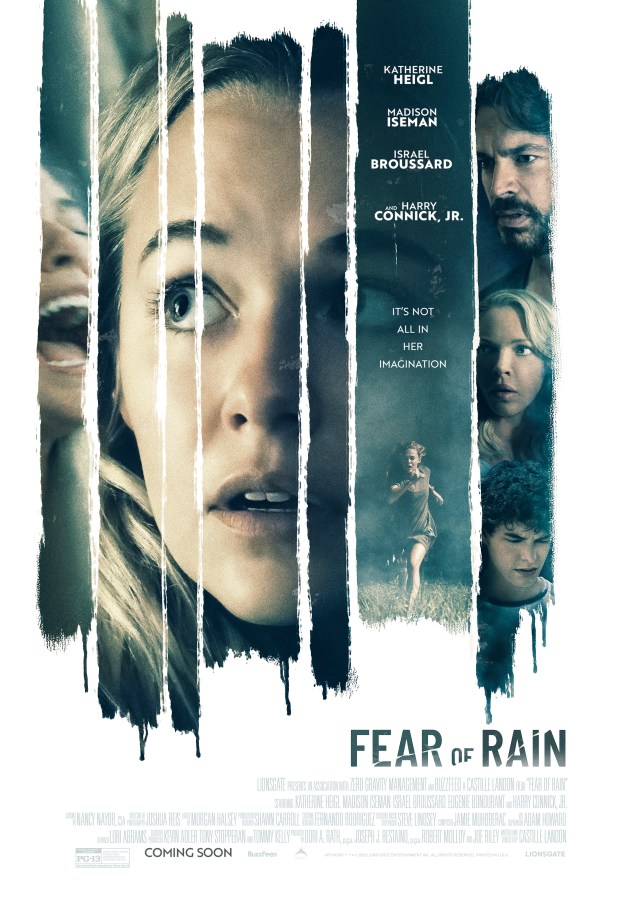
Filmed under the title I Saw a Man with Yellow Eyes — yes, there’s a bit of a giallo in this — Fear of Rain sat was released in theaters — the ones still open — last week and then went straight to video — yes, they still sell DVDs — and streaming.
Written and directed by Castille Landon, this is the story of Rain Burroughs (Madison Iseman, Tales of Halloween, Annabelle Comes Home), a young girl with vivid memories of being chased through the woods by a killer. She wakes in an emergency room with her parents (Katherine Heigl — who is still in movies — and Harry Connick Jr.) and from that moment forward, everything may or may not be real, including love interest Caleb (Israel Broussard, Happy Death Day) and the child being hidden in the attic of her next-door neighbor and teacher Dani McConnell (Eugenie Bondurant).
The movie spends most of its time — perhaps too much of it — on Castille’s trials in school and in starting to romance Caleb to the point that it never builds McConnell into anything more than a cipher. That said, using the mental illness of the lead to make her an unreliable narrator works for the movie, even if some moments, like the evil version of herself showing up in a mirror, falls into tropes that the movie struggles and mostly succeeds to overcome.
Between the dollhouses of McConnell — again, never really explained or explored — and the fact that more than one of the characters in the movie may be living in our heroine’s head, this movie does have that one foot in the world of the murder thriller, but never takes the full leap into being fully strange. And that’s fine — this is meant for a younger audience and not the devotees of Martino, Argento, Lenzi and Lado. It certainly kept my attention for its running time, which is a testament that few modern movies are able to claim.
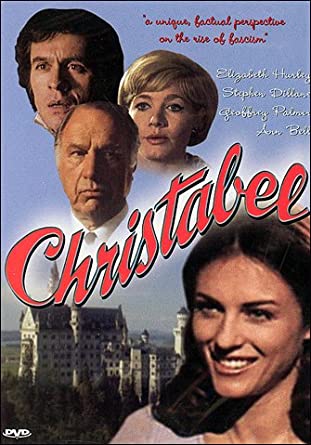
Originally a four-part miniseries adaption of the memoirs of Christabel Bielenberg, a woman who was married to a German lawyer during World War II, the version of this film on the Mill Creek The Excellent Eighties box set is two hours and twenty-seven minutes long, versus the four hour and twenty-minute original running time.
This is yet another example of a film on this set that has an early role for someone who would later become a major star. Christabel is played by Elizabeth Hurley, who had only appeared in the movie Aria and an episode of Inspector Morse before this.
This was written by Dennis Potter, who wrote Gorky Park and Pennies from Heaven. This movie really stood out to me because it showed just how quickly Hitler went from a joke that everyone ignored to something that they had to deal with someday soon to finally, a force that could jail them and destroy their lives. It felt — non-surprisingly — like the last four years of our lives.
This is the great thing about Mill Creek box sets: we probably would have never reviewed this TV Movie obscurity for the site. Well . . . maybe we would have . . . you know us and those “Big Three” network TV flicks of the ’70s and ’80s.
Before Michelle Pfeiffer outshined them all and took over the later DVD boxes.
The cheapjack DVDs you pick up from those cardboard-boxed impulse buy end caps at your favorite retail outlets (Dollar Tree, Marshalls, and Bealls; even those Walmart barrels ‘o plenty in the electronics section) woefully credit Michelle “Catwoman” Pfeiffer as the “star” of this TV mini-series that originally ran for two nights in October 1981. The cast is a TV Movie support cast-dream, with just about every actor who ever booked a supporting role on a ’70s TV series or movie (Joy Garrett, John Harkins, Macon McCalman, and James Sloyan, in particular) appearing in a wide array of bit parts. The cast is not headed by Michelle, but by ubiquitous TV actors Lindsay “Bionic Woman” Wagner, along with Jameson “Simon & Simon” Parker, and the-easily-moves-between-TV-and-film actors Dabney Coleman (McKittrick from WarGames; in production on his 178th project!) and Andrew Prine, who shows us just how great of an actor he really is — and if you’ve spent any amount of time at B&S About Movies, you know Prine’s done his share of Drive-In junk, yet always shines in his role. (If you’re new here and not familiar with Prine’s work The Town that Dreaded Sundown, Simon King of the Witches, and Hannah, Queen of the Witches will get you started down your own Prine-rabbit hole.)
Sadly, Prine isn’t here much, only acting as the story-narrating Kimbel Smyth, as the story of Callie Lord (Wagner) unfolds: She’s a 1940’s unwed mother forced to give up her son for black market adoption. Moving from her small Texas town to the big city of Dallas for a new start (to study to become a courtroom stenographer), she comes to meet newspaper editor-in-chief Randall Bordeaux (Coleman) while working as a waitress. They marry. And understanding her pain, he tracks down her once-a-rebel-always-a-rebel son, Randy (Parker). Now a powerful newspaper editor after her husband’s passing, Callie looses it all when her son is up on murder charges over his gold digging, ne’er-do-well wife (a rather pudgy Pfeiffer; not at all the svelte Cat Woman we know).
If you’re a fan of those prime soap operas of the ’80s, with their ongoing tales of secrets, lies, and betrayals committed by the underprivileged behaving very badly, there’s something here for you to spend your two-plus hours on. Just don’t be duped into thinking Michelle Pfeiffer is running the show, but Lindsay Wagner fans will enjoy it. And while Wagner’s southern accent leaves a bit to be desired, Prine thrives in southern-slang roles; even in voice over, he’s excellent.
Director Waris Hussein, whose TV career began in Britain with a dozen episodes of Doctor Who in the mid-’60s and moved into the theatrical realms with the very early Gene Wilder film Quackser Fortune Has a Cousin in the Bronx (1970), serviceably moves the camera about the solid set design that transitions from the 1940s to the late 1970s. We could easily do a week of just Waris Hussein TV movies, but we’ll call out the two we remember best: The Henderson Monster, a 1980 Frankenstein-esque horrror starring Stephen “7th Heaven” Colllins, and the really good John Savage-starring Coming Out of the Ice, a 1982 Cold War bio-drama. Teleplay scribe Thomas Thompson is an old TV western scribe whose career goes back to the days of The Rifleman, Rawhide, Wagon Train, The Virginian, Bonanza, and High Chaparral, but . . . he penned one of the great TV movies, well two: The Death of Richie (1977) and — the one that we really need to re-watch (and review!) after all these years — the two-night mini-series rating winner, A Death in Canaan (1978), which stars the sorely-missed-from-acting Paul Clemens (The Beast Within).
You can, of course, pick this up as one of the 50 movies offered on Mill Creek’s Excellent Eighties box set. There’s also a freebie upload on You Tube.
About the Author: You can learn more about the writings of R.D Francis on Facebook.He also writes for B&S About Movies.
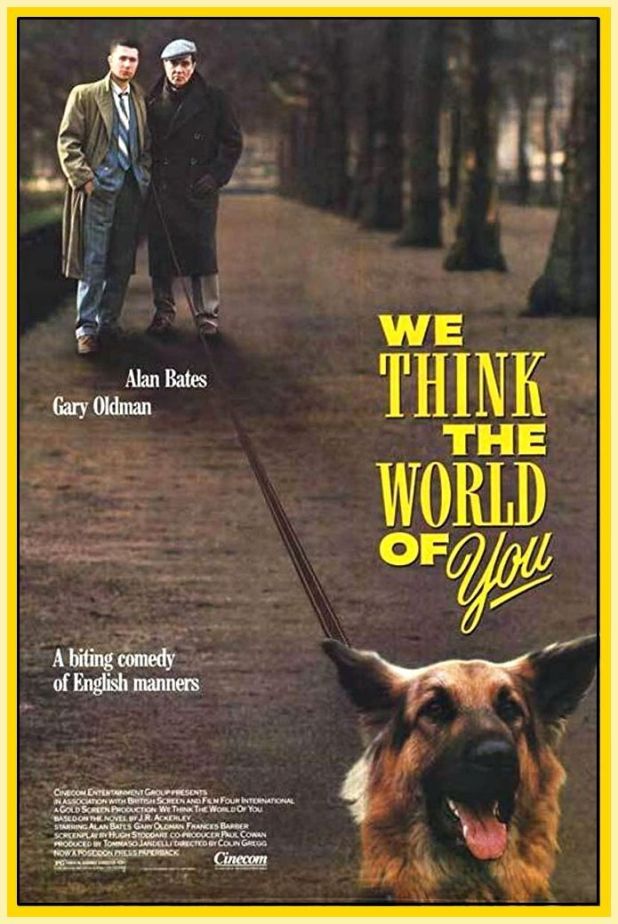
As London recovers from World War II, an aimless young man — who is bisexual and already married — named Johnny (Gary Oldman) is sent to prison. He gives his dog Evie to his parents, Tom and Millie, who are conniving at best and abusive at worst. The man who really falls in love with the dog is Johnny’s older ex-lover and best friend Frank (Alan Bates).
Based on the 1960 J.R. Ackerley novel, this film was directed by Colin Gregg, who also directed the Liam Neeson-starring Lamb, which you guessed it, is also on this Mill Creek box set.
If you ever wonder how much our world has changed, when the trailer for this movie played in the U.S., it was sold as a light-hearted comedy about a dog and nothing was said about the romance between two of its leads.
Join us this Saturday night on the Groovy Doom Facebook page at 8 PM East Coast Time for two deadly features, along with our guest Bradley Steele Harding!
Up first is Evilspeak, one of Sam’s 666 favorite movies of all time. You can watch it on YouTube.
Here’s a drink that you can drink during the movie. We’ll show how, as well as ads for the film before we watch it.
Esteban’s Black Mass
1 oz. Jägermeister
1.5 oz. Kraken
Can of cola
Maraschino cherry
Put all of this into a cocktail shaker with ice and do your dark magic by shaking it up.
Top with a cherry and you’re done. As the last page says, “Yankee Rose.”
Our second movie is the third William Girdler movie we’ve shown, Asylum of Satan! You can watch it on YouTube.
Here’s a drink recipe which you may choose to enjoy during the film.
Snake in the Swimming Pool
2 oz. Southern Comfort
4 oz. cranberry juice
1 oz. lime juice
Build over ice, starting with the SoCo, then followed by the cranberry and lemon.
Based on a series of novels by Anthony Price, this movie was originally part of a six episode ITV series, Chessgame, that was turned into three TV movies: The Alamut Ambush, The Deadly Recruits, and this movie, The Cold War Killers.
Leave it to Mill Creek to drop you into a TV series turned into an edited for time movie with no warning whatsoever.
Terence Stamp, who was one of the villains of my childhood thanks to his turn as General Zod in the Superman movies, stars as David Audley, a Cold War spy exhausted by the secret game he’s been playing against the Russians for decades.
He’s dealing with a missing British bomber, which is found when a small lake is drained to make room for a new housing development. Soon, the simple discovery becomes so much more, as it brings together smuggling, the black market, the KGB, the SS and several murders, all while Audley tries to find love.
Mike Lane, who plays Carmine Longo in this movie, was in several films that fans of our site can appreciate, like Stryker, Ulysses Against Hercules, Grotesque, A Name for Evil, Frankenstein 1970 and Demon Keeper. And Eurospy fans should keep an eye out for Carmen Du Sautoy, who was Saida in The Man with the Golden Gun.
Editor’s Note: Beware of the duplicate titles snafu, for there are two Slipstream movies: The 1973 one by William Fruet of Funeral Home, Baker County, U.S.A., Killer Party, and Blue Monkey fame, which is a Canadian drama about a troubled disc jockey: that’s the Slipstream no one knows. Then there’s the one that everyone knows — and most haven’t seen: the Mark Hamill one that, regardless of its pedigree, fails on all levels. And we wish that Mill Creek would save the 1973 one from obscurity and put it on a box set. You have two choices to pick up a copy of the Mark Hamill Slipstream: we reviewed it on November 5, 2020, as part of their Sci-Fi Invasion set and we’re revisiting it — with this second, alternate take — as part of its inclusion on Mill Creek’s Excellent Eighties 50-film pack, which we are reviewing all this month.
The overseas 25-minute making-of documentary courtesy of Pineapples 101 Movie Memorabilia Emporium blogspot.
This is a movie that many of us encountered, not in theaters as intended (at least not in the U.S.), or on VHS where it ended up: but as an oft-run movie on HBO. And regardless of how many times the pay-channel ran the film, most of us never finished it.
Why? Because it’s boring. But how is that possible?
We have Gary Kurtz who produced the first two Star Wars films with George Lucas at the helm. We have director Steven Lisberger who set the tone for future computer-animated universe films with Tron. And how can we forget Kurtz also gave us The Dark Crystal, and a bit further back, Two-Lane Blacktop and American Graffiti. Behind the camera is Frank Tidy, who got his start working with the Scott brothers, Ridley and Tony, in commercials and came to shoot The Duellists for Ridley, as well as one of the better Star Wars droppings with Spacehunter: Adventures in the Forbidden Zone (a film that’s still eluded a B&S once-over). We’ve got a score by Elmer Bernstein, whose work goes all the way back to Cat-Women of the Moon (you’ve seen, at the very least, ten movies in your lifetime with his composing and/or conducting). Behind the typewriter is, in part, Charles Pogue, who gave us David Cronenberg’s The Fly reboot and the Star Wars-inspired swords-and-sorcery romps Dragonheart and Kull the Conqueror. In the plot department: you’ve got a Mad Mad-cum-The Road Warrior post-apocalyptic vibe about dueling bounty hunters. In front of the camera: you’ve got Mark Hamill from Star Wars and Bil Paxton (who was fantastic) in Aliens, along with support roles by both Ben Kingsley and F. Murray Abraham.
So what went wrong?
Maybe it’s because the film opens with a homage to the “Crop Duster Scene” from Alfred Hitchcock’s North by Northwest (You Tube) that many seemed to miss — and those that “got it,” weren’t wowed by it. Then there’s that kiss of death: the dreaded voiceover that sets up the mythology where “global warming” finally did it: the Harmonic Converge baked the Earth, split the continents and created a “river of wind” that rendered the planet into one big dust bowl. The few who survive are the ones who’ve learned to harness the wind and solar power, just as Al Gore has always hoped for.
Amid this “green new deal” backstory: We meet Will Tasker (Mark Hamill) and Belitski (British actress Kitty Aldridge, who came to marry Mark Knopfler of Dire Straits) who are — as in Mad Max — part of a ragtag not-the-Main Force Patrol law enforcement agency that allows their agents to sideline as bounty hunters. After a run-in with Matt Owens (Bill Paxton) and confiscating his illegal arms contraband, Owens kidnaps Tasker’s bounty (British Shakespearean stalwart Bob Peck) to collect the reward and recoup the cost of his arms shipment. Oh, and Peck is actually a healing-android (he can heal blindness) who perpetually quotes the poems of Lord Byron to communicate his feelings, which leads Owens to call his new solar-wind plane shipmate, Bryon. Before you know it: Owens gets caught up in Bryon’s quest to reach a mystical land beyond the Slipstream where others, like him, live in peace and harmony.
In the end: No one was ready for an off-the-road aviation-version of The Road Warrior (or Kevin Costner’s all-water version, either). And for as many who consider this Mark Hamill’s best role, there are those who say this role — as well as his work (in the even more abysmal) Time Runner (Australian made) and The Guyver (Japanese made) — is why Harrison Ford and not him — became an A-List Hollywood leading man. Yes, there’s a reason why Hamill retreated (abet successfully) into video game and anime voice work: Slipstream is one of those reasons.
Meanwhile, as Hamill kept pumping out one late-’80s clinker after clunker, poor Gary Kurtz didn’t fair much better. After his creative fallout with George Lucas that lead to Kurtz leaving the franchise during the pre-production of Return of the Jedi and still feeling the sting of his first post-Star Wars outing, The Dark Crystal, bombing with critics and audiences, Kurtz was hoping for a box office bonanza that would set up another franchise. Instead, Slipstream — even more so that The Dark Crystal — was a critical and commercial box office bomb that also failed to find a cult audience on home video. The film drove him into bankruptcy that, in turn, lead to his divorce. Worse: he burned though his Lucasian cash windfall to create his fantasy world solely dependent on wind and sun, just like Al Gore always wanted.
So, was it all worth it? The criticism on this British-made sci-fi’er splits down the middle with no middle ground: Star Wars ephemera-oids either love it or hate. And you can decide by checking out Slipstream on Tubi or own a copy as part of its inclusion on Mill Creek’s Sci-Fi Invasion and Excellent Eighties50-film box sets.
About the Author: You can learn more about the writings of R.D Francis on Facebook. He also writes for B&S About Movies and publish music reviews and short stories on Medium.
“Like many immigrant children, I was raised to believe that the prestigiousness of a person’s career directly correlated with how good of a person they were, morally speaking. I was also raised to believe that no such prestigious career would be attainable without first paying for the privilege of a university education. Finally, I was told that my own race and appearance would have no effect on my future prospects in life, or on how people treated me here in Canada. At some point during my life, I realized these were all lies. This film is about my revelation at the bold hypocrisy that pervades throughout the esteemed institution of higher education, and indeed perhaps all western institutions held in high regard.” — Director Li Dong, from the film’s press kit
Any aspiring writer and director who receives an anointing from acclaimed German director Werner Herzog goes to the top of the streaming list of the B&S About Movies’ review stacks. If you read our “Klaus Kinski vs. Werner Herzog Night” Drive-In Friday featurette, you know how we feel about Herzog in these wilds of Allegheny Country.
The creative tales of lawyer-cum-filmmaker Li Dong, who made his feature film debut as a screenwriter with the Canadian feature drama Samanthology (2019), began on the campus of Nova Scotia’s Dalhousie University, where he graduated in 2006 with honours in English and history, and then went on to graduate from Dalhousie Law School. After law school, Li satiated his love of poker as a professional player prior to being selected by Oscar-nominated Werner Herzog for his “Rogue Film School” project. After directing episodes of the Canadian TV drama Model Minority, Li Dong’s now made his feature film debut, as both the writer and director, with this timely exploration of systematic racism — which he experienced growing up in Toronto.
However, despite the suggested heaviness of the material, Stealing School is, instead of a serious drama, an absurdist social satire. It’s a dark comedy that, instead of pointing fingers, offer solutions regarding sociopolitical issues, racial and gender inequalities, and the unilateral powers giving to school administrators of prestigious universities (and the nepotism of our employers in the real world).
Li Dong’s work also questions the value of liberal arts degrees in the real world (April thinks the class, which she’s accused of cheating, is beneath her) — a world now overwhelmed (and ever changing) by globalization and technology — and the resulting anxieties and fears inflicted on the futures of an institution’s students by the world’s archaic social views. As did Italian filmmaker Michelangelo Antonioni’s early ’60s explorations of regarding the alienation of the self in the modern world, Li Dong offers solutions to the development of our neuroses that result from our failure to adapt to our changing environs. While lacking the ubiquitous dead body (but filled with its share of Gogolian dead souls), Stealing School unfolds as a pseudo-film noir rife with analogously James M. Cain-twisted characters driven by ulterior motives and changing allegiances — whose own corruption and egotism becomes their moral and professional undoing.
We come to meet April (Celine Tsai; the Canadian TV series Rising Suns and the Hallmark Channel entry Christmas by Chance), an Asian-Canadian tech prodigy (sent to Toronto from China by her parents) accused of plagiarism by Keith, her humanities teaching assistant (Jonathan Keltz; got his start on Degrassi: The Next Generation and starred as Jake Steinberg on HBO’s Entourage), which jeopardizes her graduation from a prestigious Toronto university. Once friends, their relationship is, at best, acrimonious.
Meanwhile, a newly appointed faculty administrator wants to sweep it under the rug, lest the bad publicity derails her career. Another professor deciding April’s fate deals with clouded judgement as result of a personal grudge against April’s professor. And that professor, in turn, fears April’s fate will expose his infidelities with a student. And the student newspaper-journalism student? He’s looking for a resume-building “scoop” to start his career, so he works the racism angle to his advantage, even going as far as leaking information to off-campus publications.
Is April innocent . . . or did she actually cheat and frame others for her cheating scam. Or is she being railroaded — or not — for others’ personal gains. And what secrets about the racial and professional biases of her professors will come to light. What is the true meaning of accusing another of “guilt” and leaving them fighting for their “innocence” when it can expose an accuser’s own skeletons? For on this university campus, the halls of right and wrong are a murky maze of double-standard corridors . . . with the accuser and the accused ending their journey at a bus stop sharing a cigarette. Which is the martyr and which is the saint. Who is the sociopath let loose on the world to destroy more lives in their quest for professional admiration?
Or is it a shackle?
While Li Dong is obviously a writer and director of extinction, he’s still an indie director scratching and surviving in a streaming verse overflowing with other indie filmmakers in need of funding. And when you’re up against the budget: you write what you know around sets you know can secure. As result of his academic endeavors, Li Dong intelligently handles the poignant material in a budget efficient, subtle manner. In more a established director’s hands backed by a major studio, Stealing School, which also works as a courtroom drama (a university tribunal seated by three professors, with a teaching assistant as the prosecutor and student advisor (a law major) as the defense attorney), could have easily turned into a bloated production filled with matured Disney actors — when it doesn’t have to be bloated. Sometimes, simpler is beter, as “simple” can still convey complex subject matter (and it runs a tight 74-minutes).
In the film’s press materials, Li Dong stated that, despite the film’s potentially weighty subject matter, his first and foremost aim was to create a fun and entertaining film.
He did.
Stealing School rises proudly over the usual indie-streaming norms we experience at B&S About Movies. In fact, when considering the film is lead by a strong, female protagonist-cum-her own antagonist, the film would fit nicely into the female-driven programming blocks of the U.S.-based Lifetime Channel — but Stealing School also rises proudly over the quality of that channel’s “damsel-in-distress” telefilms. The cast of unknown actors are skilled in their roles, Li Dong’s non-linear (which turns off the many; but not me) script is followed with ease, and his camera work is engagingly well-shot.
I look forward to what the Werner Herzog-inspired Li Dong can accomplish with a larger budget on his future feature-film projects.
After its successful premiere at the Napa Valley Film Festival in 2019, Stealing School was released by Game Theory in June of 2020 on the iTunes platform in its native Canada. It becomes available across multiple streaming platforms in the U.S. courtesy Vertical Entertainment on February 26, 2021. You can follow the film on Instagram.
We previously reviewed the 2019 Vertical release, Portal.
Disclaimer: We received a screener for this film. That has no bearing on our review. Film still, theatrical one-sheet, and trailer courtesy of Vertical Entertainment.
About the Author: You can learn more about the writings of R.D Francis on Facebook.He also writes for B&S About Moviesand publishes short stories and music reviews on Medium.




 B&S About Movies
You must be logged in to post a comment.