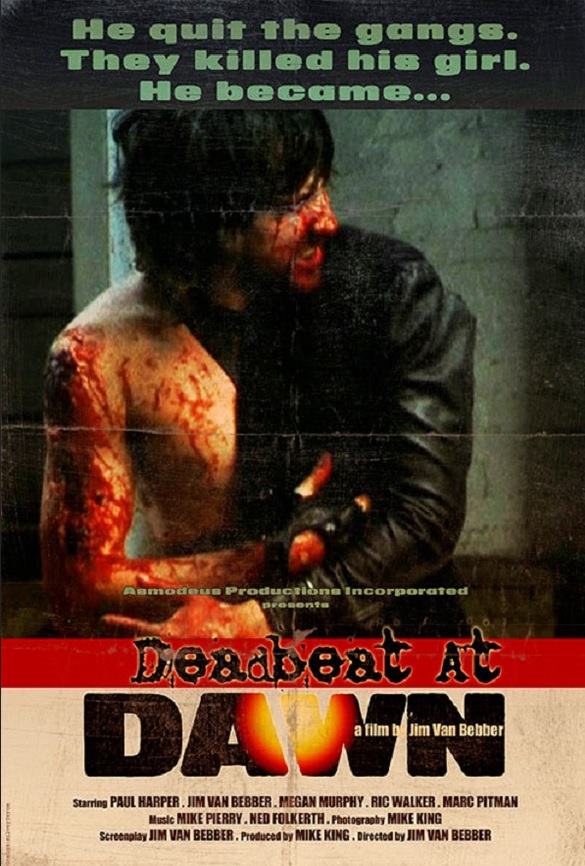
2020 Scarecrow Psychotronic Challenge Day 19: Deadbeat at Dawn (1988)

Day 19: Beyond the Darkness: Watch one with a love story. There’s more than one way to get mushy! (But this also a “two-fer,” as it qualifies as an October “Slasher Month” entry!)

Once more unto the ’80s SOV breach, dear trash video friends, once more, we go — with a film that, for me, works as a homage to the violent n’ gritty, self-destructive characters of Abel Ferrara’s (The App) initial, “video nasty” one-two punch of The Driller Killer and Ms. 45. If you’re familiar with the Ferrara canons — even with his later, more commercial films, such as Fear City and Bad Lieutenant — you know his films are all about the faith and redemption of screwed-up people making do in a screwed-up world.
Watch the trailer.

So goes the life of Danny and Goose (Paul Harper and writer-director Jim Van Bebber) in a tale we’ve seen many times before: The leader of the Ravens wants out to create a better life for him and his girl — and after one, last job, he’s done (as in the recently reviewed The Good Things Devils Do). But once you’re in “the life,” you’re never out. So when the members of a rival gang kill his woman in spite of his wanting to leave the life, Goose is out for an over-the-top, video game-styled revenge (the love-gushy Scarecrow Video part!), full knowing that his bloody rage (that will remind the underground SOV connoisseur of Buddy Giovinazzo’s 1984 debut Combat Shock) will, most likely, leave him dead by dawn. (Don’t believe me? The dudes at the Sleazoids Podcast You Tube paired Combat Shock and Deadbeat at Dawn into one review-show.)

Now, you may have seen that described tale before . . . but not one that’s directed by Jim Van Bebber, baby. His outlandish scripting is supported by kinetic camera work capturing some of the most over the top, slasher-inspired splatter (it’s “Slasher Month” all this month B&S!) that rivals the worst (or best?) of the Italian cannibal genre-boom of the ’70s and ’80s. Seriously. That’s it. That’s the plot. A simple set up giving reason for Goose to set out on revenge — and Goose cutting an ultra-violent swath across the city without reason — well, actually, “for love,” right? This shite that goes down . . . dude, Patrick Swayze would shite his pants in the Road House* that Brad Wesley built. If Road House was made in the grindhouse ’70s — and slapped with an “X,” it would be Deadbeat at Dawn.

So, how did we come to review this SOV classic from Jim Van Bebber? (Yes, it was shot on 16mm, but it’s all about the “vibe” of it all; I lump Don Dohler into the SOV-doms — even though he shot on 16mm and blew ’em to 35. There’d be no SOV ’80s* without Don’s pre-video store, drive-era influences.) Well, first off, I went down an SOV rabbit hole with a review of Curse of the Blue Lights, Jugular Wine, and Tainted for “Vampire Week” and Snuff Kill and Dead Girls for our month-long slasher-horror blow out for October. (Nope, we didn’t forget Blood Cult and Spine, already reviewed ’em!) Then, there’s my upcoming October review for the (not really starring) John Doe flick, 1997’s Black Circle Boys.

Now, if you know that Satanic-not-so-metal flick, you know that it’s based on inspired by the murderous, 1984 exploits of Ricky Kasso (which also, in part, fueled the scripting of 1986’s River’s Edge; a “Psychotronic Month” review is on the way later this month!). And that, in conjunction with one’s Van Bebber fandom, knows that, for his second film, he wrote, directed, and starred in one of the most unforgettable short films of all time, My Sweet Satan (1994). His loose take on David St. Clair’s 1987 expose Say You Love Satan, it tells the story of 17-year-old Ricky Kasso (Van Bebber) and the murderous exploits of the Knights of the Black Circle, which resulted in the sacrifice-death of his friend, Gary Lauwers.
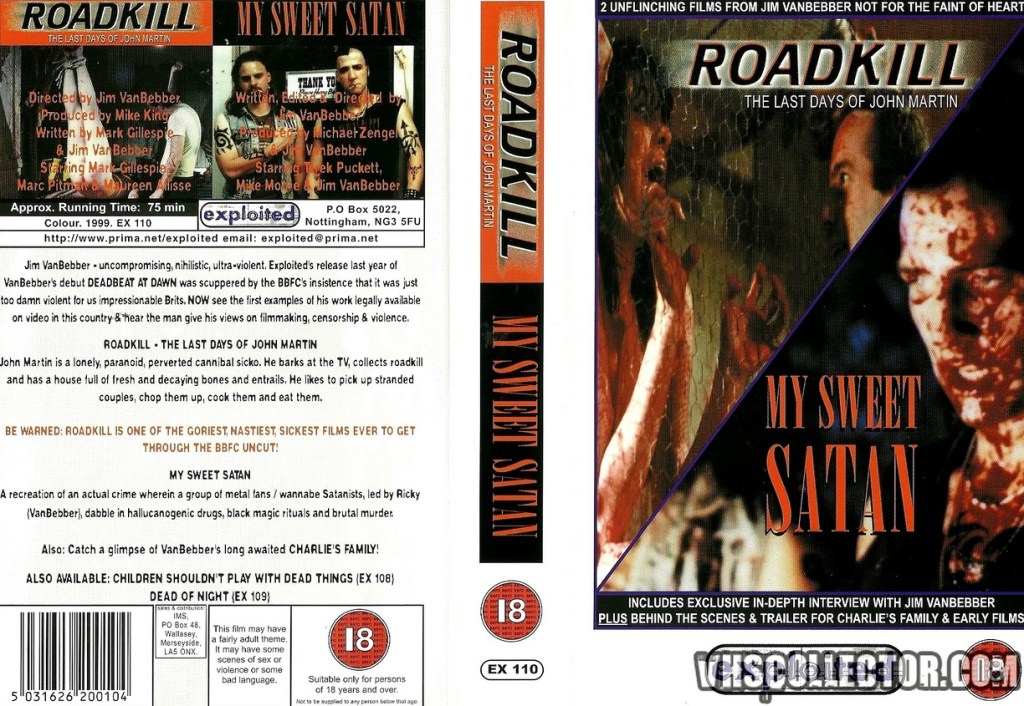
Since released on DVDs available at Amazon.

Oh, and there’s the Rocktober Blood part of the equation. . . .

It’s just another one of those analog-celluloid alignment of the stars at B&S About Movies that makes all the overworked and underpaid writing worthwhile. So we noticed an unusual uptick in views for, not only for our second Rocktober Blood review-take (written in tribute to the death of Nigel Benjamin), but for our investigation of the lost sequel, Rocktober Blood 2: Billy’s Revenge, as part of our “Box Office Failures” week of reviews.

So we hit Google and Bing. Something’s up with Rocktober Blood. Why all of this sudden flurry of hits? Did Paul Zamerelli, over at the Analog Archivist on You Tube, discover something new about the film? Nope. It turns out Petar Gagic over at The Cine-Masochist on You Tube churned up the blood pool on the “No False Metal Classic” (check out our “No False Metal Week” of reviews) with an affectionate, August 14, 2020, review of Rocktober Blood.

Of course, Petar’s brain works like Paul’s, which works like Sam’s, which works like Bill Van Ryn’s, and works like mine’s: the movies just start bleeding together. So, after mentioning the controversy over the failed production of Rocktober Blood 2, Petar’s review logically dovetailed into the controversy between Synapse and Jim Van Bebber regarding the DVD reissue of Deadbeat by Dawn.

Now, if you know your underground SOV cinema, you know all about the infamous Van Bebber voice mails. And you know that the You Tube upload of those calls has long since vanished. But thee ye analog overloads inspired Petar to make a copy — which he included on the tail end (stars at 12:15, for those of you that never heard it) of his Rocktober Blood review. So, it seems, Petar inspired the denizens of the video fringe to Google n’ Bing “Rocktober Blood” once more — 35-plus years later — and they ended up at B&S About Movies.

And, with that final nail in the coffin, so to speak, the spirits from the netherworld spoke: “Ye must write a review of Deadbeat by Dawn, for it has been foretold. If ye doeth not, Jim Van Bebber will kick thou ass and leave not ye a skin cell or corpuscle to be found.”

So, hey, I do not fuck around with the netherworlds, as I have enough problems in my life. So I ye do as they commandeth. For it has been told that for every person that doeth heard of Deadbeat by Dawn, there is the one that hath not. And ye all must bow to the SOV majesty that is the work of Jim Van Bebber.

Amen. I’ve love fucking writing fucking film reviews for this fucking site!

How deep is the fandom for this film? Fans have cut music videos backed with their favorite tunes: Vegaton w/Autopsy, Suzipeach w/Helstar, theangryemonerd w/Reversal of Man, and RueMorgueDweller w/Exodus. Then there’s the clips of fan’s favorite scenes, such as the beloved “Bonecrusher,” the (epic!) “Cemetary Battle,” “Robbery (“Give me your gun, Grandma!),” “Stealing a Motorcycle,” and the fan-cut trailers. And, of course, Petar at The Cine-Masochist did his own review of the film that’s worth the ten minutes of your life.

You can stream Deadbeat at Dawn on You Tube. True Van Bebber fans can watch the film — along with his shorts My Sweet Satan, Roadkill: The Last Days of John Martin, Doper, Kata, Into the Black — in a convenient, one-stop streaming package from Shudder through Amazon Prime. It’s a well-shot, imaginative, over the top movie. Put it on your short list of films that you must watch before making your final, mightily stomps on the terra firma. Or Van Bebber will kick thou ass into oblivion.

Even truer Bebber fans — and aren’t we all — can check out this 2003 Shock Movie Massacre Interview with, wait, is that Dave Wyndorf of Monster Magnet? Nope, that’s Jim!

* Be sure to check out our four-part interview with Road House director Rowdy Herrington. And be sure to check out our reviews of River’s Edge and Black Circle Boys for our deep dive into the life of the sick f*ck that brought us here: Ricky Kasso. And we’ve recently reviewed the Kasso documentary, The Acid King.

* Click through our SOV tag to read our ever-growing list of reviews regarding shot-on-video films from their ’80s VHS-birth to the digital and phone-shot brethren of today.

About the Author: You can learn more about the writings of R.D Francis on Facebook. He also writes for B&S About Movies.

SLASHER MONTH: Scream Park (2013)

Sure, Kennywood gets all the press, but Western Pennsylvania has had plenty of theme parks. Scream Park is shot at Conneaut Lake Park, which is north of the Steel City, closer to Erie. I went there often as a kid and while small, it has a certain charm of its own and plenty of history, as this was its 128th year of being open.

In this film, it stands in for Fright Land, a park that’s about to sadly close down. And that’s where the story begins.

Realizing that he can no longer make money from the theme park, owner Mr. Hyde (Doug Bradley, who is an adopted Pittsburgher that you can often see show up at horror events in town) decides to kill all of his employees as they celebrate the last night of the park being open. He hopes that their deaths will bring the lucrative murder tourists in to attend the newly re-opened park.

Steve Rudzinski, who made CarousHELL, appears in this movie, as does Skinny Puppy’s Kevin “ohGr” Ogilvie, who was Pavi Largo in Repo! The Genetic Opera.

Director Cary Hill has announced a follow-up, Return to Scream Park, which I’m totally down for whenever it gets made. This may not break much new ground, but it’s a competent slasher that has some moments that are really fun. You can watch it on Amazon Prime and Tubi.

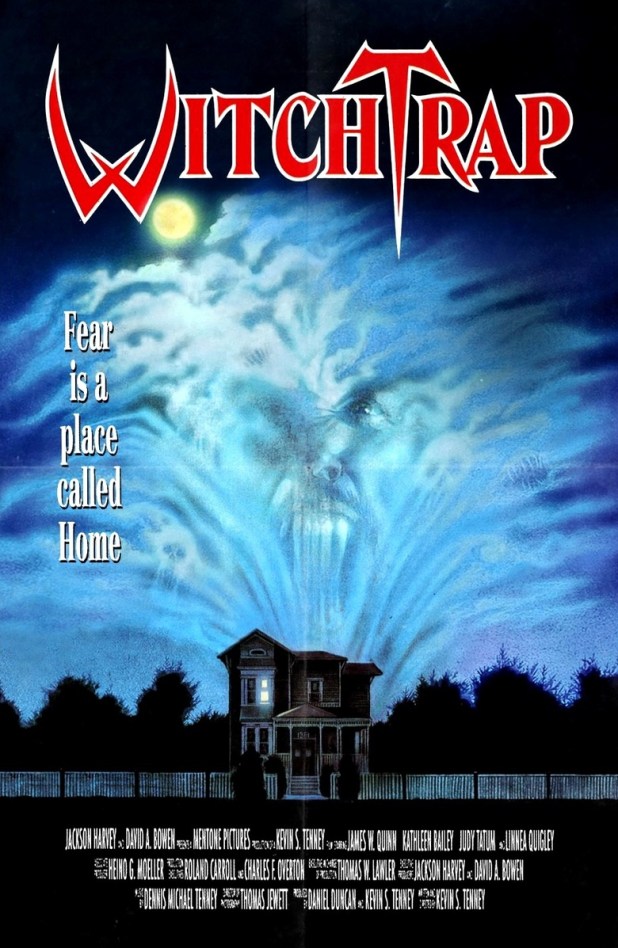
SLASHER MONTH: Witchtrap (1989)

Let’s be perfectly frank. I’d watch a movie that was 85 minutes of people repeatedly making peanut butter and jelly sandwiches as long as Linnea Quigley was in said movie. I’m sure they’d figure out some way to make her take a shower while the sandwiches were being made, which I find to be a bold directoral choice that I would explain to my wife was necessary for the foreign markets.

Anyways — Witchtrap.

You have to admire the dumbness of a movie that has a warlock as the final boss and still calls itself Witchtrap. Then again, the alternate title was The Presence and that’s not as good.

Kevin S. Tenney made two versions of Night of the Demons, along with two Witchboard movies. Here, he tells the story of a team of phenomena busters who have a special machine — a witch trap, if you will — to aid themselves in de-ghosting the Lauder House. Tenney even acts in this, as they couldn’t get another actor in time when one dropped out and hey — he already knew the script.

The whole movie is dubbed thanks to an on set filming error. But hey, if you watch Italian movies as much as me, you’ll gloss over that. I love reading reviews of this movie that decry its wooden acting and long stretches of dialogue. What did you really expect? It’s a direct-to-video 80’s movie. Be happy that there’s a super gory head explosion and Linnea gets in a shower. That said, the shower kills her, but she does fulfill her contractural obligation to jump in the stall. Seriously, why has Bathfitter or ReBath not hired her for a series of commercials?

You can watch this on Amazon Prime and Tubi. Of course, it’s available from the company that must have rented 5 for $5 movies every day of the week, Vinegar Syndrome.

World War Four (2019)

You know, if 2020 has anything left to throw at us, well, World War Three and Four is probably next, right? I mean, after murderhornets.

So what if a war was going to happen? This story explores exactly that, as a series of escalating conflicts throughout Korea and the Middle East lead to more and more fighting, with all the countries of the world ready to destroy one another — which is, you know, what a world war is all about.

Written and directed by New Zealand’s A.K. Strom, who also made End of All Things, this is a tense film that juxtaposes the big moves of military units around the world along with the impact of combat on a military family.

The budget on this is low, obviously, but it really takes advantage of great editing and quite a stock footage budget. If you think all of the military action in this looks real, that’s because it is.

You can get this on demand and on DVD from Midnight Releasing.

DISCLAIMER: We were sent this movie to review, but that does not impact our review.

2020 Scarecrow Psychotronic Challenge Day 18: Deadline (1980)

DAY 18. RESURRECTIONISTS: Watch something that came out on one of the many reissue labels that we love like Arrow, Criterion, Bleeding Skull, Scream Factory, Indicator, Vinegar Syndrome, AGFA etc.

Vinegar Syndrome has a near-magic touch, finding movies that once gathered dust in the back racks of mom and pop video store horror departments and restoring them and doing their homework, getting the filmmakers to contribute and be interviewed so that the fullest picture of what they made can be finally displayed.

Deadline is a great example of what they do.

Writer Steven Lessey (Stephen Young, Soylent Green) is a horror writer who wants to be seen as an artist but is only known for his bloodier stories, such as The Executioners, a film in which children tie up their grandmothers and set them ablaze, or the shower scene bloodbath — quite literally — that opens the film or the gonzo psychic goat that forces a man to shred his own arms off or the appearance by Rough Trade as a band empowered by German scientists to make people explode via their bowels or the children clawing their way out of their mothers. His imagination is quite horrible in all the very greatest of ways and Deadline is at its best when these moments of insanity blast into the frame and by the very end, threaten to overwhelm reality.

While all that art against commerce war is going on inside his head, his marriage is falling apart and the horror of his writing intrudes into his children’s lives in a very shocking way. His agent responds by plying him with coke and women of loose morals, which leads to a brawl while watching his latest film that decimates the fanciest of houses before the drama leads to its foregone conclusion.

Deadline is a film that shocked me in parts and stayed with me way longer than I thought it would. It’s crazy seeing it in such high definition, as this is the kind of film that belongs marked with tracking issues. While he has worked mainly in television, I’ve heard that director Mario Azzopardi has also made a fact-based film called Savage Messiah which is the equal of this film.

This is everything you want from a horror film, whether you simply want an effects-based shocker or something that makes you think about the people who create the horror that helps you escape. Make it your own film. See it your own way.

You can get this from Vinegar Syndrome.

2020 Scarecrow Psychotronic Challenge Day 18: Sometimes Aunt Martha Does Dreadful Things (1971)

DAY 18. RESURRECTIONISTS: Watch something that came out on one of the many reissue labels that we love like Arrow, Criterion, Bleeding Skull, Scream Factory, Indicator, Vinegar Syndrome, AGFA etc.

The American Genre Film Archive (AGFA) represents the world’s largest theatrical catalog of exploitation cinema. Their home video line presents a diverse selection of movies, ranging from new preservations of classics from the vast library of Something Weird to the wildest in shot-on-video (SOV) titles.

They’ve released some awesome things over the last few years, such as Scary MovieGodmonster of Indian FlatsThe Sword and the Claw and so many more. Now, they’re heading to the deepest, dankest and scuzziest parts of Florida to bring you this burst of weirdness.

Shot in Hollywood, Florida, this tale of Stanley (Wayne Crawford under the name Scott Lawrence, he also wrote Valley GirlBarracuda and Jake Speed) and Paul (Abe Zwick in his lone acting role) starts after they escape from Baltimore and go on the lamb. Paul begins to dress in drag and act as Stanley’s Aunt Martha while falling for Stanley, who only wants to do drugs and freaks out the moment a girl starts to undo his pants.

Thomas Casey wrote and directed this. This is the only movie he’d direct, although he also wrote Flesh Feast. That’s a shame that he didn’t make more films, because this movie captures the seedy side of life better than most. I honestly have no idea who this movie is for — at the time that it was made — but know that it’s perfectly made for maniacs like me who buy nearly everything AGFA puts out.

Florida is a weird state. The movies that come out of it are even stranger. This is probably one of the oddest. You can get this now from AGFA (through Vinegar Syndrome).

2020 Scarecrow Psychotronic Challenge Day 18: Warning from Space (1956)

DAY 18. RESURRECTIONISTS: Watch something that came out on one of the many reissue labels that we love like Arrow, Criterion, Bleeding Skull, Scream Factory, Indicator, Vinegar Syndrome, AGFA etc.

The majority of my paycheck? That goes to my wife.

The rest goes to movies.

Arrow Video gets a good chunk of what I have and they’ve been putting out an amazing mix of films this year, including plenty of wonderful Japanese films like 1958’s Uchūjin Tokyo ni arawaru. (Spacemen Appear In Tokyo), which was released in the U.S. as Warning from Space. It was the first color science fiction movie made in that country.

Made by Daei, the same people who would gift us with Gamera, and released in the U.S. eleven years after it came out in Japan, this movie has been pointed to as one that Kubrick watched as he grew fascinated with science fiction.

The Pairan aliens of the film are perhaps the best reason to watch this. They’ve never looked better than now, with the gorgeous remastered transfer that’s on Arrow’s new disk. Designed by avant-garde artist Taro Okamoto, they’re unlike any aliens we’d imagine in the West. Instead of humanoid creatures, they’re stars that dance their strange ballet toward camera as they wonder how to reach Earth’s scientists.

One of those aliens decides to take the form of entertainer Hikari Aozora and reach out to our scientists and World Congress to borrow our nuclear weapons to obliterate another planet in the path of our world called Planet R. As no one decides to listen to her, we’re forced to deal with all the impact of having a rogue planet come closer and closer to us. The whole “listen to science’ mantra that our world is ignoring happens here as well, but sadly, we don’t have human-sized star aliens with one giant eye to right our course.

Trust me, just watch those Pairans bounce around your screen is worth the price of this blu ray. The new Arrow Video edition of this movie also features commentary by Stuart Galbraith IV, author of Monsters Are Attacking Tokyo!, and a newly restored English dub track.

DISCLAIMER: We were sent this film by Arrow Video. That said, we spend a lot of money on movies and don’t change our reviews just because we get review copies. Buy physical media!

2020 Scarecrow Psychotronic Challenge Day 18: Island of Blood (1982)

DAY 18. RESURRECTIONISTS: Watch something that came out on one of the many reissue labels that we love like Arrow, Criterion, Bleeding Skull, Scream Factory, Indicator, Vinegar Syndrome, AGFA etc.

Vinegar Syndrome has been assaulting my budget this year, what with box sets of the Amityville direct-to-video films, forgotten Spanish giallo, Mexican horror reissues and, of course, Spookies.

They’ve rescued hundreds of movies from their namesake, the chemical reaction that deteriorates motion picture film over time. Chances are, if it was a movie that played a drive-in, grindhouse or was in the horror section of your mom and pop video store in the 1980’s — or the back room, where you had to sneak in — then they have it.

Imagine, if you will, that someone made Agatha Christie’s And Then There Were None, but made it about actors on a deserted island and started with one of them being boiled alive. Yes, that’s the movie we’re speaking of right now, 1982’s many titles Island of Blood AKA Whodunit? AKA Scared Alive).

Oh yeah — every murder in this is based on a punk song! That said, the lyrics to the song are mostly “stab me, boil me, burn me, face to face.” Therefore, it really isn’t a large stretch for the murderer to use the ways to kill in the song to, you know, kill.

The very same song features the lyrics, “Lonely as a child- you were wet, you were wild. You were… selfish. Crying out late at night with your covers pulled up tight- you were… helpless. Fear me! Fear me!”

All manner of murders follow, as simple as an exploding boat and as complex as a shower that sprays out battery acid. That takes some planning.

I wouldn’t say this is the finest slasher you’ve never seen. Nor would I claim that it’s even really all the good. But hey — if you’ve made it through everything and you’re hunting down slashers that no one else has watched — I’m speaking to myself — then this will do.

Writer/director William T. Naud also made Hot Rod HullabalooThunder In DixieBlack Jack and Ricky 1, a movie where a male gigolo becomes a boxer.

You can watch this on Tubi or order it from Vinegar Syndrome.

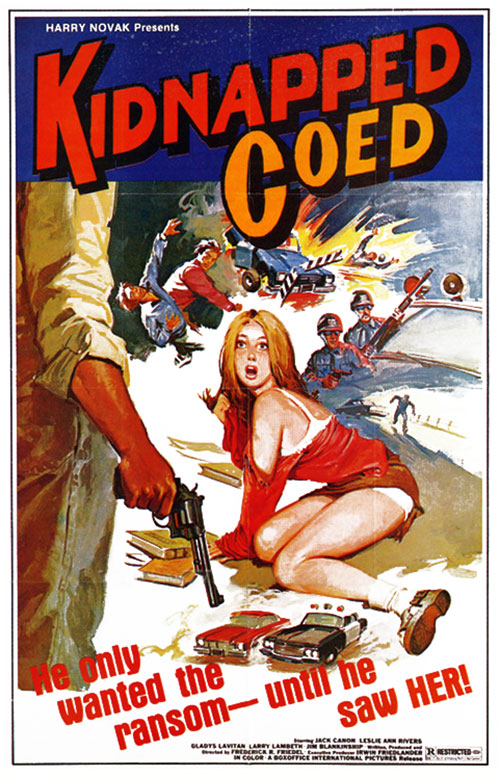
2020 Scarecrow Psychotronic Challenge Day 18: Kidnapped Coed (1976)

DAY 18. RESURRECTIONISTS: Watch something that came out on one of the many reissue labels that we love like Arrow, Criterion, Bleeding Skull, Scream Factory, Indicator, Vinegar Syndrome, AGFA etc.

I remember being at a convention and seeing my first Severin booth and thinking, “If I start buying these movies, I’m never going to stop.”

I can’t always predict the future all that well, but after my first purchase — Dr. Butcher M.D., in case you wondered — I keep buying something from this label almost every single month.

The films of Frederick R. Friedel set — which also has Axe and Blood Brothers — is just one of so many examples as to why I love Severin. Not only have they taken a Video Nasty and a drive-in obscurity and made them look better than they ever have before, they’ve also found almost everyone that worked on these films, gotten their side of the story and explain what actually happened before, during and after they were filmed.

Jack Canon, who the credits erroneously refer to as the kidnapped co-ed, plays Eddie Matlock, who is really the kidnapper. He was also in Axe, Maximum Overdrive and Trucker’s Woman. As the film begins, he’s already taking Sandra Morely (Leslie Rivers) captive. Her father puts a big ransom out for her return, so other criminals now are after them both to try and get paid.

Also known as Date With a Kidnapper, this is 75-minutes of a movie where things just happen for no reason, with no set-up or explanation. Axe is a movie where nothing happens for long stretches of time, while this is the opposite, a movie where all kinds of things happen and the Stockholm syndrome is in full effect — although the kidnapper isn’t truly the villain he seems to be when this all begins.

This film looks gorgeous, getting every cent of its budget on the screen, and was shot by Austin McKinney, who worked on all sorts of genre films, from shooting Boris Karloff’s four Mexican films (The Snake PeopleHouse of EvilIsle of the Snake People and Alien Terror), Hot Summer in Barefoot CountyGetting It On and Jaws 3-D to being part of the sound crew on Hellraiser III and A Nightmare on Elm Street 5: The Dream Child to working on the special effects team on movies like Beastmaster 2Escape from New YorkBattle Beyond the StarsSorceress and The Terminator. He was even the uncredited editor for The Beast of Yucca Flats and the production manager for The Incredibly Strange Creatures Who Stopped Living and Became Mixed-Up Zombies!!?

You can get this from Severin.

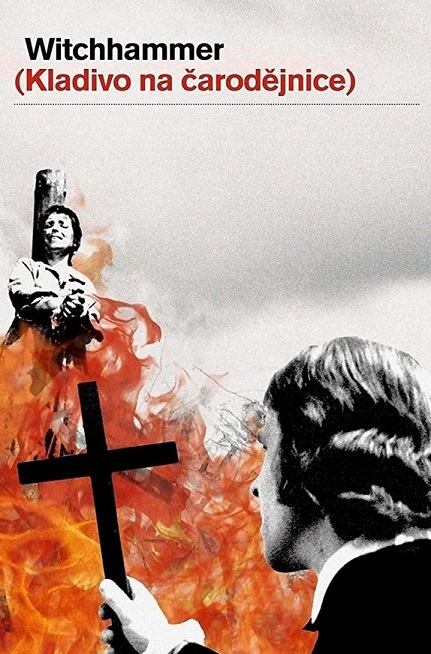
2020 Scarecrow Psychotronic Challenge Day 18: Witchhammer (1970)

Day 18: Resurrectionist: Watch something that came out on a reissues label

Courtesy of AIP Studios’ Witchfinder General (1968), everyone knows of the exploits of British witch-hunter Matthew Hopkins (as portrayed by Vincent Price) and his fictionalized counterparts in Count Christian von Meruh and Lord Cumberland (as portrayed by Udo Keir and Herbert Lom) in Mark of the Devil (1970) and Mark of the Devil II (1973). And now you’ll learn of the even bloodier exploits of Witchfinder Inquisitor Boblig von Edelstat.

Witchcraft was born during Europe’s transition from the Dark to the Middle Ages. For over five hundred years, fueled by ignorance and religious paranoia, governments decreed their countries be cleansed of evil and immorality. Thus, through armies funded by churches, soldiers hunted down the witches who carried the pestilence. Entire villages were laid waste, in acts analogous to the social cleansings committed by the third world countries of modern society. In fact, the acts committed by Witch Hunters in the name of the Lord surpassed the body count of modern day serial killers. Thus, the witch hunts led by General Cromwell and Matthew Hopkins begat McCarthy’s Red Scare in the nineteen-fifties. And the witch hunts begat the gathering of Japanese-Americans during World War II, and the Nazi regime shipping Jews, Pols, and Slavs on trains to their deaths. And the burning of witches at the stake begat African-Americans tormented with religious symbols wrapped in gas soak rags. The brutal truth of the world’s current sociopolitical system: these same hunts and killings, based in ignorance, continue. In today’s world of light and knowledge, men continue to invest in fear, ignorance, and greed. Will man ever be capable of conquering the delusions, the urges, and the ugliness? When will witchcraft disappear from our society?


Born in Austria-Hungary, Czech Republic filmmaker Otakar Vavra ranks alongside Denmark’s Carl Theodor Dreyer (1928’s The Passion of Joan of Arc and 1932’s Vampyr) as a first-rate director with a career that is, sadly, outside of their respective homelands (and the most discriminating, international film aficionadi), fading from our celluloid memories. Vavra’s IMDb page, while cataloging his oeuvre in full, the individual pages for those films are barren; not only are no plots or synopses offered, there’s no user or critic reviews.

Vavra is the cinematic equivalent of Polish futurologist and sci-fi writer Stanislaw Lem (Solaris, The Astronauts, The Magellan Nebula*): for as many of Lem’s books that have seen English adaptation, many never will—and many of us will never experience all—if any at all—of Vavra’s films. Across his 53 directing and 56 writing credits from the early ’30s up until his 2011 death, less than twenty of his films have expanded outside of Europe into the English-domestic marketplace. Some made the transition to the VHS format and later DVD format, but most have not been honored with digital preservation.

After three shorts, Vavra made his feature film debut as a director with the comedy Camel Through the Eye of the Needle (1937) and followed with the drama Virginity (1937). He closed out the 1930s with his two best-known and revered films: the historical dramas The Merry Wives (1938; hailed by the U.S. film trade Variety) and the working class-morality tale The Magic House (1939). Prior to those directing efforts, he wrote seven screenplays: the most notable of those is the comedy Three Men in the Snow (1936); the film’s homeland success initiated his directing career. His career culminated with a teaching position at Prague’s Film and TV School of the Academy of Performing Arts, a position he held since the 1950s. He was awarded the Czech Lion in 2001 and a presidential Metal of Merit in 2004 for his contributions to Czech cinema.

His other widely-distributed, directorial works include:

  • The Masked Lover (1940) — a romantic comedy concerning a Czech General
  • Enchanted (1942) — a romantic comedy
  • I’ll Be Right Over (1942) — a slapstick comedy
  • Happy Journey (1943) — a romantic comedy
  • Rozina, the Love Child (1945) — a historical drama
  • Against All (1957) — a historical war drama; part of the “Hussite Trilogy,” which are three of the most expensive Czech films ever made, with Against All as the most expensive at 25 million Czech Koruna (1.2 million U.S.)
  • August Sunday (1961) — a comedy
  • Night Guest (1961) — a drama
  • Golden Queen (1965) — a psychological drama
  • Romance for Bugle (1967) — a drama that won the Special Silver Prize at the 5th Moscow International Film Festival
  • Days of Betrayal (1973) — a historical war drama that won a honorary diploma at the 8th Moscow International Film Festival
  • Sokolovo (1974) — A Soviet co-production about the ’43 Battle of Sokolovo
  • The Liberation of Prague (1977) — a historical war drama; the third of a trilogy that began with Days of Betrayal and preceded by Sokolovo
  • Dark Sun (1980) — a crime drama that serves as Vavra’s rare foray into sci-fi that serves as a remake of his own 1948 film Krakatit
  • The Wanderings of Jan Amos (1983) — a biographical drama about 17th century Christian crusader Jan Amos Comenius


And that brings us to Vavra’s lone foray into the horror genre, a historical-drama concerned with the brutal inquisition of witches during the medieval era—a film that is heralded as Vara’s chef-d’œuvre and won several awards at Argentina’s Mar del Plata International Film Festival in 1970. One of those wins was for cinematographer Josef Illik who, after watching Witchhammer, you’ll wonder why Illik’s name is not as revered in international film circles as Hungarian-American cinematographer Vilmos Zsigmond (Deliverance, Close Encounters of the Third Kind).

Based on the best-selling Czech history novel Kladivo na čarodějnice (1963) by Vaclav Kaplicky, the 17th century tale chronicles the real-life, human rights atrocities of the North Moravia Witch Trails of the 1670s by Witchfinder Inquisitor Boblig von Edelstat in which 100 people were murdered. The book’s main protagonist, Priest Josef Lautner (Kryštof Lautner in the film), is a cleric who tries to help his people, but soon falls victim to the trails for opposing “God’s Law.” The book is heralded as an important to literary lesson of man’s ills in political-based paranoia and political prosecution on-level with Arthur Miller’s The Crucible (1953) (required high school reading; at least it was for me).

The resulting film adapted by Vavra was banned, ironically, not for its graphic nature, but for Vavra adapting the film as an acidic allegory to the Communist show trails that rocked Czechoslovakia in the 1950s. While the film was banned from showing by the Czechoslovakian government, it was accepted by the international marketplace as a cinematic masterpiece.

The atrocities began with an altar boy observing and reporting a destitute old woman hiding the bread given out during Holy Communion—a theft that she admits to, with the intend to feed it to her barren cow to re-enable its milk production. The indiscretion of hoarding holy bread, according to Witchfinder Inquistor Edelstadt, smacks of “witchcraft,” as based on his interpretation of the Catholic treatise The Malleus Maleficarum, aka Hammer of Witches (thus, the film’s title). The thumbscrews and other torture devices are dispatched in quick succession—and a young priest who opposes the trails soon finds himself among the wrongly executed.

Even if you’ve watched the admittedly more sensationalistic, West German-produced Mark of the Devil, aka Witches Tortured til They Bleed (1970), its sequel Mark of the Devil II, aka Witches Are Violated and Tortured to Death (1973), and the more reserved, Gothic-slanted AIP film that inspired its production: Michael Reeves’s Witchfinder General, aka The Conqueror Worm (1968), you’re not going to be prepared for this horrifying lesson in the absolute corruption of power. We won’t sugarcoat: Witchhammer, as was Pier Pasolini’s Salo, or the 120 Days of Sodom, isn’t pleasant (Pasolini’s film even more so), but it is an exquisite example of perfection in cinema.

You can watch Witchhammer on You Tube, but there’s a far superior, superb DVD rip available on the European F Share TV free-with-ads VOD platform. There’s an account sign-in viewable trailer on You Tube (due to graphic content). DVDs are readily available in the online marketplace at a wide variety of eRetailers or you can buy direct from Arrow Video.

Other classic witchcraft films to supplement your viewing of Witchhamer are the Sweden-Denmark co-production Haxen (1922) and Carl Theodor Dreyer’s own forgotten classic, Day of Wrath (1943).  We also examine the life of another Middle Ages’ serial killer of the von Edelstat variety, Gilles de Rais, and his inspiration behind two films by Spain’s Paul Naschy: Panic Beats and Horror Rises from the Tomb.

About the Author: You can learn more about the writings of R.D Francis on Facebook. He also writes for B&S About Movies and publishes on Medium.