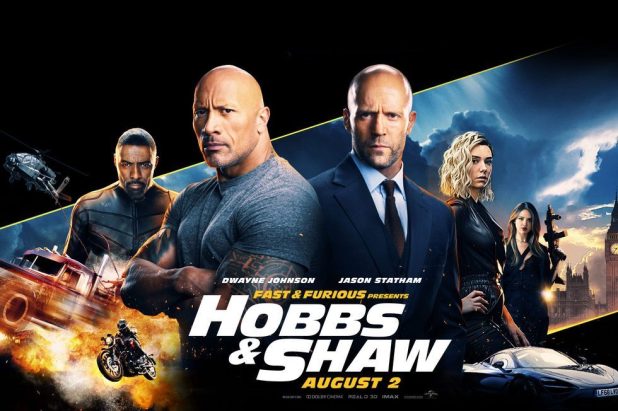
We did it! We made it through an entire week of Fast & Furious movies and let me tell you, we saved the best for last. This is a big, dumb, ridicuous and way too overblown action movie and I have to confess, I loved every single minute of it.
It was directed by David Leitch, whose first time directing was John Wick. He’s since made Atomic Blonde and Deadpool 2. Before that, he appeared in some action films of his own, such as Ninja Assassin, The Mechanic remake and as Terry Bogard in the movie version of the video game The King of Fighters.
Vanessa Kirby is the person who brings the action together. She plays Shaw’s sister Hattie, an MI6 agent who has been infected with a Snowflake virus that a terrorist group known as Eteon wants. They are led by an unseen commander and his henchman Brixton Lore (Idris Elba), a cyborg that has a past history with Deckard (Jason Statham). And Deckard, well, he has to learn to work with Hobbs (Dwayne Johnson).
If you look closely enough, Brixton has a Weyland Corporation symbol on his shoulder. So…will there be xenomorphs in the next film?
That director was supposed to be played by Keanu Reeves. The voice is supposedly Ryan Reynolds, who also appears in this movie as CIA agent Victor Locke. The name in the credits is Champ Nightingale”, which Reynolds has used in a fake Amazon review for his Aviation American Gin.
Beyond meeting more of Shaw’s family, Hobbs goes back to his homeland and we discover his brothers Jonah (Cliff Curtis, Once Were Warriors) and Mateo (WWE star Roman Reigns, who Johnson considers a cousin). Jason Mamoa was also supposed to be in this, but Johnson has promised that it will happen in the next movie.
Eiza González from Alita: Battle Angel and Baby Driver (as well as Satanico Pandemonium in the TV version of From Dusk to Dawn) is in this, too. She plays Madame M, a former associate of Shaw who helps them break into the terrorist’s base.
You know, for being in a G.I. Joe film, Johnson made a way better version of it with this movie. He loves this role, as you can tell, and even named his French bulldog — who shows up in he beginning — after his character.
Seeing as how this movie grossed $541.9 million worldwide during its opening weekend, we’re not going to see the last of these movies for some time. Interestingly enough, star Vin Diesel was also in the movie that broke that record, Avengers: Infinity War ($640.5 million) and the movie that broke that record, Avengers: Endgame ($1.481 billion).
Following the defeat of Deckard Shaw, Dom (Diesel) and Letty Ortiz (Michelle Rodriguez) are on their honymoon when Charlize Theron appears. She’s Cipher, a cyberterrorist who coerces Dom into working against his team — and family — by holding his former lover Elena (Elsa Pataky) and their son hostage. Yes, welcome to the world of the fast and the furious and the people who don’t reveal that they’ve had a baby to the lovers they give up when the old girlfriend comes back with amnesia.
This is the first installment to be directed by F. Gary Gray, whose work on The Italian Job had to have helped. He also directed Friday, Straight Outta Compton and some music videos that ruled 90’s and 00’s pop culture like “It Was a Good Day” by Ice Cube, “Natural Born Killaz” by Dr. Dre and Ice Cube, “Keep Their Heads Ringin'” by Dr. Dre, “Waterfalls” by TLC, and “Ms. Jackson” by Outkast. He had worked with Diesel in A Man Apart, Johnson in Be Cool and Statham, Theron and Olek Krupa in aforemention The Italian Job.
For those that love controversy, this was also the movie that the feud between some of its actors began.
A week before filming ended, Johnson posted this missive: “This is my final week of shooting #FastAndFurious8. There’s no other franchise that gets my blood boiling more than this one. An incredible hard working crew. Universal has been great partners as well. My female co-stars are always amazing and I love ’em. My male co-stars however are a different story. Some conduct themselves as stand up men and true professionals, while others don’t. The ones that don’t are too chicken shit to do anything about it anyway. Candy asses. When you watch this movie next April and it seems like I’m not acting in some of these scenes and my blood is legit boiling – you’re right. Bottom line is it’ll play great for the movie and fits this Hobbs character that’s embedded in my DNA extremely well. The producer in me is happy about this part. Final week on Fast 8 and I’ll finish strong. ;/ #IcemanCometh #F8 #ZeroToleranceForCandyAsses”.
This post came about as co-star and Executive Producer Diesel supposedly cancelled some of Johnson’s planned scenes at the last minute. On several occasions, Diesel didn’t show up when scheduled, leaving hundreds of cast, crew, and extras waiting on-set for him for more than six hours.
The two had a secret meeting after this message and it turned out that Johnson’s spin-off, Fast & Furious Presents: Hobbs & Shaw, was the major bone of contention. Co-star Tyrese would also grow upset about this and tweet how that movie would delay F9 for an entire year (pre-COVID-19, of course; now it’s even later).
Johnson stated that he would probably pass on another film in this series and wished Diesel, “all the best and I harbor no ill will there, just because of the clarity we have. Actually, you can erase that last part about ‘no ill will.’ We’ll just keep it with the clarity.”
Let’s end on a more positive note: this movie features two Oscar winners. Beyond Theron, Dame Helen Mirren joined the cast as the Shaw brother’s mother. She told Graham Norton and numerous other interviewers that she had an ambition to be in one of these films and just have fun. Diesel heard this and got her added to the large cast.
Roger Corman loved making deals to get the movies on the screens.
In a deal similar to the one Corman made with Ron Howard years later for Grand Theft Auto, Corman agreed that if John Ireland starred in The Fast and the Furious (1954), the then down-and-out actor could direct the picture. So when Corman decided set designer Daniel Heller (for all of Corman’s Edgar Allan Poe features, especially 1960’s House of Usher and 1961’s The Pit and the Pendulum) was ready for another picture, another deal was struck.
By that point, Heller had a solid relationship with Corman and already directed his first film, the H.P. Lovecraft adaptation Die, Monster, Die!(1965) and the biker flick Devil’s Angels (1967; with John Cassavetes). When Corman conceived the idea of Heller directing a racing flick centered around the European Grand Prix circuit, Heller pulled out his ace-in-the-hole: If Corman would finance Paddy (1970), Heller’s pet project adaptation of Irishman Lee Dunne’s raunchy sex-comedy Good-bye to the Hill, he’d undertake — for a Corman A.I.P production — the ambitious shoot that shot across six countries in less than six weeks.
That’s what’s awesome about Corman: he always took care of those who were loyal and dependable workers.
Then Heller returned the favor to (loves!) Mimsy Farmer.
Farmer transitioned from a career of bit roles on ’60s TV series into the forgotten drive-in fodder that was Hot Rods to Hell (1967; for MGM), Riot on Sunset Strip (1967; for A.I.P), and the aforementioned Devil’s Angels. With her career going nowhere fast, she soon took a job in a Canadian hospital. Then Heller gave her a call to star in The Wild Racers (alongside a young Talia Shire, aka then Coppola, sister of Francis Ford, in her feature film debut; she was another Corman crew member given a shot to live her dream). Farmer jumped at the chance to go to Europe for free and be able to visit her brother in London.
The Wild Racers ended up re-ignited her flagging career — now solely based in Europe — with respected directors Barbet Schroder (best known in the states for the later Barflyand Single White Female) casting her in the drug-drama More (1969) and Eriprando Visconti (of the oft ripped off, 1976 kidnap drama La orca) casting her in his Russian war drama Strogoff (1970). Readers of the B&S About Movies variety infatuated with all things giallo came to know Farmer for her work in Argento’s Four Files on Grey Velvet, along with The Perfume of the Lady in Black and Autopsy.
Yep. There’s nothing like the Corman touch to get careers rolling.
Sadly, the same can’t be said for Fabian (Forte) who was never able to parlay his eleven-song run of Billboard Top 100 hits into a career that rose to the Euro-respect of Mimsy Farmer — or Talia Shire, who made it to the Golden Globes and the Oscars as result of her work in 1976’s Rocky.
True, Fabian was under contract with 20th Century Fox, but he never became “a star,” thanks to the quickly forgotten drek he was cast in, like Hound Dog Man (1959) — which was a virtual rewrite of Fox’s Elvis vehicle, Love Me Tender (1956). And there’s no argument that High Time and North to Alaska are minor entries in the Bing Crosby and John Wayne canons (even my dad, a huge Duke fan, said North to Alaska, sucked). Then Fabian was with Paramount — to co-star with another teen idol, Tommy Sands — in more junk, this time, it was Love in a Goldfish Bowl (1961). Then with Columbia, it was the forgotten beach drama Ride the Wild Surf (1964).
It wasn’t Fabian’s fault. He’s an affable, naturally-skilled actor. It’s that the studios kept casting him in junk. Yeah, sure Mr. Hobbs Takes a Vacation (1962) with Jimmy Stewart and The Longest Day (1962) with John Wayne and Henry Fonda were well-made box-office hits — but who remembers those films as “classics” all these years later?
By that point, Fabian was down to picking up the occasional guest-star roles in ’60s TV series. Then Roger Corman came-a-callin’ and cast Fabian in his first film for A.I.P., which was the stock car racing drama Fireball 500 (1966) with Corman’s “Beach Party” stars Frankie Avalon and Annette Funicello; then they hit the stock car track a second time in Thunder Alley (1967), and wrapped-up their pre-Fast and the Furious “trilogy” with The Wild Racers. Let’s not forget the Fab’s “mature” gangster romp with A Bullet for Pretty Boy (1970) that also failed to connect with audiences.
When Fabian’s seven-film contract with A.I.P. ended — and as with Paul Newman and Steve McQueen (and later, Tom Cruise and Paul Walker) before him — working on Corman’s flicks ignited his love of racing — which ended with a 1978 accident during a Mojave Desert stock car race. After that, critics may say that Fabian floundered, but we love him in Soul Hustler (1976), the trashy-insane Disco Fever, and the cheap-but-loveable slasher Kiss Daddy Goodbye (1981).
I know. I know. Another review where it’s off-the-rails with trivia — and little plot. But seriously: when did any of these forgotten drive-in potboilers have much of a plot in the first place — an wasn’t a ripped from another film in the second place?
Ugh. Another trailer bites the dust. Well, give this 2022-uploaded clip a spin. Soundtrack lovers will dig this rip of the ’60s surf-themed title-credits song from the film.
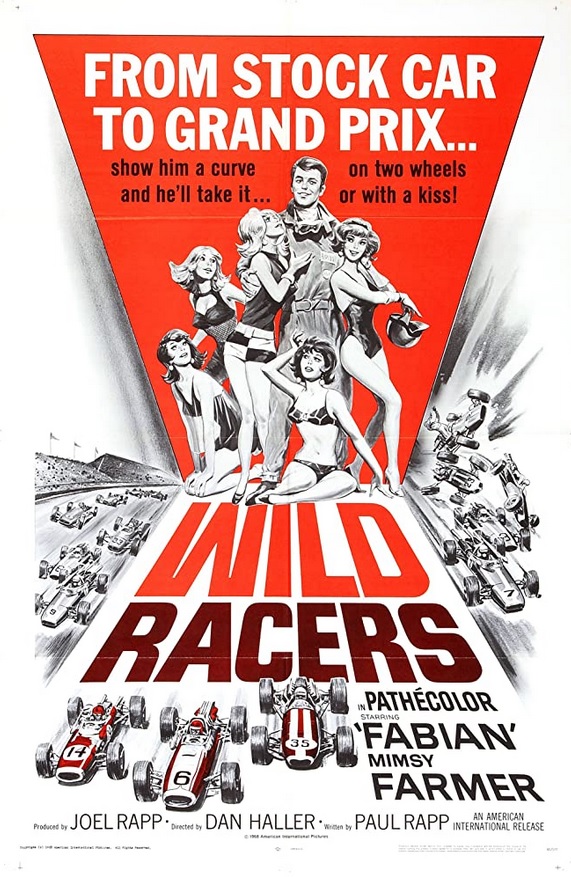
Fabian is Jo Jo Quillico, an American stock car racer who’s career is on the skids (sorry) after causing a fatal accident. So he flees to Europe. There — and in a plot swiped from just about every film noir-cum-mobster movie about a pug boxer — Jo Jo is hired by a racing tycoon to be “take a dive” driver, so as to make the team’s more experienced driver look good. But Jo Jo’s ambitions get the best of him and he proves he’s a better driver that the guy he’s hired to take dives for. (Again: name a boxing movie.) Then, as Sam, B&S Movies’ editor-in-chief would say: “romance ensues amid the asphalt and rubber.”
Joe Dante and Quentin Tarantino have said The Wild Racers is an avante-garde, Antonioni-esque art film with little dialog, lots of voice overs, and a quick series of shots that last no more than twenty seconds. Truth be told, for an A.I.P. flick, this Fabian-starrer is a well-shot film (the best of his three Corman race romps), considering it was shot guerilla-style without permits (thus Corman and Heller stole their own film-stock racing footage, which lends to its arty, documentary vibe). In the end, these fast and furious proceedings hold their own against the bigger studio race car flicks helmed by James Caan (Red Line 7000), James Garner (Grand Prix; 1966), Steve McQueen (1971; Le Mans), and Paul Newman (Winning; 1970). And it’s a hell of lot better than those process-shot stinkers Viva Las Vegas (1964), Spinout(1966), and Speedway (1968) starring Elvis as a singing race car driver.
If Fabian had been given an actual shot to be in an Michelangelo Antonioni film: Could you see Fabian in Antonioni’s Zabriskie Point (1970) or The Passenger (1975)? I can. It’s like the studios used Fabian like a pug actor — to take dives — to make other actors look good.
And he did makes other actors look good because Fabian was a damn good actor himself.
While the three films took place in a pocket universe — yes, I have thought way too much about these movies — between 2 Fast 2 Furious and The Fast and the Furious: TokyoDrift, Furious 7 was the first movie to make a step toward the future. However, it would have to do so without series star Paul Walker, whose death on November 30, 2013 would make this his last film.
After the tragedy, shooting was delayed for script rewrites. Walker’s brothers Caleb and Cody were used as stand-ins to complete his remaining scenes and this film served as the end of the story for Walker’s character, who retired from the family.
This movie also saw Justin Lin leaving and James Wan — who created the Insidious and Saw franchises — coming on board.
It also introduced new nemesis Deckard Shaw, brother of the last film’s final boss. He’s played by Jason Statham and he was so popular — and worked so well with Dwayne Johnson’s Hobbs character — that he’d eventually turn good. I don’t know how, seeing as how it looked like he killed Han. This movie also introduces Kurt Russell as Mr. Nobody, a government agent who gives a mission to the team that brings them into conflict with Shaw, as well as Tony Jaa’s first English-speaking movie and an early role for Ronda Rousey, who made this at the same time as The Expendables 3.
The film ends with Dom and Brian going their separate ways, along with a series of clips of Walker’s character across the past several films. Yeah — it’s pretty emotional.
This film more than doubled the carnage — car-wise, that is — with 230 destroyed to make this.
From the Editor’s Desk, March 2023: Once again, we were simply crossing off another obscurity from our to-do review list for our “Fast and Furious Week,” itself rife with Smokey and the Bandit ripoffs . . . and now, here we are in 2023 welcoming a restoration-reissue on March 23rd.
Dark Force Entertainment‘s latest “Retro Drive-In #19” features not only Smokey and the Judge, but double features with Alien Thunder, aka Dan Candy’s Law (1973). Smokey comes from an excellent CRI with all-new color correction. You can learn more about this amazing reissue from their Facebook post regarding the release.
Here’s what we had to say back in August 2020 about the film.
“Okay. Hold on just a minute, you smarmy, know-it-all pseudo movie critic. This is a ’70s hicksploitation Smokey and the Banditripoff has nothing to do with The Fast and the Furious and is definitely not a precursor. And, for god’s sake, don’t tie this back into Seinfeld, as that shite is getting on my nerves.”
“Hey, man. Don’t blame me. Blame Mason Heidger and Grant Pichla.”
“Who the frack are they?”
“The actor and director of the just-released indie time travel flick Making Time.”
“Oh, shite. This is another one of those off-the-rails, twisted non sequiturs and tangent-strewn reviews where you squeeze yourself over obscure actors and directors and you lose yourself in a morass of Six-Degrees babbling where you never tell us the plot of the movie.”
“Yeah, this is one of those “better go take a piss movies and make yourself a sandwich” reviews, bro.”
“Yeah, I’ll see you later. And find yourself an editor and a brevity-in-chief, bro.”
Caveat emptor: Not Hicksploitation. Discosploitation.
So . . . what am I rambling about with this escapee from the film vaults?
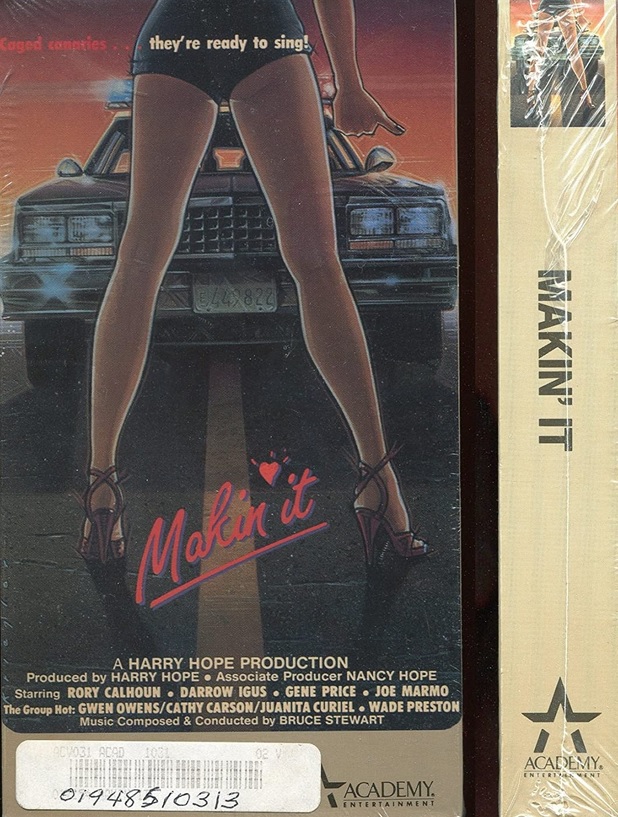
Like I said . . . I wrote up a review for Making Time, which stars Tori Titmas, and she wrote and stars in The Girls of Summer. And the director of Tori’s screenwriting debut is John D. Hancock, he of the ’70s drive-in “vampire” classic Let’s Scare Jessica to Death and the most unconventional Christmas movie you’ll ever see, Prancer. And Hancock’s cinematographer on Prancer and The Girls of Summer is . . . Misha Suslov, who lensed the cameras on Truckin’ Buddy McCoy, John Carpenter’s Black Moon Rising, and Mark L. Lester’s Public Enemies. And Suslov also eyepieced this redneck romp starring a cadaverous Rory Calhoun (who starred in Motel Hell that same year) in the Sheriff Buford T. Justice role.
So, you see. This review isn’t my fault. Send your complaints to Tori Titmas for hiring team Hancock-Suslov. For she is the one who unleashed this obscurity from the dust-bunnied, VHS shelves into the digital dustbins of B&S About Movies for you to enjoy. (And, of course, Mason and Grant are complicit in the film canister of worms thou opened.)
Hey, you may not care. But I do. And our Master of the Movie Themed Vodka-based Drinks, Sam, cares (last week’s movie drinks!). And not only do we get to talk about John D. Hancock and pay tribute to Misha Suslov in this review . . . but we can get our freak on over producer-director Harry Hope.
Oh, my Harry Hope! For only you could possibly think melding the waning disco-era with the CB radio-reinvented hicksploitation-era would make for a good movie. But what else would we expect from the man who unleashed the never-should-have-been-finished-or-released Doomsday Machine, you know, that 1971 sci-fi ditty that featured motorcycle helmet-clad astronauts blasting-off in cushy Lazy-Boy recliners? What else would you expect from the man who backed Al Adamson’s T&A romp Sunset Cove and his Jim Kelly-starring karate joint, Death Dimension. (See, there’s never a loss of movie obscurities to review! Sam, pencil them in.)
So, anywhoo . . . back in the days of polyester and mirror balls, ’60s R&B singer Gwen Owens reinvented herself as the front-woman of the Los Angeles-based disco band Hot with Cathy Carson and Juanita Curiel (the “gimmick” was that the band was multi-racial; Owens was African-American, Carson white, and Curiel hispanic) and scored a 1977 U.S Top 40 radio hit with “Angel in Your Arms.” (Learn more about Hot at souldisco.de).
Of course, in the mind of Harry Hope . . . a down-and-out one-hit wonder disco group is perfect fodder for a Harry Hope production. And the best part: this wasn’t intended as a parody of Smokey and the Bandit. (In fact, we think the redneck sheriff and judge buffoonery wasn’t a part of the original “script” and grafted in after-the-fact. “Hey, Smokies and CBs are hot right now, let’s make one of those movies,” decided the ever-mind changing producer.)
After the release of Hot’s self-titled breakthrough debut — and the then novelty of the group’s multi-racial make-up — expectations were high for their sophomore album, If That’s the Way You Want It . . . You Got It (1978). So their management decided a Beatlesesque movie would be a great way to promote the album. And they entrusted the project to Harry Hope. Obviously, no one on the Hot management team or in the Big Tree Records’ offices did their due diligence. Did anyone not see Doomsday Machine?
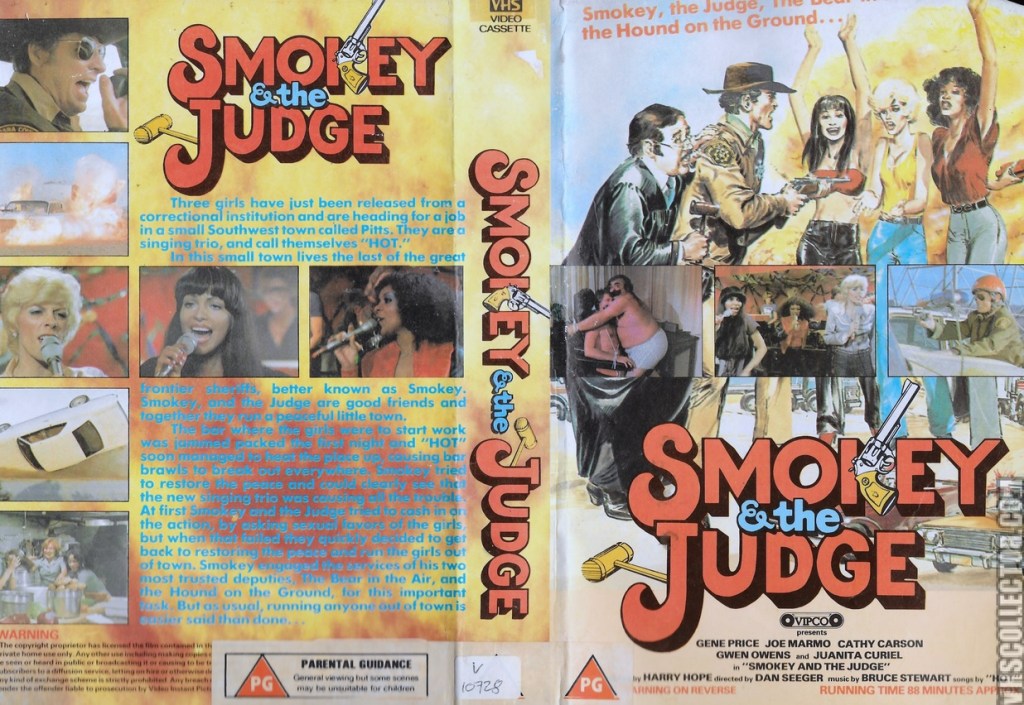
When first produced, the film was completed as We Can Be Stronger Together, so as to tie into the band’s upcoming third album. When the title of the album was shortened to Stronger Together (1980), so was the film’s title (the album sleeve features film promotional blurbs in its liner notes). And that 1980 album sold less than the second album. So title changes — to distance the film from the flop album — were afoot, with a reimaging as Running Hot and Making It! (which carried over for its VHS shelf live).
But with Smokey and the Bandit igniting its own cottage industry, the girls from Hot — who agreed to a movie tie-in to promote their album — found themselves in a CB-Smokey romp, Smokey and the Judge, to, you know, make you think Jerry Reed is going to show up singing “Eastbound and Down” — instead of a hot pants n’ hip swingin’ disco trio cooing in three-part harmonies. Truth is, for all its ripoffness, the two films that don’t get named-dropped when drive-in and home video aficionados revisit this this discoploitation romp are the two movies it’s really ripping off: the Saturday Night Fever-inspired, disco-musical comedy Thank God It’s Friday (1978) and the Earth, Wind & Fire-starring disco-musical That’s the Way of the World (1975; aka, Shining Star).
And why title the film Making It? Who knows. Perhaps the distributor decided to confuse us into thinking the film was based on David “American Werewolf In London” Naughton’s then pop hit, “Making It” — which was actually featured in Meatballs.
Courtesy of Amazon. . . Whoa, Whoa, Whoa!
“Okay, Harry. You got us into this mess. How are we going to graft a female disco group into a hicksplotation movie?”
“We’re going to rip off Roger Corman’s old women-in-prison flicks.”
“Are you sure? I mean, we’ve already ripped off so many other films already.”
For reals. Harry even took the kitchen sinks as musicians Gwen Owens and Cathy Carson meet while doing time in a women’s penitentiary and decided to form a singing group. Of course, as is the case with any women-in-prison flick, the girls are innocent, with Cathy set-up to take the fall for a jewel heist gone wrong (in a flashback sequence that looks like stock footage from another movie).
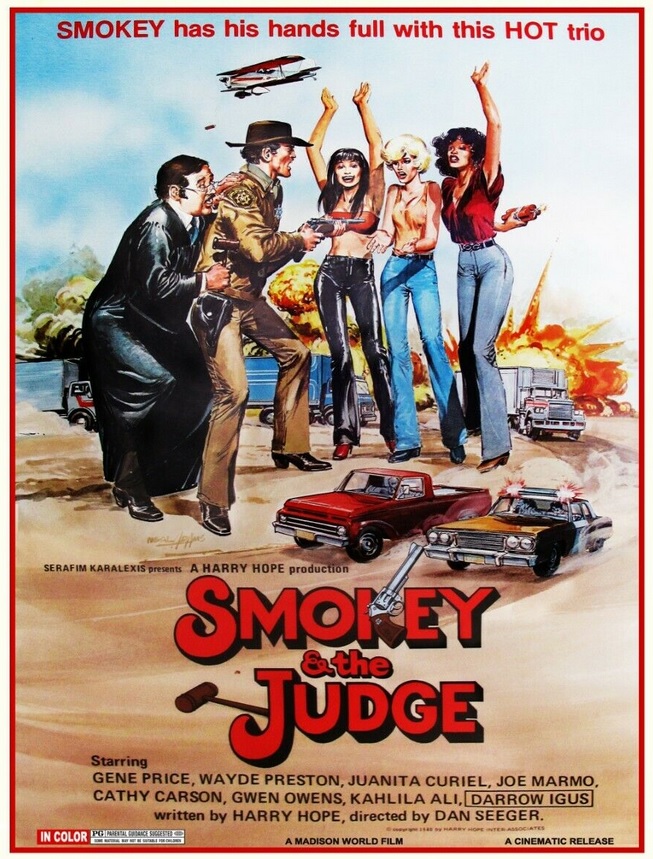
When the duo makes parole, they meet Morris Levy (Darrow Igus from Car Wash, The Fog, and lots of ’80s TV), a managerial bottom feeder who’s going to “make them stars.” And he gets them a talent show gig at an out-of-the-way Urban Cowboy-styled (another film pinched for inspiration) roadhouse in the hick town of Pitts. (The “pitts,” yuk yuk. That’s sum mighty fern movie sypherin’ there, Harry.) Of course, after singing their five songs in the film (i.e., the initial purpose of the film: to promote their music . . . and pad out the film’s short running time), they run afoul of the local Barney Fife-dufus in the form of Sheriff Cutler (Gene Price, an old Jim Nabors sidekick), he the lone minion of the always sex-starved, fatass Judge Maddox (Joe Marmo from Rappin’ and American Drive-In), who has his own honry-machinations for the girls. Car chases and crashes (i.e., the “Fast and (not so) Furious” part), ensues, which, because of all the singing, hardly happens.
Now, you noticed that we didn’t mention Rory Calhoun in that stellar synopsis. That’s because you’ve been theatrical one-sheet duped: Rory-boy isn’t the Sheriff like we’ve been led to believe; he shows up for a cameo as a record executive who judges the contest in Pitts(ville), U.S.A.
Yeah. Use the F’in-word as a prefix to the word “mess” on this one. How much so? Hy Pyke (the creepy bus driver in Lemora, Mayor Daley in Dolemite, and Hack-O-Lantern) shemps-in-comic relief (see Sam Raimi’s films for what “shempin’” means) as the roadhouse’s bartender and a cheesy used car salesman. But you know what? You give me a movie with Rory, Hy, and Darrow, along with “Harry Hope” on the box, and I am renting the movie. You dig? (A dunny to subsequently dump it in.)
And so closes another off-the-rails rant at B&S About Movies, where we coddle the forgotten and obscure films of our drive-in, UHF, and VHS yesteryears — and the latest indie films. And to Misha Suslov: we tip our hats to you. Thanks for the VHS memories.
About the Author: You can learn more about the writings of R.D Francis on Facebook.He also writes forB&S About Movies.
Before Quentin Tarantino*˟ inspired us to run to the movie theatre with anything featuring his name on it — even if he didn’t directed it — there was John Carpenter. For Quentin, the films that took our coin were Natural Born Killers and True Romance. For John Carpenter, we laid the money down for Black Moon Rising and The Eyes of Laura Mars. And the thing about Tarantino and Carpenter: while we love their pens, it’s just not the same without them in the director’s chair. But when you write and direct a blockbuster and you’re churned as Hollywood’s new “flavor of the month,” you easily up-sell those dust bunny-collecting screenplays sitting in the drawer. (Anyone want to read some of my dust bunnies? Yeah, didn’t think so. . . .)
In fact, the Roger Corman-founded New World Pictures made sure Carpenter’s name was front and center in the promotional materials to hook fans of Halloween and Escape from New York*. And toss in Carpenter’s pre-Halloween “modern western” homage Assault on Precinct 13 (1976) that became a cult classic courtesy of its incessant HBO replays in the backwash of EfNY’s success. Did we even care — or knew — that Harley Cokliss, who worked as a second unit director under Irvin Kershner on The Empire Strikes Back and directed New Zealand’s entry in the Max Max road rallies of the ’80s, Battletruck* (1982), directed Black Moon Rising? Nope. Not according to my copies of Starlog and Famous Monsters.
For the Snake Plissken-esque anti-hero of this high-tech crime caper, embodied by Sam Quint, the job was given to the always welcomed and never-not-awesome Tommy Lee Jones, who came into his own as an A-List, major-studio leading man with memorable roles in Jackson County Jail (1976), Rolling Thunder (1977), and Carpenter’s The Eyes of Laura Mars (again; didn’t direct it, natch; the aforementioned Irvin Kershner did). And it’s important to note that, in the same year Black Moon was released, Jones also starred in one of the greatest HBO-exclusive movies of all time, the Canadian-produced Rambo-inversion, The Park Is Mine.
We all know the story behind Escape from New York as it relates to Tommy Lee Jones, right? After blowing the roof off of theatres in 1978 with his Italian Giallo homage (check out our “Exploring: Giallo” featurette) Halloween, Carpenter had the clout to get his long-gestating passion project made (that he tried to get made even before 1976’s Assault on Precinct 13) about a Clint Eastwood-esque anti-hero’s adventures in a futuristic “Wild West” New York. (If Carpenter had gotten it made in the early ’70s during Clint’s “Dirty Harry” days . . . Eastwood going “Charlton Heston” in a post-apoc flick? Damn. I’d see that movie!)
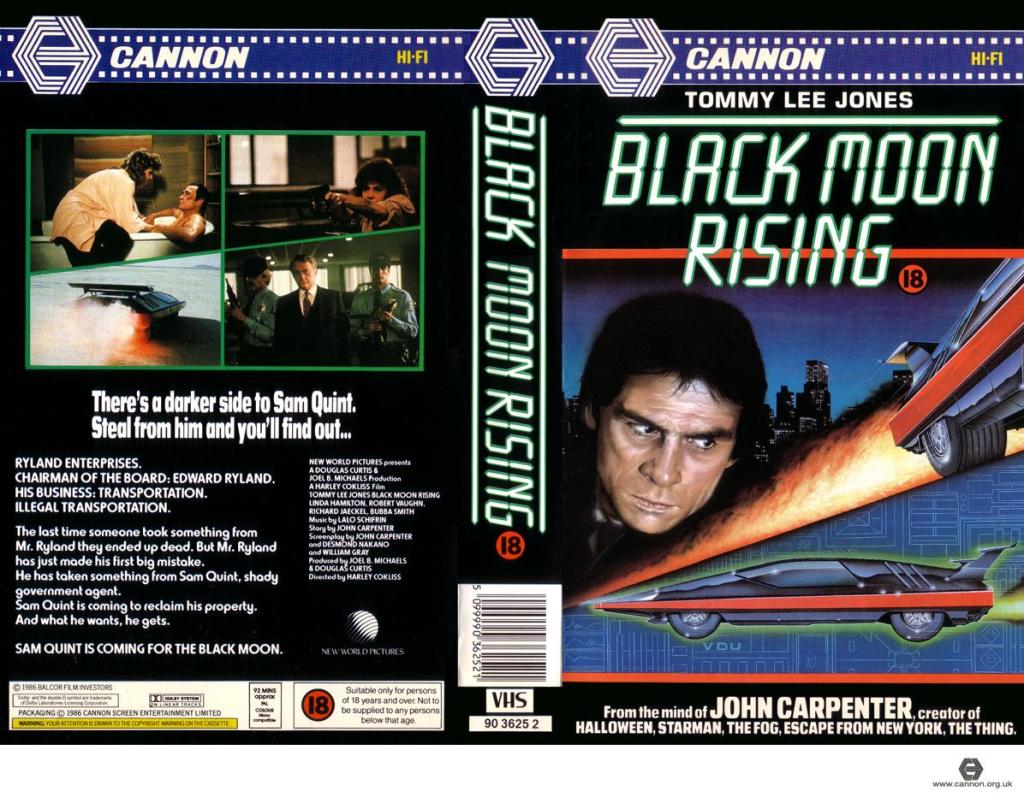
Black Moon Rising was not produced by Cannon but was sold on videotape in the United Kingdom by Cannon Screen Entertainment Limited.
At the time, Carpenter has just worked with Kurt Russell, who starred as “The King of Rock ‘n’ Roll” in the 1979 TV movie, Elvis. Carpenter wanted Russell in the lead. Avco Embassy, who initially wanted the admittedly cool-for-the-role-but-too-old Charles Bronson (sorry, Charlie), dug in their collective heels with Tommy Lee Jones (who would have owned Plissken!). Carpenter won the casting war. And Jones ended up being cast as Carpenter’s Plissken-lite, Sam Quint.
In a June 2016 radio interview with Justin Beahm, Carpenter explained that he wrote Black Moon Rising around the time he made Escape from New York (which is why we “see” Snake in Mr. Quint’s squint) as a “my car is stolen and I’m going to get it back” story. And he added that he had “never seen the final film.” And if it all sounds too familiar, like Corvette Summer (1978) familiar, you know Mark Hamill’s first post-Star Wars movie, itself a “my car is stolen and I’m going to get it back” story — without the sci-fi trappings and F.B.I tomfoolery — it probably is. . . . And if the plot of Black Moon Rising sounds familiar, like The Fast and the Furious(franchise) familiar, then it probably is. . . .
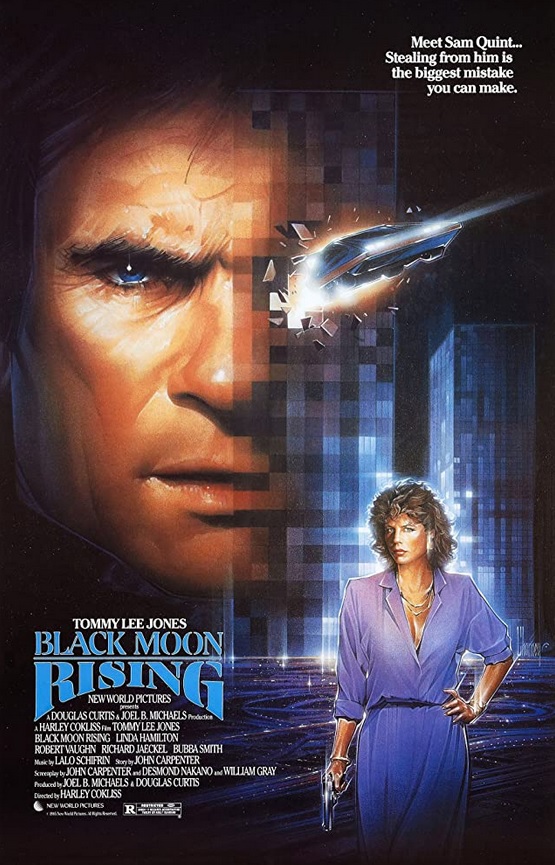
Sam Quint is a reformed thief hired by the Feds to steal a computer disc (what’s that?) that holds incriminating evidence against a corrupt Las Vegas-based corporation. After the theft, Quint’s on the run from Marvin Ringer (Lee Ving of Fear; The Decline of Western Civilization), his psycho-former partner, who wants the disc back. But, alas . . . during the course of the chase, Quint stashes the disc inside The Black Moon, a prototype supercar that exceeds speeds of 300 miles per hour — on tap water. (I know, right: the ol’ water-as-fuel sci-fi trope, again. Hey, Keanu! Hey, Val!) Then steps in master car thief Nina (Linda Hamilton in her first post-The Terminator* role), who steals the oh, so The Wraith (1986) sci-fi wagon for stolen car syndicate mogul Ed Ryland (the so-awesome Robert Vaughn as Proteus IV in Demon Seed, and yes . . . we even sat through Starship Invasions, The Lucifer Complex, Hangar 18, and the terminally goofy Battle Beyond the Stars for our Vaughn fixes). Now Quint has to break into The Ryland Towers (thus, the car-busting-through-the-glass-tower artwork of the theatrical one-sheet), where its offices’ operate Ryland’s “legit” businesses — along with a high-tech and high-volume chop shop in the basement-garage bowels.
Of course, the reason we’re writing about this forgotten entry in the John Carpenter canons — in addition to its “Fast and Furiousness,” and the fact that the fine folks at Kino Lorber reissued the film on Blu-ray (a 2K restoration from the original 35 MM interpositives) last May — is because of the 1980 Wingho Concordia II designed by Bernard Beaujardins and Clyde Kwok used in the film. Since only one was made, it was filmed for exterior stunts. Two cast cast-mold copies were made for stunts and interior shots.
The cinematographer behind Harley Cokliss’s vision of John Carpenter’s script is Russian-born Misha Suslov, who lensed the hicksploitation classics (yes, they are classics in the analog hearts of the B&S crew!) Smokey and the Judge and Truckin’ Buddy McCoy**, along with Mark L. Lester’s Public Enemies (with Eric Roberts!), and the “dark” Christmas romp, Prancer. While we lost our inner Suslov-ness over the years, we were happy to discover Suslov is still keepin’ the eye-in-the-glass with the 2020 country-romance The Girls of Summer.
About the Author: You can learn more about the writings of R.D Francis on Facebook. He also writes for B&S About Movies.
* Be sure to check out our full list of reviews from our “Apoc Month” blowout of post-apocalyptic ditties from the ’70s and ’80s with our two-part “Atomic Dust Bin” round-ups.
Update: We’ve since rolled out a “Cannon Month” of film reviews and took a second look at this film. Type in “Cannon Month” in our search box and you’ll populate all of those reviews.
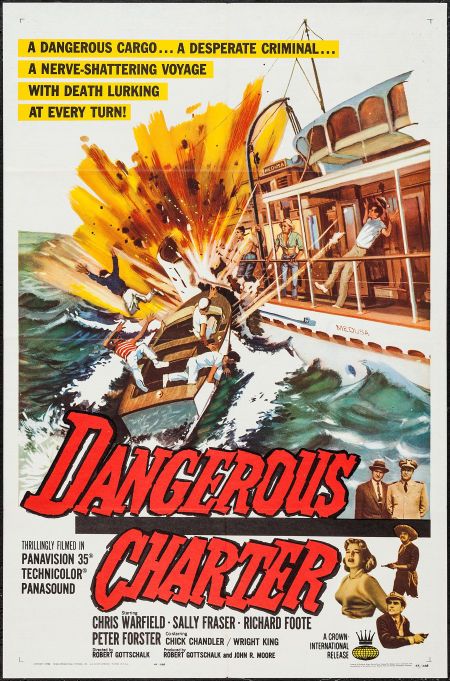
Savage Cinema’s last film is the 1962 film Dangerous Charter, the only narrative film directed and produced by Robert Gottschalk, who helped found Panavision. This film was to be a showcase for his new process and camera lenses.
Instead, it is 75 minutes that feels like 75 hours, an odyssey at sea that seems to never end. It has no motorcycles in it, no matter what the Savage Cinema box art may promise
The crew of a fishing boat finds a deserted luxury yacht at sea with a dead body and half a million of heroin on board. There is no Blind Dead to save this movie, just a lot of talking. In fact, they may still be talking as I write about this movie.
Did you know their was a remake of Vanishing Point? It’s okay. No one does.
The FOX-TV Network—back when they were in the business of creating original content, in lieu of reality programming and weirdo-dorky Seinfeld (sorry, Sam) wanna-be shitcoms—retooled this 1971 classic made by their sister film studio. Ack! No one should be poking around Richard C. Sarafian’s classic. And how did Sarafian go from this, to Farrah Fawcett’s Sunburn (1979), to become “Alan Smithee” on Solar Crisis (1990)? And so it goes in the B&S About Movies universe. (See? Too many movies, so little time. So many reviews to write!)
Of course, since this is a TV film, the vague existentialism and “thinking road flick” gibberish of the original is excised, thus transforming Barry Newman’s Kowalski into an action hero. Luckily: it features the same model 1970 Dodge Challenger R/T as the original film. Sadly: the messages regarding religious cults, racism, drug abuse, homophobia, and police entrapment are lost . . . and we’re stuck with a Challenger-driven Bonnie and Clyde redux.
And if you thought Sarafian’s transition from Vanishing Point ’71 to Farrah was odd: The director, Charles Robert Carner, wrote Gymkata (1985) for Robert Clouse. Yes. The film starring American Olympic gymnast Kurt Thomas—as if no one learned their lessons from trying to turn Olympian Mitch Gaylord into a film star with American Anthem and American Tiger.
In the Challenger cockpit is the always welcomed Viggo Mortensen (who starred in the rock-religious flick Salvation with his then wife, Exene Cervenka of X; and yes, he’s Aragorn from Lord of the Rings) as Kowalski; he’s still employed by a car delivery service, but now he’s a Desert Storm veteran pining for his glory days as a stock car racer. This Kowalski’s “need for speed” isn’t the result of drugs, bets or personal demons: he’s a clean, faithful husband desperate to get home to his pregnant wife who’s suddenly hospitalized. While the ‘70s Kowalski didn’t need a reason to say “Fuck the Man!” to earn his folk hero status, the ‘90s Kowalski becomes an Americana hero as result of being mislabeled as a “terrorist” by an overzealous government abusing new anti-terror laws.
Helping out on the radio front is a politically outspoken DJ simply known as “The Voice,” (Jason “Beverly Hills 90210” Priestly, a FOX-TV series, natch) on KBHX 106.5, “The Voice of the Rocky Mountains.” At least Priestly’s DJ is hip enough to spin tunes such as “Volunteers” by the John Doe Thing. Not helping matters is a hard-edged, ex-stock racer turned Utah State Trooper (the always welcomed Steve Railsback of Lifeforce) in hot pursuit with a Hemi of his own and a catch-Kowalski-at-all-costs attitude (if this sounds a lot like the Marjoe Gortner-Railsback persuit in The Survivalist, it probably is.) And in with the desert-dwelling assist is rocker John Doe (A Matter of Degrees) as an anti-government tax evader with a knack for repairing Hemis. (And rock trivia buffs take note: This is only time you’ll see the ex-husbands of X vocalist Exene Cervenka—Viggo and John Doe—together in the same film.)
It’s interesting to note that while a TV movie, Vanishing Point ’97 has a 90-minute, theatrical-running time. Movies shot-for-TV run 80 minutes, then 40 minutes of commercials are added to fill a two-hour programming block. Thus, 10 minutes of advertising are lost to fit the film into that 120-minute programming block. That’s bad business. So, considering Viggo’s status at the time, was this intended as a theatrical feature, and 20th Century Fox realized their production faux-pas and dumped it on TV?
What do you think, Eric?
“Jesus. Even the poster for this sucks. What the f**k was Viggo thinking.” — Eric, purveyor of film quality and Seinfeld hater
So, did you know . . . sandwiched between the ‘60s original and Phil Pitzer’s 2012 revisiting, Easy Rider: The Ride Back, there was another unofficial “sequel” to Easy Rider, which concentrates on a search for the famed Captain America chopper that appeared in Easy Rider? Never heard of it? It’s okay. No one did.
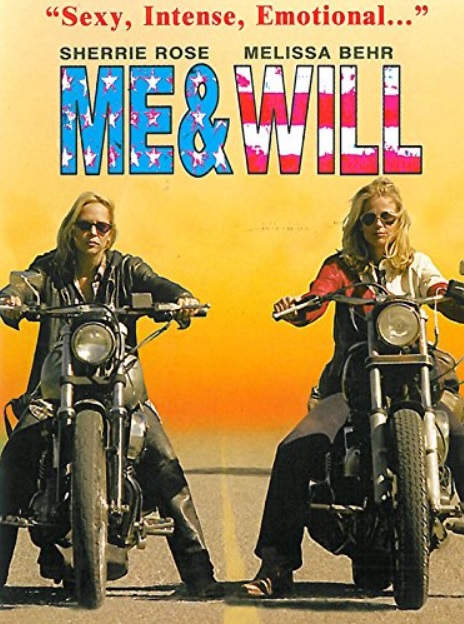
Be it an unintentional sequel or a loose remake—with a Thelma and Louise twist—of the counter-culture classic Easy Rider, there’s definitely a dash of another late 60’s cinematic classic, Midnight Cowboy, in these engine revs written and directed by its stars, Sherri Rose and Melissa Behr. (Another Easy Rider-inspired biker-epic, the better known Roadside Prophets, made in the early 90’s with John Doe, the bassist and singer from X, and a Beastie Boy, may even come to mind as the story unfolds.)
Told from the point of view of Jane (the “me”), a hard-living aspiring writer, she meets an equally burnt-out artist-cum-party girl named Will in an L.A. drug rehab clinic. After watching a late-night showing of Easy Rider on TV, Jane (Sherri Rose, American Rickshaw) and Will (Melissa Behr, aka “Doll Chick” from Bad Channels and its sequel, Dollman vs. Demonic Toys) decide to make like Wyatt and Billy and break out of rehab to embark on a trip to find the legendary chopper ridden by Peter Fonda—which is rumored to still exist in the city of Willsall, Montana.
As the road trip unfolds, Jane and Will meet the usual cross section of bikers, hippies, burnt-out garage mechanics, psycho waitresses, abused women, and abusive cops—as well as the rock bands Space Age Playboys (yes! Kory Clarke and Warrior Soul!) and Keanu Reeves’s band Dogstar. (I played Dogstar on the radio and went to their shows back in the ’90s; they were a solid indie, alt-rock band and not the “actor-gimmick” they were smarmy-labeled.)
What helps this lost bikers-searching-for-their-souls flick is the cast featuring those actors we care about at B&S About Movies: Seymour Cassel (Trees Lounge), M. Emmet Walsh (Escape from the Planet of the Apes), Steve Railsback (Lifeforce), and Grace Zabriskie (Galaxy of Terror). (Oh, shite: she was also George’s mother-in-law on Seinfeld. Sorry, Sam.) And keep your eyes open for Johnny Whitworth (Empire Records), William E. Wirth (The Lost Boys), and Tracy Lords (Shock ’em Dead).
Oh, and Jane’s boyfriend, Fast Eddie, is Patrick Dempsey (the ’80s cable comedy-classic Can’t Buy Me Love and “McDreamy” from TV’s Grey’s Anatomy). Of course, when Grey’s Anatomy became a ratings juggernaut—and as with Katherine Hegyl’s equally unknown 2006’s Zyzzyx Road—the DVD reissues of Me & Will feature Dempsey front and center—with Rose and Behr kicked to the curb.
In addition to the ‘Playboys and Dogstar appearing on the soundtrack, there’s music by Dwight Yoakam, Josh Clayton, formerly from School of Fish (remembered for their ’90s hit, “Three Strange Days”), in addition to classic tracks by the Doors and a solo-bound Mick Jagger. Matt Sorum of the Cult/Guns n’ Roses scored the film—with a guitar-style that almost leaves it feeling like a Tangerine Dream-scored film (Thiefcomes to mind, IMO), sans the synths and moogs.
To dismiss Me & Will as a vanity-driven “female Easy Rider” and to be alpha-male ruffled by its “female empowerment” message is a chauvinistic disservice to Sherri Rose and Melissa Behr’s efforts to dissuade the film from disintegrating into a hail of bullets of a gone-wrong crime caper, ala the somewhat similar Don Johnson and Mickey Rourke buddy-biker action flick, Harley Davidson and the Marlboro Man (1991).
Me & Will is a gallant effort; a heart-felt, solid indie-film and Rose and Behr certainly deserved better than their exploitation resumes allow. And kudos to Columbia Pictures giving their blessings and not having the proceedings degrade into the legalese haze of Phil Pitzer’s not-as-bad-as-they-say Easy Rider homage. You can watch Me & Will as a free-with-ads stream on TubiTv or without ads on You Tube.
So, as with Phil Pitzer’s Easy Rider: The Ride Black: Me & Will is an alright effort. So do Sherri Rose and Melissa Behr a solid and support indie film by streaming the ad-stream version on TubiTV, will ya? Other films starring Sherri we’ve reviewed for you to check out include Cy Warrior, Relentless Justice, and Summer Job.
About the Author: You can learn more about the writings of R.D Francis on Facebook. He also writes for B&S About Movies.
So . . . did you you know Easy Rider was followed forty years later by an unofficial sequel? It’s okay. No one does. . . .
The existential subtext and counterculture viewpoints (somewhat) of the original are lost . . . somewhere on a dusty, Baja road in this “sequel” (also working as a prequel) that explores the family history of Peter Fonda’s character Wyatt “Captain America” Williams through the eyes of his older brother, Morgan: a pot-distributing, Vietnam war deserter and custom jewelry-designer (specializing in Maltese crosses; not for the reasons you think, the eventual reveal is a clever trick-of-the-script) living in luxurious solitude on the Pacific coast of Mexico.
The drama and struggles center around Morgan’s cycle-lovin’ family friend, West Coast (Jeff Fahey of The Lawnmower Man, Psycho III), Williams sister Shane (Sheree J. Wilson of TV’s Dallas and as Alex Cahill on Walker, Texas Ranger; she also produces), and her wealthy-hubby (Michael Nouri of Flashdance) as it flashes to and fro from the 1940s to the present, concerned with Wyatt’s brother, Morgan (Phil Pitzer) visiting his dying, disapproving father. So, along with West as his “Billy,” Morgan mounts Wyatt’s Captain American chopper, which he recovered back in ’69 and restored, slaps on his brother’s old leathers, and takes a “ride back” to bury those family demons.
Of course, when it comes to making a sequel, the smart bet is to file legal actions against Bob Rafelson and Bert Schneider, the producers of the original through their Raybert Productions (the force behind The Monkees TV series), to block them from reclaiming their expired film rights. And don’t bring back any of the original’s cast or crew. And cavet those emptor for the ol’ home video bait n’ switch: courtesy of the flashing-back-and-forth, Fahey, Wilson, and Nouri are the marquee-stars, but only here as supporting characters. This show belongs to Phil Pitzer and Chris Engen (as the young, troubled third-brother Virgil; who despite his bigger role, is bumped off the marquee).
So goes this vanity-vision by producer and screenwriter Phil Pitzer, a former lawyer who, with a desire to enter the film industry with a bang, manipulated legal loopholes to get sequel rights. His co-writer and director, Dustin Rikert, fared better: his names pops up as a producer and director on a slew of telefilms broadcast on the Hallmark, Lifetime, and Syfy channels. Their Easy Rider part deux was initially completed in 2009 and appears in filmpedias with that release date; however, by the time it went through the festival circuits and film markets for distribution, it was formally released in 2012.
So, is Easy Rider: The Ride Back the most-unwanted-not-a-sequel since the days of Halloween III: Season of the Witch (which I really like) or House II: The Second Story (which I didn’t) or House III: The Horror Show (which I did, because well, it’s a friggin’ Lance Henriksen and Brion James movie)? And is stuffy ol’ Leonard Maltin—who hates everything the B&S About Movies crew likes—justified in calling the Pitzer’s effort “a staggeringly bad, cash-in bomb,” solely based on Pitzer’s clandestine legal maneuvers?
Uncanny: “Fonda 2009” image courtesy of Glenn Francis of Pacific Pro Digital/Wikipedia. “Pitzer 2010″ image courtesy of Zimbio.
Eh, well . . . to Pitzer’s credit: He does, as you can see, resemble Fonda, so it lends to the credibility that he’s Wyatt’s brother, as well as “being” Wyatt in flashbacks that lend to the film-to-film continuity. All of the bikes (especially Wyatt’s chopper reproduction) and time-period designs (props, costumes, cars, etc.) are correct, the Korean war sequences are well-shot, and the cinematography by Brian Lataille (videos for Incubus and Linkin Park), while not up to the László Kovács-standard in the original, is pretty solid. And yes, as with any indie, flick: there’s a few strained thepsin’ moments. So, while it’s not exactly Easy Rider, Pitzer’s effort is not a Tommy Wiseau (or Neal Breen) biker joint as some threaders and reviews claim. No, it’s definitely not “The Room on wheels” as some have said.
While the flashbacks and bike-riding interludes of Morgan’s and West Coast’s contemplations (most in voice overs as majestic “post-card moments” unfold) about life, e.g., homelessness and hunger, ecology, the meaning of patriotism and true freedom, make the film seem a bit longer than its 90-minute running time, Pitzer nonetheless crafted well-rounded characters for his actors to sink their thespin’ teeth into. He also developed a compelling “history” for an initially ambiguous, metaphorical-drifting character. So kudos to Pitzer for giving a structured “focus” to a film that was admittedly an “out of focus,” scriptless-improv in the first place (that Fonda and Hopper openly admitted in interviews).
And besides: I always enjoy seeing senior actors (e.g., the recently-released Nana’s Secret Recipe) given meaty roles and, to that end: Newell Alexander (who’s career goes back to the ’70s TV series Barnaby Jones and Battlestar Galactica ’79, The Kentucky Fried Movie; he also appeared in Walker, Texas Ranger with Sheree) and Ron Howard’s pop, Rance (The Andy Griffith Show, Grand Theft Auto, and Cotton Candy) are both excellent in their roles as Poppa Williams and his ol’ hog-riding Korean War war buddy, so much so, you’d like to see more of them in the film.
All in all, despite Leonard Maltin and the Internet hoards of war, Easy Rider: The Ride Back it’s not as Wiseauian bad as they’ll lead you to believe. (The same arguement we had with our review of Jeremy Saville’s radio dramedy, Loqueesha). And for those who have stated Phil Pitzer “thankfully, has never made another movie” and “hasn’t made another movie since”: Phil produced the upcoming Cannes Without a Plan (2021), the third writing-directing effort from Julie Simone Robb (NBC-TV’s Homicide: Life on the Street) that also stars Pitzer’s The Ride Back cast member, Jodie Fisher (of Charles Band’s Blood Dolls).
Courtesy of a new distribution deal with retro-imprint Kino Loeber, Easy Rider: The Ride Back is available worldwide as 2019-issued Blu and DVD and VOD stream on Amazon Prime and You Tube Movies. Yeah, you’ll find that errant You Tube freebie (you know you look there and TubiTV first before you buy), but do Phil Pitzer a solid and support indie film, will ya? Pay for it, okay?
Like Kowalski said in Vanishing Point: “Fuck the man!” Keep on making movies, Phil. You’re alright, kid. . . .
So, did you know . . . sandwiched between the ‘60s original and Phil Pitzer’s 2012 revisiting, Easy Rider: The Ride Back, there was another unofficial “sequel,” which concentrates on a search for the famed Captain America chopper that appeared in Easy Rider? Never heard of it? It’s okay. No one did. Join us at 3 pm for more tales from the fast and the furious . . . with Me & Will.
About the Author: You can learn more about the writings of R.D Francis on Facebook.He also writes forB&S About Movies.






 B&S About Movies
You must be logged in to post a comment.