Yeah, I have a weakness for Anna Kendrick films. I might come on here and praise Joe D’Amoto and Ruggero Deodato, but put on a movie where Anna is singing or triumphing against people who think she isn’t worthwhile and I’m right there beaming. I can admit it. I’m not afraid.
When Noelle Kringle (Kendrick) was a little girl, she grew up with a very special father: Santa. Now, five months after he’s passed on, Noelle’s older brother Nick (Bill Hader) must step into the role.
As Nick begins worrying if he can handle it, Noelle tells him to take a vacation. The only problem is he doesn’t come days before Christmas and the senior elves — Michael Gross is one of them — appoint her cousin Gabriel (Billy Eichner) has to take the job of being Santa.
To save the holiday — yes, this is the theme of every single holiday movie — Noelle must go to Phoenix to find her brother. Luckily, she has the help of her nanny Polly (Shirley MacLaine) and a cute baby reindeer named Snowcone.
Kingsley Ben-Adir is in this as a detective, as well as Julie Hagerty as Mrs. Claus (the woman never seems to age) and the always funny Ron Funches as Mortimer, a singing elf.
Writer and director Marc Lawrence is the man who made both Miss Congeniality movies, as well as Two Weeks Notice, Music and Lyrics and Did You Hear About the Morgans? Basically, this entire movie was made for my wife.
This is one of the first films available on Disney+. You know, for when you’re not watching Star Wars movies. It’s cute and with a G rating, certainly one you can share with the kids this holiday season.
Author’s Note: This review previously posted on September 11, 2017, as part of our “Tobe Hooper Week” to commorate the life and career of the late director who left us on August 26. Thanks to Disney Studios and their release of Star Wars: Episode IX – The Rise of Skywalker, we can remember Tobe once more. Also be sure to visit with Tobe courtesy of his career retrospective.
* * *
We’re here to praise Tobe Hooper, not bury him. But to get there, we have to go through some rough periods.
By 1985, Hooper’s career was in limbo. Sure, he’d tasted box office success with 1982’s Poltergeist, but he’d also be dogged with rumors — or truths — that he’d not really directed the film. Toss in a bad experience on 1981’s Venom, a film that he was replaced on ten days into shooting (Klaus Kinski claimed that the cast and crew ganged up on Hooper in an effort to have him replaced), as well as being replaced as the director of The Dark and a rumored nervous breakdown.
A three-picture deal with Cannon Films and the promise of no interference would be the panacea that would soothe Hooper’s pain. Or so he thought.
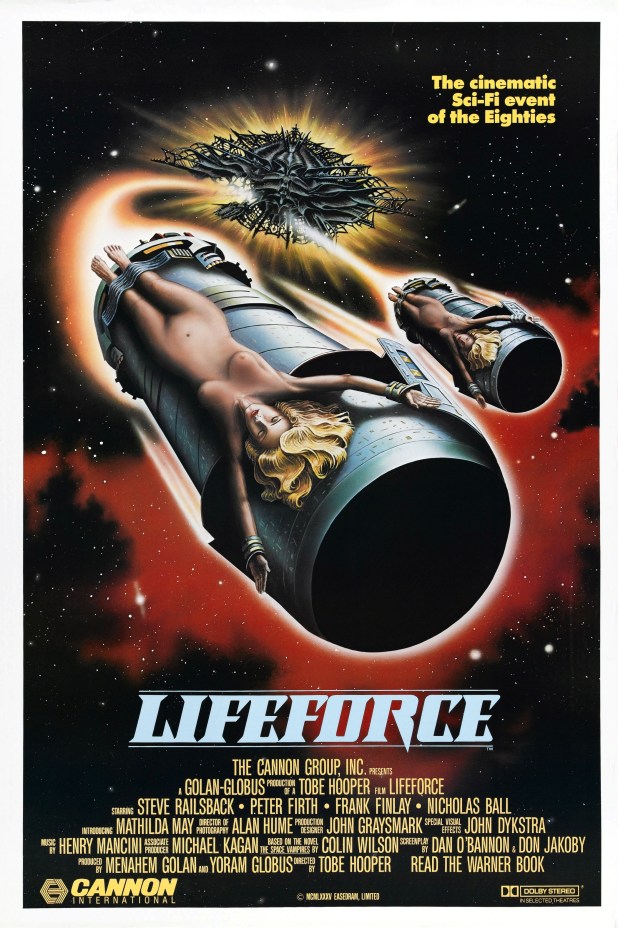
The first film in the three picture deal was Lifeforce. Based on Colin Wilson’s 1976 novel The Space Vampires and scripted by Dan O’Bannon (Alien, Return of the Living Dead) and Don Jakoby, the film was originally going to use the original title. After spending $25 million to make it, Cannon decided that they wanted a blockbuster instead of their normal exploitation films, hence the change to Lifeforce.
Once Hooper had his money and freedom, he was beyond excited, seeing the film as his chance to remake Quatermass and the Pit. In fact, he said, “I thought I’d go back to my roots and make a 70 mm Hammer film.”
Hopper turned in an initial film that was 128 minutes long, starting with 12 minutes of near silence in space aboard a space shuttle. This is 12 minutes longer than the final version which had several scenes cut, most of them taking place on the space shuttle Churchill. Three actors — John Woodnutt, John Forbes-Robertson and Russell Sommers — ended up completely cut from the final film, as was some of Henry Mancini’s score.
Even worse — the film went way over schedule and cost so much that the film was shut down when the studio ran out of money, leaving some of the most important scenes unshot.
Look — it could have been worse. Michael Winner was the original choice to direct.
So what’s it all about? Good question.
The crew of the Churchill discovers a massive spaceship — nearly 150 miles long and shaped like an artichoke (no, really) — inside Halley’s Comey. Hundreds of dead bat creatures surround the ship and inside, two perfect males and one perfect female sleep in suspended animation. They take the aliens and come back to Earth, because there are no protocols or rules about that kind of thing. I mean, I can’t even fly back from Japan with fruit and these dudes take aliens directly to London.
Tragedy strikes — a fire consumes the ship, destroying everything and everyone except for the aliens. The aliens turn out to be vampires that can shapeshift and suck out the life force of everyone they meet.
In Texas, a survivor is found — Colonel Tom Carlsen (Steve Railsback, Manson from Helter Skelter!). He explains how the crew’s life force was taken and why he set the shuttle on fire. He also has a psychic link to the female alien (the constantly naked Mathilda May). Patrick Stewart also shows up as Dr. Armstrong here — who has the female vampire inside him. They take her/him back to London, but the plan backfires when she/he escapes.
London is now filled with zombies, as the two male vampires have turned the entire population and everyone feeds on one another. All of these life forces are sent by the males to the female and then to their spaceship. The lighting looks like Poltergeist by way of Mario Bava. Still with me?
Turns out that leaded iron can kill the vampires. And oh yeah, Carlsen is in love with the female vampire. She keeps calling to him. “CARLSEN. CARLSEN. CARLSEN.”
She’s naked on the altar of St. Paul’s, sending energy to the ship, as she reveals that they are bonded through their psychic link. Carlsen responds by killing the other male (one of the two is Mick Jagger’s brother Chris) and then impaling himself and the female at the same time.
The damage to Carlsen is mortal, but the female is unfazed. She creates a column of energy to her ship and rides it back, taking Carlsen with her. This looks completely sexual, which has to be no accident, as the connected bodies look coital.
The end? The end.
Does this mean that Earth is now a planet of vampires? Did she save him to make a new group of vampires? When did this become a zombie movie?
I don’t have the answers. And now that Tobe is gone, I can’t ask him.
Plain and simple, Lifeforce is a mess. It seems inconceivable that this film and Chainsaw came from the same director. It seems more of a British film. There’s some inventive gore, such as when the female vampire (her name is only listed as Space Girl) comes out of Patrick Stewart’s body as blood.
It has moments of gorgeous shots, like the scene where we flashback to when Space Girl reaches out to Carlsen. And the battle of London is a huge effects piece. But the story is — I don’t even know where to begin. It feels more like Meteor than what you expect from Hooper. Which is, I guess, the point of so much of his Cannon films. They are all unique, all strange and all end up being completely different from the movie you expect them to be.
* * *
Star Wars: Episode IX – The Rise of Skywalker is currently playing in theatres and was theatrically on December 20 in the United States.
Author Note: This review was previously posted on September 28, 2019, as part of our September Post-Apocalypse Month. You can catch up with all of those reviews by visiting our Atomic Dustbin recap. We’re bringing it back to pay tribute to the work of George Lucas.
Okay. Let’s get this out of the way: This is the movie were you video fringe horndogs lose it over Mariette Hartley (as Lyra-A) in a two-piece bikini sporting two belly buttons (a dual circulatory system with two hearts) as a (network censored) “dominatrix” who breeds men for an oppressive, feminist regime.
Gulp.
Yes. Mariette Hartley: We’re talking Zarabeth in the Star Trek: TOS episode “All Our Yesterdays” where she cracked Spock’s emotionless Vulcan shell. She mixed it up with Gary Lockwood as Lisa Karger in Earth II (another failed TV movie pilot-to-series). She tempted Charlton Heston as Harriet Stevens in Skyjacked. She gave Dr. David Bruce Banner butterflies as Dr. Carolyn Fields in The Incredible Hulk. Yes. Mariette Hartley, with a resume of too many popular TV series to mention, all the way out to Fox TV’s 2018 hit series 9-1-1 as Patricia Clark.
Just one look at Mariette in Genesis II and you’ll forget all about the über-cool Sub-Shuttle that we all came for (and not a bogus CGI model . . . but a non-operational, full-sized prop pulled on a long-cable by an off-camera semi-truck) that pulls into a carved-out-of-the mountain sub-station (which Elon Musk has since pinched for his next millionaire-toy project). Oh, and did you notice the sterile, ultramodern-styled city looks suspiciously like the city in Conquest of the Planet of the Apes (20th Century Fox’s “Century City”)? And did you notice how many times the Sub-Shuttle footage was recycled in ‘70s sci-fi television?
Anyway . . . times were hard for ex-Star Trek creators.
In 1974, after the go-to-series failure with Genesis II, Gene Roddenberry developed another TV movie/series pilot with The Questor Tapes (1974). A thinly veiled reworking of the Gary Seven character and plot from the Star Trek: TOS episode “Assignment: Earth,” it was intended as a vehicle for Leonard Nemoy’s return to weekly television. The end product starred Robert Reed-doppelganger Robert Foxworth (1979’s Prophecy) who portrayed an android with incomplete memory tapes — in a pseudo The Fugitive storyline — searching for its creator and purpose (that also sounds like V’ger from Star Trek: TMP).
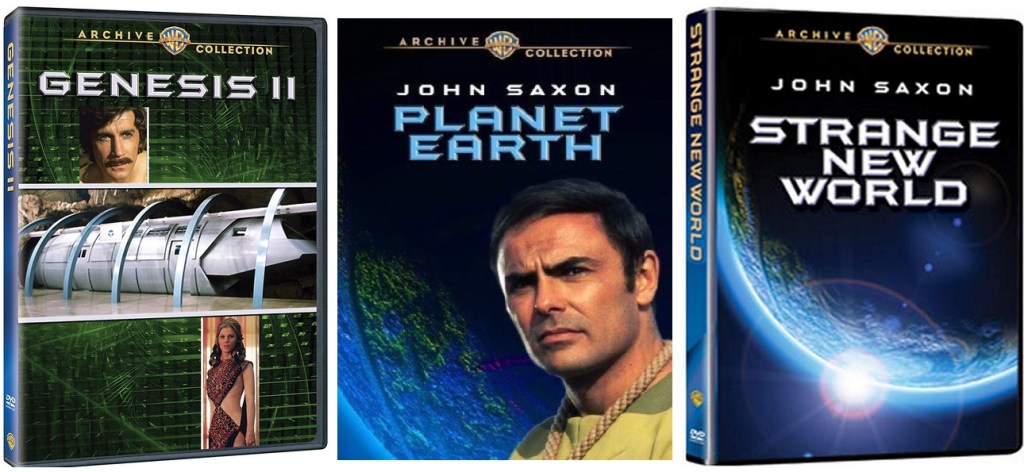
Then, after the additional go-to-series failures of the Genesis II reboots Planet Earth and Strange New World produced in the wake of The Questor Tapes, Roddenberry tried again — by jumping on the ‘70s “occult detective” sub-genre with 1977’s Spectre — by reworking another Star Trek element: the contemptuous friendship between Spock and Dr. Leonard McCoy, itself a homage to the relationship between Sherlock Holmes and Dr. Watson. Spectre starred Robert Culp (The Gladiator) as William Sebastian, a criminologist and occult expert assisted by Gig Young (1978’s Game of Death with Bruce Lee) as Dr. Hamilton.
Genesis II stars Alex Cord (who also journeyed into a “fucked up future” in Chosen Survivors) in the “future world” of 1979 as NASA scientist Dylan Hunt. Of course, he opens the post-apocalyptic proceedings with that all-too-familiar apocalypse (or psychological horror) cliché: “My name is Dylan Hunt. My story begins the day on which I died.” So goes the story a “20th Century Boy” (T Rex, anyone?) thrown forward in time by a suspended-animation earthquake-accident that damages his New Mexico/Carlsbad Caverns-housed “Project Ganymede” system for astronauts on long-duration spaceflights.
And we flash forward to the year 2133.
An archeological team of PAX (Latin for “peace”) descendants from the NASA personnel that lived-worked-were trapped in the Carlsbad installation when World War III (aka “The Great Conflict” because, well, the docile hoards of all post-apoc futures never seem to be able to preserve or retain a basic semblance of American history) broke out, discover Hunt’s buried chamber. And while they can’t seem to “remember” World War III, the PAX are smart enough to construct a subterranean rapid transit system utilizing a magnetic levitation rail operated inside a “vactrain-tunnel network” that spans the globe and saves the masses from air transportation attacks.
Anyway, here’s where Mariette Hartley comes in.
Lyra-A oversees the all-female totalitarian regime known as the mutated (natch) Tyranians that rule the lands once known as Arizona and New Mexico. In addition to their increased physical abilities, you can always spot a Tyran by their nifty, dual navels — that they seem to love to show off. (Schwing! Thank you, Gene!) Not that the wussy PAX-rats would do anything when they spot a Tyran: they let themselves be enslaved.
Lyra-A, in a grand alien fashion of the Star Trek variety, is enraptured by Roddenberry’s “Buck Rogers” and wants to harness Hunt’s knowledge of (among other things) nuclear power systems to fix the Tyranians’ dead power plant. But apoc-bitch Lyra-A double crossed him: it’s a ploy to reactivate a nuclear missile system to destroy the PAX. As a result, Hunt goes into Moses-mode (see the apoc-romps No Blade of Grass, Ravagers) and leads a revolt of the enslaved, sabotages the nuclear device, and destroys the reactor.
Sound pretty cool, right?
Airing to high ratings in March 1973 and encouraged by the network brass, Roddenberry worked up a 20-episode first season on the adventures of Alex Cord’s post-nuc Moses. Then CBS-TV dropped the bomb: they passed over Genesis II and gave the timeslot to another competing post-apoc series: the short-lived and low-rated Planet of the Apes.
Those mothballed Genesis II episodes featured recycled ideas from Star Trek: TOS and fueled the later Star Trek movies — with stories about suspended animation soldiers from the past (“Khan!!!”), a London ruled by King Charles X; NASA “evolved” computers and equipment left on Jupiter’s Ganymede returning to Earth in search of their “God” (“The Changeling” and the annoying Persis Khambatta-V’ger non-sense from Star Trek: TMP); men turned into breeders and domesticated pets (reworked for the second pilot, Planet Earth); the ol’ catapulted-through-a-time-continuum back to 1975 gaffe (“Tomorrow and the Stars,” an episode from Star Trek: Phase II, the proposed-failed post-Star Wars reboot), and a creepy priesthood who enslaves the masses via electricity used as a “God” (“Return of the Archons” from ST: TOS).
The reason the network passed on Genesis II: The series was “too philosophical” and Alex Cord’s portrayal was “too dark and brooding.” They wanted another handsome and charmingly arrogant Captain James T. Kirk. So Roddenberry and Warner Bros. rebooted Dylan Hunt into an action-driven and conflict seeking Kirk-like character embodied by John Saxon.
Cue for Planet Earth.
Now Dylan was one of three cryogenically-frozen astronauts who return to Earth to reestablish the PAX organization that sent them into space. And while we lost Mariette Hartley, we gained the equally fetching Diana Muldaur (again, from Cord’s Chosen Survivors), who rules the Amazonian, male-enslaving “Confederacy of Ruth,” along with cherished character actors Bill McKinney (Deliverance, Cannonball) and Gerritt Graham (Phantom of the Paradise, Used Cars) as “impotent males” in recurring roles.
This time, instead of CBS, ABC aired the Warner Bros. produced program in April 1974.
The network passed.
Cue a Strange New World.
To creative and legal reasons lost to the test of time, Warner Bros., who now owned the intellectual rights, reworked the premise a third time as Strange New World (pinching the title from Star Trek’s opening monologue) — sans Roddenberry’s involvement — dumped the PAX and Tyranians, and retained John Saxon as the same Kirk-like character, now known as Captain Anthony Vico, who returns from a suspended animation space trip with two other astronauts (as in Planet of the Apes TV series that screwed Genesis II in the first place).
The movie aired in July 1975.
The network passed.
And with that, between Roddenberry’s vision, and the failure of the Planet of the Apes TV series (episodes were cut into overseas theatrical and telefilms), the small screen’s attempt to jump on the major Hollywood studios’ post-apocalyptic bandwagon was over. Thus, us wee lads and lassies gathered around the TV on Saturday mornings and settled for Filmation’s Ark II, whose 15 episodes (it seems it had more episode and was on much longer), aired in 1976, then reran in 1977, then again in 1978. And that kiddie-apoc series stopped production because the network “wanted Star Wars” (and not a TV knockoff of 1977’s Damnation Alley). So Ark II was reworked and repurposed (the same “universe,” so to speak) as Space Academy and Jason of Star Command (Sid Haig, rules!).
There was also another, similar attempt at the Genesis II concept with, ironically, another Star Trek: TOS alum: Glenn Corbett (warp-drive creator Zefram Cochrane in 1967’s “Metamorphosis”). As with Roddenberry’s The Questor Tapes, The Stranger (1973) was another failed TV movie-to-series sci-fi twist on the ‘60s runaway TV hit, The Fugitive. This time, instead of returning to a post-apocalyptic society, our astronaut (Hey, Sam . . . he’s named “Stryker”!) returns to a totalitarian “twin” Earth run by the “The Perfect Order.” (And if it all sounds a bit like 1969’s Journey to the Far Side of the Sun byGerry and Sylvia Anderson of the fellow-failed, post-Star Trek series UFO and Space: 1999 . . . then it probably is: both series were movie-rebooted in the post-Star Wars universe as the telefilm/foreigner theatricals Invasion: UFO and Destination Moonbase Alpha, respectively.)
But wait . . . all was not lost with Genesis II.
Roddenberry’s widow, Majel Barrett (Nurse Christine Chapel in Star Trek: TOS and Lwaxana Troi on Star Trek: TNG and DSN) produced one of Roddenberry’s old pre/post-Star Trek dystopian-apocalyptic concepts, Andromeda (itself recycling from Genesis II and Planet Earth), a Canadian series that ran from 2000 to 2005 and aired in syndication on U.S television.
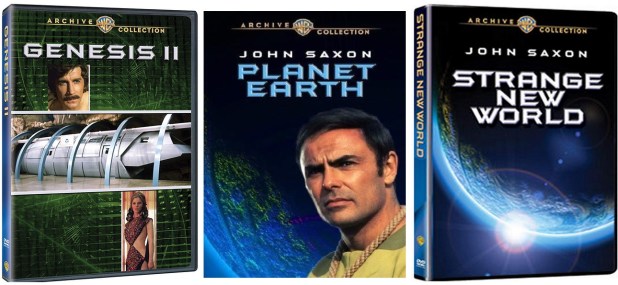
VHS rips ofGenesis II and Strange New Worldcan be enjoyed for free on You Tube, while Vudu has official, affordable streams of Genesis II and Planet Earth. For whatever “legal” reasons, no streaming platform offers Strange New World. However, copies of all three are widely available on DVD courtesy of Warner Home Video’s Warner Archive Collection.
Star Wars: Episode IX – The Rise of Skywalker is currently in theaters and was released theatrically on December 20 in the United States.
About the Author: You can read the music and film reviews of R.D Francis on Medium and learn more about his work on Facebook. He also writes for B&S Movies.
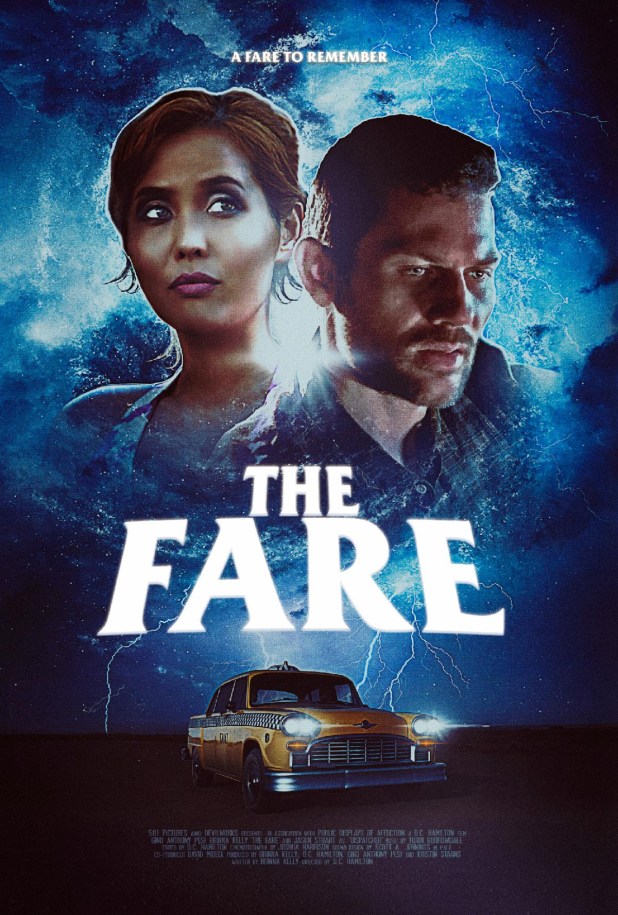
When a charming woman named Penny climbs into his taxi, Harris finds himself entranced. That is, right up until she disappears from the back seat without a trace. As he desperately tries to make sense of what happened, he resets his meter and is instantly brought back to the moment she first climbed into his cab.
Soon, Harris (don’t call him Harry) and Penny find themselves trapped in an endless loop that just might change their lives forever.
This is the second film for director D.C. Hamilton, who worked with writer Brinna Kelly on The Midnight Man. They’ve teamed up again for this film and Kelly also stars as Penny.
Basically, it’s a conversation that begins again and again between two characters. Major points for having Jack Kirby be such a big part of their back and forth, which I doubt any normal people would use as the focal point of a conversation, but hey, I’m a Kirby fan. It reminds me of the Tarantino script doctored Silver Surfer discussion in Crimson Tide that seems to come out of left field.
The look of this film is heads and shoulders above most released to streaming movies and the idea and execution are, too. An intriguing little film that you should check out for yourself, The Fare is available on demand and on blu ray from Epic Pictures.
DISCLAIMER: We were sent this movie by its PR team. That has no bearing on our review.
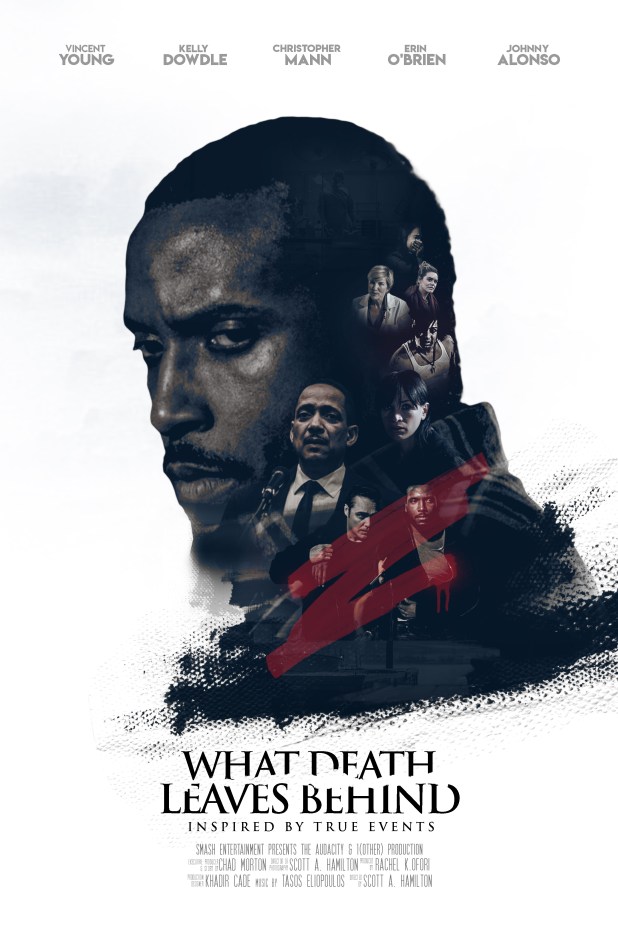
Directed by Scott A. Hamilton, and scripted by Hamilton, Chad Morton, Nico Giampietro, and Rachel K. Ofori, What Death Leaves Behind tells of a man who, after a kidney transplant, experiences flashbacks and nightmares that he thinks are from his donor. This sends him down the path of vengeance for a person he has never met before.
Shot under the working title of The Kidney, the movie gives us the literal dictionary definition of the word non-linear at the start of the film. That’s important to remember as we get into the story of Jake, who gets a new kidney, which gets him off dialysis but also starts flooding his mind with memories and potential connections to a serial killer in Chester, PA.
It’s an intriguing idea, but moves pretty slow, to be honest. That said, you may find something you like within this picture. You can learn more at the film’s official site.
DISCLAIMER: We were sent this movie by its PR agency. That has no bearing on our review.
“Dude, ya gotta do another Christmas movie for the site,” texts the portly proprietor of B&S About Movies, not realizing the proverbial stocking of worms he’s unleashing from this writer’s fingertips.
Just to be clear: I don’t do spunky elves, mystical reindeer, or magic snow globes. I go for the coal. Well, unless it’s a Fred Olin Ray holiday fest or a David DeCoteau Christmas movie. Other than that: If you want a Christmas movie review from me; you get the Wayne Coyne version of a Christmas movie . . . and one that stars the guy who once a cavorted with a talking blue dog.
You heard me right: And Steven Burns, the Daytime Emmy Winning actor-host of Nickelodeon’s Blue’s Clues drops “F-Bombs” in this movie . . . and he co-stars with The Flaming Lips—you know, the alternative rock band you saw performing their U.S Top 100 hit about a girl who preferred using Vaseline over Jelly, live at The Peach Pit in the 90210 zip code.
This is a world where Quentin Tarantino’s first film, My Best Friend’s Birthday, collides with David Lynch’s Eraserhead. If Kevin Smith’s debut film, Clerks, had been about two slacker cafeteria workers in the Death Star Canteen . . .
“You will still need a tray.”
. . . but Dante and Randal can’t handle the pressures of slinging Empire hash, so they smoke hash behind the trash compactor and trip-out into Andrei Tarkovsky’s Solaris territory (as Christmas on Mars pays tribute to the cycle of Eastern Bloc-Russian psychological sci-fi films), this is that movie.
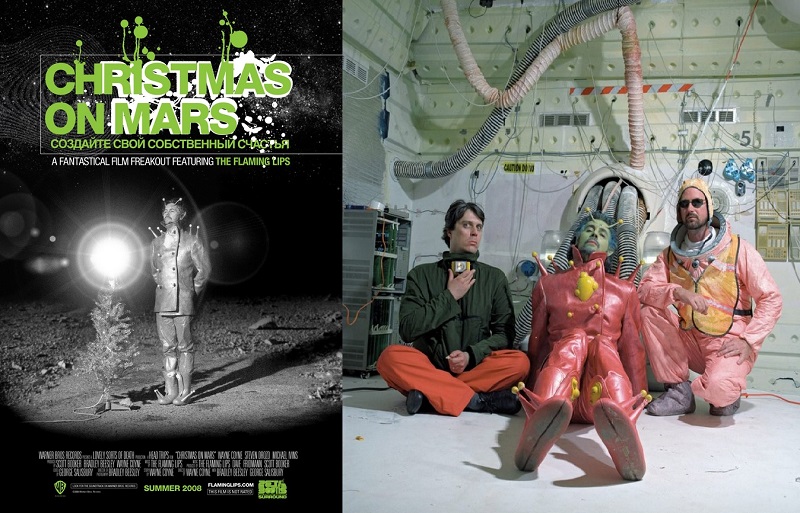
Christmas on Mars is a performance piece comprised of a 16mm feature-length film and a concept album that tells the story of Major Syrtis (the Lips’ Steven Drozd), the commander of the first colony on Mars—that’s celebrating its first Christmas . . . and the birth of its first child. As Sytris suffers a breakdown resulting from his obsessive planning of a holiday pageant to celebrate the birth, he finds an unlikely party planner: a Martian (the Lips’ Wanye Coyne)—or is he a colonist who flipped out and painted himself green—who agrees to become a de facto Santa Claus for the colonists.
Rounding out the cast of astro-colonists are fellow Lips’ members Scott Booker, Michael Ivins, and Kliph Scurlock, along with SNL’s Fred Armisen (TV’s Portlandia) and the always appreciated jittery-paranoid Adam Goldberg (Dazed and Confused, The Hebrew Hammer).
Never released theatrically—outside of unconventional, non-theatrical venues, such as social clubs and film and music festivals—the film was released in three formats: a single DVD available at commercial retailers, a deluxe edition DVD-CD soundtrack combo, and a collectible DVD-CD “Mega Deluxe Edition” packed with movie-related Lips’ paraphernalia and swag.
About the Author: You can read the music and film reviews of R.D Francis on Medium and learn more about his work on Facebook.
What if Chris Mitchum played Santa? Yes, Chris Mitchum from Aftershock, The Day That Time Ended, Faceless, Bigfootand Alejandro Jodorowsky’s Tusk. I see you starting to get a bit weirded out, but let’s press on.
So who do we get for Mrs. Claus? Well, Cynthia Rothrock, of course. Yes, the hard fighting star of China O’Brien, Honor and Glory, Rage and Honor and plenty more straight to video karate epics.
Honestly, what the fuck am I about to watch?
Let’s go one better. This movie was made in the exact same house as A Talking Cat!?!
They may have also shared the same budget, which was probably catering. Which was probably Jack in the Box.
Yeah, Mary Crawford may be the name in the credits, but this Santa movie is all the work of David DeCoteau. It feels the most porn holiday film I’ve ever seen without actual penetration. I mean, that wouldn’t do for this, a movie that’s trying to be kid friendly and feels holiday destroying.
And is that Gary Daniels I spy? Kenshiro from Fist of the North Star? In a Christmas movie? Wait! Martial artist Daniel Bernhardt, who was Alex Cardo in the second and third Bloodsport films? Surely we’re going to see fisticuffs and people go mano y mano, right?
Nope. They’re going to play croquet.
This is a Christmas movie not set at Christmas, replete with public domain holiday songs and Lucas-like wipes that use Google Images clip art. It’s as if it were edited in iMovie — I know it surely isn’t, it couldn’t be — but almost as if a family made this movie and sent it my way to drive me insane before the holidays and seasonal depression have their way with me in a threeway so rough that it had to be shot by Max Hardcore.
Gary (Daniels) is a workaholic married to another workaholic named Sadie, who is stranger still played by another world class asskicker, five-time would kickboxing champion Kathy Long. I mean, she’s known as The Punisher and the Queen of Mean. She played Fros-T in the aforementioned Rage and Honor. And why is she and her husband and their kids getting in a van and driving through some magical fog on their way to discover Santa’s Summer House?
Then there’s a caterer named Constance — what is it with DeCoteau and catering characters!?! — who bullies an orphan named Molly into giving up being a photographer.
Somehow, Robert Mitchum, the man who made The Night of the Hunter, one of my all-time favorite films, gave birth to the man who would play Santa here. Santa, who sits in a hot tub and just drops hints about what he does and none of the martial artists can pick up the sledgehammer obviou clues because they’re all too busy playing a game of croquet that may still be going on now, nearly eight years after this movie supposedly stopped filming.
As for Santa, all he wants to do is chill. He has like a month he works a year and it’s so much effort that he spends eleven months watching TV and just schvitzing in the hot tub. Chill, out Santa. Run, run Rudolph. And hey — for all the cookies Mrs. Claus cooks, she seems to be keeping in pretty decent shape. Must be all the times she kicks dudes in the head.
Every holiday season, I discover one movie that makes me at once fall in love and desperately hate the holiday. This year, Santa’s Summer House is that movie. Watch it at your own peril, because trust me, this one will fucking own you.
DeCoteau also directed Christmas Spirit and The Great Halloween Puppy Adventure, two more holiday films. If you don’t think I’m going to hunt those down right now, you may have never been to our site before. I mean, Eric Roberts and a Halloween puppy? Come on. I’m not made of stone.
True story #1: I once had the wild idea of writing a Dukes of Hazzard script where Japanese businessmen try to buy out Hazzard County from Boss Hogg, who of course gets swindled himself. Ninjas would get invovled — of course — and Cynthia Rothrock would play a new Duke cousin who was in the army and had learned how to fight overseas. Obviously, I went to art school. Anyways, imagine my surprise when Ms. Rothrock showed up in 1997’s The Dukes of Hazzard: Reunion! The moral: Sometimes, the universe listens to you.
True story #2: Cynthia used to be married to her kung fu instructor Ernest Rothrock. The guy owns schools all over Pittsburgh, including one I drive past every single day. When I was a kid, I dreamed that Cynthia was really at these schools and would teach me the ass kicking powers I needed to decimate the bullies who made my life hell. The moral: Instead of dreaming, I turned to Satan and got my revenge Trick or Treat style. Thanks, Sammi Curr!
You can watch this — with help from Rifftrax — on Tubi. It’s also on Amazon Prime without any such assistance.
ABOUT THE AUTHOR: Jim Rex knows plenty about movies and is more than happy to share that knowledge with the world at large.
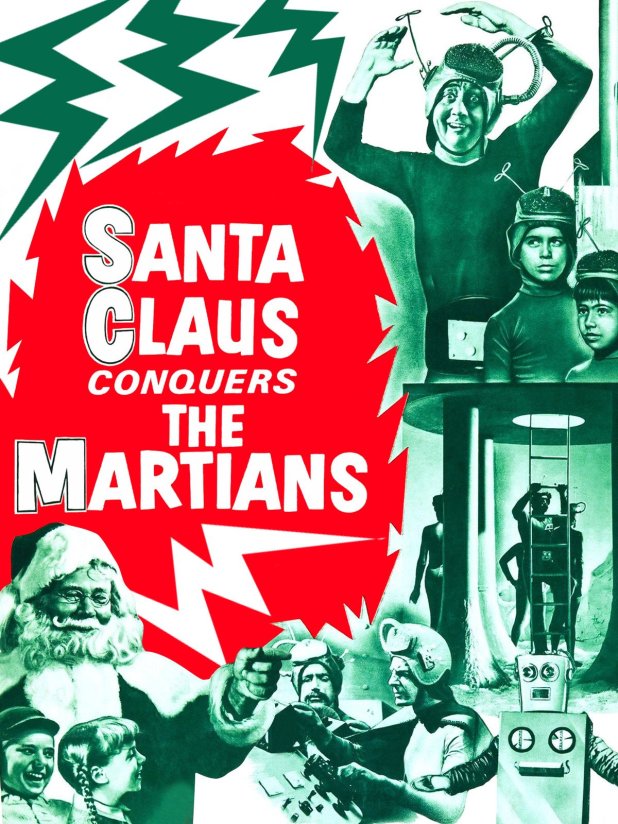
I don’t like how sometimes history has a way of slandering the memory of some films, especially ones I fell in love with as a pup. Santa Claus Conquers the Martians is such a flick.
No, I ain’t gonna try to convince you it’s some kind of misunderstood masterpiece. It most definitely is not. It’s a simple time-waster aimed at the kiddie matinee crowd but in that regard, it may be one of the best.
This flick hit screens in 1964. No point playing to the nostalgia of 1964. We’re friends, we can be honest. Between race riots and the Boston Strangler, 1964 was as screwed up as any other period in history. But it was a simpler time when a movie like Santa Claus Conquers the Martians could entertain its undemanding target audience to maximum effect.
You know the story. Martians kidnap Santa to bring joy and presents to their zoned-out Martian brood who just sit around staring at Earth transmissions on TV showing how happy the Earth kiddos are because Santa brings them joy and presents. Never one to turn his back on freaky kids who need joy and presents, Santa tries to help the little weirdos out and still gets back to Earth to make his Christmas rounds.
As simple a story that has ever entertained a kid, earthling, Martian or otherwise.
In 1964 there wasn’t much in the way of holiday movies aimed at kids, certainly nothing like today. In those days Christmas was mostly celebrated on the holiday episode of popular TV shows. (And, by god, you wanted to celebrate Christmas with the Cartwrights you made dang sure you were in front of the TV promptly at nine o’clock Sunday night for Bonanza or you missed it!) 1960 was when K. Gordon Murray slipped Rene Cardona’s Mexican Santa Claus into Saturday matinees, so there wasn’t a plethora of kiddie Christmas movies Santa Claus Conquers the Martians had to be better than.
Santa Claus Conquers the Martians is infused with the same type of fantastical whimsy that influenced a lot of popular culture of the time such as the films Robinson Crusoe on Mars and Mary Poppins, and books like Roald Dahl’s Charlie and the Chocolate Factory and Ian Fleming’s Chitty Chitty Bang Bang.
Some people like to joke on poor idiot Martian Dropo, but he’s no stupider than Gilligan from Gilligan’s Island or Gomer Pyle from Gomer Pyle, USMC, which were two new hit TV shows of 1964. (The character was on par with the type of dummies Jerry Lewis was playing in The Disorderly Orderly and The Patsy in ‘64.)
This flick is pure kiddie fantasy, from a North Pole news report by an intrepid KID TV news reporter to the jolliest of jolly old St. Nicks. (Fats never stops laughing!) It’s a comic book come to life, which is appropriate since Dell Comics released a comic version. (It cost all of twelve cents when it came out, but it’ll set you back a little more today if you luck upon a copy.)
This heady mix of cheap sets, silly humor, goofy elves, laughing Santa, green Martians, psycho robots and a flea bitten attacking Polar Bear suit delivers everything its title promises.
Joseph E. Levine released it to crowds of spastic kids dropped off at the local bijou for disgruntled theater managers to babysit for the afternoon. It played these engagements for a couple years. After that Avco Embassy Television made it available for broadcast where it lived on until finally being released on little black plastic video cassettes in the early ‘80s.
Then something happened. Something horrible happened and the flick’s legacy would eventually be forever tainted.
David and Michael Medved and their partner in crime Randy Dreyfuss were sitting around the house bored one day. The Internet hadn’t been invented yet so they couldn’t criticize movies on a global stage. For 1980 they did the next best thing. They wrote the book The Fifty Worst Films of All Time. Santa Claus Conquers the Martians was on the list.
I guess they knew what they were talking about because they had written and produced and directed and done the catering for and successfully distributed that charming and beloved Martian Christmas movie all kids loved called…uh…it’s coming to me…on the tip of my brain…ummm…
Well, it’s way easier to criticize something someone else made than to go out and try to do it better yourownself. Unfortunately, the damage was done. Dropo and the boys from Mars were now in a flick that ultra-cool film snobs were describing as a “trash movie.” Some referred to it as a “guilty pleasure” or “a movie so bad it’s good.” They all had an uppity, “cooler than thou” attitude about it when they discussed about it.
Whenit started making the rounds on all kinds of hosted “Million Dollar Movie” type shows, everyone was pretty mean to it. This was back when you could still bully someone, and folks thought it was funny.The reputation of Santa Claus Conquers the Martians was tarnished until the end of time. (I don’t think most snobs talking about it had ever seen it. They were just repeating what they heard about it from other snobs.)
Anyway, here we are. You probably ain’t changed your feelings none on Santa Claus Conquers the Martians and that’s all right. Four things you can’t change a person’s mind on is their beliefs in politics, religion, college football and movies. But if you considered Santa Claus Conquers the Martians in a different light for a few minutes, I thank you for meeting me halfway.
I’ll end with this. The first time I saw Santa Claus Conquers the Martianswas a Thanksgiving Day monster movie marathon in 1974 on KRBC in Abilene. We were at my grandma’s and I was eight and I done ate my weight in turkey and giblets. Me and my little sister settled in for King Kong vs. Godzilla and Santa Claus Conquers the Martians followed. Maybe it was the turkey in my bloodstream, working on my brain, or the fact my daddy never considered me to ever be a very bright kid. Whatever it was, Santa Claus Conquers the Martians was like a sweet, wonderful candy that made my eyes tingle. We didn’t move or look away from the TV as we laughed at Dropo and we didn’t even care how cheap that attacking Polar Bear suit looked, we loved every second of it. I maybe even had a crush on Gumar, and that was before I knew the difference between Pia Zadora and Zontar, the Thing from Venus. Grandma brought us a couple slices of warm pumpkin pie with big old globs of Cool Whip on top. We ate and laughed and watched. It was a perfect afternoon.
Now, does that sound like one of the fifty worst films of all time to you?
“I mean, this is like Star Wars meshed with Porky’s.” — Robert Freese of Videoscope and Rue Morgue
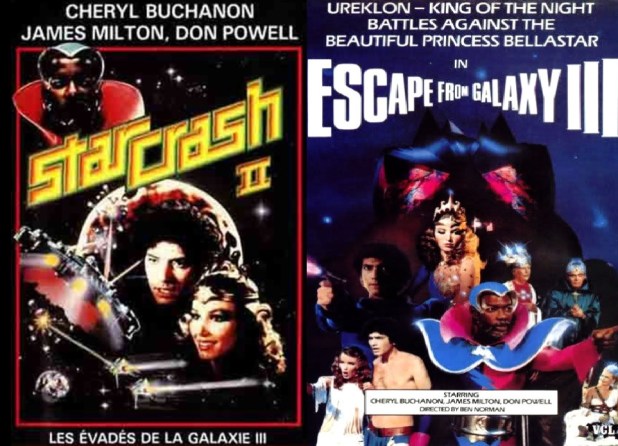
A long time ago, in a galaxy far, far away . . . lost somewhere between Luigi Cozzi’s Starcrash and the Canadian Star Wars rip Starship Invasions . . . this is the tale of Princess Belle Star’s action-filled Escape from Galaxy 3!
And you know what? This tale of Princess Belle Star (remember, the heroine in Starcrash was Stella Star) making her Princess Leia-like escape from the destruction of her home planet at the hands of the Z-Grade Ming the Merciless wanna-be in the mighty Oraclon (played by Don Powell, whose space garb reminds of George Clinton’s Parliament/Funkadelic getups) is one of my all time-favorites.
With the help of a curly-haired hero, Lithan (who looks a lot like Marjoe Gortner’s Akton from Starcrash), they escape to a mysterious, blue planet—a primitive Earth thousands of years in the past. Of course, to the Roman hippie-primitives rejected by casting from an episode TV’s Buck Rogers in the 25th Century, the strange visitors from the skies are gods—who soon discover they’ve acquired Superman-like powers in Earth’s atmosphere. And Belle and Lithan discover the joys of shooting laser beams from their hands, and the pleasures of food . . . and sex . . . and nudity . . . and disco dancing.
And who’s responsible for this so-bad-it’s-good Star Wars dropping rife with bad dialog and worse high-tech jargon (“. . . fire the uranium vapor rockets!” “. . . engage the hyper solar missile systems!”) that would give Glen Larson’s Battlestar Galactica cheese-writers pause?
Huh? No way! Not Adalberto “Bitto” Albertini?
Not the dude from the infamous Italian soft-core sexploitation “classics” Black Emanuelle (1975) Black Emanuelle 2 (1976)? Hey, wait a minute . . . that’s where I saw that Parliament/Funkadelic space emperor before! I knew he looked familiar!
Now, if you made it this far and still haven’t figured it out from looking at this article’s banner and all of the Starcrash references: Escape from Galaxy 3 pilfers all of its effects shots from Luigi Cozzi’s 1978 Star Wars rip-off, leading this pasta-turkey to also be distributed as Starcrash 2. In other markets, it was retitled as Galaxia—to possibly confuse it with Dorothy Stratton’s sex-space comedy, Galaxina? Who knows what goes on in the minds of distributors?
All I know is that EG3 is cheesy-fun . . . and Sherry Buchanan, from the Gialli What Have they Done to Your Daughters (1974), the Spielberg rip, Eyes Behind the Stars (1978), the Jaws rip-off Tentacles(1977), and the stomach-turner Zombie Holocaust (1980) gives me a “Garth Algar,” you know, like when you climb the rope in gym class.
Fellow EG3 fan and B&S contributor Robert Freese, takes a second, deeper look into the production back story of his review of the film as part of its inclusion on Mill Creek’s Sci-Fi Invasion box set. It’s a great read to learn how this mess came to exist . . . from the lips of Luigi Cozzi, himself! But it’s a mess we love, Lou!
Star Wars: Episode IX – The Rise of Skywalker was released theatrically on December 20 in the United States.
About the Author: You can read the music and film reviews of R.D Francis on Medium and learn more about his work on Facebook. He also writes for B&S Movies.
5 Galaxies has five different science fiction stories in one film. Each segment is directed by a different creative talent, including Nelson Lee, Kristen Hilkert, Amir Reichart, Vitaly Verlov and Marc-Henri Boulier. It was originally released in 2018 as A.I. Tales. If any of the films feel disjointed, blame the lack of a narrative device to hold them all together and that many of them were short films released before they were collected here.
Seed: Directed by Nelson Lee, an actor who has appeared in several films such as Disney’s new live action Mulan, this story is all about a man undergoing a combination birthday party and living funeral, all so an overpopulated society can keep on surviving, ala Logan’s Run. Pom Klementieff, who plays Mantis in the Marvel movies, shows up here.
IN/FINITE: This is the story of Jane, who decides to leave the Earth and her family behind as part of the Mars One Astronaut program. It’s directed by Kristen Hilkert and co-written by its star Ashlee Mundy.
Phoenix 9: This short was originally made by in 2014 and is directed by Amir Reichart. A post-apocalyptic tale, it was shot in the Glamis Dunes in California’s Imperial Valley, which was a location used to create Tatooine in the original Star Wars.
Redux: Originally made in 2015, this segment features Eric Roberts and is all about a scientist attempting to send a mission back in time before he is killed. It’s directed by Vitaly Verlov, who often works in visual effects.
New York 2150: This is the pilot episode of the New York 2150 series, which was written and directed by Harry Assouline.
This is, as most modern portmanteaus are, a mixed bag. There are some interesting ideas, but I prefer Amicus style anthology movies that at least are moving toward one subject or conclusion.
5 Galaxies is available on demand and DVD from Uncork’d Entertainment.
DISCLAIMER: This movie was sent to us by its PR company. That has no bearing on our review.




 B&S About Movies
You must be logged in to post a comment.