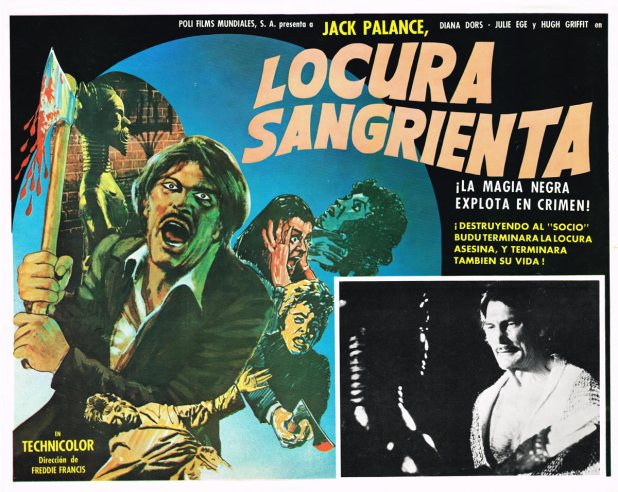
Thanks to his work on Amicus films, Freddie Francis will always get a pass. And Jack Palance has made some of the worst movies I’ve ever seen so much better. Therefore, I wanted to like Craze way more than I ended up enjoying it.
Palance stars as antique shop owner by day, cultist by night Neal Mottram. The film starts with him sacrificing a nude woman to the African god Chuku, whom he believes will reward him with both wealth and power. Its movies like this that make being a devil worshipper seem rough and pointless. Every single turn, you have to hunt someone down, kill them, get an alibi and run from the cops. It’s a lot of work and when it’s over, you still lose your soul.
Diana Dors is in it and her life story is way more interesting than the film. She gained her first fame as a Monroe-esque blonde bombshell promoted by her first husband, Dennis Hamilton. After a career of sex comedies and Page 3-style modeling, it turned out that her husband was defrauding her. Still after that, she made further headlines by holding parties where she supplied hot young starlets and plenty of drugs to a large number of celebrities. The real stinger was that she had cameras all over the house to capture the action. The Archbishop of Canterbury even publically denounced her!
Supposedly, Dors left over 2 million pounds to her son in her will. It could be unlocked via a secret code in the possession of her third husband, actor Alan Lake, but he killed himself soon after she died from cancer. Despite the best efforts of codebreakers and even a TV special, the money has never been found.
Anyways — Craze. There are plenty of British starlets in this, too. Juli Ege from On Her Majesty’s Secret Service to name one. I chose to watch this because Suzy Kendall from Torso and The Bird with the Crystal Plumage was in it. And Marianna Stone from Whoever Slew Auntie Roo? shows up as well.
It’s not horrible, but it’s very slow. Palance is great — of course he is — but even he has a lot to contend with here. You can watch it for yourself on Amazon Prime and see what you think.
Today’s Scarecrow Psychotronic challenge is 19. VHS DAY. Watch something on the greatest physical format known to psychotronica. If you don’t have access to a VCR watch something originally shot on video. While I don’t have Night Train to Terror on VHS, my copy has been bootlegged from one, complete with tracking issues and multiple gen quality.
God (Ferdy Mayne, Count von Krolock from The Fearless Vampire Killers) and Satan (Tony Giorgio, The Godfather) ride a train, discussing the fate of three people while a band makes a music video. If you’re ready to watch three movies get edited into one and ready to check your brains at the station, then you’re ready for Night Train to Terror.
A portmanteau made up of one unfinished and two previously released movies, this is one strange bit of 1980’s video store craziness. The train is doomed to go off the tracks, so God and Satan play for the souls of not just the band, but the people in the stories that follow.
In The Case of Harry Billings, John Phillip Law (Danger: Diabolik!) has been manipulated into working for the spare body parts black market. This was a film called Harry that was never finished until it was put into this film, although it was later released on VHS as Scream Your Head Off.
The Case of Gretta Connors concerns a carnival girl turned porn star who is in a suicide club and in love with her Hollywood producer old man husband and young boytoy. This was later released as 1983’s Death Wish Club. If you want one movie where giant beetles fly around and kill people who get sexually excited by death…
Finally, we have The Case of Claire Hansen, in which a surgeon battles Satan with the help of an old man who survived the Holocaust and Cameron Mitchell. Oh yeah — Richard Moll plays her husband and his hair changes throughout the story. If this all sounds familiar, it’s because we already watched and shared this movie. It’s the batshit crazy film known as The Nightmare Never Ends.
All of these films are linked together by writer Philip Yordan, who history has told us was merely a front for blacklisted writers, with his lone Oscar for Broken Lance truly belonging to Joseph L. Mankiewicz.
I don’t know if this review can prepare you for the sheer mania that this film has in store for you. Nothing in it makes sense, to the point where you’re unsure as to whether that’s it’s a David Lynch style movie or just plain ineptitude. There has never been a movie like this before or since and that’s no hyperbole.
Vinegar Syndrome released a DVD/blu-ray combo of this and it’s packed with extras, including an interview with producer/director Jay Schlossberg-Cohen and assistant editor Wayne Schmidt, as well as the full version of Gretta.
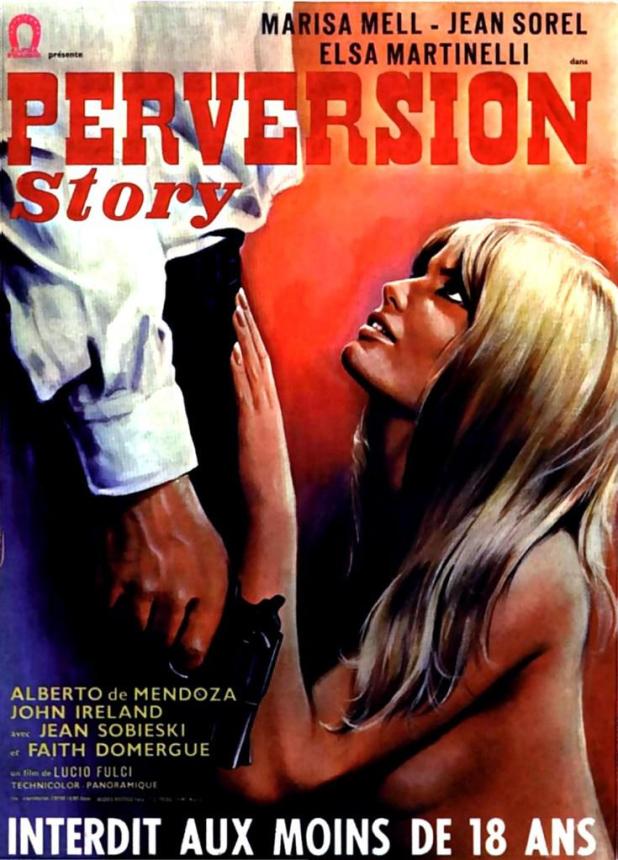
At this point in his career, Fulci was mainly known for comedies, so the move to the giallo genre was a major shift. Bava had invented the form only six years ago with his one-two punch of The Girl Who Knew Too Much and Blood and Black Lace. And Argento’s The Bird with the Crystal Plumage, which would turn the form into a genre all unto itself, wouldn’t be made until the next year. Gathering inspiration from Vertigo, Fulci felt that the script for Perversion Story ranked among his best.
Unlike many of his later films, this movie enjoys a decent budget, with eight weeks of principal photography and location shooting in San Francisco, Reno and Sacramento, including a gas chamber sequence shot at the San Quentin State Prison.
George Dumurrier (Jean Sorel, Belle du Jour) is the protagonist, a wealthy doctor who runs a clinic with his younger brother Henry (Alberto de Mendoza, The Strange Vice of Mrs. Wardh). He’s leading a double life. He’s caring for his asthma-stricken wife Susan, (played by Marisa Mell, just as gorgeous here as she is in Danger: Diabolik and could be the ultimate Fulci girl, as she nearly lost her right eye in a 1963 auto accident, with the distinctive curl of her upper lip the only remaining evidence of the damage) while he’s also having an affair with Jane (Elsa Martinelli, The 10th Victim).
George and Jane travel to Reno for a romantic getaway whole Susan remains in the care of her sister Marta (Faith Domergue, The House of Seven Corpses) and a nurse. Jane confesses that while she loves our hero, she doesn’t see any future in their relationship. There’s an amazing scene here where we watch the lovers from under the bed — Fulci almost shoots it as if the camera is below them and we’re caught in the space between reality and dream, true life and forbidden passion.
When they arrive at a casino, George has a message waiting from his brother: his wife is dead. Returning home to San Francisco, George meets the disapproving gaze of Marta who believes that he has to be behind her sister’s death, as he stands to receive $1 million dollars in life insurance, money he desperately needs for his business. That said, an insurance agent has been following George and Jane and informs police inspector Wald (John Ireland, I Saw What You Did, The Incubus) of his findings.
In the midst of all this scandal, George and Jane get an anonymous tip that leads them to The Roading Twenties strip club, where they meet Monica, an exotic dancer who looks exactly like Susan with blonde hair — shades of Vertigo fed through Italian sleaze! Monica and George begin an affair that may start with him seeking answers but ends with him being seduced. Fulci masterfully frames these scenes with Monica/Susan in positions of submission while obviously being the one in control of every single action that she allows to happen. For someone who would later contribute to some of cinema’s most stomach-churning excesses, this sequence is an exercise in beauty.
What’s striking about Perversion Story is that on the surface, the film seems like its going to be pure exploitation. But even in moments like when we first see Monica at the strip club, she is the only girl on stage clothed. And she appears on a motorcycle, at the time seen as the very symbol of male independence, mastering and dominating it, in complete control of her sexuality. She owns the entire room and every gaze — male and female — within it.
The police arrest Monica — due process be damned in late 60’s giallo — and she informs them that she’s an in-demand callgirl who was hired to pose as Susan by a woman she only knows as Betty. Fulci again stages an incredible looking scene here as the police begin testing the evidence and autopsy, as the screen fills with no less than five different frames all containing splashes of color and movement, a look and feel that Ang Lee would later attempt in his 2003 version of The Hulk. Again, a rare example of constraint by Fulci here, as we only see a hint of the corpse instead of actually seeing viscera.
Benjamin Wormser (Riccardo Cucciolla, Rabid Dogs) comes to bail out Monica, as he is one of her most besotten clients. However, when he arrives at the station, he learns that her expensive bail has already been arranged by someone the police will not reveal. There’s also a great interrogation scene here where Jane conducts a sexually charged photo shoot with Monica, all to learn why his life has been turned upside down. They need to know — who was his wife’s nurse Elizabeth O’Neal and where is she now? This scene sets up everything we expect from the girl on girl seduction scene, yet it’s all in the service of advancing the plot, something usually unheard of in the genre.
As the police search Monica’s apartment, they discover an envelope filled with money and marked with George’s fingerprints. While the femme fatale goes missed, Goerge is arrested, tried and convicted for his wife’s murder. On the eve of his execution, Henry visits and spills the entire plot to him. Monica really is Susan and they faked her death to get the money and leave him to pay for the crime, with the dead body really being the missing nurse. Of course, we already know this, thanks to a bravura scene where Monica sheds her blonde tresses and contact lenses in an airport bathroom, transforming herself into the woman she has always been, Susan. There’s even a POV shot that puts the viewer directly into the role of the customs officer reviewing her passport.
As Henry leaves his brother to rot, George tries in vain to get anyone to listen and Inspector Wald’s investigation comes up short. The only person left who believes in him is Jane. We follow him from his cell to the gas chamber, but it looks like there will be no last-minute reprieve. Or will there be? As the film intercuts between Henry and Susan’s romantic reunion and George being prepared for the gas chamber, the answer reveals itself. Keep your eyes open for an appearance by Bobby Rhodes from Demonsas a prison guard!
Truthfully, George is out of control and powerless for the entire running time as the results of her actions. Even the denouement is out of his control — we hear the end of the story from a reporter and none of the film’s heroic figures have anything to do with the close. It’s the film’s most pathetic character that actually closes off the tale.
Perversion Story doesn’t have all of the trademarks of the giallo — multiple on-camera murders, POV shots of mayhem and black-gloved killers. But don’t let that keep you from watching. I can sum this film up in one word: gorgeous. You can really feel the spirit of the late 60’s and pop art in every single frame, making this look and feel unlike any other film in Fulci’s catalog. Instead of splatter and dread, you get longing gazes at Marisa Mell. Trust me — it’s not a bad trade-off. Throw in a jazz score by Cannibal Holocaust composer Riz Ortolani and you have the complete package.
Now, Mondo Macabro has released what they refer to as the longest, most complete form of the movie ever released (Severin released the French version in 2007). Complete with an uncut 108-minute version with English and Italian audio tracks restored from the original negative (with additional scenes provided by a 35mm print), this edition also features interviews with Jean Sorel and Elsa Martinelli, as well as an incredibly insightful commentary on the movie by Stephen Thrower, author of the book Beyond Terror: The Films of Lucio Fulci. Credit where credit is due — this version of the film looks incredible, fully realizing Fulci’s color choices and sumptuous imagery. You can grab a copy yourself at their site or on Diabolik DVD.
Disclaimer: I was sent this film by Mondo Macabro for review and in no way did that impact my review.
I love Comet. It’s like having old-time TV back, finding movies that you never knew existed as they are beamed directly into your home without you having to search for them. One Sunday afternoon, before a great nap, I discovered this one.
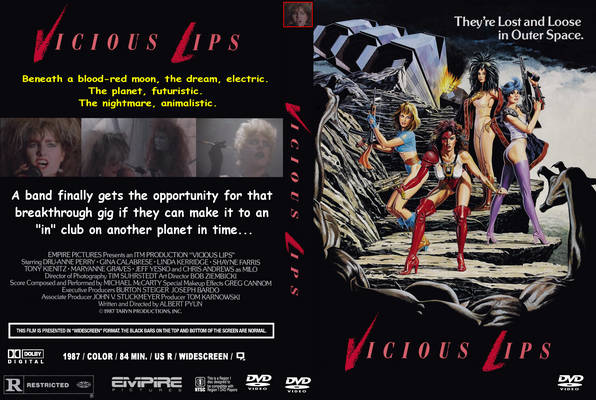
The Vicious Lips are trying to become the biggest rock band in the galaxy. Made up of Bree Synn (Gina Calabrese, The Dungeonmaster), Wynzi Krodo (Linda Kerridge, Marilyn from Fade to Black!) and Mandaa UUeu (Shayne Farris, who was also in Down Twisted with Kerridge), they’ve just lost their lead singer Ace to, well, death and need to get to a gig across the universe. Luckily, they find Judy Jetson (Dru-Anne Perry, who also plays Ace) and give her their dead singer’s name and get on their way.
I wanted to love this movie based on the first ten minutes or so, but then I realized that it came from Albert Pyun (The Sword And The Sorcerer, Cannon’s Captain America), so I had to adjust my excitement level. Here I was, hoping to get a movie about a punk rock girl band hellraising through the cosmos with the art direction of Heavy Metal and what I got was a hair ballad playing girl group slowly moving in a boring plot with art direction by whoever did the Rinse Dream’s Cafe Flesh or The Dark Brothers’ movies. That doesn’t sound like a bad thing actually. But here it is, as this film commits the cardinal sin of being boring.
If you still want to watch it, Shout! Factory has released it on blu-ray and you can watch it for free with your Amazon Prime membership.
Day 18 of the Scarecrow Psychotronic Challenge is Psychotronic Documentaries: The real authority on the occult, ufos, ghost hunters, conspiracy theories etc. They’re all real, accurate and true, right? After a week of documentaries, I had to go deep and find something truly off. And guess what? I succeeded.
This film promises so much. During Adolf Hitler’s rise to power, it states that a cabal of Nazi magicians and technicians discovered the secrets of anti-gravity and space travel from extraterrestrials.
This one hits every point you’d want it to. Hello Tesla! Hello Thule Society! Hello Maria Orsic and her Vrilerinnen, psychic girls who serve the Vril Gesellschaft, with long hair that acts as a cosmic antenna to contact occult beings from beyond our reality. Hello Black Sun! There’s also Germany’s Antarctic colony Neuschwabenland and psychic messages telling all of the Vril Society that no one will remain on this Earth.
But it doesn’t stop there. Flying wings! Flying saucers! Nordic aliens meeting with Eisenhower and Pope Pius XII! Hidden Nazi bases post World War II! Operation Paperclip! Aliens helping Nazi NASA scientists create our space program! There’s so much in this movie that it seems like the serious version of Tribulation 99: Alien Anomalies Under America!
Throw in some Roswell, Peter Levenda (who may or may not be the Simon who wrote the 1960’s Simon Necronomicon), Skull and Bones, Freemasons and more for a simmering stew full of saucer sauciness!
But don’t take it from me. Check out James Nichols site for the original essay or watch this via the link above or on Amazon Prime.
PS – Your author used to read old BBS message boards in the pre-internet phone based modem days on a Commodore 64. I was reading the Krill Papers that would eventually find their way into the book Behold a Pale Horse and there was a whole FOR YOUR EYES ONLY warning about how aliens killed Kennedy and showed our government a hologram of the Crucifixion, claiming they orchestrated the entire thing. It was at this time that my computer crashed and I became convinced — perhaps under the influence of a bottle of Jack Daniels and two Snapple Ice Teas that made for a horrifying mixed drink — that frogmen and Men in Black were coming for me, so I woke up our entire house in an abject panic. Ah, youth!
A passionate man makes a special promise of love and devotion to a girl who seems reluctant to accept it. He asks for 90 days to prove that she should marry him and within time, they fall in love. Yet after several weeks, real life takes over on romance and their relationship falls apart. So what happens next?
Director Michael Wong sent us this 9-minute film that he says is “inspired by a true story; it’s a story of a promise, misunderstanding and regret.” It’s a well shot movie that asks us to remember the promise of love, that when things become hard we must also recall how magical it all is that we meet that one person.
While not the usual fare that we cover on this site, this was still pretty interesting. I’m trying to keep my mind open to ideas in cinema, so watching this made me ponder my own relationships and learn how to keep my promise to them.
Want to watch it? I posted it above. Sometimes in life, things are just that simple. Also be sure to read our review and watch Michael Wong’s latest short, The Tattooist.
Man, these student teachers. They’re changing the old ways of high school and making it better — well, maybe more interesting — for the hip now generation. The sequel to Roger Corman’s The Student Nurses, this movie is all about the issues, man.
Directed and co-written by Jonathan Kaplan, who would go on to direct The Accused, this movie follows three student teachers: Rachel who wants to teach the good parts of sex education after school (that is, birth control and that sex isn’t this alien, frightening thing); Tracey dates an art teacher who cheats on her; and Jody works with an inner-city education effort but also gets involved in selling drugs.
Chuck Norris made his debut in this film as a karate instructor. In his autobiography, he revealed that he knew nothing of the film other than the scene he was in. When the movie was released, Norris and his family went to see it and were shocked by the explicit sex and nudity. In fact, Norris almost changed his mind about becoming an actor!
To say this movie is dated is an understatement. That said, it’s packed with the earnestness of the end of the 1970’s and the feeling that young people would change the world. They all ended up repeating the same cycle as their parents by the early 80’s. But for now, they would be the student teachers.
Day 17 of the Scarecrow Psychotronic Challenge is 17. Die Laughing. “Hello?” “I don’t think comedy belongs in horror.” “You got the wrong number, pal.” I’ve picked a movie that got a bad rap when it came out but time seems to have been kinder to, Jennifer’s Body. I missed it on the first go-round, so let’s get into it.
Jennifer’s Body was written by Diablo Cody, who became known for the blog and book Candy Girl: A Year in the Life of an Unlikely Stripper, as well as the screenplay for Juno. Since then, she’s done script revisions on the new Evil Dead as well as writing Ricki and the Flash and Tully.
Named for the Hole song, this is a film about not just demonic possession, but dealing with high school and the changes that childhood friendships go through. Anita “Needy” Lesnicki (Amanda Seyfried) and Jennifer Check (Megan Fox) have been friends since childhood, but times are changing.
Yet at the very start of the film, Anita is locked in a mental institution and unafraid to attack anyone in her way. She flashes back to her high school days with Jennifer, who was her the exact diametrical opposite. Where Anita is quiet, rude and withdrawn, Jennifer is loud, snide, sexy and popular.
Everything changes on the night that they attend a concert at the local dive bar, Melody Lane, to see Low Shoulder. While the band plays, a fire explodes across the bar and kills everyone inside, except the band, Jennifer and Anita. The band leaves with Jennifer over Anita’s protests. Later that night, she shows up bloody and shaking, devouring the inside of Anita’s mom refrigerator and spewing black fluid all over the linoleum.
Yet the next day, Jennifer is just fine. But things aren’t fine any longer. The town is devastated by the fire and the captain of the football team has been devoured in the woods. The only people who are doing well are Low Shoulder, whose heroism in the fire has been noted. Now, they want to make a charity performance at the school.
A month later, Jennifer is growing paler and needier, accepting a date with the school’s most emo kid, Colin, to see The Rocky Horror Picture Show. While Needy is losing her virginity to Chip, Jennifer is murdering her date.
Needy finds Jennifer drenched in blood and that’s when the secret comes out: Low Shoulder had tried to sacrifice her for fame and fortune, but since Jennifer wasn’t a virgin, she remains permanently possessed. Her first victim was the foreign exchange student that night after the fire. When she has eaten someone, she can survive any injury, feel no pain and becomes even more beautiful.
Needy does her research and learns that Jennifer is a succubus who can only be killed when she is hungry. She warns Chip not to attend the school dance, where she feels that Jennifer will feed on everyone. She even breaks up with him, but he comes anyone to his doom. The two girls battle in Jennifer’s bedroom before Needy is able to stab her best friend in the heart with a box cutter, ending her reign of terror.
Unfortunately, Jennifer’s mother only sees her daughter being killed, which is why Needy is in the asylum. As we come back to the beginning, Needy learns that a non-fatal bite from Jennifer has given her powers. She soon escapes, hitchhikes to Low Shoulder’s motel (of all people, Lance Henriken gives her a ride) and gets revenge for her and Jennifer.
Personally? I liked it. There’s a great moment during Needy’s first sexual encounter with her boyfriend where she notices all of Jennifer’s victims watching, much like the theater of corpses from An American Werewolf in London. I liked the relationship between the girls and am glad they didn’t follow through on the original plans to have a sex scene between them, as I felt that would have jumped too far into pure titillation.
It’d be interesting to see how this film would fare if made today. In a February 2016 New York Times interview, director Karyn Kusama (Girlfight, The Invitation) said that the studio’s all-male marketing department had no idea what to do with the movie, even suggesting that Megan Fox do live sex chats on amateur porn sites to drum up interest in the film. Obviously, the #metoo moment came at the right time.
The only downer to this film for me is how close it is to Ginger Snaps. It hits so many of the same story beats that one wonders exactly how many times Diable Cody watched it. That said, the music is decent and this movie will keep you entertained for 90 minutes.
Pottsville, Idaho has some problems. A massage parlor is coming to town and the local conservatives are going insane battling it. And oh yeah — children are disappearing and people are being horribly murdered. Oh boy, 1983 was a magical time to be alive, because this movie may have seemed stupid to critics when it came out way back when, but I loved every single minute of this.
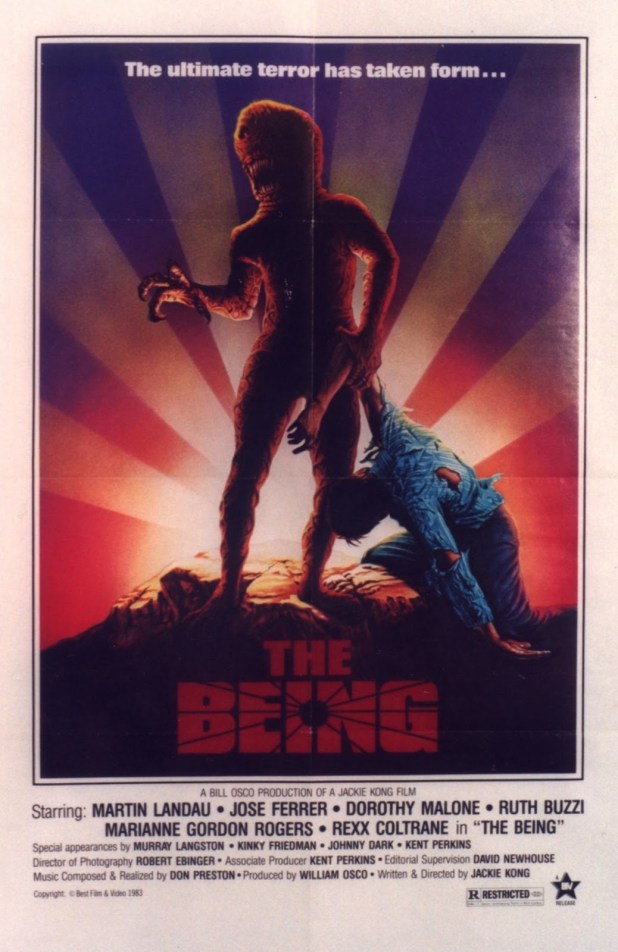
Much like Jaws, the authorities — including Mayor Lane (José Ferrer, The Sentinel) are covering everything up so that they don’t damage the town’s potato crop. That said, he hired chemical safety engineer Garcon Jones (what an amazing sentence that was to write), who is played by the always dependable Martin Landau. Detective Lutz is also on the case, played by Rexx Coltrane, who is in fact exploitation producer Bill Osco. Osco produced this film, as well as plenty of more adult titles like Flesh Gordon and Alice in Wonderland: An X-Rated Musical Fantasy. He also worked with Jackie Kong, who directed The Being, to bring Night Patrol to the screen.
Toss in Kenny Rogers’ wife (at the time) as a love interest and a mutant who is totally influenced by Alien and we’ve got ourselves a movie. This also curiously takes place during Easter, which has nothing to do with anything at all, other than inspiring its original title, Easter Sunday.
It turns out that the mutant has been exposed to radioactive materials in one of the town’s dumps. And luckily, the mutant is light sensitive, so it only attacks at night. Will Martin Landau and the film’s producer be able to stop it in time? Also, don’t you want to see this even more when I tell you that Ruth Buzzi is in it? Or that in addition to Ferrer, this film has another Oscar winner in the cast, Dorothy Malone? What if I told you that Murray Langston, the Unknown Comic himself, was in it? Or that at the end of the movie, we get to learn what happened to every character after the film with title cards and then get to see every major character with a super of who played them (and anyone who has died, we get to see them die all over again)? For these reasons and so many more — like a creature that has one eye and hundreds of teeth, this movie is a must see.
You can watch it yourself on Amazon Prime Video. It’s free with your membership. You can now thrill to my favorite scene in the film, where a cat scares the hero so much that Martin Landau has a laughing fit.
Day 16 of the Scarecrow Psychotronic Challenge is 16. Petey Wheatstraw presents. Watch a movie featuring African-Americans in the starring roles. Bonus if it’s written and/or directed by an African-American. We’re happy to answer all of those challenges with a brand new movie — Rusty Cundieff and Darin Scott’s sequel to their 1995 film Tales from the Hood.
This was a difficult movie for me to write about, to be perfectly honest, for several reasons. First, I love the original. Often, it’s hard for me to warm up a band’s new album because I am so into what came before and I need to push past that. I had this DVD sitting on my to watch pile for some time until I could be ready to watch it. And I’ll be frank: it is not nearly as good as the original. But in the twenty plus years since the original came out, a lot of good — and bad — has happened in the American experience.
Which leads me to the second part that makes this movie hard for me to share my opinion on: I’m a white male that was born in a small town with a handful of black people in it. This is very much a horror movie made for a post-black lives matter and #metoo world. And yes, I can have an opinion on the actual film, but when there are moments that may feel heavy handed and obvious to me, they may also feel incredibly poignant and earnest to others.
Keep this in mind when I bring up points in this article. Because I really liked parts of this film. I know why they did what they did. I think my major issues with it were the lower budget, which can’t really be helped, and that there’s an inconsistent morality through the stories. Yet I found a lot of things to like in it. I’ve used the Frank Capra quote “There are no rules in filmmaking. Only sins. And the cardinal sin is dullness.” before. And this movie is anything but boring.
The movie starts with Robo Hell, where we meet Dumas Beach, a rich white prison owner who is creating an army of artificial intelligence Robo Patriots that can learn from firsthand experience, as well as secondhand stories so that they can become predictive.
He hires Mr. Simms (Keith David here, instead of Clarence Williams III who has retired from acting), a storyteller who will use his collection of tall tales, legends and parables to better teach these robots and prepare them to police America’s neighborhoods and borders.
Dumas asks him to tell the robots about the people who will fill his prisons, so the first story is all about black lives mattering. In Good Golly, two friends, one white and one black, visit the Museum of Negrosity, which features a history of racist propaganda, books and dolls. The white girl wants a golliwog doll named Golly Gee for her collection, but the owner refuses. Nothing there is for sale, it’s there to teach a lesson. That night, the kids come back and try to steal it, but everyone is killed by Golly Gee and the other golliwogs, other than the one girl. She is impregnated with Golly Gee’s horrible children, who burst forth from her stomach, killing her. Also, one of Miss Cobbs’ dolls shows up from the original, but he really serves no storytelling purpose other than fan service.
Here’s where my issues begin: every character in this scene other than the museum owner is a stereotype. Yet this is a chapter about stereotypes and how racist characters are the first marketing characters, a subject I found fascinating as I come from an advertising background. When the owner says to Golly, “How dare they call you a stereotype? You’re just the creation they designed you to be!” it resonates.
That’s where I have to figure out how to discuss this film. Parables are simple stories that need stereotypes and easily understood iconography to impart a moral message. They share some employment of those storytelling tools with exploitation films, which use stereotypes to create sensationalized narratives that make money, morals be damned. My issue here is trying to figure out when Tales from the Hood 2 wants to be a morality play and when it wants to titillate and entertain.
The next part, The Medium, feels like it’s on the side of the latter. A pimp named Cliff Bettis has given up the life, giving five million dollars to a foundation and building two magnets schools in the hood he once used for his own ends. Three criminals try to extort and torture him to find the money, but after Bettis accuses one of them of being a willing bitch in prison, it goes too far and he’s killed.
That’s when we meet TV psychic John Lloyd (obviously John Edward, the TV cold reader) who uses trickery and eavesdropping to make money from an audience that thinks he can speak to the dead. The three men think that they can get the money from the other side by kidnapping Bettis’ girlfriend and using Lloyd’s psychic powers.
However, the seance goes wrong and Lloyd discovers that he really has the power as Bettis possesses him. That’s when Bettis begins using mental powers and murders the three men before taking over Lloyd’s life, using his pimp mindset and real psychic powers to become even more successful.
Here’s my issue with this segment over every single other one in this film. As you’ll discover, this movie wants people to understand the sacrifices of the generations before them and make better choices. If Bettis really has made a foundation and is helping improve his neighborhood, he quickly abandons that plan and simply murders everyone in his path before becoming an even bigger swindler. Nobody learns anything. No lives get bettered. It’s just revenge for revenge sake and seems to feel morally hollow versus other moments that will follow.
Date Night is a much simpler affair, where internet predators end up facing vampires after a game of Cards Against Humanity that goes on way too long. It’s one thing to have fun and play it at a party. It’s another thing to spend endless time on it in a film when it doesn’t really move the plot forward. This story is by the numbers and doesn’t raise the questions that the other stories do.
The Sacrifice is the longest and most troubling part of the film. It concerns a councilman, Henry Bradley, whose white wife has had several difficult pregnancies. She fears that her visions of a boy about to be lynched will make all the difference, as she thinks that boy doesn’t think her child deserves to be born.
It turns out that Bradley is a Republican who is helping William Cotton run for governor. To ensure that less black people will vote, he’s working on shutting down voting sites in their neighborhoods. Bradley’s mother is aghast and as time goes on the baby begins to slowly disappear.
The black child is, of course, Emmett Till, and the theme of this episode is that the black people of today must honor the sacrifices of those who have gone before. At one point, the world makes a startling narrative shift, where we see what the world would be like if Till, Carol Denise McNair (who was killed in the 16th Street Baptist Church bombing), James Chaney, Andrew Goodman, Michael Schwerner, Medgar Evers, Dr. Martin Luther King Jr. and Mamie Till had not made their sacrifice.
Now, instead of running on a platform to return Mississippi to its old values, Cotton leads a paramilitary KKK to Bradley’s house. The doctor and Bradley’s white wife have turned against him. And the only way out is for him to die the same way as all of these martyrs if he wants the world to be better and his child to live.
This is where the morality/exploitation question really hit me. It’s an audacious gambit here and really a grandstand that demands to know why black people, knowing the past, would vote for people that want to “make America great again.” You can say that you’re taking the race out of things, but if we’ve learned anything from Golly Gee, it’s that racism is so ingrained in our American DNA, you can never take race out of anything else ever again.
Like I said earlier, I can have an opinion on the quality of the film but not on the content of this scene. I can say that it feels exploitative to me, but the truth is, this segment may empower someone. Or it may make them think. It certainly did that for me. So often we forget everything that everyone has worked so hard to change. I try not to get political on this site, but my constant real life worry is that the last two years have erased so much progress. And often, I use horror movies as an escape. But exploitation can often be morality and vice versa and perhaps they can both serve the same purpose. This movie doesn’t have a square up reel ala IIsa, She Wolf of the SS, so I think it really wants to be more sermon than sensationalism.
Finally, the framing device, Robo Hell, ends with the Robo Patriot showing how it can identify ex-cons and illegal immigrants. But now, it’s predictive abilities, powered by Mr. Simms’ stories, allow it to see the most immediate clear and present dangers to American civilization. And that threat is obviously Dumas Beach and his people, who are so complicit in his crimes that they must die as well. We get Old Testament justice mixed with low comedy wordplay (Dumas Beach is really Dumbass Bitch) and Mr. Simms reveals that he is Satan as he takes the evil white rich old man to Hell.
The fact that the devil has a higher moral standing than someone who seems to be a red hat wearing Republican is not lost. It’s just another of the interesting stances that this movie takes.
Executive produced by Spike Lee and written and directed by the same team who produced the original, Rusty Cundieff and Darin Scott, this one really is much more of a mixed bag than the first film. I wanted to love this and ended up left with more questions than answers. That isn’t to say I hated the film. I can see why other critics would attack this film. It’s not subtle at all. It has noticeable flaws, like the cheesy robot in the wrap around. And the vampire story could be removed and make this a much better movie. Yet Keith David is great. And I actually thought a lot more about the issues raises here than I have in any other movie I’ve watched this year. That’s what a good moral story should do, right? I just wish this had a better point of view of whether it wanted to educate or entertain when it struggles to straddle the line and do both.






 B&S About Movies