Bloodlust (1977)

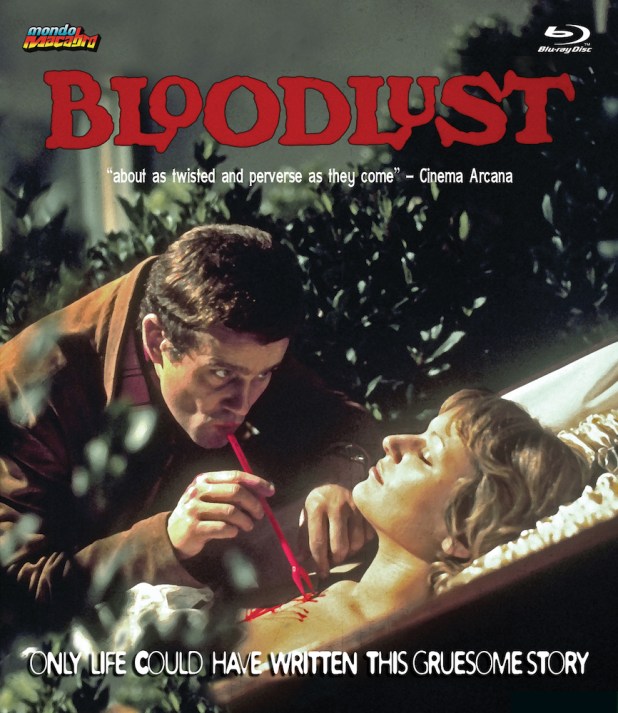
Known by several other titles Mosquito der SchänderBloodlust: The Black Forest Vampire, Bloodlust: The Vampire of NurembergMosquito and Mosquito the Rapist, this is a dark and disturbing 1970’s Eurohorror based on the macabre true story of Kuno Hofmann, the “Vampire of Nuremberg.” Cut and banned in many countries, Mondo Macabro is finally bringing the full-length and uncut version to blu ray.

Mondo Macabro describes this one as a “grown up fairy tale, albeit one that includes bloodsucking, eyeball evisceration and voyeuristic lesbian sex scenes among a host of other activities.” That pretty much covers it!

Director Marijan Vajda mainly worked in documentaries, which is a way of seeing this film. No one is named, but The Man (Werner Pochath, who was in both Ratman and Thunder 3, so he’s on the Sam movie spectrum) is a deaf and mute accountant who has been abused his entire life, from a father that beat him and raped his sister in front of him to his fellow schoolmates attacking him and now, his co-workers and neighbors with treat him with scorn. Maybe it’s because he’s weird. Maybe it’s because he’s so quiet. Maybe it’s because he plays with dolls.

The only light in his life is The Girl (Birgit Zamulo), who dresses up all day and dances, and may be potentially just as damaged as our hero. The Mother warns her to stay away from The Man, because there’s something off about him.

At night, The Man tries to visit prostitutes, but he can’t communicate or perform. Soon, only the dead provide him with comfort, as he starts slicing up bodies, decapitating them, stealing their eyes and even using a glass straw to drink their blood. He starts leaving a graffiti tag behind, the words M.Q. or Mosquito, and the press panics the city with news of a modern day vampire.

The living are still safe until The Girl falls from the roof, in an act that we’re left. to believe may or may not be suicide. Losing the only person he really loves sends The Man over the edge and into a spiral of violence after he fails to bring her back to life by feeding her his blood.

This bit of Swiss weirdness isn’t everyone’s cup of tea. It’s slow-moving, but I wasn’t bored. By the time The Man gets to killing, it descends into the sleazy madness hinted at by the back of the box. But it’s a near-silent meditation on trying to escape abuse and man’s continual inhumanity to man. It also starts with a great square up real that attempts to paint this movie as an educational experience when all it really wants to do is get you to watch the creeptastic carnage on display.

I’d never heard of this before and was pleasantly surprised that it’s such a sensitive — well, as sensitive as a vampire movie with plenty of gore can be — and well-acted film.

The new release features a 2K scan that looks beautiful, as well as exclusive interviews with assistant director Marijan David Vajda on the film (as well as his career and the career of his father) and actress Birgit Zamulo, who has some insightful thoughts on what it’s like to be in a film that’s sympathetic to a murderer. Plus, you get the original UK trailer, audio choices and some great trailers that’ll inspire you to buy more of the great stuff these guys put out. It comes out on November 13 and you can grab it from Mondo Macabro or Diabolik DVD.

Disclaimer: I was sent this film by Mondo Macabro for review and in no way did that impact this article.

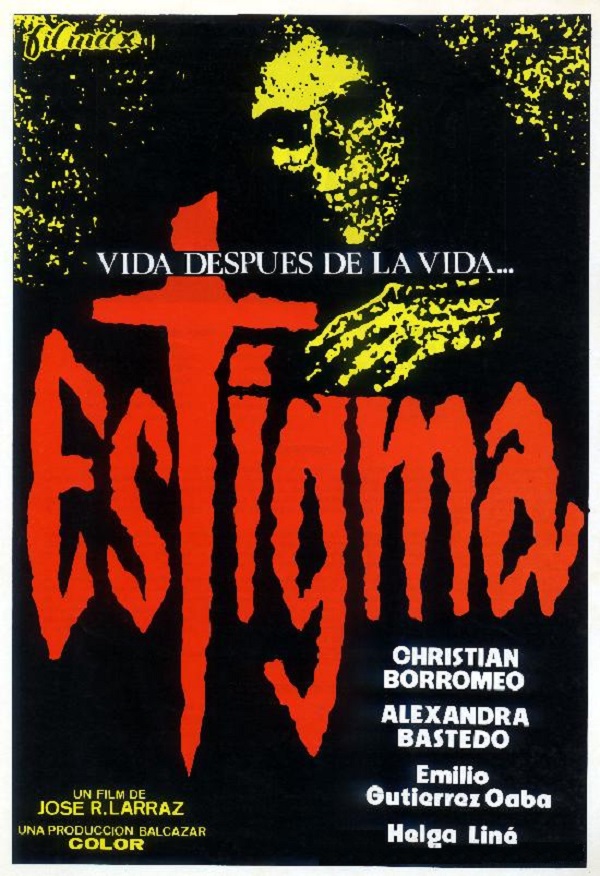
Estigma (1980)

Sebastian has become possessed and now has the power to make his thoughts come true. Somehow, all that allows him to do is relive his past lives again and again.

Director José Ramón Larraz also worked in comic books, as well as helming the films Symptoms and Vampyres.

The film starts with Sebastian learning that his father has died and his mother feeling free and ready to start her life all over again.

It turns out that Sebastian was born with a veil of skin covering his face, which is a symbol of psychic power. That may be how he knew that his father was dead before anyone told him.

Also, Sebastian has issues with women. He puts off anyone who wants to be with him and gets upset when his mother kisses another man. Learning that his father was with a whore when he died, he declares that all women are whores. His mother answers by slapping him.

Sebastian and a girl who is interested in him, Marta, end up kissing but he forces himself on her until his lip begins to bleed. At confession later, a priest tells him that wishing evil is the same as doing it. What does this have to do with Marta being dead now?

An old woman named Olga remembers Sebastian from the past as he has a vision of hanging himself. Olga awakens her granddaughter Angie, sure that something bad is about to happen to Sebastian. There seems to be a romantic triangle between him, Angie and his brother Joe.

Sebastian ends up recording his mother having sex with her new lover. This upsets him so much that his shower is filled with blood and his vision of a ghost woman makes his lip bleed again.

That love triangle I mentioned above ends up with Angie and Joe having sex. Yet Olga thinks that Sebastian and Angie have an attraction too. She’s worried about the danger that he brings. While on a ferry with Angie, Sebastian sees the ghost woman again. He confesses to Angie that when he thinks of someone he hates, he makes them die and his lip bleed — that’s his stigmata. He also can see himself from the outside of his own body and he probably killed his father.

Joe confronts Sebastian about the issues that he’s having in school, so Sebastian thinks of him dying in a car crash. Angie believes that he is evil, but he says that he has no control. Once he realizes that someone is going to die, it’s too late.

Here’s where things get really bonkers: Sebastian keeps seeing the ghost woman, so he talks with Olga. She hypnotizes him and he remembers where he killed Marta. He then goes into his past lives, where he sees his sister, who looks exactly like Angie. They have sex and he awakens in a panic as his father had become angry with him.

While he doesn’t want to see Olga again, Sebastian uses tapes of her seance to calm himself. Soon, he is visiting the setting for his dreams in real life and has more visions of his past inside them. Angie comes searching for him and he shows her where people died in the building as he starts to bleed from his lip.

That’s when we go back into the past again, where he has sex with his sister again and his father criticizes him. When his sister is engaged to be married, he becomes depressed. She doesn’t even think of him any longer and he can’t forget her or stop disappointing his father.

That’s when he uses an axe to kill his parents, then starts making love to the maid. He decides to strangle her instead, then remembers many other girls that he is killed. A mirror breaks and he begins to bleed from the lip as we return to the present and he listens to the seance tapes.

I honestly had to read several sites to make sense of what happens in this movie. It’s long on style, short on substance and yet it has a unique doom feel. I was pretty forgiving of its narrative issues, but your mileage may vary. I was interested to see what would happen next and it had enough verve to keep me watching.

You can watch this on Amazon Prime or order it from Diabolik DVD.

2018 Scarecrow Psychotronic Challenge Day 22: The Witch

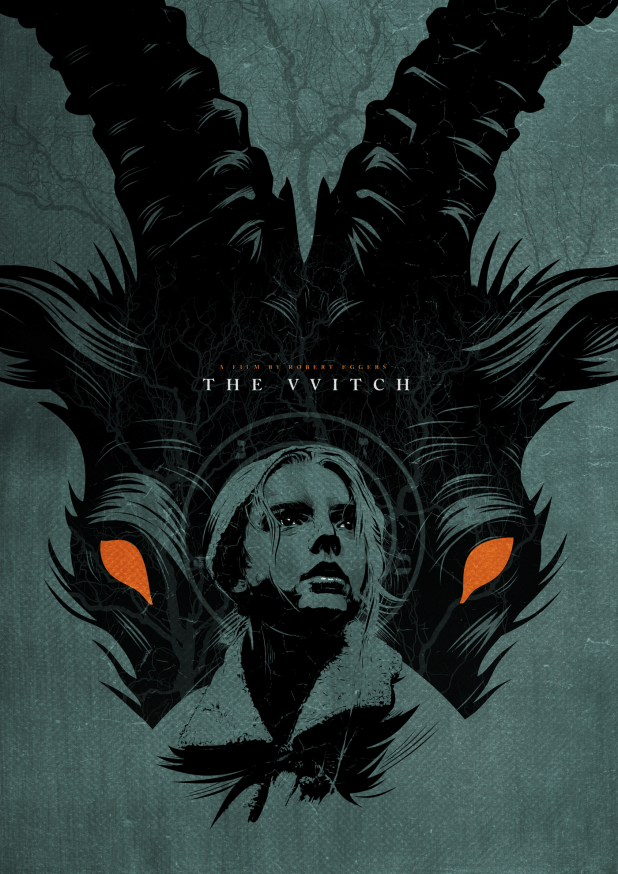
Day 22 of the Scarecrow Psychotronic Challenge is 22. Separation. Alienation. Aloneness. If you scream alone in the woods and no one is around to hear it, are you really screaming? For today’s movie, I went with The Witch, a film where one of the main characters choose all three because of his pride.

It all starts when William’s interpretation of the New Testament leads him to being banished from the plantation where his family has moved to from England. Instead of the safety of being around others, now he and his brood have to live within the forest.

One day, when the oldest daughter Thomasin is playing with the youngest, Samuel, the baby disappears, stolen by a witch and devoured. William insists that a wolf stole the child while his wife is decimated for the rest of the film. William’s lies move the story further in motion — he takes Caleb hunting deep in the wood when he has promised his wife he would not and he sells her father’s cup for hunting supplies. Meanwhile, Mercy and Jonas, the twin children of the family, insist that they speak to the goal named Black Phillip while contending with Thomasin that they are also witches.

The next morning, son Caleb leaves to see if he can get food for his family, thereby keeping them from selling Thomasin into servitude. She goes along with him, but their dog chases a hare and their horse throws Thomasin as Caleb is lost in the woods, eventually being seduced by yet another witch.

Soon, all Hell is literally breaking loose. Caleb returns, near death, and throws up an apple before his violent death. The twins forget how to pray and go into a trance. And the mother is convinced that Thomasin is behind it all.

Up until this point, the film moves at an incredibly slow pace. Get ready. I don’t want to spoil anything, but it gets more and more demented, paying off everything you’ve been waiting for.

The first film for Robert Eggers, this shot in natural light film is something to behold. It seems much more confident than a first film would suggest. There is also a lot of attention paid to supernatural detail, such as the Enochian language used throughout for the witches.

I’ve debated the end of this film so many times. Is it about Thomasin’s escape from teen to full womanhood? Is it the sin of William’s pride destroying his entire family? Is it about the fact that evil actually exists and that it may claim even the most pious? Or is the issue that William only sees the hellfire and brimstone of the Gospel when he should be preaching the literal Good News, the celebration of Christ conquering death? Would Thomasin desire to live deliciously if her life had not been so oppressive? Is it about the divide between mother and daughter? Is it a Satanic parable?

BONUS: Listen to Becca and Sam discuss The Witch on our podcast.

A Brilliant Monster (2018)

In my non-movie watching life, I write advertising copy for a living. A lot of that involves the constant search for inspiration as I battle against deadlines. So the central conceit of this movie, which concerns how Mitch Stockridge, a self-help author, gets his story ideas spoke to me. But how’s the final product?

Mitch (Dennis Friebe) has taken his life from being bullied in his teens to a successful career as a self-help author. But it’s not enough. He’ll never please his father. And he’ll never quiet the fans, journalists and even close friends who keep asking him where he gets his ideas. That’s because the truth is stranger than fiction: his ideas come from a monster that lives in his bathroom that he feeds people to. In exchange, he gets a crumpled piece of paper with scrawled ideas that he takes for his own.

After trying to write an actual novel instead of just another self-help guide, Mitch deas with the depression that comes with shooting for the stars and falling short. That’s when he decides to start feeding everyone and everything he can to the creative beast. And all of the people disappearing around him leads to the police investigating him, with Abby the lead detective going for interested to a vendetta to pure hatred. That’s because of more than just this case — one of Mitch’s self-help books inspired her husband so much that he left her and their family behind to chase his dreams.

So is this a real monster? Or is Mitch just crazy? And is Abby just as crazy for starting to believe in it, too?

Now, Mitch wants to prove the critics and his father wrong once and for all. And that means drastic measures and deaths that are way more important than just some girls he’s met in bars and on CraigsList. No, it’s time for his best friend John to meet the teeth of the bathroom monster if he really wants to be a celebrated writer.

There’s definitely a bit of Little Shop of Horrors and Basket Case at work here. I really liked how you never really see the monster, just its teeth and the sounds it makes as it tears apart its meals. There are a lot of questions raised by this film, such as Mitch’s journey from abused child to the caretaker for his father, the pains and sacrifices that it takes to create and the relationships that it costs along the way. I really felt that last part a lot.

This is definitely a low budget film, so go into it knowing that. It looks decent, though, with some solid editing and the leads are way better actors than you’d expect. There aren’t a lot of characters to like, however, as almost everyone is uniformly a bad person. There isn’t anyone to root for or learn from in this. But it is an intriguing meditation on the creative process, even if it feels like there could be more to the overall story.

The film’s IMDB site says that this film will be released on December 1. To learn more, visit the official site.

Disclaimer: I was sent this movie by its PR team, but as you know, that has no bearing on my review.

Prison (1987)

Before Renny Harlin did Die Hard 2 (or The Adventures of Ford Fairlane). Before Viggo Mortensen was in the Tolkien films. Before Tiny “Zeus” Lister was Deebo in Friday. Before Kane Hodder played Jason for the first time in Friday the 13th Part VII: The New Blood.

Before all these things, there was Prison.

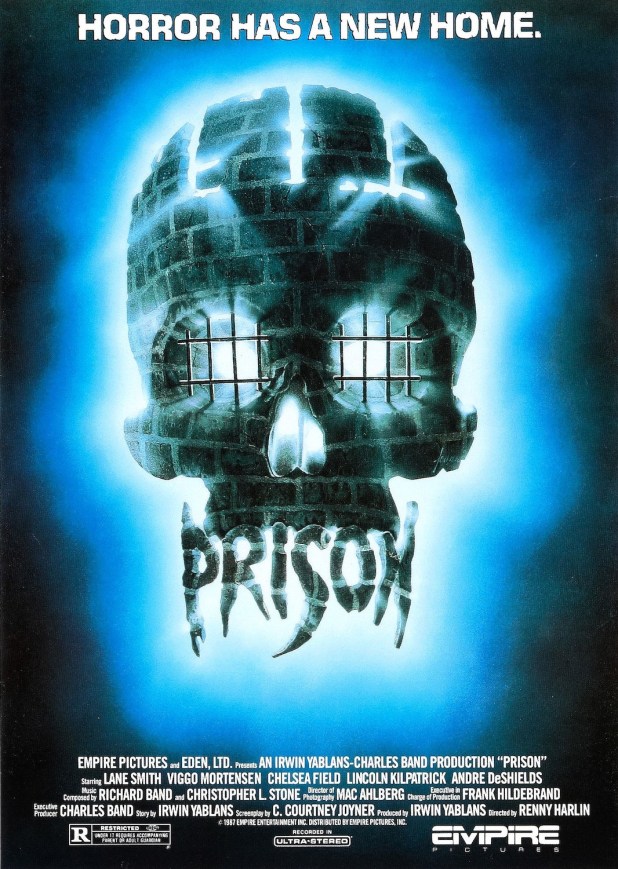
In 1964, inmate Charlie Forsythe (Mortensen) is electrocuted for a crime he did not commit. And thirty years later, when the Creedmore Prison is re-opened, his spirit is there and ready to get revenge on Eaton Sharpe (Lane Smith, district attorney Jim Trotter III in My Cousin Vinny), who knew he was innocent. Now, he’s the warden!

Unless Forsythe repays the debt he owes, every inmate will die, including  Burke (also played by Mortensen). And what a cast of felons, including Lincoln Kilpatrick (Chosen Survivors), Tom Everett (Death Wish 4: The Crackdown), André De Shields (The Wiz himself!), the previously noted Lister, Larry Jenkins (Fletch), Hodder and more. And according to IMDB, “Most of the inmate extras in the film were portrayed by real-life inmates from a nearby prison to add realism to their performances. The armed guards on the towers were, of course, armed with live ammo at the time. Stephen E. Little (Rhino) was a former Hollywood stuntman, who was still a member of SAG, who happened to be serving time for manslaughter that he committed during a bar-room brawl.”

Helping the convicts is a doctor who advises the prison be closed, played by Chelsea Field (Teela from Masters of the Universe and wife of Scott Bakula).

Sure, it’s the same idea as DestroyerShocker and House 3/The Horror Show. But it’s entertaining enough and has a surprising amount of gore. It won’t bore you, that’s for sure. There’s a great scene of a convict’s guts exploding onto the mess hall as everyone tries to eat that I loved!

Scream Factory put this out awhile back. You should grab it and see what you think.

2018 Scarecrow Psychotronic Challenge Day 21: If Footmen Tire You, What Will Horses Do? (1971)

Day 21 of the Scarecrow Psychotronic Challenge is 21. Opiate of the Masses. The power of the Scarecrow compels you to watch a religious film! I’ve been dying to watch this movie, as I’ve known parts of it from Negativland’s song “Christianity Is Stupid.” Once Nicolas Winding Refn added it to his site www.bynwr.com, I knew this would be my pick.

The title of this film references Jeremiah 12:5: “If you have run with footmen and they have tired you out, then how can you compete with horses? If you fall down in a land of peace, how will you do in the thicket of the Jordan?”

The director, Ron Ormond, started his career in vaudeville doing magic, before making B picture Westerns and exploitation films such as Mesa of Lost Women, Untamed Mistress, Teenage Bride/Please Don’t Touch Me and films such as 40 Acre Feud, which starred country star George Jones. After that, he spent much of the 1950’s writing books with Ormond McGill about magic and psychic belief, such as Religious Mysteries of the Orient/Into the Strange Unknown, The Art of Meditation and The Magical Pendulum of the Orient.

It gets stranger. By the 60’s, Ormond moved on to producing roller derby for Leo Seltzer and making  films like The Girl from Tobacco Road with cowboy star Tex Ritter and The Monster and the Stripper, an inordinately bonkers film that plays like a variety show packed with exotic dancers, contortionists, rockabilly and a swamp monster played by musician Sleepy LaBeef that was filmed in the studio of a Methodist Church with exteriors shot on location in the Okefenokee Swamp.

Then, well, Ormond crashed his single-engine plane near Nashville and had a Paul on the road to Damascus moment. Soon, instead of making movies that’d play in drive-ins for horny teens, he’d be converting them to the will of God. Yet this movie proves that he lost none of his exploitation edge. After all, his son’s godfather was Bela Lugosi. Now, Ormond was woke to the teachings of one Estus Pirkle, who was convinced that America faced its greatest danger from Communism.

In their follow-up to this film, The Burning Hell, Pirkle would speak to the horrors of the afterlife while Ormond matched him with the kind of imagery that could only come from a junk movie pioneer who nearly smashed a plane into the unforgiving Earth. Actually, he crashed another plane in 1970, after finishing The Monster and the Stripper, so two signs from God were enough to get Ormond on board. Because after all, Pirkle would preach hellfire and brimstone like this: “Hell is forever. 10,000 years from now, every sinner will still be in Hell. 100,000 years from now, every sinner will still be in Hell. 1,000,000 years from now, every sinner will still be in Hell. 100,000,000 years from now, every sinner will still be in Hell. 1,000,000,000 years from now, the inhabitants of Hell will still be sinning, cursing, crying, swearing, and in a pain that no mortal man has to experience now.”

But let’s discuss this movie because it truly boggles the mind.

As Pirkle reads a sermon, we see an America that is made up of Southern accents and good Christian folks getting decimated by Communists with the worst accents you’ve ever heard. They force people to renounce their faith, accept Castro as their personal savior and shoot their own mothers when they’re not shoving bamboo sticks into children’s brains through their ears, making those kids puke all over the place. This entire sequence is shown up close and in person. Christians are shot, stabbed, hung, tortured and murdered. Their children are made to hang them and drop them onto spikes. It’d be frightening if it wasn’t so over the top. I’ve always had the belief that Christians have way better Satanic imagery than most Satanists, as this movie and the Jack Chick tract The Beast have both shown me. But look — don’t take it from me. See it for yourself!

This film was often played in churches and in tent revivals, where at the end, there would be an altar call. Supposedly, this movie achieved its goal of saving a million souls, which was now the box office that Ormond was now really concerned with.

Pirkle promised that hundreds of dead bodies would litter the streets of our towns and tens of millions of Americans would be killed by Communists within the next 24 months. He also found the time to shame a good Christian girl who witnessed but had the temerity to wear a mini-skirt while doing so. And he also drops bon mots like “Are you aware that less than sixty years ago there was not one Communist in the world, whereas today Communism controls one billion, one hundred million people?”

I know that I grew up Catholic and that warped me beyond belief, but I really am glad that I never attended any tent revivals growing up. I would have ended up speaking in tongues, handling snakes, drinking poison and saving people with psychic surgery.

Seriously, this movie messed with my mind on a level that Alejandro Jodorowsky could only dream of. This is a movie where Communists machine gun Baptists into a giant unmarked grave as the camera luridly moves amongst the carnage and a small boy says, “Where’s my mommy? Where’s my daddy?” before another Communist monster with an accent like Dracula demands that the kid step all over a painting of Jesus, which leads to that cherubic child getting beheaded rather than turn his back on Christ and his head tumbles into the ground in dramatic slow motion while a member of the audience within the audience screams and gives up her hippie ways and finds her way back to the Lord while the ghost of her mother cries from an open casket.

This isn’t just the best religious movie I’ve ever seen. It may be the best movie ever made.

Want to see the whole thing? Fuck yes you do. I posted a YouTube link above and if you join the ByNWR site, you can see the best quality version of this film that exists.

Halloween (2018)

SPOILER WARNING: We don’t often review movies that are still in the theater, so usually don’t bother with worrying about giving away major plot points. Seeing as how this one is in the theaters right now, you may want to see it. We’d rather not be to blame for giving away plot points, twists and turns or influencing your decision to see it. Movie watching is an incredibly personal experience and we respect everyone’s opinion, even when it’s wrong and we laugh at you in the privacy of our own home about your lack of aesthetics and taste.

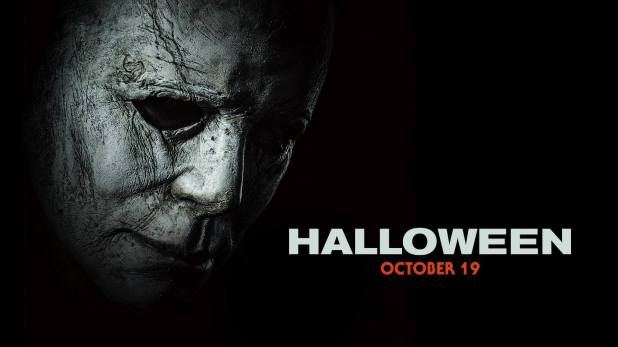
Nearly every review of the new Halloween starts out by stating the problematic nature of the franchise. In my perfect world, Halloween 2 would have been the end, with Halloween 3: Season of the Witch starting off a yearly anthology of pre-Samhain related mayhem. But my wife has so much love for this series that she endorses everything save Halloween Resurrection and the second Rob Zombie film. And even then, she’ll still watch those. We can’t hide the fact that we are fans — our shelves speak to it, with multiple versions of the first film and every cut of 6.

That’s why the possibility of a new Halloween film with a major budget, nine years after the last abortive attempt to make one of these films, raised such hope. David Gordon Green, the director of Pineapple Express, along with frequent collaborator Danny McBride would create the film along with the participation of the original creator, John Carpenter and the acting skills of Jamie Lee Curtis. For the last year, we’ve been inundated with the assurances that these creators are people who get what makes Halloween work. This would finally be the sequel that fans had been craving since, oh, 1981.

The first chink in the hype armor, for me at least, was the knowledge that this film would invalidate Halloween 2, being seen as the only sequel that counted. The convoluted history that we mentioned earlier may keep some from understanding the series, but I’ll be honest. There’s no reason why this movie had to erase the second installment. It could have still happened and it wouldn’t impact this film at all.

There’s really no nice way to say this, so let me jump in feet first. Beyond being a movie that fundamentally doesn’t comprehend what made the original Halloween such a great film, the 2018 version of Halloween is a movie with no understanding of what makes a great horror movie, either.

That isn’t to say there isn’t a great set-up. Forty years after the 1978 Haddonfield murders (referred to as “The Babysitter Murders,” a nod to the film’s original title), a Serial-like podcast team makes its way to the area to investigate the story and try to see both sides. The first mistake the journalists make is to show Michael Myers’ mask his iconic mask. This scene is pretty chilling, as the entire yard of Smith’s Grove Sanitarium rises up in chaos, dogs barking, insane men screaming, Myers just silent and not turning his back. Let’s not let the logic of how two podcasters got such a crucial piece of evidence out of police custody or how any hospital in its right mind would allow this interview to happen this way get in the path of the movie.

The podcasters then make their way to the fortress home of Laurie Strode, who has spent the last forty years preparing for Michael’s return. If this seems like 1998’s Halloween H20: 20 Years Later twenty more years later, we should be so lucky. After a quick interview in which the British duo shows that they just don’t get it, Laurie kicks them out.

That night, Dr. Ranbir Sartain and a maximum security crew transport Myers and other prisoners from Smith’s Grove to a maximum security prison. Of course, the bus crashes. Of course, Michael escapes. And of course, the footage echoes the escape from Halloween 4 while simultaneously telling us that that movie no longer exists. There’s a moment here, where Michael kills a young boy, where I felt like this was this film announcing that it wasn’t going to play by the traditional slasher rules. If young kids were fair game, everyone was. Sadly, this was one of the last surprises that the film would have in store.

Michael then finds and kills the podcast team, which has no real emotional heft because we have no reason at all to care whether they live or die. Sure, they tempted fate and must be destroyed in order for him to get his mask back. It’s a brutal scene, putting over the power that Michael has, but if we follow logic, The Shape should by 61 years old. Co-writer McBride stated that “I think we’re just trying to take it back to what was so good about the original. It was just very simple and just achieved that level of horror that wasn’t turning Michael Myers into some being that couldn’t be killed. I want to be scared by something that I really think could happen.” I haven’t seen many 61-year-old men that can throw people around like this. The refusal to embrace the supernatural evil of Myers is one of this film’s first failings.

Back to Laurie Strode. She’s had two failed marriages and had her daughter Karen (Judy Greer) taken away from her at the age of twelve. Today, they have a tenuous relationship, with Karen’s daughter Allyson working the hardest to understand her grandmother. Learning that Myers is loose, Laurie breaks into her daughter’s home and warns her and her husband Ray that they need to be ready. This is another narrative misstep. Are we supposed to believe that Laurie’s PTSD and constant battle readiness has cost her way too much? Or is she the only person who is right in this whole film? The way it plays out, as she’s pretty much the only protagonist who actually does something, proves that she’s correct all along.

That’s one of the critical flaws in this movie. Outside of Laurie, there isn’t a single character that we get to know or care about. Her daughter is someone who has given up connecting with her. That’s her one note. Her granddaughter is in a crappy relationship and wants to get to know her grandmother a little better. And that’s it. Every single other person we meet — save for Dr. Sartain and we’ll get to him later — is just fodder. Contrast this with the original, where we get to know Laurie, Lynda (P.J. Soles shows up so quickly here you don’t even catch her, by the way) and Annie really intimately before the first hint of bloodshed. I defy you to tell me one character’s motivation or reason for being beyond words on a page here. For a movie that aspires to be above and beyond the slashers of the 1980’s, even the worst of those had a character you wanted to root for other than the final girl.

Meanwhile, Michael has started to kill people all over again. Allyson’s friend Vicky is babysitting instead of attending the school dance and she gets slaughtered. The scene where Myers is hiding in the closest was so much better effect in the trailer. Here, the way it’s framed, it loses any narrative punch. That’s when we get to the next flaw in this film: it has no idea how to be suspenseful. There is no moment where you get that heart pumping feeling where the killer is stalking his prey, where you feel compelled to yell out words of help to the hapless victim onscreen. We saw this movie in a totally sold out environment of people ready to shout, scream and shriek. You could have heard a pin drop during this movie.

The only character that seemed to get a reaction was Julian, the young boy who Vicky is babysitting. Now, I’ll be honest. The kid was hilarious. And I’m not one of those people who can’t deal with a little comedy in my horror. But I’m also of the belief that once the horror truly begins, humor becomes a release valve that isn’t always necessary. In fact, Julian is so funny that he breaks the movie here, although he gets off a great line as he exits the film, telling one character that he shouldn’t even go into the house because he’ll definitely get killed.

At this point, Laurie has become Dr. Loomis, patrolling the streets on her own, gun in hand. This is something that the cops have seemingly no issue with. Maybe it’s because Sheriff Frank Hawkins was the cop who stopped Loomis from killing The Shape when he was in police custody. That’s probably better than the original script for this that had Loomis being killed before the police could stop Myers’ original rampage.

For all the time the movie spends in setting up the leader of the police, Sheriff Barker, he never appears again once the carnage really starts. No, instead of the police doing what makes logical sense — putting everyone in protective custody in a location far from Haddonfield — they allow everyone to go to Laurie’s fortified house while they search for Allyson. Keep in mind that Laurie has been wantonly shooting handguns off all over town, so she seems like the most level-headed solution, right?

Allyson is on the run, having found the body of her boyfriend’s geeky best friend impaled on a fence. She doesn’t have to run all that far or all that long. There’s literally no pretense of suspense, as Sheriff Hawkins quickly finds her and they set off for Laurie’s house, while Dr. Sartain makes a miracle recovery after being shot in the heart earlier. Seriously, the guy is near death in one scene and somehow shows up with just a sling and band-aid twenty-five minutes later. Seeing Myers on the way, Hawkins hits him Ben Tramer style with his squad car, due process and Miranda rights be damned. As they inspect the body, the “new Dr. Loomis” reveals himself to be evil, killing the cop and locking Allyson in the squad car along with the stunned Myers. That’s the only other surprise in the film, as the now mad doctor dons The Shape’s iconic mask.

“I realized right then that if this guy was the bad guy for the rest of the movie and that was it for Michael, I was going to just have to walk out of the theater.” That’s a quote directly from my wife, probably the biggest Halloween superfan I’ve ever met.

Luckily for everyone but the characters in the film, Myers survives and makes his way to Laurie’s home, stopping to stomp out Sartain’s brains all over the backyard and kill off Allyson’s dad, who outside of being cool to her boyfriend about doing drugs and bad at baiting mousetraps has no discernable character traits or reasons to exist.

As Laurie puts her daughter into the saferoom she feared as a child, she battles Michael throughout her house in a war that fanservice echoes the initial film. Instead of Michael falling off the balcony and disappearing, this time it’s Laurie’s turn. That said, there’s no real dread or worry for any of the main character’s safety — even Karen ends up having no issues shooting Myers and helping her mother trap him in the basement, which was the goal all along. They blow the house up and drive away in a truck that made me wistful for the end of The Texas Chainsaw Massacre, the second movie this year after The Strangers: Prey at Night to totally rip off the ending of a much better movie.

Director David Gordon Green said that the first cut of the film was two hours and fifteen minutes long, with the fat of the film and entire scenes cut for pacing and length. That amazes me, as this  1 hour and 46-minute film felt like it lasted for 3 hours. There are whole characters introduced, made to feel like they’ll have something to do and then discarded. You could honestly get rid of Laurie’s granddaughter, friends, the high school dance, her walk home and still have the same basic story. The only reason she’s in there is so that we have young babysitters for Myers’ to kill. We learn nothing about her other than she’s strong-willed, smart and has horrible taste in men. There’s no reason to root for her or hope that she survives. And even worse, her mother is presented as such a shrill that you almost want to see her pay for the way she has shut Laurie out of her life.

What makes the first two Halloween films work is the atmosphere — from the first frame, you realize that something inhuman is coming after Laurie Strode. The second film just amps up the pace and makes The Shape into an inhuman force that cannot be stopped. In this film, he’s just there. At no point do you feel tension from him or worry for the people he has come to kill. Things just happen. It’s sloppy, slap-dash and for all the insults lobbed at the other sequels in this franchise, much closer to parts 5 and 6 than I’m sure the filmmakers would like to admit.

This may be the first Halloween modern filmgoers see. And as such, there is no moment in it that points to what makes Michael Myers special. I can name several from the original, such as the moment where he watches Bob after he kills him or slowly rises up after we’re sure Laurie has killed him. And the end, where his body is just suddenly gone, is the stuff of nightmares. Early in the new version, Vicky’s boyfriend Dave echoes the voice of millennials, saying that Myers’ five murders aren’t such a big deal anymore in the grand scheme of things. I feel for anyone whose initial exposure to this franchise is with this film, one where Myers fails to do one remarkable thing or elicit one moment of fright.

I’ve seen plenty of reviews that state that this is the best sequel in the franchise and a return to greatness. I think that those reviews were written before anyone even saw the film, preordained so that the feel-good story of the return of a much-maligned franchise could come true. I tried to remove myself from the hype, to attempt to be surprised and enjoy Halloween 2018 on its own merits, but it really has little to none.

The sound of Michael’s breathing over the end credits signifies more than the fact that The Shape has survived. No, it means that in two years, we’ll be lining up all over again, hoping that this time perhaps someone can get what seems to be such a simple idea right.
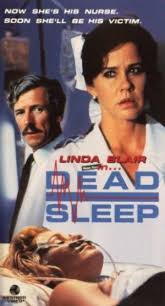
Dead Sleep (1990)

At 3 AM, my mind works like this: “Sam, there is a movie that rips off Coma and has Linda Blair in it. We must not sleep. We must watch this.”

Director Alec Mills only did one other film, Bloodmoon, but he was a camera guy and cinematographer on several Bond films like License to Kill and Moonraker. I would assume, after watching this movie, that he did the parts that are really boring, like the travelogue footage when Bond makes it to another country.

I’m on a quest to watch every Linda Blair film, so this is part of that Quixotic endeavor. Here, she plays Maggie Healey, an American who learned to be a nurse and moved to Australia where she gets a drug-addicted rich boyfriend who likes to draw pictures of her on his sailing ship. I’m not making any of this up.

She becomes a nurse at this clinic where they advise long-term sleep therapy. Being in a medically induced coma for two weeks sounds awesome and I fully endorse whatever these wacky Aussies are doing. Unfortunately, all of the bare-breasted women and men in pajamas that they have sleeping Michael Crichton-style end up killing themselves. The drama!

I really need to get around to planning a Linda Blair week. If you want to watch it yourself, it’s on Amazon Prime.

2018 Scarecrow Psychotronic Challenge Day 20: The Lost Boys (1987)

Day 20 of the Scarecrow Psychotronic Challenge is 20. VIDEO STORE DAY. The most important day of this challenge. Watch something physically purchased from an actual video store. If you live in a place that is unfortunate enough not to have one of these archival treasures then watch a movie with a video store in it at least. #vivaphysicalmedia! Sadly, the last Family Video locations that were within a half an hour of our house closed at the beginning of the year. It was incredibly depressing, despite the fact that we bought a lot of films in the closing of the store. But it felt like going to the estate sale of one of your best friends. I teared up a bit in the parking lot, because there’s nowhere left other than Redbox to look for new films. And well, those boxes may be convenient, but they just aren’t the same.

That means that I had to look for something with a video store scene in it. And that leads me to The Lost Boys, a movie that pretty much sums up the 1980’s, the days when video was king.

When I first put in The Lost Boys, my wife mentioned that she would watch it for a few minutes. Of course, she ended up watching nearly the whole thing, remarking how attractive every guy in it is, how she dressed as Star for Halloween as a little girl and reciting the dialogue word for word. After all, she says, it is the perfect 1980’s movie.

Michael (Jason Patric, who my wife also loves in Speed 2: Cruise Control) and Sam Emerson (Corey Haim, whose 976 hotline was called by my wife every single day) are the children of divorce, moving with their mother Lucy (Dianne Wiest, who my wife loves in Practical Magic) to the tourist town of Santa Carla.

They’ll be living with their strange grandpa (Barnard Hughes, Sisters) and trying to acclimate to what just might be the murder capitol of the United States (it used to be Youngstown, Ohio, a town I grew up close to). Just look at the boardwalk — it’s covered with posters of missing kids.

At a concert (once, SNL was funny and did this sketch based on this scene) featuring a shirtless and oiled up man playing saxophone (he’s actually called The Believer if you read the Vertigo Lost Boys comic book that came out in 2016). Michael falls in love quickly with Star (Jami Gertz, Less than Zero), which brings him into the orbit of the Lost Boys, led by David (a perfect Kiefer Sutherland).

Meanwhile, Sam is meeting Edgar and Alan Frog (Corey Feldman, another of my wife’s 976 call loves and Jamison Newlander, who is in the 1988 remake of The Blob), two comic shop working kids who are really fearless vampire killers. They claim that Santa Carla is the hometown of numerous vampires and that his brother could be one of them.

Tying into today’s theme of video stores, the kids’ mom soon meets Max (Edward Herrmann, Overboard), a kindly video shop owner who seems at odds with the Lost Boys that run the boardwalk (Bill S. Preston, Esq. himself, Alec Winter, is amongst their number).

The divide between brothers before and after puberty is clearly delineated by this film, as Sam is content to sing old soul songs in the bathtub with Michael is out there chasing strange women, hanging from railroad bridges and watching rice turn into maggots. You can also see this movie as the struggle between growing up and growing away from your family. Or dealing with a mother who is starting to date again and how that changes your perceptions of her. There’s also the fact that the title itself is a reference to J.M. Barrie’s Peter Pan stories, boys who will never grow up.

Of course, everything leads to a final conflict between the Emersons and the Lost Boys, with Max as their secret leader. I always loved how the video store owner’s goal all along was to finally find a mother for his motley collection of vampiric ruffians. The way he reacts when she isn’t afraid of them at the video store telegraphs this upon repeated viewings. And does anything beat grandpa’s last line? “One thing about living in Santa Carla I never could stomach: all the damn vampires.”?

After starting his directing career with The Incredible Shrinking Woman and D.C. Cab, Joel Schumacher really did an amazing job on this film. You can almost forgive him for his work on the Batman films. No, not really. You can never forgive that.

This really is the perfect 80’s film. I always felt for the vampires more than the humans. Never grow up. Never die. Never age. How does that sound bad? Sure, you have to kill other gangs on the boardwalk, but is that such a rough life?

There were plans to make a sequel named The Lost Girls with David returning as the villain — noticeably he’s the only vampire that doesn’t dissolve — but it just never worked out. There are several direct to video sequels to this that I’ve never seen, Lost Boys: The Tribe (featuring brother Angus Sutherland as the lead vampire) and Lost Boys: The Thirst. A fourth film was in the works, as well as a Frog Brothers TV show, when Warner Premiere went out of business.

Finally — I just want to mention how perfect this scene in What We Do in the Shadows is.

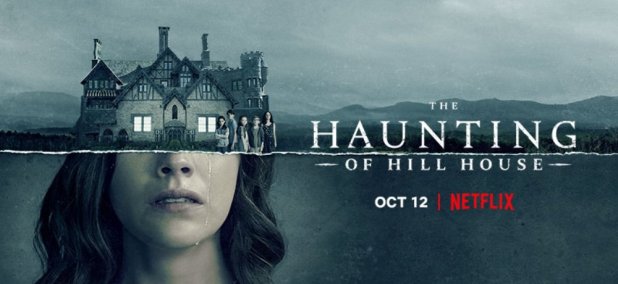
The Haunting of Hill House (2018)

I think I’ve figured out the difference between today’s “elevated horror” and the more traditional horror that we so often write about on these pages. The slasher killers of my childhood didn’t have complicated backstories or motivations, at least at first. The Shape killed because he was a killer. Leatherface and his family killed and ate because that was just their life. Sure, Jason was a mentally challenged child who drowned in a lake and somehow lived on the bottom of it for some time before coming back three movies in and wearing a hockey mask, but his mom, for all her faults, loved him.

The terrors of today’s horror? It all comes down to bad parenting. The Graham family of Hereditary was doing more than dealing with the King of Hell, they were dealing with years of family madness and secrets. Jay Height wasn’t just dealing with a sexually transmitted demon in It Follows, she was dealing with parental neglect. And in The Babadook, the real beast was just the crushing boredom of that film. It was that Amelia Vanek is a mother that blames her child for her husband’s death. She is, you guessed it, a bad mother.

There are times when you want subtext and reasons behind things. And other times, you just want to be scared. After all, when you’re looking for significance where there should be none, Freud would like to remind you that “Sometimes, a cigar is just a cigar.”

It’s no secret that I’m not a fan of “elevated horror” or trying to find the meaning behind everything — ironic as I spend a good chunk of my days debating movies right here. It’s more that I hate when people have agendas and force them into every movie. Sometimes, I just want that cigar. to be a cigar. Sometimes, I just want to watch a scary movie.

So it was without no small trepidation that I entered into the ten-hour commitment that came with watching Netflix’s new The Haunting of Hill House, an adaption of Shirley Jackson’s 1957 book (which was already made as 1963 and 1999’s The Haunting).

In the summer of 1992, Hugh and Olivia Crain plan on flipping an old mansion, just as they have with several other homes. Along with their five children, Steven, Shirley, Theodora, Luke and Eleanor, they go face to face with the paranormal, barely escaping with their lives (well, I lied, not all of them make it out as Olivia dies). Nnearlyalry a quarter of a second later, another death in the family brings the Crains back to Hill House to confront a lifetime of an absent parent, a lost mother and the ways that they’ve tried to handle so much grief and pain.

The story starts with Steven Crain (Michiel Huisman, Game of Thrones), the author of the book The Haunting of Hill House, which details his experiences in the house, as well as those of his brothers and sisters. The fact that he’s written this book — and made the money from it — has been a point of contention between he and his family ever since. That may be because of all the Crain family, he was the only one who didn’t see anything. His books and a lot of his life have been lies. At the end of the first episode, he finds his sister Nell hiding in his house. That’s when he meets a ghost for the first time — his sister has committed suicide inside Hill House hours before.

Each episode introduces us to another member of the family, from control freak Shirley (Elizabeth Reaser, Ouija: Origin of Evil and Annabelle: Creation as an adult; Lulu Wilson from  as a child) to child psychologist and psychic sensitive Theodora (who is married to director/creator Mike Flanagan, working with him on his other films like the aforementioned Ouija: Origin of Evil and Gerald’s Game) and Nell’s twin Luke, who struggles with addiction. Their lives and stories intersect and build upon one another, showing how the house and what happened on one night have ruined their lives in one way or another.

I’ve always had a theory that ghosts aren’t real. What we see in these apparitions aren’t things that go bump in the night, but moments where reality has been recorded over and over, like an old VHS tape, with the more horrible moments of life eating through the layers of reality, replaying over and over again. Hill House works that way, with the ghosts the children saw in the past simply being their future. I really want to discuss the moment that Nell realizes who the ghost she has seen her entire life is, but doing so would completely ruin this show if you haven’t seen it yet.

I was surprised by just how emotional this show made me. Credit for that is due to Timothy Hutton, who I’ve always known is an incredible actor, but he really proves it all over again as the father of this brood (the same role in 1992 in played by Henry Thomas from E.T. The Extra-Terrestrial). Carla Gugino is wonderful, as usual, as the mother who may never go away. I loved the long cuts that the actors got to use, which really added to the emotion of this. For example, the first fifteen minutes of episode six are all one straight take with no edits or cuts (there are only give cuts in the entire episode!). And bonus points for having Russ Tamblyn in here, as he was Luke in the original The Haunting!

I love that people are reporting sleep disorders and anxiety attacks after watching this show. Have we really grown so weak as a species that shows like this can trigger — that word! — us in such a way? I enjoyed this show, but I don’t enjoy reading clickbait articles like this that basically collect the tweets of people who should never, ever watch Cannibal Ferox. Just let a cigar be a cigar. Just enjoy scary shows for what they are.

But don’t just take it from me. No less of a voice in horror than Stephen King had this to say: “THE HAUNTING OF HILL HOUSE, revised and remodeled by Mike Flanagan. I don’t usually care for this kind of revisionism, but this is great. Close to a work of genius, really. I think Shirley Jackson would approve, but who knows for sure.” You watch it for yourself on Netflix.