Thanks to Paul Andolina, whose website is Wrestling with Film, for sending this to us!
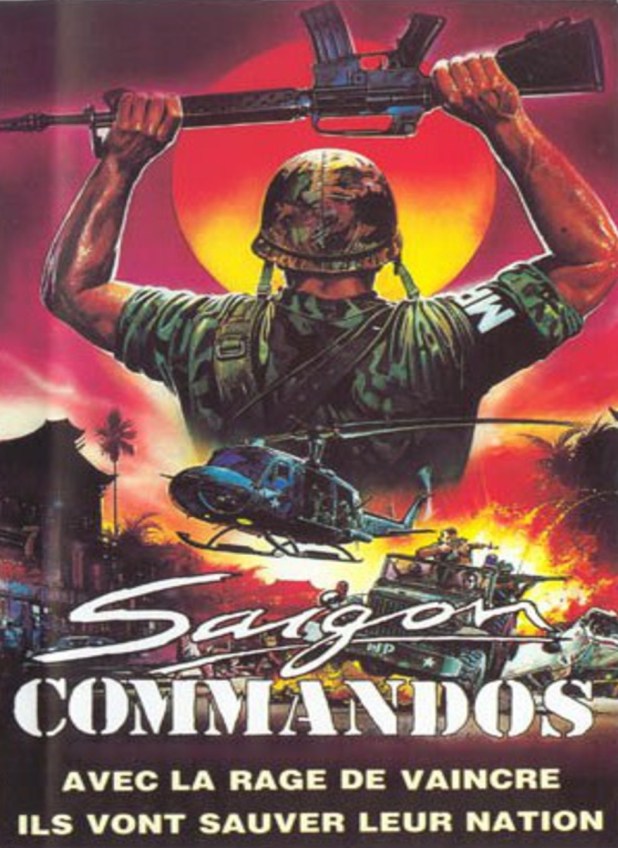
Every October since about 2014, I’ve participated in a friendly movie watching competition called the Halloween Horror Movie Marathon Madness. The first couple years I joined in I tried to stick to horror movies as much as possible. However since certain actors and directors are considered Wild Cards during the Madness I can get away with non horror fare. Such is the case with today’s film, Saigon Commandos. I came across this film while searching for movies starring P.J. Soles, who most will recognize from Carpenter’s film Halloween.
Saigon Commandos centers around a Military Police officer named, Stryker, during a drug war, a series of murders and an election happening in Saigon, Vietnam during the Vietnam War. It is based on a book in a series of novels written by Nicholas Cain, who served as an MP in Vietnam. He couldn’t get his memoirs published but was told they would publish his works if he fictionalized them with more violence and sex. The series ran for twelve novels, Saigon Commandos being an adaption of the ninth one.
Released in 1988 and starring Richard Young as Stryker, and P.J. Soles as a journalist, Saigon Commandos is not too easy to find. This is a shame as I found it to be a decent film concerning the Vietnam War that didn’t solely focus on what was going on in the jungles but more on what was happening in Saigon. Corruption is running rampant, heroin flows freely in the city streets, and someone is going around killing people with hollow point rounds. I knew I was in for a treat when it opened with a Vietnamese band singing House of the Rising Sun in a bar/stripclub. At times it felt like it was unintentionally funny especially when an AWOL soldier is shot in the ass by drug dealers. As he is on the examination table in the medic’s office in Camp Pershing, he screams in a manner that has to be heard, I found myself cracking up.
There are quite a few plot points happening at once in this film, with Stryker dealing with an AWOL Specialist who has made it his mission to get vengeance when some of the corrupt politician Trui’s men kill his fiancee when trying to get to Stryker. There is also an investigation into who exactly the hollow point killer is, as well as Trui and his men trying to win the election by fear mongering.
This film has a bit of action and even a small skirmish in the jungles of Vietnam when Stryker is forced to head into the shit to get two of his friends to sign a disposition backing up his alibi when his commanding officer of the military police turns up shot in the head in his bed after a night of Stryker’s heavy drinking.
I had very low expectations for this film and it turned out to be quite fun. If you can manage to track down a copy, I highly recommend it. I bought a German DVD that has both German, and English audio tracks. The picture quality isn’t the greatest but I think it adds to the enjoyment of it.
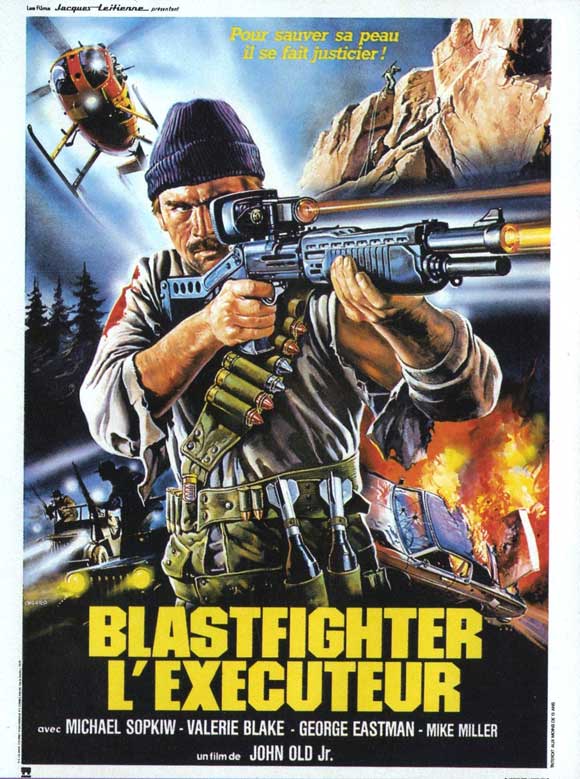
Around a minute into Blastfighter, ex-cop and con Jake “Tiger” Sharp (Michael Sopkiw, 2019: After the Fall of New York) is given the weapon that this movie is named for, a SPAS-12 shotgun that can shoot everything from darts and rockets to tear gas and grenades. He’s promised that every law enforcement officer will have this gun in a few years, but it’s his now. At this point, I was, as they say, all the fuck in.
Tiger was in jail because after his wife was murdered, he shot his wife’s killer at point blank range right in front of his lawyer. Yeah, it turns out that the suspect was the gay lover of the corrupt and sleazy lawyer — because Italian movies — and when he tries to kill that lawyer after his release, he still can’t bring himself to do it. Because deep down, he’s a good guy — because Italian movies. So he decides to go to the mountains to live in peace, burying the Blastfighter.
At this point, Tommie Baby’s “Evening Star” plays. The song was written by Barry, Robin and Maurice Gibb of The Bee Gees and you will hear it in its entirety several times throughout the movie. Please read this paragraph as a dire warning.
Tiger enjoys the wild game that runs past his cabin and adopts a baby fawn, but when local rednecks capture it alive and keep it in pain so a Chinese herbalist can benefit, he tracks down the deer and puts it out of its misery. At this point, the film goes from a revenge film to a remake of Rambo: First Blood.
A girl named Connie randomly moves in with Tiger and ends up being his long-estranged daughter. Yep, our hero didn’t even recognize his own kid. Luckily, they bond and become close, just before the town’s redneck population rises up to get revenge.
Also, to hammer home the redneck town, Billy Redden, the kid who “played” banjo in Deliverance, shows up.
The poachers show up in force, despite the truce between their leader Tom (George Eastman, who starred in Antropophagusand Warriors of the Wastelandand wrote Stagefright) and Tiger. The guys were childhood pals, so Tiger agrees not to kill Wally, Tom’s brother and get over it. But Wally is, well, Wally. You know how Wally is, always killing everyone around someone, even their grown teenage daughter. Yep. Don’t get attached to anyone not named Tiger in this one.
It’s at this point that the Blastfighter is brought back and all revenge is taken. Glorious bloody, awesome revenge.
Blastfighter is packed with Italian genre stars taking a step away from horror and visiting Georgia to make a movie. Like Ottaviano Dell’Acqua, the worm eyed and most memorable zombie in Zombi. And Michel Soavi, director of the aforementioned Stagefright and Cemetary Man, who plays Tiger’s daughter’s boyfriend. And there’s even a score by Fabio Frizzi!
This film was originally intended to be a science fiction film with Lucio Fulci directing, but budgetary issues led to it becoming a strange hybrid of Deliverance, Rambo, Mad Max and a Charles Bronson movie. Dardano Sacchetti (The Beyond, Demons, Manhattan Baby) wrote the changed script, which was originally part of a two-movie deal along with Fulci’s Warriors of the Year 2072. Lamberto Bava (son of Mario, of course, and director of Demons) stepped in to direct this one.
I don’t know if this has come through in this piece yet, but Blastfighter is a weird movie. If you go by the poster, you’re expecting that gun to be used over and over, but it’s kept out of action until the end. With the talent on hand, you’re expecting pure craziness, but that doesn’t really happen until the end. That said, I wasn’t bored at all during this and I’ve endured countless Stallone clones and this is way better than nearly all of them.
That said, I can’t even imagine seeing Fulci try his hand at a film like this. His version of Blastfighter would blow someone’s eyeball clean out of their head!
You can get the Code Red reissue of this at Ronin Flix.
Day 15 of the Scarecrow Psychotronic Challenge is 15. Easterns. The Asian continent has produced so many exotic cinema treasures. Watch one. I’ve been dying to dig into this movie, which was inspired by the Tōru Shinohara manga.
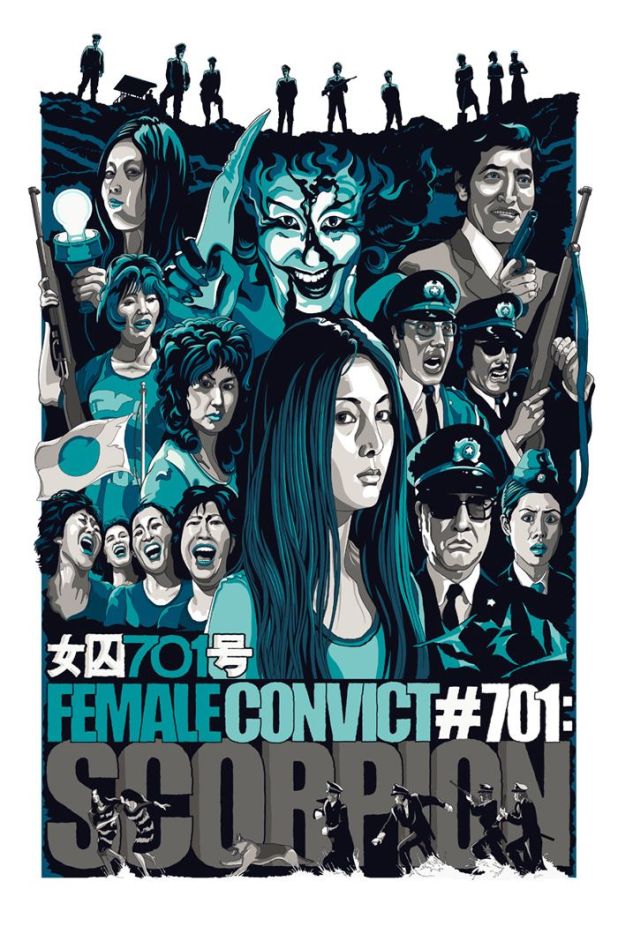
Nami “Scorpion” Matsushima has been dealt the absolute worst of hands. Her boyfriend, the crooked cop Sugimi, has used her body to curry favor with the Yakuza. When she tries to murder him on the steps of the Tokyo Metropolitan Police Headquarters, she is sentenced to hard time and given the number 701.
The films opens with a failed escape attempt between Scorpion and Yuki. However, one knows that Scorpion’s revenge is inevitable. It’s been said that Meiko Kaji decided to play this role using only her face, without speaking a word, and that choice would create an iconic role for her.
This is the kind of jail Roger Corman movies dream of being. Nude female prisoners are forced to walk up and down stairs while hooting guards watch from below and threaten them. And while Matsushima deals with dehumanization behind bars, a Yakuza and police plan to murder her is underway, blackmailing fellow convict Katagiri into making an attempt on her life.
But Matsushima won’t be broken. After being attacked and defending herself in the shower, she spends days tied down in solitary confinement, with hot miso soup being poured all over her and she’s still managed to injure her captors. Then, she is forced to dig holes for two days and nights, yet never tires, even digging against the entire combined mass of the prison.
There’s an insane moment of magical realism here where another convict finally makes an attempt on Matsushima’s life and her face transforms into a Kabuki-like as our heroine deftly steps aside and the warden’s eye pays the price. Soon, the female prisoners have taken over, raping the men and setting the entire building ablaze. Only one body can’t be found at the end. If you guessed Scorpion, you’d be correct.
Soon, she’s an angel of death, gliding into and out of the real lives of the men who thought they could destroy her, effortlessly and wordlessly dispatching them with neon red arcs of blood before calmly walking back into the prison.
This is a film of zooms, of neon, of horrible men and a woman who is willing to endure anything it takes to return their violence a thousand times. It’s also an incredibly stylish film and inspired Kill Bill. It’s director, Shunya Ito, has Scorpion character as “the ultimate rebel.” I’d describe this film as the art house and the grindhouse making violent, bloody, ultra technicolor love in slow motion.
With three direct sequels and several remakes, this is a film series you can really get plenty out of. Luckily, it’s now easy to find, as it’s streaming on Shudder.
Earlier this year, we featured Who’s Watching Oliver and really enjoyed it. We’re really excited to report that it’s now even easier to watch this movie as it’s free with an Amazon Prime membership and is also on Hulu! Check out the new teaser trailer, too!
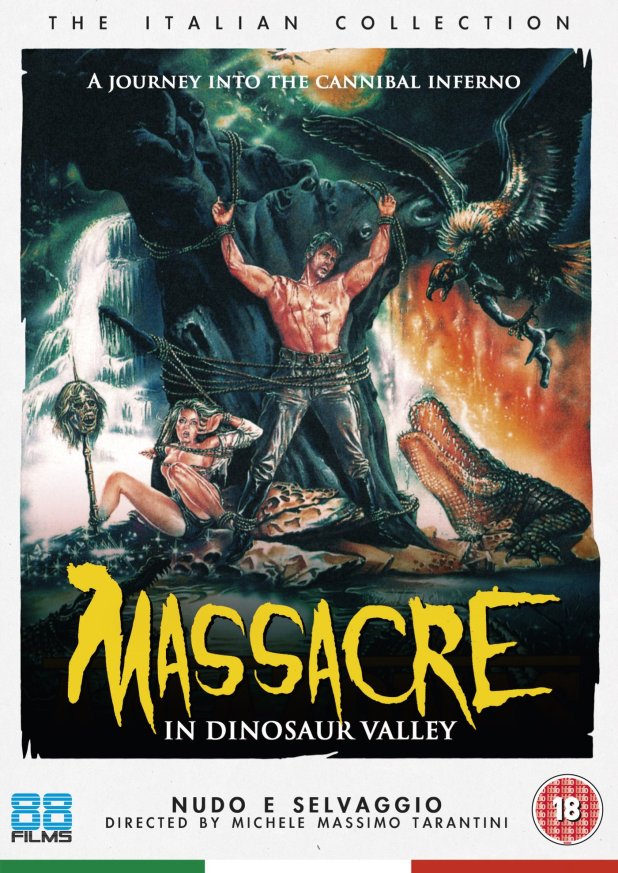
First off, there are no dinosaurs in this movie. There is, however, plenty of happy go lucky island music, a large amount of nudity, cannibals and gore. It’s also called Cannibal Ferox 2, but isn’t this a better title?
Michael Sopkiw, the star of 2019: After the Fall of New York, plays an American paleontologist who likes to fight, fuck and find archaeology. He somehow cons his way into a professor’s voyage to the green inferno that is Dinosaur Valley. Along for the ride? A Vietnam vet and his housewife, a fashion photographer and plenty of hot models. Holy shit, this cannot go well.
Directed by Michele Massimo Tarantini, written by an uncredited Dardano Sacchetti and featuring music recycled from Blastfighter, this movie is everything I love in movies. It rips off the high heel cutting scene from Romancing the Stone. It’s wildly uneven in tone, going from comedy to horror in the same scene. There’s a lesbian rape scene, subverting notions while fully being pure exploitation. And in all honestly, all this movie is missing is a “based on a true story” tag at the beginning.
This is a movie that delivers everything that it promises. Well, except dinosaurs. There are a lot of escapes from cannibals. And lots of sweet, sweet lovemaking, Sopkiw style. That’s how you can tell I’m not an 80’s action star. When I’m getting chased by cannibals, I don’t stop to make whoopie inside the footprint of a dinosaur.
There’s some slavery too that our hero and heroines need to deal with if they want to get out of Dinosaur Valley alive. Yes, that’s one way out — give yourself up to a lesbian slave owner. That doesn’t work too well, though, as the heroine who tries that gets shot in the back. And then that dude, China, who runs the slaves? He rapes the other heroine before Sopkiw saves her and makes a joke about the mile high club as a helicopter rescues them. Dude. I guess comedy equals tragedy plus time, but maybe wait a little before making with the funny. At least until we get out of Dinosaur Valley, right? Also, China looks like an indy wrestling promoter.
You can get this from the fine folks at Severin, complete with interviews with Sopikw and Sacchetti. And hey — they quoted us in the sale copy!
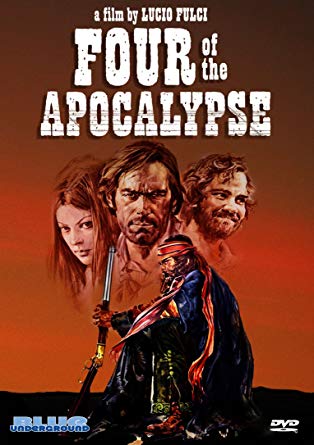
Day 14 of the Scarecrow Psychotronic Challenge is Westerns. Hats and boots are a must on this trail, y’all. Yeehaw! I chose Lucio Fulci’s Four of the Apocalypse…, which was made years before he became known as the Godfather of Gore.
Salt Flats, Utah. 1873. Professional gambler Stubby Preston (Fabio Testi, Contraband) is arrested the moment he steps off the stagecoach, thwarting his plans to win money from the town’s casino. It turns out that he’s actually lucky, because the town has become a vigilante mob that burns that den of iniquity to the ground, leaving only Stubby and three other criminals alive: Bunny (Lynne Frederick, Phase IV), a pregnant prostitute, a black man named Bud and the alcoholic Clem (Michael J. Pollard, Bonnie and Clyde).
The four are given safe passage out of town by the sheriff, who gives them a wagon and horses for all of their remaining money and possessions. Soon, they are traveling with a Mexican gunman named Chaco (Tomas Milian, Don’t Torture a Duckling) who saves the group from lawmen, only to torture one of the remaining lawmen in front of the group.
Nevertheless, everyone agrees to take peyote together. The four wake up tied up as Chaco (Milian claims he based his performance on Manson) taunts and beats them, shooting Clem and raping Bunny in front of the entire group.
There have been rumors for decades that Frederick and Testi were having an affair during this film. Testi was dating Ursula Andress at the time, who was incredibly jealous. Some evidence is that even when Frederick’s scenes were all wrapped, the two actors improvised scenes that would include the two of them, including a love scene that has been lost. During the aforementioned rape scene, Milian was so into character and so rough that Testi’s reaction in that scene is real.
The four manage to get the gravely injured Clem onto a makeshift stretcher and follow Chaco and his gang as they kill everything in their path. Finally, they find a ghost town where Clem dies, Bud loses his mind and Stubby and Bunny admit that they love one another — just in time for her to die in childbirth and Stubby to leave her son to a town made up of only men.
Stubby hunts down Chaco, learning that the sheriff set up the events of the entire movie. Enraged, he murders every single person there, leaving Cacho alive so that he can torture him. When Chaco reminds him that he raped Bunny, Stubby shoots him without a word, as he walks into the sunset with only a stray dog as a companion.
Four of the Apocalypse… is influenced by Easy Rider and attempts to offer up a journey of redemption, but you have to understand that Fulci is at the helm. That means that as soon as you have a tender, feel-good moment, you’re going to be given moments of pure gore, like people skinned alive or used for food. Yet there’s also art to be found, thanks to Fulci’s first of ten collaborations with cinematographer Sergio Salvati. It’s also the first time Fulci would work with Fabio Frizzi on the soundtrack. The result is unlike anything you’ve heard in a spaghetti western.
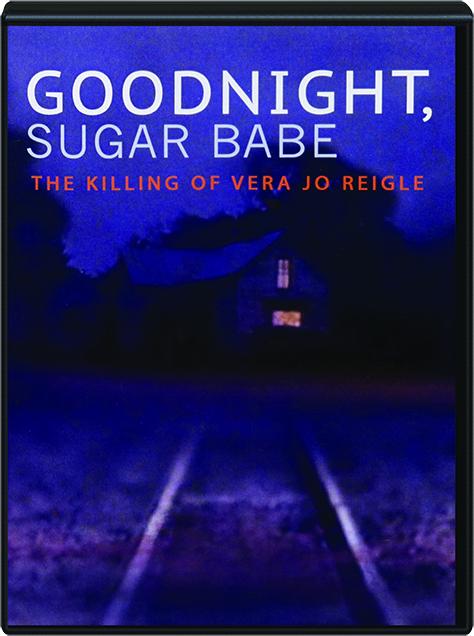
Just a warning. Of all the documentaries I watched this week, including Mondo Cane, this is the one that upset me the most. It starts with the police discovering the mutilated body of a mentally challenged young mother. And ends with a family so monstrous that it defies description and believability.
Director J. David Miles (Dead Silence) went to the heart of darkness, which ends up being Findlay, Ohio — which is also the home of Steelers quarterback Ben Roethlisberger. There, Cheri Brooks is the matriarch of a family that seems to be the stuff of Rob Zombie movies. She’s as horrible a person as it gets — her children Scottie, Michael, Maria, Joshua, and little Cheri were all taken away from her and all molested by her except for the youngest, who was taken immediately after her birth.
Meanwhile, Vera Jo’s life was one of pure terror. At the tender age of eleven, she was raped by her own father, Willard Reigle. It was suspected that she had ADHD and had an IQ in the mentally retarded range, which made learning difficult. She did, however, graduate high school but then began dating 13-year-old Zachary Brooks. This was a relationship that his mother Cheri actually encouraged because it allowed her to collect Vera Jo’s disability checks as well as get another child in the house, as she not only desired them, but wanted the perfect male child.
Vera Jo was basically a servant and scapegoat for the family and despite police calls and numerous people knowing that she was being abused (and this is all from a family that had a pig that lived in the house and was allowed to defecate anywhere it wished), when she was murdered people reacted with a mixture of surprise and we saw that coming. Yet no one did anything. At all.
The depths that Cheri pushed on Vera are heartbreaking, like forcing castor oil on her to induce labor, telling everyone that Vera’s child Willadean was hers, refusing to allow the new mother to hold her child, encouraging her own children and their insignificant others to abuse Vera and blaming her for the accidental death of her son Punky, which may have led to her death.
There’s also the matter of the family — backwoods as they may be — being part of the Crips. Yep. The same ones as South Central L.A.
This isn’t an easy movie to watch, based on the subject matter. The way it’s filmed is also completely all over the place. They had full access to so many people, so the subject matter is certainly compelling. But between the bad camera work, horrible font choices and rough editing, this could have been such a better film. Yet you can’t look away and I’ve recommended it to many true crime buffs.
I’d compare this to The Wild and Wonderful Whites of West Virginia if that family was only concerned with abuse and torture instead of drugs and dancing. You can find it on Amazon Prime.
Day 13 of the Scarecrow Psychotronic Challenge is And on the 13th Day There Was Only Black and White. Greyscale is also acceptable. There was no choice for me other than the master’s finest work: Mario Bava’s seminal Black Sunday.
This was Bava’s directorial debut — although he had already directed several scenes without credit in other films. By 1960’s standards, this is a pretty gory film, leading to it being banned in the UK and chopped up by its US distributor American International Pictures.
In the 1600’s, the witch Asa Vajda (Barbara Steele, creating her legacy as the horror female supreme) and her lover Javuto are put to death by her brother. Before she is burned at the stake and has a metal mask hammered to her face, she curses their entire family.
Several centuries later, Dr. Thomas Kruvajan and his assistant, Dr. Andre Gorobec (John Richardson, Frankenstein ’80) ae traveling to a medical conference when their carriage breaks down. Of course, they’re in a horror movie, so they wander into an ancient crypt and release Asa from her death mask and getting blood all over her face.
That’s when they meet her descendent Katia (also Steele), whose family lives in the haunted castle that of the Vajdas. Gorobec instantly falls for her and really, can you blame him?
All hell literally breaks loose, with Asa and Javuto coming back from the dead, possessing Dr. Kruvajan and concocting a plan to make Asa immortal by stealing Katia’s youth. Can good triumph against evil? Can you kill a vampire by stabbing wood into its eye socket? Which one is hotter, good or evil Barbara Steele?
A note from reader Edgar Soberon Torchia: “The blood from Dr. Kruvajan’s hand does not get all over Asa’s face. While fighting a bat he breaks the glass covering her face in the tomb. The blood in a piece of glass elegantly falls drop by drop into the empty cavity of Asa’s right eye.”
Thanks for setting us straight!
A lover of Russian fantasy and horror, Bava intended this film to be an adaption of Nikolai Gogol’s 1835 horror story “Viy.” However, the resulting script owes more to Universal Studios-style gothic horror. AIP cut or shortened the branding scene, blood spraying from the mask after it was hammered into Asa’s face, the eyeball impaling and the flesh burning off Vajda’s head in the fireplace. And in the Italian version, Asa and Javutich are brother and sister in an incestuous relationship.
Black Sunday has left quite an impression on fans and filmmakers alike. Francis Ford Coppola’s Bram Stoker’s Dracula contains several shot-for-shot homages, as does Tim Burton’s Sleepy Hollow. And Richard Donner based the cemetery scene in The Omen on the moment when Barbara Steele appears with her hounds.
For a director who is so well known for his work in color, Bava has just as much skill in black and white. The sets were actually created in monochrome, with no color, to add to the dark mood.
My favorite scene in the film is when Bava creates a split screen effect where Steele’s two roles come together, as Asa intones, “You did not know that you were born for this moment. You did not know that your life had been consecrated to me by Satan. But you sensed it, didn’t you? You sensed it… That’s why my portrait was such a temptation to you, while frightened you. You felt like your life and your body were mine. You felt like me because you were destined to become me… a useless body without life.”
You can watch this for free with an Amazon Prime subscription or on Shudder.
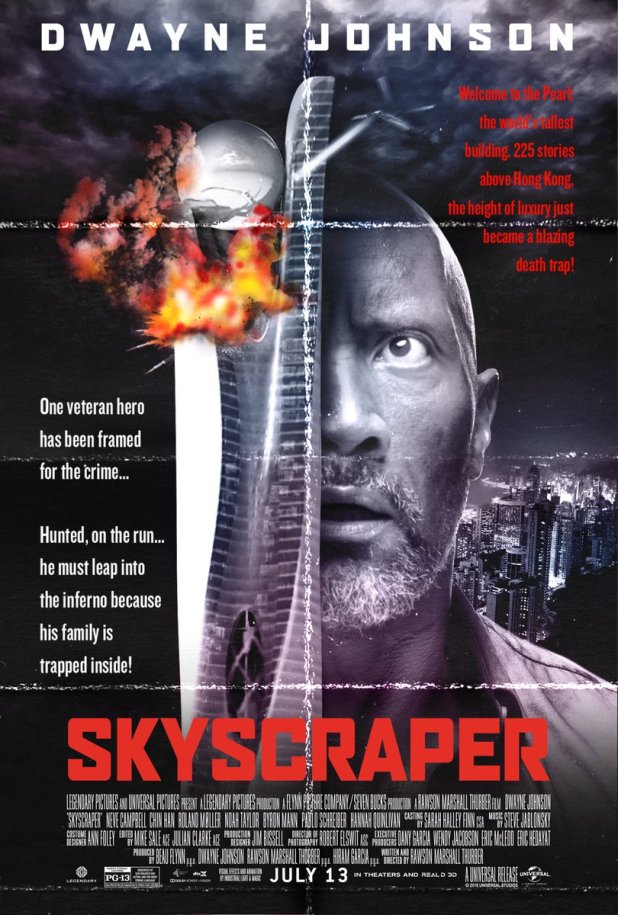
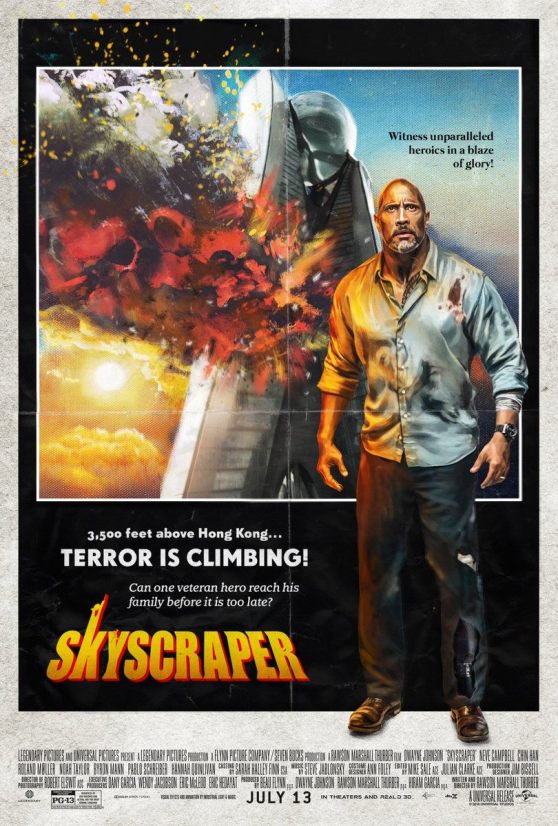
How close is this movie to The Towering Inferno and Die Hard? Just take a look at one of two posters that its star, Dwayne “The Rock” Johnson, commissioned to celebrate those films when this was released. Look — this is a summer blockbuster. If you’re going to worry about how much it steals or how stupid it is, you picked the wrong movie.
Wealthy Chinese financier and entrepreneur Zhao Long Ji is building the tallest skyscraper in the world in Hong Kong called The Pearl. To solve some of the building’s security issues, he hires former U.S. Marine and retired FBI Hostage Rescue Team leader Will Sawyer (Johnson). Even though he’s built a new life for himself, Sawyer is struggling with the past, including a mission where a suicide bomber took his left leg.
Once he gets the job of inspecting the Pearl, Sawyer, his wife Sarah (Neve Campbell, Scream) and twins Georgia and Henry move in. It seems like the building’s fire and security systems are secure, but he doesn’t trust the building’s offsite security center. Zhao gives Sawyer a tablet that gives him full access to the security system, but our protagonist is set up by his former partner, ex-FBI agent Ben Gillespie.
Now, a cadre of terrorists and criminals led by Kores Botha has taken over The Pearl, with Sawyer’s family trapped inside. Soon, the building is on fire, loved ones are trapped and the film becomes extended stunt sequences where The Rock jumps from a crane into a burning building hundreds of feet above the Earth. Your enjoyment of this film will depend on how many times you want to see The Rock cheat death.
We watched this with Becca’s parents, who were a divided lot. Her mother enjoyed this film more than any living being has ever loved a movie before, jumping and yelling with every single stunt, literally on the edge of her seat. But her father was upset the minute the movie started, sure that it was going to be unrealistic. Well, he was right. He’s also someone unafraid to loudly drum his opinion into your ear for the entire running time of a film, so he threatened to rage quit watching it. It’s not often that you get to watch a movie with two people who have such opposite opinions, yet are sitting so close.
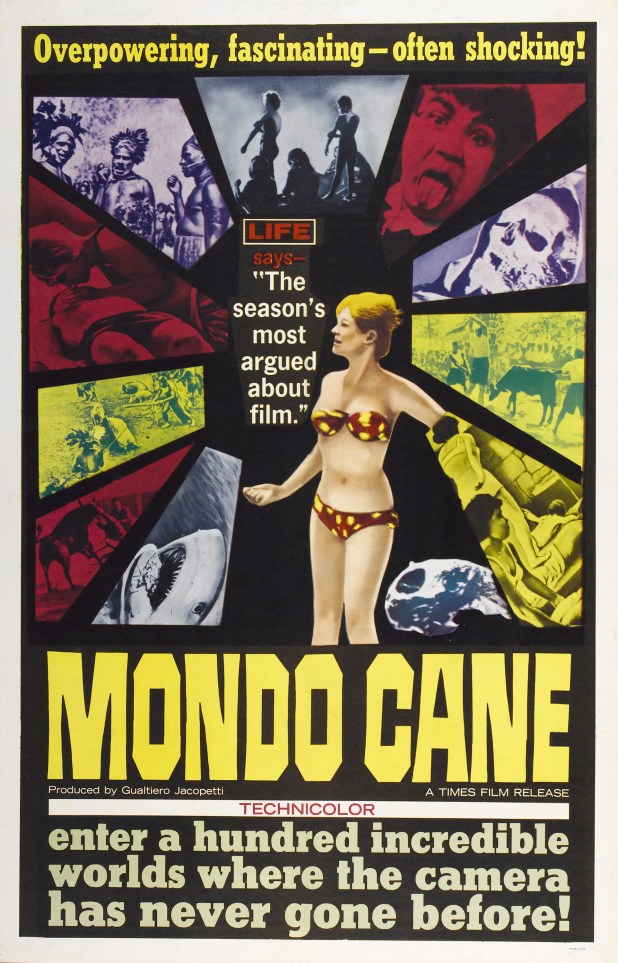
I’ve always been afraid of Mondo Cane. It’s the kind of film that is not afraid to manipulate you. So many of its scenes were staged or manipulated. And so much of it lulls you into a stupor as you watch it unfold like a kaleidoscope, then it decides to assault you with moments of pure barbaric intensity. This is a movie out to upset you.
The entire mondo subcategory comes from this film, a documentary written and directed by Italian filmmakers Paolo Cavara, Franco Prosperi, and Gualtiero Jacopetti.
Cavara and Jacopetti came up with the concept, with Prosperi credited as second director. To make this film, Cavara went on a dangerous quest, traveling the planet to obtain the necessary footage. The two men also met in Las Vegas at one point, where they were involved in the crash that ended actress Belinda Lee’s life (a troubled soul whose affair with married lover and papal prince Filippo Orsini led to a dual suicide attempt that cost his family the hereditary title of Prince Assistant to the Papal Throne).
After Mondo Cane’s appearance at the Cannes Festival and worldwide popularity, Jacopetti claimed sole credit. Cavara would leave the team, going on to challenge himself with different genres and filming styles throughout his career as a director, including The Wild Eye, where a documentary filmmaker has a crisis of conscience as he pushes his crew to new limits of depravity (an obvious comment on how he felt about former associates Jacopetti and Prosperi) and the well-regarded giallo, Black Belly of the Tarantula.
Jacopetti’s life is the kind of tale that could make its own movie. After fighting alongside the Italian Resistance against Mussolini, he co-founded the influential liberal newsweekly Cronache. However, he was forced to shut down the magazine after being charged with pornography for publishing photos of Sophia Loren. Jacopetti was punished with a year-long prison sentence before journeying through a series of careers, finally landing on being a director.
After Mondo Cane (which roughly translates to the Italian curse, a dog’s world), Jacopetti and Prosperi would go on to use discarded footage to make Women of the World (dedicated to the aforementioned Lee, a lover of Jacopetti asked to be buried next to), Mondo Cane 2, Africa Blood and Guts and the beyond depraved pseudo-documentary Goodbye Uncle Tom.
As time went on, the mondos had to outshock one another, constantly topping themselves. The entire crew was nearly executed while making Africa Blood and Guts while filming in Zaire. A scene from this film led to Jacopetti being charged with murder in Italy. He was acquitted of the crime after proving that the killing was unstaged.
This all led to Goodbye Uncle Tom, a film that David Duke, former leader of the Ku Klux Klan, claimed was a Jewish conspiracy to incite blacks to violence against whites. Presenting itself as a documentary, the film begins with Jacopetti, Prosperi and crew traveling backward through time! Sure, this may have been intended to be an anti-racist attack on the evils of slavery, but it was made with the full cooperation of Haitian dictator Papa Doc Duvalier. Prosperi may have claimed that his films angered many because “the public was not ready for this kind of truth,” but it’s difficult to defend a movie where hundreds of anonymous Haitian extras re-enact vicious scenes of abuse and torture.
The original ending of the movie occurs in the modern era, where a radical black activist reads William Styron’s The Confessions Of Nat Turner and has a fantasy of breaking into a suburban home and murdering a white baby. This was supposedly Jacopetti and Prosperi’s comment on racism, but when you realize that so much of this film basically used slaves to depict the evils of slavery, it’s kind of understand what they were going for. The American distributors of the film certainly didn’t get it and cut all of this.
I mean, this is a movie that claims to be a documentary about a time-traveling crew of Italians who somehow get to meet Harriet Beecher Stowe and Samuel Cartwright, but somehow there’s also a scene where the narrator takes the virginity of a thirteen-year-old teenage prostitute on camera. A commercial and critical failure, this was the end of Jacopetti’s big run of films, although the duo did work together on a cover version of Candie called Mondo Candido. Jacopetti would move back to the world of print while Prosperi would direct Gunan, King of the Barbariansand The Throne of Fire.
But what of Mondo Cane? This film takes your eye on a savage journey, starting with a dog being dragged through the pound as other dogs bark at him. From a statue of Valentino to women tearing off the shirt of actor Rossano Brazzi (Fulci’s Dracula in the Provinces), men being hunted by women becomes the theme, juxtaposing New Guinean tribal rituals with bikini girls on the Riviera.
If you love animals, you can pretty much leave the room now. Because Mondo Cane is going to laugh at those who mourn their pets at a cemetery, going so far to highlight other dogs pissing on their graves. From pigs being slaughtered to dogs being skinned alive in Taiwan, chicks being dyed for Easter and geese being force-fed, the film begins its descent into man’s inhumanity to, well, everyone.
Animals are dying from radiation. Fishermen shove toxic sea urchins down the mouth of a shark. And then people get drunk. More girls in bikinis. Massage parlors. Hulu dances. Skulls, dying, death and cars being smashed. Bullfights, bull beheadings and soldiers dressed in women’s clothes. My chronology is screwy now, but the film has become a barrage, assaulting my eyes and sense of reason.
The film ends with a cargo cult, a term given to South Pacific based aboriginal religions that would build airplanes and military landing strips as part of rituals hat they hoped would summon the gods that had brought them supplies during World War 2.
Mondo Cane predates and prepares us for the never-ending news cycle that we find ourselves in today. Yet even though it’s nearly sixty years old, it remains a rough testament. It doesn’t just show you the mud and filth, it pushes your face into it and laughs at you as you struggle to maintain your footing in the muck.
Yet this is also a film that was considered for the Palme d’Or at Cannes and was nominated for best song, thanks to “More,” the theme that was written by composers Riz Ortolani and Nino Oliviero. I don’t think that it’s any coincidence that Ortolani would go on to create the theme song to an even more depraved film — Cannibal Holocaust.
Should you watch Mondo Cane? That’s up to you. The voiceover may say, “All the scenes you will see in this film are true and are taken only from life. If often they are shocking, it is because there are many shocking things in this world. Besides, the duty of the chronicler is not to sweeten the truth, but to report it objectively.” But we also know that so much of this was staged or presented from many angles for maximum effectiveness. So what is truth? You’re not going to find it in a film like this that goes right for your jugular. Crash author J.G. Ballard said that mondo films are a place where “Nothing was true, and nothing was untrue.” Are you ready for that?
If so, you can watch Mondo Cane for free with an Amazon Prime subscription.



 B&S About Movies
You must be logged in to post a comment.