2018 Scarecrow Psychotronic Challenge Day 12: The Children (1980)

Day 12 of the Scarecrow Psychotronic Challenge is Too Soon: Kids 12 or less meet an early demise. Geez, grim. Who Could Kill a Child seems like a pick that everyone would pull out, so I decided to go 80’s.

The best thing that I can say about this movie is that nearly every person in it is a horrible person. There are cops that don’t do their jobs well, expectant mothers that smoke and other parents that could care less if their kids have come home yet. Even the nice people in this movie only exist to be snuffed out. This is the blackest of comedies and also the most nihilistic of films.

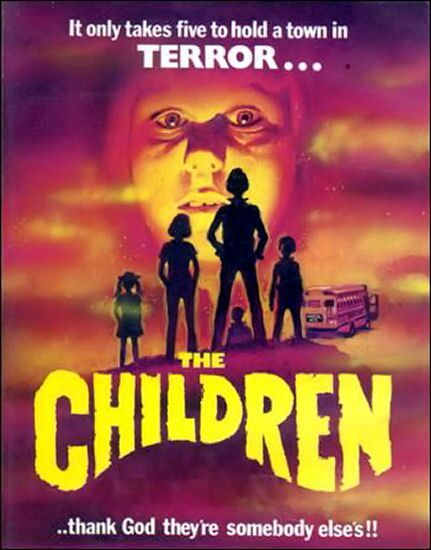
Jim and Slim, a couple of workers at the Ravensback chemical plant decide to finish work early and head to the bar, neglecting the pressure gauge warnings and allowing a cloud of yellow toxic smoke to escape.

That yellow cloud finds its way to a school bus full of innocent children who are so well behaved that they even sing a song to compliment their bus driver. Suddenly the bus passes through the yellow cloud and the kids get turned into zombie-like monsters with black fingernails.

The townspeople only think the kids have disappeared, so they shut the town down and try and keep out any outsiders until things clear up. Boy, this town…there’s Billy the local sheriff, who is in over his head. There’s Harry his deputy who only seems to want to get it on with Suzie (and who can blame him, what else is there to do in a small town?). And then there’s Molly, who runs the general store and is also the police dispatcher, because that makes sense. She’s played by Shannon Bolin, a singer who was once known as The Lady with the Dark Blue Voice in the 1940’s.

Even though this was made in 1980, it’s both woke and exploitation enough to give zombie Tommy two mommies. One of them, Dr. Joyce, is among the first to be burned alive by one of The Children. Not the last — as the kids all come home, they burn their parents and most of the town alive.

I guess John is our hero and his wife Cathy is pregnant (and pats her stomach and says, “Sorry…” before smoking a cigarette), so he’s obviously worried about her. That’s when this movie shifts into one that totally lives up to today’s theme. Kids get killed left and right with impunity. Roasted in closets, zombified hands chopped off, shotgunned…it’s pretty much open season on children. And when The Children die, it sounds like a cat in heat.

After all that, John falls asleep and wakes up to deliver his wife’s baby. We get a peaceful scene of the many, many dead bodies with the children all lying there looking peaceful and not dismembered. That’s when John noticed that his newborn child has black fingernails.

Director Max Kalmanowicz only has one other credit, the weirdo sex comedy Dreams Come True, where “a young couple masters the supernatural art of astral projection which allows them to travel through dreams, explore their fantasies and make a whole lot of love.” Hopefully nobody cuts off a ten year old’s hand in that movie.

You can watch this for free with an Amazon Prime membership.
DOCUMENTARY WEEK: Honest Man: The Life of R. Budd Dwyer (2010)

I was 15 years old when R. Budd Dwyer killed himself on live TV. Many stations refused to show the full footage, like KDKA, WPXI in Pittsburgh broadcast the footage uncensored on an early newscast, as they believed that kids wouldn’t be home to see it. That said — there was a snowstorm so many of us were home early. Many kids reacted just like they did to the Challenger crash, with dark humor being the only way to deal with it. I’ve since learned that a study of the incidence of the jokes showed that they were told only in areas where stations showed the uncensored footage.

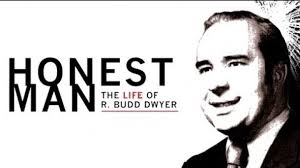
Honest Man: The Life of R. Budd Dwyer attempts to tell the story behind the man who killed himself with a .357 Magnum after being implicated in a scandal with Computer Technology Associates (CTA)

The Treasurer of the Commonwealth of Pennsylvania, Dwyer had run as a common man from a small town and throughout this documentary, this fact — and the feeling that he let down his hometown and the people that believed in him — is drummed home.

Everyone has a side to their story in this, including the last interview filmed with his wife before she died and his children. There’s also some incredible scenes William T. Smith, the person whose testimony convicted Dwyer. I wonder how much of the Breaking Bad/Better Call Saul character of James Morgan “Jimmy” McGill/Saul Goodman is based on this guy. He really seems to be a real-life Bob Odenkirk character.

This is a balanced documentary that really lets you come to your own conclusion. Sadly, I feel like politics have only gotten worse since Dwyer’s death.

The film also impacted me because Dwyer was often at the center of tape trading in the days before the internet. I’m a big fan of sites like the Found Footage Festival, who recently discussed with David Cross how he started trading tapes. My history of video mix tapes is similar — there was always someone who had a VHS tape at a party that had something you had only heard of. There were things like Pastor Gas, where televangelist Robert Tilton was overdubbed with fart noises. There was always Faces of Death. And there was always grainy footage of R. Budd Dwyer ending his life on live television.

We became desensitized to it. As each progressive generational dub was made, the footage became as hard to see as our morals. There was always a race to find the next crazy thing, to see something we shouldn’t see. At that time, there was just a strange subculture that wanted to own these moments. I’m not saying that everyone wanted to see extreme things. But the majority of mixtapes were often chock full of things like this.

Watching this film, I remembered seeing Dwyer more times than I’d like to think. And the suicide has reverberated throughout pop culture, inspiring songs like Marilyn Manson’s “Get Your Gunn” (complete with a sample of Dwyer’s voice), Kreator’s “Karmic Wheel” and Filter’s “Hey Man, Nice Shot.”

This film made me think about my ethics and about tape trading before the internet blew finding a clip wide open. And most importantly, it made reconsider a man that I’ve always thought was guilty and took the coward’s way out because his back was to the wall. Trust me — it’s not as simple as that.

If you’d like to see this for yourself, check out the official website or watch it on Amazon Prime.

2018 Scarecrow Psychotronic Challenge Day 11: Tales from the Crypt: Demon Knight (1995)

Day 11 of the Scarecrow Psychotronic Challenge is 11. That Soundtrack Though. One where the soundtrack is more impressive than the movie itself. And while I really love Tales from the Crypt: Demon Knight, I can also admit that I think the soundtrack is way better than the movie it plays during.

Unlike the HBO series and Amicus film, this story isn’t based on an EC Comic. Instead, it was intended to be Tom Holland’s follow-up to Child’s Play, then it was passed on to Pumpkinhead writer Mark Carducci, Pet Semetary director Mary Lambert and Charles Band’s Full Moon Features. finally, it was optioned by Joel Silver as one of three Tales from the Crypt spin-offs (the other two, Dead Easy and Body Count were never made).

Due to its low budget, two versions of the script were written — one with and one without demons! In the non-demon film, the Collector was a Bible salesman with “killer yuppies” as his henchmen. Luckily, that one never made it to the silver screen.

One night in the desert, The Collector (Billy Zane, chewing the scenery like no one else) is chasing after Frank Brayker (William Sadler, one of my favorite character actors). After a car crash, Frank escapes to a deconsecrated church turned boarding house thanks to town drunk Uncle Willy (character actor par excellence Dick Miller). And that boarding house is filled with even more great acting talent for such a small film: owner Irene (CCH Pounder), Wally the postal clerk (Roger Rabbit himself, Charles Fleischer), ex-con Jeryline (Jada Pinkett Smith), prostitute Cordelia and Roach, the cook (Thomas Haden Church, again, another incredible character actor).

Meanwhile, Sheriff Tupper (John Schuck from TV’s McMillan & Wife) and his deputy Bob meet The Collector near where he crashed. He convinces them that Brayker is a dangerous thief and that he needs their help. It seems Brayker has an important artifact, but when the cops confront him, they arrest both men for stealing cars. The Collector responds by punching the sheriff through the brain.

Brayker uses the key to drive The Collector outside the boarding house, so our antagonist uses his own blood to call upon demons. Now, everyone is trapped and must wait out the night. He then tells everyone in the house exactly what is going on: After God created Earth, demons used seven keys to steal the power of the cosmos. That’s why God created light, which scattered them and their keys across the galaxy. However, the demons have six of the keys now, with the artifact that Brayker holds being the last one they need to reclaim their power. At the Crucifixion, God had a thief named Sirach fill it with Christ’s blood and become the first guardian. Each guardian remains immortal while they hold the artifact, refilling it with their blood when they die. As proof, Brayker explains that he’s been alive since World War I, when his commanding officer passed the artifact to him.

What follows is a night of terror with the Collector pitting everyone against one another. At the close, there’s a new protector of the artifact and a new Collector, who walks away whistling the theme from the HBO series.

At the end of the closing credits, the Cryptkeeper returns to announce the next film, which ended up being Bordello of Blood, which has nothing to do with Demon Knight other than a scene where the artifact appears.

You know, Demon Knight isn’t horrible — it’s a cable TV late night watch, but the promise of a new Tales from the Crypt movie was ruined by having this be only one story (although the Crypt Keeper does interact with a slasher played by an uncredited John Larroquette).

But hey — enough about the film. Let’s discuss the soundtrack!

With Pantera’s closest thing to a single “Cemetery Gates” to “Hey Man, Nice Shot” by Filter, you get two songs nearly everyone knows. But then the soundtrack expands to include industrial stuff like Ministry, heavier metal from Biohazard, Sepultura, Megadeth and all over the map stuff like the Melvins, Rollins Band and the Gravediggaz. It reminds me of the great soundtracks to Spawn (which took the Judgement Night trick of combining metal with another genre, here with metal vs. techno, giving us Filter with the Crystal Method, Marilyn Manson with Sneaker Pimps, Slayer with Atari Teenage Riot and more) and Escape from L.A. (a movie I actually like, but the soundtrack boasts appearances by Tori Amos, Ministry, Clutch and the Deftones).

You can grab this movie from Shout! Factory.

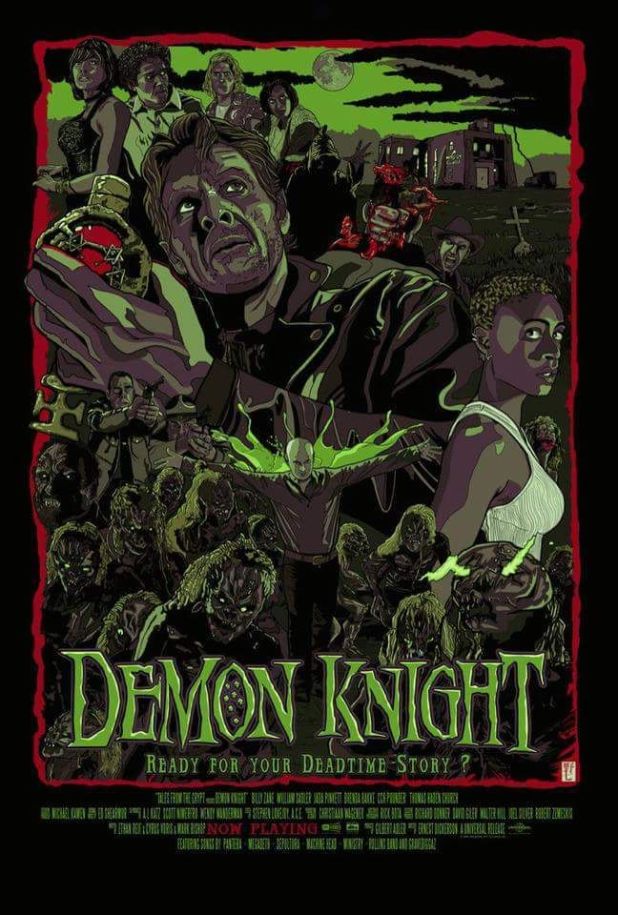
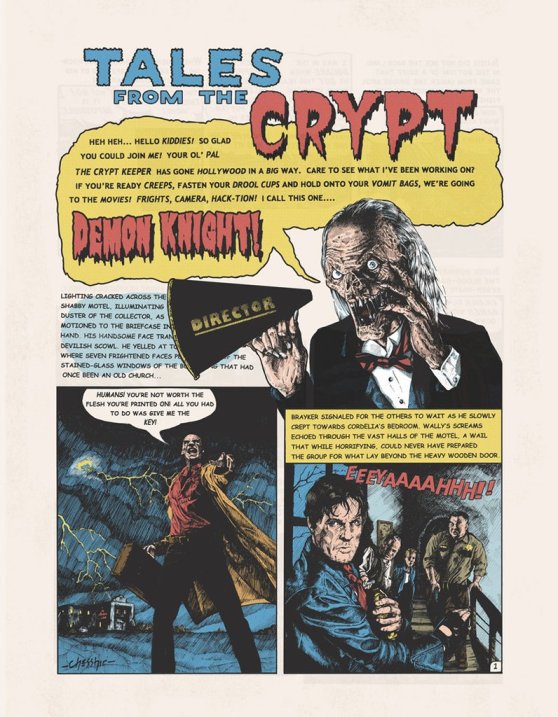
Postscript: I absolutely adore this print from Gallery 1988!

Drive-In Asylum Issue #13 is here!

Drive-In Asylum #13 is now available for order! Early orders will include a die-cut Curtains-inspired sticker, while supplies last, so order today! The third-anniversary issue is bursting with sinister intent and the pulpy newsprint nostalgia you’ve come to love about DIA.

We’re so pleased to bring you an interview with Lynne Griffin. An accomplished stage actress, Lynne’s film credits include legendary slasher pioneer Black Christmas from 1974, as well as 1983 cult classic Curtains, which has been building its own reputation thanks to a recent HD blu ray release from Synapse Films. (PS – I did some art for this article!)

Filmmaker/author Bret McCormick returns in this issue, this time with a memoir about how his childhood years as a “monster kid” led to his pursuit of a career in the movies. Stephen Pytak has a critical retrospective of the I Spit On Your Grave franchise, and Victor C Leroi’s Video Nasty series takes on 1981 slasher Don’t Go In The Woods.

In the spirit of the season, newcomer Robert Freese (from Scary Monsters and Videoscope) examines the rare 1979 novelization of Halloween, as well as its connection to 1981 sequel Halloween II and the influence its ideas had on later films in the franchise. Another newcomer, Paul Werkmeister, comments on 1972 occult flick A Name For Evil.

Many of our usual suspects also return with reviews, including Lana Revok, Sam Panico, Dustin Fallon and Mike Haushalter with reviews of Looking For Mr. Goodbar, Demonoid, Terror, Dunwich Horror and The Alpha Incident.

Each issue of DRIVE-IN ASYLUM comes with a 4×6 b&w matte print of a random vintage movie ad, and we’ve also got some fantastic die-cut CURTAINS stickers, too — limited supply of these, so order early to be sure you get one!

5.5 x 8.5, black and white (some pages are printed on colored paper), 52 pages.

Grab your copy now at the Etsy store!

DOCUMENTARY WEEK: Children of the Stars (2012)

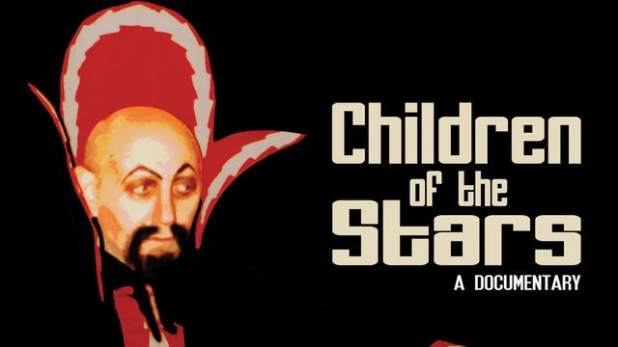
Unarius means Universal Articulate Interdimensional Understanding of Science. Since 1954, from their headquarters in El Cajon, California, they’ve worked to advanced a new “interdimensional science of life” based upon “fourth-dimensional” physics principles. This is not just the story of their church. It’s the story of the love between Ernest Norman and his wife Ruth across the galaxies and eons of time.

My question is, if the church doesn’t harm anyone, if they live as good people, what’s wrong with their love for space brothers? What’s the harm in the movies that they make? They seem much more well adjusted than many churches I’ve attended.

The other teaching of the church is the belief loop, where they can see a movie, see it as a past life experience and then create their own film documenting that fact. That means Star Wars is real. Any movie that you love can be as real as The Bible to you.

Then, there’s Charles Spiegel, Ruth’s longtime assistant and eventual successor. One day, while traveling cross-country, she confided in him that he was Lucifer. Seeing as she called herself Archangel Uriel, one wonders what their relationship was really like.

Some members also see themselves as the Roman soldiers who crucified Jesus and they are making up for that in this life by following Ernest Norman. Hey — is that any stranger than what others believe?

Ruth Norman predicted — many times — that 33 alien ships would land here on Earth, starting in 1974.  Charles Spiegel predicted 1980 and was wrong as well. After numerous dates came and went, they began to focus more on improving humanity here on Earth.

I’ve been interested in the Unarius Church since seeing them on Letterman in the 1980’s and compilations of their videos at the long-lost Mondo Video in Los Angeles. This film only confirmed my suspicions of how magical they really are.

Want to learn more? The Unarius Church website is a great place to start. And if you want to watch the film, it’s available on Amazon Prime. Or you can visit the film’s official site.

2018 Scarecrow Psychotronic Challenge Day 10: The Sound of Horror (1964)

Day 10 of the Scarecrow Psychotronic Challenge is Unhead Until…It’s too late! Your last second will be your loudest. We’re looking for the quietest non-silent movie or one where the enemy hunts by sound. It seemed like most people would just pick A Quiet Place and since I’ve been using this month to discover new movies, I again reached out to help. Bill from Drive-In Asylum and Groovy Doom was, as always, gracious and full of knowledge. He also knows just how much I love Ingrid Pitt.

In the Greek countryside, archaeologist Dr. Pete Asilov and Professor Andre are trying to find a treasure in an abandoned cave. This uncovers a reptile-like creature that soon vanishes.

Andre’s housekeeper Calliope warns him that there are curses and angry spirits and monsters in the cave, but he doesn’t listen. When the rest of his business partners arrive — bringing Ingrid Pitt in her first screen role — he keeps pushing, despite further warnings, the decayed body of a cavewoman, a set of bones and one of the men being killed by the creature. Soon, they’ll be more worried about staying alive than they are as to whether or not they get the gold.

For a movie that bills itself as an SQ Picture (Shiver and Shake, Quiver and Quake), this is a pretty silent affair. That is, until the girls just randomly decide to dance for the boys. Oh yeah — the professor’s niece Maria is played by Jess Franco’s muse Soledad Miranda, so that makes this movie a million times better than it would be otherwise.

There’s a great near-silent sequence where Calliope is stalked by the reptilian monster (which could also have fit into yesterday’s there). And hey, look at that lobby card! So I guess perhaps there’s a little more going for this film — like the tension when everyone is barricaded in the house and the allusions to the atomic age — than just Ingrid Pitt and Soledad Miranda.

DOCUMENTARY WEEK: The Source Family (2012)

People always wonder, why would someone join a cult? How could someone give away so much of their freedom to get nothing back into return? A few minutes into watching this film and your answer will not be so clear.

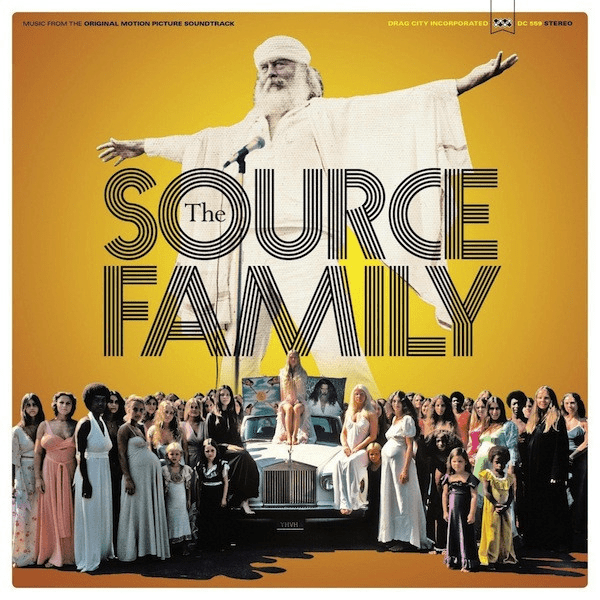
The Source Family was an attempt at creating a utopia. Between a famous health food restaurant on the Sunset Strip to an outlandish rock band and constantly being surrounded by gorgeous women, you can see how their leader, Father Yod, started to believe he was some sort of prophet.

This isn’t one of those documentaries made by people ready to laugh and not understand the mindset of the group. It was inspired by the book The Source: The Story of Father Yod, Ya Ho Wa 13, and The Source Family, which was written by Isis Aquarian and Electricity Aquarian and edited by Jodi Wille (who co-directed this film with Maria Demopoulos).

Once the group flees to Hawaii, things get out of control, leading to their demise, as well as the death of Father Yod. All of this is captured on film, as the Source Family recorded everything.

Even more amazing is that so many members of the group have gone on to lead amazing, fulfilling lives. Between the music, a large amount of actual footage and the way that it’s all sewn into an engaging storyline, this documentary does more than unfold. It inspires.

If I were alive in the early 70’s, I wonder if my spiritual journey would take me to a group like the Process or the Source Family. When we were young, a journey to the Krishna Temple of Gold in West Virginia was enlightening and frightening at the same time. So were the many visits to churches and shrines across the country. At times, I wish that I could find that childlike wonder and worship that adulthood seems to take away. That’s why I don’t laugh or wonder why anyone joins a group like this.

You can watch it on Amazon Prime or head to the official site to learn more.

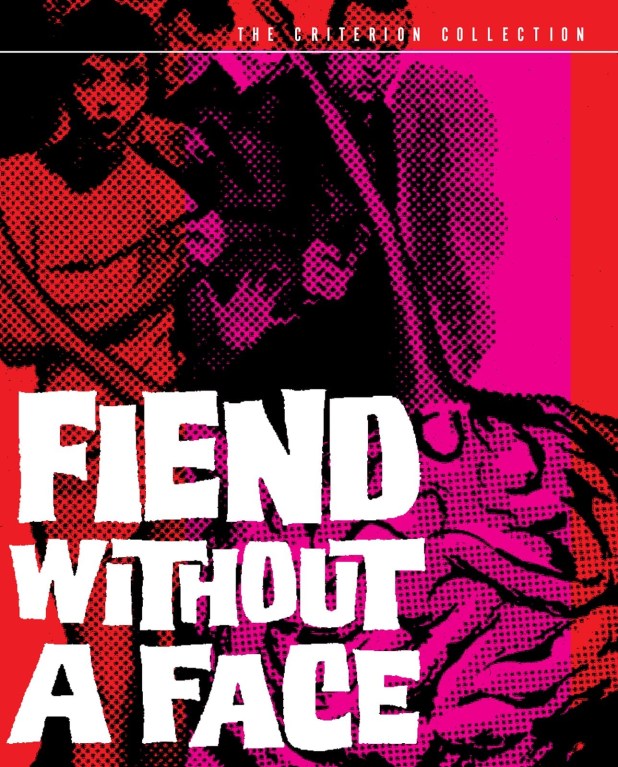
2018 Scarecrow Psychotronic Challenge Day 9: Fiend without a Face (1958)

Day 9 of the Scarecrow Psychotronic Challenge is Unseen Terror. You barely see it but it still terrifies you. This one was really rough, as I didn’t want to cover a Predator movie as that was just too simple. So I reached out to Bill from Drive-In Asylum and Groovy Doom for help. I’m using this challenge as a way to see movies I’d normally never watch, after all!

Based upon Amelia Reynolds Long’s 1930 short story “The Thought Monster”, originally published in the March 1930 issue of Weird Tales magazine, this independent British film played in the US on a double bill with The Haunted Strangler.

U. S. Air Force Interceptor Command Experimental Station No. 6 is a long-range radar installation located in the fictional town of Winthrop, Manitoba, Canada, which is a farming village that’s been plagued by unexplained deaths. It turns out that people are being killed with their brains and spinal columns being taken. The townies are up in arms, as they feel that the radiation experiments are to blame.

That leads Air Force Major Jeff Cummings starts to investigate the murders and quickly fingers Professor R. E. Walgate as a person of interest. Turns out that the Professor has been experimenting with telekinesis and thought projection for some time. That said — the radiation from the base has turned his thought projections into an entirely new life form that is attacking the locals and using them for host bodies. Of course, those bodies are mostly invisible, but also show up from time to time as moving brains with spinal columns with eyes at the end of extended eye stalks. They’re creepy as hell and led to a public uproar after its British premiere, with the public and critics angry over the films horrifying levels of gore (for the time, at least).

When this movie debuted at the Rialto Theatre in New York City, it came complete with a sidewalk exhibit of a “living and breathing Fiend” that moved and made sounds. The crowds that gathered to watch the caged Fiend created large crowds that the NYPD had to disperse.

It’s a pretty effective picture. Maybe that’s not even due to the film’s director, Arthur Crabtree. He believed that science fiction was beneath him and walked off the set at one point, with star Marshall Thompson finishing the direction of the movie.

If you like 1950’s atomic science fiction, scenes of people boarded in a room trying to hide out from pulsating brains and stop-motion blood and guys, well, this is the movie for you.

A Simple Favor (2018)

We really do go see new movies sometimes. But as late, our luck has been horrible. The Nun was painful, after all. But we’d seen the trailer for this film a few months back and it looked like Becca’s favorite kind of movie (and Sam’s least) — Gone Girl-style suburban true crime murder mystery. The actual movie, however, deviates wildly from the promise of the trailer.

I saw this movie under protest. After all, I wanted to see Hell Fest. Or The Predator. I could have even hate watched Venom. Because I have been the unfortunate recipient of Gone GIrl — not to mention movies like it such as The Girl on the Train and other works by its author like Sharp Objects and the upcoming Widows — viewings in the triple digits. The funny thing is, I ended up liking it way more than Becca.

Stephanie Smothers (Anna Kendrick from Twilight and Pitch Perfect) is a craft vlogger and single mom who constantly outdoes every other parent through sheer energy. But under her mania lies some pretty dark secrets and little to no real friends, not to mention a man. Emily (Blake Lively) is also a working mom, but is more known as a PR director for a major fashion company. These women couldn’t be more different — Stephanie prefers to hide in the background and apologize while Emily isn’t afraid to stand out and offend everybody.

The friendship between their children brings them together and the playdates their kids have to build the foundation for their fast friendship. They are soon trading confessions: Emily is frustrated with her husband’s lack of success. And Stephanie slept with her half-brother and may have had a child with him, which led to the death of both him and her husband.

Emily then asks for that simple favor: can Stephanie babysit Nicky while Sean is in London and she has to tend to a work emergency? That favor extends for days as Emily goes missing. And once her body is found in a Michigan lake, all hell breaks loose.

That’s when this movie descends into the twists and turns of a whodunit (but not a giallo, as much as I was wanting some black gloved killings and Ivan Rassimov to show up), with Stephanie caught in the midst of Emily’s psychotic ways, Sean’s devotion to her and her suddenly growing popularity amongst the local moms and her internet audience.

The film goes way over the deep end, bringing in the giallo staples of the unknown twin (actually triplet) and a family history of violence and insanity. Jean Smart shows up for all of a minute as Emily’s mother here. 

A Simple Favor is the first movie that Paul Feig has directed since his divisive Ghostbusters reboot. I enjoyed the style in the film and the soundtrack, particularly the usage of Brigitte Bardot and Serge Gainsbourg’s Bonnie and Clyde (actually, the film has multiple Bardot songs).

This is a movie unsure of what movie it really wants to be. Is it a mystery? Is it a comedy? Is it both? It never truly becomes anything, wildly shifting in tone to the point of absurdity — and not in a good way. That said, Lively and Kendrick are quite good in this, much better than anyone else in the film.

I always ask Becca if she has anything she wants to add to our review. She said that she’d give this movie a D or an F, because she wanted it to be closer to the thriller the trailer promised. And she wonders if Anna Kendrick only plays the parts of ditzy nice girls who apologize too much and get into shenanigans all the time, to which I answered, “Yes, I think that’s pretty much who she is in real life.”

Also: I call bullshit on a major plot point. Emily pays cash to rent her car from  Budget Rent-A-Car, which doesn’t allow vehicle rentals without a credit or debit card, much less a valid driver’s license. They would have had a full record of Emily renting the car. It would have been much simpler if she had someone else rent her the car and then paid that person. I realize that I’m being anal retentive about plot holes while I let gigantic ones in Argento movies pass by like bullets through the doorhole in Opera. But come on, people!

Of note, this was based on a novel by Darcey Bell, which has wildly different plot points, such as Emily only being a twin and being less complicit in the death of her sibling, as well as a completely different ending.

Postscript: As we left the theater, we noticed that there were only three other people there. One was an older gentleman in a full three piece suit who sat in front of us. Behind us was a younger couple that Becca asked about their feeling on the film. No one really liked it all that much and the older fellow called me sir while we talked and remarked how much better he likes Agatha Christie than modern mystery. We walked out of the theater late and alone on a Sunday night only for us to realize that the older gentleman was driving his son to a date. His son had to be in his late 20’s/early 30’s and the older man waited in the car for his son to embrace his date and kiss her goodnight. When we said goodbye, he said, “Have a nice week.” It was perhaps the sweetest and strangest thing that has happened to us in some time.

DOCUMENTARY WEEK: The Killing of America (1982)

If you think the United States is in bad shape today, perhaps you should check out this film, made well beyond the news bubble and the 24/7 headline cycle. The 1970’s were fucking bleak.

If you thought mass shooters were because of video games or that we just suddenly became a more violent society, sit through this movie. It’s brutal. It will assault you. It will take your name. It will own you.

Director Sheldon Renan suffered from depression for a year after he finished this film, as was editor Lee Percy. Even the John Lennon vigil at the end, added at the request of Japanese producers to help the movie end on a positive note, had people shoot at one another. That ending is somehow even more downbeat than anything else, after a movie where Sirhan Sirhan cries about killing RFK and you see more of the Zapruder film than you knew existed.

How destroyed was Renan? He went on to write the screenplay for 1990’s Lambada. What the actual fuck.

The voice of this film is incredible and it comes from Chuck Riley, who did the voiceovers for these trailers: The GodfatherChild’s Play 2Die Hard and many more.

The writing comes from Leonard Schrader, brother of Taxi Driver writer Paul, who was inspired to do this movie after writing a film called Hollow Point for Roger Corman. As he researched that movie, he met so many hitmen and spent so much time with them, he learned exactly how killers planned and executed hits.

There’s even a one-on-one interview with the Edmund Kemper, where he calmly discusses killing his mother and young women. That said — the goal of this film isn’t Mondo Cane exploitation.

According to a New Republic article, it wanted to erase the line between killers and the audience. Renan said Schrader “wanted to turn the audience into murderers. He wanted [viewers] to recognize that in themselves, ostensibly so that they would do something about it.”

As they worked on the film, Reagan and Lennon were both shot. Things did not get better. Things are bad now. So often I use film to hide from reality, but this movie makes you face it.

There is a lot here I never knew about, like Tony Kiritsis, an Indiana man who held a mortgage broker hostage while hosting a press conference in the most polite manner possible. Of course, he also had a shotgun wired to the man’s head that was ready to go off if he was shot by the police.

Some feel that this movie glamorizes the killers. I would refute that and say that it makes you see the senselessness of their action. As the former president of a Zen meditation center, Renan gave them a forum because he believed that “you just have to feel compassion for everybody — you just do. I do, anyway. For me, it was a journey into the depths to try to get some understanding.”

This is a movie that I think everyone should watch. It’s sobering. It’s maddening. And it approaches art.

This film was never released, distributed, televised, or made available for sale in the USA until it finally received an official release from Severin Films. You can also watch it on Amazon Prime