Tim Kincaid may have directed movies like Breeders and Mutant Hunt, but he may be more well-known as the adult film director of movies such as Orange Hankey Left and Joe Gage’s Sex Files Vol. 2: Uncle Pruitt Taught Me How to Do It. He was made a member of the GayVN Awards Hall of Fame in 2001 and in 2011, he won the XBIZ Award for Gay Director of the Year.
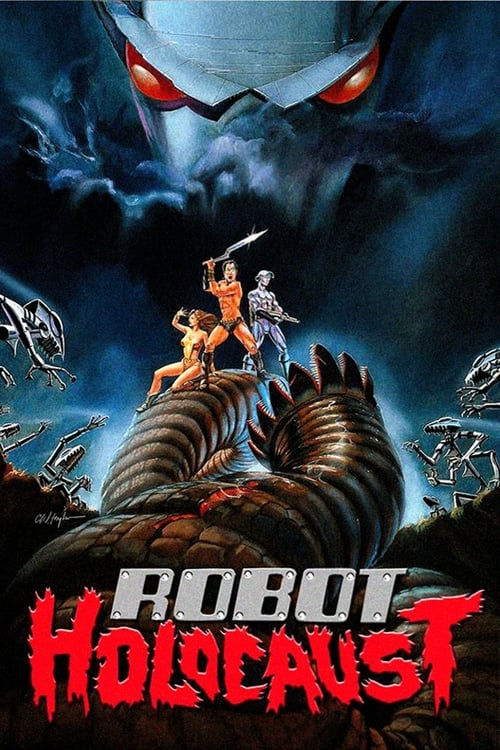
Thirty-three years before this movie began, a robot rebellion destroyed most of mankind. All the people who are left are either nomads or slaves to the Dark One, who power the city and fight in death matches, which are used to weed out the number of humans left alive.
Our hero Neo is a drifter who even has a robot sidekick Klyton. They head off to save Deeja’s dad and destroy the Dark One and his Power Station, along with some new allies that they meet on the way.
The music in this was taken directly from Laserblast. Somehow, even that movie is better than this one.
Perhaps most interesting, the man who played Klyton is Dr. J. Buzz Von Ornsteiner. Before he got his degree, he was in this film, Zombie Death House and Slash Dance. Since then, he’s become the project director for Brooklyn Arraignment Court’s Mental Health Court Advocacy Program and appears on the Reelz Channel show CopyCat Killers. The set painter on this was Andrew Kevin Walker, later of Nic Cage 8mm and Brad Pitt Se7en screenwriting fame.
All hail Brian Trenchard-Smith! Where most films today bore your eyes out, his Australian-born breed of mayhem has been etched in my memory for years. Who else could create such a wildly disparate catalog of film, including The Man from Hong Kong, Stunt Rock, BMX Bandits, Turkey Shoot, Night of the Demons 2and so many more.
Only he could make this high concept — in which a dystopian punk rock future relegates its teenage ne’er do wells to a drive-in prison — work.
In this apocalypse, the economy has collapsed due to the manufacturing industry collapsing and cars have become so rare that their parts are a constant commodity battled over between gangs and salvage companies. That’s where the drive-ins come in — they’re concentration camps for kids that can’t find work or are part of those gangs.
The prisoners soon find no reason to escape, as they’re permitting access to drugs, alcohol, junk food, exploitation films and new wave music. The inside of these prisons are preferable to the outside and therefore, no one ever wants to leave.
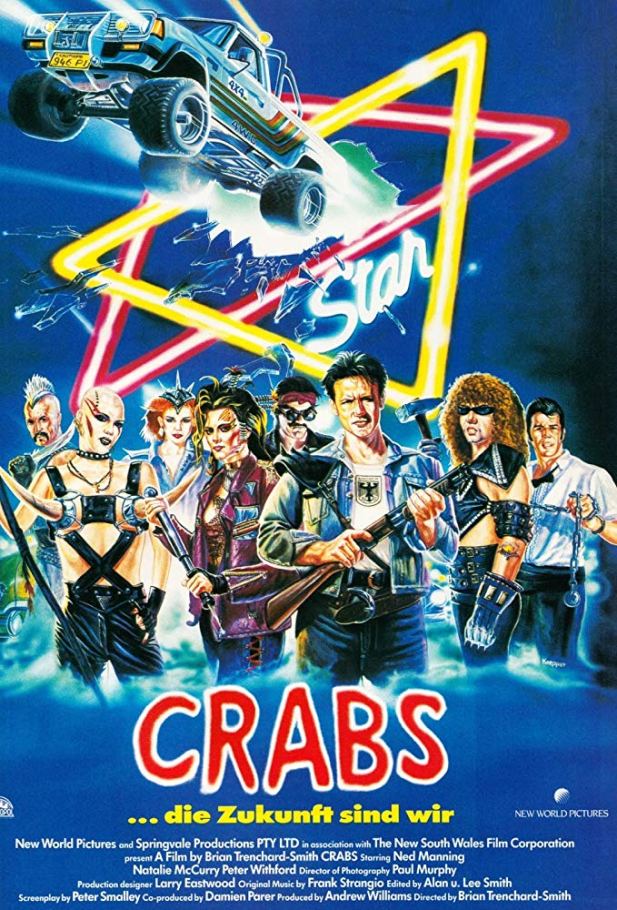
Our hero, Jimmy is known as “Crabs” and has been lured to the Star Drive-In as a date night with his girl Carmen. As soon as they start to make out, the wheels of his car are stolen by the police, which means that they’re now part of the population of the doomed.
Soon, Crabs is trying to escape as well as coming into conflict with the racist gangs that run the drive-in. Yet Carmen goes the other direction, embracing the junk food that her health-obsessed boyfriend dislikes and falling in with the drugs and anti-Asian racist mentality of the gangs.
Finally, Crabs makes one last attempt at escape, jumping a tow truck out of the drive-in. This final stunt, performed by The Road Warrior Guy Norris, cost the majority of the film’s budget and was the most expensive stunt filmed in Australia by that point, setting a world record for a truck jump at 49.378 meters or 162 feet.
This movie has always been a favorite thanks to its eighties’ neon magic. I have to confess, spending the rest of my life eating junk food, doing drugs and watching Trenchard-Smith’s movies at a drive-in doesn’t sound like all that apocalyptic of a future.
You can watch this for free on Tubi or get the blu ray from Arrow Video. If you’re interested in more Ozploitation, may I recommend Severin’s Ozploitation Trailer Explosion and the documentary Not Quite Hollywood, which you can get from Diabolik DVD.
David Engelbach wrote Over the Top, Death Wish 2 and two episodes of the TV shows Lottery and MacGyver. He also wrote the 1984 TV movie Goldie and the Bears, which starred Hulk Hogan. He’s only directed one film — the Cannon Films produced America 3000 — and you’re about to learn all about it.
“Nine hundred years after the Great Nuke. The world man created, he destroyed. Out of the darkness and ignorance of the radioactive rubble emerged a new order…and the world was woggos.”
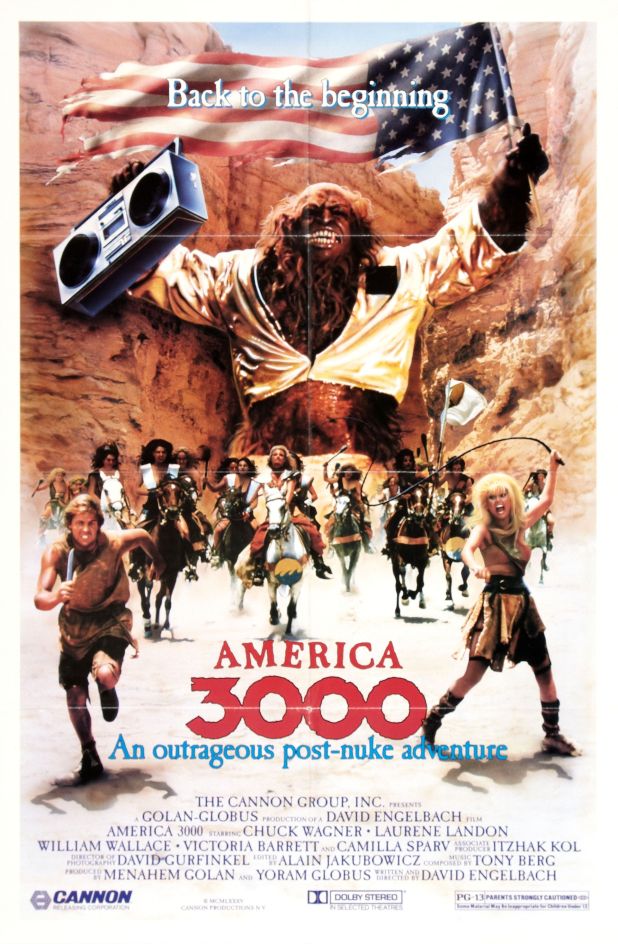
After a nuclear war in the year 1992 — surprise! — mankind has gone back to the Stone Age and is ruled by Amazon women who keep men as wild animals to be used for labor and sex.
Two young guys, Korvis (Chuck Wagner, who was on TV’s Automan and is in The Sisterhood; he went on to be a theater actor and was a ringmaster for the Ringling Brothers and Barnum & Bailey Circus) and Gruss run away and find the weapons-filled bunker of the President of the United States of America.
Laurene Landon (who was in the commercials in The Stuff), Galyn Gorg (Angie, the nuke addicted bad girl of RoboCop 2), the first Isreali mime Shaike Ophir, black belt Karen Sheperd (The Enforcer from Hercules: The Legendary Journeys) and a monster named Aargh the Awful — who is a Bigfoot with a boombox — all show up.
With that kind of description, it should be much better than it is. I’m sad to tell you that it drags and that it seems like only Australians, Italians and Filipinos can make proper post-apocalyptic movies.
Editor’s Note: This is part of our week-long tribute to the films of Sylvester Stallone. You’ll find links to several more reviews of his films, within. If you don’t see your favorite mentioned, enter the title into the search box to your left; chances are, we reviewed it.
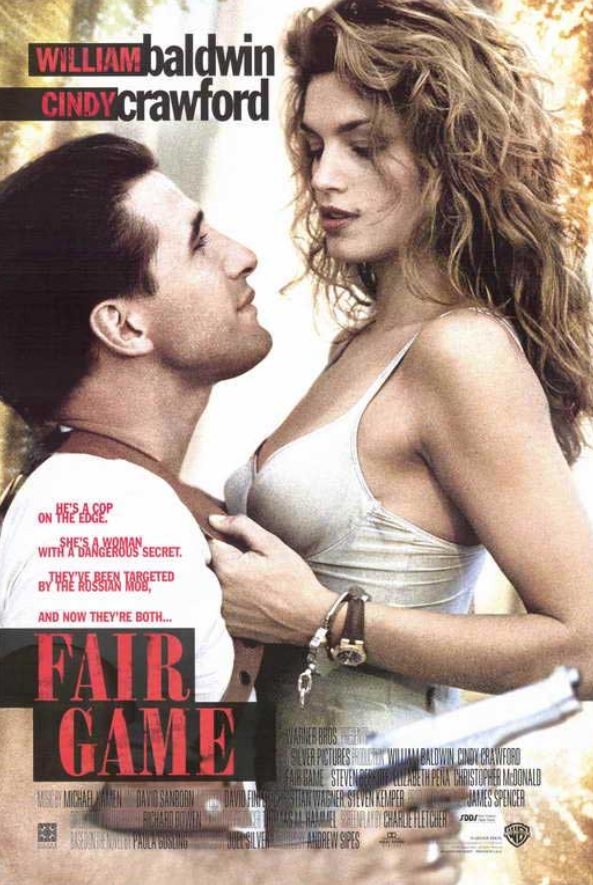
What do Cindy Crawford, Eddie Murphy, and Sylvester Stallone have in common? This movie, by way of a 1978 novel, Fair Game, initially published in 1974 as A Running Duck, written by Detroit born-and-bred writer, Paula Gosling. As result of Stallone’s screenplay rewrite, he wanted a Cobra novel published in 1986 that listed him as a co-author with Gosling. She passed on the offer.
The truth is that the pre-production history on Cobra—and how Gosling’s best seller became part of Stallone’s celluloid catalog—is more interesting than the actual movie itself.
The story goes: When he signed on the dotted line for Beverly Hills Cop, Stallone—as he does in most cases with the films he acts in—rewrote the film, which was initially conceived as a fish-out-of-water action comedy about a cop from the hard streets of East Lost Angeles who transfers to the pampered streets of the Beverly Hills Division.
Before Eddie Murphy and Stallone were attached, Mickey Rourke (The Wrestler, Iron Man 2) signed on for the Alex Foley role, after plans with Al Pacino, Richard Pryor, and James Caan failed. Then, when production problems held up the film, Rourke dropped out due to another film commitment. So Stallone came onboard and renamed the lead character as Axel Cobretti—so he could be nicknamed “Cobra”—and reimaged the film as a straight action piece. And . . . somewhere amid all of this Beverly Hills Cop pre-production hocus pocus, Gosling’s book was brought into the mix to serve as the “source material” for another Stallone Cobra rewrite—with most of the rejected action set-pieces deemed “too violent” and “too expensive to shoot,” such as Cobra playing chicken in his souped-up Mercury with a speeding train, being reused.
So what was the end result?
Beverly Hills Cop became one of the best reviewed and biggest box office successes of 1984; Cobra, in spite of its box office success, was one of worst reviewed films of 1986. Today, while considered a “cult classic,” Cobra is the least remembered film in the Stallone canons. In addition to its nod for Worst Screenplay, Stallone’s “Beverly Hills Cop” was nominated for a total of six Razzie Awards, including Worst Picture, Worst Actor for Sylvester Stallone, along with Worst Actress for Brigitte Nielsen, and Worst Supporting Actor and Worst New Star for (the very cool!) Brian Thompson’s menacing leader of “The New Order”: The Night Slasher.
I remember iconic film reviewers Gene Siskel and Roger Ebert, during an episode of their syndicated At the Movies, really tearing into Cobra. They absolutely hated it. Ebert’s biggest issue was that Stallone’s idea of “character development” was his character picking up a slice of three-day old pizza from a messy kitchen crawling with bugs and cutting the slice with a pair of scissors.
“Okay, but what does this all have to do with model-turned-skin cream magnate Cindy Crawford?” you ask.
Oh, yeah, Cindy. I forgot.
So screenwriter Charlie Fletcher, who scribed a European reimaging of the 1974 Burt Reynolds football comedy-drama, The Longest Yard, as Mean Machine (2001), completed a more faithful-to-the-source-material adaptation of Gosling’s book, with the film, in one of the very rare book-to-screen transition, retained the book’s title.
The eventual 1995 film, unlike Cobra, was a box office bomb with a pitiful $12 million gross against a $50 million budget. It was the beginning—and end—of Cindy Crawford’s career who, if you read the press on the film, didn’t want the role in the first place. And it shows. You think Cobra is bad? Be grateful that Cobra at least had a cool car to hold our interest. And to think Gina Davis, Julianne Moore and Brooke Shields were in the running for the lead. I don’t think even Gina Davis, with her Thelma and Louise wiles, could save it.
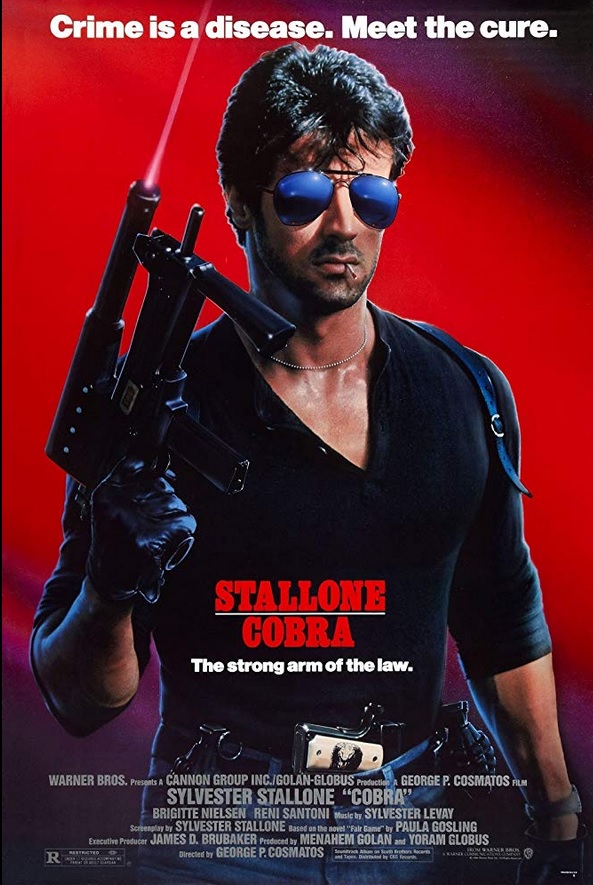
Can you imagine a novel producing two movies as diverse: one starring Sly Stallone, while the other stars Cindy Crawford? Wait, actually Cindy is the “Brigitte Nielson” damsel-on-the-run and William Baldwin is the “Cobra” who battles the KGB operatives. And William Baldwin isn’t perpetually adorned in aviator shades expounding cool lines through tooth-picked clenched lips like, “You’re the disease, I’m the cure” and “This is where the law stops, and I start,” either.
The difference between the two films—outside of the amped-up ultraviolence in Stallone’s vision—is his substituting the damsel-in-distress divorce attorney mixed up in KGB-Cuban political intrigue of the Fair Game novel with a runway model on the run from a white supremacist group. (I guess Sly thought his then real-life wife, Brigitte Neilson, wouldn’t pass as divorce attorney?) Oh, and William Baldwin doesn’t drive a bad ass, 1950 Mercury Monterey Coupe with a blower-outfitted Chevy 350 that did zero to sixty in four seconds.
“Okay, so that takes care of Beverly Hills Cop and Fair Game. What’s Cobra about?”
Stallone is Marion Cobretti (I know, from Axel to Marion? It’s a John Wayne nod that everyone missed), a member of “The Zombie Squad,” a rules-don’t-apply-to-us elite division of the LAPD that handles the toughest of cases and criminals, who goes all “Dirty Harry” with a shoot-first-ask-questions later Charles Bronson approach to law enforcement. After foiling a bloody grocery store hostage standoff, he uncovers the beginnings of a plan by a Darwinist-practicing, white supremacist group, “The New World,” that sets out to kill off the weak, leaving the strong to survive and rule a society. And in there, somewhere—most likely amid the reported 40 minutes of cut footage—is a deeper message about our disintegrating society weakened by the media and our rising fascination with violence. According to legend, there is a 130 minute cut of Cobra that initially pulled an X-rating for graphic violence—featuring gory throat slashings, severed hands, beheadings, graphic axe swings, and meat hook hangings.
All these years later, with my expanded knowledge of the Italian Poliziotteschi and Giallo films of the ‘70s, I believe Stallone was going for a hybrid-homage of the two genres that would have likely played well to Euro-audiences. Or at the very least: a ‘70s Bronson-styled Death Wish protagonist clashing with a John Carpenter-inspired ‘80s slasher (see Chuck Norris’s Silent Rage). If that was, in fact, Stallone’s original vision, I’d pay to see that movie. Hopefully, one day Stallone would be encouraged—provided that excised footage still exists—to restore the film to its 130 minute, X-rated format which, in today’s post-Saw universe world, would pull an R.
Sadly, in the end, making movies is about making money—not creating “art” or “genre homages”—Siskel and Ebert be damned. And Cobra did make money. It debuted at #1 at the American box office and several other countries to clear $160 million against its $25 million dollar budget.
And besides: William Baldwin can’t brag about a Commodore 64 video game based on his character from Fair Game.
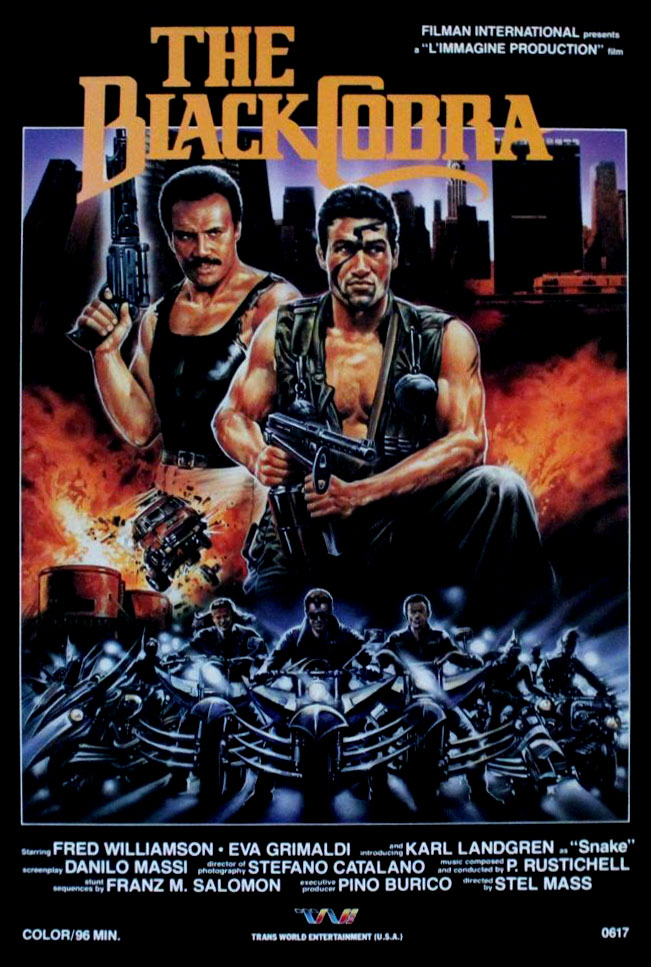
We also took another look at Cobra as result of our “Cannon Month” of film reviews. You can read more about Cannon’s catalog with our five-part interview with Austin Trunick about his film guide on the studio. In fact: Did you ever want that sequel to Cobra that you never got? Well, how’s about a blatant Euro-made ripoff of Cobra? You got one with Black Cobra—which we rolled out as part of our “April Moviethon II” (2023).
It’s different . . . but the same . . . (and we know we’ve seen those apoc-lookin’ trikes on another Italian swill-fest, but can’t place it)
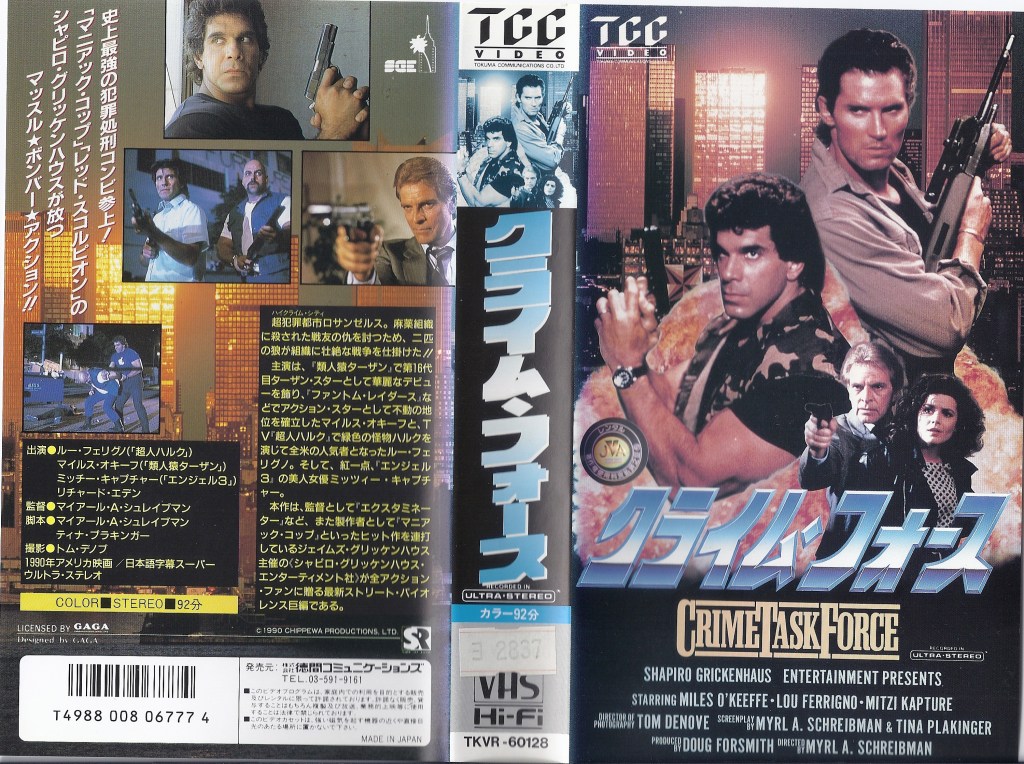
. . .just like this ripoff of Stallone’s Tango and Cash, aka Crime Task Force, aka Liberty and Bash. . .
. . . but not like Clash of the Ninjas from 1986 that Godfrey Ho wished Sly starred, but did not . . . just like Sly did not in . . .
. . . this Godfrey Ho clip joint — Cobra Against Ninja — from 1987 that hoped you’d fall for a faux-Sly battling Ninjas.But you do get more Richard Harrison in the Ho-ripoffery.
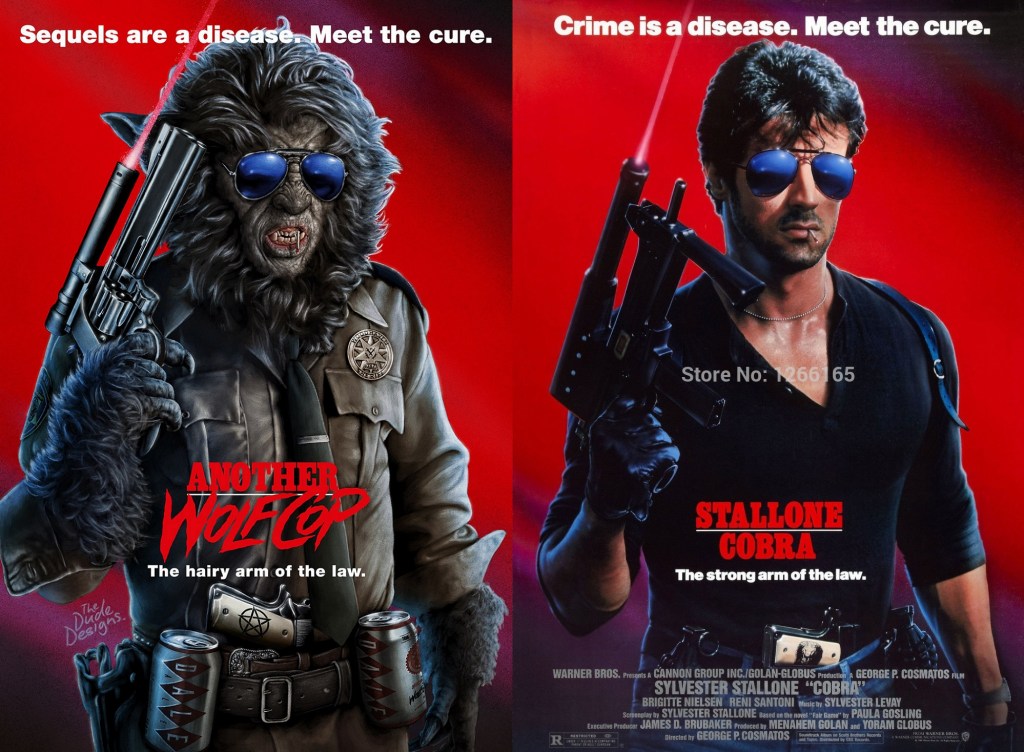
Oh, yes!Our Cobra obsession, continues: 2017’s Another Wolfcop.
About the Author: You can read the music and film reviews of R.D Francis on Medium and learn more about his work on Facebook. He also writes for B&S Movies.
In the post-Halloween slasher universe, dentists and podiatrists who wanted to become “film producers” realized all you needed to make a movie was a patch of woods, well-endowed amateur females with a good set of pipes for screaming (and racks for gawkin’), and some guys with ironically bad dental work and gnarly bare feet with a penchant for some good ‘ol fashioned, down home rapin’ n’ killin’. Ya’ll don’t be needin’ no stinkin’ script or character development ‘round ‘ere. Cum on, Uncle Jed. We’s be headin’ to the hills to make us Jethro BoDean into a bonerfide movin’ pickture star.
Looking back on the rednecksploitation (you can call it backwoodsploitation or hicksploitation if you like) era that ignited with John Boorman’s Deliverance (1972; based on the James Dickey novel), you begin to realize it was Deliverance—and not Halloween—that served as the jump-off point for Sean S. Cunningham’s Friday the 13th. Outside of F13’s Michael Myers-clone in Jason Voorhees and the accoutrements of Italian Giallo-inspired gore, it’s Boorman’s Deliverance that served as the true antecedent to most of the product from the ‘80s slasher cycle—for the true terror lurks in the woods.
However, while Deliverance has an underlying social statement about America’s class structure and questions who is stronger in a battle of wills between primitive man vs. civilized man (a message also found in Sam Peckinpaw’s Straw Dogs; 1971), all the films produced in its backwash threw away plots (that were cookie cutter n’ boilerplated anyway), character development and underlying themes, and amped the violence—even more so in a post-John Carpenter world. Macon County Line (1974), Death Weekend (1976), Rituals (1977), Just Before Dawn (George Kennedy, The Uninvited) and Walter Hill’s Southern Comfort (both 1981) each own their debt to Boorman’s backwoods-terror vision. In fact, in some overseas markets, Rituals was marketed as Deliverance 2.
At their core, most redneck flicks are just darker versions of the ‘ol fish-out-of-water masterplot where the protagonists—in this case, an obligatory group of four or five dick-swinging intellectuals, with at least one testosterone-jacked jock in tow—look and act differently that the surrounding protagonists—i.e., inbred redneck poachers—and don’t understand their foreign-backwoods environs as well as their citified arrogance leads them to believe. Of course, the additional twist: When the city-fishies are out of water in a thriller-cum-suspense horror environ: they must piss off the locals. Oh, and there has to be at least one stupid woman that wasn’t invited on the woodland adventure who decides to “surprise” her husband, because, well, Cletus and Bocephus ain’t bin wid no whimin’ fer a lerng, lerng time.
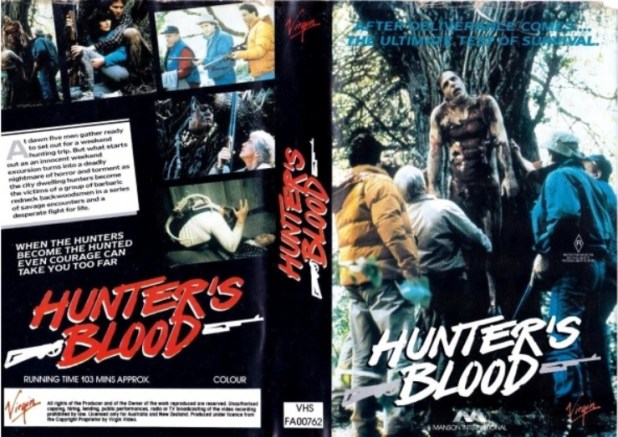
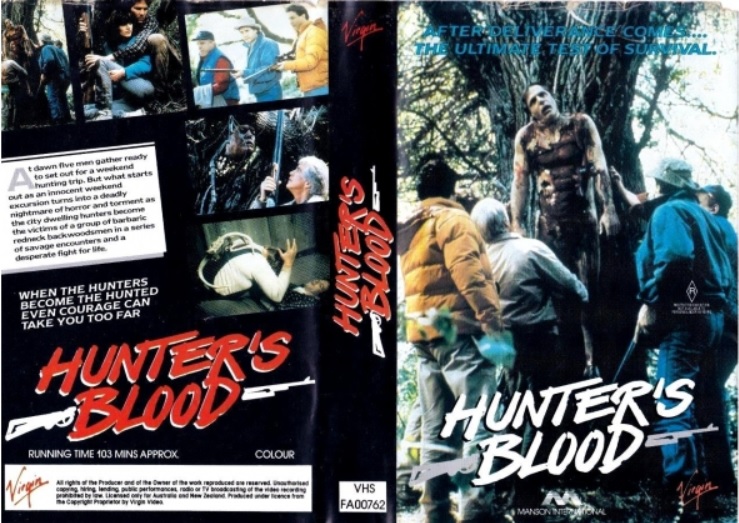
And that’s the plot of Robert C. Hughes’ Hunter’s Blood: Five city slickers go-a deer huntin’ and meet up with Redneck Local Rotary 666 and, well, anyone with a G.E.D would get the fuck out of the woods, go back to suburbia, bang Kim Delaney, and then fire up their copy of Arcadia’s Deer Hunter Skeet Shoot projection video game. And if you got no one to do the shimmy-sham: find yourself a nice, citified wings n’ ribs grill with Big Buck Hunter in the corner by the restrooms, pop a quarter, and call it day. Nope. Not in Hunter’s Blood country.
“Hey, Pop. How come we didn’t buy beer and stock our coolers in the city before we left for inbred country,” ask David (Sam Bottoms, Up from the Depths by the guru of redneck cinema, Charles B. Griffith).
“Shut up, you’re ruining the plot, son,” head smacks Mason (Clu Gulager, Burt from Return of the Living Dead!!!). “Now pull into that general store so we can buy beer and I can kick some redneck ass and unleash their wrath before Kim Delaney shows up to be raped.”
“Tobe’s Gas Stop? Hey, that’s funny. They named it after Tobe Hooper, the director of The Texas Chainsaw Massacre,” says Marty (John Travolta’s less-talented brother, Joey).
“Shut up and quit trying to act, Joey. Just sit over there and wait to be killed,” yells Al (Ken Swofford of Black Roses and a snake-bag load of American TV series). “Look at my IMDb resume, I know what I’m talking about. Now go get a real estate license and quit irritating me, kid.”
All joking aside: What makes Hunter’s Blood the type of hicksploitation classic we love here at B&S Movies is its who’s who of B-movie badassery backing up Clu and Ken (both appear in Terror at London Bridge): You have Lee De Broux as “Red Beard” (Salvage 1andRobocop), Charles Cyphers as “Woody” (Carpenter mainstay; Assault on Precinct 13), Billy Drago as “Snake” (Invasion U.S.A), and Bruce Glover as “One Eye” (Yep, Crispin’s dad!) . . . and Mickey Jones (!) as “Wash Pot” (Slingblade, Total Recall, National Lampoon’s Vacation . . . the dude was Bob Dylan’s and Kenny Rogers’s drummer and earned 17 gold records!).
And wid-a cast like that, ya’ll don’t be needin’ no stinkin’ script or character development. Bend over and squeal like a pig, and enjoy it, son.
Need more Robert C. Hughes-backwoods terror? He returned with Memorial Valley Massacre (1989). The unrated, pseudo-Eurotrash cut of the film, Son of Sleepaway Camp, marketed as a bogus sequel to 1983’s Sleepaway Camp, goes all “Jess Franco” with hardcore sex and amped gore scenes inserted.
About the Author: You can read the music and film reviews of R.D Francis on Medium and learn more about his work on Facebook.
Corey Yuen is a Hong Kong action director, film director, producer and action choreographer known for doing the fight scenes for movies like Lethal Weapon 4, X-Men and plenty of Jet Li’s American films like Romeo Must Die, The One and The Expendables. He’s also directed Sammo Hung and Jackie Chan in Dragons Foreverand helped start the careers of Cynthia Rothrock and Michelle Yeoh.
For his first movie in the United States, he worked with Ng See-yuen as a producer (he was behind the Once Upon a Time In the West series and Drunken Master) and story writer.
Scriptwriter Keith W. Strandberg became interested in martial arts films when he lived in Taiwan. After taking a job in China as a tour director, he would visit Hong Kong and try to get into the movies. After being turned down by nearly everyone, he met with the Seasonal Film Corporation and studio head Ng See-yuen. Ng wanted to make an American film and asked if Strandberg knew anything about screenplays. Despite never even seeing a screenplay before, he said yes.
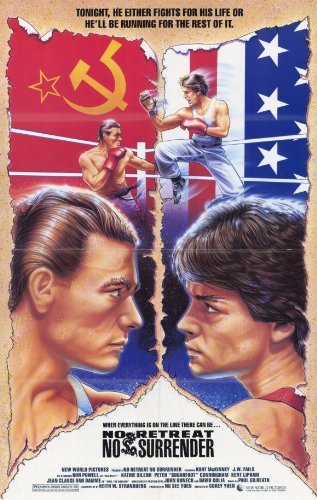
Jason Stillwell (Kurt McKinney) is a young karate student at his father Tom’s dojo in Sherman Oaks. One night after a training session, the mob visits. They’re shaking down all of the independent dojos in the country and taking them over. Tom refuses and gets his leg broken quick by Ivan Kraschinsky (Jean-Claude Van Damme, making his American debut).
The Stillwell family runs and hides — I mean, relocates — to Seattle. There, he becomes the friend and protector of R.J. Madison and reunites with an old girlfriend, Kelly, whose brother Ian is also a martial arts fan.
After getting beaten up and humiliated by a fat kid named Scott and a karate kid named Dean at Kelly’s birthday party, Jason visits the grave of Bruce Lee and begs him for help. His father has given up on martial arts completely and destroys most of his son’s Bruce Lee memorabilia. What Jason can save, he moves to an abandoned house.
That night, Bruce Lee (Kim Tai-chung, who played Lee’s character Bobby Lo in Snuff Bottle Connection and Game of Death II) appears to Jason and begins transforming him into a real martial artist. He even saves his father from another beating by the mob.
It all ends up with Jason, Tom and R.J. attending the annual full-contact kickboxing tournament with teams from both Seattle and New York. The mob bosses show up in force and make a bet that none of Seattle’s fighters can defeat Ivan. Van Damme becomes the greatest heel in the history of forever here, just annihilating everyone in his path. It’s actually shocking what a great good guy he became in movies after seeing the way he decimates everyone in his path, including Kelly’s brother Ian. He even shrugs off her attempts to hit him with a stool and bumps her off the apron. I lost my mind in sheer glee, seeing JCVD brutalize young kids who just love martial arts.
Jason ends up defeating Ivan and no one thinks, “Perhaps we should call the police on all these mob bosses. Didn’t this Russian guy potentially kill three people, attack a referee and grab the hair of an innocent young girl? Oh well — time to go to the ring and celebrate!”
Supposedly, Van Damme was either method acting or really was a bully, because he kicked Pete “Sugarfoot” Cunningham — Canadian 7-time World ChampionHall of Famekickboxer — so hard that he knocked him out. There have been several stories that Van Damme had to be continually warned to not make full contact with other actors and stuntmen, but he did so anyway. That’s been disputed by others on the set and could just be sour grapes.
This movie came up in court when two members of the cast appeared as character witnesses in the court case brought against Van Damme by Jackson “Rock” Pinckney, who claimed that the Muscles from Brussels partially blinded him in the left eye and caused him to get discharged from the Army after filming Cyborg. Timothy D. Baker — who played the dad — claimed that Van Damme was “dangerous to work with and possessed inadequate control of his movements for a martial artist”, whereas Ron Pohnel — who played Ian and really had a long fight sequence with Van Damme claimed that the actor “did in fact possess adequate control and could perform a fight scene without complaint.”
Maybe Timothy was still upset that when Van Damme’s kicks were supposed to hit his upper chest region, he kept repeatedly nailing him in the face, knee and throat.
This is one of the wackier American kung fu movies I’ve seen and one of the few that embraces that wackiness of Hong Kong films in an organic way. I laughed out loud several times and the final fights are so good, you’ll be doing spin kicks all over your living room. Just watch the television set with that kung fu!
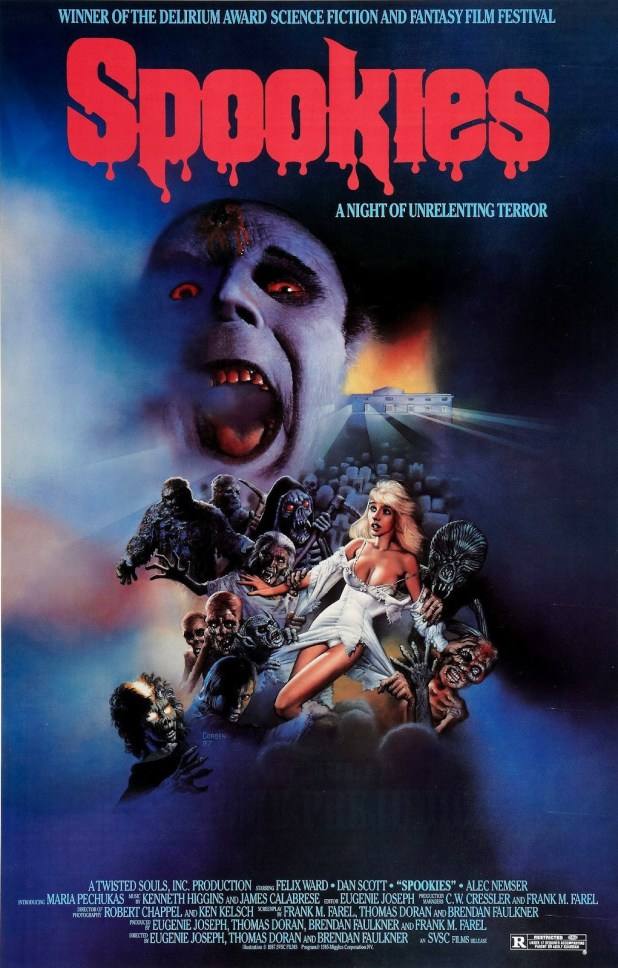
I’ve seen Spookies at least four times in the last year and I still have no answers for so many parts of the movie’s plot, motivations or reasons for existing. Hours of research have been spent reading up on the film, looking for the truth as to how such a strange movie escaped from some wall beyond sleep to infect my waking life.
There are moments of Spookies that are utterly terrifying — an incredibly realistic looking grim reaper, a spider sucking the life out of a man and zombies good enough to fit into a Fulci film. Then there are farting monsters, a wolf boy and acting on sub-Ed Wood level. How can all of these pieces fit into one movie?
That’s because, well, Spookies is more than just one movie. And despite its flaws, I love it.
Much like another of my favorite bits of 1980’s video insanity, Night Train to Terror, Spookies has its roots in a strange fashion. Whereas the former film is three movies all stitched into one, Spookies is a movie that was finished, then torn apart and finished again by a totally different creative team.
Spookies was once a movie called Twisted Souls, which was written and produced by Frank Farel, Brendan Faulkner and Thomas Doran, with the latter two men directing. It was filmed at the home of James Jay — one of the Founding Fathers — in the summer of 1984 before the producers and their financial backer ran into artistic differences. That meant that while the film was shot, the editing and post-production was never finished.
How much of Twisted Souls is left? Everything where the people arrive in two cars, as well as the monster attacks in the house came from this footage, including the demon girl with the Ouija board, the muck men, the snake demon, the grim reaper and the muck men.
A year later, the financial backer hired Eugenie Joseph to direct more footage and splice it into the original film. She hired an entirely new cast, which would be the scenes where the boy looks for his birthday party, the guy in the tree, the cat boy, the old magician, all of the zombies, the blue boy and the witch in the basement.
This would all make some semblance of sense if any of these multiple plot points and characters ever crossed over. But they really don’t. Unlike Night Train to Terror, which at least attempts to weave its three stories into one portmanteau narrative, Spookies just throws things at you until you really have no idea what’s next. Imagine if Evil Dead made even less sense and changed its tone and narrative every five minutes and you’ll gain some idea of what this movie is like. Think Demon Wind, but someone here more rambling insanity, more characters and way better effects.
Here’s the best I can do at summing it up: Billy runs away from home when his parents forget his birthday like he’s Samantha Baker or something. As he goes through the woods, he meets a man who is soon stabbed by a werecat dressed like Adam Ant and then finds an old mansion decorated like a birthday party. Thinking it’s for him, he opens a gift and finds a severed head before the werecat buries him alive.
We’re never going back to Billy. Seriously, that’s it.
A group of teenagers — along with some adults who are way too old for them to all be hanging out together — come across the mansion and decide to party. There’s Duke, who claims to be the leader and brags that he’s a horny ghost. Linda, his girlfriend. Her friend Meegan and her older boyfriend/daddy figure Peter who seems exasperated by the teenage antics. Then there’s Rich, who wears a t-shirt of himself and only speaks through a hand puppet. Oh yeah — and Carol, who gets possessed by the Ouija board. And a British woman and her American husband. I may have missed or combined a few characters, because watching this movie is very much like doing a gravity bong hit and then trying to describe everything that happened in the last twenty minutes you spent lying on the floor and attempting to stay within this plane of existence.
None of these mismatched pals counted on battling Kreon, an ancient warlock who has kept his dead wife Isabelle preserved for seventy years. He needs human victims, so he uses his bootleg Ouija board and an army of demons of all shapes and sizes to kill them off. We’ve covered some of them above, but there are also an electric octopus, a skeleton witch and reptile demons. Oh yes — I nearly forgot that an Asian woman becomes a spider.
Everyone finally dies, but Kreon’s wife runs away, chased by zombies in a scene that actually approaches true fright. It’s seriously one of the best parts in the film. She escapes to a car and a man drives her away, but he’s really the werecat. A man bursts from his grave and it’s Kreon, who laughs as the credits roll.
I have so many questions.
Why does Kreon burst out of the ground other than to just act cool? I mean, is bursting from your grave cool?
Why do the muck men — who appear terrifying — fart?
is Korda the werecat the son of Kreon and the queen who has been trapped for seventy years?
How did they talk Richard Corben, the noted comic book artist and painter of Meatloaf’s Bat Out of Hell album cover to do the poster for this?
Why does the grim reaper explode?
Why does RIch have a hand puppet that he talks to?
Why has this never been released on blu ray in an era where every film has been rediscovered?
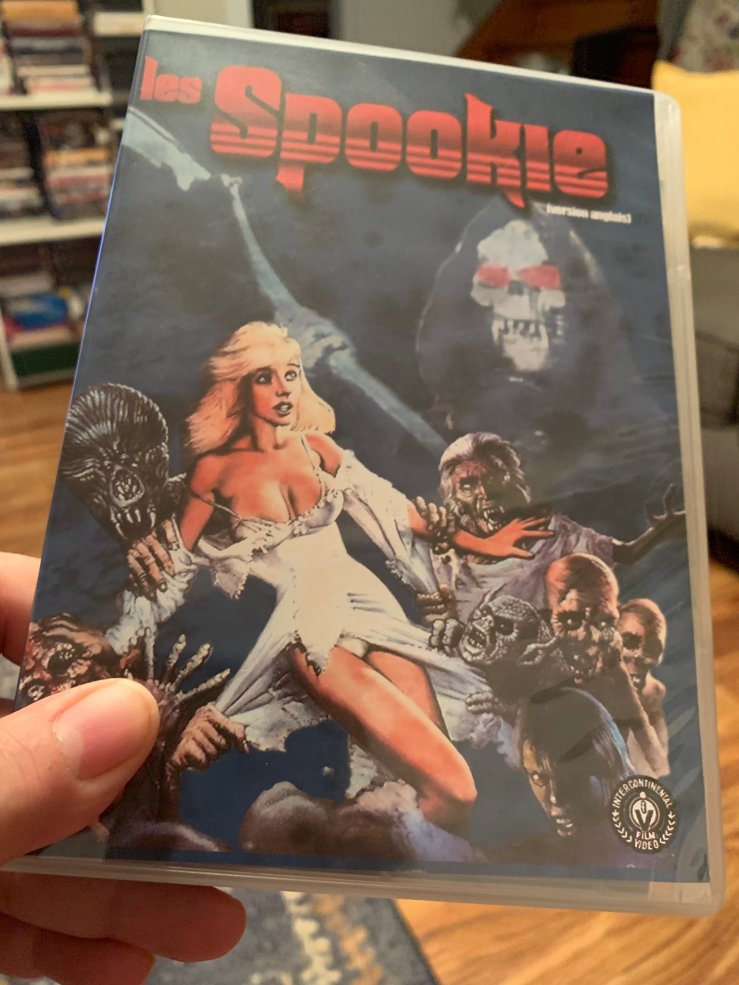
To answer some of that, this movie ran mostly on USA between 1988 and 1991. There was also a Sony Video VHS release. In 2003, UK company Vipco Entertainment released a Region 2 PAL DVD mastered from that VHS. My copy is one of the ones released in 2017 by French company Intercontinental Film and Video under the title Les Spookie, which claims to be from a new 2K scan. It still looks beat up and worn, so who knows.
This is not the first copy of Spookies that I have bought.
This article at The Dissolve gives some answers, though.
From the film’s ex-Green Beret cinematographer’s son dying from crib death on the set to the film’s original FX guy getting fired (he was replaced by a 16-year-old Gabe Bartalos (who created the Leprechaun) and future Emmy Award winner Jennifer Aspinall), it’s packed with info. And the blame for the farting zombies lies with executive producer Michael Lee, who wanted to call the movie Bowel Erupters. And somehow, out of all of this, Errol Morris’ cinematographer Bob Chappell ended up shooting the new footage (much of the crew went on to work with J, Michael Muro on Street Trash).
This is truly a lost film, despite what the back of the French release claims (“We have found the lost film!”). The original ending has never been seen, although Al Magliochetti, the visual effects artist, has an interpositive of it. And the rights, which were owned by Michael Lee, Sony, then Vestron, and then Lionsgate, are murky. No negative or print has been found.
This movie is well overdue for a fancy blu ray release, but until then, you can grab a copy from the VHSPS. Here’s hoping you’ve never encountered this movie before and get to have a first time experience like I had, being amazed, bewildered and overwhelmed by just how strange this movie is.
Heck, just watch it on YouTube and get back to me.
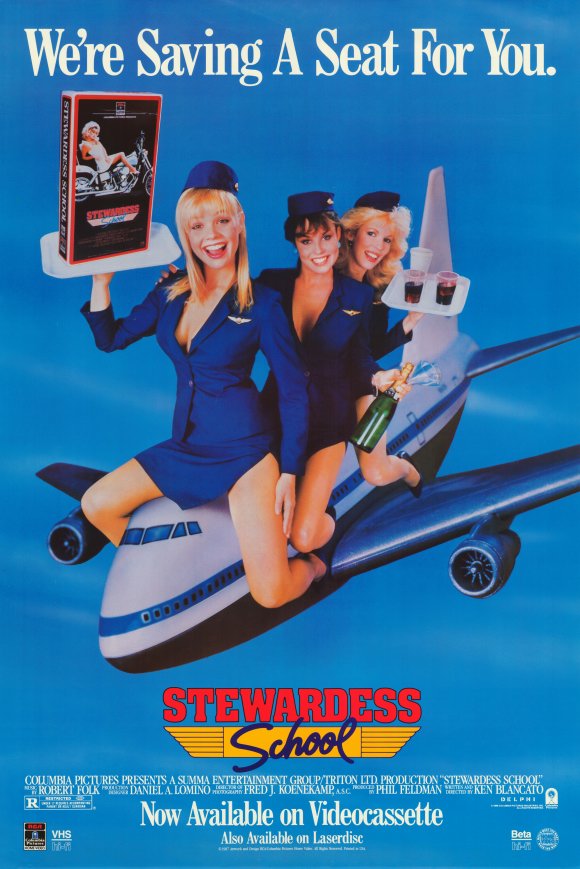
Any movie that starts with a plane crashing into downtown LA that’s played as a total farce is one I’m going to remember. Philo (Brett Cullen, who was on Falcon Crest and played Johnny Blaze’s dad in 2007’s Ghost RIder) has always wanted to be a pilot, but that crash — in a simulator — is because his contact lenses got knocked out by his friend and fellow pilot George (Donny Most, here booked as Don).
They decide that they want to stay on planes, so they enroll at Weidermeyer Academy, a stewardess school. Imagine Police Academy throughout this movie, with the teachers like Miss “Ironpants” Grummet as the older cops and the students as the cadets. Mary Cadorette — who played Vicky, the girl who finally got Jack Tripper to settle down and go from Three’s Company to Three’s a Crowd — is Kelly Johnson, an extremely clumsy girl. There’s a stereotypical gay guy. A frumpy overweight girl played by Wendie Jo Sperber, as Wendie played this role in nearly every film. There’s Wanda Polanski, a pro wrestler who just lost her latest boyfriend played by Conan the Barbarian‘s Sandahl Bergman. Julia Montgomery — yes, Betty Childs herself — plays an overly nice version of that role. Corinne Bohrer plays a punk rock girl in love with a biker (she’s a vet of these movies, appearing in Zapped!, Joysticks, Surf II, Revenge of the Nerds IV: Nerds in Love and the fourth Police Academy movie). And oh yeah — Judy Landers as Sugar Dubois, a hooker with a heart of gold that’s on work release.
After going through hell, everyone graduates and gets a job at the struggling Stromboli Air. Their first flight has a blind person’s convention and a man with a bomb who doses people with LSD. Of course, our heroes have to land the plane and fix things. But don’t worry — everything works out just fine.
Voiceover artist Rob Paulsen (Pinky of Pinky and the Brain amongst 250 different animated characters and over 1000 commercials) shows up in a rare live-action role. Sherman Helmsley appears briefly as Mr. Buttersworth. And the owner of the school is played by William Bogert, who hosted the Frontline segments on Chapelle’s Show.
If you had Comedy Central in the 1990’s, there’s a good chance you saw this movie. Trust me. You did.
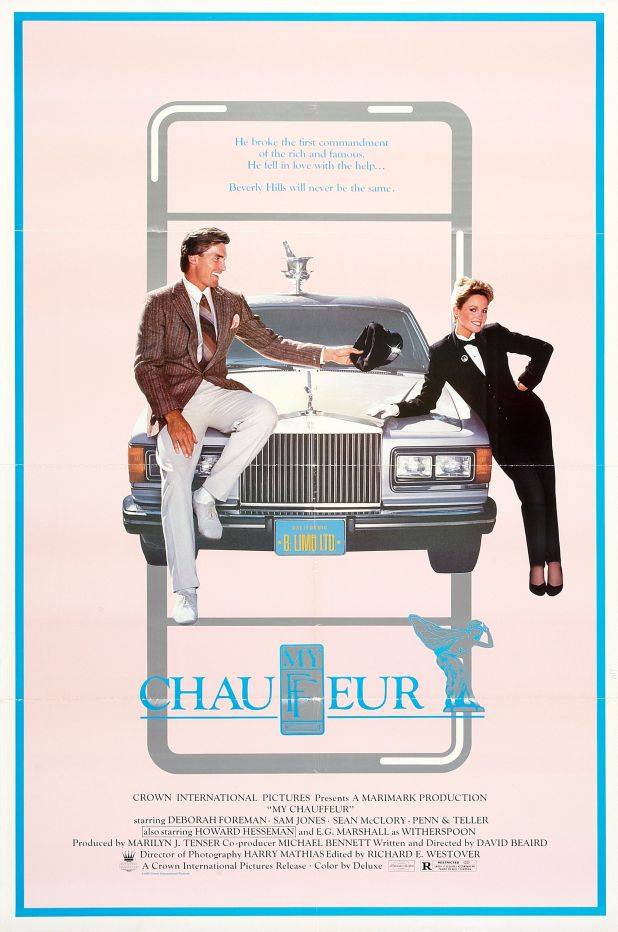
Deborah Foreman is my favorite 1980’s comedy girl. From Real Genius to Valley Girl, April Fool’s Day and Waxwork, she’s always dependable, always cute and always real. She’s the kind of girl that 80’s dorks like me wish we’d get as girlfriends. And people noticed, with one critic comparing her to a “New Wave Carole Lombard crossed with early Shirley MacLaine.” Sadly, she never really broke through to the mainstream. She has said that My Chauffeur is her favorite of the films in which she’s appeared and the most fun she ever had making a movie.
In My Chaffeur, she plays Casey Meadows, a free spirit who somehow ends up working for the Brentwood Limousine Service, which brings her into conflict with the company’s manager, McBride (Howard Hesseman!). At first, the older drivers all treat her like dirt, but her plucky spirit and hard work soon win them over. Even when they set her up with nightmare client Cat Fight, a goofball drugged out rock star, she succeeds.
Casey soon starts driving around Battle Witherspoon (Sam J. Jones, Flash Gordon), the son of limo company owner Mr. Witherspoon (E.G. Marshall, Creepshow). She helps him through a breakup, but he’s a heel, a rich boy unable to be kind to anyone — until Casey breaks through.
However, she soon runs afoul of an oil sheik and a con artist who take her for a ride even more ridiculous than the band at the start of the movie. It turns out they’re wanted men, which gets Casey fired. Penn and Teller play them and this was at the very start of their career.
Battle becomes a better person and he and Casey fall in love. He takes her home to meet her father and when in her house, she was deja vu. That’s because her mother was a former employee and she played in the house. And Battle’s dad is actually her real father. But whew — luckily for those who don’t want a Flowers in the Attic situation — Casey’s real dad was Giles, one of the other limo drivers. That means our young couple can get married and all ends happily.
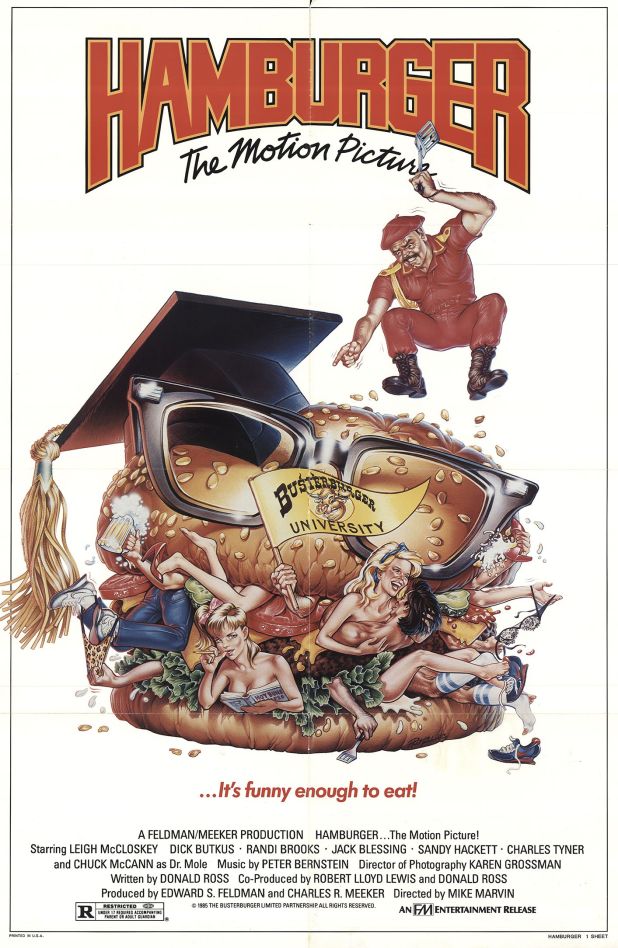
My wife asked me, “Why would anyone watch this movie?” She doesn’t get it. She wasn’t around in the 1980’s, when we had no internet. She wasn’t going through puberty. She’ll never understand staying up until 3:15 AM to catch a movie about a Hamburger University and the joy that it can bring.
Russell Proco (Leigh McCloskey, who improbably is also in Argento’s Inferno) has been kicked out of multiple schools because he can’t stop hooking up. There’s a trust fund waiting for him if he can get a diploma. So he picks the one school he knows he can graduate — Buster Burger University.
You know why the 1980’s were great? Because Dick Butkus could be in a movie and we all knew exactly who his character was. Here, his job is to beat the hell out of the students so they don’t screw up Buster Burger. Everyone has to follow the rules:
Outside consumption of food is prohibited.
All candidates are to stay on the grounds of Buster Burger University until graduation.
Since sex and success make lousy partners, all candidates are not to engage in sex while students.
This is a movie that follows the best formula: just get a bunch of crazy characters together, get them into some insane situations and let the hijinks ensue. Along the way, Russell makes a friend who is obsessed with the CEO’s sexy wife (the pneumatic Randi Brooks, who also is in TerrorVision), a nun who for some reason is going to burger school, a sex-crazed guerilla fighter, a soul singer who was arrested and is at the school on work release and so much more.
Where else other than Buster Burger University can you learn to yell things like “Put those cookies back, motherfucker,” get stuck inside a giant pickle and then have to battle against bikers and cops on your first day of work?
Most amazingly, director Mike Marvin would go on to make a movie that is even less connected to reality, The Wraith.



 B&S About Movies
You must be logged in to post a comment.