Originally released as a double feature with The Last Starfighter, I first saw this movie as a VHS rental.
It was directed by Australian Richard Franklin, who also made Fantasm, Patrick, Roadgames and Psycho 2. The writer of the last film was Tom Holland (Fright Night), who wrote this film as well.
This is a remake of The Window, which was based on the Cornell Woolrich story The Boy Who Cried Murder. Another of Woolrich’s stories, It Had to Be Murder, became the Hitchock film Rear Window, which inspired Roadgames. This same story was also made as The Boy Cried Murder and Eyewitness.
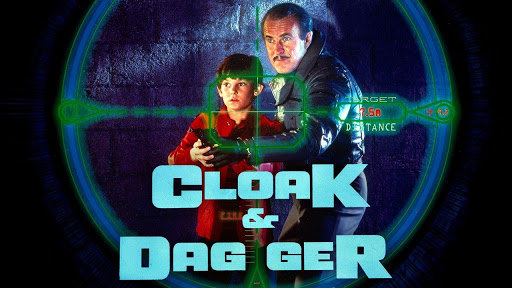
Davey Osborne (Henry Thomas, E.T.) wants to be Jack Flack, a daring man of spy derring-do. The only problem is that Jack doesn’t exist in the real world, but his father (Dabney Coleman played both roles) does.
This all changes when his friend Morris (William Forsythe) sends him on an errand to get him a candy bar. Davey and his friend Kim witness a murder and are given a Cloak and Dagger video game by the dying man. Yep — the Jack Flack video game itself, now part of a real world spying mission.
This is pretty much a forgotten movie today, but I really have always loved how the real world and fantastical spy world meet in the middle, with real life death having a dramatic impact on our hero. I don’t want to spoil the twists and turns, but the first time I saw it, there were at least two moments that totally shocked me.
You should find this one, watch it and let me know what you think. I got a copy from a beaten up old Pizza Hut pawnshop for a dollar, which is way more than it is worth.
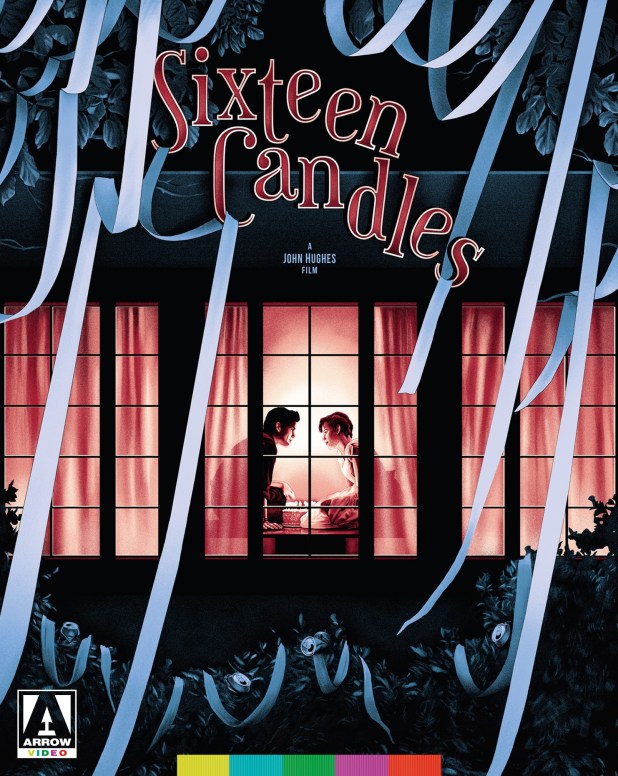
Sixteen Candles was the directing debut of John Hughes. He wrote this film after asking his agent for headshots of young actresses and was so inspired by Molly Ringwald’s photo that he put it over his desk and wrote this movie over a weekend just for her.
Filmed primarily in and around the Chicago North Shore suburban communities of Evanston, Skokie, and Highland Park, Illinois — where Hughes spent his teen years — with fifteen-year-old leads Ringwald and Anthony Michael Hall, this movie would go on to start the Brat Pack, who dominated the theaters, hearts and minds of the mid 1980’s.
Samantha “Sam” Baker wants her sixteenth birthday to be the start of her amazing new life, but everyone has forgotten it. Her sister Ginny is getting married, her grandparents have taken over the house and her dream man, Jake Ryan has no interest she exists.
To make things worse, she must deal with Ted (Hall), the geek of all geeks, who is so in love with her that he tries to take her panties to win floppy disks in a bet.
The actual story of the movie is pretty simple. There’s a dance, a party and the hijinks that ensue as the result. Along the way, Sam and Jake find love, Ted finds Jake’s ex-girlfriend (Haviland Morris, Gremlins 2: The New Batch) and there’s the introduction of one of the most racist Asian carictures of all time, Long Duk Dong.
This movie was also one of the first films for Jami Gertz and John and Joan Cusack. Plus, there are cameos by Zelda Rubenstein (Poltergeist) and Brian Doyle-Murray, which please me to no end.
Much like Revenge of the Nerds, the Caroline/Ted scenes can be seen as rape today. Then again, some think that she’s an example of the upper class being taken down and re-educated by the lower class. Your mileage and upsetness by this scene may vary.
Does this movie exist in the same universe as the other Hughes movies? You bet. My evidence? The same moving shot of the exterior of the high school at the opening of the movie was refilmed — with the same motions — for the end of Weird Science.
If John Hughes was alive, I’d ask him how damaged he was by having his extended family stay in his house. Between the Home Alone films, National Lampoon’s Christmas Vacation and this film, it keeps coming up in his work.
This movie came out when I was 12. As such, I fell in love with Molly Ringwald and wondered why no girls like her existed in my town. The truth was, this perfect person only lived in one place: the Shermer, IL inside John Hughes’ mind.
The new Arrow Video release of this movie is packed with everything you expect from the label. Aside from a new restoration from a 4K scan of the original negative, there are multiple ways to see the movie, like the theatrical and extended versions, as well as the alternated VHS/laserdisc track that had different audio.
It’s also packed with extras, interviewing everyone from the casting and music director of the film to all-new interviews with Gedde Watanabe, Deborah Pollack, John Kapelos, filmmaker Adam Rifkin (who was an extra on the film and shadowed Hughes), camera operator Gary Kibbe and composer Ira Newborn.
There’s also A Very Eighties Fairytale, a video essay written and narrated by writer Soraya Roberts that explores the feminist perspective of the film and an archival documentary, Celebrating Sixteen Candles. Plus, of course, there are trailers, TV and radio ads, new artwork and a collectors’ book on the first printing of this release.
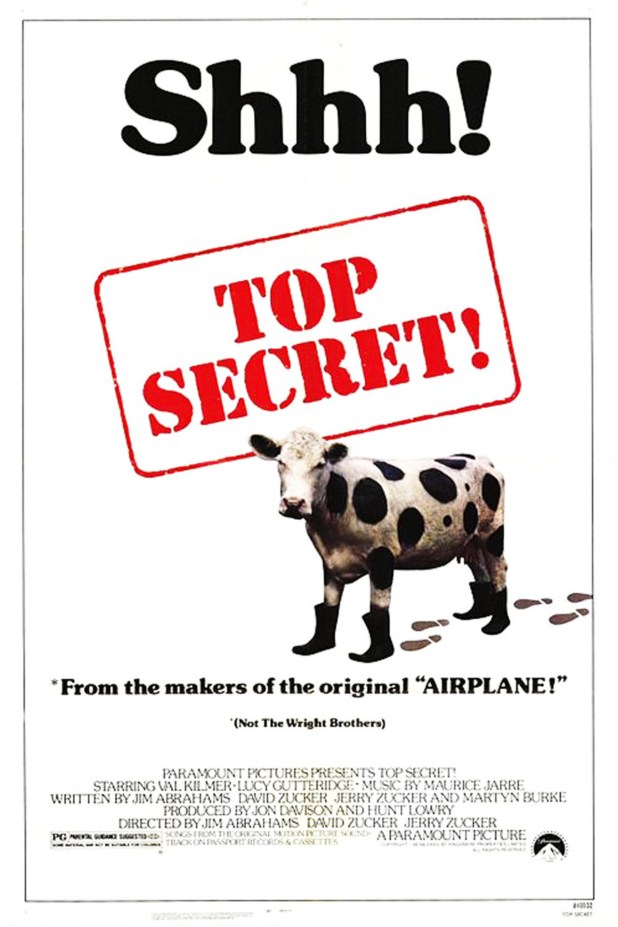
Val Kilmer picked the right debut. This ZAZ — Jim Abrahams, David Zucker and Jerry Zucker — feature packs in takes on Elvis films, spy movies and World WAR II movies all in one huge package of rapid fire jokes, allowing the star to sing, dance and pretty much act like a maniac. It’s perfect.
He plays Nick Rivers, whose hit song “Skeet Surfin'” takes him to East Germany, which is still Nazi Germany despite the Cold War taking place. Somehow, within the mashup that this film throws together also finds time to pretty much be a pastiche of the 1944 noir The Conspirators.
Unlike past ZAZ films, there aren’t many cameos here, other than Omar Sharif as Agent Cedric and an appearance Peter Cushing playing a Swedish bookstore proprietor who is filmed backward.
While this movie has its fans — Weird Al claims it’s his favorite movie — the studio was upset with its performance. And David Zucker would claim that it may be a funny movie, but it isn’t a very good one.
Me? I kind of love any movie that has the French Resistance still fighting Germany in the 1960’s, a battle that takes them to a Swedish pizza place where Nick can win over the girls with his song “Straighten Out the Rug.”
Frank Harris and Leo Fong! My head is swimming. Where do I begin with this review?
Well, first off, you can get both of these Crown International releases on Mill Creek’s “Explosive Cinema” 12-pack (along with Scorpion, Skydivers, and 9 Deaths of the Ninja). Second: You also get Troy Donahue (Omega Cop), Richard Roundtree (Q: The Winged Serpent), and, say what? Cameron Mitchell (Space Mutiny) appears in both?
Harris. Fong. Mitchell? Sign me up! I am going to loose my nut!
What’s that? Harris also did the post-apoc romp Aftershock and the cop actioner Lockdown (1990; trailer) with Richard Lynch from Deathsport and Ground Rules? What? No way! And Fong did Showdown (1993; full movie) with Lynch as well? Rock on! Richard Friggin’ Lynch. Rock on, Ankar Moor, you post-apoc bad ass.
Frank Harris
Writer, director, producer and cinematographer Frank Harris got his start as a reporter for a small California TV station. But his true love was film. He got his start in the movie business courtesy of the fifth film from Asian action star Leo Fong, 1976’s Ninja Assassins (aka Enforcer from Death Row), who hired Harris as a cinematographer. (I have wonderful memories of my older cousin, Bobby, who studied martial arts and was ready to go into the military, taking me to the Drive-In after seeing the film’s commercial on TV. Yes, I rented it when it came out on VHS.)
After putting one more cinematography gig under his belt with the 1984 actioner Goldrunner (trailer: race cars, motorcycles and kidnapping), Fong hired Harris to not only serve as the cinematographer, but as the producer, director and screenwriter for his eighth film as an actor: Killpoint.
Then there was Harris’s directing gig with 1996’s Skyscraper, an awful attempt to turn famous-for-being-famous ex-Playboy model Anna Nicole Smith into—not only into an “actress” and not only into a “leading lady”—an “action star.” Anna Nicole as a hot, corporate helicopter pilot who goes “Die Hard” when terrorists take over her employer’s office tower? Huh and W.T.F. It’s one of those movies where you simply can not turn away. And let me make this point perfectly clear: there’s a lot of people to blame for it, but Harris isn’t one of them; he was just a director-for-hire. (Watch the full movie at your own peril; the trailer might even be too much to bear.)
Killpoint (1984)
Cameron Mitchell returned from Ninja Assassins, this time as Joe Marks, an illegal arms dealer who robs a Californian National Guard Armory with plans to sell the weapons to L.A’s street gangs. Lt. James Long (Fong) a bitter, troubled L.A detective still dealing with the rape and murder of his wife a year earlier, gets his chance to go “Dirty Harry” —well, “Jackie Chan,” actually—when he discovers Mark’s sidekick, known as Nighthawk (professional ex-boxer Stack Pierce; worked on several of Fred Williamson’s Blaxploitation films), was responsible for her death. Teamed with FBI Agent Bill Bryant (Richard Roundtree), they bring them to justice.
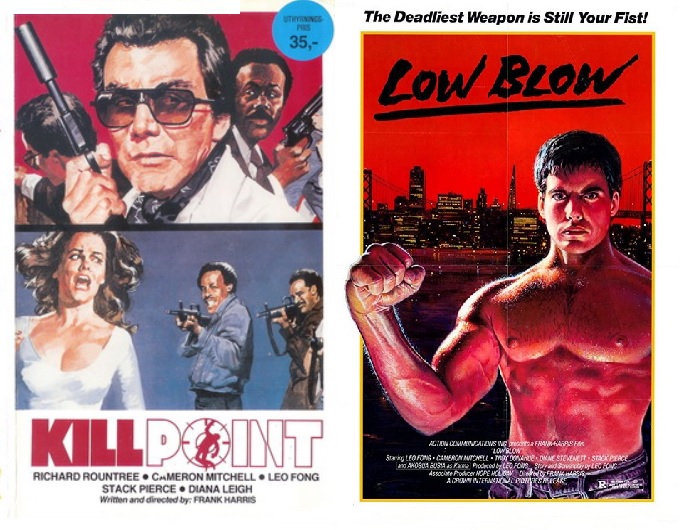
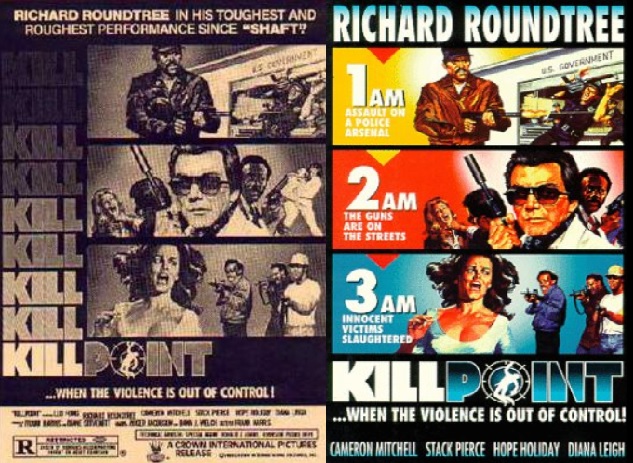
Of course, while Fong was already a major star in the Eurasian marketplace, he was an unknown commodity in the States. So while Roundtree’s part in Killpoint is a minor one, as you can see from the below poster images, that didn’t stop the distributors from highlighting Roundtree’s contribution—and giving Leo Fong the short shift on the U.S Drive-In and video campaigns.
Where’s Leo?
Low Blow (1986)
Karen Templeton (Patti Bowling; her only film role) is a young, wayward Patty Hearst-type heiress brainwashed-kidnapped by the Church of Universal Enlightenment, a Jonestown-styled religious cult run by Cameron Mitchell’s Jim Jones-inspired Yarakunda.
After seeing Joe Wong (Leo Fong), a harried ex-San Francisco detective take down a couple of thugs who mugged an old lady, Karen’s tycoon-father (Troy Donahue) decides Wong is the man for the job to rescue his daughter. So Wong recruits a Vietnam vet and ex-pro-boxer (Stack Piece is back!) to get her out. Once inside, Wong fights the cult-camp’s ninjas and world-renowned martial artist and Tae Bo exercise program guru Billy Blanks (Tango & Cash, Lionheart) in his first film role.
Leo Fong
Leo Fong is still going strong at the incredible age of 91. He starred in three films in 2018: Hidden Peaks, Dragon to Dragon, and the most recent film: Challenge of the Five Gauntlets. And he has four more films in various stations of filming and pre/post production: Pact of Vengenance (with Jon-Mikl Thor!), Asian Cowboys, Runaway Killer, Hard Way Heroes, and Junkers. You catch up with Leo and his Sky Dragon Entertainment at LeoFong.com.
Other films in the Harris-Fong oeuvre include 24 Hours to Midnight with Cynthia Rothrock (1985; clip), Hawkeye (1988; full movie) (seen them on VHS), and the direct-to-DVD releases Brazilian Brawl (2003; trailer) and Transformed (2005; full movie) (honestly, never heard of them or seen them; I need to change that).
Sometimes, the story behind a movie takes over the actual story of the movie. I can think of no better example than this film.
The Cottom Club was Robert Evans’ baby. Inspired by a picture-book of the famous nightclub by James Haskins, he was set to produce and direct, with Mario Puzo writing the original screenplay and William Kennedy and Francis Ford Coppola doing re-writes.
But wait? Didn’t Evans and Coppola famously hate one another after two go-arounds making The Godfather films? Didn’t Evans even claim, in his book that influenced everything I write, The Kid Stays In the Picture, that “Francis and I have a perfect record; we disagreed on everything?”
Production designer Richard Sylbert played good cop bad cop with both, telling Evans not to hire Coppola because “he resents being in the commercial, narrative, Hollywood movie business” while at the same time telling Coppola to steer clear because Evans was crazy.
Yet Coppola needed the money. One from the Heart had tanked and he’d done the one thing you should never do — he spent his own money.
Evans needed Coppola too — at least $13 million had already been committed to the film, then Vegas casino kings Ed and Fred Doumanu put another $30 million down, then Adnan Khashoggi — yes, the arms dealer — got involved. And then there’s Roy Radin, who cut a drug dealing associate out of the movie and got killed for it.
Let’s stop this Cotton Club train and get into Roy Radin, who touches all the hot button subject matter that I love so much. Back in 1991, Lydon LaRouche’s Executive Intelligence Review stated that Radin’s murder had been carried out in style. To wit, the murder was conducted in Satanic ritualistic fashion: 13 bullets to the back of the head; a Bible left near the body, opened to a passage from the Book of Isaiah, Chapter 22, which reads in part, “Let us eat and drink, for tomorrow we shall die.””
Radin was killed by William Malony Mentzer, who was identified by “Son of Sam” killer David Berkowitz as Manson II. He was also, at the time, the bodyguard of Larry Flynt and had two dozen similarities with the Zodiac Killer.
Radin also had ties to the occult underground in New York and Long Island, purchasing much of his cocaine from the group that Maury Terry fingered in The Ultimate Evil as a national Satanic underground that also included the Process Church of the Final Judgement and Charles Manson. Radin was also a member of the Crowley order the Ordo Templi Orientis.
I went to one of their parties once and was shocked how boring it was, as everyone ate guacamole and discussed Debbie Harry for hours. And hours. Also, of note, the Process successfully sued Terry and had the passage that connected them to Manson removed from future printings.
But I digress.
The budget had ballooned out of control — $65 million by some accounts, which would be $162 million in today’s money. When he became the director, Francis Ford Coppola added to the budgetary issues by firing nearly all of Evans’ crew, which meant large payoffs. Then, a whole new crew went to work, with six hundred people were constantly working at building sets, making costumes and playing music, like some demented Winchester house of a film, costing a quarter million a day as star Gregory Hines claimed that the rehearsals of the film were being filmed as the movie was shot during rehearsals.
At one point, five new scripts were written in 48-hours and at least thirty — if not forty — versions of the screenplay exist. Evans got forced out. The producers began suing one another. And the movie was still far from playing theaters.
Dixie Dwyer (Richard Gere) is working with the mob to help his career as a musician, but he’s fallen for Dutch Schultz’s (James Remar) woman Vera (Diane Lane). Meanwhile, Sandman Williams (Heinz) and his brother Lucky (real-life brother Maurice Heinz) start working at the Cotton Club, which is owned by Owney Madden (Bob Hoskins) and policed by his right-hand man, Frenchy Demange (Fred Gwynne!).
Dixie — who is pretty much George Raft — goes off to become a star thanks to Madden, but he pisses off Schultz along the way. Yet his brother remains in Schultz’s gang (and is played by a very, very young Nicholas Cage). And Laurence Fishburne is also in here as a Harlem-based mobster.
This movie again connects so many of my pop culture loves, from Warhol Factory star Joe Dallesandro playing Lucky Luciano to Tom Waits, Woody Strode and Julian Beck (Kane from Poltergeist 2!) having roles in the film.
Roger Ebert said that despite the movie having such a troubled birth, “what difference does that make when the result is so entertaining? Whatever it took to do it, Coppola has extracted a very special film out of the checkered history of this project.”
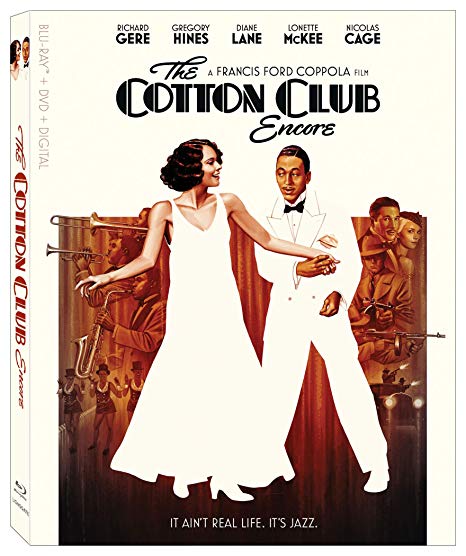
In 2015, Coppola found an old Betamax video copy of his director’s cut and spent a half million of his own money — oh Francis, you never learn — to restore the film. This new version, called The Cotton Club Encore, debuted at the Telluride Fim Festival.
The Cotton Club Encore has just been released to blu ray. It’s remastered, restored and has musical sequences and never-before-seen scenes that have been added back to the film. You can follow the link to order it.
DISCLAIMER: This movie was sent to us by Lionsgate. This has no impact on our review.
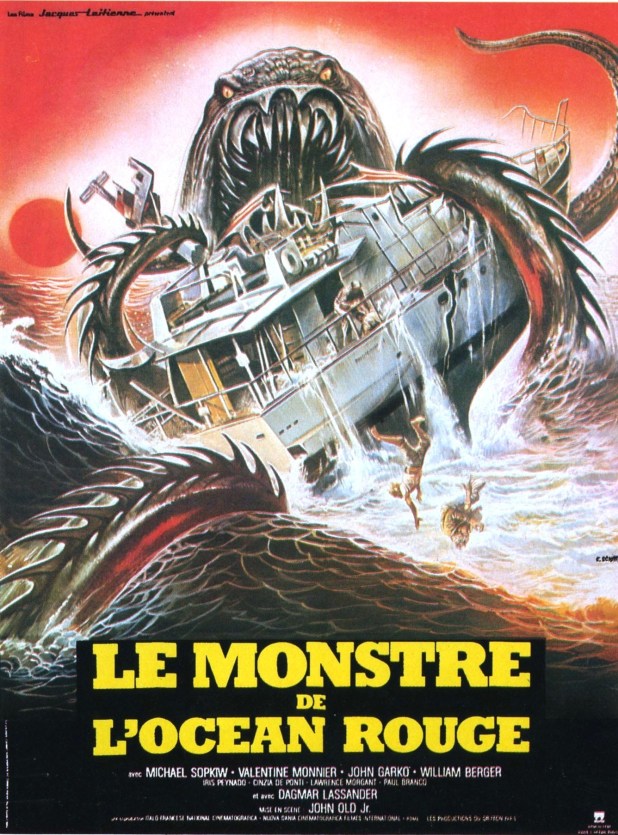
The list of talent involved in Monster Shark should get you pretty excited about the film. It took seven writers to get this movie made, including Lewis Coates, who you’d probably know better as Luigi Cozzi (Starcrash); Martin Dolman, who is really Sergio Martino (All the Colors of the Dark); Gianfranco Clerici (Cannibal Holocaust); Frank Walker, who is truly Vincenzo Mannino (The Last Shark); Hervé Piccini (Rats: Night of Terror); Dardano Sacchetti (who wrote pretty much every Italian horror and science fiction movie worth watching) and finally, John Old Jr.
Perhaps you know his infinitely more talented father, John M. Old. Yes, that’s just a pseudonym for Mario Bava, which means that the John Old Jr. who crafted this thing called Devil Fish, Monster from the Red Ocean, Devouring Waves or Shark: Red in the Ocean is truly Lamberto Bava. Whew. Sometimes watching Italian genre cinema means that you have to play investigatore.
Somewhere in Florida, the tourist trade is being attacked by a mysterious undersea beast. It’s not a shark. That’d be too easy. No, it’s a secret military operation that combines the worst parts of the octopus with the prehistoric Dunkleosteus.
While just a baby devil fish right now — an infant monster shark, a babina monster from red ocean, a toddler octopi — the beast has still broken loose to gnaw on swimmers, sailors and random females.
It’s up to Peter (Michael Sopkiw, Blastfighter), an electrician and TV repairman whose sole qualification seems to be the amount of beer he can drink; Dr. Bob Hogan, another rampant alcoholic; and dolphin trainer/marine biologist Dr. Stella Dickens (Valentine Monnier, who was also in 2019: After the Fall of New York with Sopkiw) to stop the beast. If you know anything about Luigi Cozzi, you probably realize that amongst his contributions to the script, one of them had to be the name of this character, as he names every female lead in his movies Stella.
Instead of Sheriff Brody, we get Sheriff Gordon, who is played by John Garko, who is better known as Gianni Garko, and who is better known as Sartana. Other Italian horror stars of note include Cinthia Stewart (actually Cinzia De Ponti, who is the bicyclist that gets eviscerated in the beginning of The New York Ripper as well as the ironically named babysitter Jamie Lee in Fulci’s Manhattan Baby); Iris Peynado from Warriors of the Wasteland and Iron Warrior; and Dagmar Lassander from Hatchet for the Honeymoon and The House by the Cemetery.
This is a movie that needs so much padding that it features not one, but two title sequences, yet features only three adult film-sounding Fabio Frizzi on a Casio created music cues.
By the end, when Professor Donald West (William Berger, Keoma) solemnly intones that the creature is “A marine monster, almost indestructible. And whose genetic characteristics are as fearsome as the white shark’s. A gigantic octopus with the intelligence of a dolphin, and as monstrous as a prehistoric creature,” you’ll think to yourself that in better hands, Monster Shark could have been a halfway decent affair.
There is a scene where a botched rescue leads to a man violently losing his legs. And that man was played by an actual amputee, which I guess we should applaud. And whoever decided to this needed spiced up with a subscene where a woman is attacked and electrocuted with a hairdryer? You may not know how to plot, but kudos for trying to keep this plodding affair from being a total snoozefest. And you know how you should never show the monster for the first half of the film? Bava goes one better than that, never clearly showing his titular undersea antagonist for the entire running time.
Lamberto’s Demons films are much better than this, but that’s the kind of bar that you don’t just stumble over, but one that you also stub your toe on. Sopkiw claims that he’s a great director, yet the budget here hampered his talents. I just don’t know how a movie about a giant eyed prehistoric octopus hybrid battling alcoholic flamethrower enthusiasts can be so sleep-inducing.
This article originally appeared in Drive-In Asylum Special Issue #4, which you can buy here.
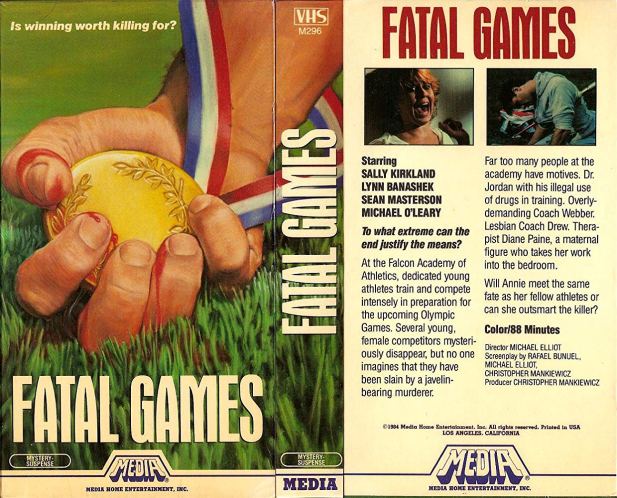
The Killing Touch. Olympic Nightmare. These are both great names, but they want with Fatal Games. If you watch this movie and think, is this Graduation Day, good news. You are not alone. Amazingly, this movie — a slasher from the late era of the genre — has never been released on DVD or blu ray. Give it time — everything is getting rediscovered these days.
The seven member gymnastics team of the Falcon Academy of Athletics could make the nationals, but there’s someone wearing a black tracksuit that is killing everyone with a javelin.
This movie has plenty of interesting folks — Sean Masterson (who wrote for nearly every show Drew Carey has worked on), Michael O’Leary (Dr. Rick Bauer on Guiding Light), stuntwoman Spice Williams-Crosby, Sally Kirkland (who was nominated for the Best Actress Oscar and won the Best Actress Golden Globe for Anna) and short moments of Brinke Stevens and Linnea Quigley.
It was created by two children of famous people. Writer Christopher Mankiewicz is the son of writer/director Joseph L. Mankiewicz and actress Rose Stradner. And Rafael Bunuel is the son of Luis Bunuel. Yes, the sons of the men who created All About Eve and Un Chien Andalou came together to create a slasher that has all of the acting power of a porn without the payoff of hardcore sex.
Also, if you recognize the setting, it was also the same high school used for Jawbreaker, Los Angeles’ University High School.
Mark Rosman started his directing career with The House On Sorority Row before working with Hillary Duff on Lizzie McGuire and directing two of her films, A Cinderella Story and The Perfect Man. He was the original director of this film, before his vision clashed with producer Edward L. Montoro.
Yes, Edward L. Montoro, the man behind Film Ventures International, the same guy who brought you movies like Grizzlyand Day of the Animals before taking a million dollars out of the company and disappearing forever.
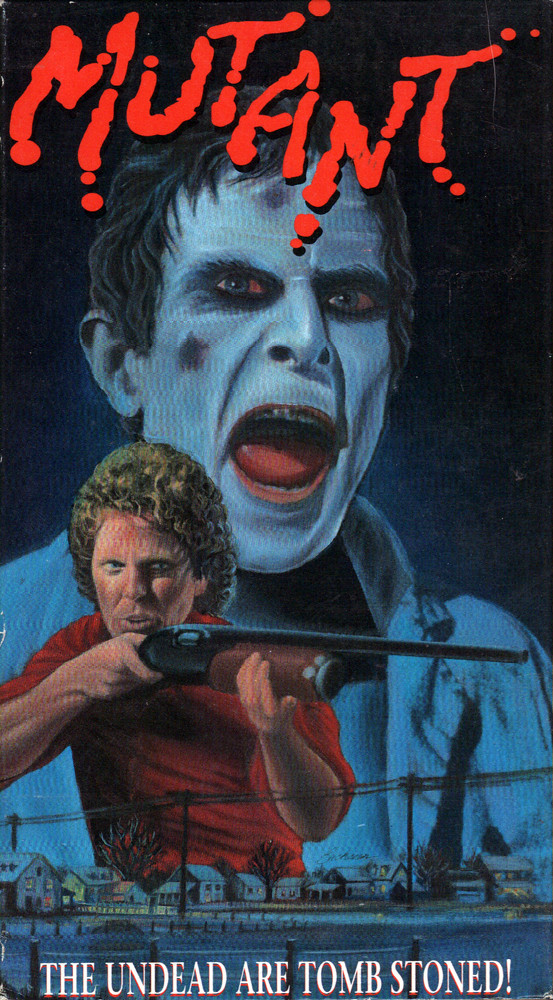
Mutant is one of the reasons why Film Ventures International was failing, which is why Montiro bounced forever. No one even knows if he’s still alive.
Taking over the directing duties of this film would be John “Bud” Cardos, who broke in to Hollywood as a result of his father and uncle managing the Graumann’s Egyptian and Chinese theaters. He started as a child actor in Hal Roach’s 1940’s Our Gang shorts, was a rodeo rider and a bird handler on The Birds before he began appearing in biker and exploitation films like Hells Angels on Wheels, Psych-Out and Satan’s Sadists before directing his own films like Kingdom of the Spiders, The Day Time Ended and The Dark. Ironically, he was also a last-minute replacement on that movie, taking over for Tobe Hooper.
He’s kept working in Hollywood, even appearing in credits as a driver on films like Memento. You can see him in the recently reviewed Danger God.
When brothers Josh (Wings Hauser, looking and acting bonkers throughout) and Mike (Lee Montgomery, the full-grown star of Ben who is also in the made-for-TV blast The Midnight Hour) are run off the road by local rednecks — it’s Josh’s fault — and forced to spend the night in a small town.
Bo Hopkins — who has been in so much of our redneck favorites like White Lightning and What Comes Around, where he played lookalike Jerry Reed’s brother — plays the local sheriff.
Cary Guffey, the child actor from Close Encounters of the Third Kind, is also here, but unlike most movies that keep the kids safe, Mutant truly does not care. The scene where he’s taken over by mutated children is pretty harrowing and I’m glad I saw it as an adult.
Jennifer Warren, who played the wife of Paul Newman in Slap Shot, gets a special appearance credit. Man, Mutant looks like such a stain on her resume, considering other films she was in like Sam’s Song and Ice Castles.
Somehow, this movie has a score that was recorded by the National Philharmonic Orchestra. It was composed by Richard Band, the brother of Charles Band.
It’s pretty interesting to me that the fortunes of Montoro’s company rested on this film, which is probably why directors were replaced and the title was changed from Night Shadows.
To be perfectly blunt, this movie is a mess. It never even gets its footing before it starts killing off characters left and right, unsure if it wants to be a redneck movie or a zombie film. That’s OK. I kind of like it just the same.
You can watch this movie on Amazon Prime and Tubi, if you don’t have the PURE TERROR box set. There’s also a Code Red blu ray that you can get from Ronin Flix.
ABOUT THE AUTHOR: Roger Braden runs the Facebook group Valley Nightmares, which is all about the history of the films that played at the drive-ins and theaters in his home state of Kentucky. He’s a great guy and I’m excited to read his take on this movie.
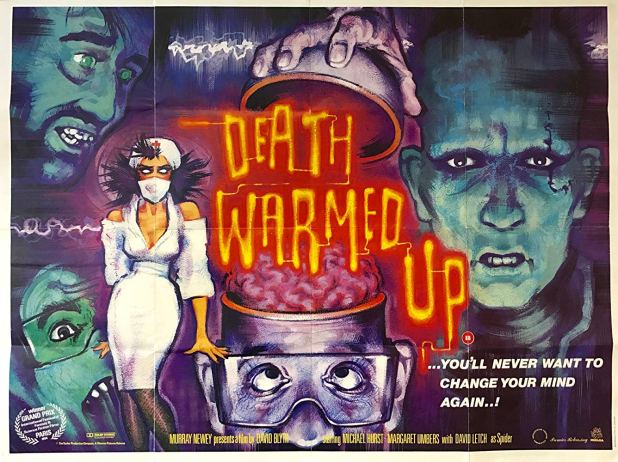
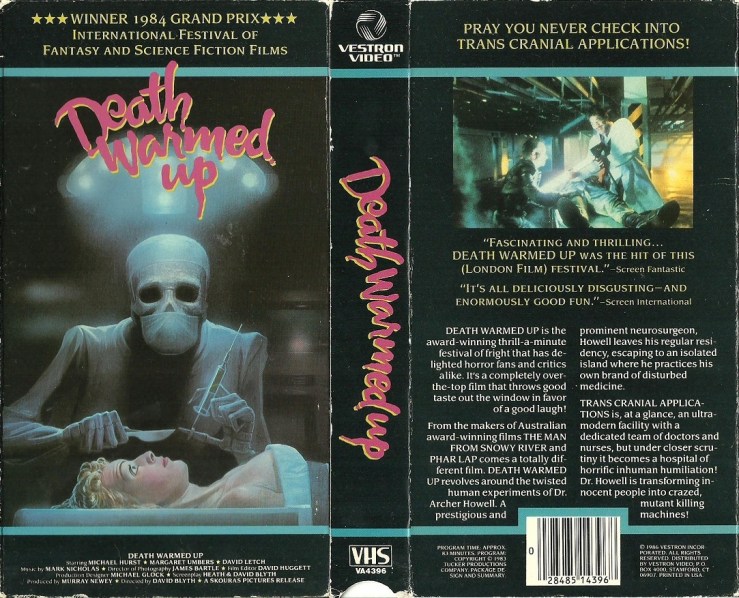
Also known as Death Warmed Over and Robot Maniac, New Zealand’s first splatter film pre-dates Peter Jacksons Bad Taste by 3 years, and was quite the shocker when first unleashed to theaters and later on VHS.
A group of friends and myself would have a movie night every weekend during the 1980s VHS rental boom, usually at my friend Marty’s place. The dude had a killer “Great Room” with a huge projection TV and quadraphonic sound system. Just bring something to watch, your own beer, snacks and smoke and the night was set. We watched everything, but I could always be counted on for bringing some obscure Horror flick that nobody had heard of, many thanks to Fangoria magazine for the knowledge.
One of those nights I brought over Death Warmed Up. The reaction from my friends that night are still vivid, and for me, hilarious. They were shocked, grossed out and had no idea what was going on. After muliple recent viewings I’d tell those friends today (and you), it still shocks and is gorily gross. And you’re still not going to have any idea of just what the fuck is going on while watching it.
The movie opens with some brain surgery being performed, and we’re talking drilling through the skull first just to get to the brain! We meet our hero Michael, whose dad is a research scientist with a Dr. Archer Howell, the two doctors that are doing the brain surgery. Seems Howell wants all the credit for what the two doctors are working on, so he brainwashes Michael into blasting his parents to death with a shotgun, then Michael is thrown into the looey bin. This is in the first 10 minutes of the film. We flash forward 7 years. Michael, formely dark haired and now sporting a blonde Rutger Hauer look is getting released, and his girlfriend, best friend and his girl pick him up so they can go vacation to the island that Dr. Howell has set up as his research facility (yes Michael knows where he’s going, he’s out for revenge!). On the ferry to the island we meet “Spider” and his partner, two of the facility workers, who clash immediately with our vacationing friends.
It only gets more bat shit crazy from here, and it’s fantastic. Our friends go exploring and discover a massive tunnel system under the island linked to Dr Howell’s facility patrolled by Spider and coworkers on their motorbikes. Howell’s patient’s brains start exploding, gun battles, squirting bloody violence, more brain surgery with wet walnut looking tumors discovered, mutants released from the bowels of the island to run amok destroying everything in their path, and an act of revenge that is not the best course of action.
I’m hoping this is enough to convince you to watch this film for the first time or the 100th. Remember Spider’s words
Thanks for having me in the Mill Creek Pure Terror series at bandsaboutmovies.com.
Day 16 Rock ‘n’ Roll Miscreants: Give some screen time to the punks and/or metal heads(and Roger Wilson gave us a two-fer: for it’s all about the watch options)
Confessions of a Fan
Ask any male teenager haunting the racks of video stores in the ‘80s who their two favorite actresses were—this writer included—and the answer inevitably comes back: Diane Franklin and Jill Schoelen. No matter how good or bad the movie: you saw either of their names on the box, you rented the flick.
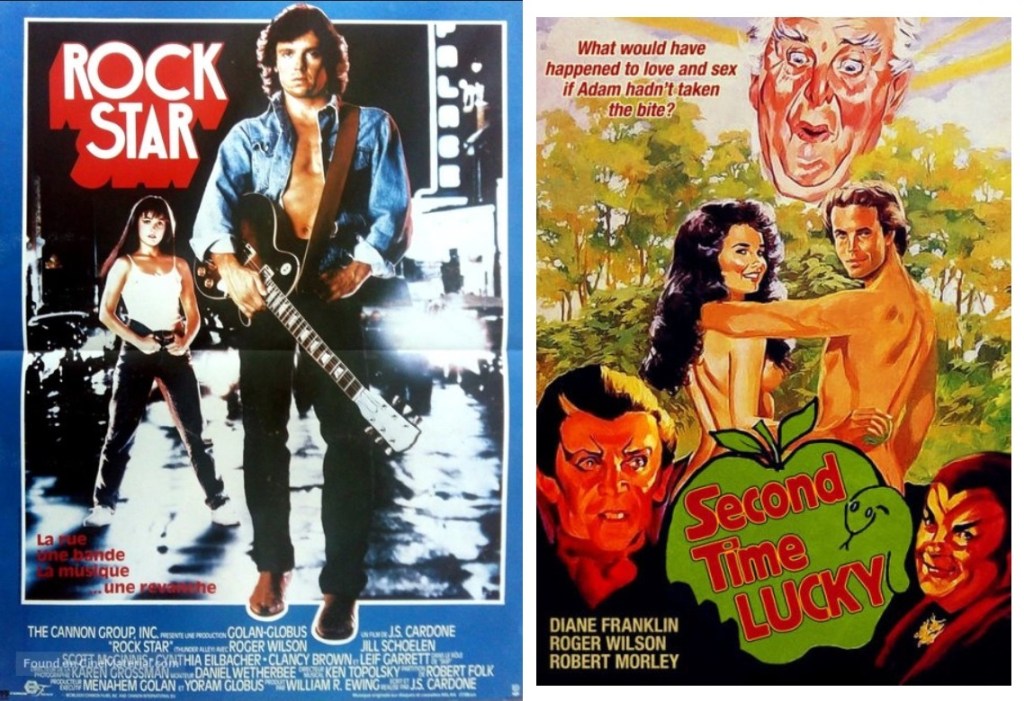
And the subject of this Scarecrow Challenge review, Roger Wilson, hit casting gold by being cast with both of them in Thunder Alley and Second Time Lucky. It’s been many, many years Roger, and we, the now low testosterone, hair-thinned curmudgeons of the VHS and vinyl epoch, continue to worship you in a Wayne Campbell and Garth Algar-tribute. We bow to you before the altar of the stage of The Palace, the faux-Phoenix, Arizona, rock club where you showed the world your rock ‘n’ roll “balbricks.” You are worthy, for you rawketh our analog, teenaged memories.
The overseas theatrical-versions of Thunder Alley and Second Time Lucky.
Roger Wilson: A Life on Record and Film
Born in New Orleans, on October 8, 1956, actor Wilson came to notice at the age of 25 in his first starring role as “Mickey” in the hugely successful Animal House-inspired comedies Porky’s (1981) and Porky’s II: The Next Day (1983).
As with Lane Caudell (with his own rock flick, Hanging on a Star), Kim Milford (with his rock flick, Song of the Succubus), and Rick Springfield (a rock star in the bomb Hard to Hold) before him, Wilson was an aspiring and accomplished rock ‘n’ roller who fronted a band called Num for several years. It was through his acting endeavors that Wilson was able to get two of his written/performed songs, “This Time” and “Radioactive Tears,” on the soundtrack for the obscure and rare New Zealand-shot Second Time Lucky (1984), an “Adam and Eve” rock musical-comedy in which he co-starred with our teenaged dream queen—Diane Franklin. Then writer-director J.S Cardone gave Roger’s musical skills a spotlight in Thunder Alley, which co-starred the soon-to-be girlfriend of Brad Pitt: Jill Schoelen. (Pitt and Schoelen became engaged after meeting on the set of a pre-stardom Pitt flick, the 1989 slasher romp, Cutting Class. The story of how Jill and Brad split before getting married is epic.)
A reformed rock ‘n’ roller who spent several years touring with rock bands in the early ‘70s, Cardone made a huge splash on the burgeoning home video market with his debut film, the 1982 slasher “video nasty” The Slayer—a film so “nasty” that it was banned from distribution in the land that loves-to-ban anything entertaining: the United Kingdom (see it on B&S Movies Exploring: Video Nasties Section 2 List). Cardone then hit his career peak in the early ‘90s through his association with Charles Band’s Full Moon Pictures. For us reformed teen denizens stumbling through our twenties in the pre-dawn years of the grunge era, we rented everything with a Full Moon logo on it—and with J.S Cardone’s name front and center on Shadowzone and Crash and Burn (both 1990), it was a no brainer: there was entertainment to be had.
After Cardone made a bloody splash in the post-Halloween slasher market and proved he could turn out economical, quality product, he was able to secure financing for his second film—a personal pet-project that drew from his early ‘70s band experiences.
So, in the glut of rock ‘n’ roll films permeating the cable transmission waves and video store shelves, with the likes of such rock ‘n’ roll classics as Eddie & the Cruisers (1980), Ladies and Gentleman: The Fabulous Stains (1981) and Streets of Fire (1984) (a “punk rock” Diane Lane two-fer?!), and Scenes from the Goldmine (1987; Catherine Mary Stewart from Night of the Comet!), there was Cardone’s 1985 rock ‘n’ roll love letter: Thunder Alley. And he cast Roger Wilson as; it seems, to be the onscreen pseudo-version of his younger Cardone-rock ‘n’ roll self.
Sadly, there’s no DVD version of Thunder Alley with an audio commentary to learn the backstory of Cardone’s hungry rock ‘n’ roll years. This writer ventures that Cardone made connections during those times and knew Surgical Steel’s Jim Keeler and Jeff Martin, Canadian hitmaker Gary O’Conner, and Shooting Star’s Gary West and Van McLain—and brought them onto the project to craft the music for the film’s faux band fronted by Roger Wilson: Magic.
Phoenix, Arizona’s Surgical Steel—where the film was shot (using some of the same locations as The Wraith and Harley Davidson and the Marlboro Man)—appear in the film as themselves, as the “biggest band in town” and Magic’s main competition. In real life, they were; but as with their critically acclaimed, hometown brethren, Icon, a Quiet Riot rise-to-stardom wasn’t meant to be for the ‘Steel. The film spotlighted their songs “Surrender” and “Gimme Back My Heart.”
In addition to casting Roger Wilson, Cardone provided ex-bubblegum teen-idol Leif Garrett with his first gritty “adult” roll as the egotistical-insecure “Skip” (we wonder who Cardone’s “model” was). Garrett not only turns in a wonderful performance as an actor—but does a stellar job on lead vocals singing “Do You Feel Alright,” which previously appear on Shooting Star’s third album, III Wishes (July 1982). Other songs expertly done by Garrett (take the overly critical bubblegum out of your ears, Garrett really can sing) are “Just Another Pretty Boy,” written by Gary O’Connor (who provided “Back Where You Belong” to 38 Special), and “Danger, Danger” by Frankie Miller (revered British singer from Jude with Robin Trower).
However, the real star of this show was Roger Wilson. Although Roger is an accomplished guitarist in his own right, and proves those skills with his spot-on playing, he’s actually doubled by Scott Shelly—one of Shelly’s most prominent students was Quiet Riot and Ozzy Osbourne’s Randy Rhoads. There’s no doubt Cardone believed in Roger; to promote Wilson’s career, Cardone released a promotional 7” 45-rpm that was given away in record stores and movie theatres. It seemed Wilson’s dream to make it as a musician was happening.
A Falling Star
Then as quickly as his star rose, it came crashing down in a blaze of thunder, oddly enough, in an alley.
The story starts with Academy Award-winning actor Leonardo DiCaprio when, fresh from his breakout roll in Titanic, partied with friends in the “Wolf Pack,” which is alleged to be a post-stardom euphemism for the group’s original, more nasty (and allegedly a press-generated) moniker of “The Pussy Posse.” The wolf-posse included an HBO-esque Entourage that included magician David Blaine and actors Kevin Connolly (ironically, later a star of Entourage; directed the John Travolta box-office bomb, Gotti), Jay Ferguson (“Stan Rizzo” of Mad Men), actor Lukas Haas, writer/director Harmony Korine, Tobey Maguire of Spider-Man fame, screenwriter Josh Miller (“Tim” in River’s Edge), and Ethan Suplee (TV’s My Name is Earl). Regardless of how the actor-amalgamate referred to themselves: they were notorious for their allegedly misogynistic and rebel rousing behaviors on the “upscale” New York City club scene.
One of those “incidents” that led to the wolf-posse’s ill repute involved actress Elizabeth Berkley, known for her attempt to break away from her squeaky clean teen-idol image cultivated by Saturday morning TV’s Saved by the Bell with a starring role in a “grown up part” in the critically lambasted Showgirls.
According to multiple media reports, Berkley attended the premiere of DiCaprio’s latest film, The Man in the Iron Mask—and visited the film’s VIP area, which was in full party mode courtesy of the Wolf Pack. It’s alleged that through DiCaprio’s L.A publicist, Karen Tenser, Berkley was invited by the actor and Jay Ferguson to party at the club Elaine’s after the premiere. Berkley politely declined, as she was dating Roger Wilson at the time (other media reports say Roger was there at the club by Berkley’s side when the invite was made).
Not taking a “no” for an answer, Berkley alleged that is when the “harassment” started, with an incessant barrage of invites from Tenser and Ferguson for dinners and parties. Wilson, as any chivalrous boyfriend would, intervened on one of those phone calls from actor Jay Ferguson—this time inviting Berkley to party with the pack at New York’s ritzy Asia de Cuba. Ferguson’s incensed response to Wilson’s intrusion was to invite Wilson to the club for a showdown.
Wilson accepted. And the thunder was about the roll in the alley.
Upon arrival at the club, Wilson took Ferguson’s offer to “step outside.” It’s then alleged DiCaprio (who ironically starred in Gangs of New York) interjected, “let’s go kick ass,” and led his wolf-posse into a West Side Story-styled, street-alley rumble. At that point, the recollections are hazy: a member of the posse—allegedly Ferguson—punched Wilson in the throat and damaged his larynx. Of all the body parts to suffer a blow: not his head or face, stomach or back: his throat.
Wilson’s singing career was over.
The unchecked testosterone melee resulted in a Manhattan judge tossing out Wilson’s $45 million lawsuit in 2004 against DiCaprio and “two other men” for the assault. It was determined that DiCaprio not only didn’t throw a punch, he didn’t encourage the fight—and Wilson was cast as the “aggressor.”
After the May 4, 1998, assault, Wilson’s career floundered with a series of little-seen TV movies and haphazardly distributed direct-to-video releases. Another TV series in the wake of Seven Brides for Seven Brothers wasn’t forthcoming. Meanwhile, DiCaprio moved up to the A-List and worked with Martin Scorsese.
Wilson, however, remained in the business behind the scenes. He moved into screenwriting, doing numerous uncredited rewrites (like the highly respected Carrie Fisher of Star Wars) for projects supervised by producer Steve Tisch (who produced Risky Business and Forrest Gump), Penny Marshall, and actress Sharon Stone. After teaching screenwriting at the college level, Roger Wilson forged a career in real estate development, which he still pursues today.
The bottom line, Roger: We love your work then and will love your work now. So clear out the vaults and upload your old material (especially from the hard-to-find Second Time Lucky)—and newer tunes—to a Spotify account for all of us Roger Wilson and Thunder Alley fans to enjoy. For in our analog-beating hearts sustained on digital life support, you are still a rock star. We want to rock with you again. You, my friend, are worthy to rock Thunder Alley.
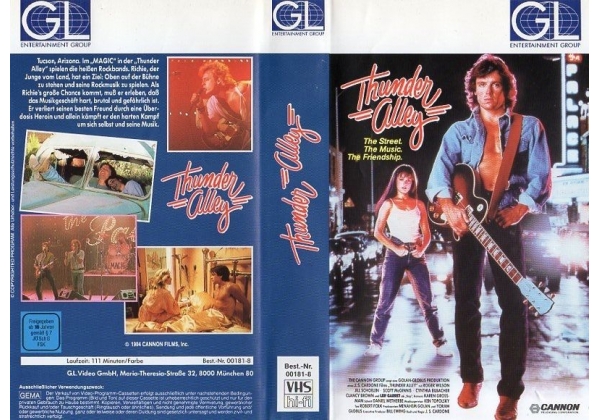
Overseas “Big Box” VHS Sleeve.
More Roger Wilson?
A “Music of Roger Wilson and Thunder Alley” YouTube Playlist features the studio and video versions of all the songs from Thunder Alley with Roger Wilson and Leif Garrett, along with music by Gary O (and 38 Special), Frankie Miller (and Nazareth), Surgical Steel and Shooting Star. The playlist also includes the trailers and full films for Second Time Lucky and Thunder Alley.
Update, May 18, 2021: We, unfortunately, didn’t delve into the Judas Priest connection sidebar to Thunder Alley, since this film review — and my previous Medium article — was all about showing Roger Wilson the love. But you know the connection now, courtesy of the fine folks at Global Web News for pinging back in our comments section (below) about this incredible article (published May 17) regarding Judas Priests’ Rob Halford’s connection to Phoenix, Arizona’s Surgical Steel — written by Cherry Bomb in the digital pages of Metal Injection.
So there you go! All the Roger Wilson and Surgical Steel ephemera you can handle, and then some.
About the Author: You can read the music and film reviews of R.D Francis on Medium and learn about his work on Facebook. He also writes for B&S Movies.



 B&S About Movies
You must be logged in to post a comment.