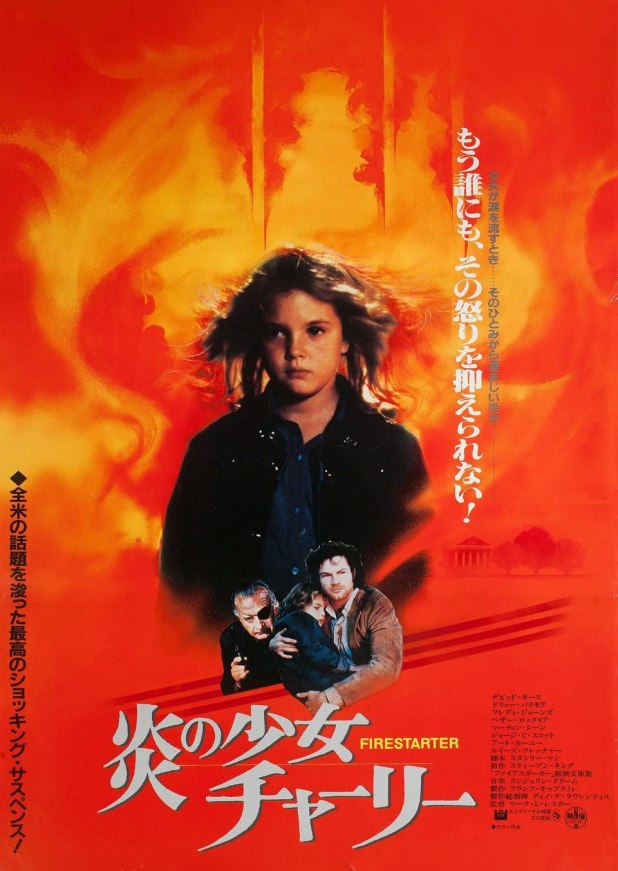
If you live in the world of Stephen King and meet Martin Sheen, run the other way. He’s never a positive person. That’s the life lesson that Firestarter has taught me.
During the filming of The Thing, Universal offered this movie to John Carpenter, but when that failed — you know that story — they gave it to Mark Lester. Did it work? Well, King told American Film that the movie was “flavorless; it’s like cafeteria mashed potatoes.”
When Andy (David Keith) and Vicky (Heather Locklear) were in college, they earned extra cash by getting dosed with LOT-6, a drug that gave him the ability to take over minds and her the talent of reading people’s thoughts. Once they had Charlie (Drew Barrymore), she could see into the near future and start fires with a thought.
Of course, The Shop created her and they want her back. Everyone in this government group is horrible, from Sheen to John Rainbird (George C. Scott), who comes off as a grandfather but is the worst of them all.
Tangerine Dream composed the music for this film and if you’re wondering, “How does the crew at B&S About Movies feel about Tangerine Dream?” the answer is, “We did an entire week of their movies and you can read about it here.”
They composed the music without ever seeing the movie. They sent no directions to Lester, only a note that said “use the music wherever you like, it fits wherever you want it to.” As he was editing it into the movie, he was shocked. Their music really did fit anywhere he placed it.
Another question you may ask is, “Didn’t Stranger Things pretty much rip off most of this?” The answer would be, “Well, they ripped off a lot of things.” When they eventually remake this, I can’t wait for the hot take articles about how King ripped off Netflix.
Disproving my theory that Old Hollywood only wants to sacrifice you to Satan, the only nice people other than our heroine and her parents are the Manders, played by Art Carney and Louise Fletcher, who is much kinder here than she was in Flowers in the Attic.
While Charlie was modeled on King’s daughter Naomi, Barrymore feels that she was born to play this role, as she resembled the girl on the cover of the book. Barrymore said, “When I read it, I came into the kitchen where my mom was making dinner and said: “‘I’m the Firestarter. I’m Charlie McGee!” But she didn’t know what I was talking about.”
This was the first of many films that built the film industry in Wilmington, North Carolina. You should also look out for two versions of Michael Myers in this movie, both Dick Warlock and George P. Wilbur.
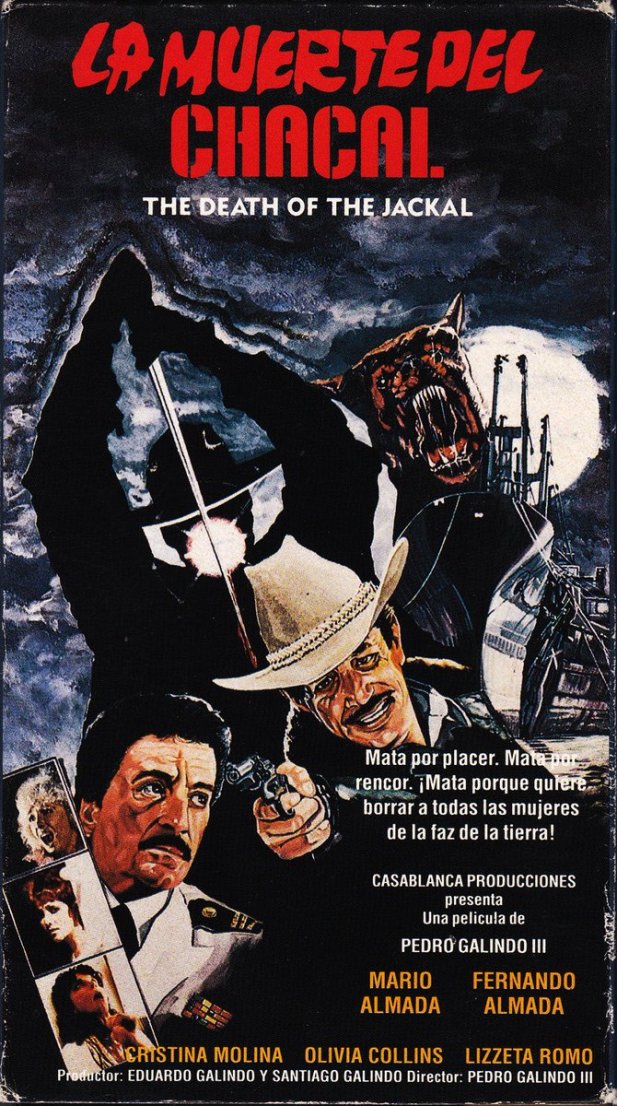
Mario and Fernando Almada are brothers that ended up in the same movie, with Mario as Sheriff Bob (BOB!) and Fernando as the equally epically titled Roy. They had another brother named Horacio who stayed home, far away from this movie that’s pretty much a cop movie that turns into a Mexican giallo. No puedo creerlo!
Speaking of family, this was directed by the father and grandson team of Pedro Galindo and Pedro Galindo III. The elder Pedro was an actor, producer and musician. His song “Malaguena Salerosa” is on the soundtracks for Kill Billand Once Upon a Time In Mexico. Meanwhile, Pedro III made the crowd pleasing Vacaciones del Terror 2 and Trampa Infernal.
Anyways, there’s a killer loose cane with a sword in it and a giant dog that helps him murder, paying back that mutt who used to talk to Berkowitz.
This has one of the best kills I’ve ever seen in an exploitation movie, where a dead man is thrown through a glass window and on to the stage of a strip club, where his lifeless form collides with a fully nude dancer.
A movie that skirts the edge between slasher and giallo, which is a thin one when you think about it hard enough. This is dark and scummy, which is pretty much exactly what you’d hope it would be.
There’s also a sequel, Massacre In Rio Grande, that I’ve been trying to hunt down. If you can find it, let me know. I’ll be your mejor amigo!
Supposedly a remake of a 1940 film, this shot on video oddity is all about, well, a mad monk who claims to be Satan but is closer to the Crypt Keeper. He introduces us to two tales, one of which is about a priest who falls in love with an attractive women in his congregation and ends up knocking her out a window, leading to his crucifix being cursed. Then there’s the story of a couple who uses a magical object and all of the wishes go wrong, as if they were in, oh let’s say The Monkey’s Paw.
All of this effort came from Julio Aldama, who not only directed and starred in this movie, but got his whole family to be part of it. You may think that time with the family is valuable and worthwhile, but did your dad ever ask you to be part of a movie where a horny priest accidentally murders someone he was trying to sexually assault? Nope. I don’t think your dad ever did that.
Obviously, I will watch any movie ever, but man. Once I saw the goofy eye of the Cripta-esque teller of these two tales, I almost checked out. However, I am a brave man and consider you, the reader of this site, special. So I toughed it out for you.
Actually, I did some more research, feeling that this wasn’t enough, and learned that The Mad Monk was a radio series in the 1930’s that started with the monk saying the words, “No one knows, no one knew, the truth about the terrifying case of…”
There were comics of The Mad Monk as well and from the looks of things, they feel very EC Comics inspired, but of course taken to the typical Mexican extreme.
El Monje Loco also appears in a series of memes, too. Who knew?
Poison for the Fairies was directed by Carlos Enrique Taboada, who wrote the Nostradamus series of vampire movies and also directed Even the Wind Is Afraid, Blacker than the Night and The Book of Stone. This film earned him two Ariel Awards, which are the Mexican equivalent of the Oscar, for Best Picture and Best Director.
If you’re a fan of young girls dabbling in witchcraft — and I think by now the movies that I talk about proves that this genre is beloved here — then get ready.
Veronica is an orphan that lives in a crumbling house with her near-dead grandmother and a nanny who has told her all about the power of witchcraft. Any other child would be afraid. Our heroine uses these stories to protect herself against the bullies of her school.
She finally gains a friend in Flavia, a wealthy girl who was raised to be an atheist. Veronica keeps bragging that she’s an actual witch and the cause of so much of the bad luck that this small Mexican village has been suffering through. Within days, Flavia is so afraid of Veronica that she will do anything she asks, even giving her some of her most prized possessions and obeying her every whim, even taking her on vacation with her family.
As they spend time in the country, Veronica says that she plans on making poison for the fairies, the natural enemies of las brujas. Flavia, pushed to the point of mania, locks the girl in a barn and watches it burn, ridding the world of witchcraft or, at least, one young girl who pushed her to the brink of madness.
I’ve never seen a movie quite like this. I’d say that it fits into the realm of folk horror, ala The Blood on Satan’s Claw, but filtered through Mexico’s unique co-existence of a magical realm and a very real Catholic world. The barn closing also reminds me of another film that is somewhat forgotten, The Other. Malevolent children in both of these films also learn to harness forces — perhaps more real in these examples than Veneno Para las Hadas — that they ultimately cannot truly ever hope to understand.
Hey, wait a minute? They stole the artwork from Rocktober Blood! Bogus!
Nope, this isn’t the case of Top Line, Hands of Steel, and Cy Warrior — three different movies — all using the same artwork, because . . .
This is still the Rocktober Blood you know and love . . . just with a slap of the ol’ Dutch Boy “Giallo Yellow” for its Italian theatrical and home video distribution.
Forget the fact that there’s no mention of “seven notes” in the film, or “seven” of anything. No seven keys or locks to solve a bloody noir mystery. And that Head Mistress only had six members and a lot more than seven people died. And there were no insects, or animals, or velvet, or scorpions, or cats, rats, or bats. But there were “eyes,” per se.
But why was Billy Harper nicknamed “eye” in film? Did he remove or collect eyes? Nope. Why not redub the film as Seven Eyes of Terror/Sette occhi di terror. Or Seven Bloody Irises/sette sanguinose iridi?
Yes, I am well aware there’s seven notes in a scale. But there’s also twelve notes in an octave. Why not redub the film Ottava di terror. Or Terrore in 12 note. And it wasn’t Billy, it was John who did the killings, so why not title it Gemello della morte?
Dude, this is Spine all over again. Your overthinking films is annoying.
Yeah, I know. And yeah, I know we know we go and on about this metalsploitation classic — three times, in fact, as Sam(review) and myself (review) both chronicled the exploits of Billy Eye Harper. We even reviewed the never-made sequel, Rocktober Blood 2: Billy’s Revenge. Then we waxed over it again, as part of our “Drive-In Friday: Heavy Metal Horror Night” featurette. Then we named dropped it again in our review of AC/DC: Let There Be Rock.
Huh? What does this all have to do with AC/DC?
Oh, you didn’t know that Billy Eye Harper, aka actor Trey Loren, aka Tracy Sebastian, is responsible for helping break the Aussie rockers in America? True story. So, while Billy Eye duped us all with bogus, grey market-level DVD and Blu reissues and a bogus Rocktober Blood sequel, he did his part in unleashing AC/DC in America and, for that, we thank him. And forgive him.
Best part of the movie and only reason to watch #1 . . .
Of course, thedirect-to-video “boobs and blades” shenanigans cooked up Ferd and Beverly Sebastian in California — while beloved by us, the once wee denizens of the ‘80s video fringe — is no “homage” to the likes of the masterworks of Dario Argento, Lucio Fulci, Emilio Paolo Miraglia, Umberto Lenzi, and Antonio Margheriti by any stretch of all the colors of the dark. And let’s face it: Billy Eye ain’t no Jason Vorhees or Freddie Kruger, either.
Ah, but the “New Wave of British Heavy Metal” (NWOBHM), featuring the violent, religious mania and bloody lyrics composed by the likes of Venom and Iron Maiden, complete with the requisite Satanic imagery on the album covers, was in full swing. And the dumbed-down American Slasher-cum-giallo-ripoff flicks colliding with heavy metal was the next logical match made in hell, as the music coming out of England was, in fact, Giallo musicals . . . but we ended up calling it “metalsploitation” here in the critically puritanical states.
Best part of the movie and only reason to watch #2 . . .
And let’s not forget where that musical sub-genre’s roots began: Dario Argento was the first to mix the hard rock peanut butter into the chocolate giallo with 1971’s Four Flies on Grey Velvet, which follows a musician (Michael Brandon of FM) that gets tangled in a murderous web. And how can we forget the late-in-the-giallo cycle Paganini Horror, with Luigi Cozzi’s Bon Jovi wannabes unleashing a curse from an ancient composition? And that Argento cranks up the Goblin to make our ear drums pulse in fear?
But before those films, there was Brian DePalma’s tribute to the likes of Alice Cooper and Kiss in the frames of his 1975 rock opera, Phantom of the Paradise. And there’s no denying that the exploits of Winslow “The Phantom” Leech and Gerrit “Beef” Graham influenced the frames of Black Roses, Shock ’em Dead, Terror on Tour, Rock ’n’ Roll Nightmare, and Rock ’n’ Roll Zombies, and Trick or Treat, along with the non-classic Turbulence 3: Heavy Metal, in which a reviled Marilyn Manson-like gothstar becomes an international hero after saving a jet liner from a terrorist takeover (a film that needed a whole lotta Ray Liotta and maybe a little Danzig). Then there’s Don Kirshner’s rip on DePalma with his ABC-TV “Movie of the Week” two-fer with Song of the Succubus and its sequel, Rock-a-Die, Baby.
Ah, yes. Satan’s music is still bloodying up our films. And we hail our Dark Lord . . . to the tune of seven red notes. Let the Acid Witch bless your soul!
We dig into the failed attempt at getting a sequel off the ground. True story, for reals!
Ferd Sebastian July 25, 1933 — March 27, 2022 Obituary
About the Author: You can read the music and film reviews of R.D Francis on Medium and learn more about his work on Facebook.He also writes forB&S About Movies.
Nothing Lasts Forever has never been released theatrically or even on VHS, DVD or blu ray — hell, it isn’t even streaming — in the United States. The closest anyone ever came to seeing it was when a fan uploaded a copy to YouTube, which was up for moments before Turner Entertainment demanded it be removed. Ever since, it has aired only at live screenings and rarely on the TCM Underground late night movies on Turner Classic Movies.
Good luck finding it.
The writer and director of Nothing Lasts Forever, Tom Schiller, is perhaps most famous for the short films he made for Saturday Night Live. Perhaps the best-known one is Don’t Look Back in Anger, a tale where a much-older John Belushi dances on the graves of all of the other Not Ready for Prime Time Players. Even in art, Belushi knew that he would pass away before them all, so this sketch is at once hilarious and heartbreaking. Another of his films, Love Is a Dream, featured the gone too soon Phil Hartman and Jan Hooks, and is equally depressing yet full of optimism.
Yes, the work of Schiller is often a juxtaposition. Much like this film, which tries to be a crowd-pleasing 1940’s mainstream film made in 1984 for audiences that probably wanted nothing to do with it.
Adam Beckett (Zach Galligan) starts the film in a dream, forced to sit behind a player piano and miming through songs before he is caught. As he awakes, he is asked what he wants to be.
Surely, he could be an artist. But the Port Authority has assumed control of New York City and forces him into manual labor, led by Buck Heller (Dan Aykroyd), his probably mentally deranged boss.
However, he soon learns that the true power in the world lies in the hands of the tramps who huddle around open fires and live underground. As he has been kind to them, they help him travel to the moon on a bus driven by Ted Breughel (Bill Murray) where he will be inspired by his true love Eloy (Lauren Tom). Her name is a reference to the future people in The Time Machine.
We end where we began, with Beckett on stage playing the piano, yet now fulfilled and sure of himself.
Along the way, Eddie Fisher plays himself as an entertainer on that aforementioned bus to the moon, Imogene Coco shows up and Mort Sahl appears. Yes, this movie was made in 1984. It also features a cameo from Dr. Emanuel Bronner, the man who made the soap with all of the Bible verses and strange words all over the packaging. I knew who he was the instant he began to speak.
There are many lessons to be learned in this film, with dialogue like “You will get everything you want in your lifetime, only you won’t get it in the way you expect.” This is the kind of movie that makes me tear up when I think of it. I wish that it was easier to share, something that could be found, but perhaps the occult nature of it being lost adds to its power, its mystique.
Someday, it may be available on a Criterion blu ray or able to stream whenever you want to watch it. But in a world where everything is at our fingertips, it gives me some joy to know that not everything is so easy to touch.
What can I tell you about Ghostbusters that hasn’t already been said? That it was supposed to have Belushi and Eddie Murphy in it? That it was based on Dan Aykroyd’s father, who wrote the book A History of Ghosts? That the original script wasn’t a comedy?
We know all that. What we sometimes forget is that Ghostbusters does something astounding for a film. None of the main characters make the hero’s journey. None of them.
At the beginning and the end, Ray Stantz (Aykroyd) is still an incredibly smart but simple-minded scientist that at least had a ghost practice the fleshy clarinet for him. Egon Spengler (Harold Ramis) is still a super-smart geek, albeit one with a super-smart geek girl now (Annie Potts, who makes the most of her small role). Peter Venkman (Bill Murray) is still a smarmy con man, despite potentially winning the heart of the possessed Dana Barrett (Sigourney Weaver). And Winston Zeddemore (Ernie Hudson) barely gets a moment to show anything at all.
Nobody grows. Nobody changes. Nobody cares, really, because it’s all so loud and entertaining and filled with gorgeous practical effects and a montage heavy way of telling a very simple story.
Rick Moranis is firing on all gears here and so is William Atherton, who is the absolute king of all movie jerks. Just look at that list of actors — nobody here is slacking at all. This is top of the game casting and that’s what helps make this movie great. Hell, it even has Joe Franklin in it!
So here are a few facts you may not know, as everyone knows the plot:
The demonic voice of Dana/Zuul? That’s director Ivan Reitman.
Gozer was originally going to be played by Paul Ruebens.
For some reason, the video for Ray Parker Jr.’s theme features a bunch of celebrities that have absolutely nothing to do with this movie, including Chevy Chase, Irene Cara, John Candy, Melissa Gilbert, Jeffrey Tambor, George Wendt, Al Franken, Danny DeVito, Carly Simon, Teri Garr and Peter Falk.
Aykroyd originally foresaw the movie as a future story where Ghostbusters were as common as firefighters. The script, called Ghost Smashers, would have cost around $300 million in today’s money to make.
A more ferocious version of the Librarian Puppet was rejected, but it later turned up as Amy Peterson’s vampiric form in Fright Night.
Amazingly, this movie and Gremlins came out on the same day. Needless to say, 1984 was an amazing year for blockbusters.
There’s a deleted scene that has Murray show up as Carl Spackler from Caddyshack.
I never realized it, but Louis becomes the Keymaster after being locked out three different times in the film.
So there you go. If you haven’t seen this, honestly, what are you even doing reading a movie site?
So, did you hear the one about Police Commissioner Stewart “Mac” McMillan, Darth Vader, Mr. Miyagi, and a future Golden Globe winner who probably doesn’t want anyone to know she got her start in the biz with a role in Police Academy 4: Citizens on Patrol, and the ex-husband of Cloris Leachman (Mel Brooke’s Young Frankenstein and High Anxiety) walking into an NBC-TV gin joint?
Could the VHS sleeve be any cheaper?
Yes, today The Vegas Strip War is remembered as Rock Hudson’s last movie: he died less than a year later (remember when Rock went “sci-fi” with Embryo?). Ah, but we, the TV movie lovin’ dorks of B&S About Movies, remember this as the final film directed by Leachman’s ex and Jack Albertson’s nephew (Grandpa Joe in Willy Wonka and the Chocolate Factory), George Englund — who brought us the world’s first “electric western,” the 1971 counterculture classic (read: dud), Zachariah, starring, off all people: Joe Walsh of the Eagles (then with the James Gang), San Francisco hippy-rockers Country Joe and the Fish, and Don Johnson (A Boy and His Dog).
Englund, who was best buds with Marlon Brando, made his directing and producing debut with Brando as his star in the 1963 political adventure, The Ugly American, which he followed up with one of the lesser known, but well-made film noirs, 1965’s Signpost to Murder (written by Sally Benson of Alfred Hitchcock’s Shadow of a Doubt (1943) fame). After the critical and financial failure of (the previously linked) Zachariah, Englund’s career cooled, but the 1972 snow-based Italian crime caper, Snow Job, was a pretty darn cool UHF-TV movie favorite of yesteryear (not bad for starring an Italian Olympic skier who couldn’t act). Englund ended his career producing the series Blossom and The Golden Girls for NBC-TV and publishing the 2004 memoir about his friendship with Brandon: Marlon Brando: The Way It’s Never Been Done Before.
Ah, I see what you’re doing, there, Mr. Distributor.
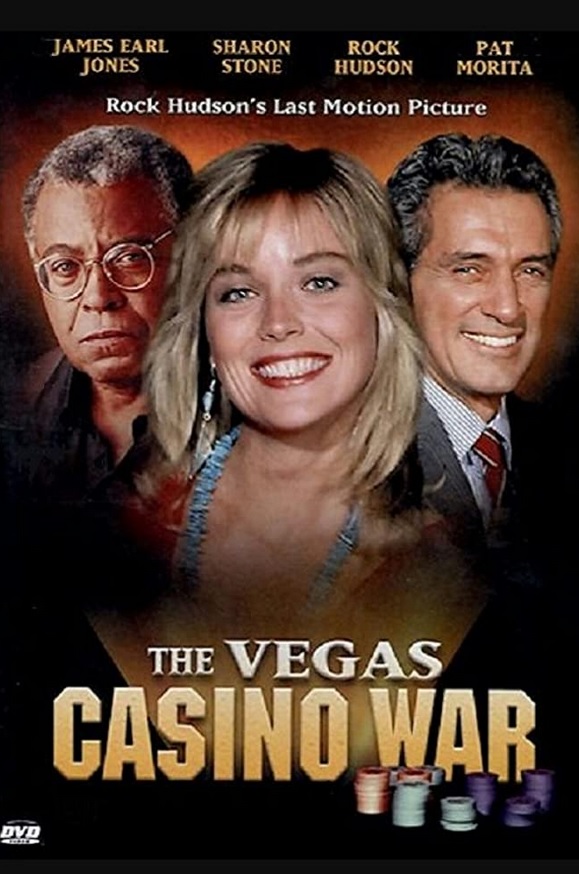
The Vegas Strip War is another one of those films that, even thought it was released on VHS, is hard to find. And it would have been lost forever if not for Martin Scorsese’s back-to-back box-office hits Goodfellas(1990) and Casino(1995). And as you can tell from the original VHS and its DVD reboot, Sharon Stone’s supporting role, which wasn’t even mentioned on the VHS, is front and center on the DVD, which got a title change to tie it to the 1995 Scorsese film.
Rock is Neil Chaine, a character not far removed from Robert DeNiro’s Sam “Ace” Rothstein, who’s fired in a coup d’etat from The Desert Inn, the hotel-casino he operates. In an act of subtle revenge, Chaine purchases a decaying casino next door, The Tropicana, with the goal of crushing his old employer. Helping him along the way are Sarah (Sharon Stone), a casino hostess who uses her “connections” (i.e, she sidelines as a prostitute) to get Chaine a gambling license, and Jack Madrid, a sports promoter (no, that’s not Don King-meta, that’s James Earl Jones in a fright-wig doing Don King!) that’ll set up a prize-winning boxing match at the new hotel.
Of course, Madrid’s got other plans . . . and Chaine’s nefarious short cuts lead him to a stint on Alcatraz — and prison sex with Sharon Stone. Oh, I almost forgot about Pat Morita: He’s the offensively named Yip Tak (hey, it was the ’80s), a high rolling Chinese gambler from the Desert Inn days; he makes a deal with Chaine to bring rich Asian businessman to the Tropicana. Yep, it’s all a double cross as Tak and his friends bankrupt the casino in a gambling scam.
There’s no trailer, but you can watch this clip of the film’s opening credits. And if you like what you see, then you can watch a pretty clean rip of the full movie on You Tube.
Oh, yes! That spinning ITC logo is the same production company behind U.F.O., Space: 1999 and the Kirk Douglas Star Wars dropping, Saturn 3. And if you’ve been, or your parents have been to Vegas (and you saw the pictures), you’ll notice this was all shot on location inside the late-famed The Desert Inn and still standing (but totally revamped) The Tropicana. And after the failure of Saturn 3 and Raise the Titanic, ITC was on verge of bankruptcy and had no choice but to shoot-on-location-on-the-cheap (they went under shortly thereafter). Is this as great as the Scorsese flick? No, but for a TV movie production on a budget, George Englund delivered an entertaining mob flick.
About the Author: You can read the music and film reviews of R.D Francis on Medium and learn more about his work on Facebook. He also writes for B&S About Movies.
If you don’t think the world was a better place in 1980’s, let me tell you that it had both Hamburger: the Motion Picture and Hot Dog…The Movie come out. Perhaps these two cultural forces don’t matter to you. Well, then you’re part of the problem.
Between this and Youngblood, director Peter Markle pretty much laid claim to many an HBO time slot.
Patrick Houser is Harkin Banks, who has saved up all year to travel from Idaho to Squaw Valley to compete in the world freestyle skiing competition. Along the way, he picks up a teen runaway named Sunny (Tracy Smith, Bachelor Party) and joins the Rat Pack, a gang of goofball skiers led by Dan O’Callahan (David Naughton, An American Werewolf In London) and is tempted by Sylvia Fonda (1982 Playboy Playmate of the Year Shannon Tweed).
Of course, there’s the foreign menace, led by the Austrian superstar Rudi. By the end, everyone must battle in a Chinese Downhill to see who the best in the world really is.
Keep an eye out for Playboy Playmate of the Month for September 1971 Crystal Smith as the hotel clerk and Buddy Hackett’s son Sandy as a wet t-shirt contest host.
James Saito, who is Kendo and was the original Shredder in Teenage Mutant Ninja Turtles, fooled the entire cast and crew for three weeks, convincing them that he could speak Japanese. The world was very different — and perhaps way more racist — in 1984. Otherwise, it was much better than 2020.
You can get the unrated producer’s cut of this movie on blu ray directly from Synapse.
AUTHOR’S NOTE: This review was originally posted on June 19, 2019, back when I was lost in the throes of trying to watch every single Linda Blair movie in the same week. It fits perfectly into this week of Police Academy films. Now, I have to watch the other two Jackie Kong movies that I am missing.
If you learn anything today, know that Linda Blair and Murray Langston, AKA The Unknown Comic, made two movies together: the romantic comedy Up Your Alley and this film, which takes Police Academy to an even filthier and more ridiculous level. Seriously: there’s no way this movie could have been made in 2019.
Jackie Kong directed four movies: The Being, The Underachievers, Blood Diner and this one, all with Bill Osco. Osco started his career producing adult films and would go on to star in The Being under the name Rexx Coltrane before starting to direct his own projects, starting with the comedy special The Unknown Comedy Show, a vehicle for Langston. Seeing as how two of his directing efforts are The Art of Nude Bowling and Cat Fight Wrestling, you’ll get an idea of where this film is heading.
Officer Melvin White (Langston) wants to be a stand-up comic, so to hide from his boss Captain Lewis (Billy Barty!), he becomes The Unknown Comic. At the very same time, a man with a paper bag over his head — and here I am assuming anyone in 2019 knows who The Unknown Comic is or what he looks like — is committing crimes.
Linda Blair comes in as Officer Sue Perman, who operates the switchboard for the police. Then there’s comedian and perennial Presidential candidate Pat Paulsen as Melvin’s partner, Officer Kent Lane. Pat Morita also shows up as a sexual assault victim and there’s an ongoing joke with Sydney Lassick (Charlie from One Flew Over the Cuckoo’s Nest) as a peeping tom.
Jack Riley, who played Bob Newhart’s patient Elliot Carlin has graduated from patient to doctor, here playing Murray’s therapist Dr. Zieglar. Throw in comedians Johnny Dark, Bill Kirchenbauer and Vic Dunlop, as well as Jaye P. Morgan, disc jockey Machine Gun Kelly (who is also in Roller Boogie and Voyage of the Rock Aliens) and an incredibly young Andrew Dice Clay.
There really isn’t any story here, but you do get Billy Barty farting throughout the film and the heroes donning blackface to solve a crime. There’s also a gay copy team, so this movie goes out of its way to offend nearly everyone. That said, it does have Linda punching a really obnoxious rich girl, which makes the movie.







 B&S About Movies
You must be logged in to post a comment.