21. BARN HOWLS: There are strange things afoot at the farm. Bonus points if you see a pumpkin patch!
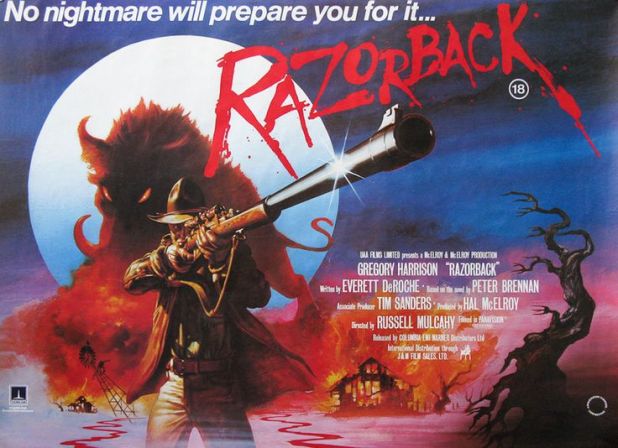
Between the cinematography of Dean Semler (The Road Warrior, Mad Max Beyond Thunderdome) and the lunatic vision of Russell Mulcahy (who was known for his music videos before making movies like this and Highlander; some of the videos he directed include “Video Killed the Radio Star” by The Buggles, “Vienna” by Ultravox and tons of Cultre Club and Duran Duran songs), Razorback looks better than any movie about a gigantic rampaging pig should.
But not just any pig. A giganic razorback that’s so maniacal that it eats its own young and now has the power to implicate men in the murder of their family. That kind of pig. Most of the film’s budget went to making six animatronic pigs that were used for different stunts, including a special boar made to attack cars.
As for real boars, they really are pretty tough. Can they be stabbed in the throat and keep going? I honestly don’t want to find out for myself. But hey — this is a Jaws on land film that even has “New Moon on Monday” show up on the soundtrack. And there are moments where the camerawork gets nearly psychedelic and you think, “Hey, is this art or a movie with a giant pig that eats people?”
Of the three stories within that film, The Nightmare Never Ends and this one were actually fully complete movies* that may be better in their chopped down form, but let me tell you, this movie is completely beyond insane for so many reasons that don’t make it into Night Train.
It’s also based on Erskine Caldwell’s book Gretta, but when I say loosely, I mean loosely.
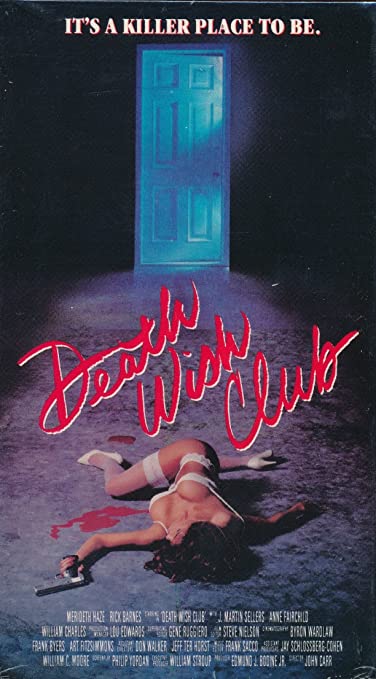
Pre-med student Glen Marshall falls for Gretta (Meridith Haze, who is great in this movie and I wished had done more than just this role) the first time that he sees her in an adult film. He starts to hunt her down, not knowing that she’s a woman kept by George Youngmeyer**, her Hollywood producer sugar daddy pimp husband after he bought her back when she was selling popcorn at the carnival.
Well, Glen gets her. She thinks that she’s a mermaid and won’t leave the bathtub, so Youngmeyer asks Glen to visit, make love to her in front of him and then he’s allowed to take her home.
But Glen gets more than he bargained for as Gretta is a sexual beast that is only happy when a man is making love to her. Otherwise, she’s selling your TV set, bringing in a piano and parading in front of your mother naked. She is not the kind of girl you take home as they used to say. She’s a fantasy woman for Glen but removed from the fantasy male gaze of pornography she remains the fantasy male gaze pornography object which is perfect in ten-minute onanistic blasts — pun intended — but potentially exhausting in real life.
Other than her sex addiction, Greta is only turned on by the adrenaline that comes from putting herself in near-death situations, along with a club of others who have survived death. This coterie has some real maniacs, including Federico Libuse, Contessa Pacelli and Prince Flubutu, who we are led to believe is Jimi Hendrix.
After surviving the deadly sting of a claymation Tanzanian winged beetle, Glen decides that no sex is worth all of this. He tries to get back with his normal former girl and back to his normal life but she tells him that there’s no way that he can ever be free from Gretta.
I mean, Youngmeyer did warn him that Gretta lives “in the fourth dimension.”
There’s a new problem, though. Gretta has overdosed and Youngmeyer takes him to her funeral. Lost, he makes his way back to the club where he first saw her playing piano and it turns out that Gretta is still there, but now she has become a he, the piano playing noir tough guy Charlie White. She hasn’t left the suicide club either, as now Glen has to survive a homemade electric chair and is forced at gunpoint to get in a sleeping bag and be in the path of a deadly multi-ton wrecking ball.
So can our protagonist get the man he’s in love with to be the woman he’s alternatively afraid of and sexually attracted to again? Will he have to break into her wedding The Graduate style and do some kung fu? Why is Gretta glad that Chopin is dead?
There’s even an ending that speaks to Yordan’s theories on love. Or whatever he saw it as.
Death Wish Club is an astounding piece of moviemaking. It’s very David Lynch without trying to be, which is the best kind of film, a movie that’s near occult-level weird because the people making it were all very damaged or just had no clue how humanity behaves because they came here from a parallel planet where this is how men meet women.
*Scream Your Head Off was unfinished, but later was put together as Marilyn Alive and Behind Bars and man, it’s crazy as it gets.
**I love the theory that The Bloody Pit of Horror advances that this character is pretty much writer Phillip Yordan, who may have never fallen out of love with Cat People actress Simone Simon and just treated the rest of his wives like Youngmeyer, who believes that “one-sided love is the only emotion.” Yordan was quoted as saying that he married his first three wives “…and supported them in a lifestyle none of them experienced before they met me. That’s all I had to offer.” For more about Yordan, check out our piece on another of his absolutely bonkers films, Savage Journey.
Jeffrey Obrow is a stellar screenwriter and director — who teaches at USC’s film school — who should be a horror household name, but alas. . . . He gave us the Daphne Zuniga Friday the 13th rip that is The Dorm That Dripped Blood (1982), which served as his feature film debut, the hag n’ trollsploitation two-fer starring Rod Steiger and Kim Hunter that is The Kindred (1987), the pretty cool Dean R. Koontz adaption of Servants of the Twilight (1991), and what I thought was a pretty decent take on Bram Stroker’s “Jewel of the Seven Stars” with Legend of the Mummy (1998). Each are highly recommended watches for your this year’s “30 days of Halloween” watch schedule.
Here, in his second film, a group of people come into possession of an ancient, Aztec clay doll. However, the doll is possessed by an evil spirit. . . .
Cry (low budget) havoc and let slip the (meh acting) mayhem by way of a class project as four high schoolers research the trinket — in a graveyard with a Ouija board, of course. Modeled after Destacatyl, a Mexican god, the idol was acquired by one the student’s parents from their own South of the Border excursion to learn of its myth. Jerry (Warren Lincoln, over and done after the 1986 pseudo-U.S. giallo, Torment) soon becomes obsessed with learning more about the idol . . . then becomes obsessed by the idol’s trapped spirit.
Let slip the stalking. . . .
Is the inanimate-objects-possessing-the-souls plot a bit derivative? Does the concept of possessed idols, which are knock offs of the ol’ “genie in a bottle” stories of yore, date back to the Hammer/Amicus drive-in ’50s and ’60s? Sure, but what movie in the John Carpenter and Sean S. Cunningham ’80s backwash, doesn’t?
However, thanks to Jeffrey Obrow — along with his usual partner, Stephen Carpenter — while the acting isn’t that great, the script is production-solid, the film is effectively spooky n’ atmospheric (with a truly shock-scaring arms-out-of-the-bed pisser), the film score does its job, the effects are low-budget but Fangoria gooey-goo great, and the ending has a decent didn’t-see-it-coming twist.
Sadly, The Doom That Dripped Blood, The Power, The Kindred, and Servants of the Twilight, while each are well-made, valiant efforts, they were not the box office bonanzas Jeffery Obrow and Stephen Carpenter hoped; each went their separate ways. All four are fine films. I wished they would have made more. . . .
Jeffrey Obrow, as result of his transition into academia, slowed down his career, but came back with the aforementioned Legend of the Mummy and three more horrors (not as effectively-distributed): They Are Among Us, The Perfect Host, and One by One; his latest, currently-in-production writing and directing effort, is the Molly Ringwald-starrer, Pursued (2022). If you like to know more about Jeffrey Obrow’s work, look for his August 1991 Fangoria* interview with Anthony C. Ferrante, “To Serve the Twilight,” in promotion of his Koontz adaption (sorry, no online scans; copies abound on eBay, however).
Stephen Carpenter eventually hit box office gold penning the Martin Lawrence action-comedy Blue Streak (1999) and the Samuel L. Jackson comedy, The Man (2005). Did you see Eliza Dushku in Soul Survivors (2001)? Well, that’s Stephen behind the Brother processors and Canon Reds. Then, between 2011 to 2017, he created and scripted the 123-episode run of Universal/NBC-TV’s Grimm.
And in production backstory twist: While Obrow and Carpenter co-penned and directed The Power, the initial concept and story draft was done by John Penney: he gave us the box office failure Zyzzyx Rd. (2006), a film that made a lousy $20 bucks in its brief theatrical run.
Oh, and one of our students, in her debut, is Suzy Stokey: she became a go-to actress for our beloved Fred Olin Ray (A Christmas Princess) in his films The Tomb, Star Slammer, and Deep Space.
There’s a serial killer called The Black Angel out there doing his or her thing. This movie is listed as an erotic thriller on Wikipedia, but that sounds like a giallo, but it’s slasher month and hey — this movie sat on shelves for years until Kevin Costner became a big name.
Rydell King is a cop with something to prove, because his daughter was kidnapped and killed several years ago, so the opportunity to deal out justice to another killer sounds like a dish he didn’t put in the air fryer. He gets the idea that a prostitute named Lee, who is totally living that Betsy Russell/Donna Wilkes life because she looks way too clean to be a girl working those rough streets, can lead him to the killer.
She then goes to her birthday party, which has a dude playing stand-up bass and a magician and we have another 80s movie that says, “See, being a hooker is totally fun and safe except for that one guy who wants to kill you.” And then Lee gets strangled while her boyfriend (Costner) doesn’t want to go swim naked with her. He claims its because he wants to watch the magic show, which is absolutely a lie because no one really likes magic, and more likely because every time he swims, The Mariner must drink his own urine.
In case you wonder when someone is going to die, it’s every time someone gets naked. And by someone, I mean women, because this movie is all about the male gaze as well as showing how pubic hair was styled in 1981. It’s also horrible. Yes, despite non-stop nudity, this movie still manages to be like overdosing on opiates and the sleep of death that results.
Actually, this might be a giallo because an obvious dummy gets thrown off a rooftop.
I’d never seen this until the Neon Brainiacs guys picked it one of our movies on the Drive-In Asylum Double Feature. Man — this is something.
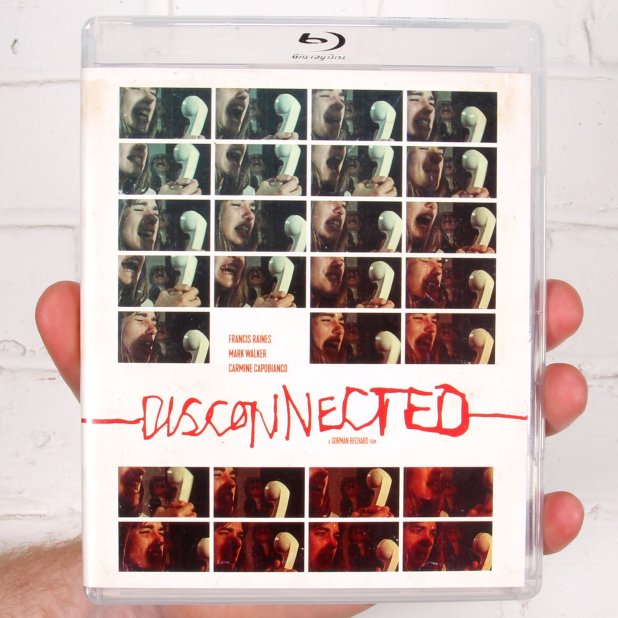
Directed by Gorman Bechard, this film centers around video store employee Alicia — if you love seeing classic VHS cases, this is assuredly a movie you should watch — who allows an old man into her home to use the phone and abruptly disappear. She tries to relate this story to her boyfriend Mike and her gorgeous twin sister Barbara Ann, who is definitely stealing Mike away from her. She’s also being pursued by a strange man named Franklin who comes to her store despite not having a VCR. And when she gets home from the bar that night, she starts a series of prank calls that either have strange voices at the end or have Mike and her sister discussing murdering her and the affair they are having behind her back.
At the same time, Detective Tremaglio is investigating a series of crimes and this section of the movie takes the form of what we’d call found footage these days, as we see the actual interrogations.
If you’ve just read those two paragraphs and thought, “Disconnected seems to make no sense,” trust me, it lives up to its name.
Alicia and Franklin begin a romance — at the same time that he’s murdering women and using their dead bodies for sexual pleasure — and then just when it seems like things are about to get resolved, the calls begin all over again, even after she destroys the phone, which starts bleeding. Then the old man leaves her apartment.
Shot in Waterbury, Connecticut and featuring a soundtrack with XTC, The Excerpts (the band Jon Brion started in), Haysi Fantayzee and Hunters & Collectors, there really isn’t a slasher — there isn’t a movie — like this. Of course, Vinegar Syndrome put it out. They made some kind of deal with several dark demons to have the inside track on the rights to forgotten VHS rental movies or something. They’re going to all lose their souls, but we get some great movies out of their dark deal.
Editor’s Note: We’re also discussing the writer and director’s earlier works Pandora (1984) and Dance Macabre (1986) within this review.
The original VHSs/courtesy of mattressparty/picuki.
Thanks to the digital realms, with horror fans willing to rip VHS tapes into DVD-rs for their retro-retail portals and video-sharing sites, the once-lost, extremely-hard-to-find resume of Wim Vink — which has all of the earmarks of the ’80s SOVs we adore at B&S About Movies (thus our joint “SOV” and upcoming “Video Nasties” tribute-review weeks) — is easier to discover.
Well, unless you live in the Netherlands, where these films were shot-on-film stocks and distributed exclusively on VHS tapes, independently, by Wim Vink.
Vink’s was an oeuvre you didn’t hear about during the height of the video ’80s in the U.S. You may have picked up on the films in some of the more, offbeat, pulpy underground mags n’ ragzines of the day; possibly you back-page ordered (Spine and Blood Cult) or back-page tape-traded a grey copy. However, we, the many, had their first exposures via the Internet, as horror aficionados began praising the work on blogs, genre message boards, and websites. Maybe, as I did with Pandora — my first exposure to and the only film of Vink’s I’ve seen pre-Internet — many years ago, you picked up a grey copy (along with the U.S. made but Japan-distributed Cards of Death) at your local comic book store.
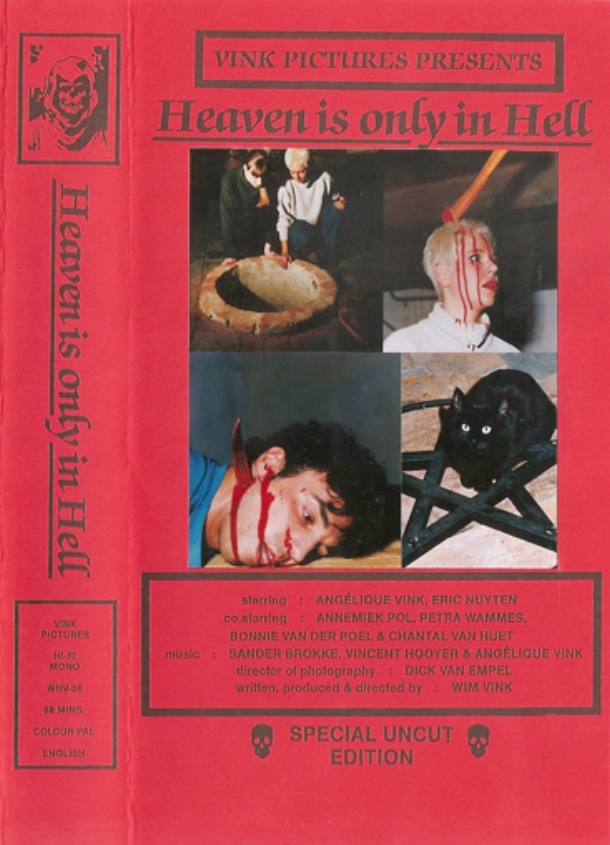
Vink’s works are intelligent films rife in scene details, but with very little dialog. They’re films that wear a Romero and Argento influence on their bloody sleeves, only with more of an art house film vibe. Some say the films are “boring and repetitive” — and more so with the only full-length film in the Vink catalog, Heaven is Only in Hell. However, that is the whole point of a Vink joint: the devil, if you will, is in the details: the mundane details. For the mundane is, in fact, our reality. Sure, a “good” or “professional” filmmaker knows how to edit out those moments for “narrative flow,” etc. and so on. Well, you know what: when I want that in my film, I’ll load up an A24 or Blumhouse “shock-scare” set piece.
Me, I’m the guy who watched Don Coscarelli’s Phantasm at the local duplex in 1979 and was jaw-dropped. Sam Raimi’s The Evil Dead dislocated my mandibles as a “Midnight Movie.” (And, along the muddy water banks of the Waal, bordering the south-central city of Tiel, it seems Vink lost his own, lower jawbone.) And I’ve rewatched the ‘Cos’s and ‘Ram’s debuts more than I’ve watched Star Wars — and I’ve watched them every Halloween, since. Look, I’m a Dennis Devine SOV-type of guy; the one who has watched Fatal Images and Dead Girls more than the average VHS purist. I can go on and on . . . and on — and I have during this “SOV Week” — about the films of Doug Ulrich and Al Darago (Snuff Kill). I adore the heart and inventiveness of each and every one of these filmmakers.
My only beef: Wim Vink is, unlike Coscarelli, Raimi, and Devine, an utter mystery — at least here, in the U.S. (Well, not so much, anymore, as we’ll discuss, later.) Even the Ulrich-Darago collective under the shadow of Vink, is easier to uncover in our Google world. Vink’s career is a series of fan-blogged and message board bits n’ pieces — and we’re doing our best to pull it all together, for a one-stop, Wim Vink shopping experience, right here, at B&S About Movies, in little ‘ol Pittsburgh, U.S.A. (along the muddy river waters of the Allegheny).
In fact, while many believe Vink’s resume of pro-super-8 and 16mm films consists of only four films — it’s actually a resume of eight films. The others — it seems, are forever elusive in the U.S. — are ZombieHorror (1981), Surrealism (1982), Porror (1988), and the Star Wars homage Luke Skywalker Meets the Horror of Darth Vader (1989).
Yes, Wim Vink’s career demands a box set — complete with a color booklet, commentary tracks, and other various vignettes. Make it happen, Severin. Yeah, we know about the music cues “borrowed,” and it’s a music copyright licensing nightmare. However, Wim Vink’s films must be digitally preserved: he is a Dutch filmmaker of historical importance and deserves to have his oeuvre contained in a luxurious box set. So make it happen, ahem, Arrow Films.
Alas . . . until then, and every now and then, we’ll just have to keep plugging “Wim Vink” into search engines and video hosting sites — with the hope that the remainder of Wim Vink’s resume surfaces, somewhere. . . . I want to set up a theater in Pittsburgh, fly in Vink, and have an all-day retrospective — complete with a question and answer event, then have fans line up to buy DVDs and posters for a signing session. Hell, we’ll invite Quentin Tarantino and Nicolas Winding Refn.
Calm down, R.D. Settle. . . .
The reality is: Wim Vink’s films are, in fact — regardless of the “depth of field” issues that appear from time to time (but that’s more of a VHS tape wear n’ tear issue) — “good” and “professional,” properly-edited films. Vink’s films are not just some U.S., 16mm-blown-to-35mm “backyarder” from the Drive-In ’70s (say, like the pretty fine works of Maryland master Don Dohler), nor an ’80s SOV’er start-n-stop-start shot over months of weekends on the non-thespian “friends and family plan,” on-the-sly, sans permits. Vink’s works consistently hit all of the engaging, cinematography touchstones of well-framed singles and doubles, wides, reverses, cutaways, and even “POV” and “God Shots” in the frames.
The films are also — especially Heaven is Only in Hell — packed with background actors, aka extras: and they’re real, trained actors (some say they’re friends and acquaintances; if so, they so a stellar job). And we know this because of the natural approach of the acting exhibited. No one in Vink’s films are deer-in-the-headlights-I’m-in-a-movie! acting for the cameras. And while Vink’s films are practically void of dialog, the leads are effective — in conjunction with Vink “professionally” setting a scene — in “selling the drama” at hand through staging and body language.
There’s a great scene — sans dialog (as with all of the films; the only audio present is soundtrack music) — in Half Past Midnight where one of the bullies leans over the nurse’s desk-station to speak with her mother: a character whom we’ve already met, earlier, in the film. So, we know they’re “conspiring” to hide the daughter’s behavior that put our tortured protagonist in the hospital, in the first place. In the next scene: mom’s injecting poison — with the purpose of murder.
Vink’s work with that hospital scene takes me back to Francis Ford Coppola’s work in The Godfather, which I rewatched in the same week as Vink’s slight resume. (Settle, hear me out.)
Al Pacino’s Michael Corleone goes to the hospital to visit his father, Don Corleone, to discover the police officers assigned to protect his father — as well as hospital workers — are missing. Then, footsteps. The assassin is coming . . . revealed to be a bouquet-bearing Enzo, the neighborhood baker, only wanting to pay his respects. Michael — without dialog, his mind working — sees Enzo in his fedora and overcoat: he looks like one of pop’s men. So Michael asks Enzo for a favor: stand outside, in front of the hospital. The “presence” will stave off the assassin until the “family members” arrive to protect the Don. No dialog: just staging and actor body-language.
Then there’s the Corleone wedding scene: Today, that extensive scene would be studio-cut to shreds. But it’s a scene with all these, wonderful, engaging little details and events — moments that add nothing to the narrative at hand (the grandfather sings a dirty song in Italian, for example) — but it’s details that need to be there.
Vink’s work is filled with those same, non-dialog and, what seems, superfluous details. Yes, even though Vink is working in the SOV-horror realms, those works, while admittedly rough in spots, are competently produced works (unlike, say, 1985’s abysmal Blue Murder) and probably the best-produced works in the annals of ’80s SOV-to-retail and ’70s 16-to-35mm-to-Drive-In distribution (something like 1967’s abysmal Night Fright comes to mind as the worst-produced 16-to-35mm romp).
While there may be music-cheats (but really “homage”) afoot in a Vink joint, in terms of staging, there’s no “cheat” in a Vink film: we get a staging, prop, and set design competence not prevalent in most other, SOV or 8 and 16mm horrors.
During Vink’s lone feature-length production, Heaven is Only in Hell, that’s a real fire truck and real ambulance in the scene — a scene packed with voyeur extras (voyeurism is one of the film’s subtexts) — and real first responder personnel amid a well-stocked, engaging crowd. We’re inside a real hospital, not some errant room with a bogus, unconvincing dressing. And a real school campus, both interior and exterior. A character is a car mechanic: we’re inside a real garage, and a real hair salon, a real record store, and so on. So, yeah, a Vink production is not your typical SOV or single-digit-mm joint: somehow, all of the locations — regardless of the budget — are booked, and up the overall production values.
Vink’s earliest was Pandora (1984), a shot-on-8mm tale-to-video of Romero-styled zombies, shot-in-Dutch (the only one), concerned with an Evil Dead-styled box with the power to raise the dead. Eh, who needs the English language when you can listen to zombies (loudly) munching. Then there’s Dance Macabre (1986), with more Romero-undead mayhem by a cult that raises a female’s skeletal remains who then attacks people and starts a zombie plague (more munching) in an apartment complex. Both are short in content, but, oh, so long — as all of Vink’s films are — on style: a Lucio Fulci fever dream, if you will.
Pandora and Dance Macabre are extremely hard to find on VHS (again, at least in the U.S.). Today, we’ll review the two easiest-to-find films: the main subjects of this two-fer review, and then we’ll ease into those first two films.
Half Past Midnight(1988)
Courtesy of the IMDb.
Dutch writer-director-make up artist Wim Vink’s next SOV’er concerns a shy, sweet girl bullied at school by her fellow classmates: your typical, ’80s big-haired and mascara-type bitches, and boyfriends. Debbie loves computers and electronics and solders circuit boards (which comes in handy for the later mayhem). She loves photography. She has great relationship with her mom. She rides a bike, everywhere.
Why do her classmates hate her so?
They’re bullies. There is no reason.
Since Vink is a director of details, one of surrealistic-slanted cinematography, there’s little to no dialog to tell us why: for Vink is about the actors selling the story — which they do, both lead and background. Sure, the “story” all seems mundane, at first watch (you can’t watch it just once), but that’s only to heighten the shock of when Debbie gets her revenge by killing her tormentors one by one, in extremely gruesome, bloody ways — and OTE gory and bloody, in the best of ways.
Half Past Midnight is a great example of ultra-low-budget horror. It’s absurd. It’s raw. It’s awesome. And it was shot in Tiel, Gelderland, Vink’s hometown. So it is truly homegrown, which makes us love it, even more.
Half Past Midnight is also, only half an hour long (and in English) — the prefect length, due to its brutality — with its tale of Debbie (Angelique Viesee), an attractive-awkward student, relentlessly bullied by her dickish classmates. One is a voyeur always taking pictures of Debbie’s misfortunes. Her teacher (Ad Kleingeld) takes pity, but with an ulterior motive: he rapes her.
While it’s not established if we are in a high school or college, everyone looks to be beyond their teen years. And that office building looks more “college campus” than “high school” to these eyes. So, that takes the creep-factor off the fact Debbie’s, obviously older, teacher asks her on a date. Now, mind you, without dialog, Vink’s made a statement on how easy it is for a sexual predator to chose and manipulate an insecure victim; the simplest act of kindness to a put upon person can open the door to a graphic event. Again, it’s about the “reality” in a Vink production.
As we mentioned: voyeurism is part of the — non-verbal — subtext. Everyone stands by and watches Debbie being assaulted, brutally, and does nothing. And when one does, such as her lecherous teacher (helps her pick up dumped books and papers; has her collect the student’s papers after class), it’s only as a backdoor for his own assault. Then, the bully who photographs Debbie’s assaults — in an eerie foreshadow of today’s smartphone-viral media sickness — develops the film in a dark room, with a glean in her eye.
So . . . the bullies are back: with a teacher now in their corner. The students ambush-spray an aerosol can in Debbie’s face and blind her. She stumbles into traffic and is hit by a car. She survives, barely. But a nurse at the hospital — the mother of one of the bullies — injects poison into Debbie’s eye.
Debbie dies. (We think.)
Debbie returns from the dead — whatever was injected in her eye, reanimates her (we think) — so she lays waste to the lot of them, going “Ash” on their asses, if you will. Using her electronics skills, Debbie solders herself a belted-power pack, complete with knife sheath, to run an electric chainsaw. And said chainsaw POVs into chests, as butcher knifes go through-and-through necks, as well as sawed off arms, and torso dismemberment, and intestinal flow, ensues, in one of the bloodiest, seven minutes ever committed to film. The only thing missing is a penis detachment by hedge clippers.
So, you thought Deadbeat at Dawn was the ultra-low-budget throwdown. Eh, piffle. Jim Van Bebber is a pussy compared to Wim Vink. Debbie ain’t no Carrie (a definite influence, here, alongside The Evil Dead) that’s for damn sure, for no ESP is required. Just a chainsaw, please. Oh, and lots of loud, screamin’ guitars by Rob Orlemans!
Half Past Midnight is simply fucking amazing. Period. Exclamation point.
The joy of a Wim Vink film is, not only recognizing the musical-homage cues, but the plot and visual cues. In the case of Vink’s only feature-length film, fans cite Michele Soavi’s classic The Church (1989). And if you’re familiar with that film — of course you are — the film unbalances you with its “what the hell is going on” plotting. Soavi’s works (the early ’90s pieces of StageFright, The Sect, and Cemetery Man) are less about fixed, narrative flow and more about image collages; loosely connected nightmares. And as with Vink’s other works: the characters are connected, somehow, then they’re not. The Vink modus operandi: ambiguity.
Here, we meet Mike and Sharon; he works as a garage mechanic, while Sharon works as a bookkeeper at stereo store. (Were they once related; now reincarnated in a future, apart, now searching for one another?) A local house for sale — where someone previously died (when, who knows/or is Mike seeing his future) — begins to haunt his mind, to the point his work suffers. Sharon, likewise, is disturbed by the same visions: the result of her psychic abilities.
Of course, as with the characters in each of Wim Wink’s films: the characters don’t live fast, they slowly exist in boring, mundane lives: going to work, then home, work, home. And it’s the drudgery that make them susceptible to the supernatural, in this case: the ghostly chants urging them to open a well’s portal.
Their dreams/visions concern a centuries old pagan coven, led by a witch and her young daughter (?), and a cursed, ancient well that, as result of progress, is now in the basement of the empty home Mike purchases. Meanwhile, Sharon’s visions overwhelm her to the point that she breaks into the house to find the “Hell Well” in its cellar — set in the middle of a finished, wooden floor, covered by an iron pentagram. And Sharon brings a “sacrifice” from her aerobics class; with fresh blood, she can now descent into the well. Mike? He hesitates and rejects his mistress: he’s strung up “Evil Dead” style by ghostly ropes from the home’s attic’s rafters — and slaughtered.
This time, the soundtrack’s all-original, composed by Angelique Vink (who also plays Sharon), as well as synth-numbers by Sander Brokke and Vincent Hooyer. And, again: sparse dialog, with only the repetitive looping of the film’s opening chant-narration for an unsettling, moody work of horror impressionism (think F.W. Murnau’s Nosferatu from 1922, better yet: Carl Theodor Dreyer’s stellar, Vampyr, from 1932). Again, detractors may say the film is overly repetitive and padded; that maybe so. However, I see it as a purposeful, artistic-narrative choice: Mike and Sharon’s lives are so, utterly empty, their aural and mental visions consume their lives to the point of an obsessive-compulsive disorder.
So, with that, as mysteriously (well, at least outside of the Netherlands) as Wim Vink drifted into the VCR-driven snows of the SOV ’80s . . . he dissipated into the developing, nickle-collated, laser-spinning ethers. For Wim Vink’s visions were not meant for a digital world, only the analog tapes of the past. . . .
Image courtesy Letterboxd. Both are available as a two-fer PAL-VHS in overseas markets.
Pandora (1984)
Oh, Hail Satan and the hell with this being in Dutch with no subtitles. All I know is I’m nostalgia waxing an Amando de Ossorio-meets-Paul Naschy Spanish zombie joint, à la Tombs of the Blind Dead and The People Who Own the Dark. (Hey, did you see the 2020 homage-sequel, Curse of the Blind Dead, yet? Do it!)
Now, when you see the word “Pandora,” you think “box,” but what we have here is a book . . . well, there’s a box, too . . . as well as music cues lifted from Suspiria, The Exorcist, and even some Tangerine Dream*. Of course, the music is gone . . . so we can hear the zombie munching n’ licking n’ slurpin’.
What’s great about Vink’s work is that it’s a body of work that understands film is an art form based in “showing” and not “telling”; for film is 90% visual and 10% dialog (and the stage is the reverse). A film’s images tell the story though props, an actor’s body language and, most importantly: that your actors are not skilled in the craft of acting—but “being.” This was a fatal mistake made by James Glickenhaus (The Exterminator, producer of Maniac Cop) with his debut film, The Astrologer (1975, aka Suicide Cult): he didn’t have a complete grasp of — as does Wim Vink — of cinematography; so his otherwise intriguing film, bogs down with 60 minutes of ponderous dialog against its 79-minute running time. This is a “mistake” not experienced in a Vink film.
So, regardless of language, we have a young woman who requests information on a book; the librarian directs her. Why would a book that can open a doorway for the dead to rise be in the library? Why was the woman looking for the book?
I don’t care.
All I know is, she — we think — has been “possessed” by the book, and having visions of a white-robed witch. And a leaf-covered sarcophagus slides open and four, Bob Clark/Alan Ormsby,’60s era Children Shouldn’t Play with Dead Things zoms are now the white-cloaked witch’s army of the dead. And they need to retrieve a box — from a businessman who possessed the box.
Fog starts pouring out of the box. One witch stabbing later: lunchtime for zombies — and it’s better than anything dished in Bruno Mattei’s Hell of the Living Dead.
Then, the woman who checked out the book, buys that errant “Pandora” box from an antiques shop . . . and the witch and her zombie quartet are back, for the box. And we get a little bit of time displacement, a sudden transport into a cavernous crypt, and an even larger zombie army. . . .
Dutch language, be damned, this film rocks my rocks offs.
Dance Macabre (1986)
In 1978, Sam Raimi, Bruce Campbell, Rob Talpert and Scott Spiegel released their their proof-of-concept short Into the Woods: a tale about a group of friends who desecrate an Indian burial ground while staying at a cabin. Around that same time, Don Coscarelli began filming Phantasm: his tale about two brothers running afoul of a cryptic mortician. Romero released Dawn of the Dead that same year. Dance Macabre is a homage to those films, right down to a music-pinch from Phantasm’s funeral scene, as well as synth-cues from Romero’s, as well as Argento’s and Fulci’s zom-romps (you’ll know ’em when you hear them). And I love the hat tip to Coscarelli, courtesy of a reenactment of Jody first meeting The Tallman, right down to the bone chilling, “Sir.”
Oh, my beautiful Vink surrealism. My only complaint is that the film isn’t longer than 22 minutes. My greatest love: there’s never one moment of silence. Outside of a character’s ritual chant, no one speaks, but the ripped music cues never stop, throbbing, trapping us in a black-metal disco on the cusp of a Dante circle. Well, except for the flesh munching. . . .
We first meet a trio of necromancers digging up a coffin of skeletal remains.
Why? Who cares.
Then we’re traveling down a modern-day road in a 19th Century-styled, horse drawn carriage. In the back: a kidnapped girl, then carried up to the attic of an apartment building. One throat slit and blood flow later: we have a white-eyed, big-haired blonde demon reanimated and on-the-loose (with a knife-licking fetish), impaling knifes into foreheads and ripping across throats of the building’s tenants.
Of course, the dead rise as a plague breaks out in the building. A SWAT team is called in for a little Pittsburgh-inspired cops vs. zombies battle. . . .
Who were the necromancers? Were they in the past? Who’s the blonde? Sure, she’s a witch, but from when and whom?
I don’t care. . . .
I just watched a film with more fun packed into 22 minutes than any 90 minute VHS slopfest I’ve watched in my analog lifetime. Dance Macabre is everything I want in an SOV horror — even though this was shot on 16mm. And it only gets better with Half Past Midnight, and even better-better with the full-length opus, Heaven is Only inHell.
Why didn’t Argento, Fulci, or Romero see the magic in Wim Vink and bankroll a 35mm feature proper? What a fucking tragic, missed opportunity.
The VHS reissues/courtesy of onorato73/picuki.
Were to Watch
You can watch Heaven is Only In Hell on You Tube courtesy of BurialGround5 — what would we do on Saturday nights without BG5?
Someone by the name of Jurgen Telkamp saved Half Past Midnight for the digital realms — god bless you, brother — on You Tube. Devilman666 comes with the back-up assist on another You Tube copy, as well.
You can watch Dance Macabre on You Tube, thanks to Hipster Pobre.
You can watch Pandora on You Tube courtesy of altohippiegabber. Just wow. The memories. Thank you!
Vim Wink’s Complete Resume (Thanks, Alto!)
1981 — ZombieHorror (30 mins) 1982 — Surrealism (25 mins) 1984 — Pandora (30 mins) 1986 — Dance Macabre (22 mins) 1988 — Porror (6 mins) 1988 — Half Past Midnight (32 mins) 1989 — Luke Skywalker Meets the Horror of Darth Vader (5 mins) 1994 — Heaven is Only in Hell (86 mins)
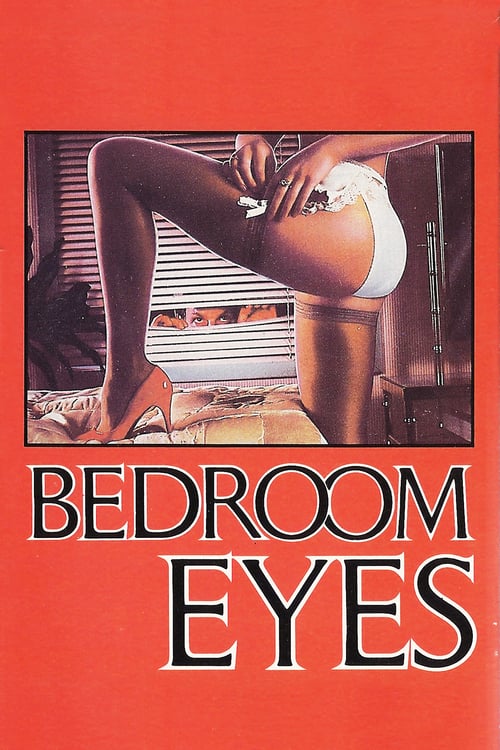
If you enjoy Canadian horror, then you know who William Fruet is, the maker of Death Weekend (released here as The House By the Lake), Cries In the Night (better known as Funeral Home), redneck rampage film Trapped(AKA Baker County U.S.A.), Spasms and the kinda-sorta Alien by way of animal experimentation oddity Blue Monkey.
This time, he’s taking on the genre of adult thriller, which by 1984 is kind of what giallo was leaning toward and then would completely become in the wake of Fatal Attraction and Basic Instinct. The ideas are the same — identity, secrets, sex, shame, violence — but it’s missing the great music and the fashion for the most part.
If you’re nostalgic for a film that aired on USA Up All Night, this movie is for you. This is the type of universe where a peeping tom is the hero, where a psychologist can see past his perversion — or encourage it — to see the man he is inside and where every other woman is evil.
This was, of course, followed by Bedroom Eyes II, which is way better because it has Wings Hauser, Veronica Hart and Linda Blair in the cast, as well as Chuck Vincent directing, and that movie also has no compunctions about feeling sweaty and filthy while this one seems clean and wrapped up, like some of the 80s felt.
This one does get points for having its female antagonist repeatedly beat the protagonist up, including a slapstick bonk at the end as the police take her away.
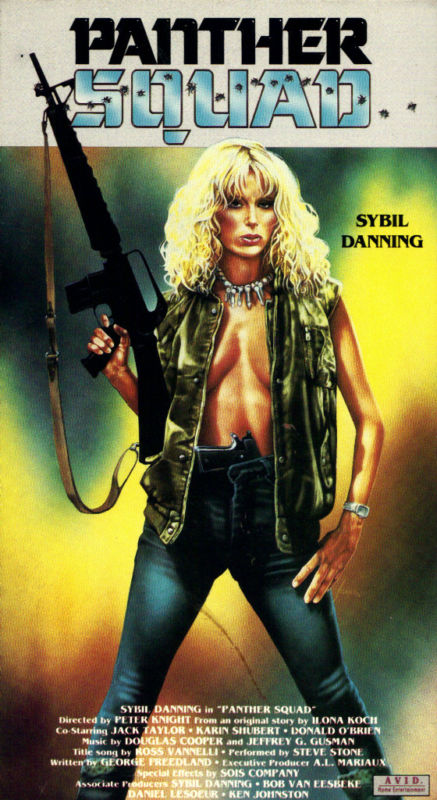
Yes, I realize that this is not a Full Moon film, but they carry it in their online store and on their streaming platform and I’m quite frankly exhausted by all the puppets and bongs and miniature killers and DeCoteau movies and when I saw Sybil Danning on the poster, teenage me said, “We need to stay up until.4 AM on a work night and watch this.”
The New Order of Nations is ready to escape Earth and start exploring space, but there are these terrorists called Clean Space who realize that humans are just going to litter other planets, so they decide to kill every astronaut so the nations of the planet decide to hire Sybil Danning, who wears lots of leather and honestly, that’s more than enough plot and makes me like this movie even if they never go to space.
There are so many guitar riffs and people running around in ill-advised outfits and I watched this in French because why not?
Force Five Podcastput up the best action from this movie — honestly there barely is any — and I can admit that I’m only posting it here because Sybil Danning is lounging poolside dressed like someone ready to fight a Terminator and sometimes when I get sad, this is the kind of thing that gets me through the day.
Facts you should know:
The theme song is called “She’s Tough and Tender (Theme from Panther Squad).”
Sybil Danning kept her outfit after filming was done.
Somehow, Jack Taylor made bad movies all over the world and I love him every single time he’s on my screen. I feel the same way about Donald O’Brien and I would like to think they had several meals and drinks together where they argued over who had the craziest films in their respective histories. I’d love to debate this with someone.
Karin Schubert, Hanna D.‘s mother from that Bruno Mattei blast of ripoff insanity, is in this.
If you want to see this movie done right, I can recommend every single Andy Sidaris movie to you.
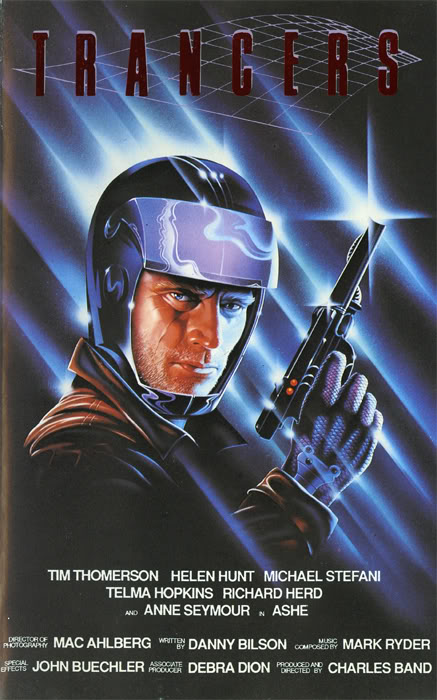
Look, there are bad Full Moon movies — there are more than a few — and there is also Trancers, a movie that has people in the future doing drugs to go back in time and the cop who polices the time stream, who is called Jack Deth, is played by Tim Thomerson and for some reason is a hardboiled film noir character in the midst of what is kind of a science fiction zombie movie that eventually also becomes a medieval parallel world story as the sequels keep on coming.
It was written by Danny Bilson and Paul De Meo, who really had some great ideas, writing — and occasionally directing — everything from Zone Troopers and The Wrong Guys to The Rocketeer and TV series like The Flash, Viper, Human Target and The Sentinel. Bilson was also the go-between for the Harry Potter games, making sure that EA and creator JK Rowling were on the same page. The team also worked for THQ, where they pushed for the video game company’s own IPs to gain prominence — THQ mostly made licensed games at first — including the great Saints Row series. Bilson also wrote Eliminators and Arena, but sadly died in 2016. The team’s last script, Da 5 Bloods, became a Spike Lee joint in 2020.
Deth has come to our time from the 23rd century on the hunt for Martin Whistler, a psychic supervillain who can use his mental powers to make people into mindless Trancers, which Jack can detect with his special bracelet. Once they are triggered, these human bombs go from normal people to killers in seconds; as Jack would say, “Only squids get turned into Trancers.”
Our hero is currently in the body of Phil Dethton, a journalist ancestor, and gets an instant girlfriend in the form of Leena, who is played by Helen Hunt. That may surprise you. What is even more astounding is that she showed up for the sequel.
How can you not love a movie that has a member of Tony Orlando and Dawn — Telma Hopkins — as the engineer of a time machine? Trancers is full of ridiculous moments that somehow all work out and a lot of the credit for that goes to Thomerson, who was once in the Army National Guard with Brion James before becoming a stand-up comic.
Look, they’ve made six of these — and a short — and I could watch them all multiple times. I realize my taste is not the best, but I can honestly say that the Trancers films fall on the good side of the Empire and Full Moon release slates.
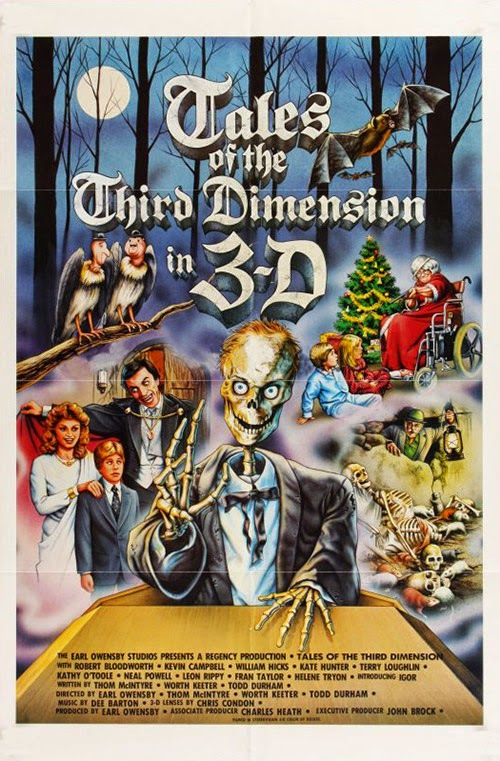
First off, that title says the same thing twice. But hey, let’s forgive a movie that has a skeletal narrator who is supposed to sound like Rod Serling but has a voice-over actor who didn’t get the memo and decided to sound more like Howard Cosell. This movie has the temerity to use puppets not only in the opening, but for the bats and other creatures throughout, as well as one of the worst cat effects ever. This all makes make love this because it was shot on film and made in 1984. If it was a digital video streaming release from this year, I would have hated it. Such is the wonder of me.
This movie came out of the Earl Owensby Studios, a place where Ginger Alden made Lady Grey opposite David Allen Coe and the thinly-veiled Elvis bio Living Legend: The King of Rock and Ro complete with a soundtrack by Roy Orbison. The secret to Owensby’s success? Never spending more than a million dollars to make a film and never signing a distribution deal that would net them less than eight million. He also knew how to make money, because his purchase of the abandoned Cherokee Nuclear Power Plant ended up providing exactly the set that James Cameron was able to fill with water to make The Abyss.
Igor the skeleton is joined by some ravens — or vultures or crows, they’re puppets that aren’t well made — three of whom sound like the Three Stooges and two that are Laurel and Hardy to cover all the comedy bases as he introduces three tales of terror that all involve Dr. Tongue-level three-dimensional effects.
In Young Blood, a vampiric couple pushes an adoption agency to get a child — any child — and end up with a werewolf. If you’ve seen it all before, you have, as this story is “The Secret” from Haunt of Fear #24. Seriously, it’s the same exact story, but if you’re going to steal for your portmanteau, I guess steal from the best.
The Guardians is the tale of grave robbers who need money so bad that they’ll cut the ring off a dead woman’s finger (and take the finger as well). They get even greedier and descend into the catacombs under the graves where they meet their fate.
The whole reason you should watch this movie is the last segment, Visions of Sugar Plums. Two kids are dropped off at grandmother’s house for the holidays as their parents go away to Hawaii. However, grandma has run out of her medicine and ends up singing Christmas carols about puking all over the place and killing Santa with a brick before she brines the cat like a holiday ham — don’t worry, this effect was literally taking a live cat and putting some pineapples on him — and then grabbing a shotgun to kill the kids who defend themselves with knives as a deranged version of “Jingle Bells” plays. To top this all off, this segment was directed by Todd Durham*, who would create the Hotel Transylvania series of movies. He also made another 3D Owensby Studios film, Hyperspace (AKA Gremloids) which somehow stars Paula Poundstone and Chris Elliot.
Somehow, the titles for this movie show up nearly an hour into the movie. You have to love that kind of who cares filmmaking. I have no doubt that this movie will eventually come out from Vinegar Syndrome and people will lose their minds. Jump in now and drink in that third story.
*The other stories are directed by Worth Keeter, who would go on to make multiple episodes of Power Rangers, and Thom McIntyre, who wrote nearly all of the filmography of Owensby Studios.





 B&S About Movies
You must be logged in to post a comment.