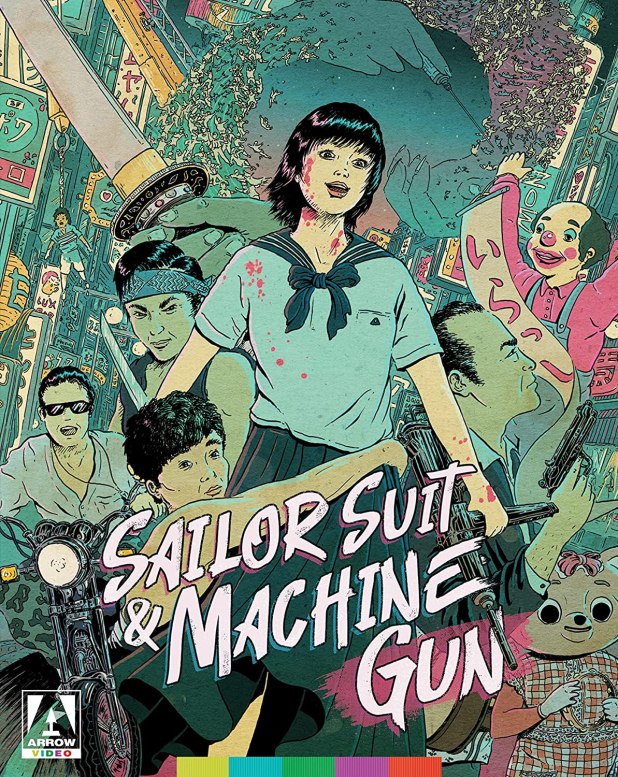
Shinji Somai (Typhoon Club, Wait and See, Moving) is an influential filmmaker whose work has rarely been seen in the U.S. That’s changing with the Arrow release of one of his best-known movies, Sailor Suit and Machine Gun.
A combination of Japan’s unique idol and yakuza films with the traditional coming of age story, this film is centered on Hoshi Izumi, an innocent young girl who suddenly finds herself the leader of her great-uncle’s organized crime clan.
Hiroko Yakushimaru, who plays Hoshi Izumi, achieved icon status thanks to this movie and its theme song “Sailor Fuku to Kikanjū.” The song stayed at number one in the charts for five straight weeks and was the second highest-ranked song of 1982.
In truth, Hoshi’s father should have led the group, but he died in an accident before they could find him. Beyond inheriting the title of oyabun, she also is given her father’s secret lover Mayumi Sandaiji.
The kobun, or followers, refuse to take the young girl seriously and also seem to think that their attack against their rivals has to be successful. Faced with leading a gang that doesn’t want her and who will also enact a suicide pact if forced to disband, Hoshi must give up on her childhood and take the titular gun in hand if she wants to make her new life a success.
Despite its origins as a teen novel and the fact that its idol actress had such a major song out of the film, this is more arthouse than you’d expect. While its influence may be small in the U.S., the other films — and media — it inspired all flow from this original river.
The Arrow Video Sailor Suit and Machine Gun blu ray has both the original theatrical version and the 1982 complete version (kanpeki-ban) re-issue of the film, restored by Kadokawa Pictures from a 4K scan of the original negative. Plus, there’s a new documentary Girls, Guns and Gangsters: Shinji Somai & Sailor Suit & Machine Gun, trailers and TV spots, and a sleeve with original and newly commissioned artwork by Michael Lomon. The first pressing comes with an illustrated collector’s booklet featuring new writing on the film by Aaron Gerow and Alex Zahlten, and a discussion between the film’s star Hiroko Yakushimaru and acclaimed director Kiyoshi Kurosawa, who was an assistant on the film.
On November 15, you can also stream this movie on the Arrow player. Visit ARROW to start your 30-day free trial. Subscriptions are available for $4.99 monthly or $49.99 yearly. ARROW is available in the US, Canada, the UK and Ireland on the following Apps/devices: Roku (all Roku sticks, boxes, devices, etc), Apple TV & iOS devices, Android TV and mobile devices, Fire TV (all Amazon Fire TV Sticks, boxes, etc), and on all web browsers at https://www.arrow-player.com.
So yeah, in Germany, Porno Holocaust was actually considered a sequel to Joe D’Amato’s Orgasmo Nero (we just called it Sex and Black Magic here) and everyone had to be content to a title that isn’t as in your face. Don’t worry — this movie is still as repellant as it gets*.
Back in the 50s, governments used to regularly blast an island with nuclear bombs just to see how they blew up and to test the idea that perhaps these weapons would split reality into pieces. Well, all they did was create a place filled with mutant animals and a monster — a giant appendaged monster — that a bunch of stupid, stupid scientists are going to visit and all die.
That creature was once Antoine Domoduro and much like another D’Amato/George Eastman epic — Antropophagus — he was once a man with a family that all died in the atomic bomb blasts and now, all he has are two speeds: fuck and destroy.
D’Amato made Papaya, Love Goddess of the Cannibals and Tough to Kill in Santo Domingo and had such a good time that he returned to make Paradiso blu, Sesso nero, Orgasmo nero, Hard Sensation, Erotic Nights of the Living Deadand this movie all in July of 1979. That’s right — five movies in one month.
The first mainstream hardcore film in Italy, this movie ends with Tom Selleck look-a-like — and travel writer when he wasn’t making porn — Mark Shannon surviving and making sweet love to Lucia Ramirez on a very small boat in the middle of the ocean, which is more astounding than anything else in this movie, as I wondered how D’Amato was able to get all of his camera equipment onto this boat, shoot this scene and not have anyone fall off.
Italian movie directing at its finest.
*Or maybe not. The German softcore version is Insel der Zombies. Seeing how a full third of this movie is hardcore penetration, I can only imagine how short that movie is.
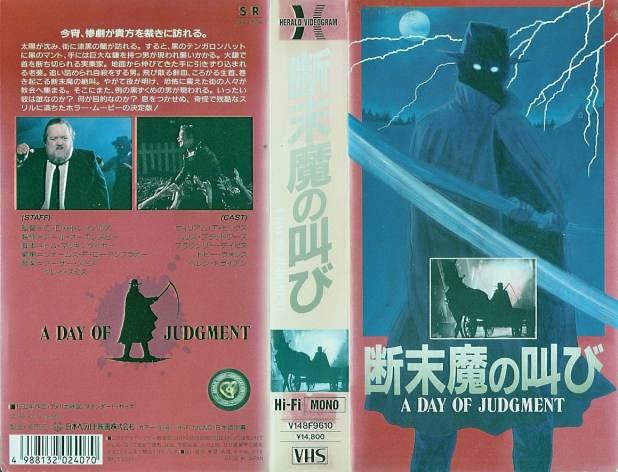
Produced by the same Earl Ownsby that made the truly oddball Tales of the Third Dimension in 3D, this Wilmington, North Carolina curiosity makes the strange step of being one part slasher, one part Christian morality play. And man, what a strange tasting cocktail that is*.
Director C.D.H. Reynolds and writer Tom McIntyre put together this tale of a 1930s small town that is packed with lust, corruption and sin that has choked the God out of the last preacher, sending him running away into the night.
Now, a mysterious figure wielding a scythe arrives just as he leaves and everyone that has done anything has to pay — not only with their lives, but with their souls.
Everyone in town has something to be ashamed of. Mr. Sharpe, the banker, is out to take everything he can from everyone. Drunken Mrs. Fitch only cares about her flowers and will poison animals if they get too close. Ruby only married her husband to become rich, as everything about him is old, even his smell, but she doesn’t care for anyone, even the shop assistant that she’s been screwing behind her husband’s back. And then there’s George, who conspires with the banker to commit his parents and finally leave this town behind.
This feels like the lost Charles B. Pierce movie we never got or the slasher they’d allow you to watch in Sunday school or a junior high production of Our Town that the drama teacher rewrote to slam book the entire town that he knew would never accept him and that he’d never escape. All filtered through with nightmarish conjurings of a foggy and blue lit reaper just walking from victim to victim and man, I love blue fog.
It’s a slow moving movie — and you know how those work for me — in the best of ways, a deranged message film that makes me leap with glee when the end credits start with the Ten Commandments. Bravo, people. Bravo.
According to Stephen Thrower — who is on the Severin blu discussing this — Reynolds went back to teaching and was an atheist. He also worked on Carnival Magic, which makes a lot more sense.
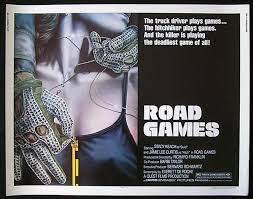
The same Richard Franklin that made Psycho II and Cloak and Dagger made Patrick, Fantasm and this movie and this fact makes me beyond happy. All of these movies are so far apart and different from one another and I just love that they all came from the same director.
While making Patrick, Franklin gave Everett De Roche a copy of Rear Window as an example of how he wanted the script typed. De Roche loved what he read and wanted to make a similar movie but within a moving vehicle, so the dup worked on the first draft while Franklin was producing The Blue Lagoon.
Franklin wanted Sean Connery, but the budget couldn’t handle that, despite the $1.75 million cost making it the most expensive movie yet made in Australia. No matter — Stacy Keach is beyond great in this. However, casting Jamie Lee Curtis to appease Avco Embassy led to politics between actors’ equity groups and nearly shut down the movie.
Patrick Quid (Keach) is driving the lonely highways of Australia, delivering large quantities of pork, and forbidden to pick up the many hitchhikers he sees along the road. And there’s also the matter of a killer (Grant Page, Stunt Rock) on the same roads that the police haven’t been able to catch. Before the end of the film, Patrick will be suspected of these killings more than once.
Quid has his own suspicions, as a green van and its driver have gotten in his way more than once and even attacked the dingo that Quid keeps for company for the long drives. His suspicions are shared by a hitchhiker he finally decides to pick up, Pamela Rushworth (Curtis), the daughter of an American politician.
This movie failed in Australia and the U.S., but it found the right audience to make it a cult classic. I’d not watched it — saving it for just the right time — and I was floored by it.
1981 was a great, great time to be alive and excited about horror movies.
On the other side of the world, Australian folk horror was taking root, at least with this film, which starts with 16-year-old Alison playing with a spirit board and we all know just how well that works out in film. It doesn’t work out in minutes, not hours or days, as Alison’s dead father begins to warns her that ‘s she in trouble and that she shouldn’t go home for her birthday through possessing one of her friends, who is then killed dead when a bookcase falls on her.
Years later, Alison and her boyfriend visit her family, who instantly keep them apart and Alison begins having vivid nightmares. The plan is to keep slowly drugging and gaslighting them both, ending with the spirit of a demon named Mirna being moved from Alison’s grandmother into her body, as has been the tradition for two hundred years.
Director and writer Ian Coughlan also made Stones of Death and Cubbyhouse, another movie about devil worship that supposedly has a connection to this movie. I’ve heard that it’s near unwatchable and has Joshua Leonard from The Blair Witch, so I leave it up to some other brave soul to watch it. Who am I kidding — I’ll probably update this post sooner or later with my findings.
As part of the All the Haunts Be Ours box set from Severin, this modern folk horror will finally be seen by a larger audience. It may not be the fastest moving story, it may not have all the gore of the slasher yeat of 1981, but it has a definite dark mood that makes it unlike anything you’ve seen before, even if you know exactly where it leads. You can also watch it on Tubi.
8. CRAFT NIGHT: Cast your eyes upon the screen, whence a witch’s spell is surely seen.
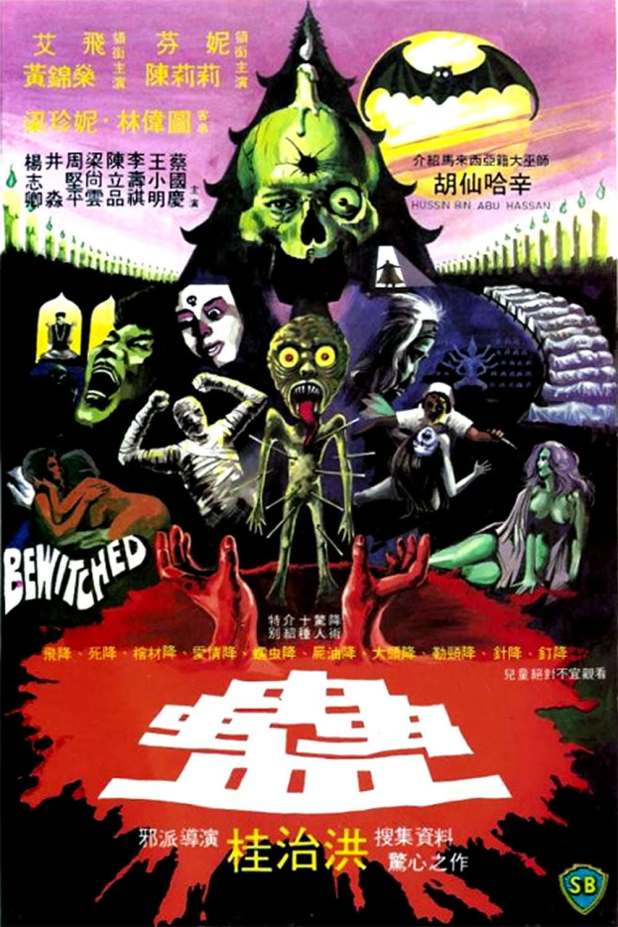
Detective Wong King Sun is investigating the horrific and violent death of a little girl at the hands of her father, who claims that he was under the influence of a wizard. This takes the detective all the way to Thailand to learn more and, as happens in films such as this, to be cursed by a powerful magician named Magusu, who was supposedly played by an infamous Malay sorcerer. That’s what the credits say and who are we to deny the words of Shaw Brothers or any exploitation studio when you get right down to it?
Wong King Sun decides to fight black magic, he needs a white magic monk. What follows is an entire movie of one-upmanship battles over whose magic is strongest, including a gut-churning moment when the evil magician grabs that pause that refreshes. Except that we’re not talking about Coca-Cola. This dude likes to sip from a big urn filled with unborn children and blood.
If that last sentence made you wince, turn back now. Bewitched is a ride through absolute chaos. It’s gorgeous, it’s frenetic and it’s also unafraid to try and make you throw up throughout its running time. And if this one seems like it’s going to be too much, its sequel, The Boxer’s Omen, goes even further. Director Chih-Hung also made the equally blood and madness-filled Corpse Mania.
We all know that old Chinese chestnut of advice, right? Don’t take the virginity of village women, ghost them and then just move on or you’ll be covered in body hair, unable to get it up and eventually hammering a spike into your daughter’s head so that she stops being possessed and attempting to kill you.
“The moral of the story is to admonish people against casual sex and to be on guard against witchcraft.” That’s what the end says. As for me, I’m all about movies with neon colors, glittery bats that come to animated life and actual black magic rituals being used to entertain audiences.
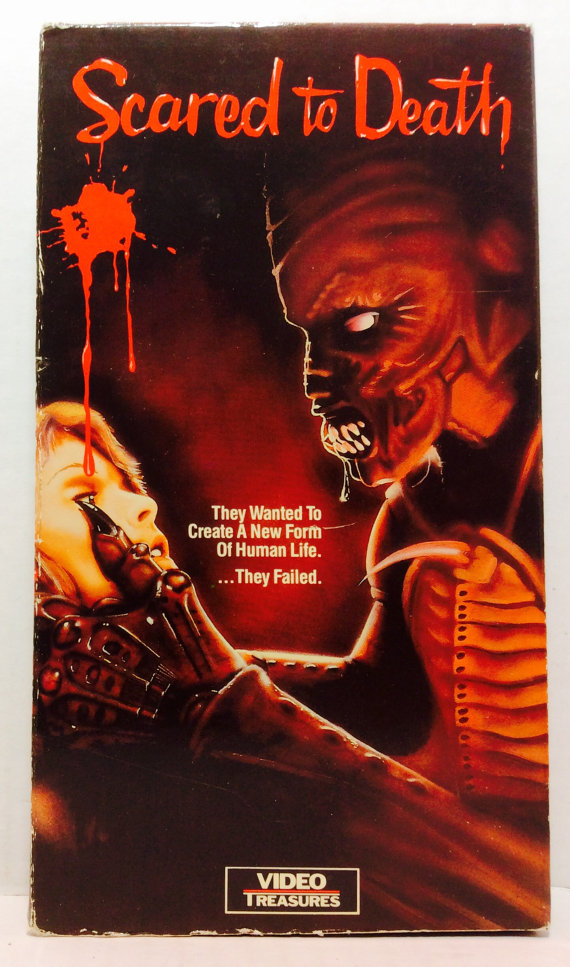
William Malone wanted to be a director and decided that a horror movie was the way to go. After all, he’d made monster masks at a factory so he could make the monster himself. And by that, I mean spend three months making an H.R. Giger clone. Then he sold his car, mortgaged his house and somehow got Rick Springfield to be in this, but he dropped out the night before shooting started, which feels like a total kayfabe story.
This might seem like a slasher, but then you learn that the killer is drinking spinal fluid and this woman just shows up and says, “Oh, I worked at the lab where we made a creature named the Syngenor that lives off spine juice. And in case you wonder, the name means SYNthesized GENetic ORgansism.”
Yes, the very same Syngenor that Re-Animator villain David Gale goes absolutely full-on bonkers within. That’s why when this movie was released to DVD, it got the new title Scared to Death: Syngenor.
Malone would move on to make Creature, House on Haunted Hill, feardotcom and Parasomnia. If we let him make another movie, I really worry what the title will be. I have no idea who let him make a film again after feardotcom because not even my steady diet of Franco and Mattei could get me through that movie.
Roger Spottiswoode directed everything from Terror Train, Under Fire and Shoot to Kill to Turner & Hooch, Stop! Or My Mom Will Shoot, The Sixth Day and Tomorrow Never Dies. This movie originally had John Frankenheimer* as the director, but he was replaced by Buzz Kulik, the director of Bad Ronald. The script was written by an uncredited W.D. Richter (Jeffrey Alan Fiskin has the credit) and was based on the book Free Fall: A Novel by J.D. Reed.
After getting the finished film, the producers felt like it needed a stunt and some editing, so editor-director Roger Spottiswoode came in. However, Spottiswoode claimed that without new sequences, the movie would fail. He brought in Ron Shelton, a former baseball player who would later write and direct Bull Durham. Together, they’d reshoot 70% of the movie, according to “Ghostwriters” in the March/April 1983 issue of Film Comment.
It seems like two movies got made: Kulik’s is a post-Vietnam movie in which Cooper is angered that he gains more fame as a thief than he did as a soldier, while the Spottiswoode movie is a chase film.
What do you do when you have a troubled production? You William Castle things. Universal offered a million dollars for any information that would lead to the capture and arrest of the real D.B. Cooper, totally missing the message that Cooper was the hero of their film and no one who saw him that way in the movie would want to see him in jail. No one ever claimed the prize.
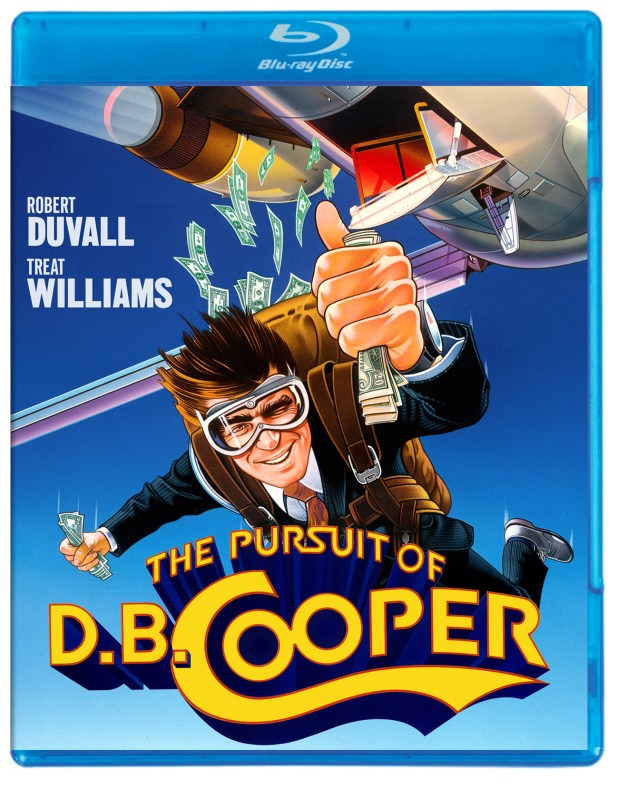
So who is Cooper, the man who anonymously hijacked a Boeing 727 aircraft between Portland and Seattle, got a ransom of $200,000, then jumped out and disappeared, with his crime being the only unsolved air piracy in commercial aviation history? Treat Williams, who plays an army man named Jim Meade trying to impress his wife, played by Kathryn Harrold.
He won’t get away easy, as Sgt. Bill Gruen (Robert Duvall), his old military boss, is now an insurance investigator. Another man from the war past, Remson (Paul Gleason), is also after him, as he recalls discussing highjacking with Meade.
The new Kino Lorber blu ray of The Pursuit of D.B. Cooper has a commentary track with writer Jeffrey Alan Fiskin and film historian Daniel Kremer, 3 TV commercials and a trailer. I remember the commercials for this playing on TV all the time, so I’m excited that I finally own a copy.
*Frankenheimer was fired after one scene was shot, telling the Los Angeles Times that this movie was “…probably my worst-ever experience. A key member in the chain of command had been lying to both management and myself with the result that we all thought we were making a different movie”
Writer, director and actor Joel M. Reed wowed us on the ’80s home video fringes with his 1976 drive-in ditty Bloodsucking Freaks. Do read B&S bossman Sam Panico’s review, as he waxes nostalgic over the lost bricks-and-mortar era of video stores that afforded us, the jock-bullied, wee horror and metal lovin’ pups of its discovery — and of today’s feature film.
“Who is this whack job?” we pondered as we searched the video racks for other Joel M. Reed product.
Courtesy of the pulpy monster mags we got at the corner smoke shop or, if on a family excursion to the mall, Waldenbooks, we learned (Googling is no fun) Reed made his debut with two sexploitation flicks: Sex by Advertisement (1968) and Career Bed (1969). (Eh, buying online is no fun; mail-order catalogin’ from the back of monster rags for VHS-greys is the way to go.) Then Reed changed it up with an action flick — as only Joel M. Reed can make one — with a “Rambo” that has herpes (?) in Wit’s End, (1971). Of course, with Sly-Namexploitation in full swing in the ’80s, it was repacked as The G.I. Executioner.
So, this is the part of the film review and Reed career examination where we drop CBS-TV’s Everybody Loves Raymond into the discussion . . . because Marie Barone, aka Doris Roberts, stars . . . alongside Harve Presnell (Fargo, Saving Private Ryan; “Mr. Parker” in NBC-TV’s The Pretender) in Reed’s twist on the Amicus anthology format with Blood Bath (1975).
And that’s Joel M. Reed’s six-film career as a writer and director — a “tribute week” in one fell swoop of a review. Prior to his April 2020 passing, Reed appeared as himself (he has 15 other character-acting credits) in uber-fan Eric Eichelberger’s retro-SOV’er Ghoul Scout Zombie Massacre (2020).
Now, before we get into the movie at hand . . . let’s clear up the title confusion, as there are two movies with the title/alternate title of Gamma 693: First, there’s Joel M. Reed’s sixth and final film released onto video in 1981. Then there’s the other one starring Linda Blair and Troy Donahue from 1989 — which served as the lone directing credit by Jack A. Sunseri. Oh, you know Jack: he gave us the cheesy “puffbox” timewaster, The Dead Pit (1989) — that’s not to be confused with The Pit (1981). No, we’re talking about the one with the blinking zombie eyes on the VHS Box (You Tube clip of the box in action).
Now, I’ve personally never sought out The Chilling starring Linda and Troy. In fact, I don’t ever recall seeing it on the store shelves, even though it came out as a theatrical in 1989 and hit U.S. video shelves in 1992. It’s said The Chilling played on USA Network’s “Up All Night” and “Night Flight” weekend programming blocks, but not to my knowledge. Is Jack A. Sunseri’s flick a homage or loose faux-sequel to Reed’s film, we wonder. Alas, it’s an analogy quandary I shall delve into not, as The Chilling is so awful in its inept Return of the Living Dead (1985) ripoffery. Let’s just say Sunseri attempted to hornswoggle us Joel M. Reed freaks into renting a Sunseri boondoggle, and just leave it at that.
To add to the bad analog Intel: It is also said that Reed’s Gamma 693, aka Night of the Zombies, also carries the title alternate of The Chilling. Not only have the B&S worker bees not been able to locate any theatrical one-sheets with the Gamma 693 title, we were unable to locate any VHS or DVD reissue slipcovers with The Chilling title. So, let’s just say The Chilling alternate title is an Intel cut-n-paste snafu resulting from Sunseri’s film coping the Gamma 693 title at some point during its own video shelf life. And it wasn’t it enough to piggyback on Reed’s works; Sunseri swinehumped Wes Craven’s superior cryogenic horror, Chiller (1985), which starred Michael Beck (The Warriors, Battletruck) and Jill Schoelen (Thunder Alley) that aired as a first-run TV movie on the USA Network.
If you’re in a NaziZom* binge-mood: Other films you can check out are They Saved Hitler’s Brain (1964) and its fellow Nazi scientist-cum-world-conquest villains in She Demons (1958), The Flesh Eaters (1964), and Flesh Feast (1970). To a lesser extent, there’s the Nazi we-never-see ghosts of Death Ship (1980). Then there’s the later NaziZomsploitation sub-genres homages Outpost (2007), with its own sequels War of the Dead (2011) and Bunker of the Dead (2015; in a found footage format), and the Finland-made dark comedy of Dead Snow (2009), which has its own sequel-verse. No, while it’s cool: not Iron Sky (2012), for that has no zoms, but Nazi UFOs on the moon, even though the dark side of the moon is a cold bitch.
Now that you are a well-informed, frozen-Nazi zombie consuming streamer, on with today’s feature presentation.
Ah, the VHS slipcover art I remember, aka Gamma 693, aka Hell of the Living Dead.Don’t be fooled by the “X,” as this is not the least bit “video nasty.”
As with John Howard’s Spine — and Paul Norman’s Ice Cream Man and Tucker Johnson’s Blood Salvage — Reed’s flick is also a porn-connected produced horror flick — thus, the shot-on-video production values. It was shot in the Munich, Bavaria, Germany home and on the property of noted ’70s porn purveyor, Shaun Costello. (It had pick-ups done on the sly in the wooded environs of New York’s Central Park and a “Euro-looking area” of Greenwich Village.)
Now, come on. Don’t be shy and lie, because I’m not.
When I aged-into my behind-the-taboo-green-curtain years, I rented a VHS copy of Costello’s infamous Girl Scout Cookies (1976). So, yes . . . our 420-plus credits leading actor here, Jamie Gillis, is, in fact, a porn actor who occasionally moonlighted in low-budget “mainstream” flicks, but is best known for his work in Deep Throat II (1987). As if we forgot there was already an official Deep Throat Part II in 1974 to the 1972 film. See, even porn films do the alternate-title hornswoggle.
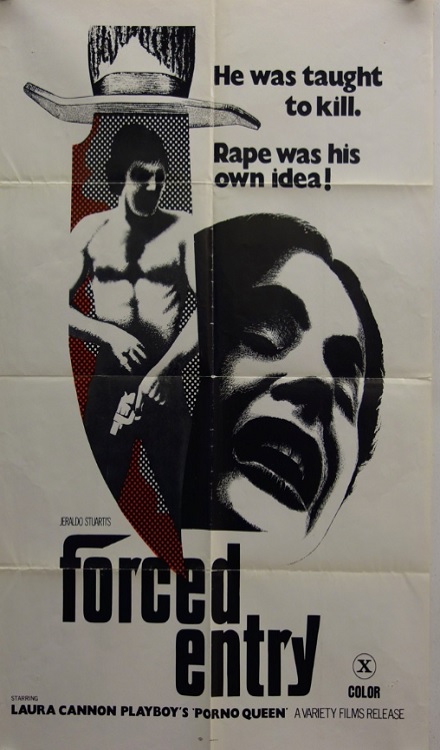
In addition to Girl Scout Cookies — and if you’re a ’70s proto-slasher fan — Shaun Costello, after achieving success with a series of adult film short, aka loops, made his feature film debut as a writer and director with the X-rated Forced Entry (1973). Remade in 1976 as The Last Victim — by Jim Sotos/Gary Graver; yep, both porn-connected — the film was marketed on the grindhouse and drive-in circuits until the early ’80s, courtesy of Tanya Roberts, later of Charlie’s Angels fame, starring.
When Dawn of the Dead (1978) inspired a Euro-zom craze that soon engulfed home video shelves, Reed’s NaziZomsploitation romp appeared on VHS in 1983 under its better known title: Night of the Zombies. If you were a fan of Eliva’s Mistress of the Dark syndicated movie blocks, you may have seen it on television under that title. Maybe you caught it — as did I — at your local twin cinema in 1981 as Hell of the Living Dead, which has nothing to do with the 1980 Bruno Mattei film of the same name. To add to the confusion: Reed’s zom-romp also carries the home video title of Night of the Zombies II, as an ersatz-sequel to Bruno Mattei’s film, which itself is also known as Night of the Zombies. Later ’90s DVD reissues carry the title of Night of the Zombies: Battalion of the Living Dead.
Just wow. That’s way to much market effort for a film that doesn’t deserve the lipstick-on-a-pig marketing effort.
Where’s Jean Rollin’s Zombie Lake (1981) and Jess Franco’s Oasis of the Zombies (1982) when we need ’em. Hell, where’s the Dana Andrews-starring frozen Nazi-heads flick The Frozen Dead (1966). I can’t believe I just said that. Yes, those three dopey zom romps — and Mattei’s for the matter — are far better than this Joel M. Reed mess that isn’t the least bit zombie goo-messy, it’ “twist ending” be damned. And, worst of all is that it takes us 40 minutes to get to the blue guacamole-smeared zombies — and that’s if you can see ’em through the worst night-photography ever committed to film.
Then there’s the government lamenting and spy-drivel pontificating — via stammering “actor” ad-lib. Then there’s the “set design” of government offices that don’t look like government office that look like the filmmakers guerilla-shot their way into a hotel conference room and got out before hotel security kicked them out: Pentagon and Fort Detrick, my ass. Then there’s the obvious, medical lab-borrowed skeletons — that are supposed to be what’s left of the zombies after melting — and the melting effects are questionable — that have a visible, linear mark across their caps. Remember Billy Eye Harper’s plastic-bone rotted remains in Rocktober Blood? Plastic skull is as plastic skull does, Forrest.
So, how did we get here: Upon the death of two scientists in the Bavarian Alps investigating the activities of a WW II U.S. Army Chemical Corps unit engaged top-secret chemical warfare with something called “Gamma 693,” the U.S. government sends Nick Monroe (our porn star Jamie Gillis), a not-James Bond CIA agent to investigate the deaths. During his investigation, Monroe learns of the rumors of a regiment of Nazi zombies roaming the countryside and uncovers a Nazi plot for world domination with an undead army. Without the chemical agent — designed as a healing agent for the war wounded — the Nazi ranks will age and decompose. So there’s only one thing left to do to stop the rot: eat human flesh. And since these are intelligent zoms: they tell their food that they don’t want to, but must.
Is there a creepy atmosphere? Is the plot a bit whacked? Is the soundtrack queasy-inducing? Sure. But it’s all too little too late. If only Eli Roth (re) made this, it would be so much better, for the story is there. So I’ll just take my VHS copy of Ken Weiderhorn’s Shock Waves to my movie room and call it a night.
If you’re a first-timer to Joel M. Reed’s Alpine snow-zoms, you may pass, as well. Then again, you may like it. Just as I enjoyed Weiderhorn’s Carribean aqua-zoms and others hate it. Everyone’s tolerance for B-movie cheapness and nostalgia miles for the past, may vary. Like Steel Town wrestler Shirley Doe says, “Films are funny that way.”
You can watch Reed’s contribution to the NaziZomsploitation genre on You Tube HERE (the Prism Video-version as Night of the Zombies II — with a trailer for Shock Waves!) and HERE (as Die Nacht Der Zombies).
Oh, call it what you will, you ol’ ’80s “Midnight Movie” and VHS-renting road dogs: Mondo Cannibale, CannibalWorld, Cannibals, White Cannibal Queen, A Woman for the Cannibals, or Barbarian Goddess. All we known is that, once again, Jess Franco, casts himself as the patron saint of the video nasty, as he sticks his hands into the boiling native vats and fucks up a genre. While shooting, this soon-to-be U.K.-banned ditty was titled Rio Salvaje, aka Wild River, probably as an ersatz sequel to Umberto Lenzi’s 1972 progenitor, Man from Deep River. As if we’d be duped by a Franco joint.
White Cannibal Queen
Ah, the VHS clamshell sleeve I remember. Heaven.
On the plus side: Franco gives us the always welcomed Al Cliver (The Beyond) and Sabrina Siani (Conquest and The Throne of Fire). According to Franco, he did this movie and fellow cannibal romp Devil Hunter (1980) for the money and had no idea why anyone would enjoy these films. (Is it just me, or does Franco have a lot of those type of films in his career? He said the same thing about his NaziZom rip, Zombie Lake.) Franco also went on record that Sabrina Siani was the worst actress he ever worked with and that her only good quality was her “delectable derrière.”
Whatever, Jess. Pedophilic Pig.
However, to Franco’s credit, he does change it up a bit: Instead of looking for the usual lost tribes or oil, or whatever vegetable or mineral MacGuffin we need to steal from a peaceful native tribe to make a better life for the white man, our civilized man — with one arm, who lost it during the first expedition — returns to the jungle where he lost his family to rescue his now teenage daughter — who’s become the blonde white cannibal queen of the tribe.
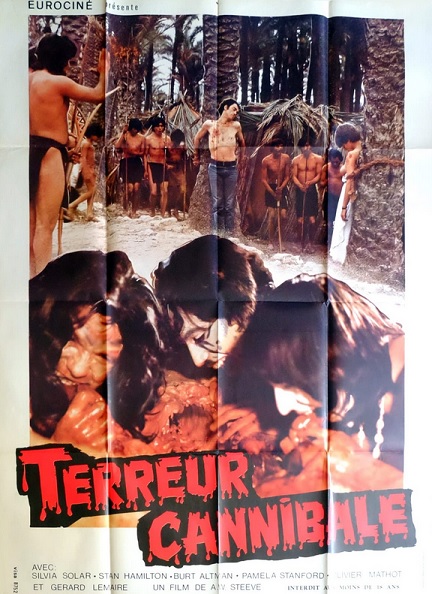
Cannibal Terror
It’s another Jess Franco joint: it’s different, but the same.
Now, don’t let Jess Franco bamboozle you with Cannibal Terror, aka Terreur Cannibale (1981). While Franco penned the script, it’s actually a way-too-late French entry into the genre directed by Alaine Deruelle, and not a repack of White Cannibal Queen, aka Mondo Cannibale. But it does raid that Franco film for stock footage. As result, we see Sabrina Siani, the White Cannibal Queen, while not starring in the film, appearing in a bar scene (oops); several shots of the dancing cannibals from Franco’s film are redux, here; a background actor (said to have a distinctive, Mick Jagger-type face) appears in three roles, here: as two cannibals, a border guard, and a third cannibal eating Al Cliver’s wife; the guitar player at the bar, here, found Al Cliver after he had his arm cut off in White Cannibal Queen (oops).
White Cannibal Queen and Cannibal Terror also share actors Olivier Mathot and Antonio Mayans, both whom have starring roles, as well as porn actress Pamela Stanford, who has a major role in Cannibal Terror, but a support role in White Cannibal Queen by way of stock pillaging. The leading woman change up is Silvia Solar from Umberto Lenzi’s Eyeball(1975).
As far as the “plot” goes in the French remake/ripoff: Two criminals take their kidnapping victim to their partner’s jungle hideaway. The local cannibal tribe hunts them down one by one.
Devil Hunter
Where I have I seen you before? Oy! Another Jess Franco cannibal joint!
And don’t let Jess Franco hornswoggle you with Devil Hunter (1980), aka, Sexo Canibal, The Man Hunter, and Mandingo Manhunter, for he is director Clifford Brown and writer Julius Valery, incognito; his second wife, Lina Romay, co-directed, while his first wife, Nicole Guettard, edited.
And since Devil Hunter was shot back-to-back with White Cannibal Queen, Al Cliver returns in the leading hero role. And Antonio Mayans, from it’s-not-Franco’s-film-but-it-is Cannibal Terror, returns as Cliver’s co-star. The change up, here, is that Ursula Buchfellner, a German model who became Playboy magazine’s “Playmate of the Month” in October 1979, stars as our resident damsel-in-distress. Did you see the Euro-adult comedies Popcorn and Icecream (1979), Cola, Candy, Chololate (1979), and Hot Dogs in Ibiza (1979), and Jess Franco’s women-in-prison romp Hellhole Women, aka Sadomania (1981)? Well, now you know four more Ursula Buchfellner’s films than most (normal) people. Do you feel blessed by B&S?
As far as the “plot” goes, well, it’s pretty much a retread of Cannibal Terror: After the kidnapping by white bandits of a top model/actress (Buchfellner) on a jungle shoot/location scouting trip, an ex-Vietnam vet (Cliver) and his mercenary pal (Mayans) head into the deep jungle of the island nation to rescue her, not only from the kidnappers, but from cannibals who worship a “Devil God.” And (snickering) the “God” is a tall African dude with ping-pong eyes falling out of his head.
And get this: Jess Franco claims the makers of Predator stole their idea from this movie.
Whatever, Mr. Franco. Ye who commits celluloid theft, himself.
Needless to say: All of the stock footage padding from White Cannibal Queen and Cannibal Terror, along with the expected Franco-sleaze, and awful dubbing, is back — to lesser . . . and lesser effect. Wow, Jess, thanks for making White Cannibal Queen look even better than it’s allowed to be. But it does “splatter” nicely to make the U.K.’s “Video Nasties” list, which is the whole reason we’re reviewing this film this week for our “Video Nasties Week.”
So, there you go. Now you’re an educated Euro-cannibal flick consumer in-the-know that Cannibal Terror and Devil Hunter aren’t alternate titles to White Cannibal Queen, but three distinct — as distinct as a Franco joint can be — separate films . . . that are different, but the same. Sorta. Kinda. Oh, Franco!
But you know Franco: He’s a magnificent, maniacal bastard and we love him for it. What would our youth have been without Franco flicks and Venom tunes?
We did a whole week of cannibal films with our “Mangiati Vivi Week” tribute back in February 2018. You can also learn more about the genre with our review of the documentary Me Me Lai Bites Back (2021). And there’s more “nasties” to be found with our “Section 1,” “Section 2,” and “Section 3” explorations.
You can purchase White Cannibal Queen from Blue Underground or watch it as a free-with-ads-stream on Tubi.
You can purchase Cannibal Terror from 88 Films or watch it as a VOD on Amazon Prime.
You can purchase Devil Hunter from Severin Films or watch it as as free-with-ads-stream on Daily Motion.
Update: In January 2023 we rolled out our Jean Rollin-uary month of reviews. If you’re not familiar with Rollin’s works, click through and check them out. Oh, yes! If you do a month of Jean Rollin, you must do a month of Jess Franco! February 2023 was our “Jess Franco Month.”
About the Author: You can read the music and film reviews of R.D Francis on Medium and learn more about his work on Facebook.











 B&S About Movies
You must be logged in to post a comment.