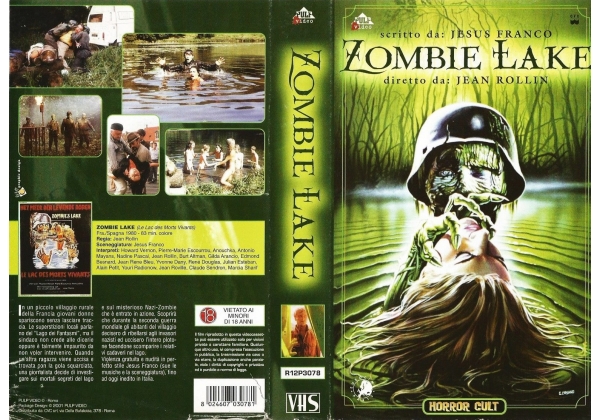
Do you want to watch a boring underwater Nazi zombie movie? Then, by all means, watch Zombie Lake. All others skip it and slosh on over to Ken Wiederhorn’s far superior Shock Waves (1977). How this test in zom-tedium ended up as one of the 82 films on the U.K.’s “Section 3” Video Nasties list is dumbfounding.
It all started with Jesús Franco. Then the testosterone started splashin’ around between Franco and the producers. Enter Jean Rollin — with less than a week before production was to begin. Yes, Jean Rollin, the director who never met a film he couldn’t thrust into boredom. Yes, Mr. Rollin (and Mr. Franco, for that matter): I do need more than just nudity and triangle-of-death shots to move me. Yes: I need my zombies to have more than green paint smeared on their puss. Another problem: Two editors worked on the film: one for the French and International version and one for the Spanish version. Yes, a film where Jess Franco quits and Jean Rollin signs on . . . well, you’ve been warned. Needless to say: the poster’s great, but the plot is a mess.
Mind you: A bulk of this film takes place twenty years after the end of World War II, so 1965 — but it looks like forty years later, aka 1985. Anyway: A group of nubile ladies take a (skinny) dip in the village’s small lake — a lake referred to by the locals as “the lake of the damned.” And it’s know as such because it was used for witchcraft ceremonies. And the “lake” swallows them whole. So, with fresh human blood in their bellies and energized, the green-faced and grey-uniformed zom troopers take their revenge on the town. The revenge stems — we come to learn — from a WW II Nazi soldier and a local French girl falling in love and having a child. The villagers, members of the French resistance, murdered the soldier’s platoon and dumped their bodies into the lake. And the “witchcraft” of the lake kicks in. We think.
Of course, the town mayor is behind the murders of the soldiers and a cover up is in order — that errant on-the-road all-girls basketball team traveling through France who decide to take a restful (skinny) dip in that same small town lake, be damned. Of course, the fact that the lake offers us the scuzziest, most uninviting swim in the history of Zagat’s Euroguides is of no consequence to none of the young ladies that happen up on Lake COVID. Are the ladies “hypnotized” and drawn by unseen forces, aka the witches, to feed the zombie? Uh, this is a Jess Franco-rejected-Jean Rollin production. Don’t ask questions.
I can’t help but think Jess Franco penned this as a homage to Amando de Ossorio’s second entry in his “Blind Dead” series: Return of the Blind Dead (1973), as that film also had a town mayor more concerned with his town’s annual festival and his personal reputation than the rise and return of the Templars. Of course, de Ossorio got his pinch off Roger Vadim’s And Die of Pleasure (1960). In addition to the story pillaging, there’s the stock footage pinching: Zombie Lake‘s WW II war footage comes from Jess Franco’s Nazisploitation romp The Depraved Third Reich, aka Convoy of Girls, aka East of Berlin (1978)*. Now, was that the original intent: for Franco to pinch Franco? Or did Rollin pinch Franco on his own? Who cares, a pinch is a pinch is a rip and this movie sucks scuzzy, quaint French pond scum.
When it comes to “bad” Euro zombie films, I err to the side of Bruno Mattei with his New Guinea laboratory romp Hell of the Living Dead (1980) and Andrea Bianchi’s cursed mansion romp Burial Ground (1981). While Zombie Lake is not an ’80s SOV film, boy, oh, boy it certainly plays like one — and makes ’80s SOVs look good. At least SOV’ers are first time filmmakers figuring it out as they go along with camcorders. But when you’re Jean Rollin and at the game since the late 1950s with hundreds of films on your resume . . . this should be so much better. There’s just no excuse. At least I only paid a buck on the 5-5-5 home video store plan. Euro-audiences paid the full theatrical freight. I’d be Solo: A Star WarsStory-pissed.
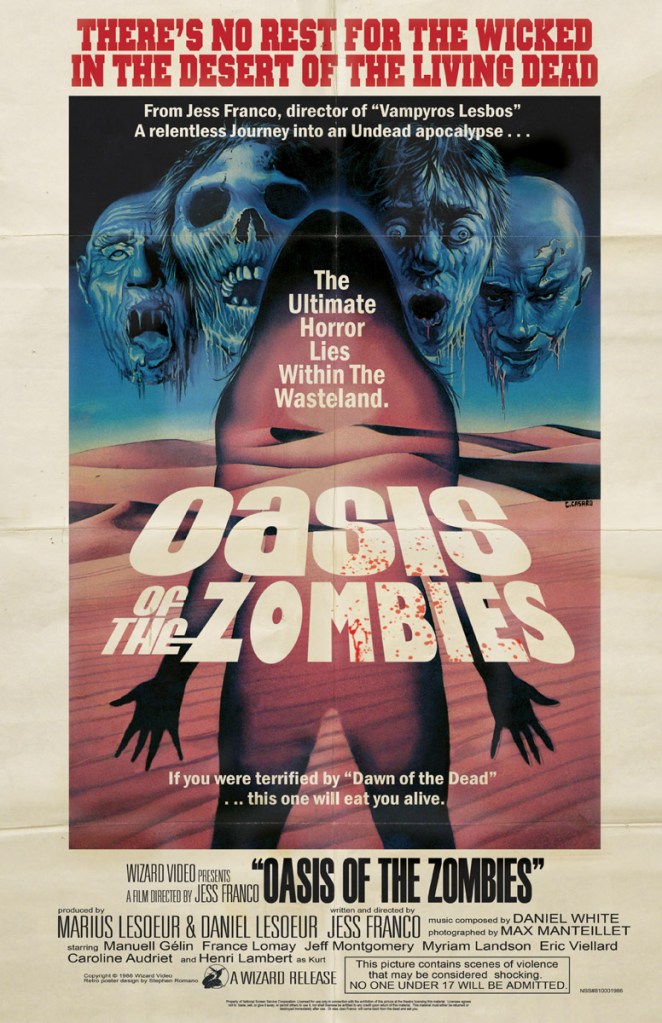
As for Jess Franco: He and the producer behind Zombie Lake, Eurocine (we’ve reviewed quite a few Eurocine films), made nice and did the Nazi Zoms thing again — only ditching the lake for the desert in Oasis of the Zombies. Did he fair any better? Oh, hell no. But that doesn’t mean we don’t dig it, for B&S reviewed it twice: Roger Braden and Sam the Boss offer their takes. As for my bottom line: Zombie Lake just isn’t all that nasty. Now, if the U.K. had a “Video Boring” list, those tea-taxin’ Red Coats would be onto something.
To quote Sam in his review of Burial Ground: “This movie is a real piece of shit. But you know, it’s an entertaining piece of shit. It’s the kind of film you can say, ‘But yeah, did you see Burial Ground? That one is totally insane.'”
Sadly, the same can not be said for Zombie Lake.
You can get Zombie Lake from Diabolik DVD. It’s also on the Euro Shock Collection issued by Imagine Entertainment (2001), as well as Arrow Films (2004), and Kino reissued it as a Blu-ray (2013). But you know us: we found you a freebie on You Tube.
Stay with us all this week, as we still have two and a half more days of U.K. video nasties from their three “Section” lists to review.
One of the many re-titles and covers to Franco’s Convoi de filles.
Update: In January 2023 we rolled out our Jean Rollin-uary month of reviews. If you’re not familiar with Rollin’s works, click through and check them out. We gave Zombie Lake a new take because, well . . . you never can never watch enough Jean Rollin flicks!
Oh, yes! If you do a month of Jean Rollin, you must do a month of Jess Franco! February 2023 was our “Jess Franco Month.”
About the Author: You can learn more about the writings of R.D Francis on Facebook.He also writes for B&S About Movies.
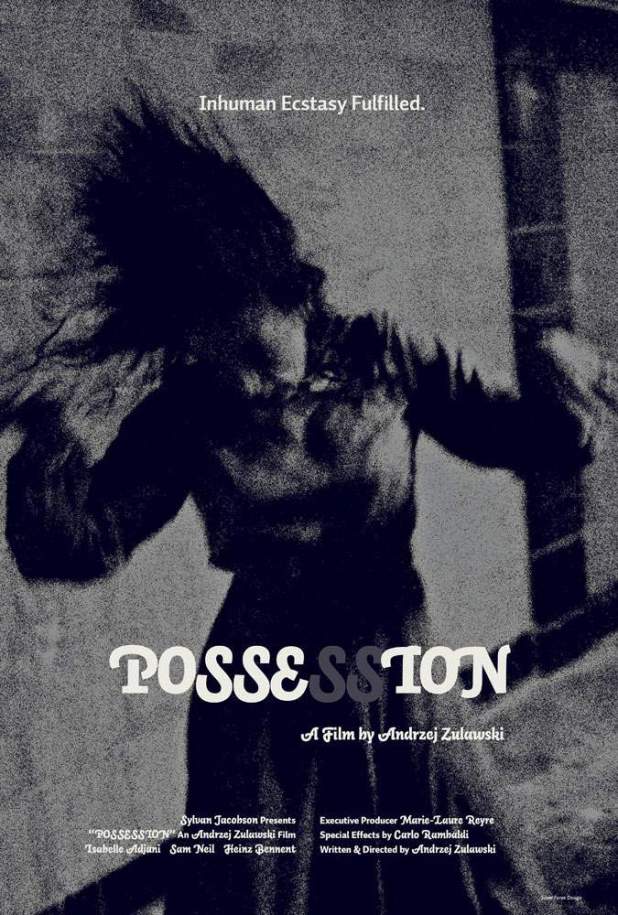
Director and co-writer Andrzej Żuławski’s only English language film, Possession is the only section 2 video nasty that has a lead actress, Isabelle Adjani, who won the Best Actress award at the Cannes Film Festival.
I often think, “Man, it would be awesome to act in a movie or be part of one,” but at no moment during this movie did I wish that I could be on the other side of the lens. Written during the painful divorce of Zulawski with actress Malgorzata Braunek, this is the very definition of a rough watch.
So what the hell is going on here? Is Anna going insane? Is Mark (Sam Neill) unable to escape their breakup? Are they both dealing with things their own way, and by that, I mean Mark replacing his wife with a subservient drone of a woman (also Adjani) while Anna grows her own Mark in a jar? Is this all happening in a dream? Or are all the dead bodies, grocery throwing freakouts and electric knife mutual self-mutilation sessions really happening? Is it really about Zulawski divorcing himself from Poland? Or maybe as it was made in a still-divided Berlin, is it hopeful about the destruction and rebirth that will come from the tearing down of the Wall?
Zulawski went into this movie wanting to kill himself, as his wife had left him (the scene where the child is left alone for hours and the husband comes home to discover his son naked and covered in jelly is autobiographical) while the strains that Adjani put herself through left her in the throes of massive depression and suicidal thoughts, which the director confirms that she acted upon but survived.
Neill would later say, “I call it the most extreme film I’ve ever made, in every possible respect, and he asked of us things I wouldn’t and couldn’t go to now. And I think I only just escaped that film with my sanity barely intact.”
Mark is a spy home from the cold, yet he returns to a wife who no longer wants to be part of this relationship. She can’t tell him why – it’s not a new lover – but she doesn’t want him any longer. He wants out of the espionage life, even if his handlers seemingly refuse to allow him that choice. Yet she does have a lover – Heinrich – who is not only cucking Mark but easily bests him in a punchup. He in turn attacks his soon-to-be ex-wife and then they take turns attacking one another and themselves with the aforementioned carving knife.
Anna also has a second apartment and another life, a tentacled creature that lives with her, and a room full of destroyed body parts, which soon include the detective that Mark has hired to follow her and that detective’s lover.
Before long, the love that exists – or doesn’t – between the married couple consumes everyone, sometimes in fire, sometimes in bullets, sometimes in knife wounds, sometimes just one another on the kitchen floor.
That tentacle thing – credit goes to Carlo Rambaldi. You know, I just saw A Lizard In a Woman’s Skin at a crowded drive-in and even horror-hardened viewers audibly gasped when his creation of still alive dogs torn apart flashed across the screen. Between that, Alien, Deep Red, A Bay of Blood and so many more, I find it rather life-affirming that the same man who created so many nightmarish visions also had a hand in creating E. T.
At one point, Mark says, “You know, when I’m away from you, I think of you as a monster or a woman possessed, and then I see you again and all this disappears.” This is the most real moment inside a film filled with a cavalcade of fantastic imagery. Tearing apart the life you once had for the promise of something new that may not be as good or may take a tremendous amount of emotional work is the most frightening thing I’ve ever done in my life. Possession gave me flashbacks to those moments where the world felt like it was ending every day, where I felt like a monster and when the only person you could confide in became the person you could never speak to again.
Man, Possession is not an easy watch. Just warning anyone of that going in. But hey – movies should not be just wallpaper. They should attack you. They should change your consciousness. They should take your psyche like a rock tumbler and slam you against the walls over and over until you emerge better.
A new 4K scan of this film will make its U.S. debut during Fantastic Fest on Saturday, September 25, completing the circle of this film from being critically savaged to embraced. It will also play the Beyond Fest, as well as opens theatrically and digitally exclusively at Metrograph October 1 In theaters, then nationwide on October 15.
ABOUT THE AUTHOR: Eric Wrazen is a Technical Director and Sound Designer for live theatre, specializing in the genre of horror, and is the Technical Director the Festival de la Bête Noire – a horror theatre festival held every February in Montreal, Canada. You can see Eric as an occasional host and performer on Bête Noire’s Screaming Sunday Variety Hour on Facebook live. An avid movie and music fanatic since an early age, this is Eric’s first foray into movie reviewing.
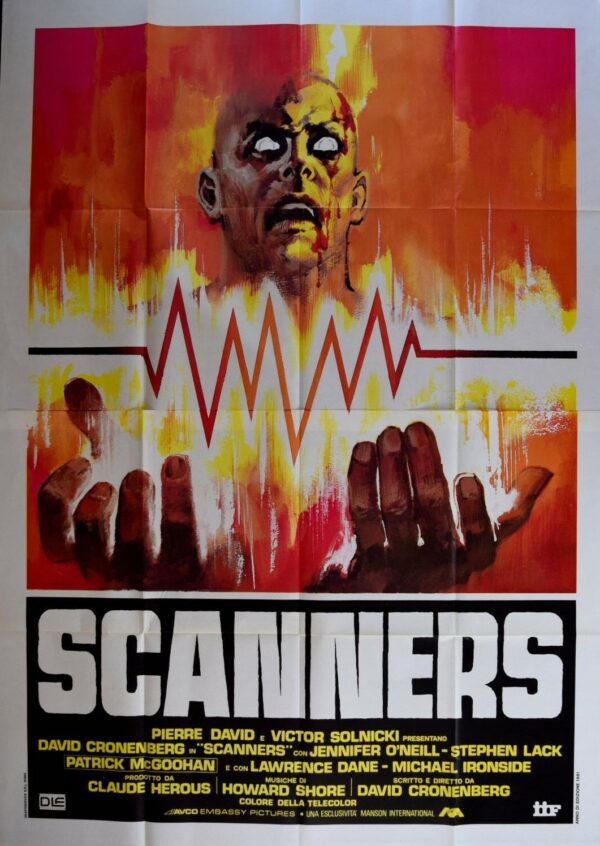
It’s kind of difficult to review a film like Scanners without restating the common points that have been reviewed and discussed ad nauseum for decades within the horror community.
Its Cronenberg. It’s a classic. It’s a fun, yet flawed film. It starts (and kinda also ends) with an exploding head.
If there is one single aspect of Scanners that got it on the BBFC’s Sh*t list, it was that exploding head scene… which, incidentally, happens within the first 5 minutes of the movie! Scanners was most likely the fastest movie added to the list of nasty films as the reviewer probably only had to see the first 5 minutes before declaring “Blimey! EE’s gone and blown up dat mates ‘Ed, he did!” (Yes, in my mind, the BBFC reviewer has a Liverpool accent) and putting Scanners in the reject pile.
For the fact-focused crowd, Scanners was released in theatres in 1981. Directed by David Cronenberg and featuring some acting talents that SF, action, and horror fans will easily recognise: Michael Ironside as the baddie Darrel Revok, Patrick McGoohan as Dr. Paul Ruth, as well as lesser knowns Stephen Lack as our clueless Scanner hero Cameron Vale, and Jennifer O’Neill as Kim Obrist, another scanner who, is like the leader of a commune of hippie scanners, or something. Fun fact: the exploding head guy was played by Louise Del Grande, who is very familiar to old-timey Canadians, because he was the lead in a really popular “Murder She Wrote-style” mystery show that aired on CBC (Canada’s public TV broadcaster) for years. The show was called “Seeing Things” and Del Grande played… get this…. a crime-solving psychic!
The Scanners production itself was a troubled one. The movie was funded via a Canadian government tax incentive program (as were all of Cronenberg’s early films) and the catch was the film had to be in the can by a specific date in order to get the funding… which resulted in a rushed start to filming – before the final script was even done – which I feel adds to the unhinged and somewhat disjointed flow of Scanners.
Historical side note: Scanners was the first Cronenberg movie I saw in the theatre when it released in 1981! It’s one of the pivotal movies that got me hooked on bizarre, weird sh*t, and I will always love it for that reason. This was my first re-watch of Scanners in 40 years! (PS – f*ck, I am old).
More useless information: It was filmed in and around Montreal, Canada (my hometown) in locations like a water treatment plant that was 10 minutes from my boyhood home, and “2020 University” – the very groovy 70’s shopping mall featured in the opening scene.
The film itself is a fun ride if you are willing to accept some glaring flaws, such as: over AND under acting by the entire cast; continuity errors, obvious lack of basic understanding of how computers work, and an evil organization so badly run that the head of security is in cahoots with the guy trying to destroy the company, who is incidentally the son of the company’s head of R&D.
Regardless, Scanners is a fun film to watch. I viewed the old MGM DVD release and now I’m seriously considering getting the Criterion release to enjoy all the extras.
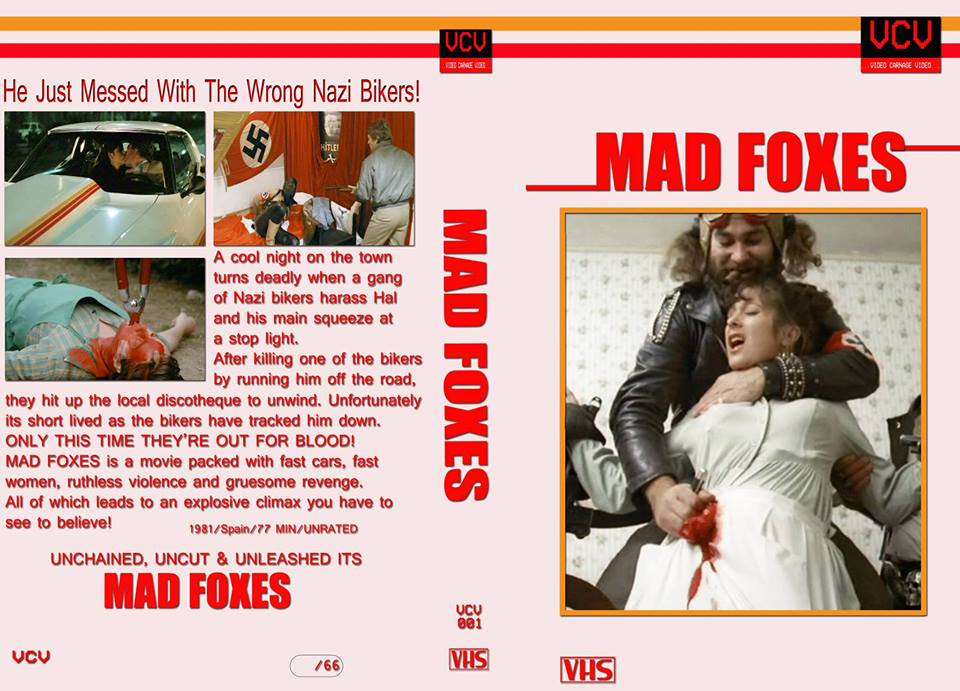
This Spanish revenge movie — with a Nazisploitation twist — is all about a man getting back at the bikers who killed his wife. Sounds simple? Well, there are tons of scenes that upset U.K. censors, including rape, gore, castration and nunchakus. Yes, that’s right. Not the Nazi stuff. But the nunchakus.
According to the BBFC website: “The success of Enter the Dragon, and the kung-fu genre in general, saw public concerns arise at the concurrent spread of the use of chainsticks (or nunchakus) and other martial arts weaponry among London youths. Media coverage of the issue caught the eye of Murphy’s successor as BBFC Secretary, James Ferman. In December 1979, Ferman recalled Enter The Dragon for another look in the light of these anxieties. Ferman asked the film’s distributor to remove the sight of chainsticks in the fight sequence between Bruce Lee and his attackers. The images nunchakus were also requested to be removed from the film’s trailer and its promotional posters.”
The removal of martial arts weaponry soon became standard BBFC practice with the advent of VHS bringing violent kung-fu films into the home in the early 1980s. When Enter The Dragon came out on VHS, some cuts were restored but the weaponry remained cut out, which has lasted way into the DVD and streaming eras.
That’s right — you can show guns in U.K. films, but not martial arts weapons.
Sounds legit to us.
Besides, you can’t go wrong with a film that pairs the violence with my then — and still — favorite band (next to the almighty Saxon and April Wine), Switzerland’s Krokus with “Easy Rocker” and “Celebration.” Appearing on their U.S. breakthrough album Hardware (1981), the album spawned their first U.S. Top 40 hit with “Burning Bones,” courtesy of its AC/DC-like qualities.
In fact, when formulating their next move after the death of Bon Scott, one of the first people Angus Young and the boys called in for an audition was Krokus lead singer, Marc Storace. At the time, Krokus made some headway in U.K. and U.S. with the minor hits “Heatstrokes” and “Bedside Radio” from Metal Rendezvous (1980), which were big hits throughout Europe. Storace turned them down because he felt Krokus was “going places.”
Then Black in Black (1980) — featuring Brian Johnson — shook the world. And I rented a copy of Mad Foxes after reading Krokus tunes would be in the film. It took four video stores, before I found a copy. And I was a happy, young metal pup.
You can watch the bad karate madness backed by Krokus on Tubi. You can hear April Wine tunes, by the way, in the Canadian film The Killing of Randy Webster. As for the almighty Saxon: How is it that they only made one film soundtrack appearance? “Everybody Up” (from the beginning to their downward slide; but the albums from that era grew on me over the years) from their seventh studio album Innocence is No Excuse (1985) appears on Lamberto Bava’s Demons released that same year.
About the Author: You can read the music and film reviews of R.D Francis on Medium and learn more about his work on Facebook.
Acclaimed music video director Jay Dubin* made his feature film debut with this chronicle of Black Sabbath’s and Blue Öyster Cult’s co-headlining “Black & Blue” tour, which became, not only a concert box office smash, but also a hit on the U.S. “Midnight Movie”** circuit — alongside AC/DC: Let There Be Rock, released in 1980 and playing out through 1981.
The footage was shot on October 17, 1980, at the Nassau Memorial Coliseum in Hempstead, Long Island, New York. Originally shot for and used on a December 6, 1980, episode of Don Kirsher’s Rock Concert*˟, that footage, along with additional footage, was edited into this feature film released in 1981 after the completion of the tour (remembering that MTV launched on August 1, 1981, and subsequently ended theatrical-released concert films and programs like Rock Concert). The tour and its accompanying film came together under the tutelage or Sandy Pearlman, who managed both bands at the time (as well as New York’s the mighty Dictators and Shakin’ Street at one point). (Blue Öyster Cult returned to the venue on December 30, 1981; their live version of “Dr. Music” appears on their 1982 album, Extraterrestrial Live.)
The U.S. theatrical poster/courtesy of the IMDb.
At the time, both bands were on the road as separate headliners (with the likes of Molly Hatchet, Journey, and Cheap Trick as their opening acts): Black Sabbath was promoting Heaven and Hell, their new release featuring Ozzy Osbourne’s replacement in ex-Rainbow frontman Ronnie James Dio; Blue Öyster Cult were promoting their seventh album, Cultösaurus Erectus, which, while a Gold-selling album (500,000 units), it produced no hit singles, although “The Marshall Plan” became an FM rock favorite. (BOC would have to wait until their next album, 1981’s Fire of Unknown Origin to — as did their 1976 album, Agents of Fortune, with “Don’t Fear the Reaper” — return them to the U.S. Top 40 album and singles charts.)
Speaking of “The Marshall Plan,” that’s how the film starts off: with BOC’s new, pre-MTV “promotional clip” featuring Don Kirshner (who also appears in the song’s speaking-intro). Then we segue into the concert, with Ronnie James Dio tearing it up on Sabbath’s new hits: the mighty “Neon Knights” and the title cut from the new Sabbath’s album, Heaven & Hell (they wanted to ditch the Sabbath name and call the Dio-fronted concern Heaven & Hell; the record company said otherwise), as well as the Ozzy-era classics “War Pigs” and “N.I.B.” BOC gives us “Cities on Flame (with Rock ‘n’ Roll),” while drummer Albert Bouchard dons a Godzilla mask for their FM radio stable, “Godzilla,” and Eric Bloom rides out on a chopper as a precursor to their cover of Steppenwolf’s “Born to Be Wild.” And there’s lot of purple “black and blue” lights as fog machines belch, stage throwers spew flames, and giant, illuminated crucifixes flash in the darkness under seizure-inducing strobe lights.
The film cuts back and forth between the band’s sets. There’s no backstage hokum, or interviews (as in the aforementioned AC/DC: Let There Be Rock), no fancy camera work (as in that said film; just transitional fades), or cinematic special effects (outside of what the bands bring to the stage) — just pure rock ‘n’ roll. The film is cut seamlessly, so you even though we go back and forth between the two bands for the 80-minute running time, it’s never choppy or jarring.
After their joint October 17, 1980, appearance at the Nassau Memorial Coliseum, the tour moved to Madison Square Garden: for that show, BOC went on first and Sabbath went on second. Then there was the riot in Milwaukee (which was not filmed and does not appear in the film).
The Riot
As the theatrical one-sheet states: one and a half million people attended the co-headlining tour. However, what is not preserved in the frames of Black & Blue was a tale told in a October 25th, 1980, Billboard magazine issue regarding the tour’s infamous October 9, 1980, gig at the MECCA – the Milwaukee Exposition Convention Center Arena, which disintegrated into a 9,000-person riot. (I remember the musical melee making the national, network nightly news and my ol’ pop chastising “my generation,” for the umpteenth time.)
Opinions vary as to the cause: BOC’s set ran too long and fans wanted the more popular Sabbath. Or it was the hour-long delay between the band’s sets. Then, with Sabbath finally on stage, while the lights were down (for a theatrical effect), Sabbath bassist Geezer Butler was beaned on the head by a beer bottle by the third song. The lights came up: Sabbath is gone. The stage is empty.
Between BOC going long, the hour wait time, and Sabbath abruptly leaving the stage to rush Butler to the hospital: a riot ensued. Riot geared-officers 150-strong arrived. Fist-fights broke out inside and outside the venue. Over 160 goers were arrested (a mix of riot and drug-related charges) and the venue sustained $40,000 worth of damage. In the aftermath, “hard rock” concerts were banned at the MECCA and beer sales for all shows, suspended. (The exact page with the Billboard story is HERE; the embedded You Tube video below has the audio of the riot.)
The MECCA’s next big concert starred (the non-hard rock) Bruce Springsteen and the E Street Band on Oct. 14; the show went on without incident, but without beer sales. Of course, when you’re dealing with the economic realities of operating a multi-purpose indoor arena, you cave when the accountants break out the spreadsheets. So the bans were lifted, with hard-rockers AC/DC and Van Halen appearing, respectively — and beer taps, flowing.
The DVD Reissue
Black & Blue was released to the ’80s home video market by Warner Bros. in the U.S. (Black Sabbath’s label, which also released AC/DC: Let There Be Rock to video) and Polygram’s video division in the U.K. In the U.K. and Japan, in addition to VHS, the film was also released on both Betamax and Laserdisc formats; the first VHS-only copies appeared in Europe (outside of the U.K.) and the U.S.; first Laserdisc was issued in 1984 by Polygram, while Warner Brothers released it in Japan on a (quickly pulled from the market) 1993 Laserdisc.
According to Dio.net, in 2002, Castle Pictures promoted the first, official DVD reissue — with licensing snafus leading to the project’s cancellation in January 2003. By 2004, Universal Studios’ video division acquired the rights and released their DVD into the marketplace. The same licensing issued resulted in the film being quickly pulled from the European market — but not until a limited amount were distributed into some European countries.
While the earlier-released (most likely the Laserdisc over the VHS or Beta versions) home video versions certainly fueled the bootleg markets in the pre-Interent epoch, those 2004 Universal DVDs have certainly been grey-marketed, since. In fact, a Brazilian company flooded the market with copies ripped from the Laserdisc — rips considered to be of “higher quality” than the countless overseas DVD-r greys in the online marketplace ripped from the more accessible (and worn out) VHS tapes. Those ersatz impresses carry release dates of 1998 and 2008. In 2006, the quickly-pulled Universal-European DVD returned to the grey market, the copies believed to originate from companies based in Russia, Sweden, and Finland.
As you can see, Black & Blue is a legalese quagmire, with the members of Blue Öyster Cult wanting the release, while and the members of Black Sabbath — including Sharon Osbourne (?) and Wendy Dio — not wanting it on the market. Ironically, all of their respective legal bickering ended up feeding the grey markets and now fans are stuck with inferior impresses. Wouldn’t you want to do a full restoration proper and put an official version in the marketplace to quash the bootleggers?
Whatever.
You know me: I always go for the original VHS, anyway, which is a direct copy of the film I enjoyed all those midnight-weekends ago in that little ol’ six-plex theater. For before there was “my MTV,” and I was able to go to concerts, and I wanted more than watching bands on TV by way of the pre-MTV Don Kirshner’s In Concert and Rock Concert, and NBC-TV’s The Midnight Special, going to a movie theater to “see a concert” was all we had in the ’70s and early ’80s.
A blessing . . . but ultimately, a curse.
The “Midnight Movie” Days
Yeah, it’s fun to be able to go back to revisit these concert films and other, non-rock “Midnight Movies.” And it’s great for B&S About Movies’ younger rock flick fans to experience the Black and Blue metal time capsule for the first time. But experiencing this Sab/Cult document is all about the theater: with the ticket holders treating the movie theater like a concert hall, screamin’ and-a tootin, while sneaking-in brews and lighting joints to the chagrin of the ushers. As a “Midnight Movie” goer, you remembered to pack an extra t-shirt, hang your head out of the car window to air out your hair, then hit yourself with a slap/squirt of cologne (guys used Memmen Skin Bracer; chicks used Revlon’s Jean Nate) to rid your teen-self of the second-hand pot smoke (and Listerine flowed to cover the brew breath, since we passed a bottle).
Yeah, before the advent of video stores and cable television in the ‘80s, the “Midnight Movie” was a ‘70s marketing gimmick for non-commercial films, mainly exploitation films and just about everything that made the dreaded “video nasties” list. Sam Raimi’s The Evil Dead, the animated rock flick Heavy Metal, and Pink Floyd: The Wall broke to a mass audience, first, as midnight programmers. British graphic design company Hipgnosis — known for their Pink Floyd and Def Leppard album covers — founded by Storm Thorgerson and Aubrey Powell, had a “Midnight Movie” hit on their hands with their long-form video-infused drama, Incident at Channel Q.
For those of us too young to go to concerts, we got to see Led Zeppelin for the first time in The Song Remains the Same. We became “Dead Heads” courtesy of The Grateful Dead Movie. Our first AC/DC concert (distributed by Ferd and Beverly Sebastian of Rocktober Blood fame; also a midnight flick, natch) was, again, AC/DC: Let There Be Rock (linked above). And how can we forget The Rocky Horror Picture Show? The ’70s radio comedy, FM, also, because of its rock slant, ran as midnighter.
Yeah, the good times of convincing the ol’ ‘rents to let me go to the theater to see AC/DC: Let There Be Rock and Black & Blue with friends because, at the time, no way the ‘rents were allowing me to go a concert, alone, and they sure as hell weren’t taking me to a show. (The last concert my dad went to was the tragic Buddy Holly tour in 1959 at the Syria Mosque in Squirrel Hill, east of Pittsburgh. Square.) Black & Blue was pure awesomeness for me in the theater in 1981. Re-watching it for the first time in forty years to preserve it for the pages of B&S About Movies has been a real treat. And it’s been forty years because, between all of my video store memberships and cut-out bin excursions, I never once came across a VHS copy of Black & Blue.
While you can readily purchase greys of Black & Blue at Amazon.com (some may be original presses, but emptor the caveats), we discovered a ripped copy on You Tube.
The 1980 Polygram European VHS artwork/courtesy of Dio.net.
* After his work with Sandy Pearlman to promote Black Sabbath and Blue Öyster Cult, Jay Dubin directed multiple video hits for REO Speedwagon, Hall & Oates, John Mellencamp, Billy Joel, and Chicago, as well as concert film documents for Andrew Dice Clay. Durbin’s only other film, according to the barren page at the IMDb, is the 1982 TV Movie Dangerous Dan. All we know about the film is that it’s co-produced by Dean Hardgrove Productions and Fred Silverman Productions, who produced a lot of product for NBC-TV, but it’s distributed by Viacom, which is tied into CBS-TV. So, who knows which network it aired on? If you know anything about the movie, let us know.
*˟ We discussed Don Kirshner’s work in rock ‘n’ roll television with our reviews of his film productions with Jeff Beck’s Kim Milford in Song of the Succubus and our “Exploring: Don Kirshner” featurette.
We Bow: To uber-Dio fan Tapio Keihänen at Dio.net, as well as the Milwaukee Sentinel Journal, for the research in sorting out this hard-to-find, beleaguered, classic “Midnight Movie” for preservation on B&S About Movies. Somebody’s gotta do it, right? No sleep ’til Squirrel Hill, daddy-o.
About the Author:You can read the music and film reviews of R.D Francis on Medium and B&S Movies, and learn more about his work on Facebook.
I have no idea what mania exists within Beaver Dam, Wisconsin, but that’s where this movie comes from and man, you know how people say that movies feel like transmissions from another dimension? They only think they know what they’re talking about and really wish that they had seen this movie.
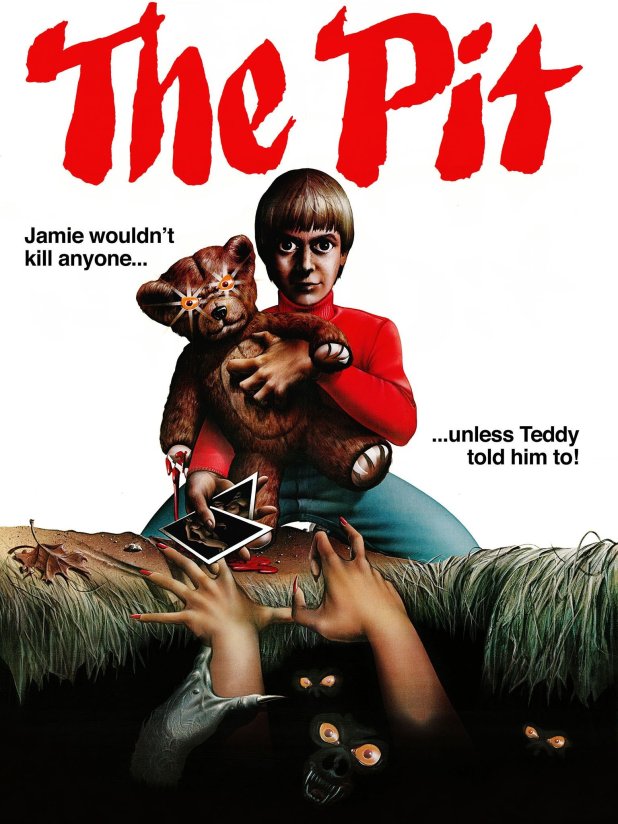
Everybody in town hates Jamie Benjamin. The kids in school, other kids who don’t go to school with him, eben old ladies, everyone he meets either makes fun of him or abuses him. His only friend is Teddy, his stuffed bear, which may be sort of strange, as he’s twelve. And yeah, he’s starting to get into girls thanks to puberty, including his babysitter, who he soon takes to show one more secret.
You see, Jamie has a pit in the woods filled with Trogs that he feeds with raw meat. Teddy suggests feeding everyone who treats him badly to these monsters and Jamie agrees, but then Sandy gets knocked into the pit and gets devoured. A bitter Jamie allows the Trogs to escape and they attack the town before a militia kills them and he’s sent to live with his grandparents.
Is puberty a pit filled with hairy beasts that love to destroy human beings? This film believes that. It’s also a movie that has no interest in the thing you call real life. I mean, the original script definitely felt that way, as the Trogs were only in the mind of Jamie and not real.
This is the only movie Lew Lehman ever directed. He did write several films — Phobia — and for the Police Surgeon series, a TV show he also was worked on as the music supervisor. His wife wouldn’t allow him to shoot the nude scenes, so the story goes that the screenwriter shot them instead. The only shot involving nudity that Lehman was allowed to film was the skinny dipping scene and only because the actress was his daughter Jennifer, adding one more bit of weirdness to an odd movie.
EDITOR’S NOTE: We originally covered this film on June 1, 2018. Now that Blue Underground is releasing it in a UHD edition, it’s time bring it back and share how you can get this expaned edition.
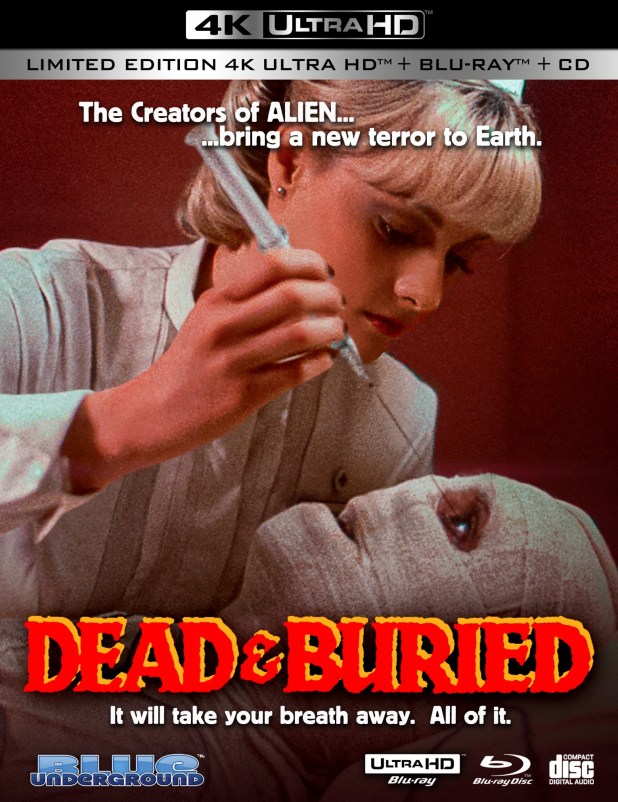
Potter’s Bluff is one of those perfectly gorgeous New England coastal towns. You know, the kind where visitors are beaten, tied to a post and set on fire while people take photos of them. And then, when they survive, nurses stab them right in the eyeball with a syringe.
Dead and Buried was written by the Alien team of Dan O’Bannon and Ronald Shusett and featured Stan Winston special effects, so the poster was justified in shouting, “From the people who brought you Alien…” Unfortunately, those people do not include Ridley Scott, as we have Gary Sherman directing this (he also helmed Poltergeist III). That said, O’Bannon disowned the film, claiming that Shusett had actually written it by himself but needed O’Bannon’s name on the project to get it made. He never made any of O’Bannon’s suggestions before it was produced.
Sheriff Dan Gillis (James Farentino, The Final Countdown) is our hero and he is working with Dobbs (Jack Albertson, Willy Wonka & the Chocolate Factory and TV’s Chico and the Man), the town’s coroner/mortician to solve the murders that have gripped their small town. And with each one, a photo of the murder is found.
As Gillis rushes to a suspected attack, he accidentally hits a man, whose arm is stuck in the grill of his car. The man attacks the sheriff, then takes his arm and runs away. Further research shows that a tissue sample of the man shows that he has already been dead for four months.
The sheriff begins to suspect everyone, including Dobbs, who he learns was fired from his last job for conducting unauthorized autopsies, and his wife Janet (Melody Anderson, Flash Gordon), who has begun to teach witchcraft to her students.
It turns out that Dobbs has learned how to reanimate the dead and that nearly everyone in town — I’m looking at you, Robert Englund — are under his control. He considers himself an artist who improves the lives of the dead after he controls them. Just then, the sheriff notices that his hands are rotting and Dobbs offers to repair him. That’s because he’s been dead all along, as his zombie wife had killed him during sex, a scene he watches as its projected on the wall.
Dead & Buried has a great trailer that it lives up to. While it feels very Carpenter-esque, it lacks the style and verve of his films. That said, there are some interesting touches, such as the director avoiding the color red throughout the film so that the murders would be more shocking.
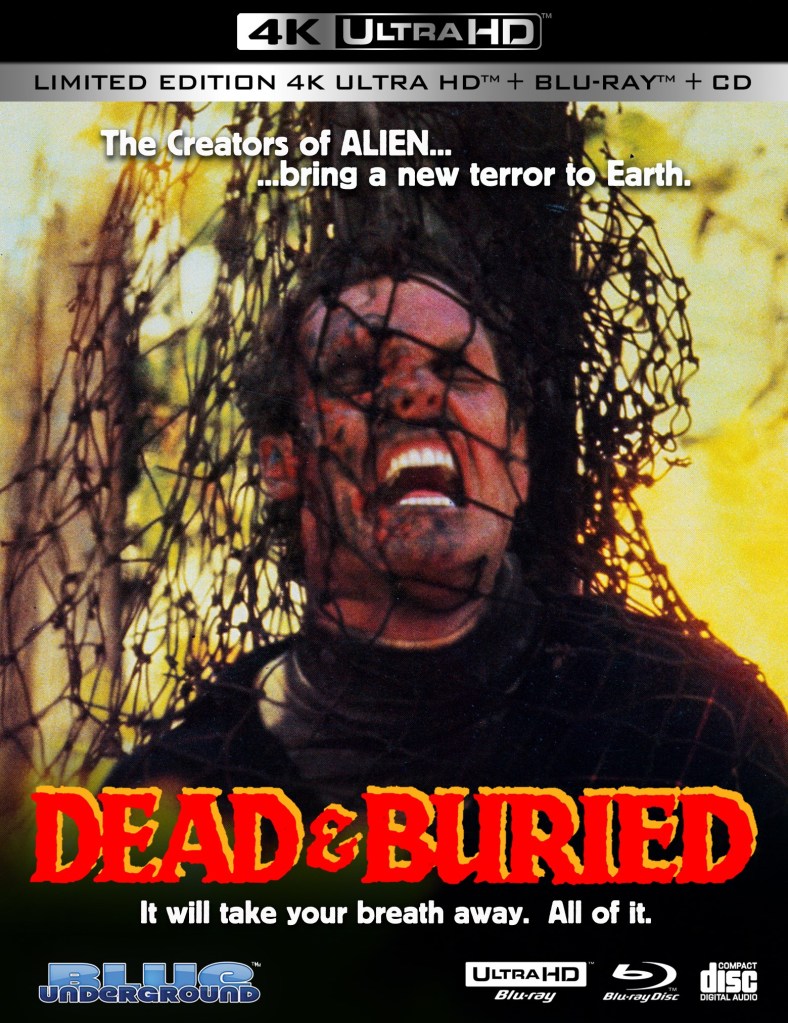
The new Blue Underground edition has both Ultra HD Blu-ray (2160p) and HD Blu-ray (1080p) Widescreen 1.85:1 feature presentations of the film, plus four different commentaries (director Gary Sherman; Co-Writer/Co-Producer Ronald Shusett and Actress Linda Turley; Director of Photography Steven Poster, ASC; Troy Howarth and Nathaniel Thompson), as well as a great behind the scenes that was actually shot as home movies with comments by the crew; a look at the locations now and then; new interviews with Sherman, composer Joe Renzetti and novelization author Chelsea Quinn Yarbro; plus features on Stan Winston’s FX, Robert Englund and Dan O’Bannon. Plus, this packed release also has trailers, poster and still galleries, location stills, a collectible book with a new essay by Michael Gingold and the Original Motion Picture Soundtrack on CD for the first time ever. You can get this from MVD and it comes in three different covers.
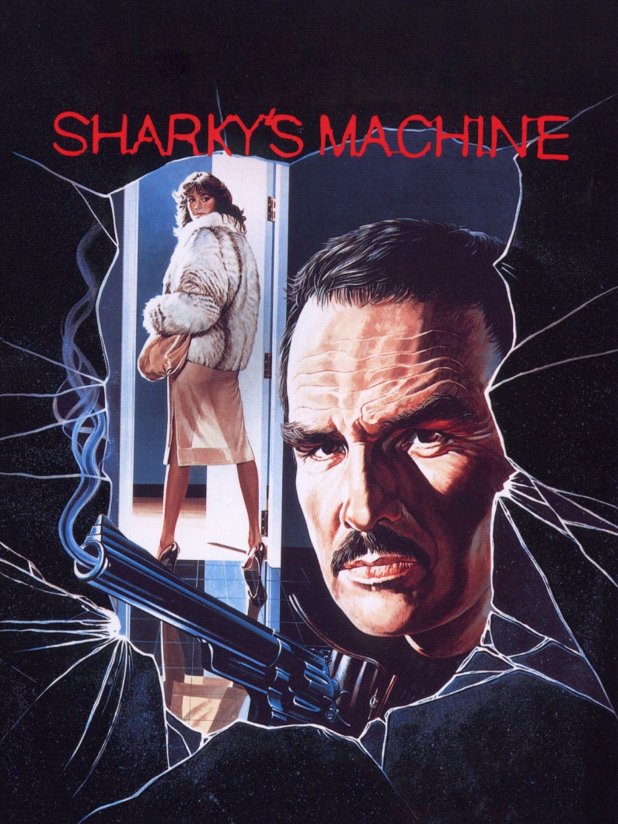
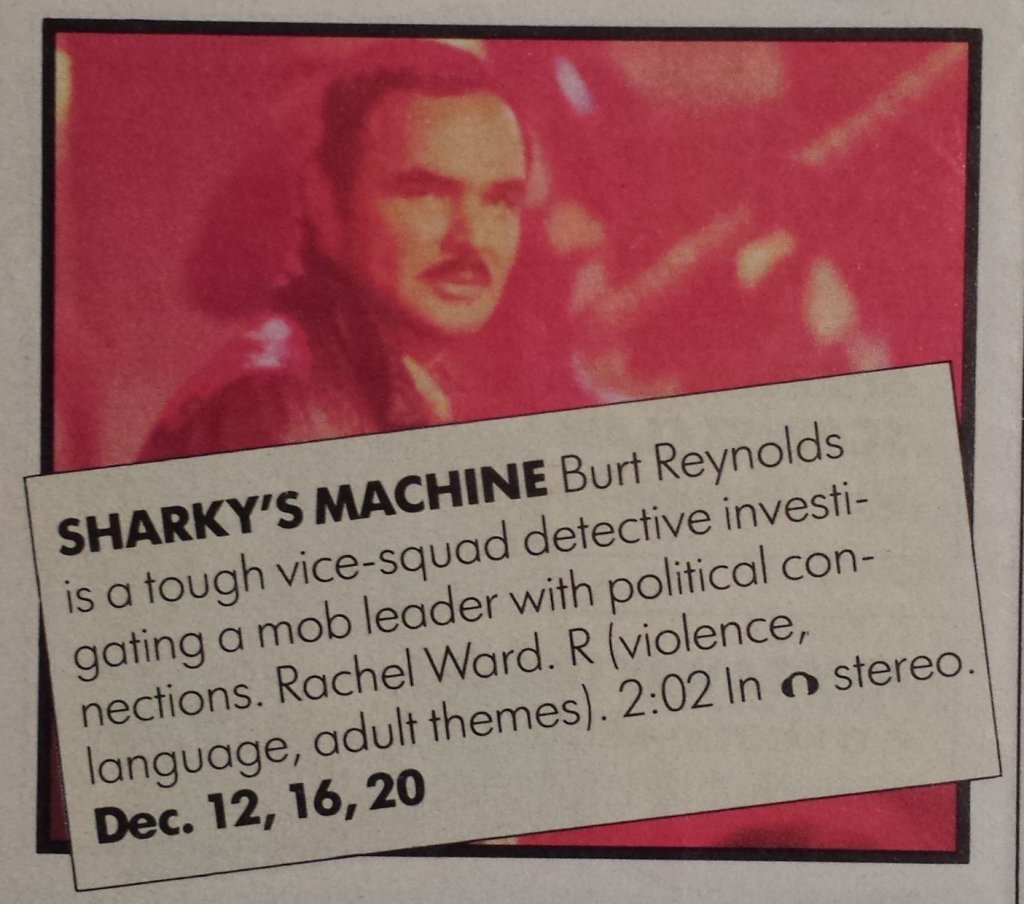
Man, when I was a kid, the only movie that I think HBO had — besides The Car — seemed to be Sharky’s Machine. I never watched it back then and I totally should have, because it would have changed my life.
Based on the book by William Diehl, which was sent to the film’s director and star Burt Reynolds by Sidney Sheldon, this was Reynold’s chance to get away from the funnier movies he’d been making. He told the Boston Globe, “I figured it was time to get away from Smokey. I’d been doing a lot of comedy in recent years, and people had forgotten about Deliverance.”
Reynolds wanted to make a movie like his favorite film ever — the noir masterwork Laura — and he wanted John Boorman to direct. However, he was busy with Excalibur.
A bust gone wrong has moved Tom Sharky (Reynolds) from drugs to the vice squad, the worst occupation a police officer can have. Working under Frescoe (Charles Durning), our hero discovers a high-class prostitution ring that includes a thousand dollar a night girl named Domino Brittain (Rachel Ward) who is connected to governor candidate Donald Hotchkins, who is owned by Victor D’Anton (Italian star Vittorio Gassman).
One evening, while conducting surveillance and falling for Domino, Sharky watches her get blasted in the face with a shotgun by the evil William “Billy Score” Scorelli. Let me tell you, if you think Henry Silva was great before, this is perhaps the best I’ve ever seen him. He’s a force of complete terror and mayhem in this and I couldn’t love him any more after the ending of this film, which features the highest free-fall stunt ever performed from a building for a commercially released film.
As everyone thinks Domino is dead, she suddenly shows up and tells Sharky that it was her friend that ate the blast to the face. Now, she could bring the entire conspiracy down, if everyone can just stay alive.
Tough cop movies only wish they were a sliver as good as this movie. I mean, you have Bernie Casey and Brian Keith as cops, you’ve got bad guys slicing off Burt’s fingers and you have a Doc Severinsen-orchestrated theme that Tarantino took for Jackie Brown.
Supposedly, when Clint Eastwood made Every Which Way but Loose, Reynolds said, “Clint, you’re getting into my territory and if it’s a success, I’m going out and make Dirty Harry Goes to Atlanta!”. When this film went into production, Eastwood sent a telegram to Reynolds saying, “You really weren’t kidding, were you?”
Editor’s Note: We featured this film in our two featurette overviews written by Sam Panico, the proprietor of B&S About Movies, on the rash of Alien-inspired films of the ’80s — “Ten Movies that Ripoff Alien” and “A Whole Bunch of Alien Ripoffs All at Once” — as well as his third part of our “Exploring: Video Nasties Section 3” series. Since this is our “Norman J. Warren Week,” I’ve been inspired to give it a full review proper.
Sam, our Movie-Themed Drink Mixmaster of Ceremonies and overall Chief Cook and Bottlewasher at B&S About Movies, experienced Norman J. Warren’s second foray into the sci-fi genre (his first was the truly awful, HBO-ran comedy Spaced Out from 1979) as a home video release. I, on the other hand, was fortunate (not really) enough to see this mess — and Luigi Cozzi’s Alien cash-in, Contamination — at the local Twin Cinema. Is this as gory and demented — and poorly edited as Cozzi’s? Well, like James Dalton tells the patrons of The Double Deuce, “Opinions vary.” The opinion that doesn’t vary: this movie sucks. Well, we take that back: not if you watch the unsensored version. But still: Think of all of the things that made Alien a “wow moment” film. Think of all of the things that made Mario Bava’s Alien antecedent Planet of Vampires a UHF-TV classic. Now, take all of that all away. Then turn the premise into a (trashy) battle of the sexes, message-we-didn’t-ask-for allegory about the male-powered hierarchy corruption of females.
U.S. theatrical one-sheet.
Thus, unlike with 20th Century Fox being sued by science fiction writer A. E. van Vogt over copyright infringement for using his The Voyage of the Space Beagle (1950) (you did O’Bannon, end of story) in the creation of Alien, the studio had enough common sense not return a legal volley at Shaw Brothers and company for ripping off what was — regardless of it being of a uniquely layered, superior quality — a ripoff itself.
This movie has been, rightfully, criticized for bad sets, poor acting and bad special effects. However, in truth, these are all things you truly need to make a great genre film. But right there in the title, you know what you’re getting . . . if you want to get it. And you know we do: someone is getting inseminated by something from space. . . .
Image of U.S. home video version courtesy of Amazon.
So, what does £1 million and a two-month production schedule get you?
A British/Hong Kong co-production, this was financed by Run Run Shaw of the famous Shaw Brothers, who would also foist 1979’s Meteor into our theaters, if not our hearts. It’s directed by Norman J. Warren, who was part of a new school of ’70s British horror, pushing the boundaries of explicit sex and violence much further than the Amicus and Hammer studios of the previous decades. Cases in point: the obscure Satan’s Slave (Warren’s third film, but first horror film) and the better-known, also David McGillivray-penned Preyand Terror.
Bottom line: If you’re going to make a movie called Inseminoid . . . and a bunch of censors don’t get upset, you’ve really failed at your job. This was one of the first U.K. movies to quickly be released on home video after its appearance in cinemas, which led to it reaching seventh place on the British video sales charts in November 1981. One of the reasons why this movie was so controversial — I mean, other than the fact that it’s a movie for people who want to see an alien impregnate a human female — is that the producers did a direct mail campaign that featured lead actress Judy Geeson screaming alongside a headline that screamed “Warning! An Horrific Alien Birth! A Violent Nightmare in Blood! Inseminoid at a Cinema Near You Soon!”
Director Norman J. Warren came to regret that exploitation-inspired marketing gimmick, saying “The problem with mail-drops is that you have no way of knowing who lives in the house, or who will see it first. It could be a pregnant woman, and old lady, or even worse, a young child. So it was not such a good idea.”
Concerned with a group of Nostromo-inspired archaeologists and scientists excavating the ruins of an ancient civilization on a distant planet, the screenplay was written by Nick and Gloria Maley, a husband and wife special effects team who worked on Warren’s (very good) Satan’s Slave. The screenplay’s working title, known as Doomseed, was changed to Inseminoid, so as to avoid confusion with the A.I.-rape tale Demon Seed (1977), which makes no sense, as that big-budgeted, Herb Jaffe Productions’ sci-fi programmer for Metro-Goldwyn-Mayor wasn’t exactly a hit (or remembered much four-years later). (In some mainland Euro-countries, the film was releases as Seeds of Evil.)
The U.K.-paperback tie-in based on Nick and Gloria Maley’s screenplay. Image courtesy of Vault of Evil: Brit Horror Pulp Plus, where the book is discussed at length by readers.
Of course, Ridley Scott shocked the world when esteemed British actor John Hurt had an alien rip out of his stomach. So, those scenes of a male impregnated via a “face hugger” had to be one-upped. So, this time, the Xenomorph doesn’t waste time laying eggs in a derelict craft for some wayward space jockeys to stumble into: ol’ Xeno goes straight to the incubator source and (violently) rapes Judy Geeson (who we all fell in love with in her film debut, To Sir, with Love (1970); Rob Zombie honored Geeson with roles in his The Lords of Salem and 31). As would any Earthbound-cum-human rape victim of the I Spit on Your Grave or Abel Ferrara-Ms. 45 variety, Geeson’s raging-Ripley has a psychotic break (or a psychic link with her “attacker,” ugh) and kills the crew — then devours their flesh to nourish her “inseminoid” that soon births as hybrid twins.
Do the twins stowaway on the ensuing rescue ship . . . uh, you really don’t know your Alien ripoffs very well, mijo.
You can find out by streaming Inseminoid on Amazon and You Tube.
You say you want to buy a copy of all of, well, most of, Warren’s films? The Indicator/Powerhouse imprint released Bloody Terror: A five-film box set of Warren’s films, which includes Satan’s Slave, Prey, and Terror, as well as Bloody New Year, alongside Inseminoid. So, there you go: You have yet another reason to own a region-free Blu-ray player.
Here’s some trivia: The alien planet in the film was shot on the rocky, Mediterranean island of Gozo. And here we are, all of these years later, reviewing a psychological horror film shot on the island, Gozo (2020). That’s how B&S Movies, rolls.
About the Authors: You can learn more about the writings ofR.D Francis on Facebook. He also writes for B&S Movies.
Editor’s Note: We reviewed this on May 22, 2020, as part of one of our many “TV Week” tributes. It’s back again for the second day of our three-day “Bernard Kowalksi Week” tribute to his drive-in features and telefilms. He directed this CBS film after working on numerous episodes of TV’s The Untouchables and Mission: Impossible, as well as the westerns Rawhide and The Wild Wild West.
Bernard L. Kowalski has a decent horror pedigree, directing Night of the Blood Beast, Attack of the Giant Leeches,Krakatoa: East of Java, Terror in the Sky and Sssssss. Here, he puts theterror on a slow boil and puts Reverend John Keyes (Roy Thinnes, constantly battling the occult) and his wife Lorna (Lynn Loring, The Horror at 37,000 Feet) against an unseen force bedeviling a small Western town named San Melas. There’s voodoo, devil worship and a mute young girl and a gunslinger possessed by the Left Hand Path.
Ray Milland shows up, proving that Old Hollywood is never to be trusted. Plus, there’s Gloria Grahame (Blood and Lace), Henry Silva (Almost Human, Megaforce, the epic Escape from the Bronx), stuntman Stan Barrett, Joshua Bryant (Salem’s Lot), a young Leif Garrett (Thunder Alley) and Jodie Foster’s brother, Buddy.
This 1970s made-for-TV horror neglects the Old West, so it is a strange film to start with. Then again, it also plays the Troll 2 trick of a town with a backward name and a connection to witches, but it doesn’t telegraph that. The ending—which moves to 1971—more than makes up for the slow-moving last 68 minutes. I love dreamy TV movies that take forever to get anywhere.








 B&S About Movies
You must be logged in to post a comment.