Junesploitation 2021: Private Lessons (1981)

June 13: Junesploitation’s topic of the day — as suggested by F This Movie — is ’80s comedy!

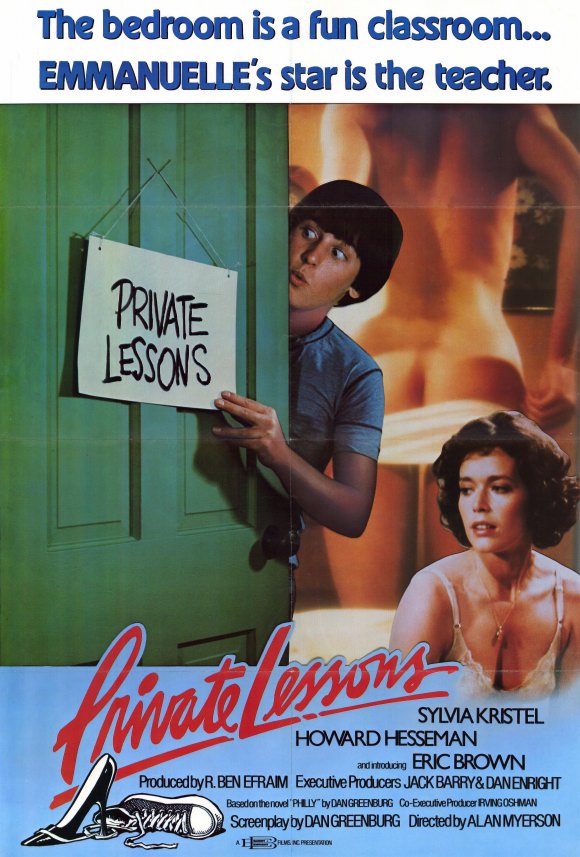
Dan Greenburg has written plenty of books, including the Zack Films and Secrets of Dripping Fang children’s books. He’s also had several of his books made into movies, including the Elvis Presley film Live a Little, Love a Little, which was based off his work Kiss My Firm But Pliant Lips, Foreplay, Private SchoolThe Guardian and the movie we’re about to discuss, which was based on his book Philly.

It’s directed by Alan Myerson, who was O.K. Corrales in Billy Jack and directed Police Academy 5, as well as episodes of Ally McBeal, Friends, The Larry Sanders Show and more. In case you’re wondering, “Does Alan Myerson know comedy?” the answer is yes, as he’s one of the people who helped found The Committee, which counted folks like Howard Hesseman, David Ogden Stiers, Carl Gottlieb, Rob Reiner and Del Close.

That said, Private Lessons made me question my younger self. To wit: when you’re fifteen years old, the opportunity to lose one’s virginity to Sylvia Kristel seems like a dream come true. But when you’re getting close to fifty, you start to cringe at scenes where she tries to lure this film’s protagonist into a bathtub or makes out with him in the back of a limo. It doesn’t seem like a fantasy any longer. It feels wrong.

Philip “Philly” Fillmore (Eric Brown, Waxwork) is a 15-year-old high school student whose father has left him alone for the summer with the only supervision coming from Lester the chauffeur (Howard Hesseman) and Nicole Mallow (Kristel), the family’s new French maid. Sure, Kristel is really Dutch, but we’re not here to quibble about her nationality.

All of her seduction games with our newly pubescent protagonist are all a ruse. She’s an illegal alien who Lester is using in a scheme against Philly and his father. Once they have sex, she’s going to fake her death and Lester will help Philly bury her body. Then, the kid will have to steal ten grand to keep the mysterious demise of Nicole a secret.

The weird thing is, even when Philly busts Lester, he ends up letting the guy keep his job. Once you also see this movie through the eyes of someone from 2021, you realize that Philly is a rich white kid who is going to grow up to be a creep, empowered by the knowledge that he was able to subjugate those in castes below him and still get to repeatedly struggle snuggle with the woman who was once Emmanuelle, despite the fact that she states numerous times in the movie that she feels guilt for having taken his innocence. He has no innocence to speak of, as the last scene in the film shows, where he boldly inquires for a date with a teacher who already informed him that she found his intentions upsetting. I guess money can solve so much, but I wouldn’t really know.

Now for the fun parts.

This movie was Jack Barry & Dan Enright Productions, who usually stuck to producing game shows. They even used one of their announcers, Jay Stewart, to do the trailer’s voice-over. Barry received a lot of hate mail for this film from loyal viewers of his shows who were disgusted by the content of Private Lessons. As a result, he never made another film again.

Yet even more intriguing was the fact that this was the first picture for Jensen Farley Pictures, a subsidiary of Sunn Classic Pictures. Yes, after years of making movies just for America’s families, Jensen Farley would release stuff like The Boogens and another movie where an older woman — Joan Collins! — would deflower a younger man, Homework.

I can’t even imagine the music budget on this movie, because it has everything from Air Supply’s  “Lost In Love” to Eric Clapton, Earth, Wind and Fire, John Cougar and “Hot Legs” “Tonight’s The Night,” and “You’re in My Heart” from Rod Stewart.

It’s also the American debut of Jan de Bont, who was the cinematographer here and would go on to make Speed and Twister.

I should mention that I despise Eric Brown even more now, because not only did he get to do multiple love scenes with Sylvia Kristel, but he did the very same thing in They’re Playing With Fire, except that that time, the kid got to appear with Sybil Danning.

Another last revelation: I now realize that many of the women I’ve dated are just me trying to find my own Sylvia Kristel. Sadly, the real thing had a very rough life that was dominated by addiction and a quest to find a man who could replace her father.

Man, I should never write about comedies, huh?

You can watch this on Tubi.

PS: I totally forgot that Pamela Bryant from Don’t Answer the Phone! is in this.

Porky’s (1981)

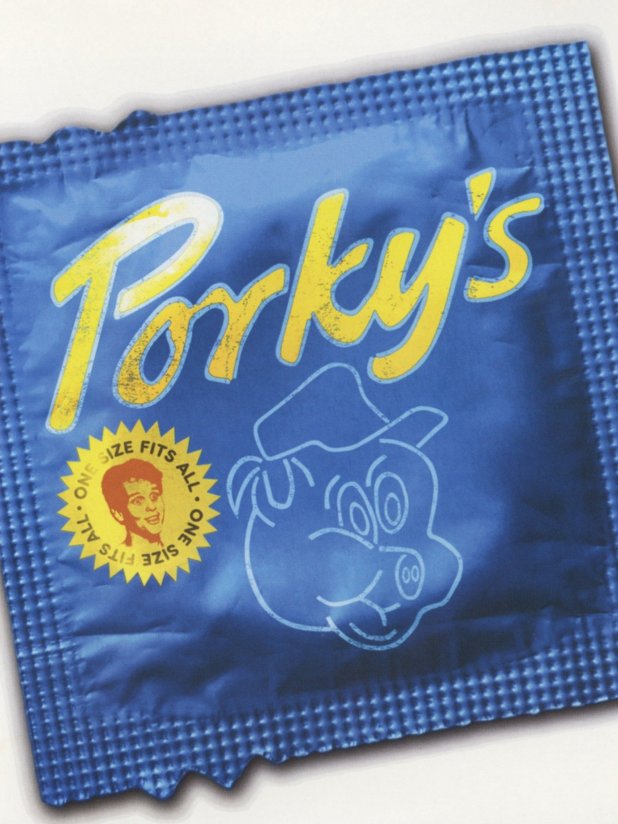
Bob Clark wrote and directed this film — the adventures of the students of Florida’s Angel Beach High School in 1954 — that ended up inspiring an entire generation of movies much in the same way that Animal House inspired it. Clark based the movie on his own experiences growing up.

At one point, every studio in Hollywood turned down Porky’s. Clark got the movie produced through Melvin Simon Productions and a Canadian firm, Astro Bellevue Pathe, making the film up north to take advantage of tax benefits. So yeah. This is yet another Canadian tax shelter film.

Much like, well, every teen sex comedy that would follow this,  the boys all want to lose their virginity. They go to Porky’s, a strip club in the swamp, thinking they can hire a girl there, but they’re all dumped into the Everglades by the club’s owner, Porky. They demand their money back, but Porky’s brother is the sheriff, which means that they lose even more cash.

The movie revolves around getting back at Porky and also getting into the pants of the ladies, including Lynn “Lassie” Honeywell (Kim Cattrall). In 1954 and 1981, this was a common part of growing up. Today’s viewers may not see the film in such a comedic light, but you can’t expect things made forty years ago to understand the progress that has happened since they were made. The fact that you recognize that these movies are outdated points to how much progress we have made; enjoy them for the parts that you can enjoy them for.

The real Porky’s — Porky’s Hide Away in Oakland Park — is now an L.A. Fitness. That makes me incredibly depressed.

Goin’ All the Way! (1981)

This movie starts with a female weightlifter* luring a guy into the gym showers with the promise of sex, then she and her friends shave his head as she laughs. Trust me, if young Sam had seen this in 1981 — he would have been nine — he would have had yet another obsessive crush.

Robert Freeman directed one movie. This is it. He also was the negative cutter on True Blood and the absolutely deranged movie The Forest. It was written by Roger Stone — not the right wing maniac but instead the writer of A Night at the Magic CastleLethal Pursuit and Paradise Motel. He also wrote several of the songs in this movie** — “Goin’ All The Way,” “Love or Nothing at All,” “No Time Like Now,” “Secret Hideaway,” “She’s a Bad Girl” and “Hot Spell” — as well as music for Talk Dirty to Me: Part 2Bodies In HeatAdult 45 Volume 1 and An Unnatural Act. He also wrote the song “Get Even” from Gymkata. He was joined by Jack Cooper, who was not Jackie Cooper.

Artie wants to sleep with his girlfriend Monica and she won’t give in, so they break up, because high school. Actually, because guys, too.

There’s also a big beefy dude named Bronk who is played by Joshua Cadman, Johnny Big Head from Surf II and you should really just go watch that movie instead of this movie. He was also Spike in Angel and yeah, you should watch that instead, too.

The movie ends at a Sadie Hawkin’s Dance, which was an invention of Al Capp in the comic strip Li’l Abner. This dance is one where the girls ask the guys and yet another invention by the high school elite to remind geeks why they must remain in their caste, unasked to the party and home playing Dungeons & Dragons and listening to Grim Reaper. Oh, that was me? Yes it was.

You can watch this on Tubi.

*Seeing as how this is a guy-centered movie, her only name is weightlifter in the credits.

**He was joined by Richard Hieronymus on some of these tracks. He also composed the music for Lethal Pursuit, as well as The ForestSweater GirlsThe Love ButcherAmanda By Night and more.

Evil Dead (1981)

Yeah, I have no idea how we haven’t covered this yet.

Actually, we try to avoid movies that everyone has seen and said things about, because I often worry, “What else can I add to the conversation?”

In truth, I’d seen Evil Dead II before the original and preferred the comic take on the same story. And Army of Darkness takes that goofiness, mixes in some peplum and Harryhausen and gets even cooler. I’ve ever seen — and been coated with gore during — the stage play. And we even talked about Within the Woods, the proof of concept that sold this movie.

What can I say about this movie that’s new and different? Do you want me to say something like, “It’s a less claymation version of Equinox?” Because, yes, I absolutely believe that to be true but I’m still pretty amazed by what Sam Raimi and his skeleton crew were able to get out of this movie.

How great is it that Raimi’s career started here, mounting a camera to a board and running through the woods chasing people to try and get the perfect shot? Evil Dead is infused with a heavy metal energy and blows through 85 minutes like a band blasting as many songs as it can in one set so it can rock your face off.

Where the later movies lose their edge slightly — there’s no way Ash is getting killed — everyone in this movie is fair game. It feels dangerous and unhinged, as only the best horror movies can be.

I mean, it must have worked out. They’re still making sequels and video games and toys, after all.

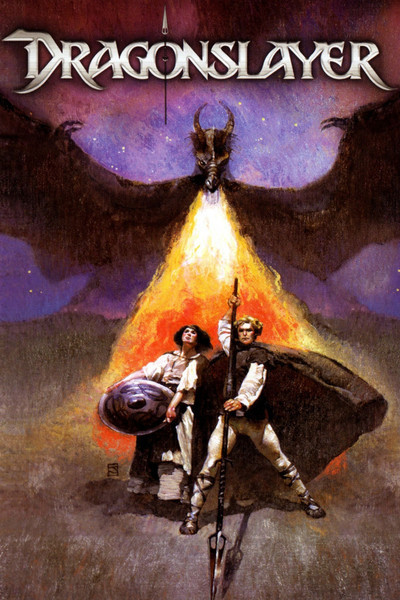
Dragonslayer (1981)

After Popeye, this was the second joint production with Paramount of films that were more mature than the expected Disney offerings. That meant that Drahonslayer’s violence, themes and even brief nudity ended up being controversial, despite only being rated PG.

Set the film after the Roman departure from Britain, prior to the arrival of Christianity, the film shows a world of sorcery unlike many others in the genre. Co-writers Hal Barwood (who also wrote The Sugarland ExpressThe Bingo Long Traveling All-Stars & Motor KingsMacArthur and Corvette Summer, as well as writing and directing Warning Sign and creating video games like Indiana Jones and the Fate of Atlantis) and Matthew Robins (who wrote Crimson Peak and wrote and directed Batteries Not Included and I would be remiss not to mention that he also directed The Legend of Billie Jean) were inspired to make something new. Barwood said, “our film has no knights in shining armor, no pennants streaming in the breeze, no delicate ladies with diaphanous veils waving from turreted castles, no courtly love, no holy grail. Instead, we set out to create a very strange world with a lot of weird values and customs, steeped in superstition, where the clothes and manners of the people were rough, their homes and villages primitive and their countryside almost primeval, so that the idea of magic would be a natural part of their existence.”

Vermithrax is also one of the best dragons ever made, even forty years after the film’s release. More than 25% of the movie’s budget went to realizing the dragon. This was the first movie to use go-motion, which had parts of the mechanical dragon be programmed and filmed by computer. The forty-foot tall beast was brought to life by sixteen puppeteers. Its full name — Vermithrax Pejorative — means The Worm of Thrace Which Makes Things Worse.

As for the story, it’s all about Galen Bradwarden (Peter MacNicol, who is embarrassed by this movie, perhaps because you can fully see his ween in it) saving Valerian (Caitlin Clarke) from being a virgin sacrifice to the dragon. She’s no damsel in distress, however, as she’d hid her gender identity to help create the sword that can destroy the beast.

But yeah. It’s worth watching for just the dragon.

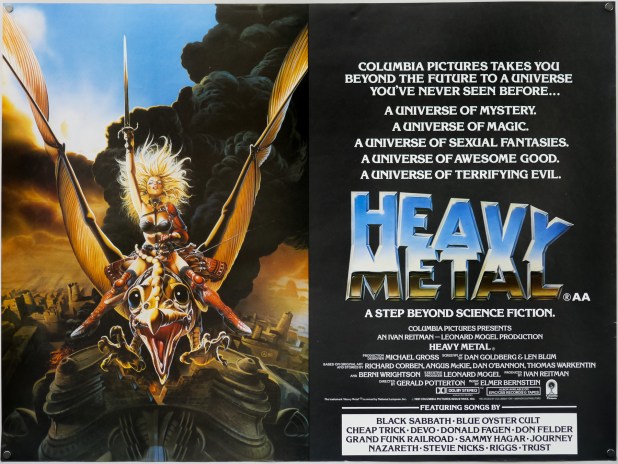
Heavy Metal (1981)

I should not have seen this movie at nine or ten years of age, nor should I have read the magazine. I should have been blissfully ignorant of the mindblowing nature of what I was about to see and waited until I was ready, but here we are, literally forty years later and not a day goes by that this movie doesn’t cross my mind.

Directed by animator Gerald Potterton and produced by Ivan Reitman and publisher Leonard Mogel, this movie takes on the near-impossible task of taking the stories of an unwieldy adult science fiction magazine and making them into a coherent story about, well, evil? Or something? Honestly, who cares, there’s animated Roger Corben and zombie bombers and half-nude warrior women riding dinosaurs and stabbing people.

Based on the comic book tale, “Soft Landing” starts the film. Created by Dan O’Bannon and Thomas Warkentin, it has a man fly a car from space to Earth. He’s an astronaut home to see his daughter, but in the next sequence, “Grimaldi,” what he has brought back kills him and his daughter soon learns of a galaxy and time-spanning evil called the Loc-Nar. That entity is present in every story throughout the film and actually works really well.

Moebius’ “The Long Tomorrow” has become “Harry Canyon,” the story of a film noir detective in a 2031 New York City that looks and feels a lot like Blade Runner, because, well, Blade Runner looked a lot like Moebius. In this installment, the Loc-Nar is a Maltese Falcon-ish McGuffin.

In “Den,” based on the Richard Corben comic of the same name, that ultimate evil is the magical element that everyone on the world of Den wants. Our hero is a nerdy kid who has been transported to another world and become a superheroic character that everyone wants to either get in their bed or put in the dirt. For me, this is the center of this movie and other than the closing section, it stands hands, shoulders and various nude parts above the other segments. Plus, that’s John Candy as Den.

Bernie Wrightson’s “Captain Sternn” follows, with Eugene Levy as the Sternn and a court trial that shows just how dirty of a future spaceman its hero can be. A section called “Neverwhere Land” was deleted from the film, which would have connected these segments and would have been a loop set to either Pink Floyd’s “Time” or Krzysztof Penderecki ‘s “Magnificat: Passacaglia.”

The zombie segment with the haunted “B-17” is next, followed by an adaption of Angus McKie’s “So Beautiful, So Dangerous,” a tale of alien pilots, Earthwomen and lines of Plutonian Nyborg.

In the last story, based on “Arzach” by Moebius, “Taarna” and her reptile bird battle mutants and the Loc-Nar itself, sacrificing herself to save the world before she is reborn in the young girl in the framing device that began the story. As she walks outside, the reptile bird returns and the adventure begins all over again.

The soundtrack to this movie — that kept it from legally being released for years — is amazing. There’s everything from Black Sabbath’s “Mob Rules” and “Prefabricated” by Trust to the theme song by Don Felder and Blue Öyster Cult’s “Veterans of Psychic Wars.” The band originally wrote the song “Vengeance (The Pact),” but the makers of the film thought it too closely told the story of the segment.  Both songs appeared on BÖC’s Fire of Unknown Origin.

For years, there had been talk of a reboot. Whatever that ended up being aired on Netflix as the series Love, Death & Robots.

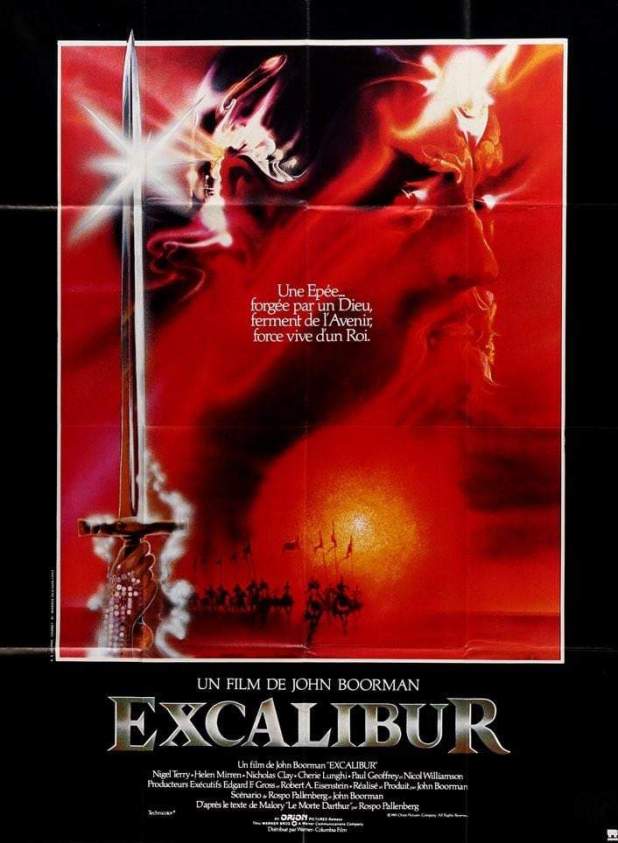
Excalibur (1981)

Shot entirely on location in Ireland, employing mostly Irish actors and crew, Excalibur was an important film for the Irish filmmaking industry and helped start the careers of Liam Neeson, Patrick Stewart, Gabriel Byrne and Ciarán Hinds.

It was also known as the Boorman Family Project, as several members of director Jonathan Boorman’s family appear, with his daughter Katrine Boorman playing Igrayne — Arthur’s mother — as well as his daughter Telsche as the Lady of the Lake and his son Charley acting in the role of Mordred as a boy. It was shot a mile from his home, so he was able to be at home for the entire making of the movie.

Boorman has been wanting to make the movie since 1969, yet the three-hour script was seen as too costly by United Artists and instead, he was offered The Lord of the Rings, which he did not make yet did develop. He ended up using some of the work that went into that adaption here, as well as potentially being inspired by Monty Python and the Holy Grail.

He’d worked with Rospo Pallenberg on that canceled film (as well as Exorcist II: The Heretic and The Emerald Forest; Pallenberg would also direct Cutting Class), so he worked with him here to bring Malory’s Morte d’Arthur to theaters. Boorman said that his film was about “the coming of Christian man and the disappearance of the old religions which are represented by Merlin. The forces of superstition and magic are swallowed up into the unconscious.”

I love Roger Ebert’s review of this movie, in which he said that the film was both a wondrous vision and a mess, “a record of the comings and goings of arbitrary, inconsistent, shadowy figures who are not heroes but simply giants run amok. Still, it’s wonderful to look at.”

It’s beyond gorgeous, actually, a movie that combines shocking gore with artistic flourishes, like the three ladies in white who attend Arthur to Avalon at the close. Boorman was also smart enough to cast Nicol Williamson as Merlin and Helen Mirren as Morgana Le Fay, two actors who had had a conflict when they acted in Macbeth together. He felt that tension would be seen on screen and it certainly is. That said, Mirren claimed that the two become friends while making Excalibur.

It rained every single day of the shoot, which adds to the foggy look of the film. It had many issues, as the first fight scene had to be filmed three times. It was filmed at night and the exposure meter was broken, leading to two different scenes of underexposed film.

Boorman’s career is pretty great. Sure, there are the big movies like Deliverance, but I love that he shoots for the fences and makes off the wall stuff like Zardoz and Exorcist II: The Heretic. Here’s to less playing it safe for directors, even if the misses end up being spectacular losses. I don’t think that that can happen any longer in entertainment.

My initial exposure to this film came from Mad Magazine. Often as a kid, we wouldn’t see an R-rated movie until it was on HBO, so many of the films I’ve had to find as an adult were first seen through the eyes of Mad’s Usual Gang of Idiots. This time, Don Martin did the movie adaption. I’m happy to share a few panels with you thanks to Jesse Hamm on Twitter.

Escape from New York (1981)

Seriously, this article should just say, “This is the best movie of all time” and nothing else.

It is absolutely impossible for me to be impartial to this movie. How can you be? A western set inside a destroyed New York City that’s been converted into a prison for the worst people in America being invaded by someone even worse than all of them put together to rescue a President with only 24 hours to do it? Yeah, they don’t make them like this anymore.

Actually, they never did. This is a once in a lifetime film.

AVCO Embassy Pictures wanted Charles Bronson or Tommy Lee Jones to play Snake. Kurt Russell was still seen as a Disney kid. But Carpenter saw in him someone who could be a Clint Eastwood-like mercenary who lived for the next minute and nothing else.

The film slams us into 1997, a time and place where the world is constantly at war. As the President of the United States flies to a peace summit in Hartford, Connecticut, Air Force One is hijacked and crashed, with the President (Donald Pleasence!) being taken to New York City and captured by the Duke of New York City (Isaac Hayes!).

The police would never make it on a rescue mission. That’s when Police Commissioner Bob Hauk (Lee Van Cleef) gets an idea. Instead of sending in a military force, he sends Snake into the Hell on Earth that is New York City to save the President. If he completes the rescue mission, he gets a full pardon. And if not, well…he was going to die anyway. To keep Snake from running, he’s injected with micro-explosives that will kill him in 22 hours.

Driven in an armored cab by Ernest Borgnine to Harold “Brain” Hellman (Harry Dean Stanton!) to attempt to find the leader of the free world, Snake encounters all manner of enemies that he outwits, outfights and outright murders to complete his mission, including an incredible fight with pro wrestler Ox Baker (originally it was going to be Bruiser Brody, but he was in Japan at the time). Plus, you get appearances by Carpenter regulars like Adrienne Barbeau, George Wilbur, Dick Warlock, Nancy Stephens, George “Buck” Flower, John Strobel, Tom Atkins, Charles Cyphers and a voice cameo by Jamie Lee Curtis.

At the end, the President tells Snake he can have anything he wants. Snake only wants to know how he feels about everyone that had to die so that he could live. The President barely conveys gratitude as Snake walks away in disgust.

You can see echoes of Snake in nearly every post-apocalyptic movie that came after this film. In a perfect world, there would have been way more than just one sequel to this movie.

Clash of the Titans (1981)

I saw this day one in the theater, all of nine years old, and ready to scream and yell and drive any adult near me insane with the sheer force of my absolute bliss at seeing a Ray Harryhausen movie in the theater and not on TV.

Columbia Pictures, who had distributed so many of Harryhausen and producer Charles H. Schneer’s films. But as always, change happened and the new heads of the studio no longer wanted to pay for such a big budget. Schneer took it to Orion Pictures, who insisted on Arnold Schwarzenegger playing the lead, but at that point, Arnold was unproven at dialogue. So that took the movie to MGM.

The producer wanted better-known actors to play the Gods in order to improve the film’s chances at the box office. He got exactly what he wanted, thanks to Maggie Smith as Thetis, Claire Bloom as Hera, Ursula Andress as Aphrodite and Laurence Olivier as Zeus. But the real star in this movie is Harryhausen, making his final film and giving us Calibos, Pegasus, Bubo the mechanical owl, Dioskilos, Medusa, the scorpions and the Kraken, which was a toy that I asked for to no avail.

While this film came out at the same time as Raiders of the Lost Ark, it was still one of 1981’s biggest hits. The story of Perseus (Harry Hamlin) and his love for Andromeda became one that 80s kids would know by heart. Sure, the Kraken is from Norse mythology and Calibos is from Shakespeare, but why argue?

Director Desmond Davis mostly worked in TV, but he does a fine job here. Even decades later and so many advances in animation and I still thrill to the release of the Kraken.

Separate Ways (1981)

Karen Black is unhappy with her marriage, so she prays with her knees upward with a younger man (David Naughton! who also worked on Kidnapped!, the final film of Howard Avedis) after catching her husband, played by Tony Lo Bianco, aardvarking with one of his used car saleswomen.

So begins the exploration of how a woman finds herself and tries to determine if marriage still makes sense in 1981. I’d say that this is a tender exploration of relationships and how the sexual revolution has changed male and female dynamics. But then I saw the Crown International Pictures logo at the beginning and that Howard Avedis directed this and I realized that we’d be seeing Karen Black in all manner of skimpy costumes.

That said, man, I’ll watch Karen Black in anything. Even this.

But hey — there’s a small role for Sybil Danning, as well as Sharon Farrell. And let’s not forget Sybil also starred for Avedis in his next “affairs” flick, They’re Playing with Fire, and Angel Tompkins seducing her students in The Teacher.

Also — put this into your Letterboxd list of “Movies that have exotic dancing clubs where no one ever gets nude.”

We found a copy to enjoy on You Tube.