JESS FRANCO MONTH: Les gardiennes du pénitencier (1981)

So this is kind of cheating, because this is less a Jess Franco movie and more a Eurocine mix tape that has been edited from Franco’s Barbed Wire Dolls, Alain Peyat’s Hitler’s Last Train and Patrice Rhomm’s Captive Women 4 with some new footage directed by Alain Deruelle in which numerous SS officers run away to Latin American where they’ve created special laboratories to breed beautiful women that will satisfy their darkest desires. How this helps them get revenge for the fall of the Third Reich is way beyond me.

Seriously, all of those movies, all mixed up, all with new dialogue dubbed over the top of them.

Jailhouse Wardress is literally only for Franco completists. And by that, I mean me. But seriously, if you’ve never watched one of his movies, this would not be the one to start with. Or really ever have to see.

Hoero Tekken (1981)

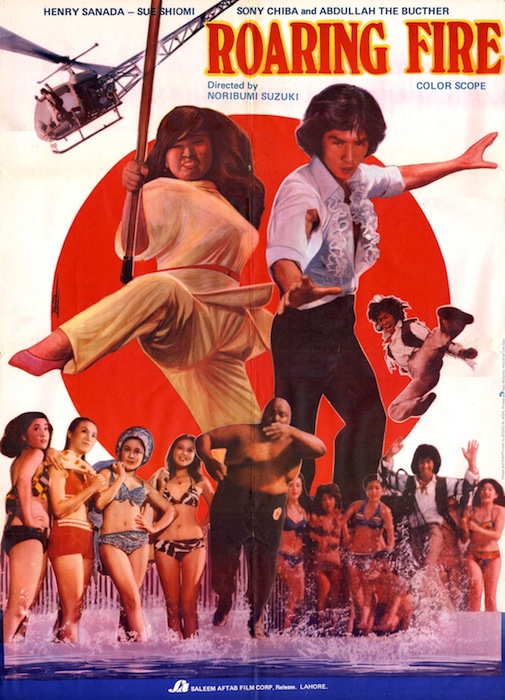
Roaring Fire is everything wonderful and perfect and wild and needed in movies. It truly is the very thing that keeps my brains moving, that makes me keep loving film, that says to me that there will always be something new to discover and I ask you, please start your own search for the movies that will blow your mind and share them with the world.

Director and co-writer Norifumi Suzuki also made School of the Holy Beast, a Japanese nunsploitation movie which makes my mind scream in the most perfect joy sounds that can’t be translated into sound, ten of the Torakku Yarō movies and The Great Chase, which is a lot like this movie in that it’s a delight.

Just as we watch the mob execute Toru Hinoharu (Hiroyuki Sanada) in Hong Kong, we also discover that he has a twin, a Texas cowboy named Joji Hibiki (also played by Sanada), who learns that his father is dying and that he was kidnapped eighteen years ago and must come back to Japan to meet his sister and twin brother, who we just watched get shot.

Joji is in Japan for just a few hours when his monkey Peter — yes, the hero has a pet primate — pulls off a girl’s bikini top and that leads to Joji fighting Spartacus, who is Abdullah the Butcher, and at this point, there’s no way I could dislike this wild film. As these things happen, the battle gives the two some mutual respect and as Joji has just had his wallet stolen, he’s soon off on an adventure to find it.

After his uncle Ikeda Hinokaru (Mikio Narita) finds him, our hero meets his sister Chihiro (Etsuko Shihomi, Sister Street Fighter) who can use sound and wind to fight like Zatoichi. He also meets a ventriloquist named Mr. Magic (Sonny Chiba) who uses his puppet to inform Joji not to trust his uncle who soon proves that he’s evil by sending an American boxer and a staff fighter to smash him after he overhears his plans.

Man, this movie feels like the best video game you never played, with German soldier-dressing evil women with whips sending our hero into gas-filled chambers that drive men insane before being defeated by a well-thrown monkey, ninja gangs, bad guys bad enough to shoot heroic women up with heroin, numerous heroic sacrifices and an ending chase that takes up the entire last third of the movie, with Joji not stopping, walking through gunfire, multiple martial arts experts and end boss after boss before throwing a tomahawk at a helicopter, punching a diamond through a man’s eye and then learning how magic can defeat handcuffs.

New Line Cinema released this movie in the United States in May 1982 and changed Hiroyuki Sanada’s name to Duke Sanada. I wish I had seen this when I was ten years old because I would have literally lost my entire ability to speak, walk and display emotions.

You may never want to watch another movie after you see this. It’s that good.

Kyoufu Densetsu Kaiki! Frankenstein (1981)

Along with Dracula: Sovereign of the Damned, Toei made two animated movies for Marvel and of all the properties they could have used, they made Dracula and Frankenstein’s Monsters movies. Released here as Monster of Frankenstein and Frankenstein Legend of Terror in 1984, this was based on the Marvel Comic Monster of Frankenstein, which ran 18 issues. In case you wondered, that monster is now in SHIELD’s monstrous version of the Howling Commandos.

Much like so many Japanese cartoons made for kids, this is totally way more violent than our country would be ready for. It starts with the monster falling off a cliff and Dr. Frankenstein trying to keep his family ahead of his crimes and dealing with a blackmail attempt by his assistant, making the doctor paranoid and having non-stop nightmares about the pure evil he has created.

Meanwhile, the blind man from the Universal movies is recast as Dr. Frankenstein’s father, who adopts the creature along with his granddaughter Emily and names him Franken. As for Victor, he wants to shoot the monster at the same time the monster is learning about God, which ends pretty quickly when her mother dies in a fire and Emily blames him.

Have you ever seen a movie — much less an animated movie — where Frankenstein’s Monster has a hole in his hand and related to Jesus, who also has one? Or one that ends with the creature committing suicide at the same time as his creator? And again, let me state, this is a cartoon.

Why not watch it for yourself on YouTube?

JOE D’AMATO WEEK: Absurd (1981)

EDITOR’S NOTE: Man, I love this movie. We wrote about it all the way back around October 30, 2018 and I still watch it at least once a year. Stay tuned — there’s even a drink that goes with this movie.

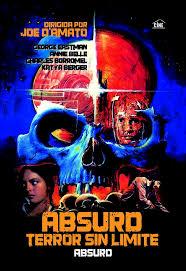
Originally called Rosso Sangue (Red Blood), this movie is also known as Zombie 6: Monster Hunter, Horrible, The Grim Reaper 2 and Anthropophagus 2. This really has nothing to do with Anthropophagus (well, D’Amoto and Eastman were involved there, too and that movie ends with Eastman’s guts all over the place and this one starts that way), as it’s more of a Halloween ripoff. And I don’t mean that as an insult. It’s actually my third favorite of the sequels.

Mikos Stenopolis (Eastman) starts off being chased by the Vatican priest (Edmund Purdom, of all people) who created him. So let’s get this crazy set-up out of the way: a Greek monster who can’t be killed because his blood coagulates very quickly was created by the Roman Catholic church somewhere and when that maniac escaped, he ended up in some small American town that only cares about the game between the Pittsburgh Steelers and the Los Angeles Rams, so I’m just going to assume that they’re in New Castle or Zelienople.

The chase leads to a fence where Mikos is impaled. He makes his way to the front door of the Bennett house, holding his bloody guts as he passes out. He’s revived in a local hospital — shades of Haddonfield Memorial — and escapes after murdering a nurse with a drill. This being an Italian film, that entire murder appears in great detail.

The priest — let’s call him Father Loomis, cousin of the other Father Loomis in Prince of Darkness — informs the authorities that there’s only one way to kill Mikos: destroy his cerebral mass.

Synchronicity rears its head when Mr. Bennett, in a hurry to get home and watch Terry Bradshaw thread the needle to Lynn Swann, hits Mikos with his car. He just keeps going. When he gets home, he’s brusque with his wife and kids. Seems that his daughter, Katia, has a spinal condition and must stay in traction. All she wants to do is use a compass to continually draw the same drawing over and over again, while her brother Willy is obsessed that the Boogeyman is coming to kill him. Guess what, Willy? You’re right.

Mikos spends the rest of the movie randomly killing anyone who gets in his way, like a young Michele Soavi playing a biker and a butcher who gets the top of his head sawed off. He finally makes his way to the house. Peggy is on her way to watch the kids when she gets a pickaxe to the head. And the other woman who was watching them? Well, she gets her head forced into a lit oven that bakes the flesh off of her face in an extended sequence before being stabbed in the neck with a pair of scissors.

Willy goes all Tommy Doyle and runs to get help while Katia finally frees herself from her bed. She stabs him in the eyes with her compass and leads the killer on a chase throughout the house, using loud music to distract him. The priest arrives and struggles with Mikos, just in time for Katia to chop off the killer’s head with a ceremonial axe.

The police arrive late, but Katia assures her little brother that everything will be fine as the camera reveals that she is holding Mikos’ bloody head.

Absurd inspired the German black metal band who took their name, who eventually went from watching gore films to killing people for real as their music went further and further into far right extremism.

Your enjoyment of this film will be colored by how much you like gore, how much you understand that Italian movies are often very hard to understand and how much you’re willing to forgive a film. Personally, I loved it. The oven kill scene is really uncomfortable to watch and the gore is incredibly effective.

Severin Films re-released this film with all of their trademark quality and insanity. It’s the first uncut release of the film in the U.S. and features an interview with Eastman and Soavi, as well as a bonus soundtrack CD. They’ve also rereleased Anthropophagus. I love that Severin gives films as disreputable as these all the care and concern that Criterion would to a movie from a director much more esteemed and talented (but so much more boring).

BONUS! Here’s a recipe to drink while you watch this movie on Tubi.

Mikos the Axe Murderer (based on this recipe)

  • 1 oz. amaretto
  • 1 oz. gin
  • 1 oz. white rum
  • 1 oz. Southern Comfort
  • 1 oz. tequila (I use Espolon)
  • 1 oz. triple sec
  • 1 oz. vodka
  • A splash of 7-Up or Sprite or the generic brand of your fancy
  • 1/2 oz. grenadine
  • As much pineapple juice as you want
  1. Throw it in a glass with lots of ice. Get a straw and chop your head off.

JOE D’AMATO WEEK: Two movies with George Eastman

EDITOR’S NOTE: While we just covered these movies on October 1, 2021 and October 31, 2021, you can’t do a week of Joe D’Amato without bringing up two of his most transgressive — and to be honest somewhat boring — movies. 

Erotic Nights of the Living Dead (1980): I work in my basement from when I wake up until when I go to bed, writing all sorts of words for people, from health care to highed education, parent-teacher groups and all manner of businesses large and small. There are times when all that writing and the way the world has been acting for the last 18 months which feel like 18 years when it just seems hopeless. Why am I doing this? Who am I doing it for? Why do I feel compelled to keep on writing and then in my spare time write some more about movies?

Because of movies like this.

Make no mistake, Le notti erotiche dei morti viventi is absolutely the sleaziest kind of movie there is, a film that combines all of the oatmealed faced zombies and gore of Italian cinema with the sexual congress of, well, Italian cinema. It’s as if someone said, “What if we saw people screw before we kill them horribly?” And that man, friends, was Joe D’Amato.

Now, the man himself said that this was an utter failure, telling Spaghetti Nightmares that the movie was”…a total fiasco. I had endeavored to mingle my two favorite genres, tending more toward the erotic side in this case, but the film was rejected by the public.”

Made at the same time as Porno Holocaust — another movie with the same cast, the same plot and the same mix of sex and death — just thinking of the plot of this movie makes me laugh like some kind of maniac.

It stars Mark Shannon, whose main career was working as a travel agency correspondent, but would take breaks to make adult films. He plays John Wilson, who has come to the Dominican Republic to build a hotel on Cat Island, a place with a voodoo curse so dangerous that it causes one of the two prostitutes who’ve recently serviced him to run in fear. Don’t worry. He was smart enough to finish their bedsheet gymnastics first.

As he chases her down the hall, he meets Fiona (Dirce Funari, who was one of the women in the infamous snuff sequence in D’Amato’s Emanuelle in America), who has just left an elderly lover at sea. After doing an oral inspection of Georgia O’Keefe’s inspiration, they become a couple of sorts for the rest of the film. I think we can all appreciate a meet cute in an Italian pornographic zombie film, right?

Meanwhile, Larry O’Hara (George Eastman, who wrote this) is either a sea captain or in an insane asylum. He starts the film off having wild frolicking sex with a nurse and ends it with the same woman in the same style as the film makes a Jacob’s Ladder cycle back to the mental ward, complete with another patient slack jawed and enjoying their coupling with a one-handed ovation.

There’s an absolutely mindbending scene where Eastman sits inside a darkened club that makes it appear that he’s smoking and drinking and bored and trapped in the infinite regions of space when Liz (Lucía Ramírez, Sex and Black Magic) appears to dance for him. Eastman makes no attempt to engage with her at all, even when she brings a champagne bottle on stage to, well, yeah. You know what happens. What you may not know is that she opens the bottle for him and does not use his hands and man, Joe D’Amato, you know how to rescue a man from abject depression.

Meanwhile, Laura Gemser shows up as a woman who bleeds green blood and can transform into a cat and has a blind grandfather who follows her and then she has sex with Eastman on the beach through his buttoned jeans.

Finally, everyone drinks J&B and we come — pun unintended — back to the start of the film as orderlies drag Eastman to his cell.

My favorite part of this movie was watching the absurd — D’Amato pun not intended — lengths to which some of the bigger star’s lovemaking scenes were created in very Cinemax After Dark style, which Shannon just went balls out. Literally.

Orgasmo nero II – Insel der Zombies (1981):

So yeah, in Germany, Porno Holocaust was actually considered a sequel to Joe D’Amato’s Orgasmo Nero (we just called it Sex and Black Magic here) and everyone had to be content to a title that isn’t as in your face. Don’t worry — this movie is still as repellant as it gets*.

Back in the 50s, governments used to regularly blast an island with nuclear bombs just to see how they blew up and to test the idea that perhaps these weapons would split reality into pieces. Well, all they did was create a place filled with mutant animals and a monster — a giant appendaged monster — that a bunch of stupid, stupid scientists are going to visit and all die.

That creature was once Antoine Domoduro and much like another D’Amato/George Eastman epic — Antropophagus — he was once a man with a family that all died in the atomic bomb blasts and now, all he has are two speeds: fuck and destroy.

D’Amato made Papaya, Love Goddess of the Cannibals and Tough to Kill in Santo Domingo and had such a good time that he returned to make Paradiso blu, Sesso nero, Orgasmo nero, Hard SensationErotic Nights of the Living Dead and this movie all in July of 1979. That’s right — five movies in one month.

The first mainstream hardcore film in Italy, this movie ends with Tom Selleck look-a-like — and travel writer when he wasn’t making porn — Mark Shannon surviving and making sweet love to Lucia Ramirez on a very small boat in the middle of the ocean, which is more astounding than anything else in this movie, as I wondered how D’Amato was able to get all of his camera equipment onto this boat, shoot this scene and not have anyone fall off.

Italian movie directing at its finest.

*Or maybe not. The German softcore version is Insel der Zombies. Seeing how a full third of this movie is hardcore penetration, I can only imagine how short that movie is.
JOE D’AMATO WEEK: Sesso acerbo (1981)

Look, when it comes to Joe D’Amato, I’m going deep and that’s no pun.

Sasha Kramer (Roland Carey, whose career stretches back to peplum like Revolt of the Barbarians and the gothic horror of La bambola di Satana) and his wife Helen (Pauline Teutscher, whose career mainly was in adult film) are a middle-aged and childless couple. Things seem good for them, except that Helen is lonely, so she gets a job becoming Alain’s maid, but we all know that things are going to progress into them hooking up because of who directed this along with Claudio Bernabei, who was the assistant director on Like Rabid Dogs and wrote D’Amato’s films Death Smiles on a Murderer and Giubbe rosse.

It’s all a plot to have a child while Sasha also sleeps with the man who is cucking him’s mother, which is the kind of double negative cuck that makes the first cuck no longer count and only happens in Italian movies, right?

There’s literally nothing in this that’s all that erotic and it’s mainly a grimy looking story of searching for a connection. The name means Bitter Sex and it was made during the same year that D’Amato made thirteen other movies, including Absurd.

Early Warning (1981)

Jenny Marshall (Delana Michaels; a slight resume, but still in the business), a Christian woman, wants Sam Jensen, an atheist newspaper reporter (Greg Wynne; in his acting debut, and with another slight resume), to publish an “early warning”: a cover-blowing story about the rise of the “bible prophesied” One World Foundation. Skeptical at first, Sam Jensen comes to believe Jenny Marshall (who was working on the “big story” with Sam’s old newspaper mentor; since murdered by the OWF) as result of her relentless pursuit by the foundation. A troubling romance, i.e., Christian woman falls in love with the atheistic reporter, but can’t be in love with a non-believer, yada, yada, yada (and yawn), ensues, as the sort-of-romantic duo try to take down the Antichrist.

More book cover than theatrical one-sheet?

Is it as dry and dopey-mopey, replete with weak acting and weakly-excuted action, as the Christian post-apoc’er Years of the Beast released in the same year? Eh, well, er . . . the scripting is (just a little) better than that end-times snooze-fest-o-rama. However, while I am not a fan of montage-newscast voice overs to set up the story, screenwriter David R. Elliot does eerily predict the very same issues we’re dealing with in 2021 (outbreaks of racial and religious-based violence, closing of churches and arrests of pastors, out-of-control gun violence, gun and explosive-possessing terrorist cells, male-only draft laws, the rebirth of Nazism, outbreaks of senseless murders and rapes) in his opening titles sequence. And the talk of one world banks, laser-engraved computer numbers, the rise of radical liberalism in schools as the plot unfolds has its intelligent-engaging moments.

Film and television sound editor David R. Elliot (The Waltons, Stephen King’s Cujo), in his lone writing and directing effort, was certainly influenced by Donald W. Thompson’s (who wraps up his end-times tetralogy with The Prodigal Planet in 1983) and Hal Lindsey’s eschatological works (his 1979 documentary The Late Great Planet Earth). It’s obvious Elliot is also a sci-fi fan, as you’ll notice influences ranging from the early A.I. classic Colossus: The Forbin Project and John Carpenter’s post-apoc game changer Escape from New York.

While the proceedings are obviously on a low-budget, Elliot’s vision of the coming rise of the Beast is more technically proficient (his ability to stage car chases under helicopter sniper fire by black-clad soldiers, give us over-the-cliff car crashes, and some flashy techo-trinkets) courtesy of his being a filmmaker, first (he’s also worked on Stewart Raffill’s High Risk and, with Bo Hopkins, The Plutonium Incident). As result, the against-the-budget production values are higher than, and more effectively framed and shot than, a Thompson Christian-apoc production; however, Early Warning is still, very TV drama-flat and just a (slight) notch above a PBS-TV movie apoc-production (Hide and Seek, Music of the Spheres).

The acting is obviously above the non-pro thespian fray of Thompson’s end-time flickers, and it’s nice to have familiar actors Alvy Moore (ironically of The Brotherhood of Satan) and (George) Buck Flower(s) (a Carpenter go-to actor) show up . . . but neither is here long enough to balance against the other, weaker-unknown actors. While we get Flowers in the expected, desert-rat/survivalist role, Alvy Moore, god bless him, is one of the worst astronomers committed to film. (Did he just say, “I study stars n’ stuff” to explain his work? Could he be anymore “Hank Kimble” in his delivery?)

Oh, watch out for the ’60s Batman-era stock soundtrack: it’s arduous. And that flutes and clarinet stock music “chase sequence” music ain’t helping. Also of a particular annoyance: as with Carpenter’s post-apoc game changer, we have a (evil) society advanced enough to create laser-etching, ultraviolet-scanning computers to “mark” people — but it still all comes down to “mission critical” cassette tapes to put a stop to the chaos. Ugh.

Eh, look, it streams for free-with-commercials on Tubi and, as November 2022, Early Warning now appears on various Smart TV channel platforms (thus the odd, recent spike of reads of this review; and here we were simply scratching off an old Christploitation flick from our list). It’s something for the curiosity-seeking non-believer to fast-forward through on a slow Saturday night . . . to see the cinema drek Sam and I were stuck watching under revival tents and Wednesday Chapel’s once-a-month “media day” events. Yes, churches forced us kids to watch this stuff. And so it goes. . . .

You can also stream this — and other Christian movies we’ve reviewed this week — on the You Tube Christian Movies Portal. You can sample the trailer on You Tube.

About the Author: You can read the music and film reviews of R.D Francis on Medium and learn more about his work on Facebook.

Sailor Suit and Machine Gun (1981)

Shinji Somai (Typhoon Club, Wait and SeeMoving) is an influential filmmaker whose work has rarely been seen in the U.S. That’s changing with the Arrow release of one of his best-known movies, Sailor Suit and Machine Gun.

A combination of Japan’s unique idol and yakuza films with the traditional coming of age story, this film is centered on Hoshi Izumi, an innocent young girl who suddenly finds herself the leader of her great-uncle’s organized crime clan.

Hiroko Yakushimaru, who plays Hoshi Izumi, achieved icon status thanks to this movie and its theme song “Sailor Fuku to Kikanjū.” The song stayed at number one in the charts for five straight weeks and was the second highest-ranked song of 1982.

In truth, Hoshi’s father should have led the group, but he died in an accident before they could find him. Beyond inheriting the title of oyabun, she also is given her father’s secret lover Mayumi Sandaiji.

The kobun, or followers, refuse to take the young girl seriously and also seem to think that their attack against their rivals has to be successful. Faced with leading a gang that doesn’t want her and who will also enact a suicide pact if forced to disband, Hoshi must give up on her childhood and take the titular gun in hand if she wants to make her new life a success.

Despite its origins as a teen novel and the fact that its idol actress had such a major song out of the film, this is more arthouse than you’d expect. While its influence may be small in the U.S., the other films — and media — it inspired all flow from this original river.

The Arrow Video Sailor Suit and Machine Gun blu ray has both the original theatrical version and the 1982 complete version (kanpeki-ban) re-issue of the film, restored by Kadokawa Pictures from a 4K scan of the original negative. Plus, there’s a new documentary Girls, Guns and Gangsters: Shinji Somai & Sailor Suit & Machine Gun, trailers and TV spots, and a sleeve with original and newly commissioned artwork by Michael Lomon. The first pressing comes with an illustrated collector’s booklet featuring new writing on the film by Aaron Gerow and Alex Zahlten, and a discussion between the film’s star Hiroko Yakushimaru and acclaimed director Kiyoshi Kurosawa, who was an assistant on the film.

You can order this movie from MVD and Diabolik DVD.

On November 15, you can also stream this movie on the Arrow player. Visit ARROW to start your 30-day free trial. Subscriptions are available for $4.99 monthly or $49.99 yearly. ARROW is available in the US, Canada, the UK and Ireland on the following Apps/devices: Roku (all Roku sticks, boxes, devices, etc), Apple TV & iOS devices, Android TV and mobile devices, Fire TV (all Amazon Fire TV Sticks, boxes, etc), and on all web browsers at https://www.arrow-player.com.

Orgasmo nero II – Insel der Zombies (1981)

So yeah, in Germany, Porno Holocaust was actually considered a sequel to Joe D’Amato’s Orgasmo Nero (we just called it Sex and Black Magic here) and everyone had to be content to a title that isn’t as in your face. Don’t worry — this movie is still as repellant as it gets*.

Back in the 50s, governments used to regularly blast an island with nuclear bombs just to see how they blew up and to test the idea that perhaps these weapons would split reality into pieces. Well, all they did was create a place filled with mutant animals and a monster — a giant appendaged monster — that a bunch of stupid, stupid scientists are going to visit and all die.

That creature was once Antoine Domoduro and much like another D’Amato/George Eastman epic — Antropophagus — he was once a man with a family that all died in the atomic bomb blasts and now, all he has are two speeds: fuck and destroy.

D’Amato made Papaya, Love Goddess of the Cannibals and Tough to Kill in Santo Domingo and had such a good time that he returned to make Paradiso blu, Sesso nero, Orgasmo nero, Hard SensationErotic Nights of the Living Dead and this movie all in July of 1979. That’s right — five movies in one month.

The first mainstream hardcore film in Italy, this movie ends with Tom Selleck look-a-like — and travel writer when he wasn’t making porn — Mark Shannon surviving and making sweet love to Lucia Ramirez on a very small boat in the middle of the ocean, which is more astounding than anything else in this movie, as I wondered how D’Amato was able to get all of his camera equipment onto this boat, shoot this scene and not have anyone fall off.

Italian movie directing at its finest.

*Or maybe not. The German softcore version is Insel der Zombies. Seeing how a full third of this movie is hardcore penetration, I can only imagine how short that movie is.
SLASHER MONTH: Day of Judgement (1981)

Produced by the same Earl Ownsby that made the truly oddball Tales of the Third Dimension in 3D, this Wilmington, North Carolina curiosity makes the strange step of being one part slasher, one part Christian morality play. And man, what a strange tasting cocktail that is*.

Director C.D.H. Reynolds and writer Tom McIntyre put together this tale of a 1930s small town that is packed with lust, corruption and sin that has choked the God out of the last preacher, sending him running away into the night.

Now, a mysterious figure wielding a scythe arrives just as he leaves and everyone that has done anything has to pay — not only with their lives, but with their souls.

Everyone in town has something to be ashamed of. Mr. Sharpe, the banker, is out to take everything he can from everyone. Drunken Mrs. Fitch only cares about her flowers and will poison animals if they get too close. Ruby only married her husband to become rich, as everything about him is old, even his smell, but she doesn’t care for anyone, even the shop assistant that she’s been screwing behind her husband’s back. And then there’s George, who conspires with the banker to commit his parents and finally leave this town behind.

This feels like the lost Charles B. Pierce movie we never got or the slasher they’d allow you to watch in Sunday school or a junior high production of Our Town that the drama teacher rewrote to slam book the entire town that he knew would never accept him and that he’d never escape. All filtered through with nightmarish conjurings of a foggy and blue lit reaper just walking from victim to victim and man, I love blue fog.

It’s a slow moving movie — and you know how those work for me — in the best of ways, a deranged message film that makes me leap with glee when the end credits start with the Ten Commandments. Bravo, people. Bravo.

According to Stephen Thrower — who is on the Severin blu discussing this — Reynolds went back to teaching and was an atheist. He also worked on Carnival Magic, which makes a lot more sense.

*I can only think of one other movie that attempts this, The Redeemer: Son of Satan.

You can get this from Severin.

PS: A lot of the cast also shows up in Death Screams, which Arrow just put out.