El periscopio (1979)

Also known as …And Give Us Our Daily Sex, this film finds director and co-writer (with Sergio Garrone, who also directed and wrote Django the BastardSS Experiment Love Camp and If You Want to Live… Shoot!) José Ramón Larraz making a Commedia Sexy All’ Italiana except in Spain, but you’ll forgive him as he was smart enough to get Laura Gemser as the lead and really, most of the movie has a good chance of me liking it.

She plays the unnamed friend of Veronica (Bárbara Rey, The Ghost Galleon) and the two live upstairs from a couple and their teenage son Albert, who is driven near-mad by the fact that two gorgeous lesbian nurses live upstairs. That’s why he builds a periscope — it’s there in the original name — all while the parents basically lead their own sex lives outside their marriage.

That’s what leads to Albert getting pains in the groin that Ms. Gemser correctly diagnoses as blue balls and then jerks the kid off with his parents in the room. Her husband Gabriele Tinti is also in this and why not? I loved that they used their movie careers to basically travel the world for free.

The porn inserts in this cheapen the film somewhat; it’s certainly erotic enough what with Laura Gemser in garters (I get it, I feel like Evelyn Quince) but you know, much like how Bava only worked once with Vincent Price and it’s Dr. Goldfoot and the Girl Bombs, I can’t even imagine if Larraz made one of his trademark houses in the London countryside and women who murder with Gemser. More people would be talking about it than me writing a few hundred words about a softcore movie that only had a VHS release and is not known all that much in the U.S. Oh well.

The one thing you may recognize as Larraz is that the mother is using her lover to buy a mink coat that her husband refuses to purchase as most of their money goes to improving his balding hair. The fact that the nurses end up with it and the son’s virginity just sticks it to the upper class even more. But seriously, if you were to lose it to Gemser and Rey, would you even need to be alive any longer? Your life will not improve.

The Golden Lady (1979)

Post-Moonraker, there seemed to be an interest in creating new Eurospy ripoff movies like The Nude Bomb; No. 1 of the Secret Service (I realize it came out in 1977) and its sequels Licensed to Love and Kill and Number One GunThe Golden Lady literally says in its ads that it’s a female James Bond; most curiously it was directed by horror and sex film fiend José Ramón Larraz from a script by Joshua Sinclair, who went from working in Calcutta with Mother Teresa to making Marlene Dietrich’s last movie Just a Gigolo, writing Keoma and making 1985’s Shaka Zulu.

Julia Hemingway (Ina Skriver using the name Christina World, already famous from her love scene with Koo Stark in The Awakening of Emily; she was also in episodes of Space: 1999 and The New Avengers)  has been hired by a millionaire named Charlie Whitlock (Patrick Newell, the Mother spymaster of The Avengers) to destroy his competition in the oil fields of Saudi Arabia.

The film also decides to up its Eurospy cast by having Q himself, Desmond Llewelyn, appear as a mentor to our heroine and, you knew it, give her a few gadgets.

Julia is helped by three agents who in every way are to remind us of Charlie’s Angels: the tech-savvy Lucy (June Chadwick, Lydia from V and Dolby mispronouncing Jeanine Pettibone in This Is Spinal Tap), military superwoman Dahlia (Suzanne Danielle, who shows up in The Wild Geese and Carry On Emmannuelle as Emmannuelle) and supermodel and nymphomaniac — it says so right on her file! — Carol (Anika Pave, who had a cameo in The Spy That Loved Me and was also in Confessions of a Window Cleaner). They’re joined by a pneumatic lady of the evening named Anita (Ava Cadell, who is in the Andy Sidaris films Do or DieHard HuntedFit to Kill and Return to Savage Beach as Ava, who goes from an evil hitwoman to a good agent of L.E.T.H.A.L. and a DJ/sex therapist who does her radio show from her hot tub; she is literally a woman made for Andy Sidaris films) who uses her orgasmic yelps and gyrations to flummox their enemies.

The girls come up against industrialists like Dietmar Schuster (comedian Dave King) and his bisexual henchman Wayne Bentley (Richard Oldfield, who shows up as one of the rebels in Empire Strikes Back) as well as Greek shipping tycoon Aristotle…I mean Yorgo Praxis (Edward De Souza, who is also in The Spy That Loved Me) and finally, Julia’s ex-lover Max Rowlands (Stephan Chase).

Also, Hot Gossip —  a British dance group who backed Sarah Brightman on her single “I Lost My Heart to a Starship Trooper” and also sang “Making Love on a Phone” — appear. They were also on The Kenny Everett Video Show and even recorded a second album — Geisha Boys and Temple Girls — that was produced by Martyn Ware (Human League/Heaven 17) with one song, “I Burn for You,” written by Sting. Several of the members of this dance band went on to bigger things, like video queen Bunty Bailey (who is also in Spellcaster and Dolls), Bruno Tonioli of Dancing with the Stars, Perri Lister (who sang the French parts in Billy Idol’s “Eyes Without a Face” and part of the Blitz Kids with Boy George, Steve Strange, Spandau Ballet and Marilyn; she’s also the mother of Idol’s son Willem Wolf Broad) and the aforementioned Brightman.

Girl group Blonde on Blonde —  made up of Page 3 girls Nina Carter (who was married to Rick Wakeman for a while) and Jilly Johnson — also are in this and on the soundtrack. They were big in Japan and best known for their disco cover of Led Zeppelin’s “Whole Lotta Love.”

Somehow, despite glitz, fashion, disco and spying, this movie makes me wonder how and why this movie’s producers — Sinclair, Keith Cavele (he produced Queen Kong), Paul Cowan (The Crying Game) and Jean Ubaud (who moved on to make The BurningTag: The Assassination Game and Terminal Choice after this) — picked Larraz to make an action movie, a genre he’d never attempted before nor will he try again. The Spanish Eurosex and horror standout would later say that Sinclair “couldn’t write a letter home to his mother let alone a script.”

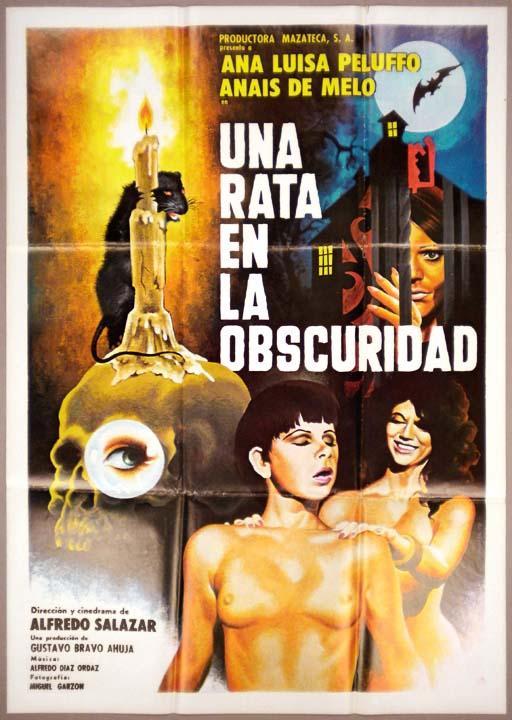
Una Rata en la Oscuridad (1979)

Alfredo Salazar wrote 65 movies (Frankestein el Vampiro y CompañíaDoctor of Doom and The Panther Women to name a few) and directed 11 and none of them prepared me — not even the black magic clown movie Herencia Diabólica for this movie.

Somehow, this movie seems Italian despite being made in Mexico and that’s a supreme compliment in my world. Josefina Hill (Ana Luisa Peluffo) and her sister Sonia (Anaís de Melo) have purchased a run-down mansion for a too good to be true price and you know how that goes in a horror movie.

Josefine is the more level headed of the two, a college professor, while Sonia has had mental powers since she was a child, using her abilities to predict the death of their mother and find lost items. And I say they’re sisters, because the movie tells us so, but they also indulge in topless massages and discuss that they’ve never been married so that they can always be there for one another.

There’s a painting of a mean-looking woman over the fireplace that ends up being the portrait of the madame that once ran this house of the rising sun and if we’ve learned anything from The Nesting, if there’s a bordello being turned into a house, there are ghosts. The madame was killed by a lover she hurt, but she may have also have been the person who sold them the house. Seeing as how the girls have already left their lease, they decide to move into the mansion with no electricity or telephone, because what could go wrong?

The madame begins to visit Sonia and comes between the sisters — psychically — and then the ghost — is it a ghost? — ends up seducing both of them. This movie is completely unconcerned with being incredibly sleazy, so perhaps this ghost is seducing me by knowing exactly the strangeness that I want from my entertainment.

Panties are stolen, rats run wild and the real identity of the madame is probably going to upset a lot of people if they ever see this movie. It doesn’t explain the flying objects, little earthquakes or the fact that the madame’s hands glow blue when she appears. There’s also a lovemaking scene that sends Josefina into the kind of bliss that makes her imagine that she’s dancing around a piano.

Peluffo was one of the first Mexican actresses to appear nude — in 1955’s La fuerza del deseo — and she’s also in a movie that may challenge this for being as weird as it gets, El Violador Infernal, which has her play El Diablo and give a condemned man the chance to live forever as long as he sexually assaults people, kills them and then carves 666 into their bodies. Trust me, Mexican sleaze horror defines the term problematic and then pisses all over the dictionary.

You can watch this on YouTube.

Junesploitation 2022: Un’ombra nell’ombra (1979)

June 13: Junesploitation’s topic of the day — as suggested by F This Movie— is Italian Horror! We’re excited to tackle a different genre every day, so check back and see what’s next.

Ring of Darkness is about four women who made a pact with the Devil a decade ago. Now, Carlotta (Anne Heywood) has lost control of her daughter Daria (Lara Wendel, who so famously died in Tenebre), who has started to develop Satanic powers of her own, casting spells and hurting everyone in her way, including a boy with a crush who submits to her burning touch.

Carlotta and some of her friends enlist the help of a priest (John Phillip Law) to help them rid themselves of the pact that they made with Lucifer all those years ago.

Also known as Satan’s Wife, this is a nice Danger: Diabolik reunion as Marissa Mell is in it with Law. And man, nobody does a Satanic movie like Italian Catholics, huh? When interviewed on set in 1977, director and writer Pier Carpi (who also wrote the Diabolik comic book) denied that his screenplay was inspired by The Exorcist and claimed that it was based on his novel Un ombra nell’ombra which he wrote in the 60s and was published in 1974.

You know what I do love about this beyond the Black Mass nude opening? The synth heavy score Stelvio Cipriani! You know who else liked it? Whomever ripped it off for the American edit of Pieces.

I’ve seen people online critical of this movie and the score. Come on. We should be so lucky to have more Italian takes on American occult movies!

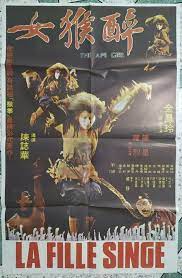
Junesploitation 2022: Zui hou nu (1979)

June 3: Junesploitation’s topic of the day — as suggested by F This Movie— is martial arts! We’re excited to tackle a different genre every day, so check back and see what’s next.

Chi-Hwa Chen directed Jackie Chan in some of his earliest successes, like Half a Loaf of Kung Fu and Police Story. For this movie, he enters the fantastic and tells us the legend of Ming Ling Shur (Kam Fung-ling), a girl raised by apes and in the world of Hong Kong martial arts cinema, that means that she also has a fighting style based on the monkey that allows her to oufight nearly anyone.

Sadly, she falls for the wrong man, the prince (Chen Sing) that she serves as the guard for. He’s just using her to become emperor, but she wants love, so she gets a makeover — some have called this She’s All That mixed with Wolf Devil Woman and you know, yes as many times as I can say yes — and loses most of her powers. That means that she needs to relearn all of her martial arts abilities in time to battle a killer (Lo Lieh) and prove that the prince was the one behind the scheme to steal the crown.

Better titled The Ape Girl, we can consider Ming Ling Shut the Iron Monkey in fighting style and trickster ability. Despite being only a feral girl, she also somehow has a taile, yet the film never explains where she came from. You just accept these things and enjoy things like the opening where she does monkey style kung-fu intercut with a chimpanzee.

Luckily, even when our heroine becomes a gorgeous human, she retains her tail and remembers that everyone shunned her when she was more simian in appearance. Her master didn’t want her to become human, as he knew she’d have her heart broken, and there’s a lesson there for all of us.

So how does she make the great change? Her master’s wife puts her in a barrel for three days and pours special chemicals on her that make her transform into a woman with a tail. It’s pretty astounding.

Not many movies have flying monkey women who can choke men out with their prenhensile tails, so you should take this one and hold it close to your heart.

You can watch this on Tubi. The print is battered into oblivion and sometimes, that makes a movie that much better.


Love and Bullets (1979)

John Huston was originally going to direct Charles Bronson and Jill Ireland in this movie, working from a script by Wendell Mayes, the writer of Death Wish as well as From Hell to Texas and The Poseidon Adventure. Huston worked for some time on the film, but a mixture of illness and creative issues led to him leaving and being replaced by Stuart Rosenberg (The Amityville HorrorVoyage of the Damned).

Charlie Congers (Bronson) has been assigned to bring gangster Joe Bomposa’s (Rod Steiger) girlfriend Jackie Pruitt (Jill Ireland) back to the U.S. so that she can testify what she knows. The truth is, she knows nothing, but that doesn’t mean that Bomposa won’t take her out and the FBI won’t hang both her and Congers out to dry.

This movie was produced by Lew Grade’s ITC Entertainment, which spent millions on movies like The Legend of the Lone Ranger, Movie MovieRaise the TitanicThe Golden GateEscape to AthenaThe Golden Gate and Road to the Fountain of Youth with Bing Crosby and Bob Hope (the last two of these went unmade). The only two of their movies that made money were The Boys from Brazil and The Muppet Movie. Bronson would make two more movies for ITC, Borderline and The Evil That Men Do.

It’s not the best of Bronson’s movies, but it does have lots of great character actors in it, like Strother Martin, Bradford Dillman, Henry Silva and Paul Koslo. Not that it mattered to Bronson, who was a success on this no matter what, as he made $1.5 million, a percentage of the film’s profits, a role for his wife and the traveling expenses for an entourage of more than fourteen people and the blended Bronson-Ireland family.

You can watch this on Tubi.

Knobby the Belwood Wampus Cat (1979)

R.C. Nanney shows up in four movies — other than this one — and they include Wolfman (a 3D movie made by Earl Owensby Studios, as well as their Hyperspace and two other near-regional slashers, Final Exam and Death Screams. Born in Cleveland County, North Carolina, R.C. was known as “The Rhythm Kid” on stage and Curly Lee on the radio. At some point in the 70s, R.C. bought land near his wife Sandy’s family in Knob Creek, a place where Knobby lives.

North Carolina’s own Bigfoot, Knobby is also referred to — at least in this movie — as a Wampus Cat, which is a half-dog, half-cat creature that can either walk like a man or a beast while having yellow eyes that can see inside your soul. That said, some claim that R.C. was the one to name Knobby. He’s definitely the one who made this movie, in which he appears and sings “The Knobby Song” in this shot on video film that was sold in tourist shops.

R.C. also made 1983’s Return of Knobby and 2005’s Knobbett, as well as screen printing his own Knobby merchandise. He told the Shelby Star, “I didn’t try to make any money. Big movie companies spend thousands of dollars with the expectations of getting more money. I spent $15 to $20 with the expectation of getting people to laugh and smile.”

In 2010, Tim Peeler saw Knobby and protected his dog from the creature by rough talking him and poking him with his stick before telling it to git. Knobby is still alive.

Sadly, R.C. passed in 2016. Yet he left behind this film, the attempt of a man to create some fun on the new magic of videotape — pretty advanced, when you think about it — and created a North Carolina version of The Legend of Boggy Creek, if one that’s even more raw and weird.

Don’t expect to find this on IMDB or Letterboxd. But watch it all the same.

You can watch this on YouTube.

Black Star and the Golden Bat (1979)

Who is the lead character in this? Batman? The Golden Bat of Japanese culture? The Batman of Zur-En-Arrh?

Who knows, but when a bunch of kids and their pet dog find supervillain Black Star and his army of henchmen, they must find the hero they worship and get his help, all to show their dying friend that they can be brave. Also, cats and dogs in this universe have the power of speech while humans are animated so poorly that they stand in place for several minutes at a time.

I always hated teen characters and sidekicks, because I never wanted to be Wendy and Marvin or Bucky or Robin. I wanted to be Batman. Years later, I still can’t figure out why comics and cartoons and pushed these second bananas our way. Well, this movie has like six Snapper Carrs in it and one’s dying and his mom died and now he’s going bald.

Made in Korea, dubbed in Spanish, combining a Japanese superhero with an American one. It’s a wild world, huh?

You can watch this on YouTube.

Legends of the Superheroes (1979)

January 18, 1979: I was six years old and in pure comic book mania, as Superman had come out, there was a DC ski stunt show at Sea World, The Incredible Hulk was on CBS, the Captain America TV movie would be airing the very next day and there had already been a few Spider-Man TV movies. It was an amazing time to be a kid and get free superhero stuff sent over the airwaves and often, we’d have no idea what we were about to get other than what TV Guide told us.

The Justice League of America were all showing up on my TV! And not just Batman and Robin, played by Adam West and Burt Ward, but the deep cut heroes I loved, like Hawkman (Bill Nuckols, Wally from Supertrain), Captain Marvel (Garrett Craig, the third man to play the man who says “Shazam!” in the 70s after Jackson Bostwick and John Davey), Huntress (Barbara Joyce) and Black Canary (Danuta Wesley, who took over as the Tea Time Matinee Lady on The Tonight Show after the death of Carol Wayne), plus more well-known ones like Flash (Rod Haase, Candy Stripe NursesIf You Don’t Stop It… You’ll Go Blind!!! and the sequel Can I Do It ‘Till I Need Glasses?) and Green Lantern (Howard Murphy, the gardener in Young Lady Chatterley II, which would become another important memory in my young life for different reasons).

A party for the retirement of Scarlet Cyclone (William Schallert from Inner Space and In the Heat of the Night) when the Legion of Doom spoils everyone’s fun by announcing they’ve hidden a bomb, so everyone must get de-powered, split into smaller teams and save the day. If that seems like a Gardner Fox story, it’s not a bad thing. The bad guys are Riddler (Frank Gorshin, who else?), Weather Wizard (Jeff Altman, who a year after this would star in one of the most baffling TV shows in broadcast history, The Pink Lady and Jeff), Sinestro (comedian Charlie Callas), Mordru (yes, a Legion of Superheroes villain! He’s played by Gabriel Dell, doubling down on oddball kids shows, as he had just been the voice of Boba Fett on The Star Wars Holiday Special), Doctor Sivana (Howard Morris, whose voice was all over the cartoons I grew up on), Giganta and Solomon Grundy (Mickey Morton, who was also in the aforementioned Star Wars nightmare, playing Chewbacca’s wife Malla).

While the show looked cheap and kind of silly, I was six. So I was beyond excited because there was another episode the very next week.

The next week is why I grew up to be the cynical person who will go on at length about why I hate Wed Craven or how no good slasher has been made with minor exceptions after 1984. All my pain came from this show, in which the adventure format was ditched to instead present a celebrity superhero roast of the superheroes hosted by Ed McMahon.

Now, I love celebrity seventies roasts.

I love Ed McMahon.

But I had been laughed at — and would be laughed at my entire life — for knowing too much about comic books.

Now, even comic books were abandoning me to the void of ennui. Yes, I was the kind of six year old that often asked for an Anacin because I claimed life was giving me a migraine.

Anyways…

New characters were added, including stand-up comic black hero Ghetto Man (Brad Sanders), Captain Marvel’s Aunt Minerva (Ruth Buzzi), Hawkman’s mother (Pat Carroll, the voice of Ursula in The Little Mermaid) and superhero reporter Rhoda Rooter (June Gable, Estelle on Friends) who lets the world know that Giganta (early trans actor Aleshia Brevard, who played one of the female creatures in Bigfoot) was marrying The Atom (Alfie Wise, who was Batman in Cannonball Run).

If it sounds horrible, well — it was. And it still is.

I mean, didn’t the producers realize that Captain Marvel lived on Earth-S, I wondered? Yet even I knew that this was above Wonder Woman, who had her own show, and Superman, who at one point eclipsed Batman, who bided his time and worked with the right directors obviously.

In his book Back to the Batcave, Adam West said that he regretted doing these shows. They couldn’t even get his Batman costume right.

But hey! Gary Owens showed up!

Captain America II: Death Too Soon (1979)

Airing on November 23 and 24, 1979 — the same nights that Salem’s Lot was also on CBS — with the new creative team of director Iván Nagy (perhaps better known as the boyfriend of Hollywood madam Heidi Fleiss) and Wilton Schiller (who produced the last season of The Fugitive and wrote this with his wife, former casting agent Patricia Payne).

According to star Reb Brown, Captain America wore a helmet in these movies because the California Highway Patrol — you know, CHiPs — said that he must have a helmet to ride a motorcycle on the freeway.

At least he gets to hang-glide this time. And get a decent villain, as Christopher Lee plays General Miguel, who is using an aging formula to hold Portland hostage. Cap has Connie Selleca on his side as a scientist, but this pitch for a series — the second if you count the other TV movie that aired four months before — didn’t get the ratings needed, what with those expensive stunts.

I kind of love reading reviews making light of Steve Rogers being a painter in these movies. That’s totally the character from the comics, one of the few things that made it into this film.