I love Mondo Macabro. They put out amazing releases and clean up neglected foreign films, making things a million times better than they have any right to. Just this year they’ve released a slew of films that have never even been put out on DVD in our country. They’re one of my favorite labels.
However, they nearly got me in trouble by sending me a review copy of this film. With no warning, my wife opened it and instantly called and asked why I bought it. Thanks — I hate looking a gift horse in the mouth (and this movie does way more than look when it comes to horses).
Oh yeah — this entire review is NSFW. You’ve been warned.
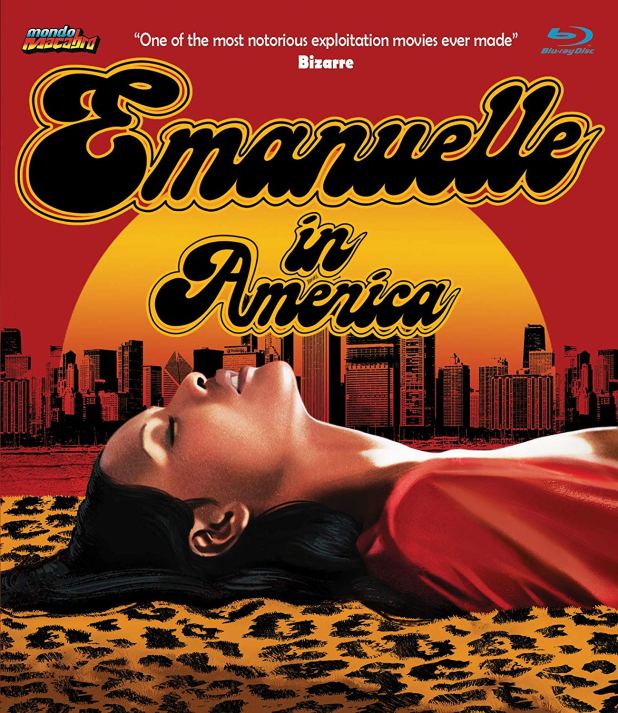
This is the second in this series of movies to be directed by Joe D’Amoto. Whatever name he uses, you know exactly the kind of insanity that that name means.
Emanuelle — notice the missing M to denote that this has just enough legally not to do with the French film that starred Sylvia Kistel but just enough to make you think that it may — is a photojournalist out to get a great story no matter what. No matter what often means that she’s getting naked and in trouble, starting with an angry virginal boyfriend of a model that wants her dead.
She’s played by Laura Gemser, who has also used the name Moira Chen, and if you’ve seen a Bruno Mattei or D’Amoto film, you know exactly who she is. I’d recommend her star turn as a psychic who gets menaced by mutant fishmen in Endgamemyself.
Here, she’s on the trail of playboy Eric Van Darren, who is enslaving women and creating a harem. She also hooks up with Italian duke Alfredo Elvize (Gemser’s real-life husband Gabriele Tinti who is in Enter the Devil if you’d like to descend further down the funnel of Italian scum) and his wife (Paola Senatore, Eaten Alive!).
You may be like — hey, this seems like the typical Cinemax After Dark film, albeit with much better production values and one hell of a musical score. That’d be correct until Emanuelle ends up going to an island where every fantasy can become reality. Hold the Ricardo Montalban!
That’s when she discovers that some of the folks there like making love while watching films of young women dying. Yep — snuff films!
Emanuelle is disgusted and quits her job to go on a long vacation with her boyfriend. Of course, she’s soon come back for Emanuelle Around the World, where she meets a guru who promises the ultimate orgasm. And that guru is, of course, played by George Eastman. Ivan Rassimov also shows up, and if you suddenly started searching for this film, you get why I spend so much time writing about movies on this site.
After that, D’Amoto and Gemser would team up for perhaps an even more insane tale than this one, Emanuelle and the Last Cannibals, and one other Black Emanuelle film, 1978’s Emanuelle and the White Slave Trade.
If you saw the version of this that played on Cinemax or Showtime in the 1980’s, you didn’t get the full uncut madness that appears on this blu ray. Honestly, outside of degenerates, I have no idea who is ready for such madness.
You can get this directly from Mondo Macabro. The colors are gorgeous, the music sounds better than ever and the extras, like a documentary entitled D’Amato Totally Uncut: The Erotic Experience, brand new audio commentary by Eurotrash aficionados Bruce Holecheck and Nathaniel Thompson and a brand new interview with author David Flint, are worth just as much as the movie.
But man — you guys gotta warn me when you send me this kinda stuff. Still, much appreciated.
DISCLAIMER: We were sent this movie by Mondo Macabro. Luckily, my marriage survived.
ABOUT THE AUTHOR: John S Berry is someone I have great conversations with. I’m excited that he’s writing for the site. You can check out John on Twitter.
I had one of those odd realizations as I was watching Keep My Grave Open. Someone had recently asked me if David Lynch was my favorite director. I couldn’t jump right on that answer and say yes for some reason. Don’t get me wrong, I love his work (yes even Dune) but favorite? What makes someone your favorite?
Sunday night I was winding down a great weekend and was happy to have an extra hour to burn. I remembered I needed to re-watch Keep My Grave Open for Sam. It had been some time since I had viewed it and Sam’s Movie Pack reviews deserve the respect of watching them as they appear on the box sets (note: I watched it again Monday night)
So, I put this in and about midway something hit me, SF Brownrigg may be my favorite director. All my current favorite films and filmmakers have the same spirit; small I budgets, character studies and unique locations that make me either homesick or nostalgic. His movie always have a touch of sadness to them and I often find some sweetness in one or more of the characters. Maybe SF Brownrigg is the great grandfather of horror that really is about the people and the small universes they inhabit.
Grave starts with cracks and pops and the sounds of wind in the back of a pick-up. The old bum immediately melted my heart as he investigated the surrounding farms as the mournful music played and he grabbed his knapsack. This just set the tone for the movie, people carrying a quiet sadness about them in a rural setting, it was like seeing some of my mom’s scrapbooks come to life and speak.
Usually I am not too fond of origin stories or laying out a character’s back story piece by piece. With all of Brownrigg’s films (all 5, four horror and the ones I have seen) I want to know how they got there, why are they damaged this way?
Even with the opening hobo character just serving as a quick jumpstart to the story I found myself wanting to know more about him. Why the bright yellow sweater? Why was he so polite in a sense when he was raiding the fridge and didn’t take all the contents? Was he looking for work?
Brownrigg often used some of the same actors in his films and they all do great to decent jobs. They give a lot of them small little natural quirks. Keep My Grave Open centers around Ms. Fontaine played by Camilla Carr who keeps up appearances (2 to be exact). But is slowly losing her grip on sanity or is she just trying to win over the mysterious Kevin?
Ms. Fontaine is a lonely tortured soul in a good-sized country house with a nice young man named Bobby who takes care of her horse Caesar. Bobby cares more about the horse than teenage girls (OK community college girls) or older women trying to seduce him. He is likeable polite young Texas man and the actor is Topher Grace before there was a Topher Grace or that 70s show.
There are many dimensions to a film that was made to fill up time on the drive-in screens across America in the 70s. It is much more nuanced and open ended, and boy do I love an open-ended film, especially when you can go and talk about theories and ideas with a friend over a good milk shake (miss you Lucas).
In that spirit, rather than recap and describe the film (which to be honest you cannot get better than Groovy Doom’s amazing piece here.
Let’s all take some time,78 minutes and get out our notecards, yarn, push pins and giant whiteboard. Put on your best formed foil hat and let’s talk some theories and speculation.
But before we get into was Kevin real? Was he there the whole time? Etc. Let’s take a minute to really ponder the odd old dingy country bar/ one stop brothel scene, one of the those great I can almost smell it scenes that Brownrigg often had in his films.
After hearing of this place from Kevin and him giving a great Yelp review of Twinkle Ms. Fontaine decides maybe she needed to see what the fuss was about. Maybe get some take out for Kevin.
We cut to a man and a lady trying to negotiate how much adult fun they are going to have this evening. What comes next is some good old fashion haggling but using amounts of $22.50 with a counter of $17.50. Is there change in prostitution? Where and how do you give change?
I imagine the bar/brothel really priding themselves in their customer service and imagine most interactions went like this:
Trixie Diamond: OK you had the #3 and an Around the World.’
Good Bubba: ‘Here’s a twenty.’
Trixie Diamond: OK and here’s a dollar fifty back.
Good Bubba: Keep the change
Trixie Diamond: Thanks hon’ Have a good rest of your night.
Good Bubba: You too ma’am careful driving home looks like rain.
Old bar maid: Don’t forget to get your customer rewards card punched. 12 punches and you get a free one.
Twinkle was inpatient lady, she must have double booked herself. Smart move hiding in the car and pulling the sheet over your head. Not such a smart move gasping and giving away your position.
So, we know some of the facts but do we truly? We know of Ms. Fontaine’s version and her recalling. But we have also been hinted at a different truth from the doctor?
Was????:
A. Kevin an orphan with Miss Fontaine as children or her biological brother. At her 16th birthday she was caught changing innocently to try on the dress or is that Miss Fontaine’s version? Where they really caught by the old aunt who took care of them and Kevin was shipped out to another orphanage or military school or did he just run away. Again, we are hearing Ms. Fontaine’s telling of the story
B. They were both orphans and Red was crushed that he left, and she was stuck with the house after the old lady died and she kept dreaming of Kevin returning.
C. Maybe Kevin was there the whole time but would go on benders and do anything he could do to get away from Ms. Fontaine. Each of the victims had some connection to Kevin which is why Ms. Fontaine eliminated them:
1c. Old Bum was one of Kevin’s drinking buddies fellow hobo on the road coming back into town. Remembered that was his place and thought he would stop by.
2c. Bobby (Topher Grace) was ranch hand that Kevin liked working with and was kind of like a kid brother which leads to…
3c. Twinkle was one of the ladies that Kevin and Topher uh hung out with when they went out for beers on a Saturday night
4c. Young girl who liked Bobby had caught Kevin’s eyes a few times and Miss Fontaine saw it
C. Why the fencing like sword and gloves as the weapon? Did Kevin kill a fellow orphan or sibling when the old lady made them practice fencing?
D. Why did nobody come looking for any of the people. OK we know they probably thought Twinkle had finally mouthed off to the wrong guy. But what about the Topher Grace and the other girl, I am not sure if they were supposed to high school kids or community college kids. But someone had to wonder where they were.
E. Did Ms. Fontaine kill herself because she had gone to such extremes and Kevin had still not come back and given her is full attention? Or did he just not care and was sleeping off one hell of a bender?
F. Did Kevin read about Ms. Fontaine’s death in the paper? Maybe he get word from the MD? Perhaps he was just as damaged where he was, a male version going through what Miss Fontaine was going thru but on a different coast or state and he came to take his place as last member of odd family?
G. Or is it possible there is some sort of rebirth, re-awakening action going on? With Ms. Fontaine dying, she re immerges as the manifestation of Kevin. Kevin calls up to her in the house at the end. Or maybe the suicide opened some odd dimension and they switched places ala Freaky Friday? Or perhaps Ms. Fontaine took
I guess that is why SF Brownrigg may be my favorite director, in a simple short movie made for drive ins I become immersed in the what ifs and wonder whys. Anyone can Room 237 a Kubrick film, but I am glad to get to do the service for SR Brownrigg.
I have an idea of the story but am never sure how it is going to end or what direction it will take. SF Brownrigg’s films make day dream and speculate, and wouldn’t it be nice if more films did that?
DAY 26. THERE’S SOMETHIN’ IN THEM THAR HILLS: Twangy cringers from the backwoods and by-waters.
After seeing Joe Bob Briggs “How Rednecks Saved Hollywood,” the entire B&S About Movies team mobilize and celebrated these films, from a Letterboxd list to making our own picks for top 70’s good ol’ boys movies. But to be honest, we watched so many of these movies, where would we find something new to answer the Scarecrow Challenge for one more day?
Canada, with your tax shelters and movies that are far north of odd, remains our constant bastion and perhaps place to run to after next November.
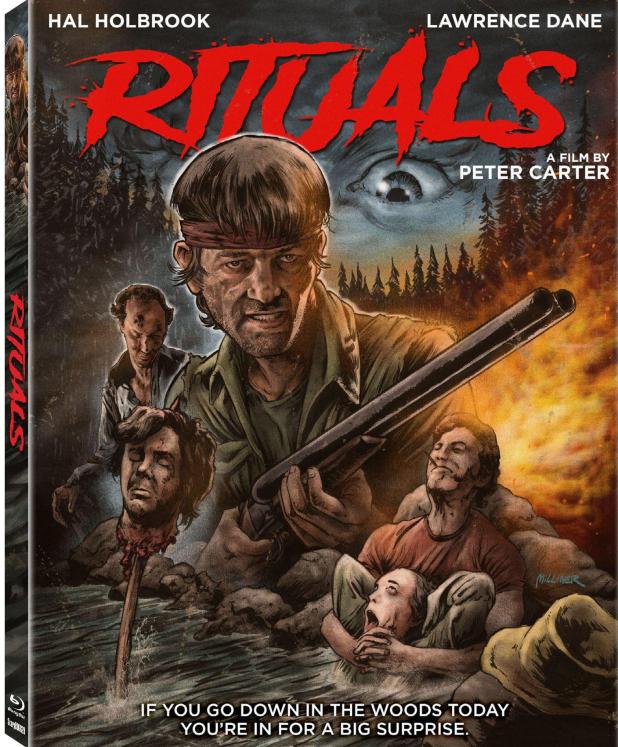
Director Peter Carter also made a movie called High-Ballin’ and it wasn’t a porno, instead a trucking film, so we need to respect the artist coming in.
Five doctors go on vacation deep in the Northern Ontario wilderness. Every year, one of them gets to pick where they go and this time, it’s D.J. who gets to be travel agent. He takes the guys to the Cauldron of the Moon, which was a practical location that had been created by a fire a few years earlier.
According to the natives, this is where the earth collided with the moon and it hsould be a place of magic, but it’s really just a place for the doctors to get drunk and argue about their lives, their ethics and, well, just argue.
As our guys wake up for another day of cutting up, they end up getting cut up in a much different way. That’s because everyone’s boots have been stolen. I guess these guys never listened to Iron Maiden or cowboy lore.
D.J. had said, time and again, being a backup pair of boots, and he ended up being the only one that did so. That means he has to go back alone through he dangerous woods and bring back four pairs of boots. As the guys wait for their friend, they’re soon confronted by the carcass of a dead deer before they also discover a severed head. That’s a real dead deer, by the way, in case you think the Italians are the only ones willing to sicken you with autentic snuffed out animals on celluloid.
Harry (Hal Holbrook) takes charge, but it seems as if the past — and all the mistakes with it — have come back to haunt the rest of the group.
While this movie was obviously inspired by Deliverance, it’s also a proto-slasher, with a killer setting traps in the woods that predates the work of Cropsey, Madman Marz and Pamela Vorhees’ little man.
You have a lot of options if you want to see this movie. You can watch this on the Internet Archive for free. Or you can allow our friends at Mill Creek to help with either their Drive-In Movie Classics: 50 Movie Pack or Horror Classics: 100 Movie Pack. However, the best version is available from Ronin Flix, who have the Scorpion Releasing blu ray re-release of this.
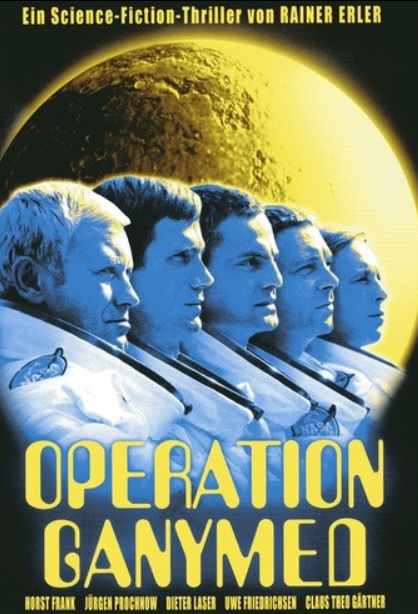
This dystopian-inspired version of a psychological Russian space epic (1970’s Signale, 1972’s Eolomea, 1980’s The Orion Loop, 1983’s Moon Rainbow) produced for German theatres in the wake of the ‘70s Star Wars-inspired production boom also appeared on German and European television as Heroes: Lost in the Dust of the Stars. Courtesy of the burgeoning home video market, Operation Ganymed appeared a few years later on U.S shores in a limited/low-key, admittedly patience-trying and poorly-executed English dub under its theatrical title on defunct Marathon Video (Atlantis in the U.K).
The now ultra-rare tape sought by VHS/Beta collectors doesn’t even appear in U.S tape guides. (How rare is the tape? A VHS is currently for sale on eBay for $78.00 . . . sigh, that’s the copy/version I rented from Tapes n’ More so many years ago!) The film was popular enough in Europe to warrant DVD reissues dubbed or subtitled for various markets—but are barebones VHS rips. And beware: most of those are DVD-Rs (but don’t complain and just be happy the film is at least digitally preserved).
Recognized as a winner of a few Euro-science fiction film festivals, the film earned a domestic stateside-release when star Jürgen Prochnowimpressed U.S audiences with his break out rolls in Das Boot (1981) and Dune (1984). Astute post-apocalypse fans will instantly notice those U.S-issued VHS tapes were most-likely plundered by the producers of the less intelligent Canadian exploiter Def-Con 4 (1985) and the South African gimp-clone Survivor (1987). If there’s ever a film that deserves a full-blown digital restoration from its original 35MM print—which was bestowed this year by Arrow Video to Def-Con 4—then Operation Ganymed is the film.
The long-awaited, inferior DVD currently in the marketplace came as result of respected German actor Deiter Laser (who I remember from the obscure and equally rare VHS The Elixirs of the Devil, a 1976 German take on the ‘70s Euro-horror nasties The Devils and Mark of the Devil) achieving his first taste of worldwide fame with his turn as the mad Dr. Heiter in Tom Six’s art house stomach churner, The Human Centipede (2009).
The remainder of us video and genre fringe geeks will recognize the third-billed Horst Frank, who became a go-to bad guy for spaghetti westerns (1968’s Django, Prepare a Coffin; with George Eastman and Terence Hill), Euro war epics (1964’s Mission to Hell), and Italian Gialli (1971’s Cat o’ Nine Tails for Dario Argento). The other two explorers, portrayed by Claus Theo Gardener and Uwe Friedrichsen, built extensive German-based resumes, with the late Friedrichsen in 121 projects and Gardener moving into directing.
As with the Russian you-either-love-it-or-hate-it epic-mindbender Solaris (1972), Operation Ganymed is an introspective, metaphysical journey concerning a United Nations-sponsored team of three Americans, two European, and one Russian who return from their four-year (left in 1985 and returned in 1989, according to the video box description; in the film it’s 1991) catastrophic mission to Jupiter’s moon in which, while they discovered rudimentary, primitive life (they pontificate on the foolishness of spending $38 billion for one tube of green slime), it was at the cost of 21 crew members, including two that perished on Ganymede’s surface.
What’s unknown to the crew: Earth lost contact with them 900 days ago (just over 2 1/2 years)—and considered Ganymed 2 lost. No one is waiting for them; no Earth-orbit rendezvous is prepared. Unable to establish radio contact, and with 21 hours of oxygen left and no mission control to guide them, the astroquintet decides to make an emergency ocean landing off a rocky desert coastline that may be Earth—possibly Mexico—or a strange, new planet.
As they begin their trek across the desert towards what they hope is the U.S, they come to believe the Earth was decimated by a mysterious, cataclysmic ecological event or nuclear war. Their lines of reality begin to blur as hunger, dehydration, possible radiation sickness, and long-stewing inter-ethnic tensions lead them to madness, murder, and cannibalism—real or imagined.
The film’s first 30 minutes are impressive in adapting Apollo-era technology, suits, and tech-jargon for a Jupiter mission (that’ll leave a sci-fi buff pining for another watch of the 1978 Apollo-Mars pot-boiler Capricorn One), and the later, frequent flashbacks to the crew’s spacecamp-training sessions on Earth, and the sequences on Ganymede, which details how the two crew members died, also exceed the film’s budgetary constraints—limitations not experience by the likes of Star Wars and Capricorn One, even the cheesy Italian pasta-space opera, Star Crash. So if you’re looking for a big-budget production with flashy models, blinding laser beams and drooling, human-crunching aliens, this film isn’t for you.
Regardless of those reservations, let it be known that respected and successful German film and TV director Rainer Erler delivers a product far more engrossing that most post-2000 CGI failed-mission-discovers-life-on-a-distant-planet romps, such as the fellow Euro-produced Stranded, Europa Report, and Last Days on Mars.
Since this is a psychological, post-apocalyptic journey through man’s “inner space,” be warned: Operation Ganymed takes its time and you’ll be left with more questions than answers: Were the astronauts crazy. Were they on Earth. Did they warp to another planet. Does the Earth even exist. Were they even in Mexico. Did their fellow crew members really die on Ganymede. Did they all die on Ganymede—and this is all a hellish penance. Are they guinea pigs in a test set up by the corporation that sent them into space?
Find out for yourself by watching the full movie for free In English (at 1:33:00) and the uncut German version (at 1:53:00; with no subtitles) on You Tube. The DVD is available as part of a German-issued Rainer Erler Kultfilme (Cultfilm) 6-pack. There are more current, professionally-packaged, non-USA Playback Region 2 DVDs at Amazon (Caveat: know your regions!), along with the older DVD-issues at Amazon (you can sample those DVD images with the two video-clip trailers provided in this review).
You can catch up on the wide array of post-apocalyptic adventures with B&S Movies’ “Atomic Dust Bins” Part 1 and Part 2 featuring 20 mini-reviews of movies you never heard of, along with a “hit list” featuring all of the apoc-flicks we watched for September 2019’s Apoc Month.
About the Author: You can read the music and film reviews of R.D Francis on Medium and learn more about his work on Facebook. He also writes for B&S Movies.
To the chagrin of the Italian film industry: we are still alive. And to my chagrin: the Italian post-apocalypse — the single greatest sci-fi film sub-genre to dominate the drive-ins and home video stores of my youth — is over.
Sure, Hollywood offered us their big-budgeted versions of our decimated future with Waterworld (1995), Escape from L.A (1996), 28 Days Later (2002), The Road (2006), I Am Legend (2007), The Book of Eli (2010), World War Z (2013), and Mad Max: Fury Road (2016) — all were honorable, but sometimes misfired, efforts. But it was the lowbrow, low-budgeted indie knock-offs coming out of Eurasia in the 1980s — spearheaded by the Italian film industry’s insatiable quest to rip-off proven American genre flicks — that revved our post-nuke engines (just as B&S Movies’ “Fucked Up Futures” and “Deadly Game Show” weeks prove).
However, prior to the Australians, Italians and Filipinos (we love you, Ciro H. Santiago!) dishing their starchy-apocalypses, there was the “Big Three” by Moses and Ben-Hur himself: Charlton Heston. Chuck’s turn in Planet of the Apes (1968) ignited the post-apocalyptic sci-fi craze within the Hollywood mainstream studio system and led to Heston’s turns in The Omega Man (1971) and Soylent Green (1973).
Once sour on the low-budget “image” of sci-fi films of the ’50s and ’60s, major studios and A-List actors quickly committed to the apocalypse genre — with Oliver Reed in Z.P.G (1971), Bruce Dern in Silent Running (1972), Yul Brynner in The Ultimate Warrior, Sean Connery in Zardoz, and Jackie Cooper in Chosen Survivors, (all 1974), James Caan in Rollerball (1975), Michael York in Logan’s Run (1976), George Peppard in Damnation Alley (1977), and Richard Harris and Paul Newman in Ravagers and Quintet (both 1979), respectively.
So while the Hollywood apoc-mainstream gave us some pretty incredible movies from 1968 to 1979, only one of those films had a bad ass apocalypse truck piloted by our favorite ‘80s TV bad-asses: Col. John “Hannibal” Smith from The A-Team and Stringfellow Hawke from Airwolf.
Sadly, Damnation Alley isn’t as bad-ass as the ‘80s Italian post-apoc flicks left in its wake. If you want a film with George Peppard going into battle with real life (unconvincing) “giant” scorpions and cockroaches blue screen-composited (pasted) into live action sequences, then this is film is for you. Just make sure the papier mâché scorpion claws don’t bite you in the ass.
Damnation Alley started out promising enough: as a popular 1967 sci-fi novella written by Roger Zelanzy. In light Pierre Boulle’s success with the 1968 Planet of the Apes adaptation of his 1964 novel La planète des singes (aka Monkey Planet), Zelanzy was urged to expand the novella into a 1969 novel to make the story more viable for a movie deal. And he got the deal. And it took eight years to develop. And what made it to the silver screen—under the direction of Jack Smight, who scored consecutive box office hits with the disaster flick Airport 1975 and the war movie Midway (1976) — barely resembled the source material.
Check out this awesome synopsis of the book:
The story opens in a post-apocalyptic Southern California, in a hellish world shattered by nuclear war decades before. Several police states have emerged in place of the former United States. Hurricane-force winds above five hundred feet prevent any sort of air travel from one state to the next, and sudden, violent and unpredictable storms make day-to-day life a mini-hell. Hell Tanner, an imprisoned killer, is offered a full pardon in exchange for taking on a suicide mission — a drive through “Damnation Alley” across a ruined America from Los Angeles to Boston — in one of three Landmaster vehicles attempting to deliver an urgently needed plague vaccine.
Police states? A Snake Plissken-like criminal? Did John Carpenter read this book? So what in the hell happened to that movie?
The first pass at the novel, which mirrored the novel-source material, was penned by Lukas Heller, himself with consecutive screenwriting hits with the war-action films The Flight of the Phoenix (1965) and The Dirty Dozen (1967). Zelanzy loved Heller’s script.
Then, for whatever reasons . . . as studios do . . . the studio executives made their “notes,” then hired Alan Sharp, who had hits with the Burt Lancaster action-western Ulzana’s Raid (1972) and the Gene Hackman police-mystery Night Moves (1975), to do a rewrite — which expunged all the elements that made Zelanzy’s book a best seller in the first place. Bye-bye, Hell Tanner, you bad-ass. Poof goes the Escape from New York-esque police states. Hello, campy storytelling. Goodbye serious-dark plotting and characters.
Sigh. Will the studios ever learn?
So, while Steven Spielberg battled perpetually-failing mechanical sharks on the set of Jaws, Jack Smight’s proposed “epic” Landmaster-motorcycle battle against full-scale 8-foot scorpions was a disaster. The giant cockroaches fared worse. However, the 12-wheeled, seven-ton Landmaster built by Dean Jeffries (also responsible for the vehicles in the apoc-satire Death Race 2000) at a cost of $350,000 (one was built; “two” appear in the film as result of photo trickery) worked better than expected. So the studio requested more shots of the Landmaster appear in the film — which is not a good sign. (And Allan Arkush being instructed to “blow up more motorcycles” in Deathsportdidn’t work out either. And so it goes.)
So, 20th Century Fox labored over the film in post-production for 10 months, trying to “save” the picture by superimposing “radioactive skies,” scorpions and cockroaches. At one point, as this old Starlog article from September 1977 shows, the studio even decided to ditch the book’s unique title and retitled the film with the vanilla . . . Survival Run (which became the title of a 1979 Peter Graves hillbilly-bent The Hills Have Eyes rip-off). Meanwhile, George Lucas was toiling away on his Flash Gordon homage, and released, Star Wars. And the studio believed Damnation Alley would be the “blockbuster” . . . and Star Wars would be the flop.
And we know how that worked out.
The post-production snafus over Damnation Alley became so heated that the studio wrestled control of the film from Jack Smight and re-edited the film a second time — dumping what little plot and character development was left . . . for more of the Landmaster . . . and all that was left of Roger Zelanzy’s book was the Landmaster. At least the studio got the picture they wanted.
So, was it worth it?
This You Tube video shows the Landmaster going through its paces in the film — all seven minutes of it — for your viewing pleasure. Hey, it’s why we love the movie in the first place: Hannibal and Stringfellow driving a post-apocalyptic, amphibious heavy metal scorpion crusher is why we bought our tickets.
Thus, five months after the $20 million-budgeted Star Wars was released on May 25, 1977, the $8 million budgeted — that ballooned to $17 million — Damnation Alley finally saw the light of day on a date no one remembers: October 21, 1977. A critical failure, its box-office stalled at less than $5 million in sales. The film was eventually recut for television and premiered as a high-rated NBC Sunday Night Movie on June 12, 1983, and featured alternate and additional scenes that offered more character and plot development — but that TV cut was lost and never released on video. In fact, George Peppard has gone on record as being unhappy with the 1977 theatrical cut. Zelanzy wanted his name taken off the movie; the studio (for whatever legal snafus) refused.
Oh, so you want to know what the movie is about.
Sorry, this is one of those films where the backstory (like Stallone’s D-Tox and Cobra, for example) is better than the actual movie. Let’s put it this way: Damnation Alley is almost the same as Def Con 4 in plot . . . but even with its shortcomings, Damnation Alley is the far superior film. And for $17 million, it should be.
First Lieutenant Jake Tanner (Jan-Michael Vincent, White Line Fever) and Major Eugene “Sam” Denton (George Peppard, Battle Beyond the Stars) are on duty at an Air Force ICBM missile silo in the California desert when the Soviet Union launches a nuclear strike (film clip). Regardless of their retaliatory strike, Tanner and Denton only managed to intercept 40% of the Soviet missiles.
Two years pass. The Earth has titled off its axis, radiation has mutated what life is left, and the planet is wracked by massive aurora borealis-like hurricanes and windstorms. Then, one day, they pick up a radio transmission from Albany, New York. There are survivors! So they hop into their giant, 12-wheeled Landmasters to travel across “Damnation Alley,” with stops along the way in the Omega Man-devastated cities of Salt Lake City, Utah, Las Vegas, Nevada, and Detroit, Michigan—and pick up Jackie Earle Haley (Kelly Leak from the Bad News Bears, Rorschach in Watchmen, and Freddy Krueger in the remake of A Nightmare on Elm Street) along the way.
You can watch the movie for free on You Tube and enjoy Dean Jeffries’s fascinating discussion on the development and construction of the Landmaster on You Tube. Can you imagine if this film had been a blockbuster? We would have played with a bad-ass Landmaster and giant scorpions with moveable claws chompin’ on our George Peppard and Jan-Michael Vincent action figures. Would our Landmasters have laid waste to the Millennium Falcon and kicked Steve Austin’s one-armed plastic-engine lifting ass? You bet!
As for 20th Century Fox: They fared better with their next venture into the science fiction realm with a script making the office rounds under the title of “Star Beast.” Rushed into production to capitalize on the success of Star Wars, the film became an influential smash that inspired a series of gooey Italian space romps: 1979’s Alien (as B&S Movies’ “Ten Movies that Rip-off Alien” and “A Whole Bunch of Alien Rip-offs All at Once,” investigates; we also blow out a bunch of apocs with our two-part “Atomic Dustbin” feature).
Regardless of its shortcomings, we post-apoc rats love Damnation Alley. How loyal is our love? The members of progressive space rockers Hawkwind wrote a song about the movie! How many movies can make that claim?
Oh, and contrary to popular opinion: The Ark vehicle from Filmation’s Ark II television series that aired on CBS-TV in 1976/1977 was not the repainted and modified Landmaster from Damnation Alley, as this article from Space 1970 clarifies.Is the Ark II as bad-ass as the Landmaster? Oh, hell yeah.
We talk more about the Landmaster, the Ark II and other apoc rides!
Update: Be sure to check out McSmith’s The Books That Time Forgot blog and his review of Roger Zelazny’s Damnation Alley.
About the Author: You can read the music and film reviews of R.D Francis on Medium and learn more about his work on Facebook. He also writes for B&S Movies.
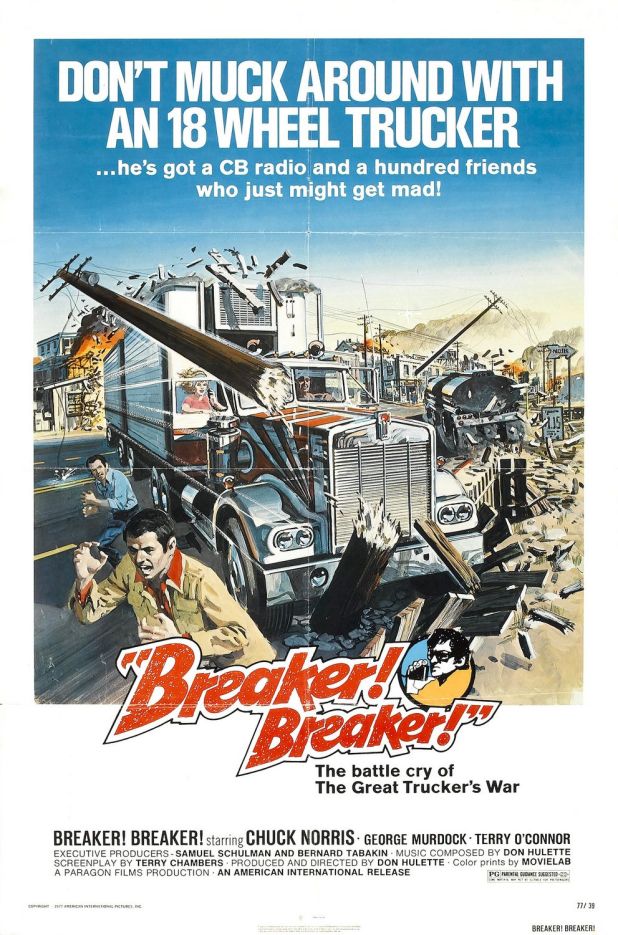
Don Hulette somehow went from the music to Starhops to directing this, which feels like a glitch in the matrix which is IMDB. Kind of the same feeling one gets realizing that they’re about to watch a trucking movie starring Chuck Norris, who said, “I didn’t know anything when I made that movie. We shot it in just 11 days. But it was amazing, people loved it anyway. It’s a down-home kind of movie. It’s still my dad’s favorite.”
J.D. (Chuck Norris) is a trucker from California who learns that his friend was paralyzed after being beaten by Texas City cops Sergeant Strode and Deputy Boles, who have a history of entrapping truckers and sending them to jail. J.D. warns his brother Billy to stay out of Texas City, the kid doesn’t listen and goes missing.
That brings J.D. to town, winning over single mom waitresses and accidentally killing mechanics, which gets him sentenced to death by Judge Trimmings. Luckily, J.D.’s new hash slinging old lady calls in a convoy of big rigs to save him. Jack Nance is in this, too. Yes, the same Jack Nance who was in Eraserhead. Life’s funny like that.
Evel Knievel steps up to the mic and addresses his fans: “Before I make the jump, there’s something I’d like to say to you, that’s been bothering me for a long time.
I go to Indianapolis every year to see the Indy 500. I go there with friends to drive and race. Every year when they go there to qualify, they usually have to go as fast as they possibly can to get a front row position. They put nitro in their cars sometimes, instead of the fuel that is intended to be in the cars so that the cars will go faster … and they do, for five or ten laps. And then they blow all to hell.
And you people, you kids, if you put nitro in your bodies in the form of narcotics, so that you can do better, or so that maybe you think that you can do better, you will for about five or ten years, and then you’ll blow all to hell.”
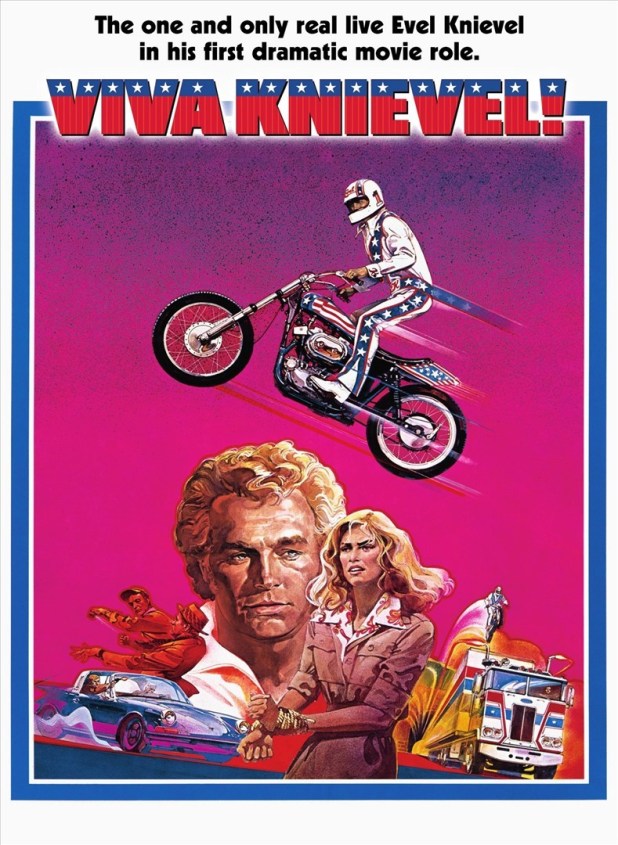
Ladies and gentlemen, welcome to the alternative universe that was the 1970s, when Irwin Allen would produce a film all about Evel Knievel and his exploits, while neglecting to mention that Evel was married with three kids, all so that a subplot where a reporter (Lauren Hutton) can romance our daredevil in stars and stripes.
Let me tell you right now — this movie is everything that I love. It’s an earnest production that goes all out behind a cultural phenomena that is moments away from spectularly flaming out, bringing along a cast of Hollywood near A-listers. It’s one of those films that you’ll incredulously yell, “How the hell did they get him to be in this?”
Any movie that casts Marjoe Gortner as Evel Knievel’s stuntman rival is a movie that I’m going to write a few thousand words about, let me tell you that much.
This movie came out in June of 1977, just three months before Knievel and his associates violently assaulted promoter Shelly Saltman with an aluminum baseball bat. With Evel losing his sponsorship deals as the result, the film suffered, only opening in four foreign markets.
But that Evel — the one that would scream “I’m going to kill you!” while breaking defenseless men on Hollywood backlots — doesn’t appear here. Instead, Evel almost seems like a supernatural force of nature, randomly showing up in the middle of the night at orphanges bearing gifts for the children, inspiring a crippled boy to walk again and even charming Sister Charity, the toughest of the nuns (Allen’s wife Sheila).
When he’s not miraculously appearing to help the downtrodden children of America in a leisure suit, he’s travelling around the country jumping over mountain lions and fire to bring entertainment to the real people of the U.S. of A. His charity even continues on the people he surrounds him with, like promoter Ben Andrews (how did they get Red Buttons?) and alcoholic mechanic Will Atkins (how did they get Gene Kelly?).
Evel tells the press like it is, making quips at everything they ask him. And when he’s ambushed by photojournalist Kate Morgan (how did they get Lauren Hutton?), he snaps at her too. After all, if Evel dies trying this jump, it’ll make for a big story. Well, if you know anything about Evel, he totally bites it on this big jump, announces his retirement, flips out at the promoter and goes to the hospital.
While Evel is in the hospital, a bizarre plot against his life is hatched. His one-time protege Jessie (I know how they got Marjoe Gortner) is trying to convince him to do an incredibly daring jump that he’ll definitely die trying. Then, Stanley Millard (I kind of understand how they got a pre-Airplane! Leslie Nielsen) will hide $3.6 million worth of nose candy in the walls of Evel’s tour trailer. The border patrol will all be too sad that Evel is dead and not search his truck and then, they’ll all profit.
Meanwhile — as if this movie can grow any stranger — Will’s estranged son Tommy returns from boarding school. Will can’t deal with the kid, who reminds him of his dead wife, which is the reason he’s drinking. That leaves Evel to basically become Tommy’s new magical father.
Will learns of the plot against Evel and is sent to a mental hospital where the evil Dr. Ralph Thompson (how did they get Dabney Coleman?) keeps him under lock and key. And when Evel gets to Mexico — along with real-life pal Frank Gifford (how did…oh, you get the joke by now) — Jessie gets all zooted and kncoks out our hero, steals his bike and really does make the impossible jump before he dies thanks to the bike being sabotaged. His body is taken so that the drug deal can continue and everyone in the rest of Mexico now believes that Evel is muerto. Amazingly, this is real crash footage of Evel’s May 1975 Wembley Stadium jump.
For all of the other stunts, professional stuntman Gary Charles Davis was hired. His role was kept hush hush to avoid questions — and possibly insurance concerns — about Knievel himself performing his own motorcycle stunts.
Evel breaks Will out of the hospital and they discover that Tommy and Kate have been taken hostage. Of course, everything works out. The drug lords — which also count Cameron Mitchell, God bless him, amongst their number — are defeated, Leslie Neilsen drives off a cliff, Lauren Hutton falls for Evel and father and son are reunited. Then, Evel jumps a put of fire and the credits roll.
Silent partner Irwin Allen ended up directing eighty percent of this movie after origianl director Gordon Douglas (They Call Me Mister Tibbs!, In Like Flint) fell ill. I could make a joke about how he specialized in making disaster movies, but that joke is way too simple. Much like Evel, I only take on the most dangerous of writing stunts.
This movie is lterally everything that I love all at once. When I finally die jumping over a pit full of snakes, please play it on a loop at my funeral. Thank you.
“Shoot, why didn’t they just pud it all in one gosh dang movin’ pickture called ‘Bite My Grand Theft Auto Dust, Smokey’?” — Cletus
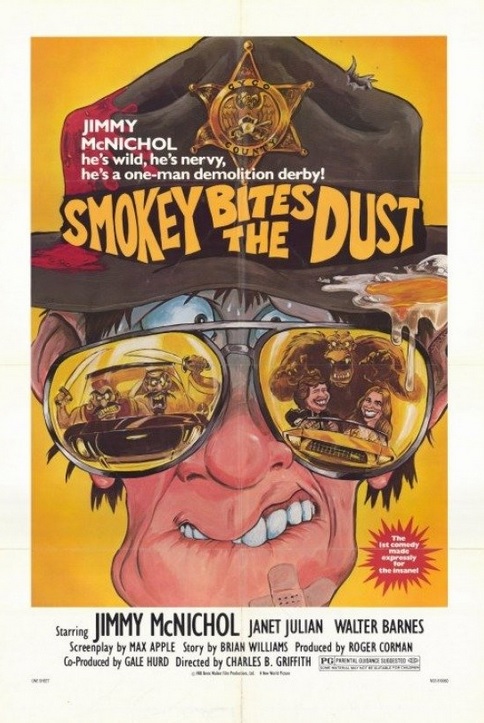
“Shoot, Hoke. I thought you said this were’s a sequel to Smokey and the Bandit,” says Cletus with a baseball cap smack to the head of Hoke. “There ain’t no Burt Reynolds in this!” Then Cletus feels a movement in the those demin-stained loins. “Oh, now wait jusda gosh-dang minute. Now who be that little darlin’ in the yellow daisy-duke overalls? She’s purty. That’s be makin’ up for Burt Reynolds not bein’ in it.”
And that’s the plot of Smokey Bites the Dust: Janet Julian in that yellow jumper.
Looks like a Boss Hog and Daisy Duke to me.
And it’s the same exact plot as the Halloween rip-off, Humongous (1982), the Iceman rip-off, Ghost Warrior (1984), and the Rambo rip-off, Choke Canyon (1986): Janet Julian. And they all suck celluloid donkey ass. And the only reason to watch any of them, class . . .
“Janet Julian, Mr. Francis.”
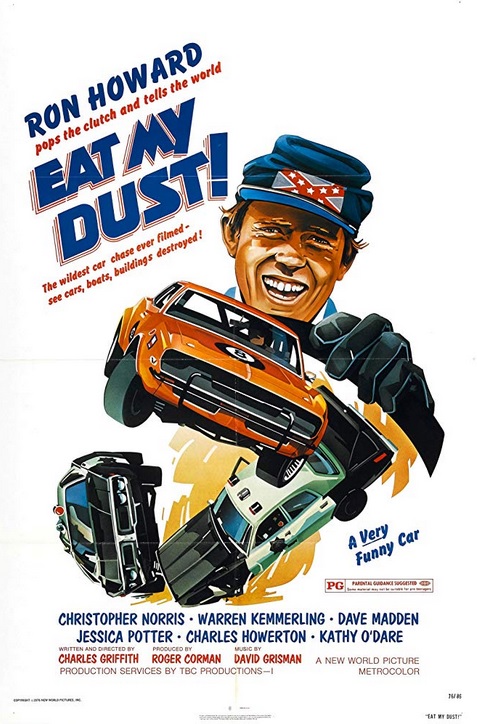
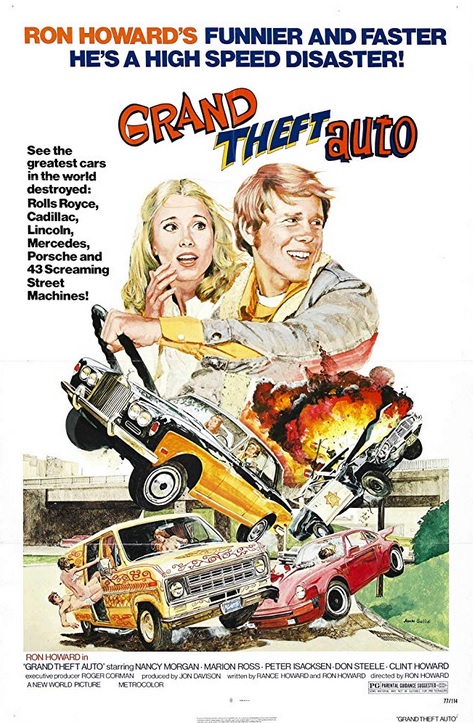
As for the “plots” to Eat My Dust and Grand Theft Auto: It’s the same ol’ Smokey and the Bandit car chases and car crashes tomfoolery caused by another bumbling Sheriff Buford T. Justice-clone chasing another Bandit-clone—both owing their existence to Burt Reynolds’ White Lightning—but without the desperately needed Janet Julian fix. Yeah, Christopher Norris in Eat My Dust is cute and Nancy Morgan in Grand Theft Auto is okay. But they’re all the same Sally “Frog” Field character from Smokey and the Bandit and, again, class . . .
“They’re not Janet Julian in those yellow daisy-duke overalls, Mr. Francis.”
Look, the hicksploitation plot equation is real simple, Bocephus: Ron Howard’s Hoover Neibold in Eat My Dust x his Sam Freedman in Grand Theft Auto ÷ Jimmy McNichol’s Roscoe Wilton in Smokey Bites the Dust = Burt Reynolds’s Bo “Bandit” Darville in Smokey and the Bandit. You got that, son?
Yeah, I know that William Forsythe (Stone Cold), one the best—if not the best—“heavies” in the business, makes an early film appearance as the lovesick football player in pining for Janet Julian’s Peggy Sue Turner. But Big Bad Bill is not yet into his full bad assery-mode that we know and love—and there’s not enough of Bill and way too much teen-idol “Bandit” tomfoolery with Jimmy McNichol getting in the way. Thank God, Janet is there in those, class . . .
“Yellow daisy-duke overalls, Mr. Francis.”
While B-Movie novices may have been buffaloed into thinking they were seeing a sequel to Smokey and the Bandit (a skill in which Roger Corman excelled), Smokey Bites the Dust isn’t a sequel—at least not in the character or plot development departments—to Corman’s Eat My Dust, as commonly reported.
Ron Howard, then hot from his starring role as Richie Cunningham on TV’s Happy Days, was approached by Corman to star in Eat My Dust. Howard wanted to move into directing. So they made a deal: Howard starred in Eat My Dust and Corman financed Howard’s directing debut with Grand Theft Auto—both films stealing the White Lightning blueprints and quickly produced to cash in and beat Smokey and the Bandit into theatres. And they both cleaned up at the box office.
“Shoot, Cletus. You’s sure we ain’t bin seein’ this movie before? All these car chases and crashes sure du-be lookin’ fermilar,” head scratches Hoke with an oil can spout.
“Gud God, Hoke. Yer sures is dumb. Don’t ya know ya-be watchin’ a film produced by the king of stock footage recycling?” baseball cap smacks Cletus.
In the wake of Star Wars (?), Corman came up with an idea for a “sequel” to Eat My Dust called Car Wars—based around the stunt footage from Corman’s five previous “hicksploitation” productions: Eat My Dust, Moving Violations (starring Kay Lenz), Fighting Mad (starring Peter Fonda) (both 1976), Thunder and Lightning (starring David Carradine), and Grand Theft Auto (both 1977). In fact, Corman had Allan Arkush and Joe Dante use the same celluloid bricklaying concept to create Hollywood Boulevard. (1976). And how many times have we seen the special effects footage from Corman’s Battle Beyond the Stars?
Of course director Charles B. Griffith had the nerve to inject a plot and character development into Smokey Bites the Dust—which took away from the car chases and crashes—so Corman cut out all that character and plot crap getting in the way. And that’s how we ended up with a plot that revolves around, everyone . . .
“Janet Julian in those yellow daisy-duke overalls, Mr. Francis.”
As for the hicktastic Sheriff Buford T. Justice-clones of Bite My Grand Theft Auto Dust, Smokey:
Charles Howerton, who stars as Sheriff Sherman “Sherm” Bleed in Eat My Dust, dubbed voices for the Italian Gialli Confessions of a Police Captain, Four Flies on Grey Velvet, and What Have You Done to Solange?, and is best known to trash cinema connoisseurs for his work in 1975’s Nazi-blaxploitation hybrid, The Black Gestapo. In addition to Charles B. Griffith’s Jaws rip, Up from the Depths, Howerton played another redneck sheriff in another hicksploitationer, Joyride to Nowhere (1977).
Barry Cahill plays a pseudo-sheriff as Bigby Powers, the corrupt Governor-father of Nancy Morgan in Grand Theft Auto. He also appeared in Daddy’s Gone A-Hunting (1969), Coffy, and The Stone Killer (both 1973), and had a fruitful career on American soap operas.
In addition to his role as Sheriff Hugh Turner in Smokey Bites the Dust, former NFL Philadelphia Eagle guard-turned-actor Walter Lee Barnes became a stock player in Clint Eastwood’s oeuvre, most notably as Tank Murdock in Every Which Way but Loose, along with roles in Bronco Billy and High Plains Drifter. In addition to working alongside John Wayne in Cahill U.S Marshall, trash cinema lovers may remember Barnes in Pigs (1972; aka Daddy’s Deadly Darling), The Christian Licorice Store (1971), and Day of the Animals (1977).
Class dismissed. Study your films. Work on your Janet Julian dissertations. See you on Monday! Have a good weekend!
And thank you, Burt. For without you: we would have NEVER gotten Janet Julian in that yellow jumper. God bless your redneck heart.
An update from the “What Makes B&S About Movies So Cool: Our Readers” Department: This little piece ‘o film trivia—that you won’t find on a Trivial Pursuit card—slipped by us. Doh! And we pride ourselves on our oddball “Amaze your friends with obscure film trivia” OCD.
So, it turns out Walter Lee Barnes played a variation of his Sheriff Hugh Turner, here, in the original version of Disney’s Escape to Witch Mountain (1975) as Sheriff Purdey: a sheriff bribed by the evil Aristotle Bolt (Ray Milland). We did two takes on the film, first in December 2019, then in July 2021. How did we miss this?
Seriously, a connection—a just beyond an actor’s resume—between a Corman and Disney film? Who knew? Our awesome, uplifting readers, that’s who. In fact, that reader, Phantom 309, came in with the assist on another Smokey-inspired hicksploitation romp, Double Nickels (1977). You rock, Phantom! Any fan of the classic Plymouth Satellite is okay in our book!
About the Author: You can read the music and film reviews of R.D Francis on Medium and learn more about his work on Facebook. He also writes for B&S Movies.
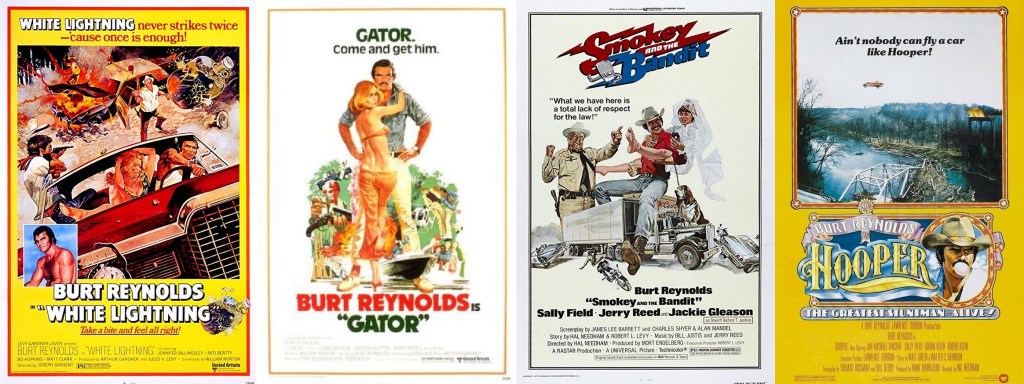
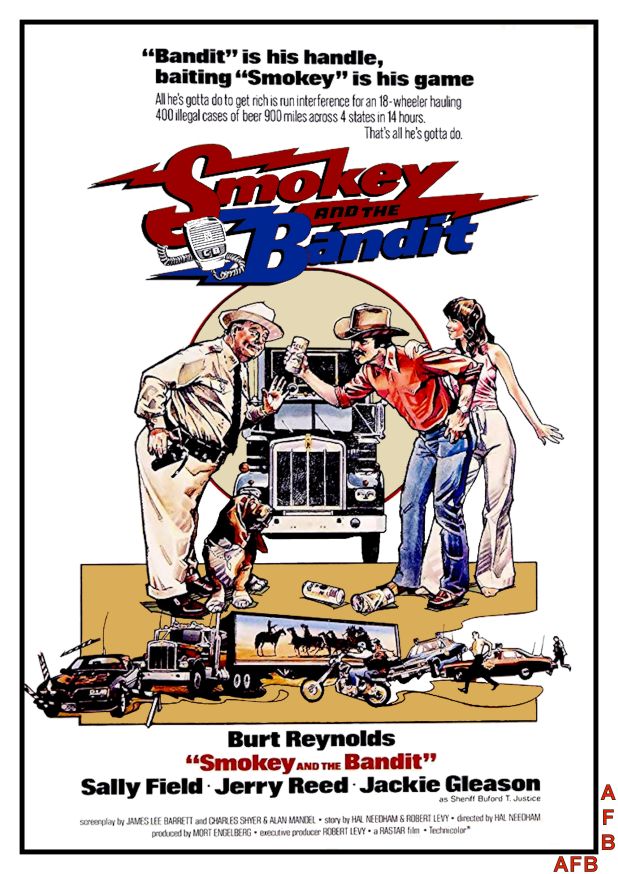
Director Hal Needham was going to make a low budget movie with a million dollar budget and Jerry Reed as the Bandit, but his friend Burt Reynolds looked over his first draft of the script, scribbled on yellow legal pads, and declared it one of the worst he’d ever read. Yet there was something there and he wanted to be the star, with Reed moving to the role of sidekick Snowman.
Buford T. Justice, played by Jackie Gleason,, was the name of a real Florida Highway Patrolman who was friends with Reynolds’ father and who was once Police Chief of Riviera Beach, Florida. Reynold’s dad also inspired the frequent usage of the phrase sumbitch, but Gleason was also given carte blanche to pretty much do whatever he wanted.
The results? A $300 million worldwide gross on a $4.3 million dollar budget, putting it in second place for all movies made in 1977. Yep, this little movie, made by someone that Hollywood only saw as a stuntman, was only beat by Star Wars.
Wealthy Texans Big Enos Burdette and his son Little Enos (comedian Pat McCormick and renaissance man Paul Williams) have bet every trucker around that they can’t get him Coors beer in 28 hours. Even the best have been busted. Yep, it might seem strange today, but there was a time when Coors was forbidden fruit and unavailable for sale east of Oklahoma.
The type of beer in this movie — Coors Banquet Beer — was often sought it out because of its lack of stabilizers and preservatives. That also explains the 28-hour deadline the Burdettes place upon it. All manner of famous people bootlegged Coors, accoriding to a 1974 article in Time magaine: Vice President Gerald Ford hid it in his luggage, President Dwight D. Eisenhower would have it airlifted via Air Force One and baseball great Carl Yastrzemski would stash it in his team’s equipment trunks. Often, it was sold in the south for four times its original value.
Big Enos has sponsored a racer and wants to celebrate in style when he wins, so they hired legend Bo “Bandit” Darville (Reynolds) and make him a deal: $80,000 to pick up 400 cases of Coors from the closest legal place they can buy it — Texarkana, home of the Phantom Killer — and bring it back to Atlanta. That adds up to $8.33 a can, which if we adjust for inflation, is $35.20 a can. Obviously, people really loved Coors back n 1977.
Needham was inspired by Coors when he worked on Reynolds’ Gator. The driver captain on the set brought some Coors beer from California and stored them in Needham’s room. The maid kept stealing them and he thought that bootleg running coors would make a great movie.
The Burdette boys also buy Bandit a black Pontiac Trans Am to use as a blocker to divert attention from his tractor trailer, which will be driven by his friend Snowman (Reed). Needham had seen an ad for the 1977 Pontiac Trans Am and knew right away that it would be another character in the movie. That’s right — not just a vehicle, but a character.
Pontiac sent four of the 1976 model cars with the changed 1977 front ends and nearly all of them were destroyed by the end of filming. The epic bridge leap scene had an Evel Knievel-style rocket booster installed and Needham himself pulled off that stunt.
Burt Reynolds even claimed that a Pontiac senior executive bet him a free Trans-Am if the movie was a success. It was and the 1977 T-Top Trans-Am became the hottest car around. Yet Burt never got his car. He didn’t want to be a Hollywood phony begging for a handout, but one day, he called Pontiac and learned that the executive had retire and his replacement refused to honor the bet.
After getting to Texarkana an hour early, the way back gets rough. Bandit meets a runaway bride named Carrie (Sally Field, who producers did not think was attractive enough to be in the film; Reynolds disagreed and they began dating). This makes Bandit the target of Sheriff Justice (Gleason), whose son Junior (former NFL player and Tarzan actor Mike Henry).
Hijinks ensure, with police cars, motorcyles and helicopters chasing the Bandit and Snowman as they race the clock. Despite the help of everyone within the reach of a CB, Bandit is ready to give up when Snowman passes him and smashes through a police roadblock, allowing the boys to make it with ten minutes to spare. That said, they decide to go double or nothing with teh dare of bringing back Bostin chowder in 18 hours.
Before they leave, Bandit reveals himself to Justice and allows him to chase him again in a show of respect, However, his car has been absolutely destroyed. Don’t worry — the chase would continue through two sequels that we’ll definitely be covering. And people still love this movie, four two years later, even celebrating it with an annual race, The Bandit Run.
There were also four TV movies — Bandit Goes Country, Bandit Bandit, Beauty and the Bandit and Bandit’s Silver Angel — that ran on Universal TV with Brian Bloom playing Bandit in his younger days. Plus, the popularity of this film helped The Dukes of Hazzard on TV. Several of its stars appear here — “Cooter” Ben Jones, John Schneider and Sonny Shroyer (who played a police officer here and Enos on Dukes). Reynolds would later play Boss Hogg in the 2005 movie version.
I really can’t explain what a big deal this movie was or how many times my grandfather delighted to it. It rivals only The Car for the most watched movie of my childhood. Rewatching it, it hasn’t lost any of its energy and fun.
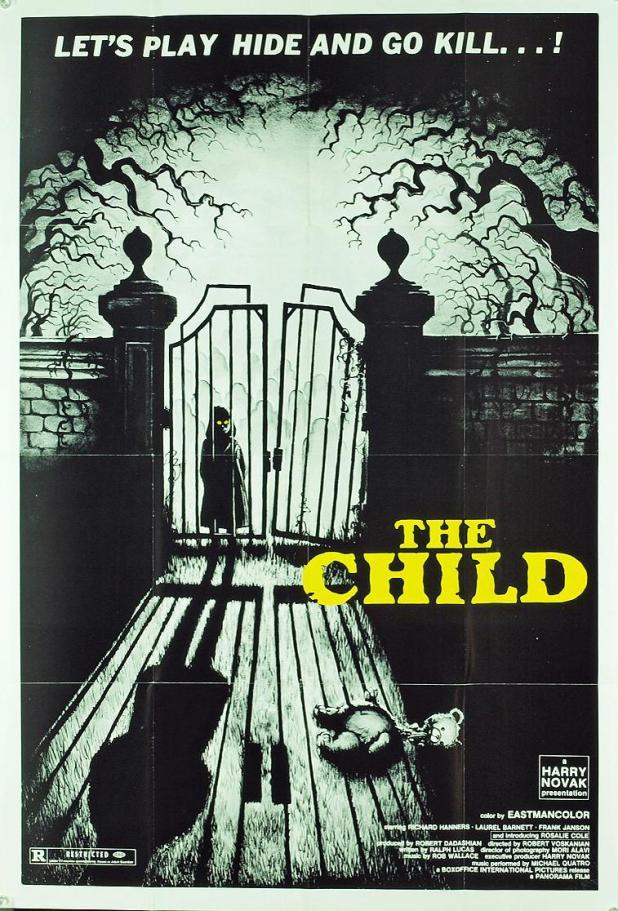
We first encountered The Child at a Halloween party thrown at the palatial Mexican War Streets home of Mr. Groovy Doom himself, Bill Van Ryn. While some folks drank in the kitchen or enjoyed the mix of Goblin and My Life With the Thrill Kill Kult blasting in the sitting room, I was entranced by a film that was playing on the TV. The sound wasn’t turned up, the images all felt like transmissions from beyond and nothing really added up in the movie. “What the hell is this,” I asked. “Oh, The Child!” exclaimed Bill, hurriedly running in to try and explain why he was growing more and more obsessed with multiple rewatches of the film.
Every print I’ve ever encountered of this film has been beaten to hell and back. So when it was announced that Arrow Video was about to clean it up and release it was part of their American Horror Project series, I was excited. For me, it was the main selling point of the entire second volume.
Sometime in the 1930’s — which you’d only know from the old cars, as this film feels like an anachronism lost in no particular time — Alicianne has been hired to be the caretaker for Rosalie Nordon, the titular child, who has just lost her mother. Along with her father and brother Len, she lives in a house on the edge of the woods.
Even the trip to the house is strange, with Alicianne’s car breaking down after she drives it into a ditch. A journey through the woods brings her to Mrs. Whitfield, who warns her about the Nordon family. She probably should have listened, as everyone in this family — hell, everyone in this movie — is touched, as they say.
When Alicianne first meets Rosalie, he jack in the box suddenly moves by itself. It’s a very subtle scene that hints that things might not be right here. After all, people have seen Rosalie wandering the cemetery late at night, a place where she brings kittens so that her friends there will do anything she asks. And even dinner is strange, as her father relates a story of Boy Scouts eating a soup stirred with oleander that caused them all to die. Father and daughter have a good laugh at that while Len just seems embarrassed by his family.
Then there are the drawings — Rosalie has been sketching everyone who was at her mother’s funeral, marking them for death. And if she does have psychic abilities, is she using them to reanimate the dead or control them? Or do they just do whatever she wants? The Child wasn’t made to give you those answers. It just screams in your face and demands that you keep watching despite your ever-growing confusion.
Mrs. Whitfield’s dog is taken first, then that old busy body pays the price, with her face getting ripped off as the zombies mutilate her. That gardener has some of mommy’s jewelry, so he has to pay, too. And Alicianne, who was supposedly here just for Rosalie, has started to spend too much time with Len. She’s next on the list.
There are some really haunting scenes as we get closer to Halloween, like a scarecrow come to life and a jack-o-lantern that keeps relighting itself and following our heroine around the room.
Finally, Mr. Nordon starts to discipline his daughter, which leads to Rosalie unleashing all of her powers. She decimates her father, crashes Alicianne’s car and sends zombies to chase her governess and brother all the way to an old mill. Len tries to fight them while Alicianna just screams and screams, but he can’t stop them from dragging him under the building and tearing his face to bloody pieces. As the attack of the zombies stops, Rosalie walks through the door just as our heroine hits her with an axe. She walks outside into the dawn’s light and everything is still. The threat is over.
Written by Ralph Lucas as Kill and Go Hide, The Child isn’t a great movie, but it’s an interesting one. If you ask me, that’s way more important. Some people will get tied up in things like narrative cohesion, good acting and a soundtrack that makes sense. None of those people should watch The Child with you, as they’ll just ruin what can be an awesome experience. This is the kind of movie that takes over, kind of like one of those dreams you have and try to write down the moment you wake up, but it gets lost in the ether of reality. For most of the film, the zombies are barely glimpsed, just seen in the shadows, so they really could just be tramps that live in the cemetery. Or something much worse.
Producer Harry Novak acquired this film and made his money on it, even if director Robert Voskanian and producer Robert Dadashia saw no profit. It’s a story we’ve seen hundreds of times — an interesting movie taken, used and abused by conmen who have no interest in art.
This new version of The Child simply looks amazing. I’m used to VHS level or worse copies of the film that obscure everything in the movie. That said, there’s something about a battered copy of a movie like this that makes you love it even more.
This release also includes an appreciation of the film with Stephen Thrower, who also moderated audio commentary on the film with Voskanian and Dadashian. There are also interviews with the creators of the film, which discusses how the movie was shot on heads and tails of film stock, which were sometimes left in an ice box until they afford to send it out for developing.
My favorite part of The Child is that there’s a dream sequence. Just think of that — a dream scene in a movie that completely feels like one big dream. If that doesn’t make you run out and find a copy of this, I don’t know what else will. Or come over to my house, where we can do an all-night movie watch of this, Cathy’s Curse and The Children.
You can learn more about the American Horror Project vol. 2 box set on Arrow Video‘s web site.
DISCLAIMER: Arrow sent us this set for review, but we were already planning on buying it. That had no bearing on our review.








 B&S About Movies
You must be logged in to post a comment.