Suspiria (1977)

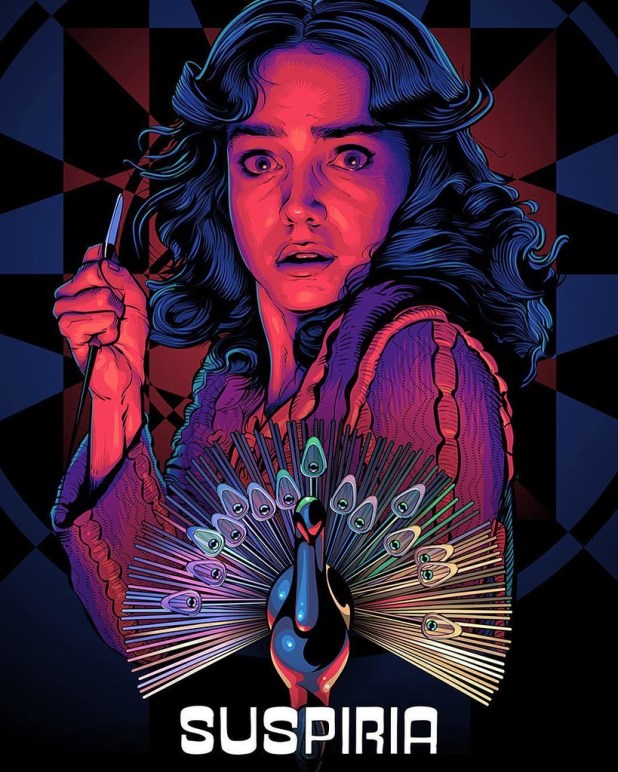
I was afraid to write about this film here. What else can I say about it? My love for it as pure as the adoration you feel for your first love. This is what movies are all about to me: a dream world that is punctuated with staccato blasts of violence, neon and Goblin’s never topped soundtrack. It took the remake of the film to get me to write down my feelings on this film.

Suspiria is all about the impact that magic has on our world, a subject about which creator Dario Argento said, “There’s very little to joke about. It’s something that exists.” The genesis for the film came from a trip through the “Magic Triangle,” the place where the countries of France, Germany, and Switzerland meet.

The movie theorizes that if there are three Fates and three Graces, there must be three Sorrows: Mater Lacrymarum, Our Lady of Tears, Mater Suspiriorum, Our Lady of Sighs” and Mater Tenebrarum, Our Lady of Darkness. This was inspired by a 19-century book by Thomas de Quincey called Suspiria de Profundis.

Argento brought his wife Daria Nicolodi on that aforementioned trip and when he lamented that they hadn’t seen a witch, she shared a story her grandmother, the French pianist Yvonne Müller Loeb Casella, had told her of an academy that she attended on the border between Germany and Switzerland that had a faculty that practiced black magic.

While Argento claims that this story was false and other elements were more of the inspiration for the movie, Nicolodi feels otherwise. “Suspiria was imagined and written by me, thanks to the fundamental inspiration of my grandmother’s story,” she said. “Then, for the usual quibbles related to the cinema industry, this story was signed by both of us.”

Even the end of the movie was inspired by a dream that Nicolodi had in which she encountered an invisible witch and then a panther exploded.

While she was to originally star in the film, to make it more marketable to American audiences, Jessica Harper took over the lead. You can still see Nicolodi at the airport scene in the beginning and hear her as the voice of Helena Markos (supposedly, that’s a 90-year-old ex-prostitute who Argento found on the streets playing that role).

Suzy Bannion (Harper) is an American ballet student lost in Germany, arriving in a violent rainstorm and looking for her new school, the Tanz Dance Academy As she arrives, another student, Patricia, flee in terror. Despite the storm and her pleas over the intercom, no one will allow Suzy into the school. The cab drives her back to down as she watches Patricia run through the woods.

Patricia finds her way to a friend’s apartment but within moments, she’s pulled out a window — Argento’s biggest directorial signature — stabbed and then lynched through the apartment’s stained glass skylight while her friend watches on, helplessly, before she’s impaled by pieces of bloody stained glass.

You might say, “Wait, what is happening here?” Argento isn’t going to slow down or explain anything to you. What do you expect from one of the last movies shot in Technicolor and specifically lit to take advantage of the otherworldly colors that that film stock produced? Argento told cinematographer Luciano Tovoli that they were trying to make the film look like Disney’s Snow White. In fact, he had to be talked out of making the students of the school all twelve years and under by his producer — and father — Salvatore Argento. Argento made the girls all around twenty years old but didn’t rewrite their dialogue, which is why they act so naive and their dialogue is so childlike. Next time you watch this movie, notice the doorknobs. They were placed at the same height as the actress’ heads so they would have to raise their arms to open them. All so they would really be children, not adults.

The next morning, Suzy goes back to the school where she meets the headmistress, Madame Blanc (Joan Bennett in the final role of her career) and Miss Tanner (Alida Valli, who is also in Argento’s Inferno). She’s supposed to stay with Olga (Barbara Magnolfi, The Suspicious Death of a Minor), but she’s kicked out in moments and must return to the school. There are some scenes cut from the film that reveal that Olga is probably a witch in training, hence why she plays with Suzy so much.

The next day, Suzy starts her classes but quickly grows dizzy. Then, she becomes friends with Sara (Stefania Casini, The Bloodstained Shadow). Later that evening, when the girls are getting ready for dinner, maggots rain from the ceiling. Again — why? Supposedly its just rotten food, but it feels like something much more sinister is happening, especially when Sara notices the academy’s director wandering the halls late at night and hiding behind the curtains.

Can things get worse? Sure they can. The school’s blind piano player is killed by his own dog. And just as Suzy remembers that Patricia had uttered the words “secret iris” to her, she passes out just as a man enters her room, chasing Sara through a series of rooms until she becomes entangled in barbed wire before the black-gloved man decides that this is now a giallo and slits her throat. This was an incredibly painful scene for Casini to shoot, as even though the barbed wire was fake, it still entangled and tore at her skin.

Suzy learns from Sara’s friend Dr. Frank Mandel (Udo Kier!) that the school had been established by Helena Markos, a woman that everyone in town believed was a witch. She is now dead, the victim of a fire, and another of Mandel’s friends, Professor Milius (Rudolf Schündler, Karl from The Exorcist and Father Conrad from Magdalena, Possessed by the Devil, one of the scummiest possession movies you will ever see) believes that her coven is suffering without her as their leader.

Suzy returns to the school and discovers that she is alone. She follows the sound of footsteps to Madame Blanc’s office, where a mural of irises opens a secret door. Entering this passage, she overhears the Blanc and the teachers plotting her doom. And then, running from Blanc’s nephew Albert and his servant, she finds Sara’s body.

As Suzy hides in a room, she discovers that Helena Marcos is sleeping there. As the witch awakens, she possesses Sara’s body and come after Suzy to kill her. A flash of lightning reveals where Marcos is hiding and Suzy stabs her through the neck with a giant neon peacock quill — quite literally The Bird with the Crystal Plumage — and kills the old woman. The entire school begins to burn and fall apart around her, killing the teachers who had just been planning to kill her. As Suzy escapes into the rainy night, she pauses to smile. I absolutely adore this scene, this moment of survival, this brief bit of exhilaration. Suspiria is quite literally a haunted house ride and our heroine has survived.

The Italian band Goblin — credited as The Goblins — composed the score along with Argento before the movie was filmed. Of note are the hushed whispers of Claudio Simonetti, who has said that that much of what he says in the songs is nonsense.

I’ve gone on record numerous times about my hatred for the remake of this film. But I want to use this time to talk about what this movie is, not what that one isn’t. Everything magical about film is within these 98 minutes. Instead of worrying about narrative cohesion and things making sense, I find it best to just sit back and let Suspiria take you somewhere amazing. You’d do well to watch this movie with that in mind.

You can watch this for free on Tubi, but I recommend going all in and grabbing the Synapse 4K blu ray from Diabolik DVD.

The Kentucky Fried Movie (1977)

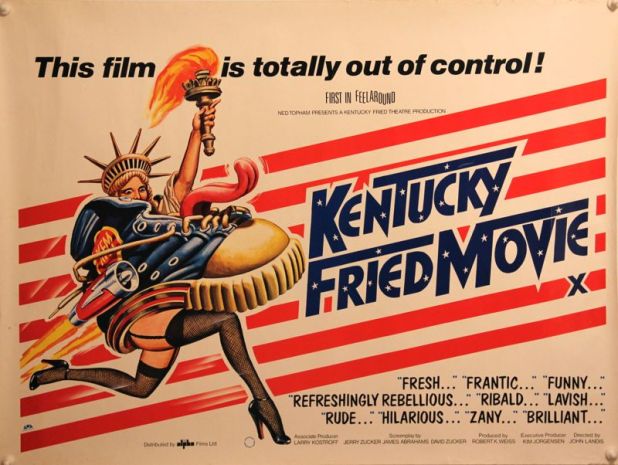
Directed by John Landis and written by the ZAZ team of David Zucker, Jim Abrahams and Jerry Zucker (who would go on to Airplane! and The Naked Gun), this movie is a complete mess and I wouldn’t have it any other way. I’ve probably watched this film more than any other thanks to a taped off HBO copy I had throughout my teenage years.

Containing a number of exploitation films produced by Samuel L. Bronkowitz (a combination of everyone from Samuel Bronston and Joseph L. Mankiewicz to legendary American International Pictures producer Samuel Z. Arkoff), this movie just never stops or lets up. If a scene isn’t funny for a little bit, stick around. Something really comedic — or strange — is right around the corner.

How can you not adore a film that begins with a news anchorman warning you, “The popcorn you’ve just been eating has been pissed in?”

Starting with a commercial for Argon Oil, the first real segment of the film is an extended watch of A.M. Today, as a gorilla (special effects master Rick Baker) goes wild on set. That’s followed by a trailer for Catholic High School Girls in Trouble, which is pretty much every softcore sexploitation movie the late 1960’s and early 1970’s foisted on drive-in and grindhouse screens. The sound effects alone make this segment worthwhile.

A segment called See You Next Wednesday shows a theater that offers Feel-A-Round technology. It’s really just an excuse for Landis to get this catchphrase into one of his films, which he repeats throughout his career. It’s the last line that Frank Poole’s father says to him in a letter from home in 2001: A Space Odyssey. And Landis has used it in movies from Schlock and The Blues Brothers to the video for ThrillerTwilight Zone: The MovieTrading Places and Spies Like Us (among many of his other films). It also shows up in Amazon Women on the Moon, which is pretty much a spiritual sequel to this. It’s called The Cheeseburger Movie while the original is called The Hamburger Movie in France, plus they both end with the song “Carioca.”

There are so many moments here that it’s hard for me to list them all. I’ll try. Big Jim Slade, making the album The Wonderful World of Sex much better for the ladies. Building “a fighting force of extraordinary magnitude” in the film’s longest movie-within-a-movie, the Bruce Lee ripoff A Fistful of Yen. That’s Armageddon, an Irwin Allen-style movie that stars George Lazenby and Donald Sutherland as “the clumsy waiter,” a part that never fails to make me laugh. A Leave It to Beaver in court sketch that predates the way modern comedy would reinvent old shows, even bringing original Wally Tony Dow along for the ride. The blacksploitation (and jewsploitation) film Cleopatra SchwartzDanger Seekers, which could never — and probably should never — be made today. And literally so much more.

The humor was going to extend to the title of the film, which was going to be either Free Popcorn or Closed for Remodeling, either which would have let to total chaos.

Look — to paraphrase Mitch Hedberg, you’re either going to love this, hate it or not care either way. But you can watch it for free on Tubi or Amazon Prime. Or just order the blu ray from Shout! Factory. We also featured The Kentucky Fried Movie — with a second look — as part of our weekly “Drive-In Friday” featurettes with a tribute to the old USA Network’s “Night Flight” programming block from the ’80s.

The Dragon Lives Again (1977)

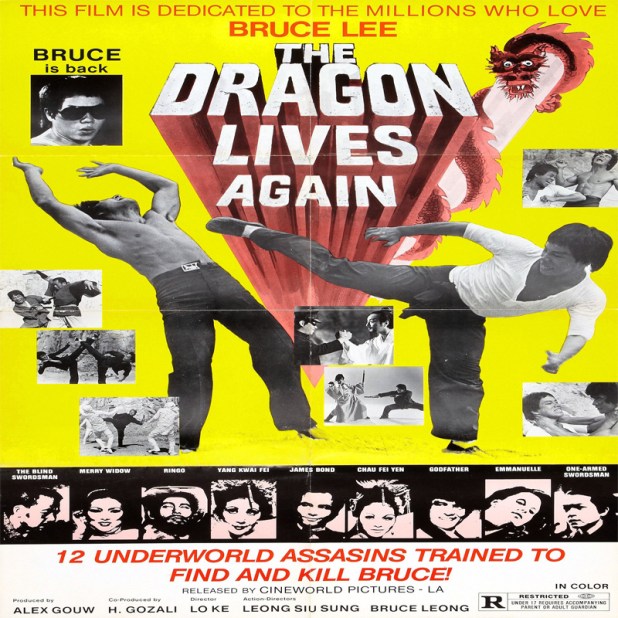
You’ve got to love the balls of the people who made this movie, starting it with the words, “This film is dedicated to millions who love Bruce Lee.” Then, they have a fake Bruce Lee literally go to Hell.

Bruce (Bruce Leung Siu-lung, The Beast from a movie that’s just as crazy as this, Kung-Fu Hustle) wakes up from being dead and faces the lord of the underworld, who threatens him with an earthquake. Then, Bruce goes to a restaurant where he meets three new friends: Caine from TV’s Kung Fu, Fang Kang the One-Armed Swordsman and of all people, Popeye. Yes, really.

To Bruce’s surprise, there’s been a gang terrorizing hell, made up of Dracula, James Bond, Zatoichi the Blind Swordsman and Clint Eastwood. Our hero does what you or I would do were we in hell: he starts a martial arts school.

Meanwhile, the Godfather Vito Corleone, Regan from The Exorcist and Emmanuelle (played by Jenny, Emmanuelle of N. Europe, blowing my mind that if there can be a Black Emmanuelle and an Emanuelle with only one m, there can be honorary Emmanuelles from different regions of the globe) decide to take over the King of the Underworld’s throne.

Bruce ends up becoming the King’s bodyguard before he finally battles the leader of the Underworld, wins and goes back to Earth. So is Bruce alive again? The mind boggles.

THere’s also an extended part of the film where the “third leg of Bruce” is discussed. Yes, his real power is in his penis. I can’t believe that this movie exists and that it’s taken me so long to find it.

You should just watch this whole movie. It’s on Amazon Prime and the YouTube link below.

Exo-Man (1977)

In 1977, we didn’t have too many options when it came to superhero movies. Superman was a year away and otherwise, we would have to make do with repeats of the 1960’s Batman show and a Spider-Man TV series that was so cheap, his web shooters were a grappling hook. Yes, it was pretty bleak.

Into this sad landscape strides — well, waddles — Exo-Man, a made-for-TV movie that I definitely watched and drew — and redrew — again and again for weeks after it aired. What can I say? 1977 didn’t have much else after Star Wars and the made-for-TVThe Incredible Hulk.

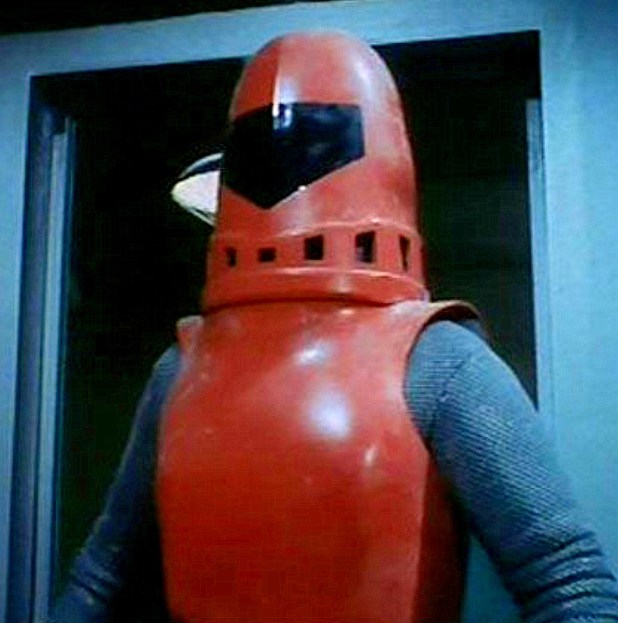
Dr. Nicholas Conrad (David Ackroyd, The Dark Secret of Harvest Home) is injured and paralyzed in a mob hit, so he has to use his research into exo-suits to become, well, Exo-Man. It takes literally 75% of the movie’s running time before he’s finally in the costume and lumbering his way toward the bad guys.

Based on a book by Cyborg author Martin Caidin — that original story became The Six Million Dollar Man — this movie also has plenty of 1970’s guest stars, like future Alf mom Anne Schedeen; soap star A Martinez; Rosemary Clooney’s two-time husband Jose Ferrer and one of the stars of The Sentinel; the man who would chase TV’s The Incredible Hulk later in 1977 as tabloid reporter Jack McGee, Jack Colvin; Dragnet and M*A*S*H* star Harry Morgan, Invasion of the Body Snatchers star Kevin McCarthy; and Donald Moffat, who appeared in John Carpenter’s The Thing.

It’s all directed by former supporting actor Richard Irving, who was behind plenty of episodes of the formerly mentioned The Six Million Dollar Man. Supposedly, Calder hated the costume but was told that Universal TV’s marketing department had created it with the hope of making toys. Despite high ratings and the hopes for a series, that never happened, probably because NBC picked up the canceled The Six Million Dollar Woman and decided to turn The Man from Atlantis into a series after four made-for-TV movies.

Obviously, five-year-old Sam had more patience for superhero movies than forty-six-year-old Sam. You can watch the entire movie here:

The Psychic (1977)

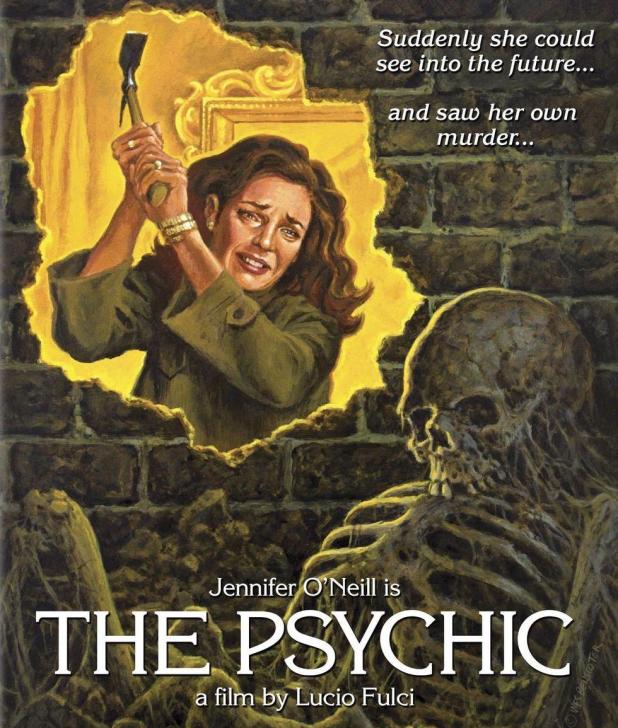
Before Fulci became known as the godfather of gore, he made movies in nearly every genre. This is the next to last film he’d make — Silver Saddle follows it in 1978 — before 1979’s Zombie announced to the world that he was here to tear eyeballs, unleash bats and provide dazzling if incomprehensible odes to mayhem.

Fulci is no stranger to the Giallo, with some of his most important films being A Lizard in a Woman’s Skin and Don’t Torture a Duckling and the unappreciated Perversion Story. The title refers to the film’s exploration of the duality of human nature, a theme that Fulci often revisits in his work. Here, he’d team up again with writer Roberto Gianviti and begin his long partnership with writer Dardano Sacchetti, who sought to lend a touch of Argento to the original script’s traditional mystery.

What emerged was a film shrouded in mystery and darkness—a rumination where death is inescapable and always close, a world where doom hangs over every moment, captivating the audience with its enigmatic atmosphere.

The film is set in Dover, England, in 1959, a time of social change and upheaval. A woman commits suicide by literally diving from the Cliffs of Dover. Forgive the harmful effects — Fulci tends to use wooden bodies in his films for some reason, much like the end of Duckling. The main point is that her daughter Virginia may be living in Italy, but she can clearly see her mother’s day.

Today, Virginia (Jennifer O’Neill, Scanners) lives in Rome and is married to a wealthy businessman named Francesco (Gianni Garko, Sartana himself!). As she drives him to the airport for his next business trip, she begins to see visions. An older woman is being killed. A wall is torn down. And a letter is under a statue. How strange is it that the house she is beginning to renovate looks precisely like the one in her visions?

When she tears down the wall that looks like the one in her dreams, she finds the skeleton of her husband’s ex-lover and the police want to charge him with the murder. Virginia becomes the detective of the story, obsessed with saving her husband with the help of psychic researcher Luca Fattori. Soon, they believe that the real killer is Emilio Rospini (Gabriele Ferzetti, On Her Majesty’s Secret Service).

So who is the woman? Why was her body in that room, which was once her husband’s bedroom? Why is the woman’s face on the cover of the magazine that Virginia buys? That’s because Virginia’s visions aren’t the past but premonitions of the future.

Meanwhile, she’s given a wristwatch that plays a haunting theme every hour in the house. This eerie soundtrack, composed by Fabio Frizzi, adds a layer of suspense and tension to the film and was reused to incredible effect in Kill Bill. The growing knowledge that the victim isn’t dead yet—and that Virginia may be that victim—darkens every frame of Fulci’s epic.

Quentin Tarantino was so in love with this film that he intended to remake it with Bridget Fonda sometime in the 2000s, but this never happened.

Perhaps just as interesting as the film is the life of its star, Jennifer O’Neill. Possibly best known for her long career as a Cover Girl model, she has been married nine times to eight husbands (she married, divorced, and remarried her sixth husband, Richard Alan Brown). By the age of 17, she’d already attempted suicide so as not to be separated from her dog, had a horse break her neck in three places and married her first husband. She’s also had a horrible history with guns, having accidentally shot herself in 1982 and being on the set of the TV show Cover Up in 1984 when co-star Jon-Erik Hexum accidentally killed himself. While waiting for a delay, he had been playing Russian roulette with a prop gun and was unaware that the discharge could still cause damage. Placing the gun to his temple, he fired and caused so much damage to his brain that he died six days later.

New Female Prisoner Scorpion: Special Cellblock X (1977)

In the first of the remade Scorpion movies, Nami was framed for her involvement in the murder of a politician who was threatening to expose corrupt practices. She escaped from jail to get revenge on those who set her up, including her lover, but was captured at the end. Now, she’s been sent back to prison. The rest of the inmates have been punished for her escape, making her life even rougher. And now, a tougher warden is on the way to make sure she never gets out. Scorpion!

Yu Kohira returns to direct this film, but now we have the third actress to portray Nami Matsushima, Yoko Natsuki.

In this installment, one of the guards just wants peace in the jail, so he’s willing to give the women the cigarettes and chocolate that they need to remain calm. Trust me — this technique never fails to keep my wife happy. However, the new warden just wants to be tough and make life hell for everyone.

The guard tries to expose the abuses of the new warden and ends up chained to Scorpion as they escape into the mountains. So we go from a women in prison movie to a chase film, so at least this one doesn’t follow all the steps of the previous films. Sure, it still feels like we’ve seen this all before — because we have — as this is literally a reboot of the series again!

I did enjoy the kabuki aspects of the film, though. It’s just hard to go from watching the Meiko Kaji films to this, as there’s not much of the style and swagger. However, the scene where the warden tries to quell a riot by shooting his gun into the air, only for a woman to tell him to go have sex with himself, was totally awesome.

Once the escape into the mountains happens, Scorpion finally becomes herself. I love how she continually subverts the male gaze of the guard, willing to kill him and drag his corpse instead of letting him touch her. He asks her if she’s even a woman, but she has no reply.

As the final assassin comes upon them, however, she’s won him over with her toughness and resolve. He sacrifices himself, dashed on the rocks so that she can be free to have her revenge.

The film closes with Scorpion dressed in her trademark black hat, stalking the urban environments of Japan, on her way to get her final bloody payback.

This isn’t the best of the Scorpion movies, but I get that people just want more of them. Maybe they should just watch the first three over and over again like I do.

Day of the Animals (1977)

William Girder died in a helicopter crash while scouting locations in 1978. If that hadn’t ended his life, who knows the heights of lunacy he would have achieved?

In just six years, he directed nine feature films — Asylum of Satan, The Get ManThree on a Meathook, The ManitouSheba BabyProject: Kill, the astonishing AbbyGrizzly and…Day of the Animals. If this movie is any indication, I wish that he had made many more films.

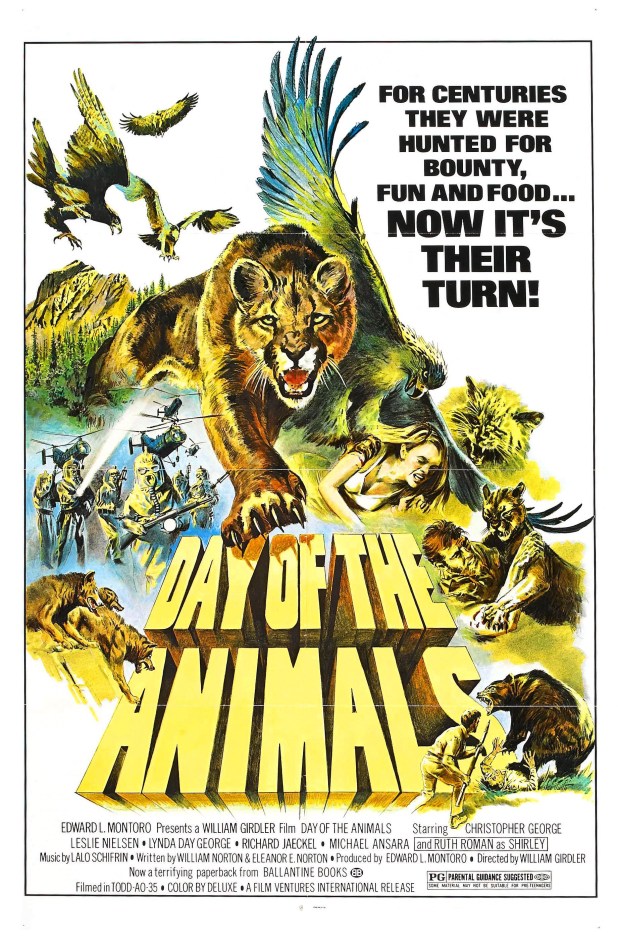
This had to have been the first movie about the loss of Earth’s ozone layer. Who knew that it would drive everyone nuts, including animals? Certainly not the hikers in this tale who turn against one another and try to survive all of the animal assaults.

Steve Buckner (Christopher George, who is fighting with Michael Pataki and George Eastman for most appearances on this site) has a dozen or so hikers who are about to go to Sugar Meadow for a nature hike, even though Ranger Chico Tucker (former NFL player Walt Barnes) tells him that the animals have been acting strangely.

Along for this nature trail to hell are anthropologist Professor MacGregor (Richard Jaeckel, Grizzly), a married couple named Frank and Mandy Young (Jon Cedar, who in addition to being a recurring Nazi on Hogan’s Heroes was also the co-star, co-screenwriter and associate producer of The Manitou and Susan Backlinie, the first victim in Jaws), rich Shirley Goodwyn (Ruth Roman from The Baby!), her son Johnny, teenage lovers Bob Dennins (Andrew Stevens, who was in the Night Eyes films) and Beth Hughes, a former pro football player dealing with cancer named Roy Moore, a magical Native American guide named Daniel Santee (Michael Ansara, Killer Kane from the 1980’s Buck Rodgers series as well as the voice of Mr. Freeze), a television reporter named Terry Marsh (Lynda Day George, always ready to scream “BASTARDS!”) and finally, a frenzied Leslie Neilsen in the role of his career as Paul Jenson, an ad executive who acts like every account guy I’ve ever had to deal with in my 24-year-long ad career.

Before you know it, wolves are attacking people in sleeping bags, vultures circle overhead, hawks knock women off cliffs, Leslie Nielsen goes beyond bonkers and kills a dude with a walking stick and threatens to assault women before wrestling a bear and getting his neck torn out, rats attack the sheriff who decides to eat before trying to figure out how to deal with this emergency, dogs turn on the people they loved, rattlesnakes bite people and the military dons hazmats suits to deal with all of it.

If you haven’t figured it out yet, this movie is stupid. And awesome. It’s stupid awesome. And if you only know Nielsen from his later comedic roles, take a look at him in this movie. I love this movie. I don’t care what you think of me.

You can watch the original or Rifftrax version on Amazon Prime, or watch this on Shudder.

Cathy’s Curse – Take Two! (1977)

This article originally appeared in Drive-In Asylum #12, which you can buy right here.  It’s the second — and probably not the last — time I’ve talked about Cathy’s Curse, a movie that will own your very will to live.

There has never before or since been a movie where pure evil finds its origin in a rabbit crossing the road that’s narrowly missed by a misogynistic father, who then smashes his car into a ditch where it goes up like a tinderbox. It’s movies like this that made me run on foot from my first fender bender, diving into a snowbank, waiting for my car to blow up real good. Spoiler warning: It sure didn’t.

Cathy’s Curse finds its true origins in many places. First, the Canadian Film Development Corporation was formed to encourage more movie making north of the border. According to Canuxploitation.com, “thanks to $10 million dollars of allocated funds in 1971 and the added incentive of tax shelter laws that increased the Capital Cost Allowance (CCA) for money used in the production of a Canadian feature film from 30% to 100%, Canada experienced an unprecedented explosion of moviemaking.” That money gave birth to filmmakers like Bob Clark and David Cronenberg, as well as the maniacs behind this film.

Secondly, Canadian horror is strange to American eyes. Again, Canuxploitation.com claims that’s because these films “are distinctive in the way they present concepts of individuality, community, and even morality. Our films tend to be more story and character focused than their American counterparts, and when at all possible, the “wild” Canadian landscape is used to full effect.” In particular, films from Quebec stand out as even stranger than the rest of the country, with Possession of Virginia and The Pyx coming immediately to mind.

Finally, the third father (I should set them up with Argento’s Three Mothers) to Cathy’s Curse is a preponderance of occult based films in the mid-1970’s. Thanks to the one-two Satanic punch of The Omen and The Exorcist, filmmakers saw child possession as a rich source of appropriation.

So why do I love this movie so much? Because I believe that it was made by aliens who have no understanding of how human beings truly behave or act. It’s like John Keel’s stories of how the Men in Black were often confused by everyday objects like pens and had no idea how to eat food properly. Characters make asides that seem to be important plot points that ultimately go nowhere while glossing over things that end up being essential.

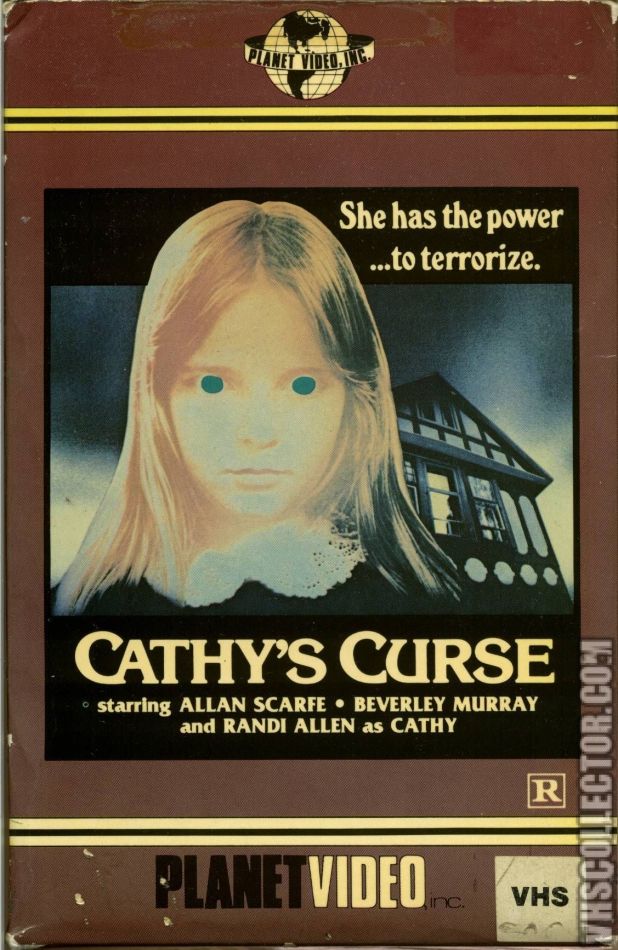
In my exhaustive research of Canadian possession movies, which was done with several cans of Molson as a control group, I have learned that when kids get taken over in a Canadian film, instead of the pure bile and meanness of say, Regan MacNeil, they just end up becoming impolite and swearing a lot more. Cathy Gimble, our heroine in this film, immediately picks this up. From forcing a group of children to repeat that all women are bitches to stabbing kids with needles, she goes from polite North of the Border pre-teen to Rhoda Penmark in no time flat.

Why else do I love Cathy and her film so very much? Because there are so many lessons to be learned. For example, if your daughter finds a frightening looking doll in the attic — much less an attic that has a giant cast iron frog that no one ever comments on in the film — don’t let her keep it. And if you want to make sure your psychokinetic problem child is being properly taken care of, don’t entrust her daycare to a handyman that’s had lifelong issues with the sauce.

I adore Cathy’s Curse for its inconsistencies. Cathy’s powers are never really explained. They can do everything from blow-up knick-knacks to making snakes and rats appear out of nowhere to pulling maids out of windows like a Helen Reddy loving Damien Thorn, Cathy has the power she needs when she needs that power. How does one use the power to make food rot and get covered with bugs properly? You can’t very well join Alpha Flight (Canada’s Avengers) with that one.

I celebrate this movies for its actors, blessed with limited abilities, hilarious pronunciations and magical leather coats complete with wooly fur. A scream or an overreaction happens in nearly every scene.

You know how most horror movies start with an opening sequence showing how nice and happy everyone’s life is to juxtapose how horrible everything gets when the supernatural invades the real world? This movie will have none of that. Every single frame is packed with goofball weirdness. People wear dresses in the coldest of snow. Every wall is covered with pictures of animals. Next door neighbors just happen to be mediums connected to the spirit world. Strange music cues and cuts in the middle of dialogue happen for no reason whatsoever.

Unlike draconian films that have a point of view or an actual plot, this is a movie with no real point of view. Instead, it’s less a narrative and more scenes of Cathy destroying lives. You won’t learn a pesky moral or meaningless lesson. Instead, you will watch a young girl repeatedly tell off old women, including the immortal line where she refers to a medium as an “extra large piece of shit.”

In short, Cathy’s Curse is the kind of film that I put on and people say to me. “Why would you show me that?” and I never invite them to my house ever again. It’s a good litmus test to weed out boring people who have no idea how to enjoy the magic of film. You didn’t need them anyways! You have Cathy!

You can get Cathy’s Curse from Severin.

BASTARD PUPS OF JAWS: Tintorera…Tiger Shark (1977)

When I was a kid in the 1970’s, I was sitting in a B. Dalton’s reading — parents routinely dropped kids off places to read without any fear of kidnapping back then — and discovered a copy of Alex Comfort’s The Joy of Sex on a shelf. I had no idea what it was at the time, but the drawings (by Chris Foss, who would go on to work on AlienFlash Gordon and Jodorowsky’s Dune) were upsetting to me. Hairy soft focused seventies post-hippies getting it on didn’t jibe well with my single digit mind.

I forgot what that feeling was like. And then I watched Tintorera…Tiger Shark.

This movie is based on the novel of the same name by oceanographer Ramón Bravo, an undersea explorer who studied the 19-foot-long species of shark known as “tintorera” and also discovered the sleeping sharks of Isla Mujeres. You may know him better for his role as the underwater zombie in Lucio Fulci’s Zombi 2.

Here’s the thing — this is a shark movie, but it’s also pretty much a softcore adult movie about the three-way relationship between the heroes. As such, this is the only shark movie I’ve watched all week with full frontal male nudity, which is something of an accomplishment.

Hugo Stiglitz from Nightmare City plays Steven, born in the US but a Mexican businessman here in Cancun for vacation. He falls for Patricia (Fiona Lewis, Dr. Phibes Rises Again) but breaks up with her when he can’t decide whether or not he’s in love with her. Ah, the 1970’s.

Jealousy ensues when she starts hooking up with Miguel (Andrés García, a real-life former diving instructor who is also in Bermuda: Cave of the Sharks), the swimming instructor at the resort. After those two dance the devil’s dance and Steven gets all misty-eyed, she goes skinny dipping and ends up being eaten by a tiger shark that seems to have breathing problems, judging by the soundtrack.

The two fight over what happened to Patricia, but neither ever learn that she was devoured by a shark. That night, the two hook up with Kelly and Cynthia Madison, two American college students looking for fun, and swim to Steven’s yacht as the heavy breathing shark follows them. They swap beds all night long before heading back to the resort and the shark decides to leave them alone. Kelly is played by Jennifer Ashley, who was also in Phantom of the Paradise, Chained Heat and Guyana: Cult of the Damned, while Cynthia is Laura Lyons, which is her real name and not a stage name inspired by the Sherlock Holmes story The Hound of the Baskervilles. She was the Playboy Playmate of the Month for February 1976 and actually led a strike amongst the club bunnies that led to better wages and rights for them. Other than an appearance on TV’s Love, American Style, this is the only other acting role in her career.

Steven and Miguel decide to partner up both in a shark hunting business and in being womanizers. They start shooting all manner of sharks, but Miguel warns Steven that if they ever meet a tiger shark that they must immediately get out of the water.

The guys meet Gabriella (Susan George, Die Screaming, Marianne) and take her shark hunting. She hates it, but falls for both men. They decide to form a triad relationship where they can’t be with any other woman or fall in love with her. Remember those The Joy of Sex drawings I mentioned earlier? Get ready to watch the play out as the three make love, make omelets and sightsee the Mayan ruins.

Sadly, the next time they go shark hunting, the tiger shark reappears — surprise! — and bites Miguel in half. Gabriella is so upset that she leaves, never to return. Steven vows revenge on the shark and beats up every shark he can find, upsetting even the most hardened fishermen. Surely, they tell him, he has killed the tiger shark by now.

Nope. It’s still out there, killing fishermen and lying in wait for Steven. At a beach party with Kelly, Cynthia and two new American girls (one of them is Priscilla Barnes from TV’s Three’s Company and The Devil’s Rejects), everyone skinny dips. As Steven and Cynthia make out nude in the water, the tiger shark comes back and tears the woman literally out of his embrace. Everyone is injured by the shark’s attack and Steven makes a promise to kill the shark himself.

You may be wondering: how will Steven go about killing this shark? If you guessed “he’s going to blow it up” then congratulations. You’ve been watching just as many shark movies as I have. Are explosives the shark’s natural predator?

Anyhow — Steven uses a devilfish to lure the shark close and then he hears its breathing, because that’s how sharks work. He succeeds in turning that shark into a million pieces, but loses his arm in the process. He wakes up in a hospital bed, minus an arm but filled with happy memories of the sexy times he shared with Miguel and Gabriella.

Keep in mind when you seek out this film that there are two versions. One is 85 minutes long and is more of a shark film. Then there’s the 126 minutes long cut that’s chock full of swinging Mexican resort sex. Also, a warning for those of you sensitive to these matters: many of the scenes of fish being caught and killed underwater are unsimulated. That should be no surprise to anyone who has seen a René Cardona Jr. directed film, as he threw live birds through windows in Beaks: The Movie and a cat over a wall in Night of a Thousand Cats. He’s also responsible for the borderline insane film Bermuda Triangle, as well as the scum-ridden cash-in Guyana: Crime of the Century.

Tintorera…Tiger Shark is one of the stranger films I’ve watched, not only in my shark obsessed week of trying to watch every single pre-Sharknado film of this genre, but really in all the films I’ve watched. I have no idea who it is truly for, yet appreciate its willingness to indulge in spectacle and scum, whether that be people hooking up or being eaten in front of your very eyes.

BASTARD PUPS OF JAWS: Orca (1977)

If you read comic books in the summer of 1977, there’s no way you didn’t know about Orca. Despite everything that nature — and SeaWorld — could teach us, it was time to meet a predator even more deadly to man than the great white shark. To quote Neko Case: “You know they call them killer whales.”

Orca raises the Jaws rip-off stakes: if the name Orca can be Quint’s boat, here, it can be an entire movie. Dino De Laurentiis called writer Luciano Vincenzoni (he also wrote The Good, The Bad and the Ugly) in the middle of the night and told to find a fish tougher and more terrible than the great white to make a movie that could go up against Spielberg’s. Vincenzoni’s brother told him all about the killer whales and the rest is scumtastic movie history.

Directed by Michael Anderson (Logan’s Run, Doc Savage), Orca is the kind of movie that critics have assaulted for years. I’m here to tell you that every single one of them is wrong. It’s a completely ridiculous film, a shameless reboot of both Jaws and Moby Dick, but by no means is it not entertaining as hell. And it has an incredible Ennio Morricone score, something that so many fish films could only wish they aspired to.

Captain Nolan (Richard Harris, who nearly died doing his own stunts and also would grow enraged if anyone dared compare this movie to any other film) catches fish and marine animals so that he can pay off his boat. His crew is looking for a great white, which comes after crewmember Ken (Robert Carradine, Lewis from Revenge of the Nerds). An orca saves Ken and Nolan decides to repay its kindness by capturing it. After he harpoons the whale, he learns that he’s killed its mate, which miscarries and drops a fetus onto the deck of the ship that the callous captain hoses off into the ocean while our titular hero/villain/sea mammal screams in anguish. This is when you wonder: how did this movie get a PG rating?

Novak (Keenan Wynn, The DarkPiranha), another crew member, cuts the female loose and its mate drags her dead body to shore. The villagers all rise up against the crew, who demand that Nolan kill the orca, who has gone wild and is ruining local fishing. When Nolan refuses to put the fish out of its misery, it retaliates by sinking all of the fishing boats and breaking all of the town’s fuel lines, because of course killer whales can hold grudges.

That’s what brings Dr. Rachel Bedford (Charlotte Rampling), a whale expert, into the movie. She believes that orcas are like humans, a fact that Nolan can understand. He sees himself as one of the whales, as his wife and unborn child were killed by a drunk driver. He promises not to fight the whale, but it kills Novak, attacks Nolan’s house and then bites off the leg of his injured worker, Annie (Bo Derek in her film debut).

Nolan and his crew, including Paul (Peter Hooten, who was also in Derek’s first actual filmed movie, Fantasies, as well as the 1970’s Dr. Strange TV movie and Just a Damned Soldier with Mark Gregory), all take off after the orca, along with Native American Jacob Umilak (Will Sampson, the magical Native American in films like One Flew Over the Cuckoo’s Nest and Poltergeist II). That’s when the orca goes buckfutter and wipes out nearly everyone by either grabbing them, biting them, crushing them and tossing icebergs at the boat.

The orca throws Nolan all the lace like a ragdoll, killing him, but leaving Bedford alive. We watch as Nolan sinks into the water in a crucified pose and the killer whale decides to swim under the ice. Now, there’s some conjecture here: is the killer whale trapped or has it decided that with its revenge complete, all it can do is die when faced with the path or revenge that it has wrought? I can see the poetry of this thought, but then I realize that I’ve just watched a film filled with no subtlety whatsoever, so perhaps the orca swam on, discovered a new mate and remains ready to wipe out all of humanity at a moment’s notice.

Orca is everything I love about movies: it’s big and dumb and bloody. It’s the kind of movie a fine actor like Richard Harris chews the scenery with just as much viciousness as a killer whale devours one of Bo Derek’s shapely gams. It also takes shark films to the next level. Every single one of the humans in this movie are amongst the dumbest people ever, doomed by the fact that they even known Captain Nolan. The moment he hoses orca’s son into the icy waters, he’s sealed his fate. This is one of the few films where you root for the beast and savor its revenge.

You’ll laugh. You’ll cry. You’ll be amazed at Bo’s bloody stump. I want more people to love this movie even a fourth as much as I do.