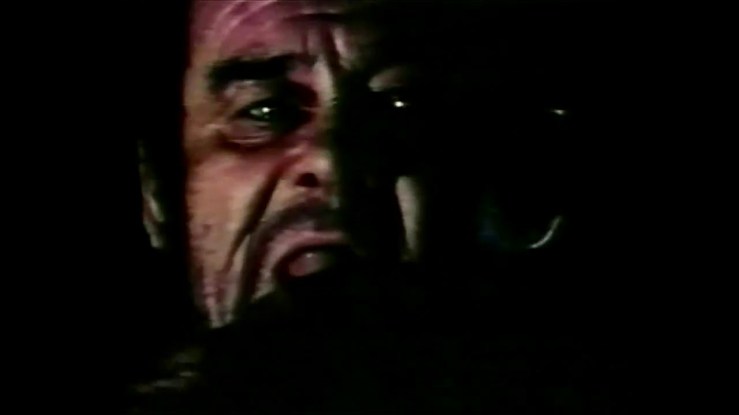
Cozzilla (1977)

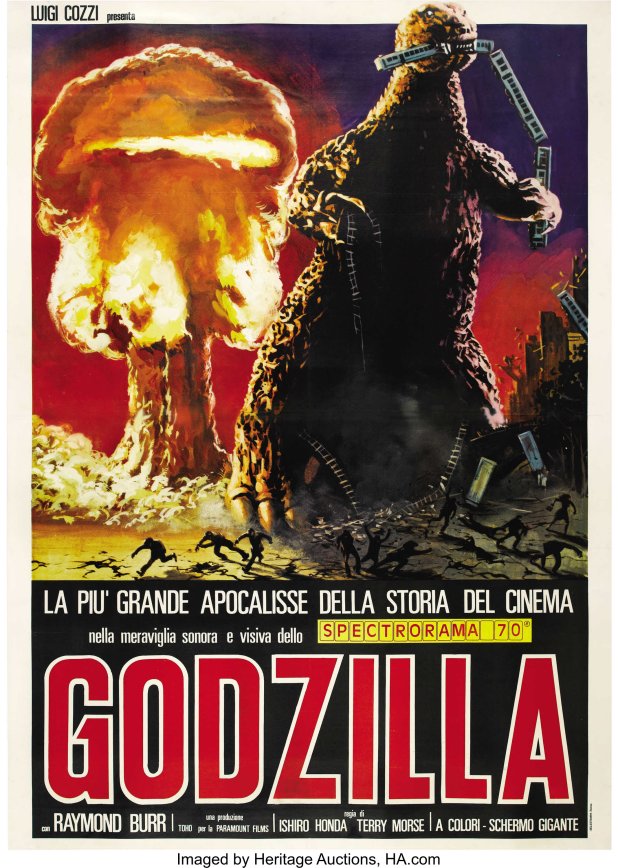
All the way back in 1979, the first issue of Fangoria came out with a psychedelic cover of Godzilla. I always wondered where this image came from and now I know — the strange and alluring 1977 Luigi Cozzi led version of the original film.

Yes, Italian filmmaker Luigi Cozzi (StarcrashContaminationPaganini Horror) created this colorized version of the original Godzilla, complete with a soundtrack that used a magnetic tape process similar to Sensurround.

Due to the success of the 1976 remake of King Kong, Cozzi attempted to cash in on the film’s success by re-releasing Gorgo, but it costs too much. Toho gave him a good price, but were only able to provide negatives for the 1956 American version of the film. Cozzi’s distributors refused to release the film, after discovering it in black-and-white.

At this point, Cozzi got the approval from Toho to colorize the film, provided they get the new negative when he was done. He had final approval over the stock footage, music, and choice of coloring.

To pad the film’s running time to 90 minutes, Cozzi added stock footage, saying “The decision to insert extra footage was because the original picture was 1 hour and 20 minutes. This was normal length in the fifties but in the mid seventies a picture to be shown theatrically had to be at least 1 hour and 30 minutes long. So we were forced to add material to it in order to reach that length. Its final length was 1 hour and 45 minutes.”

Cozzi wanted to give an old film an “up-to-date and more violent look,” so the director added real footage of death and destruction from war-time and Hiroshima  stock footage, as well as scenes from The Train, The Day the Earth Caught Fire, The Beast from 20,000 Fathoms and Godzilla Raids Again

To make the movie even bigger, Cozzi added Sensurround effects that would be blasted from giant loudspeakers specially placed in each theater. Composer Vince Tempera wrote the film’s additional score on electric piano, with synth music being used to give the film a more modern feel.

Image from SciFi Japan

Then, the film was colorized by Armando Valcauda frame-by-frame using stop motion gel photography, a process that took three months. The effect isn’t really seeing the movie in color, as later colorization efforts would accomplish, but pretty much providing a tripped out version of the film that is constantly being splashed with neon colors.

So what was Spectrorama ’70? Cozzi told SciFi Japan, “Spectrorama 70” is just a name I did invent to help advertising. It refers to colorization but also gives a feeling of 70mm which at that time was typical of every big budget Hollywood blockbuster. This invented name, in the style of William Castle, helped to give a “bigger” look at my Godzilla theatrical re-release advertising materials.”

This is one of the hardest kaiju films to find and one that’s probably one of the weirdest and most interesting. There’s really nothing like this movie and you can say that about just about every film that Cozzi created.

You can download this on the Internet Archive.

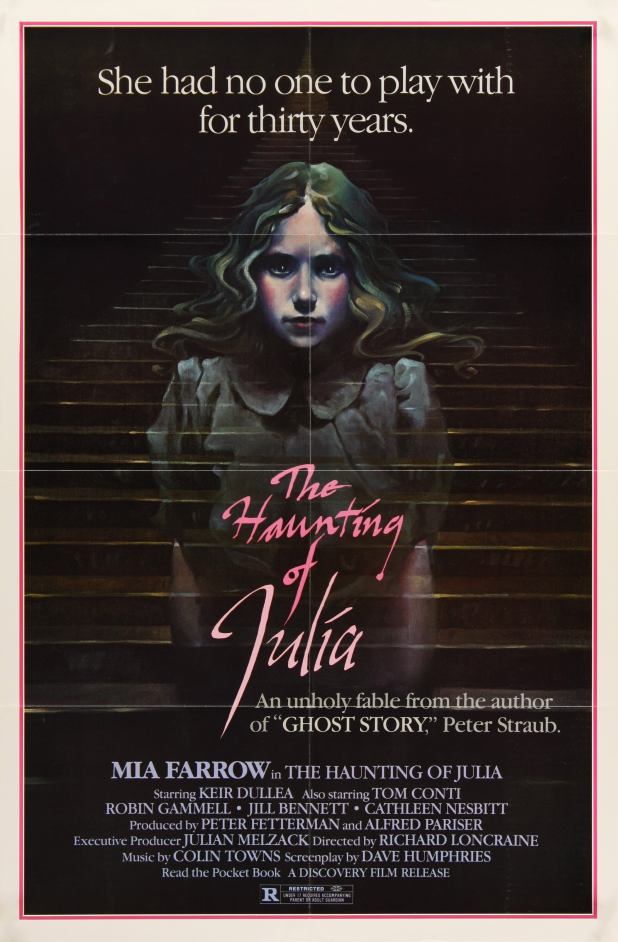
The Haunting of Julia (1977)

Plenty of people know the Mia Farrow movie Rosemary’s Baby, but few know this film, which was based on the book Julia by Peter Straub. It was originally released in the UK as Full Circle, where it bombed before doing poorly in the U.S.

It was directed by Richard Loncraine, who helped make Band of Brothers on HBO and the incredible music film — and another bomb that has been recognized as a great movie years later — Slade In Flame.

Julia Lofting’s (Farrow) life changes in a second: her daughter chokes on breakfast and an emergnecy tracheotomy causes her to bleed to death. This causes her to leave her husband (Keir Dullea) and move into a flat that’s filled with toys which once belonged to a girl named Olivia, a young woman with such a power over the other children that she could make them kill one another.

The movie sat unreleased in the United States until it was discovered, along with the Richard Burton movie Absolution, by a movie fan who worked to get both movies into theaters.

This was on Shudder for a few weeks, but is no longer on the service. It’s not a great film, but it’s interesting. I got my copy at a convention years ago and don’t regret the purchase.

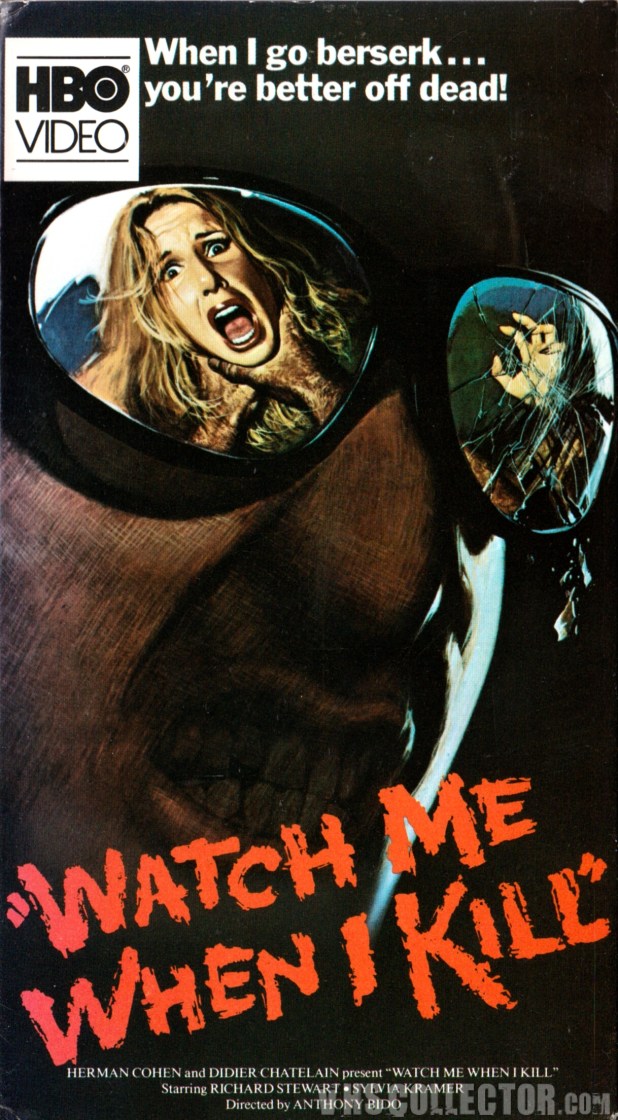
Watch Me When I Kill (1977)

Antonio Bido also directed the giallo The Blood Stained Shadow, which I tend to enjoy more than this one. However, how great is the title of this film?

A pharmacist is murdered and Mara, the woman who saw the killer leave the scene, is now being stalked. Her boyfriend Lukas, being protective, decides to figure out who the killer is and soon learns that it’s anything but a normal crime.

Originally known as Il Giatto Dagli occhi Di Giada, or Cat with the Jade Eyes, as well as The Cat’s Victims, Terror in the Lagoon and The Vote of Death, this film has some unique murder scenes from its killer who has a cat-like mask.

An escaped murderer named Pasquale Ferrante seems the most likely suspect. He’s played by Paolo Tedesco, who was Calo in The Godfather, the bodyguard in Italy who said, “In Sicily, women are more dangerous than shotguns.”

Most of the victims were at his murder trial, but the clues go the whole way back to Axis collaborators during World War II. Giuseppe Addobbati (Nightmare Castle) also appears as a judge.

This movie feels much like a pre-Suspiria Argento giallo, which is not a bad thing.

You can watch this on Tubi. You can also get it on blu ray from Synapse.

Ruby (1977)

Curtis Harrington had the thread of magic running through all of his films. One of the leaders of New Queer Cinema, he also directed Queen of Blood, Voyage to the Prehistoric PlanetWhat’s the Matter with Helen?Who Slew Auntie Roo?, the Sylvia Kristel-starring Mata Hari, tons of episodic television shows and the TV movies Devil Dog: The Hound of Hell, The Dead Don’t DieKiller BeesThe Cat Creature and How Awful About Allen.

His links to the occult, include the study of Thelema with his close associates Kenneth Anger (he played Cesare, the somnambulist in the magician/filmmaker/author’s movie Inauguration of the Pleasure Dome), Marjorie Cameron — who is pretty much the nexus point of twentieth-century occult doings and appears in his film Night Tide — and avant-garde film pioneer Maya Deren, an initiated voodoo priestess.

Harrington was also the driving force in rediscovering the original James Whale production of The Old Dark House and — as a friend of Whale near the end of his life — advised the making of the movie Gods and Monsters.

His final film was Usher, based on a high school film he made of Edgar Allan Poe’s The Fall of the Hosue of Usher. He cast Nikolas and Zeena Schreck — the daughter of Church of Satan founder Anton LaVey — who financed the movie by brokering the sale of Harrington’s signed copy of Crowley’s The Book of Thoth. Perhaps even more interesting is the theory that singer Taylor Swift is a clone of Zeena. No, really.

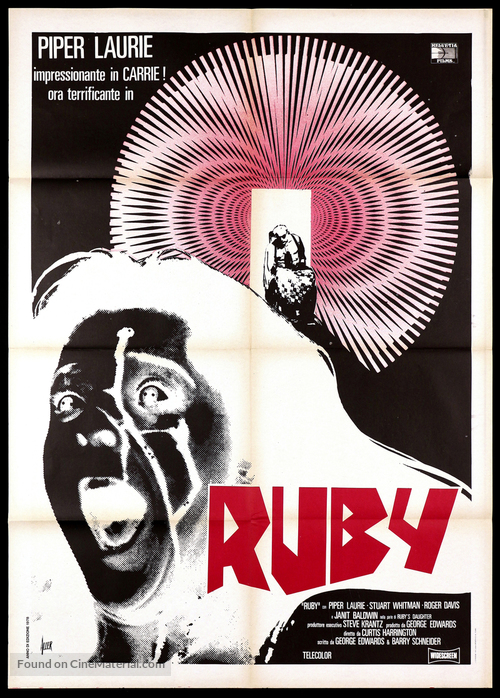
But hey — we’re here today to discuss 1977’s Ruby, a movie that brings Piper Laurie from Carrie into a story about possession and flashbacks.

In 1935, a lowlife mobster named Nicky Rocco is betrayed and executed in the swamps as his pregnant girl Ruby (Laurie) watches. The moment he dies, she goes into labor. Fast-forward sixteen years and she’s living with a mute daughter named Leslie (Janit Baldwin, GatorbaitPhantom of the ParadiseBorn InnocentHumongous) and running a drive-in with several ex-mobsters like Ruby’s lover Vince (Stuart Whitman!) and Jake (Western actor Fred Kohler Jr.), a wheelchair-ridden man whose eyes were once cut out.

Ruby misses her days as a lounge singer, but the present has some nasty surprises. A poltergeist begins killing people at the theater, including the projectionist and a creepy guy who runs the concession stand (Paul Kent, A Nightmare on Elm Street 3: Dream WarriorsPray for the Wildcats and the founder of the Melrose Theater). Before long, our heroine — such as it is — believes that Nicky’s spirit has returned and believes that she caused his death.

Vince is visited by Dr. Keller (Roger Davis, Dark ShadowsNashville Girl and the first husband of Jaclyn Smith), who helped him get out of jail early. He’s a clairvoyant who believes that there’s something in the drive-in, which is true, because Nicky starts speaking Ruby’s name over the speakers at the drive-in. Before long, Ruby’s daughter is speaking with the voice of her dead father and showing the wounds he endured before his death.

The producer chose to change the ending, and both Curtis Harrington and Piper Laurie refused to be involved in the re-shoot. It was allegedly shot by Stephanie Rothman (the director of The Student Nurses and the writer of Starhops). This ending, where Nicky comes back from the grave and drags Ruby into the swamp, was part of the TV commercials for the film.

Keep an eye out for Len Lesser in this — he was Uncle Leo on Seinfeld — as well as Crystin Sinclaire, who appeared in Eaten Alive and Caged Heat.

You can watch this on Amazon Prime. There’s also a Rifftrax version on Tubi.

Hitchhike to Hell (1977)

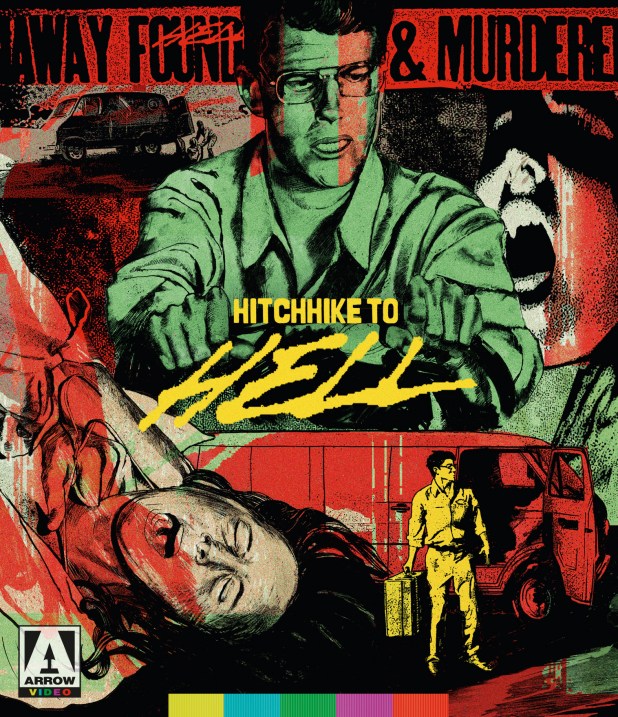
Somewhat inspired by the “Co-ed Killer” Edmund Kemper — who shows up on Netflix’s Mindhunter and now reads books on tape — Hitchhike to Hell is all about Howard (Robert Gribbon, Trip with the Teacher), a mild-mannered momma’s boy whose delivery job gives him plenty of time to pick up runaways and punish them for their transgressions. Can the cops stop him before he kills again?

Irv Berwick also directed Malibu High and The Monster of Piedras Blancas, so you know he’s coming from a place of pure sleaze. This movie comes from the vaults of the legendary — or infamous — Harry Novak and is one of the last movies that his Boxoffice International Pictures released. You may know them from other films like Axe (AKA Lisa Lisa or California Axe Massacre), The ChildRattlersWham! Bam! Thank You, Spaceman!The Sinful DwarfDr. Frankenstein’s Castle of FreaksToys Are Not for Children and so many more fine efforts.

At one point, Captain J.W. Shaw (Russell Johnson, the Professor from Gilligan’s Island and Dr. Steve Carlson from This Island Earth) mentions several real serial killers, like the Zodiac Killer, the Skid Row Slasher and “that nut down in Houston,” which refers to Dean Corll, who abducted, assaulted, tortured, and murdered at least 28 teenage boys and young men between 1970 and 1973 in Houston, Texas.

Why is Howard so nutty? Is it because of his way too close relationship with his mama? Or because his older sister ran away from home as a teenager and was never heard of again? Did his sister really have it coming, like his mother mutters to herself? Your guess is as good as mine, because this movie never reveals the answers. It does, however, have teenage runaways killed with coathangers, so there’s that.

Basically, don’t hitchhike. You kids don’t have to worry about that. You’ve got Uber now.

The Arrow Video blu ray of this movie features a brand new 2K restoration from original film elements, as well as a newly-filmed appreciation by Nightmare USA author Stephen Thrower, a video essay by Alexandra Heller-Nicholas exploring the dark side of hitch-hiking in the real world and on the screen and the original trailers for the movie. You can get it from Arrow here.

DISCLAIMER: We were sent this movie by Arrow Video.

Holocaust 2000 (1977)

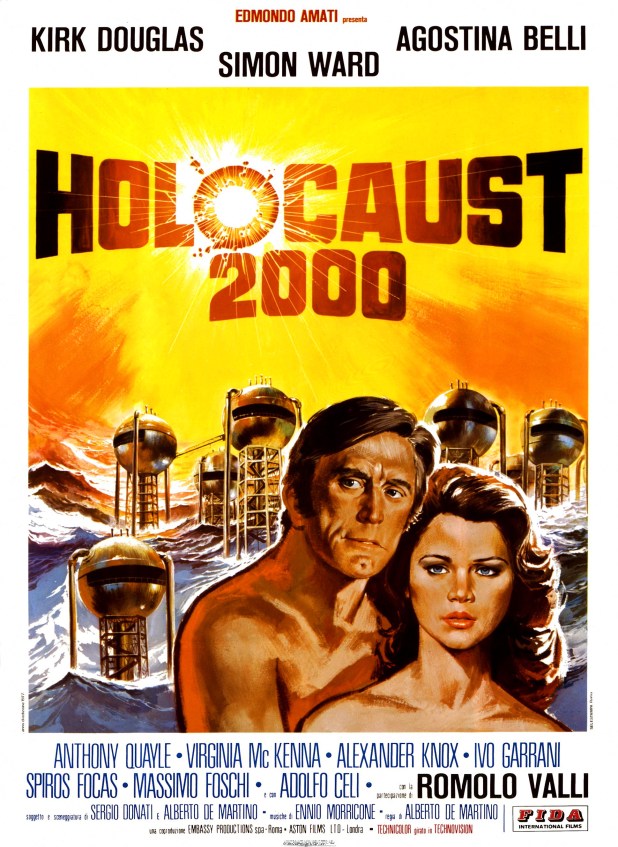
Of all the things the devil’s done, I wonder exactly how he was able to get Kirk Douglas — KIRK DOUGLAS! — to be in an Alberto De Martino ripoff of The Omen? I mean, this is the same director who made The Antichrist and Miami Golem! What horrifying secrets does the First of the Fallen have to make one of the lead actors of Hollywood’s Golden Age appear in this burst of Satanic majesty?

Holocaust 2000 (AKA the Chosen and Rain of Fire) was written by De Martino, Michael Robson and Sergio Donati, who wrote some of the script for Once Upon a Time In the West and Duck, You Sucker! as well as Orca, early Arnold vehicle Raw Deal and the original version of Man On Fire.

You gotta hand it to Robert Caine (Douglas). No matter how many people protest, no matter the fact that his wife was stabbed in front of him at a party or the killer went nuts in a mental institution and sliced his own wrists in front of him, he’s not giving up his plan to build a nuclear power plant near a sacred cave in the Middle East.

He soon learns that he has bigger problems. His son Angel (Simon Ward, The Monster Club) is the Antichrist and the plant he wants to build looks just like the evil beast that the Whore of Babylon will ride at the end of the world.

Seriously, after a bit of crumpet, Caine falls asleep next to his way too young new girlfriend (Agostina Belliand, who was in the original Scent of a Woman) watches the nuclear plant rise from the sea, with multiple heads rising from the currents.

An Italian and UK co-production, this movie also features Ivo Garrani (Bava’s Black Sabbath) as The Prime Minister, Alexander Knox (who nearly won an Oscar for 1944’s Wilson before his liberal views got him chased out of Hollywood during the McCarthy era), Adolfo Celi (who wasn’t just Emilio Largo in Thunderball, he was also the Captain in Live Like a Cop, Die Like a Man and the villainous Ralph Valmount in Danger: Diabolik), Geoffrey Keen (Minister of Defence Frederick Gray in six James Bond movies and one of the three noblemen using Dracula in Taste the Blood of Dracula), Peter Cellier (Sir Frank Gordon from yes, Prime Minister), Denis Lawson (Wedge Antilles!) and Tony Clarkin, who played a stormtrooper in the second and sixth Star Wars movies, as well as appearances in The Monster Club as a vampire and Outland.

In Europe, this movie ends with Caine living in exile with his newborn child, as Angel begins developing the plant intended to cause Armageddon. But in the U.S., Douglas returns to his company and blows everybody up real good.

I’ve wanted to see this movie since I saw its trailer on Trailer Trauma. You can still get that collection from Diabolik DVD and get fired up about finding some strange movies yourself.

You can get this on blu ray from Shout! Factory.

The Uncanny (1977)

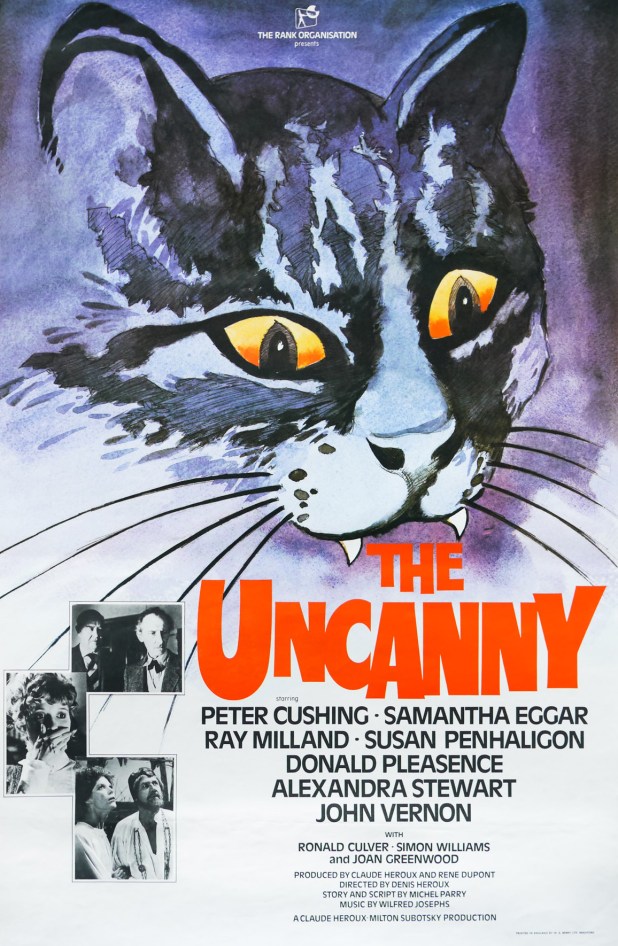
In 1977, legendary Amicus co-founder Milton Subotsky joined with  Canadian producer Claude Héroux (Scanners, Videodrome) to create a portmanteau movie in the grand Amicus style. The uniting story for this concerns a paranoid writer played by Peter Cushing who is trying to convince a publisher (Ray Milland) that cats are evil and that his book is the only way to save the human race.

Directed by Denis Héroux (Naked MassacreValerie) from a screenplay by Michel Parry (Xtro), this is a film that I’ve neglected over the past few years and can happily say lived up to my hopes for a fun anthology film.

The film begins the Montreal of 1977, as writer Wilbur Gray (Cushing) visits publisher Frank Richards(Milland) to discuss his new book. The writer is convinced that cats are actually Satanic creatures here to destroy humanity. He tells three stories to explain:

r believes that felines are supernatural creatures, and that they are the devil in disguise. Wilbur tells three tales to illustrate his thoughts:

London 1912: Miss Malkin rewrtes her will, leaving everything to her cats instead of her ne’er do well nephew Michael. The maid Janet, who is in love with Michael, tries to steal the will, but Miss Malkin catches her. Janet kills her, but the cats avenge her death.

Quebec 1975: Lucy (Katrina Holden Bronson, the adopted daughter of Charles Bronson and Jill Ireland) is an orphan who now lives with her aunt Mrs. Blake (Alexandra Stewart, who is also in Because of the Cats, which is appropriate). Her parents have died in a plane crash so she is allowed to keep her cat Wellington, who is an awesome fat black cat. However, her cousin covets the cat and any attention she can get. She’s played by Chloe Franks, who was the go to young girl in horror for this era, with appearances in Trog, The House That Dripped Blood (she’s Christoper Lee’s daughter), Whoever Slew Auntie Roo? and Tales from the Crypt (she’s Joan Crawford’s daughter). This section combines two of my horror loves — evil kids and Satanic hijinks.

Hollywood 1936: Actor Valentine De’ath (Donald Pleasence) replaces the blade of a fake pendulum to kill his actress wife, which gives him the opening he needs to give his young mistress a chance at acting. He didn’t count on her cat avenging her. This chapter features Samantha Eggar (DemonoidWelcome to Blood City), Sean McCann (Starship Invasions) and the always awesome John Vernon (CurtainsNational Lampoon’s Animal House).

This story has one of my favorite movie tropes, as when Cushing discusses Pleasence’s character, he holds up a photo that is in truth a publicity still of the actor as Blofeld and his cat Tiddes from You Only Live Twice.

For all the cat love in this, cinematographer Harry Waxman (The Wicker ManThe Beast In the Cellar) threatened to leave the film when he felt that the production was abusing cats.

That said — this is pretty much everything you want from an anthology. Modern filmmakers littering on demand services with their short films all assembled into one movie should take a moment and watch this to see how it’s done.

You can get this from Severin or watch it on Amazon Prime.

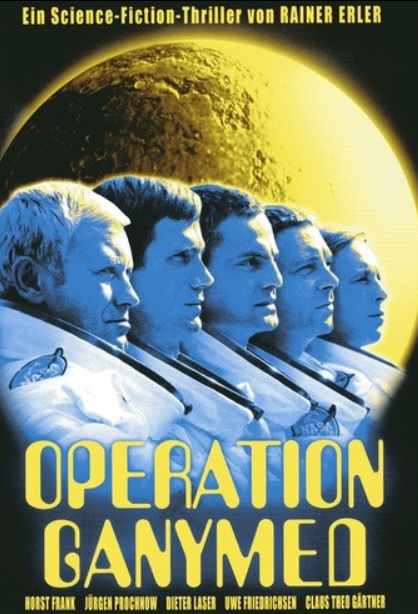
Star Wars German Style: Operation Ganymed (1977)

This dystopian-inspired version of a psychological Russian space epic (1970’s Signale, 1972’s Eolomea, 1980’s The Orion Loop, 1983’s Moon Rainbow) produced for German theatres in the wake of the ‘70s Star Wars-inspired production boom also appeared on German and European television as Heroes: Lost in the Dust of the Stars. Courtesy of the burgeoning home video market, Operation Ganymed appeared a few years later on U.S shores in a limited/low-key, admittedly patience-trying and poorly-executed English dub under its theatrical title on defunct Marathon Video (Atlantis in the U.K).

The now ultra-rare tape sought by VHS/Beta collectors doesn’t even appear in U.S tape guides. (How rare is the tape? A VHS is currently for sale on eBay for $78.00 . . . sigh, that’s the copy/version I rented from Tapes n’ More so many years ago!) The film was popular enough in Europe to warrant DVD reissues dubbed or subtitled for various markets—but are barebones VHS rips. And beware: most of those are DVD-Rs (but don’t complain and just be happy the film is at least digitally preserved).

Recognized as a winner of a few Euro-science fiction film festivals, the film earned a domestic stateside-release when star Jürgen Prochow impressed U.S audiences with his break out rolls in Das Boot (1981) and Dune (1984). Astute post-apocalypse fans will instantly notice those U.S-issued VHS tapes were most-likely plundered by the producers of the less intelligent Canadian exploiter Def-Con 4 (1985) and the South African gimp-clone Survivor (1987). If there’s ever a film that deserves a full-blown digital restoration from its original 35MM print—which was bestowed this year by Arrow Video to Def-Con 4—then Operation Ganymed is the film.

The long-awaited, inferior DVD currently in the marketplace came as result of respected German actor Deiter Laser (who I remember from the obscure and equally rare VHS The Elixirs of the Devil, a 1976 German take on the ‘70s Euro-horror nasties The Devils and Mark of the Devil) achieving his first taste of worldwide fame with his turn as the mad Dr. Heiter in Tom Six’s art house stomach churner, The Human Centipede (2009).

The remainder of us video and genre fringe geeks will recognize the third-billed Horst Frank, who became a go-to bad guy for spaghetti westerns (1968’s Django, Prepare a Coffin; with George Eastman and Terence Hill), Euro war epics (1964’s Mission to Hell), and Italian Gialli (1971’s Cat o’ Nine Tails for Dario Argento). The other two explorers, portrayed by Claus Theo Gardener and Uwe Friedrichsen, built extensive German-based resumes, with the late Friedrichsen in 121 projects and Gardener moving into directing.

As with the Russian you-either-love-it-or-hate-it epic-mindbender Solaris (1972), Operation Ganymed is an introspective, metaphysical journey concerning a United Nations-sponsored team of three Americans, two European, and one Russian who return from their four-year (left in 1985 and returned in 1989, according to the video box description; in the film it’s 1991) catastrophic mission to Jupiter’s moon in which, while they discovered rudimentary, primitive life (they pontificate on the foolishness of spending $38 billion for one tube of green slime), it was at the cost of 21 crew members, including two that perished on Ganymede’s surface.

What’s unknown to the crew: Earth lost contact with them 900 days ago (just over 2 1/2 years)and considered Ganymed 2 lost. No one is waiting for them; no Earth-orbit rendezvous is prepared. Unable to establish radio contact, and with 21 hours of oxygen left and no mission control to guide them, the astroquintet decides to make an emergency ocean landing off a rocky desert coastline that may be Earthpossibly Mexicoor a strange, new planet.

As they begin their trek across the desert towards what they hope is the U.S, they come to believe the Earth was decimated by a mysterious, cataclysmic ecological event or nuclear war. Their lines of reality begin to blur as hunger, dehydration, possible radiation sickness, and long-stewing inter-ethnic tensions lead them to madness, murder, and cannibalismreal or imagined.

The film’s first 30 minutes are impressive in adapting Apollo-era technology, suits, and tech-jargon for a Jupiter mission (that’ll leave a sci-fi buff pining for another watch of the 1978 Apollo-Mars pot-boiler Capricorn One), and the later, frequent flashbacks to the crew’s spacecamp-training sessions on Earth, and the sequences on Ganymede, which details how the two crew members died, also exceed the film’s budgetary constraints—limitations not experience by the likes of Star Wars and Capricorn One, even the cheesy Italian pasta-space opera, Star Crash. So if you’re looking for a big-budget production with flashy models, blinding laser beams and drooling, human-crunching aliens, this film isn’t for you.

Regardless of those reservations, let it be known that respected and successful German film and TV director Rainer Erler delivers a product far more engrossing that most post-2000 CGI failed-mission-discovers-life-on-a-distant-planet romps, such as the fellow Euro-produced Stranded, Europa Report, and Last Days on Mars.

Since this is a psychological, post-apocalyptic journey through man’s “inner space,” be warned: Operation Ganymed takes its time and you’ll be left with more questions than answers: Were the astronauts crazy. Were they on Earth. Did they warp to another planet. Does the Earth even exist. Were they even in Mexico. Did their fellow crew members really die on Ganymede. Did they all die on Ganymede—and this is all a hellish penance. Are they guinea pigs in a test set up by the corporation that sent them into space?

Find out for yourself by watching the full movie for free In English (at 1:33:00) and the uncut German version (at 1:53:00; with no subtitles) on You Tube. The DVD is available as part of a German-issued Rainer Erler Kultfilme (Cultfilm) 6-pack. There are more current, professionally-packaged, non-USA Playback Region 2 DVDs at Amazon (Caveat: know your regions!), along with the older DVD-issues at Amazon (you can sample those DVD images with the two video-clip trailers provided in this review).

* * *

You can catch up on the wide array of post-apocalyptic adventures with B&S Movies’ “Atomic Dust Bins” Part 1 and Part 2 featuring 20 mini-reviews of movies you never heard of, along with a “hit list” featuring all of the apoc-flicks we watched for September 2019’s Apoc Month.

You can learn more about Russian/Eastern Bloc science fiction films released from the 1950s to 1980ssuch as 1970’s Signale, 1972’s Eolomea, 1980’s The Orion Loop, and 1983’s Moon Rainbowby visiting: “Exploring (Before “Star Wars”): The Russian Antecedents of 2001: A Space Odyssey.”

And finally, this review was previously posted on September 28, 2019, as part of our September Post-Apocalypse Month.

* * *

Star Wars: Episode IX – The Rise of Skywalker is currently in theaters and was released theatrically on December 20 in the United States.

About the Author: You can read the music and film reviews of R.D Francis on Medium and learn more about his work on Facebook. He also writes for B&S Movies.

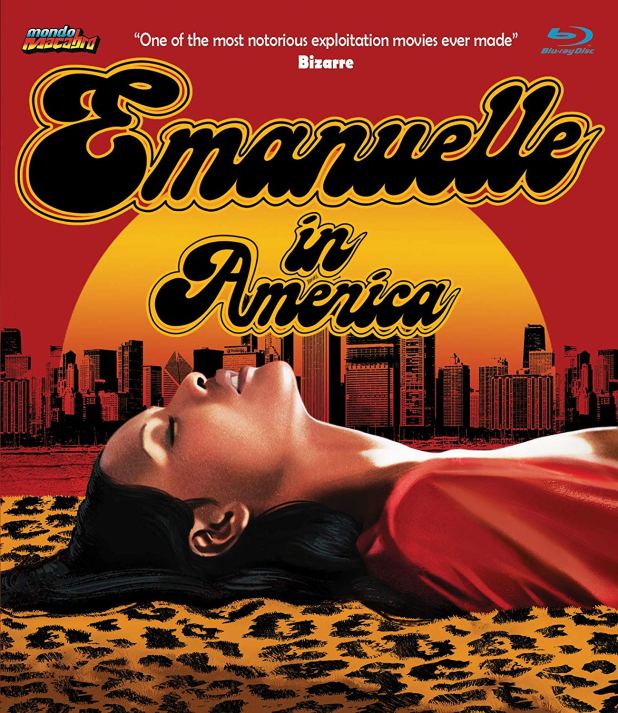
Emanuelle in America (1977)

I love Mondo Macabro. They put out amazing releases and clean up neglected foreign films, making things a million times better than they have any right to. Just this year they’ve released a slew of films that have never even been put out on DVD in our country. They’re one of my favorite labels.

However, they nearly got me in trouble by sending me a review copy of this film. With no warning, my wife opened it and instantly called and asked why I bought it. Thanks — I hate looking a gift horse in the mouth (and this movie does way more than look when it comes to horses).

Oh yeah — this entire review is NSFW. You’ve been warned.

https://www.dailymotion.com/video/x5hyyl1

This is the second in this series of movies to be directed by Joe D’Amoto. Whatever name he uses, you know exactly the kind of insanity that that name means.

Emanuelle — notice the missing M to denote that this has just enough legally not to do with the French film that starred Sylvia Kistel but just enough to make you think that it may — is a photojournalist out to get a great story no matter what. No matter what often means that she’s getting naked and in trouble, starting with an angry virginal boyfriend of a model that wants her dead.

She’s played by Laura Gemser, who has also used the name Moira Chen, and if you’ve seen a Bruno Mattei or D’Amoto film, you know exactly who she is. I’d recommend her star turn as a psychic who gets menaced by mutant fishmen in Endgame myself.

Here, she’s on the trail of playboy Eric Van Darren, who is enslaving women and creating a harem. She also hooks up with Italian duke Alfredo Elvize (Gemser’s real-life husband Gabriele Tinti who is in Enter the Devil if you’d like to descend further down the funnel of Italian scum) and his wife (Paola Senatore, Eaten Alive!). 

You may be like — hey, this seems like the typical Cinemax After Dark film, albeit with much better production values and one hell of a musical score. That’d be correct until Emanuelle ends up going to an island where every fantasy can become reality. Hold the Ricardo Montalban!

That’s when she discovers that some of the folks there like making love while watching films of young women dying. Yep — snuff films!

Emanuelle is disgusted and quits her job to go on a long vacation with her boyfriend. Of course, she’s soon come back for Emanuelle Around the World, where she meets a guru who promises the ultimate orgasm. And that guru is, of course, played by George Eastman. Ivan Rassimov also shows up, and if you suddenly started searching for this film, you get why I spend so much time writing about movies on this site.

After that, D’Amoto and Gemser would team up for perhaps an even more insane tale than this one, Emanuelle and the Last Cannibals, and one other Black Emanuelle film, 1978’s Emanuelle and the White Slave Trade.

If you saw the version of this that played on Cinemax or Showtime in the 1980’s, you didn’t get the full uncut madness that appears on this blu ray. Honestly, outside of degenerates, I have no idea who is ready for such madness.

You can get this directly from Mondo Macabro. The colors are gorgeous, the music sounds better than ever and the extras, like a documentary entitled D’Amato Totally Uncut: The Erotic Experience, brand new audio commentary by Eurotrash aficionados Bruce Holecheck and Nathaniel Thompson and a brand new interview with author David Flint, are worth just as much as the movie.

But man — you guys gotta warn me when you send me this kinda stuff. Still, much appreciated.

DISCLAIMER: We were sent this movie by Mondo Macabro. Luckily, my marriage survived.

PURE TERROR MONTH: Keep My Grave Open (1977)

ABOUT THE AUTHOR: John S Berry is someone I have great conversations with. I’m excited that he’s writing for the site. You can check out John on Twitter

I had one of those odd realizations as I was watching Keep My Grave Open. Someone had recently asked me if David Lynch was my favorite director. I couldn’t jump right on that answer and say yes for some reason. Don’t get me wrong, I love his work (yes even Dune) but favorite? What makes someone your favorite? 

Sunday night I was winding down a great weekend and was happy to have an extra hour to burn. I remembered I needed to re-watch Keep My Grave Open for Sam. It had been some time since I had viewed it and Sam’s Movie Pack reviews deserve the respect of watching them as they appear on the box sets (note: I watched it again Monday night)

So, I put this in and about midway something hit me, SF Brownrigg may be my favorite director. All my current favorite films and filmmakers have the same spirit; small I budgets, character studies and unique locations that make me either homesick or nostalgic. His movie always have a touch of sadness to them and I often find some sweetness in one or more of the characters. Maybe SF Brownrigg is the great grandfather of horror that really is about the people and the small universes they inhabit. 
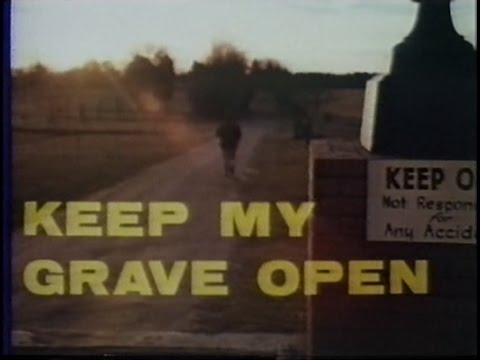
Grave starts with cracks and pops and the sounds of wind in the back of a pick-up. The old bum immediately melted my heart as he investigated the surrounding farms as the mournful music played and he grabbed his knapsack. This just set the tone for the movie, people carrying a quiet sadness about them in a rural setting, it was like seeing some of my mom’s scrapbooks come to life and speak.

Usually I am not too fond of origin stories or laying out a character’s back story piece by piece. With all of Brownrigg’s films (all 5, four horror and the ones I have seen) I want to know how they got there, why are they damaged this way? 

Even with the opening hobo character just serving as a quick jumpstart to the story I found myself wanting to know more about him. Why the bright yellow sweater? Why was he so polite in a sense when he was raiding the fridge and didn’t take all the contents? Was he looking for work?  

Brownrigg often used some of the same actors in his films and they all do great to decent jobs. They give a lot of them small little natural quirks. Keep My Grave Open centers around Ms. Fontaine played by Camilla Carr who keeps up appearances (2 to be exact). But is slowly losing her grip on sanity or is she just trying to win over the mysterious Kevin?

Ms. Fontaine is a lonely tortured soul in a good-sized country house with a nice young man named Bobby who takes care of her horse Caesar. Bobby cares more about the horse than teenage girls (OK community college girls) or older women trying to seduce him. He is likeable polite young Texas man and the actor is Topher Grace before there was a Topher Grace or that 70s show. 

There are many dimensions to a film that was made to fill up time on the drive-in screens across America in the 70s. It is much more nuanced and open ended, and boy do I love an open-ended film, especially when you can go and talk about theories and ideas with a friend over a good milk shake (miss you Lucas). 

In that spirit, rather than recap and describe the film (which to be honest you cannot get better than Groovy Doom’s amazing piece here.

Let’s all take some time,78 minutes and get out our notecards, yarn, push pins and giant whiteboard. Put on your best formed foil hat and let’s talk some theories and speculation. 

But before we get into was Kevin real? Was he there the whole time? Etc. Let’s take a minute to really ponder the odd old dingy country bar/ one stop brothel scene, one of the those great I can almost smell it scenes that Brownrigg often had in his films. 

After hearing of this place from Kevin and him giving a great Yelp review of Twinkle Ms. Fontaine decides maybe she needed to see what the fuss was about. Maybe get some take out for Kevin.
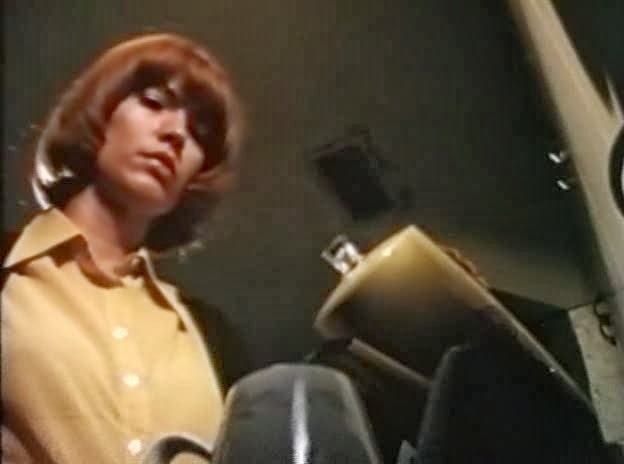
We cut to a man and a lady trying to negotiate how much adult fun they are going to have this evening. What comes next is some good old fashion haggling but using amounts of $22.50 with a counter of $17.50. Is there change in prostitution? Where and how do you give change? 

I imagine the bar/brothel really priding themselves in their customer service and imagine most interactions went like this:

Trixie Diamond: OK you had the #3 and an Around the World.’ 

Good Bubba: ‘Here’s a twenty.’ 

Trixie Diamond: OK and here’s a dollar fifty back.

Good Bubba: Keep the change

Trixie Diamond: Thanks hon’ Have a good rest of your night.

Good Bubba: You too ma’am careful driving home looks like rain. 

Old bar maid: Don’t forget to get your customer rewards card punched. 12 punches and you get a free one. 

Twinkle was inpatient lady, she must have double booked herself. Smart move hiding in the car and pulling the sheet over your head. Not such a smart move gasping and giving away your position.

So, we know some of the facts but do we truly? We know of Ms. Fontaine’s version and her recalling. But we have also been hinted at a different truth from the doctor? 

Was????:

  1. A. Kevin an orphan with Miss Fontaine as children or her biological brother. At her 16th birthday she was caught changing innocently to try on the dress or is that Miss Fontaine’s version? Where they really caught by the old aunt who took care of them and Kevin was shipped out to another orphanage or military school or did he just run away. Again, we are hearing Ms. Fontaine’s telling of the story 
  2. B. They were both orphans and Red was crushed that he left, and she was stuck with the house after the old lady died and she kept dreaming of Kevin returning.

C. Maybe Kevin was there the whole time but would go on benders and do anything he could do to get away from Ms. Fontaine. Each of the victims had some connection to Kevin which is why Ms. Fontaine eliminated them: 

1c. Old Bum was one of Kevin’s drinking buddies fellow hobo on the road coming back into town. Remembered that was his place and thought he would stop by. 

2c. Bobby (Topher Grace) was ranch hand that Kevin liked working with and was kind of like a kid brother which leads to…

3c. Twinkle was one of the ladies that Kevin and Topher uh hung out with when they went out for beers on a Saturday night

4c. Young girl who liked Bobby had caught Kevin’s eyes a few times and Miss Fontaine saw it

  1. C. Why the fencing like sword and gloves as the weapon? Did Kevin kill a fellow orphan or sibling when the old lady made them practice fencing? 
  2. D. Why did nobody come looking for any of the people. OK we know they probably thought Twinkle had finally mouthed off to the wrong guy. But what about the Topher Grace and the other girl, I am not sure if they were supposed to high school kids or community college kids. But someone had to wonder where they were. 
  3. E. Did Ms. Fontaine kill herself because she had gone to such extremes and Kevin had still not come back and given her is full attention? Or did he just not care and was sleeping off one hell of a bender?
  4. F. Did Kevin read about Ms. Fontaine’s death in the paper? Maybe he get word from the MD? Perhaps he was just as damaged where he was, a male version going through what Miss Fontaine was going thru but on a different coast or state and he came to take his place as last member of odd family?
  5. G. Or is it possible there is some sort of rebirth, re-awakening action going on? With Ms. Fontaine dying, she re immerges as the manifestation of Kevin. Kevin calls up to her in the house at the end. Or maybe the suicide opened some odd dimension and they switched places ala Freaky Friday? Or perhaps Ms. Fontaine took 

I guess that is why SF Brownrigg may be my favorite director, in a simple short movie made for drive ins I become immersed in the what ifs and wonder whys. Anyone can Room 237 a Kubrick film, but I am glad to get to do the service for SR Brownrigg.

I have an idea of the story but am never sure how it is going to end or what direction it will take. SF Brownrigg’s films make day dream and speculate, and wouldn’t it be nice if more films did that?