Oh man, you Turkish maniacs. You aren’t content to just make your own slightly different version of The Exorcist like, well, any of the movies on our list of Ten Possession Movies That Aren’t The Exorcist. No, you’re going to pretty much remake the movie scene for scene and have “Tubular Bells” in just about every single scene. Bravo!
12-year-old girl Gul is living a high society life with her mother in Istanbul, yet becomes possessed after messing around with an Ouija board. Did she learn nothing from The Chill Factor, Spookies, all of the Ouija movies and, well, The Exorcist?
“This is literally the same movie,” said my wife, Becca.
“Shot for shot,” was my answer. “Just with fewer people and no budget.”
99% of Turkey’s population is Muslim and it has a history of being Islamic. One wonders how the Catholicism of the original would have played there. Perhaps that’s why we have this grainy little remake. I kind of love its slavish devotion to the source material, like a Sweded movie before anyone knew what that was.
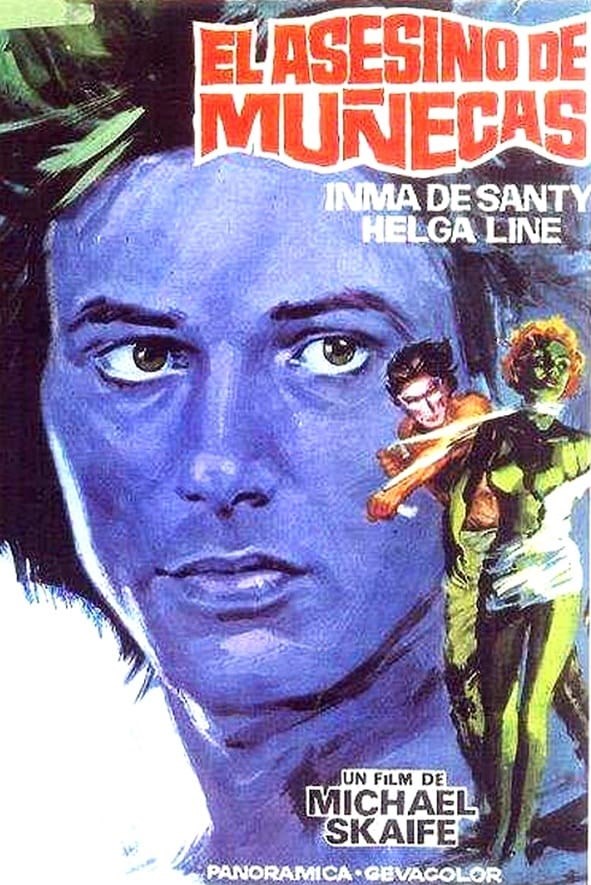
Miguel Madrid — credited here as — only has directed three films: The Butcher of Binbrook, Bacanal en Directo and this completely insane entry. He also wrote The Feast of Satan and Del Amor y de la Muerte. He’s credited as Michael Skaife on this movie, the same name he used on The Butcher of Binbrook, which was released in the U.S. as Graveyard of Horror.
All hail Spanish horror! Your movies make my head hurt and yet I love them so!
David Rocha plays Paul, who was thrown out of medical school because he can’t stand the sight of blood. Now, he’s back home, living on the estate of Countess Olivia (Helga Line, Horror Express, Horror Rises from the Tomb), where his father is a gardener.
To say Paul is mixed up is an understatement. The film attempts to explain it by stating that Pail was raised as a girl after his sister died and has taken on part of her personality. He also likes to perform surgery on his dolls and remove their hearts. And oh yeah — there’s a female-voiced masked killer on the loose wearing a black wig and a white doll mask.
There aren’t many Spanish giallo films — I can point to Blue Eyes of the Broken Doll (AKA House of Psychotic Women), The House That Screamed, Clockwork Terror, Maniac Mansion, The Corruption of Chris Miller, A Dragonfly for Each Corpse, The Killer Is One of Thirteenand Glass Ceiling are some that I can think of. Of course, there’s also Pieces and Bloody Moon, but I feel that those are more slasher than giallo.
The thing about Paul — and this movie — is that instead of comely females writhing around half nude as in most giallo, our protagonist showers all of the time, except for when he’s not killing and dreaming that people in his life are mannequins. Seriously, the dude loves taking showers. He’s also given to going completely bonkers, running in slow motion past seagulls after smashing flowerpots with an axe while screaming “Leave me alone!”
Ah man, I totally loved this movie. It gives up who the killer is way early, unlike most giallo, but it’s so charmingly daffy and out of control. This is a movie that I’d never even heard about before it was sent my way. And man, that little Robert kid who pals around with Paul? That kid seems like a real handful. Why he hangs out with a murderous twenty-something man who identifies as a woman and everyone is cool with it is beyond me, but maybe 1974 was just that crazy.
If you didn’t get the hint, go get this movie now. Like…right now.
You can get this movie from Mondo Macabro, who as always put out some amazing cinema from around the world. Released for the first time ever in the U.S. and the first time on blu ray, it features a brand new 4K restoration from the original negative with Spanish audio and newly created optional English subtitles. Plus, there are new interviews with actor David Rocha and Dr. Antonio Lazaro-Reboll (author of the book The Spanish Horror Film), as well as new commentary tracks, one by Kat Ellinger and the other by Robert Monell and Rodney Barnett. You can grab your copy right here.
DISCLAIMER: This movie was sent to us by Mondo Macabro.
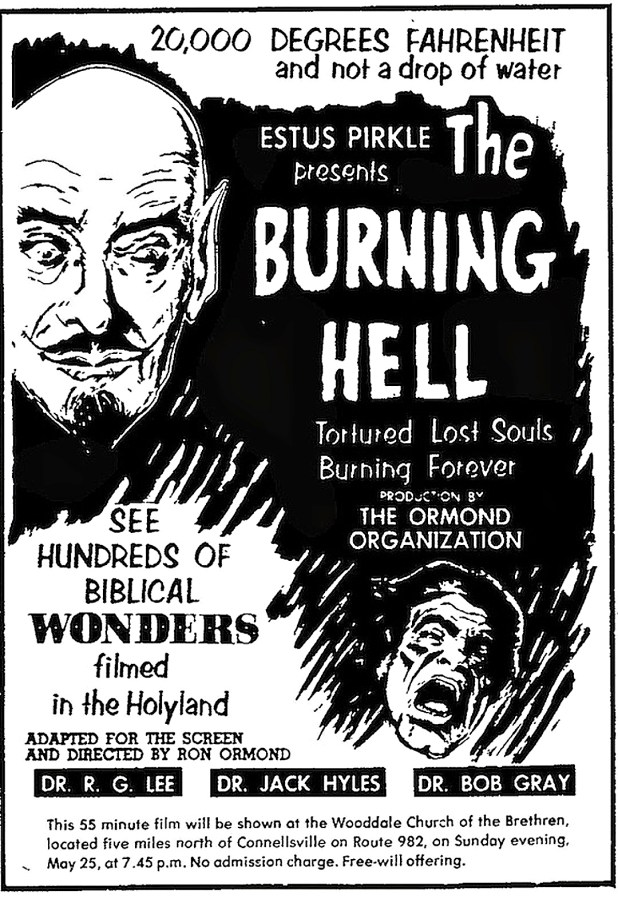
If Footmen Tire You, What Will Horses Do? is probably my favorite religious movie ever made. Unlike today’s religious films that sneakily preach at you and make you feel inferior, that movie straight up lets you know that Communists are going to kill everyone you love and that you’re definitely going to burn in Hell forever.
If you think three years dulled the edge of Estus Pirkle, you’ve never been more incorrect. Get ready to pay, sinner!
At once a combination of regional exploitation and good old fashioned revival sermon, this movie is going to punch you in the face as many times as it can. This is the kind of film where two hippies show up wanting to learn more about God, get rebuffed, one of them dies by getting beheaded and the other runs right back to church.
You get to see people actually in Hell and learn exactly how long it lasts. This is the kind of movie that is going to either confirm your mania or let you know that everyone is insane. Seriously, they don’t make them like this any longer. That’s right — no movie made now spends as much time explaining how worms are going to eat you forever and ever and ever.
Let me quote to you from this movie. “Statistics have proven…every hour 3,000 people go to Hell; every minute 60 people go to Hell; right this very moment, someone is headed for a burning Hell.”
Ron Ormond, who directed this, survived two near-death plane crashes before finally deciding to turn to the Lord. Before that, he made movies like the 1950 Lash LaRue-starring King of the Bullwhip (he actually directed many films starring that whip-wielding cowboy) and the minstrel show review Yes Sir, Mr. Bones before going into full-on exploitation madness with flicks like Please Don’t Touch Me, Girl From Tobacco Rowand The Exotic Ones. He shows here that he lost none of his touch for shocking the living shit out of you in just about every frame. Bravo, Mr. Ormond. Bravo.
You can watch this on the Internet Archive or on the YouTube link posted below.
Author Note: This review was previously posted on September 28, 2019, as part of our September Post-Apocalypse Month. You can catch up with all of those reviews by visiting our Atomic Dustbin recap. We’re bringing it back to pay tribute to the work of George Lucas.
Okay. Let’s get this out of the way: This is the movie were you video fringe horndogs lose it over Mariette Hartley (as Lyra-A) in a two-piece bikini sporting two belly buttons (a dual circulatory system with two hearts) as a (network censored) “dominatrix” who breeds men for an oppressive, feminist regime.
Gulp.
Yes. Mariette Hartley: We’re talking Zarabeth in the Star Trek: TOS episode “All Our Yesterdays” where she cracked Spock’s emotionless Vulcan shell. She mixed it up with Gary Lockwood as Lisa Karger in Earth II (another failed TV movie pilot-to-series). She tempted Charlton Heston as Harriet Stevens in Skyjacked. She gave Dr. David Bruce Banner butterflies as Dr. Carolyn Fields in The Incredible Hulk. Yes. Mariette Hartley, with a resume of too many popular TV series to mention, all the way out to Fox TV’s 2018 hit series 9-1-1 as Patricia Clark.
Just one look at Mariette in Genesis II and you’ll forget all about the über-cool Sub-Shuttle that we all came for (and not a bogus CGI model . . . but a non-operational, full-sized prop pulled on a long-cable by an off-camera semi-truck) that pulls into a carved-out-of-the mountain sub-station (which Elon Musk has since pinched for his next millionaire-toy project). Oh, and did you notice the sterile, ultramodern-styled city looks suspiciously like the city in Conquest of the Planet of the Apes (20th Century Fox’s “Century City”)? And did you notice how many times the Sub-Shuttle footage was recycled in ‘70s sci-fi television?
Anyway . . . times were hard for ex-Star Trek creators.
In 1974, after the go-to-series failure with Genesis II, Gene Roddenberry developed another TV movie/series pilot with The Questor Tapes (1974). A thinly veiled reworking of the Gary Seven character and plot from the Star Trek: TOS episode “Assignment: Earth,” it was intended as a vehicle for Leonard Nemoy’s return to weekly television. The end product starred Robert Reed-doppelganger Robert Foxworth (1979’s Prophecy) who portrayed an android with incomplete memory tapes — in a pseudo The Fugitive storyline — searching for its creator and purpose (that also sounds like V’ger from Star Trek: TMP).
Then, after the additional go-to-series failures of the Genesis II reboots Planet Earth and Strange New World produced in the wake of The Questor Tapes, Roddenberry tried again — by jumping on the ‘70s “occult detective” sub-genre with 1977’s Spectre — by reworking another Star Trek element: the contemptuous friendship between Spock and Dr. Leonard McCoy, itself a homage to the relationship between Sherlock Holmes and Dr. Watson. Spectre starred Robert Culp (The Gladiator) as William Sebastian, a criminologist and occult expert assisted by Gig Young (1978’s Game of Death with Bruce Lee) as Dr. Hamilton.
Genesis II stars Alex Cord (who also journeyed into a “fucked up future” in Chosen Survivors) in the “future world” of 1979 as NASA scientist Dylan Hunt. Of course, he opens the post-apocalyptic proceedings with that all-too-familiar apocalypse (or psychological horror) cliché: “My name is Dylan Hunt. My story begins the day on which I died.” So goes the story a “20th Century Boy” (T Rex, anyone?) thrown forward in time by a suspended-animation earthquake-accident that damages his New Mexico/Carlsbad Caverns-housed “Project Ganymede” system for astronauts on long-duration spaceflights.
And we flash forward to the year 2133.
An archeological team of PAX (Latin for “peace”) descendants from the NASA personnel that lived-worked-were trapped in the Carlsbad installation when World War III (aka “The Great Conflict” because, well, the docile hoards of all post-apoc futures never seem to be able to preserve or retain a basic semblance of American history) broke out, discover Hunt’s buried chamber. And while they can’t seem to “remember” World War III, the PAX are smart enough to construct a subterranean rapid transit system utilizing a magnetic levitation rail operated inside a “vactrain-tunnel network” that spans the globe and saves the masses from air transportation attacks.
Anyway, here’s where Mariette Hartley comes in.
Lyra-A oversees the all-female totalitarian regime known as the mutated (natch) Tyranians that rule the lands once known as Arizona and New Mexico. In addition to their increased physical abilities, you can always spot a Tyran by their nifty, dual navels — that they seem to love to show off. (Schwing! Thank you, Gene!) Not that the wussy PAX-rats would do anything when they spot a Tyran: they let themselves be enslaved.
Lyra-A, in a grand alien fashion of the Star Trek variety, is enraptured by Roddenberry’s “Buck Rogers” and wants to harness Hunt’s knowledge of (among other things) nuclear power systems to fix the Tyranians’ dead power plant. But apoc-bitch Lyra-A double crossed him: it’s a ploy to reactivate a nuclear missile system to destroy the PAX. As a result, Hunt goes into Moses-mode (see the apoc-romps No Blade of Grass, Ravagers) and leads a revolt of the enslaved, sabotages the nuclear device, and destroys the reactor.
Sound pretty cool, right?
Airing to high ratings in March 1973 and encouraged by the network brass, Roddenberry worked up a 20-episode first season on the adventures of Alex Cord’s post-nuc Moses. Then CBS-TV dropped the bomb: they passed over Genesis II and gave the timeslot to another competing post-apoc series: the short-lived and low-rated Planet of the Apes.
Those mothballed Genesis II episodes featured recycled ideas from Star Trek: TOS and fueled the later Star Trek movies — with stories about suspended animation soldiers from the past (“Khan!!!”), a London ruled by King Charles X; NASA “evolved” computers and equipment left on Jupiter’s Ganymede returning to Earth in search of their “God” (“The Changeling” and the annoying Persis Khambatta-V’ger non-sense from Star Trek: TMP); men turned into breeders and domesticated pets (reworked for the second pilot, Planet Earth); the ol’ catapulted-through-a-time-continuum back to 1975 gaffe (“Tomorrow and the Stars,” an episode from Star Trek: Phase II, the proposed-failed post-Star Wars reboot), and a creepy priesthood who enslaves the masses via electricity used as a “God” (“Return of the Archons” from ST: TOS).
The reason the network passed on Genesis II: The series was “too philosophical” and Alex Cord’s portrayal was “too dark and brooding.” They wanted another handsome and charmingly arrogant Captain James T. Kirk. So Roddenberry and Warner Bros. rebooted Dylan Hunt into an action-driven and conflict seeking Kirk-like character embodied by John Saxon.
Cue for Planet Earth.
Now Dylan was one of three cryogenically-frozen astronauts who return to Earth to reestablish the PAX organization that sent them into space. And while we lost Mariette Hartley, we gained the equally fetching Diana Muldaur (again, from Cord’s Chosen Survivors), who rules the Amazonian, male-enslaving “Confederacy of Ruth,” along with cherished character actors Bill McKinney (Deliverance, Cannonball) and Gerritt Graham (Phantom of the Paradise, Used Cars) as “impotent males” in recurring roles.
This time, instead of CBS, ABC aired the Warner Bros. produced program in April 1974.
The network passed.
Cue a Strange New World.
To creative and legal reasons lost to the test of time, Warner Bros., who now owned the intellectual rights, reworked the premise a third time as Strange New World (pinching the title from Star Trek’s opening monologue) — sans Roddenberry’s involvement — dumped the PAX and Tyranians, and retained John Saxon as the same Kirk-like character, now known as Captain Anthony Vico, who returns from a suspended animation space trip with two other astronauts (as in Planet of the Apes TV series that screwed Genesis II in the first place).
The movie aired in July 1975.
The network passed.
And with that, between Roddenberry’s vision, and the failure of the Planet of the Apes TV series (episodes were cut into overseas theatrical and telefilms), the small screen’s attempt to jump on the major Hollywood studios’ post-apocalyptic bandwagon was over. Thus, us wee lads and lassies gathered around the TV on Saturday mornings and settled for Filmation’s Ark II, whose 15 episodes (it seems it had more episode and was on much longer), aired in 1976, then reran in 1977, then again in 1978. And that kiddie-apoc series stopped production because the network “wanted Star Wars” (and not a TV knockoff of 1977’s Damnation Alley). So Ark II was reworked and repurposed (the same “universe,” so to speak) as Space Academy and Jason of Star Command (Sid Haig, rules!).
There was also another, similar attempt at the Genesis II concept with, ironically, another Star Trek: TOS alum: Glenn Corbett (warp-drive creator Zefram Cochrane in 1967’s “Metamorphosis”). As with Roddenberry’s The Questor Tapes, The Stranger (1973) was another failed TV movie-to-series sci-fi twist on the ‘60s runaway TV hit, The Fugitive. This time, instead of returning to a post-apocalyptic society, our astronaut (Hey, Sam . . . he’s named “Stryker”!) returns to a totalitarian “twin” Earth run by the “The Perfect Order.” (And if it all sounds a bit like 1969’s Journey to the Far Side of the Sun byGerry and Sylvia Anderson of the fellow-failed, post-Star Trek series UFO and Space: 1999 . . . then it probably is: both series were movie-rebooted in the post-Star Wars universe as the telefilm/foreigner theatricals Invasion: UFO and Destination Moonbase Alpha, respectively.)
But wait . . . all was not lost with Genesis II.
Roddenberry’s widow, Majel Barrett (Nurse Christine Chapel in Star Trek: TOS and Lwaxana Troi on Star Trek: TNG and DSN) produced one of Roddenberry’s old pre/post-Star Trek dystopian-apocalyptic concepts, Andromeda (itself recycling from Genesis II and Planet Earth), a Canadian series that ran from 2000 to 2005 and aired in syndication on U.S television.
VHS rips ofGenesis II and Strange New Worldcan be enjoyed for free on You Tube, while Vudu has official, affordable streams of Genesis II and Planet Earth. For whatever “legal” reasons, no streaming platform offers Strange New World. However, copies of all three are widely available on DVD courtesy of Warner Home Video’s Warner Archive Collection.
Star Wars: Episode IX – The Rise of Skywalker is currently in theaters and was released theatrically on December 20 in the United States.
About the Author: You can read the music and film reviews of R.D Francis on Medium and learn more about his work on Facebook. He also writes for B&S Movies.
None of these Italian and Spanish demon-possession soirées compare to the silver screen sleaze that is Magdalena, Possessed by the Devil. And you thought the Germans crossed the boundaries of bad taste with their Hammer Studios witch hunt rip-off, Mark of the Devil (1970)? And you thought The Eerie Midnight Horror Show threw Friedkin’s class and style out the window? Not even Tony Curtis’s pimple-on-the-neck-turns-into-an-Indian-demon-shaman buffoonery of The Manitou (1978) is up to the challenge of this X-Rated demon romp.
“I want to take communion, but not in my mouth, but down in my ‘hoo-hoo,’ you dirty nun ‘boinker,’” Magpie caresses her “triangle of death” before a priest. “When are you going to ‘screw’ your housekeeper,” she rants to Father Ed in an un-synced dub that makes Italian Giallos look in-sync.
Welcome to the X-Rated adventures of Linda Does Berlin, aka Satan’s Full-Frontal Lesbians School for Girls.
Our story beings with a Godspell-cum-Rocky Horror Show cast reject, aka a prostitute, walking down the street on a pleasant Ash Wednesday evening who launches into scenery-chewing hysterics at the discovery of an old man, Joseph Winter, crucified Jesus-style on the gate of her apartment building and . . .
Jump Cut! We’re in a record store with hot German chicks so we can meet ol’ Joe’s niece, Magdalena, who’s off to a party at her boarding school. . . . Now, if you know your Eurotrash cinema, you know the entire student body—even the headmistress and the instructors—at all-female boarding schools are red-herring “lesbians” because, well, all of the girls in Eurotrash-boarding schools are lesbians and up to some nefarious, bitchy deeds to torture the naïve innocent girl who just had a rich uncle kick-the-bucket, aka Joseph Winter.
. . . And cue the swarm of buzzing-house-flies SFX so people know shits-about-to-go-down. Ol’ Uncle Joe is sitting up in the morgue and, for whatever reason, this inspires Maggie to spaz n’ spider-arch and spew some rabies-foam and ruin the Lesbian School for Girls party. But that’s just plot piffle: We got ourselves two red-herring lesbians on the stairs giving us a “triangle of death” rub and a full-frontal rack at the 15-minute mark. What does this have to do with the plot? Nothing, it’s the ubiquitous and unnecessary “de Ossorio” lesbo-scene—so the director has a fantasy to jerk to after the day’s wrap.
Uh-oh. The eerie synth-music backing the buzzing flies . . . here we go. And Magpie is a-kung-fu fighting and trashing a kitchen and wants the school’s headmistress “inside of her.” Yes! Magpie’s gone full-frontal at 20 minutes with some invisible demon sex and Satan is going for some back-door action.
More buzzing flies . . . Mags has another episode and climbs a concrete wall like a spider monkey and takes a nap on top of ol’ Joe’s grave. Do we get a Carrie-style hand pop through the dirt? A Phantasm dwarf? It’s a dream sequence, right? Nope, she really did run away from the school to sleep on ol’ Joe’s grave. And on the way to take a cat nap on Uncle Joe’s grave, Mags hitched a ride and, big surprise, it’s time for the obligatory you-owe-me-for-the-ride rape gag so she can “wishbone” his legs . . . and rape him! Dick Hurtz, indeed.
Meanwhile, lamps and paintings are flying around on wires in the school’s attic. Why? Who cares! We have another full-frontal “triangle of death” rubbing alert at 31 minutes and Magpie’s off on another rabies-Tourette’s rant that puts Ms. Blair to shame.
Okay, I’m getting bored . . . cue the buzzing flies SFX. Now ol’ Magpie is on a McCambridge-PMS magnum opus to a priest and tearing through bibles like Jon-Milk Thor through a phone book. Will Mags kiss the priest and blow ‘em up like a water bottle (it’s a Jon-Mikl Thor thing)? Nope.
Now we’re in Exorcist II: The Heretic territory—even though that hasn’t been released yet to rip off—with the ol’ psychobabble-and-attach-the-electrodes-to-her-head-scene. Is it epilepsy? Tourette’s? Schizophrenia? Split Personality Disorder? Manic Depression? Why is no one listening to the priest? Eh, who cares? What’s up with the staircase lesbians? Are they drugging Magpie to steal Uncle Joe’s inheritance? Nope. Toss that red herring back in the water and just wait for a Paul Naschy-styled, out-of-left-field dues ex machina to appear.
So . . . the electrode-brain-scan hocus pocus tell us Mags needs some time in the county to ride horses and bicycles in a plaid mini-skirt and go-go boots to, you know, pad the film’s short running time. (This clever music video created with the film’s filler scenes—set to Cat Stevens’s “Morning Has Broken”—sums it up nicely.)
There are those flies, again. . . . Yes! Magpie’s going topless and picking up strange men in bars via pressing her nips into a windowpane. . . . Now, if I may interject for a moment: If ever the time comes when I see a woman pressing her ta-tas onto a windowpane and “wants me to give it to her now,” I just naturally assume the chick must have a demon rattling around inside of her—and I get the hell out of there . . . but this dude. . . . Yes! Full-frontal alert at 55 minutes and Magpie’s pitting two rapists against each other and one stabs the other . . . what the hell? She’s vanished into thin air.
La, la, la . . . more romantic bike rides in the countryside . . . friggin’ horses . . . a Table Tennis match with a romantic piano interlude? Okay, wait. Hold on! We may have a full-frontal moment here. . . . Nope. More horseback riding? What happened to the Table Tennis sex scene? Oh, wait! Naked piano playing and autoerotic asphyxia in the parlor. . . . Nope.
Now the cops arrested a burglar at ol’ Uncle Joe’s apartment whose babbling about the “man in black” who killed ol’ Joe. Why? Who? We’ll never know because “Joe” gave creepy-red herring-trench coat-burglar guy a push over a Hitchcockian-Vertigo stair railing at the police station. What does this have to do with the plot? It’s another red-herring tosser for the river.
Okay, so doctor dude at the psycho-chateau can clearly see Magpie is completely unhinged—devil possession de damned. Naturally, he jumps into the sack. I guess he didn’t hear the buzzing flies nesting in her Devil’s Triangle south of the 41st parallel.
Finally! We get to the Mercedes McCambridge-demon-voice-bed-flip-out scene of the movie so we can learn who in the hell this demon is and what this full-frontal lesbians excuse of a mess has to do with Magpie’s uncle and this red-herring burglar.
Welcome to the plot twist: Uncle Joe was frequenting prostitutes and his wife murdered him. So ol’ Uncle Joe, and Auntie Winter’s suicide soul, are inside our Magpie fighting each other and . . . okay, enough of that plot piffle. We have another full-frontal invisible demon rape scene at 1:15 with only seven minutes to go . . . well, whadda ya know . . . ol’ Joe, you sly-pedophile.
Are you following? Uncle Joe is the horny devil, doggy-style rapist. And all of Magpie’s mouthin’ foam moments—that was Auntie Winter. You got that? At least I think that’s what’s going on with this Euro-demon tomfoolery. . . .
Okay, so for a little back story to clear up this mess:
In the beginning of the film, during the initial investigation of Uncle Joe’s Ash Wednesday crucifixion, the headmistress of Magpie’s prep school told the detectives “how excited” Mags would be when it came time for one of her “visits” with Uncle Joe. Where do we file this uncle-niece incest insinuation? Is it a dues ex machina, red-herring, or MacGuffin incest? Someone please cue the random, Paul Naschy errant knight and out-of-left-field zombie attack. Will Mags use her demon-soul to resurrect the dead to attack the psycho-retreat? Nope.
And the flies are back so Magpie can set fire to the psycho-farmhouse and swing an axe and . . . one “Our Father Who Art in Heaven” later and . . . Magpie is spitting up a gummy fishing worm that turns into a baby garden snake. What the hell? Ladies and gentlemen: We have our Ruggero Deodato-denying-he-sliced-up-a-live-turtle-during-Cannibal Holocaust moment! Horny doctor dude just head-stomped a live snake! Call PETA. Alert the ASPCA!
Huh? We can’t file charges. The snake-evidence just vanished into thin air.
“There are things between heaven and hell,” so says horny doctor dude.
Yes, and there are things between one’s ass cheeks and the toilet.
For an alternate, less unhinged perspective on Magdalena, Possessed by the Devil, you can check out Sam’s take on it.
Also be sure to read his reviews of the film that started the whole ‘70s Euro-demon enchilada, The Exorcist, and its sequel, Exorcist II: The Heretic.
And where did all of this demon possession hocus pocus originate: Check out Brunello Rondi’s (Black Emmanuelle, White Emmanuelle) Il Demonio (1963; The Demon) starring Daliah Lavi. Her spider walk exorcism scene (without wires) says it all; you won’t sleep for a week after watching it.
You want another totally inappropriate, blatant rip-off of The Exorcist? Then check out 1975’s The Return of the Exorcist.
About the Author: You can read the music and film criticisms of R.D Francis on Medium and learn more about his rock ‘n’ roll biographies, along with horror and sci-fi novellas, on Facebook.
A movie starring a Pittsburgh born-and-bred actress who
starred as Yeoman Tankris in “Wolf in the Fold” on Star Trek, and as Jeanne
Leeds, one of Mr. Drysdale’s secretaries on The
Beverly Hillbillies, and as
Darlene Wheeler, Ebb’s girlfriend on Green
Acres?
Yeah, I know it’s weird that I can “six-degree” Judith
McConnell like that. She’s this Pittsburgh born-and bred-Trekkies dream! To the
transporters, Scotty!
Hold on there, Bones. Stow the pocket rocket.
Before Judith McConnell beamed to the Philippines to quench the blood lust of fellow ‘60s television mainstay, John Considine (who made his film debut as “Doctor Death” in 1973’s Doctor Death: Seeker of Souls), she had to meander through the New Mexico desert so a devil-worshipping cult could maintain their eternity in The Brotherhood of Satan (1971).
. . . And somewhere between being a member of Ted V. Mikels’s The Doll Squad (1973) and finding steady work in the American daytime dramas As the World Turns, Another World (86 shows), One Life to Live, and Santa Barbara (over 1,000 episodes!), she appeared in this Filipino pseudo-vamp potboiler.
Gulp! It’s Brigette Bardot’s doppelganger, Jennifer Billingsley, from Burt Reynolds’s rednecksploitation classic, White Lightning (1973)!
There’s that bucktoothed hottie, Tani Guthrie, from Daughters of Satan (1972) playing another twisty, witchy-bitchy blood priestess!
R.D! We get it! All
of the B-Movie actors you love are in the movie. What’s it about? Is it as
tantalizing as the art work depicts? A film featuring Judith McConnell strapped
to assembly-line style tables under the tagline: They need a special liquid to stay young. It is thick, red and warm,
must be hot n’ sexy!
Yeah, you’d think.
It starts off AWESOME, with Judith McConnell go-go dancing
in a cage for a bunch of horny, on-shore leave U.S sailors . . . that’s
kidnapped by mysterious, crimson-hooded figures. . . . That’s what’s great
about these Filipino horror flicks: there’s never
a shortage bikini-clad, hot white chicks to kidnap and sacrifice.
So, anyway . . . going along for the boat ride to Baru’s
(John Considine) plastic-trees jungle and papier-mâché caves, jungle-cult
island getaway are Fredricka Myers, Chiqui da Rosa and, GULP!, Jennifer
Billingsley who, at first, assume they’re going to shipped to Hong Gong for the
sex trade.
Didn’t you girls read the “plot twist” in the script? You’re
going to be “blood cows” for some eternal youth elixir hocus pocus in the name
of a “God” that is a . . . disembodied talking head in a glass box?
So how does the mayhem end? I bet they’re building a Frankenbabe
with all the “best parts,” like in Blood Cult
(1985), to put the “head” on, right?
Nope.
Baru decides to defy the “Ring of Age” and spend his mortal
life with Jennifer Billingsley. Yep, the little head out thinking big head
screws up yet another evil plan. . . .
What? Huh? Ssork! Is the movie over?
Yeah, this one’s a sleeper that even Judith the babe can’t save.
If this had only been a Star Trek
episode where Kirk and the gang land on a planet with a blood-cult society
tying up all the red mini-dress lassies. . . . Why the hell not? With all the
flowing pastel getups and Considine’s high-collared Dr. Strange wares, it looks
like that Star Trek episode with David “Hutch” Soul feeding that stone-cave
god. (Check out this review of Soul’s In
the Line of Duty: The F.B.I Murders for last month’s Scarecrow
Pyschotronic Challenge.)
It’s not a surprise the film ended up being the first and
last writing-directing features effort for television actor-director Terry Becker,
who directed episodes of Mission:
Impossible and starred as Chief Sharkey on Voyage to the Bottom of the Sea.
After The Thirsty Dead, John Considine returned to TV work; in the ‘80s, you couldn’t not see him on a TV series—mostly notably the daytime drama, Santa Barbara, and multiple episodes of MacGyver.
As for Judith McConnell: She’ still thespin’ in 2019 with roles
on the successful web-soap opera, The Bay,
and truTV’s comedy series, I’m Sorry.
. . .
Oh, by the way: Judith McConnell maintains a “Bacon Rating” of “1”; she co-starred with Kevin Bacon in 2016’s The Darkness. It was produced by Blumhouse Productions, known for the low-budget horrors Paranormal Activity, The Purge, Get Out, Insidious, Happy Death Day, and Halloween.
About the Author: You can read the music and film criticisms of R.D Francis on Medium and learn more about his rock ‘n’ roll biographies, along with horror and sci-fi novellas, on Facebook.
While Amicus is mainly known for their anthology films, they also presented singular stories. Director Jim Clark may have also made the films Every Home Should Have One and Rentadick, but he’s better known as an editor. You’ll definitely recognize the films he edited — Midnight Cowboy, The Killing Fields, The World Is Not Enough and Marathon Man to name but a sliver of his list of efforts.
It’s also the sad end of the AIP cycle of films, as Samuel Z. Arkoff felt that due to its lower box office, it marked the end of the horror cycle. That makes sense — it seems a film at odds with the direction horror would take, present a character not unlike Dr. Phibes who must now deal with the new horror, styles like giallo and American independent films that would reinvent the rules.
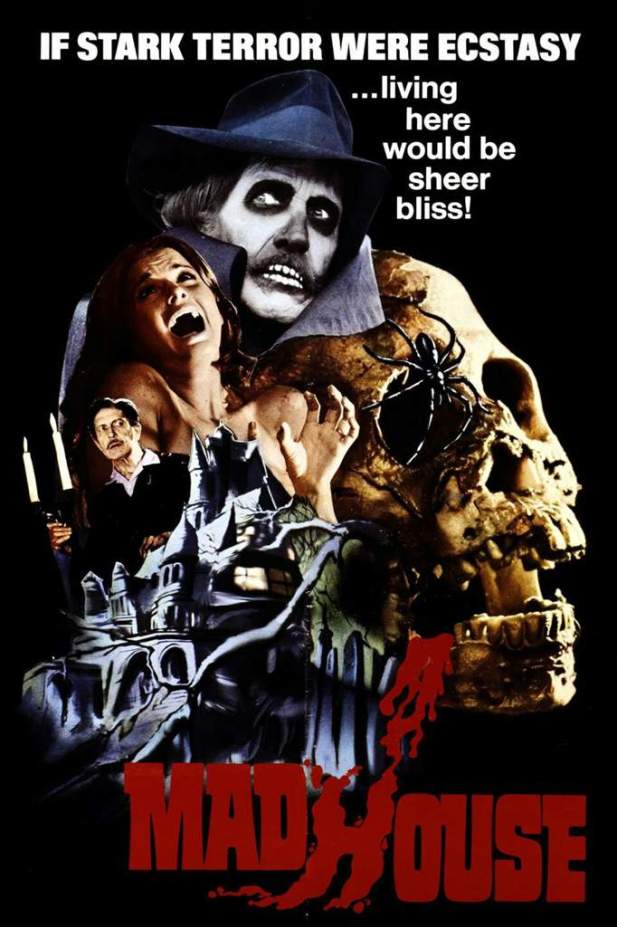
Paul Toombes (Vincent Price) has been a horror star for decades and is set to make his fifth appearance as Dr. Death, a skull-faced killer. During the premiere, he announces his engagement to Ellen Mason, a co-star, who gives him an engraved watch. However, within no time at all, adult film producer Oliver Quayle (Robert Quarry, who was despised so much by Price in real life that it comes through in the film) reveals that Ellen had once been in his films.
Toombes explodes in anger and when Ellen returns to her room, before the sight of any credits, she’s attacked by a point of view killer. When our protagonist attempts to apologize, her head falls from her neck and into his hands, a shocking scene for the usually staid AIP world.
The world falls apart — Toombes is instituitionalized, unsure if he killed his love or not. He’s acquitted and the rest of the world moves on in his absence.
Years pass and Toombes is released. He visits London to meet his friend, screenwriter Herbert Flay (Peter Cushing), who is created a Dr. Death TV series with Quayle.
On the cruise ship that will bring him to the U.K., Toombes must deal with Elizabeth (Linda Hayden, The Blood On Satan’s Claw), an ingenue actress who wants publicity. She continues to follow him, as do her parents once she’s killed with a pitchfork.
Flay’s situation is no better than his former lead actor’s. In the basement, his wife Faye (Adrienne Corri, best known as the abused wife Mrs. Alexander in A Clockwork Orange), who was once the lead in a Dr. Death film, has gone mad, the result of her constant affairs leading to a car accident that has left to her being hideously burned.
Every time Toombes becomes enraged, someone dies, and they expire in a manner directly releated to his films. He finally goes mad and sets the set — and himself — ablaze.
That night, under the assumption that Toombes is dead, Flay signs a contract to take his place as Dr. Death. He celebrates by watching Toombes’ apparent death on film. That’s when the real Toombes walks toward him, burned but alive, and learns how his friend was behind it all. Flay’s wife reappears and stabs him, feeding him to her spiders, before she and Toombes sit down for dinner. Now, the actor has completed the makeup that will allow him to look like the traitor that tried to destroy his life.
Madhouse is an interesting film. At once, it’s a best of retrospective of AIP films, featuring moments from Tales of Terror, The Raven, The Haunted Palace, The Pit and the Pendulum, Scream and Scream Again, and House of Usher. It even points out that it was made thanks to special participation by Basil Rathbone and Boris Karloff, who had died in 1967 and 1969, as they make appearances from the past of AIP.
Then, it feels like a meditation on the past ending and a struggle to keep pace with the new world. Within a half-decade, horror would be filled with slashers and the Price films would feel charming and quaint, not movies that terrified the world. And at the very same time, Italian giallo was doling out movies filled with equal measure of brutality and shifting identities.
Finally, it’s also a movie in love with the idea of horror films themselves, willing to show both Quarry and Cushing dressed as their vampiric alter egos at a cast party.
The whole thing just made me sort of sad — as I know that no one today really thinks of films such as this and can see the magic inside them. It’s as if Price is playing Toombes as himself, going out one last time to try and wring out whatever he can from a dying genre of film.
Man, Alan Ormsby has done so much. In addition to working with Bob Clark on Children Shouldn’t Play with Dead Things and Death Dream, he wrote My Bodyguard and the remake of Cat People. Plus, he was the original director of Popcorn and the man behind Kenner’s Hugo: Man of a Thousand Faces action figure.
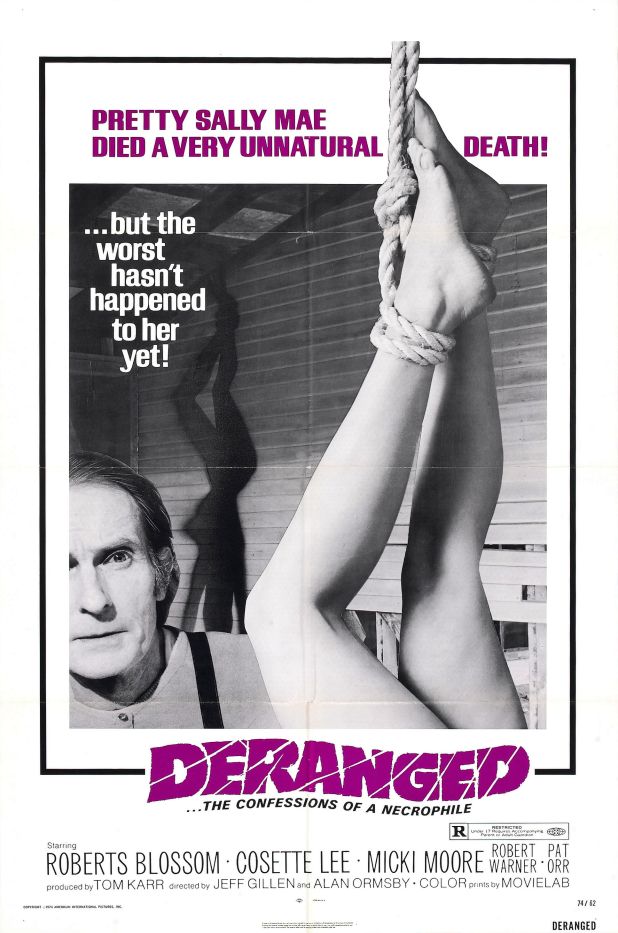
He’s the man behind Deranged, along with Jeff Gillen, who played Jeff in Children Shouldn’t Play with Dead Thingsand who you can see every Christmas Eve as Santa Claus in A Christmas Story.
Deranged is filmed as if it were a true story, with reporter Tom Simms (Leslie Carlson, Black Christmas) appearing within the events and narrating them. The whole thing was based on Ed Gein, the infamous real life Butcher of Plainfield, Wisconsin that The Texas Chainsaw Massacre and Psycho are both based on.
It was produced by producer Tom Karr, a concert promoter for bands like Led Zeppelin and Three Dog Night who had been fascinated with Ed Gein and dreamed of making a film about his story.
Ezra Cobb (Roberts Blossom, Old Man Marley in Home Alone, how’s that for a scary tie-in role?) is our Ed Gein stand-in, running a midwest farm with his mother Amanda (Cosette Lee, who played Raxl, Daughter of the Priestess of the Serpent on Strange Paradise, a Canadian occult soap opera created in the wake of Dark Shadows). Since he was a boy, she’s taught him to hate women.
Once she dies, it takes a year for him to come out of his shell. When he finally snaps to it, he does what any loving and grieving son would do: he digs his mom up and puts her body together with fish skin and wax.
Ezra gets involved with an eccentric older woman who claims she’s psychic named Maureen Shelby (Marian Waldman, Mrs. MacHenry from Black Christmas, and if you don’t know who that is, please stop reading and start watching). They have a fumbling sexual encounter that ends with Ezra killing her and we’re off to the races.
Ezra’s next target is Mary Ransum (Mickie Moore, who is also in The Vindicator and is one of the Believers in, yes, The Believers), a waitress who he lures home, knocks out and dresses in just her underwear for dinner. Their nice meal is ruined by her trying to run, so he smashes her head with a femur bone. And then he takes out young Sally, which leads the police to his home, where they find him in the kitchen, enjoying a bowl of blood after skinning her.
Deranged is not an easy watch, as its subtitle, Confessions of a Necrophile, will tell you. It’s also the second movie — after Deathdream — that Tom Savini ever worked his special effects magic on.
You can get the blu ray of this film from Kino Lorber.
Okay. Let’s get this out of the way: This is the movie were you video fringe horndogs lose it over Mariette Hartley (as Lyra-A) in a two-piece bikini sporting two belly buttons (a dual circulatory system with two hearts) as a (network censored) “dominatrix” who breeds men for an oppressive, feminist regime.
Gulp.
Yes. Mariette Hartley: We’re talking Zarabeth in the Star Trek: TOS episode “All Our Yesterdays” where she cracked Spock’s emotionless Vulcan shell. She mixed it up with Gary Lockwood as Lisa Karger in Earth II (another failed TV movie pilot-to-series). She tempted Charlton Heston as Harriet Stevens in Skyjacked. She gave Dr. David Bruce Banner butterflies as Dr. Carolyn Fields in The Incredible Hulk. Yes. Mariette Hartley, with a resume of too many popular TV series to mention, all the way out to Fox TV’s 2018 hit series 9-1-1 as Patricia Clark.
Just one look at Mariette in Genesis II and you’ll forget all about the über-cool Sub-Shuttle that we all came for (and not a bogus CGI model . . . but a non-operational, full-sized prop pulled on a long-cable by an off-camera semi-truck) that pulls into a carved-out-of-the mountain sub-station (which Elon Musk has since pinched for his next millionaire-toy project). Oh, and did you notice the sterile, ultramodern-styled city looks suspiciously like the city in Conquest of the Planet of the Apes (20th Century Fox’s “Century City”)? And did you notice how many times the Sub-Shuttle footage was recycled in ‘70s sci-fi television?
Anyway . . . times were hard for ex-Star Trek creators.
In 1974, after the go-to-series failure with Genesis II, Gene Roddenberry developed another TV movie/series pilot with The Questor Tapes (1974). A thinly veiled reworking of the Gary Seven character and plot from the Star Trek: TOS episode “Assignment: Earth,” it was intended as a vehicle for Leonard Nemoy’s return to weekly television. The end product starred Robert Reed-doppelganger Robert Foxworth (1979’s Prophecy) who portrayed an android with incomplete memory tapes — in a pseudo The Fugitive storyline — searching for its creator and purpose (that also sounds like V’ger from Star Trek: TMP).
Then, after the additional go-to-series failures of the Genesis II reboots Planet Earth and Strange New World produced in the wake of The Questor Tapes, Roddenberry tried again — by jumping on the ‘70s “occult detective” sub-genre with 1977’s Spectre — by reworking another Star Trek element: the contemptuous friendship between Spock and Dr. Leonard McCoy, itself a homage to the relationship between Sherlock Holmes and Dr. Watson. Spectre starred Robert Culp (The Gladiator) as William Sebastian, a criminologist and occult expert assisted by Gig Young (1978’s Game of Death with Bruce Lee) as Dr. Hamilton. (If you care: Other shows in the ‘70s occult TV movie-to-series subgenre include The Sixth Sense with Gary Collins of Hanger 18 and Killer Fish, Roy Thinnes of Satan’s School for Girlsin The Norliss Tapes, and the most-successful of the pack: Darren McGavin of Dead Heat and the post-apoc dropping Firebird 2015 A.D in Kolchak: The Night Stalker.)
Genesis II stars Alex Cord (who also journeyed into a “fucked up future” in Chosen Survivors) in the “future world” of 1979 as NASA scientist Dylan Hunt. Of course, he opens the post-apocalyptic proceedings with that all-too-familiar apocalypse (or psychological horror) cliché: “My name is Dylan Hunt. My story begins the day on which I died.” So goes the story a “20th Century Boy” (T Rex, anyone?) thrown forward in time by a suspended-animation earthquake-accident that damages his New Mexico/Carlsbad Caverns-housed “Project Ganymede” system for astronauts on long-duration spaceflights.
And we flash forward to the year 2133.
An archeological team of PAX (Latin for “peace”) descendants from the NASA personnel that lived-worked-were trapped in the Carlsbad installation when World War III (aka “The Great Conflict” because, well, the docile hoards of all post-apoc futures never seem to be able to preserve or retain a basic semblance of American history) broke out, discover Hunt’s buried chamber. And while they can’t seem to “remember” World War III, the PAX are smart enough to construct a subterranean rapid transit system utilizing a magnetic levitation rail operated inside a “vactrain-tunnel network” that spans the globe and saves the masses from air transportation attacks.
Anyway, here’s where Mariette Hartley comes in.
Lyra-A oversees the all-female totalitarian regime known as the mutated (natch) Tyranians that rule the lands once known as Arizona and New Mexico. In addition to their increased physical abilities, you can always spot a Tyran by their nifty, dual navels — that they seem to love to show off. (Schwing! Thank you, Gene!) Not that the wussy PAX-rats would do anything when they spot a Tyran: they let themselves be enslaved.
Lyra-A, in a grand alien fashion of the Star Trek variety, is enraptured by Roddenberry’s “Buck Rogers” and wants to harness Hunt’s knowledge of (among other things) nuclear power systems to fix the Tyranians’ dead power plant. But apoc-bitch Lyra-A double crossed him: it’s a ploy to reactivate a nuclear missile system to destroy the PAX. As a result, Hunt goes into Moses-mode (see the apoc-romps No Blade of Grass, Ravagers) and leads a revolt of the enslaved, sabotages the nuclear device, and destroys the reactor.
Sound pretty cool, right?
Airing to high ratings in March 1973 and encouraged by the network brass, Roddenberry worked up a 20-episode first season on the adventures of Alex Cord’s post-nuc Moses. Then CBS-TV dropped the bomb: they passed over Genesis II and gave the timeslot to another competing post-apoc series: the short-lived and low-rated Planet of the Apes.
Those mothballed Genesis II episodes featured recycled ideas from Star Trek: TOS and fueled the later Star Trek movies — with stories about suspended animation soldiers from the past (“Khan!!!”), a London ruled by King Charles X; NASA “evolved” computers and equipment left on Jupiter’s Ganymede returning to Earth in search of their “God” (“The Changeling” and the annoying Persis Khambatta-V’ger non-sense from Star Trek: TMP); men turned into breeders and domesticated pets (reworked for the second pilot, Planet Earth); the ol’ catapulted-through-a-time-continuum back to 1975 gaffe (“Tomorrow and the Stars,” an episode from Star Trek: Phase II, the proposed-failed post-Star Wars reboot), and a creepy priesthood who enslaves the masses via electricity used as a “God” (“Return of the Archons” from ST: TOS).
The reason the network passed on Genesis II: The series was “too philosophical” and Alex Cord’s portrayal was “too dark and brooding.” They wanted another handsome and charmingly arrogant Captain James T. Kirk. So Roddenberry and Warner Bros. rebooted Dylan Hunt into an action-driven and conflict seeking Kirk-like character embodied by John Saxon.
Cue for Planet Earth.
Now Dylan was one of three cryogenically-frozen astronauts who return to Earth to reestablish the PAX organization that sent them into space. And while we lost Mariette Hartley, we gained the equally fetching Diana Muldaur (again, from Cord’s Chosen Survivors), who rules the Amazonian, male-enslaving “Confederacy of Ruth,” along with cherished character actors Bill McKinney (Deliverance, Cannonball) and Gerritt Graham (Phantom of the Paradise, Used Cars) as “impotent males” in recurring roles.
This time, instead of CBS, ABC aired the Warner Bros. produced program in April 1974.
The network passed.
Cue a Strange New World.
To creative and legal reasons lost to the test of time, Warner Bros., who now owned the intellectual rights, reworked the premise a third time as Strange New World (pinching the title from Star Trek’s opening monologue) — sans Roddenberry’s involvement — dumped the PAX and Tyranians, and retained John Saxon as the same Kirk-like character, now known as Captain Anthony Vico, who returns from a suspended animation space trip with two other astronauts (as in Planet of the Apes TV seriesthat screwed Genesis II in the first place).
The movie aired in July 1975.
The network passed.
And with that, between Roddenberry’s vision, and the failure of the Planet of the Apes TV series (episodes were cut into overseas theatrical and telefilms), the small screen’s attempt to jump on the major Hollywood studios’ post-apocalyptic bandwagon was over. Thus, us wee lads and lassies gathered around the TV on Saturday mornings and settled for Filmation’s Ark II, whose 15 episodes (it seems it had more episode and was on much longer), aired in 1976, then reran in 1977, then again in 1978. And that kiddie-apoc series stopped production because the network “wanted Star Wars” (and not a TV knockoff of 1977’s Damnation Alley). So Ark II was reworked and repurposed (the same “universe,” so to speak) as Space Academy and Jason of Star Command (Sid Haig, rules!).
There was also another, similar attempt at the Genesis II concept with, ironically, another Star Trek: TOS alum: Glenn Corbett (warp-drive creator Zefram Cochrane in 1967’s “Metamorphosis”). As with Roddenberry’s The Questor Tapes, The Stranger (1973) was another failed TV movie-to-series sci-fi twist on the ‘60s runaway TV hit, The Fugitive. This time, instead of returning to a post-apocalyptic society, our astronaut (Hey, Sam . . . he’s named “Stryker”!) returns to a totalitarian “twin” Earth run by the “The Perfect Order.” (And if it all sounds a bit like 1969’s Journey to the Far Side of the Sun byGerry and Sylvia Anderson of the fellow-failed, post-Star Trek series UFO and Space: 1999 . . . then it probably is: both series were movie-rebooted in the post-Star Wars universe as Invasion: UFO and Destination Moonbase Alpha, respectively.)
But wait . . . all was not lost with Genesis II.
Roddenberry’s widow, Majel Barrett (Nurse Christine Chapel in Star Trek: TOS and Lwaxana Troi on Star Trek: TNG and DSN) produced one of Roddenberry’s old pre/post-Star Trek dystopian-apocalyptic concepts, Andromeda (itself recycling from Genesis II and Planet Earth), a Canadian series that ran from 2000 to 2005 and aired in syndication on U.S television.
VHS rips ofGenesis II and Strange New Worldcan be enjoyed for free on You Tube, while Vudu has official, affordable streams of Genesis II and Planet Earth. For whatever “legal” reasons, no streaming platform offers Strange New World. However, copies of all three are widely available on DVD courtesy of Warner Home Video’s Warner Archive Collection.
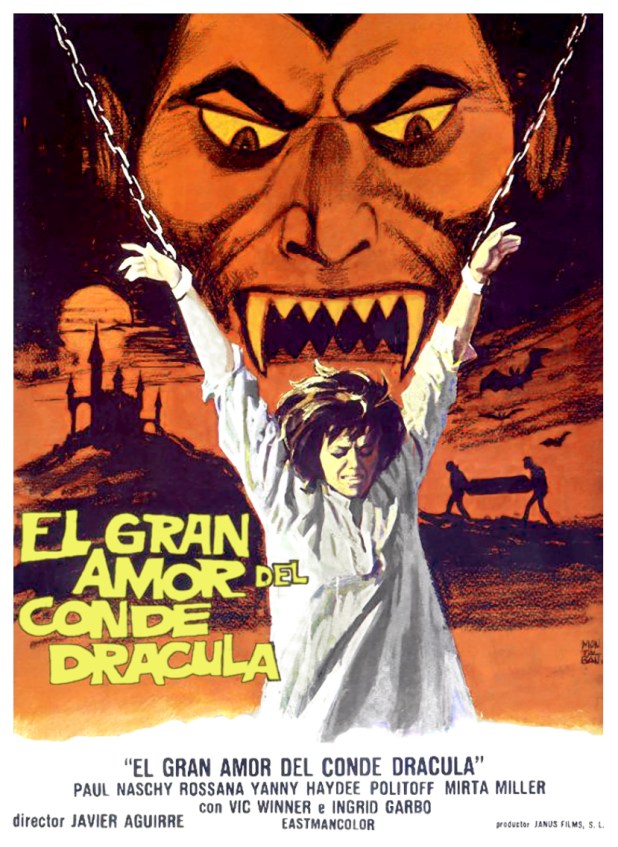
Call it El Gran Amor del Conde Dracula. Call it Cemetery Girls. Or Dracula’s Great Love — the title I saw the film under — or Dracula’s Virgin Lovers or The Great Love of Count Dracula. Whatever title you prefer, you’re about to savor a nonsensical odyssey through Spanish vampire madness, a world where someone can fall down the steps for what seems like hours, all women dress like Disney princesses and a girl can step on a beartrap and only get a small scratch.
We start in an old sanitorium, deep in the Carpathian Mountains as two delivery men arrive with a large, heavy man-shaped crate. Of course, you know that that crate has Doctor Wendell Marlow (Naschy) inside it. But right now, this scene is all about these movers casing the joint and trying to steal something, only for one to get hit with an axe and the other to get his throat ripped out and sent tumbling over and over and well, over.
Then, a stagecoach with four women — Karen, Marlene, Senta and Elke — breaks down and forces the girls to stay at Marlowe’s mansion.sanitorium. One by one, the girls are bitten and become part of Dracula’s army of the undead, all with the goal of the head vamp resurrecting his daughter Radna and convincing a virgin — hi Karen — to love him forever before he sacrifices her.
By the end, Dracula has tired of this lifestyle and decides to kill all of his brides with sunlight. Then, he realizes that he loves Karen and can’t use her to further his monstrous aims, so he kills himself with a stake.
If you’re a fan of female vampires being female vampires — which mostly means them licking blood off of one another and whipping — then Naschy has exactly what you’re craving here. There was a Spanish version of the film that has the actresses remaining modest, while international cuts of the film feature abundant full monty shots of the brides. And there’s also fifteen minutes of footage that no one can locate that supposedly goes even further!
If you want to see the best possible version of this film, Vinegar Syndrome has a blu ray that features the European unclothed cut of the film, as well as a never-released audio commentary track with Naschy and director Javier Aguirre.






 B&S About Movies
You must be logged in to post a comment.