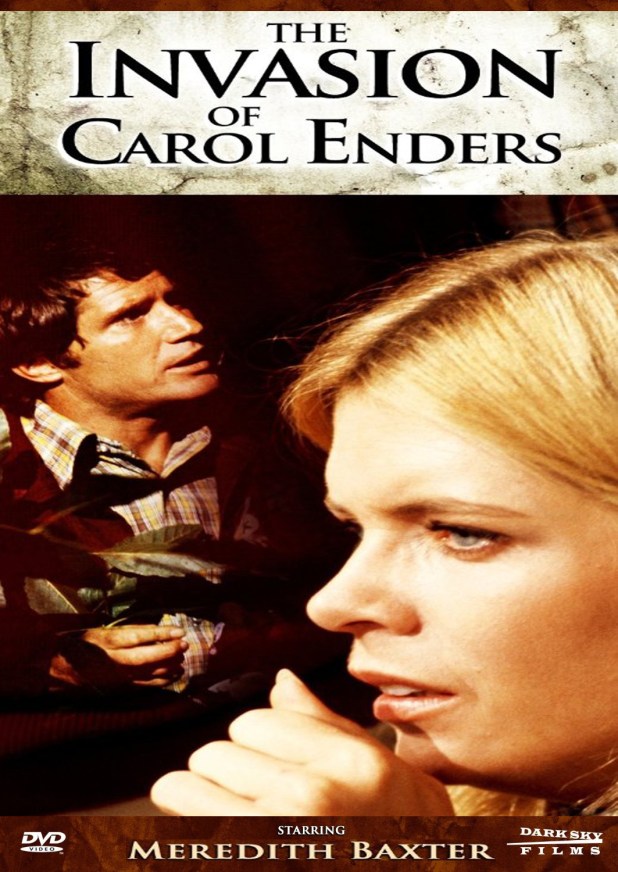
Gene R. Kearney wrote one of the first made-for-TV movies, How I Spent My Summer Vacation, as well as the movie Night of the Lepus and scripts for several TV shows, such as Night Gallery and Kojak. He was joined by Merwin Gerard, who wrote the TV horror film The Victim and several episodes of One Step Beyond to create this 1974 TV movie.
It was directed by Pittsburgh native Burt Brinckerhoff and an uncredited Dan Curtis, who was also the producer.
Carol Enders (Meredith Baxter from Family Ties) is having more than a bad day. No sooner than her boyfriend tells her that he can’t be engaged any longer, a man emerges from the woods and attacks her. She ends up in the hospital, where the spirit of a dead woman named Diana Bernard must find her ex-husband Dr. Peter Bernard (Charles Aidman, who narrated the 80’s Twilight Zone reboot) to figure out who killed her.
Dark Shadows fans will also be pleased to learn that John Karlen (Willie Loomis from the Gothic soap opera and Daughters of Darkness) plays David Hastings, the angry second husband of the dead woman and prime suspect.
I love the look of this video-shot movie, which has a very soap opera feel. It’s like a self-contained Dark Shadows arc, which you can get through in a little over an hour.
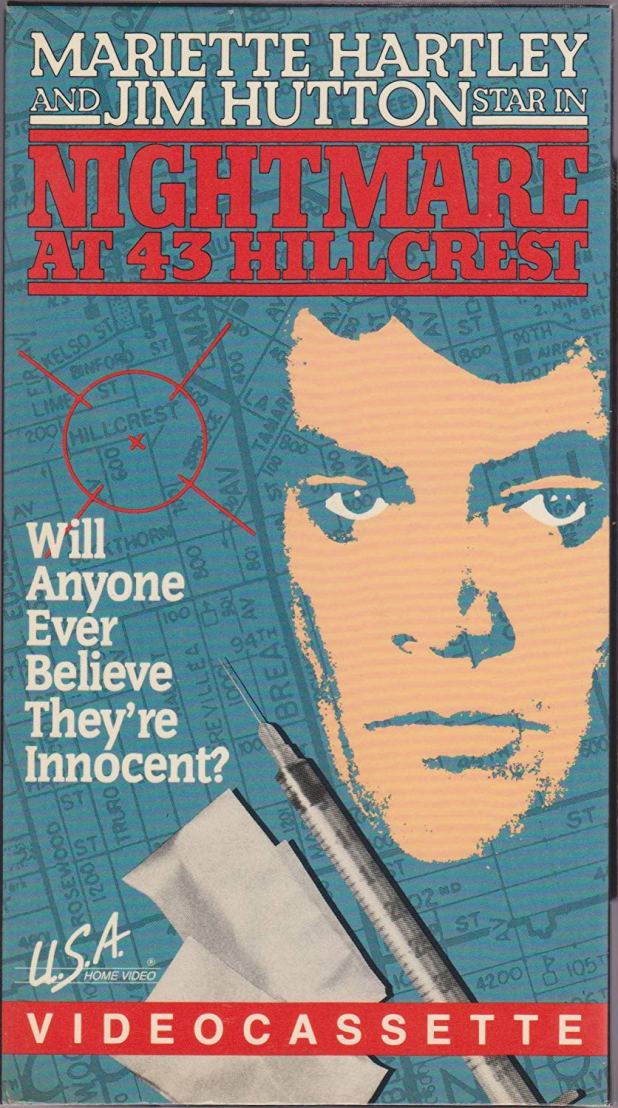
This is based on a true story and all about the Leyden family and how they went up against the law.
One evening, Gregory (Jim Hutton, Psychic Killer, The Green Berets), his wife Esther (Emmaline Henry, Elise Dunstan from Rosemary’s Baby) and their daughter Nancy (Linda Curtis, daughter of director/producer Dan Curtis, who would sadly die a year after this film aired) are having a quiet evening when the cops burst in. The reason? Heroin.
Yes, police commissioner Clarence Hartog (Peter Mark Richman, so memorable as teacher Charles McCulloch in Friday the 13th Part VIII: Jason Takes Manhattan)has made a mistake, but he’s not going back on it. It was supposed to be a bust at 43 North Hillcrest, not 43 Hillcrest. But now, he’s shredded all the evidence and forced one of the cops, Sandy Bates (Don Dubbins, From Earth to the Moon), to be part of his scheme.
This made for TV movie also features Mariette Hartley (who was in all those Polaroid commericals with James Garner) and John Karlen (who was also on Curtis’ Dark Shadows as Willie Loomis).
Wiilie Katz wrote this, but he’s perhaps better known for the song “Mr. Touchdown U.S.A.,” which was used in Some Call It Loving, Yes Man and Jackass 3D. Lela Swift, who also directed several episodes of Dark Shadows and Ryan’s Hope, provided co-direction.
This is a great artifact of 1970’s TV, shot on video and filled with dark themes of uncaring police and a downer ending. It’s one of the few commercially released episodes of ABC’s The Wide World of Mystery. Sadly, not many episodes are available, which makes me upset. These hour-plus mini-films are just plain awesome.
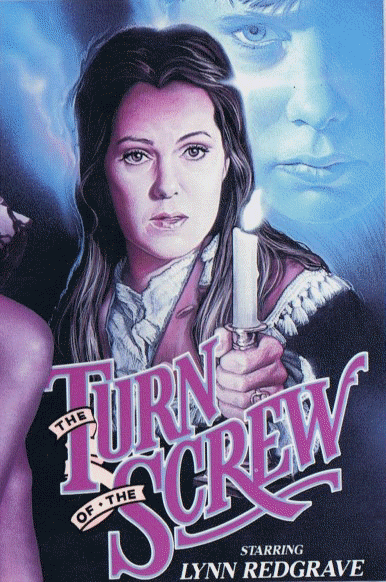
Originally airing on ABC on April 15, 1974, this Dan Curtis-produced and directed film takes the videotaped look of Dark Shadows to the Henry James novel and wraps it all up in a little under two hours. And if you love that gothic fiction soap opera, good news. Music cues from it are all over this made for TV movie.
Lynn Redgrave stars as Miss Jane Cubberly, is hired by Peter Quint and sent to look after young Miles and Flora after the deaths of their parents. Yet wickedness (that word will be used often; I chased my wife around our house screaming dialogue from this movie in my horrible British accent) abounds and perhaps Jane should have never made her way to the Bly house.
The issue with The Turn of the Screw happens with every adaption: people have been trying to figure out the novel since it was first written. The story, the revelation at the end and the characters’ motivations are all up to the individual reader, which makes it difficult to film a movie for everyone.
Kathryn Leigh Scott, who played Maggie Evans on the original Dark Shadows and has written many of the books that have kept the show alive, is in this as Miss Jessel. Megs Jenkins, who plays Mrs. Grose, also had the same exact role in another adaption, The Innocents.
Here’s a great fact: Redgrave is one of four members of her family to appear in an adaptation of this story. Her father Michael was in The Innocents, her brother Corin was in the 2009 version and her niece Joely Richardson played Darla Mandell in the recent version, The Turning.
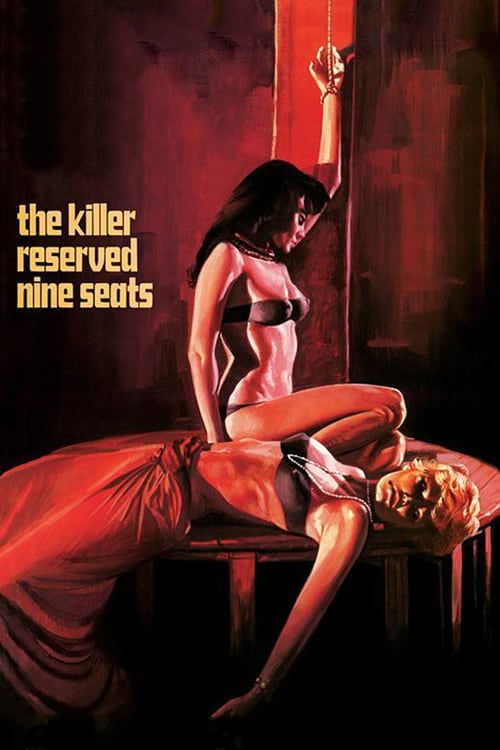
To celebrate his birthday, wealthy Patrick Davenant (Chris Avram, The Eerie Midnight Horror Show, Emanuelle in Bangkok) brings his friends to his family’s unused theater — empty for a century, which is how long his family has been cursed, which in no way is taken from The Red Queen Kills Seven Times.
There’s his sister Rebecca (Eva Czemerys, Escape from the Bronx) and her lover — look how ahead of its time Italian giallo in 1974 was — Doris (Lucretia Love, who was in The Arenaand the astoundingly titled When Men Carried Clubs and Women Played Ding-Dong). And he’s also decided to bring his ex Vivian (Rosana Schiaffino, once called the Italian Hedy Lamarr) and her new husband Albert (Andrea Scotti, Terror Express), along with Patrick’s daughter Lynn (Paola Senatore, Ricco the Mean Machine, Emanuelle in America (1977) and Eaten Alive!; due to an unplanned pregnancy and being hooked on drugs, she ended her career by appearing in an adult film, Non Stop… Sempre Buio in Sala before being arrested for possession and trafficking of drugs) and her boyfriend Duncan (Gaetano Russo, Crazy Blood), as well as Patrick’s fiancee Kim (Janet Agren, City of the Living Dead), her ex-boyfriend Russell (Howard Ross, otherwise known as Renato Rossini, The New York Ripper) and finally, to finish off this cast of gorgeous people who all hate one another, some dude no one can really figure out where he belongs (Eduardo Filpone, Flavia the Heretic).
Oh yeah — there’s also a caretaker played by Luigi Antonio Guerra from Spasmo.
Before you know it, everyone starts getting killed, including one death via stabs to the lady business and their cranium being nailed to a board. You’d think with all this mayhem, the movie would be pretty interesting, but sadly, it drags.
The mysterious stranger — when he’s not looking funky fresh in blue blazer and fancy medallion — is given to saying things like, “You know what I like about you people? … You’re so civil to each other as you tear each other apart.” and “I spent a night here a hundred years ago” and “The actors are present and now the play may start…”
Janet Agren gets to act out a scene from Romeo and Juliet before she dies at least.
You know how people decry American slashers because they punish anyone who enjoys sex or drugs or any behavior deemed aberrant? This movie takes that notion and delivers it in spades. Of course, it also presents sin in all its glory but uses violent death as the square up reel.
This is the last movie that Giuseppe Bennati made. It fits in with post-Argento giallo, but doesn’t add much to the form other than a great title and poster.
By 1974, the giallo was waning and the poliziottesco was starting to win over the Italian box office. This offering is a hybrid of both — unlike many giallo, the police are not presented as ineffectual or non-essential. Instead, they’re followed for most of the film.
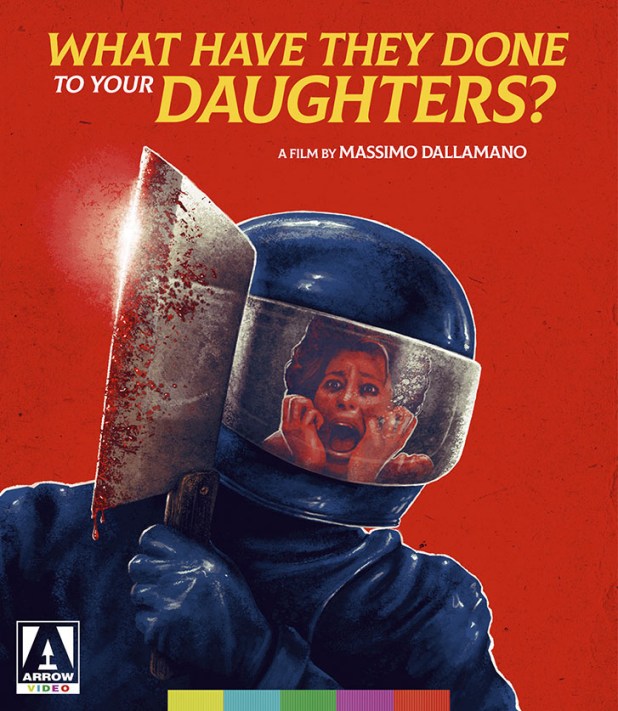
Massimo Dallamano (The Night Child) made What Have You Done to Solange?, a giallo that exists outside of the Argento archetype. He’d follow it with this rougher and much darker — somehow that’s possible! — semi-sequel.
Deputy Attorney Vittoria Stori (Giovanna Ralli, The Mercenary, Sex with a Smile) is a rarity in giallo. She’s a woman in command of the police and never presented as a victim. She’s in charge of the murder investigation of Sylvia Polvesi (Sherry Buchanan, Dr. Butcher M.D.).
Found hanging in an attic, her suicide is anything but, as Inspectors Silvestri (Claudio Casinelli, Murder Rock, Hercules) and Valentini (Mario Adorf, Short Night of Glass Dolls) soon discover. And oh yeah — there’s soon a leather jacketed biker using a meat cleaver to gorily off his or her victims. And a peeping tom, too! And teenage prostitution! And Farley Granger, showing up to class up the proceedings!
Obviously, the look of the killer in this movie would influence a movie that has no interest in classing up the giallo — Strip Nude for Your Killer — and an American movie that gets so close to a giallo but is missing the murderous set pieces — Night School.
It’s a shame that Dallamano died in a car accident at the somewhat young age of 59. As the cinematographer for Leone’s A Fistful of Dollars and For a Few Dollars More, he certainly had an eye for action and movement, as evidenced by the hallway chase scene in this film that seems as steady as, well, a Steadi-Cam shot (it isn’t!).
The Giallo Files site compared this movie to an episode of Law and Order. That’s an apt comparison. It’s a good movie to introduce someone to the genre with, as while it has some twists and turns, it doesn’t descend into plot hole jumping or an abundance of red herrings as some films of this genre.
You can grab the Arrow Video release of this movie from Diabolik DVD.
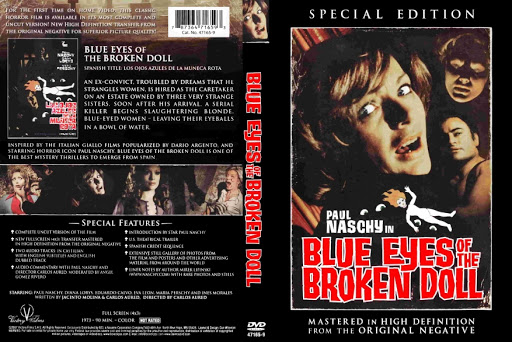
This movie is also known as House Of Psychotic Women, which is an edited version for U.S. audiences. There’s also an even further edited TV version called House of Doom. I’ll tell you, this is the only movie I can think of where the children’s song “Frere Jacques” plays during murders.
It was directed by Carlos Aured, who would also make Horror Rises from the Tomb, Curse of the Devil and The Mummy’s Revenge with this movie’s star and co-writer, Paul Naschy.
Naschy plays a ne’er do well named Gilles who wanders into a French town looking for work but ends up getting a ride from a woman named Claude (Diana Lorys, Fangs of the Living Dead) with a fake hand. She soon hires him to put in some work on the house that she shares with her sisters, the insatiable Nicole (Eva Leon) and the wheelchair-bound Yvette (Maria Perschy).
Oh yeah — it’s giallo week. I forgot to mention that a black-gloved killer is murdering only blue-eyed women and putting them eyeballs into glasses of water. The top suspect? Lucio Fulci. No, no, it’s Gilles.
All those eyeball scenes earned this movie a spot on the section 3 video nasty list. Trust me — it’s not as rough as many of the films on that list, but it probably disturbed enough people that it got picked. It’s an odd film with a strange atmosphere.
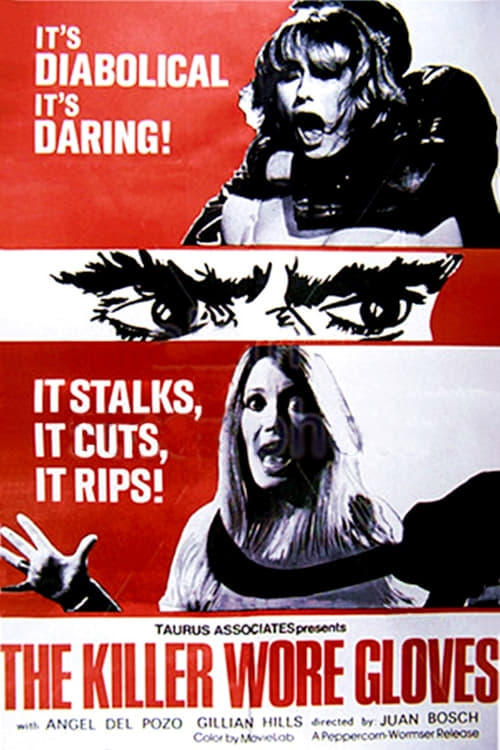
I am consumed by near-constant nerves and worries, pains that can only be assuaged by late-night viewings of only the rarest and most deranged examples of film. So when I see a movie with the titles of Hot Lips the Killer, Le Calde Labbra del Carnefice (The Hot Lips of the Executioner), La Muerte Llama a las 10 (Death Calls at 10) and The Killer Wore Gloves — because it’s a giallo and dammit the killer better wear gloves — then all my being up at 3:15 AM like the haunted bastard son of Ronnie DeFeo all pays off.
Peggy (Gillian Hills, A Clockwork Orange, Blow-Up) is worried that she hasn’t heard from her boyfriend Michael for months as he’s been covering the dangerous war in Vietnam. She’s also rented out the loft in her apartment to a friend of a friend of a friend named John Kirk Lawford, whose body shows up dead. And where’s our heroine On the way to meet Michael at an abandoned airplane hangar when a gloved killer — the movie MUST live up to its title, right? — tries to kill her. And now, another man shows up with the name John Kirk Lawford and a whole bunch of money shows up in our heroine’s apartment
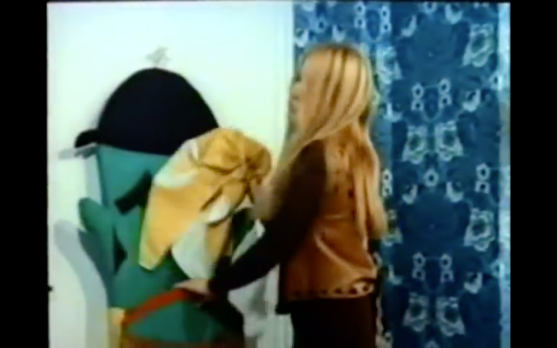
Peggy wears the type of outfits — and lives in the type of bonkers apartment, complete with a fabric Frankenstein’s monster hamper — that only exist in 1970’s giallo. Let’s face it. Our girl has a giant egg in the middle of her flat.
Poor Peggy. Every man in her life is absolutely horrible and despite people shooting at her and showing up dead all around the place, she never informs the police or seeks any help. Oh to be a giallo heroine, constantly having to wear leather mini-dresses and have all manner of skeevy men offering you money for sex, just plain sex or sex with lots of violent death as a side dish.
Director Juan Bosch also wrote Secta Siniestra, in which a woman pregnant with the Anti-Christ is menaced by Satanists — you’d think they’d want to make that pregnancy go a little simpler, am I right? — and directed Exorcismo, which stars our favorite Spanish actor Paul Naschy.
A Spanish movie imitating an Italian film based on German krimi movies taken from a British author starring an actress from the UK. If you ever wondered, “Why can’t we all just get along?” then you haven’t been watching much mid-70’s giallo, hmm?
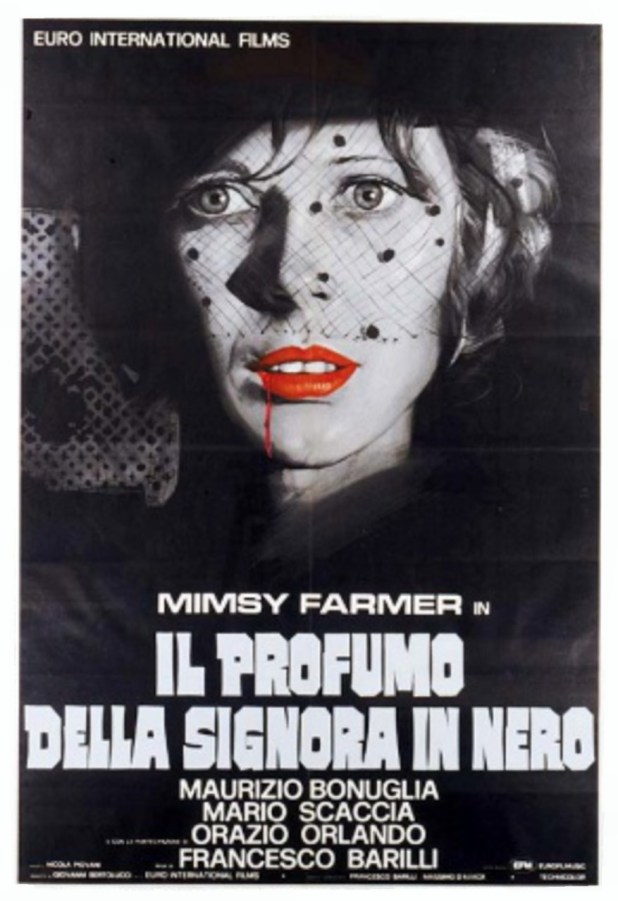
I wish that Francesco Barilli had made more giallo. His two additions to the genre as a director, Hotel Fear and The Perfume of the Lady In Black, are both movies that descend into insanity and grapple with the issues of their female protagonists being abused until they violently turn the tables on their tormentors. He also wrote Who Saw Her Die?, another example that doesn’t follow the Argento giallo format.
Sylvia (Mimsy Farmer, Autopsy, The Black Cat, Body Count) is an industrial scientist who is trying to deal with a series of flashbacks related to the suicide of her mother — the literal lady in black, whose scent has haunted Sylvia since she was a child — and nearly every single person around her, each of whom want to kill her or use her or watch her or just — look, reality is out the window.
Imagine Rosemary’s Baby filtered through the Italian horror sensibility and the way that the 1970’s ended every movie with tragedy and you have some idea of this film. By the end of the movie, Sylvia’s hallucinations include a tea party filled with dead bodies and her own self as a child, who begins to tell her what to do.
Man, all movies should be this good. The ending was so disquieting that I’m still disturbed by it. You should do yourself a favor and watch it right now.
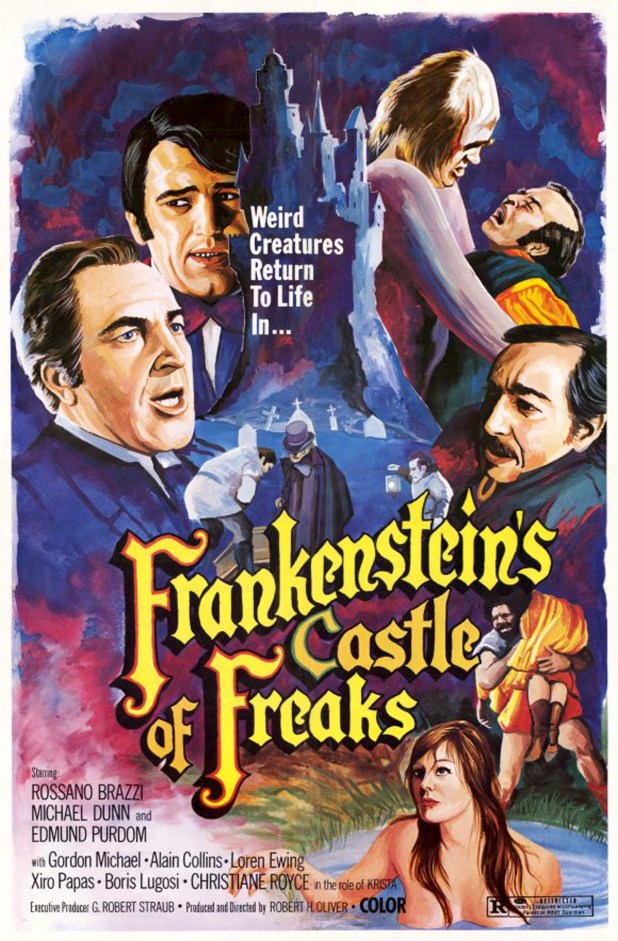
Known in Italy as Terror! Il Castello Delle Donne Maledette (Terror! The Castle of Cursed Women), this movie was released as Terror Castle, The House of Freaks, The Monsters of Dr. Frankenstein and Dr. Frankenstein’s Castle of Freaks in the U.S., while it was named Frankenstein’s Castle in the UK.
According to Roberto Curti’s Italian Gothic Horror Films, 1970–1979, no one can even agree on who the director of this movie is.
Suspects include Spanish actor Ramiro Oliveros (The Pyjama Girl Case), producer Oscar Brazzi (The Loves of Daphne), cinematographer Mario Mancini (who ran camera on Blood and Black Lace, as well as acting as the director of photography for The Girl In Room 2A and directing Frankenstein ’80), producer Dick Randall (who produced Mario Bava’s Four Times That Night, as well as For Your Height Only, Don’t Open ‘Till Christmasand Slaughter High) and screenwriter William Rose (who wrote Pamela, Pamela, You Are… and shows up in the film as the Devil and in Herzog’s Fitzcarraldo).
Although director Robert H. Oliver was a pseudonym of Mancini, actor Gordon Mitchell claims that the director was Robert Oliver, while actress Simone Blondell remembered that the director “spoke English, he wasn’t Italian.” Perhaps the best answer comes from assistant director Gianlorenzo Battaglia (the cinematographer for A Blade In the Dark, Blastfighter, Demons, Witchery and so many more films — he was also the underwater camera operator for Popeye, Cozi’s Hercules, Alligator, Screamers and Phenomena!) said that “the American director left the film because of disagreements with the producer, and so Mario finished it on his own. I’m not 100% sure though!”
After a Neanderthal man named Goliath (Salvatore Baccaro, billed as Boris Lugosi) is lynched by villagers, Count Frankenstein (Rossano Brazzi, who was in Krakatoa, East of Java) brings the monster back to life.
Man, let me tell you about Rossano Brazzi. In 1940, he married Baroness Lidia Bertolini. They never had children, but he did have a son with Llewella Humphreys, who was the daughter of American mobster Murray “The Camel” Humphreys. At a young age, Llewella had shown fine musical talent, so her father sent her to Europe to study. After all, her father would do anything for her. There’s a story that when she went to the prom, she wanted to take Frank Sinatra. One phone call later and “Old Blue Eyes” was her date.
While in Rome, Llewella fell for Brazzi and they had that aforementioned son. When she returned to America, she changed her name to Luella Brady, an anglicization of Brazzi. Humphreys sent her and George, the baby, to live with her mother in Oklahoma, but she was so mentally unstable by this point that she was institutionalized. Man — her dad was the man who said, “If you ever have to cock a gun in a man’s face, kill him. If you walk away without killing him after doing that, he’ll kill you the next day,” taught mobsters how to plead the Fifth and inspired Tom Hagen in The Godfather and here’s the married Brazzi getting her pregnant!
After his wife’s death from liver cancer in 1984, Brazzi married Ilse Fischer, a German woman who had been the couple’s housekeeper for many years who had met the actor when she was a twenty-four-year-old fan.
But I digress…
Michael Dunn also shows up as Genz, an evil dwarf who indulges in necrophilia. Perhaps you know Dunn from Dr. Miguelito Loveless from The Wild Wild West or as Dr. Kiss in The Werewolf of Washington. Also invited to this Castle of Freaks party are Edmund Purdom (Pieces), Gordon Mitchell playing Igor (you may recall him as playing Dr. Otto Frankenstein in Frankenstein ’80), Loren Ewing (Big John from the Batman TV show as well as, get this, the transportation department for the movie Idaho Transfer), Walter Saxer (who would later produce Herzog’s films), Simonetta Vitelli (who was in four totally unrelated Sartana movies), Luciano Pigozzi (Pag from Yor Hunter from the Future) and Xiro Papas, who is, of course, Mosaic from Frankenstein ’80, the vampire monster from The Devil’s Wedding Night and Lupo in The Beast In Heat.
Somehow, all of this depravity got a PG rating.
This movie is not great, but gets many points for having 19th-century villagers wearing modern blue jeans.
Want to read more? You can check out our list of Edmund Purdom movies on Letterboxd because yeah — we’re just that crazy. And for more movies that were rated PG that don’t quite make sense, check out this list.
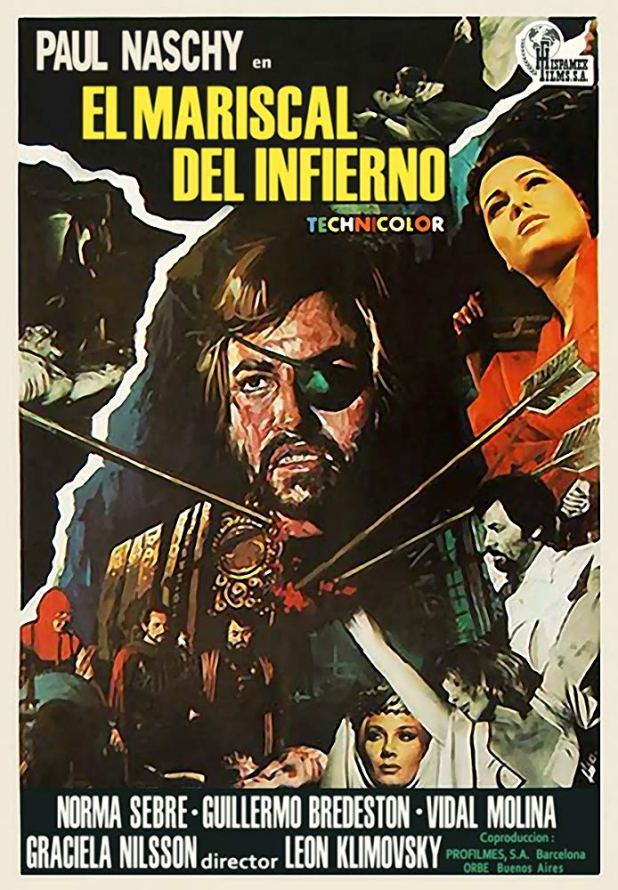
Leon Klimovsky — The People Who Own the Dark, The Dracula Saga, The Vampires Night Orgy — teams with Spain’s resident horror movie bad guy, Paul Naschy, to deliver some medieval torture and Satanic slaughter which is in no small way influenced by Ken Russell’s The Devils.
Written by Naschy himself, here the actor plays Baron Gilles de Lancre, who has returned from war only to be mistreated by his king. So he does what you or I would naturally do — search for the Philosopher’s Stone and kill anyone who gets in his way.
Gilles might have started out just trying to be a good guy, but Lady Georgelle and the alchemist Braqueville get him thinking that he could be King of France if he just starts sacrificing one virgin every Saturday for seven weeks, then doing that all over again. Only old war friend Gaston de Malebranche can stop the insanity.
Known as Marshall of Hell in its native Spain, this movie plays more like a historical drama than an outright occult film. That said, there are some fun psychedelic sacrifice scenes.
 B&S About Movies
You must be logged in to post a comment.