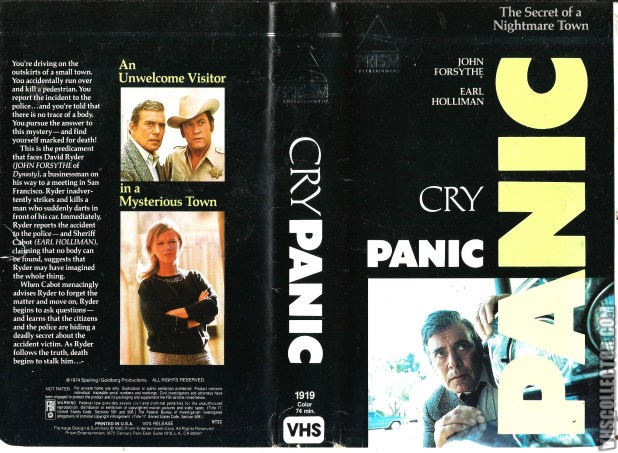
Jack B. Sowards created perhaps one of the most interesting parts of Star Trek: the Kobayashi Maru, a no-win scenario for new Starfleet captains that was first brought up in Star Trek II: The Wrath of Khan. He also wrote this TV movie which was directed by James Gladstone, whose tie to Star Trek is directing the classic episode “Where No Man Has Gone Before.” He also was behind the films Rollercoaster and When Time Ran Out…
Dennis Ryder (John Forsythe, who is astounding in this movie) is driving to San Francisco for a job interview when he hits a man who no one will admit is dead. No one — the sheriff (Earl Holliman from Police Woman), Ralph Meeker from The Alpha Incident, the town doctor (Noman Alden, Kansas City Bomber) and certainly not Anne Francis.
Jason Wingreen, who is in this, was also the voice of Boba Fett.
Seriously, this entire town is against Ryder. It’s a taunt 74 minutes and gets more out of that time than three movies today. I’ve heard people say it has a David Lynch vibe, which I can see. It’s intriguing when a man knows that he’s killed somebody and begs the police to charge him.
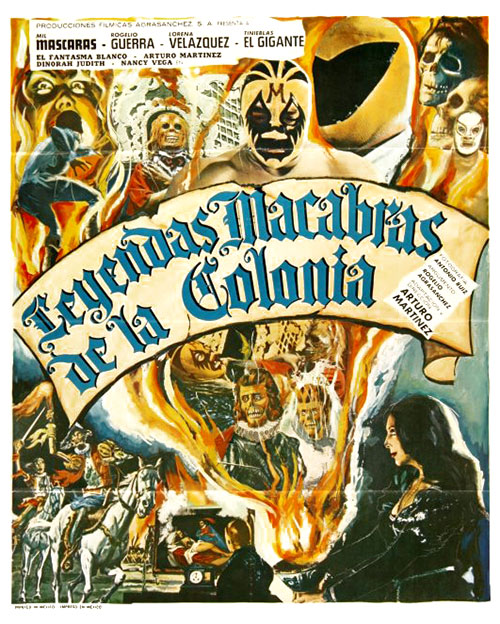
Tinieblas — wearing an awesome brown suit — buys an ancient painting of a dead woman, despite the warning that it is haunted, because he thinks it’ll help him with the ladies.
After a trios match with his partners El Fantasma Blanco (The White Ghost) and Mil Mascaras, they head off to a party with two ladies. Soon, that painting has taken them back in time and they’re battling a witch played by Lorena Velazquez, who was Thorina queen of the vampires in Santo Contra las Mujeres Vampiros. Her mother is the woman in the haunted painting and she’s a living dead woman who demands human sacrifices in her unholy name. She also has an army of conquistadors (no, not Jose Estrada and Jose Luis Rivera) and Aztec warriors who end up coming to our time to wrestle a trios match against our heroes. And oh yeah — she claims to be La Llorona!
I learned from this movie that while Mil has many, many masks, he is no master of history. As they go back in time, he says that they are sometime between 1512 and 1520. The Spanish have already conquered Mexico in this timeline, but that didn’t happen in our reality for many years aftward. Oh that Mil.
Your life is not complete until you watch Mexican wrestlers in all their finery battle rubber suited demonic soldiers.
This insanity comes from Arturo Martinez, who also had another film of Spanish zombies called The Mummies of San Angel. This one has a much better title, which translates as Macabre Legends of the Colony.
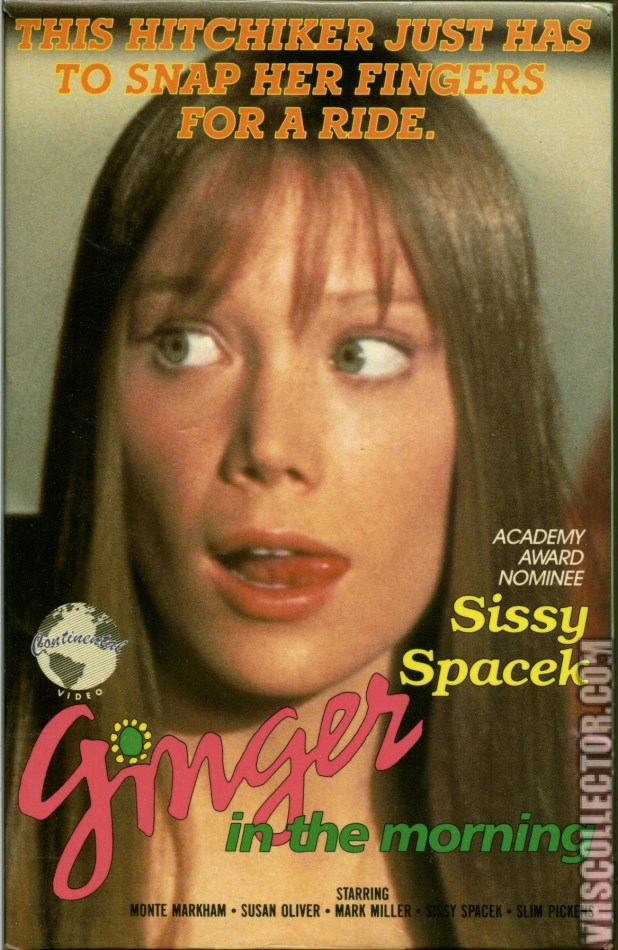
Ginger (Sissy Spacek in her first starring role) is an attractive young hitchhiker who shacks up with a lonely, middle-aged ad guy (Monte Markham, We Are Still Here) who just got divorced.
Can he learn from her free spirit? Will she break him out of his shell? Will his friends act like jerks? Yes. Yes. Yes.
Mark Miller from Please Don’t Eat the Daisies, David Doyle (Bosley from Charlie’s Angels) and Fred Ward — yes, Remo Williams — are all in this.
This is an early version of the manic pixie dream girl trope (there’s a great article-slideshow about 14, present-day, “manic pixie dream girl” movies at Refinery 29; and wouldn’t you know it: Wikipedia has a page dedicated to the, what they describe as a “trope” genre, as well). So watch Ginger in the Morning and think about 1974, a time when AIDS was a myth and the only pandemic we were worried about were killer bees.
So you’ve got a free movie — and you learned about the Manic Pixie Dream Girl (MPDG) stock character-trope in film. Hey, we do what we can to expand the film horizons at B&S.
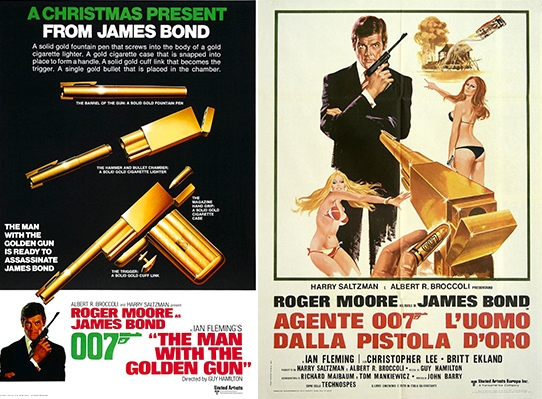
The fourth and final Bond film directed by Guy Hamilton, The Man with the Golden Gun is everything that was 1974: oil crisises and martial arts films. It was seen by some — at the time — as a low point in the series. And it also marks the last Bond film co-produced by Albert R. Broccoli and Harry Saltzman, as Saltzman would sell his half of Danjaq, LLC, the parent company of Eon Productions, after the release of the film. As a result, this would be the last Bond film for three years until The Spy Who Loved Me.
The part of Scaramanga, the killer other side of the coin to Bond, was offered to Jack Palance, but he turned it down. Christopher Lee, Ian Fleming’s step-cousin (Fleming had suggested him for the role of Dr. No), would be the man to take the role.
He’s a killer paid $1 million dollars per hit. Supposedly, he’s coming after Bond, but only to throw him off the trail of a MacGuffin called the Solex Agitator. Along the way, Herve Villechaize show up as Scaramanga’s miniature henchman Nick Nack, Maud Adams makes her first Bond girl appearance as the villain’s mistress Andrea Anders, Britt Eklund shows up as Mary Goodnight and Sheriff J.W. Pepper comes back.
When I saw this as a kid, I always thought that Bond defeated his nemesis way too easily. I still feel that way. It’s filled with ridiculousness, a low body count and plenty of moments that Moore didn’t agree with, like pushing the kid into the water and threatening to nreak Anders’ arms.
The theme song by Lulu is alright, but I kind of love that Alice Cooper wanted to do it. His Bond theme is on his album Muscle of Love.
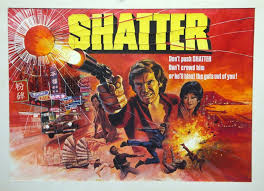
The last film the classic Hammer made, Shatter was also their second film with the Shaw Brothers after The Legend of the 7 Golden Vampires. It was directed by Michael Carreras (The Curse of the Mummy’s Tomb).
It starts Stuart Whitman as Shatter, a hitman who is in the midst of international chaos after killing an African leader and heading back to Hong Kong.
Shatter then learns that he is the next target, as he’s being used by his client for a political agenda. He enlists the help of a martial artist named Tai Pah for help against the many killers coming his way.
This is Peter Cushing’s 23rd and final Hammer film. His scenes were shot by Monte Hellman (Cockfighter, Silent Night, Deadly Night 3: Better Watch Out!).
Lung Ti, who plated Tai Pah, would go on to appear in A Better Tomorrow and Legend of Drunken Master. Anton Diffring (The Iguana With the Tongue of Fire) is the bad guy.
This was intended to be a TV series, but it never really even makes sense as a regular movie. Oh well — it has some fun parts at least.
Uh, oh. The Constanzaian Worlds are colliding once again at B&S About Movies, as “Kaiju Week” rear ends April’s “James Bond Month.”
Yes. There’s a Godzilla movie with James Bond-styled spies. And Apes. And not just one movie, but two movies. And my love for each, especially the first, is unbound.
Toho Studios had Godzilla. 20th Century Fox Studios had Pierre Boulle’s apes. And the American studio was kicking the Big Green One’s ass in the Pacific Rim box office. So what does Toho Studios do? They created their own race of sentient humanoid-ape aliens to introduce into the series.
Toho Studios celebrated the Great Green One’s 20th anniversary in style with this everything-plus-the-kitchen sink monster romp featuring the return of Anguirus from Ishiro Honda’s first Godzilla sequel, 1955’s Godzilla Rides Again, a new monster in the form of the good kaiju dog-deity, King Caesar, and a James Bond-inspired Interpol superspy to defeat the aliens. (Angie and King C returned in 2004’s 50th Anniversary blowout, Godzilla: Final Wars, and they should: director Ryuhei Kitamura cites Godzilla vs. Mechagodzilla as his favorite Godzilla film.)
And if that wasn’t enough: they brought on the apes.
Toho’s new breed of intelligent apes, who hail from the “Third Planet from the Black Hole,” built a secret, underground high-tech base in Okinawa. And they have the ability to build robots. And they construct Mechagodzilla, a robotic doppelganger of Godzilla equipped with a wide array of weapons and flight capabilities.
Oh, yeah. And these apes enjoy their wine. And they can morph into human form.
The fun begins as an Oriental priestess has a vision of Japan’s destruction by a giant monster. Cue to a spelunker who discovers a chunk of never before seen metal in a cave. A subsequent archaeological excavation to find more of the metal unearths a chamber with a biblical-like prophecy of a forthcoming battle between huge monsters on the Earth.
Of course that errant hunk of metal is the work of The Simians and was used to construct Mechagodzilla to spearhead their conquest of Earth.
As crazy as it seems, it wasn’t 20th Century Fox who sued over this—but Universal Studios. When the film was released in the U.S in March of 1977 under the title Godzilla vs. the Bionic Monster, Universal took issue over the use of the word “Bionic,” as they owned the rights to The Six Million Dollar Man and The Bionic Woman TV series. That led to the title that we U.S kiddies saw it under: Godzilla vs. The Cosmic Monster.
Those were the UHF-TV days. . . .
Keeping with their “borrowing” of the 20th Century Fox franchise, another race of Toho aliens from the third black hole planet returned in the 1975 sequel, Terror of Mechagodzilla. This time the aliens “aped” the underground disfigured mutants from Beneath the Planet of the Apes—and hid their disfigurement under rubber masks. Oh, and they brought along another, new monster-partner: the aquatic, non-mechanical Titanosaurus. The Mechagodzilla sequel would prove to be the last of the films until the Big Green One’s 30th anniversary started a new wave of Godzilla films.
If you must have Godzilla vs. Mechagodzilla in your collection, there’s the 1988 restored Japanese cut with English audio on a 1988 VHS, a 2004 DVD with both English and Japanese audio, and a 2019 Showa-era Blu-ray issued by the Criterion Collection alongside 15 other Godzilla films released from 1954 to 1975. Terror of Mechagodzilla also appears in that collection, along with its three singular DVD forms issued in 1998, 2002, and 2007.
The epic battle! This stuff rocks no matter how old you are!
About the Author: You can read the music and film reviews of R.D Francis on Medium and learn more about his work on Facebook. He also writes for B&S Movies.
* This review first appeared on January 3, 2020 as part of our “Ape Week” retrospective.
Here’s some of the other Kaijus (and sort of Kaiju) that we’ve reviewed. For the rest that we’ve recently reviewed to commemorate the March 2021 release of Godzilla vs. Kong, enter “Kaiju Day Marathon” in our search box to the left to populate that list of films (you may see a few reposted Godzilla reviews, but many new film reviews concerning Godzilla, Kong, and other creatures from the Lands of the Rising Sun).
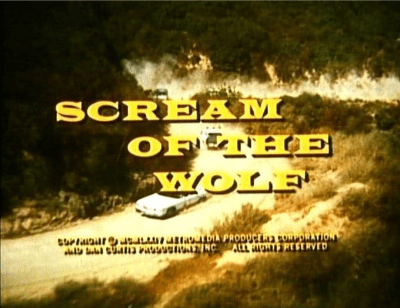
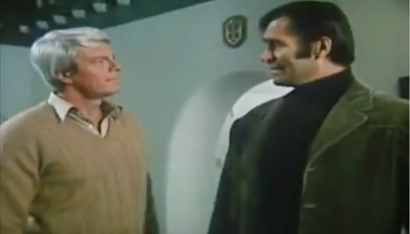
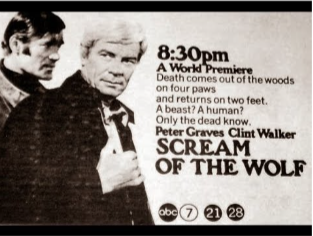
In a sleepy town along the coast of California, an unknown animal begins killing people, beginning with a ‘70s version of Dana Carvey. The local sheriff (All My Children’s Philip Carey) recruits local writer John Wetherby (Peter Graves) who used to earn his living as a big game hunter to help track the animal. Baffled by the presence of both four and two-legged tracks, he approaches his shifty ex-hunting buddy Byron (Clint Walker) for assistance who refuses to cooperate. As more people die, the townsfolk begin to believe there’s a werewolf in their midst.
A few weak red herring characters peppered throughout the story aside, Byron is the prime suspect. Not only was he bitten by a wolf, he has a strange obsession with the exchange of power between predator and prey. He hates John’s new “emasculating” life of leisure and possesses a rather creepy yet swaggering demeanor.
Based on the story The Hunter by David Case, Richard Matheson’s teleplay is better than the average TV movie script. On the surface it appears to be a standard whodunnit supernatural mystery. It was only upon further scrutiny I noticed the anti-hunting message and sexual subtext. Both of the protagonists are professional hunters. One becomes civilized and changes careers. The other sticks with it and grows into a psychopath who masks his feelings for another man through hyper-masculinity and violence.
The sexual tension between John and Byron isn’t just palpable. It’s downright steamy. The long knowing gazes, Byron’s unexplained hatred for John’s girlfriend Sandy (Jo Ann Pflug), the passive aggressive references to their time together alone in the Canadian wilderness and the arm-wrestling match where Byron challenges John, to “last seven minutes” are all very obvious references that Byron just can’t quit John. I kept waiting for them to embrace in a passionate kiss and walk off into the sunset together, carrying their very long rifles at waist height.
Alas, this is a ‘70s TV movie, so their past is never fully revealed. Instead, we get a nice double twist where first Byron fakes his death and pins the werewolf murders. After returning to confront him, Byron reveals himself to John, who assumes he was the werewolf all along. Not even close. In fact, it isn’t a werewolf at all that’s been mutilating people. It’s a German Shepherd, tortured and trained to hunt humans by Byron. Why? To awaken John’s “urge to action” and get him to go off to South America with him on another “hunting trip.” It doesn’t work. After a chase reminiscent of The Most Dangerous Game (1932), heterosexuality wins out. John outsmarts Byron and shoots him with a hidden handgun after a nice bit of dialogue where Byron tells his prey, “You wanted me to stalk you.” and John replies, “Let’s just say I didn’t want you to leave.”
By the time Scream of the Wolf aired, director Dan Curtis was already well-known for working in the horror genre, having made Dark Shadows and The Norliss Tapes. Whether he was aware of the subtext in the teleplay is unclear, but he directs the stalk-attack sequences with his usual skill, and is very unsettling even for a TV movie. As journeymen actors, Graves, Walker, Pflug and Carey are all very good in their respective roles. The musical score is another highlight, with a groovy yet suspenseful theme that’s a combination of Enter the Dragon and Friday the 13th.
While not as well-known as Trilogy of Terror, which arrived the following year, Scream of the Wolf is an overlooked gem that made the rounds on cable about 15 years ago. It’s never been given a proper DVD or Blu-Ray release, but it definitely deserves one. It’s got a good script, plenty of dead bodies, good acting and subtext so subtle it probably flew right over the average ‘70s ABC viewer’s head. Fans of Dan Curtis, or older men arm-wrestling will enjoy it. Did I mention Peter Graves drive a sweet Corvette? The cherry on top.
I’m loving these Dan Curtis produced ABC Wide World of Mystery TV movies, which are shot on video and appear like maniacal soap operas but are infused with so much murder and menace that you’re shocked that they played on regular TV.
Eileen Brennan (Mrs. Peacock from Clue) stars as Mary, a housekeeper who yearns for a man of her own. But she realizes that she’s not the most attractive fish in the sea, so to win over her handsome boss Walter (George Maharis, TV’s Route 66), she blackmails him. Sure, he might be a murderer, but he’s attractive and has seen so much more of the world than she ever will.
Look for Nick Ferrari (Sweet Sweetback’s Baadasssss Song, Slaughter’s Big Rip-Off), Charles Macaulay (who was the Dracula who turned Prince Mamuwalde into Blacula), Alan Napier (Alfred from TV’s Batman) and Kathryn Leigh Scott (Maggie Evans from Curtis’ Dark Shadows).
This was directed by Pittsburgh native Burt Brinckerhoff, who also helmed plenty of episodic TV like Lou Grant, Remington Steele, 7th Heaven and Alf, as well as the TV movie Can You Hear the Laughter? The Story of Freddie Prinze. He started his career as an actor and appears in The Greatest Story Ever Told.
I really dug this one — it feels like an Americanized giallio — minus the directorial flourishes, but certainly with the twists, turns and psychosexual drama inherent within the genre. There’s a great scene where Mary asks Walter about his experience with orgies and drugs. You can really sense that she both wants to know everything and wants to hear nothing. It’s really well done.
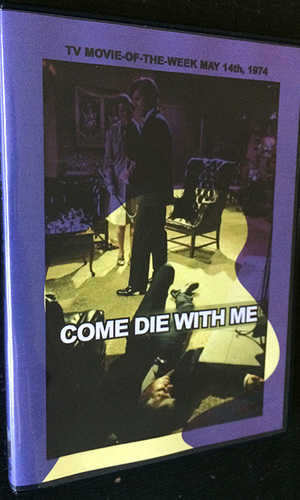
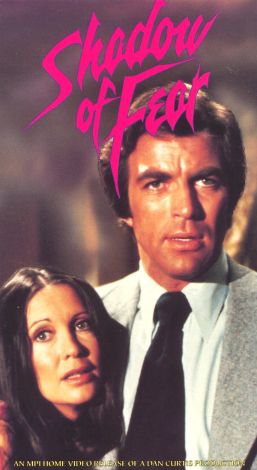
Danna Forester (Anjanette Comer, The Baby) is a rich woman in a kept relationship with the much older Mark (Jason Evers, The Brain That Wouldn’t Die). They’re both having affairs, including her way close friendship with Mark Brolin (a very young Tom Selleck). One night, as she returns home, sinister messages are painted all over the walls of their house. The cops can’t help, but perhaps ex-cop Styran (Claude Atkins!) can put it all together.
Then again, maybe Danna isn’t all that tightly wound as it seems. Or perhaps she really is and all of this is one big ploy.
Herbert Kenwith is mainly known for his long associations with Norman Lear (DifferentStrokes, The Facts of Life, GoodTimes, One Day at a Time) and Mae West, for whom he directed theatrical presentations. He had an amazingly rich directing career, even if it was mainly for the stage and television. Reading his IMDB biography brought a smile to my face.
Writer Larry Brody’s career has plenty of interesting cartoon scripts on it, including the pilot for the European Diabolik cartoon, Spider-Man Unlimited, Silver Surfer, as well as live action shows like Super Force and The Fall Guy.
This is another Dan Curtis produced episode of the ABC Wide World of Mystery. There aren’t many episodes that have survived, but this is one of them. It’s wild — shot on video and filled with the twists and turns of a soap opera.
Gene R. Kearney wrote one of the first made-for-TV movies, How I Spent My Summer Vacation, as well as the movie Night of the Lepus and scripts for several TV shows, such as Night Gallery and Kojak. He was joined by Merwin Gerard, who wrote the TV horror film The Victim and several episodes of One Step Beyond to create this 1974 TV movie.
It was directed by Pittsburgh native Burt Brinckerhoff and an uncredited Dan Curtis, who was also the producer.
Carol Enders (Meredith Baxter from Family Ties) is having more than a bad day. No sooner than her boyfriend tells her that he can’t be engaged any longer, a man emerges from the woods and attacks her. She ends up in the hospital, where the spirit of a dead woman named Diana Bernard must find her ex-husband Dr. Peter Bernard (Charles Aidman, who narrated the 80’s Twilight Zone reboot) to figure out who killed her.
Dark Shadows fans will also be pleased to learn that John Karlen (Willie Loomis from the Gothic soap opera and Daughters of Darkness) plays David Hastings, the angry second husband of the dead woman and prime suspect.
I love the look of this video-shot movie, which has a very soap opera feel. It’s like a self-contained Dark Shadows arc, which you can get through in a little over an hour.
You must be logged in to post a comment.