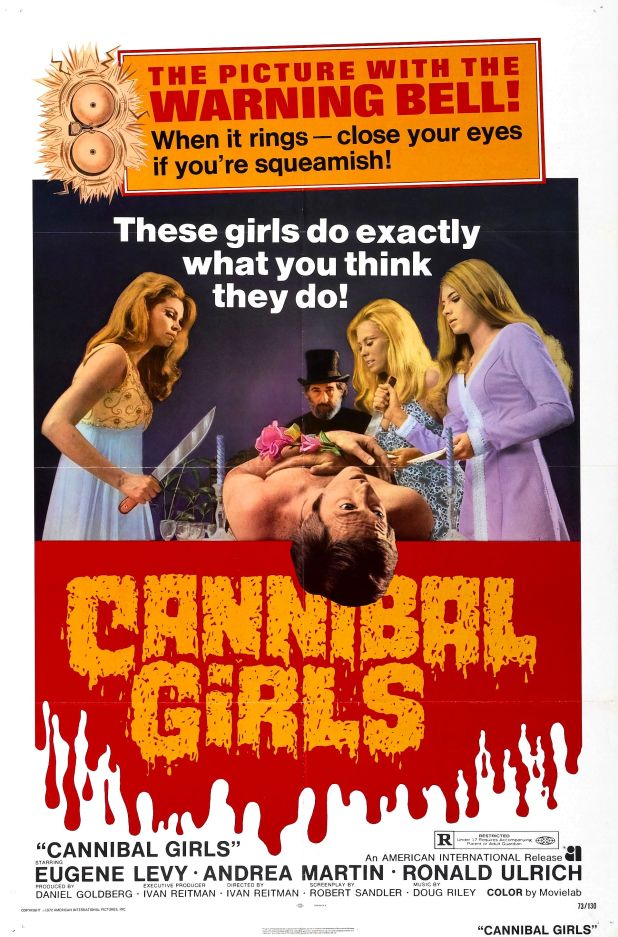
Cannibal Girls (1973)

Shot in 1971 and 1972 in the towns surrounding Toronto — Beaverton, Aurora, and Oak Ridges — this low budget, mostly improvised Canadian horror film would be unremarkable if it wasn’t some of the first work of Andrea Martin, Eugene Levy and Ivan Reitman.

Levy stars as Clifford Sturges, a traveling guitar player, while Martin is his new girlfriend Gloria Wellaby. When their car breaks down in a small town called Farnhamville, they soon learn that not many visitors make it out of town.

After finding Mrs. Wainwright’s small motel, the owner tells them about the Cannibal Girls —  Anthea, Clarissa, and Leona — sirens who lure men to their doom, only to eat them while they’re still alive.

Along with another stranger looking for his missing sister, our heroes are taken to the home of Reverend Alex St. John, who commands most of the town. They don’t even realize it, but they’re now in the presence of the titular villains.

Cannibal Girls aspires to the strange town aesthetic that movies like Messiah of Evil excel at. It doesn’t get there, sadly. But the idea that this family of human-eating femme fatales continues to add to their number is a good one.

Weirdly enough, when this played in the UK, it had a loud siren that announced when a scene with gore in it was about to be played, then a bell when that scene was over. This kind of feature would play well at my in-laws, where my wife’s mother often enters the room eyes and ears covered whenever a horror movie is on the TV.

While an interesting curiousity, this feels like the kind of film that Count Floyd would struggle to get through and instead replace it with another showing of Dr. Tongue’s Evil House of Pancakes. These sketches have special relevance for those born in Pittsburgh, as SCTV’s late night movie host turned werewolf howling vampire is pretty much a comedy version of “Chilly” Billy Cardille, a Pittsburgh broadcaster who was as comfortable doing the news as he was hosting Studio WrestlingJackpot Bingo or radio shows as he was showing horror movies late into Saturday night.

There was also another Pittsburgh horror host who influenced Count Floyd, KDKA’s E-Gor, who hosted the show The 13th Hour from 1958 to 1959. He was played by announcer George Eisenhauer, who from the 1950’s to the 1980’s was the familiar smooth voice who’d intone, “This is KDKA, Pittsburgh.” He also the host of the religious program Not Just Sunday. Yes, only in Pittsburgh could someone show you a horror film on Friday and discuss theology on Sunday.

You can Cannibal Girls for free on Tubi.


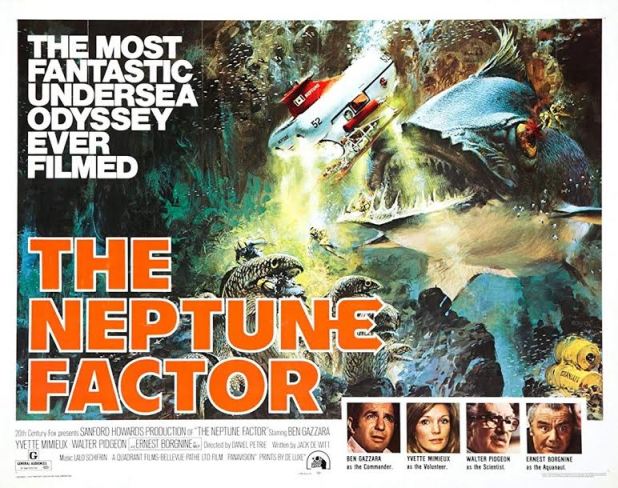
2019 Scarecrow Psychotronic Challenge: Day 14: The Neptune Factor (1973)

Day 14 S.T.D Madness!: Science, Transformations & Dabbling: A cracked scientist’s creative palette

This writer was a wee lad when 1973’s The Neptune Factor played at the neighborhood duplex. Equipped with nothing but the television and print ads we, the grade school-era Ralph McQuarries, feverish drew our Neptune submarine art class recreations, anticipating our parents taking us to see the film that weekend.

An Irwin Allen-styled earthquake? An underwater ocean lab plummets into a deep ocean trench? Lazy scientists that never leave the lab and, when they do, their hysterics unleash the beast? The “Aliens” attacking the crew of the Nostromo in James Cameron’s “Abyss” . . . are giant killer eels?

I’m all in . . . or at least I was: age robs us of our innocent, youthful tastes.

As is the case with the sensationalistic movie posters of ‘70s: the film behind the one-sheet never delivers on the art work promises. There was no “digital water” in the pre-CGI, George Lucas ‘70s; so the special effects endangering The Neptune consisted of fish “optically enlarged” into head butting, growling and howling, blood-thirsty monsters that cavort with Godzilla-style miniatures.

Beware: Giant Seahorse Crossing Ahead!

Forty-five years later, as I embark into the skies of blue and sea of green on my White & Red Submarine to battle the Aqua Meanies of Neptuneland, I’m blown away that The Neptune Factor — at its core it’s just your average sci-fi B-picture, only with a million dollar budget — starred Ernest Borgnine (“Cabbie” from Escape from New York), an Oscar winning actor. His co-star, Ben Gazzara (“Brad Wesley” from Road House), earned multiple Golden Globe and Emmy nods and Broadway accolades. Walter Pidgeon had two Oscar nods in his pocket; Yvette Mimieux worked consistently as one of MGM Studios’ leading contract players throughout the 1960s and made her debut in H.G Wells The Time Machine.

The Most Fantastic Underwater Odyssey Ever Filmed,” so proclaimed those advertisements that fueled those art class fantasies.

And that was MGM’s goal: to do for the ocean what Kubrick did for space — by placing an Irwin Allen paint-by-numbers disaster plot underwater. And in case we forgot: the closing credits again remind us — with the film’s subtitle — we just experienced “An Undersea Odyssey.”

Uh, did we, really?

To hell with the Blue Meanies that freak me out, still, to this day. Full steam ahead to Pepperland, Ringo: We sail to a land where, instead of a HAL supercomputer jeopardizing the crew and mission, we get an Yvette superbitch disobeying orders, throwing switches, blowing circuits and causing the “Discovery” of the film to tumble ass-over-elbows down an aquatic abyss. Instead of a mind-bending space gate: we get a mind-numbing plethora of giant tropical fish. Instead of an acid-spewing Xenomorph: we get a head-butting Gold Fish.

For a film junkie like me: it’s celluloid déjà vu.

I’m watching the “giant” underwater crabs attack the toy-miniature Space Probe Taurus (1965) — only on a reported $2.5 million budget — all over again. At least the giant rat-spider-bat from Angry Red Planet (1959) was fun. It’s no fun watching 80 minutes of a future, post-apocalyptic New York cab driver feigning awe over a tropical fish tank under a zoom lens.

In the pre-2001: A Space Odyssey epoch, your typical science fiction film of the ‘50s and ‘60s consisted of Shakespearean-trained character actor John Carradine (father to “Snake Charmer” in Kill Bill) slipping into a silver lamé “space suit” to find a cure for the Earth’s vampire plague by way of a horde of bubbling, gurgling vials and beakers strewn across a wooden table in the “science lab.” On the wall was the requisite Bulova industrial-clock hung above a bank of reel-to-reel tape players replete with flashing lights that indicate danger is ahead.

For a film junkie like me: it’s celluloid déjà vu.

Here I am, watching another long-in-the-tooth actor — this time it’s Walter Pidgeon — in the same Carradine lab. And there’s a shot of a Bulova clock on the wall, again, you know, to remind us the stranded sealab’s oxygen is running out and the aquanauts will die.

Oh, Stanley. How did the “underwater you” go so wrong?

Stanley Kubrick, along with special effects artist, Douglas Trumbull, opened the once scoffing eyes of Hollywood’s mainstream studio system to the fact that the once low-budget genre of science fiction could present the same level of quality to the screen as any of their bloated-budget war, western, or bible epics.

The first A-List star to cross Hollywood’s sci-fi picket line was Moses and Ben-Hur himself: Charlton Heston. All three of Chuck’s contributions to the genre — Planet of the Apes (1968), The Omega Man (1971), and Soylent Green (1973) — became critical and box office hits—not just domestically, but internationally. Thanks to Heston setting the stage and proving science fiction could be well-made and generate favorable reviews and box office returns, then the flood gates opened with Yul Brynner, Bruce Dern, James Caan, Nigel Davenport, Sean Connery, Jackie Cooper, Richard Harris, Paul Newman, George Peppard, and Oliver Reed all making science fiction films.

And it was time for Ben Gazzara to jump into the deep end of the pool.

Made by 20th Century Fox and co-released by Fox and MGM Studios, The Neptune Factor (retitled for TV and video as The Neptune Disaster and Undersea Odyssey), essentially, is an underwater, sci-fi reimaging of Ernest Borgnine’s previous hit, the gold standard of ‘70s disaster pics: The Poseidon Adventure. And why is Walter Pidgeon here? For an air of familiarity: he captained The Seaview for Irwin Allen’s 20th Century Fox’s sci-fi sub flick, Voyage to the Bottom of the Sea.

Yes, for a film junkie like me: it’s celluloid déjà vu.

And there I was, six years later, my mind swimming with X-Wing dogfights over the Death Star, anticipating the release of Voyage to the Bottom of the Black Hole, uh, I mean, The Black Hole Disaster, I mean, The U.S.S Cygnus Disaster, uh, The Poseidon In Space, as The Neptune shed its watery space as it shot off into outer space — minus the photo-giant fish tomfoolery — with Borgnine and Mimieux at the helm once again, this time aboard the Palamino, as they entered Disney’s Star Wars-inspired black hole.

And cinema history tells us The Black Hole was initially conceived in 1974 as a Poseidon-inspired sci-fi adventure — to capitalize on the sci-fi craze sparked by Heston’s success — known as Space Station One, aka, Voyage to the Bottom of the Black Hole Abyss as the Aliens Attack the U.S.S Poseidon Neptune Disaster Adventure. Considering the coolness of Trumbull’s post-2001 space opera, Silent Running, Space Station One, if made in 1974, could have worked.

Yes, it all comes back full circle because . . . for a film junkie like me: it’s always celluloid déjà vu.

And yes, I still run crying to my mommy because those Blue Meanies are still coming to get me, for a Beatle is scarier than a fish. Live in fear of the seas of green with the full movie on You Tube and Daily Motion.

Do you need more celluloid déjà vu? Then pull up a Chalmers, uh, I mean, chair, and visit the post-apocalypse world of Bladerunner—before Bladerunner—with 1962’s Creation of the Humanoids. And, it gets worse with 2020’s Underwater.

About the Author: You can read the music and film reviews of R.D Francis on Medium and B&S Movies, and learn more about his work on Facebook.

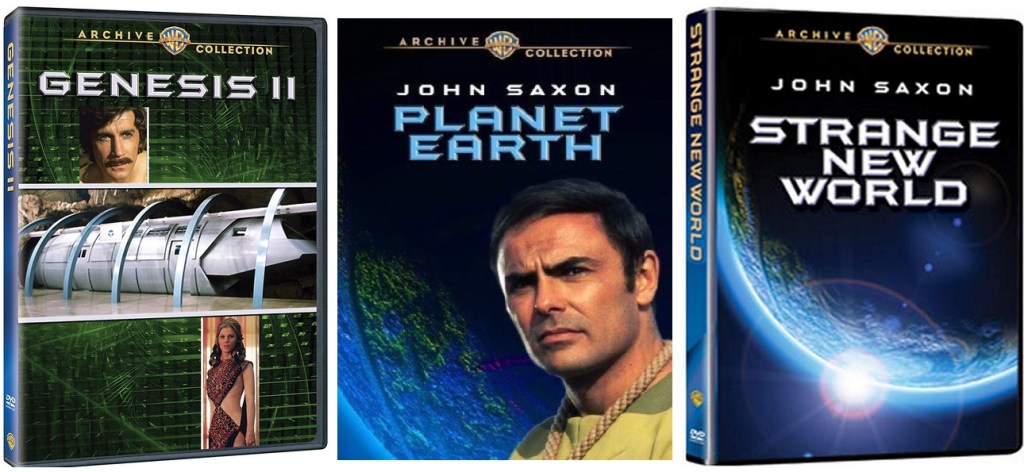
Genesis II (1973), Planet Earth (1974), and Strange New World (1975)

Okay. Let’s get this out of the way: This is the movie were you video fringe horndogs lose it over Mariette Hartley (as Lyra-A) in a two-piece bikini sporting two belly buttons (a dual circulatory system with two hearts) as a (network censored) “dominatrix” who breeds men for an oppressive, feminist regime.

Gulp.

Yes. Mariette Hartley: We’re talking Zarabeth in the Star Trek: TOS episode “All Our Yesterdays” where she cracked Spock’s emotionless Vulcan shell. She mixed it up with Gary Lockwood as Lisa Karger in Earth II (another failed TV movie pilot-to-series). She tempted Charlton Heston as Harriet Stevens in Skyjacked. She gave Dr. David Bruce Banner butterflies as Dr. Carolyn Fields in The Incredible Hulk. Yes. Mariette Hartley, with a resume of too many popular TV series to mention, all the way out to Fox TV’s 2018 hit series 9-1-1 as Patricia Clark.

Just one look at Mariette in Genesis II and you’ll forget all about the über-cool Sub-Shuttle that we all came for (and not a bogus CGI model . . . but a non-operational, full-sized prop pulled on a long-cable by an off-camera semi-truck) that pulls into a carved-out-of-the mountain sub-station (which Elon Musk has since pinched for his next millionaire-toy project). Oh, and did you notice the sterile, ultramodern-styled city looks suspiciously like the city in Conquest of the Planet of the Apes (20th Century Fox’s “Century City”)? And did you notice how many times the Sub-Shuttle footage was recycled in ‘70s sci-fi television?

Anyway . . . times were hard for ex-Star Trek creators.

In 1974, after the go-to-series failure with Genesis II, Gene Roddenberry developed another TV movie/series pilot with The Questor Tapes (1974). A thinly veiled reworking of the Gary Seven character and plot from the Star Trek: TOS episode “Assignment: Earth,” it was intended as a vehicle for Leonard Nemoy’s return to weekly television. The end product starred Robert Reed-doppelganger Robert Foxworth (1979’s Prophecy) who portrayed an android with incomplete memory tapes — in a pseudo The Fugitive storyline — searching for its creator and purpose (that also sounds like V’ger from Star Trek: TMP).

Then, after the additional go-to-series failures of the Genesis II reboots Planet Earth and Strange New World produced in the wake of The Questor Tapes, Roddenberry tried again — by jumping on the ‘70s “occult detective” sub-genre with 1977’s Spectre — by reworking another Star Trek element: the contemptuous friendship between Spock and Dr. Leonard McCoy, itself a homage to the relationship between Sherlock Holmes and Dr. Watson. Spectre starred Robert Culp (The Gladiator) as William Sebastian, a criminologist and occult expert assisted by Gig Young (1978’s Game of Death with Bruce Lee) as Dr. Hamilton. (If you care: Other shows in the ‘70s occult TV movie-to-series subgenre include The Sixth Sense with Gary Collins of Hanger 18 and Killer Fish, Roy Thinnes of Satan’s School for Girls in The Norliss Tapes, and the most-successful of the pack: Darren McGavin of Dead Heat and the post-apoc dropping Firebird 2015 A.D in Kolchak: The Night Stalker.)

Genesis II stars Alex Cord (who also journeyed into a “fucked up future” in Chosen Survivors) in the “future world” of 1979 as NASA scientist Dylan Hunt. Of course, he opens the post-apocalyptic proceedings with that all-too-familiar apocalypse (or psychological horror) cliché: “My name is Dylan Hunt. My story begins the day on which I died.” So goes the story a “20th Century Boy” (T Rex, anyone?) thrown forward in time by a suspended-animation earthquake-accident that damages his New Mexico/Carlsbad Caverns-housed “Project Ganymede” system for astronauts on long-duration spaceflights.

And we flash forward to the year 2133.

An archeological team of PAX (Latin for “peace”) descendants from the NASA personnel that lived-worked-were trapped in the Carlsbad installation when World War III (aka “The Great Conflict” because, well, the docile hoards of all post-apoc futures never seem to be able to preserve or retain a basic semblance of American history) broke out, discover Hunt’s buried chamber. And while they can’t seem to “remember” World War III, the PAX are smart enough to construct a subterranean rapid transit system utilizing a magnetic levitation rail operated inside a “vactrain-tunnel network” that spans the globe and saves the masses from air transportation attacks.

Anyway, here’s where Mariette Hartley comes in.

Lyra-A oversees the all-female totalitarian regime known as the mutated (natch) Tyranians that rule the lands once known as Arizona and New Mexico. In addition to their increased physical abilities, you can always spot a Tyran by their nifty, dual navels — that they seem to love to show off. (Schwing! Thank you, Gene!) Not that the wussy PAX-rats would do anything when they spot a Tyran: they let themselves be enslaved.

Lyra-A, in a grand alien fashion of the Star Trek variety, is enraptured by Roddenberry’s “Buck Rogers” and wants to harness Hunt’s knowledge of (among other things) nuclear power systems to fix the Tyranians’ dead power plant. But apoc-bitch Lyra-A double crossed him: it’s a ploy to reactivate a nuclear missile system to destroy the PAX. As a result, Hunt goes into Moses-mode (see the apoc-romps No Blade of Grass, Ravagers) and leads a revolt of the enslaved, sabotages the nuclear device, and destroys the reactor.

Sound pretty cool, right?

Airing to high ratings in March 1973 and encouraged by the network brass, Roddenberry worked up a 20-episode first season on the adventures of Alex Cord’s post-nuc Moses. Then CBS-TV dropped the bomb: they passed over Genesis II and gave the timeslot to another competing post-apoc series: the short-lived and low-rated Planet of the Apes.

Those mothballed Genesis II episodes featured recycled ideas from Star Trek: TOS and fueled the later Star Trek movies — with stories about suspended animation soldiers from the past (“Khan!!!”), a London ruled by King Charles X; NASA “evolved” computers and equipment left on Jupiter’s Ganymede returning to Earth in search of their “God” (“The Changeling” and the annoying Persis Khambatta-V’ger non-sense from Star Trek: TMP); men turned into breeders and domesticated pets (reworked for the second pilot, Planet Earth); the ol’ catapulted-through-a-time-continuum back to 1975 gaffe (“Tomorrow and the Stars,” an episode from Star Trek: Phase II, the proposed-failed post-Star Wars reboot), and a creepy priesthood who enslaves the masses via electricity used as a “God” (“Return of the Archons” from ST: TOS).

The reason the network passed on Genesis II: The series was “too philosophical” and Alex Cord’s portrayal was “too dark and brooding.” They wanted another handsome and charmingly arrogant Captain James T. Kirk. So Roddenberry and Warner Bros. rebooted Dylan Hunt into an action-driven and conflict seeking Kirk-like character embodied by John Saxon.

Cue for Planet Earth.

Now Dylan was one of three cryogenically-frozen astronauts who return to Earth to reestablish the PAX organization that sent them into space. And while we lost Mariette Hartley, we gained the equally fetching Diana Muldaur (again, from Cord’s Chosen Survivors), who rules the Amazonian, male-enslaving “Confederacy of Ruth,” along with cherished character actors Bill McKinney (Deliverance, Cannonball) and Gerritt Graham (Phantom of the Paradise, Used Cars) as “impotent males” in recurring roles.

This time, instead of CBS, ABC aired the Warner Bros. produced program in April 1974.

The network passed.

Cue a Strange New World.

To creative and legal reasons lost to the test of time, Warner Bros., who now owned the intellectual rights, reworked the premise a third time as Strange New World (pinching the title from Star Trek’s opening monologue) — sans Roddenberry’s involvement — dumped the PAX and Tyranians, and retained John Saxon as the same Kirk-like character, now known as Captain Anthony Vico, who returns from a suspended animation space trip with two other astronauts (as in Planet of the Apes TV series that screwed Genesis II in the first place).

The movie aired in July 1975.

The network passed.

And with that, between Roddenberry’s vision, and the failure of the Planet of the Apes TV series (episodes were cut into overseas theatrical and telefilms), the small screen’s attempt to jump on the major Hollywood studios’ post-apocalyptic bandwagon was over. Thus, us wee lads and lassies gathered around the TV on Saturday mornings and settled for Filmation’s Ark II, whose 15 episodes (it seems it had more episode and was on much longer), aired in 1976, then reran in 1977, then again in 1978. And that kiddie-apoc series stopped production because the network “wanted Star Wars” (and not a TV knockoff of 1977’s Damnation Alley). So Ark II was reworked and repurposed (the same “universe,” so to speak) as Space Academy and Jason of Star Command (Sid Haig, rules!).

There was also another, similar attempt at the Genesis II concept with, ironically, another Star Trek: TOS alum: Glenn Corbett (warp-drive creator Zefram Cochrane in 1967’s “Metamorphosis”). As with Roddenberry’s The Questor Tapes, The Stranger (1973) was another failed TV movie-to-series sci-fi twist on the ‘60s runaway TV hit, The Fugitive. This time, instead of returning to a post-apocalyptic society, our astronaut (Hey, Sam . . . he’s named “Stryker”!) returns to a totalitarian “twin” Earth run by the “The Perfect Order.” (And if it all sounds a bit like 1969’s Journey to the Far Side of the Sun by Gerry and Sylvia Anderson of the fellow-failed, post-Star Trek series UFO and Space: 1999 . . . then it probably is: both series were movie-rebooted in the post-Star Wars universe as Invasion: UFO and Destination Moonbase Alpha, respectively.)

But wait . . . all was not lost with Genesis II.

Roddenberry’s widow, Majel Barrett (Nurse Christine Chapel in Star Trek: TOS and Lwaxana Troi on Star Trek: TNG and DSN) produced one of Roddenberry’s old pre/post-Star Trek dystopian-apocalyptic concepts, Andromeda (itself recycling from Genesis II and Planet Earth), a Canadian series that ran from 2000 to 2005 and aired in syndication on U.S television.

VHS rips of Genesis II and Strange New World can be enjoyed for free on You Tube, while Vudu has official, affordable streams of Genesis II and Planet Earth. For whatever “legal” reasons, no streaming platform offers Strange New World. However, copies of all three are widely available on DVD courtesy of Warner Home Video’s Warner Archive Collection.

You say you’re still jonesin’ for a fix of the “Big Three”-over-the-air U.S television network movies from the good ol’ days before the VHS and cable television boom? Then check out B&S Movies’ tributes of “Lost TV Week,” “Week of Made for TV Movies,” “Sons of Made for TV Movies Week,” and “Grandson of Made for TV Movie Week.” 

About the Author: You can read the music and film reviews of R.D Francis on Medium and learn more about his work on Facebook.
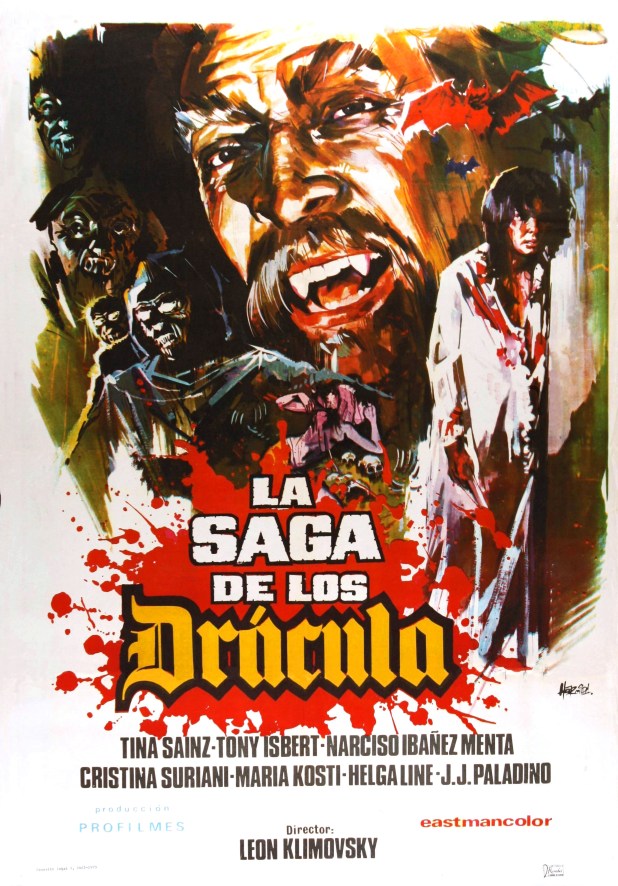
The Dracula Saga (1973)

The problem with being Count Dracula is that your family line will eventually have to deal with in-breeding, which means that your lone male heir is a one-eyed, furry-faced boy Oh yeah — and your daughters may appear to be highly cultured musicians by day, but by night, they seduce any man — or woman — in their path, even priests. Actually, if Leon Klimovsky’s La Saga de los Draculas taught me anything, it’s that I don’t want to be Count Dracula.

If you’ve encountered any Spanish vampire films, you know that for every moment of sheer surrealist glee or breast baring blood blasting scene, you have to deal with long stretches where not much happens. Then again, we kind of specialize in movies where not much happens until the insane end of the film around here.

Berta is the long-lost relative of the Dracula clan who has returned home to the family castle, where all hopes of a male heir are pinned upon her. By the end of the film, she’s full-on bonkers, dispatching her cheating husband who has already consorted with all of her nubile relatives, then wipes them all out while they sleep in their coffins with an axe. Of course, that’s never worked on vampires before, but this film also features blood drinkers walking around in broad daylight.

By the end, she’s delivered her own baby and lied to the Count, who doesn’t struggle when she attacks him. That said, her blood gets all over the baby, who eagerly laps it up, ensuring that the Dracula bloodline will go on.

The print that played at the Drive-In Super Monster Rama was afflicted with a nasty case of vinegar syndrome, meaning that it would run for ten minutes and then fall apart, with credits that weren’t even worth running. That didn’t matter at all — by 2:30 AM I had ingested several strong ciders, some moonshine, some blazing hot slices of Buffalo chicken pizza and perhaps some other things that we can’t legally discuss. As the windows of our car fogged up and my wife slept by my side, I was pulled into the family dalliances of the Draculas.

It has everything you want from a European 1970’s vampire film: Helga Line leading an attractive cast of female blood suckers, some fine gore and even some cinematography that approaches art, mixed with — you guessed it — long stretches where people just talk and listen to some Bach. It’s certainly unlike any vampire film I’ve seen before. That — and the environment in which I watched it for the first time — added to my enjoyment.

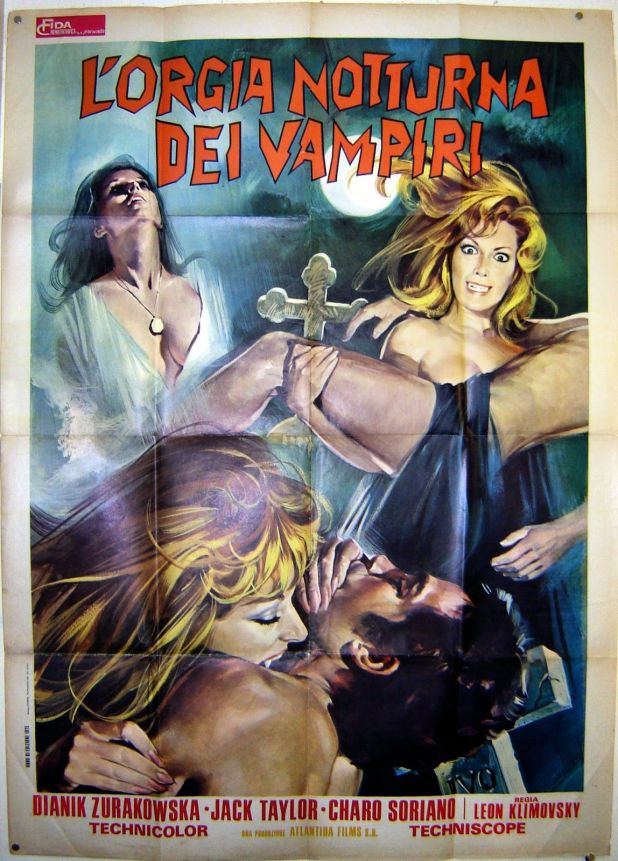
The Vampire’s Night Orgy (1973)

If you’re going to tour Europe on a bus, stopping in quaint small towns, check and double check your inventory. There’s a pretty good chance that at least one of those tiny and charming hamlets and burgs will be replete with the undead. Bring crosses and garlic accordingly.

To think that my high school teachers said I’d learn absolutely nothing from watching horror movies!

The villagers of Tolnia can’t be found on any map. That’s probably just as well, as it’s lorded over by a Countess (Helga Line, Nightmare CastleHorror Express) who is served by mute villagers who may or may not be zombies. They’re definitely cannibals, but nice ones, because they’ll cut off their own limbs to feed you. Oh yeah — there’s also a ghost boy wandering about.

Of course, like most Spanish horror made under the reign of Generalissimo Francisco Franco — who is still dead — scenes were shot in nude and non-nude variants. But for a movie entitled The Vampire’s Night Orgy, there is little to no orgy-ing happening.

If you live a stressful life, however, let me give you some advice. There is quite nothing like ingesting your favorite vices and being half-awake through four Eurohorror films of carrying quality in the middle of the night at a drive-in. It’s as close to lucid dreaming as some of us may ever get and it totally reaffirmed my love of life. I didn’t even get a hangover!

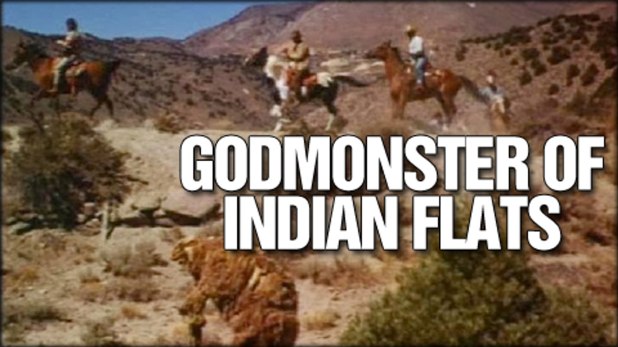
Godmonster of Indian Flats (1973)

Before he made his first movie — Troika — in 1969, Frederic Hobbs was an artist who went from the traditional to a whole way of presenting art, creating parade sculptures that took art from the museum to the people. That’s when he figured it out — to get the people to see something as art, you should hide it in a film. He also created the films Roseland and Alabama’s Ghost before this one. And honestly, nothing can prepare you for this.

Imagine if David Lynch made a 1950’s nuclear warning monster film. But before you go see it, you get in a car crash and suffer a really bad concussion. Cool. Then, someone spikes your Icee with a dose of LSD that would cripple Owsley “Bear” Stanley. You now have a very, very small idea of just how crazy things are about to get.

There are two stories happeninghere: a scientist is trying to crack the code on a mysterious sheep-like creature while a conservative landowner fights being bought out by prospectors. All in Virginia City, Nevada, which was once the richest city in America after the silver and gold rush. The mines went dry, the people went away and the only people left are tourists staring at a dead husk.

I have to tell you, you’ve never quite seen a creature quite like the Godmonster. At once it appears to be the most real and yet fakest creature ever seen on the silver screen. It very well could be one of Lovecraft’s ancient ones for all I know, as it saunters and stumbles and falters across the frame, scaring children at birthday parties and blowing up gas stations.

There’s also a subplot with a fake dog funeral. Don’t ask me how any of this ties together, because all of it has blown my mind sky high, like a Jigsaw song from 1975.

Imagine a movie where the creature doesn’t do a single thing until more than one hour into the run time of a movie under ninety minutes, all while the nonprofessional actors can’t act and the professional ones chew scenery like they’re the godmonsters of the fringe festival.

I get real down sometimes when I think the world could be a better place than it is. The Godmonster of Indian Flats proves to me that somewhere out there, at some time, in some corner of the cosmos — let’s say a drive-in that smells like skunk weed and MD40 — some brave souls had no idea what the actual fuck they were getting into when it started playing. That fact makes me happy, imagining people driving away before the movie even ends, telling their friends and family that they suffered their way through a movie where a lamb emitted smoke and gave his life so that an entire town could die. There aren’t enough stars in the galaxy and every reality ever to properly review this movie. I’ll have to go back to college to invent some kind of formula so that my fragile mind can try and quantify it.

You can get this on blu ray from the amazing and astound folks at Something Weird and the AGFA. It’s also on Amazon Prime, if you’re brave. Or stupid. But probably you should be both.

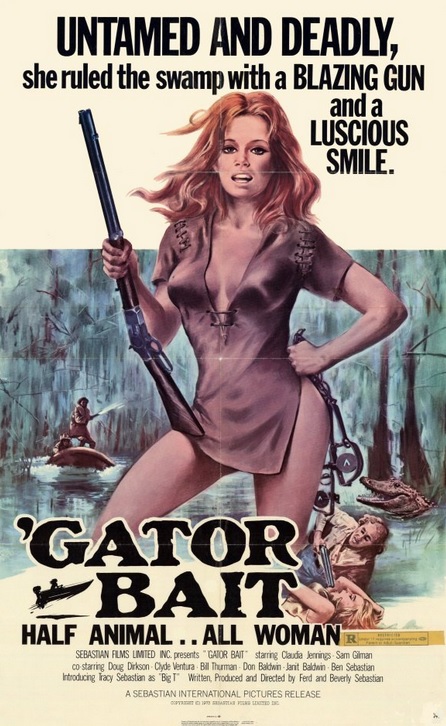
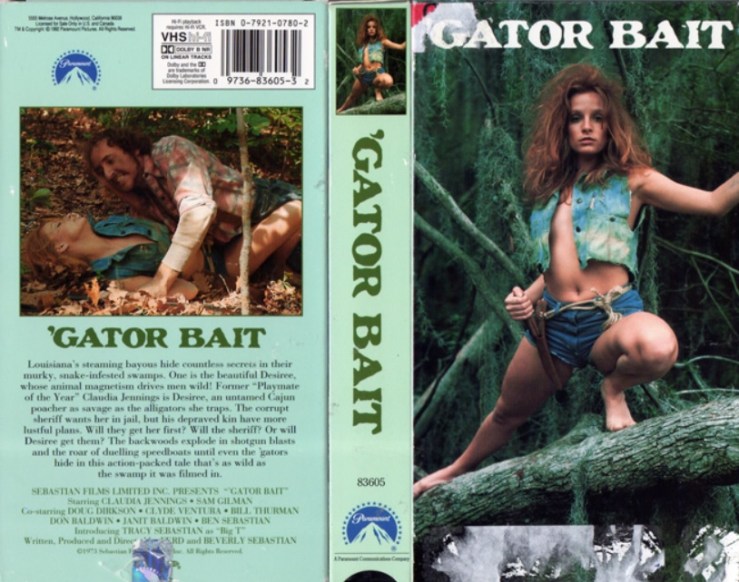
‘Gator Bait (1973)

Sam’s Note: I’m glad that Redneck Week will not just be me exploring these movies. R. D Francis has joined me with a review featuring perhaps the most popular actress of the genre, Claudia Jennings.

Prior to their mid-‘90s conversion to Christianity and retirement from the industry, Sebastian International Pictures was a family affair run by the husband and wife writing, directing, and cinematography team of Ferd and Beverly Sebastian; their sons Benjamin and Tracy (aka Trey Loren), and daughter, Jan, worked behind the scenes and sometimes stepped in front of the camera on the family’s films.

The Sebastians’ company edict mirrored Roger Corman’s: Make ‘em fast, make ‘em cheap and, when opportunity knocks, always produce a knockoff of a then-popular film. So when John Boorman struck box office gold with his redneck-revenge horror, Deliverance (1972), the Sebastians’ response was ‘Gator Bait. Made for a few hundred thousand—less than John Carpenter’s reported $300,000 budget for Halloween, ‘Gator Bait grossed double-digit millions on the drive-in circuit.

The “bait” for this swamp romp is Desiree Thibodaux (Playboy Playmate Claudia Jennings), a barefoot and daisy duke-wearing Cajun huntress carrying on the family’s gator poachin’ business (after the off-camera deaths of her ma and pa) and taking care of her mute, little brother, Big T, and her teen sister.

In steps the dopey-deputy son (Clyde Ventura of Poor Devil) of Sheriff Joe Bob Thomas (B-Movie stalwart Bill Thurman, Creature from Black Lake). Seems sonny boy is decidin’ he wants to git-em-sum of that “wildcat” and tries to arrest Desiree for poachin’. (Take note: In the Louisiana bayous: justice equals rape.) In her escape, Desiree tosses a burlap bag of poached snakes into dopey-deputy’s boat, which he subsequently shoots holes in—to kill the snakes—and shoots his redneck-rapist boat pilot in the process.

Guess what lies sonny boy done be tellin’ his pappy?

“S**t, boy, I just paid $300 for that there boat!” says Sheriff Joe Bob.

Yee-haw! Sheriff Joe Bob is roundin’ up ‘emself a posse with his “buddy,” T.J Bracken (Sam Gillman, an ex-Marvel comic artist who starred alongside Charlton Heston and James Coburn in The Last Hard Men), a daddy who be bull whippin’ his horny son after catchin’ ‘em tryin’ to rape his sister. Oh, and the plot twist: the reckneck-rapist boat pilot was T.J’s third son.

And with that: Joe Bob and his sonny boy, along with T.J and his two horndog sons . . . well they’s be a-goin’ to git Desiree and bring her to “justice.” And when you’re dishin’ out “bayou justice,” you murder-rape Desiree’s teen sister (Janit Baldwin of Humongous and Linda Blair’s Born Innocent), in order to apprehend (read: rape) Desiree.

Hell yeah! Desiree goes “John Rambo” on their asses, drawin’ em deeper n’ deeper into the swamp. As the inbred-bunch turn on each other, T.J lets more of the plot out of the snake sack: Sheriff Joe Bob had a “thing” with Desiree’s Ma, and Desiree’s Pa used Ma as “gator bait” for cheatin’ on ‘em, and the sheriff shot Pa in “self-defense.” Oh, and it turns out T.J is really Desiree’s pappy, so T.J’s three sons have been lustin’ ‘efter their own sister!

Well, it looks like this is the end to the Sheriff and T.J’s own gator poachin’ business and Desiree will have the market cornered.

Claudia’s other flicks in the redneck/hicksploitation cycle are the Bonnie and Clyde-cum-Big Bad Mama rip-off, The Great Texas Dynamite Chase and, for Corman, well ‘ol Rog wasn’t letting Smokey and the Bandit zoom by without producing a cheap knockoff, so Claudia starred alongside Ben Gazarra’s “Bandit” in Moonshine County Express. As part of Claudia’s two-picture deal with the Sebastians (she got a free Caribbean vacation via the film shoot), she starred in The Single Girls (with Greg Mullavey of I Dismember Mama fame).

Prior to their retirement, the Sebastians produced a 1988 sequel: Gator Bait II: Cajun Justice, where Big T—just a kid in the 1973 original—carries on the family business and teaches his wife (Jan MacKenzie; aka Sebastian, their daughter) the ways of the swamp—which she uses to extract Cajun revenge.

The Sebastians have since come to reacquire the rights to most of their Vestron Video and Paramount-distributed catalog, releasing their films on DVD via their Panama Films imprint through various online retailers. You can also learn more about Claudia Jennings at her official tribute site.

Ferd Sebastian
July 25, 1933 — March 27, 2022
Obituary

About the Author: You can read the music and film reviews of R.D Francis on Medium and learn more about his work on Facebook.

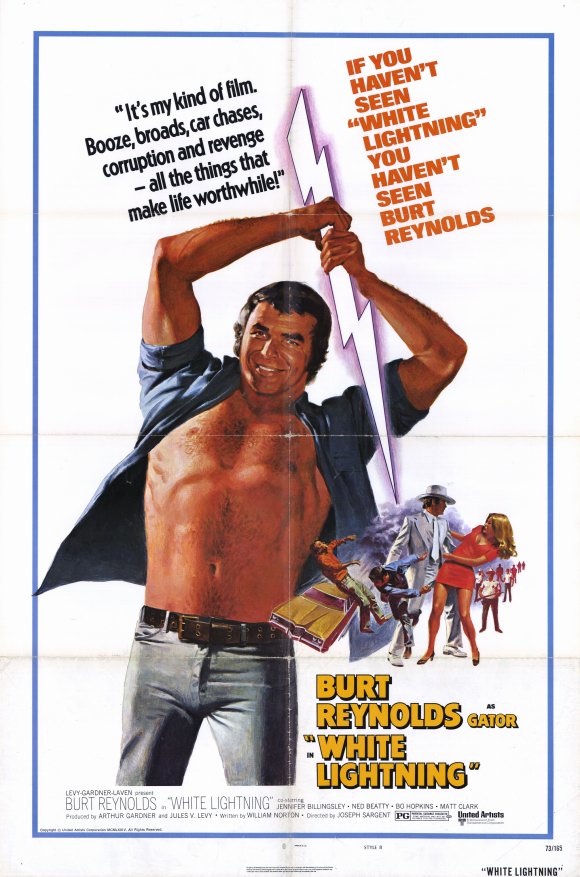
White Lightning (1973)

Burt Reynolds said that White Lightning was “the beginning of a whole series of films made in the South, about the South and for the South. No one cares if the picture was ever distributed north of the Mason-Dixon line because you could make back the cost of the negative just in Memphis alone. Anything outside of that was just gravy.”

It was originally going to be directed by Steven Spielberg after his films Duel, Something Evil and Savage. The famous director said, “I spent two-and-a-half months on the film, met Burt once, found most of the locations and began to cast the movie, until I realized it wasn’t something that I wanted to do for a first film. I didn’t want to start my career as a hard-hat, journeyman director. I wanted to do something that was a little more personal.” He left the film to direct Sugarland Express instead.

Bobby “Gator” McKlusky (Reynolds) is serving time in an Arkansas prison for running moonshine when he discovers that his brother Donny was murdered by Sheriff J.C. Connors (Ned Beatty). He agrees to go undercover to get the dirt on the sheriff.

He’s teamed with Dude Watson, a local stock car racer and moonshine runner on probation. Gator gets his own job doing the same thing alongside Roy Boone (Bo Hopkins). Of course, once he gets one look at Boone’s woman Lou and running afoul of Connors’ henchman, Big Bear (R.G. Armstrong, Pruneface from Dick Tracy). Diane Ladd shows up as Maggie and an uncredited Laura Dern plays her daughter.

White Lightning was directed by Joseph Sargent, who was also responsible for Nightmare and Jaws The Revenge. It’d be followed by Gator, with only Reynolds returning. If it wasn’t for these two movies, we wouldn’t have so many of the films we’ve covered this week.

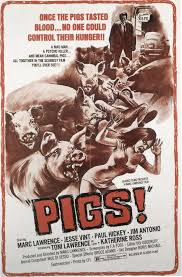
Pigs (1973)

Marc Lawrence had a career filled with playing the heavies, mostly gangland types. In fact, his autobiography was entitled Long Time No See: Confessions of a Hollywood Gangster.

Lawrence found himself under scrutiny for his political leanings. He was the son of Polish and Russian parents and was married to Odessa-born novelist and screenwriter Fanya Foss. Once called before the House Un-American Activities Committee, he admitted he had once been a member of the Communist Party and named Sterling Hayden, Lionel Stander, Anne Revere, Larry Parks, Karen Morley and Jeff Corey as fellow Communists. Blacklisted, he continued to make films in Europe before returning to America.

He’s probably best known for playing gangers in Diamonds Are Forever and The Man With the Golden Gun, but he also shows up in plenty of genre films like From Dusk Till Dawn and Dream No Evil. He directed several episodes of TV shows before helming Nighemare In the Sun, which was written by his wife and stars Ursula Andress and Aldo Ray. This was the only other film that he’d direct. He also wrote the movie and it starts his daughter Toni. It’s also one of the strangest movies you’ll find.

Also known by many, many names — The 13th Pig, Daddy’s Deadly Darling, Horror Farm, Daddy’s Girl, The Strange Exorcism of Lynn Hart, The Strange Love Exorcist and Roadside Torture Chamber — Pigs is all about Lynn Webster (Toni Lawrence), who has escaped a sanitarium and hides out in the diner owned by Zambrini (Marc Lawrence).

Behind the diner lies a pigpen of swine that have been taught to eat human flesh. Zambrini soon has a partner in murder as Lynn begins to kill any man that reminds her of the father that assaulted her. She killed him and she’ll kill anyone else who gets in her way.

This movie is pretty much the 70s — complete insanity and murderous intent, capped off with off-kilter camera angles. Suffice to say, I loved every single moment of it.

Toni Lawrence would go on to appear in several TV shows and the Final Destination inspiration Sole Survivor. She was also once married to Billy Bob Thornton, who honestly has some amazing taste in ladies.

Jesse Vint plays the sheriff who tries to see the good in everyone. He shows up in plenty of redneck cinema with appearances in movies like Bobbie Joe and the OutlawBlack Oak Conspiracy, the Walking Tall TV series and Macon County Line. He also stars in the absolutely incredible science fiction weirdo film Forbidden World.

Marc Lawrence’s original cut of the film is the one released as The 13th Pig. However, there are two additional versions. The Love ExorcistBlood Pen titled versions begin with another actress playing the role of Lynn Webster, who runs away from an attempted exorcism. The Daddy’s Girl version, which was released on VHS, started with Lynn’s father attacking her. She stabs him to death, ends up in the asylum but escapes when a nurse takes off her uniform to make love to a doctor. She wears those clothes, takes that amorous caregiver’s keys and runs away. Multiple actresses play Lynn in these scenes and all wear completely bonkers wigs.

Vinegar Syndrome has re-released this film, packed with extras like the alternate openings for Daddy’s Girl and The Strange Love Exorcist. You can also watch this on Amazon Prime.

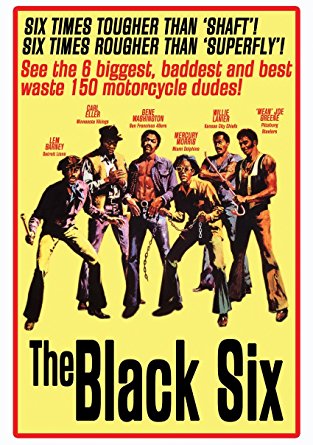
The Black Six (1973)

Matt Cimber has pretty much lived a life — he was married to Jayne Mansfield, he created the Gorgeous Ladies of Wrestling and he directed movies like ButterflyThe Witch Who Came from the Sea and Hundra amongst others. And in 1973, he was able to convince six currently playing NFL stars to appear in a black version of the biker film. The results? Amazing.

The Black Six is made up of six All-Pro NFL stars:

  • Gene Washington, San Francisco 49ers (who also was in Cimber’s Lady Cocoa and Airport ’75)
  • Willie Lanier, Kansas City Chiefs (who is in the NFL Hall of Fame and was named to the NFL 75th Anniversary All-Time Team)
  • Carl Eller, Minnesota Vikings (an NFL Hall of Famer who went on to found substance abuse clinics)
  • Mercury Morris, Miami Dolphins (a Pittsburgh native who was drafted to West Texas State, the alma mater of tons of pro wrestlers, including Tully Blanchard, Stan Hansen, Ted DiBiase, Dusty Rhodes and both Funk brothers to name but a few)
  • Lem Barney, Detroit Lions (an NFL Hall of Famer who sang backup on Marvin Gaye’s “What’s Going On” and played himself in Paper Lion)
  • Joe Greene, Pittsburgh Steelers (one of my hometown heroes, Greene is probably one of the greatest — if not the greatest — Steelers ever. He  appeared in a famous Coke commercial, as well as Fighting Back: The Rocky Bleier Story and Smokey and the Bandit II and is also an NFL Hall of Famer)

Washington already had some acting experience, so he stars as Bubba Daniels, a Vietnam War vet who returns home to find that his brother has been killed by a white supremacist biker gang. Their leader, Thor, is played by Ben Davidson, an avid real-life biker who played for the Oakland Raiders. You can also see him in M*A*S*H*Conan the Barbarian and as Porter the Bouncer in Behind the Green Door.

Bubba and his gang — the Black Six — decide to avenge that death, which leads to battles with racist townies, uncaring police and Thor’s gang. The final battle ends with Thor blowing up his own bike to kill them all or so it would seem. According to Mercury Morris’ book Against the Grain, the players protested that ending — guess they didn’t realize that nearly every biker movie ends with the heroes getting killed — so that’s why the movie ends with the title card that says “Honky, look out…Hassle a brother, and the Black 6 will return!” 

It’s all pretty depressing stuff, to be honest. But you can say that for nearly all biker and blaxploitation cinema. It’s still amazing to be that at one point, the NFL didn’t have the control that it does today and that six of its biggest stars could go off and make a movie together.

You can get The Black Six on Mill Creek’s new Soul Team Six DVD collection, along with five other films.

DISCLAIMER: Mill Creek sent us this set, but we were planning on buying it anyway. It has no bearing on this review.